 Growth and Reproductive Dynamics of the Tropical Urban Lichen Pyxine petricola in Central Brazil
Abstract
This study investigates the growth and reproductive strategies of the foliose lichen Pyxine petricola in the urban environment of Campo Grande, MS, Brazil, addressing a knowledge gap regarding its response to meteorological variation and urban environmental stressors. Over a two-year period, we monitored 13 individual thalli, analyzing growth dynamics, reproductive investment, and environmental associations. On average, thalli expanded more than 3.32 cm² per year and produced approximately 93 apothecia annually. Despite some individual variability, three thalli consistently exhibited high growth and reproductive output. Our results show that sexual reproduction in P. petricola does not necessarily reduce vegetative growth. Environmental variables—particularly total rainfall—were positively correlated with both thallus expansion and apothecia production. Additionally, lichen mortality mirrored host tree mortality, emphasizing the role of phorophyte viability. These findings offer novel insights into P. petricola’s adaptive capacity in urban settings and reinforce the value of lichens as sensitive indicators for environmental monitoring.
Key words
Apothecia; Environmental Stressors; Growth Rate; Lichen-forming fungi; Reproductive Investment; Urban Biodiversity
INTRODUCTION
Living organisms face an intrinsic dilemma in allocating energetic resources between the competing demands of growth and reproduction, as described by classical trade-off theory (Lotka 1922, Williams 1996). According to this framework, resource limitations compel organisms to make adaptive decisions that maximize biological fitness. Allocating energy to growth favors survival, resource acquisition, and longevity, whereas investment in reproduction enhances offspring production and gene transmission (Brody & Lardy 1945, Jessup & Bohannan 2008, Lotka 1922). Resolving this dilemma involves complex evolutionary adaptations influenced by environmental factors, selective pressures, and life history strategies, highlighting the intricate interplay between immediate needs and long-term reproductive goals in population and evolutionary dynamics (Lotka 1922, Williams 1996).
Despite lichens being similar to true ecosystems resulting from a symbiotic relationship between fungi and at least one photosynthetic partner, they too must navigate the inherent dilemma of trade-offs between growth and reproduction (Gauslaa 2006, Jackson et al. 2006). As partnerships between fungi and at least one photosynthetic partner (algae or cyanobacteria), lichens rely on efficient resource allocation for ecological success (Gauslaa 2006, Gauslaa et al. 2020, 2021, Jackson et al. 2006). This balance is particularly relevant due to their important ecosystem functions, including nutrient cycling and soil formation.
Reproductive investment in lichens can occur via sexual reproduction (e.g., ascospore production in Ascomycota) or vegetative propagules such as isidia and soredia, which contain both symbionts. However, reproduction requires energetic costs that may reduce structural maintenance and vegetative expansion, influencing long-term persistence and fitness (Jackson et al. 2006, Martínez et al. 2012, Pringle et al. 2003).
In urban contexts, these biological dynamics gain applied relevance. Lichens have long been used as effective bioindicators due to their sensitivity to atmospheric changes and anthropogenic disturbances. Urban foliose lichens, including Pyxine species, have proven valuable in detecting spatial gradients of environmental stress (Banerjee et al. 2023, Käffer et al. 2021, Koch et al. 2019). More recently, novel methodologies have emerged to estimate lichen growth under urban conditions, such as the use of archived Google Street View imagery to track thallus expansion over time (Kubo & Ohmura 2025). These innovative approaches highlight the growing interest in quantifying lichen dynamics in cities, while reinforcing the importance of direct, long-term field studies in tropical regions.
In the Brazilian city of Campo Grande, Pyxine petricola Nyl. (Caliciaceae, Ascomycota) is a widespread foliose lichen and a promising model for assessing growth dynamics and reproductive allocation under urban stressors. Although this species is frequently observed in tropical cities across continents (GBIF Backbone Taxonomy 2023), little is known about how its growth and reproduction responds to environmental variation and pollution levels (Nayaka et al. 2003).
This study addresses this knowledge gap by conducting a two-year longitudinal assessment of the growth and reproductive performance of Pyxine petricola in a tropical urban environment. We monitored 13 individual thalli across 12 sampling dates to quantify absolute growth and apothecia production, generating long-term growth trends for each thallus. These biological responses were evaluated in relation to key environmental variables, including total rainfall, temperature, short-term precipitation, and atmospheric particulate matter (PM2.5 and PM10), allowing us to explore how climate and pollution jointly shape lichen dynamics.
In addition to exploring temporal growth patterns, we assessed whether reproductive investment limited vegetative expansion or if both processes could occur simultaneously. We also examined the role of phorophyte condition—particularly the death and decay of host trees—as a potential stressor influencing lichen vitality. By integrating physiological, temporal, and environmental dimensions, this study aims to provide a comprehensive understanding of the adaptive strategies of P. petricola and reinforce its potential use as a bioindicator of urban environmental conditions.
MATERIALS AND METHODS
Study site
The study was carried out at the Federal University of Mato Grosso do Sul campus (20°30’14.7”S, 54°36’44.2”W), located in the city of Campo Grande, midwest Brazil. One of the most arboured capitals in the country, Campo Grande has approximately 885,000 inhabitants, a population density of 97 inhab/km2 and an urbanization rate of 98% (PLANURB 2019). Green areas correspond to 2.4% of the urban landscape, with typical Cerrado phytophysiognomies, Semideciduous Seasonal Forest transitional areas, and zones used for agriculture and livestock (PLANURB 2019). The climate is markedly seasonal, with a dry period from April to September and a rainy season between October and March. The average annual rainfall is 1500 mm and temperature between 18 and 30°C (PLANURB 2019).
The site was selected for its logistical suitability and environmental consistency, allowing for long-term, repeated, and non-invasive monitoring of lichen thalli. All samples were collected from the same urban setting to minimize variation in anthropogenic and environmental conditions across sampling units.
Sample design and periodicity
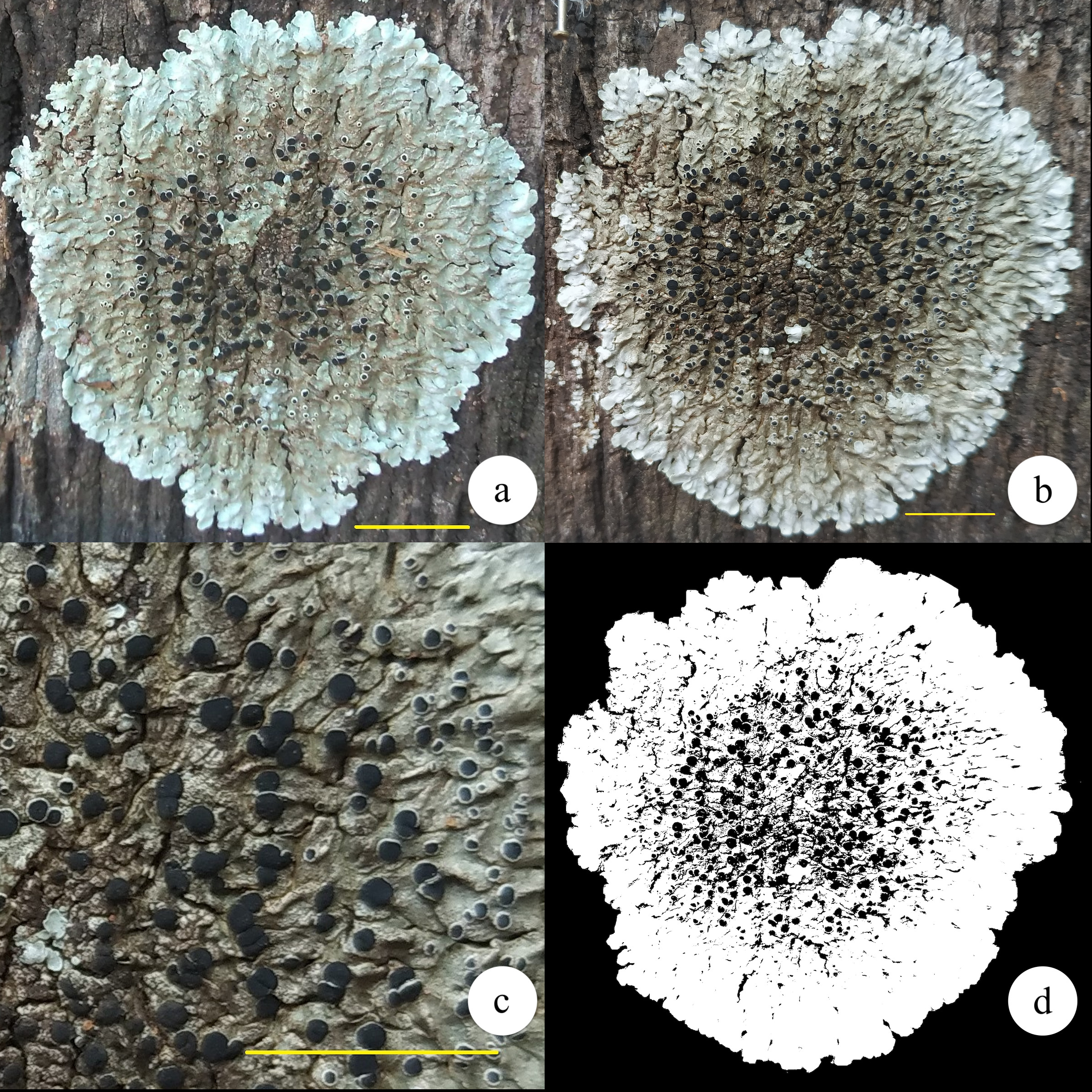
A total of 13 thalli of the lichenized fungus Pyxine petricola (Fig. 1a, b) were selected and tagged on five Imperial palms (Roystonea oleracea (Jacq.) O.F. Cook). This phorophyte species was chosen intentionally due to its smooth bark, vertical architecture, and frequent occurrence in the urban environment of the study area — features that facilitate photographic standardization and thallus visualization.
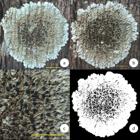
General view of the specimen F1L3 of Pyxine petricola at period P1, with 16.8 cm² and 200 apothecia (a), and at period P12 with 26.4 cm² and 511 apothecia (b). Detail of apothecia (c) and the same image as in (b), processed and contrasted to allow measurement of total thallus area (d). Scale bar = 1 cm.
Selection of individual thalli was based on strict ecological and morphological criteria. Only P. petricola thalli that met all of the following conditions were included: (i) visibly healthy and intact, (ii) at least 5 cm distant from other neighboring thalli, (iii) minimum surface area of 3 cm², and (iv) at reproductive stage, with visible apothecia (the ascomata type of P. petricola) (Fig. 1c). These constraints limited the number of eligible individuals and phorophytes, resulting in five trees and 13 thalli that satisfied all criteria for longitudinal monitoring.
Photographs of each selected thallus were taken approximately every 60 days over a two-year period, from December 2020 to December 2022, using a 12 MP camera and a stainless steel ruler for scale calibration. The sampling units (SUs) were defined as each thallus at each time interval, which served as the basis for measuring thallus growth (in cm²) and reproductive investment (number of apothecia). The raw data is available in the study’s official repository (Rezende 2024).
Measurement of growth rate and apothecia production
High-resolution photographs were taken approximately every 60 days over a two-year period to document thallus area and apothecia number. Image analysis was performed with ImageJ software (Schneider et al. 2012), using a stainless steel ruler in each frame to calibrate scale. The thallus outline was delimited using the wand tool based on contrast thresholds (Fig. 1d), and apothecia were counted manually using the multipoint tool.
Absolute growth (cm²) was calculated as the difference between the initial and final thallus area. In addition to absolute values, long-term growth trends were assessed by fitting linear regressions to the complete series of area measurements for each thallus.
To enable size-standardized comparisons among individuals, we calculated the Relative Thallus Area Growth Rate (RTAGR) for the entire monitoring period, following Evans (1972):
where and are thallus areas in cm2, and is the total duration of the study in days.
The study followed a non-invasive approach: all thalli remained attached to their original phorophytes throughout the monitoring period, and no artificial hydration or manipulation was applied. Photographs were taken under natural field conditions.
Reproductive investment was quantified by counting apothecia present on each thallus at every sampling date. Annual apothecia production was estimated from the difference between total apothecia at the beginning and end of the study, divided by two, and the percentage increase in apothecia was used to describe reproductive investment over time.
Environmental and statistical analysis
Environmental data were obtained from the Air Quality and Meteorology Station (EMQar-UFMS), located only a few meters from the monitored phorophytes within the Federal University of Mato Grosso do Sul campus. This station provides high-resolution local measurements of climatic conditions and particulate matter, ensuring that the environmental variables used in this study accurately reflect the conditions experienced by the thalli.
For each sampling interval, we compiled summary statistics for the following environmental variables: maximum, minimum and mean air temperature; total accumulated rainfall; number of days with measurable rainfall; solar radiation; and concentrations of particulate matter (PM₁₀ and PM₂.₅). In addition to total rainfall, we also calculated short-term accumulated precipitation over the 1, 3, 5, and 7 days preceding each measurement (Rain-1, Rain-3, Rain-5, Rain-7). These short-term hydrological metrics were included to characterize rapid hydration cycles typical of poikilohydric lichens and are not used to infer structural growth, but rather to describe the immediate moisture context associated with temporary thallus expansion.
Associations between environmental variables, absolute thallus growth, the total RTAGR (calculated only for the full two-year interval), and apothecia production were evaluated using multiple linear regression models implemented in PAST software (Hammer et al. 2001). Growth and reproductive metrics were treated as response variables, and environmental summaries for each interval served as predictors. All analyses were descriptive and exploratory, with the aim of identifying potential environmental correlates of lichen performance in the monitored urban microhabitat.
RESULTS AND DISCUSSION
We monitored the growth and reproduction of 13 individual Pyxine petricola thalli over a two-year period, totaling 169 photographic records. Absolute growth, measured as the increase in thallus area (cm²), varied markedly among individuals and across time intervals, reflecting dynamic responses to environmental conditions.
Table I summarizes all lichen–phorophyte associations, including height, orientation, and individual performance metrics such as initial and final thallus area, absolute and percentage growth, annual growth rate, total apothecia counts, reproductive investment, and annual reproductive output. Among all individuals, the three thalli with the highest percentage growth also exhibited the greatest reproductive investment: F1L1 (164% growth; 1641% reproduction), F1L2 (159% growth; 1412% reproduction), and F2L1 (155% growth; 1020% reproduction). Thallus F1L3, which had the largest initial area (13.91 cm²), displayed the highest absolute growth (6.28 cm² year⁻¹) and the greatest apothecia production (195.5 apothecia year⁻¹).
Growth and reproduction metrics for 13 specimens of P. petricola monitored over two years. Initial (In.) and final (Fi.) measurements range from December 2020 to December 2022. Growth (Gr.) and reproduction (Re.) percentages and rates refer to the entire monitoring period.
These results indicate that, in P. petricola, high reproductive output does not necessarily constrain vegetative expansion. This pattern aligns with findings for other foliose lichens, where increased investment in apothecia does not preclude substantial thallus growth (Gauslaa 2006, Hestmark et al. 2004).
To complement the absolute measurements, we calculated a single RTAGR value for each thallus over the full two-year interval. These long-term, size-standardized estimates mirrored the trends observed in absolute growth: individuals on phorophyte F1 consistently showed the highest performance, whereas those on F5 exhibited the lowest values.
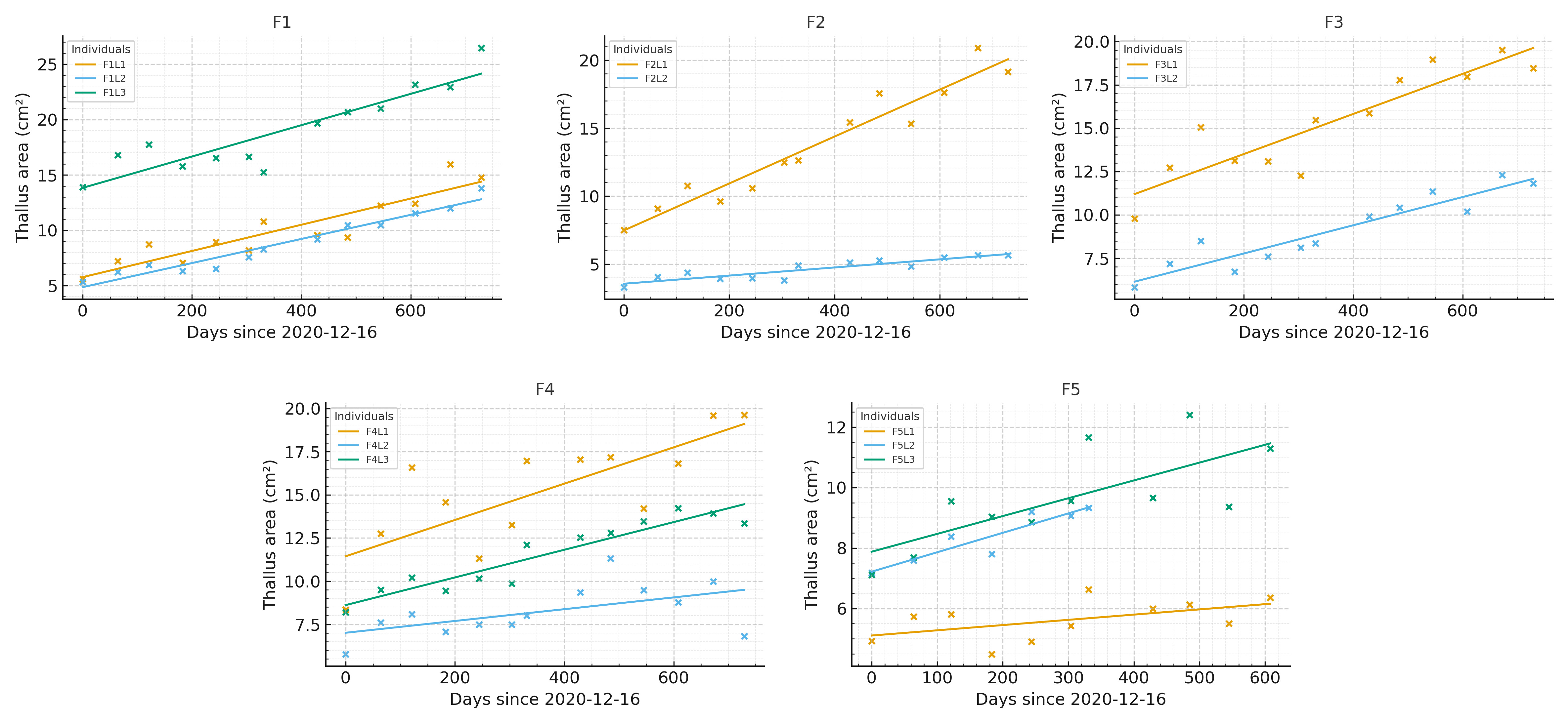
Long-term trajectories of thallus area are depicted in Figure 2, which presents the fitted growth regressions grouped by phorophyte. These curves highlight sustained expansion among thalli on F1 and more irregular or reduced growth among thalli on F5. Because the regressions are based on directly measured area rather than short-interval growth rates, they illustrate long-term structural trends while avoiding hydration-driven fluctuations that occur between sampling events.
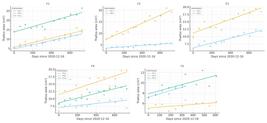
Linear regressions of thallus area over time for 13 individuals of Pyxine petricola, grouped by phorophyte (F1–F5). Points represent observed thallus area (cm²), and colored lines show fitted long-term growth trends.
Recent methodological innovations, including the use of archived street-level imagery to retrospectively estimate thallus expansion (Kubo & Ohmura 2025), demonstrate how emerging tools can expand temporal and spatial contexts for lichen growth analysis. However, these approaches remain limited by image resolution, visibility, and substrate exposure. In this sense, our study reinforces the importance of long-term, in situ monitoring for capturing fine-scale structural changes and hydration-dependent variability.
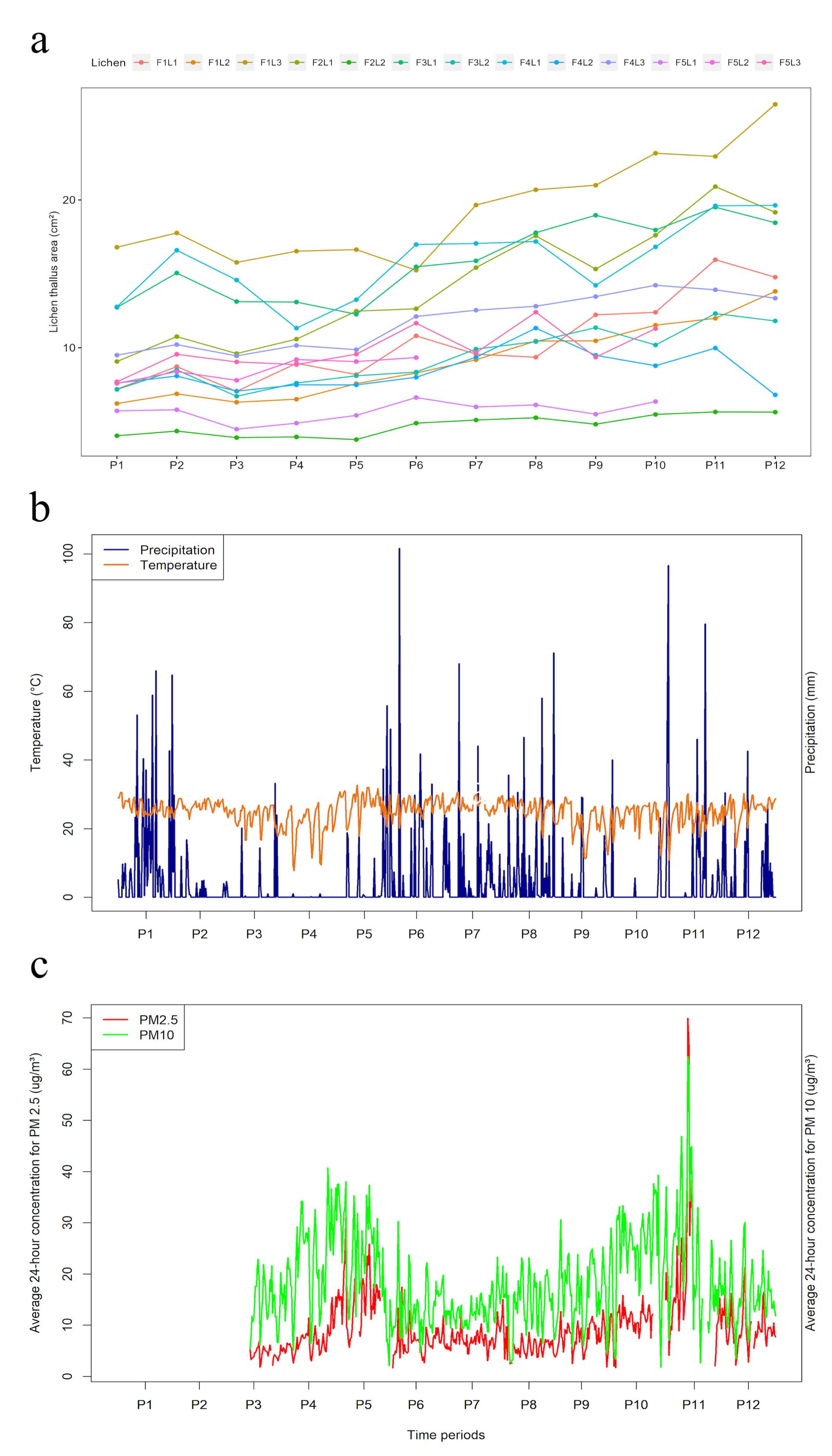
Reduced performance was especially evident in thalli on phorophyte F5, which showed frequent contractions in measured thallus area throughout the study (Fig. 2, Fig. 3a). This pattern intensified after the death of the host tree near the end of the first year, followed by progressive bark decomposition. Consequently, the physiological integrity of associated thalli declined markedly (Supplementary Material – Figure S1).
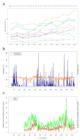
Growth timeline of Pyxine petricola. (a) Temporal variation in thallus area for all monitored individuals. Lines connect measurements for each period; colors identify individual thalli (legend at right). The abrupt end of timelines for the three thalli from phorophyte F5 indicates the point at which they were excluded from quantitative analyses. (b) Daily accumulated precipitation (blue) and mean atmospheric temperature (orange), provided by EMQar. (c) Daily particulate matter concentrations recorded by EMQar (PM2.5 in red; PM10 in green). The x-axis of panels (a–c) corresponds to the two-year monitoring period divided into §0-day intervals (see Table III for exact dates).
Because of this degradation, we excluded the entire second year of measurements for F5L2 and the final intervals of F5L1 and F5L3, restricting their analyzed period to December 2020–August 2022. This adjustment was necessary to avoid skewed estimates of growth and reproduction under advanced substrate decay.
When a phorophyte dies, attached lichens may persist temporarily, but bark deterioration alters light exposure, humidity retention, and mechanical stability—factors critical for thallus hydration. Additionally, decomposer fungi proliferate as the bark decays. Although some lichens can produce secondary metabolites to defend their territory (Kharpukhaeva & Mukhortova 2016, Votintseva 2007), such mechanisms are often insufficient once the substrate collapses. The decline observed on F5 aligns with similar dynamics reported in other lichenized systems (Hauck 2005, Spribille et al. 2022).
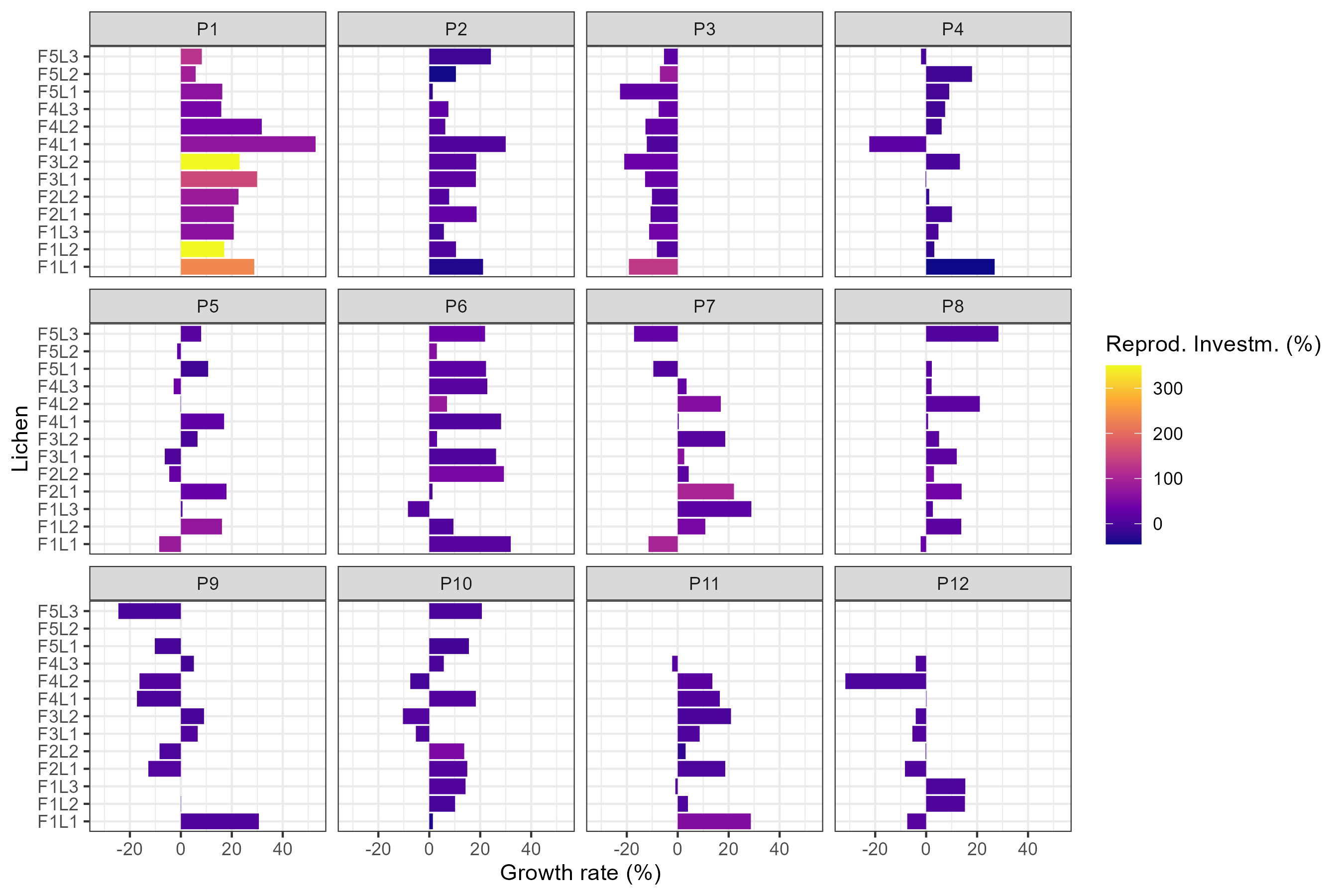
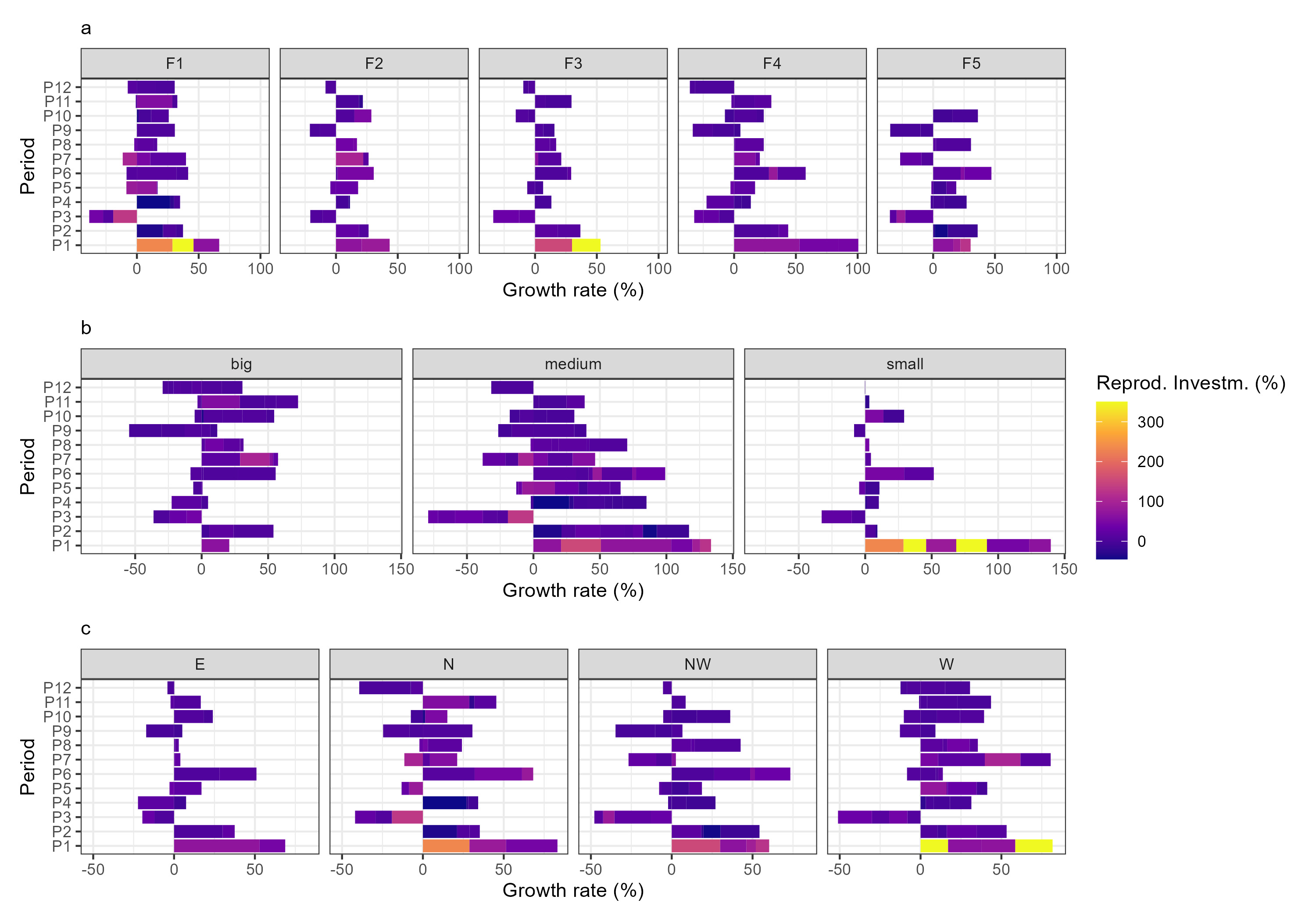
A period-by-period timeline of thallus area is shown in Figure 3a, illustrating alternating phases of expansion and contraction across the ~60-day intervals. Figure 4 synthesizes these dynamics by displaying, for each period (P1–P12), the magnitude of growth (bar size) and reproductive investment (color gradient) for each thallus.
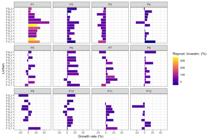
Growth rate and reproductive investment of Pyxine petricola. Each box represents one study period (P1–P12); lines represent individual thalli. Bar length indicates growth, and color gradient (legend at right) indicates reproductive investment.
To better understand factors influencing performance, individuals were categorized into three ecological groupings (Fig. 5): phorophyte identity (Fig. 5a), initial thallus size (Fig. 5b), and cardinal orientation on the trunk (Fig. 5c). These categories capture how substrate characteristics, intrinsic structural traits, and microclimatic exposure shape both growth and reproduction in P. petricola.
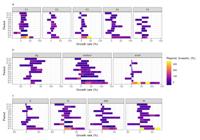
Re-clustered representation of the individual bars shown in Fig. 4, grouped according to three ecological parameters. (a) Phorophyte identity (F1–F5). (b) Initial thallus size class (large > 11.9 cm²; medium 5.9–11.9 cm²; small < 5.9 cm²). (c) Cardinal orientation on the phorophyte (E = east; N = north; NW = northwest; W = west). Bar length represents percentage growth; color shading represents reproductive investment.
Patterns across phorophytes (Fig. 5a) indicate that thalli on F1 exhibited the highest growth and reproductive investment, likely reflecting more favorable microhabitat conditions. In contrast, individuals on F5 showed the lowest performance, consistent with the decline of that host. Intermediate trends among F2–F4 suggest strong modulation by microenvironmental variation, such as shading, moisture retention, and bark stability.
When grouped by initial thallus size (Fig. 5b), medium-sized individuals exhibited the highest average growth and reproduction. This likely reflects an optimal balance between photosynthetic capacity and structural limitations. Larger thalli did not necessarily outperform smaller ones, indicating that size alone does not guarantee superior performance and underscoring possible allometric constraints.
Orientation effects (Fig. 5c) reveal that thalli facing north and east generally performed better than those oriented south and west, likely due to gentler morning light exposure and reduced desiccation—factors particularly relevant in tropical urban environments.
Figure 5 also supports the role of initial thallus size in determining absolute growth rates, consistent with allometric trends observed in other foliose lichens (Seminara et al. 2018). Taken together, the figures show that internal traits (e.g., size) and external conditions (e.g., host vitality and cardinal exposure) interact to shape lichen performance in urban landscapes.
Across the monitored site, some thalli grew more than 11 cm² over two years (averaging >5 cm² year⁻¹), while others showed pronounced oscillations of expansion and contraction, ending with total growth as low as 2 cm². Contractions were commonly associated with dry periods. For instance, after a high-rainfall interval (P1, >650 mm³) followed by a markedly drier period (P2, ~80 mm³), all thalli continued to expand (Fig. 3a, 3b; Table III). However, during P3—another low-precipitation interval—all individuals showed area contraction. This pattern is consistent with poikilohydric responses, where thallus shrinkage reflects water loss rather than biomass reduction, and helps explain the strong environmental correlations observed (Table II). Similar contraction–expansion cycles have been documented in other foliose and crustose lichens (Armstrong 1973).
Summary of linear regressions testing relationships between thallus percentual growth, percentual reproductive investment, and environmental variables. p-values between 0.05 and 0.0005 are indicated with (*); values < 0.0005 with (**).
Desiccation induces a suite of physiological responses in lichens, including metabolic downregulation and temporary suspension of apothecia production (Gasulla et al. 2021, Larson 1979, Spagnuolo et al. 2011). Because lichens lack mechanisms to actively regulate water content, hydration cycles strongly influence both growth and reproduction, particularly in tropical urban areas subject to prolonged dry spells.
Total rainfall exhibited the strongest correlation with both thallus growth (p = 1.72 × 10⁻⁶) and reproductive investment (p = 4.69 × 10⁻¹³), underscoring its role as a key driver of physiological activity. Additional predictors included lower temperatures and precipitation accumulated over the preceding five days, suggesting a delayed physiological response to short-term climatic variation.
Atmospheric particulate matter (PM2.5 and PM10) also showed statistically significant associations with growth and reproduction (Table II), indicating that particulate load may influence lichen performance. Although we did not analyze pollutant composition, the correlations suggest potential effects on hydration dynamics, gas exchange, or light interception.
Finally, the patterns observed in our study align with broader ecological trends in tropical urban environments. Urban climate—particularly the urban heat island (UHI) effect—can modulate functional diversity of lichens by altering temperature and humidity regimes (Wilby & Perry 2006). Studies have shown that water-requirement functional groups are especially sensitive to urban microclimates (Munzi et al. 2014), emphasizing the importance of recognizing the interplay between climatic constraints and lichen ecophysiology.
CONCLUSIONS
This study demonstrates that Pyxine petricola is capable of sustained growth and active reproduction under tropical urban conditions. Over two years, individuals exhibited marked variation in growth and reproductive output, strongly shaped by local environmental factors. Rainfall emerged as the primary driver of physiological activity, while temperature and short-term precipitation patterns also influenced thallus expansion and apothecia production. Significant correlations with atmospheric particulate matter further suggest that P. petricola is sensitive to multiple components of urban environmental stress.
We also found that high reproductive investment did not constrain vegetative growth; several individuals exhibited both rapid expansion and intense apothecia production. This indicates that classical growth–reproduction trade-offs may be less pronounced in this species under favorable microhabitat conditions.
Thalli growing on dead or deteriorating phorophytes showed markedly reduced performance, underscoring the importance of substrate integrity for lichen viability. Overall, our findings highlight P. petricola as a sensitive and informative bioindicator for assessing environmental conditions in tropical urban landscapes, reinforcing its usefulness in biomonitoring applications.
Acknowledgements
We thank the Coordenação de Aperfeiçoamento de Pessoal de Nível Superior (CAPES) for their generous financial support through scholarship funding. This assistance has been indispensable to the successful completion of our project, highlighting CAPES dedication to advancing higher education and research.
References
- ARMSTRONG RA. 1973. Seasonal growth and growth rate-colony size relationships in six species of saxicolous lichens. New Phytol 72: 1023-1030. Available at: http://www.jstor.org/stable/2431555.
-
BANERJEE S, RAM SS, MUKHOPADHYAY A, JANA N, SUDARSHAN M & CHAKRABORTY A. 2023. Potential of Epiphytic Lichen Pyxine cocoes, as an Indicator of Air Pollution in Kolkata, India. Proc Natl Acad Sci India Sect B Biol Sci 93: 165-180. https://doi.org/10.1007/s40011-022-01395-7.
» https://doi.org/10.1007/s40011-022-01395-7 - BRODY S & LARDY HA. 1945. Bioenergetics and Growth. New York: Reinhold Publishing Corporation, p. 1033.
- EVANS GC. 1972. The Quantitative Analysis of Plant Growth. Berkeley: University of California Press, Blackwell Scientific Publications, p. 343.
-
GASULLA F, DEL CAMPO EM, CASANO LM & GUÉRA A. 2021. Advances in Understanding of Desiccation Tolerance of Lichens and Lichen-Forming Algae. Plants 10: 807. https://doi.org/10.3390/plants10040807.
» https://doi.org/10.3390/plants10040807 -
GAUSLAA Y. 2006. Trade-off between reproduction and growth in the foliose old forest lichen Lobaria pulmonaria. Basic Appl Ecol 7: 455-460. https://doi.org/10.1016/j.baae.2005.12.007.
» https://doi.org/10.1016/j.baae.2005.12.007 -
GAUSLAA Y, MIKULEC MM & SOLHAUG KA. 2021. Short-term growth experiments – A tool for quantifying lichen fitness across different mineral settings. Flora 282: 151900. https://doi.org/10.1016/j.flora.2021.151900.
» https://doi.org/10.1016/j.flora.2021.151900 -
GAUSLAA Y, SOLHAUG KA & PHINNEY NH. 2020. Growth rates and thallus loss in hair lichens along small-scale Picea abies-canopy gradients. Fungal Ecol 47: 100947. DOI: 10.1016/j.funeco.2020.100947.
» https://doi.org/10.1016/j.funeco.2020.100947 -
GBIF BACKBONE TAXONOMY. 2023. Pyxine petricola Nyl. Available at: https://www.gbif.org/species/2609311 Accessed on: 29 May 2023.
» https://www.gbif.org/species/2609311 - HAMMER Ø, HARPER DAT & RYAN PD. 2001. PAST: Paleontological Statistics Software Package for Education and Data Analysis. Palaeontologia Electronica 4(1): 1-9. Available at: https://palaeo-electronica.org/2001_1/past/past.pdf.
-
HAUCK M. 2005. Epiphytic lichen diversity on dead and dying conifers under different levels of atmospheric pollution. Environ Pollut 135: 111-119. https://doi.org/10.1016/j.envpol.2004.09.021.
» https://doi.org/10.1016/j.envpol.2004.09.021 -
HESTMARK G, SKOGESAL O & SKULLERUD Ø. 2004. Growth, reproduction, and population structure in four alpine lichens during 240 years of primary colonization. Can J Bot 82: 1356-1362. https://doi.org/10.1139/b04-068.
» https://doi.org/10.1139/b04-068 - JACKSON HB, CLAIR LLS & EGGETT DL. 2006. Size is not a reliable measure of sexual fecundity in two species of lichenized fungi. Bryologist 109: 157-165. Available at: http://www.jstor.org/stable/20110769.
-
JESSUP CM & BOHANNAN BJM. 2008. The shape of an ecological trade-off varies with environment. Ecol Lett 11: 947-959. https://doi.org/10.1111/j.1461-0248.2008.01205.x.
» https://doi.org/10.1111/j.1461-0248.2008.01205.x -
KÄFFER MI, PORT RK, BRITO JBG & SCHMITT JL. 2021. Lichen functional traits and light influx in the analysis of environmental quality of subtropical riparian ecosystems. Ecol Indic 125: 107510. https://doi.org/10.1016/j.ecolind.2021.107510.
» https://doi.org/10.1016/j.ecolind.2021.107510 -
KHARPUKHAEVA TM & MUKHORTOVA LV. 2016. Dynamics of interaction between lichens and fallen deadwood in forest ecosystems of the eastern Baikal region. Contemp Probl Ecol 9: 125-139. https://doi.org/10.1134/S1995425516010066.
» https://doi.org/10.1134/S1995425516010066 -
KOCH NM, MATOS P, BRANQUINHO C, PINHO P, LUCHETA F, MARTINS SMDA & VARGAS VMF. 2019. Selecting lichen functional traits as ecological indicators of the effects of urban environment. Sci Total Environ 654: 705-713. https://doi.org/10.1016/j.scitotenv.2018.11.107.
» https://doi.org/10.1016/j.scitotenv.2018.11.107 -
KUBO K & OHMURA Y. 2025. Estimation of lichen growth rates using archived Google Street View images. Bryologist 128(3): 514-521. DOI: 10.1639/0007-2745-128.3.514.
» https://doi.org/10.1639/0007-2745-128.3.514 -
LARSON DW. 1979. Lichen Water Relations Under Drying Conditions. New Phytol 82: 713-731. https://doi.org/10.1111/j.1469-8137.1979.tb01666.x.
» https://doi.org/10.1111/j.1469-8137.1979.tb01666.x - LOTKA AJ. 1922. Contribution to the Energetics of Evolution. Proc Natl Acad Sci 8: 147-151. Available at: https://www.jstor.org/stable/84174.
-
MARTÍNEZ I, FLORES T, OTÁLORA MAG, BELINCHÓN R, PRIETO M, ARAGÓN G & ESCUDERO A. 2012. Multiple-scale environmental modulation of lichen reproduction. Fungal Biol 116: 1192-1201. DOI: 10.1016/j.funbio.2012.09.005.
» https://doi.org/10.1016/j.funbio.2012.09.005 - MUNZI S, CORREIA O, SILVA P, LOPES N, FREITAS C, BRANQUINHO C & PINHO P. 2014. Lichens as ecological indicators in urban areas: beyond the effects of pollutants. Firn J (Ed), J Appl Ecol 51: 1750-1757. Available at: http://www.jstor.org/stable/43869667.
- NAYAKA S, UPRETI DK, GADGIL M & PANDEY V. 2003. Distribution pattern and heavy metal accumulation in lichens of Bangalore city with special reference to Lalbagh garden. Curr Sci 84: 674-680.
-
PLANURB. 2019. Perfil Socioeconômico de Campo Grande – Mato Grosso do Sul. 26th ed. rev. Campo Grande, MS. Available at: https://cdn.campogrande.ms.gov.br/portal/prod/uploads/sites/18/2019/08/Perfil-2019-PLANURB-vers%C3%A3o-final.pdf Accessed on: 03 March, 2021.
» https://cdn.campogrande.ms.gov.br/portal/prod/uploads/sites/18/2019/08/Perfil-2019-PLANURB-vers%C3%A3o-final.pdf -
PRINGLE A, CHEN D & TAYLOR JW. 2003. Sexual Fecundity is Correlated to Size in the Lichenized Fungus Xanthoparmelia cumberlandia. The Bryologist 106: 221-225. DOI: 10.1639/0007-2745(2003)106[0221:SFICTS]2.0.CO;2.
» https://doi.org/10.1639/0007-2745(2003)106 -
REZENDE V. 2024. Raw Data of the paper: Growth and Reproductive Dynamics of the Tropical Urban Lichen Pyxine petricola in Central Brazil. Available at: https://zenodo.org/records/10607525 Published February 1, 2024.
» https://zenodo.org/records/10607525 -
SCHNEIDER CA, RASBAND WS & ELICEIRI KW. 2012. NIH Image to ImageJ: 25 years of image analysis. Nat Methods 9: 671-675. https://doi.org/10.1038/nmeth.2089.
» https://doi.org/10.1038/nmeth.2089 -
SEMINARA A, FRITZ J, BRENNER MP & PRINGLE A. 2018. A universal growth limit for circular lichens. J R Soc Interface 15: 20180063. doi: 10.1098/rsif.2018.0063.
» https://doi.org/10.1098/rsif.2018.0063 -
SPAGNUOLO V, ZAMPELLA M, GIORDANO S & ADAMO P. 2011. Cytological stress and element uptake in moss and lichen exposed in bags in urban area. Ecotoxicol Environ Saf 74: 1434-1443. https://doi.org/10.1016/j.ecoenv.2011.02.011.
» https://doi.org/10.1016/j.ecoenv.2011.02.011 -
SPRIBILLE T, RESL P, STANTON DE & TAGIRDZHANOVA G. 2022. Evolutionary biology of lichen symbioses. New Phytol 234: 1566-1582. https://doi.org/10.1111/nph.18048.
» https://doi.org/10.1111/nph.18048 -
VOTINTSEVA AA. 2007. Interspecific interactions of wood-decomposing fungi with epiphytic lichens and mosses. Russ J Ecol 38: 285-288. https://doi.org/10.1134/S1067413607040108.
» https://doi.org/10.1134/S1067413607040108 -
WILBY RL & PERRY GLW. 2006. Climate change, biodiversity and the urban environment: a critical review based on London, UK. Prog Phys Geogr Earth Environ 30: 73-98. https://doi.org/10.1191/0309133306pp470ra.
» https://doi.org/10.1191/0309133306pp470ra -
WILLIAMS GC. 1996. Adaptation and natural selection: a critique of some current evolutionary thought. Princeton, NJ: Princeton Univ. Press, p. 307. https://doi.org/10.2307/j.ctt7s4g0
» https://doi.org/10.2307/j.ctt7s4g0
Edited by
-
Handling editor
Alexander Kellner
The photographs that constitute the raw data of the work, as well as the measurements in the lichen images are available in repository official.