 Foraminifera from the Campanian–Maastrichtian of the Miriri Sub-Basin, Paraíba Basin, Brazil: implications for biostratigraphy and paleoenvironmental reconstruction
Abstract
This study investigates the core RT-01-PB from the Miriri Sub-Basin, Paraíba Basin, analyzing planktic and benthic foraminifera from the upper Campanian to lower Maastrichtian. The strata belong to the Itamaracá and Gramame formations. Lithostratigraphic, biostratigraphic, and paleoenvironmental interpretations were developed using microbiofacies and benthic foraminiferal morphogroups. Fifty samples were processed for foraminiferal recovery, and thirty-five petrographic thin sections were analyzed to identify bioclastic constituents and diagenetic features, aiming to describe and classify the microbiofacies. Two planktic foraminiferal zones were identified: Gansserina gansseri Zone (upper Campanian–lower Maastrichtian) and Contusotruncana contusa Zone (lower Maastrichtian). Benthic foraminifera were classified into morphogroups by morphology and habitat, associating strata with depositional environments. Petrographic analysis revealed five microbiofacies types, including the first occurrence of larger benthic foraminifera in Brazil during the Upper Cretaceous. During the upper Campanian–lower Maastrichtian, the Miriri Sub-Basin was a platform environment, ranging from inner to mid-ramp (0–100 m depth) under oligotrophic conditions, with predominance of epifaunal forms. In the lower Maastrichtian, a middle–outer ramp (100–200 m) shifted to mesotrophic conditions, marked by increased infaunal foraminifera and authigenic phosphate, coincident with a gamma-ray peak. These data offer perspectives on climatic and palaeoenvironmental variations across the northern South American Platform during the Campanian–Maastrichtian.
Key words
Environmental change; larger benthic foraminifera; morphogroup analysis; phosphatic level; Upper Cretaceous
INTRODUCTION
During the Late Cretaceous, the global climate underwent a gradual cooling, with surface and bottom waters recording lower temperatures (Jenkyns et al. 1994, Huber et al. 1995, Barrera & Savin, 1999). The Campanian–Maastrichtian transition is particularly significant as it coincided with this global cooling (Li & Keller 1998a, 1999, Linnert et al. 2014, 2018, Wilmsen & Niebuhr 2017) and the reconfiguration of ocean circulation patterns (Barrera & Savin, 1999, Friedrich et al. 2009). Although cooling peaked during Late Cretaceous, it was punctuated by brief warming intervals, culminating in a more pronounced warming episode at the end of the Maastrichtian (Li et al. 1999, Abramovich & Keller 2002, 2003, Friedrich et al. 2005).
Planktic foraminifera first appeared in the Early Jurassic (Gradstein 1976, Hart 1980, Caron & Homewood 1983, Wernli 1988, Boudaugher-Fadel et al. 1997, Hart et al. 2003, Wernli & Görög 2007, Gradstein et al. 2021), becoming globally abundant from the Early Cretaceous onward (Petrizzo et al. 2020a). During the Campanian and Maastrichtian, planktic foraminiferal diversity increased due to an origin rate higher than extinction, reflecting greater bioprovinciality (Petrizzo et al. 2020a, b). This rapid evolution and wide distribution marks foraminifera essential for Cretaceous biostratigraphy, enabling the definition of biozones and stratigraphic correlations while also aiding in understanding mass extinction events and paleoecological changes, such as the events of the Cretaceous-Paleogene transition (Keller 1988a, b, Albertão et al. 1994, Keller et al. 1995, 2002, 2009, Koutsoukos, 1996, 2006). Benthic foraminifera are widely used in the reconstruction of marine and coastal paleoenvironments, as their distribution is influenced by physicochemical factors such as temperature, salinity, dissolved oxygen, and nutrient availability (Boltovskoy & Wright 1976, Murray, 1991, 2006). Studies on their community ecology adopt classification by morphogroups, which group similar forms regardless of taxonomy, facilitating paleoenvironmental interpretations and microhabitat analyses (Murray 1973, 2006, Jones & Charnock 1985, Koutsoukos & Hart 1990, Jorissen et al. 1995, Bernasconi & Cusminsky 2005, Alperin et al. 2008, Bernasconi et al. 2009). Additionally, the relationship between the morphology of benthic foraminiferal shells and the characteristics of the physical environment have been extensively investigated, reinforcing its application in paleoecology (Severin 1983, Koutsoukos & Hart 1990, Reolid et al. 2008).
The Paraíba Basin, bounded to the south by the Pernambuco Lineament and to the north by the Mamanguape Fault (Barbosa et al. 2004), has its tectonic configuration controlled by Precambrian lineaments and basement structural highs (Barbosa et al. 2007). This structural framework led to the development of three main depocenters: the Olinda, Alhandra, and Miriri sub-basins (Barbosa et al. 2007). Research in the basin has mainly focused on the Olinda Sub-Basin, particularly on interval Maastrichtian–Danian, as exemplified by Melo et al. (2023), who documented a well-preserved foraminiferal record, recognizing seven biozones that refine biostratigraphy and enhance the understanding of paleoenvironmental changes across the Cretaceous-Paleogeneboundary in the Paraíba Basin.
Despite significant advances in the Paraíba Basin, especially in the Olinda and Alhandra sub-basins, understanding of Campanian–Maastrichtian paleoenvironmental and climatic changes in the northern sector of the South American Platform remains limited. The Miriri Sub-Basin offers an important, yet understudied, record to address this gap. This study aims to assess these paleoenvironmental changes on the northern margin of the South American Platform through the biostratigraphic and paleoenvironmental characterization based on foraminifera and microbiofacies from core RT-01-PB (Miriri Sub-Basin, Paraíba Basin).
Geological settings
The Paraíba Basin was the last connection between Africa and South America in the Late Cretaceous, a period marked by crustal stretching and gradual subsidence, forming distinct sedimentary blocks and sub-basins (Mabesoone & Alheiros 1988, Rand 1967). Bounded to the south by the Pernambuco Lineament and to the north by the Mamanguape Fault, it comprises the Olinda, Alhandra and Miriri sub-basins (Barbosa et al. 2004).
The stratigraphic succession of the Paraíba Basin comprises six main formations. The Beberibe Formation, dated to the Coniacian–Santonian (Beurlen 1967a, b), consists of fluvial deposits composed of medium to coarse-grained sandstones, conglomerates, siltstones, and claystones. Overlying this unit, the Itamaracá Formation, from the Campanian (Barbosa et al. 2006, Rossetti et al. 2011, 2012, Correia Filho et al. 2015, Melo et al. 2023), records a marine transgression and is composed of calcareous sandstones, siltstones, phosphatic levels, and estuarine limestones. Subsequently, the Gramame Formation, deposited during the Maastrichtian (Muniz 1993, Santos et al. 1994, Melo et al. 2023), is characterized by marl limestones and interbedded marls, representing typical carbonate facies of a neritic to bathyal platform. The Maria Farinha Formation, Paleocene in age (Tinoco 1967, Muniz 1993, Albertão et al. 1994, Koutsoukos 1996, 1998, 2006, Gertsch et al. 2013, Melo et al. 2023), consists of detrital limestones and clay lenses, reflecting regressive conditions. The Tambaba Formation, likely Eocene in age (Beurlen 1967a, b), is composed of fossiliferous reefal limestones, including calcilutites, calcarenites, and calcirudites (Correia Filho et al. 2015). Finally, the Barreiras Formation, attributed to the Miocene (Arai 2006, Rossetti et al. 2011, Andrades–Filho et al. 2021), comprises fluvial and alluvial deposits made up of conglomerates, sands, and clays, often showing cross-bedding.
In the Miriri Sub-Basin, the strata studied belong to the Itamaracá and Gramame formations. The Itamaracá Formation consists of calciferous sandstones, siltstones, and lagoonal and estuarine deposits, reflecting a marine transgression whose peak is represented by phosphate levels (Barbosa et al. 2003, 2007, Souza & Lima Filho 2005), dating from the Campanian (Kegel 1957, Beurlen 1967a, Melo et al. 2023). The Gramame Formation, characterized by marly limestones and marls intercalated with clays, represents the continental shelf deposits from the Maastrichtian (Beurlen 1967a, Tinoco 1967, Lima & Koutsoukos 2002, Barbosa et al. 2003, Melo et al. 2023). This formation reflects conditions of a high sea level and low terrigenous influx, favoring the development of carbonate shelves (Barbosa et al. 2007). It presents several microbiofacies, such as mudstones and wackestones, and evidence of P2O5 enrichment associated with maximum flooding surfaces (Beurlen 1967a, Lima & Koutsoukos 2006).
MATERIALS AND METHODS
The samples analyzed in this study were collected from a core drilled between the municipalities of Rio Tinto and Lucena, in the state of Paraíba (Figure 1), as part of the “Projeto Fosfato na faixa sedimentar costeira Pernambuco-Paraíba”, conducted by the Geological Survey of Brazil – SGB/CPRM. The core RT-01-PB, measuring 30 meters in length, includes different types of rocks, ranging from calcareous sandstones at the base to carbonates, exhibiting lithological variations along the profile. Thirty-five samples were selected for the preparation of thin petrographic sections, and 50 for the recovery of carbonate microfossils, collected at regular intervals (~5 cm) with minor variations. The samples were processed following the methodological procedures described by Gusmão et al. (2024), using 5% acetic acid for 5 minutes. After the chemical reaction, the residues were washed in sieves with a mesh size of >63 µm and then analyzed. For each sample, at least 300 foraminiferal specimens were collected. In cases where the required number was not available, all specimens in the fraction were collected.
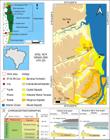
Maps showing the location of the studied section (RT-01-PB) in the proximity of the Municipality of Lucena State of Paraíba, Brazil. a) Map of Brazil, indicating the Paraíba Basin in green rectangle; b) Map of the Paraíba Basin and its sub-basins; red star indicating the location of the core. Adapted from Mabesoone & Alheiros (1993); c) map of the Miriri Sub-Basin; d) Stratigraphic Chart of the Paraíba Basin, with emphasis on the Upper Cretaceous units that are the focus of this work.
The foraminifera recovered were identified using Zeiss Discovery V8 and V12 stereomicroscopes of the Applied Micropaleontology Laboratory-LMA, in the Petroleum and Energy Research Institute (i-LITPEG) of the Federal University of Pernambuco (UFPE). For detailed analysis, representatives of each morphotype were photographed using a Zeiss Discovery V16 stereomicroscope and Hitachi TM4000Plus scanning electron microscope (SEM), in the Advanced Microscopy and Imaging Laboratory of the Department of Biosciences of UFPE. The illustrated and analyzed specimens were deposited in the scientific collection of the Applied Micropaleontology Laboratory (LMA-i-LITPEG-UFPE). The material was deposited at Applied Micropaleontology Laboratory of UFPE, under the prefix LMA and curatorial numbers 00713 to 00774.
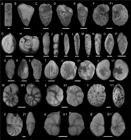
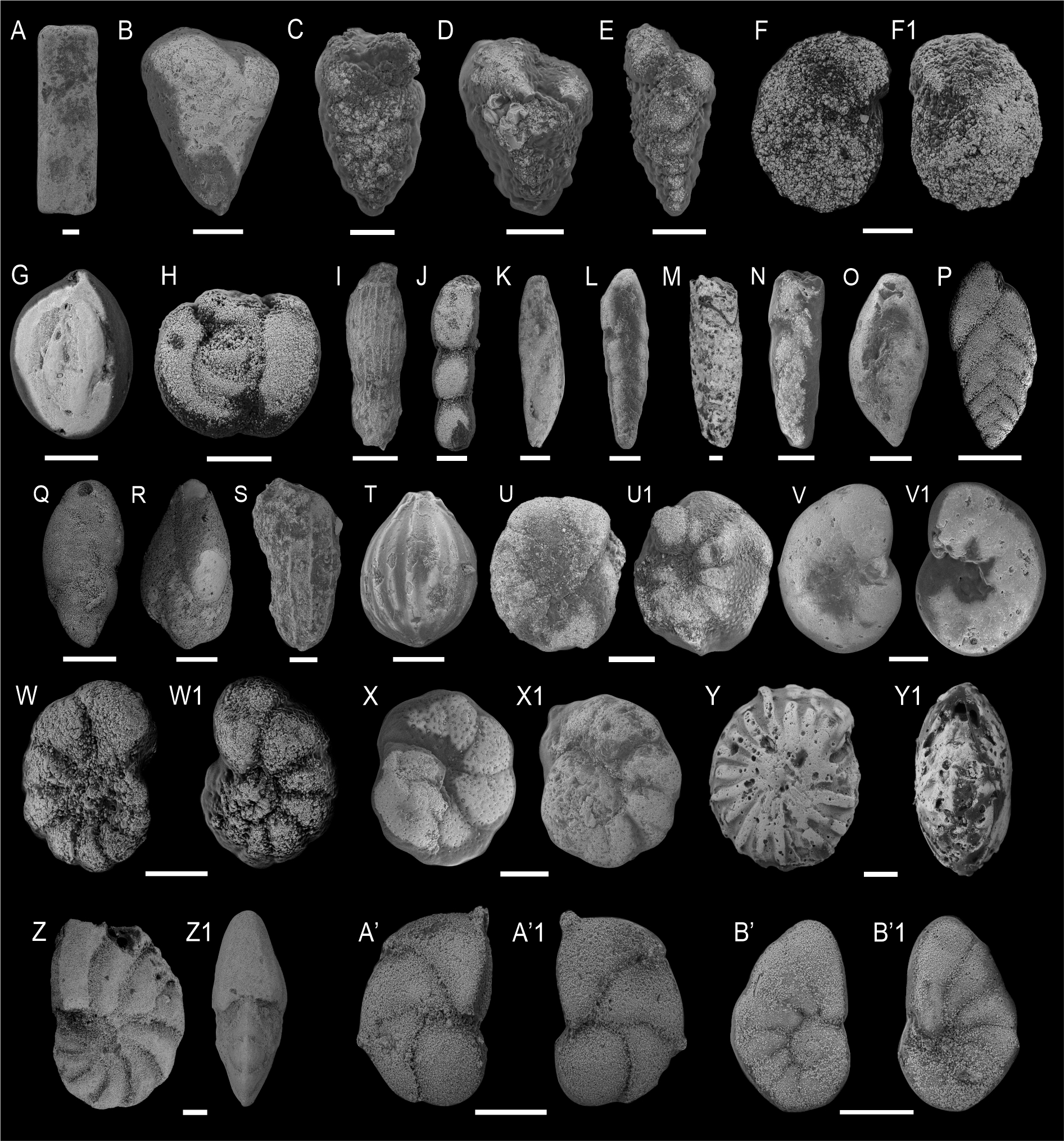
SEM photomicrographs of selected benthic foraminifera of RT-01-PB Core: a - Bathysiphon sp., LMA-00713, 11.7–11.77 m; b - Marssonella sp., LMA-00714, 10.28–10.36 m; c - Textularia sp., LMA-00715, 22.89–22.95 m; d - Gaudryina sp., LMA-00716, 22.89–22.95 m; e - Verneuilina sp., LMA-00717, 20.86–20.91 m; f - f1 - Haplophragmoides sp., LMA-00718, 14.18–14.28 m; g - Quinqueloculina sp., LMA-00719, 16.93–16.98 m; h - Sigmoihauerina sp., LMA-00720, 29.97–29 m; i - Dentalina sp., LMA-00721, 8.28–8.32 m; j - Laevidentalina sp., LMA-00722, 23.33–23.38 m; k - Marginulina sp., LMA-00723, 9.6–9.67 m; l - Coryphostoma sp., LMA-00724, 17.46–17.52 m; m - Vaginulina taylorama, LMA-00725, 8.63–8.68 m; n - Loxostomoides sp., LMA-00726, 8.63–8.68 m; o - Pyrulina sp., LMA-00727, 8.63–8.68 m; p - Bolivina sp., LMA-00728, 17.46–17.52 m; q - Bulimina sp., LMA-00729, 8.63–8.68 m; r - Guttulina sp., LMA-00730, 14.18–14.28 m; s - Siphogenerinoides bramletti, LMA-00731, 7.76–7.81 m; t - Lagena sulcata, LMA-00732, 8.28–8.32 m; u - u1 - Trochulina sp., LMA-00733, 23.33–23.38 m; v - v1 - Gyroidinoides sp., LMA-00734, 6.92–6.84 m; w - w1 - Gavelinella sp., LMA-00735, 6.92–6.94 m; x - x1 - Cibicidis sp., LMA-00736, 6.92–6.94 m; y - y1 - Lenticulina sp., LMA-00737, 22.89–22.95 m; z - z1 - Lenticulina sp. 1, LMA-00738, 11.7–11.77 m; a’ - a’1 - Astacolus sp., LMA-00739, 17.46–17.52 m; b’ - b’1 - Nonnionella sp., LMA-00740, 17.46–17.52 m, Scale bars = 100 μm.
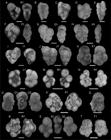
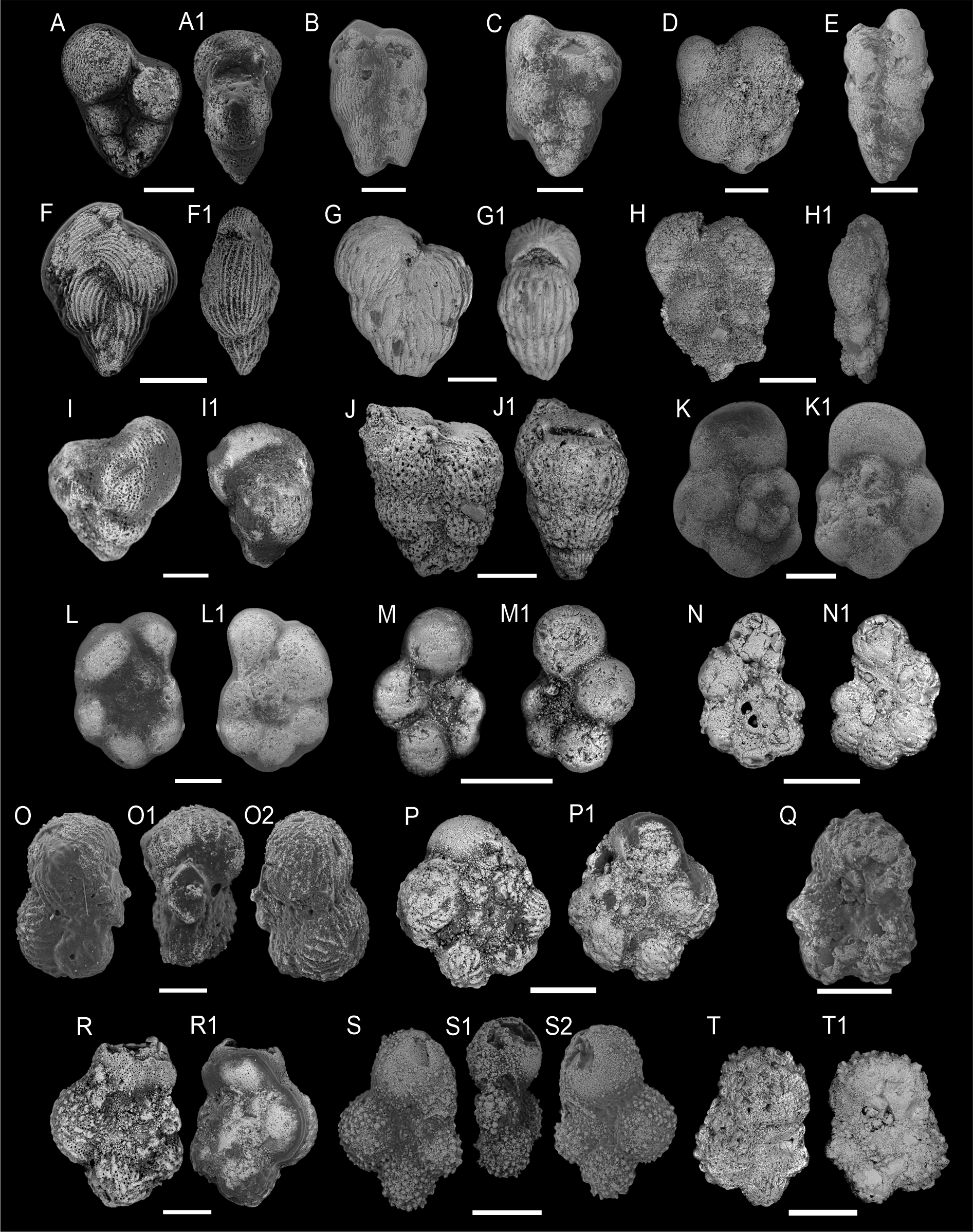
SEM photomicrographs of selected planktic foraminifera of RT-01-PB Core: a–a1 - Planoheterohelix globulosa, LMA-00741, 9.6–9.67 m; b - Planoheterohelix planata, LMA-00742, 9.9–9.97 m; c - Planoheterohelix sp., LMA-00743, 6.57–6.62 m; d - Planoglobulina sp., LMA-00744, 9.6–9.67 m; e - Pseudoguembelina praehariaensis, LMA-00745, 7.76–7.81 m; f–f1 - Pseudoguembelina costulata, LMA-00746, 9.3–9.37 m; g–g1 - Pseudoguembelina excolata, LMA-00747, 8.63–8.68 m; h–h1 – Laeviheterohelix sp., LMA-00748, 22.89–22.95 m; i–i1 - Pseudotextularia elegans, LMA-00749, 6.92–6.94 m; J–J1 - Braunella punctalata, LMA-00750, 7.76–7.81 m; K–K1 - Globotruncanella pschadae, LMA-00751, 16.1–16.16 m; l–l1 - Muricohedbergella sliteri, LMA-00752, 10.28–10.36 m; m–m1 - Muricohedbergella monmouthensis, LMA-00753, 6.92–6.94 m; n–n1 - Planohedbergella prairiehillensis, LMA-00754, 6.92–6.97 m; o–o2 - Rugoglobigerina macrocephala, LMA-00755, 10.28–10.36 m; p–p1 - Rugoglobigerina rugosa, LMA-00756, 6.57–6.62 m; q - Rugoglobigerina spinosa, LMA-00757, 9.9–9.97 m; r–r1 - Rugotruncana subcircumnodifer, LMA-00758, 6.57–6.62 m; s–s2 - Globotruncanella petaloidea, LMA-00759, 8.9–8.97; t–t1 - Globotruncanella minuta, LMA-00760, 7.76–7.81 m. Scale bars = 100 μm.
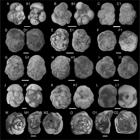
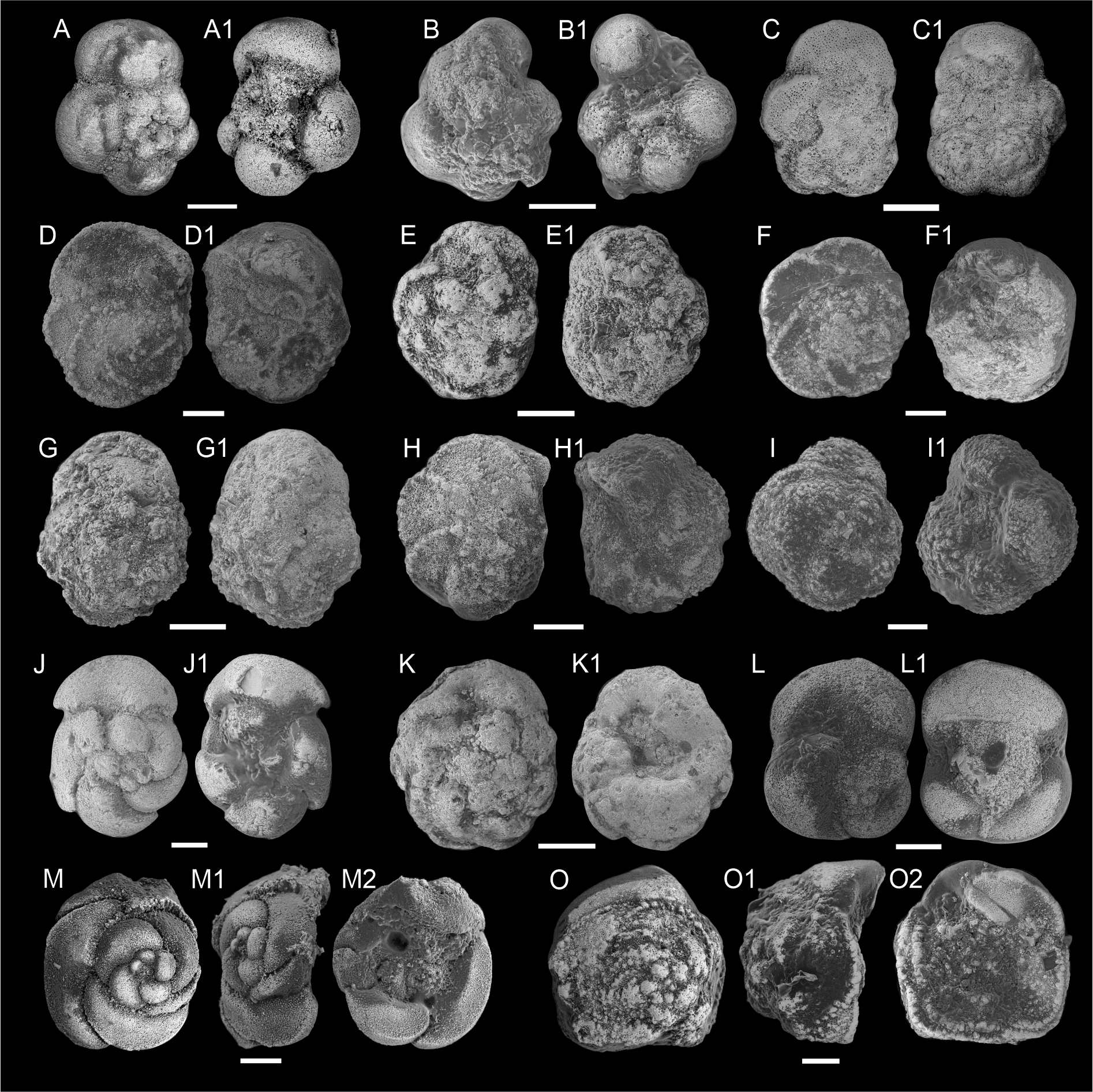
SEM photomicrographs of selected Planktic foraminífera of RT-01-PB Core: a–a1 - Archaeoglobigerina blowi, LMA-00761, 6.92–6.94 m; b–b1 - Archaeoglobigerina cf. australis, LMA-00762, 16.1–16.16 m; c–c1 – Gansserina gansserri, LMA-00763, 17.46–17.52 m; d–d1 - Globotruncana aegyptiaca, LMA-00764, 9.3–9.37 m; e–e1 - Globotruncana bulloides, LMA-00765, 7.76–7.81 m; f–f1 - Globotruncana arca, LMA-00766, 8.28–8.32 m; g–g1 - Globotruncana rosetta, LMA-00767, 8.9–8.97 m; h–h1 - Globotruncanita pettersi, LMA-00768, 9.3–9.37 m; i–i1 - Globotruncanita sp., LMA-00769, 10.95–11 m; j–j1 - Globotruncanita sp. 1, LMA-00770, 8.63–8.68 m; k–k1 - Contusotruncana morozovae, LMA-00771, 8.63–8.68 m; ; l–l1 - Contusotruncana fornicata, LMA-00772, 6.92–6.94 m; m–m2- Contusotruncana patelliformis, LMA-00773, 7.07–7.12 m; n–n2 - Contusotruncana contusa, LMA-00774, 6.92–6.94 m. Scale bars = 100 μm.
The taxonomic classification followed the main references in the literature, including Pessagno (1967), Smith & Pessagno (1973), Tinoco (1976, 1977, 1978), Robaszynski et al. (1984), Caron (1985), Nederbragt (1989, 1991), Premoli Silva & Verga (2004), Özcan et al. (2021), Melo et al. (2023), in addition to data provided by catalogs the Planktic Foraminiferal Working Group, Mikrotax.org (pforams@mikrotax, Huber et al. 2016) and Ellis & Messina (1940).
The quantitative values of foraminifera were calculated from the total count recovered in each sample, being considered: rare (between 1–5 specimens); common (between 6–20 specimens); abundant (between 21–50); and very abundant (> 51 specimens). The classification of foraminiferal morphogroups was used to palaeoecological inferences, taking into consideration the works of Bernhard (1986), Bak et al. (1997), Nagy et al. (2009), Linnert et al. (2019), Koutsoukos & Hart (1990).
The petrographic samples were analyzed in cooperation with the Laboratory of Applied Geochemistry for Petroleum (LGAPE/i-LITPEG/UFPE), using a Zeiss AXIO Scope A1 optical microscope, with a camera Zeiss AxioCam MRc, and the AxioCam Mr R3 – ZEN 2 Lite imaging program.
RESULTS
Foraminiferal assemblage
Forty-four genera and thirty species of benthic and planktic foraminifera were identified (Figures 2, 3, 4 and 5), enabling the identification of bioestratigraphic and paleoecological markers. The complete list of identified taxa is presented in the Appendix A.
At the base of the section, between 30.0 m and 23.0 m, where calcareous sandstones dominate, a benthic foraminiferal assemblage was recorded, primarily composed of Gyroidinoides (very abundant), Gavelinella, Quinqueloculina, Lenticulina, Textularia and Nonionella. The planktic foraminifers are mainly represented by trochospiral and biserial forms, including Globotruncanella minuta and Planoheterohelix globulosa. In the following interval, from 23.0 m to 18.0 m, a limestone (mudstone to packstone) with siliciclastic content was observed, containing a similar benthic assemblage composed of Gyroidinoides (very abundant), Gavelinella, Quinqueloculina, Lenticulina, Textularia, Nonionella, Dentalina, Guttulina, and Bathysiphon. In this interval, the planktic forms have greater richness, with the presence of Globotruncanella minuta, Planoheterohelix globulosa, Muricohedbergella sliteri, Pseudoguembelina elegans, Contusotruncana fornicata, Gansserina gansserri, Rugoglobigerina macrocephala, Planohedbergella prairiehilensis, Muricohedbergella monmouthensis, and Globotruncana aegyptiaca. Between 18.0 m and 11.0 m, intensely bioturbated limestone (mudstone) was deposited, with a benthic foraminiferal assemblage dominated by Gavelinella (most abundant), Gyroidinoides, Quinqueloculina, Lenticulina, Textularia, Nonionella, Dentalina, Guttulina, Bathysiphon, Bolivina and Lagena. The planktic forms include Archaeoglobigerina blowi, Archaeoglobigerina australis and Muricohedbergella holmdelensis. Between 11.0 m and 6.0 m, an intercalation of limestone (mudstone) with intensely bioturbated marl, containing Thalassinoides ichnogenus, was observed. The benthic foraminiferal assemblage is dominated by the same assemblage as in the previous intervals, but with the absence of Textularia and the presence of Marssonella. The planktic forms show a significant increase in abundance, maintaining the same taxa from the previous association, and including Planoheterohelix planata, Rugotruncana circunmodifer, Planohedbergella multispira, Rugoglobigerina rugosa, Globotruncanella pschadae, Contusotruncana contusa, and other less abundant species. The final sampled interval, between 6.0 m and 0 m, consists of intercalations of limestone and claystone, showing a significant decrease in the abundance and diversity of foraminifera. The benthic assemblage is composed of Gyroidinoides, Gavelinella, and Bathysiphon, while the planktic assemblage is represented by Planoheterohelix globulosa, Gansserina gansserri, and Pseudotextularia nutalli.
The ratio between planktic and benthic foraminifera (P/B) in well RT-01-PB demonstrates a predominance of benthic foraminifera throughout the entire core. However, a significant change occurs in the interval between 11.0 m and 5.0 m, where the quantity of planktic foraminifera increases considerably, although benthic forms remain dominant.
Foraminiferal biostratigraphy
The first occurrences (FOs) and last occurrences (LOs) of marker species were used to define the bioestratigraphic markers in the strata, primarily based on the biozonations proposed by Premoli Silva & Bolli (1973), Robaszynski & Caron (1995), Li & Keller (1998a), and Melo et al. (2023).
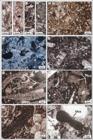
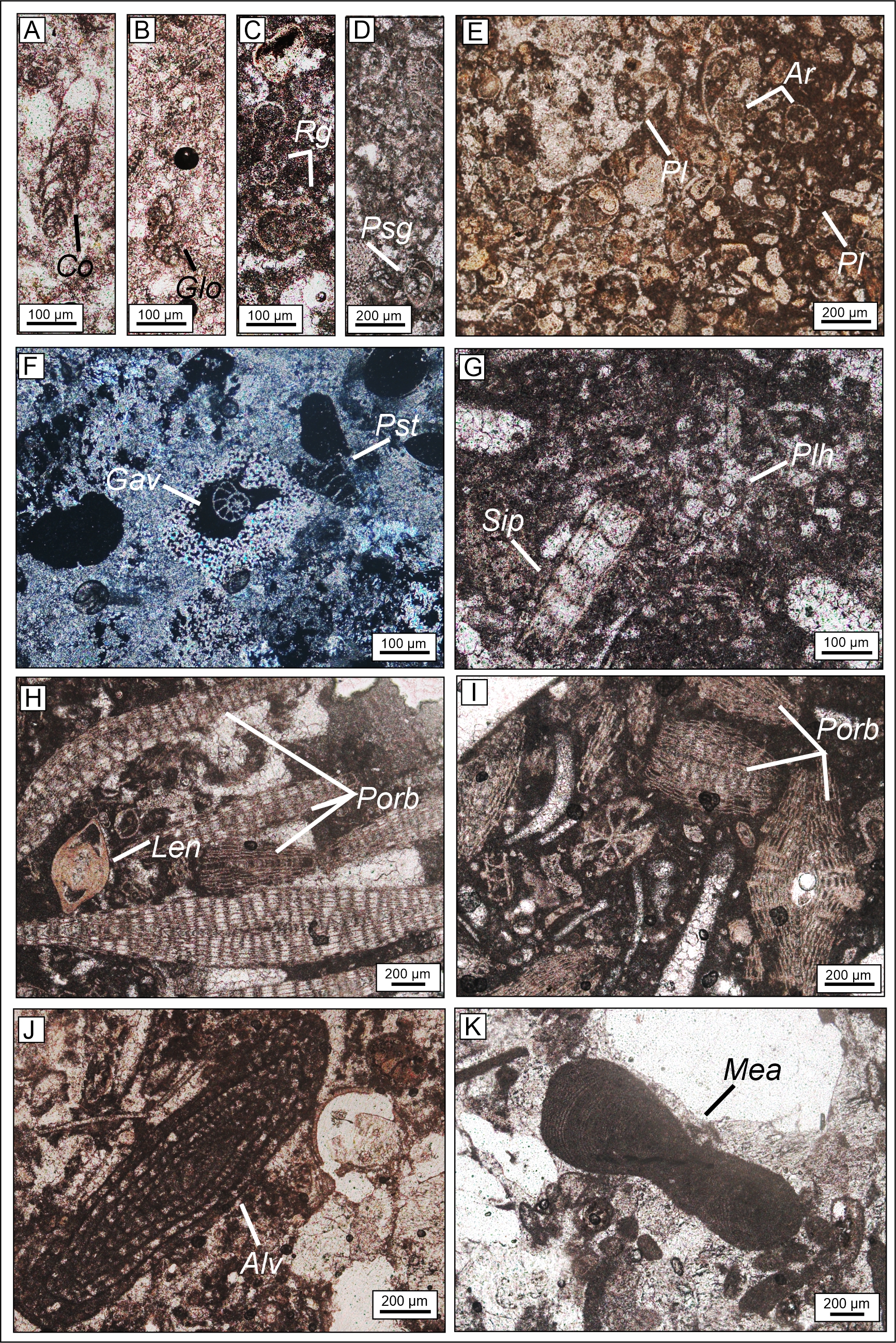
Thin section photomicrographs of the foraminifera in the RT-01-PB core.: a. Coryphostoma sp. (Co), 8.63–8.68 m; b. Globotruncanella sp. (Glo), 6.57–6.62 m; c. Rugoglobigerina sp. (Rg), 16.93–16.98 m; d. Pseudoguembelina sp. (Psg), 22.23–22.28 m; e. Planoheterohelix sp. (Pl) and Archaeoglobigerina (Ar), 9.3–9.37 m; f. Gavelinella sp. (Gav) and Pseudotextularia elegans (Pst), 9.6–9.67 m; g. Planohedbergella sp. (Plh) and Siphogenerinoides bramletti (Sip), 11.7–11.77 m; h. Lenticulina sp. (Len) and Pseudorbitoides sp., (Porb), 14.8–14.86 m; i. Pseudorbitoides sp., (Porb), 12.2–12.26 m; j. Alveolinidae (Alv), 17.46–17.52 m; k. Meandropsinidae? (Mea), 27.93–27.99 m.
The biostratigraphic studies of planktic foraminifera allowed the subdivision of the strata in the upper Campanian–lower Maastrichtian interval (Figure 6). In total, two biozones were recognized, reflecting the scarcity of planktic species in the studied area. The upper Campanian was attributed to the Gansserina gansseri Zone, while the lower Maastrichtian was associated with the Contusotruncana contusa Zone.
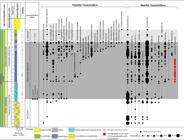
Biostratigraphic zonation, distribution of main foraminifera in the RT-01-PB core, Paraíba Basin.
Gansserina gansseri Interval Zone (CF7)
Definition: The interval is bounded by the First Occurrence (FO) of Gansserina gansseri of base and the FO of Contusotruncana contusa of top (Li & Keller, 1998a, b).
Remarks: This biozone comprises a sedimentary package composed of mudstones to packstones with marl levels at the top, having a thickness of 15.66 meters in core RT-01-PB, with the appearance of G. gansseri recorded at 22.28 meters and the appearance of C. contusa at 6.62 meters. Planktic and benthic foraminifera are abundant and diverse throughout this interval (Figure 6). FOs of planktic foraminifera occur, including Rugoglobigerina macrocephala, Pseudotextularia elegans, Planohedbergella prairiehilensis, Muricohedbergella momouthensis, Globotruncana aegyptiaca, Archaeoglobigerina blowi, Archaeoglobigerina australis, Planoheterohelix planata, Rugoglobigerina rugosa, among others less expressive. The benthic assemblage is represented by the abundance of Gyroidinoides spp., Gavelinella spp., Quinqueloculina spp. and Lenticulina spp.
Stratigraphic distribution: RT-01-PB Core (22.28 m to 6.62 m).
Horizon: upper Campanian–lower Maastrichtian.
Contusotruncana contusa Interval Zone (CF6)
Definition: In the studies of Li and Keller (1998a), the Contusotruncana contusa Zone, or CF6 Zone, was defined by the FO of the taxon Contusotruncana contusa at its base and the LO of Globotruncana linneiana at its top. In this study, the biozone (Contusotruncana contusa) was defined in the base based on the FO of the taxon Contusotruncana contusa, and top by the LO of typical Cretaceous species, such as Pseudotextularia nutalli and Planoheterohelix globulosa.
Remarks: The sedimentary interval is 3.5 meters thick and is composed of intercalations of mudstone and claystone in core RT-01-PB. The top coincides with the limit between the Gramame and Barreiras formations. At this boundary, there is a hiatus marked by the complete absence of the Paleocene section (Barbosa et al. 2004). The definition of the biozone is based on the FO of C. contusa at 6.62 meters, also associated with the FO of Pseudotextularia nutalli. Additionally, several last occurrences (LOs) are recorded of planktic foraminifera, including Muricohedbergella sliteri, Pseudotextularia elegans, Contusotruncana fornicata, Rugoglobigerina macrocephala, Muricohedbergella monmouthensis, Globotruncana aegyptiaca, Archaeoglobigerina blowi, and Rugoglobigerina rugosa (Figure 6). Regarding the benthic foraminifera, at the base of the biozone is registered LOs of Lenticulina spp. and Bolivina spp., while at the top there are LOs of Gyroidinoides spp. and Gavelinella spp.
Stratigraphic distribution: RT-01-PB Core (6.62 m to 3.12 m).
Horizon: lower Maastrichtian.
Morphogroups/ Microhabitats
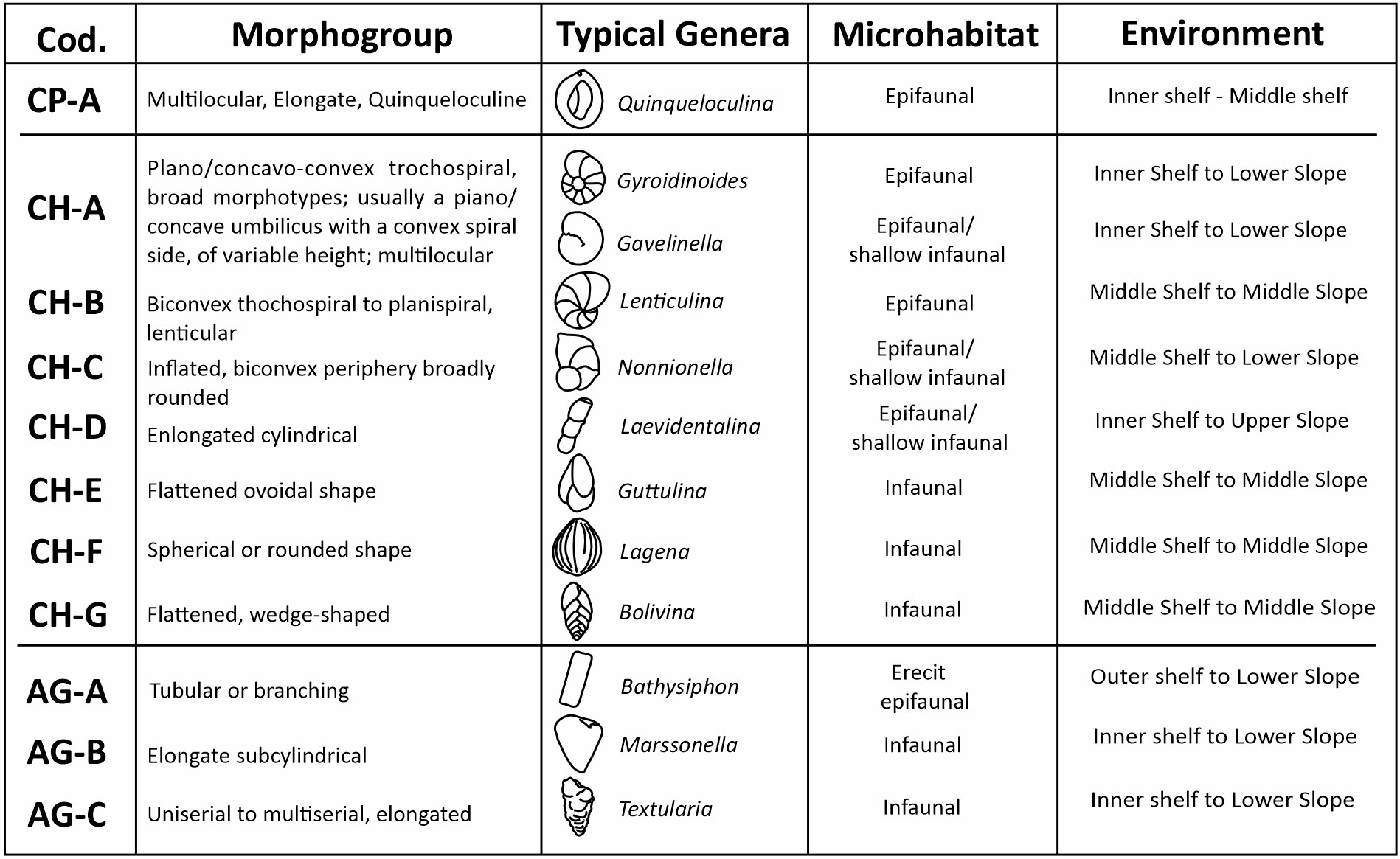
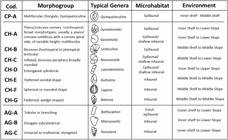
Morphogroup analyses of foraminifera were performed to interpret the possible paleoenvironments according to the genera of the specimens collected. In total, 11 morphogroups were identified, focusing on the morphotypes present in the samples (Figure 7 and 8).
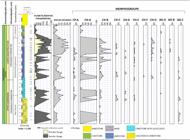
Planktic/Benthic foraminifera ratio, species richness and morphogroups occurrence, in the RT-01-PB core, Paraíba Basin.
The distribution of morphogroups is relatively constant throughout the studied section, with minimal variations. The morphogroups identified in Figure 7 describe the morphogroup CP-A, composed of porcelaneous calcareous, occurs in the interval from 30.0 m to 9.0 m. The hyaline calcareous morphogroups are the most diverse, with the CH-A morphogroup standing out as the most abundant in the entire section, occurring from the base of the core, between 30.0 m and 3.12 m. The CH-B morphogroup has the second largest distribution, occurring between 30.0 m and 6.62 m.
The CH-D and CH-E morphogroups have a similar distribution, but less expressive, occurring between 23.0 m and 7.0 m. Morphogroup F is not very significant, Occurring rarely in between 18.0 m and 7.0 m. Morphogroup CH-G occurs between 18.0 m and 6.0 m, with greater abundance in the upper intervals.
The agglutinating foraminiferal morphogroups are represented by AG-A appearing from 21.0 m, extending up to 4.0 m, occurring commonly, AG-B, which occurs between 10.0 m and 6.0 m, and AG-C, which occurs from 30.0 m to 11.0 m, with greater abundance in the most basal portion of the core (Figure 6).
Microbiofacies
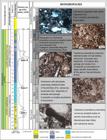
The petrographic analyses allow the identification of a diverse assemblage of foraminifera, contributing to the characterization of microbiofacies and paleoenvironmental reconstruction. In addition an assemblage of larger benthic foraminifera were identified (Figure 5).
Five types of microbiofacies were identified, based on their lithological characteristics and associated specimens (Figures 8 and 9). These microbiofacies were grouped into three main categories. The first group, designated as Fa1, is characterized by calciferous sandstones containing larger benthic foraminifera belonging to the family Meandropsinidae, associated with smaller forms of benthic foraminifera and ostracods. The second group encompasses microbiofacies Fb1 and Fb2, which exhibit lithologies ranging from wackstones to packstones, with siliclastics present in Fb1. This group is dominated by bryozoans, sponge fragments and bivalves, with foraminifera also recorded, showing a greater abundance of smaller forms of benthic foraminifera. In microbiofacies Fb2, there is a significant abundance of larger benthic foraminifera of the genus Pseudorbitoides, absent in Fb1. The third group, corresponding to microbiofacies Fc1 and Fc2, stand out for the greater richness and abundance of planktic foraminifera in the studied section. Between 11.0 m–9.0 m, authigenic phosphates occur filling the foraminiferal chambers. The lithology present is composed of wackstones to packstones, with a significant amount of ostracod skeletal bodies and bivalve fragments. Fc2 is composed of calciferous mudstones and shows a significant decrease in the abundance of foraminifera. These microbiofacies contain quartz fragments, probably originating from erosion scarps, with sedimentary fillings associated with the Barreiras Formation.
DISCUSSION
Biostratigraphic considerations
The ages were determined based on the integration of primary and secondary data from planktic foraminifera. The biostratigraphic results obtained from the analysis of planktic foraminiferal assemblages in core RT-01-PB enabled the characterization of two biozones covering the upper Campanian–lower Maastrichtian interval (Supplementary Material -Table SI).
The first observed interval comprises the Gansserina gansseri Zone of upper Campanian–lower Maastrichtian age, correlative to the zonal interval CF8a–CF7 of Li & Keller (1998a, b), corresponding to the Pseudoguembelina palpebra Zone of Huber et al. (2008). The age of the base of this interval could not be determined with precision. This is partly due to the FO of the index taxon Gansserina gansseri (CF7), which may have arisen later than it appears, influenced by the deposition of calciferous sandstones that preceded the emergence of the index taxon, indicating an environment unfavorable for planktic foraminifera (Almogi-Labin et al. 1993, Abramovich et al. 1998, 2010, Ashckenazi-Polivoda et al. 2011).
The secondary biostratigraphic markers Rugoglobigerina macrocephala and Pseudotextularia elegans occur at the base of the interval, which comprises the Gansserina gansseri Zone. According to Robaszynski et al. (1984), the FO of R. macrocephala approximately coincides with the FO of Gansserina gansseri, which was dated to 70.4 Ma. The Zone of Pseudoguembelina palpebra, covering the period from 71.64 to 69.62 Ma, from the FO of P. palpebra to the FO of Racemiguembelina fructicosa. The FO of Pseudotextularia elegans, dated to 71.79 Ma by Huber et al. (2022), also supports this interpretation.
In the Paraíba Basin, the occurrence of Gansserina gansseri (=Globotruncana gansseri), Rugoglobigerina macrocephala, and Contusotruncana contusa (=Globotruncana contusa) within the Campanian–Maastrichtian interval was first described by Tinoco (1976), in correlation with the upper part of the Guayaguare Formation on the island of Trinidad. This unit is considered correlated with the Navarro Group in Texas and, in its upper portion, equivalent to the Mendez Formation in Mexico. In agreement with this biostratigraphic interpretation, Lima & Koutsoukos (2006) on petrographic slides identified a diverse assemblage of foraminifera in the 0–36.5 m section of the CIPASA quarry, of Gramame Formation. In the section studied by the authors, the Gansserina gansseri Zone (KS 30) of Sliter (1999) of age Maastrichtian. Melo et al. (2023) identified the same biozone in sections of the Olinda Sub-Basin, also related to the Campanian–Maastrichtian interval, reinforcing the recurrence of this assemblage in different contexts of the Paraíba Basin and its correlatives.
The second biozoned interval corresponds to the C. contusa Zone, defined at its base by the FO of C. contusa, confined to the CF6 zonal interval of Li & Keller (1998a). Tinoco (1976) recorded the occurrence of Contusotruncana contusa (=Globotruncana contusa) along the coastal sedimentary strip between Recife and João Pessoa cities, placing it within the Maastrichtian and associating it with the Gramame Formation. In this locality, the species was found alongside other characteristic forms of the interval, such as Globotruncanita stuarti, Rugoglobigerina rugosa, Pseudotextularia elegans, Racemiguembelina fructicosa, and Heterohelix sp. Melo et al. (2023) identified these biozones in core sections from the Olinda Sub-Basin, Paraíba Basin, occurring similarly in limestone and marl lithologies, defining the FO of Contusotruncana contusa at the base and the LO of Gansserina linneiana at the top, and is also associated with the FOs of Polycamerella tardata, Contusotruncana contusa, and Trinitella scotti.
The upper boundary of this biozone in the studied well is defined by the LO of Cretaceous species such as P. globulosa and P. nuttalli. Barbosa et al. (2004) reported strong evidence of a significant erosional phase acting on the Gramame carbonate platform in the (Miriri/Alhandra sub-basins), when it was exposed by the regression at the end of the Maastrichtian. This event resulted in the loss of material that could represent the index taxa of the top of the Contusotruncana contusa Zone.
In core RT-01-PB, the transition from the Itamaracá Formation to the Gramame Formation was inferred based on the interruption of siliciclastic input from the basin interior. This boundary is marked by a shift from packstones with siliciclastic content to wackestones and packstones devoid of siliciclastics and by the FO of Archaeoglobigerina blowi. Data from Mikrotax (www.mikrotax.org; Pessagno 1967, Robaszynski et al. 1984) show the FO of A. blowi within the A. mayaroensis Zone (67.64–69.27 Ma) base in the Maastrichtian stage. Though works such as Georgescu et al. (2012) show the range of A. blowi as upper Coniacian–Campanian (upper part of the D. concavata Zone to the Radotruncana calcarata Zone). Another criterion for defining the age of the Gramame Formation in the section consists of the record of species considered typical of the Maastrichtian such as C. contusa, C. plicata, P. praehariaensis, G. wiedenmayeri (www.mikrotax.org), which occur only in the limestone beds, corroborating the chronostratigraphic positioning of the unit.
Paleoecological Considerations
The paleoenvironmental characterization of the studied area was based on the integration of data from foraminiferal assemblages, grouped by morphogroups, together with the determination of microbiofacies. According to Koutsoukos & Hart (1990), morphogroups comprise benthic foraminifera whose test morphology, composition, and paleoenvironmental distribution reflect specific adaptive strategies to their environment. The bathymetric framework follows Van Morkhoven et al. (1986) and Berggren & Miller (1989), defining the neritic zone (0–200 m), which is subdivided into inner (<30 m), middle (30–100 m), and outer (100–200 m) sectors.
The intervals corresponding to the upper Campanian (Itamaracá Formation) and lower Maastrichtian (base of the Gramame Formation), encompassing the lower part of the G. gansseri Zone, revealed microbiofacies Fa1, Fb1, and Fb2, comprising calcareous sandstones and limestones with siliciclastics. These frequently contain ostracods, echinoid spines, bivalve fragments, corals, and bryozoans, in addition to foraminifera, forming a typical inner ramp association (Tucker & Wright 1990, Flügel & Munnecke 2010, Dias-Brito 2017). Flügel & Munnecke (2010) inferred that a biota rich in benthic organisms, such as algae, foraminifera, and bivalves, is typical of normal marine inner platforms. The lithological association of calcareous sandstone and sandy limestone is characteristic of platforms within marine megasequences (Guardado et al. 1989), corroborated by the association between microfacies and the abundance of morphogroups CP-A, CH-A, CH-B, CH-C, and AG-C strongly indicates an inner platform environment (Figure 10), characterized by shallow and warm waters. Koutsoukos & Hart (1990), in their study of benthic foraminifera from the Sergipe Basin, reported that assemblages typical of inner to middle platforms are composed of epifaunal deposit feeders such as Gavelinella (main representative of morphogroup CH-A in this study), Dentalina (main representative of morphogroup CH-D), Nonnionella (main representative of morphogroup CH-C), Quinqueloculina (main representative of morphogroup CP-A), as well as agglutinated forms like textulariids (AG-A). The recurrent presence of these same morphotypes in the lower levels of the analyzed section reinforces their affinity with more restricted and shallow environments (Figure 7).
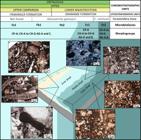
Paleoenvironmental model interpreted from microbiofacies and morphogroup data. Bv - bivalve fragment; Co - coral fragment; Fos - Phosphate grain; Os - Ostracod; Mfb - large benthic foraminifera; Porb - Pseudorbitoides; Fb - benthic foraminifera; Fp - planktic foraminifera.
Foraminiferal assemblages present in the interval, where microbiofacies Fa1, Fb1 and Fb2 predominate, are primarily represented by epifaunal morphogroups, indicating oligotrophic environments (Jorissen et al. 1995) (Figure 10). The main occurrences of foraminifera found in microbiofacies include planktic foraminifera, including keeled, (globotruncanids), trochospiral (ruglobligerinds), planispiral (globigerinelloids), and biserial (heterohelicids), corresponding to the Tethysian Province (Premoli Silva & Sliter, 1999). The benthic foraminifera are represented by Lenticulina, Siphogenerinoides, and an abundance of larger benthic foraminifera Pseudorbitoides.
The distribution of larger benthic foraminifera in recent tropical and subtropical environments is largely controlled by environmental factors such as light penetration up to 150 m in clear waters, nutrient availability, turbidity, depth, temperature, and salinity (Hallock 1984, 1988, Hallock & Glenn 1986, Leutenegger 1984, Hohenegger 2000, 2004). These organisms typically host photosynthetic algae as symbionts, a relationship that is only effective in warm, oligotrophic environments within the photic zone (Omaña et al. 2021). In modern seas, symbiont-bearing foraminifera are restricted to regions where the minimum sea surface temperature is at least 16 °C during the coldest month (Langer & Hottinger 2000). Given this pattern, it is presumed that Mesozoic benthic foraminifera had a similar distribution (Hohenegger 2004, Boudaugher-Fadel 2008).
In core RT-01-PB, the genus Pseudorbitoides, identified between 18–11 m (Fb2), can indicate a shallow platform environment with warm conditions and moderate to high energy (Goldbeck & Langer 2009). In the study area, the association between lithology and microfossil content suggests a depositional system characterized by significant siliciclastic sediment input. This scenario proves to be optimal for the occurrence of Pseudorbitoides that also inhabited high-energy environments with turbulent waters and increased siliciclastic deposition (Seiglie & Ayala-Castañares 1963). Dias-Brito (2017) suggests that limestones rich in larger benthic foraminifera indicate deposition in calm environments on inner platforms, implying that accumulation areas were near the platform high/margin, with reworking of shallow-water bioclasts.
The paleobiogeographic distribution of Pseudorbitoides reveals a pattern that is markedly restricted to the Caribbean region (Omaña et al. 2021), where it is considered an important center of abundance and diversity of reef forms during the Maastrichtian (Seiglie & Ayala-Castañares 1963). Continuing this line of thought, Seiglie (1974) highlighted that the family Pseudorbitoididae, whose oldest representative is the genus Sulcorbitoides, has its origin recorded in the Campanian and is considered endemic to the Caribbean region. Despite the Caribbean concentration, sparse records suggest that Pseudorbitoides were not absolutely confined to this province, for example, Hanzawa (1962) report the presence of Pseudorbitoides in New Guinea. Chengjie (1987) documented the presence of Pseudorbitoides yini in southern Tibet and re-evaluated the Indian form “Orbitocyclina ariyalurensis”, proposing its inclusion within the genus Pseudorbitoides. The records from New Guinea and the Central Pacific previously described by Beckmann (1976) and Premoli Silva et al. (1995), broadens the distributional scope of the group and suggests the need to reassess the traditionally accepted paleobiogeographic boundaries for Upper Cretaceous larger foraminifera. This geographically restricted distribution of Pseudorbitoides contrasts with the wide dispersal of the genus Orbitoides (Orbitoididae), which is common throughout the Tethyan realm. Kupper (1954) had already suggested that this difference could be related to the presence of a more efficient planktic neanic stage in Orbitoides, a hypothesis that remains unconfirmed but is frequently cited in literature as a possible explanatory factor. In the context of global dispersal patterns of larger benthic foraminifera, Boudaugher-Fadel & Price (2021) noted that while interprovincial migrations were possible during the Cretaceous as exemplified by orbitolinids that migrated from the Tethyan domain to the American province during episodes of sea-level fall, these transfers were uncommon and often resulted in parallel, poorly diversified lineages. The specimens of larger benthic foraminifera of Pseudorbitoididae from the Paraíba Basin have revealed morphologies different from those of Orbitoididae. For example, the embryonic chambers of Pseudorbitoides are microspheric and uniserial. In the neanic stage, a system of vertical radial plates develops within the equatorial layer, typically reduced and irregular toward the periphery. The primary lateral layer is deposited over these plates and the embryonic chambers, while the lenticular thickening of the test results from the regular addition of secondary layers of lateral chambers interconnected by basal stolons and fine pores (Loeblich & Tappan 1988). This suggests a possible episode of dispersal or affinity between Caribbean and Brazilian faunas during the Campanian–Maastrichtian interval.
The wackestone composition with planktic foraminifera such as Gansserina, Contusotruncana, Globotruncana, and Globotruncanita indicates an open hemipelagic marine influence with moderate energy (Deloffre et al. 1985, Michaud 1988). Meanwhile, packstone-wackestone deposits with larger foraminifera benthic (alveolinids) thrived in smooth substrate environments characterized by wackestone, indicating a protected shallow lagoon environment with low hydrodynamic energy within the euphotic zone (Deloffre et al. 1985, Michaud 1988). The foraminiferal assemblage from the core suggests platform environments ranging from inner to middle ramp, with paleobathymetric conditions spanning from shallow neritic (0–30 m) to middle neritic (~30–100 m) within an oligotrophic setting (Van Morkhoven et al. 1986, Berggren & Miller 1989). The first interval, primarily defined by the accumulation of larger benthic foraminifera, suggests such conditions. Hottinger (2001) report that Late Cretaceous larger benthic foraminifera indicate environments with low nutrient concentrations and low primary productivity.
In the intervals corresponding to the top of lower Maastrichtian (Gramame Formation) of the analyzed section, wackestones/packstones interbedded with marls and claystones at the top, represented by the abundant occurrence of morphogroups CH-A, CH-B, CH-G, and AG-B. The assemblages are dominated by epifaunal and shallow infaunal deposit feeders, such as plano-convex to low, broadly trochospiral forms (CH-A) and lenticular to planispiral forms (CH-B), along with deeper infaunal deposit feeders, represented by elongated and conical morphotypes (CH-G). This composition is consistent with the descriptions by Koutsoukos & Hart (1990) for middle to outer platform environments, where foraminiferal communities are dominated by detritivorous species adapted to various substrate depths and microbiofacies Fc1 and Fc2, are observed, featuring numerous skeletal remains of foraminifera and ostracods. The benthic foraminiferal assemblages are mainly composed of Gyroidinoides and Coryphostoma, while the planktic assemblages include Pseudotextularia elegans, Planoheterohelix, Archaeoglobigerina, and Globotruncanella. This interval shows a peak in the diversity and abundance of planktic foraminifera, associated with the occurrence of authigenic phosphate filling the chambers of these foraminifera. The phosphate level is recorded between 11.0 m and 9.0 m, immediately after the disappearance of the larger benthic foraminifera, such as Pseudorbitoides, which occur in packstones, followed by alternations of wackestones/packstones and marls. Along with this peak in phosphate abundance and occurrence, a corresponding gamma ray peak is observed. During the drilling of well RT-01-PB, a gamma ray test identified three peaks, with the largest and most prominent occurring in this interval (Neto 1979, unpublished data, Table SII).
Between 11.0 m and 9.0 m, the depositional setting suggests a transition from middle to outer ramp environments, corresponding to paleobathymetric conditions ranging from intermediate neritic (>30 m) to outer neritic (<200 m) depths (Van Morkhoven et al. 1986, Berggren & Miller 1989), as well as a shift from oligotrophic to mesotrophic conditions driven by upwelling events and increased infaunal morphogroup concentrations (Jorissen et al. 1995). These local signals are consistent with broader paleoceanographic trends, as isotopic evidence indicates that the North Atlantic may have acted as one of the main centers of warm, saline deep-water formation during the Campanian–Maastrichtian, thereby influencing both oceanic circulation and relative sea-level changes (Hay & DeConto 1999, Barrera & Savin 1999). The covariation of δ¹⁸O values in planktic and benthic foraminifera across different latitudes reveals synchronous responses, underscoring the active role of the Atlantic in driving global eustatic oscillations during the Late Cretaceous (Barrera et al. 1997). Comparable patterns have also been documented in Europe, Kędzierski & Leszczyński (2013), for example, examined the upper Campanian–lower Maastrichtian succession in the Polish Carpathian Flysch Basin using calcareous nannofossils, identifying a relative sea-level rise associated with dominant carbonate sedimentation and intensified coastal upwelling that enhanced pelagic productivity.
Phosphogenesis in the Paraíba Basin: evidence of a global event
Phosphatic sedimentation in the Paraíba Basin occurred during the final stage of the Itamaracá Formation and is part of a global phosphogenesis event (Souza & Lima Filho 2005). This event is known as the Tethyan Phosphogenesis, with phosphorite deposits associated with carbonate platforms ranging from the Late Cretaceous to the Middle Eocene (Pufahl et al. 2003). Kegel (1954, 1955) reported the presence of phosphatic beds in the Lower Maastrichtian, while Souza & Lima Filho (2005) described phosphate deposition as characterized by a horizon of reduced sedimentation rates or a hardground at the top of the Itamaracá Formation. The phosphatic level extends throughout the basin, from the northern portion, in the João Pessoa region, Paraíba State, to the southern portion, near the Recife region, Pernambuco State, with variable concentrations (Menor et al. 1977).
Souza & Lima Filho (2005) suggested that the deposition of the phosphorite layer in the Paraíba Basin may be associated with upwelling events, driven by oceanic currents flowing from south to north between the African and South American continents, in response to a eustatic rise of considerable magnitude. In this context, the phosphate layer is genetically linked to the transgressive phase, marking the Maximum Flooding Surface of the sequence. According to Pufahl (2010), phosphorites deposited on continental margins typically form in outer shelf settings. The lithological association can be highly variable, as phosphorites may be deposited in both carbonate systems and terrigenous clastic systems. However, they are more commonly associated with clastic successions, reflecting nutrient-rich, eutrophic conditions. Pufahl (2010) further highlights that this is a key factor controlling phosphorite precipitation in upwelling settings. Phosphogenesis in upwelling environments is linked to microbial activity, where pure phosphorite forms in non-bioturbated, oxygen-depleted settings due to microorganisms decomposing organic matter accumulated on the seafloor (Pufahl 2010).
Mabesoone & Alheiros (1988) reported that phosphate deposition persisted until the accumulation of the calcareous microbiofacies of the Gramame Formation. During this period, a gradual subsidence of the barrier occurred, possibly intensified by the major Maastrichtian transgression. This process allowed planktic forms from open and deeper ocean waters to expand over a slightly irregular, submerged shelf floor, where planktic faunas mixed with benthic faunas from shallower areas. This situation was marked by the accumulation of phosphate-rich sediments, resulting from the upwelling of deeper ocean waters onto shallow platform settings.
A similar phenomenon was recorded between 11.0 m and 9.0 m in core RT-01-PB. Neto (1979, unpublished data, Table SII) conducted natural gamma-ray analyses in this borehole, measured in counts per second (CPS), and identified three anomalous zones (Zones I–III, Figure 9), with Zone III (10.93–8.80 m) showing the most significant enrichment, reaching up to 200 CPS and 5.2% P₂O₅. A significant increase in infaunal benthic foraminifera was observed, particularly in morphogroup CH-G, which comprises flattened and wedge-shaped forms mainly represented by the genus Bolivina. In addition, considerable increases were also recorded in morphogroup CH-E, characterized by a flattened ovoidal shape (Guttulina), and in morphogroup CH-F, defined by spherical to rounded forms (Lagena), indicates reduced oxygenation relative to epifaunal assemblages in Zone III, suggesting hypoxic conditions (Jorissen et al. 1995). The disappearance of larger benthic foraminifera, Pseudorbitoides, in the same interval may also be related to such events.
The association of low oxygenation, higher phosphate concentration, and the gamma-ray peak supports the interpretation of an upwelling event. Lima & Koutsoukos (2006) described disseminated phosphate mineralization throughout the Gramame Formation. According to the authors, these occurrences are linked to a significant positive anomaly in P₂O₅ values, particularly during the lower Maastrichtian, when a Maximum Flooding Surface (MFS) developed. This surface represents a period of relative sea-level rise, which led to drowning of the source area and a consequent reduction in sedimentation rates. Such conditions favored the formation of authigenic phosphates, indicating a condensed section.
CONCLUSIONS
Well RT-01-PB in the Miriri Sub-Basin, Paraíba Basin, yielded a diverse foraminiferal assemblage, providing refined age constraints, paleoenvironmental insights, and evidence of novel paleobiogeographic patterns. Two planktic foraminiferal biozones, Gansserina gansseri and Contusotruncana contusa, constrained the succession to the late Campanian–early Maastrichtian interval. Benthic assemblages revealed 11 morphogroups, and petrographic analyses identified five microbiofacies, showing that during the late Campanian to early Maastrichtian the area was a shallow oligotrophic platform (0–100 m). In the early Maastrichtian, it evolved into an intermediate–outer ramp (100–200 m) under mesotrophic conditions, influenced by upwelling and reduced oxygenation. The occurrence of larger benthic foraminifera such as Pseudorbitoides represents the first record of this genus in Brazil for the Late Cretaceous, expanding its paleobiogeographic distribution and reinforcing a possible connection with the Tethyan realm. These results contribute to refining global correlations of foraminiferal assemblages and enhance the understanding of paleoceanographic dynamics during the Campanian–Maastrichtian on the South American Platform. In this context, future investigations should prioritize advancing studies on a larger benthic foraminifera, with a focus on taxonomic refinement and paleogeographic distribution, to more accurately assess the Tethyan influence recorded in the core and its potential connections with the North Atlantic. Thus, beyond providing a more robust biostratigraphic framework, this work broadens the basis for intercontinental correlations and for integrating regional paleogeography into the global context of Late Cretaceous paleoceanographic evolution.
Acknowledgements
This study was funded by the Fundação de Amparo à Ciência e Tecnologia de Pernambuco, Brazil (FACEPE, Process APQ-1173-1.07/22), and by the Geological Service of Brazil – SGB/CPRM for providing the samples used in this study. We also thank PETROBRAS for their financial support to projects developed in Applied Micropaleontology Laboratory. Our thanks to Prof. João Adauto (LGAPE) for his assistance in the petrographic microscopy sessions. The Advanced Microscopy and Imaging Laboratory (LAMI) at the Northeast Biodiversity Prospecting and Management Center - NPGBio (FACEPE APQ-0522-2.04/19) by capturing the images in the scanning electron microscope. EKP thanks the Conselho Nacional de Desenvolvimento Científico e Tecnológico – CNPq (grant n. 303656/2025-5) Finally, we would like to thank the anonymous reviewers and editors for their detailed suggestions, which allowed us to improve this manuscript.
References
-
ABRAMOVICH S, ALMOGI-LABIN A & BENJAMINI C. 1998. Decline of the Maastrichtian pelagic ecosystem based on planktic foraminifera assemblage change: Implication for the terminal Cretaceous faunal crisis. Geology 26(1): 63-66. https://doi.org/10.1130/0091-7613(1998)026%3C0063: DOTMPE%3E2.3.CO;2.
» https://doi.org/10.1130/0091-7613(1998)026 -
ABRAMOVICH S & KELLER G. 2002. High stress late Maastrichtian paleoenvironment: inference from Planktic foraminifera in Tunisia. Palaeogeogr Palaeoclimatol Palaeoecol 178(3-4): 145-164. https://doi.org/10.1016/s0031-0182(01)00394-7.
» https://doi.org/10.1016/s0031-0182(01)00394-7 -
ABRAMOVICH S & KELLER G. 2003. Planktic foraminiferal response to the latest Maastrichtian abrupt warm event: a case study from South Atlantic DSDP Site 525. Mar micropaleontol 48(3-4): 225-249. https://doi.org/10.1016/s0377-8398(03)00021-5.
» https://doi.org/10.1016/s0377-8398(03)00021-5 -
ABRAMOVICH S, YOVEL-COREM S, ALMOGI-LABIN A & BENJAMINI C. 2010. Global climate change and planktic foraminiferal response in the Maastrichtian. Paleoceanography 25(2). https://doi.org/10.1029/2009PA001843
» https://doi.org/10.1029/2009PA001843 -
ALBERTÃO GA, KOUTSOUKOS EA, REGALI MP, ATTREP JR M & MARTINS JR PP. 1994. The Cretaceous-Tertiary boundary in southern low-latitude regions: preliminary study in Pernambuco, northeastern Brazil. Terra Nova 6(4): 366-375. https://doi.org/10.1111/j.1365-3121.1994.tb00509.x.
» https://doi.org/10.1111/j.1365-3121.1994.tb00509.x -
ALMOGI-LABIN A, BEIN A & SASS E. 1993. Late Cretaceous upwelling system along the southern Tethys margin (Israel): interrelationship between productivity, bottom water environments and organicmatter preservation. Paleoceanography 8: 671-690. https://doi.org/10.1029/93PA02197.
» https://doi.org/10.1029/93PA02197 - ALPERIN M, BERNASCONI E & CUSMINSKY G C. 2008. Asociaciones de foraminíferos bentónicos recientes de la Plataforma Continental Argentina (39°-43° S y 58°-65° O) analizadas con métodos estadísticos para datos composicionales. Ameghiniana 45(2): 443-461.
-
ANDRADES-FILHO CO, DE FÁTIMA ROSSETTI D & BEZERRA FHR. 2021. The unsteady post-rift stage of the South American passive margin based on the tectono-sedimentary evolution of the onshore Paraíba Basin, NE Brazil. Quaternary International 580: 100-119. https://doi.org/10.1016/j.quaint.2020.10.051.
» https://doi.org/10.1016/j.quaint.2020.10.051 -
ARAI M. 2006. A grande elevação eustática do mioceno e sua influência na origem do Grupo Barreiras. Geologia USP. Série Científica 6(2): 1-6. https://doi.org/10.5327/S1519-874X2006000300002.
» https://doi.org/10.5327/S1519-874X2006000300002 -
ASHCKENAZI-POLIVODA S, ABRAMOVICH S, ALMOGI-LABIN A, SCHNEIDER-MOR A, FEINSTEIN S, PÜTTMANN W & BERNER Z. 2011. Paleoenvironments of the latest Cretaceous oil shale sequence, Southern Tethys, Israel, as an integral part of the prevailing upwelling system. Palaeogeogr Palaeoclimatol Palaeoecol 305(1-4): 93-108. https://doi.org/10.1016/j.palaeo.2011.02.018.
» https://doi.org/10.1016/j.palaeo.2011.02.018 - BAK K, BAK M, GEROCH S & MANECKI M. 1997. Biostratigraphy and paleoenvironmental analysis of benthic foraminifera and radiolarians in Paleogene variegated shales in the Skole unit, Polish Flysch Carpathians. Ann Soc Geol Pol 67(2-3): 135-154. https://geojournals.pgi.gov.pl/asgp/article/view/12459/10933.
- BARBOSA JA, DE SOUZA EM, FILHO MFL & NEUMANN VH. 2003. A estratigrafia da Bacia Paraíba: uma reconsideração. Estudos Geológicos 13: 89-108.
-
BARBOSA JA, KELLER G, ADATTE T, NEUMANN V H & LIMA FILHO M. 2006. Maastrichtian-Paleocene deposition in the Paraíba basin, NE Brazil. Anuário do Instituto de Geociências 29(1): 480-481. https://doi.org/10.11137/2006_1_480-481.
» https://doi.org/10.11137/2006_1_480-481 - BARBOSA JA, NEUMANN VH, LIMA FILHO M, SOUZA ED & MORAES MD. 2007. Estratigrafia da faixa costeira Recife-Natal (Bacia da Paraíba e Plataforma de Natal), NE Brasil. Estudos Geológicos 17(2): 3-30.
- BARBOSA JA, SOUZA EM, LIMA FILHO M & NEUMANN VH. 2004. The stratigraphic evolution of the Paraíba Basin, NE Brazil: a basic analysis using sequence stratigraphy tools. AAPG BULL 88: 13.
-
BARRERA E & SAVIN SM. 1999. Evolution of late Campanian-Maastrichtian marine climates and oceans. In Evolution of the Cretaceous Ocean-Climate System. Geol Soc Am 332: 245-282. https://doi.org/10.1130/0-8137-2332-9.245.
» https://doi.org/10.1130/0-8137-2332-9.245 -
BARRERA E, SAVIN SM, THOMAS E & JONES CE. 1997. Evidence for thermohaline-circulation reversals controlled by sea-level change in the latest Cretaceous. Geology 25(8): 715-718. https://doi.org/10.1130/0091-7613(1997)025%3C0715: EFTCRC%3E2.3.CO;2.
» https://doi.org/10.1130/0091-7613(1997)025 - BERGER WH & DIESTER-HAASS L. 1988. Paleoproductivity: the benthic/planktic ratio in foraminifera as a productivity index. Mar Geol 81(1-4): 15-25.
-
BERGGREN WA & MILLER KG. 1989. Cenozoic bathyal and abyssal calcareous benthic foraminiferal zonation. Micropaleontol 35(4): 308-320. https://doi.org/10.2307/1485674.
» https://doi.org/10.2307/1485674 - BECKMANN JP. 1976, Shallow-water foraminifers and associated, Deep Sea Drilling Project 33: 467-489.
-
BERNHARD JM. 1986. Characteristic assemblages and morphologies of benthic foraminifera from anoxic, organic-rich deposits: Jurassic through Holocene. J Foramin Res 16: 207-215. https://doi.org/10.2113/gsjfr.16.3.207.
» https://doi.org/10.2113/gsjfr.16.3.207 - BERNASCONI E & CUSMINSKY G. 2005. Distribución de Nonionella auris (d’Orbigny)(Foraminiferida) en el golfo San Matías, Provincia de Río Negro, Argentina. Ameghiniana 42(1): 167-174.
- BERNASCONI SM, ČRNE AE, MÉHAY S, KELLER CE, HOCHULI PA, ERBA E & WEISSERT H. 2009. CO2 pulses and carbonate and biotic crises in the Mesozoic. Geochim Cosmochim Ac 73(13): A113.
- BEURLEN K. 1967a. Estratigrafia da faixa sedimentar costeira Recife-João Pessoa. Bol Soc Bras Geol 16 (1): 43-53.
- BEURLEN K. 1967b. Paleontologia da faixa sedimentar costeira Recife-João Pessoa. Bol Soc Bras Geol 16(1): 73-79.
- BOLTOVSKOY E & WRIGHT R. 1976. Planktonic foraminifera. In: Recent Foraminifera. Springer Netherlands, p. 159-195. doi: 10.1007/978-94-017-2860-7_7.
- BOUDAUGHER-FADEL MK. 2008. Evolution and Geological Significance of Larger Benthic Foraminifera; Dev Palaeontol Stratigr 21: 544. https://doi.org/10.14324/111.9781911576938.
- BOUDAUGHER-FADEL MK, BANNER FT & WHITTAKER JE. 1997. Aspects of the probable physiology and ecology of the Praehedbergellidae, aided by studies of living Globigerinacea. In: The early evolutionary history of planktic foraminifera, Springer Netherlands 1(13): 229-243.
-
BOUDAUGHER-FADEL MK & PRICE GD. 2021. The geographic, environmental and phylogenetic evolution of the Alveolinoidea from the Cretaceous to the present day. UCL Open Environment 3: e015. https://doi.org/10.14324/111.444/ucloe.000015.
» https://doi.org/10.14324/111.444/ucloe.000015 - CARON M. 1985. Cretaceous planktic foraminifera. In: Bolli HM, Saunders JB & Perch-Nielsen K (Eds), Plankton stratigraphy. Cambridge University Press, Cambridge, p. 17-86.
- CARON M & HOMEWOOD P. 1983. Evolution of early planktic foraminifers. Mar Micropaleontol 7(6): 453-462.
- CHENGJIE L. 1987. New knowledge of the geographical distribution of Pseudorbitoides (Foraminifera) and its new species from South Tibet, China. Chinese J Geol 22(1): 93-96.
- CORREIA FILHO OJ, ALENCAR ML, BARBOSA JA & NEUMANN VH. 2015. Proposta de formalização da formação Tambaba, Eoceno da bacia Paraíba, NE do Brasil. Estudos Geológicos 25(2): 61-81.
- DELOFFRE R, FOURCADE E & MICHAUD F. 1985., Acroporella chiapasis nov. sp., algue dasycladacea du Maastritchtien du Chiapas (SE Mexique). Bulletin Centre Research Exploration Production, Elf Aquitaine 9(1): 115-125.
- DIAS-BRITO D. 2017. Guia petrográfico dos carbonatos do Brasil. Rio Claro, UNESP-IGCE-UNESPetro, 244 p.
-
DUNHAM RJ. 1962. Classification of carbonate rocks acording to depositional texture. AAPG Memoir, p. 108-121. https://doi.org/10.1306/M1357
» https://doi.org/10.1306/M1357 -
ELLIS BF & MESSINA AR. 1940. Catalogue of Foraminifera. New York, NY, USA: Am Mus Nat His. https://www.marinespecies.org/Foraminifera/
» https://www.marinespecies.org/Foraminifera/ -
FLÜGEL E & MUNNECKE A. 2010. Microbiofacies of carbonate rocks: analysis, interpretation and application. Springer Berlin, Heidelberg, 984 p. https://doi.org/10.1007/978-3-642-03796-2
» https://doi.org/10.1007/978-3-642-03796-2 -
FRIEDRICH O, HEMLEBEN C & HERRLE J O. 2005. Climatic changes in the Late Campanian- Early Maastrichtian: micropaleontology and stable isotopic evidence from an epicontinental sea. J Foramin Res 35: 228-247. https://doi.org/10.2113/35.3.228.
» https://doi.org/10.2113/35.3.228 -
FRIEDRICH O, ERBACHER J, WILSON PA, MORIYA K & MUTTERLOSE J. 2009. Paleoenvironmental changes across the Mid Cenomanian Event in the tropical Atlantic Ocean (Demerara Rise, ODP Leg 207) inferred from benthic foraminiferal assemblages. Mar Micropaleontol 71(1-2): 28-40. https://doi.org/10.1016/j.marmicro.2009.01.002.
» https://doi.org/10.1016/j.marmicro.2009.01.002 - GEORGESCU MD. 2012, Evolutionary classification of the Late Cretaceous (Coniacian-Maastrichtian) planktic foraminifera Archaeoglobigerina Pessagno, 1967 and Gandolfia new genus/directional lineage. In: Bailey DR & Howard SE (Eds), Deep-Sea Marine Biology, Geology, and Human Impact: Nova Science Publishers, New York, p. 101- 130.
-
GERTSCH B, KELLER G, ADATTE T & BERNER Z. 2013. The Cretaceous-Tertiary boundary (KTB) transition in NE Brazil. J Geol Soc 170(2): 249-262. https://doi.org/10.1144/jgs2012-029.
» https://doi.org/10.1144/jgs2012-029 - GOLDBECK E J & LANGER MR. 2009. Biogeographic provinces and patterns of diversity in selected Upper Cretaceous (Santonian-Maastrichtian) larger foraminifera. In: Demchuk T & Jones GD (Eds), Geological Problem Solving with Microfossils, Society for Sedimentary Geology, p. 187-232. https://doi.org/10.2110/sepmsp.093.187.
- GRADSTEIN FM. 1976. Biostratigraphy and biogeography of Jurassic Grand Banks Foraminifera. In: Schafer C T & Pelletier BR (Eds), Maritime Sediments, Special Publication 1B: 557-583.
-
GRADSTEIN F, WASKOWSKA A & GLINSKIKH L. 2021. The first 40 million years of planktic foraminifera. Geosciences 11(2): 85. https://doi.org/10.3390/geosciences11020085.
» https://doi.org/10.3390/geosciences11020085 - GUARDADO LR, GAMBOA LA P & LUCCHESI CF. 1989. Petroleum geology of the Campos Basin, Brazil, a model for a producing Atlantic type basin. In: Edwards JD & Santogrossi PA (Eds), Divergent/Passive Margin Basins. AAPG Memoir 3-70. https://doi.org/10.1306/M48508C1.
-
GUSMÃO RB, PIOVESAN EK, MELO RM, NOUCOUCOUK AA & SILVA CRM. 2024. Extração De Microfósseis Carbonáticos: Análise De Diferentes Métodos De Preparação. Terrae Didatica 20: e024023. https://doi.org/10.20396/td.v20i00.8676729.
» https://doi.org/10.20396/td.v20i00.8676729 -
HALLOCK P. 1984. Distribution of selected species of living algal symbiont-bearing foraminifera on two Pacific coral reefs. J Foramin Res 14(4): 250-261. https://doi.org/10.2113/gsjfr.14.4.250.
» https://doi.org/10.2113/gsjfr.14.4.250 - HALLOCK P. 1988. Diversification in algal symbiont-bearing foraminifera: a response to oligotrophy? Rev Paléobiol 2: 789-797.
-
HALLOCK P & GLENN EC. 1986. Larger foraminifera: a tool for paleoenvironmental analysis of Cenozoic carbonate depositional facies. Palaios 1: 55-64. https://doi.org/10.2307/3514459.
» https://doi.org/10.2307/3514459 - HANZAWA S. 1962. Upper Cretaceous and Tertiary three-layered larger foraminifera and their allied forms. Micropaleontol 129-186.
-
HART MB. 1980. A water depth model for evolution of the planktic foraminifera. Nature 286: 252-254. https://doi.org/10.1038/286252a0.
» https://doi.org/10.1038/286252a0 -
HART MB, HYLTON MD, OXFORD M J, PRICE GD, HUDSON W & SMART C W. 2003. The search for the origin of the planktic Foraminifera. J Geol Soc 160(3): 341-343. https://doi.org/10.1144/0016-764903-003.
» https://doi.org/10.1144/0016-764903-003 - HAY WW & DECONTO RM. 1999. Comparison of modern and Late Cretaceous meridional energy transport and oceanology. In: Barrera E & Johnson CC (Eds), Evolution of the Cretaceous ocean-climate system. Geol Soc Am 332, p. 283-300. https://doi.org/10.1130/0-8137-2332-9.283.
- HOHENEGGER J. 2000. Coenoclines of larger foraminifera. Micropaleontol 46: 127-151. https://www.jstor.org/stable/1486185.
-
HOHENEGGER J. 2004. Depth coenoclines and environmental considerations of western Pacific larger foraminifera. J Foramin Res 34(1): 9-33. https://doi.org/10.2113/0340009.
» https://doi.org/10.2113/0340009 -
HOTTINGER L. 2001. Archaiasinids and related porcelaneous larger foraminifera from the Late Miocene of the Dominican Republic. J Paleontol 75(3): 475-512. https://doi.org/10.1666/0022-3360(2001)0752.0.CO;2.
» https://doi.org/10.1666/0022-3360(2001)0752.0.CO;2 -
HUBER BT, HODELL DA & HAMILTON CP. 1995. Middle Late Cretaceous climate of the southern high latitudes: Stable isotopic evidence for minimal equator-to-pole thermal gradients. Geol Soc Am Bull 107: 1164-1191. https://doi.org/10.1130/0016-7606(1995)107<1164: MLCCOT>2.3.CO.
» https://doi.org/10.1130/0016-7606(1995)107 -
HUBER BT, MACLEOD KG & TUR NA. 2008. Chronostratigraphic framework for upper Campanian-Maastrichtian sediments on the Blake nose (subtropical north Atlantic). J Foramin Res 38(2): 62-182. https://doi.org/10.2113/gsjfr.38.2.162.
» https://doi.org/10.2113/gsjfr.38.2.162 -
HUBER BT, PETRIZZO MR & FALZONI F. 2022. Taxonomy and phylogeny of AlbianeMaastrichtian planispiral planktic foraminifera traditionally assigned to Globigerinelloides Micropaleontol 68: 117-183. https://doi.org/10.47894/mpal.68.2.01.
» https://doi.org/10.47894/mpal.68.2.01 - HUBER BT, PETRIZZO MR, YOUNG JR, FALZONI F, GILARDONI SE, BOWN PR & WADE BS. 2016. Pforams@microtax: A new online taxonomic database for Planktic foraminifera. Micropaleontol 62(6): 429-438. https://www.mikrotax.org/pforams.
-
JENKYNS HC, GALE AS & CORFIELD RM. 1994. Carbon- and oxygen-isotope stratigraphy of the English Chalk and Italian Scaglia and its palaeoclimatic significance. Geological Mag 131(1): 1-34. https://doi.org/10.1017/s0016756800010451.
» https://doi.org/10.1017/s0016756800010451 - JONES RW & CHARNOCK MA. 1985. “Morphogroups” of agglutinating Foraminifera. Their life positions and feeding habitats and potential applicability in (palaeo)ecological studies. Rev Paléobiol 4: 311-320.
- JORISSEN FJ, DE STIGTER HC & WIDMARK GV. 1995. A conceptual model explaining benthic foraminiferal microhabitats. Mar Micropaleontol 26: 3-16.
-
KĘDZIERSKI M & LESZCZYŃSKI S. 2013. A paleoceanographic model for the Late Campanian-Early Maastrichtian sedimentation in the Polish Carpathian Flysch basin based on nannofossils. Mar Micropaleontol 102: 34-50. https://doi.org/10.1016/j.marmicro.2013.06.001.
» https://doi.org/10.1016/j.marmicro.2013.06.001 - KEGEL W. 1954. Nota sobre os microfósseis do fosfato Cretáceo de Pernambuco. Bol Soc Bras Geol 3: 25.
- KEGEL W. 1955. Geologia do fosfato de Pernambuco. Dep Nac de Prod Min Boletim 157: 54.
- KEGEL W. 1957. Novo Membro fossilífero da Formação Itamaracá (Cretáceo Superior) De Pernambuco. An Acad Bras Cienc 29(3): 373-375.
-
KELLER G. 1988a. Extinction, survivorship and evolution of planktic foraminifers across the Cretaceous/Tertiary boundary at El Kef, Tunisia. Mar Micropaleontol 13(3): 239-263. https://doi.org/10.1016/0377-8398(88)90005-9.
» https://doi.org/10.1016/0377-8398(88)90005-9 - KELLER G. 1988b. Biotic turnover in benthic foraminifera across the Cretaceous/Tertiary boundary at El Kef, Tunisia. Palaeogeogr Palaeoclimatol Palaeoecol 66(3-4): 153-171.
- KELLER G, LI L & MACLEOD N. 1995. The Cretaceous/Terti-ary boundary stratotype section at El Kef, Tunisia: howcatastrophic was the mass extinction? Palaeogeogr Palaeoclimatol Palaeoecol 119: 221-254.
-
KELLER G, ADATTE T, STINNESBECK W, LUCIANI V, KAROUI-YAAKOUB N & ZAGHBIB-TURKI D. 2002. Paleoecology of the Cretaceous-Tertiary mass extinction in planktic foraminifera. Palaeogeogr Palaeoclimatol Palaeoecol 178(3-4): 257-297. https://doi.org/10.1016/0031-0182(95)00009-7.
» https://doi.org/10.1016/0031-0182(95)00009-7 -
KELLER G & ABRAMOVICH S. 2009. Lilliput effect in late Maastrichtian planktic foraminifera: response to environmental stress. Palaeogeogr Palaeoclimatol Palaeoecol 284: 4762. https://doi.org/10.1016/j.palaeo.2009.08.029.
» https://doi.org/10.1016/j.palaeo.2009.08.029 - KOUTSOUKOS EAM. 1996. The Cretaceous-Tertiary Boundary at Poty, NE Brazil - Event stratigraphy and palaeoenvironments. In: Jardiné S, De Klasz I & Debenay JP (Eds), Géologie de L’Afrique et de L’Atlantique Sud, Elf Aquitaine Édition, Mémoire 16: 413-431.
- KOUTSOUKOS E A. 1998. An extraterrestrial impact in the early Danian: a secondary K/T boundary event? Terra Nova Oxford 10: 68-73.
-
KOUTSOUKOS EAM. 2006. The Cretaceous-Paleogene boundary at the Poty section, NE Brazil: foraminiferal record and sequence of events - a review. Anuario Instituto de Geociencias 29(1): 95-107. https://doi.org/10.11137/2006_1_95-107.
» https://doi.org/10.11137/2006_1_95-107 - KOUTSOUKOS EA & HART MB. 1990. Cretaceous foraminiferal morphogroup distribution patterns, palaeocommunities and trophic structures: a case study from the Sergipe Basin, Brazil. Trans Earth Sci 81: 221-246.
- KUPPER K. 1954. Notes on Cretaceous larger Foraminifera. 1. Genus Orbitoides in America: Cushman Found. Foram. Research 5(2): 63-67.
- LANGER MR & HOTTINGER L. 2000. Biogeography of selected “larger” foraminifera. Micropaleontol 46: 105-126.
-
LEUTENEGGER S. 1984. Symbiosis in benthic foraminifera; specificity and host adaptations. J Foramin Res 14(1): 16-35. https://doi.org/10.2113/gsjfr.14.1.16.
» https://doi.org/10.2113/gsjfr.14.1.16 - LI L & KELLER G. 1998a. Diversification and extinction in Campanian-Maastrichtian planktic foraminifera of Northwestern Tunisia. Eclogae Geol Helv 91: 75-102.
-
LI L & KELLER G. 1998b. Maastrichtian climate, productivity and faunal turnovers in planktic foraminifera in South Atlantic DSDP sites 525A and 21. Mar Micropaleontol 33(1-2): 55-86. https://doi.org/10.1016/s0377-8398(97)00027-3.
» https://doi.org/10.1016/s0377-8398(97)00027-3 -
LI L, KELLER G & STINNESBECK W. 1999. The Late Campanian and Maastrichtian in northwestern Tunisia: palaeoenvironmental inferences from lithology, macrofauna and benthic foraminifera. Cretaceous Res 20(2): 231-252. https://doi.org/10.1006/cres.1999.0148.
» https://doi.org/10.1006/cres.1999.0148 - LIMA FHO & KOUTSOUKOS EAM. 2002. Calcareous nannofossil biostratigraphy in the Maastrichtian of the Pernambuco-Paraíba Basin, NE Brazil. In: Simpósio sobre o Cretáceo do Brasil 6, p. 279-284.
-
LIMA FHO & KOUTSOUKOS EA. 2006. Towards an integrated stratigraphy of the Gramame Formation (Maastrichtian), CIPASA Quarry, Pernambuco-Paraíba Basin, NE Brazil. Anuário do Instituto de Geociências 29(1): 81-94. https://doi.org/10.11137/2006_1_81-94.
» https://doi.org/10.11137/2006_1_81-94 -
LINNERT C, ROBINSON SA, LEES JA, BOWN PR, PÉREZ-RODRÍGUEZ I, PETRIZZO MR & RUSSELL EE. 2014. Evidence for global cooling in the Late Cretaceous. Nat Commun 5(1): 4194. https://doi.org/10.1038/ncomms5194.
» https://doi.org/10.1038/ncomms5194 -
LINNERT C, ROBINSON S, LEES J, PÉREZ-RODRÍGUEZ I, JENKYNS H, PETRIZZO MR, ARZ J, BOWN P & FALZONI F. 2018. Did Late Cretaceous cooling trigger the Campanian-Maastrichtian Boundary Event? Newsl Stratigr 51: 145-166. https://doi.org/10.1127/nos/2017/0310.
» https://doi.org/10.1127/nos/2017/0310 -
LINNERT C, ENGELKE J, WILMSEN M & MUTTERLOSE J. 2019. Environmental footprints of the early Maastrichtian cooling-The record of benthic foraminifera from northern Germany. Cretaceous Res 97: 143-159. https://doi.org/10.1016/j.cretres.2019.01.014.
» https://doi.org/10.1016/j.cretres.2019.01.014 - LOEBLICH AR & TAPPAN H. 1988. Foraminiferal genera and their classification, Van Nostrand Reinhold Company, New York, 2115 p.
- MABESOONE JM & ALHEIROS MM. 1988. Origem Da Bacia Sedimentar Costeira Pernambuco- Paraíba. Rev Bras Paleontolog 18(4): 476-482.
- MABESOONE JM & ALHEIROS MM. 1993. Evolution of the Pernambuco-Paraíba-Rio Grande do Norte Basin and the problem of the South Atlantic connection. Neth J Geosci 71(3): 351-362.
-
MELO R, COSTA DS, AGOSTINHO SMO, KOUTSOUKOS EAM & VILELA CG. 2023. Foraminiferal biostratigraphy of the upper Campanian-lower Danian of the Poty and Olinda cores in Pernambuco, northeastern Brazil. Cretaceous Res 152: 105670. https://doi.org/10.1016/j.cretres.2023.105670.
» https://doi.org/10.1016/j.cretres.2023.105670 - MENOR EA, DANTAS JRA & SOBRINHO ACP. 1977. A sedimentação fosfática em Pernambuco e Paraíba: revisão de novos estudos. In: Simpósio de Geologia do Nordeste, 8, Campina Grande, Anais 6: 1-27.
-
MICHAUD F. 1988. Neogyroporella? servaisi new dasycladacea do Maastrichtiano de Chiapas, sudeste do México. Cretaceous Res 9: 369-378. https://doi.org/10.1016/0195-6671(88)90008-0.
» https://doi.org/10.1016/0195-6671(88)90008-0 - MUNIZ GCB. 1993. Novos Moluscos da Formação Gramame, Cretáceo Superior dos. Estados da Paraíba e Pernambuco, Nordeste do Brasil. Ed. Universitária da UFPE, 202 p.
-
MURRAY JW. 1973. Distribution and Ecology of Living Benthic Foraminiferids. Heinemann, London, 274 p. https://doi.org/10.4319/lo.1973.18.6.1011a
» https://doi.org/10.4319/lo.1973.18.6.1011a - MURRAY JW. 1991. Ecology and distribution of planktic foraminifera. In: Lee JJ & Anderson OR (Eds), Biology of Foraminifera. Academic Press, London, 255-285.
- MURRAY JW. 2006. Ecology and applications of benthic foraminifera. Cambridge University Press, 440 p.
-
NAGY J, REOLID M & RODRÍGUEZ-TOVAR FJ. 2009. Foraminiferal morphogroups in dysoxic shelf deposits from the Jurassic of Spitsbergen. Polar Res 28(2): 214-221. https://doi.org/10.3402/polar.v28i2.6119.
» https://doi.org/10.3402/polar.v28i2.6119 -
NEDERBRAGT AJ. 1989. Maastrichtian heterohelicidae (Planktic Foraminifera) from the northwest Atlantic. J Micropalaeontol 8(2): 183-206. https://doi.org/10.1144/jm.8.2.183.
» https://doi.org/10.1144/jm.8.2.183 - NEDERBRAGT AJ. 1991. Late Cretaceous biostratigraphy and development of Heterohelicidae (planktic foraminifera). Micropaleontology 37: 329 -372.
-
OMAÑA L, PONS JM & CRUZ R. 2021. Biostratigraphy and paleoenvironment of Maastrichtian foraminiferal assemblages from a succession located NW of Tuxtla Gutiérrez, Chiapas (SE Mexico). Rev Mex Cienc Geol 38(1): 65-81. https://doi.org/10.22201/cgeo.20072902e.2021.1.1598.
» https://doi.org/10.22201/cgeo.20072902e.2021.1.1598 -
ÖZCAN E, YÜCEL AO, CATANZARITI R, KAYĞILI S, OKAY AI, SIMMONS MD & ERBIL Ü. 2021. Multiple Orbitoides d’Orbigny lineages in the Maastrichtian? Data from the Central Sakarya Basin (Turkey) and Arabian Platform successions (Southeastern Turkey and Oman. J Paleontol 140: 1-30. https://doi.org/10.1186/s13358-021-00219-x.
» https://doi.org/10.1186/s13358-021-00219-x -
PESSAGNO JR EA. 1967. Upper Cretaceous planktic foraminifera from the Western Gulf Coastal Plain. Palaeontographica American 5(37): 245-445. https://doi.org/10.2307/1484993.
» https://doi.org/10.2307/1484993 - PETRIZZO MR, WADE B & GRADSTEIN FM. 2020a. Planktonic foraminifera. In: Gradstein FM, Ogg JG, Schmitz MD & Ogg GM (Eds), Geologic Time Scale 2020. Elsevier 2(3): 74-87.
-
PETRIZZO MR, HUBER BT, FALZONI F & MACLEOD KG. 2020b. Changes in biogeographic distribution patterns of southern mid-to high latitude planktic foraminifera during the Late Cretaceous hot to cool greenhouse climate transition. Cretaceous Res 115: 1-24. https://doi.org/10.1016/j.cretres.2020.104547.
» https://doi.org/10.1016/j.cretres.2020.104547 - PREMOLI SILVA I & BOLLI HM. 1973. Late Cretaceous to Eocene planktic Foraminifera and stratigraphy of the leg 15 sites in the Caribbean Sea. Initial Reports of the Deep-Sea Drilling Project 5: 499-547.
- PREMOLI SILVA I & BRUSA C. 1981. Shallow-water skeletal debris and larger foraminifers from the Deep-Sea Drilling Project Site 462, Nauru Basin, Western Equatorial Pacific: Deep Sea Drilling Project 61: 439-473.
- PREMOLI SILVA I, NICORA A & ARNAUD VANNEAU A. 1995. Upper Cretaceous Larger Foraminifer Biostratigraphy from Wodejabato Guyot, Sites 873 through 8771. In: Haggerty JA, Premoli Silva L, Rack F & McNutt MK (Eds), Proceedings of the Ocean Drilling Program: Scientific Results 144: 171-197.
-
PREMOLI SILVA I & SLITER WV. 1999. Cretaceous paleoceanography: evidence from planktic foraminiferal Evolution. The Geol Soc Am 332: 301-328. https://doi.org/10.1130/0-8137-2332-9.301.
» https://doi.org/10.1130/0-8137-2332-9.301 - PREMOLI SILVA I & VERGA D. 2004. Practical Manual of Cretaceous Planktic Foraminifera. International School on Planktic Foraminifera. In: Verga D & Rettori R (Eds), 3o Course: Cretaceous: Perugia, Italy, Universities of Perugia and Milan, International School on Planktic Foraminifera, Tipografia Pontefelcino, 283 p.
- PUFAHL PK. 2010. Bioelemental Sediments. In: James NP & Dalrymple RW (Eds), Microbiofacies Models. 4th edition, Geological Association of Canada, 477-503.
-
PUFAHL P, GRIMM K, ABED AM & SADAQAH R. 2003. Upper Cretaceous (Campanian) phosphorites in Jordan: Implications for the formation of a south Tethyan phosphorite giant. J Sediment Geol 161: 170-205. https://doi.org/10.1016/S0037-0738(03)00070-8.
» https://doi.org/10.1016/S0037-0738(03)00070-8 - RAND HM. 1967. Estudos geofísicos na faixa sedimentar costeira Recife - João Pessoa. Soc Bras Geol 16(1): 87-99.
-
REOLID M, NAGY J, RODRÍGUEZ-TOVAR FJ & OLÓRIZ F. 2008. Foraminiferal assemblages as palaeoenvironmental bioindicators in Late Jurassic epicontinental platforms: relation with trophic conditions. Acta Palaeontologica Polonica 53(4): 705-722. http: //dx.doi.org/10.4202/app.2008.0413.
» https://doi.org/10.4202/app.2008.0413 - ROBASZYNSKI F, CARON M, DONOSO JMG & WONDERS AAH. 1984. Atlas of Late cretaceous globotruncanids. Rev Micropaleontol 26: 145-305.
- ROBASZYNSKI F & CARON M. 1995. Foraminiferes planktoniques du Cretace: commentaire de la zonation Europe-Mediterranee. Societe geologique de France 166(6): 681-692.
-
ROSSETTI DF, BEZERRA FHR, GÓES AM, VALERIANO MM, ANDRADES-FILHO CO, MITTANI JCR, TATUMI SH & BRITO-NEVES BB. 2011. Late Quaternary sedimentation in the Paraíba Basin, Northeastern Brazil: implications for the interplay among landform, sea level and tectonics in Eastern South America passive margin. Palaeogeogr Palaeoclimatol Palaeoecol 300: 191-204. https://doi.org/10.1016/j.palaeo.2010.12.026.
» https://doi.org/10.1016/j.palaeo.2010.12.026 -
ROSSETTI DF, GÓES AM, BEZERRA FH, VALERIANO MM, BRITO-NEVES BB & OCHOA FL. 2012. Contribution to the stratigraphy of the onshore Paraíba Basin, Brazil. An Acad Bras Cienc 84: 313-334. https://doi.org/10.1590/S0001-37652012005000026.
» https://doi.org/10.1590/S0001-37652012005000026 - SANTOS MEM, CASSAB RT, FERNANDES ACS, CAMPOS DA, BRITO IM, CARVALHO IS, TINOCO IM, DUARTE L, CARVALHO MS & LIMA MR. 1994. The Pernambuco Paraíba Basin. In: Beurlen G, Campos DA & Viviers MC (Eds), Stratigraphic range of Cretaceous of mega and macrofossils of Brazil. Inst Geoc 245-272.
-
SEIGLIE GA. 1974. Foraminifers and Continental Drift. AAPG Bulletin 58(6): 1000-1007. https://doi.org/10.1306/83D915EC-16C7-11D7-8645000102C1865D.
» https://doi.org/10.1306/83D915EC-16C7-11D7-8645000102C1865D -
SEIGLIE GA & AYALA-CASTAÑARES A. 1963. Sistemática y bioestratigrafía de los Foraminíferos grandes del Cretácico Superior (Campaniano y Maastrichtiano) de Cuba. Paleontología Mexicana 13: 1-56. https://doi.org/10.22201/igl.05437652e.1963.0.13.90.
» https://doi.org/10.22201/igl.05437652e.1963.0.13.90 - SEVERIN KP. 1983. Test morphology of benthic foraminifera as a discriminator of biomicrobiofacies. Mar Micropaleontol 8(1): 65-76.
- SLITER WV. 1999. Cretaceous planktic foraminiferal biostratigraphy of the Calera Limestone, northern California, USA. T. J Foraminifer Res 29(4): 318-339.
-
SMITH EA & PESSAGNO JR EA. 1973. Planktic foraminifera and stratigraphy of the Corsicana formation (Maestrichtian) North-central Texas. Cushman Found Foraminifer Res Spec Publ 12: 1-67. https://doi.org/10.1016/0377-8398(83)90005-1.
» https://doi.org/10.1016/0377-8398(83)90005-1 - SOUZA EM & LIMA FILHO M. 2005. Marco estratigráfico nos arenitos calcíferos (Formação Itamaracá) do Campaniano da Bacia Paraíba à luz da estratigrafia de sequências.Rev Geol 18(1): 61-68.
- TINOCO IM. 1967. Micropaleontologia da faixa sedimentar costeira Recife-João Pessoa.Boletim da Sociedade Brasileira de Geologia16(1): 81-85.
- TINOCO IM. 1976. Foraminíferos planctônicos e a passagem entre o Cretáceo e o Terciário em Pernambuco, NE do Brasil. In: Congresso Brasileiro de Geologia, 29, Ouro Preto_MG, Anais 29, p. 17-35.
- TINOCO IM. 1977. Foraminíferos bentônicos da Formação Maria Farinha (Paleoceno de Pernambuco). In: Simpósio de Geologia do Nordeste, 8, Campina Grande-PB, Anais 8: 65-99.
- TINOCO IM. 1978. Foraminíferos bentônicos da Formação Gramame (Cretáceo Superior, Maastrichtiano de Pernambuco). In: Congresso Brasileiro de Geologia, 30, Recife-PE, Anais 30(2): 1032-1046.
- TUCKER ME & WRIGHT VP. 1990. Carbonate Sedimentology. Massachusetts: Blackwell Scientific Publications, 482 p.
-
VAN MORKHOVEN FM, BERGGREN WA & EDWARDS AS. 1986. Cenozoic cosmopolitan deep-water benthic foraminifera. Bull Cent Rech Explor Prod Elf Aquitaine 11: 421. https://doi.org/10.2113/gsjfr.18.1.90.
» https://doi.org/10.2113/gsjfr.18.1.90 - WERNLI R. 1988. Les protoglobigérines (foraminifères) du Toarcien et de l’Aalenien du Domuz Dag (Taurus Occidental, Turquie). Eclogae Geol Helv 81(3): 661-668.
-
WERNLI R & GÖRÖG Á. 2007. Protoglobigérines et Oberhauserellidae (Foraminifères) du Bajocien-Bathonien du Jura méridional, France. Rev Micropaléontol 50(2): 185-205. https://doi.org/10.1016/j.revmic.2006.11.001.
» https://doi.org/10.1016/j.revmic.2006.11.001 - WILMSEN M & NIEBUHR B. 2017. High-resolution CampanianeMaastrichtian carbon and oxygen stable isotopes of bulk-rock and skeletal components: palaeoceanographic and -environmental implications for the Boreal shelf sea. Acta Geologica Polonica 67: 47-74.
Edited by
-
Handling editor
Jamal Rafique
Data will be made available upon reasonable request.