 Influence of particle size on the efficiency of semipurified diets in juvenile zebrafish
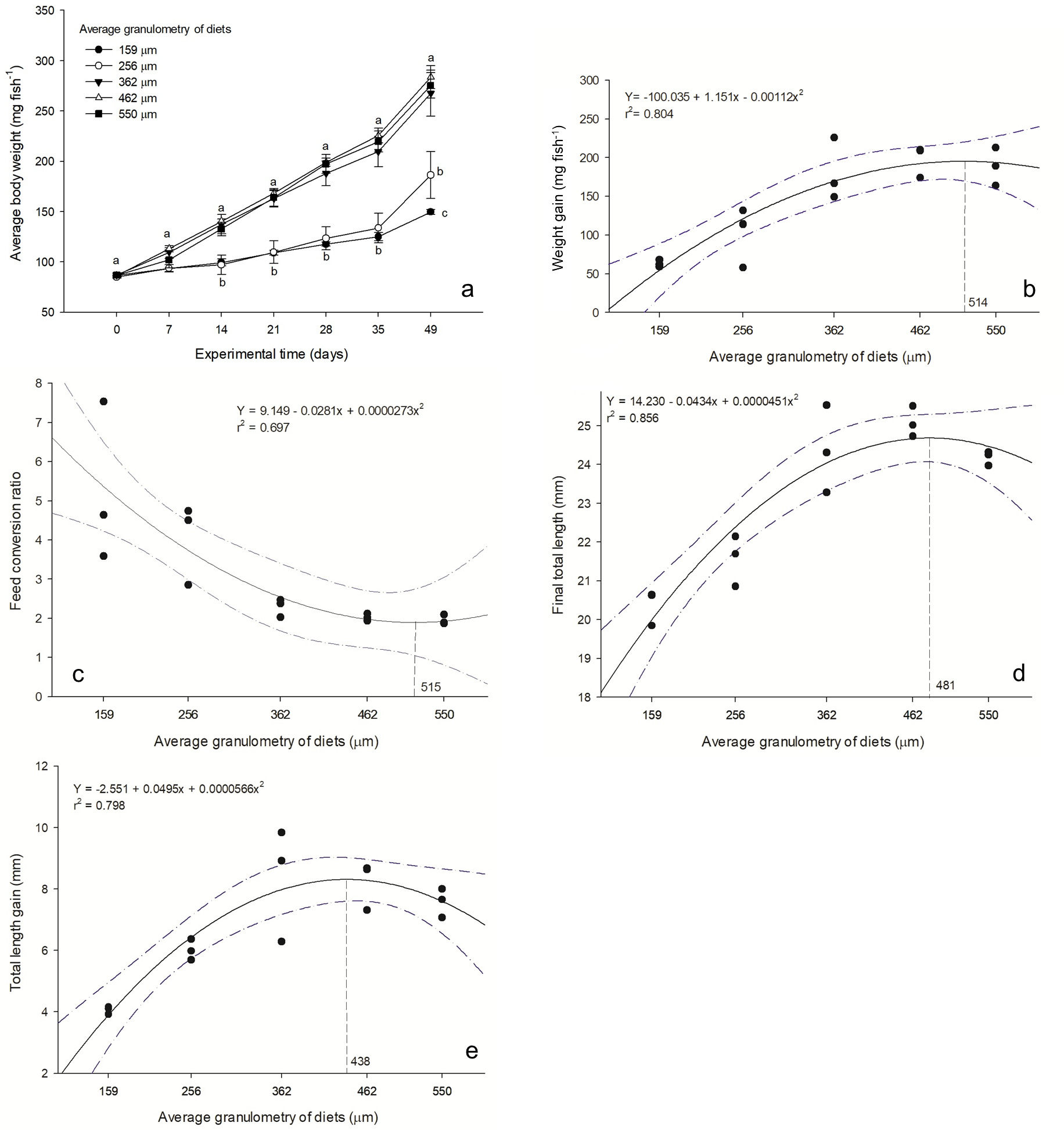
Standardizing feeding protocols for zebrafish (Danio rerio) is essential to improve experimental reproducibility. This study evaluated the effects of semi-purified diet particle size (159, 256, 362, 462, and 550 µm) on the performance of juvenile zebrafish. A total of 225 fish (85.8 ± 1.3 mg) were randomly distributed in a completely randomized design with three replicates per treatment (15 fish per tank). Fish were fed twice daily at 5% body weight for 49 days using a semi-purified diet containing 35% crude protein. Weight gain increased quadratically (p < 0.05) with particle size, peaking at 514 µm. Feed conversion was optimized at 515 µm while survival was unaffected (p > 0.05). Fish fed 159 and 256 µm particles had 23-32% lower weight gain than those fed 362-550 µm particles, which performed similarly (p > 0.05). The estimated optimal particle size (~515 µm) represented 2.0-2.1% of fish total length (16.3 ± 0.9 mm), although sizes from 1.5 to 2.3% (362-550 µm) showed no significant differences. The findings demonstrate that diets with a particle size of approximately 2% of fish length maximize growth and feed efficiency, providing a practical guideline for standardizing feeding protocols in zebrafish research.
Key words
Standardized diet formulation; Nutritional requirements in zebrafish; Dietary particle size; Zebrafish model
 Thumbnail