 Influence of particle size on the efficiency of semipurified diets in juvenile zebrafish
Abstract
Standardizing feeding protocols for zebrafish (Danio rerio) is essential to improve experimental reproducibility. This study evaluated the effects of semi-purified diet particle size (159, 256, 362, 462, and 550 µm) on the performance of juvenile zebrafish. A total of 225 fish (85.8 ± 1.3 mg) were randomly distributed in a completely randomized design with three replicates per treatment (15 fish per tank). Fish were fed twice daily at 5% body weight for 49 days using a semi-purified diet containing 35% crude protein. Weight gain increased quadratically (p < 0.05) with particle size, peaking at 514 µm. Feed conversion was optimized at 515 µm while survival was unaffected (p > 0.05). Fish fed 159 and 256 µm particles had 23-32% lower weight gain than those fed 362-550 µm particles, which performed similarly (p > 0.05). The estimated optimal particle size (~515 µm) represented 2.0-2.1% of fish total length (16.3 ± 0.9 mm), although sizes from 1.5 to 2.3% (362-550 µm) showed no significant differences. The findings demonstrate that diets with a particle size of approximately 2% of fish length maximize growth and feed efficiency, providing a practical guideline for standardizing feeding protocols in zebrafish research.
Key words
Standardized diet formulation; Nutritional requirements in zebrafish; Dietary particle size; Zebrafish model
INTRODUCTION
The zebrafish (Danio rerio), an omnivorous cyprinid, has become a key model organism in various research fields (Canedo et al. 2022, Trigueiro et al. 2020). However, the lack of standardized protocols for husbandry, feeding and environmental conditions can lead to inconsistent results across laboratories, thereby complicating interlaboratory comparisons and generalization of findings (Brenes-Soto et al. 2019, Frederickson et al. 2021, Licitra et al. 2024).
Feed presentation is a critical aspect of feed management, directly influencing weight gain and feed efficiency. Physical characteristics such as particle size, color, texture, and density affect the fish’s ability to detect, capture, and ingest food (Ramos-Júdez & Duncan 2022). Despite widespread recognition of the need for nutritional standardization (Siccardi et al. 2009, Watts & D’Abramo 2021), particularly particle size, within zebrafish feeding protocols. The significance of appropriate particle sizing has been documented across multiple aquaculture applications (Martins et al. 2020), yet systematic evaluation in zebrafish remains limited despite the species’ growing importance in biomedical research. A commonly cited guideline for many fish species suggests that optimal feed particle size ranges from 25% to 50% of the fish’s mouth gape (Jobling et al. 2001).
However, this general recommendation has not been rigorously validated for zebrafish under controlled laboratory conditions using semi-purified diets. Larger-than-optimal pellets may facilitate feed detection but can hinder capture and ingestion due to increased handling time and nutrient leaching (Azaza et al. 2010, Knights 1983). Conversely, undersized particles hinder food detection, reduce net energy gain, and impair digestive efficiency through accelerated intestinal transit (Hossain et al. 2000, Busti et al. 2022). Consequently, inappropriate particle sizes can impair growth, worsen feed efficiency, degrade water quality, and compromise overall rearing efficiency.
The lack of standard diets, such as those available for rodents (NRC 1995), remains a critical challenge to consolidating zebrafish as a model organism (Monteiro et al. 2024, Hillman et al. 2024). In this context, the adoption of semi-purified diets has been recommended as an intermediate step toward the development of standardized feeds for zebrafish (Watts & D’Abramo 2021). This approach aims to replace generic commercial diets (Fowler et al. 2019, Siccardi et al. 2009) or those formulated based on the nutritional requirements of other species (Kaushik et al. 2011), until specific knowledge gaps regarding zebrafish nutritional are addressed (Monteiro et al. 2024). Semi-purified diets are composed of highly refined ingredients and are free from antinutritional factors, unlike conventional ingredient-based feeds (NRC 1995), thereby reducing the risk of adverse health effects in zebrafish (Watts et al. 2016). However, these diets are also associated with higher production costs and lower palatability, which may negatively affect feed intake, growth, and feed efficiency (NRC 2011).
Formulating semi-purified diets with particle sizes suited to zebrafish oral anatomy poses practical challenges, given typical laboratory equipment constrains (Wilson 2012, Brenes-Soto et al. 2019). Particle size is often adjusted post-pelleting via mechanical fragmentation (Fernandes et al. 2016, Martins et al. 2020). However, this process introduces pellet fractures that increase water penetration and nutrient leaching. While binders are incorporated to enhance pellet integrity, their efficacy is limited by fragmentation damage. The problem is especially acute for semi-purified diets, which often contain highly water-soluble ingredients such as crystalline amino acids, vitamins, and dextrin. Thus, identifying optimal particle sizes is essential not only to maximize nutrient retention and minimize leaching, but also establish reproducible feeding protocols that improve interlaboratory comparability.
Accordingly, this study aimed to determine the optimal particle size of a semi-purified diet for juvenile zebrafish reared under controlled laboratory conditions.
MATERIALS AND METHODS
Ethical approval
All experimental procedures were approved by the Ethics Committee on Animal Use of the Palotina Campus, Federal University of Paraná (CEUA/Palotina; Protocol 11/2022).
Fish acquisition and acclimation
Wild-type juvenile zebrafish (Danio rerio) were obtained from a commercial ornamental fish supplier (Aqua Paraná, Toledo, PR, Brazil) and underwent quarantine and acclimation to laboratory conditions. Fish were housed in a circular fiberglass quarantine tank (1 m³) equipped with a biological filter, temperature control (28 ± 1.9°C), and continuous aeration to maintain dissolved oxygen levels above 5.0 mg/L. Water quality parameters, including pH (7.5 ± 0.0), total ammonia nitrogen (< 0.1mg/L), and nitrite (< 0.1 mg/L), were monitored weekly and remained within optimal ranges for the species (Mocho 2024) throughout the acclimation period.
Experimental diet preparation
A semi-purified experimental diet was formulated (Table I). Ingredients were weighed, homogenized, moistened, pelleted into 2 mm diameter pellets, and dried in a forced-air oven at 55°C for 16 hours. Pellets were cooled in a desiccator and mechanically fragmented using a commercial-grade grinder. The resulting particles were sieved with an electromagnetic shaker using mesh sizes of 600, 500, 425, 300, 212, and 106 μm. Mean particle size was calculated as the arithmetic mean between the upper and lower mesh sizes retaining particles: 600-500 μm (550 μm), 500-425 μm (462 μm), 425-300 μm (362 μm), 300-212 μm (256 μm), and 212-106 μm (159 μm) (Azaza et al. 2010). Particles retained on the 600 μm sieve or that passed through the 106 μm sieve were discarded. Diets were stored in labeled airtight containers at 4°C until use.
Feeding transition protocol
During the first 17 days of quarantine, fish were fed to satiation twice daily with a commercial flake diet (Novo Color - JBL; 43% crude protein minimum, 8.3% lipids minimum, 1.9% fiber maximum, 8.1% ash maximum), maintaining the feeding regimen used by the producer from which the fish were acquired. On day 18, a subsample of 10% of the initial population was weighed to initiate the transition to the experimental diet. The semi-purified diet used during this transition was fragmented but not sieved, to avoid fish acclimation to specific particle sizes before the experiment. Fish were fed at 5% biomass per day for six days, with the following ratios: 75:25% (commercial diet to semi-purified diet) for two days, 50:50% for two days, and 25:75% for two days. After the transition, fish were exclusively fed the semi-purified diet at 5% biomass/day.
Experimental facilities and management
Following complete acclimation, fish were fasted for 24 h prior to the start of the trial. A total of 225 fish (mean weight: 85.8 ± 1.3 mg; standard length: 16.3 ± 0.9 mm) were randomly assigned to 15 polycarbonate aquaria (3 L each), with 15 fish per aquarium. All aquaria were connected to a recirculating water system in which the mechanical and biological filtration compartment had a total volume of 300 L. The system provided continuous aeration and operated under an 11:13 h light:dark photoperiod. A 6000 L/h pump with flow control ensured a flow rate of 8.4 L/h per experimental unit.
Fish were assigned to a completely randomized design with five treatments (particle sizes: 159, 256, 362, 462, and 550 μm), each three replicates. Feeding occurred twice daily (08:00 and 16:00) at 5% group biomass/day for seven weeks. Weekly biometric measurements were performed to monitor growth and adjust feed rations. For measurements, fish were fasted for 16h, anesthetized with 50 mg/L benzocaine, weighed, and counted.
Water pH (7.4 ± 0.2), total ammonia nitrogen (0.02 ± 0.06 mg/L), and nitrite (0.0 ± 0.0 mg/L) were assessed as acclimation protocols. Daily temperature (28.0 ± 1.7°C) and dissolved oxygen (5.4 ± 0.9 mg/L) were measured using a multiparameter meter. A malfunction in the climate control system on day 37 temporarily increased water temperatures to 29.4-31.1°C for eight days. To minimize stress, biometric measurements were skipped on day 42. Temperatures exceeded 30°C on only four of the affected days. All other water parameters remained within the optimal range for the species (Mocho 2024).
Performance evaluation
At the end of the experiment, fish were assessed following the weekly biometric protocol. The following performance metrics were calculated: weight gain (mg/fish) = final body weight – initial body weight; specific growth rate (%/day) = 100 × [(ln(final body weight) – ln(initial body weight)]/experimental days; feed conversion ratio (g:g) = total feed intake/weight gain; and survival rate (%) = 100 × (final fish count/initial fish count). Total length of the fish was measured from the tip of the snout to the end of the caudal fin using a digital caliper.
Statistical analysis
Data normality was evaluated using the Shapiro-Wilk test, and homogeneity of variances was assessed using Bartlett’s test, to validate ANOVA assumptions. One-way ANOVA was applied, followed by Tukey’s test for multiple comparisons when significant differences were detected. Regression analysis was performed to determine the predicted optimal particle size. Among the tested models, the quadratic regression yielded the best fit, as evidenced by the lowest residual sum of squares (Shearer 2000). All statistical analyses were conducted using SAS version 9.1, with a significance threshold set at p < 0.05.
RESULTS
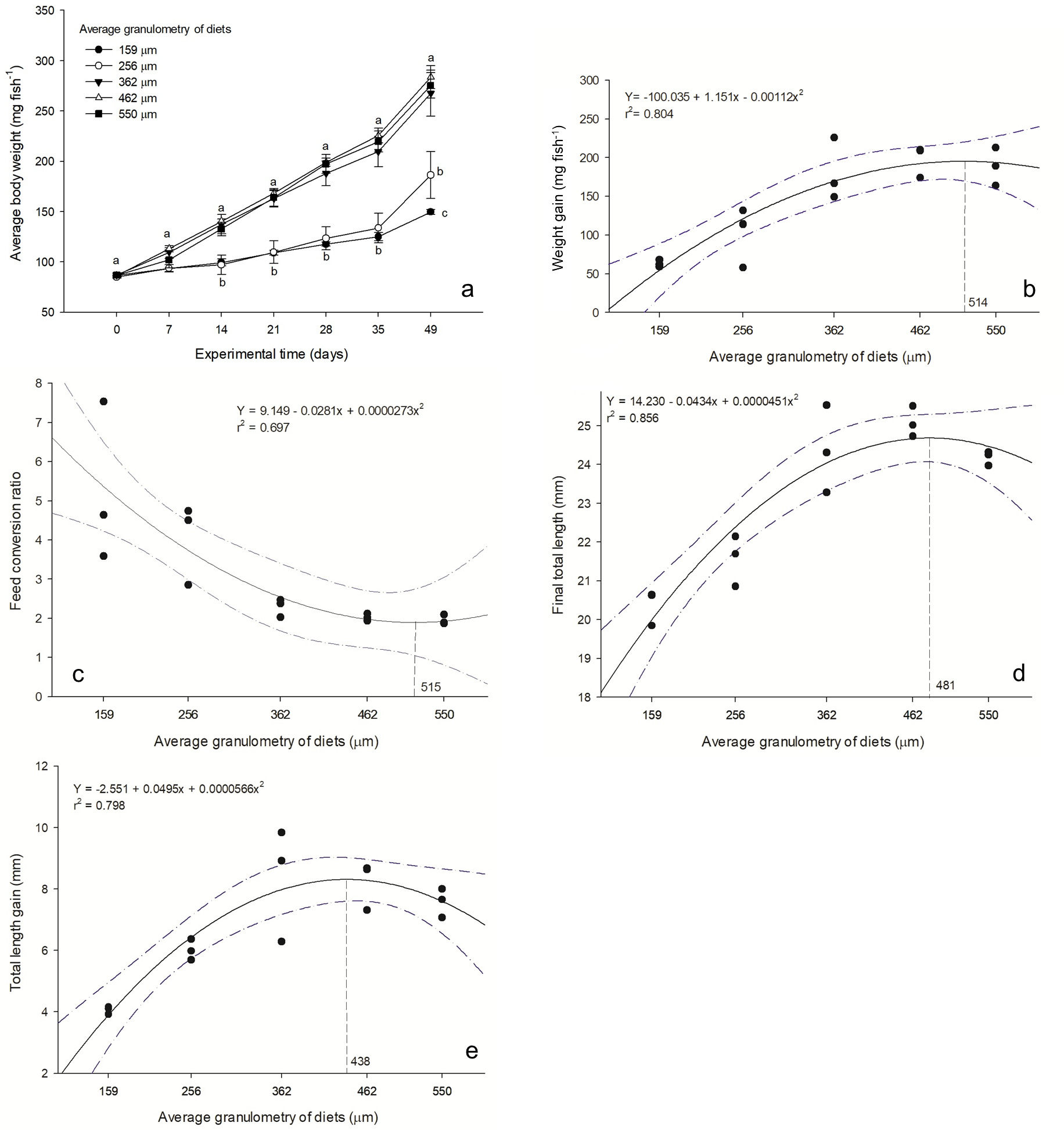
Dietary particle size had no significant effect on survival rates (p > 0.05; Table II). Growth performance did not differ significantly (p > 0.05) among fish fed pellets ranging from 362 to 550 μm throughout the experiment period (Figure 1a). In contrast, diets with smaller particles sizes resulted in reduced growth, although differences were not statistically significant (p > 0.05) until day 35. By day 49, fish fed the 256 μm diet achieved intermediate mean weight, significantly higher than those in the 159 μm group but lower than all other groups (p < 0.05), which remained statistically similar to each other (p > 0.05).
Productive performance parameters of zebrafish fed semi-purified diet with different particle sizes after 49 days.
Growth performance and biometric parameters of juvenile zebrafish fed semi-purified diets with varying particle sizes. (a) Body weight evolution over the 49-day experimental period; different letters indicate significant differences between treatments at specific time points (Tukey’s test, P < 0.05). (b) Weight gain, (c) Feed conversion ratio, (d) Final total length, and (e) Total length gain as a function of diet particle size. In panels b-e, solid lines represent the quadratic regression model, curved dashed lines indicate the 95% confidence intervals, and vertical drop lines highlight the optimal particle size estimated by the model. Values are presented as mean ± standard deviation (n=3).
The greatest weight gain (Figure 1b) was observed at an estimated particle size of 514 μm (r² = 0.804), while the lowest feed conversion ratio (Figure 1c) occurred at 515 μm (r² = 0.697). The highest final total length (Figure 1d) was observed at an estimated particle size of 481 μm (r² = 0.856), while the greatest total length gain (Figure 1e) occurred at 438 μm (r² = 0.798).
DISCUSSION
Particle size plays a critical role in zebrafish feeding behavior, influencing diet palatability, capture efficiency, and ingestion (Hasan & Macintosh 1992). Licitra et al. (2024) recommended dietary particle sizes of 200-400 μm for juveniles (50-305 mg body weight), consistent with protocols used by Martins et al. (2020) for zebrafish aged 30-60 days post-fertilization (dpf). However, the present results contradict this recommendation, as diets containing 256 μm particles significantly impaired growth performance. Growth improvement was observed only with particle sizes ≥362 μm, with maximal weight gain and optimal feed conversion ratio (FCR) at 514 μm and at 515 μm, respectively. Notably, the recommendation by Licitra et al. (2024) was based on a systematic review of studies using heterogeneous commercial diets, underscoring the need for empirical validation of feeding protocols to strengthen the utility zebrafish as a model organism (Hillman et al. 2024).
Ease of ingestion may not be the primary factor driving prey selection, larger particles may reduce predation-associated energy expenditure (Busti et al. 2022, Khadka & Rao 1986). Energy density correlates directly with pellet volume (Zarzar et al. 2022), and fish consuming smaller particles must exert greater foraging effort to achieve the same intake.
Feeding regime (ad libitum or restricted) also impacts particle availability. Excessive provisioning of small particles over short intervals can increase waste due to leaching, as physical capture and ingestion rates are limited within given timeframes (Tabachek 1988). Larger particles, while eliciting faster detection responses (Ramos-Júdez & Duncan 2022), may require prolonged handling, increase aqueous exposure time and promote nutrient leaching. In recirculating systems, uneaten feed is often lost due to water flow, leading to waste and environmental impacts (Linnér & Brännäs 1994, Hasan & Macintosh 1992).
Feed efficiency varies with particle size across fish species (Azaza et al. 2010, Hossain et al. 2000, Zarzar et al. 2022), possible due to effects on digestive transit. Smaller particles are evacuated from the digestive tract more rapidly, reducing nutrient absorption efficiency (Jobling 1987). However, species-specific adaptations may alter this pattern. For example, Busti et al. (2022) found that gastric evacuation contributes less to digestibility than intestinal processes in gilthead sea bream, which exhibit chewing behavior when fed 4-6 mm diameter pellets. In zebrafish, a stomach less species, particle size effects are confined to intestinal transit. Despite the larger surface area of smaller particles enhancing enzymatic access (Azaza et al. 2010), the accelerated passage through the intestine likely reduced FCR (Busti et al. 2022, Hossain et al. 2000), as observed in this study.
Growth response to dietary particle size results from a multifactorial interplay between evacuation time, net energy gain per particle, and individual particle availability. The slightly higher albeit non-significant, mortality (p > 0.05) observed in fish fed 256 μm particles likely reduced intraspecific competition (Mattila & Koskela 2018), enhanced feed access and uniform distribution (Zarzar et al. 2022). Zebrafish regulated intake effectively across a 1.5-fold particle size range (362-550 μm). Understanding the relationship between oral anatomy and particle size remains central to nutritional studies (Dabrowski et al. 1983, Dabrowski & Bardega 1984), as mouth gape is a key predictor of optimal prey or pellet dimensions.
As fish grow, net energy gain per unit handling time becomes the primary criterion for prey selection (Khadka & Rao 1986). Thus, fish length can be used to dynamically adjust particle size, since optimal size scale with body size (Hasan & Macintosh 1992). For example, a strong correlation (r = 0.967) exists between mouth gape and total length in common carp (Cyprinus carpio) by Dabrowski et al. (1983). Another advantage of using total length instead of measuring mouth gape is that, for many species, it can be performed without the need to sacrifice individuals, aligning with the basic principles of animal use in research (Canedo et al. 2022). In this study, particle sizes corresponding to 1.5-2.3% of total length supported optimal growth, peaking at 2.0-2.1%. These values are within the range found for common carp fry with values of 1.7-3.7% of total length reported Hasan & Macintosh (1992).
Despite its ease of measurement, total length does not adequately reflect zebrafish development at more advanced stages. The species exhibits rapid growth between 9 and 51 days post-fertilization (dpf), followed by a plateau in length at approximately 65 dpf (Gómez-Requeni et al. 2010). These authors report that, during this phase, muscle hyperplasia becomes minimal and redirects a significant portion of dietary energy toward lipogenesis and gonadal maturation, resulting in increased body weight without a proportional gain in length. In the present study, positive allometry was observed in zebrafish. This finding explains why the particle-size estimates required to maximize total length (481 μm) and length gain (438 μm) were slightly smaller than those associated with the greatest weight gain (514 μm). Hillman et al. (2024) corroborate our results and suggest that length-only assessments may underestimate true growth differences. Therefore, we recommend that zebrafish feeding protocols include a multidimensional growth analysis to ensure applicability across diverse scientific fields.
Fish growth is a key performance for diet evaluation in aquaculture. However, growth rate declines as fish grow, necessitating feeding practice adjustments for each zebrafish life stage (Licitra et al. 2024). To ensure proper feed intake, it is essential to consider the physical and chemical characteristics of the diet, including particle size, which should be tailored to the developmental stage of zebrafish (Watts et al. 2012). The ideal particle size is based on the measurement of mouth gape (Goolish et al. 1999) and varies according to life stage, impacting not only growth but also survival of larvae, juveniles, and adults. In zebrafish, the juvenile stage encompasses body weights ranging approximately from 50-70 mg to 350-500 mg (Licitra et al. 2024). In this context, juveniles fed semi-purified diets containing 35% crude protein with particle sizes greater than 362 μm exhibited specific growth rates of 2.3-2.4% body weight per day. Conversely, adult zebrafish with an initial body weight of 350 mg, fed higher-protein semi-purified diets (45% CP) under restricted feeding regimes (5% BW/day), showed lower specific growth rates ranging from 1.07 to 1.63% BW/day (Vural et al. 2021). These findings highlight that beyond nutritional composition and feeding regimen, optimizing feed particle size according to developmental stage is critical to maximizing feed intake and growth performance, particularly in juveniles, whose physiological development imposes limitations on ingesting larger particles (Lawrence 2007, Siccardi et al. 2009).
Semi-purified diets generally yield lower growth rates than those formulated with standard ingredients (e.g., fish meal, soybean meal). Juvenile zebrafish fed laboratory-formulated practical diets exhibit variable growth rates. For example, Carneiro et al. (2020) reported growth rates of 1.55-1.66% BW/day in juvenile zebrafish (initial BW = 160 mg) fed practical diets containing 33% crude protein (CP). Similarly, Silva et al. (2021) registered lower growth rates (0.46-1.15% BW/day) in juvenile zebrafish (initial BW = 290 mg) fed 51% CP practical diets compared to the current findings. Physical (e.g., size, shape), chemical (e.g., nutrient profile), and nutritional factors (e.g., energy density) modulate nutrient intake and assimilation (Watts & D’Abramo 2021), despite higher nutrient levels than those in the semi-purified diet used here. However, optimized feeding protocols combined with semi-purified diets of appropriate particle size achieved species-typical growth rates, highlighting the critical role of efficient dietary nutrient acquisition.
Therefore, documenting the particle size of diets administered to zebrafish is a critical consideration in experimental designs. Numerous studies document the manufacturing particle size, nutritional composition, and ingredient profiles of zebrafish diets (Carneiro et al. 2020, Silva et al. 2021, Vural et al. 2021). However, given equipment limitations in laboratory-scale production, reported pellet sizes often exceed the ingestion capacity of adult D. rerio (Licitra et al. 2024). Thus, while rarely methodologically detailed, pellets were likely fragmented to match species-specific ingestion capacity, as observed in prior work (Fernandes et al. 2016, Martins et al. 2020). However, grinding method, duration, force, diet texture, and pellet cohesion may yield particles outside the optimal size range for the species.
In summary, particle size in semi purified diets significantly influences growth and feed efficiency in juvenile zebrafish, highlighting the critical importance of standardizing this parameter in experimental protocols. Beyond the direct nutritional implications, these results underscore how this dietary characteristic may introduce uncontrolled inconsistencies in scientific outcomes. Thus, a systematic documentation of particle size specifications in zebrafish experiments is recommended. This practice would mitigate experimental variability in zebrafish feeding protocols, which critically influence growth and development (Watts et al. 2016, Watts & D’Abramo 2021), and enhance reproducibility across laboratories. This approach directly supports refinement principles in zebrafish husbandry (Canedo et al. 2022) by ensuring that fish receive optimized nutrition tailored to their physiological requirements, promoting welfare and enhancing scientific rigor. Implementing evidence-based feeding protocols that incorporate standardized granulometric specifications and nutritional composition advances zebrafish utilization as a biological model, strengthens its translational applicability, and minimizes methodological inconsistencies among research institutions (Watts et al. 2016, Watts & D’Abramo 2021).
CONCLUSIONS
In conclusion, the use of semi-purified diets with a particle size ranging from 362 to 550 µm is recommended for juvenile zebrafish (initial weight of ~85 mg). To maximize overall performance, the formulation should predominantly consist of particles near 515 µm.
Acknowledgements
The authors thank the Conselho Nacional de Desenvolvimento Científico e Tecnológico (CNPq) for financial support (Process No. 404869/2021-1). We also acknowledge the Universidade Federal do Paraná (UFPR) for funding through the FDA 2023/2024 Call (Process No. 23075.014124/2024-80) and the Research Support Call (Process No. 23075.019151/2023-68). Additionally, we recognize CNPq for granting a scientific initiation scholarship to F.L.V.
References
-
AZAZA MS, DHRAIEF MN, KRAIEM MM & BARAS E. 2010. Influences of food particle size on growth, size heterogeneity, food intake and gastric evacuation in juvenile Nile tilapia, Oreochromis niloticus, L., 1758. Aquaculture 309(1-4): 193-202. https://doi.org/10.1016/j.aquaculture.2010.09.026.
» https://doi.org/10.1016/j.aquaculture.2010.09.026 -
BRENES-SOTO A, TYE M & ESMAIL MY. 2019. The role of feed in aquatic laboratory animal nutrition and the potential impact on animal models and study reproducibility. ILAR J 60(2): 197-215. https://doi.org/10.1093/ilar/ilaa006.
» https://doi.org/10.1093/ilar/ilaa006 -
BUSTI S, BONALDO A, DIANA A, PERFETTI S, VIROLI C, FONTANILLAS R, ERIKSEN TB, GATTA PP & PARMA L. 2022. The incidence of different pellet size on growth, gut evacuation, feed digestibility and feed waste in gilthead sea bream (Sparus aurata). Aquaculture 555: 738204. https://doi.org/10.1016/j.aquaculture.2022.738204.
» https://doi.org/10.1016/j.aquaculture.2022.738204 -
CANEDO A, SAIKI P, SANTOS AL, CARNEIRO KS, SOUZA AM, QUALHATO G, BRITO RS, MELLO-ANDRADE F & ROCHA TL. 2022. Zebrafish (Danio rerio) meets bioethics: the 10Rs ethical principles in research. Cienc Anim Bras 23(19): e-70884. https://doi.org/10.1590/1809-6891v22e-70884.
» https://doi.org/10.1590/1809-6891v22e-70884 -
CARNEIRO WF, CASTRO TFD, ORLANDO TM, MEURER F, PAULA DAJ, VIROTE BCR, VIANNA ARCB & MURGAS LDS. 2020. Replacing fish meal by Chlorella sp. meal: Effects on zebrafish growth, reproductive performance, biochemical parameters and digestive enzymes. Aquaculture 528: 735612. https://doi.org/10.1016/j.aquaculture.2020.735612.
» https://doi.org/10.1016/j.aquaculture.2020.735612 -
DABROWSKI K & BARDEGA R. 1984. Mouth size and predicted food size preferences of larvae of three cyprinid fish species. Aquaculture 40: 41-46. https://doi.org/10.1016/0044-8486(84)90214-X.
» https://doi.org/10.1016/0044-8486(84)90214-X -
DABROWSKI K, BARDEGA R & PRZEDWOJSKI R. 1983. Dry diet formulation study with common carp (Cyprinus carpio L.) larvae. Z Tierphysiol Tierernahr Futtermittelkd 50(1-5): 40-52. https://doi.org/10.1111/j.1439-0396.1983.tb00668.x.
» https://doi.org/10.1111/j.1439-0396.1983.tb00668.x -
FERNANDES H, PERES H & CARVALHO AP. 2016. Dietary protein requirement during juvenile growth of zebrafish (Danio rerio). Zebrafish 13(6): 548-555. https://doi.org/10.1089/zeb.2016.1303.
» https://doi.org/10.1089/zeb.2016.1303 -
FOWLER LA, WILLIAMS MB, DENNIS-CORNELIUS LN, FARMER S, BARRY RJ, POWELL ML & WATTS SA. 2019. Influence of commercial and laboratory diets on growth, body composition, and reproduction in the zebrafish Danio rerio Zebrafish 12(6): 508-521. https://doi.org/10.1089/zeb.2019.1742.
» https://doi.org/10.1089/zeb.2019.1742 -
FREDERICKSON SC, STEINMILLER MD, BLAYLOCK TR, WISNIESKI ME, MALLEY JD, PANDOLFO LM & CASTRANOVA D. 2021. Comparison of juvenile feed protocols on growth and spawning in zebrafish. J Am Assoc Lab Anim Sci 60(3): 298-305. https://doi.org/10.30802/AALAS-JAALAS-20-000105.
» https://doi.org/10.30802/AALAS-JAALAS-20-000105 -
GÓMEZ-REQUENI P, CONCEIÇÃO LEC, OLDERBAKK JORDAL AE & RØNNESTAD I. 2010. A reference growth curve for nutritional experiments in zebrafish (Danio rerio) and changes in whole body proteome during development. Fish Physiol Biochem 36(4): 1199-1215. https://doi.org/10.1007/s10695-010-9400-0.
» https://doi.org/10.1007/s10695-010-9400-0 -
GOOLISH EM, OKUTAKE K & LESURE S. 1999. Growth and survivorship of larval zebrafish Danio rerio on processed diets. N Am J Aquac 61(3): 189-198. https://doi.org/10.1577/1548-8454(1999)061<0189:GASOLZ>2.0.CO;2.
» https://doi.org/10.1577/1548-8454(1999)061 -
HASAN MR & MACINTOSH DJ. 1992. Optimum food particle size in relation to body size of common carp, Cyprinus carpio L., fry. Aquac Res 23(3): 315-325. https://doi.org/10.1111/j.1365-2109.1992.tb00774.x.
» https://doi.org/10.1111/j.1365-2109.1992.tb00774.x -
HILLMAN C, COOPER AH, RAM P & PARKER MO. 2024. The effect of laboratory diet and feeding on growth parameters in juvenile zebrafish. Lab Anim 53(11): 327-335. https://doi.org/10.1038/s41684-024-01456-6.
» https://doi.org/10.1038/s41684-024-01456-6 -
HOSSAIN MAR, HAYLOR GS & BEVERIDGE MCM. 2000. The influence of food particle size on gastric emptying and growth rates of fingerling African catfish, Clarias gariepinus Burchell, 1822. Aquac Nutr 6(2): 73-76. https://doi.org/10.1046/j.1365-2095.2000.00131.x.
» https://doi.org/10.1046/j.1365-2095.2000.00131.x -
JOBLING M. 1987. Influences of food particle size and dietary energy content on patterns of gastric evacuation in fish: test of a physiological model of gastric emptying. J Fish Biol 30(3): 299-314. https://doi.org/10.1111/j.1095-8649.1987.tb05754.x.
» https://doi.org/10.1111/j.1095-8649.1987.tb05754.x - JOBLING M, GOMES E & DIAS J. 2001. Feed Types, Manufacture and Ingredients. In: Houlihan D et al. (Eds), Food Intake in Fish, Oxford: Blackwell Science, p. 25-48.
-
KAUSHIK S, GEORGA I & KOUMOUNDOUROS G. 2011. Growth and body composition of zebrafish (Danio rerio) larvae fed a compound feed from first feeding onward: toward implications on nutrient requirements. Zebrafish 82(2): 87-95. https://doi.org/10.1089/zeb.2011.0696.
» https://doi.org/10.1089/zeb.2011.0696 -
KHADKA RB & RAO TR. 1986. Prey size selection by common carp (Cyprinus carpio var. communis) larvae in relation to age and prey density. Aquaculture 54(1-2): 89-96. https://doi.org/10.1016/0044-8486(86)90260-7.
» https://doi.org/10.1016/0044-8486(86)90260-7 -
KNIGHTS B. 1983. Food particle-size preferences and feeding behaviour in warmwater aquaculture of European eel, Anguilla anguilla (L.). Aquaculture 30(1-4): 173-190. https://doi.org/10.1016/0044-8486(83)90160-6.
» https://doi.org/10.1016/0044-8486(83)90160-6 -
LAWRENCE C. 2007. The husbandry of zebrafish (Danio rerio): A review. Aquaculture 269 (1-4): 1-20. https://doi.org/10.1016/j.aquaculture.2007.04.077.
» https://doi.org/10.1016/j.aquaculture.2007.04.077 -
LICITRA R, FRONTE B, VERRI T, MARCHESE M, SANGIACOMO C & SANTORELLI FM. 2024. Zebrafish feed intake: a systematic review for standardizing feeding management in laboratory conditions. Biology 13(4): 209. https://doi.org/10.3390/biology13040209.
» https://doi.org/10.3390/biology13040209 -
LINNÉR J & BRÄNNÄS E. 1994. Behavioral response to commercial food of different sizes and self-initiated food size selection by Arctic char. Trans Am Fish Soc 123(3): 416-422. https://doi.org/10.1577/1548-8659(1994)123<0416:BRTCFO>2.3.CO;2.
» https://doi.org/10.1577/1548-8659(1994)123 -
MARTINS G, DIOGO P, SANTOS T, CABRITA E, PINTO W, DIAS J & GAVAIA PJ. 2020. Microdiet formulation with phospholipid modulate zebrafish skeletal development and reproduction. Zebrafish 17(1): 27-37. https://doi.org/10.1089/zeb.2019.1794.
» https://doi.org/10.1089/zeb.2019.1794 -
MATTILA J & KOSKELA J. 2018. Effect of feed pellet size on production parameters of pike-perch (Sander lucioperca). Aquac Res 49(1): 586-590. https://doi.org/10.1111/are.13443.
» https://doi.org/10.1111/are.13443 - MOCHO JP. 2024. Organization of the zebrafish facility. In: Allen C & Mocho JP (Eds), Zebrafish: A Practical Guide to Husbandry, Welfare and Research Methodology, Wallingford: CABI, p. 182-222.
- MONTEIRO J, MARTINS S, ALMEIDA R, CABRERA C & CERTAL AC. 2024. Dietary requirements for zebrafish. In: Allen C & Mocho JP (Eds), Zebrafish: A Practical Guide to Husbandry, Welfare and Research Methodology, Wallingford: CABI, p. 53-92.
- NRC. 1995. Nutrient requirements of laboratory animals: fourth revised edition. 4th ed. Washington, D.C.: National Academy Press, 192 p.
- NRC. 2011. Nutrient requirements of fish and shrimp. Washington, D.C.: National Academies Press, 376 p.
-
RAMOS-JÚDEZ S & DUNCAN N. 2022. Feeding habits and the influence of pellet diameter on the feeding responses of the flathead grey mullet (Mugil cephalus) in captivity. Anim Feed Sci Technol 290: 115368. https://doi.org/10.1016/j.anifeedsci.2022.115368.
» https://doi.org/10.1016/j.anifeedsci.2022.115368 -
SHEARER KD. 2000. Experimental design, statistical analysis and modelling of dietary nutrient requirement studies for fish: a critical review. Aquac Nutr 6(2): 91-102. http://doi.wiley.com/10.1046/j.1365-2095.2000.00134.x.
» https://doi.org/10.1046/j.1365-2095.2000.00134.x -
SICCARDI AJ, GARRIS HW, JONES WT, MOSELEY DB, D’ABRAMO LR & WATTS SA. 2009. Growth and survival of zebrafish (Danio rerio) fed different commercial and laboratory diets. Zebrafish 6(3): 275-280. https://doi.org/10.1089/zeb.2008.0553.
» https://doi.org/10.1089/zeb.2008.0553 -
SILVA TC, SILVA M, CARBONERA F, VISENTAINER JV, UTSUNOMIYA KS, GASPARINO E & PEREIRA R. 2021. Flaxseed oil and clove leaf essential oil in zebrafish diet (Danio rerio). Acta Sci Anim Sci 43(1): e48126. https://doi.org/10.4025/actascianimsci.v43i1.48126.
» https://doi.org/10.4025/actascianimsci.v43i1.48126 -
TABACHEK JAL. 1988. The effect of feed particle size on the growth and feed efficiency of Arctic charr [Salvelinus alpinus (L.)]. Aquaculture 71(4): 319-330. https://doi.org/10.1016/0044-8486(88)90201-3.
» https://doi.org/10.1016/0044-8486(88)90201-3 -
TRIGUEIRO NSS, CANEDO A, BRAGA DLS, LUCHIARI AC & ROCHA TL. 2020. Zebrafish as an emerging model system in the Global South: Two decades of research in Brazil. Zebrafish 17(6): 412-425. https://doi.org/10.1089/zeb.2020.1930.
» https://doi.org/10.1089/zeb.2020.1930 -
VURAL O, SILICI S & AKSAKAL E. 2021. The effect of royal jelly dietary on growth performance and expression of genes related to growth and immunity of zebrafish, Danio rerio Aquac Rep 20: 100652. https://doi.org/10.1016/j.aqrep.2021.100652.
» https://doi.org/10.1016/j.aqrep.2021.100652 -
WATTS SA & D’ABRAMO LR. 2021. Standardized reference diets for zebrafish: addressing nutritional control in experimental methodology. Annu Rev Nutr 41(1): 511-527. https://doi.org/10.1146/annurev-nutr-120420-034809.
» https://doi.org/10.1146/annurev-nutr-120420-034809 -
WATTS SA, LAWRENCE C, POWELL M & D’ABRAMO LR. 2016. The vital relationship between nutrition and health in zebrafish. Zebrafish 13(Suppl. 1): 72-76. https://doi.org/10.1089/zeb.2016.1299.
» https://doi.org/10.1089/zeb.2016.1299 -
WATTS SA, POWELL M & D’ABRAMO LR. 2012. Fundamental approaches to the study of zebrafish nutrition. ILAR J 53(2): 144-160. https://doi.org/10.1093/ilar.53.2.144.
» https://doi.org/10.1093/ilar.53.2.144 -
WILSON C. 2012. Aspects of larval rearing. ILAR J 53(2): 169-178. https://doi.org/10.1093/ilar.53.2.169.
» https://doi.org/10.1093/ilar.53.2.169 -
ZARZAR CA, CAVALLI RO, SANTOS PRB & TROMBETA TD. 2022. Effect of different diet pellet sizes on the growth of juvenile cobia (Rachycentron canadum). Arq Bras Med Vet Zootec 74(4): 677-685. https://doi.org/10.1590/1678-4162-12543.
» https://doi.org/10.1590/1678-4162-12543
Edited by
-
Handling editor
Juliano Morimoto
The datasets generated and analyzed in this study are available from the corresponding author upon justified request.