 AnacroIndex: the first step towards interactive identification for Anacroneuria Klapálek, 1909 (Plecoptera: Perlidae)
Abstract
Anacroneuria is the genus of Plecoptera with the greatest species richness — around 400 species — encompassing more than 10% of the order’s known diversity. It is one of the most frequently collected genera in the Neotropical region, where all its species are found. While reliable species identification is crucial for taxonomic, ecological, and biomonitoring research, the genus includes a large number of poorly described species — mainly for adults —, some of which share a high degree of morphological similarity. The dichotomous nature of traditional keys may pose challenges to identification in genera such as Anacroneuria, and new identification tools can attenuate these difficulties. Thus, this work aims to produce the first step of an interactive, multi-access identification key for the males of the species of Anacroneuria. In this work, the first iteration of the key is released with the species found in Southeastern Brazil — which includes almost half of the species found in Brazil. The key currently covers 36 species by means of 15 characters — one of the largest taxon coverages and highest efficiencies in the genus to date. The key is housed in Xper3, a database for interactive identification, and in collaborative efforts the project will expand its species coverage.
Key words
Interactive identification; Stoneflies; Taxonomy; Xper3
INTRODUCTION
Anacroneuria Klapálek, 1909 is the genus with the greatest number of known species in Plecoptera and is widely distributed and abundant across the Neotropical region (Morrone et al. 2022, DeWalt et al. 2025). Including more than 10% of the valid extant species in the order, this genus has a vast distribution, abundance and species richness along the tropics (Hynes 1976, DeWalt et al. 2015). Stoneflies are frequently used as bioindicators and since Anacroneuria accounts for much of the stonefly abundance in the Neotropical region, identifying its species is crucial for biomonitoring and ecological work involving stream invertebrates.
Anacroneuria is characterized by their highly complex sclerotized endophallic apex, known as a penial armature (Stark & Gaufin 1976). While the penial armatures of Anacroneuria are of similar structure in all species, the specific shape and disposition of each component of the penial armature varies among them, making the penial armature shape the most used structure in taxonomy and species descriptions (Stark et al. 1999, Froehlich 2002, 2004, Gutiérrez-Fonseca 2015).
Even if the penial armature is reliable in providing characters for describing species, considering the species richness in the genus, many species still resemble each other. Since many descriptions often only focus on either external appearance or penial armature disposition, confident identification is very hard for some species (Froehlich 2010a, Baldin et al. 2013). It is also worth noting that specimen color and specific markings on the head and pronotum — which are often used for species description and identification — can vary greatly depending on the tenerality and material preservation of the analyzed specimen (Almeida & Bispo 2020). As such, reliable identification of Anacroneuria is a difficult task at best, often done by comparison of a specimen with multiple species descriptions and illustrations.
To make identifying the many species of Anacroneuria possible, some authors have produced dichotomous identification keys (e.g., Needham & Broughton 1927, Jewett 1959, Stark 1995, 1998, 2001, 2012, Bispo & Froehlich 2004, Stark & Zúñiga 2014, Mayorga-Villalobos & Barba-Álvarez 2019). These works pioneered identification in the genus and provided dichotomous keys for different regions within the range of Anacroneuria. However, the nature of dichotomous keys poses some challenges in their structure and architecture. With the development of new methods, particularly in cybertaxonomy, some of these challenges can be solved through new identification tools (Rajmohana & Bijoy 2012).
A possible alternative to dichotomous identification keys is that of electronic multi-access interactive keys (Kerner et al. 2021). The ability to fill character states according to the availability of the structures in the analyzed specimen provides these keys the necessary flexibility for dealing with taxa that have large species richness and morphologically similar species such as Anacroneuria. Over the last decade, different platforms such as Xper3 have made interactive key creation and usage simple and powerful, and this technology is seeing use across different taxa (Salles et al. 2015, Jouveau et al. 2018, Klimmek & Baur 2018, Bodin et al. 2019, Kerner et al. 2021). Being digital, an interactive key can include very high-definition images of all taxa and character states, facilitating identification. An electronic identification key may also be continuously updated as new species are described or as the coverage of said key is increased, making it an ever-expanding and cooperative endeavor among researchers in a particular taxon. Ultimately, interactive multi-access keys provide users with a more flexible and often faster approach to identification.
For Anacroneuria, a species rich genus with very similar species, the interactivity of an electronic multi-access key could provide users with faster and more accurate identification. With that in mind, we introduce the AnacroIndex project, which aims to provide an illustrated interactive multi-access key for the males of Anacroneuria. The objective of this work is to detail and release the first iteration of this project, built under Xper3. While the objective of the project is to include as many Anacroneuria species as possible, that is quite a daunting task. Thus, we decided to release the first version of the key including the species present in a delimited geographical region. In this first version, the key covers the Anacroneuria species of Southeastern Brazil. It is the most well-studied region in Brazil, where 40 of the roughly 90 Brazilian species occur (Froehlich 2010b, Pessacq et al. 2019) and with the most well-preserved and abundant material, and also with the easiest access to type specimens and recently collected material.
MATERIALS AND METHODS
Examined Material
We analyzed reference material from the Museu de Entomologia da Universidade Federal de Viçosa (UFVB at the Department of Entomology, Federal University of Viçosa (UFV), Viçosa, MG, Brazil), the Aquatic Insect Collection “Prof. Dr. Cláudio Gilberto Froehlich” (CIACGF at Aquatic Biology Laboratory, State University of São Paulo (UNESP), Assis, SP, Brazil), the Museu de Zoologia da Universidade de São Paulo (MZUSP at the University of São Paulo (USP), São Paulo, SP, Brazil), the Coleção Entomológica Prof. José Alfredo Pinheiro Dutra (DZRJ at the Department of Zoology, Federal University of Rio de Janeiro) and the Coleção de Entomologia da Universidade Federal do Tocantins (CEUFT at the Laboratory of Entomology, Federal University of Tocantins (UFT), Porto Nacional, TO, Brazil). Preference was given to the type series of each species, when possible, and relatively recent material due to better condition of specimens.
Specimen preparations followed male genitalia extraction by severing the abdomen and clarifying the structures in potassium hydroxide (KOH 10%). Reactions were neutralized with acetic acid, and the male penial armature was removed. Some specimens had their wings mounted on temporary slides for photography. Whenever possible, the holotype of each species was analyzed by filling the character state matrix. Specimens were photographed to allow visualization of all characters. Specimens were compared to their original descriptions or redescriptions when the holotype was unavailable to check for potential intraspecific morphological plasticity when filling the character state matrix. Morphological notes on the analyzed specimens were taken following the framework established in Gastaldo et al. (2025) for the same purpose. Examined material for each species is given in the species notes.
Key Coverage
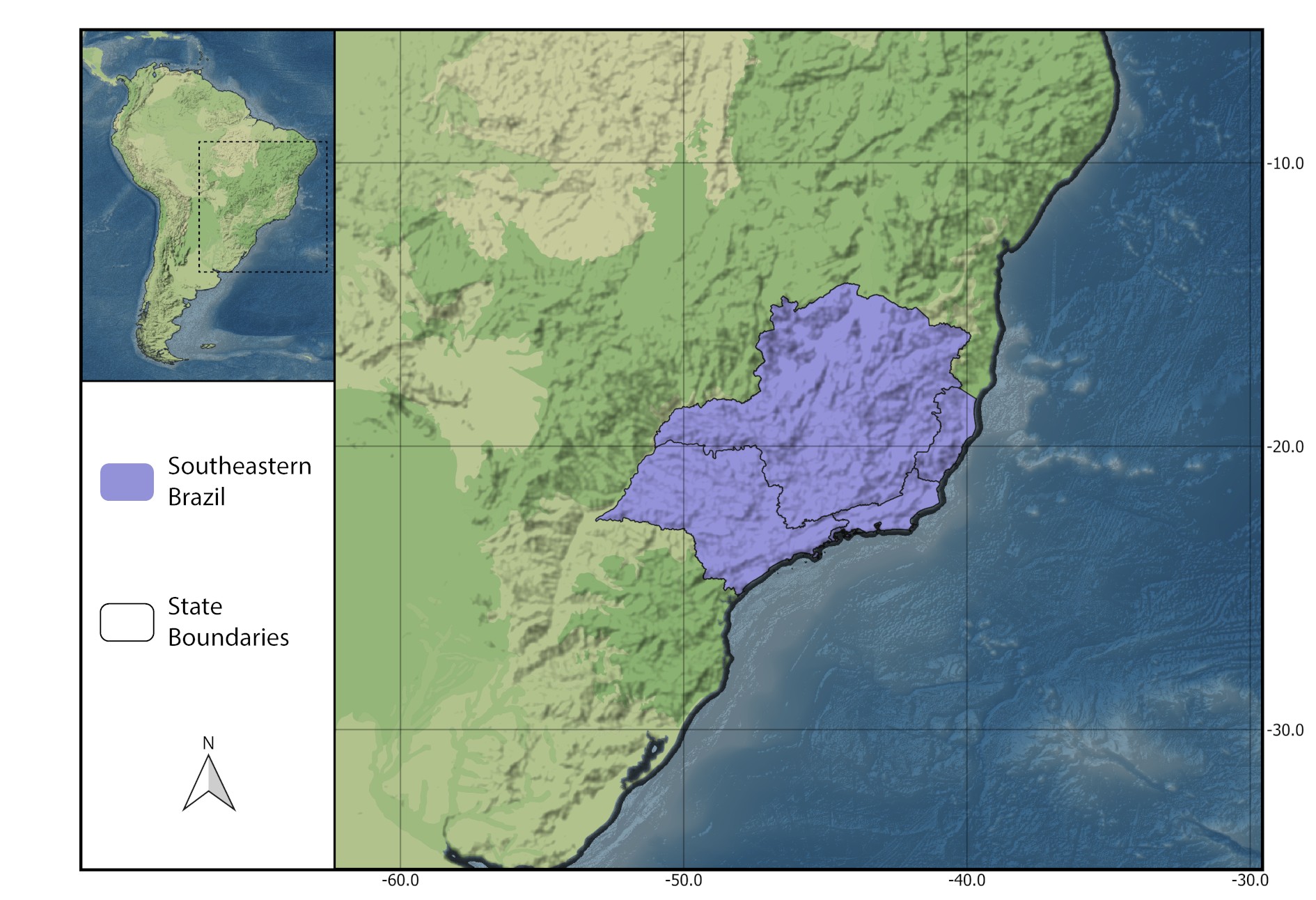
Southeastern Brazil (Fig. 1) encompasses the states of São Paulo, Minas Gerais, Rio de Janeiro and Espírito Santo. It includes mainly two ecoregions: the Atlantic Forest, a tropical rainforest which spans all the Brazilian coastline, and the Cerrado, a savannah formation which covers much of the interior of Brazil. The region covers approximately 10% of Brazil, spanning 924,620 km². While in the Atlantic Forest, frequent rainfall is common, in the Cerrado rain is mostly seasonal. The region is mostly mountainous and has great altitude variation near its coast to the east, but tapers into more plain terrains westward.
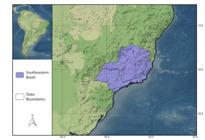
Map of South American continent. The Southeastern Brazilian states are delimited by black lines and highlighted in blue.
We based species occurrence on Froehlich (2010b) and Pessacq et al. (2019), as well as more recent species descriptions for this region (Castillo-Velásquez et al. 2023). Currently, 38 Anacroneuria described species are considered valid and have known males from Southeastern Brazil.
Character choice and metrics
Characters were chosen by prioritizing features that are not easily lost due to specimen preservation and have little intraspecific variation. Considering the variation in maculation patterns, color and sclerite shape due to tenerality of specimens or preservation, most of the characters refer to the penial armature of the species (Almeida et al. 2018, Almeida & Bispo 2020, Gastaldo et al. 2025). Some external characters were also chosen, with priority given to those which are easily recognizable and well-preserved in older material. An efficiency metric was calculated based on the division of the number of characters by the number of covered species, with equal weighing among characters and considering dependent characters. This metric was also applied to other previously published identification keys for Anacroneuria for comparison. If a key has a low efficiency metric, it indicates that relatively more species can be identified using less characters, while higher values of this metric point to many characters being needed to identify a smaller pool of species. This metric can estimate the efficiency of the key by means of how many different structures should be analyzed before a single specimen can be identified, on average. However, this does not consider how troublesome said character can be, and thus only estimates the number of characters and not necessarily the ease of use of the key. The final characters and their respective states are available in the Supplementary Material - Table SI.
Image acquisition
Reference material for each species and character state was photographed using a Leica M205A stereomicroscope and a digital camera Leica MC170 HD with auto montage image software. Preference for photography was given to type specimens that had not been previously photographed, followed by well-preserved specimens from Southeastern Brazil, and finally teneral specimens or specimens collected outside of Southeastern Brazil, when no other material was available for photography. All available species had their head, pronotum, and penial armature in dorsal, ventral and lateral view photographed when possible. Images were treated using Adobe Photoshop 2024 and Adobe Illustrator 2024. Image treatment prioritized clarity and visibility of structures.
Images were also taken to illustrate every character state included in the key. In this manner, other miscellaneous pictures were used, such as wing slides and photographs of live specimens. Character state images were frequently drawn over with Adobe Illustrator 2024 to point out the relevant structures in the picture.
Morphological terminology
The morphological terminology used followed that established in Gastaldo et al. (2025) for the external morphology of Anacroneuriini and male reproductive structures in Anacroneuria. All characters are coupled with succinct descriptions and pictures for easier use without consulting the terminology.
Xper3 usage
Xper3 is an online platform for interactive identification. With a free account, users may access, create or edit existing databases made for varying taxa. It has been used for a wide variety of different taxa and is a staple in interactive identification across its other iterations such as Xper and Xper2 (Jouveau et al. 2018, Klimmek & Baur 2018, Bodin et al. 2019, Kerner et al. 2021). Species are inserted as items, while characters are inserted as descriptors. A description consists of assigning the corresponding descriptor states — or character states — in each descriptor for each item – or species. In this way, a description matrix is formed. In this matrix, descriptor states may be changed easily and readily, and insertion of new items or new descriptors is straightforward. Every item, descriptor and descriptor state may have a picture and short explanation of its contents. More information on Xper can be retrieved on their website <xper3.fr> or in Kerner et al. (2021), which details the platform’s uses, history and future developments.
RESULTS
The key is housed in Xper3 and is available on the following link: https://app.xper3.fr/xper3GeneratedFiles/publish/identification/-2023637698988978647/mkey.html. Our key includes 36 of the 38 species with known males in Southeastern Brazil. The species included in the key can be found accompanied by identification remarks below. The species A. dilaticollis (Burmeister, 1839) and A. fumigata Klapálek, 1922 were not included in the key due to their uncertain identification. Photographs are available for all but three species — A. stanjewetti, A. quilombola and A. fuscicosta, for which no material was able to be examined. The key uses 15 characters (descriptors) to identify the included species, which can be found in Table SI along with their definition, states and species that exemplify each state.
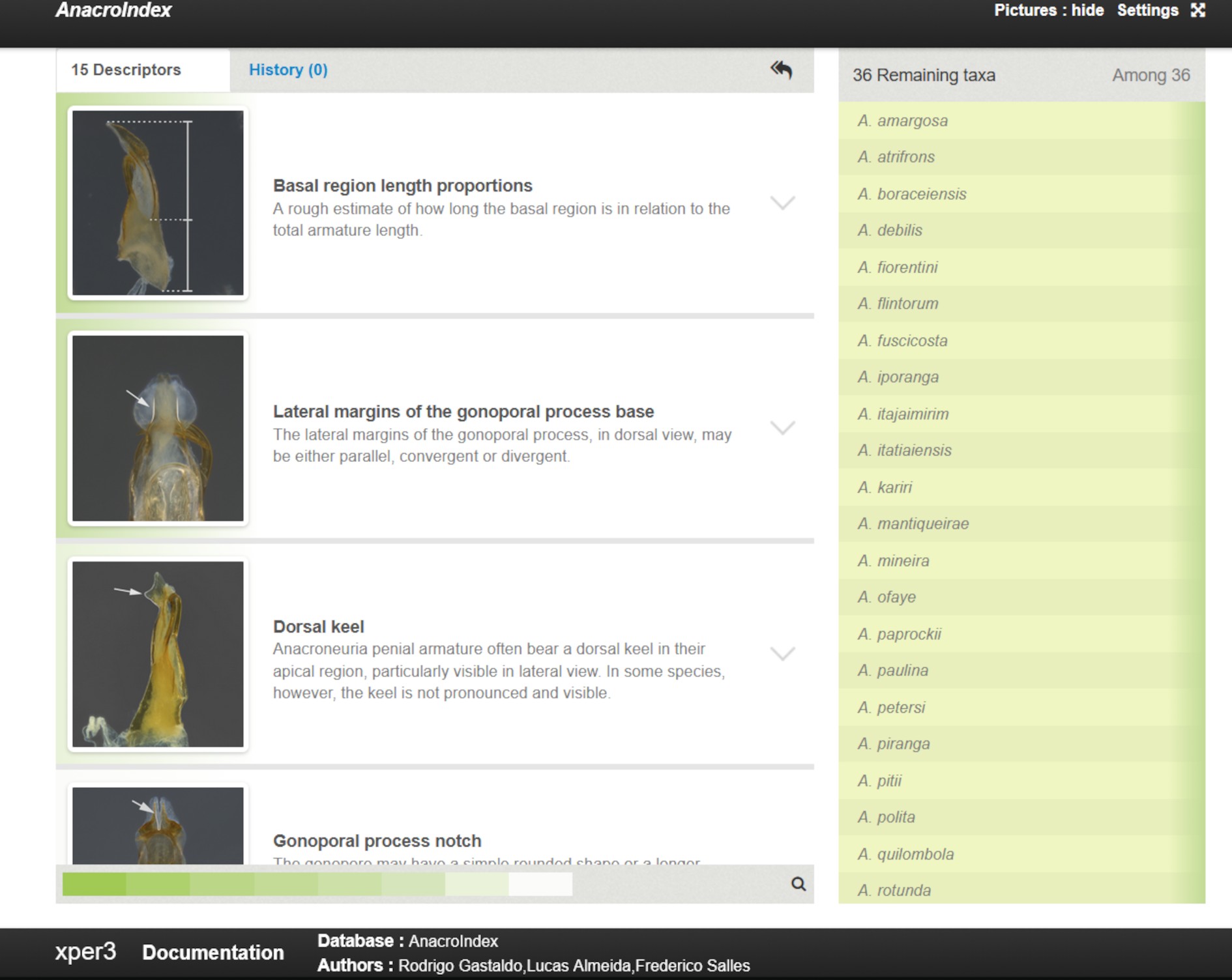
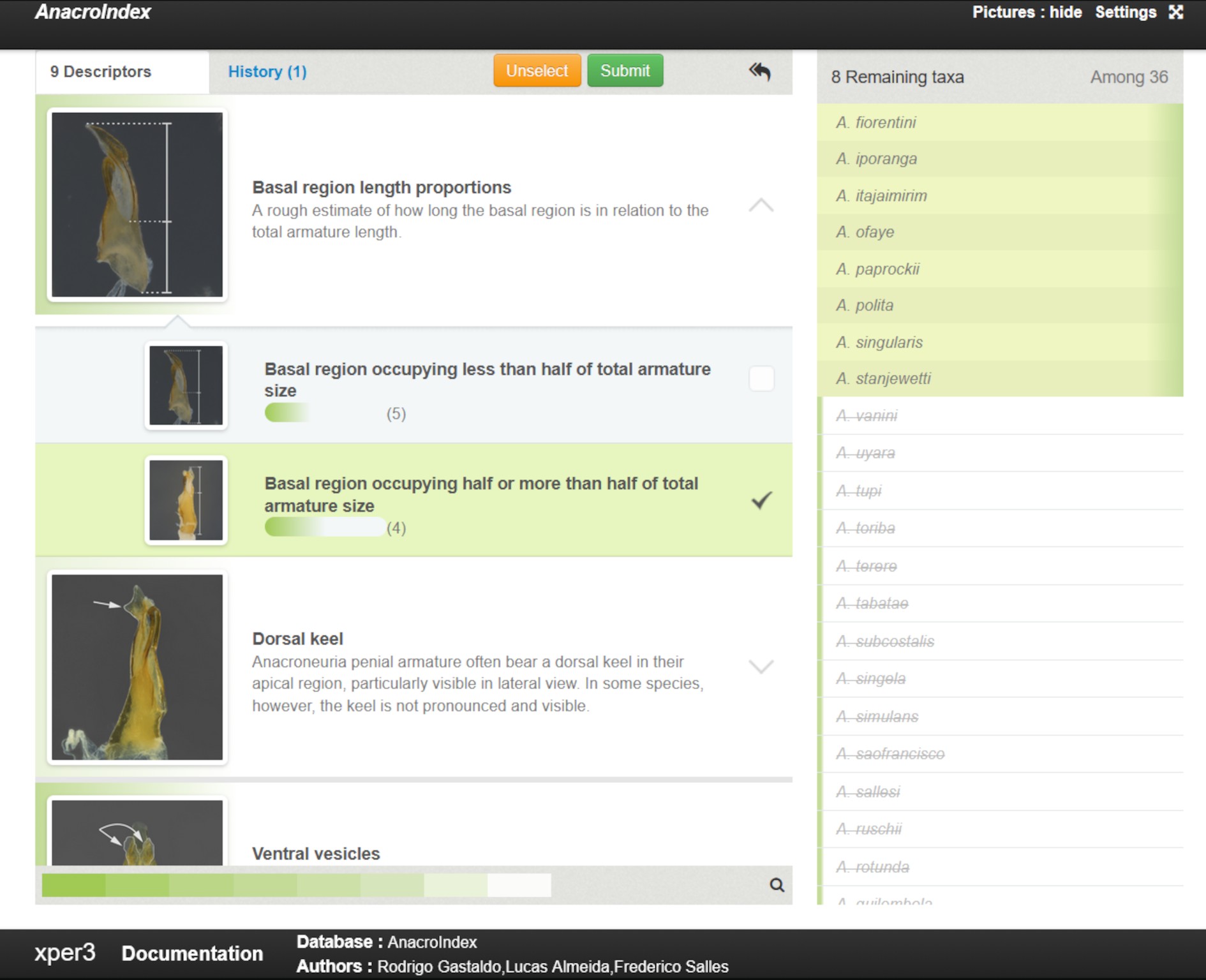
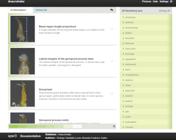
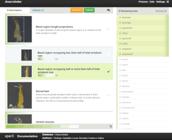
When using the key in Xper3, users are first greeted by the characters as drop-down menus with their character states as the options on the left, and a list of remaining possible taxa on the right (Fig. 2). At any moment, users may click on any of the taxa on the right to see all of their character states, pictures of the species and a short comment on each. Users may choose the states for as many or as few characters as they like before entering “Submit” on the top. When submitted, the key will be refreshed, keeping only the taxa which fulfill the character states entered (Fig. 3).
Map of South American continent. The Southeastern Brazilian states are delimited by black lines and highlighted in blue.
Printscreen of the first page of the AnacroIndex key. No characters have been filled, and every species is still possible to be identified, as indicated by the column on the right.
During the identification process, as species are excluded and only a few possible species are left, identification may require filling more subtle characters. The species remarks, pictures and the recommendation section of this paper provide details to help in this harder stage of identification. The key can identify most species with approximately five characters. Remarks on identification for each of the species can be found below.
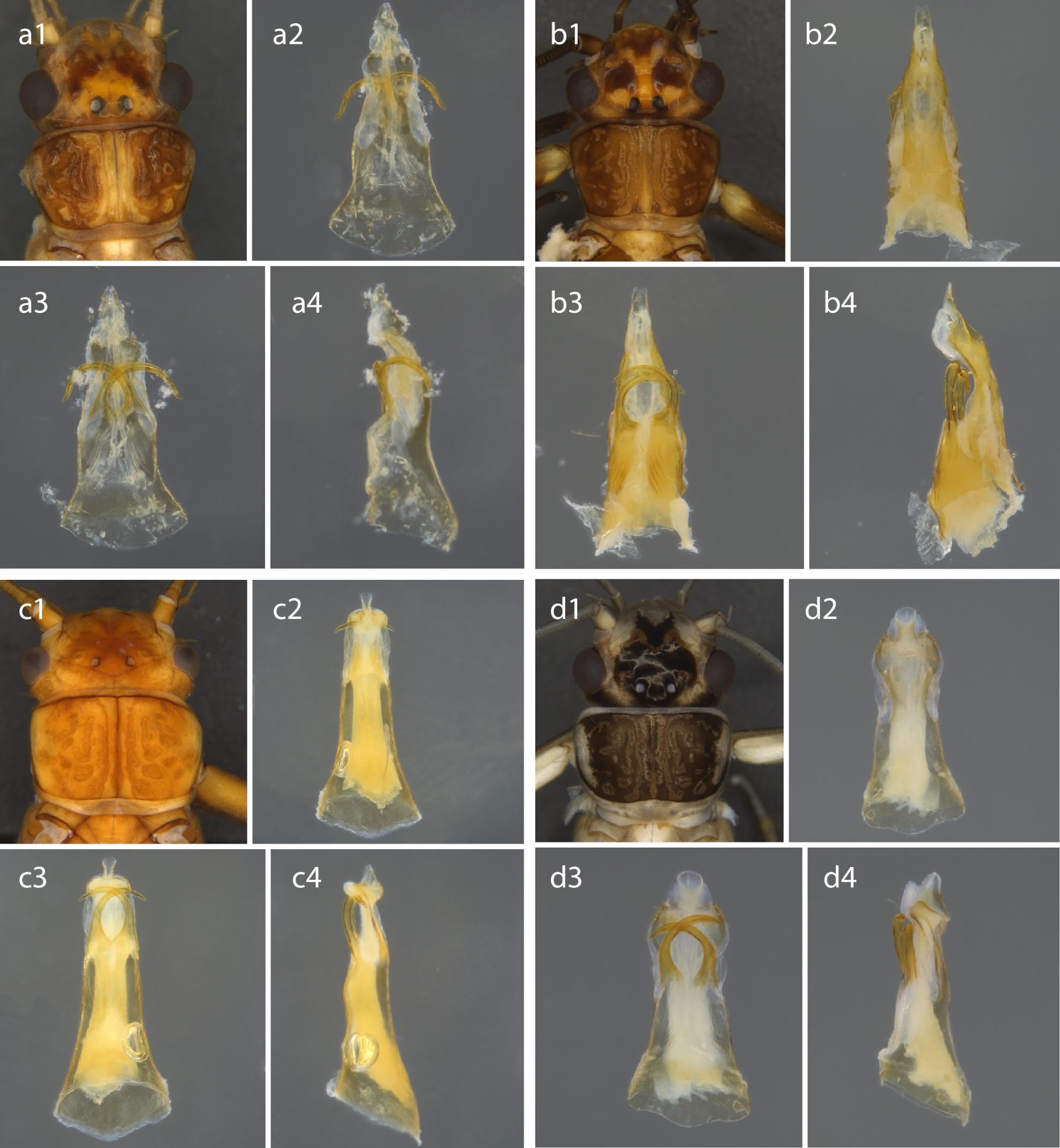
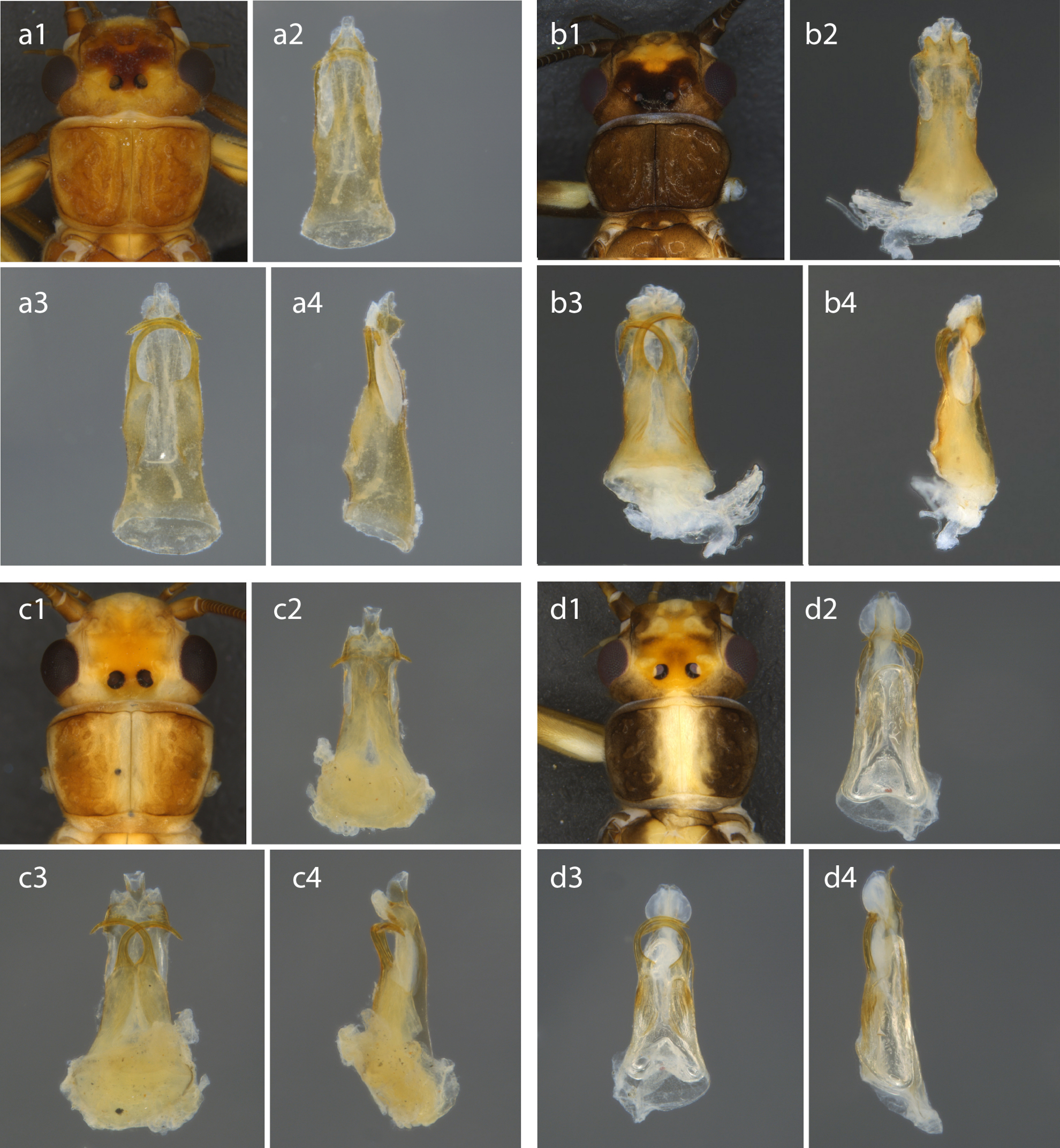
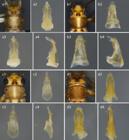
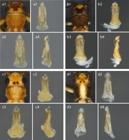
Anacroneuria amargosa Righi-Cavallaro & Froehlich, 2013 (Fig. 4a)
Examined material.Brazil, Espírito Santo: Santa Teresa, REBIO Augusto Ruschi, Córrego da Estrada, 2018.iii.20 – 2018.iii.21, light trap, 1 male, FF Salles leg. (CIACGF – DP57).
Printscreen of the AnacroIndex key during its use. In this step, a single character has been chosen so far, indicated by the “History” tab, and four remaining species are possible, indicated in the column on the right.
Remarks: This species occurs in northern Espírito Santo. The photographed specimen is teneral, so comparison with the photographs should be done with care, especially regarding the maculation pattern. Regarding the penial armature, this species is quite similar to A. boraceiensis, which occurs in Minas Gerais and São Paulo. They may be distinguished in the key due to the following characters: A. amargosa does not show ventral vesicles while they may or may not be seen in A. boraceiensis, the keel shape in dorsal view is U-shaped in A. amargosa and U or )( shaped in A. boraceiensis, the lateral margins of the gonoporal process base are convergent in A. amargosa and subparallel in A. boraceiensis and proportions between the apical and basal region widths occupy half of the total armature length in A. amargosa and less than half in A. boraceiensis.
Anacroneuria atrifrons Klapálek, 1922 (Fig. 4b)
Examined material. Brazil, Minas Gerais: Aimorés, Rio Manhuaçu, 19°29’38”S 41°16’31”W, 2022.i.06 – 2022.i.07, light trap, 1 male, ADL Viana, P Bonfá, P Rodrigues & M Rothe-Neves leg. (UFVB – PL00452).
Remarks: This species occurs in most of Southeastern Brazil. This species may be considered similar to A. mineira due to the general shape of the armature. For identifying this species, careful observation of the width of the hooks in the penial armature is crucial, as they widen over their extension and constrict apically.
Anacroneuria boraceiensis Froehlich, 2004 (Fig. 4c)
Examined material. Brazil, São Paulo: Salesópolis, Estação Biológica de Boracéia, Córrego Coruja, 2022.xii.08, light sheet, 1 male, LH Almeida & PN Taniguti leg. (CIACGF – DP785).
Remarks: See the remarks for A. amargosa.
Anacroneuria debilis Pictet, 1841 (Fig. 4d)
Examined material. Brazil, Minas Gerais: Araponga, Parque Estadual da Serra do Brigadeiro, 2022.x.19 – 2022.xi.03, Malaise, 1 male FF Salles leg. (UFVB – PL193); 2023.iii.12 – 2023.iv.14, Malaise, 2 male, MLS Rippel leg. (UFVB – PL223, PL224); 2023.vii.23 – 2023.ix.08, Malaise, 1 male, FF Salles leg. (UFVB – PL241); Araponga, Pousada Fazenda do Remanso, 2023.ii.14 – 2023.ii.17, light trap, 1 male, MLS Rippel leg. (UFVB – PL368, PL395, PL398); 2021.xi.17, light trap, 1 male (UFVB – PL443); 2022.vi.29 – 2022.vii.29, Malaise, 1 male, FF Salles leg. (UFVB – PL505); Jaboticatubas, Parque Nacional da Serra do Cipó, Córrego das Pedras, Capão dos Palmitos, 2022.x.06, 1 male, light trap, MLS Rippel leg. (UFVB – PL206); Brumadinho, Córrego Laranjeira, 20° 7’ 25,63” S 44° 8’ 57,92” W, 2021.vi.23, Malaise, 6 males, Roxinol leg. (UFVB – PL455, PL456, PL457, PL459, PL506); Espírito Santo: Reserva Biológica Augusto Ruschii, Córrego da Estrada, light trap, 1 male (UFVB – PL449).
Remarks: This species occurs in most of Southeastern Brazil. This species has a very broad range of distribution and may exhibit some morphological plasticity regarding the keel shape in dorsal view and the gonoporal process apex (Table SI). In Southeastern Brazil, it may be mistaken for A. ruschii, which occurs in Espírito Santo, and A. uyara, which occurs in São Paulo, and the differentiation between these species is difficult. These three species may be distinguished in the key due to the following differences: the basal region length proportion occupy more than half of total armature length in A. debilis and A. uyara, and less than half in A. ruschii, and the gonoporal process shape is rounded in A. debilis and truncated in A. uyara.
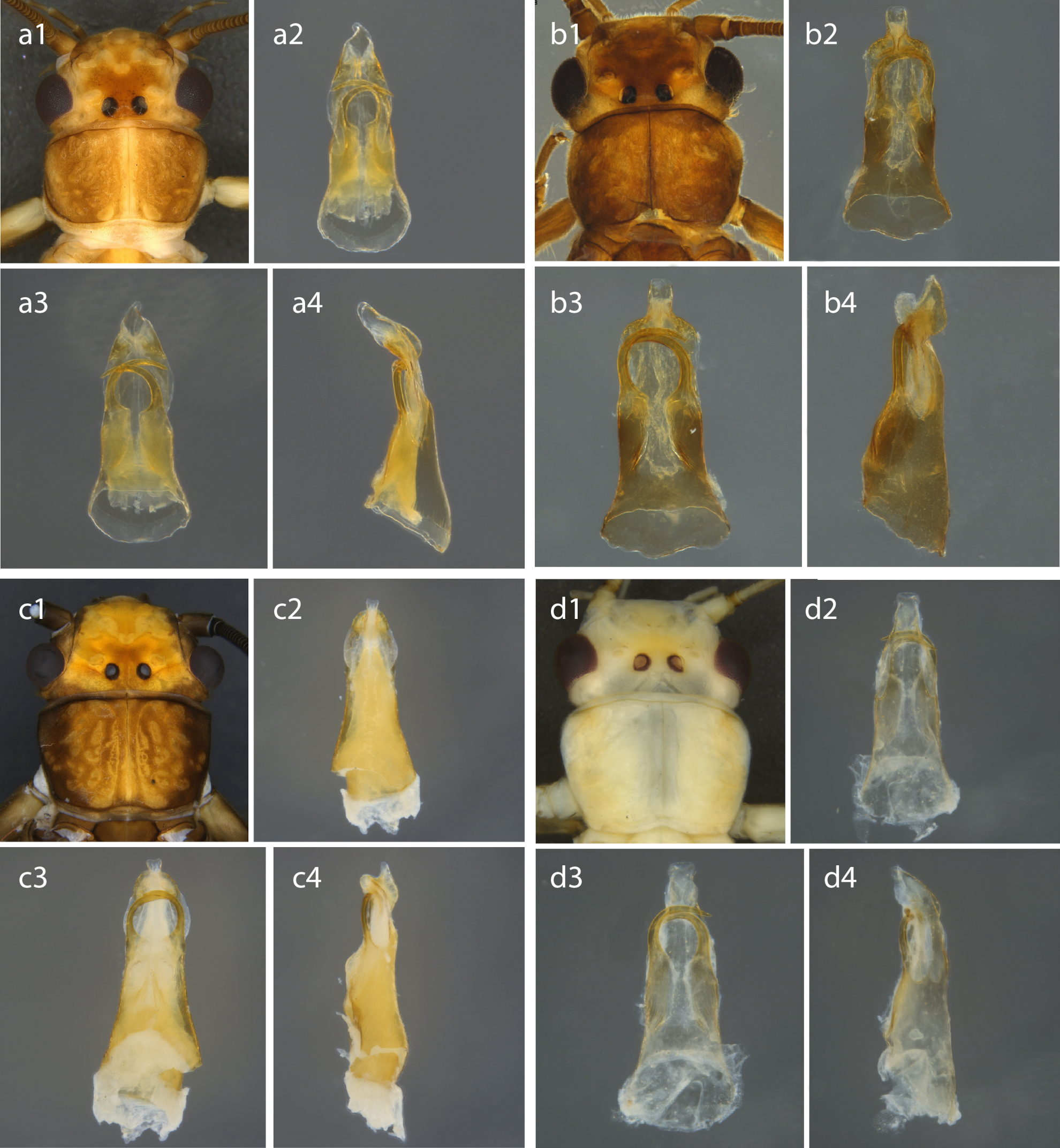
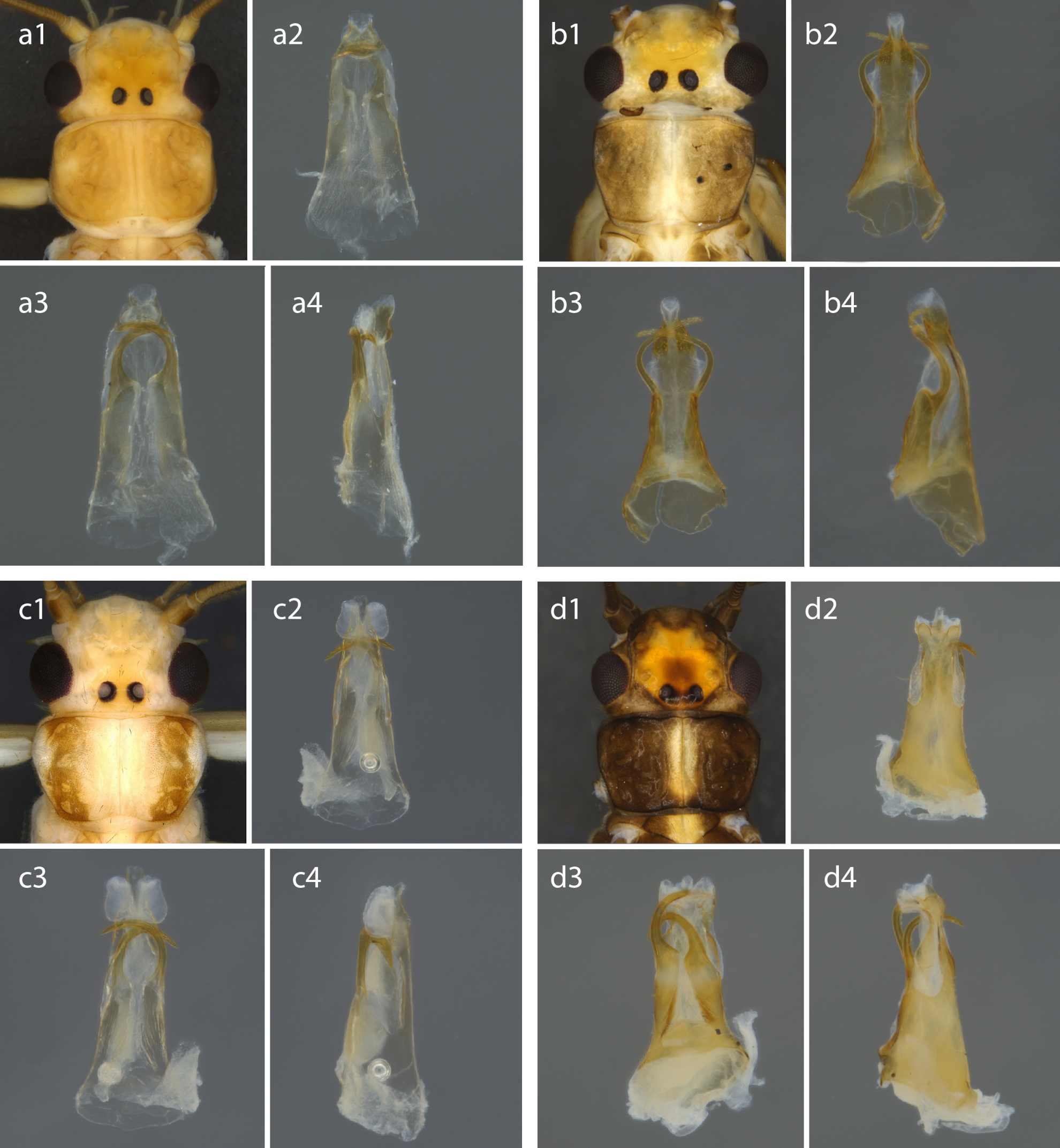
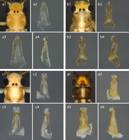
Anacroneuria fiorentini De Ribeiro & Froehlich, 2007 (Fig. 5a)
Examined material. Brazil, São Paulo: Iporanga, Parque Estadual de Intervales, Ribeirão do Carmo (Próx. Alecrim), 2010.viii.11, light sheet, LH Almeida leg. (CIACGF – LM15).
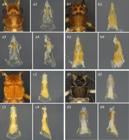
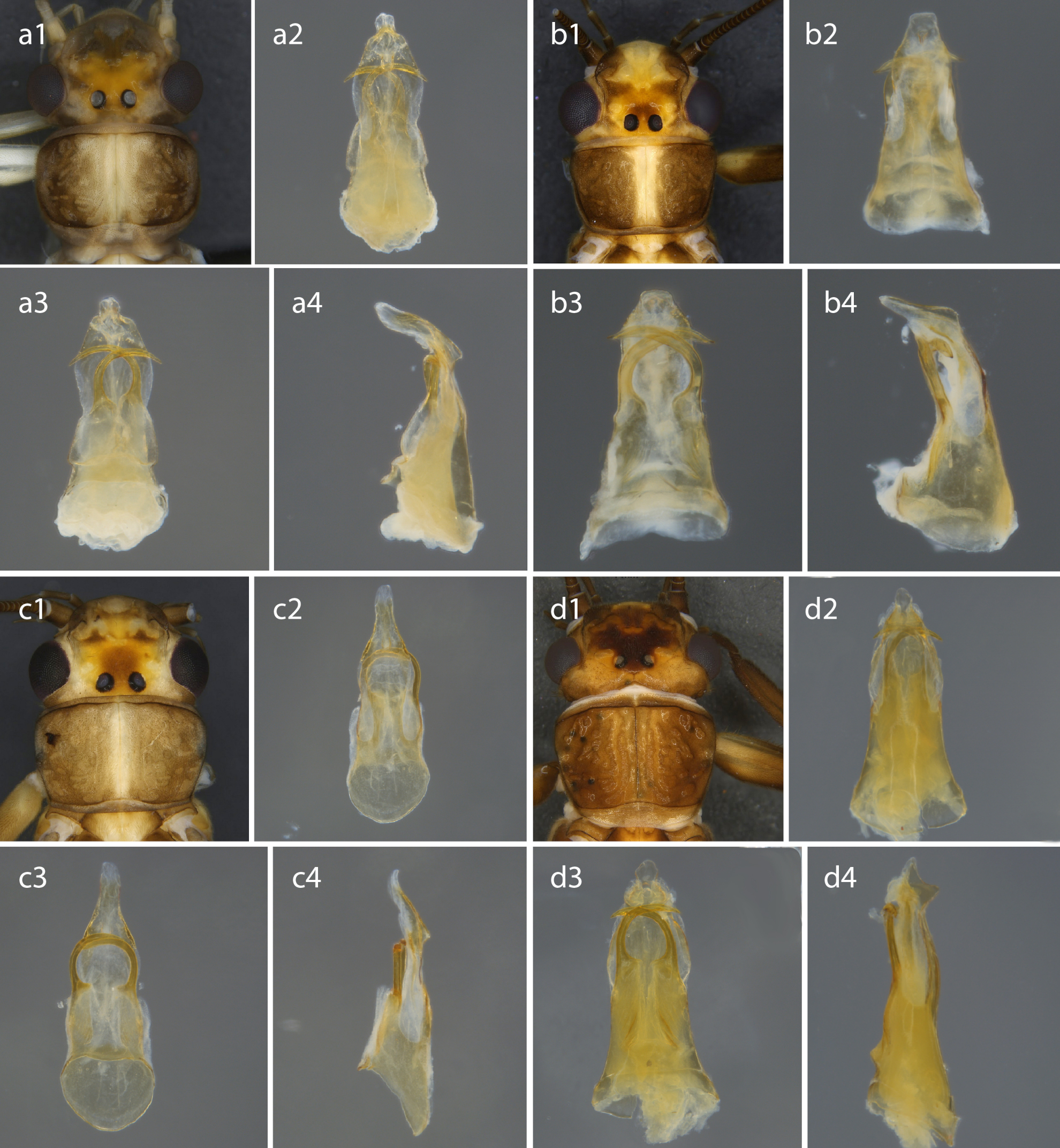
Figures provided in the AnacroIndex key. Each figure shows (1) head and pronotum, penial armature in (2) dorsal, (3) ventral and (4) lateral views. (a) Anacroneuria amargosa; (b) Anacroneuria atrifrons; (c) Anacroneuria boraceiensis; (d) Anacroneuria debilis.
Remarks: This species occurs in Southern Brazil and southern São Paulo. The photographed specimen is teneral, so comparison with the photographs should be done with care. This species is quite unique regarding the penial armature and the combination of a number of characters distinguish it from other species, such as the shape of the lateral margins of the gonoporal process base, which is diverging, and the shape of the gonoporal process apex, which is either rounded or sharp.
Anacroneuria flintorum Froehlich, 2002 (Fig. 5b)
Examined material.Brazil, Minas Gerais: Araponga, Parque Estadual da Serra do Brigadeiro, 20° 43’ 52” S 42° 27’ 50” W, 1110 m, 2022.x.03 - 2022.xii.07, Malaise, 1 male, FF Salles leg. (UFVB – PL210); 2022.vi.29, Malaise, 2 males, FF Salles leg. (UFVB – PL211); 2023.iii.12 – 2023.iv.14, Malaise, 1 male, MLS Rippel leg. (UFVB – PL222); Araponga, Pousada Fazenda do Remanso, 2023.iii.21 – 2023.iii.22, light trap, 5 males, (UFVB – PL196, PL200, PL231, PL232, PL242); 2023.ii.15 - 2023.ii.17, 20° 39’ 24” S 42° 27’ 08” W, light trap, 2 males, MLS Rippel leg. (UFVB – PL369, PL399). Rio de Janeiro: Itatiaia, Parque Nacional do Itatiaia, Véu da Noiva, 22° 25’ 37” S 44° 37’ 6” W, 1170 m, 2022.iii.15 – 2022.iii.16, light trap, 3 males, FF Sallles leg. (UFVB – PL333, PL334, PL335); Itatiaia, Parque Nacional do Itatiaia, Cachoeira da Maromba, 22° 25’ 46” S 44° 37’ 10” W, 1100 m, 2022.iii.14, light trap, 1 male, FF Sallles leg. (UFVB – PL332).
Remarks: This species occurs in most of Southeastern Brazil. This species may be confused with A. polita, as their penial armatures are relatively similar. They are mostly distinct by the following characters: the keel shape in dorsal view, the keel is undeveloped in A. flintorum and developed in A. polita, and lateral margin of the dorsal plate. The maculation pattern on the head is distinct and may be used in cases of doubt in well sclerotized and well-preserved specimens by comparison with the photographed specimen.
Anacroneuria fuscicosta Enderlein, 1909
Examined material. No material could be examined for this species, as no material has been collected recently and the type series could not be located. Inclusion in the key followed the illustrations of Froehlich (2002), who examined 2 male specimens: Brazil, Santa Catarina, Nova Teutonia, F. Plaumann leg., Jan 1963 (CAS); Paraná, Rio dos Patos, 3 km E of Prudentópolis, 700m, 2 Mar 1969, W.L & J.G. Peters (NMNH).
Remarks: This species occurs in Southern Brazil and in Southern São Paulo. This species is distinguished from others included in the key due to the following combination of character states: the basal region length occupy more than half of total armature length, the gonoporal process apex is either rounded or sharp, the gonoporal process is unnotched, the lateral margins of the gonoporal process base are convergent, and the keel shape in dorsal view is V-shaped.
Anacroneuria iporanga Bispo & Froehlich, 2004 (Fig. 5c)
Examined material.Paratype/MZUSP. Brazil, São Paulo: Iporanga, Parque Estadual de Intervales, Córrego Bocaina, 2000.xi.28 – 2000.xi.30, 1 male, PC Bispo leg.
Remarks: This species is known from Southern São Paulo. The photographed paratype has lost its entire maculation pattern, and this aspect should be disregarded when comparing specimens with the species photographs. It is a very large species, with a forewing size around 17 mm. As most other large Anacroneuria, the basal region length proportion is an important character: it occupies more than half of total armature length. Its penial armature is relatively similar to that of A. mantiqueirae and A. paulina but may be differentiated from them due to the following characters: the lateral margin of the gonoporal process is divergent in A. iporanga, and subparallel in A. mantiqueirae and A. paulina, and lateral expansion of the membrane is absent in A. iporanga and A. mantiqueirae, but expanded in A. paulina. A final distinguishing feature not included in the key is the external appearance of the head and pronotum, as both A. iporanga and A. paulina are much darker species than A. mantiqueirae. As always, the head and pronotum color and maculation patterns may only be used as a last resort in particularly well sclerotized and well-preserved material.
Anacroneuria itajaimirim Bispo & Froehlich, 2004 (Fig. 5d)
Examined material.Brazil, São Paulo: Iporanga, Parque Estadual de Intervales, Rio do Carmo, 2017.ii.09, light trap, 1 male, LH Almeida leg. (CIACGF – DP144); Apiaí, Parque Estadual Turístico do Alto Ribeira, Núcleo Santana, Riacho Furnas, 2017.ii.14, light trap, LH Almeida leg. (CIACGF – DP145).
Remarks: The photographed specimen is teneral, so comparison with the photographs should be done with care in relation to the maculation pattern. This species differentiates itself from others in the key by the following characters: the hook width is variable, as A. itajaimirim may have distinct wide regions in its hooks, the basal region length proportion occupies half of the total armature length, and the basal region width proportion, as A. itajaimirim has the base of the apical region narrower than the base of the basal region. It is worth noting that A. itajaimirim is only known from the Paranapiacaba Mountains and Cananéia. While distribution data is updated regularly, this may be used as auxiliary information in the identification of this species.
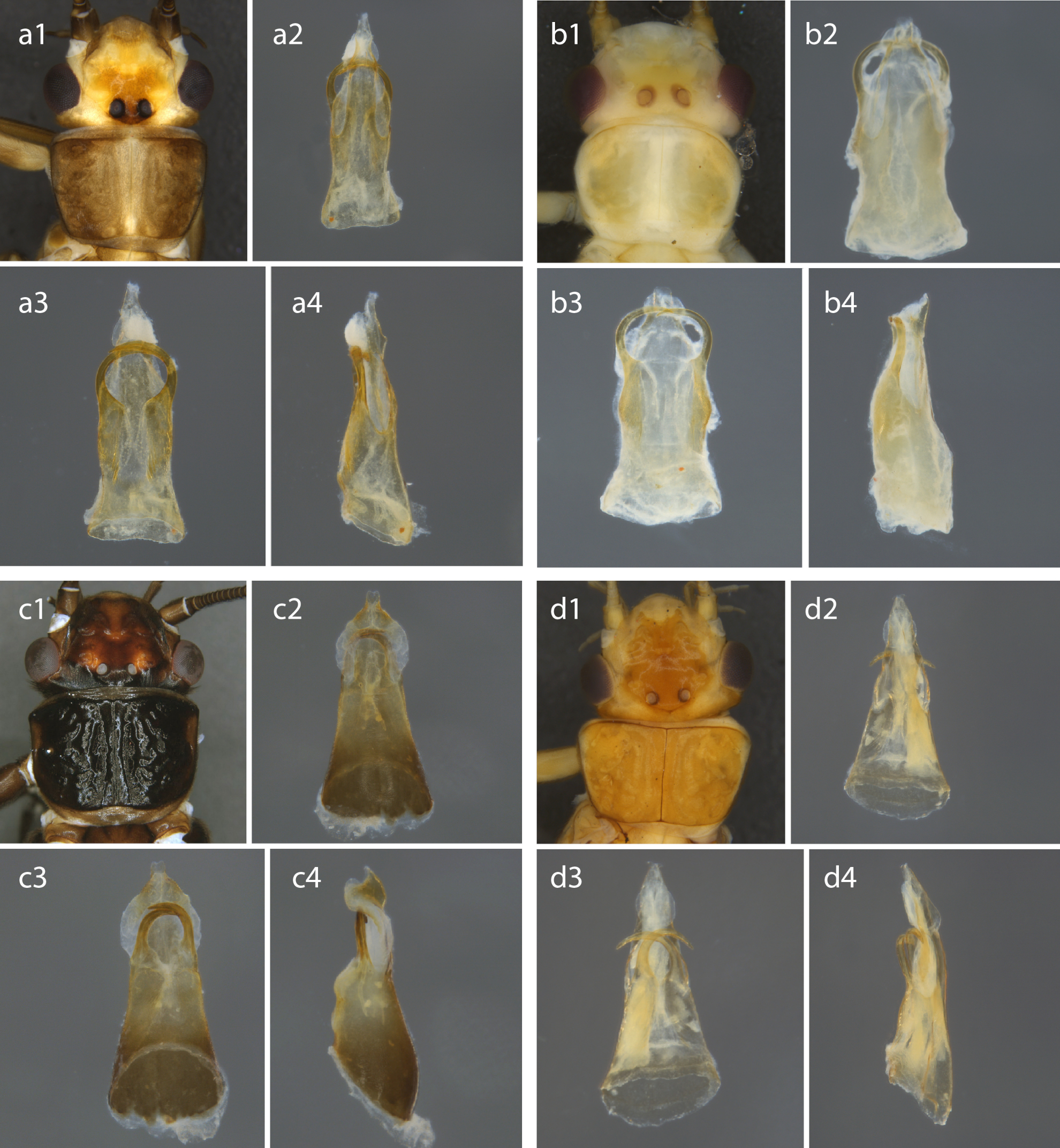
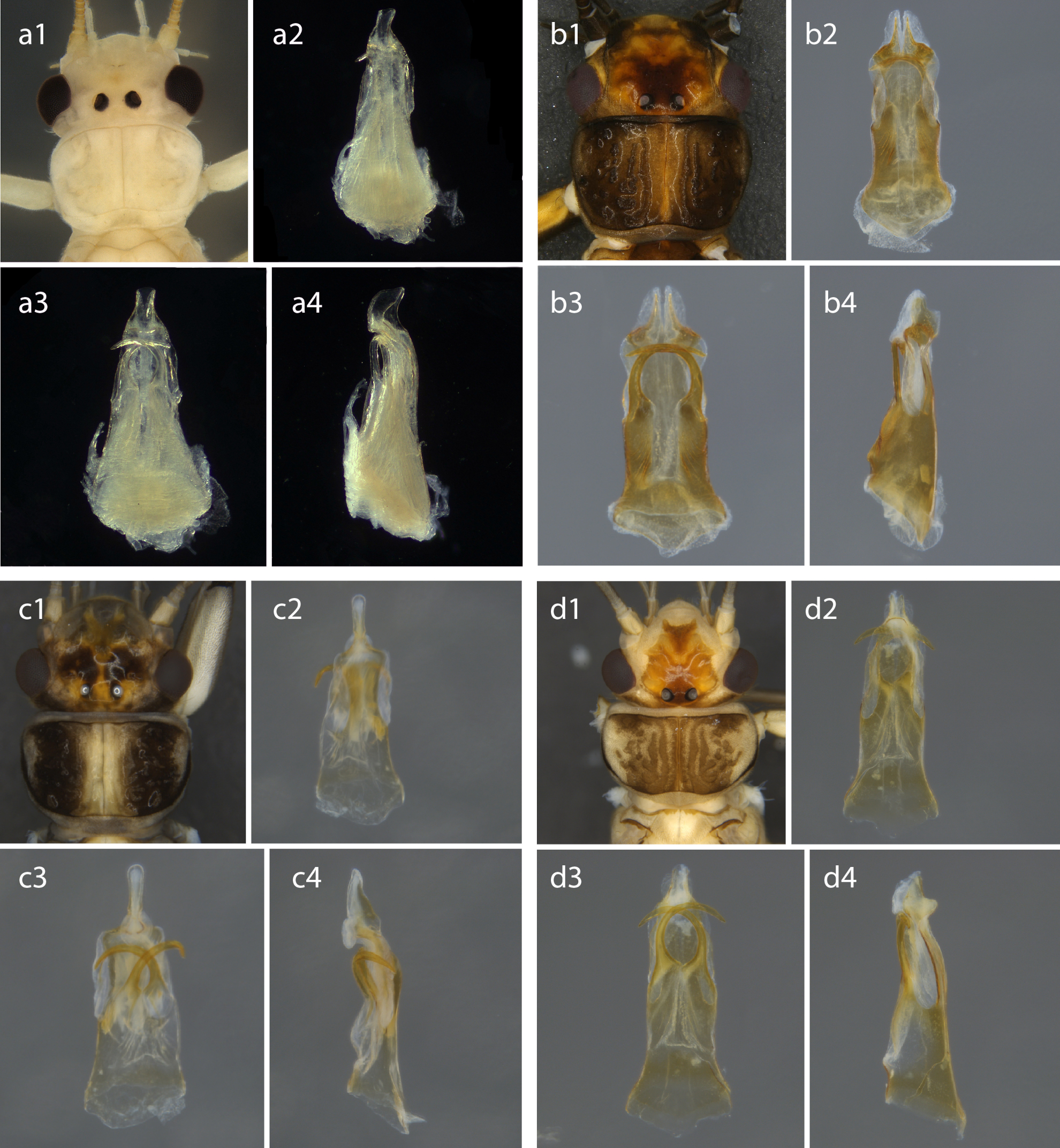
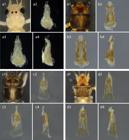
Anacroneuria itatiaiensis Baldin, Bispo & Novaes, 2013 (Fig. 6a)
Examined material.Brazil: Minas Gerais: Mariana, Rio Gualaxo do Norte, 20° 15’ 09.81” S 43° 22’ 24.56” W, 2022.iii.28, 1 male, light trap, TG Kloss leg. (UFVB – PL214); Mariana, Rio Gualaxo do Norte, 20° 16’ 38.64” S 43° 26’ 20.04” W, 2022.iii.2, 1 male, light trap, TG Kloss leg. (UFVB – PL218); Mariana, Rio Gualaxo do Norte, 20° 14’ 52.00” S 43° 20’ 55.66” W, 2022.iii.30, TG Kloss leg., 1 male, light trap (UFVB – PL219); Mariana, Rio Gualaxo do Norte, 20° 14’ 26.23” S 43° 20’ 37.13” W, 2022.iii.30, 1 male, light trap, TG Kloss leg. (UFVB – PL220); Mariana, Rio Gualaxo do Norte, 20° 14’ 26.23” S 43° 20’ 37.13” W, 2022.iii.30, 1 male, light trap, TG Kloss leg. (UFVB – PL225); Mariana, Rio Gualaxo do Norte, 20° 14’ 21.61” S 43° 20’ 06.91” W, 2022.iii.30, 1 male, light trap, TG Kloss leg. (UFVB – PL230); Mariana, Rio Gualaxo do Norte, 20° 17’ 03.60” S 43° 27’ 43.86” W, 2022.iii.27, 1 male, light trap, TG Kloss leg. (UFVB – PL234); Guaraciaba, Rio Piranga, 20° 32’ 46.30” S 42° 59’ 25.25” W, 2022.i.14, 2 male, light trap, ADL Viana leg. (UFVB – PL451, PL453).
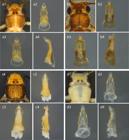
Figures provided in the AnacroIndex key. Each figure shows (1) head and pronotum, penial armature in (2) dorsal, (3) ventral and (4) lateral views. (a) Anacroneuria fiorentini; (b) Anacroneuria flintorum; (c) Anacroneuria iporanga paratype; (d) Anacroneuria itajaimirim.
Remarks: A common species with a wide distribution. It may be confused for A. pitii and A. quilombola. It may be distinguished from them due to the paired vesicles. This species may have more than one state in this character, however, and in some cases the species are indistinguishable. Their identity as separate species is questionable, and further studies should be conducted in order to uncover possible synonymy or currently unknown characters.
Anacroneuria kariri Righi-Cavallaro & Froehlich, 2013 (Fig. 6b)
Examined material.Brazil, BA: Mucugê, Parque Nacional da Chapada Diamantina, Rodovia BA242, Ponte Dr. Heitor M. Chamusca, 12° 59’ 24’’ S 41° 21’ 1’’ W, 2018.viii.19, light trap, 1 male, MC Gonçalves leg. (UFVB – PL00293); Mucugê, Parque Nacional da Chapada Diamantina, Cachoeira das Andorinhas, 13° 01’ 02’’ S 41° 20’ 30’’ W, 2018.vii.21 – 2018.vii.23, Pennsylvania, 1 male, Rodrigues & Prado leg. (UFVB – PL00294).
Remarks: A small species which occurs in Northeastern Brazil and the northern parts of Minas Gerais. It is quite distinct from the other species included in the key: the keel shape in dorsal view is Y-shaped, and the gonoporal process apex is truncated.
Anacroneuria mantiqueirae Froehlich, 2010 (Fig. 6c)
Examined material. Brazil, Rio de Janeiro: Itatiaia, Parque Nacional do Itatiaia, Cachoeira Véu da Noiva, 2017.x.07, light trap, 1 male, R Campos leg. (CIACGF – DP02).
Remarks: See the remarks for A. iporanga.
Anacroneuria mineira Novaes & Bispo, 2014 (Fig. 6d)
Examined material.Holotype. Brazil, Minas Gerais: Santana do Riacho, Serra do Cipó, Rio Cipó, Cardeal Mota – Cachoeira Baixa, 19° 20’ 55’’ S 43° 38’ 53’’ W, 2001.xi.10, RW Holzenthal, H Paprocki leg. (MZUSP).
Remarks: A relatively large species that occurs in the Midwest of Brazil and western Minas Gerais. The photographed holotype has lost its entire maculation pattern, so this aspect should be disregarded when comparing specimens with the species photographs. The penial armature can be distinguished from other species by the basal region length proportion, which occupies more than half of total armature length and keel shape in dorsal view, which forms a Y.
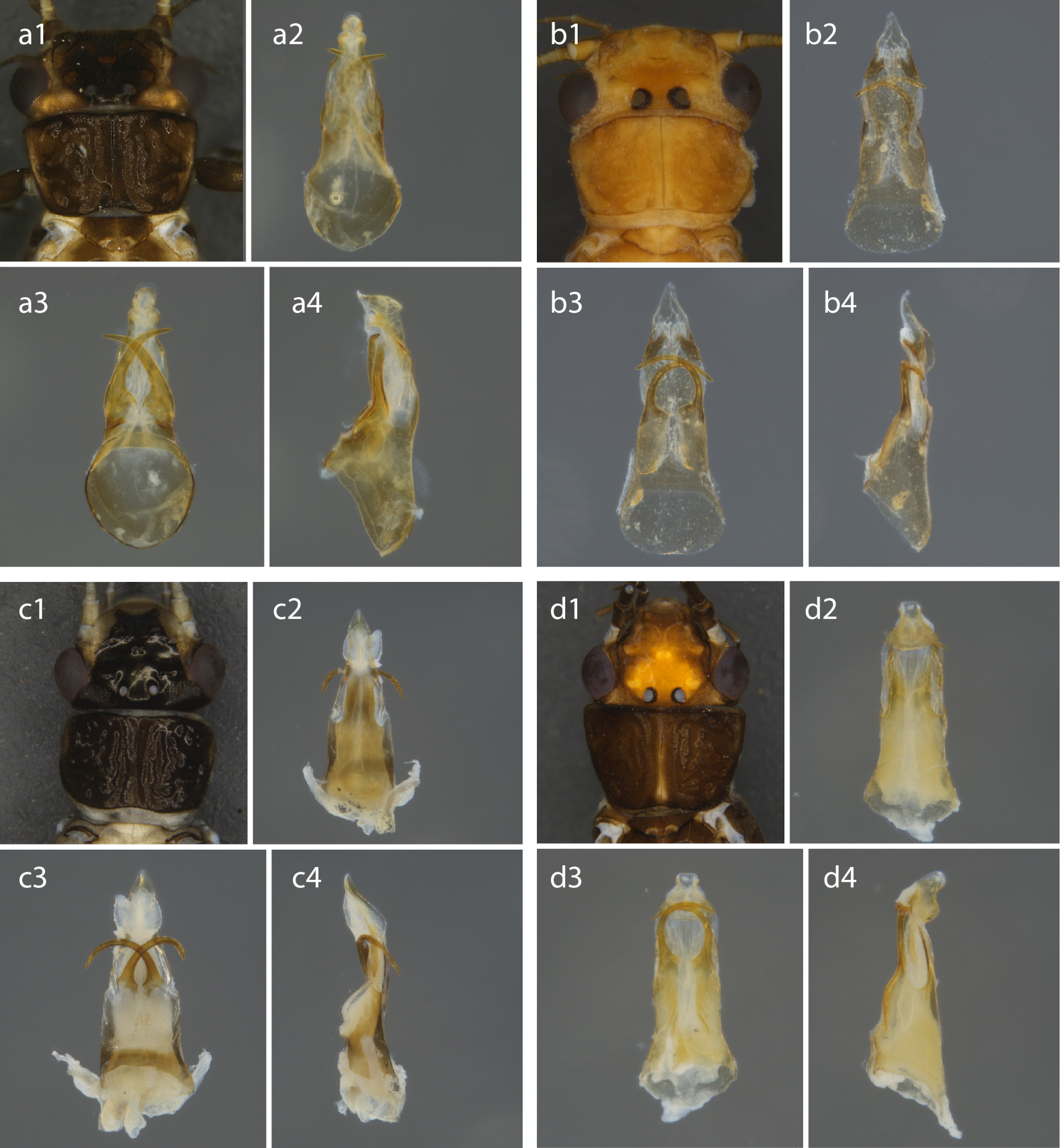
Anacroneuria ofaye Froehlich, 2007 (Fig. 7a)
Examined material.Brazil, São Paulo: Assis, Estação Ecológica de Assis, Riacho Água do Xaxim, 2019.xi.18 – 2019.xii.18, Malaise, 1 male, LH Almeida leg. (CIACGF – F58).
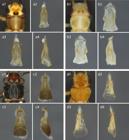
Figures provided in the AnacroIndex key. Each figure shows (1) head and pronotum, penial armature in (2) dorsal, (3) ventral and (4) lateral views. (a) Anacroneuria itatiaiensis; (b) Anacroneuria kariri; (c) Anacroneuria mantiqueirae; (d) Anacroneuria mineira holotype.
Remarks: This species occurs mainly in São Paulo. It is quite distinct from others included in the key. The lateral margins of the gonoporal process base are divergent and the acute yet truncated gonoporal process apex are important characters in its identification.
Anacroneuria paprockii Novaes & Bispo, 2014 (Fig. 7b)
Examined material.Holotype. Brazil, Minas Gerais: São Gonçalo do Rio Preto, Parque Estadual do Rio Preto, small stream near park entrance, 18° 05’ 43’’ S 43° 20’ 51’’ W, 2001.xi.14, H Paprocki leg. (MZUSP).
Remarks: This species occurs in Minas Gerais. The photographed holotype has lost its entire maculation pattern, so this aspect should be disregarded when comparing specimens with the species photographs. The combination of the divergent lateral margins of the gonoporal process base, the truncated gonoporal process apex and the basal region length proportions occupying half or more than half of total armature length are important characters in identifying this species.
Anacroneuria paulina Navás, 1936 (Fig. 7c)
Examined material.Brazil, São Paulo: Salesópolis, Estação Biológica de Boracéia, Rio Guaratuba, 2024.i.18, light trap, 1 male, PN Taniguti & B Sabino leg. (CIACGF – DP1179).
Remarks: See the remarks for A. iporanga.
Anacroneuria petersi Froehlich, 2002 (Fig. 7d)
Examined material.Brazil, São Paulo: Paratype Santo André, Estação Biológica de Paranapiacaba, 1963.x.15, 1 male, CG Froehlich leg. (MZUSP).
Remarks: This species occurs in São Paulo. The photographed paratype is a teneral specimen, so most of its maculation pattern has been lost due to the preservation techniques employed. This should be considered when comparing specimens with the species photographs. This species is similar to A. polita, and only the keel shape in dorsal view distinguishes them: it is V-shaped in A. petersi and )( shaped in A. polita.
Anacroneuria piranga Castillo-Velásquez, Gonçalves & Salles, 2023 (Fig. 8a)
Examined material.Brazil, Minas Gerais: Holotype Guaraciaba, Rio Piranga, 20° 32’ 46’’ S 42° 59’ 25’’ W, 526 m, Pennsylvania, ADL Viana, P Bonfá & P Rodrigues leg. (UFVB); Paratype Guaraciaba, Rio Piranga, 20° 32’ 46’’ S 42° 59’ 25’’ W, 526 m, Pennsylvania, 1 male, ADL Viana, P Bonfá & P Rodrigues leg. (UFVB); Guaraciaba, Rio Piranga, 20° 32’ 46’’ S 42° 59’ 25’’ W, 2024.ix.30, light sheet, 1 male, FF Salles, C Nieto, T Senar-Serra & A Ruiz leg. (UFVB – PL00535).
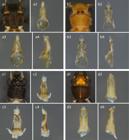
Figures provided in the AnacroIndex key. Each figure shows (1) head and pronotum, penial armature in (2) dorsal, (3) ventral and (4) lateral views. (a) Anacroneuria ofaye; (b) Anacroneuria paprockii holotype; (c) Anacroneuria paulina; (d) Anacroneuria petersi paratype.
Remarks: This species is only known from the type locality in Minas Gerais. The penial armature of this species is quite distinct from others included in the key. The main character used in identifying this species is the curvature of the hooks, which are mostly straight.
Anacroneuria pitii Gonçalves, Novaes & Salles, 2017 (Fig. 8b)
Examined material.Brazil, Espírito Santo: Holotype Alegre, Rio Norte, reared nymph collected 07.viii.2004, emerged 08.viii.2004, MC Gonçalves leg (UFVB - PL00597).
Remarks: See the remarks for A. itatiaiensis.
Anacroneuria polita Burmeister, 1839 (Fig. 8c)
Examined material.Brazil, Rio de Janeiro: Itatiaia, Parque Nacional do Itatiaia, Córrego Taquaral – 810m, 06.x.2017, Malaise, 1 male, R Campos leg. (CIACGF – DP08).
Remarks: The photographed specimen is teneral, and comparison with the photographs should be done with care. See the remarks for A. petersi.
Anacroneuria quilombola Righi-Cavallaro & Froehlich, 2013
Examined material. No material could be examined for this species, and we weren’t able to access the type material, deposited at MZUSP, or any recently collected specimens. Inclusion in the key followed the description’s illustration and photographs (Righi-Cavallaro et al. 2013).
Remarks: See the remarks for A. itatiaiensis.
Anacroneuria rotunda Gonçalves, Novaes & Salles, 2017 (Fig. 8)
Examined material.Brazil, Espírito Santo: Holotype Alegre, 20°37’11’’S 41°37’35’’W, 04-05.iv.2016, light trap, Salles leg. (UFVB - PL00598); Alfredo Chaves, Mathilde, 20-21.i.2017, light sheet, 1 male, FF Salles leg. (CIACGF – DP58).
Remarks: This species is known from Espírito Santo and Minas Gerais. It has the same character states as A. singela, and the key is unable to differentiate them (Table SI). This is due to the astounding similarity between the armatures of these species. The coloration of A. rotunda is characteristic, and even in teneral or badly preserved specimens, the external difference between these two species is apparent. As such, when identifying either of these species, the external coloration should be considered.
Anacroneuria ruschii Novaes, Bispo & Gonçalves, 2016 (Fig. 9a)
Examined material.Brazil, Espírito Santo: Holotype Santa Teresa, 19°54’53’’S 40°33’40’’W, 08-09.ix.2015, light trap, FF Salles leg (UFVB - PL00599).
Figures provided in the AnacroIndex key. Each figure shows (1) head and pronotum, penial armature in (2) dorsal, (3) ventral and (4) lateral views. (a) Anacroneuria piranga; (b) Anacroneuria pitii holotype; (c) Anacroneuria polita; (d) Anacroneuria rotunda holotype.
Remarks: See the remarks for A. debilis.
Anacroneuria sallesi Almeida, Gonçalves & Bispo, 2025 (Fig. 9b)
Examined material.Brazil, Espírito Santo: Holotype/UFVB Santa Teresa, Reserva Biológica Augusto Ruschi, Córrego Bragacho, 20-21.ii.2018, 1 male, FF Salles leg. (PL00617).
Remarks: This species is only known from Espírito Santo. It has some readily seen characters that may confuse it for A. vanini, such as the anterior wing membrane color with a hyaline window present or its pronounced shoulder projection. The species can be distinguished, however, due to the following characters: the shape of the gonoporal process is truncated in A. sallesi and rounded in A. vanini, the apical region width proportions are subequal in A. sallesi and narrower in A. vanini, the basal region length proportions occupy half or more than half of total armature length in A. sallesi and less than half in A. vanini, and the dorsal keel is developed in A. sallesi and undeveloped in A. vanini.
Anacroneuria saofrancisco Novaes, Vilela, Lopez & Ferreira, 2018 (Fig. 9c)
Examined material.Brazil, Minas Gerais: Holotype Parque Nacional da Serra da Canastra, Rio do Peixe, -20.2569, -46.4097, 17–19.x.2017, GFT leg (MZUSP).
Remarks: This species occurs in Minas Gerais. This species may be distinguished from others in the key due to the dorsal keel, which is undeveloped, the armature dorsal plate lateral margins, which are divergent, the gonoporal process apex, which is truncated and the unprojected shoulders.
Anacroneuria simulans Froehlich, 2010 (Fig. 9d)
Examined material.Brazil, São Paulo: Campos do Jordão, Parque Estadual Campos do Jordão, Estrada Galharada, 15.ii.2019, light trap, 1 male, LH Almeida leg. (CIACGF – DP190); Campos do Jordão, Parque Estadual Campos do Jordão, Estrada Galharada, 15.ii.2019, light trap, 1 male, LH Almeida leg. (CIACGF – DP191).
Remarks: This species occurs in São Paulo and Rio de Janeiro. The penial armature of this species is similar to A. subcostalis. The fore wing vein coloration, however, distinguishes these two species: C and ScP darker than remaining longitudinal veins in A. subcostalis and similar or lighter than remaining longitudinal veins in A. simulans. As a final distinguishing feature, although not included in the key, the head and pronotum colors and maculation patterns are distinct, which may be useful in identifying well sclerotized and well-preserved material. In A. simulans, the head is darker laterally, and the M-Line is distinctly light compared to the rest of the head, while in A. subcostalis the head is uniformly light in color.
Anacroneuria singela Duarte & Lecci, 2016 (Fig. 10a)
Examined material.Brazil, BA: Paratype Iaçu, Rio Paraguaçu, 24.iii.2012, by hand, 1 male, T Duarte & I Garcia leg. (MZUSP).
Figures provided in the AnacroIndex key. Each figure shows (1) head and pronotum, penial armature in (2) dorsal, (3) ventral and (4) lateral views. (a) Anacroneuria ruschii holotype; (b) Anacroneuria sallesi holotype; (c) Anacroneuria saofrancisco holotype; (d) Anacroneuria simulans.
Remarks: See the remarks for A. rotunda.
Anacroneuria singularis Righi-Cavallaro & Lecci, 2010 (Fig. 10b)
Examined material.Brazil, MT: Nova Xavantina, Córrego Antártico, 14.xi.2021, light sheet, 1 male, LH Almeida leg. (CIACFG – DP527); Nova Xavantina, Córrego Antártico, 14.xi.2021, light sheet, 1 male, LH Almeida leg. (CIACFG – DP529).
Remarks: This species occurs in northern Minas Gerais and Central Brazil. It has a unique penial armature due to the curvature of the hooks, which are curved in more than one plane.
Anacroneuria stanjewetti Froehlich, 2002
Examined material. No material could be confidently examined for this species. The type specimen, which is deposited at the California Academy of Sciences (CASTYPE19424), was also not available for morphological study. Thus, we rely on the original description for inclusion in the key (Froehlich 2002).
Remarks: This species occurs in Southern Brazil and all the states of Southeastern Brazil. It can be distinguished from others in the key based on the combination of the following characters: the ventral vesicles have an imperceptible separation between them, the lateral margins of the gonoporal process base are divergent, the gonoporal process apex is truncated and basal region length proportions occupy half or more than half of total armature length.
Anacroneuria subcostalis Klapálek, 2021 (Fig. 10c)
Examined material.Brazil, Minas Gerais: Araponga, Parque Estadual da Serra do Brigadeiro, 20°43’52’’S 42°27’50’’W, 1110m, 25.v.2022, 1 male, GM Pantoja, TYS Orlando & ICH Cortes leg. (UFVB – PL00203); Araponga, Parque Estadual da Serra do Brigadeiro, 20°43’52’’S 42°27’50’’W, 1110m, 25.v.2022, 1 male, GM Pantoja, TYS Orlando & ICH Cortes leg. (UFVB – PL00204).
Remarks: See the remarks for A. simulans.
Anacroneuria tabatae Froehlich, 2010 (Fig. 10d)
Examined material.Brazil, São Paulo: Campos do Jordão, Parque Estadual Campos do Jordão, Trilha Galharada, 12-13.ii.2019, light trap, 1 male, LH Almeida leg. (CIACGF – DP184).
Remarks: This species is only known from Campos do Jordão, in São Paulo. It has a unique penial armature among those included in the key. The shoulders are projected and the basal region length proportions occupy half or more than half of total armature length, which are important characters in identifying it. The head and pronotum color and maculation patterns are quite unique and are also informative in well sclerotized and well-preserved material.
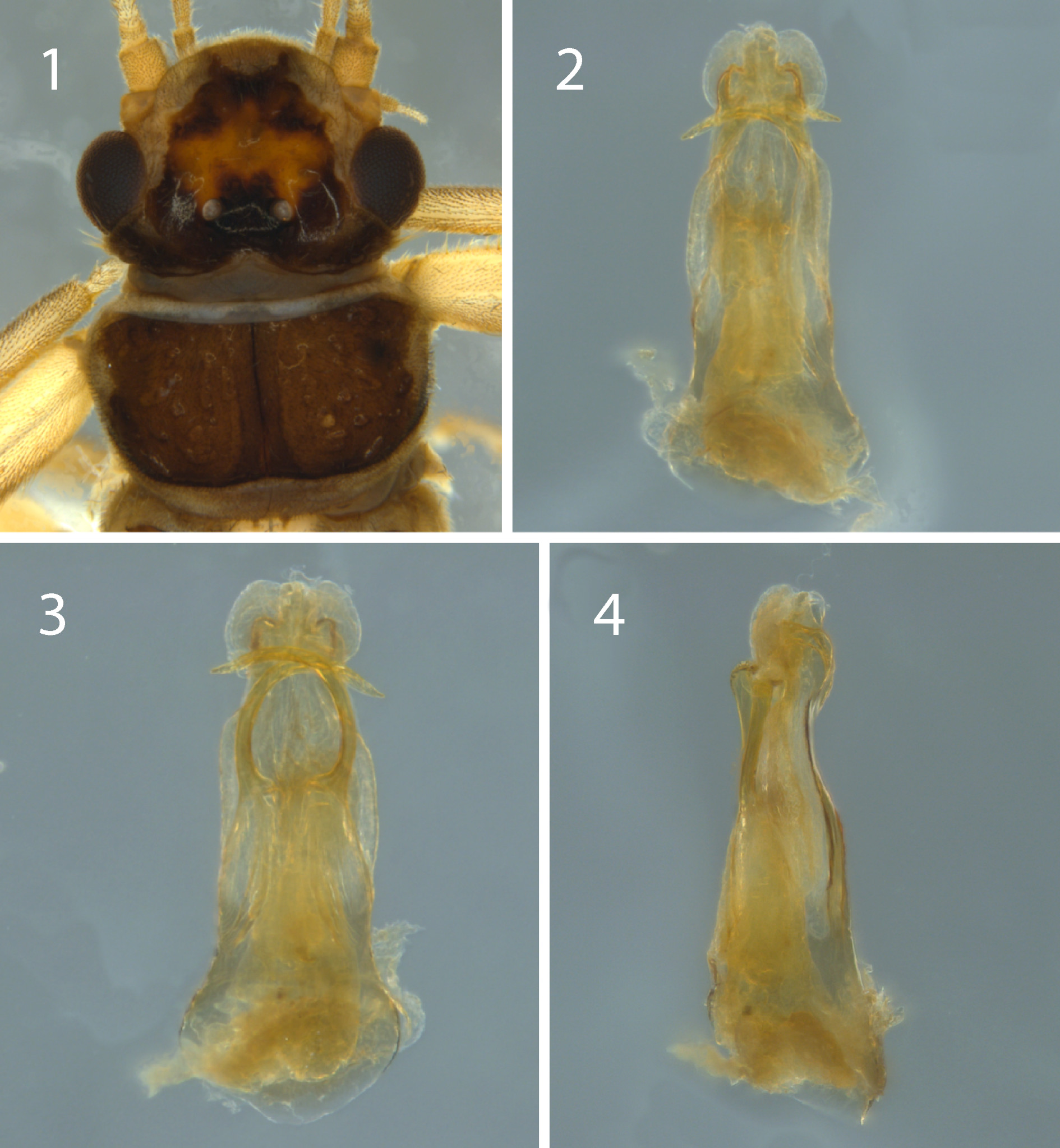
Anacroneuria terere Righi-Cavallaro & Lecci, 2010 (Fig. 11a)
Examined material.Brazil, Tocantins: Pedro Afonso municipality, Rio do Sono, -08.99590, -48.13934, 180 m, 11-12.x.2018, light sheet, TYS Orlando & T Krolow leg., 1 male (CEUFT).
Figures provided in the AnacroIndex key. Each figure shows (1) head and pronotum, penial armature in (2) dorsal, (3) ventral and (4) lateral views. (a) Anacroneuria singela paratype; (b) Anacroneuria singularis; (c) Anacroneuria subcostalis; (d) Anacroneuria tabatae.
Remarks: This species occurs in northern Minas Gerais, Central and Northern Brazil. This species can be distinguished from others in the key by the combination of the undeveloped dorsal keel and notched gonoporal process.
Anacroneuria toriba Froehlich, 2002 (Fig. 11b)
Examined material.Brazil, Rio de Janeiro: Teresópolis, Parque Nacional da Serra dos Órgãos, Trilha Pedra do Sino #2, 8.xii.2024, light trap, 1 male, RB Gastaldo leg. (UFVB – PL00596); São Paulo: Campos do Jordão, Parque Estadual Campos do Jordão, Córrego Galharada, 22°41’39’’S 45°27’41’’W, 1580m, 19.vii.2023, 1 male, by hand, PN Taniguti leg. (UFVB – PL00215).
Remarks: This species occurs in São Paulo, Espírito Santo and Rio de Janeiro. It may be identified especially by the combination of a developed dorsal keel and notched gonoporal process.
Anacroneuria tupi Bispo & Froehlich, 2004 (Fig. 11c)
Examined material.Brazil, São Paulo: Iporanga, Parque Estadual de Intervales, Rio do Carmo, 09.ii.2017, light trap, 1 male, LH Almeida leg. (CIACGF – DP142); Iporanga, Parque Estadual de Intervales, Rio do Carmo, 09.ii.2017, light trap, 1 male, LH Almeida leg. (CIACGF – DP143).
Remarks: This species occurs in São Paulo. The photographed specimen is teneral, so comparison with the photographs should be done with care in relation to the maculation pattern. The character states of this species are included in the possible character states for A. ruschii, and when identifying A. tupi the key won’t exclude A. ruschii as a possible species (Table SI). However, upon observing the photographs of both species, they are easily distinguished.
Anacroneuria uyara Froehlich, 2002 (Fig. 11d)
Examined material.Brazil, São Paulo: Salesópolis, Estação Biológica da Boracéia, Rio Claro, 17.i.2024, light trap, 1 male, PN Taniguti leg. (CIACGF – DP1183).
Remarks: See the remarks for A. debilis.
Anacroneuria vanini Froehlich, 2004 (Fig. 12a)
Examined material.Brazil, Minas Gerais: Araponga, Parque Estadual da Serra do Brigadeiro, 20°43’52’’S 42°27’50’’W, 1110m, 3.x.2022 – 7.xii.2022, malaise, 1 male, MLS Rippel leg. (UFVB – PL245).
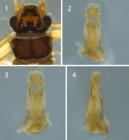
Figures provided in the AnacroIndex key. Each figure shows (1) head and pronotum, penial armature in (2) dorsal, (3) ventral and (4) lateral views. (a) Anacroneuria terere, photographs by MLS Rippel; (b) Anacroneuria toriba; (c) Anacroneuria tupi; (d) Anacroneuria uyara.
Remarks: See the remarks for A. sallesi.
Recommendations
When using the AnacroIndex key, there are a couple of suggestions we would like to point out. For those unfamiliar with Anacroneuria penial morphology and terminology, we recommend reading the corresponding section of Gastaldo et al. (2025). One practical suggestion in the use of the AnacroIndex key in Xper3 is the frequent submission of the key. After submission, the key will eliminate impossible characters and recommend characters that are critical for the next step of the identification process. As such, if the user fills in too many characters without submitting, the key has less opportunities to suggest characters to the user, increasing the probability of running into dead ends.
One of the advantages of our key is that almost all species have their head, pronotum and penial armature photographed and available at all times to the user through clicking the species name on the list on the right of the screen (Fig. 1). In our experience, users find it considerably harder to fill the last couple of characters when only a few possible species are left. Considering this, if the user is having trouble or facing uncertainty in filling the last characters when only 5 or fewer species are possible, we encourage the user to briefly check on the provided photographs for the remaining potential taxa. This might be quicker and easier to identify a specimen than to confidently fill the last, harder characters in the key. When comparing external appearance to the provided photographs, always keep in mind the tenerality of your specimen, the possible tenerality of the photographed specimen, as commented when pertinent, and how well-preserved they are. Teneral Anacroneuria frequently have rounded pronota, as opposed to the trapezoidal shape of fully sclerotized specimens. Other defining characteristics of teneral specimens are milky wings and pale bodies, slightly sclerotized medially.
DISCUSSION
The key developed in this work provides a couple of advantages over dichotomous keys for Anacroneuria. The flexibility and editing potential of an interactive key is unmatched by dichotomous keys, as adding new characters or species is as simple as adding a new row or column in the description matrix (Dallwitz et al. 2002). When paired with the cooperative nature of the Xper3 platform, in which other researchers may add data, this makes that the key may be continuously worked upon and improved as new species are recognized and taxonomy is updated. Thus, the key as is described in this work may be consistently worked upon, streamlined and made to encompass more species.
Another advantage of this interactive key over other, previously published dichotomous keys is its character efficiency. In the keys of Stark & Kondratieff (2004) or Duarte & Lecci (2016) for example, the proportion of the number of used characters by the number of included species ranges around 0.85-1.4. The present key has a number of used characters by number of included species proportion of 0.38, meaning that fewer characters are needed to identify a proportionally larger number of species.
Including 36 species so far, this is already one of the largest keys for Anacroneuria. Considering the growth potential of this key and flexibility in species and character inclusion, we expect it to soon become a fundamental tool in identifying the Anacroneuria species across a wide geographical range. The next steps in development of the key include the coverage of the species found in Northeastern Brazil, which Duarte & Lecci (2016) have already made a precise dichotomous key for, and Southern Brazil, as many of the species found in this region are also found in Southeastern Brazil and are already included in the key. Thus, we expect that the next version of the key to be released will include more than half of the species found in Brazil, leaving only the few species of the Midwest and the Amazonian species remaining for a full coverage of the country. The expansion of this key beyond the political border of Brazil is also desirable and feasible. However, this is a massive undertaking, only achievable in the very long term and with the contribution of other research groups.
Finally, the key points us to some taxonomic problems that reflect in troublesome identification. In two cases, between A. rotunda and A. singela and among A. itatiaiensis, A. quilombola and A. pitii, the key showed trouble in differentiating species. These cases show us that the current taxonomy in Anacroneuria has some problems that impair clear delimitation between some species. This may be due to current knowledge of distinguishing characters, which may be solved with further research, or can point us to either potential species synonymy or cryptic diversity. Therefore, the shortcomings of the current state of the key show us problems with the species delimitation within Anacroneuria, and which species require further research the most. Thus, we hope this key can not only be a useful resource for species identification, but also a tool that pushes Anacroneuria taxonomic research forward.
Acknowledgements
We would like to thank Coordenação de Aperfeiçoamento de Pessoal de Nível Superior (CAPES), Conselho Nacional de Desenvolvimento Científico e Tecnológico (CNPq) (309666/2019-8, 408346/2023-0, 445578/2024-6), Fundação de Amparo à Pesquisa do Estado de Minas Gerais (FAPEMIG) (APQ-0005461-18, APQ-01591-23, APQ-03468-25) for funding this research and Fundação de Amparo à Pesquisa do Estado de São Paulo (FAPESP) (2021/04798-3) for their research grant to LHA. We would also like to thank professors Pitágoras da Conceição Bispo (UNESP – Assis), Daniela Maeda Takiya (UFRJ) and Tiago Krolow (UFT – Porto Nacional) for granting access to entomological material from their instituitions. We would like to thank the Termitology Laboratory (UFV) for access to the image acquisition equipment and software and Mellis Layra Soares Rippel for providing images on Anacroneuria terere. Finally, we would like to thank Rodrigo Feitosa and Fábio Quinteiro for their outstanding ideas and contributions to the original draft of this paper.
References
-
ALMEIDA LH & BISPO PC. 2020. Perlidae (Plecoptera) from the Paranapiacaba Mountains, Atlantic Forest, Brazil: Diversity and implications of the integrative approach and teneral specimens on taxonomy. PLoS ONE 15(12): e0243393. https://doi.org/10.1371/journal.pone.0243393.
» https://doi.org/10.1371/journal.pone.0243393 -
ALMEIDA LH, GONÇALVES MC, NOVAES MC, PARESQUI RC & BISPO PC. 2018. Anacroneuria flintorum Froehlich 2002 (Plecoptera: Perlidae): Notes, distribution, and life stages association using molecular tools. Zootaxa 4370(4): 409-420. https://doi.org/10.11646/zootaxa.4370.4.6.
» https://doi.org/10.11646/zootaxa.4370.4.6 -
BALDIN C, BISPO PC & NOVAES MC. 2013. New species and records of Anacroneuria (Plecoptera: Perlidae) from Rio de Janeiro State, Brazil. Zootaxa 3694(4): 391-397. https://doi.org/10.11646/zootaxa.3694.4.7.
» https://doi.org/10.11646/zootaxa.3694.4.7 -
BISPO PC & FROEHLICH CG. 2004. Perlidae (Plecoptera) from Intervales State Park, São Paulo State, Southeastern Brazil, with Descriptions of New Species. Aquat Insects 26(2): 97-113. https://doi.org/10.1080/01650420412331325837.
» https://doi.org/10.1080/01650420412331325837 -
BODIN SC, SCHEEL-YBERT R, BEAUCHÊNE J, MOLINO JF & BREMOND L. 2019. CharKey: An electronic identification key for wood charcoals of French Guiana. IAWA J 40(1): 75-91. https://doi.org/10.1163/22941932-40190227.
» https://doi.org/10.1163/22941932-40190227 -
CASTILLO-VELÁSQUEZ RM, GONÇALVES MC, CORREIA MCD, VIANA ADL, RIPPEL MLS, BONFÁ-NETO P, SPERBER CF & SALLES FF. 2023. Stoneflies left over from a mining disaster: New species and records of Perlidae (Plecoptera) from the Doce River basin, southeastern Brazil. Zootaxa 5360(3): 409-418. https://doi.org/10.11646/zootaxa.5360.3.4.
» https://doi.org/10.11646/zootaxa.5360.3.4 - DALLWITZ MJ, PAINE TA & ZURCHER EJ. 2002. Interactive identification using the internet. In: Towards a global biological information infrastructure – Challenges, opportunities, synergies, and the role of entomology. European Environment Agency Technical Report 70: 23-33.
-
DEWALT ER, HOPKINS H, NEU-BECKER U & STUEBER G. 2025. Plecoptera Species File Plecoptera Species File. Available at: https://plecoptera.speciesfile.org/ Accessed on October 7, 2025.
» https://plecoptera.speciesfile.org/ - DEWALT ER, KONDRATIEFF BC & SANDBERG JB. 2015. Order Plecoptera. In: Thorp JH & Rogers DC (Eds), Ecology and General Biology, 4th ed., v. 1, p. 933-949. Academic Press.
-
DUARTE T & LECCI LS. 2016. New species and records of Anacroneuria (Plecoptera: Perlidae) from the northeastern semi-arid region of Brazil. Zootaxa 4079(2): 291-300. https://doi.org/10.11646/zootaxa.4079.2.10.
» https://doi.org/10.11646/zootaxa.4079.2.10 - FROEHLICH CG. 2002. Anacroneuria mainly from southern Brazil and northeastern Argentina (Plecoptera: Perlidae). Proc Biol Soc Wash 115(1): 75-107.
-
FROEHLICH CG. 2004. Anacroneuria (Plecoptera: Perlidae) from the Boracéia Biological Station, São Paulo State, Brazil. Aquat Insects 26(1): 53-63. https://doi.org/10.1076/aqin.26.1.53.35377.
» https://doi.org/10.1076/aqin.26.1.53.35377 -
FROEHLICH CG. 2010a. Anacroneuria (Plecoptera, Perlidae) from the Mantiqueira Mountains, São Paulo State, Brazil. Zootaxa 2365(1): 55-68. https://doi.org/10.11646/zootaxa.2365.1.3.
» https://doi.org/10.11646/zootaxa.2365.1.3 - FROEHLICH CG. 2010b. Catalogue of Neotropical Plecoptera. Illiesia 6(12): 118-205.
-
GASTALDO RB, ALMEIDA LH & SALLES FF. 2025. On Anacroneuriini (Plecoptera: Perlidae) morphology: Standardizing vocabulary and a morphological atlas. Arthropod Struct Dev 86: 101427. https://doi.org/10.1016/j.asd.2025.101427.
» https://doi.org/10.1016/j.asd.2025.101427 -
GUTIÉRREZ-FONSECA PE. 2015. Three new species of Anacroneuria Klapálek (Plecoptera: Perlidae) from Panama. Zootaxa 3957(1): 69-76. https://doi.org/10.11646/zootaxa.3957.1.5.
» https://doi.org/10.11646/zootaxa.3957.1.5 -
HYNES HBN. 1976. Biology of Plecoptera. Annu Rev Entomol 21: 135-156. https://doi.org/10.1146/annurev.en.21.010176.001031.
» https://doi.org/10.1146/annurev.en.21.010176.001031 - JEWETT S. 1959. Some Stoneflies from Santa Catarina, Brazil (Plecoptera). Am Midl Nat 61(1): 148-161.
-
JOUVEAU S, DELAUNAY M, VIGNES-LEBBE R & NATTIER R. 2018. A multi-access identification key based on colour patterns in ladybirds (Coleoptera, Coccinellidae). ZooKeys 758: 55-73. https://doi.org/10.3897/zookeys.758.22171.
» https://doi.org/10.3897/zookeys.758.22171 -
KERNER A, BOUQUIN S, PORTIER R & LEBBE RV. 2021. The 8 Years of Existence of Xper3: State of the art and future developments of the platform. Biodivers Inf Sci Stand 5: e74250. https://doi.org/10.3897/biss.5.74250.
» https://doi.org/10.3897/biss.5.74250 -
KLIMMEK F & BAUR H. 2018. An interactive key to Central European species of the Pteromalus albipennis species group and other species of the genus (Hymenoptera: Chalcidoidea: Pteromalidae), with the description of a new species. Biodivers Data J 6: e27722. https://doi.org/10.3897/BDJ.6.e27722.
» https://doi.org/10.3897/BDJ.6.e27722 -
MAYORGA-VILLALOBOS A & BARBA-ÁLVAREZ R. 2019. A new species of Anacroneuria Klapálek, 1909 (Plecoptera: Perlidae) from Selva Lacandona, Mexico. Aquat Insects 40(3): 185-195. https://doi.org/10.1080/01650424.2019.1603391.
» https://doi.org/10.1080/01650424.2019.1603391 -
MORRONE JJ, ESCALANTE T, RODRÍGUEZ-TAPIA G, CARMONA A, ARANA M & MERCADO-GÓMEZ JD. 2022. Biogeographic regionalization of the Neotropical region: New map and shapefile. An Acad Bras Cienc 94: e20211167. DOI: 10.1590/0001-3765202220211167.
» https://doi.org/10.1590/0001-3765202220211167 - NEEDHAM JG & BROUGHTON E. 1927. Central American Stoneflies, with Descriptions of New Species (Plecoptera). J N Y Entomol Soc 35(2): 109-121.
- PESSACQ P, ZÚÑIGA MDC & DUARTE T. 2019. An updated checklist of Neotropical Plecoptera. Zoosymposia 16: 182-209.
- RAJMOHANA K & BIJOY C. 2012. Cibertaxonomy: a novel tool in biodiversity science. In: Kumar B et al. (Eds), Biodiversity: Utilization, Threats and Cultural Linkages, Dehli: Narendra Publishing House, Dehli, India, p. 55-64.
-
RIGHI-CAVALLARO KO, FROEHLICH CG & LECCI LS 2013. New species of Anacroneuria (Plecoptera: Perlidae) from northeast Brazil. Stud Neotrop Fauna Environ 48(2): 125-134. http://dx.doi.org/10.1080/01650521.2013.844590.
» https://doi.org/10.1080/01650521.2013.844590 -
SALLES FF, MASSARIOL FC, ANGELI KB, LIMA MM, GATTOLLIAT JL & SARTORI M. 2015. Revealing the diversity of Cloeodes Traver, 1938 (Ephemeroptera: Baetidae) in the Neotropics: description of eleven new species from Brazilian mountain ranges. Zootaxa 4020(1): 1-50. https://doi.org/10.11646/zootaxa.4020.1.1.
» https://doi.org/10.11646/zootaxa.4020.1.1 - STARK BP. 1995. New species and records of Anacroneuria (Klapálek) from Venezuela (Insecta, Plecoptera, Perlidae). Spixiana 18: 211-249.
- STARK BP. 1998. The Anacroneuria of Costa Rica and Panama (Insecta: Plecoptera: Perlidae). Proc Biol Soc Wash 111: 551-603.
- STARK BP. 2001. Records and Descriptions of Anacroneuria from Ecuador (Plecoptera: Perlidae). Scopolia 46: 1-42.
- STARK BP. 2012. Anacroneuria Pakaraima and A. wokomung, two new stonefly species from Guyana (Plecoptera: Perlidae). Illiesia 8(10): 114-118.
-
STARK BP & GAUFIN AR. 1976. The Nearctic genera of Perlidae (Plecoptera). SPIE. https://doi.org/10.4182/KWHH7779
» https://doi.org/10.4182/KWHH7779 -
STARK BP & KONDRATIEFF BC. 2004. Anacroneuria from Mexico and upper Mesoamerica (Plecoptera: Perlidae). Monogr West N Am Nat 2(1): 1-64. https://doi.org/10.3398/1545-0228-2.1.1.
» https://doi.org/10.3398/1545-0228-2.1.1 - STARK BP & ZÚÑIGA MDC. 2014. New species and records of Colombian, Ecuadorian and Venezuelan Anacroneuria (Plecoptera: Perlidae), with a review of the Anacroneuria aymara Stark & Sivec Complex. Illiesia 10(8): 66-79.
- STARK BP, ZÚÑIGA MDC, ROJAS AM & BAENA ML. 1999. Colombian Anacroneuria: Descriptions of new and old species (Insecta, Plecoptera, Perlidae). Spixiana 22: 13-46.
Edited by
-
Handling editor
Marcia Couri
The key is available in Xper3 for public use, and information on each character state for every species is available when using the key.