 Comparative morphology of the mouthparts of Brontocoris tabidus and Podisus nigrispinus (Heteroptera: Pentatomidae): Functional implications for predation efficiency
Abstract
The predator Brontocoris tabidus (Signoret 1852) (Hemiptera: Pentatomidae) exhibits greater predatory efficiency than Podisus nigrispinus (Dallas 1851) (Hemiptera: Pentatomidae). This study aimed to assess whether the superior performance of B. tabidus is related to differences in the morphology of its mouthparts. The rostrum, as well as the mandibular and maxillary stylets of adult insects, were analyzed using scanning electron microscopy. No structural differences were observed between the mouthparts of the two predators. Both species have asymmetrical maxillary stylets with tapered tips and small lateral teeth near the apical end. The mandibular stylets are symmetrical, with large apical teeth arranged in an arrow-like pattern, and deep grooves along their surface. Both the teeth and grooves are oriented toward the insect’s head. The mandibular stylets and arrow-shaped structures are proportionally longer in B. tabidus, which may confer greater attack efficiency and could be associated with the larger body size of this predator.
Key words
Insect; Hemiptera; Predation; Rostrum
INTRODUCTION
Alternative methods for controlling insect pests have been studied worldwide in both agricultural and forestry systems. Biological control using predatory and parasitoid insects is an important tool that can yield satisfactory results when applied correctly. This approach can also help mitigate environmental, social, economic, and human health issues by reducing the need for insecticides (Torres et al. 2006, Zanuncio et al. 1994, 2002).
Asopinae are important predators commonly used in biological control programs, particularly against defoliating caterpillars (Pires et al. 2023, Carvalho et al. 2020, Lemos et al. 2003, Matos-Neto et al. 2002, Santos & Boiça Jr. 2002, Molina-Rugama et al. 1997, Zanuncio et al. 1994, Thomas 1992). Brontocoris tabidus and Podisus nigrispinus are two such predators with potential for controlling pests in eucalyptus plantations (Pires et al. 2023, Zanuncio et al. 1994), as well as in cotton (Santos & Boiça Jr. 2002), soybean (Matos-Neto et al. 2002), tomato (Oliveira et al. 2002), and sweet potato (Assis et al. 2023).
Studies on the predatory efficiency of Asopinae have shown that factors such as prey size and defense mechanisms, predator-prey density ratios, digestive enzymes, and mouthpart morphology influence both attack success and the ability to subdue prey (Pires et al. 2023, Martinez et al. 2014, Fialho et al. 2012, Soares et al. 2009, Lemos et al. 2005, Boyd et al. 2002, De Clercq 2000, Saavedra et al. 1997).
The attack mechanism of Asopinae predators involves inserting their stylets into the prey’s body and injecting saliva that contains toxins that paralysis and kill (Martinez et al. 2016), as well as digestive enzymes (Fialho et al. 2012), which initiate the process of extra-oral digestion (Cohen 1990, 1993, 1995, 2000).
Research has explored the insecticidal effects of extra-oral digestion, since compounds present in the saliva of Asopinae, such as 1,2,5-trithiepane and DMA (as identified in studies with P. nigrispinus) (Martinez et al. 2016), have been shown to cause mortality, histological and cytological alterations, and cellular damage, particularly in the midgut of Spodoptera frugiperda (Lepidoptera: Noctuidae) caterpillars (Campos et al. 2021).
Brontocoris tabidus has been shown to attack and kill Thyrinteina arnobia (Stoll 1782) (Lepidoptera: Geometridae) caterpillars more rapidly than P. nigrispinus, capturing and immobilizing them more efficiently (Pires et al. 2023). The aim of this study was to investigate whether the higher predatory efficiency of B. tabidus is related to morphological differences in the mouthparts of these two predators.
MATERIALS AND METHODS
Insects
Adult females of Brontocoris tabidus and Podisus nigrispinus were obtained from the Entomology Department of the Federal University of Viçosa, where they are fed on Tenebrio molitor pupae (Coleoptera: Tenebrionidae), Eucalyptus cloeziana leaves, and water (Zanuncio et al. 1994).
Scanning electron microscopy
The insects had their heads dissected and were transferred to Zamboni’s fixative solution (Stefanini et al. 1967), dehydrated in an ethanol series (70%, 80%, 90%, and 99%), transferred to hexamethyldisilazane (HMDS) for 10 minutes, air-dried, sputter-coated with gold, and examined using a LEO VP1430 scanning electron microscope.
Measurements
The insects had their heads dissected and were transferred to Zamboni’s fixative solution (Stefanini et al. 1967) for 2 hours and the mouthparts were measured using a micrometric eyepiece coupled to a stereoscopic microscope and were compared using an F-test at a significance level of p < 0.05.
RESULTS
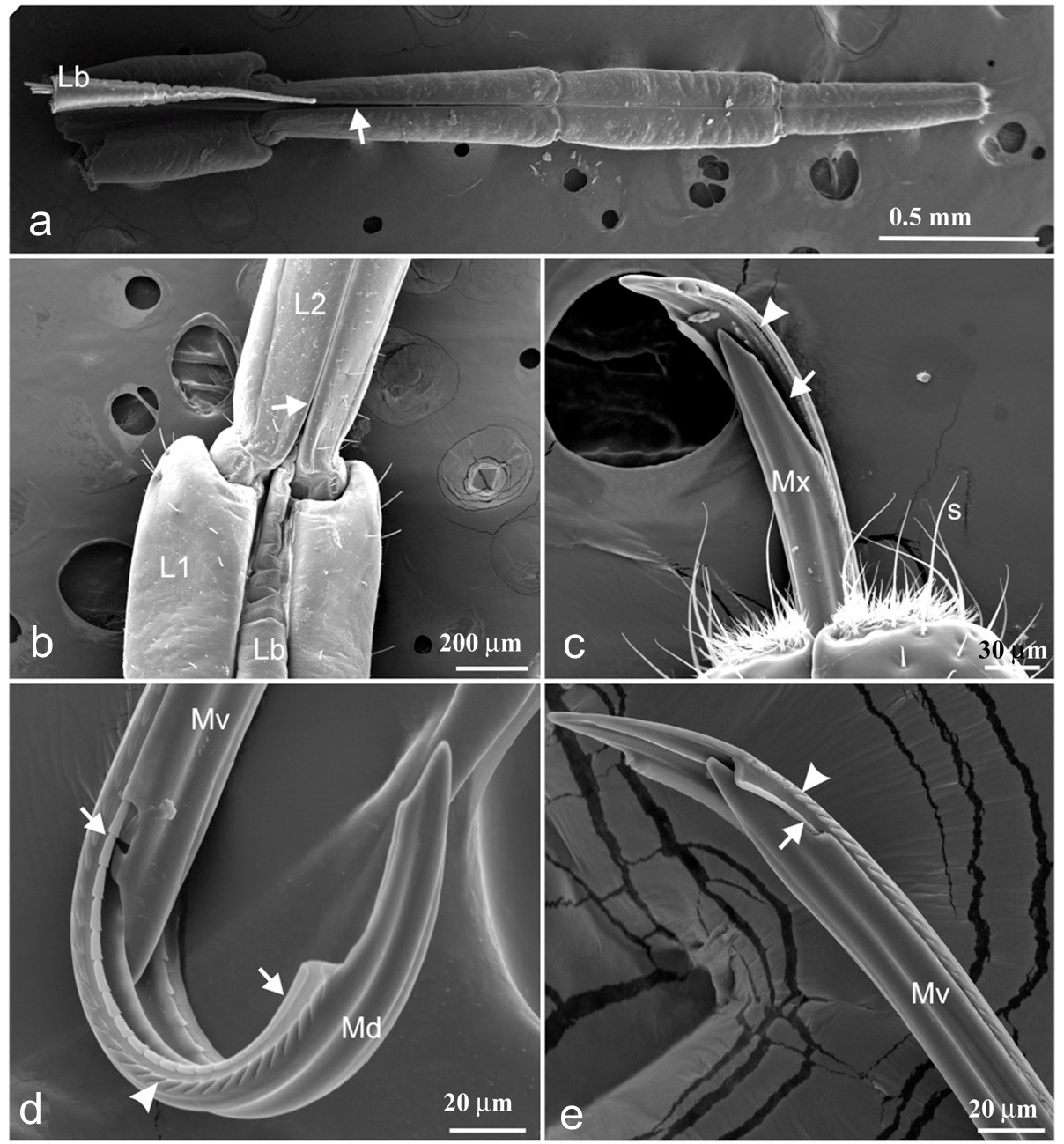
The mouthparts of B. tabidus and P. nigrispinus are similar. Both species possess a labium divided into four segments (Figure 1a), with a longitudinal groove on the dorsal side that houses the labrum and paired maxillary and mandibular stylets (Figures 1a, b). The distal end of the last labial segment has some sensilla (Figure 1c).
Scanning micrographs of the mouthparts. a) Rostrum of Podisus nigrispinus in ventral view showing the labium with four segments, the labrum (Lb), and the longitudinal groove (arrow). b) Detail of the first segment of the labium (L1) of Brontocoris tabidus with the labrum (Lb) inserted into the longitudinal groove (arrow) and L2 is the second segment of the labium. c) Apex of the labium of B. tabidus with somr sensilla (s) and the protruding maxillary stylets (Mx) with the alimentary canal (arrow) and salivary canal (arrowhead). d) Ventral (Mv) and dorsal (Md) maxillary stylets of B. tabidus, showing the tapered tips, the interlocking structures (arrows) and the lateral grooves forming small teeth (arrowhead). e) Maxillary stylets of P. nigrispinus showing the interlocking folds (arrow) and lateral grooves (arrowhead). Mv, ventral maxillary stylet.
The dorsal and ventral maxillary stylets are tapered at the ends and fit together through lateral folds, forming a tube with a central channel through which food is sucked (Figures 1c-e). These stylets can move over one another; however, the ventral stylet is longer and has a salivary canal along one side (Figure 1c). The lateral surfaces of the maxillary stylets also exhibit grooves that form small, apically oriented teeth (Figures 1d, e).
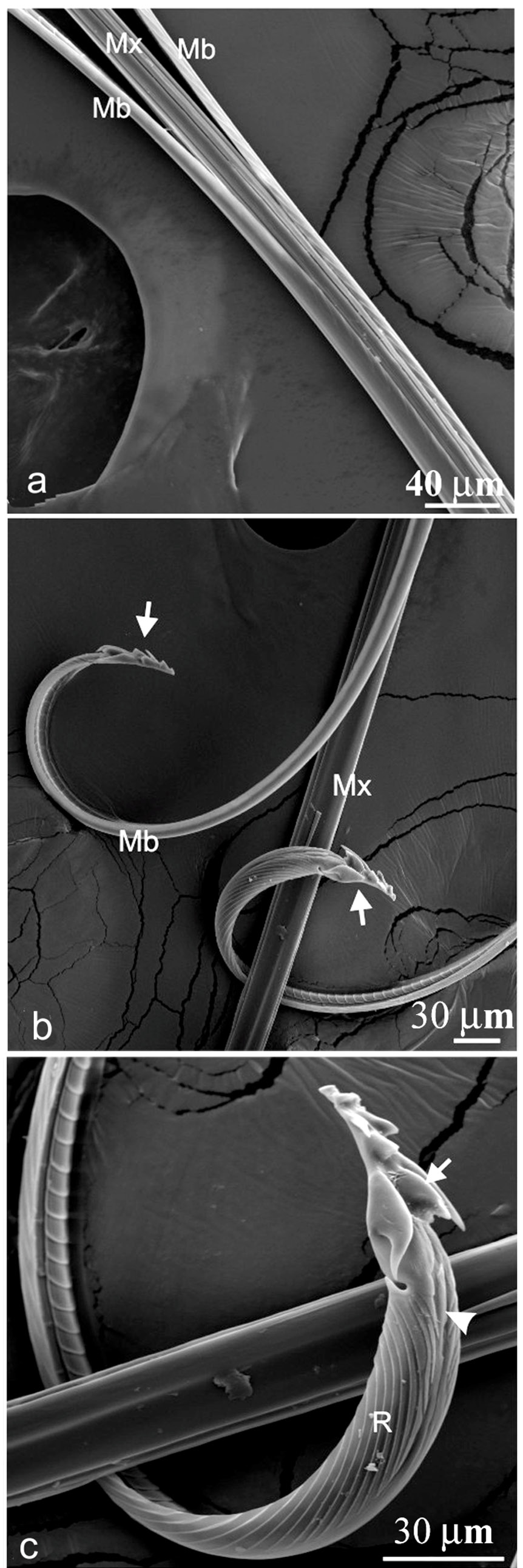
The two mandibular stylets are positioned laterally, covering the maxillary stylets (Figure 2a). They are flattened and have eight teeth at their distal ends, which gradually decrease in size toward the tip. The teeth are directed away from the insect’s head and arranged in an arrow-shaped pattern (Figures 2b, c).
Scanning electron micrographs of the mouthparts. a) Mandibular stylets (Mb) arranged laterally to the maxillary stylet tube (Mx) of B. tabidus. Bar = 40 µm. b) Mandibular stylets (Mb) of P. nigrispinus with the apical arrows (arrow). Mx, maxillary stylets. Bar = 30 m. c) Detail of the maxillary stylet of P. nigrispinus showing the terminal arrow with teeth (arrow), the oblique grooves that run along the entire stylet (R) and the mediated groove (arrowhead). Bar = 30 m.
Oblique grooves forming the arrow tips extend along the entire length of the stylet and are aligned in the same direction as the arrowhead-shaped teeth, beginning immediately below the last tooth. These grooves are present on both sides of the stylet and converge to form a median channel (Figure 2c).
Measurements of the mouthparts revealed that both the mandibular stylets and the terminal setae of B. tabidus are longer than those of P. nigrispinus (Table I). However, when analyzing the length of the terminal seta relative to the stipe, both species showed the same proportion, with the seta corresponding to 1.1% of the stipe length (Table I).
Length (mean ± sd) of the mouthparts of the predators Podisus nigrispinus and Brontocoris tabidus (Heteroptera: Pentatomidae).
DISCUSSION
The mouthpart morphology of B. tabidus and P. nigrispinus is consistent with that observed in other predatory Heteroptera. These insects possess a pair of maxillary stylets that form the alimentary canal and a pair of mandibular stylets bearing anteriorly positioned teeth directed toward the insect’s head (Boyd et al. 2002, Cohen 1998, 2000, Cobben 1978). Together, these structures form a proboscis specialized for piercing and sucking (Cohen 1998).
High-resolution imaging of the maxillary and mandibular stylets of B. tabidus and P. nigrispinus revealed that both structures possess teeth and grooves oriented in the opposite direction to the stylet tip. Comparative analyses of stylet morphology in phytophagous and zoophagous Heteroptera indicate that predatory species have maxillary stylets with larger and more numerous teeth than those of phytophagous species, whereas the orientation of grooves on the mandibular stylets varies. In phytophagous species, the grooves at the distal ends of the stylets are directed away from the insect’s head (Boyd et al. 2002, Cohen 1990, 2000, Cobben 1978). Brontocoris tabidus and P. nigrispinus are zoophytophagous species, as they supplement their diet with plant sap to improve reproduction, development, and longevity (Holtz et al. 2009, Lemos et al. 2001, 2009, Coll & Guershon 2002, Oliveira et al. 2002, Crum et al. 1998, Molina-Rugama et al. 1997, Coll 1996, Valicente & O’Neil 1993, O’Neil & Wiedenmann 1990, Ruberson et al. 1986, Naranjo & Stimac 1985). The morphology of their mouthparts reflects their primarily predatory feedinf habit, and the structural similarities observed between the two species here analyzed, suggest the existence of a morphological pattern within the Asopinae. This hypothesis may be further tested through comparative studies involving additional species within this group.
Brontocoris tabidus and P. nigrispinus attack caterpillars by inserting their stylets into the prey’s body, maintaining control over them for extended periods (Pires et al. 2023, Cohen 2000). Typically, caterpillars respond with sudden body movements in an attempt to escape the predator (Soares et al. 2009, Lemos et al. 2005). The tapered ends and toothed structures of the maxillary and mandibular stylets in B. tabidus and P. nigrispinus facilitate penetration into the prey. The orientation of the maxillary stylet teeth favors the forward motion of the bite, suggesting that these structures play a role in tearing the prey’s tissues rather than in anchoring. In contrast, the mandibular stylets appear to contribute more directly to prey arrest. They possess terminal setae and grooves whose distal ends are oriented opposite to the direction of the bite, potentially aiding in anchoring the stylets within the prey’s body. Furthermore, the mandibular stylets can move independently of the maxillae, as they are not fused and do not contribute to the formation of the alimentary or salivary canal. This independence likely increases their contact with the prey’s tissues during feeding. Thus, a greater development of fixation-related structures in the mouthparts may enhance the predator’s efficiency during prey capture and immobilization.
The morphology of the mouthparts of B. tabidus and P. nigrispinus is similar, differing primarily in size. Both the mandibular stylets and the terminal setae of B. tabidus are larger than those of P. nigrispinus. However, the ratio between these structures indicates that the terminal setae scale with the size of the stylets, suggesting that the larger setae in B. tabidus are likely associated with its greater body size. This morphological advantage may enhance its ability to capture and kill caterpillars such as Thyrinteina arnobia (Lepidoptera: Geometridae) more rapidly than P. nigrispinus (Pires et al. 2023). As a result, B. tabidus tends to be more successful in resisting counterattacks during the prey’s escape attempts. In addition to morphological differences, other factors—such as the quantity and biochemical properties of saliva may also influence predation efficiency between the two species. Notably, B. tabidus exhibits nearly 10-folds higher amylase activity than P. nigrispinus, which may facilitate more efficient extra-oral digestion (Pires et al. 2023).
CONCLUSIONS
The morphological characteristics of the mouthparts of B. tabidus and P. nigrispinus reflect their predatory behavior and are consistent with patterns observed in other Asopinae species. Although both species share similar structural features, the larger size of the mandibular stylets and terminal setae in B. tabidus, confers a functional advantage during prey capture and immobilization. These differences, combined with higher salivary enzyme activity, may explain the greater predation efficiency of B. tabidus compared to P. nigrispinus. Given these complementary traits, the combined use of both species may enhance the effectiveness of biological control programs involving Asopinae predators.
Acknowledgements
We thank the Nucleus of Microscopy and Microanalyses from Federal University of Viçosa, for technical assistance. This research was supported by Brazilian research agencies Conselho Nacional de Desenvolvimento Científico e Tecnológico (CNPq) (3030243/20222-8), Fundação de Amparo à Pesquisa do Estado de Minas Gerais (FAPEMIG) (APQ 02486-22), and Financiadora de Estudos e Projetos (FINEP).
References
-
ASSIS CHB, DOMICIANO ML, AGUIAR RL, HOLTZ AM, DUTRA TR & CARVALHO JR. 2023. Podisus nigrispinus (Hemiptera: Pentatomidae), a potential biocontrol agent of larvae and adults of Henosepilachna vigintioctopunctata (Coleoptera: Coccinellidae). Biocontrol Sci Technol 33(10): 991-996. https://doi.org/10.1080/09583157.2023.2262783.
» https://doi.org/10.1080/09583157.2023.2262783 -
BOYD DW JR, COHEN AC & ALVERSON DR. 2002. Digestive enzymes and stylet morphology of Deraeocoris nebulosus (Hemiptera: Miridae), a predacious plant bug. Ann Entomol Soc Am 95(3): 395-401. https://doi.org/10.1603/0013-8746(2002)095[0395:DEASMO]2.0.CO;2.
» https://doi.org/10.1603/0013-8746(2002)095 -
CAMPOS JM, MARTÍNEZ LC, PLATA-RUEDA A, WEIGAND W, ZANUNCIO JC & SERRÃO JE. 2021. Insecticide potential of two saliva components of the predatory bug Podisus nigrispinus (Heteroptera: Pentatomidae) against Spodoptera frugiperda (Lepidoptera: Noctuidae) caterpillars. Toxin Rev 41(1): 268-279. https://doi.org/10.1080/15569543.2020.1868008.
» https://doi.org/10.1080/15569543.2020.1868008 -
CARVALHO JR, PRATISSOLI D, ARAUJO JUNIOR LM, DAMASCENA AP, HOLTZ AM, DALVI LP & VIANNA UR. 2020. Predation behavior of Podisus nigrispinus on Spodoptera eridania J Asia-Pac Entomol 23(4): 1279-1282. https://doi.org/10.1016/j.aspen.2020.10.007.
» https://doi.org/10.1016/j.aspen.2020.10.007 - COBBEN RH. 1978. Evolutionary trends in Heteroptera. Part II. Mouthpart-structures and feeding strategies. Meded, Landbouwhogesch, Wageningen, 407 p.
-
COHEN AC. 1990. Feeding adaptations of some predatory Hemiptera. Ann Entomol Soc Am 83: 1215-1223. https://doi.org/10.1093/aesa/83.6.1215.
» https://doi.org/10.1093/aesa/83.6.1215 -
COHEN AC. 1993. Organization of digestion and preliminary characterization of salivary trypsine-like enzimes in a predaceous heteropteran Zelus renardii J Insect Physiol 39: 823-829. https://doi.org/10.1016/0022-1910(93)90114-7.
» https://doi.org/10.1016/0022-1910(93)90114-7 -
COHEN AC. 1995. Rewiew: Extra-oral digestion in predaceous terrestrial arthropoda. Annu Rev Entomol 40: 85-103. https://doi.org/10.1146/annurev.en.40.010195.000505.
» https://doi.org/10.1146/annurev.en.40.010195.000505 -
COHEN AC. 1998. Solid-to-liquid feeding: the inside story of extra-oral digestion in predaceous Arthropoda. Am Entomol 44(2): 103-117. https://doi.org/10.1093/ae/44.2.103.
» https://doi.org/10.1093/ae/44.2.103 - COHEN AC. 2000. How carnivorous bugs feed. In: Schaefer CW & Panizzi AR (Eds), Heteroptera of economic importance, 1st ed., Boca Raton, CRC Press, p. 563-570.
-
COLL M. 1996. Feeding and ovipositing on plants by an omnivorous insect predator. Oecol 105: 214-220. https://doi.org/10.1007/BF00328549.
» https://doi.org/10.1007/BF00328549 -
COLL M & GUERSHON M. 2002. Omnivory in terrestrial arthropods: mixing plant and prey diet. Annu Rev Entomol 47: 267-297. https://doi.org/10.1146/annurev.ento.47.091201.145209.
» https://doi.org/10.1146/annurev.ento.47.091201.145209 -
CRUM DA, WEISER LA & STAMP NE. 1998. Effects of prey scarcity and plant material as a dietary supplement on an insect predator. Oikos 81: 549-557. https://doi.org/10.1017/CBO9780511542220.007.
» https://doi.org/10.1017/CBO9780511542220.007 - DE CLERCQ P. 2000. Predaceous stinkbugs (Pentatomidae: Asopinae). In: Schaefer CW & Panizzi AR (Eds), Heteroptera of Economic Importance. 1st ed., Cambridge University Press, Cambridge, p. 737-789.
-
FIALHO MCQ, MOREIRA NR, ZANUNCIO JC, RIBEIRO AF, TERRA WR & SERRÃO JE. 2012. Prey digestion in the midgut of the predatory bug Podisus nigrispinus (Hemiptera: Pentatomidae). J Insect Physiol 58(6): 850-856. https://doi.org/10.1016/j.jinsphys.2012.03.009.
» https://doi.org/10.1016/j.jinsphys.2012.03.009 -
HOLTZ AM, ALMEIDA GD, FADINI MAM, ZANUNCIO JR JS, ZANUNCIO TV & ZANUNCIO JC. 2009. Survival and reproduction of Podisus nigrispinus (Heteroptera: Pentatomidae) effects of prey scarcity and plant feeding. Chil J Agr Res 69: 468-472. http://dx.doi.org/10.4067/S0718-58392009000300021.
» https://doi.org/10.4067/S0718-58392009000300021 -
LEMOS WP, MEDEIROS RS, RAMALHO FS & ZANUNCIO JC. 2001. Effects of plant feeding on the development, survival and reproduction of Podisus nigrispinus (Dallas) (Heteroptera: Pentatomidae). J Appl Entomol 47: 89-93. https://doi.org/10.1080/09670870151130499.
» https://doi.org/10.1080/09670870151130499 -
LEMOS WP, RAMALHO FS, SERRÃO JE & ZANUNCIO JC. 2003. Effects of diet on development of Podisus nigrispinus (Dallas) (Het., Pentatomidae), a predator of the cotton leafworm. J Appl Entomol 127: 389-395. https://doi.org/10.1046/j.1439-0418.2003.00765.x.
» https://doi.org/10.1046/j.1439-0418.2003.00765.x -
LEMOS WP, SERRÃO JE, ZANUNCIO JC, LACERDA MC, ZANUNCIO VV & RIBEIRO RC. 2009. Body weight and protein content in the haemolymph of females of the zoophytophagous predator Brontocoris tabidus (Heteroptera: Pentatomidae) with different diets and ages. JPDP 116: 218-222. https://doi.org/10.1007/BF03356314.
» https://doi.org/10.1007/BF03356314 -
LEMOS WP, ZANUNCIO JC & SERRÃO JE. 2005. Attack behavior of Podisus rostralis (Heteroptera: Pentatomidade) adults on caterpillars of Bombyx mori (Lepidoptera: Bombycidae). Braz Arch Biol Technol 48(6): 975-981. https://doi.org/10.1590/S1516-89132005000800014.
» https://doi.org/10.1590/S1516-89132005000800014 -
MARTINEZ LC, FIALHO MCQ, BARBOSA LCA, OLIVEIRA LL, ZANUNCIO JC & SERRÃO JE. 2016. Stink bug predator kills prey with salivary non-proteinaceous compounds. Insect Biochem Mol Biol 68: 71-78. https://doi.org/10.1016/j.ibmb.2015.11.006.
» https://doi.org/10.1016/j.ibmb.2015.11.006 -
MARTINEZ LC, FIALHO MCQ, ZANUNCIO JC & SERRÃO JE. 2014. Ultrastructure and cytochemistry of salivary glands of the predator Podisus nigrispinus (Hemiptera: Pentatomidae). Protoplasma 251(3): 535-543. https://doi.org/10.1007/s00709-013-0549-0.
» https://doi.org/10.1007/s00709-013-0549-0 -
MATOS-NETO FC, ZANUNCIO JC, PICANÇO MC & CRUZ I. 2002. Reproductive characteristics of the predator Podisus nigrispinus fed with an insect resistant soybean variety. PAB 37(7): 917-924. https://doi.org/10.1590/S0100-204X2002000700004.
» https://doi.org/10.1590/S0100-204X2002000700004 - MOLINA-RUGAMA AJ, ZANUNCIO JC, TORRES JB & ZANUNCIO TV. 1997. Longevidad y fecundidad de Podisus nigrispinus (Heteroptera: Pentatomidae) alimentado con Musca domestica (Diptera: Muscidae) y frijol. Rev Biol Trop 45: 1125-1130.
-
NARANJO SE & STIMAC JL. 1985. Development, survival and reproduction of Geocoris punctipes (Hemiptera: Lygaeidae): effects of plant feeding on soybean and associated weeds. Environ Entomol 14: 523-530. https://doi.org/10.1093/ee/14.4.523.
» https://doi.org/10.1093/ee/14.4.523 -
OLIVEIRA JEM, TORRES JB, CARRANO-MOREIRA AF & BARROS R. 2002. Efeito das plantas do algodoeiro e do tomateiro, como complemento alimentar, no desenvolvimento e na reprodução do predador Podisus nigrispinus (Dallas) (Heteroptera: Pentatomidae). Neotrop Entomol 31(1): 101-108. https://doi.org/10.1590/S1519-566X2002000100014.
» https://doi.org/10.1590/S1519-566X2002000100014 -
O’NEIL RJ & WIEDENMANN RN. 1990. Body weight of Podisus maculiventris (Say) under various feeding regimens. Can Entomol 122: 285-294. https://doi.org/10.4039/Ent122285-3.
» https://doi.org/10.4039/Ent122285-3 -
PIRES EM, NOGUEIRA RM, BEBER RC, JUNIOR WF, SOARES MA, SERRÃO JE & ZANUNCIO JC. 2023. Attack efficacy by Brontocoris tabidus and Podisus nigrispinus (Hemiptera: Pentatomidae) on Thyrinteina arnobia (Lepidoptera: Geometridae) with different pre-release food-free intervals. Phytoparasitica 51(5): 967-973. https://doi.org/10.1007/s12600-023-01104-8.
» https://doi.org/10.1007/s12600-023-01104-8 -
RUBERSON JR, TAUBER MJ & TAUBER CA. 1986. Plant feeding by Podisus maculiventris (Heteroptera: Pentatomidae): effect on survival, development and preoviposition period. Environ Entomol 15: 894-897. https://doi.org/10.1093/ee/15.4.894.
» https://doi.org/10.1093/ee/15.4.894 -
SAAVEDRA JLD, ZANUNCIO JC, ZANUNCIO TV & GUEDES RNC. 1997. Prey capture ability of Podisus nigrispinus (Dallas) (Heteroptera: Pentatomidae) reared for successive generations on a meridic diet. J Appl Entomol 121: 327-330. https://doi.org/10.1111/j.1439-0418.1997.tb01414.x.
» https://doi.org/10.1111/j.1439-0418.1997.tb01414.x -
SANTOS TM & BOIÇA JR AL. 2002. Biological aspects and predatory capacity of Podisus nigrispinus (Dallas) (Hemiptera: Pentatomidae) fed on Alabama argillacea (Hübner) (Lepidoptera: Noctuidae) reared on cotton genotypes. Sci Agric 59: 671-675. https://doi.org/10.1590/S0103-90162002000400008.
» https://doi.org/10.1590/S0103-90162002000400008 -
SOARES MA, ZANUNCIO JC, LEITE GLD, WERMELINGER ED & SERRÃO JE. 2009. Does Thyrinteina arnobia (Lepidoptera: Geometridae) use different defense behaviours against predators? JPDP 116(1): 30-33. https://doi.org/10.1007/BF03356283.
» https://doi.org/10.1007/BF03356283 -
STEFANINI M, DEMARTINO C & ZAMBONI L. 1967. Fixation of ejaculated spermatozoa for electron microscopy. Nat 216: 173-174. https://doi.org/10.1038/216173a0.
» https://doi.org/10.1038/216173a0 - THOMAS DB. 1992. Taxonomic synopsis of the Asopinae Pentatomidae (Heteroptera) of the Western Hemisfere. Entomological Society of America, Lanham, 156 p.
-
TORRES JB, ZANUNCIO JC & MOURA MA. 2006. The predatory stinkbug Podisus nigrispinus: biology, ecology and augmentative releases for lepidopteran larval control in Eucalyptus forests in Brazil. CAB Perspect Agric, Vet Sci, Nutr Nat Resour 1(15): 1-18. https://doi.org/10.1079/PAVSNNR20061015.
» https://doi.org/10.1079/PAVSNNR20061015 - VALICENTE FH & O’NEIL RJ. 1993. Effects of two host plants on selected life-history characteristics of Podisus maculiventris (Stål) (Heteroptera: Pentatomidae). 1. Without access to prey. An Soc Entomol Bras 22: 513-519.
-
ZANUNCIO JC, ALVES JB, ZANUNCIO TV & GARCIA JF. 1994. Hemipterous predators of eucalypt defoliator caterpillars. For Ecol Manag 65(1): 65-73. https://doi.org/10.1016/0378-1127(94)90258-5.
» https://doi.org/10.1016/0378-1127(94)90258-5 - ZANUNCIO JC, GUEDES RNC, OLIVEIRA HN & ZANUNCIO TV. 2002. Uma década de estudos com percevejos predadores: conquistas e desafios. In: Parra JRP et al. (Eds), Controle Biológico no Brasil: Parasitóides e Predadores. 1a ed., Manole, São Paulo, Brasil, p. 495-509.
Edited by
-
Handling editor
Marcia Couri
The data supporting the conclusions of this study are available upon request from the corresponding author [EMP]