 Design and Implementation of Robust Adaptive Synergetic Control for Prosthetic Finger Systems
Abstract
Prosthetic fingers are advancing to improve grip and natural movement for amputees, but controlling them and minimizing chattering remains challenging, highlighting the need for more robust, precise, and stable control solutions to address these issues. To solve this issue, this study uses adaptive synergetic control. To verify this algorithm, a compares the performance of two control algorithms, adaptive sliding mode control and adaptive synergetic control, in managing the angular positions of a prosthetic finger. The adaptive synergetic control algorithm demonstrated superior tracking, achieving the desired trajectory 19% faster than adaptive sliding mode control, with minimal steady-state error and smoother control. Robustness tests were conducted under varying levels of system uncertainty (25% to 90%), showing that the adaptive synergetic control method effectively maintains accurate angular positions and velocities. Torque analysis revealed the adaptive synergetic control system’s adaptive response to uncertainties, with initial torque spikes compensating for increased uncertainty levels. The results highlight adaptive synergetic control robust performance, demonstrating its effectiveness in precise and stable control of prosthetic devices despite significant parameter variations.
Key words
Prosthetic fingers; ASC; ASMC; chattering; robustness; angular positions
Introduction
A prosthetic finger is a precisely designed device intended to replace a missing or impaired finger, helping to restore both the function and appearance of the hand. Advances in materials science, biomechanics, and prosthetic technology have led to the development of increasingly sophisticated prosthetic fingers. Where many advanced models incorporate electronic components, microprocessors, and sensors, enabling natural movement, intuitive control, and effective gripping capabilities (Meißner 2014, Bundhoo & Park 2005, Goyal & Goel 2015). Several studies have shown that prosthetic fingers greatly enhance both hand function and psychosocial well-being, highlighting their importance in improving the quality of life for individuals with finger amputations. Researchers have suggested various effective control strategies for prosthetic finger operation, with many previous studies utilizing different control strategies (Arslan et al. 2008, Espinosa Garcia et al. 2022, Pertuz et al. 2023, Zhu & Hao 2024). Despite considerable advancements in prosthetic finger control techniques, effectively controlling prosthetic fingers and minimizing the chattering effect, common in robust methods like Sliding Mode Control (SMC) and Adaptive Sliding Mode Control (ASMC), it remains challenging to control the movement of prosthetic fingers. Current approaches, such as Proportional Integral Derivative (PID), Fuzzy Logic Control (FLC), and computed torque control, each have their strengths and weaknesses. However, they fail to fully resolve issues related to chattering, nonlinear system complexities, and input uncertainties. This highlights the need for further research to develop more robust, precise, and stable control strategies.
Arslan et al. (2008, 2015) compared the path-tracking efficiency of various control strategies, including Fuzzy Logic (FL), SMC, and PID controllers, using a biomimetic robot hand-finger model. They analyzed the simulation results quantitatively but cautioned that these findings were based on simulations rather than real-world scenarios. Consequently, the study focused on experimental data analysis, such as tendon forces and prosthetic finger motion. Xu et al. (2013) presented results from a project utilizing two synergetic inputs to achieve precise movements with a prosthetic hand. They developed postural synergy on a phantom hand kinematically identical to a real hand to replicate intended poses for manipulation tasks. The prosthetic hand was assembled and its motion ranges were qualitatively verified, allowing for continuous transitions between positions via contralateral postural synergies and synergetic inputs. Lysenko et al. (2017) proposed a mathematical model for a biomechanical finger prosthesis, emphasizing its dynamics across a wide range of movements. The control system’s mathematical model was well-designed, keeping the regulator’s output values within permissible limits and aligning the control time closely with the engine’s constant time. Humaidi et al. (2020) introduced both classical and adaptive control strategies, derived from synergetic theory, for tracking control in a single-link robot arm powered by artificial muscles. ASC effectively addressed uncertainties in muscle parameters while maintaining system stability. The optimized control design outperformed non-optimal designs in both transient and steady-state behaviors, though it consumed more power. In the presence of parameter uncertainties, the adaptive control system performed better than non-adaptive systems. Al-Hussein et al. (2021) examined the suppression of chaotic oscillations in a three-conductor power system using an ASMC algorithm with a Static Synchronous Compensator (STATCOM) and energy storage devices. The system’s dynamics exhibited significant chaotic oscillations, which posed a threat to bus voltage stability. The presence of chaos in power systems can lead to system failures, negatively impacting the quality of commercial power services. Abbas & Kadhim (2024) developed control algorithms for two-link robotic manipulators using Classic Synergetic Control (CSC) and Adaptive Synergetic Control (ASC), aimed at regulating the angular positions of the robotic arms for precise tracking while eliminating disturbances and uncertainties. Their findings showed that ASC offers significant improvements over CSC, particularly in terms of precision, response time, and the elimination of oscillations. For example, ASC improved tracking performance by 63% and eliminated chattering, a common issue in control systems. They concluded that ASC is a robust and adaptive control strategy, outperforming CSC in managing nonlinearities and uncertainties in robotic systems. Fan et al. (2018) proposed an adaptive grasp technique that incorporates error estimation compensation and collaborative control to reduce object pose uncertainty. This strategy, using finger tactile information, compensates for pose errors, significantly improving the success rate of grasping objects in uncertain poses. Li et al. (2021) introduced a novel framework for object-level impedance control that enhances grasp force and quality by sliding from the initial grasp position to the final one. This allows the controller to adjust the object in the hand while reacting to external forces. The selection of design parameters, confirmed through a Lyapunov function, ensures effective control performance of the closed-loop robotic system. Shahriari et al. (2022) developed a single-arm control policy applicable to multi-manual systems, featuring an adaptive force-impedance controller designed around a model control objective. In two experiments—one involving a bi-manual system grasping and maneuvering an object, and the other focused on a teleoperation setup the results demonstrated the approach’s reliability and practicality. Zhang et al. (2016) introduced adaptive sliding mode friction indemnification controllers for a stereophonic artificial hand. A five-fingered hand equipped with sensory capabilities and control hardware/software based on Digital Signal Processing (DSP) was developed to meet the requirements of a force-tracking impedance controller. Experimental results showed that the adaptive controller, with friction indemnification, achieved accurate force tracking and stable torque/force response in environments with unknown stiffness and position. Jalani et al. (2013) presented an innovative active compliance control methodology through Integral Sliding Mode Control (ISMC), integrating a virtual mass-spring damper for compliant control with a model reference approach. The controller demonstrated superior tracking performance, even with significant friction and stiction. Using a posture controller for the index and thumb fingers, the fingers were able to move around objects without colliding, enhancing grasping tasks. Herrmann et al. (2016) proposed a novel use of ISMC for active compliance control. The combination of spherical and cylindrical coordinates with a posture controller for the thumb and index fingers ensured smooth object manipulation without collisions. Additionally, tactile pressure sensors in BERUL fingers reduced the force applied to objects, and an automated tuning procedure showed the system’s effectiveness in grasping similar objects with varying force levels. Labbadi & Cherkaoui (2019) developed a robust adaptive controller for tracking and stabilizing the flight path of quadrotor Unmanned Aerial Vehicles (UAVs). They used the Newton-Euler method to determine the quadrotor’s dynamics and designed two robust controllers to handle parametric uncertainties, combining SMC methods and the Adaptive Backstepping approach. Mohd Zaihidee et al. (2019) investigated the application of SMC for speed regulation in Permanent Magnet Synchronous Motors (PMSM). They identified areas needing further exploration, such as integrating sliding mode observers with other control strategies, implementing SMC in PMSM DTC, and developing sensor less speed control systems using sliding mode controllers. Jung (2018) explored neuro-sliding mode control using a reference compensation technique within a non-model-based framework. They used a Radial Basis Function (RBF) network, similar to a Multi-Layer Perceptron (MLP), to address uncertainties in a three-link robot manipulator. Simulation results showed the neuro-sliding mode control scheme outperformed traditional sliding mode control in tracking performance. Majeed et al. (2022) focused on modeling and controlling a tendon-driven prosthetic finger that mimics the human index finger. They employed CSMC and ASMC methods to regulate finger movements, successfully reducing the chatter problem associated with CSMC. The results demonstrated that ASMC provided superior performance with faster response times and less chatter. Mahdi et al. (2022) developed an adaptive control system for knee rehabilitation, improving stability in the face of parameter uncertainties. They used synergy control and Lyapunov stability analysis to address uncertainties and introduced a Particle Swarm Optimization (PSO) algorithm to enhance controller performance, proving more effective than traditional methods in maintaining stability and reducing tracking errors. Al-Khazraji et al. (2024) conducted a comparative study between Synergetic Control (SC) and SMC for the angular position tracking of driven-pendulum systems. The results showed that SC effectively addressed the tracking problem and demonstrated robust performance when external disturbances were introduced. A key difference between the two methods is that SMC exhibited a chattering problem in the control signal, while SC did not, making SC a smoother and more reliable option.
Table I summarizes the main systems, control strategies, and corresponding references discussed in the literature review, providing a clear overview of existing approaches and their characteristics.
The review of existing literature identifies a key challenge in controlling prosthetic fingers, which is more complex than managing fully actuated prosthetic systems. While numerous control approaches such as PID, FLC, and computed torque control have been developed, they are limited in addressing key issues like the chattering effect, nonlinear system complexities, and input uncertainties. This underscores the need for further research to develop more robust, precise, and stable control solutions.
The major advantages of the ASC algorithm can be represented by its robustness to disturbances and uncertainty, as it can the ASC can adapt to system disturbances and uncertainties, ensuring robust and precise control. This ability to handle parameter variations makes it superior to traditional methods like CSC. Also, improved tracking performance, where the ASC demonstrates significant improvements in tracking precision compared to CSC and other traditional control methods. It eliminates oscillations and provides a smoother response. In addition to a reduction of the chattering effect, unlike methods such as SMC, ASC effectively minimizes the chattering effect, which is common in robust control strategies, leading to smoother motion and reduced wear on mechanical components. As well as adaptability, ASC continuously adjusts control parameters in real-time, ensuring system stability even in varying conditions, such as changes in load mass. This adaptability makes it particularly effective in dynamic and nonlinear systems.
From the above, the ASC’s adaptability, improved tracking, and robustness make it a promising approach for controlling complex robotic systems. This work presents an ASC for controlling the variables of a constrained prosthetic finger, with the goal of maintaining system robustness in the face of parameter variations and disturbances. Also, it involves analyzing the dynamic model and state space representation of the prosthetic finger, developing ASC algorithms, and conducting stability analysis based on the control law, which is responsible for constructing and maintaining the prosthetic finger motion.
This paper contributes by developing an ASC algorithm for tracking the control of a prosthetic finger under parameter uncertainty. The ASC effectively prevent chattering, addressing a previously unmet challenge in the literature on non-linear and angular motion for prosthetic fingers and control algorithm design.
Lyapunov stability analysis demonstrates that under ASC, the prosthetic finger exhibits asymptotic stability, with all errors converging to zero equilibrium points.
Dynamic Model
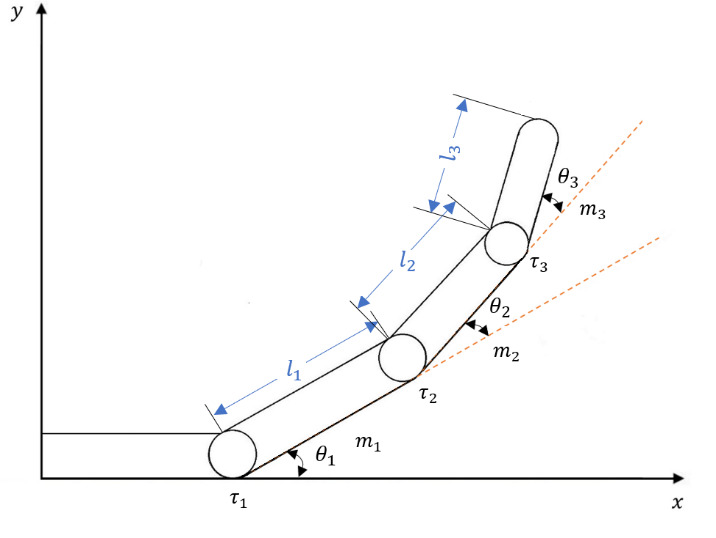
Advancements in robotic hands have greatly enhanced productivity and efficiency in the automation industry, where robots perform tasks such as cutting, welding, assembling, and picking and placing (Ajwad et al. 2016). Figure 1 depicts the design of a prosthetic hand controlled by the index finger. This prosthetic finger consists of three phalanges that replicate the middle, proximal, and distal bones of a natural index finger (Yagiz et al. 2007, Jones & Stopforth 2016). Each joint of the prosthetic finger is driven by a motorized conveyor belt, with the motor mounted on the forearm frame, controlling the movement of the phalanges via a pull mechanism.
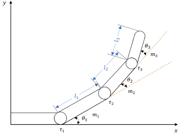
In tendon-driven finger movement, power is transferred from the motor to the joint via a belt. The flexibility of this belt significantly influences the joint’s behavior, analogous to a flexible joint. The dynamics of this system are analyzed using the Lagrangian method to derive the equation of motion, with the formulation of the Lagrangian equation being detailed as follows (Mohammed et al. 2021, Baccouch & Dodds 2020, Kadhim et al. 2024):
where is the kinetic energy and represents the potential energy. Whereas the angular displacement of the finger’s phalange is denoted by , represents the length of the phalange, signifies phalange mass, and g is the gravitational acceleration.The Lagrange-Euler method can be employed to develop the dynamic model of a 3- Degrees of Freedom (DOF) cable-driven prosthetic finger. Using this method, the equations of motion for each phalanx coordinate and can be derived, which then allows for the determination of the applied torque at each joint as follows:
The dynamic model of the 3-DOF prosthetic finger, derived using the Lagrange-Euler formulation, can be expressed in the standard compact form for robotic manipulators as:
where: is the vector of joint angular positions. is the symmetric positive-definite inertia matrix. is the Coriolis and centrifugal matrix. is the gravitational torque vector. is the vector of control input torques applied at the joints.Expanding the compact form, the system dynamics can be written in the following matrix representation:
Choosing a state variable for the state equation can be expressed as follows (Ali et al. 2020, Ahmed & Kadhim 2023): (Angular position of the phalanges) (Angular velocity of the phalanges)
Equations (12) to (17) illustrate the complex nonlinear behavior of the prosthetic finger. By choosing suitable state variables in the state equation (Ahmed & Kadhim 2022, Shanan & Kadhim 2023), it can be represented as:
(First phalangeal actuator’s torque) (Second phalangeal actuator’s torque) (Third phalangeal actuator’s torque)Control Design
Classic Synergetic Control Algorithm
The first step in the design is to define the error is the difference between the desired angle position ( =) and the actual angle position ( = ).
By calculating the derivative, one can obtain the desired outcome.
The dynamic equation of the Marco variable is described as:
In this context, the scalar design for synergetic control is denoted as , where is a positive value.
The symbol denotes the manifold equation variable as defined within the context.
Where is greater than , is the converging ratio of to manifold with .
By substituting Equation (21) into Equations (22), to obtain:
The synergetic control law for a prosthetic finger system can be obtained as:
Adaptive Synergetic Control Algorithm
The certainty equivalence adaptive control method is a modern technique that uses adaptive laws to estimate and represent unknown parameters accurately. It ensures stability in adaptive control systems by applying Lyapunov stability principles (Rebai et al. 2016, Mahmood et al. 2023). A specific control strategy has been developed for tracking the angular position in a prosthetic finger system using this adaptive control approach.
Consider the Lyapunov candidate function as
The uncertainty will be addressed in terms of disturbances, where represents the number of disturbances. In this context, represents the macro-variable, denotes the estimated error disturbance, and represents the adaptation gains.
The estimated error disturbance can be expressed by the following formula:
represents an unidentified external disturbance and the estimation of disturbance. derivative is express as follow:
To ensure the negative definiteness of the function, the adaptive laws will be defined as follows:Lyapunov stability theory states that for a system to be asymptotically stable, the time derivative of a Lyapunov function (V) must be negative definite (Kanchanaharuthai & Mujjalinvimut 2017). The ASC method ensures this stability even with uncertainties in system parameters. To develop the ASC algorithm for a prosthetic finger system, specific steps are provided (Xu 2016):
Differentiating Equation (29) to time, the following expression is obtained:
In order to ensure that the value of remains, the second term has been adjusted to a value of zero. Consequently, the following adaptation laws can be derived:The derivative of the Lyapunov equation is found to be negative definite. This ensures that the system remains asymptotically stable (Barkana 2016).
Similarly, in the variables and .
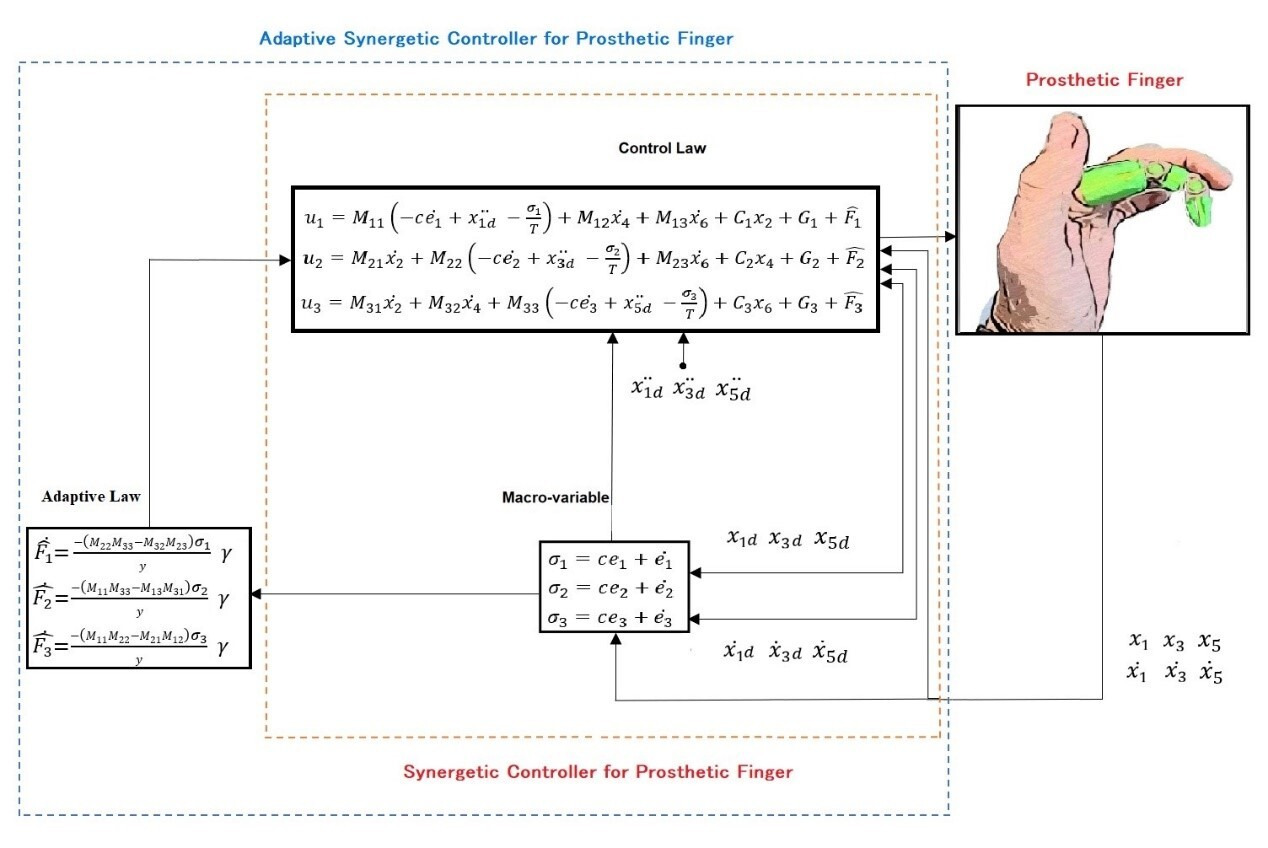
According to the ASC approach equations, Figure 2 provides a schematic diagram that illustrates how the proposed ASC algorithm functions in this study.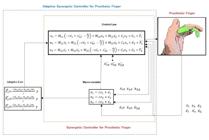
Simulation results and discussion
In this study, MATLAB/SIMULINK was employed to develop and simulate a model of the prosthetic finger system. The control algorithms and system model were implemented using m-functions, while the main system framework was built within the SIMULINK environment. Table II provides the design parameter values for the comprehensive ASC, including the configuration options for the prosthetic finger system. The numerical design and convergence ratio were refined through trial and error to adjust the conventional ASC design parameters for the phalange, namely , , and , with values of 2, 0.0001, and 0.00001, respectively.
Validation and Verification
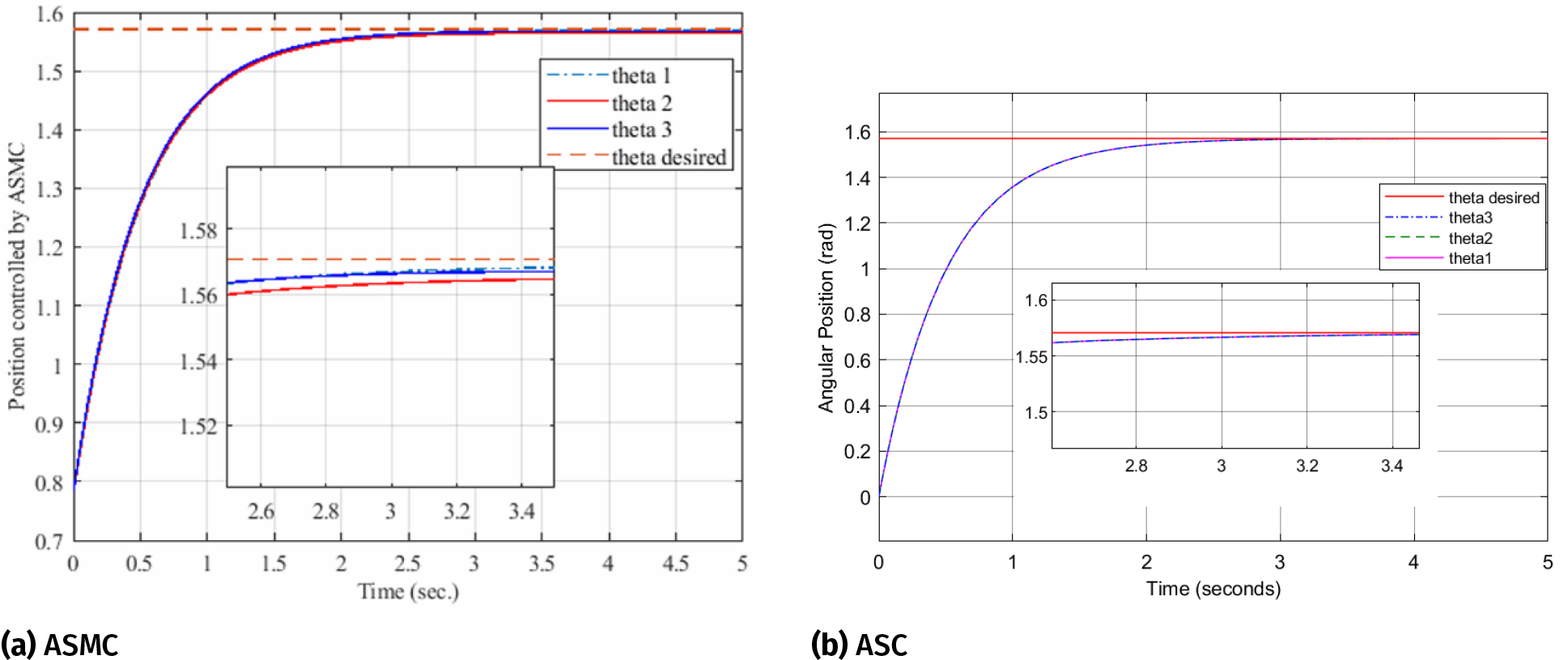
Figure 3 presents the performance of two control algorithms ASMC (Majeed et al. 2022, and ASC for managing the angular positions of a prosthetic finger. The graphs display the responses of three angular positions (, , ) against a desired trajectory () over time.
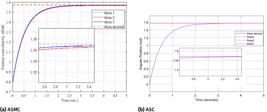
For both algorithms, the angular positions initially deviate from the desired trajectory but converge towards it as time progresses. After about 3.8 to 4 seconds, the ASMC algorithm shows all positions stabilizing close to the desired value with minimal error, though some chattering is observed. The ASC algorithm also demonstrates effective tracking, with positions converging to the desired trajectory between 2.8 and 3.4 seconds and showing smoother control with no significant chattering.
The ASC algorithm achieves the desired trajectory with 19% less time than ASMC, demonstrating its efficiency in precise control for prosthetic applications. The ASC method is highlighted for its minimal steady-state error and smooth performance, making it highly effective for precision control tasks.
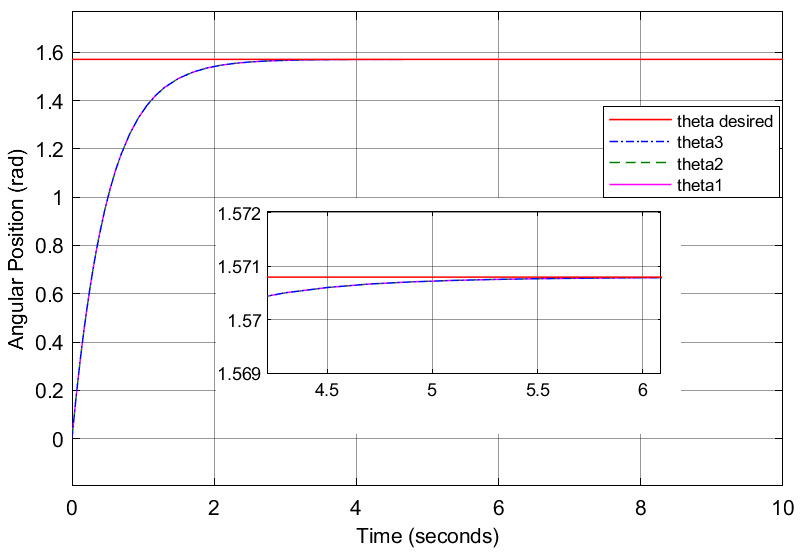
Figure 4 illustrates the tracking performance of a system comparing the desired angular position () with the actual angular positions (, , ) over time. Figure 4 shown that the system response and performance, where the all actual positions (, , ) show a rapid initial rise, suggesting a quick response at the beginning. Around 2 seconds, the system response starts to stabilize and closely follows the desired value. Also, from the inset graph zooms in on the behavior of the system around 4 to 6 seconds, showing that the positions converge and stabilize very closely near the desired value with minimal oscillation or overshoot. In addition, the graph indicates good tracking performance as the system quickly and accurately reaches the desired position with minimal steady-state error. As well as the inset provides a detailed view of the settling behavior, showing how closely the actual positions approach the desired value without significant deviation. Where the quick initial rise suggests that the system has a fast response time, and the smooth approach to the desired value without significant overshoot or oscillation indicates that the system is well-tuned with appropriate damping characteristics. Overall, the figure demonstrates effective control performance, where the system’s actual positions (, , ) successfully track the desired position () with high accuracy and stability.
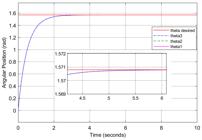
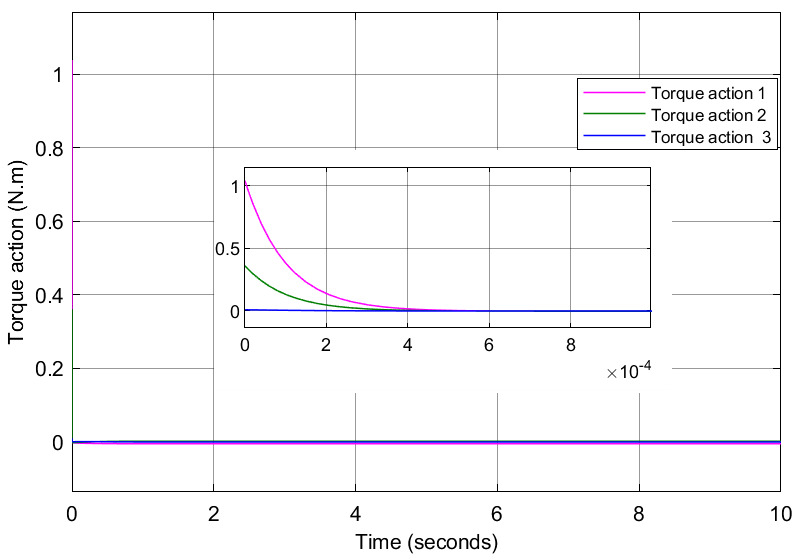
Figure 5 illustrates the response of the ASC algorithm in controlling a prosthetic finger. It compares the torque actions applied over time, specifically (, , ). The figure reveals that all three torque actions initially start around 1 N·m but quickly decrease towards zero. Where is the control action for the first phalange peaks at 1.039 (N·m). The second phalange reaches a peak of 0.360 (N·m), while the third phalange peaks at 0.01 (N·m). This initial spike in torque signifies a substantial corrective action, which diminishes rapidly as the system stabilizes. The inset figure, focusing on the first 8 milliseconds, emphasizes the sharp drop in torque, demonstrating that the control actions are almost completely dissipated within a very brief period. This swift decline suggests that the system promptly reaches its desired position or state, requiring minimal further adjustment. The steep reduction in control actions indicates that the system stabilizes quickly, with torque demands dropping to nearly negligible levels. This behavior reflects effective control, with immediate adjustments and minimal ongoing corrective actions, showcasing good control performance and stability. The overlay of the three control actions reveals similar trends with slight variations in decay rates, which might be due to differences in the prosthetic finger’s components. Overall, Figure 5 confirms that the ASC algorithm effectively manages the prosthetic finger, applying a high initial torque that swiftly reduces to zero, highlighting the system’s capability to achieve stability and minimize long-term control efforts efficiently.
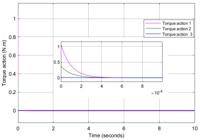
Figure S1 illustrates the angular velocity response of a system controlled by the ASC algorithm. It compares three angular velocities (, , ) over time. Initially, all three velocities start at a high value near 3.5 rad/s, but they rapidly decrease and stabilize around zero within the first few seconds. The sharp initial decline indicates a strong deceleration response, reflecting the effective damping and control provided by the ASC algorithm. By about 2 seconds, the angular velocities nearly reach zero, demonstrating that the system achieves a steady state quickly. The inset figure, which zooms in on the time frame from 2.5 to 5.5 seconds, shows the velocities remaining very close to zero with minimal oscillations, highlighting the system’s stability and minimal residual motion. The system exhibits a robust and swift response, with all angular velocities converging to zero without significant overshoot or oscillatory behavior. This confirms the ASC algorithm’s effectiveness in managing angular velocities and achieving a smooth, stable state efficiently. The three angular velocities follow nearly identical trajectories, suggesting consistent performance across different components or axes of the system. Overall, Figure S1 demonstrates the ASC algorithm’s successful application in controlling angular velocities, reducing them quickly to zero, and maintaining this state with high stability, reflecting good damping characteristics and efficient control.
Figure S2 illustrates the position error response for an ASC system. Initially, the error is substantial, at around -1.5 radians, but it decreases sharply within the first 2 seconds as the system’s position aligns with the desired value. The error approaches zero over time, demonstrating the system’s effectiveness in minimizing the difference between the desired and actual positions. The inset, focusing on the period from 4 to 6 seconds, highlights that the error remains close to zero, indicating minimal residual error and high precision in tracking. Overall, Figure S2 confirms that the position error diminishes rapidly and stays near zero, ensuring accurate tracking of the desired position.
Figure S3 illustrates the velocity error response of an ASC system, with three distinct curves e1, e2, and e3 representing the error under different conditions or scenarios. Each curve has a unique line style, reflecting variations in parameters or initial conditions. Initially, all curves show a high-velocity error, indicating a significant deviation from the desired velocity. However, as time progresses, the error decreases rapidly, highlighting the ASC system’s ability to quickly correct the velocity. By around 2-3 seconds, the error approaches near zero, demonstrating the controller’s effectiveness in minimizing velocity errors. The inset plot focuses on the time window between 3 and 6 seconds, offering a closer view of the small oscillations or residual errors after the initial reduction. During this period, the error stabilizes around zero with minor oscillations, indicating that the system maintains a steady state with minimal deviation. The rapid reduction in velocity error confirms that the ASC system effectively guides the system toward the desired state. While the inset plot reveals some minor residual dynamics or noise, the overall error remains close to zero. The similar performance of curves e1, e2, and e3 suggests that the ASC system is robust across different conditions. In conclusion, Figure S3 demonstrates the stability and performance of the ASC system in consistently reducing velocity errors over time. Also, the ASC controller ensures that the prosthetic finger achieves asymptotic stability by driving both the error and its derivative to zero effectively by the final trajectory, resulting in precise tracking of the finger’s movement (Hameed & Hamoudi 2023).
Uncertainty in the system
During the operation of a prosthetic finger, changes in the fingertip’s posture can affect the load moment of inertia on the joints, and various frictional forces impact the long driving chain. These factors introduce modeling uncertainties, necessitating accurate estimation of these uncertainties. In designing control systems under atypical conditions, a thorough examination of the systems is crucial. Control strategies should be applied sequentially if the system’s parameters are highly uncertain.
Robustness analysis for model uncertainties is used to validate the system’s response and assess the effectiveness of the ASC controller. To evaluate this, uncertainty will be introduced into the proposed model. Additionally, trial and error will be employed to adjust the load mass (m) and phalanx length (l) of the prosthetic finger system by (Salman & Kadhim 2022).
Figures S4 and S5 illustrate the angular position and angular velocity of the phalanges under the ASC (Composite State Control) method. Each figure’s four subplots (a, b, c, d) represent different levels of system uncertainty: , respectively.
Figure S4 shows that the angular position of the prosthetic finger closely follows the desired path across all levels of uncertainty (). The discrepancies between the actual and desired angular positions are minimal, indicating that the ASC method effectively maintains the desired position. The inset graphs offer a closer view of the system’s performance between 4.5 and 6 seconds, highlighting the system’s stability and precision.
Similarly, Figure S5 reveals that the angular velocity maintains consistent behavior across all uncertainty levels. The ASC method ensures that the velocity aligns with the desired trajectory, with minimal chattering observed, reflecting stable and robust control performance.
Overall, the results demonstrate that the ASC method effectively maintains the desired angular position and velocity of the prosthetic finger, even with significant uncertainties. The controller performs reliably across different uncertainty levels, with no major impact on operating speed or stability. This robustness indicates that the ASC method is highly effective for controlling prosthetic devices, ensuring accurate and stable operation despite variations in system parameters.
Figures S6 and S7 show that the ASC (Composite State Control) algorithm effectively handles position and velocity errors under varying levels of system uncertainty (). The position error quickly reduces and stabilizes around zero with minimal fluctuations at all uncertainty levels. Similarly, the velocity error decreases rapidly and stabilizes close to zero, with consistent performance across different uncertainties. These results indicate that the ASC system maintains stability and precision despite significant parameter variations, demonstrating robustness and reliability compared to previous controllers.Top of Form
Figure S8 illustrates the impact of control actions on the torque exerted on a prosthetic finger under varying levels of uncertainty (). At 25% uncertainty, torque values are relatively low with minimal fluctuations following an initial spike, indicating modest impact from the uncertainty. At 50% uncertainty, the torque values increase slightly, with a more pronounced initial spike, showing a greater effect of uncertainty. At 75% uncertainty, torque values rise significantly, and the initial spike is even more pronounced, reflecting aggressive compensation for the increased uncertainty. At 90% uncertainty, torque values reach their highest, with a substantial initial spike indicating a high level of compensation required. The findings conclude that as uncertainty increases, the torque exerted by the control system on the prosthetic finger also increases, evident from the progressively larger initial torque spikes. This demonstrates the control system’s adaptive response to maintain desired performance despite varying uncertainties. The ASC algorithm effectively manages and compensates for these uncertainties, showing its critical role in maintaining the prosthetic finger’s functional performance.
Figure S9 shows that as system uncertainty increases, the torque exerted on the prosthetic finger rises to compensate, highlighting the control system’s adaptability. This emphasizes the importance of robust control algorithms like ASC in effectively managing uncertainties and ensuring the reliable performance of prosthetic devices in real-world applications.
Conclusions
In this study, an ASC was developed for a 3-DoF prosthetic finger system to handle model uncertainty. Where the results collectively demonstrate the superior performance of the ASC algorithm in managing the angular positions, velocities, and torque actions of a prosthetic finger, even under significant system uncertainties. The ASC algorithm consistently outperforms ASMC by achieving quicker convergence to the desired trajectory, smoother control with minimal chattering, and more effective compensation for variations in system parameters, which improved performance by approximately 19%. Its robustness and precision in tracking performance, torque control, and error reduction make ASC a reliable solution for prosthetic applications, ensuring both stability and adaptability in real-world conditions.Bottom of Form Future research will focus on Implementing the developed controllers on the actual hardware to acquire precise results and better performance.
References
- ABBAS AK & KADHIM SK. 2024. Dynamic Motion Control of Two-Link Robots with Adaptive Synergetic Algorithms. J Robot Control 5(5): 1536-1548.
- AHMED AS & KADHIM SK. 2022. A comparative study between convolution and optimal backstepping controller for single arm pneumatic artificial muscles. J Robot Control 3(6): 769-778. https://doi.org/10.18196/jrc.v3i6.16064.
- AHMED AS & KADHIM SK. 2023. Non-Leaner Control on the Pneumatic Artificial Muscles: A Comparative Study Between Adaptive Backstepping and Conventional Backstepping Algorithms. Math Model Eng Probl 10(2). https://doi.org/10.18280/mmep.100236.
-
AJWAD SA, ISLAM RU, AZAM MR, ULLAH MI & IQBAL J. 2016. Sliding mode control of rigid-link anthropomorphic robotic arm. In: 2nd Int Conf Robot Artif Intell (ICRAI), Rawalpindi, Pakistan, p. 75-80. https://doi.org/10.1109/ICRAI.2016.7791232
» https://doi.org/10.1109/ICRAI.2016.7791232 - AL-HUSSEIN ABA, TAHIR FR, OUANNAS A, SUN TC, JAHANSHAHI H & ALY AA. 2021. Chaos suppressing in a three-buses power system using an adaptive synergetic control method. Electronics 10(13): 1532. https://doi.org/10.3390/electronics10131532.
- ALI SS, RAAFAT SM & AL-KHAZRAJI A. 2020. Improving the performance of medical robotic system using H ∞ loop shaping robust controller. Int J Model Ident Control 34(1): 3-12. https://doi.org/10.1504/IJMIC.2020.10031053.
- AL-KHAZRAJI H, AL-BADRI K, AL-MAJEEZ R & HUMAIDI AJ. 2024. Synergetic Control Design Based Sparrow Search Optimization for Tracking Control of Driven-Pendulum System. J Robot Control 5(5): 1549-1556. https://doi.org/10.18196/jrc.v5i5.22893.
-
ARSLAN YZ, HACIOGLU Y, TASKIN Y & YAGIZ N. 2015. Control of a Biomimetic Robot Hand Finger: Classical, Robust, and Intelligent Approaches. In: Handbook of Research on Advancements in Robotics and Mechatronics, p. 475-499. IGI Global. https://doi.org/10.4018/978-1-4666-7387-8.ch016
» https://doi.org/10.4018/978-1-4666-7387-8.ch016 - ARSLAN YZ, HACIOGLU Y & YAGIZ N. 2008. Prosthetic hand finger control using fuzzy sliding modes. J Intell Robot Syst 52: 121-138. https://doi.org/10.1007/s10846-008-9207-8.
- BACCOUCH M & DODDS S. 2020. A two-link robot manipulator: Simulation and control design. Int J Robot Eng 5(12). https://doi.org/10.35840/2631-5106/4128.
- BARKANA I. 2016. Barbalat’s lemma and stability-misuse of a correct mathematical result. Math Eng Sci Aerospace (MESA) 7(1): 197-218.
- BUNDHOO V & PARK EJ. 2005. Design of an artificial muscle actuated finger towards biomimetic prosthetic hands. In: 12th Int Conf Adv Robot, p. 368-375. IEEE. https://doi.org/10.1109/ICAR.2005.1507437.
- ESPINOSA GARCIA FJ, LUGO-GONZÁLEZ E, TELLÉZ-VELÁZQUEZ A, ARIAS-MONTIEL M & CECCARELLI M. 2022. Optimal Position Fuzzy Control of an Underactuated Robotic Finger. Math Probl Eng 2022: 2091337.
- FAN S, GU H, ZHANG Y, JIN M & LIU H. 2018. Research on adaptive grasping with object pose uncertainty by multi-fingered robot hand. Int J Adv Robot Syst 15(2): 1729881418766783. https://doi.org/10.1177/1729881418766783.
- GOYAL A & GOEL H. 2015. Prosthetic rehabilitation of a patient with finger amputation using silicone material. Prosthet Orthot Int 39(4): 333-337.
- HAMEED AM & HAMOUDI AK. 2023. A 2-Link Robot with Adaptive Sliding Mode Controlled by Barrier Function. J Eur Syst Automat 56(6). https://doi.org/10.18280/jesa.560620.
- HERRMANN G, JALANI J, MAHYUDDIN MN, KHAN SG & MELHUISH C. 2016. Robotic hand posture and compliant grasping control using operational space and integral sliding mode control. Robotica 34(10): 2163-2185. https://doi.org/10.1017/S0263574714002811.
- HUMAIDI AJ, IBRAHEEM IK, AZAR AT & SADIQ ME. 2020. A new adaptive synergetic control design for single link robot arm actuated by pneumatic muscles. Entropy 22(7): 723. https://doi.org/10.3390/e22070723.
- JALANI J, MAHYUDDIN N, HERRMANN G & MELHUISH C. 2013. Active robot hand compliance using operational space and Integral Sliding Mode Control. In: IEEE/ASME Int Conf Adv Intell Mechatron, p. 1749-1754. IEEE.
- JONES GK & STOPFORTH R. 2016. Mechanical design and development of the touch hand ii prosthetic hand. RD J South African Inst Mech Eng 32: 23-34.
- JUNG S. 2018. Improvement of tracking control of a sliding mode controller for robot manipulators by a neural network. Int J Control Autom Syst 16(2): 937-943. https://doi.org/10.1007/s12555-017-0186-z.
- KADHIM RA, KADHIM MQ, AL-KHAZRAJI H & HUMAIDI AJ. 2024. Bee algorithm based control design for two-links robot arm systems. IIUM Eng J 25(2): 367-380. https://doi.org/10.31436/iiumej.v25i2.3188.
- KANCHANAHARUTHAI A & MUJJALINVIMUT E. 2017. Application of adaptive synergetic control to power systems with superconducting magnetic energy storage system. Int J Innov Comput Inf Control 13(6): 1873-1885.
- LABBADI M & CHERKAOUI M. 2019. Robust adaptive backstepping fast terminal sliding mode controller for uncertain quadrotor UAV. Aerosp Sci Technol 93: 105306. https://doi.org/10.1016/j.ast.2019.105306.
- LI X, CHEN Z & MA C. 2021. Optimal grasp force for robotic grasping and in-hand manipulation with impedance control. Assembly Automat 41(2): 208-220. https://doi.org/10.1108/AA-11-2020-0180.
- LYSENKO A, KHASHEV D & URYANSKAYA E. 2017. Development of a mathematical model of a biomechatronic finger prosthesis as part of a multifunctional prosthetic hand. In: MATEC Web Conf 132: 02003. https://doi.org/10.1051/matecconf/201713202003.
- MAHDI SM, YOUSIF NQ, OGLAH AA, SADIQ ME, HUMAIDI AJ & AZAR AT. 2022. Adaptive synergetic motion control for wearable knee-assistive system: a rehabilitation of disabled patients. Actuators 11(7): 176. https://doi.org/10.3390/act11070176.
- MAHMOOD ZN, AL-KHAZRAJI H & MAHDI SM. 2023. Adaptive control and enhanced algorithm for efficient drilling in composite materials. J Eur Syst Automat 56(3): 507-512. https://doi.org/10.18280/jesa.560319.
- MAJEED HS, KADHIM SK & JABER AA. 2022. Design of a sliding mode controller for a prosthetic human hand’s finger. Eng Technol J 40(01): 257-266. http://doi.org/10.30684/etj.v40i1.1943.
- MEISSNER A. 2014. Dynamic Modelling of a modular robot finger. Institut für Robotik und Mechatronik (IB.Nr.: 572-14-13).
- MOHAMMED RA, ABD SOUD W & BAQER IA. 2021. Kinematic Analysis of Underactuated Robotic Finger Design. In: IOP Conf Ser Mater Sci Eng 1094(1): 012070. https://doi.org/10.1088/1757-899X/1094/1/012070.
- MOHD ZAIHIDEE F, MEKHILEF S & MUBIN M. 2019. Robust speed control of PMSM using sliding mode control (SMC)—A review. Energies 12(9): 1669. https://doi:10.3390/en12091669.
- PERTUZ SA, PEÑA CA & RIAÑO CI. 2023. Design and Building of a Multi-finger Robotic Hand Prototype for Grip Control. Int J Mech Eng Robot Res 12(5): 264-274. https://doi.org/10.18178/ijmerr.12.5.264-274.
- REBAI A, GUESMI K & HEMICI B. 2016. Adaptive fuzzy synergetic control for nonlinear hysteretic systems. Nonlinear Dyn 86: 1445-1454.
- SALMAN MA & KADHIM SK. 2022. Optimal backstepping controller design for prosthetic knee joint. J Eur Syst Automat 55(1): 49-59.
- SHAHRIARI E, BIRJANDI SAB & HADDADIN S. 2022. Passivity-based adaptive force-impedance control for modular multi-manual object manipulation. IEEE Robot Autom Lett 7(2): 2194-2201.
- SHANAN DS & KADHIM SK. 2023. Comparative Analysis of Airflow Regulation in Ventilator Systems Using Various Control Strategies. J Eur Syst Automat 56(5). https://doi.org/10.18280/jesa.560512.
- XU K, ZHAO J, DU Y, SHENG X & ZHU X. 2013. Design and postural synergy synthesis of a prosthetic hand for a manipulation task. In: IEEE/ASME Int Conf Adv Intell Mechatron, p. 56-62. https://doi.org/10.1109/AIM.2013.6584068.
- XU Q. 2016. Precision motion control of piezoelectric nanopositioning stage with chattering-free adaptive sliding mode control. IEEE Trans Autom Sci Eng 14(1): 238-248.
- YAGIZ N, ARSLAN YZ & HACIOGLU Y. 2007. Sliding mode control of a finger for a prosthetic hand. J Vib Control 13(6): 733-749. https://doi.org/10.1177/1077546307072352.
- ZHANG T, JIANG L, FAN S, WU X & FENG W. 2016. Development and experimental evaluation of multi-fingered robot hand with adaptive impedance control for unknown environment grasping. Robotica 34(5): 1168-1185. https://doi.org/10.1017/S0263574714002161.
- ZHU J & HAO G. 2024. Modelling of a general lumped-compliance beam for compliant mechanisms. Int J Mech Sci 263: 108779. https://doi.org/10.1016/j.ijmecsci.2023.108779.
Edited by
-
Handling editor
Diego Knupp
The data and simulation codes supporting the findings of this study are available from the corresponding author upon reasonable request.