 Trends and gaps in microplastics research in Tropical freshwater ecosystems
Abstract
Although the contamination of microplastics is a very recent topic, knowledge increased rapidly, especially in the last decade. Despite this, freshwater ecosystems have received less attention than marine ones, particularly in the tropics. Considering the particularities of Tropical freshwater ecosystems that can be important in the microplastics dynamic, such as the high rate of untreated water, the flooding dynamics and high number of reservoirs, our review aims to present the state of the research of microplastic contamination in Tropical freshwater ecosystems, emphasizing the knowledge advances and existing gaps. We compared studies in different countries, ecosystems and type of samples, and identified gaps and needs for futures research. Although research and the complexity of studies have increased over the years, Tropical freshwater ecosystems are still understudied. We emphasized the need for more studies in African countries and Tropical Australia, as well as in reservoirs across all Tropical regions. It is also crucial to evaluate contamination related to flooding dynamics and in aquatic invertebrates. Advancements in research on this topic are essential to provide a clear picture of the real problem in the tropics, leading to the possibility of better mitigation and conservation actions in the future.
Key words
Aquatic environment; bibliometric review; plastic pollution; Tropical ecosystems
INTRODUCTION
The contamination of microplastics in different environmental matrices is a major concern globally. These particles are defined as synthetic polymers ranging in size from 1 mm to 5 mm. In the ocean, only 20% of the microplastic found is the result of direct anthropic activities in this environment, the remaining 80% reaches the marine ecosystem from terrestrial sources, with rivers being the main pathway (Lebreton et al. 2017, Rochman 2018, Osman et al. 2023). Microplastics have been documented in several different organisms, including in humans (de Sá et al. 2018, Osman et al. 2023). Although the knowledge of their effects is still limited and mostly focused on model organisms (Bhuyan 2022), it is known that the consequences to exposure to microplastics are not only related to the particle itself, but also to several contaminants that can be adsorbed by the particles (Li et al. 2018, Bhuyan 2022, Osman et al. 2023).
The amount of microplastic particles found in aquatic environments is strongly related to anthropic activities. Both sewage and solid waste are recognized as sources of microplastic contamination. Landfills can produce microplastics due to the plastic litter degradation (Kabir et al. 2023), and these particles can reach water bodies and groundwater through the runoff and the leachate (Ferronato & Torretta 2019, He et al. 2019). Although wastewater treatment can remove more than 90% of microplastics, this rate can vary greatly since its efficiency depends on microplastics characteristics and treatment conditions (Ahmed et al. 2024). Regardless, the wastewater effluent is still a major source of contamination in freshwater environments (Kay et al. 2018). This is a particularly critical problem in the Tropical region, where only seven countries are classified as developed (high-income) (Fantom & Serajuddin 2016). Most developing countries face extensive problems related to the treatment and disposal of waste and lack of policies and infrastructure to deal with solid waste and water treatment (WWAP 2017, Ferronato & Torretta 2019). The rate of untreated wastewater in those countries, which can be released into water courses, can reach up to 92% (WWAP 2017).
Microplastics can also enter aquatic environments from terrestrial sources through flood pulses. The flooding of terrestrial areas during the rainy season is a key aspect of tropical river dynamics (Welcomme 1985). This process is an important source of trophic resources, influencing the entire river basin and its trophic web (Junk et al. 1989). However, the microplastics retained inland can enter the river during the flooding events (Song et al. 2020). In addition to these factors, the presence of large reservoirs in tropical rivers could also be significant in microplastic dynamics, playing a key role in freshwater ecosystems, as they can act as sinks for these particles (Zhang et al. 2015, Watkins et al. 2019, Liu et al. 2022).
Although it is a very recent topic, the knowledge on microplastic contamination increased rapidly, with a gradual rise in the last decade (Liu et al. 2023). Despite this, freshwater ecosystems have been receiving less attention than the marine. By 2018, only 4% of the publications focused on freshwater environments (Wagner & Lambert 2018). Nevertheless, microplastics were reported in different freshwater ecosystems across the world (Eerkes-Medrano et al. 2015) and some freshwater bodies can present higher concentrations of particles than estuarine and coastal areas (Luo et al. 2019). Considering the particularities of Tropical freshwater ecosystems that can be important in the microplastics dynamic, such as the high rate of untreated water, the flooding dynamics and high number of reservoirs, our review aims to present the state of the research of microplastic contamination in Tropical freshwater ecosystems. We compared studies in different countries, ecosystems and type of samples, in addition to present gaps and needs for futures research.
MATERIALS AND METHODS
Tropical region
We considered as Tropical countries those with at least half of its territory within the tropics (23.5° N and 23.5° S). Although we found some studies in the Himalayan and Andean regions that were between the tropics, they were not considered as tropical due to the high altitude, which results in significantly different climatic conditions. Nearly half of Australia’s territory lies within the Tropics, but only a small portion of the country has tropical conditions. Because of this, when screening publications from Australia, each study was assessed for whether it was conducted in the tropical Australia; if not, it was excluded.
Search strategy
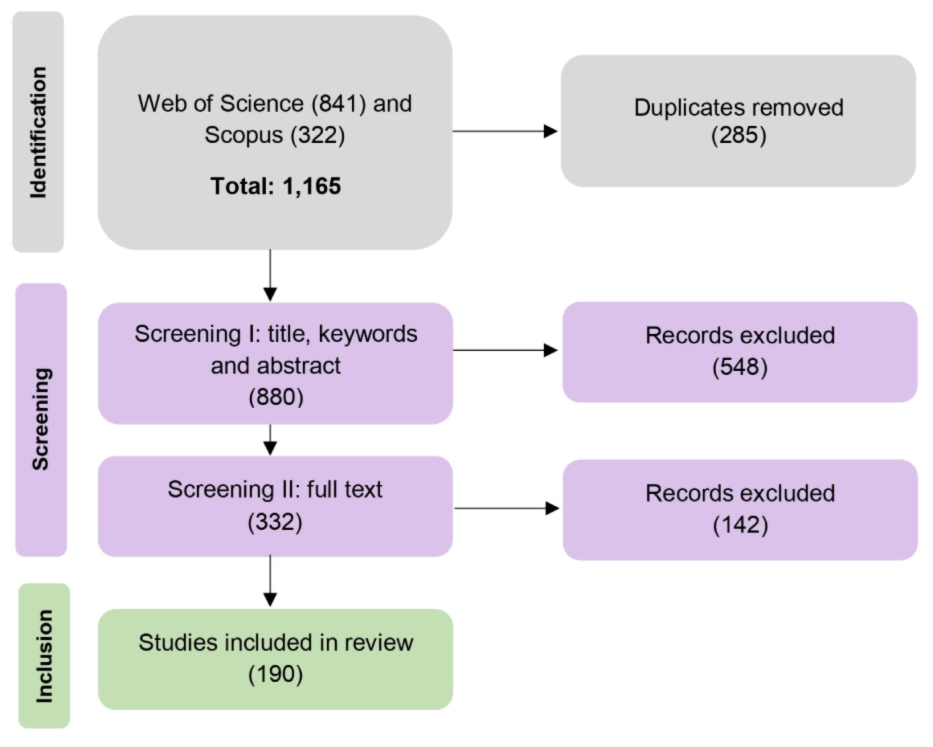
We used Web of Science (all databases) and Scopus to search for peer review studies on microplastics in the Tropics and followed the PRISMA guidelines for systematic reviews (Page et al. 2021). We combined terms in English that described the three aspects of the studies we were interested in: microplastic, freshwater, and tropical region (Table I). We selected papers that were published up to the date of the search (July 8, 2024).
Methods used for the identification and exclusion of studies on microplastic contamination in Tropical freshwater ecosystems, along with the data extracted from these studies.
Inclusion and exclusion criteria
We included papers that were not exclusively focused on tropical regions, freshwater environments, or microplastic contamination, as long as part of the study also addressed these aspects. We did not include (i) gray literature, (ii) experimental studies, since most of what we found were performed with model organisms which it is not in the scope of our review, (iii) studies in brackish water and estuarine environments, and (iv) global review papers because they typically provide little or no information on tropical freshwater environments.
Data extraction
We extracted five variables from each paper (Table I, Supplementary Material - Table SI). We divided the aim of the studies into five categories: (1) descriptive, (2) analytical, (3) modelling, (4) systematic review and, (5) meta-analysis. We considered a paper descriptive when it only describes the microplastic contamination in a specific environment or organism (i.e., quantification and types of particles found). As for the analytical aim, were considered studies that not only described the contamination, but also focused on the causes, consequences and/or variables influencing the contamination; temporal and/or spatial patterns; and/or risks assessments indices based on microplastic contamination. For the review papers, we were interested in only the year of publication and studied country to avoid overestimating and duplication of the results. Many studies involved multiple environments, countries, or sample types. In these cases, each was counted individually.
RESULTS
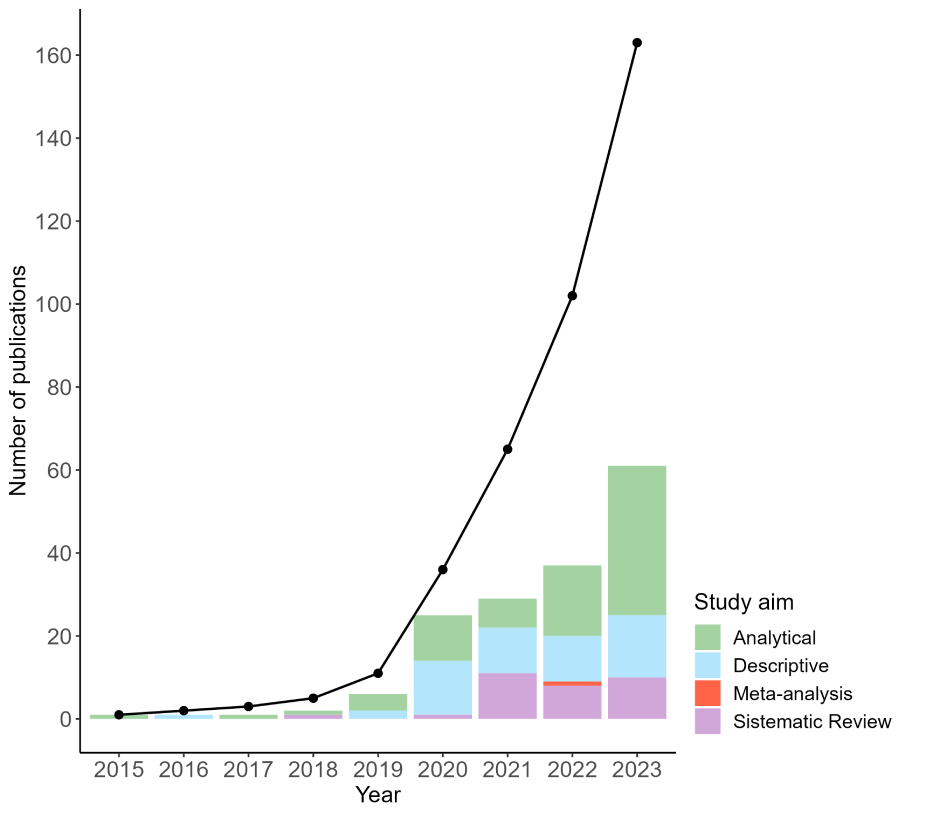
Initially, our search returned a total of 1,165 publications. After two rounds of screening, we found 190 papers that met all of our criteria (Figure 1). The first study was published in 2015 and it was the only one on that year. Before 2019, only five studies had been published. After this, there was a significant increase, with 61 studies published in 2023 alone (Figure 2). The years of 2021 and 2022 showed the smallest increase in the number of publications, compared to the previous year, with four and eight studies published, respectively. This marked a notable difference comparing to others years after 2019, which had an increase around 20 papers per year.
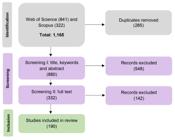
Preferred reporting items for systematic reviews and meta-analysis (PRISMA) flowchart adapted from Page et al. (2021) describing the search protocol.
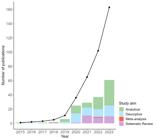
Number of publications on microplastics contamination in freshwater ecosystems of the Tropical region along with the aims of the studies for each year. The black line represents the cumulative number of publications.
We found papers covering all the aims that we previously categorized but this varied by year and region (Figure 3). Most studies were analytical and descriptive (46% and 33%, respectively). We found only one paper using modeling, which was published in 2024. The year of 2021 showed differences in the patterns study type. In general, after 2019, there was a constant number of descriptive papers along the years, while analytical studies increased. However, 2021 presented more descriptive studies, in addition to a high number of review papers, making it the year with the most published reviews.
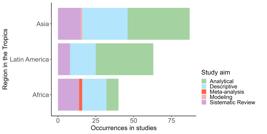
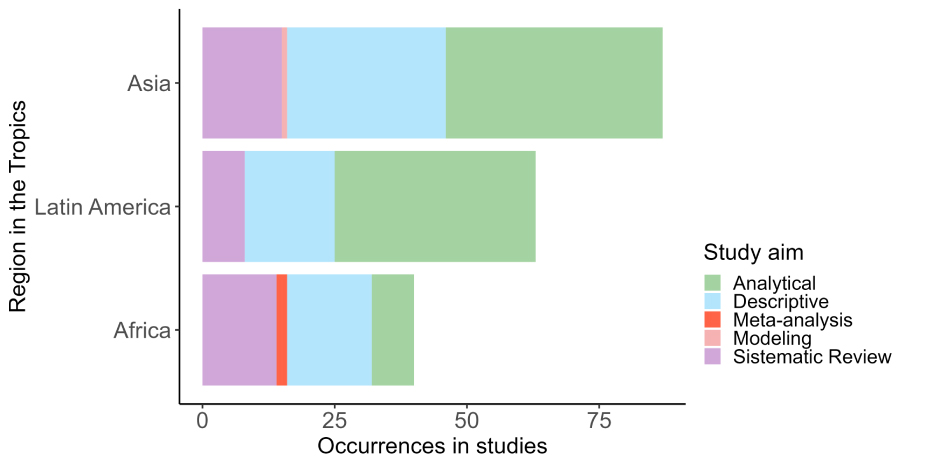
Number of publications in each region of the Tropics, along with the aims of the studies for each region.
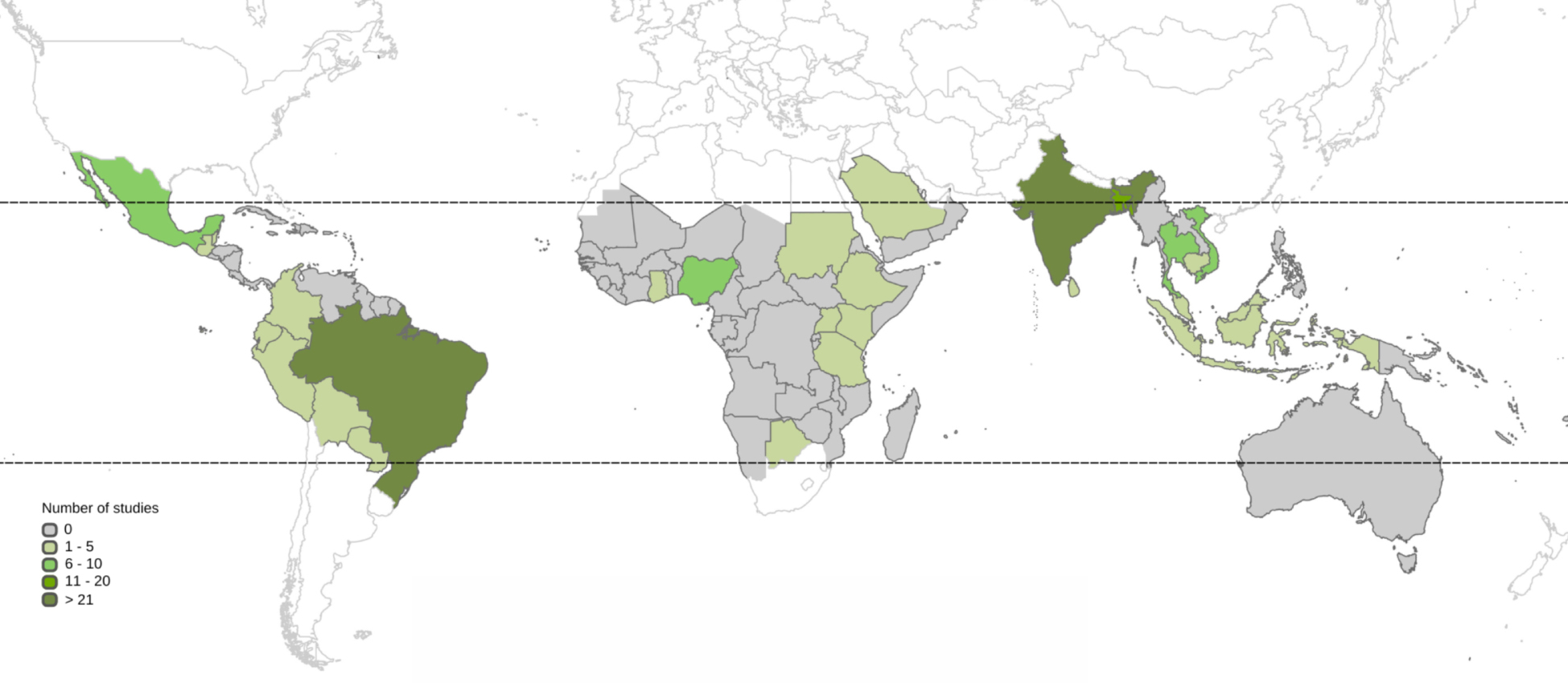
India and Brazil were the most studied countries, representing, together, 48% of the total of papers in the tropical region. Asia was the most studied region, followed by Latin America and Africa (Figure 4). While we found studies for most countries in Asia and Latin America, in Africa, only eight countries were studied. Additionally, we didn’t find papers for the tropical region of Australia.
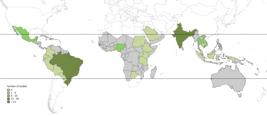
Map showing the countries in the Tropical region, along with the number of publications per country. The dotted line indicates the Tropics, while the countries shown in white were excluded from the tropical classification.
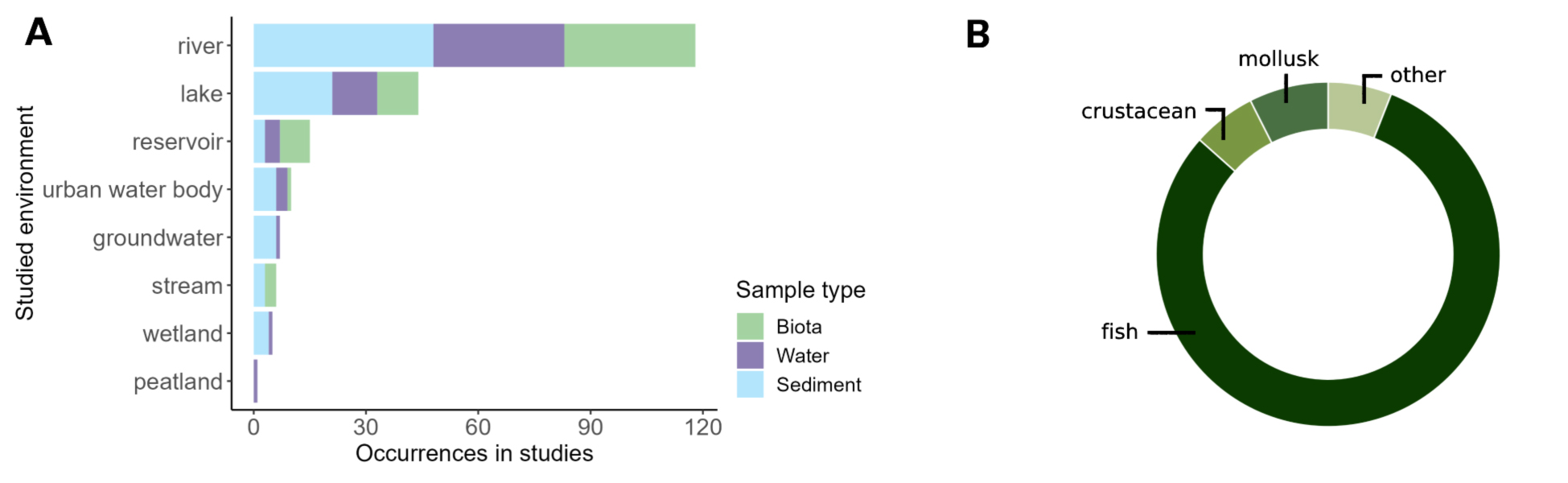
Eight different Tropical freshwater ecosystems were studied for microplastic contamination (Figure 5). Rivers were the most studied (57%), followed by lakes (21%) and reservoirs (7%). Our search identified multiple artificial water bodies in urban environments, such as channels, lakes and stormwater retention reservoirs. All of these environments were grouped into the category urban water bodies, representing 4.85% of the total. In all the environments, the contamination of one or more of the following was studied: water (40%), biota (32%) and sediment (27%). Among the biota, fish and fish eggs, crustacean, mollusk, insect, plant and stingray were studied (Figure 5). There was a predominance of studies with fish, regardless of the region, which were studied at least ten times more than other organisms. In addition, nine of the studies with fish, used fish bought from markets to analyze the microplastic contamination. The other organisms were represented by only one to five occurrences in the publications.
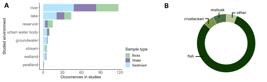
Number of publications in freshwater ecosystems in the Tropical region along with the sample type analyzed in each one (a) and, the freshwater organisms that were studied within these ecosystems (b).
DISCUSSION
Microplastic contamination is a recent research topic, especially for freshwater environments. Our results show that studies in the Tropical region began less than ten years ago. In the following four years, only ten studies were published. Publications over the years for the Tropical region followed the pattern found for freshwater environments for the whole globe, which had its first studies in 2013 and then showed a slow increase until 2019 (Wang et al. 2023). Although Tropical freshwater environments have been gaining interest and a fast increase in publications in the last years, by 2022 it still accounted for only 14% of the studies of the world (Wang et al. 2023).
The last three years’ studies increased in complexity. In 2022, a meta-analysis was published, and in 2024 a study using modeling. Both were the first and, until now, the only studies of their kind in freshwater environments of the tropical region. With the exception of 2021, there has been a continuous increase in the number of analytical studies over the years. The increase in the number of publications and more complex studies shows significant progress to the knowledge of microplastic contamination in the tropics and in the freshwater environments, and this seems to be a pattern to be continued. As of mid-2024, there are 25 publications encompassing all five types of study: descriptive, analytical, modeling, meta-analysis, and review.
The reviews have presented important syntheses and overviews of the knowledge available for some regions of the tropics, representing an advance in this field. They focused on different aspects, such as the contamination of water, sediment, fish and others. However, they are often focused on a specific river basin, country or continent. Considering the tropics, the only reviews available that compare different continents focus in Latin America countries and Caribbean.
The small increase in the number of publications between 2021 and 2022, together with the high number of descriptive and review papers instead of analytical, especially in 2021, could be a reflection of the consequences of the COVID-19 pandemic on science. Although there was growth in productivity, grants offered, and publications in research related to COVID-19, other areas were significantly affected (Omary et al. 2020). The social distancing and increase of remote work have led to a decrease in the productivity of scientists of different areas for multiple reasons, such as increased responsibilities of parents due to the daycares being closed, poor mental health, the absence of an adequate work environment at home and difficulty in finding new funding for research (Heo et al. 2022). Yet, besides these consequences, the research areas that need laboratory facilities and field work, which is the case for microplastic contamination studies, were severely affected (Omary et al. 2020, Heo et al. 2022). The restricted access to laboratories and canceled field trips slowed and decreased the productivity in these areas. Even in the beginning of the COVID-19 pandemic, some journals in aquatic sciences presented low submission rates (Hobday et al. 2020).
India and Brazil represent significant advances in the knowledge of microplastics contamination in Tropical regions. Both are among the largest producers of plastic waste in the world (Law et al. 2020). Although the total number of publications in these countries is still small, especially in relation to their size, most of their studies are more complex, including, for example, spatial and temporal assessments and the association of microplastic particles with other contaminants. They also have descriptive studies, which are essential for developing a strong base of the knowledge, and some reviews that summarize the knowledge. Additionally, studies from these countries evaluated the contamination in different samples, such as water, sediment and various organisms.
Africa was the region with less studied countries, Nigeria is the only country with more than six papers. Most of the tropical countries in Africa are classified as low or lower-middle income (Fantom & Serajuddin 2016). Along with inadequate funding for the research (Hydén 2017), these countries struggle both to access high-quality scientific journals and to publish in them. This is a problem caused by the high fees charged to publish in the Open Access system, where low and lower-income countries lack funding to cover these expenses and cannot personally pay with an ecologist’s salary (Mekonnen et al. 2022, Tomillo et al. 2022). Unlike other countries in Africa, Nigeria has a fund to pay for publications fee, it is still a very competitive process, but this explains the higher number in studies of that country (Mekonnen et al. 2022).
Rivers accounted for almost half of the total studied environments and were studied across all Tropical regions. In addition to their high representation, compared to others environments, rivers also exhibited a balanced number of studies in all the sample types: water, sediment and biota. Although less studied than marine environments (Wagner & Lambert 2018), rivers are the main pathway of microplastic from terrestrial to estuarine and marine ecosystems (Lebreton et al. 2017, Lambert & Wagner 2018, Rochman 2018). And it’s contamination can also be similar to marine environments (Eerkes-Medrano et al. 2015).
Lentic ecosystems, especially reservoirs, play a key role in microplastic dynamics. They can act as sinks, accumulating these particles, particularly in sediments (Watkins et al. 2019). The lentic ecosystems represent 32.6% of the studies in the tropics. Research on reservoirs in the tropics began only in 2019 and, although reservoirs of all regions were studied, there are only nine publications on this ecosystem. Across the Northern Hemisphere, microplastics have been well documented in lakes and reservoirs within a wide range of population densities and sizes, with concentrations higher than some very affected locations in the ocean (Nava et al. 2023). Although tropical countries have a high number of reservoirs (Lehner et al. 2011) this is still an understudied environment that needs further research, especially because, compared to temperate reservoirs, they generally have large areas and longer residence time.
Interaction of microplastic with several aquatic organisms were documented around the world, with ingestion rates and effects varying among different species (Tang et al. 2021). The studied organisms in Tropical freshwaters follow a global trend – with fish, crustacean and mollusk being the most studied from both fresh and seawater (de Sá et al. 2018). Globally these three organisms are targeted by a high number of publications (de Sá et al. 2018), however, in the Tropical region, the numbers were uneven, with fish being studied at least ten times more than all the others. This emphasizes the significant knowledge advances on Tropical fish. There are both descriptive and more complex studies on fish in all tropical regions in different lentic and lotic ecosystems. These fish were mainly sampled in the wild but there are also studies investigating the contamination in fish that are sold in markets for human consumption. Additionally, one study evaluated the eggs of commercially exploited fish.
Insects, stingrays, and plants only appeared once in our search. While the first two were part of descriptive studies, the study on plants is more complex, analyzing the efficiency of microplastic removal by two different species. Although crustaceans were the focus of only four papers, these includes all Tropical regions and both lentic and lotic environments. As for mollusks, the studies are mainly analytical and were conducted in Africa and Asia.
RESEARCH GAPS AND FUTURE DIRECTIONS
We presented an overview of the current research on microplastics contamination in Tropical freshwater environments, emphasizing the knowledge advances and existing gaps. Although research and the complexity of studies have increased over the years, the Tropical region and its freshwater environments are still understudied. Furthermore, we highlight the need for future research in countries in Africa and in the tropical region of Australia, which are still understudied compared to other tropical regions. Regarding the environments, reservoirs deserve more attention, since recent research has shown high levels of contamination of microplastics in these environments (Watkins et al. 2019), which can be acting as sinks for these particles. Whether the trapping of particles in reservoirs represents a beneficial process for the downstream areas and, subsequently, the oceans, or poses a significant risk to aquatic organisms of the reservoir, remains unclear and needs further investigation.
Tropical river basins often flood over large terrestrial areas flood pulses in the rainy season (Welcomme 1985). The flooding process could be acting both as a source of microplastic for aquatic environments, transporting the particles from terrestrial areas, and as a sink for terrestrial particles. This dynamic has not been thoroughly explored in the tropics and deserves more attention. Moreover, less than 5% of the studied environments in the Tropical region are urban waterbodies. We emphasize the need for future research in these environments, since they can provide valuable insights of the contamination in urban centers. Additionally, some of these environments can be discharged in natural waterbodies, being a source of microplastics in these ecosystems.
The ingestion and effects of microplastic particles on aquatic invertebrates also need to be addressed in future studies, in addition to the consequences for these organisms. They could also be impacting the food web and, some of them, such as crustaceans and mollusks, are consumed by humans, exposing them to health issues (Alberghini et al. 2022, Bhuyan 2022).
Freshwater environments provide several ecosystem services for humans, with their quality being essential to human use (Sterner et al. 2020, Petsch et al. 2023). Some of these services can be a source of microplastics in this environment, potentially affecting human health (Alberghini et al. 2022, Bhuyan 2022). This is a major challenge in developing countries of the tropical region, which are still facing problems with water quality and waste treatment (WWAP, 2017). Advancements in research on this topic are essential to provide a clear picture of the real problem in the tropics, leading to the possibility of better mitigation and conservation actions in the future.
SUPPLEMENTARY MATERIAL
ACKNOWLEDGMENTS
This study was financed in part by the Coordenação de Aperfeiçoamento de Pessoal de Nível Superior - Brasil (CAPES) - Finance Code 001. CGL is funded by the UKRI Future Leaders Fellowships (MR/W011085/1). PSP was granted a research fellowship (302328/2022–0) by Conselho Nacional de Desenvolvimento Científico e Tecnológico (CNPq).
REFERENCES
-
AHMED SF, ISLAM N, TASANNUM N, MEHJABIN A, MOMTAHIN A, CHOWDHURY AA, ALMOMANI F & MOFIJUR M. 2024. Microplastic removal and management strategies for wastewater treatment plants. Chemosphere 347: doi.org/10.1016/j.chemosphere.2023.140648.
» https://doi.org/10.1016/j.chemosphere.2023.140648. -
ALBERGHINI L, TRUANT A, SANTONICOLA S, COLAVITA G & GIACCONI V. 2022. Microplastics in Fish and Fishery Products and Risks for Human Health: A Review. Int J Env Res Pub He 20(1): 789. doi.org/10.3390/ijerph20010789.
» https://doi.org/10.3390/ijerph20010789. -
BHUYAN MS. 2022. Effects of Microplastics on Fish and in Human Health. Front Environ Sci 10: 1-17. doi.org/10.3389/fenvs.2022.827289.
» https://doi.org/10.3389/fenvs.2022.827289. -
DE SÁ LC, OLIVEIRA M, RIBEIRO F, ROCHA TL & FUTTER MN. 2018. Studies of the effects of microplastics on aquatic organisms: What do we know and where should we focus our efforts in the future? Sci Total Environ 645: 1029-1039. doi.org/10.1016/j.scitotenv.2018.07.207.
» https://doi.org/10.1016/j.scitotenv.2018.07.207. -
EERKES-MEDRANO D, THOMPSON RC & ALDRIDGE DC. 2015. Microplastics in freshwater systems: A review of the emerging threats, identification of knowledge gaps and prioritisation of research needs. Water Res 75: 63-82. doi.org/10.1016/j.watres.2015.02.012.
» https://doi.org/10.1016/j.watres.2015.02.012. - FANTOM N & SERAJUDDIN U. 2016. The World Bank’s Classification of Countries by Income. Washington, DC: World Bank. doi.org/10.1596/1813-9450-7528.
-
FERRONATO N & TORRETTA V. 2019. Waste Mismanagement in Developing Countries: A Review of Global Issues. Int J Env Res Pub He 16(6): 1060. doi.org/10.3390/ijerph16061060.
» https://doi.org/10.3390/ijerph16061060. -
HE P, CHEN L, SHAO L, ZHANG H & LÜ F. 2019. Municipal solid waste (MSW) landfill: A source of microplastics? Evidence of microplastics in landfill leachate. Water Res 159: 38-45. doi.org/10.1016/j.watres.2019.04.060.
» https://doi.org/10.1016/j.watres.2019.04.060. - HEO S, CHAN AY, PERALTA PD, JIN L, NUNES CRP & BELL ML. 2022. Impacts of the COVID-19 pandemic on scientists’ productivity in science, technology, engineering, mathematics (STEM), and medicine fields. Humanit Soc Sci Commun 9(1): 1-11. doi.org/10.1057/s41599-022-01466-0.
-
HOBDAY AJ, BROWMAN HI & BOGRAD SJ. 2020. Publishing and peer reviewing as indicators of the impact of COVID-19 on the productivity of the aquatic science community. ICES J Mar Sci 77(7-8): 2439-2444. doi.org/10.1093/icesjms/fsaa151.
» https://doi.org/10.1093/icesjms/fsaa151. - HYDÉN G. 2017. The role and impact of funding agencies on higher education and research for development. In: Nossum J & Halvorsen T (Eds), North-South Knowledge Networks Towards Equitable Collaboration Between: Academics, Donors and Universities. Cape Town: African Minds, p. 1-39.
- JUNK WJ, BAYLEY PB & SPARKS RE. 1989. The Flood Pulse Concept in River-Floodplain Systems. Can J Fish Aquat Sci 106: 110-127.
-
KABIR MS, WANG H, LUSTER-TEASLEY S, ZHANG L & ZHAO R. 2023. Microplastics in landfill leachate: Sources, detection, occurrence, and removal. Environ Sci Ecotechnology 16: 100256. doi.org/10.1016/j.ese.2023.100256.
» https://doi.org/10.1016/j.ese.2023.100256. -
KAY P, HISCOE R, MOBERLEY I, BAJIC L & MCKENNA N. 2018. Wastewater treatment plants as a source of microplastics in river catchments. Environ Sci Pollut R 25: 20264-20267. doi.org/10.1007/s11356-018-2070-7
» https://doi.org/10.1007/s11356-018-2070-7 - LAMBERT S & WAGNER M. 2018. Microplastics Are Contaminants of Emerging Concern in Freshwater Environments: An Overview. In: Wagner M & Lambert S (Eds), Freshwater Microplastics. The Handbook of Environmental Chemistry. vol. 58. Cham: Springer, p. 1-23. doi.org/10.1007/978-3-319-61615-5_1.
-
LAW KL, STARR N, SIEGLER TR, JAMBECK JR, MALLOS NJ & LEONARD GH. 2020. The United States’ contribution of plastic waste to land and ocean. Sci Adv 6(44): 1-7. doi.org/10.1126/sciadv.abd0288.
» https://doi.org/10.1126/sciadv.abd0288. -
LEBRETON LCM, VAN DER ZWET J, DAMSTEEG J-W, SLAT B, ANDRADY A & REISSER J. 2017. River plastic emissions to the world’s oceans. Nat Commun 8: 15611. doi.org/10.1038/ncomms15611.
» https://doi.org/10.1038/ncomms15611. -
LEHNER B ET AL. 2011. High-resolution mapping of the world’s reservoirs and dams for sustainable river-flow management. Front Ecol Environ 9(9): 494-502. doi.org/10.1890/100125.
» https://doi.org/10.1890/100125. -
LI J, LIU H & CHEN JP. 2018. Microplastics in freshwater systems: A review on occurrence, environmental effects, and methods for microplastics detection. Water Res 137: 362-374. doi.org/10.1016/j.watres.2017.12.056.
» https://doi.org/10.1016/j.watres.2017.12.056. - LIU M, LIU J, XIONG F, XU K, PU Y, HUANG J, ZHANG J, PU Y, SUN R & CHENG K. 2023. Research advances of microplastics and potential health risks of microplastics on terrestrial higher mammals: a bibliometric analysis and literature review. Environ Geochem Health 45: 2803-2838. doi.org/10.1007/s10653-022-01458-8.
-
LIU Y, CAO W, HU Y, ZHANG J & SHEN W. 2022. Horizontal and vertical distribution of microplastics in dam reservoir after impoundment. Sci Total Environ 832: 154962. doi.org/10.1016/j.scitotenv.2022.154962.
» https://doi.org/10.1016/j.scitotenv.2022.154962. -
LUO W, SU L, CRAIG NJ, DU F, WU C & SHI H. 2019. Comparison of microplastic pollution in different water bodies from urban creeks to coastal waters. Environ Pollut 246: 174-182. doi.org/10.1016/j.envpol.2018.11.081.
» https://doi.org/10.1016/j.envpol.2018.11.081. -
MEKONNEN A ET AL. 2022. Can I afford to publish? A dilemma for African scholars. Ecol Lett 25: 711-715. doi.org/10.1111/ele.13949.
» https://doi.org/10.1111/ele.13949. - NAVA V ET AL. 2023. Plastic debris in lakes and reservoirs. Nature 619: 317-322. doi.org/10.1038/s41586-023-06168-4.
-
OMARY MB, ESWARAKA J, KIMBALL SD, MOGHE PV, PANETTIERI RA & SCOTTO KW. 2020. The COVID-19 pandemic and research shutdown: staying safe and productive. J Clin Invest 130(6): 2745-2748. doi.org/10.1172/JCI138646.
» https://doi.org/10.1172/JCI138646. - OSMAN AI ET AL. 2023. Microplastic sources, formation, toxicity and remediation: a review. Environ Chem Lett 21: 2129-2169. doi.org/10.1007/s10311-023-01593-3.
-
PAGE MJ ET AL. 2021. The PRISMA 2020 statement: an updated guideline for reporting systematic reviews. BMJ 372: n71. doi.org/10.1136/bmj.n71.
» https://doi.org/10.1136/bmj.n71. - PETSCH DK, CIONEK VM, THOMAZ SM & SANTOS NCL. 2023. Ecosystem services provided by river-floodplain ecosystems. Hydrobiologia 850: 2563-2584. doi.org/10.1007/s10750-022-04916-7.
-
ROCHMAN CM. 2018. Microplastics research—from sink to source. Science 360(6384): 28-29. doi.org/10.1126/science.aar7734.
» https://doi.org/10.1126/science.aar7734. -
SONG J, HOU C, ZHOU Y, LIU Q, WU X, WANG Y & YI Y. 2020. The flowing of microplastics was accelerated under the influence of artificial flood generated by hydropower station. J Clean Prod 255: 120174. doi.org/10.1016/j.jclepro.2020.120174.
» https://doi.org/10.1016/j.jclepro.2020.120174. -
STERNER RW, KEELER B, POLASKY S, POUDEL R, RHUDE K & ROGERS M. 2020. Ecosystem services of Earth’s largest freshwater lakes. Ecosyst Serv 41: 101046. doi.org/10.1016/j.ecoser.2019.101046.
» https://doi.org/10.1016/j.ecoser.2019.101046. -
TANG Y ET AL. 2021. A review: Research progress on microplastic pollutants in aquatic environments. Sci Total Environ 766: 142572. doi.org/10.1016/j.scitotenv.2020.142572.
» https://doi.org/10.1016/j.scitotenv.2020.142572. -
TOMILLO P, ZANDONÀ E, IÑAMAGUA JP & PAYO-PAYO A. 2022. Open Access perpetuates differences between higher- and lower-income countries. Front Ecol Environ 20(6): 343-344. doi.org/10.1002/fee.2538.
» https://doi.org/10.1002/fee.2538. - WAGNER M & LAMBERT S. 2018. Freshwater Microplastics. vol. 58. Cham: Springer, 303 p. doi.org/10.1007/978-3-319-61615-5.
-
WANG Y, LIU G, WANG Y, MU H, SHI X, WANG C & WU N. 2023. The Global Trend of Microplastic Research in Freshwater Ecosystems. Toxics 11(6): 539. doi.org/10.3390/toxics11060539.
» https://doi.org/10.3390/toxics11060539. -
WATKINS L, MCGRATTAN S, SULLIVAN PJ & WALTER MT. 2019. The effect of dams on river transport of microplastic pollution. Sci Total Environ 664: 834-840. doi.org/10.1016/j.scitotenv.2019.02.028.
» https://doi.org/10.1016/j.scitotenv.2019.02.028. - WELCOMME RL. 1985. River fisheries. Rome: FAO Fisheries Technical Paper, 330 p.
- WWAP - THE UNITED NATIONS WORLD WATER DEVELOPMENT REPORT. 2017. Wastewater: The Untapped Resource. Paris: UNESCO, 180 p.
-
ZHANG K, GONG W, LV J, XIONG X & WU C. 2015. Accumulation of floating microplastics behind the Three Gorges Dam. Environ Pollut 204: 117-123. doi.org/10.1016/j.envpol.2015.04.023.
» https://doi.org/10.1016/j.envpol.2015.04.023.