 Floristic Distribution Patterns of Araceae Juss. in the Atlantic Forest of Rio de Janeiro
Abstract
Araceae play a crucial role in the biodiversity of the Atlantic Forest, enhancing its ecological complexity and ecosystem function. However, distribution knowledge within this Phytogeographic Domain remains limited. This study aims to elucidate the distribution patterns of Araceae in the Atlantic Forest of Rio de Janeiro by assessing floristic similarity across fifteen sites using Sørensen similarity analysis and evaluating the influence of environmental and geographical variables through Canonical Correspondence Analysis (CCA) and Mantel tests. Nineteen genera and 87 species were identified for Rio de Janeiro, representing 95% and 78.4% of native Araceae genera and species, respectively. Ten species were classified as rare and four as common. Sørensen similarity coefficients ranged from 0.11 to 0.86, indicating moderate to high floristic similarity among sites. CCA explained 26% of the variation in species composition, highlighting the influence of temperature and precipitation on the distribution of Araceae species. Mantel test further confirmed significant correlations between species distribution and environmental gradients. This study advances the understanding of Araceae biogeography and provides crucial data for conservation planning and ecological restoration efforts, emphasizing key areas for conservation and sustainable management.
Keywords:
Biodiversity; Environmental Variables; Floristic Similarity; Protected Areas; Rarity; Species Conservation
Introduction
Biogeography is essential for understanding the distribution of organisms over time and space by recognizing patterns and proposing hypotheses about the processes influencing these distributions (Morrone, 2004). Ecological biogeography specifically examines how short-term ecological processes affect species distribution (Aguilar, 2009), elucidating how species adapt to current environmental conditions and explaining regional species distribution through exposure to environmental factors. According to Cox & Moore (2011), species dispersal effectiveness is determined by physical, geological, climatic, and biological barriers, and stochastic events (neutral theory), with organisms having specific ecological tolerances (Odum, 2012). Additionally, historical anthropogenic factors also influence species distribution. According to Galvão (2009) and Aguiar (2017), since the early 16th century, the Rio de Janeiro state has been subjected to environmental degradation. It has been observed that throughout its socio-spatial formation, and continuing to the present day, activities related to agriculture, livestock farming, extractive industries, tourism, and intensive urbanization have all contributed to the fragmentation of the natural environment (Aguiar, 2017). Biogeographic methodologies and concepts are critical for conservation, as they inform conservation priorities and regulatory measures for land use (Cox & Moore, 2011). For example, Article 27 of the Forest Code (Federal Law No. 12,651, of May 25) (Brasil, 2012) and MMA Normative Instruction No. 02 (July 10) (MMA, 2015) mandate assessments of species distribution for conservation and mitigation planning.
Araceae, a diverse family of monocotyledons, is renowned for its extensive range of morphological traits and life forms, playing a pivotal role in the structuring of ecosystems (Mayo et al., 1997). This family is among the most species-rich in the Atlantic Forest Phytogeographic Domain, substantially contributing to the region’s biodiversity (BFG, 2018). According to data from Flora e Funga do Brasil (2024), there are 235 native species classified into 26 genera within this domain. Despite their ecological significance, research on the geographic distribution of Araceae in the Atlantic Forest is still limited. Key contributions to this field include studies by Mayo (1988), Sakuragui (2001), Temponi (2006), and Pontes (2010). In the state of Rio de Janeiro, 111 native species across 20 genera have been documented (Coelho et al., 2014; Flora e Funga do Brasil, 2024). However, detailed knowledge of Araceae distribution in this state is sparse. The most comprehensive study to date focuses on floristic similarity, was conducted exclusively in sandy coastal plains environments along the coastal zone of Rio de Janeiro by Calazans et al. (2018).
The state of Rio de Janeiro, despite its historical environmental degradation (Golfari & Moosmayer, 1980; Martins, 2008), remains a biodiversity hotspot within the Atlantic Forest due to its diverse ecosystems, ranging from mountainous regions to coastal areas. Sandy coastal plains (restingas) are characterized by pioneer vegetation influenced by marine conditions, with plant communities adapted to varying degrees of flooding and sandy substrates (IBGE, 2012). Restingas include various formations such as non-floodable and floodable herbaceous, shrub, and forest types, reflecting their dynamic ecological conditions (Pereira & Menezes, 2023).
The Atlantic Forest of the state of Rio de Janeiro also presents a wide variety of forest formations. These include the Lowland Dense Ombrophilous Forest, which develops at altitudes up to 50 meters in areas with high rainfall, and the Lowland Semideciduous Seasonal Forest, which occurs in less humid regions, also at altitudes up to 50 meters (IBGE, 2012). At higher elevations, the Submontane Semideciduous Seasonal Forest is found on hillsides at altitudes between 50 and 500 meters. The Montane Semideciduous Seasonal Forest dominates the highest regions of the mountain ranges, such as the Serra do Mar and Serra da Mantiqueira, at altitudes ranging from 500 to 1,500 meters, contributing to landscape and habitat diversity (IBGE, 2012). The coexistence of these different ecosystems is what defines the rich and complex biodiversity of the state.
In this context, this study aims to elucidate the floristic distribution patterns of Araceae within the Atlantic Forest of Rio de Janeiro by assessing floristic similarity across many sites and evaluating the influence of environmental and geographical variables on species distribution. The data obtained will provide a scientific basis for informed decision-making in the conservation and management of Rio de Janeiro's flora. This, in turn, will support the development of ecological restoration projects and conservation strategies focused on preserving the remaining Atlantic Forest, safeguarding its biodiversity, and ensuring the continued provision of ecosystem services.
Material and methods
Study area
Fifteen areas were selected to compile a comprehensive list of Araceae species within the Atlantic Forest of Rio de Janeiro state (Table 1). This list was developed through fieldwork, consultation of the SpeciesLink database (https://specieslink.net/, accessed in August 2024), and direct examination of specimens in Rio de Janeiro herbaria (CBPM, FCAB, HB, HUENF, HRJ, HUNI, NIT, R, RB, RBR, RFA, and RFFP). Additionally, relevant published works were reviewed [Silva & Somner (1983), Araujo & Oliveira (1988), Coelho (1997), Fontoura et al. (1997), Araujo (2000), Coelho (2000), Coelho & Schneider (2001), Pereira et al. (2001), Araujo et al. (2009), Callado et al. (2009), Coelho et al. (2009a), Dias (2009), Carvalho & Sá (2011), Sakuragui et al. (2011), Sakuragui (2012), Temponi & Coelho (2014), Cruz & Nunes Freitas (2017), Calazans et al. (2018), Lourenço & Bove (2019), Dutra Jr. (2021), and Dutra Jr. et al. (2024)].
Study sites within the Atlantic Forest of Rio de Janeiro state used for Sørensen floristic similarity analysis, rare or common species classification, canonical correspondence analysis (CCA) and Mantel test. Vegetation types are represented by the following acronyms: DOF, Dense Ombrophilous Forest; SSF, Seasonal Semideciduous Forest; RES, Restinga; ROV, Rocky Outcrop Vegetation; CAM, Campos de Altitude; MAN, Mangrove.
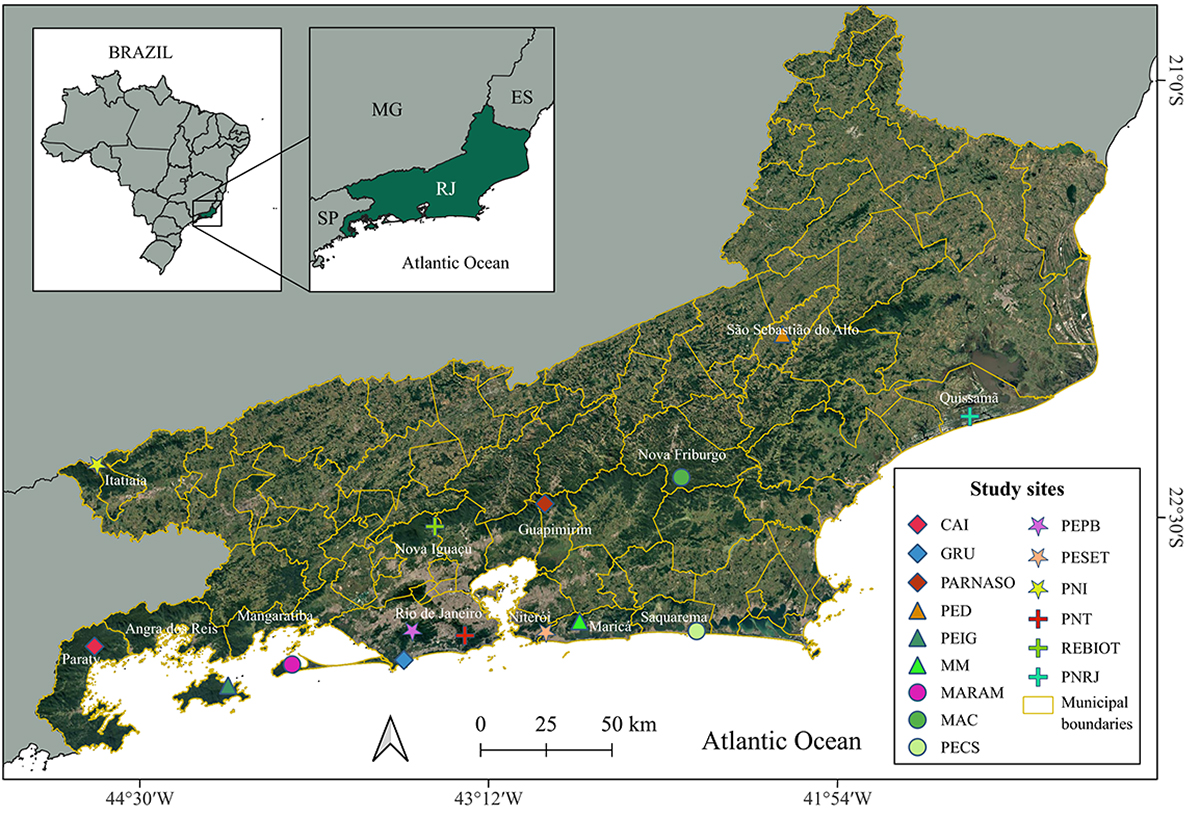
Fieldwork was conducted across various locations within the Municipality of Maricá (MM), including its protected areas, with monthly collections occurring from March 2022 to January 2023. Maricá is situated in the Metropolitan East region of Rio de Janeiro state, covering approximately 361.57 km², with 119 km² designated as protected areas. These include the Restinga de Maricá Environmental Protection Area, Serra da Tiririca State Park, Pedra de Itaocaia and Inoã Municipal Natural Monuments, Serra de Maricá Municipal Wildlife Refuge, Serra de Maricá Municipal Environmental Protection Area, and Lagoa do São Bento Wildlife Refuge, all of which were sampled in this study. The selected areas (Fig. 1) represent six Atlantic Forest vegetation types: Dense Ombrophilous Forest (DOF) (12 sites), Seasonal Semideciduous Forest (SSF) (one site), Restinga (RES) (eight sites), Rocky Outcrop Vegetation (ROV) (5 sites), Campos de Altitude (CAM) (four sites), and Mangrove (MAN) (four sites). The delimitation of the Atlantic Forest follows the Atlantic Forest Law (n° 11,428).
As outlined by IBGE (2012), these six vegetation types can be characterized as follows: DOF is characterized by an abundance of phanerophytes, including macro and mesophanerophytes, woody lianas, and epiphytes. This type thrives in tropical climates with high temperatures (mean of 25°C) and well-distributed rainfall, resulting in a bioecological setting with no biologically dry period. SSF is defined by its response to a seasonal climate, with partial leaf shedding during winter due to dry or cold conditions. It is dominated by phanerophytes with protective scales or hairs. In RES, plant communities directly influenced by marine waters, typically found along coastal plains. ROV is a vegetation that exists in the crevices of rock outcrops, typically identified as ecological refuges. CAM is a high-altitude grassland with distinct ecological characteristics. MAN is a microphanerophytic community found in brackish environments, typically at river mouths, adapted to saline conditions.
Map showing the location of 15 sites within the Atlantic Forest of Rio de Janeiro state used for Sorensen floristic similarity analysis, rare or common species classification, canonical correspondence analysis (CCA), and Mantel tests. Study sites are represented by the following acronyms: PESET, Serra da Tiririca State Park; REBIOT, Tinguá Biological Reserve; MM, Municipality of Maricá; PNT, Tijuca National Park; PEPB, Pedra Branca State Park; GRU, Restinga of the Grumari Environmental Protection Area; PNI, Itatiaia National Park; CAI, Cairuçú Environmental Protection Area; PEIG, Ilha Grande State Park; MARAM, Ilha da Marambaia; PNRJ, Jurubatiba Restinga National Park; PECS, Costa do Sol State Park; DEP, Desengano State Park; PARNASO, Serra dos Órgãos State Park; MAC, Macaé de Cima Environmental Protection Area.
Floristic composition and acquisition of environmental and geographical data
The nomenclatural review was conducted using the Flora e Funga do Brasil (2024) list. To ensure accuracy, duplicate records were manually identified and removed based on catalog codes, collector names and numbers, and sample collection years. We then compiled a list of species with current accepted nomenclature using the flora package (Carvalho, 2020) in R 4.4.0 (R Core Team, 2024). This package allowed us to update and verify species names by cross-referencing with the ‘Flora e Funga do Brasil’ database (http://floradobrasil.jbrj.gov.br/).
From the extensive list of environmental variables, we selected the most relevant ones for Atlantic Forest (Oliveira‐Filho & Fontes, 2000) - mean elevation (altitude), mean annual temperature, annual cumulative precipitation, distance from the ocean, and geographic coordinates -, also justified by the known sensitivity and specificity of this group of plants to these variables, as widely documented in the literature (Croat, 1978; Gentry, 1982; Mayo et al., 1997). Humidity, although not explicitly listed as an independent variable, is intrinsically contemplated by the selected variables (Croat, 1978; Simmons et al., 2010). For each study area, these environmental variables were sourced from the WorldClim 2.1 database (https://www.worldclim.org/data/index.html, accessed in August 2024). 'Distance from the Ocean' and geographic coordinates were mined from Google Earth software (2024).
Data analysis
Initially, we organized the matrix of floristic composition and provided a detailed description of it in this study. To assess the similarity in species composition between sites, we employed the Sørensen index, which measures compositional changes between two or more communities and is commonly used to compare β-diversity (Magurran, 2013). To assess the effects of environmental and geographic variables, we used Canonical Correspondence Analysis (CCA) and conducted a Monte Carlo permutation test to evaluate the significance of the ordination axes. This analysis was performed with Araceae species composition data, along with environmental and geographic variables (Table S1 and S2), using the Fitopac 2.1 software (Shepherd, 2010). We tested the correlation between floristic dissimilarity and environmental and geographic variables. For this purpose, we employed Euclidean distance for the floristic matrix and Gower's distance for environmental and geographic matrices. Partial Mantel tests (rM) were used to determine the distance between floristic composition and environmental, as well as floristic and geographic variables, with the null hypothesis being the absence of linear correlation between these variables (Legendre & Legendre, 2012). Statistical significance for Mantel's correlations was determined based on 10,000 permutations, calculated using Fitopac.
Subsequently, we identified and classified species as either common or rare. Species were classified based on their distribution across the selected areas and their floristic similarity. The classification of species as rare or common was adapted from Rabinowitz et al. (1986), taking into account geographic distribution and habitat specificity. Species with broad geographic and habitat ranges (occurring in at least ten locations and exhibiting more than three habitat types) were categorized as common, while species with restricted geographic and habitat ranges (confined to a single location and exhibiting only one habitat type) were classified as rare. Habitat information was derived from herbarium records and the Flora e Funga do Brasil database (2024).
Results
A total of 19 native genera and 87 native species of Araceae (Table S3) were identified in the study. These include the genera Anthurium, Asterostigma, Caladium, Heteropsis, Landoltia, Lemna, Monstera, Montrichardia, Philodendron, Pistia, Rhodospatha, Spathicarpa, Spirodela, Syngonium, Taccarum, Thaumatophyllum, Xanthosoma, Wolffia, and Wolffiella. Among these, 36 species were recorded in the municipality of Maricá. The surveyed taxa represent 95% of the 20 native genera and 78.4% of the 111 native Araceae species known to occur in the state of Rio de Janeiro.
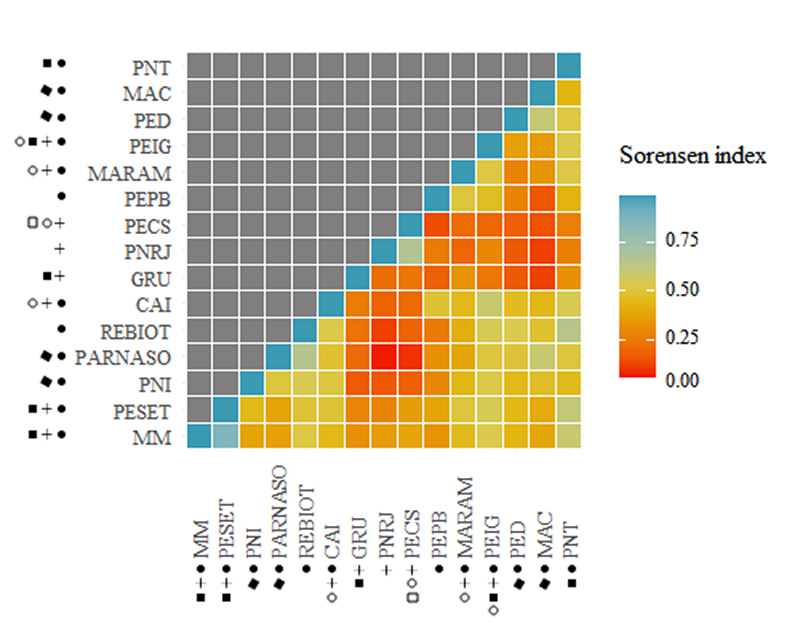
The overall floristic similarity of Araceae species across the different study sites was 0.79. The highest similarity in species composition was observed between Municipality of Maricá and Serra da Tiririca State Park (ISs = 0.85), followed by the similarity between Restinga de Jurubatiba National Park and Costa do Sol State Park (ISs = 0.66), Serra dos Órgãos State Park and Tinguá Biological Reserve (ISs = 0.65), and Tijuca State Park and Tinguá Biological Reserve (ISs = 0.64) (Fig. 2). In contrast, the Restinga de Jurubatiba National Park and Serra dos Órgãos State Park exhibited the lowest similarity (ISs = 0.04), followed by Serra dos Órgãos State Park and Costa do Sol State Park (ISs = 0.08), Macaé de Cima Environmental Protection Area and Restinga de Jurubatiba National Park (ISs = 0.10), and Tinguá Biological Reserve and Jurubatiba National Park (ISs = 0.10) (Fig. 2).

Similarity matrix based on the Sorensen index between study sites. Blue colors or close to 1 mean higher similarity. Study sites are represented by the following acronyms: PESET, Serra da Tiririca State Park; REBIOT, Tinguá Biological Reserve; MM, Municipality of Maricá; PNT, Tijuca National Park; PEPB, Pedra Branca State Park; GRU, Restinga of the Grumari Environmental Protection Area; PNI, Itatiaia National Park; CAI, Cairuçú Environmental Protection Area; PEIG, Ilha Grande State Park; MARAM, Ilha da Marambaia; PNRJ, Jurubatiba Restinga National Park; PECS, Costa do Sol State Park; DEP, Desengano State Park; PARNASO, Serra dos Órgãos State Park; MAC, Macaé de Cima Environmental Protection Area. The vegetation types are represented by the following symbols: ●, Dense Ombrophilous Forest; □, Seasonal Semideciduous Forest; +, Restinga; ■, Rocky Outcrop Vegetation; ♦, Campos de Altitude; ○, Mangrove.
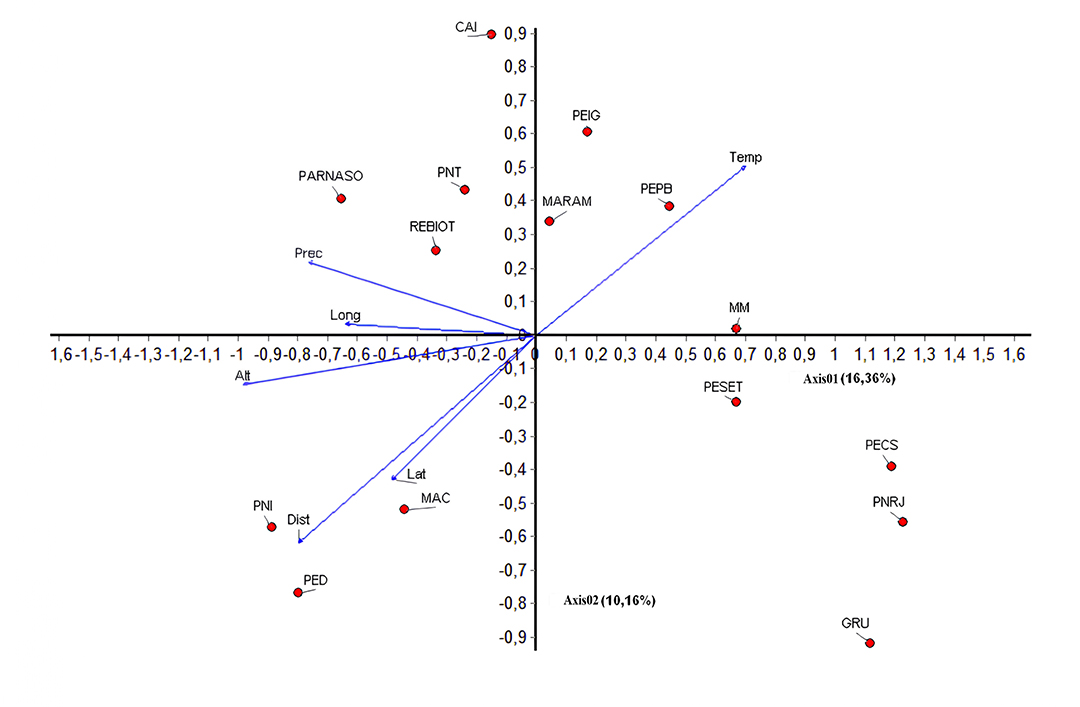
The first axis of the CCA was correlated with altitude, temperature, and precipitation (Fig. 3). The second axis was associated with distance to the ocean, latitude, and longitude. The first two axes explained 26.52% of the total variation. The Monte Carlo test did not indicate a significant relationship between matrices for the first ordination axes (p > 0.05). PEIG, MARAM, PEPB, and MM were positioned in the upper right quadrant of the biplot, reflecting the temperature gradient, while PESET, PECS, PNRJ, and GRU were located in the lower right quadrant, also aligned with the temperature gradient. PNT, REBIO, CAI, and PARNASO were more closely associated with precipitation and longitude gradients. Conversely, MAC, PED, and PNI were more related to altitude, distance to the ocean, and latitude. Mantel's partial correlation analysis revealed a strong correlation between environmental variables and geographic location with the floristic similarity of the area (r = -0.5, p < 0.01). However, the test did not show a significant correlation of geographic factors on the floristic matrix (r = 0.1, p > 0.05).
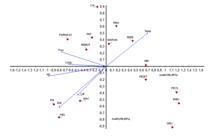
Diagram obtained by canonical correspondence analysis showing the ordination on the first two axes of 15 sites in the Atlantic Forest of Rio de Janeiro based on occurrence records of Araceae. Study sites are represented by the following acronyms: PESET, Serra da Tiririca State Park; REBIOT, Tinguá Biological Reserve; MM, Municipality of Maricá; PNT, Tijuca National Park; PEPB, Pedra Branca State Park; GRU, Restinga of the Grumari Environmental Protection Area; PNI, Itatiaia National Park; CAI, Cairuçú Environmental Protection Area; PEIG, Ilha Grande State Park; MARAM, Ilha da Marambaia; PNRJ, Jurubatiba Restinga National Park; PECS, Costa do Sol State Park; DEP, Desengano State Park; PARNASO, Serra dos Órgãos State Park; MAC, Macaé de Cima Environmental Protection Area. Environmental and geographical variables: Alt, altitude; Dist, distance from the ocean; Lat, latitude; Long, longitude; Prec, precipitation; Temp, mean annual temperature.
Based on their distribution in the areas listed in the floristic similarity analysis and habitat specificity, 10 out of the 87 analyzed species were considered rare, while four were classified as common. Table 2 details the sites of occurrence and the identified habits of the species classified as the most common and rare, respectively.
Distribution and habitats of common and rare Araceae species based on floristic similarity areas. Study sites are represented by the following acronyms: PESET, Serra da Tiririca State Park; REBIOT, Tinguá Biological Reserve; MM, Municipality of Maricá; PNT, Tijuca National Park; PEPB, Pedra Branca State Park; GRU, Restinga of the Grumari Environmental Protection Area; PNI, Itatiaia National Park; CAI, Cairuçú Environmental Protection Area; PEIG, Ilha Grande State Park; MARAM, Ilha da Marambaia; PNRJ, Jurubatiba Restinga National Park; PECS, Costa do Sol State Park; DEP, Desengano State Park; PARNASO, Serra dos Órgãos State Park; MAC, Macaé de Cima Environmental Protection Area. Life form is represented by the following acronyms: Aq = aquatic; Ep = epiphyte; He = hemiepiphyte; Ru = rupicolous; Sa = saxicolous; Te = terricolous.
Discussion
Floristic similarity
The Atlantic Forest in the state of Rio de Janeiro is recognized as one of the most biodiverse regions in Brazil, largely due to its complex geomorphology, which supports a wide range of vegetation formations (Coelho et al., 2017). This combination of geomorphological diversity and environmental heterogeneity was decisive for the results found in this study, as it contributed directly to the high number of Araceae genera and species recorded across the surveyed areas. Based on data from Flora e Funga do Brasil (2024), a comparison of Araceae species richness in the Atlantic Forest across the other states in the Brazilian Southeast region shows that while Rio de Janeiro has 20 genera and 109 native species, São Paulo records 20 genera and 83 native species, followed by Minas Gerais with 20 genera and 102 native species, and Espírito Santo with 19 genera and 107 native species.
According to data available in the Catálogo de Plantas das Unidades de Conservação do Brasil (2025), within São Paulo, the areas with the lowest Araceae species richness are the Ilhas da Queimada Pequena and Queimada Grande Relevant Ecological Interest Area, Bananal Ecological Station, and Porto Ferreira State Park, all with two species each. In contrast, the richest areas were Carlos Botelho State Park, with 11 species, and Alto Ribeira Touristic State Park, with 12 species. Summing the occurrences in these areas, seven genera and 27 species are recorded. In Minas Gerais, the Sempre Vivas National Park registered six species, while Caparaó National Park, which spans both Minas Gerais and Espírito Santo, presented 22 species. Summing the occurrences in these areas, 11 genera and 25 species are recorded. In Espírito Santo, the areas with the lowest richness were Mata das Flores State Park (four species) and Rio Preto National Forest (five species). The richest were Forno Grande State Park (15 species), Mestre Álvaro Environmental Protection Area (22 species), and Duas Bocas Biological Reserve (23 species). Summing the occurrences in these areas, 14 genera and 59 species are recorded. The present study inventoried a total of 19 genera and 87 native species in the investigated areas of Rio de Janeiro state, as shown in the results. These findings highlight how geomorphological and vegetational complexity promote high levels of floristic richness and representativeness for the Araceae family, in accordance with Croat (1988), Mayo et al. (1997), and Croat & Ortiz (2020).
The floristic similarity of the Araceae shows that the communities in the state of Rio de Janeiro are different in the areas selected for the analysis, with different levels of similarity to each other. Comparing with other studies with biogeographic data of Araceae for the Brazilian Atlantic Forest (Mayo, 1988; Sakuragui, 2001; Almeida et al., 2005; Sakuragui et al., 2007; Temponi et al., 2006; Temponi, 2006; Pontes, 2010; Calazans et al., 2018; Camelo et al., 2020), the family also presented high species richness in some of the forest remnants evaluated in the present study.
Although some pairs of sites showed moderate to high floristic similarity (Sørensen index values ranging from 50% to 70%), the overall similarity matrix revealed considerable dissimilarity across the broader set of sites in Rio de Janeiro, reflecting the region's environmental and habitat heterogeneity. This indicates that although certain sites share a substantial portion of species, Araceae communities as a whole show considerable variation in the overall composition of the Rio de Janeiro state.
The Canonical Correspondence Analysis (CCA) explained a relatively low percentage of the total variation in species composition (26.52% along the first two axes). Such low explanatory values are typical in ecological studies involving species-rich and environmentally complex vegetation, as is the case in Atlantic Forest systems (Ter Braak, 1987). This means that multiple interacting environmental factors are essential to explain species distribution; that is, a combination of these factors is required for a conclusive explanation, as no single factor is independently sufficient. Despite that low variance explained, the CCA ordination clearly revealed strong relationships between species distribution and key environmental gradients - including temperature, precipitation, altitude, and distance to the ocean. These variables strongly influenced the spatial arrangement of the study sites in the ordination plot, indicating their important role in shaping local Araceae community composition. Leimbeck et al. (2004) point to altitude and humidity as powerful environmental variables to explain the richness of Araceae. In the state of Rio de Janeiro, what must also be taken into consideration is, mainly, the distance from the ocean to explain the wealth found and the division of groups, with marine influence revealing the distribution patterns found.
Through the results of this analysis, the distribution pattern of Araceae species in the state of Rio de Janeiro is recognized. Therefore, two primary groups with approximately 50% similarity are revealed: coastal areas directly influenced by the ocean (MM, PESET, PNT, PEPB, MARAM, PEIG, and CAI) and inland areas far from direct coastal influence (PNI, REBIO, PARNASO, MAC, and PED). GRU, PNRJ, and PECS are formed specifically by restingas. The GRU positions itself as a sister group in these areas, while the PNRJ and PECS stand out from the others, representing the initial divergence.
Araceae is among the ten richest families in the restingas of the state of Rio de Janeiro (Araujo, 2000). This type of vegetation occurs at low altitudes in the coastal region, where the temperature is higher, with climates that vary from hot, humid, humid subtropical to hot semi-arid. The PECS region has peculiarities. The climate is known for being hot and arid, being the driest region on the entire southeastern Brazilian coast (Pereira & Araujo, 2000). This stretch is considered an area where drought-resistant species are isolated by the surrounding Dense Ombrophylous Forest. This is one of the main factors that makes the region a center of diversity of unrelated taxonomic groups (Araujo, 1997; Araujo et al., 1998; Araujo, 2000). What explains this characteristic is the low level of precipitation in the region (800 mm/year) and the resurgence phenomenon (Barbiére & Coe-Neto, 1999). This set of factors occurs due to seasonality between spring and summer, due to the steep geomorphology of the continental shelf, direction of the coast, and predominance of winds in the northeast direction (Veloso et al., 2022).
In relation to the types of vegetation found within this restinga, non-floodable herbaceous formations, non-floodable herbaceous formations, non-floodable closed bushes, non-floodable open bushes, floodable open bushes, non-floodable forest, flooded forest, and floodable forest are highlighted (Pereira & Menezes, 2023). In RJU, vegetation types are found classified as non-floodable herbaceous formations, non-floodable open shrubs, non-floodable closed shrubs, floodable open shrubs, and floodable forest (Araujo et al., 1998; Pereira & Menezes, 2023). These floodable restinga areas provide greater habitat richness, with the establishment of aquatic species, in addition to epiphytes in forested areas. Even though the occurrence of Araceae is more related to humid areas, in agreement with Magno et al. (2011), this environmental factor favors the establishment of different life forms, which makes it possible to establish a community of Araceae in a dry matrix.
Calazans et al. (2018) also obtained floristic similarity of Araceae from the restingas of Rio de Janeiro, supported by the cophenetic coefficient of 0.79 (Jaccard). In this study, the most similar areas were the Grumari and Maricá restingas, with 50%. The other areas compared were Armação de Búzios, Copacabana, Grumari, Grussaí, Jacarepaguá, Jurubatiba, Marambaia, Massambaba, Mauá, Niterói, Praia do Sul, and Praia Virgem. The authors discuss the results showing that the composition of Araceae varies according to the geological formations of Rio de Janeiro and climatic influence, in addition to human occupation in the areas, which can select the most generalist species.
For Calazans et al. (2018), the location close to the forested slope in crystalline basement causes the species to disperse to the restingas. This pattern was also observed by Moreira et al. (2014) with Orchidaceae from restinga areas in the state of Rio de Janeiro. In the present study, the results found corroborate those previously mentioned, where the areas with the presence of restingas (CAI, MARAM, PEIG, PESET, and MM) (Barros, 2008; Pereira et al., 2008; Callado et al., 2009) are strongly influenced by the surrounding humid matrix, standing out but emerging from the group of areas mainly composed of Dense Ombrophylous Forest. However, there is no such relationship for the restingas of the North (PECS and PNRJ).
The main factor responsible for grouping PARNASO, REBIOT, PED, MAC, and PNI is their distance from the ocean and their higher altitudes, making them the most elevated areas in the Rio de Janeiro state. Influenced by the surroundings of Guanabara Bay, PARNASO and REBIOT exhibit among the highest rates of similarity. These areas are geographically proximate and demonstrate a certain degree of connectivity. The mountainous portions of the Serra do Mar (PED, MAC, REBIOT, and PARNASO) and Serra da Mantiqueira (PNI) are considered priority areas for Atlantic Forest conservation (MMA, 2007). They establish a connection between the floristic blocks of the Norte Fluminense and Serrana Central regions (Rocha et al., 2006; Monteiro & Guimarães, 2009). The combination of these characteristics, coupled with historical land use and protection, results in these areas being the most diverse and composed of well-preserved forests with the highest number of exclusive Araceae species.
Besides having the same vegetation type, the group composed of CAI, MARAM, PEIG, PEPB, PNT, PESET, and MM is directly influenced by the coast. Some areas form strong orographic barriers (e.g., PEIG and PNT) (Callado et al., 2009) that provide high rainfall. The geomorphology surrounding Guanabara Bay also contributes to the formation of this group (MM, PESET, and PNT). In the vicinity of this geomorphological feature, the Coastal Massifs stand out, corresponding to isolated elevations parallel to the coastline (Silva, 2021). Rocky outcrops characterize the relief formations of this coastal strip in the state of Rio de Janeiro. Ecologically, these environments function as terrestrial islands (inselbergs) with exposed rocks surrounded by shrubby vegetation and shallow soil (Porembski, 2007).
Apart from the environmental factors that contribute to the existence of similar ecological niches, the proximity between fragments must also be taken into account. Although the increase in spatial distance between communities provides a decrease in similarity (Nekola & White, 1999), the size of the areas can also influence the distribution of the species. Thus, smaller fragments have lower habitat richness, which in turn plays a fundamental role in the regulation of species richness (MacArthur & Wilson, 1967). The areas with the highest similarity value in the analysis either overlap (MM and PESET, Serra da Tiririca nucleus of PESET) or are close (PNT and REBIOT, PARNASO and REBIOT, and PNRJ and PECS), which helps to explain the values found. This allows the existence of several shared species that use the same vegetation type or habitat, many of which are endemic to this type of environment.
Consequently, the congruence of environmental attributes is paramount in determining the higher occurrence and sharing of Araceae species, reflecting the significance of the diverse vegetation types found within the state of Rio de Janeiro. This circumstance can be a valuable conservation strategy concerning biodiversity. Therefore, it is feasible to devise conservation strategies that integrate the various fragments, which, despite their diminutive size, still harbor a substantial portion of the biodiversity, not only of Araceae but also of other biological groups.
Rare and common species
The rarity analysis revealed species with the most limited and extensive geographical distribution and habitat preferences at the state level of Rio de Janeiro. Ten species were classified as rare, and four species were classified as common. Among the species of the genus Anthurium, A. intermedium and A. comtum stand out for their wide distribution across Brazil (Coelho et al., 2009b; Flora e Funga do Brasil, 2024), a pattern that is also confirmed for the state of Rio de Janeiro. Both species exhibit multiple life forms - epiphytic, rupicolous, saxicolous, and terrestrial - reflecting high ecological versatility. A. intermedium was recorded in 14 areas, ranging from coastal restinga habitats such as CAI, GRU, PNRJ, and PECS to lowland and montane rainforest environments with varying altitudes, including MARAM, PEIG, MM, PESET, PNT, PEPB, PARNASO, MAC, PED, and PNI. A. comtum was found in 11 localities, predominantly in forested areas such as PESET, PNT, REBIOT, CAI, PEPB, PARNASO, MARAM, PEIG, MAC, PED, and PNI. This ecological plasticity may be associated with the physiological tolerance of these species to varying moisture levels, light availability, and substrate types, allowing them to colonize open environments, such as forest edges and restinga, as well as dense ombrophilous forests across different altitudinal gradients. Such ecological breadth contrasts with the restricted distribution of congeneric species such as A. bragae and A. purpureum, both classified as rare and each recorded in a single locality in the state (PNI and MAC, respectively), occurring solely as terrestrial plants. This suggests a greater degree of ecological specialization or limitation, which restricts their dispersal.
Among species of the genus Philodendron, P. cordatum and P. crassinervium are notable and classified as common. According to Sakuragui (2001), P. cordatum is the most frequently collected species and likely the one with the widest ecological amplitude, a pattern confirmed in Rio de Janeiro by its broad distribution and multiple life forms - epiphytic, rupicolous, saxicolous, terrestrial, and hemiepiphytic - evidencing remarkable ecological plasticity. P. cordatum was recorded in 11 areas, ranging from coastal restinga vegetation (CAI and GRU) to lowland and montane rainforests across various altitudes (MM, PESET, PNI, PARNASO, REBIOT, MARAM, PEIG, MAC, and PNT). P. crassinervium displays a similar pattern, also occurring in 11 localities with comparable characteristics (MM, PESET, PNI, PARNASO, REBIOT, CAI, GRU, MARAM, PEIG, PED, and PNT), although it was not recorded as hemiepiphytic. This broad distribution and diversity of life forms reflect high tolerance to different microhabitats and edaphoclimatic conditions, enabling their establishment in both open coastal formations and moist forests. In contrast, rare species of the same genus, such as P. alternans and P. obliquifolium, exhibit extremely restricted distributions (PARNASO and PED, respectively), each being recorded in a single locality in well-preserved forested areas. Both species are hemiepiphytic, highlighting the ecological diversity within the genus and the potential dispersal limitations associated with specific life forms.
Spathicarpa sagittifolia is considered a rare species, being recorded exclusively in MM, with a terrestrial habit. This species belongs to a small neotropical genus composed of a few species, typically adapted to well-drained soils, often in semi-arid areas (Gonçalves, 2002). In the state of Rio de Janeiro, the area where it was found is among the few records known for the species (Gonçalves, 2002), reflecting its ecological limitation, likely associated with historical habitat occupation in surrounding areas. The low frequency of S. sagittifolia in floristic surveys within the state and its absence from other sampled areas emphasize the importance of conserving the natural remnants in which it occurs, as these may harbor unique and underrepresented floristic components at the regional scale.
Another rare record is Taccarum sp., found exclusively in PNI with a terrestrial habit. Although the genus occurs widely across non-Amazonian Brazil (except the extreme south) (Gonçalves, 2002), its distribution in Rio de Janeiro is limited. Its occurrence within a protected area that includes ecotones of the Atlantic Forest suggests that this population may be associated with specific microhabitats. This isolated occurrence reinforces the role of high-altitude preserved areas as refuges for rare or little-known plant lineages, particularly in groups such as Araceae, whose diversity in open environments is often underestimated, as wetlands have long been considered primary refuges for species in the family (Mayo et al., 1997; Leimbeck et al., 2004; Magno et al., 2011; Croat & Ortiz, 2020).
Four aquatic species were recorded and classified as rare in the state of Rio de Janeiro: Montrichardia linifera, Spirodela intermedia, Wolffia arrhiza, and Wolffiella lingulata. Although these species have wide distributions in Brazil (Lourenço & Bove, 2019; Flora e Funga do Brasil, 2024), aquatic environments in the state have historically been neglected and degraded, representing a limiting factor for regional species dispersal. Among them, M. linifera was found only in a protected area in MM and is already classified as Endangered (EN) in the state due to habitat degradation at its known location (Dutra Jr., 2021). S. intermedia, W. arrhiza, and W. lingulata were exclusively recorded in the PECS region. While W. arrhiza is associated with permanently flooded areas, S. intermedia and W. lingulata generally occur in temporary wetlands (Lourenço & Bove, 2019). These three species belong to the subfamily Lemnoideae and are the smallest known angiosperms, with fast reproductive cycles. Their diminutive size and seasonality may contribute to underrepresentation in conventional floristic inventories. Sampaio et al. (2025) note that the challenges in collecting the group and the limited number of studies on the family result in a low number of records in herbaria and online databases. This is because these plants are particularly difficult to sample and identify using conventional floristic survey methods due to their diminutive size and anatomical complexity. This helps to conclude that, despite being considered rare in the present study, there is a clear shortfall of information on these species, as reflected by the irregular and reduced distribution of records found in databases. This identification of both rare and common species, along with the distribution patterns of native Araceae in the state of Rio de Janeiro, provides valuable insights into their ecological roles and potential applications in biodiversity conservation and environmental monitoring.
The four species classified as common demonstrated a greater ability to colonize diverse environments due to their generalist nature, which can contribute to increasing ecosystem complexity. With life forms varying between terrestrial, saxicolous, rupicolous, epiphytic, and hemiepiphytic, these species have a greater ease in establishing themselves in recovering environments. Due to their greater ease of incorporation into the terrestrial substrate, they possess the potential to disperse to other substrates. This phenomenon is commonly observed in natural environments, where representatives of the family can be found diversifying across various life forms (Dutra Jr. et al., 2024).
In contrast, the rare Araceae species can be categorized as detectors or bioindicators due to their restricted distribution and stringent habitat requirements. These species exhibit a measurable response to environmental changes and pressures (Zamoner, 2007). Their varying levels of tolerance or sensitivity to changes in environmental conditions provide valuable tools for assessing the environmental quality of a given ecosystem. Consequently, the presence, absence, or behavior of these species can serve as indicators of environmental integrity. Given the rarity of the ten Araceae species identified, the prioritization of conservation efforts, including the protection of their habitats, is justified. Knowledge of these species is essential for the evaluation and planning of effective conservation strategies (Slatyer et al., 2007).
While species richness is essential in restored areas for ecosystem stability, the functional diversity of these species will ultimately drive ecological processes (Loreau et al., 2001; Hooper et al., 2005; Díaz et al., 2007). The presence or absence of each species reinforces the idea of dependence on the maintenance of local and global environmental variables (Hill et al., 1999; Parmesan et al., 2000). As noted by Pinto et al. (2009), since the colonization of Brazil, the Atlantic Forest has undergone a succession of episodes of natural forest conversion for other purposes, resulting in the fragmented landscapes. Consequently, local environmental disequilibrium poses a significant challenge, as alterations can adversely affect the urban environment, as well as various biological communities, disrupting unique interactions and ecological processes. Therefore, by understanding the geographical distribution of species with bioindicator potential, as well as the environmental factors influencing their occurrence, it becomes feasible to utilize these species in projects aimed at the rehabilitation and reintroduction of degraded areas.
Accordingly, Araceae ought to be regarded as potential candidates for the restoration of degraded areas in various successional phases, particularly within the context of non-arboreal species. This strategic approach is supported by the fact that life forms such as vines, herbs, epiphytes, and others constitute approximately 55% of the species diversity in the Atlantic Forest (Ivanauskas et al., 2001). These non-arboreal elements play a pivotal role in enhancing the structural and habitat complexity of restored areas (Fontoura et al., 1997) and are frequently overlooked in ecological restoration initiatives.
Due to their ecological significance, a few Araceae species are already employed in ecological restoration initiatives, conservation projects, and as bioindicators (Pontes, 2010; Gama et al., 2013; Rezende, 2013; Padilha, 2019), although their broader potential remains largely underutilized. Araceae demonstrate potential as bioindicators of urban environmental quality (Santos & Gasparetto, 2014), as well as being valuable bioindicators of preserved environments (Pontes, 2010). The communities of epiphytic and hemiepiphytic vascular plants in secondary forests are revealed as biological indicators sensitive to environmental changes, being useful for detecting climate change, environmental degradation, pollution, and other disturbances in ecosystems (Croat, 1988; Richter, 1991; Lugo & Scatena, 1992). Coelho et al. (2013) state that certain Araceae species are highly restricted to specific habitats and struggle to survive in altered conditions. For example, native Philodendron species are particularly sensitive to fluctuations in humidity and light, rendering them incapable of thriving in dry or degraded areas (Coelho, 2000). In contrast, terrestrial Araceae species can be found in both wet and dry habitats, demonstrating adaptability to extreme conditions such as low temperatures or drought. Aquatic species such as Pistia stratiotes and Montrichardia linifera are also used to monitor the health of various ecosystems, serving as bioindicators and bioremediators (Amarante et al., 2009; Botelho et al., 2019). The same principle can be applied to the species identified in this study that possess these potentials.
The identification of rare and common species and the distribution patterns of native Araceae species in Rio de Janeiro provide insights into potential bioindicator species and contribute to a deeper understanding of biodiversity conservation in the Atlantic Forest. These findings highlight the importance of environmental factors in the spatial distribution of Araceae, offering valuable information for future conservation efforts and ecological studies.
Supplementary Material
The following online material is available for this article:
Table S1 -
Table S2 -
Table S3 -
Acknowledgements
We thank Davi Nepomuceno da Silva Machado, the entire team at the Laboratório de Estudos Interdisciplinares Culturais e Ambientais (LEICA), and Faculdade de Formação de Professores, Universidade do Estado do Rio de Janeiro (FFP/UERJ) for the support and structure in the collection and herbarization of collected material. And to CAPES for implementing the scholarship for the first author.
References
- Aguilar JMR. 2009. Biogeografia. São Cristóvão, Universidade Federal de Sergipe/CESAD.
- Aguiar TC. 2017. Uma visão integrada dos impactos ambientais no estado do Rio de Janeiro. In: Marafon GJ, Ribeiro MA (eds.). Revisitando o território fluminense. Rio de Janeiro, Universidade do Estado do Rio de Janeiro, EDUERJ. p. 65-84.
- Almeida VR, Temponi LG, Forzza RC. 2005. Araceae da Reserva Biológica da Represa do Grama - Descoberto, Minas Gerais, Brasil. Rodriguésia 56: 127-144.
- Amarante CB, Silva JCF, Solano FAR. 2009. Estudo espectrométrico das folhas da aninga (Montrichardia linifera) coletadas a margem do Rio Guama no Campus da UFPA, Belém-PA. Uma contribuição ao estudo químico da família Araceae. Revista Científica da UFPA 7: 1-19.
- Araujo DSD. 1997. The Cabo Frio region. In: Davis SD, Heywood VH, Herrera McBryde O, Villa-Lobos J, Hamilton AC. (eds.) Centers of Plant Diversity: A guide and strategy for their conservation. V. 3: The Americas. Oxford, WWF/IUCN. p. 373-375.
- Araujo DSD. 2000. Análise florística e fitogeográfica das restingas do Estado do Rio de Janeiro. PhD Thesis, Universidade Federal do Rio de Janeiro, Brazil.
- Araujo DSD, Oliveira RR. 1988. Reserva Biológica Estadual da Praia do Sul (Ilha Grande, Rio de Janeiro): lista preliminar da flora. Acta Botanica Brasilica 1: 83-94.
- Araujo DSD, Sá CFC, Fontella Pereira J, Garcia DS, Ferreira MV, Paixão RJ, et al 2009. Área de Proteção Ambiental de Massambaba, Rio de Janeiro: caracterização fitofisionômica e florística. Rodriguésia 60: 67-96.
- Araujo DSD, Scarano FR, Sá CFC, Kurtz BC, Zaluar HLT, Montezuma RCM, et al 1998. Comunidades vegetais do Parque Nacional da Restinga de Jurubatiba. In: Esteves FA. (ed.) Ecologia das lagoas costeiras do Parque Nacional da Restinga de Jurubatiba e do Município de Macaé (RJ). Rio de Janeiro, Universidade Federal do Rio de Janeiro. p. 39-62.
- Barbiére EB, Coe-Neto R. 1999. Spatial and temporal variation of the east fluminense coast and Atlantic Serra do Mar, state of Rio de Janeiro, Brazil. In: Knoppers BA, Bidone ED, Abrão JJ (eds.). Environmental Geochemistry of Coastal Lagoon Systems, Rio de Janeiro, Brazil. Rio de Janeiro, FINEP. p. 25-46 (Série Geoquímica Ambiental 6).
- Barros AAM. 2008. Análise florística e estrutural do Parque Estadual da Serra da Tiririca, Niterói e Maricá, RJ, Brasil. PhD Thesis. Instituto de Pesquisa Jardim Botânico do Rio de Janeiro, Brazil.
- BFG - Brazil Flora Group. 2018. Brazilian Flora 2020: Innovation and collaboration to meet Target 1 of the Global Strategy for Plant Conservation (GSPC). Rodriguésia 69: 1513-1527.
- Botelho AS, Amarante CB, Batista RJR. 2019. Avaliação do potencial bioacumulador e fitorremediador da parte aérea de Montrichardia linifera (Arruda) Schott. Revista Virtual de Química 11: 1180-1189.
-
Brasil. Lei nº 12.651, de 25 de maio de 2012. Dispõe sobre a proteção da vegetação nativa; altera as Leis nº 6.938, de 31 de agosto de 1981, nº 9.393, de 19 de dezembro de 1996, e nº 11.428, de 22 de dezembro de 2006; revoga as Leis nº 4.771, de 15 de setembro de 1965, e nº 7.754, de 14 de abril de 1989, e a Medida Provisória nº 2.166-67, de 24 de agosto de 2001; e dá outras providências. https://www.planalto.gov.br/ccivil_03/_ato2011-014/2012/lei/L12651compilado.htm 17 Nov. 2023.
» https://www.planalto.gov.br/ccivil_03/_ato2011-014/2012/lei/L12651compilado.htm - Callado CH, Barros AAM, Ribas LA, Albarello N, Gagliardi RF, Jascone CES. 2009. Flora e cobertura vegetal. In: Bastos M, Callado CH (eds.). O ambiente da Ilha Grande, Rio de Janeiro. Rio de Janeiro, Centro de Estudos Ambientais e Desenvolvimento Sustentável. p. 91-162.
- Calazans LSB, Valadares RT, Sakuragui CM, Lopes RC. 2018. Araceae of Grumari Restinga: contribution to the conservation of the flora of Rio de Janeiro State, Brazil. Acta Botanica Brasilica 32: 55-62.
- Camelo MC, Coelho MAN, Leoni LS, Temponi LG. 2020. Araceae do Parque Nacional do Caparaó, MG-ES, Brazil. Rodriguésia 71: e01742018.
-
Carvalho G. 2020. Flora: Tools for interacting with the Brazilian flora 2020. R package version 0.3.4. https://cran.r-project.org/web/packages/flora/index.html 30 Aug 2024.
» https://cran.r-project.org/web/packages/flora/index.html - Carvalho DA, Sá CFC. 2011. Estrutura do estrato herbáceo de uma restinga arbustiva aberta na APA de Massambaba, Rio de Janeiro, Brasil. Rodriguésia 62: 367-378.
-
Catálogo de Plantas das Unidades de Conservação do Brasil. Jardim Botânico do Rio de Janeiro. 2025. https://catalogo-ucs-brasil.jbrj.gov.br 29 Aug 2025.
» https://catalogo-ucs-brasil.jbrj.gov.br - Coelho MAN. 1997. Araceae. In: Marques MCM (ed.). Mapeamento da cobertura vegetal e listagem das espécies ocorrentes na área de proteção ambiental de Cairuçu, Município de Parati, RJ. Rio de Janeiro, Fundação Instituto de Pesquisas Jardim Botânico do Rio de Janeiro, 13. p. 1-87.
- Coelho MAN. 2000. Philodendron Schott (Araceae): morfologia e taxonomia das espécies da Reserva Ecológica de Macaé de Cima, Nova Friburgo, Rio de Janeiro, Brasil. Rodriguésia 51: 21-68.
- Coelho MAN, Baumgratz JFA, Lobão AQ, Sylvestre LDS, Trovó M, Silva LAED. 2017. Flora do estado do Rio de Janeiro: avanços no conhecimento da diversidade. Rodriguésia 68: 1-11.
- Coelho MAN, Maurenza D, Penedo TSA, Freitas MF. 2013. Araceae. In: Martinelli G, Moraes MA (eds.). Livro Vermelho da Flora do Brasil. Rio de Janeiro, Instituto de Pesquisas Jardim Botânico do Rio de Janeiro. p. 177-181.
-
Coelho MAN, Sakuragui CM, Calazans L. 2014. Araceae. Catálogo das espécies de plantas vasculares e briófitas do Estado do Rio de Janeiro. Rio de Janeiro, Instituto de Pesquisas Jardim Botânico do Rio de Janeiro . http://florariojaneiro.jbrj.gov.br 21 Nov. 2023.
» http://florariojaneiro.jbrj.gov.br - Coelho MAN, Sakuragui CM, Gonçalves EG, Temponi LG, Valadares RT. 2009a. Araceae. In: Stehmann JR, Forzza RC, Salino A, Sobral M, Costa DP, Kamino LY (eds.). Plantas da Floresta Atlântica. Rio de Janeiro, Jardim Botânico do Rio de Janeiro. p. 141-145.
- Coelho MAN, Schneider SM. 2001. Araceae. In: Costa AF, Dias ICA (eds.). Flora do Parque Nacional da Restinga de Jurubatiba e arredores, Rio de Janeiro, Brasil: listagem, florística e fitogeografia. Rio de Janeiro, Universidade Federal do Rio de Janeiro /Museu Nacional. p. 155-165.
- Coelho MAN, Waechter J.L, Mayo SJ. 2009b. Revisão taxonômica das espécies de Anthurium (Araceae) Seção Urospadix Subseção Flavescentiviridia Rodriguésia 60: 799-864.
- Cox CB, Moore PD. 2011. Biogeografia: uma abordagem metodológica e evolucionária. Rio de Janeiro, Grupo Editorial Nacional.
- Croat TB. 1978. Flora of Barro Colorado Island. California, Stanford University Press.
- Croat TB. 1988. Ecology and Life Forms of Araceae. Aroideana 11: 1-52.
- Croat TB, Ortiz OO. 2020. Distribution of Araceae and the Diversity of Life Forms. Acta Societatis Botanicorum Poloniae 89: 8939.
- Cruz ACR, Nunes Freitas AF. 2017. Diversidade e conservação das epífitas vasculares da Ilha Grande, RJ. In: Milward de Azevedo MA, Cortines E (eds.). Anais do Simpósio de Gestão Ambiental e Biodiversidade. Três Rios, SIGABI. p. 18-24.
- Dias AS. 2009. Ecologia de epífitas vasculares em uma área de Mata Atlântica do Parque Nacional da Serra dos Órgãos, Teresópolis, RJ. MSc Thesis. Universidade Federal Rural do Rio de Janeiro, Brazil.
- Díaz S, Lavorel S, Bello F, Quetier F, Grigulis K, Robson TM. 2007. Incorporating plant functional diversity effects in ecosystem service assessments. Proceedings of the National Academy of Sciences 104: 20684-20689.
- Dutra Jr DLS. 2021. Araceae Juss. da Serra da Tiririca, Niterói e Maricá, estado do Rio de Janeiro, Brasil. BSci Thesis. Universidade do Estado do Rio de Janeiro, Brazil.
-
Dutra Jr DLS, Barros AAM, Coelho MAN. 2024. Anthurium Schott (Araceae) da Serra da Tiririca, Niterói e Maricá, Estado do Rio de Janeiro, Brasil. Hoehnea 51: e1062023. doi: 10.1590/2236-8906-2023-62023
» https://doi.org/10.1590/2236-8906-2023-62023 -
Flora e Funga do Brasil. 2024. Araceae. Jardim Botânico do Rio de Janeiro. https://floradobrasil.jbrj.gov.br/FB51 25 Jun. 2024.
» https://floradobrasil.jbrj.gov.br/FB51 - Fontoura T, Sylvestre LS, Vaz AMF, Vieira CM. 1997. Epífitas vasculares, hemiepífitas e hemiparasitas da Reserva Ecológica de Macaé de Cima. In: Lima HC, Guedes Bruni RR (eds.). Serra de Macaé de Cima: diversidade florística e conservação em Mata Atlântica. Rio de Janeiro, Fundação Instituto de Pesquisas Jardim Botânico do Rio de Janeiro . p. 89-102.
- Galvão MCC. 2009. Percursos geográficos. Rio de Janeiro, Lamparina, ANPEGE.
-
Gama MMB, Vieira AH, Rocha RB. 2013. Ecological features of titica vine (Heteropsis flexuosa (Kunth) GS Bunting) in Rondônia State, Northwest Brazilian Amazon. Anais da Academia Brasileira de Ciências 85: 1017-1025. doi: 10.1590/S0001-37652013000300015
» https://doi.org/10.1590/S0001-37652013000300015 - Gentry AH. 1982. Neotropical floristic diversity: phytogeographical connections between Central and South America, Pleistocene climatic fluctuations, or an accident of the Andean orogeny? Annals of the Missouri Botanical Garden 69: 557-593.
- Golfari L, Moosmayer H. 1980. Manual de reflorestamento do estado do Rio de Janeiro. Rio de Janeiro, Banco de Desenvolvimento do Estado do Rio de Janeiro, Secretaria de Planejamento e Coordenação Geral.
-
Google Earth (ver. 7.3.6.9326). 2024. Mountain View, Google Inc. https://www.google.com/earth/ 30 Aug. 2024.
» https://www.google.com/earth/ - Gonçalves EG. 2002. Sistemática e Evolução da Tribo Spathicarpeae (Araceae). PhD Thesis. Universidade de São Paulo, Brazil.
- Hill JK, Thomas CD, Huntley B. 1999. Climate and habitat availability determine 20th century changes in a butterfly’s range margin. Biological Sciences 266: 1197-1206.
- Hooper DU, Chapin FS, Ewel JJ, Hector A, Inchausti P, Lavorel S, et al 2005. Effects of biodiversity on ecosystem functioning: A consensus of current knowledge. Ecological Monographs 75: 3-35.
- IBGE - Instituto Brasileiro de Geografia e Estatística. 2012. Manual técnico da vegetação brasileira. 2nd. edn. Rio de Janeiro, Coordenação de Recursos Naturais e Estudos Ambientais, Instituto Brasileiro de Geografia e Estatística.
- Ivanauskas NM, Monteiro R, Rodrigues RR. 2001. Levantamento florístico de um trecho de Floresta Atlântica em Pariquera-Açu, SP. Naturalia 26: 97-129.
- Leimbeck RM, Valencia R, Balslev H. 2004. Landscape diversity patterns and endemism of Araceae in Ecuador. Biodiversity and Conservation 13: 1755-1779.
- Legendre P, Legendre L. 2012. Numerical ecology. Amsterdam, Elsevier.
- Loreau M, Naeem S, Inchausti P, Bengtsson J, Grime JP, Hector A. et al 2001. Biodiversity and Ecosystem Functioning: Current Knowledge and Future Challenges. Science 294: 804-809.
- Lourenço AR, Bove CP. 2019. Flora do Rio de Janeiro: Lemnoideae (Araceae). Rodriguésia 70: 1-15.
- Lugo AE, Scatena FN. 1992. Epiphytes and climate change research in the Caribbean: A proposal. Selbyana 5: 207-213.
- MacArthur RH, Wilson EO. 1967. The theory of island biogeography. Princeton, Princeton University Press.
- Magno LFS, Martins SV, Pereira OJ. 2011. Heterogeneidade florística das fitocenoses de restingas nos estados do Rio de Janeiro e Espírito Santo, Brasil. Revista Árvore 35: 245-254.
- Magurran AE. 2013. Medindo a diversidade biológica. Curitiba, Editora da UFPR.
- Martins AL. 2008. História do café. São Paulo, Ed. Contexto.
- Mayo SJ. 1988. Aspectos da evolução e da geografia do gênero Philodendron Schott (Araceae). Acta Botanica Brasilica 1: 27-40.
- Mayo SJ, Bogner J, Boyce PC. 1997. The genera of Araceae. Belgium, The European Union by Continental Printing.
-
MMA - Ministério do Meio Ambiente. 2007. Áreas prioritárias para conservação, uso sustentável e repartição de benefícios da biodiversidade brasileira. Atualização: Portaria MMA nº 9, de 23 de janeiro de 2007. https://antigo.mma.gov.br/estruturas/chm/_arquivos/biodiversidade31.pdf 29 Aug. 2025.
» https://antigo.mma.gov.br/estruturas/chm/_arquivos/biodiversidade31.pdf -
MMA - Ministério do Meio Ambiente. 2015. Instrução Normativa MMA nº 02, de 10 de julho de 2015. h https://pesquisa.in.gov.br/imprensa/jsp/visualiza/index.jsp?data=13/07/2015&jornal=1&pagina=91&totalArquivos=104 17 Nov. 2023.
» ttps://pesquisa.in.gov.br/imprensa/jsp/visualiza/index.jsp?data=13/07/2015&jornal=1&pagina=91&totalArquivos=104 - Monteiro D, Guimarães EF. 2009. Flora do Parque Nacional do Itatiaia - Brasil: Manekia e Piper (Piperaceae). Rodriguésia 60: 999-1024.
- Moreira MM, Barberena FFVA, Lopes RC. 2014. Orchidaceae of the Grumari restinga: floristic and similarity among restingas in Rio de Janeiro state, Brazil. Acta Botanica Brasilica 28: 321-326.
- Morrone JJ. 2004. Panbiogeografía, componentes bioticos y zonas de transición. Revista Brasileira de Entomologia 48: 149-162.
- Nekola JC, White PS. 1999. The distance decay of similarity in biogeography and ecology. Journal of Biogeography 26: 867-878.
- Odum EP. 2012. Ecologia. Rio de Janeiro, Guanabara Koogan.
- Oliveira-Filho AT, Fontes MAL. 2000. Patterns of floristic differentiation among Atlantic Forests in Southeastern Brazil and the influence of climate. Biotropica 32: 793-810.
- Padilha PT. 2019. Composição, diversidade e distribuição espacial de epífitos vasculares em diferentes estágios sucessionais na floresta atlântica do sul de Santa Catarina, Brasil. PhD Thesis. Universidade do Extremo Sul Catarinense, Brazil.
- Parmesan C, Root TL, Willig M. 2000. Impacts of extreme weather and climate on terrestrial biota. Bulletin of the American Meteorological Society 81: 443-450.
- Pereira MCA, Araujo DSD, Pereira OJ. 2001. Structure of a shrub community in the sandbank of Barra de Maricá - RJ. Revista Brasileira de Botânica 24: 273-281.
- Pereira MG, Menezes LFTD, Schultz N. 2008. Aporte e decomposição da serapilheira na Floresta Atlântica, Ilha da Marambaia, Mangaratiba, RJ. Ciência Florestal 18: 443-454.
- Pereira OJ, Araujo DSD. 2000. Análise florística das restingas dos estados do Espírito Santo e Rio de Janeiro. In: Esteves FA, Lacerda LD. (eds.). Ecologia de restingas e lagoas costeiras. Macaé, NUPEM/UFRJ. p. 25-63.
- Pereira OJ, Menezes LFT. 2023. Restinga no Espírito Santo: Flora, Vegetação e Distribuição Geográfica das Espécies. Belo Horizonte, Rupestre.
- Pinto LP, Hirota M, Calmom M, Rodrigues RR, Rocha R. 2009. A Mata Atlântica. In: Rodrigues RR, Brancalion PHS, Isernhagen I. (eds.). Pacto pela restauração da Mata Atlântica: referencial dos conceitos e ações de restauração florestal. São Paulo LERF/ESALQ/Instituto BioAtlântica.
- Pontes TA. 2010. Diversidade de Araceae em fragmentos de Floresta Atlântica de terras baixas ao Norte do Estado de Pernambuco - Brasil. MSc Thesis. Universidade Federal de Pernambuco, Brazil.
- Porembski S. 2007. Tropical inselbergs: habitat types, adaptive strategies and diversity patterns. Revista Brasileira de Botânica 30: 579-586.
-
R Core Team. 2024. A Language and Environment for Statistical Computing. https://www.r-project.org/ 30 Aug. 2024.
» https://www.r-project.org/ - Rabinowitz D, Cairns S, Dillon T. 1986. Seven forms of rarity and their frequency in the flora of the British Isles. In: Soule ME (ed.) Conservation biology: The science of scarcity and diversity. Massachusetts, Sinauer Associates.
- Rezende LAL. 2013. Restauração ecológica de Campos rupestres ferruginosos. PhD Thesis. Universidade Federal de Viçosa, Brazil.
- Richter M. 1991. Methoden der Klimaindikation durch pflanzenmorphologische Merkmale in den Kordilleren der Neotropics. Die Erde 122: 267-289.
- Rocha CFD, Bergallo HG, Sluys MV, Alves MAS, Jenkins C. 2006. Corredores ecológicos e conservação da biodiversidade: um estudo de caso na Mata Atlântica. In: Rocha CFD, Bergallo HG, Sluys MV, Alves MAS (eds.). Biologia da Conservação: Essências. São Carlos, RiMa. p. 317-342.
- Sakuragui CM. 2001. Biogeografia de Philodendron seção Calostigma (Schott) Pfeiffer (Araceae) no Brasil. Acta Scientiarum 23: 561-569.
- Sakuragui CM, Calazans LSB, Morais EB, Coelho MAN, Pellegrini MOO. 2011. Diversity and conservation of Philodendron Schott (Araceae) in Atlantic Forest of Rio de Janeiro State, Brazil. Feddes Repertorium 122: 472-496.
- Sakuragui CM, Mayo SJ, Nadruz M. 2007. Flora da Serra do Cipó, Minas Gerais: Araceae. Boletim de Botânica 25: 87-94.
- Sakuragui CM. 2012. Two new species and a revised key for Philodendron Section Schizophyllum (Araceae). Systematic Botany 37: 43-47.
-
Sampaio FB, Pellegrini MOO, Cabral GS, Fares ALB, Pott VJ, Gurgel ESC, et al 2025. Collection biases in aquatic macrophytes in Brazil: a case study with duckweed (Lemnoideae, Araceae). Rodriguésia 76: e00692024. doi: 10.1590/2175-7860202576018
» https://doi.org/10.1590/2175-7860202576018 - Santos JCA, Gasparetto NVL. 2014. Ocorrência de Philodendron bipinnatifidum Schott. na área central da cidade de Campo Mourão/PR. Revista GEOMAE 5: 31-41.
- Shepherd GJ. 2010. Fitopac 2.1.2: Manual do usuário. Campinas, Unicamp.
- Silva JG, Somner CV. 1983. Plantas da restinga de Barra de Maricá, Rio de Janeiro. Revista Brasileira de Farmácia 64: 56-62.
- Silva TM. 2021. A Geomorfologia do entorno da Baía de Guanabara. In: Fonseca EM, Neto JAB, Pompermayer FCL (eds.) Baía de Guanabara: um ambiente em transformação. Rio de Janeiro, Ape’Ku. p. 95-120.
- Simmons AJ, Willett KM, Jones PD, Thorne PW, Dee DP. 2010. Low-frequency variations in surface atmospheric humidity, temperature, and precipitation: Inferences from reanalyses and monthly gridded observational data sets. Journal of Geophysical Research: Atmospheres 115: D01110.
- Slatyer C, Rosauer D, Lemckert F. 2007. An assessment of endemism and species richness patterns in the Australian Anura. Journal of Biogeography 34: 583-596.
- Temponi LG. 2006. Sistemática de Anthurium sect. Urospadix (Araceae). PhD Thesis. Universidade de São Paulo, Brazil.
- Temponi LG, Coelho MAN. 2014. Two new species of Anthurium (Araceae) endemic to Rio de Janeiro state, Brazil. Phytotaxa 188: 162-168.
- Temponi LG, Garcia FCP, Sakuragui CM, Carvalho-Okano RM. 2006. Araceae do Parque Estadual do Rio Doce, Minas Gerais, Brasil. Acta Botanica Brasilica 20: 87-103.
- Ter Braak CJF. 1987. The analysis of vegetation-environment relationships by canonical correspondence analysis. Vegetatio 69: 69-77.
-
Veloso JAC, Silveira RAD, Semprebom TR, Peiró DF. 2022. Zonas de ressurgências no oceano. https://www.bioicos.org.br/post/zonas-de-ressurgencias-nos-oceanos 01 Dec. 2023.
» https://www.bioicos.org.br/post/zonas-de-ressurgencias-nos-oceanos - Zamoner M. 2007. Biologia Ambiental. Curitiba, Protexto.