 Palynology of Stachytarpheta species with pedicellate flowers: A group endemic to the Brazilian Cerrado
Abstract
Palynological studies provide valuable data for taxonomy, particularly in supporting species delimitation. The genus Stachytarpheta includes a smaller group of seven species with pedicellate flowers and salmon- or wine-colored corollas, which are restricted to the Brazilian Cerrado. Despite representatives of this group, known as the S. longispicata group, being readily distinguished from other Stachytarpheta taxa for bearing sessile flowers, differentiating the seven species remains challenging due to their pronounced morphological overlap. In this context, we analyze the pollen morphology of the seven species in the S. longispicata group, aiming to evaluate its relevance to current taxonomic circumscription. Palynological characterization was based on observations under light microscopy and scanning electron microscopy using pollen material from herbarium specimens of the seven species. Under light microscopy, we measured pollen grain parameters after chemically treating the samples. The pollen grains are monads, very large, radially symmetrical, isopolar, with an amb varying from triangular to quadrangular, and shape ranging from suboblate to prolate-spheroidal. Size, shape, sexine ornamentation, margin type, and membrane ornamentation were key to identification, supporting seven distinct species. We provide an identification key based on pollen morphology for the group.
Keywords:
Palynology; Species complex; Stachytarpheta; Taxonomy; Verbenaceae
Introduction
Stachytarpheta Vahl is a monophyletic genus and the second largest within Verbenaceae, encompassing approximately 120 species of shrubs, subshrubs, and some herbs, characterized by an androecium with two fertile stamens and two staminodes (Atkins, 2005; Marx et al., 2010; O’Leary& Múlgura, 2012; Cardoso et al., 2021). Despite the mainly Neotropical distribution of the genus, some ruderal herb species of Stachytarpheta have become naturalized in tropical and subtropical regions of Africa, Asia, and Oceania. (Atkins, 2005; Cardoso et al., 2021). Brazil constitutes the main center of diversity of the genus, comprising 91 species, 83 of which are endemic (Cardoso et al., 2024; 2025; Cardoso & Salimena, 2025). Most of them have narrow ranges in the rupestrian grasslands (campos rupestres) and savannas of the Espinhaço Range (states of Bahia and Minas Gerais) and the Chapada dos Veadeiros (state of Goiás) (Atkins, 2005; Salimena et al., 2009; Cardoso et al., 2024; Cardoso & Salimena, 2025).
Most species of Stachytarpheta bear sessile flowers arranged in spikes, except for a small group endemic to the Brazilian Cerrado, which is distinguished by pedicellate flowers organized in racemes (Atkins, 2005; Cardoso et al., 2022; 2023). This group is further characterized by salmon- or wine-colored corollas, in contrast to the blue, bright red, atropurpureous, purple, black, lilac, or white corollas found in other congeners (Atkins, 2005). These distinctive traits render the group easily identifiable within the genus. There are no phylogenetic studies to determine whether the group is monophyletic so far.
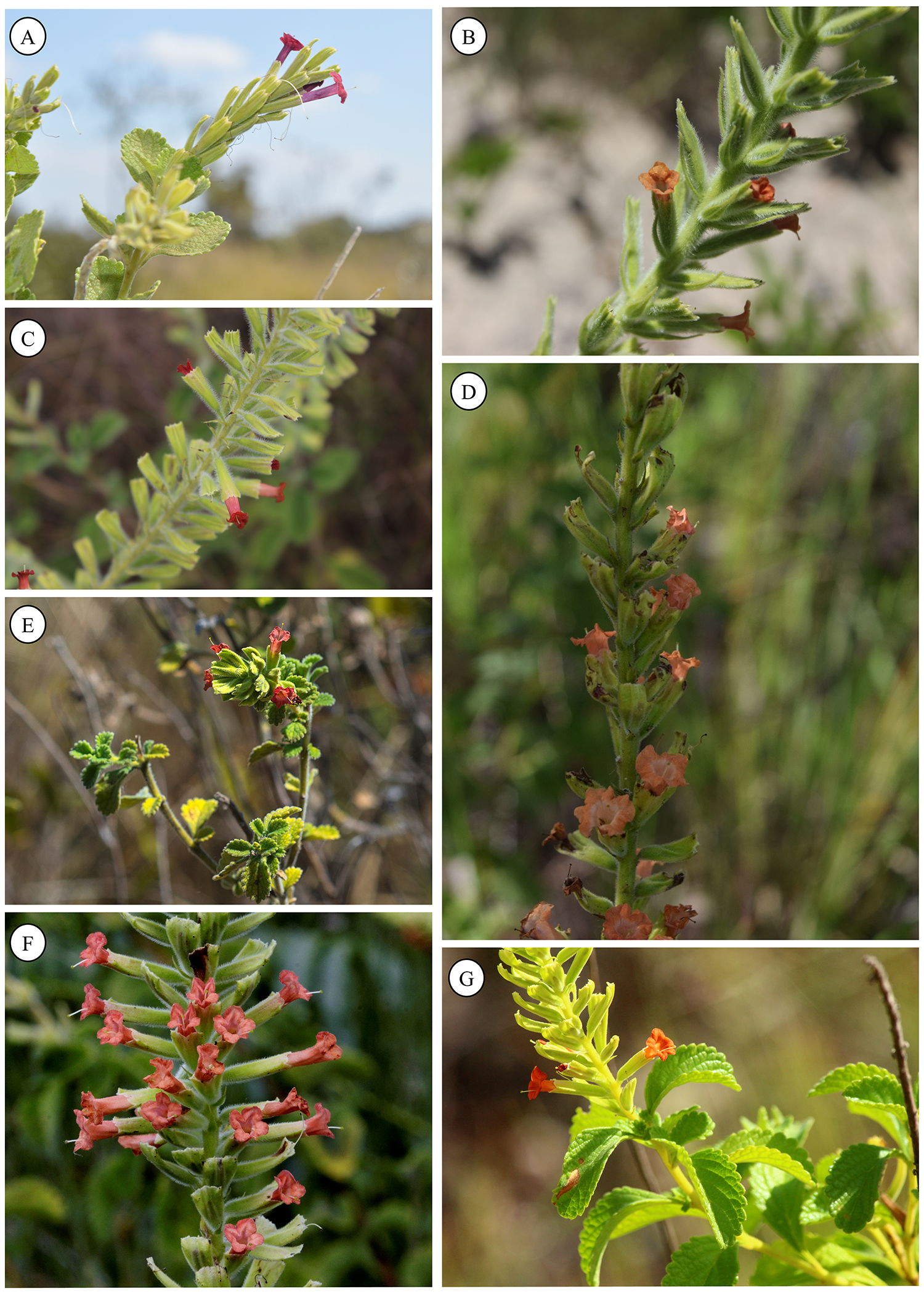
According to Atkins (2005), this group of pedicellate flowers with salmon or wine-colored corollas was circumscribed into seven infraspecific taxa, including subspecies and varieties, under Stachytarpheta longispicata (Pohl) S.Atkins. However, due to poorly defined boundaries between the taxa, Cardoso et al. (2022) conducted a comprehensive revision of this species complex, integrating population morphometry and morphological evidence. Based on their findings, a new delimitation was proposed, recognizing five distinct species, each found in different regions, with no geographic co-occurrence: S. brevibracteata (Moldenke) P.H.Cardoso, S. longipedicellata (Moldenke) P.H.Cardoso, S. longispicata (Pohl) S.Atkins, S. minasensis (S.Atkins) P.H.Cardoso, and S. ratteri (S.Atkins) P.H.Cardoso. Subsequently, based on the examination of additional herbarium collections, two new species with pedicellate flowers and salmon-colored corollas were described: Stachytarpheta rizzoi P.H.Cardoso and S. longibracteata P.H.Cardoso (Cardoso et al., 2023). Thus, the group-hereafter referred to as the S. longispicata group-currently comprises seven accepted species (Fig. 1A-G), all with distinct, non-overlapping geographic distributions (Cardoso et al., 2022; 2023).
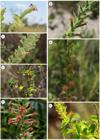
Photographs of individuals of the Stachytarpheta longispicata group. A. Stachytarpheta brevibracteata. B. S. longibracteata. C. S. longipedicellata. D. S. longispicata. E. S. minasensis. F. S. ratteri. G. S. rizzoi. Photo credits: A, C, D by Pedro Henrique Cardoso. B by Guilherme Antar; E by Pedro Henrique Nobre; F by Maurício Mercadante; G by Rodolph Delfino Sartin.
Palynological studies have been instrumental in angiosperm taxonomy, offering valuable information for delimiting morphologically similar species (e.g., Mezzonato-Pires, 2018; Evgeny et al., 2023; Deng et al. 2023). A recent study by Patrício et al. (2024) successfully distinguished selected Brazilian species of Stachytarpheta sect. Stachytarpheta (characterized by sessile flowers embedded in the rachis excavations and corollas that are lilac, purple, white, blue, or rarely red), underscoring the significance of palynological data for the taxonomy of the genus.
Palynological data for the Stachytarpheta longispicata group, included in S. sect. Melasanthus Walp., remains scarce. Pohl (1827), in the original description of S. longispicata (under the name Melasanthus longespicatus Pohl), characterized its pollen grains as spherical and yellow. Later, Atkins (1991) described the pollen morphology of S. longispicata (sub name S. chamissonis Walp.), reporting an equatorial diameter ranging from 85 µm to 100 µm (n = 7 pollen grains). In this study, we conducted a comprehensive analysis of pollen morphology in the seven accepted species of the S. longispicata group. Our aim was to evaluate whether palynological characters support the current taxonomic delimitation proposed by Cardoso et al. (2022; 2023), and to provide additional evidence for species boundaries within the group, whose identification remains challenging due to their striking morphological similarities.
Material and Methods
Material examined
Sixteen specimens belonging to the Stachytarpheta longispicata group were analyzed, all deposited at Leopoldo Krieger Herbarium (CESJ) of the Universidade Federal de Juiz de Fora (UFJF). The seven species within the group were sampled following the circumscription and geographic distribution data provided by Cardoso et al. (2022; 2023). The material examined is listed below; specimens indicated with an asterisk refer to the standard material.
Stachytarpheta brevibracteata (Moldenke) P.H.Cardoso - BRAZIL. Minas Gerais: Delfinópolis, 11/03/2003, J.N. Nakajima 3475*, R. Romero, R.L. Volpi, R.A. Pacheco & C.A. Faria; São Roque de Minas, 06/05/2021, P.H. Cardoso 65 & W.P. Leite; ibidem, P.H. Cardoso 66 & W.P. Leite.
Stachytarpheta longibracteata P.H.Cardoso - BRAZIL. Tocantins: Mateiros, 30/01/2015, G.M. Antar 721*, H.P. Antar & U.R. Chagas.
Stachytarpheta longipedicellata (Moldenke) P.H.Cardoso - BRAZIL. Goiás: Alto Paraíso de Goiás, 15/03/2020, P.H. Cardoso 59*, M. Pignal & L. Echternacht; 02/03/1972, ibidem, J.A. Rizzo 7762; Niquelândia, 06/01/1993, R.C. Mendonça, P.E. Noguera Silva & M. Claudio da Silva Jr. s.n. (CESJ 60161).
Stachytarpheta longispicata (Pohl) S.Atkins - BRAZIL. Goiás: Cristalina, 12/03/2020, P.H. Cardoso 46*, I.M. Rollim, L.E.F. Silva & M. Trovó; ibidem, 12/03/2020, P.H. Cardoso 48, I.M. Rollim, L.E.F. Silva & M. Trovó.
Stachytarpheta minasensis (S.Atkins) P.H.Cardoso - BRAZIL. Minas Gerais: Joaquim Felício, 11/10/2022, F.R.G. Salimena 4125* & P.H. Nobre; ibidem, 14/09/2019, F.R.G. Salimena 4051 & P.H. Nobre; ibidem, 11/10/2022, F.R.G. Salimena 4124 & P.H. Nobre.
Stachytarpheta ratteri (S.Atkins) P.H.Cardoso - BRAZIL. Distrito Federal: Brasília, 07/05/2003, M.L. Fonseca 4664 & D. Alvarenga*; ibidem, 06/07/1999, J.G. Faria 261 et al.; ibidem, 07/03/2021, B. Schindler 56 & M. Figueira.
Stachytarpheta rizzoi P.H. Cardoso - BRAZIL. Goiás: Serra Dourada, 04/05/1969, Rizzo 4183*.
Observation by light microscopy
We described pollen grains using the method of Wodehouse (1935), with modifications proposed by Melhem et al. (2003). The acetolysis method used was lactic acetolysis (ACLAC) at 60% following Raynal & Raynal (1971), to prevent morphological changes in pollen grains caused by Erdtman acetolysis (1960), as observed by another author (Atkins, 1991). The methodology used was the same performed by Patrício et al. (2024). We made measurements using a light microscope with an ocular micrometer. The palynological terminologies adopted were those by Erdtman (1952) and Punt et al. (2007). In equatorial view, the following parameters were measured: polar diameter (P), equatorial diameter (E), aperture width, and length. In polar view, we measured the following: largest diameter (DM), apocolpium side (A), exine stratification, and margin. For the standard specimens, we took measurements of P, E, DM, and A from 25 pollen grains contained in at least three slides, whenever possible. For the comparative specimens, morphometric data were based on 10 pollen grains contained on a minimum of three slides. We made all measurements within one week of slide preparation (Salgado-Labouriau, 1973).
Observation by Scanning Electron Microscopy (SEM)
Pollen grains were spread onto double-sided adhesive tape previously affixed to a numbered SEM stub. We examined samples under low vacuum in a FEI Quanta 250 scanning electron microscope (SEM).
Descriptive statistics
For parameters measured from a sample size of 25, we performed statistical analysis in Microsoft Excel 365 (version 2305) and included: size range (Xmin-Xmax), arithmetic mean (X), standard deviation (S), standard error (Sx), 95% confidence interval (CI), and coefficient of variation (CV%). For other measurement parameters, we present only the mean and range.
Multivariate analysis
Using the PAST software (Hammer et al., 2001), the morphometric data resulting from the palynological analyses were subjected to multivariate analysis. The resulting mean value of each parameter of the standard material was subjected to principal component analysis (PCA), using correlation.
Results
Description of pollen grains
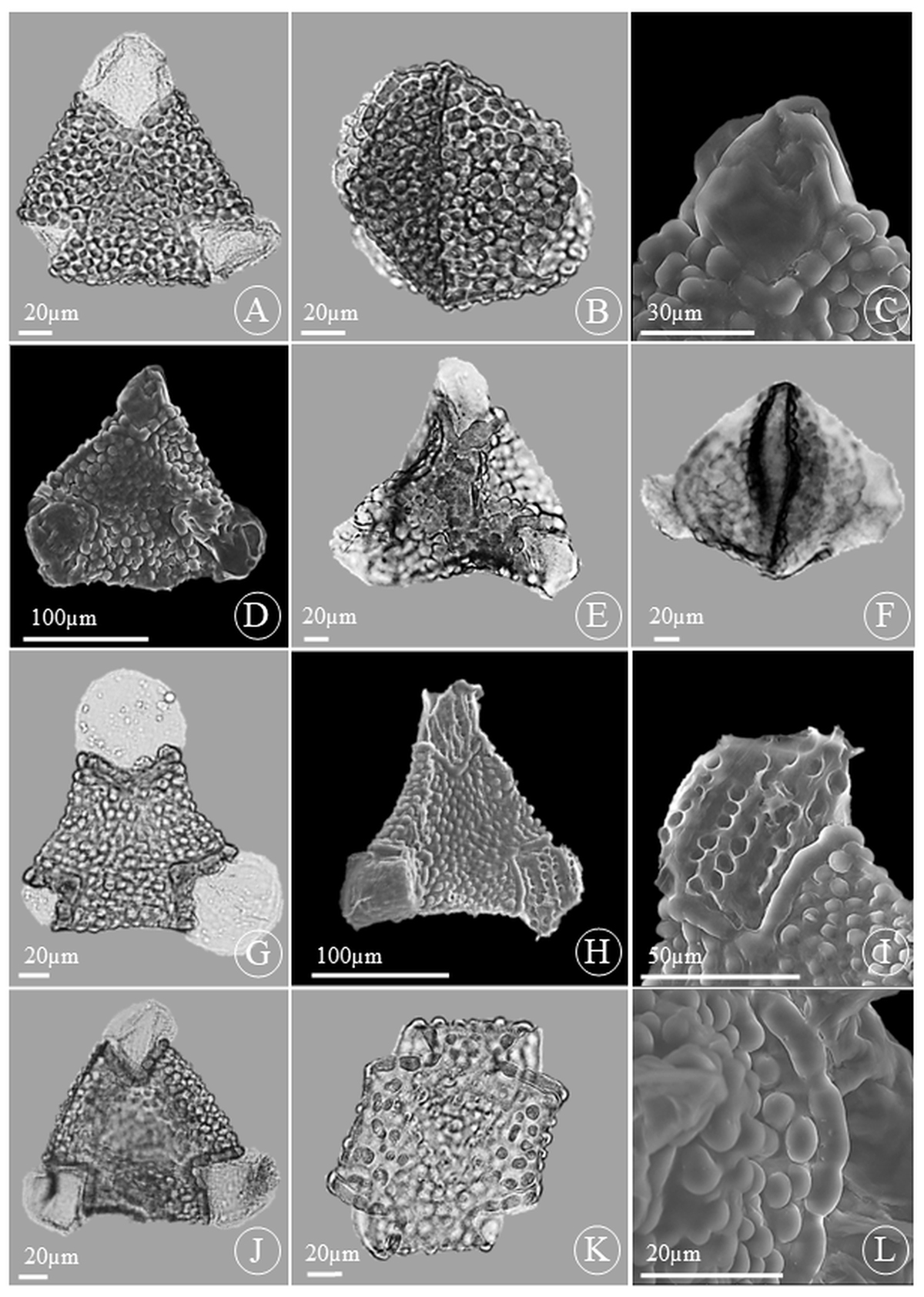
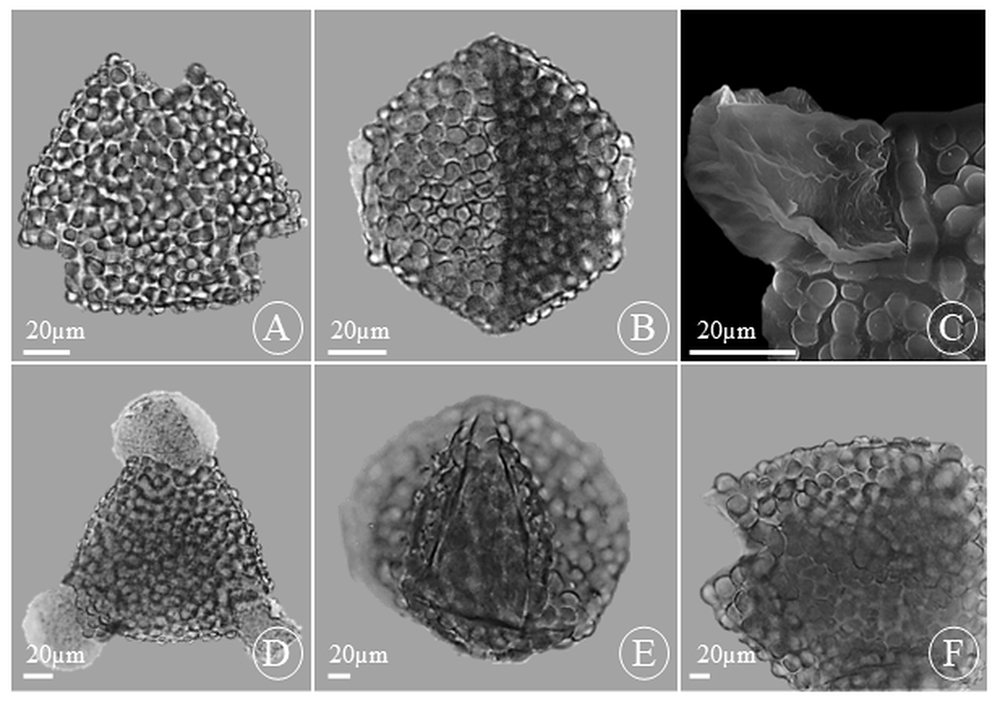
The studied species (Fig. 1, Fig. 2, Fig. 3) present pollen grains that are monads, with a very large average size (Tab. 1), radial symmetry, and isopolarity; amb varying from triangular (Fig. 2A), subtriangular, subcircular to quadrangular (Fig. 2K), and the shape varying from suboblate, oblate-spheroidal to prolate-spheroidal (Tab. 1). The pollen grains are tricolpate, sometimes tetracolpate, with narrow, anguloaperturate colpi (Fig. 2D). The pollen grains surface is verrucate, with verrucae either regularly distributed (Fig. 2A) or more distantly spaced (Fig. 2K). The pollen grains exhibit margins (Fig. 2, 3) and membranes (Figs. 2A, 2C, 2D, 2G-I, 2J, 2L, 3C-D).
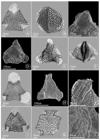
Photomicrographs (ML) and electromicrographs (SEM) of pollen grains of the studied species. A-D. Stachytarpheta brevibracteata. A. Polar view (ML - non-acetolized). B. Equatorial view (ML - acetolized). C. Details of membrane and margin (SEM - non-acetolized). D. Polar view (SEM - non-acetolized). E-F. S. longibracteata. E. Polar view (ML - non-acetolized). F. Equatorial view (ML - non-acetolized). G-I. S. longipedicellata. G. Polar view (ML - non-acetolized). H. Polar view (SEM - non-acetolized). I. Details of membrane and margin (SEM - non-acetolized). J. S. longispicata. J. Polar view (ML - non-acetolized). K-L S. minasensis. K. Polar view (ML - acetolized). L. Details of membrane and margin (SEM - non-acetolized).
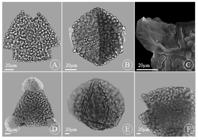
Photomicrographs (ML) and electromicrographs (SEM) of pollen grains of the studied species. A-C. Stachytarpheta ratteri. A. Polar view (ML - acetolized). B. Equatorial view (ML - acetolized). C. Details of the membrane and margin (SEM - non-acetolized). D-F. S. rizzoi. D. Polar view (ML - non-acetolized). E. Equatorial view (ML - acetolized). F. Details of the margin (ML - acetolized).
Morphometric data of pollen grains from the standard material of the Stachytarpheta longispicata group. P = polar diameter (μm); E = equatorial diameter (μm); DM = largest diameter (μm); A = side of the apocolpus (μm); C = length (μm); L = width (μm).
Morphometric data for the polar diameter (P) of pollen grains of the standard material of the Stachytarpheta longispicata group. P = polar diameter (μm); Xmin = minimum (μm); Xmax = maximum (μm); X = mean (μm); sX = standard error (μm); S = standard deviation (μm); CI = 95% confidence interval (μm); CV = coefficient of variability (%).
Morphometric data for the equatorial diameter (E) of pollen grains of the standard material of the Stachytarpheta longispicata group. E = equatorial diameter (μm); Xmin = minimum (μm); Xmax = maximum (μm); X = mean (μm); sX = standard error (μm); S = standard deviation (μm); CI = 95% confidence interval (μm); CV = coefficient of variability (%).
Morphometric data of pollen grains from the comparison material of the Stachytarpheta longispicata group. P = polar diameter (μm); E = equatorial diameter (μm); DM = largest diameter (μm).
Stachytarpheta brevibracteata - Pollen grains very large (Tab. 1), with triangular (Fig. 2A), subtriangular, and subcircular amb, oblate-spheroidal shape (Tab. 1), and 3-colpate (Fig. 2A). Ornamentation with verrucae regularly distributed (Fig. 2A-C). Simple margin, with aligned and fused verrucae (Fig. 2C). The apertural membrane is psilate with occasional perforations (Fig. 2C).
Stachytarpheta longibracteata - Pollen grains very large (Tab. 1), with triangular (Fig. 2E), subtriangular, and quadrangular amb (Fig. 2K), oblate-spheroidal shape (Tab. 1), and 3-colpate (Fig. 2E) or 4-colpate (Fig. 2K). Ornamentation with verrucae regularly distributed (Fig. 2D-F). Simple margin, with aligned and fused verrucae (Fig. 2E-F). The apertural membrane is psilate with occasional granules.
Stachytarpheta longipedicellata - Pollen grains very large (Tab. 1), with triangular (Fig. 2G), subtriangular, and subcircular amb, oblate-spheroidal shape (Tab. 1), and 3-colpate (Fig. 2G). Ornamentation with verrucae regularly distributed (Fig. 2G-I). Simple margin, with fused verrucae (Fig. 2I). The apertural membrane is perforate (Fig. 2I).
Stachytarpheta longispicata - Pollen grains very large (Tab. 1), with triangular (Fig. 2J), subtriangular, and subcircular amb, suboblate shape (Tab. 1), and 3-colpate (Fig. 2J). Ornamentation with verrucae regularly distributed (Fig. 2J). Simple margin, with fused verrucae (Fig. 2J). The apertural membrane is psilate with occasional perforations.
Stachytarpheta minasensis - Pollen grains very large (Tab. 1), with triangular, subtriangular, quadrangular (Fig. 2K), and subcircular amb, prolate-spheroidal shape (Tab. 1); and 3-colpate or 4-colpate (Fig. 2K). Ornamentation with verrucae regularly distributed and distantly spaced (Fig. 2K-L). Double margin, the first with aligned verrucae, and the second presents verrucae fused and perforations(Fig. 2K-L). The apertural membrane is psilate (Fig. 2L).
Stachytarpheta ratteri - Pollen grains very large (Tab. 1), with triangular, subtriangular, and subcircular amb (Fig. 3A), prolate-spheroidal shape (Tab. 1), and 3-colpate (Fig. 3A). Ornamentation with verrucae regularly distributed (Fig. 3A-C). Simple margin, with aligned and fused verrucae (Fig. 3C). The apertural membrane is psilate, with occasional perforations and striations (Fig. 3C).
Stachytarpheta rizzoi - Pollen grains large (Tab. 1), with triangular (Fig. 3D), subtriangular, and subcircular amb, oblate-spheroidal shape (Tab. 1), and 3-colpate (Fig. 3D) or 4-colpate. Ornamentation with verrucae regularly distributed (Fig. 3D-F). Double margin, both ornamented with aligned and fused verrucae (Fig. 3E-F). The apertural membrane is perforate.
Multivariate analysis
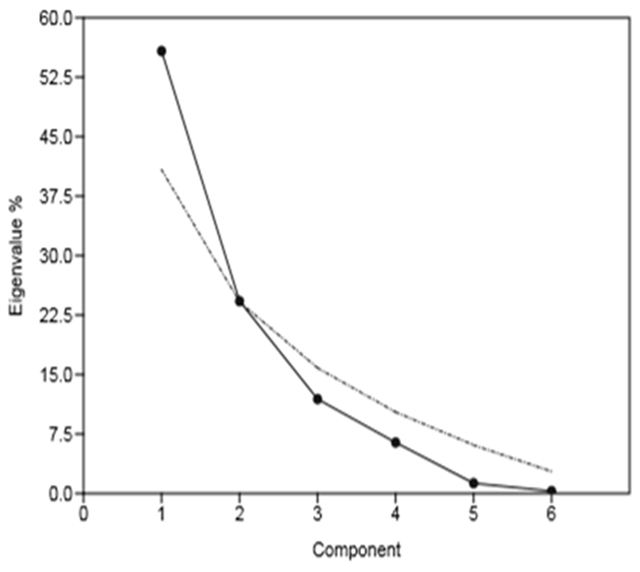
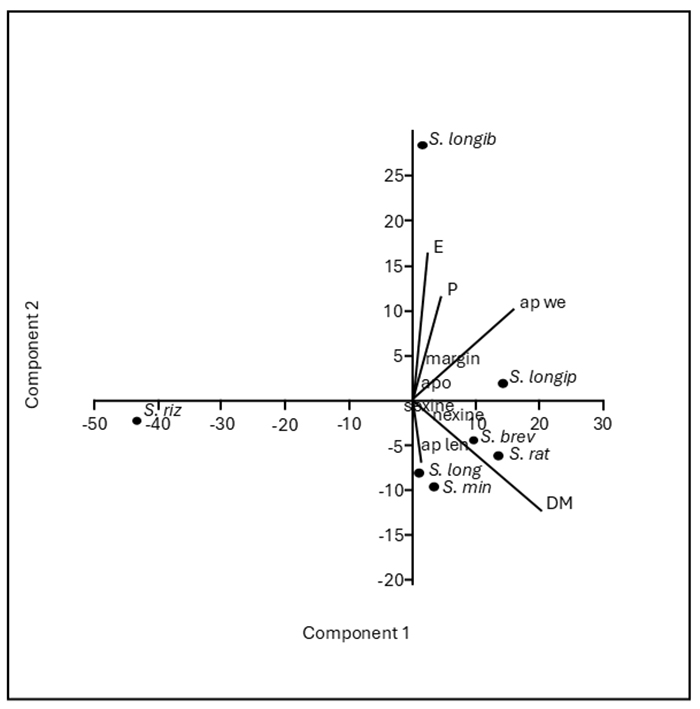
The PCA (Table 5) showed that components 1 and 2 explain 80.1% of the data, with 55.8% explained by component 1 and 24.3% by component 2 (Table 5). The scree plot (Fig. 4) confirms the importance of components 1 and 2.

Based on the PCA results (Fig. 5), it was possible to observe that the mean values of the standard material measurements allowed for the differentiation of the species in Stachytarpheta longispicata. The most relevant variables for this separation were polar diameter, equatorial diameter, largest diameter, nexine, and aperture width. Stachytarpheta longibracteata has the largest mean measurements of the standard material in polar diameter (128.38 μm) and equatorial diameter (130.30 μm) (Fig. 5), standing out from the other species analyzed. Stachytarpheta longipedicellata is positively positioned in components 1 and 2, presenting the largest mean measurements of the standard material in nexine (5.95 μm) and aperture width (103.12 μm) (Fig. 5). Stachytarpheta rizzoi is negatively positioned in components 1 and 2, presenting the smallest measurements of the standard material averages in the polar diameter (103.61 μm), equatorial diameter (106.90 μm) and largest diameter (86.52 μm) (Fig. 5). The species S. brevibracteata, S. ratteri, S. longispicata, and S. minasensis are close to each other, negatively positioned in component 1 by the measurements of the standard material averages in the largest diameter, being respectively 133.29 μm, 129.07 μm, 125.91 μm, and 124.02 μm (Fig. 5). The present results enable the distinction of the species in an identification key, presented below.
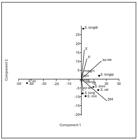
Graph showing principal component analysis: S. brev = Stachytarpheta brevibracteata. S. longib = S. longibracteata. S. longip = S. longipedicellata. S. long = S. longispicata. S. min = S. minasensis. S. rat = S. ratteri. S. riz = S. rizzoi.
Palynological identification key for the Stachytarpheta longispicata group
1. Pollen grains that may have 4 colpi............................................................................2
1’. Pollen grains always 3-colpate.................................................................................3
2. Pollen grains with membrane having occasional granules ............................................................................................ S. longibracteata
2’. Pollen grains with membrane having occasional perforations and striations ...............................................................................................................................S. ratteri
3. Pollen grains with double margins ................................................................................ 4
3’. Pollen grains with simple margins .............................................................................. 5
4. Pollen grains with a psilate membrane ...................................................... S. minasensis
4’. Pollen grains with a perforate membrane .......................................................... S. rizzoi
5. Pollen grains with margin presenting aligned and fused verrucae ……………………………………………….…………........................ S. brevibracteata
5’. Pollen grains with margin presenting fused verrucae ………………………....…...... 6
6. Pollen grains with margin measuring >10 μm ................................... S. longipedicellata
6’. Pollen grains with margin measuring <10 μm ........................................ S. longispicata
Discussion
Although palynological studies on Stachytarpheta are still incipient (Erdtman, 1963; Raj, 1983; Atkins, 1991; 2004; 2005; Adedeji, 2010; Patrício et al., 2024; Cardoso et al.; 2025), research on related genera within Verbenaceae, such as Lantana L. and Phyla Lour. (see Atkins, 2004; O’Leary & Múlgura, 2012), suggests that characters like ornamentation and number of colpi have similar diagnostic value, reinforcing the applicability of this type of analysis within the family. Raj (1983) and Atkins (1991) described the pollen grains of Stachytarpheta longispicata as 3-colpate, oblate to peroblate. Although employing distinct terminology, Atkins (1991) reported variations in amb that are corroborated by the present study, as well as the verrucate ornamentation. Atkins (1991) noted that Erdtman's (1960) acetolysis method caused some pollen grains to collapse and that measurements were taken from only seven pollen grains. In the present study, lactic acetolysis (Raynal & Raynal, 1971) was employed, a method previously used for Stachytarpheta pollen grains by Patrício et al. (2024). The different preparation techniques used for pollen grains may account for the size variations observed when comparing the present data with those reported by Atkins (1991), particularly in equatorial diameter.
The species limits within the Stachytarpheta longispicata group were clarified by Cardoso et al. (2022; 2023). Among these, S. brevibracteata and S. minasensis are the most similar, as both have shorter inflorescences and occur in the state of Minas Gerais (Cardoso et al., 2022). In addition to the morphological traits distinguishing them, such as leaf size, indumentum, and calyx width (Cardoso et al., 2022), S. brevibracteata presents oblate-spheroidal pollen grains, with three colpi, a single ornamented margin with aligned verrucae, and a membrane with occasional perforations. In contrast, S. minasensis has prolate-spheroidal pollen grains, with three to four colpi, a double margin, and a psilate membrane. In the multivariate analysis, the species are positioned on the same side of the graph due to the similarity in the measurements of the standard material for the largest diameter; however, they are separated by variation in the sexine measurement.
Cardoso et al. (2023) highlighted that Stachytarpheta longibracteata, found in the Jalapão region, state of Tocantins, is morphologically most similar to S. longipedicellata, which is frequently found in the Chapada dos Veadeiros region, state of Goiás. The pollen grains of these two species are very large in size and exhibit an oblate-spheroidal shape. However, they can be distinguished by amb, as well as by the ornamentation of the margin and membrane. In S. longibracteata, the amb ranges from triangular and subtriangular to quadrangular, the grain may present four colpi, the margin is composed of aligned and fused verrucae, and the membrane is psilate with occasional granules. In contrast, S. longipedicellata has triangular, subtriangular, or subcircular amb, a simple margin with fused verrucae, and a perforated membrane. In the multivariate analysis, the two species were differentiated based on the mean measurements of the standard material. Stachytarpheta longibracteata was distinguished mainly by its polar and equatorial diameters, whereas in S. longipedicellata, the most informative variables were nexine thickness and aperture width. Both species were positioned on the same side of the graph for components 1 and 2; however, all standard measurements differed between them, except for the margin measurement (10.25 µm).
Stachytarpheta longispicata and S. ratteri are morphologically similar and constitute the two most difficult species to distinguish from one another within the group when relying solely on herbarium material. The former is endemic to the municipality of Cristalina, in the state of Goiás, whereas the latter is the most frequently collected species of the group, common in Brasília, Distrito Federal, and surrounding areas (Cardoso et al., 2022). However, their pollen grains can be distinguished based on the following characteristics: S. longispicata has pollen grains with a suboblate shape, fused verrucae on the margin, and a psilate membrane with occasional perforate; whereas in S. ratteri, the pollen grains have a prolate-spheroidal shape, aligned verrucae on the margin, and a psilate membrane with occasional perforations and striations. According to Cardoso et al. (2023), S. rizzoi is also morphologically similar to S. ratteri. Nevertheless, the pollen grains of these two species differ in shape and margin type. In S. rizzoi, pollen grains are oblate-spheroidal, with a double margin and a perforated membrane. In the multivariate analysis, S. longispicata and S. ratteri clustered together in the scatter plot due to similar mean values of the largest diameter of the standard material. In contrast, S. rizzoi was separated from the other species, positioned negatively on components 1 and 2, mainly due to its polar diameter, equatorial diameter, and largest diameter measurements. The results of this study demonstrate that pollen morphology and PCA support the distinction among the seven species comprising the Stachytarpheta longispicata group. Therefore, this study reinforces the role of palynology as a useful tool for the taxonomy of Stachytarpheta, as also demonstrated by Patrício et al. (2024).
Acknowledgments
We thank the Programa de Pós-Graduação em Biodiversidade e Conservação da Natureza at the Universidade Federal de Juiz de Fora (UFJF) for their support, and the Centro de Microscopia Eletrônica (UFJF) for providing access to the scanning electron microscope. We are also grateful to technician Pedro Loureiro for his assistance with sample preparation and observation, and to the Fundação de Amparo à Pesquisa do Estado de Minas Gerais for the equipment acquired through previous projects. We thank Flávia Bonizol Ferrari and Wanderson Tavares Ribeiro for their support during the development of the study. We thank Guilherme Antar, Maurício Mercadante, Pedro Henrique Nobre, and Rodolfo Delfino Sartin for the images provided in Figure 1.
References
-
Adedeji O. 2010. Palynology of the genus Stachytarpheta Vahl. (Verbenaceae). Notulae Scientia Biologicae 2(4): 27-33. doi: 10.15835/nsb244816
» https://doi.org/10.15835/nsb244816 - Atkins S. 1991. Stachytarpheta sericea Atkins (Verbenaceae) and its hybrid with S. chamissonis Walp. Kew Bulletin 46: 281-289.
-
Atkins S. 2004. Verbenaceae. In: Kubitzki K, Kadereit JW (eds). The families and genera of vascular plants, vol. 7. Berlin, Springer-Verlag. Pp. 449-468. doi: 10.1007/978-3-642-18617-2_25
» https://doi.org/10.1007/978-3-642-18617-2_25 - Atkins S. 2005. The genus Stachytarpheta (Verbenaceae) in Brazil. Kew Bulletin 60: 161-272.
-
Cardoso PH, Colli-Silva M, Menini Neto L, Trovó M. 2024. Distribution and historical aspects of Brazilian Stachytarpheta (Verbenaceae): Exploring a comprehensive dataset of taxonomically verified specimens. Flora 317: 152561. doi: 10.1016/j.flora.2024.152561
» https://doi.org/10.1016/j.flora.2024.152561 -
Cardoso PH, Menini Neto L, Somavilla N, Trovó M. 2022. A morphometric approach and recircumscription of the Stachytarpheta longispicata complex (Verbenaceae). European Journal of Taxonomy 833: 12-45. doi: 10.5852/ejt.2022.833.1899
» https://doi.org/10.5852/ejt.2022.833.1899 -
Cardoso PH, Menini Neto L, Trovó M. 2023. Still on the Stachytarpheta longispicata complex (Verbenaceae): Two new narrowly endemic species from the Cerrado domain of Central Brazil. Nordic Journal of Botany 2023: 1-9. doi: 10.1111/njb.03946
» https://doi.org/10.1111/njb.03946 - Cardoso PH, O’Leary N, Olmstead RG, Moroni P, Thode VA. 2021. An update of the Verbenaceae genera and species numbers. Plant Ecology and Evolution 154(1): 80-86.
-
Cardoso PH, Salimena FRG, Luizi-Ponzo AP, Somavilla N, Patrício PT, Trovó M. 2025. Stachytarpheta serrana, a new species of Verbenaceae endemic to the Diamantina Plateau in Espinhaço Range (Minas Gerais, Brazil), with palynological and anatomical notes. Anais da Academia Brasileira de Ciências 97(suppl 2): e20241271. doi: 10.1590/0001-3765202520241271
» https://doi.org/10.1590/0001-3765202520241271 -
Cardoso PH, Salimena FRG. Stachytarpheta In: Flora e Funga do Brasil. Jardim Botânico do Rio de Janeiro. Available at: <Available at: https://floradobrasil.jbrj.gov.br/FB15189 >. Accessed on: 04 Aug 2025.
» https://floradobrasil.jbrj.gov.br/FB15189 -
Deng W, Lin MZ, Tian HQ. 2023. Callose wall and sporoderm characteristics during the anther development stage of Dendrobium officinale Flora 303: 152278. doi: 10.1016/j.flora.2023.152278
» https://doi.org/10.1016/j.flora.2023.152278 - Erdtman G. 1952. Pollen morphology and plant taxonomy. Angiosperms. Waltham, Chronica Botanica Co
- Erdtman G. 1960. The acetolysis method: A revised description. Svensk Botanisk Tidskrift 54: 561-564.
- Erdtman G. 1963. Palynology: An introduction to pollen analysis. New York, Hafner Publishing Company.
-
Evgeny K, Ernest M, Valerii P, Ilshat M, Ruslan I, de Azevedo A. 2023. Experimental investigation of the deformability of the masonry vault in church historical building. Case Studies in Construction Materials 18: e012456. doi: 10.1016/j.cscm.2023.12.456
» https://doi.org/10.1016/j.cscm.2023.12.456 - Hammer Ø, Harper DA, Ryan PD. 2001. PAST: Paleontological statistics software package for education and data analysis. Palaeontologia Electronica 4: 1-9.
- Marx HE, O’Leary N, Yuan YW, Lu-Irving P, Tank DC, Múlgura ME, et al 2010. A molecular phylogeny and classification of Verbenaceae. American Journal of Botany 97(10): 1647-1663.
- Melhem TS, Cruz-Barros MAV, Corrêa MAS, Makino-Watanabe H, Silvestre-Capelato MSF, Esteves VLG. 2003. Variabilidade polínica em plantas de Campos do Jordão (São Paulo, Brasil). Boletim do Instituto de Botânica 16: 9-104.
-
Mezzonato-Pires AC, Mendonça CBF, Azevedo MAM, Gonçalves-Esteves V. 2018. Taxonomy, palynology and distribution notes of seven new records of Passiflora L. (Passifloraceae s.s.) for Brazil. PhytoKeys 95: 1-14. doi: 10.3897/phytokeys.95.26778
» https://doi.org/10.3897/phytokeys.95.26778 - O’Leary N, Múlgura ME. 2012. A taxonomic revision of the genus Phyla (Verbenaceae). Annals of the Missouri Botanical Garden 98(4): 578-596.
-
Patrício PT, Cardoso PH, Luizi-Ponzo AP. 2024. Pollen morphology and its taxonomic potential in Stachytarpheta sect. Stachytarpheta (Verbenaceae) occurring in Brazil. Palynology 48(2): 2284144. doi: 10.1080/01916122.2023.2284144
» https://doi.org/10.1080/01916122.2023.2284144 - Pohl JB. 1827. Plantarum Brasiliae Icones et Descriptiones Vol. 1. Wien, A. Strauss.
- Raj B. 1983. A contribution to the pollen morphology of Verbenaceae. Review of Palaeobotany and Palynology 39(3-4): 343-422.
- Raynal J, Raynal A. 1971. Une technique de préparation des grains de pollen fragiles. Adansonia 11: 77-79.
- Salgado-Labouriau ML. 1973. Contribuição à palinologia dos cerrados. Rio de Janeiro, Academia Brasileira de Ciências.
-
Salimena FRG, Silva TRS. 2009. Flora de Grão-Mogol, Minas Gerais: Verbenaceae. Boletim de Botânica da Universidade de São Paulo 27(1): 119-126. http://www.jstor.org/stable/42871769
» http://www.jstor.org/stable/42871769 - Wodehouse RP. 1935. Pollen Grains. Columbus, McGraw-Hill.
-
Data Availability
Not applicable.
-
Funding Information PTPS thanks the Conselho Nacional de Desenvolvimento Científico e Tecnológico (CNPq 141837/2020-9). PHC thanks the Fundação Carlos Chagas Filho de Amparo à Pesquisa do Estado do Rio de Janeiro (FAPERJ) (processes no. 200.029/2025 and 200.030/2025).
Not applicable.