 Still uncharted waters: Are we truly advancing in molecular studies of green and brown macroalgae (Ulvophyceae and Phaeophyceae) in Brazil?
Abstract
Despite the ecological importance of marine macroalgae, molecular studies on green and brown algae in Brazil remain limited in scope and continuity. This review presents a scientometric analysis of DNA sequences deposited in GenBank from 1998 to 2023, focusing on Brazilian specimens of Ulvophyceae and Phaeophyceae. We identified 304 sequences: 202 from Ulvophyceae and 102 from Phaeophyceae, produced by 17 institutions, with only six of these being Brazilian. The data reveal regional asymmetries, with most contributions concentrated in Southeastern and Northeastern regions of Brazil. Although more than 40 molecular markers have been employed, the most common were rbcL, tufA, and cox1. The absence of specimen voucher codes and incomplete metadata in many submissions highlights significant challenges in data quality and reproducibility. Compared to red algae (Rhodophyta), for which thousands of sequences exist, green and brown macroalgae remain understudied. Our findings underscore the urgent need to invest in researcher training, strengthen institutional collaboration, and improve the quality and sampling coverage of molecular data. Such actions are crucial for advancing the taxonomy, systematics, and conservation of Brazilian macroalgal biodiversity.
Keywords:
biodiversity; DNA barcoding; Genbank; scientometric analysis; seaweed
Introduction
Macroalgae assemble diverse groups of photosynthetic organisms that play a crucial role in maintaining and supporting aquatic ecosystems, particularly in ocean environments (Pereira, 2021). Among the three groups of seaweed (=marine macroalgae), red algae (Rhodophyta) are the most diverse, with 7,690 described species. In contrast, green (Ulvophyceae) and brown (Phaeophyceae) algae have 2,806 and 2,153 accepted species, respectively (Guiry & Guiry, 2025). According to the Flora and Funga of Brazil (2025), the Brazilian coast hosts 583 species of Rhodophyta, 229 species of Ulvophyceae, and 107 species of Phaeophyceae.
Over the past few decades, molecular data have been utilized to explore the diversity and relationships among Brazilian red macroalgae, leading to the identification of several new species, including those in the Gracilariaceae (Lyra et al., 2016), Peyssonneliaceae (Pestana et al., 2021), Rhodomelaceae (Brito & Cassano, 2024), and Cystocloniaceae (Jesus et al., 2023). New species of green algae were molecularly identified within the Bryopsidales (e.g., Oliveira-Carvalho et al., 2012; Ximenes et al., 2017) and Ulotrichales (e.g., Pellizzari et al., 2013). There is a notorious lack of molecular studies on brown algae along the Brazilian coast. The only new Phaeophyceae species from Brazil confirmed by DNA sequencing, Asterocladon lobatum D.G.Müller, E.R.Parodi & A.F.Peters (Asterocladaceae), was sampled in São Paulo state, and described by researchers from Germany and Argentina (Müller et al., 1998). Araújo et al. (2023) conducted the first scientometric analysis of molecular studies on red algae collected from Brazil, using information associated with DNA sequences deposited in GenBank (National Center for Biotechnology Information, 2025) between 1994 and 2020. In this study, the authors identified the red algal groups for which most molecular data were generated. They also tracked the number of sequences deposited by each institution (Brazilian and foreign) since 1994, highlighted the primary markers used, indicated which regions require more collection effort, and identified the locations of institutions generating molecular data on red algae in the country. In addition to the trends in red algae research along the Brazilian coast, the researchers highlight the significance of scientometric approaches in identifying taxonomic and geographic gaps.
It is a fact that molecular data are essential for macroalgal taxonomy and systematics. Several studies (summarized in Araújo et al., 2023) have shown that a substantial amount of data, including genomic information (Iha et al., 2018; Lyra et al., 2021; Jesus et al., 2023), is being accumulated for red algae in Brazil. In this context, we aim to assess the progress of molecular research on green and brown macroalgae, as the study of these two groups of seaweeds in Brazil seems to be limited or insufficient, and their biodiversity is underestimated. To achieve this goal, we conducted a scientometric analysis of molecular studies on Brazilian algae over the past 25 years, drawing on data from sequences deposited in GenBank.
Materials and Methods
We analyzed data from GenBank (National Center for Biotechnology Information, 2025) from 1998 to 2023, encompassing the period during which the first sequences of Brazilian green and brown algae were deposited. All data were mined as outlined in Araújo et al. (2023), using the following parameters: “Ulvophyceae” [Organism], “Phaeophyceae” [Organism], “Ulvophyceae” [All Fields], “Phaeophyceae” [All Fields], and “Brazil” [All Fields]. After searching, we filtered the data to verify the collection location within the country, based on information available in GenBank (up to December 2023) and, when published, in the articles related to the DNA sequences. The data was analyzed using the R programming environment (R Core Team, 2024). For this analysis, we focused exclusively on macroalgae.
Results
A total of 44 molecular markers, or combinations of them, were used in studies involving green and brown algae collected from the Brazilian coast. Specifically, 39 markers were utilized for Ulvophyceae and 11 for Phaeophyceae (see Table 1 for the main molecular markers used in each class). For both groups, the most used marker was the plastidial Ribulose-1,5-bisphosphate carboxylase/oxygenase gene (rbcL). A total of 65 rbcL sequences were obtained from Ulvophyceae and 22 from Phaeophyceae. The other commonly used markers were not shared between the two groups. The plastidial elongation factor Tu gene (tufA) was the second most frequently used marker in green algae, with 47 sequences. In brown algae, the mitochondrial Cytochrome c oxidase subunit 1 gene (COI or cox1) was the second most used marker, followed by the photosystem II protein D1 gene (psbA), with 17 and 16 sequences, respectively.
Main molecular markers used in studies of Brazilian green (Ulvophyceae) and brown (Phaeophyceae) macroalgae, and the number of sequences deposited in GenBank
The search yielded a total of 304 DNA sequences of Brazilian green and brown macroalgae deposited in GenBank. Of the total, 66.45 % of the sequences are from specimens identified as belonging to Ulvophyceae, and 33.5 % are specimens identified as belonging to Phaeophyceae. The sequences of Brazilian green algae were first deposited in GenBank in 2002 (Fig. 1), while the sequences of Brazilian brown algae began to be deposited in 1998 (Fig. 2). For some sequences, the collection date could not be determined due to the absence of the record from GenBank and the lack of a corresponding sample voucher. Therefore, these data were not included in the interpretation of the collection period. The sequences of Brazilian green and brown algae submitted up to 2007 and 2009, respectively, were exclusively provided by researchers affiliated with international institutions. Later, Brazilian institutions became key figures in sequence deposition for Ulvophyceae and Phaeophyceae, making increasing contributions to the molecular studies on Brazilian specimens.

Annual number of green macroalgae (Ulvophyceae) DNA sequences collected in Brazil and deposited in GenBank, categorized by contributing Brazilian and international institutions

Annual number of brown macroalgae (Phaeophyceae) DNA sequences collected in Brazil and deposited in GenBank, categorized by contributing Brazilian and international institutions.
Our analysis revealed that efforts by Brazilian institutions accounted for 69.7 % of the DNA sequences from the green (n=150) and brown (n=62) macroalgae collected in the country. This was followed by Belgium (13.2 %), Australia (10.5 %), France (2.3 %), and Japan (1.3 %). Such sequences were associated with 18 papers on Ulvophyceae, one of which was listed as unpublished, and 19 papers on Phaeophyceae, two of which were unpublished. The largest number of deposited green algae sequences occurred in 2012 and 2015, with counts of 46 and 41, respectively. These studies were conducted in Brazilian universities and research institutions in São Paulo and Pernambuco. In 2016, Brazilian researchers from Rio de Janeiro recorded the highest number of sequence deposits for brown algae, with a total of 31 sequences. The second-highest number of sequences deposited was observed in 2020, when researchers from Belgium contributed 22 sequences published in a single paper to the database.
A total of 17 institutions contributed to the production of the sequences, including six from Brazil. When analyzing the distribution of the Brazilian institutions by geopolitical region, we found that five of them were in the Southeastern region (Rio de Janeiro and São Paulo), while only one was in the Northeastern region (Pernambuco). Among these, the institutions with the highest number of deposited sequences were Universidade Federal Rural de Pernambuco (UFRPE), Universidade de São Paulo (USP), and Universidade Federal do Estado do Rio de Janeiro (UNIRIO) (see Table 2). UFRPE, USP, and Instituto de Pesquisas Ambientais (IPA) are recognized for their research on Ulvophyceae, while UNIRIO, Instituto de Pesquisas do Jardim Botânico do Rio de Janeiro (JBRJ), and Universidade Federal do Rio de Janeiro (UFRJ) are notable for their studies on Phaeophyceae.
Brazilian institutions and the number of DNA sequences deposited in GenBank for Ulvophyceae and Phaeophyceae.
Specimens were mainly collected from the Southeastern and Northeastern regions of Brazil, which had the highest number of sequences produced for both Ulvophyceae and Phaeophyceae from the coasts of Rio de Janeiro and Pernambuco (Figs. 3 and 4), making them the first and second states with the most abundant sequences for both groups, respectively. For the Ulvophyceae, the third and fourth states with the highest sequence abundance were found in the Northeastern region, specifically Bahia (n=26) and Alagoas (n=21), while for the Phaeophyceae, the third and fourth states with the highest sequence abundance were São Paulo (n=16) and Espírito Santo (n=13), both in the Southeastern region.

Number of green macroalgae (Ulvophyceae) DNA sequence records submitted to GenBank by Brazilian state. The abbreviations for the coastal states are as follows: PA - Pará, MA - Maranhão, PI - Piauí, CE - Ceará, RN - Rio Grande do Norte, PB - Paraíba, PE - Pernambuco, AL - Alagoas, SE - Sergipe, BA - Bahia, ES - Espírito Santo, RJ - Rio de Janeiro, SP - São Paulo, PR - Paraná, SC - Santa Catarina and RS - Rio Grande do Sul.

Number of brown macroalgae (Phaeophyceae) DNA sequence records submitted to GenBank by Brazilian state. The abbreviations for the coastal states are as follows: PA - Pará, MA - Maranhão, PI - Piauí, CE - Ceará, RN - Rio Grande do Norte, PB - Paraíba, PE - Pernambuco, AL - Alagoas, SE - Sergipe, BA - Bahia, ES - Espírito Santo, RJ - Rio de Janeiro, SP - São Paulo, PR - Paraná, SC - Santa Catarina and RS - Rio Grande do Sul.
In total, sequences from 61 taxa were found. These consisted of 42 Ulvophyceae and 19 Phaeophyceae belonging to 20 genera (Figs. 5-6). Among the 11 genera of green algae, Codium Stackhouse and Halimeda J.V.Lamouroux (Fig. 7A-B, respectively) had the highest sequence abundance, each with 63 sequences, while Valonia C.Agardh (Fig. 7C) was represented by only one sequence (Fig. 5). In 2012, 32 sequences of Codium were found, contributing to the peak in green algae sequence deposition recorded that year, followed by Gayralia K.L.Vinogradova (Fig. 7D) with 14 sequences. In 2015, the only standout was Halimeda, which had 41 sequences deposited.

Total number of DNA sequences deposited in GenBank by genus of green macroalgae (Ulvophyceae) collected from Brazil.

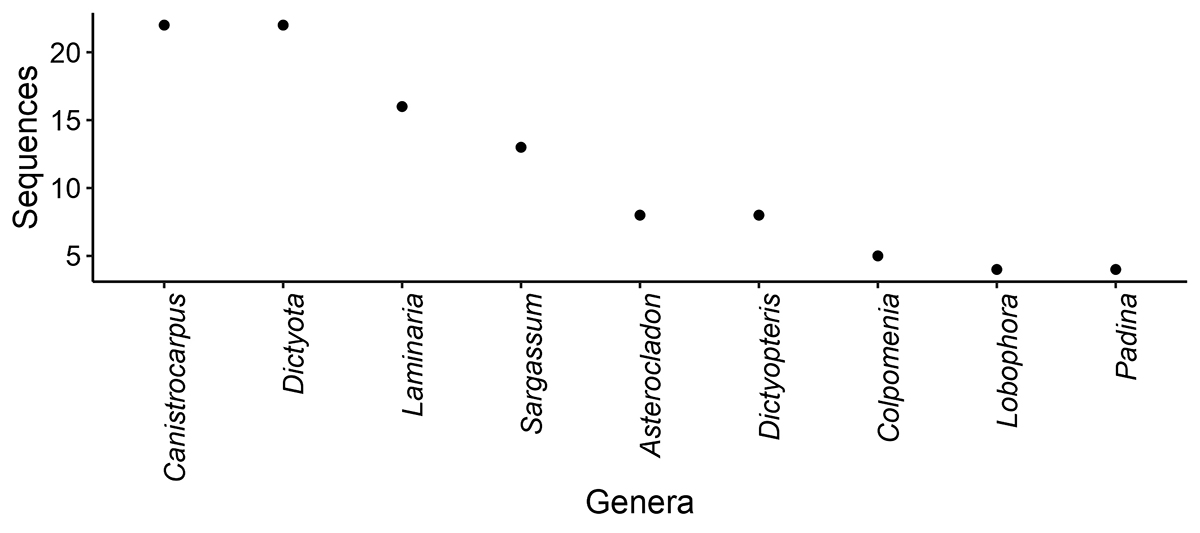
Total number of DNA sequences deposited in GenBank by genus of brown macroalgae (Phaeophyceae) collected from Brazil.

Representative species of Brazilian green (Ulvophyceae) and brown (Phaeophyceae) macroalgae included in molecular studies. A. Codium taylorii, image reproduced from Andrade (2009), with permission. B.Halimeda cuneata. C. Valonia ventricosa, image reproduced from Andrade (2009), with permission. D. Gayralia sp., image provided by Jhullyrson O.F. Brito. E. Canistrocarpus cervicornis, voucher from R-Algae 207460. F. Dictyota dichotoma. G. Padina boergesenii. H. Lobophora sp. Scale bars = 1 cm (when present)
Among the brown algae, we found sequences from nine genera. Of these, Canistrocarpus De Paula & De Clerck and Dictyota J.V.Lamouroux (Fig. 7E-F) were the most studied, each with 22 sequences, while Padina Adanson and Lobophora J.Agardh (Fig. 7G-H, respectively) were the least studied, with four sequences each (Fig. 6). The largest number of brown algae deposits took place in 2016, with 18 sequences from Canistrocarpus, 11 from Sargassum C.Agardh, and two from Dictyota recorded that year. The second largest number of sequence deposits was observed in 2020, totaling 22, with Dictyota being the genus that contributed the most sequences that year, totaling nine records.
According to sequences available in GenBank, the Brazilian states with the highest species richness for the Ulvophyceae are Bahia and Pernambuco, which have 12 and 10 taxa, respectively. They are followed by Espírito Santo and Paraíba, with nine and six taxa, respectively (Fig. 8). Among the Brazilian coastal states, only Amapá (North region), Piauí (Northeastern region), and Rio Grande do Sul (South region) did not have DNA sequences of representatives of the Ulvophyceae. The states of Rio de Janeiro and São Paulo hold the highest diversity of Phaeophyceae species according to the available sequences, with 11 and seven taxa, respectively. Pernambuco follows, with five taxa (Fig. 9). Throughout the Brazilian coast, there are several locations where no specimens of the Phaeophyceae have been collected, based on the DNA database. These locations include Amapá (in the North region), Piauí, Ceará, Rio Grande do Norte, and Sergipe (in the Northeastern region), as well as Paraná, Santa Catarina, and Rio Grande do Sul (in the South region).

Species richness of green macroalgae (Ulvophyceae) by Brazilian coastal state, measured as the number of species with at least one DNA sequence record submitted to GenBank. The abbreviations for the coastal states are as follows: PA - Pará, MA - Maranhão, PI - Piauí, CE - Ceará, RN - Rio Grande do Norte, PB - Paraíba, PE - Pernambuco, AL - Alagoas, SE - Sergipe, BA - Bahia, ES - Espírito Santo, RJ - Rio de Janeiro, SP - São Paulo, PR - Paraná, SC - Santa Catarina and RS - Rio Grande do Sul.

Species richness of brown macroalgae (Phaeophyceae) by Brazilian coastal state, measured as the number of species with at least one DNA sequence record submitted to GenBank. The abbreviations for the coastal states are as follows: PA - Pará, MA - Maranhão, PI - Piauí, CE - Ceará, RN - Rio Grande do Norte, PB - Paraíba, PE - Pernambuco, AL - Alagoas, SE - Sergipe, BA - Bahia, ES - Espírito Santo, RJ - Rio de Janeiro, SP - São Paulo, PR - Paraná, SC - Santa Catarina and RS - Rio Grande do Sul.
Discussion
A significant number of DNA sequences have been produced and stored in online databases, mainly after the introduction of DNA barcoding by Hebert and his collaborators in 2003 (Jin et al., 2020). Seaweeds are a polyphyletic group of organisms with ancient origins (De Clerck et al., 2012), for which several DNA regions and primers have already been tested (Preuss & Zuccarello, 2024). Our analysis revealed that over 40 markers have been used in the study of Brazilian green and brown algae during the past 25 years. These improvements led to the standardization of the most effective molecular markers for specific studies and applications. For example, within the Ulvophyceae group, the plastid gene tufA is typically utilized for DNA barcoding (Famà et al., 2002). In contrast, for Phaeophyceae, the mitochondrial genes cox1 and cox3 are employed for the same purpose (Lane et al., 2007; Silberfeld et al., 2010).
Many of the sequences analyzed here were employed for reconstructing phylogenies or phylogeography networks (Souza-Gestinari et al., 2009; Oliveira-Carvalho et al., 2012; Pellizzari et al., 2013; Fucikova et al., 2014; Ximenes et al., 2017; Araújo et al., 2018; Oliveira et al., 2021; Vieira et al., 2021; Martins et al., 2022; Rocha et al., 2023), the latter requiring a larger sampling effort for a specific taxonomic group. In addition to enhancing our understanding of the evolutionary history of seaweeds, these studies are crucial for making more data available on databases such as GenBank, favoring new research based on the deposited sequences. To improve the reliability of the sequences in GenBank, it is crucial that the vouchers for the specimens from which these sequences were obtained be accurately filled out and disclosed (Dillman et al., 2014).
Our findings show that the molecular knowledge of Brazilian green and brown algae is underestimated compared to that of red algae compiled by Araújo et al. (2023). In Brazil, we found only 202 sequences of green algae and 102 sequences of brown algae deposited in GenBank, whereas there are 3,735 sequences of red algae. Only 17 published studies included sequences for Ulvophyceae and another 17 for Phaeophyceae, compared to 154 papers focused on Rhodophyta. It is worth noting that studies with these groups began after those with red algae had started and are not continuous or progressive. However, Brazilian researchers have made important contributions to understanding the biodiversity of Ulvophyceae in the country, particularly in recent years (e.g., Oliveira et al., 2021; Silva et al., 2022; Rocha et al., 2023; Brito et al., 2024).
The situation regarding brown algae is particularly concerning. The first sequence of brown algae was deposited in 1998 by researchers from Germany (Müller et al., 1998), just four years after the first sequence of red algae was deposited. The next sequence for brown algae was not submitted until a decade later, in 2009, by researchers from the Netherlands (Draisma et al., 2010). Since then, the most significant contributions in the submission of sequences from Brazilian researchers were made in 2011, 2016, and 2017 (e.g.,Marins et al., 2012; Lopes-Filho et al., 2017; Sissini et al., 2017; Araújo et al., 2018; De-Paula et al., 2018).
Although more foreign institutions were involved in sequence deposition, Brazilian institutions were responsible for the largest number of deposited sequences from both green (74.3 %) and brown (60.87 %) algae collected in Brazil. According to Araújo et al. (2023), the USA was the primary foreign country involved in using Brazilian specimens for molecular research on red algae. Our data revealed that Belgium was the leading country in sequence deposits from Brazilian collections of both Ulvophyceae and Phaeophyceae, which challenges the global trend of USA dominance in marine algae research (Kumaresan et al., 2015; Konur, 2020).
The collaboration among researchers from various institutions, regions, and countries plays a crucial role in enhancing our understanding of molecular phycological biodiversity. Such collaborations serve as powerful catalysts that increase the impact of the research conducted. Generally, collaborative work - whether at the national or international level - tends to have a more significant scientific influence, a trend that is evident in published studies (Wagner & Leydesdorff, 2005; Shin et al., 2022).
Research on Ulvophyceae has highlighted three articles resulting from institutional collaborations that collectively account for most of the group's sequences (Oliveira-Carvalho et al., 2012; Fucikova et al., 2014; Ximenes et al., 2017). This success can be attributed to the enhanced material and intellectual resources provided by these partnerships. The success of institutions like USP and IPA in São Paulo may be attributed to the 'first-mover advantage' paradigm (Lieberman & Montgomery, 1988). These institutions have laboratories dedicated to phycological studies that possess the necessary expertise, infrastructure, and funding to effectively conduct molecular biology and bioinformatics work (Araújo et al., 2023). Nevertheless, the dedication of some of the most prolific laboratories in Brazil to taxonomy or generating DNA sequences of Phaeophyceae or Ulvophyceae has not been continuous. Shifts in this scientific landscape are due, for example, to the retirement of main trainers of qualified scientists in Phycology, or to shifts in the career focus of leaders of the most structured laboratories in the country. These situations have created a gap in the continuity of molecular studies on Ulvophyceae and Phaeophyceae in the region, hindering the ongoing development and in-depth systematic research of these organisms.
Significant progress in understanding Brazilian phycoflora has been made through DNA sequencing initiatives (Menezes et al., 2015). However, our data reveal that molecular studies on Ulvophyceae and Phaeophyceae in Brazil remain restricted, being conducted by a few specific research groups. Even for red algae, considered relatively well studied in the region, according to Araújo et al. (2023), our overall knowledge of marine algal biodiversity remains limited. Of the more than 900 species of marine macroalgae reported along the Brazilian coast (Flora and Funga of Brazil, 2025), only 17.2 % have been sequenced to date. The underrepresentation of these organisms in molecular databases limits both the accuracy and scope of biodiversity assessments.
Acknowledging these gaps highlights the urgent need for renewed scientific efforts, particularly those that incorporate molecular tools capable of detecting cryptic biodiversity. Several studies have shown that certain green and brown species can only be accurately identified through molecular data (e.g., Gayralia,Pellizzari et al., 2013), lack distinct morphological features (e.g., Colpomenia (Endlicher), Martins et al., 2022), or comprise cryptic species complexes (e.g., Bryopsis J.V.Lamouroux, Oliveira et al., 2021). There is an urgent need to train a new generation of taxonomists skilled in classical taxonomy and capable of integrating molecular techniques.
Brazil has an extensive coastline that spans both tropical and subtropical regions, encompassing over 364 million hectares of marine territory (Vicente et al., 2024). Although regional asymmetries were identified in the review of red algae across Brazilian geopolitical zones (Araújo et al., 2023), sequences from specimens collected in all coastal states were nevertheless found. This comprehensive effort, involving collaboration between Brazilian and international research institutions, has generated a substantial body of knowledge on the molecular diversity of Rhodophyta. In contrast, our data reveals that studies on Ulvophyceae and Phaeophyceae remain geographically restricted, leaving significant gaps in our understanding of the country’s true algal biodiversity. Addressing these gaps is crucial for reconstructing the evolutionary trajectories of these taxa, assessing the impacts of environmental change on species composition, developing effective mitigation strategies, and promoting the sustainable use of local species (Preuss & Zuccarello, 2024).
Some of the sequences analyzed in this study lacked associated voucher specimens in GenBank, while others were missing other essential metadata, such as precise collection locations and dates. The frequent submission of sequences with incomplete or outdated information can be attributed to several factors, including limited funding, insufficient research incentives, and technical barriers related to the submission process (Oliveira et al., 2020). Despite these limitations, GenBank remains a critical platform for the public dissemination of nucleotide sequences from diverse taxa, including macroalgae, particularly during this period of rapid growth in molecular data. To truly advance molecular research on green and brown macroalgae in Brazil, efforts must go beyond increasing the number of studies; they must also prioritize data quality, transparency, and reproducibility. Promoting research led by Brazilian scientists is key to strengthening national phycological capacity and elevating the global relevance of science produced in the country. Ultimately, investment in researcher training and the reinforcement of institutional collaborations, both fundamental to the present study, are essential steps toward filling current knowledge gaps and navigating these still uncharted waters.
Acknowledgments
JSV acknowledges support from the Office of Research at the Federal University of ABC (ProPes/UFABC) through a Scientific Initiation scholarship in the Programa Pesquisando desde o Primeiro Dia (PIBIC/PDPD). PBJ acknowledges the Fundação de Amparo à Pesquisa do Estado de São Paulo (FAPESP N° 2022/03234-1). We are grateful to anonymous reviewers for their valuable suggestions, which greatly enhanced this manuscript.
References
- Andrade NA. 2009. Acervo digital das Clorofíceas marinhas (Chlorophyta, Ulvophyceae) da Ilha de Itaparica, Bahia - Brasil. Monograph Thesis, Universidade Estadual de Feira de Santana, Brazil.
- Araújo JM, Tappin MRR, Fortes, RR, Lopes- EAP, Salgueiro F Filho, Paula JC . 2018. Chemodiversity of the brown algae Canistrocarpus cervicornis (Dictyotaceae, Phaeophyceae) in tropical and subtropical populations along the southwestern Atlantic coast of Brazil. Journal of Applied Phycology 30: 611-618.
- Araújo LM, Rocha DSB, Affe HMJ, Jesus PB. 2023. A scientometric study of the molecular data on Brazilian red algae. Acta Botanica Brasilica 37: e20220174.
- Brito JOF, Cassano V. 2024. Kapraunia silviae (Rhodomelaceae, Rhodophyta), a new species from the South Atlantic Ocean. Botanica Marina 67: 361-374.
- Brito JOF, Silva MCS, Oliveira MC, Pellizzari F, Cassano V, Gama WA. 2024. Occurrence of Dictyosphaeria (Cladophorales, Chlorophyta) species on the Brazilian coast and oceanic islands, based on morphological and molecular data. Botanica Marina 67: 287-296.
- De Clerck O, Bogaert KA, Leliaert F. 2012. Diversity and evolution of algae: Primary endosymbiosis. In: Piganeau G (ed.). Advances in Botanical Research. Leiden, Academic Press, p. 55-86.
- De-Paula JC, Lopes- EAP Filho, Salgueiro F, Yoneshigue-Valentin Y, Cavalcanti DN, Villaça RC, Teixeira VL. 2018. Diterpenes content of the brown alga Dictyota ciliolata (Dictyotales, Phaeophyceae) and recognition of a Brazilian haplotype based on psbA sequences. New Zealand Journal of Botany 56: 415-429.
- Dillman CB, Zhuang P, Zhang T, Zhang LZ, Mugue N, Hilton EJ. 2014. Forensic investigations into a GenBank anomaly: Endangered taxa and the importance of voucher specimens in molecular studies. Journal of Applied Ichthyology 30: 1300-1309.
-
Draisma SGA, Prud’homme Van Reine WF, Kawai H. 2010. A revised classification of the Sphacelariales (Phaeophyceae) inferred from a psbC and rbcL based phylogeny. European Journal of Phycology 45: 308-326. doi: 10.1080/09670262.2010.490959
» https://doi.org/10.1080/09670262.2010.490959 - Famà P, Wysor B, Kooistra WHCF, Zuccarello GC. 2002. Molecular phylogeny of the genus Caulerpa (Caulerpales, Chlorophyta) inferred from chloroplast tufA gene. Journal of Phycology 38: 1040-1050.
-
Flora and Funga of Brazil. 2025. Jardim Botânico do Rio de Janeiro. http://floradobrasil.jbrj.gov.br/ 14 May 2025.
» http://floradobrasil.jbrj.gov.br/ - Fucikova K, Leliaert F, Cooper ED et al 2014. New phylogenetic hypotheses for the core Chlorophyta based on chloroplast sequence data. Frontiers in Ecology and Evolution 63: 1-12.
-
Guiry MD, Guiry GM. 2025. AlgaeBase. https://www.algaebase.org/ 14 May 2025.
» https://www.algaebase.org/ - Iha C, Grassa CJ, Lyra GM, Davis CC, Verbruggen H, Oliveira MC. 2018. Organellar genomics: A useful tool to study evolutionary relationships and molecular evolution in Gracilariaceae (Rhodophyta). Journal of Phycology 54: 775-787.
- Jesus PB, Lyra GM, Zhang H et al 2023. Phylogenomics and taxon-rich phylogenies of new and historical specimens shed light on the systematics of Hypnea (Cystocloniaceae, Rhodophyta). Molecular Phylogenetics and Evolution 183: 107752.
- Jin S, Kim KY, Kim M-S, Park C. 2020. An assessment of the taxonomic reliability of DNA barcode sequences in publicly available databases. Algae 35: 293-301.
- Konur O. 2020. The scientometric analysis of the research on the algal genomics. In: Konur O (ed.). Handbook of Algal Science, Technology and Medicine. London, Academic Press, p. 175-197.
- Kumaresan R, Vinitha K, Kannan K. 2015. Scientometric analysis of seaweed research with reference to Web of Science. Library Philosophy and Practice 2015: 1348.
- Lane CE, Lindstrom SC, Saunders GW. 2007. A molecular assessment of northeast Pacific Alaria species (Laminariales, Phaeophyceae) with reference to the utility of DNA barcoding. Molecular Phylogenetics and Evolution 44: 634-648.
- Lieberman MB, Montgomery DB. 1988. First-mover advantages. Strategic Management Journal 9: 41-58.
- Lopes- EAPFilho, Salgueiro F, Nascimento SM, Gauna MC, Parodi ER, Campos de Paula J. 2017. Molecular evidence of the presence of Dictyota dichotoma (Dictyotales: Phaeophyceae) in Argentina based on sequences from mtDNA and cpDNA and a discussion of its possible origin. New Zealand Journal of Botany 55: 293-305.
- Lyra GM, Gurgel CFD, Costa ES et al 2016. Delimitating cryptic species in the Gracilaria domingensis complex (Gracilariaceae, Rhodophyta) using molecular and morphological data. Journal of Phycology 52: 997-1017.
- Lyra GM, Iha C, Grassa CJ et al 2021. Phylogenomics, divergence time estimation and trait evolution provide a new look into the Gracilariales (Rhodophyta). Molecular Phylogenetics and Evolution 165: 107294.
- Marins BV, Amado- GM Filho, Barreto MBB, Longo LL. 2012. Taxonomy of the southwestern Atlantic endemic kelp: Laminaria abyssalis and Laminaria brasiliensis (Phaeophyceae, Laminariales) are not different species. Phycological Research 60: 51-60.
- Martins NT, Cassano V, Gurgel CFD. 2022. Phylogeography of Colpomenia sinuosa (Ectocarpales, Phaeophyceae) along the Brazilian coast. Journal of Phycology 58: 543-554.
- Menezes M, Bicudo CEM, Moura CWN et al 2015. Update of the Brazilian floristic list of Algae and Cyanobacteria. Rodriguésia 66: 1047-1062.
- Müller DG, Parodi ER, Peters AF. 1998. Asterocladon lobatum gen. et sp. nov., a new brown alga with stellate chloroplast arrangement, and its systematic position judged from nuclear rDNA sequences. Phycologia 37: 425-432.
-
National Center for Biotechnology Information. 2025. GenBank. https://www.ncbi.nlm.nih.gov/genbank/ 14 May 2025.
» https://www.ncbi.nlm.nih.gov/genbank/ - Oliveira CYB, Oliveira CDL, Müller MN, Santos EP, Dantas DMM, Gálvez AO. 2020. A scientometric overview of global dinoflagellate research. Publications 8: 50.
- Oliveira MGT, Pereira SMB, Benko-Iseppon AM et al 2021. First molecular analysis of the genus Bryopsis (Bryopsidales, Chlorophyta) from Brazil, with an emphasis on the Pernambuco coast. Acta Botanica Brasilica 35: 161-178.
- Oliveira-Carvalho MF, Oliveira MC, Pereira SMBP, Verbruggen H. 2012. Phylogenetic analysis of Codium species from Brazil, with the description of the new species C. pernambucensis (Bryopsidales, Chlorophyta). European Journal of Phycology 47: 355-365.
- Pellizzari F, Oliveira MC, Medeiros AS, Yokota NS, Oliveira EC. 2013. Morphology, ontogeny, and phylogenetic position of Gayralia braziliensis sp. nov. (Ulotrichales, Chlorophyta) from the southern coast of Brazil. Botanica Marina 56: 197-205.
- Pereira L. 2021. Macroalgae. Encyclopedia 1: 177-188.
- Pestana EMS, Nunes JMC, Cassano V, Lyra GM. 2021. Taxonomic revision of the Peyssonneliales (Rhodophyta): Circumscribing the authentic Peyssonnelia clade and proposing four new genera and seven new species. Journal of Phycology 57: 1749-1767.
- Preuss M, Zuccarello GC. 2024. Review of available DNA sequence data: Our understanding of macroalgal diversity in New Zealand. New Zealand Journal of Botany : 2264-2274.
- R Core Team. 2024. R: A language and environment for statistical computing. Vienna, R Foundation for Statistical Computing.
- Rocha MCBS, Pereira SMB, Oliveira-Carvalho MF et al 2023. Morphological and molecular characterization of Udotea species (Bryopsidales, Chlorophyta) from northeastern Brazil with a new record of U. dotyi from the western South Atlantic. Phytotaxa 578: 57-74.
- Shin H, Kim K, Kogler DF. 2022. Scientific collaboration, research funding, and novelty in scientific knowledge. PLoS One 17: e0271678.
- Silberfeld T, Leigh JW, Verbruggen H, Cruaud C, Reviers B, Rousseau F. 2010. A multi-locus time-calibrated phylogeny of the brown algae (Heterokonta, Ochrophyta, Phaeophyceae): Investigating the evolutionary nature of the “brown algal crown radiation”. Molecular Phylogenetics and Evolution 56: 659-674.
- Silva SLA, Brito JOF, Pereira SB et al 2022. Morphological and molecular studies on the genus Gayralia (Ulotrichales, Chlorophyta) in northeastern Brazil with expansion of its species distribution. Botanica Marina 65: 379-390.
- Sissini MN, Barros-Barreto MBB, Széchy MTM et al 2017. The floating Sargassum (Phaeophyceae) of the South Atlantic Ocean - likely scenarios. Phycologia 56: 321-328.
- Souza-Gestinari LM, Oliveira MC, Milstein D, Yoneshige-Valentin Y, Pereira SMB. 2009. Phylogenetic analyses of Cladophora vagabunda (L.) C. Hoek (Cladophorales, Chlorophyta) from Brazil based on SSU rDNA sequences. Brazilian Journal of Botany 32: 531-538.
- Vicente VS, Longo PAS, Mansur KFR, Serrano H, Batistão AR, Leite FPP. 2024. Biodiversity of macroalgae-associated invertebrates in the marine protected area of Alcatrazes archipelago, southeastern Brazil. Biota Neotropica 24: e20241610.
- Vieira C, Steen F, D’Hondt SD et al 2021. Global biogeography and diversification of a group of brown seaweeds (Phaeophyceae) driven by clade-specific evolutionary processes. Journal of Biogeography 48: 703-715.
- Wagner CS, Leydesdorff L. 2005. Network structure, self-organization, and the growth of international collaboration in science. Research Policy 34: 1608-1618.
- Ximenes CF, Cassano V, Oliveira-Carvalho MF et al 2017. Systematics of the genus Halimeda (Bryopsidales, Chlorophyta) in Brazil including the description of Halimeda jolyana sp. nov Phycologia 56: 369-381.
Datasets related to this article will be available upon request to the corresponding author.