 Taxonomic study of Anthurium sect. Pachyneurium (Schott) Engl. (Araceae) from Brazil
Abstract
We present a taxonomic study of Anthurium sect. Pachyneurium (Schott) Engl. from Brazil, encompassing 20 accepted species, ten of which are endemic from this country. The species were identified based on analyses of vegetative and reproductive characters from material collected in the field, in cultivation and from herbaria. Section Pachyneurium is circumscribed by having a short stem, a rosulate habit, generally coriaceous, elliptical to obovate leaf blades, primary lateral veins usually free (eucamptodromous nervation), and thickened, as well as by having involute prefoliation. An identification key, nomenclatural revisions, morphological descriptions, taxonomic comments, geographic distribution, and habitat notes are presented.
Keywords:
Alismatales; endemism; nomenclature; Pothoideae; taxonomy
Introduction
AnthuriumSchott (1829) is a neotropical genus in the Araceae family, with approximately 1319 described species, primarily occurring in humid and cloud forests of Central and South America (Boyce et al., 2025). The genus is characterized by inflorescences consisting of a peduncle, spathe, and spadix, with persistent, bisexual flowers. A notable synapomorphy includes the presence of four tepals and a spiral arrangement of flowers on the spadix (Croat & Bunting, 1979; Mayo et al., 1997). Anthurium exhibits considerable morphological diversity, but this variation, coupled with limited field observations, often complicates accurate species identification (Coelho et al., 2009; Temponi & Coelho, 2011).
In Brazil, approximately 163 species of Anthurium are found, of which 131 are endemic (Flora e Funga do Brasil, 2025). Of the 20 sections in the genus (Carlsen & Croat, 2019), only five are represented in Brazil: Anthurium sect. Dactylophyllium Schott (Engl.) emend. Croat & Carlsen, sect. Leptanthurium Schott (Engl.), sect. Pachyneurium Schott (Engl.), sect. Tetraspermium Schott (Engl.) and sect. Urospadix Schott (Engl.) (Croat & Carlsen, 2020). Sect. Pachyneurium is distinctive for its involute leaf prefoliation (the inward curling of leaf margins), a trait that distinguishes it from other Anthurium sections and genera within the Araceae (Croat, 1991). Species in this section typically have a rosette habit, coriaceous leaves, and thickened primary lateral veins with free terminations.
The distribution of Pachyneurium spans from Mexico to Argentina, with the greatest diversity occurring between Costa Rica and Peru, particularly in Ecuador (36 spp.) and Peru (28 spp.) (Croat, 1991). Species delimitation remains challenging due to the group's complex evolutionary history and the extensive morphological variation, including vegetative traits such as leaf shape, texture, petiole and peduncle length and color, which are often difficult to document properly (Croat & Sheffer, 1983; Mayo et al., 1997; Coelho et al., 2009; Temponi & Coelho, 2011).
Taxonomic studies of Anthurium began in the 19th century with significant contributions from botanists such as Schott, Sellow, and Riedel, who collected specimens for herbaria and botanical gardens in Europe (Coelho & Mayo, 2007). The first taxonomic work on species in Pachyneurium was conducted by Linnaeus in 1763 when Pothos crenata was described and later transferred to Anthurium by Kunth (1841). Schott (1860) was a pioneer in the infrageneric classification of the genus, grouping 20 species into a grex called Pachyneurium. Engler (1878) subsequently divided the genus into 18 sections and seven subsections, with Pachyneurium remaining a single group until 1905 Engler (1905). Croat (1991) revised the section Pachyneurium, dividing it into two series: Multinervia and Pachyneurium, with 126 species. In recent studies, Carlsen & Croat (2019) and Croat & Carlsen (2020) reorganized the genus into 20 sections, acknowledging the non-monophyly of several of them. As part of this reorganization, the former series Multinervia was elevated to sectional rank, becoming sect. Multinervia (Croat) Carlsen & Croat (Croat & Carlsen, 2020). Phylogenetic studies have demonstrated that section Pachyneurium (formerly series Pachyneurium) is not monophyletic in its traditional circumscription (Croat & Carlsen, 2020). Although sect. Pachyneurium series Pachyneurium is broadly distributed from Central to South America, with a center of diversity in the Amazonian and Atlantic Forest domains and sect. Multinervia is restricted to the Andes, where species exhibit distinct greenish leaves in dried material and closely spaced primary lateral veins (Croat & Carlsen, 2020).
Recent phylogenetic analysis, including target enrichment sequencing (Camelo et al., 2025, in prep.), has led to a more detailed taxonomic revision of Pachyneurium, incorporating Brazilian species in the analysis to better elucidate this group. We present here a taxonomic revision of Anthurium sect. Pachyneurium in Brazil, including a dichotomous identification key, descriptions of each species and taxon, nomenclature, comments on geographic distribution, and habitat and life forms.
Materials and Methods
A survey of Anthurium sect. Pachyneurium of online repositories, such as the REFLORA Virtual Herbarium, Jabot, and SpeciesLink, was carried out to obtain species occurrence records. Visits to the herbaria ALCB, ASE, BHCB, GFJP, HFSL, HUENF, HUEFS, HURB, IAN, INPA, MG, MO, PEURN, R, RB, RON, UB, UNOP, UFMT, UFP, UFRN, and UFRPE were made. Herbarium acronyms follow Index Herbariorum (Thiers 2020, continuously updated). Protologues of the studied species were reviewed using the Biodiversity Heritage Library (2023) databases (http://www.biodiversitylibrary.org/). The images of the type specimens were consulted through the JSTOR Global Plants (2023; http://plants.jstor.org/), GBIF.org (2023; Global Biodiversity Information Facility; https://www.gbif.org/), REFLORA (2023; http://reflora.jbrj.gov.br/), and the virtual herbaria of B, K, and NY.
All samples, collected on expeditions conducted from January 2019 through Febuary 2020, were prepared upon the completion of each field campaign. The collected material was preserved according to standardized procedures (Croat, 1985) and deposited into the RB Herbarium; duplicates, when available, were sent to ALCB, BHCB, HUEFS, HURB, MO, PEUFR, UFBA, UFCE, UFP, UFRN, and UNOP herbaria. When a species was found only in the vegetative stage, juvenile plants were collected for cultivation in the greenhouse of the Botanical Garden of Rio de Janeiro (JBRJ). Once plants reached maturity, it was possible to carry out analyses of floral and reproductive structures.
Morphological descriptions of species were made using living plants and herbarium material. External structures were analyzed with a stereomicroscope (Leica Microsystems MZ7s), and for flower measurements, we used Mitutoyo vernier calipers. The color was noted from the living collections when possible and supplemented with label information. The morphological terminology followed by Croat & Bunting (1979), Stearn (2004), and Ellis et al. (2009), with the colors of reproductive structures following Beentje (2010). The classification, circumscription, and species descriptions format of Anthurium section Pachyneurium follows Croat (1991), Coelho & Croat (2005), Gonçalves (2005) and Camelo et al., (2023b) with amendments and updates presented in the results. The morphological terminology for petiole cross-sections is newly proposed in this study. The terminology of the Phytogeographic Domains is based on Fiaschi & Pirani (2009). Maps were performed with QGIS software 3.28 Firenze and the shapefiles (vectors) of Brazil (QGIS.org, 2025).
Results
Morphology of Anthurium section Pachyneurium from Brazil
Vegetative structures
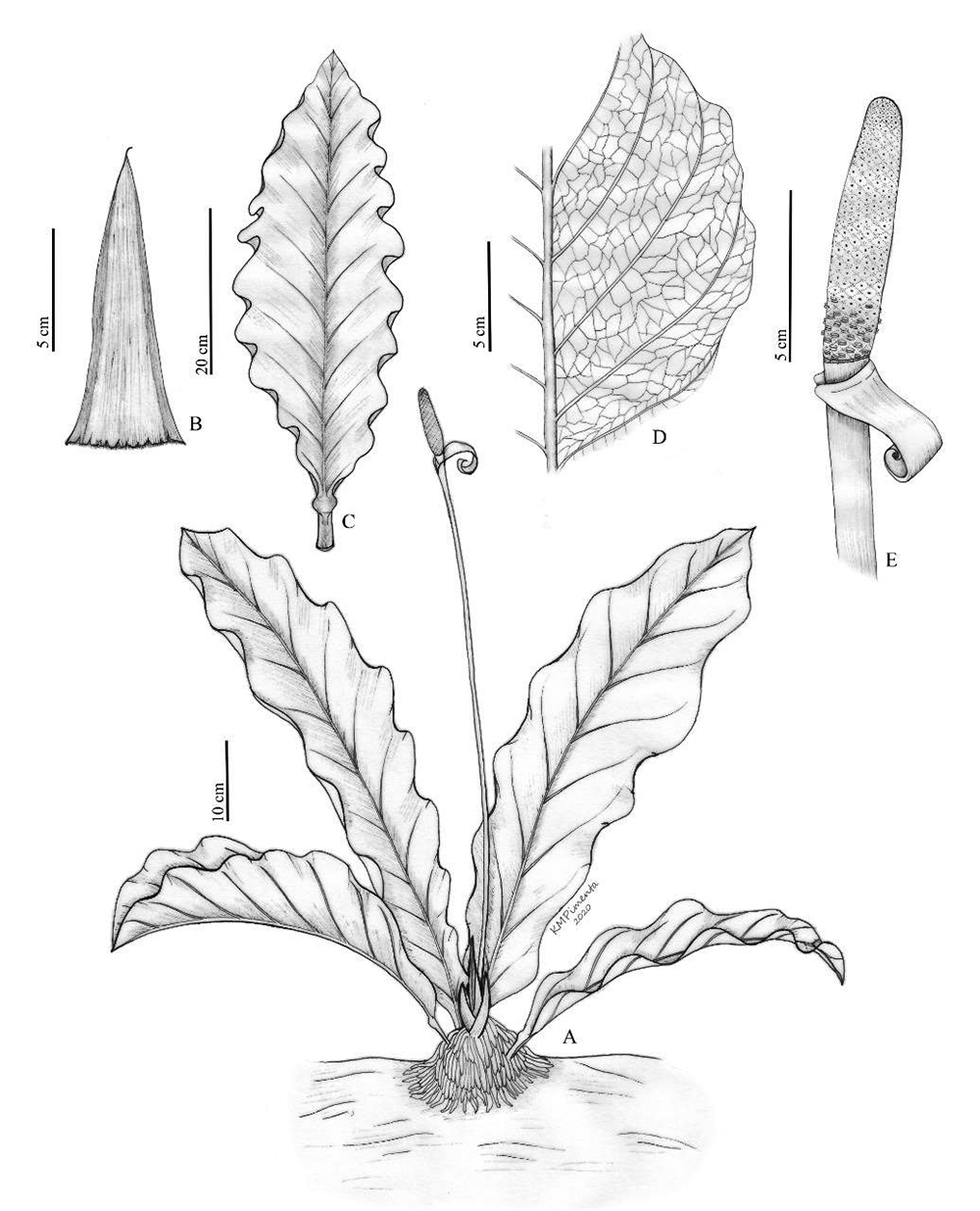
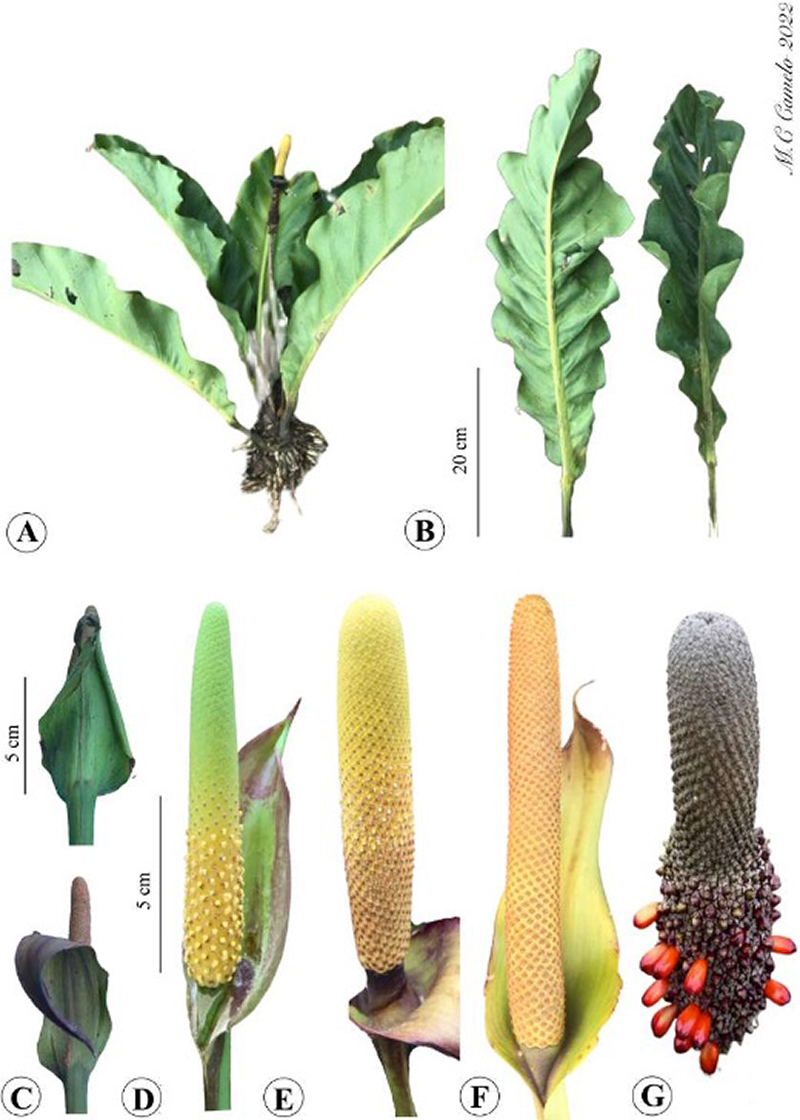
The vegetative organization of section Pachyneurium consists of four types of laminar structures: cataphyll, geniculum, petiole, and leaf blade. The reproductive organization consists of pedunculate inflorescences, with a free spathe, homogeneous spadix, and bisexual flowers (Fig. 1). Section Pachyneurium is generally characterized by having short petioles vs. longer petioles in the other sections of Anthurium from Brazil. Stems are typically erect, regardless of terrestrial or epiphytic habit, and usually wider than long. Stems are usually less than 20 cm in length, though some have been documented to a maximum of 30 cm (Fig. 1A). The cataphyll exhibits two distinct morphologies: lanceolate to narrowly triangular, which occurs either (a) with a straight apex (Fig. 1B; most common) or (b) as a rare hook-shaped variant, and cucullate (hood-like). In Brazilian species, the lanceolate/narrowly triangular form predominates, with straight-apex cataphylls being characteristic of nearly all taxa except for A. loretense Croat, the sole species bearing cucullate cataphylls. Hooked apices, when present, represent exceptional cases within the lanceolate/narrowly triangular type.
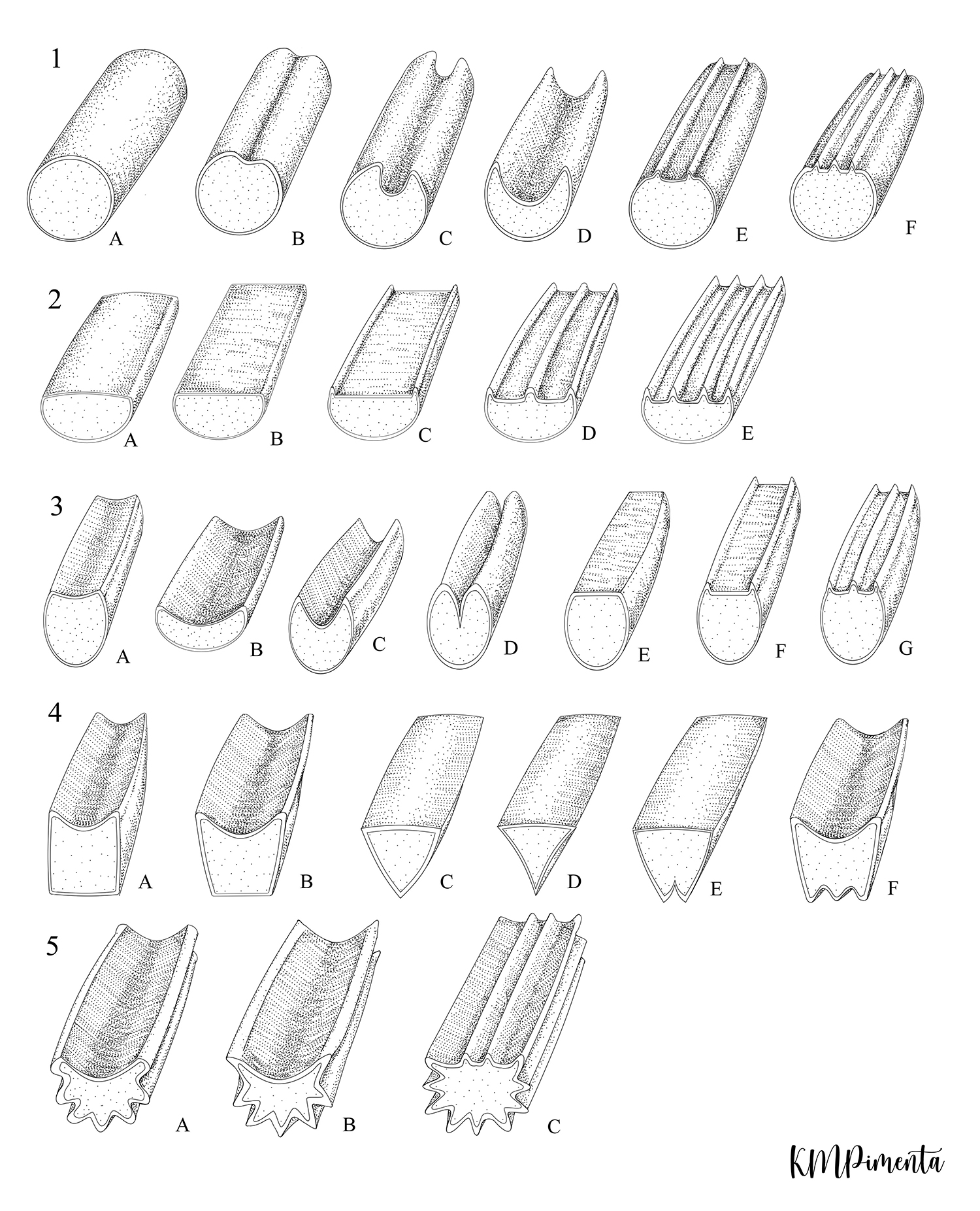
In section Pachyneurium the petiole is typically much shorter than the leaves, which, together with the short internodes of the stem, provide a rosulate arrangement of the leaves, with a 'bird’s nest' appearance, varies greatly from one species to another, but are generally shorter than leaf blades (Fig. 1A). The petiole shapes in cross sections are diverse (Fig. 2) but can be categorized into six morphological types: circular/subcircular, semilunar, semicircular, tetragonal, obtrapezoidal, and obtriangular that we proposed here. In section Pachyneurium, the leaf blade has a set of diagnostic characters, helping to differentiate the species of the section that includes the leaf color, texture, shape, and presence or absence of punctate glands abaxially. The blades are generally discolored to rarely concolorous, with a coriaceous to chartaceous texture, rarely membranaceous, varying in shape from obovate, oblong, or elliptical, rarely ovate, and strongly undulate or straight margins (Fig. 1A, (C).
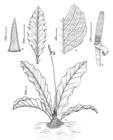
Structural organization pattern of Anthurium section Pachyneurium (eg, Anthurium affine Schott). A. Habit. B. Detail of the cataphyll. C. Leaf blade. D. Eucamptodromous nervation. Inflorescence. Illustration by Karena Pimentad.
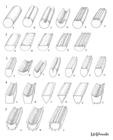
Morphology of petioles in cross sections. 1A. Circular. 1B. Subcircular, with grooved adaxial surface and obtuse edges. 1C. Subcircular, with canaliculate adaxial face and obtuse edges. 1D. Semilunar, with canaliculated adaxial face and obtuse edges. 1E-F. Subcircular, with adaxial face 2-3 sided, blunt ribs. 2A-E. Semicircular, with a flat adaxial face and obtuse, acute or carinated edges or 2-3 sides. 3A. Subcircular with canaliculated adaxial face and sharp edges. 3C-D. Subcircular, with canaliculated or grooved adaxial face and obtuse edges. 3E-G. Subcircular, with flat adaxial face and sharp edges (E) or canaliculated adaxial face and carinated edges or 2-3 sides (F-G). 4A. Tetragonal, with fluted adaxial face and obtuse edges. 4B, F. Obtrapezoidal, with fluted adaxial face and sharp to obtuse edges and 3-sided abaxial face. 4C-E. Obtriangular, with flat adaxial surface and acute to obtuse edges and abaxial surface 1-sided (4C-D) or 2-sided (4E), acute ribs. 5A-B. Semilunar, with canaliculate adaxial surface and acute to obtuse edges and multi-sided abaxial surface, acute to obtuse ribs. Illustration by Karena Pimenta.
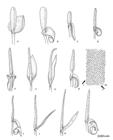
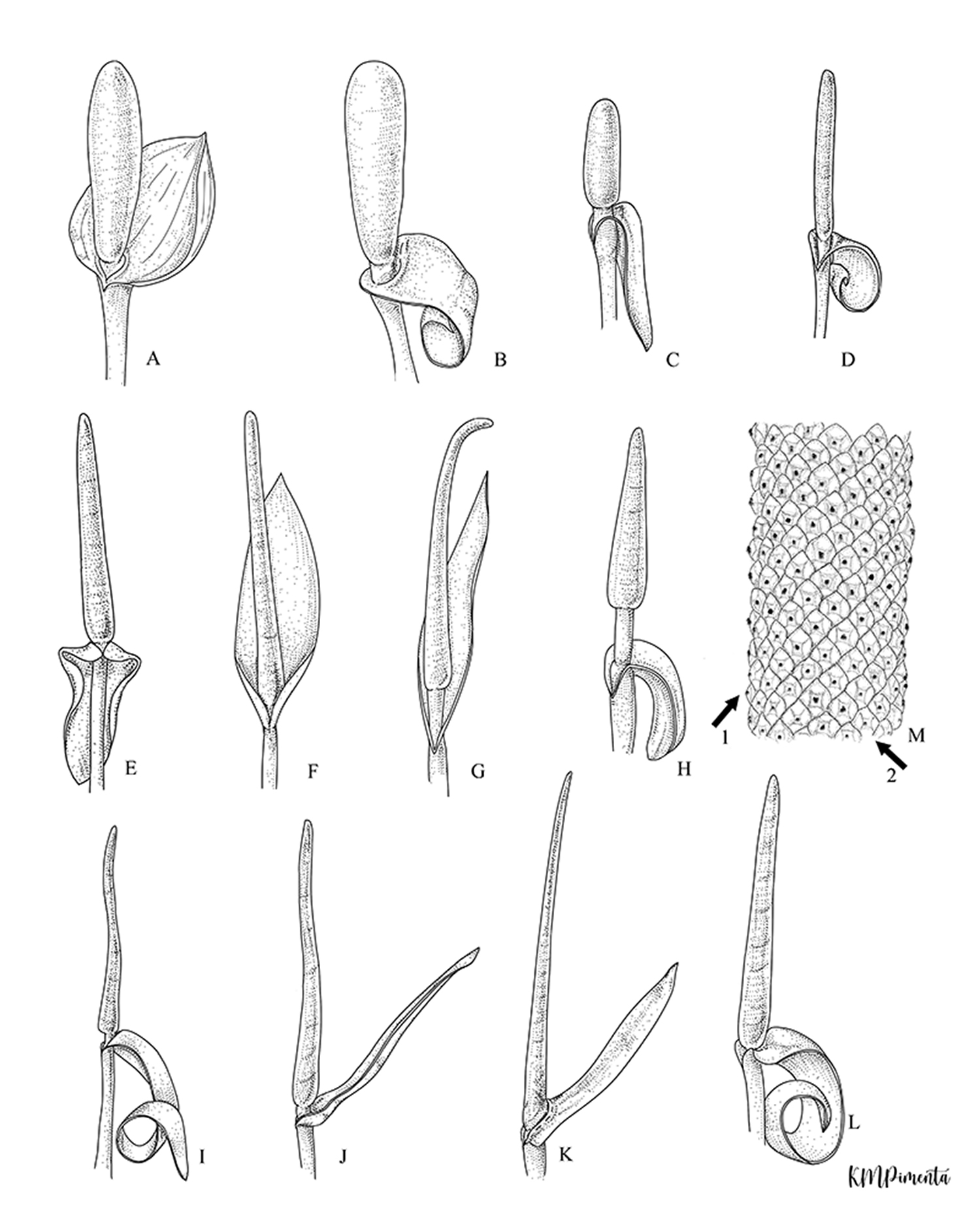
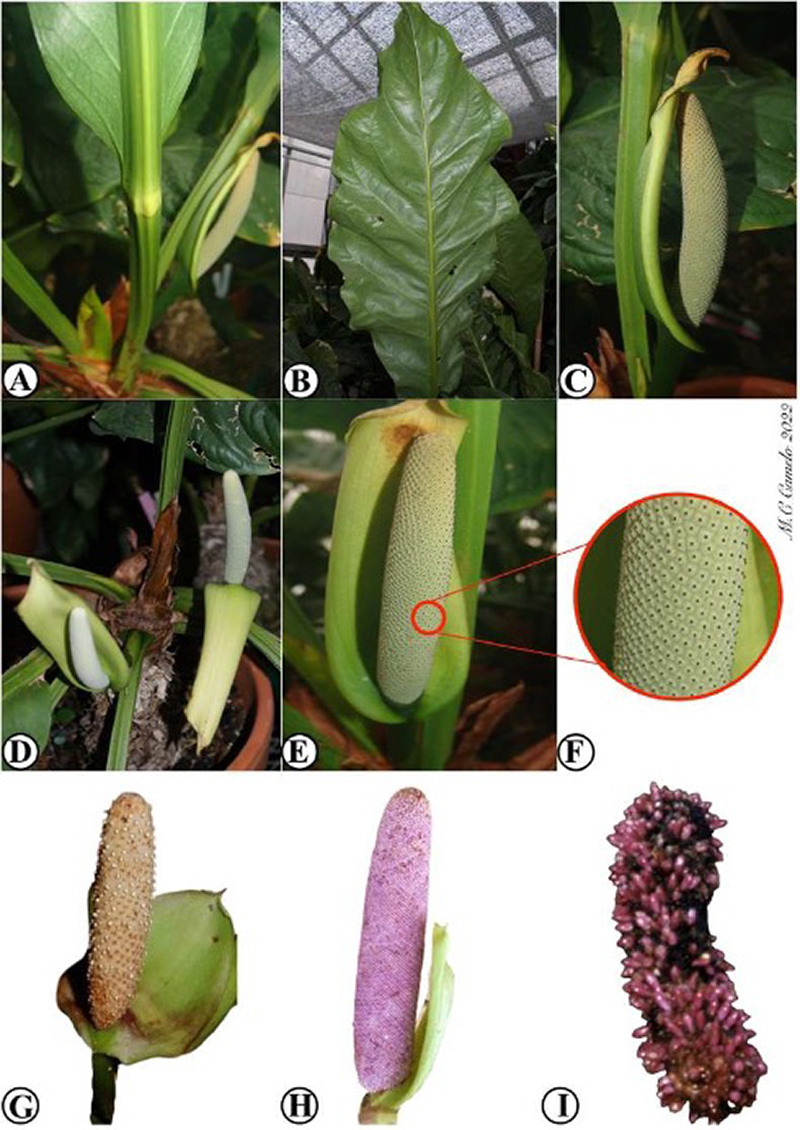
Details of different inflorescences. A. Spadix clavate, spathe ovate, erect. B. Spadix clavate, spathe reflexed, recurved. C. Spadix cylindroid, stipitate, spathe larger than spadix, reflexed. D. Spadix cylindroid, sessile, spathe reflexed, recurved. E. Spadix tapered, sessile, spathe reflexed. F. Spadix tapered, sessile, spathe erect. G. Spadix tapered, curved, long-stipitate, spathe erect. H. Spadix tapered, long-stipitate, spathe reflexed to slightly recurved. I. Spadix tapered, stipitate, recurved. J. Spadix tapered, stipitate, spathe with a size equivalent to slightly patent. K. Spadix tapered, tapered at apex, spathe smaller than spadix, slightly patent. L. Spadix tapered, tapering at apex, spathe smaller than spadix, recurved. M. Detail of the flowers by spiral (1. Principal spiral, 2. alternate spiral). Illustration by Karena Pimenta.
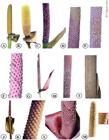
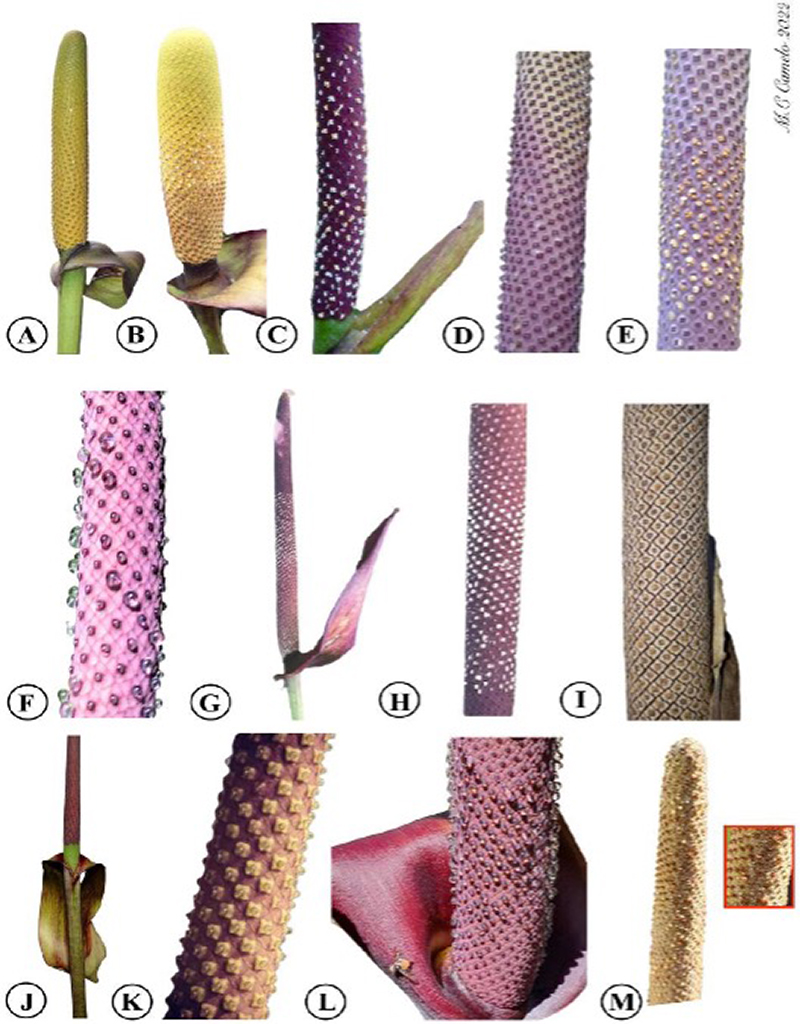
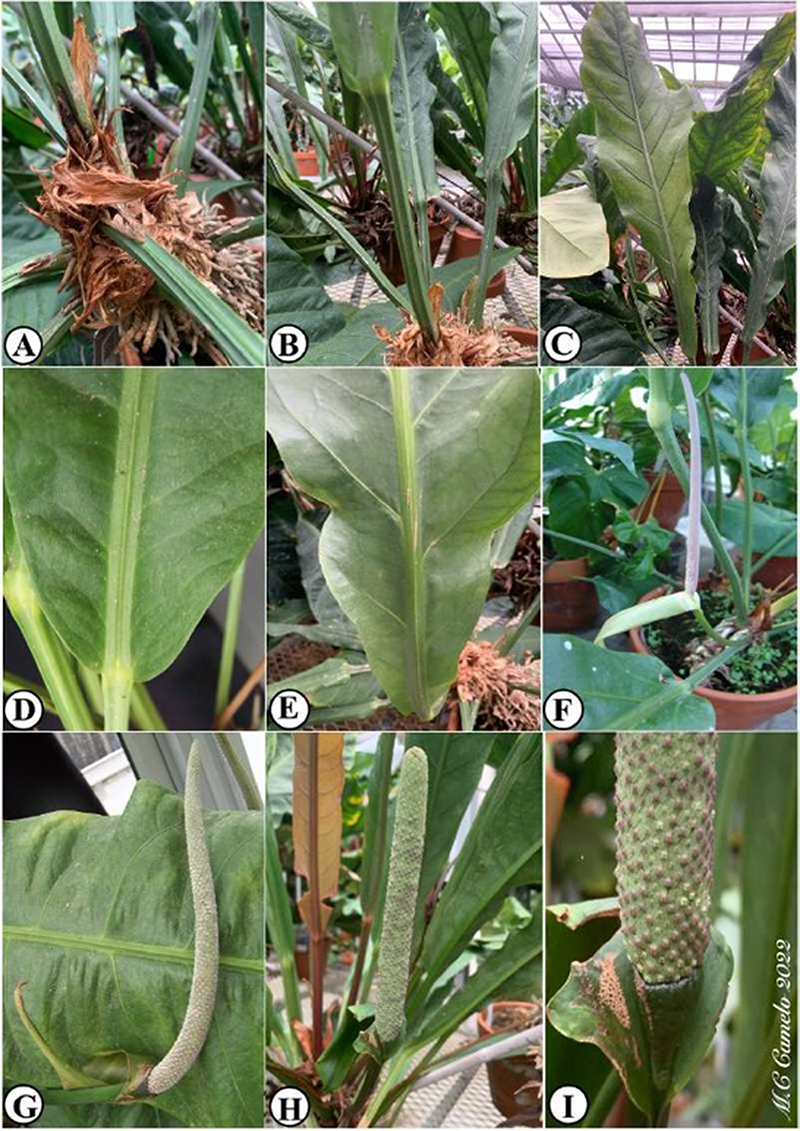
Details of the spadix at different stages of anthesis. A-B. Anthurium affine Schott. A. Detail of the spadix in pre-anthesis with nectar droplets. B. Detail of the spadix in anthesis with yellowish pollen grains. C. Anthurium atropurpureum. Detail of the spadix in anthesis. D-E. Anthurium santaritense Croat & Nadruz. D. Detail of the spadix in pre-anthesis with nectar droplets. E. Detail of the spadix in anthesis with yellowish pollen grains. F-I. Anthurium solitarium Schott. F. Detail of the spadix in pre-anthesis with nectar droplets. G. Detail of the spadix in anthesis. H. Detail of the spadix with whitish pollen grains. I. Detail of the spadix after anthesis. J-K. Anthurium lindmanianum Engl. J. Spadix in pre-anthesis. K. Detail of spadix with droplets of nectar. L-M. Anthurium plowmanii Croat. L. Detail of the spadix in pre-anthesis with nectar droplets. M. Detail of the spadix in anthesis with orange pollen grains. Photos by Mel de Castro.
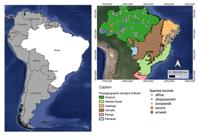
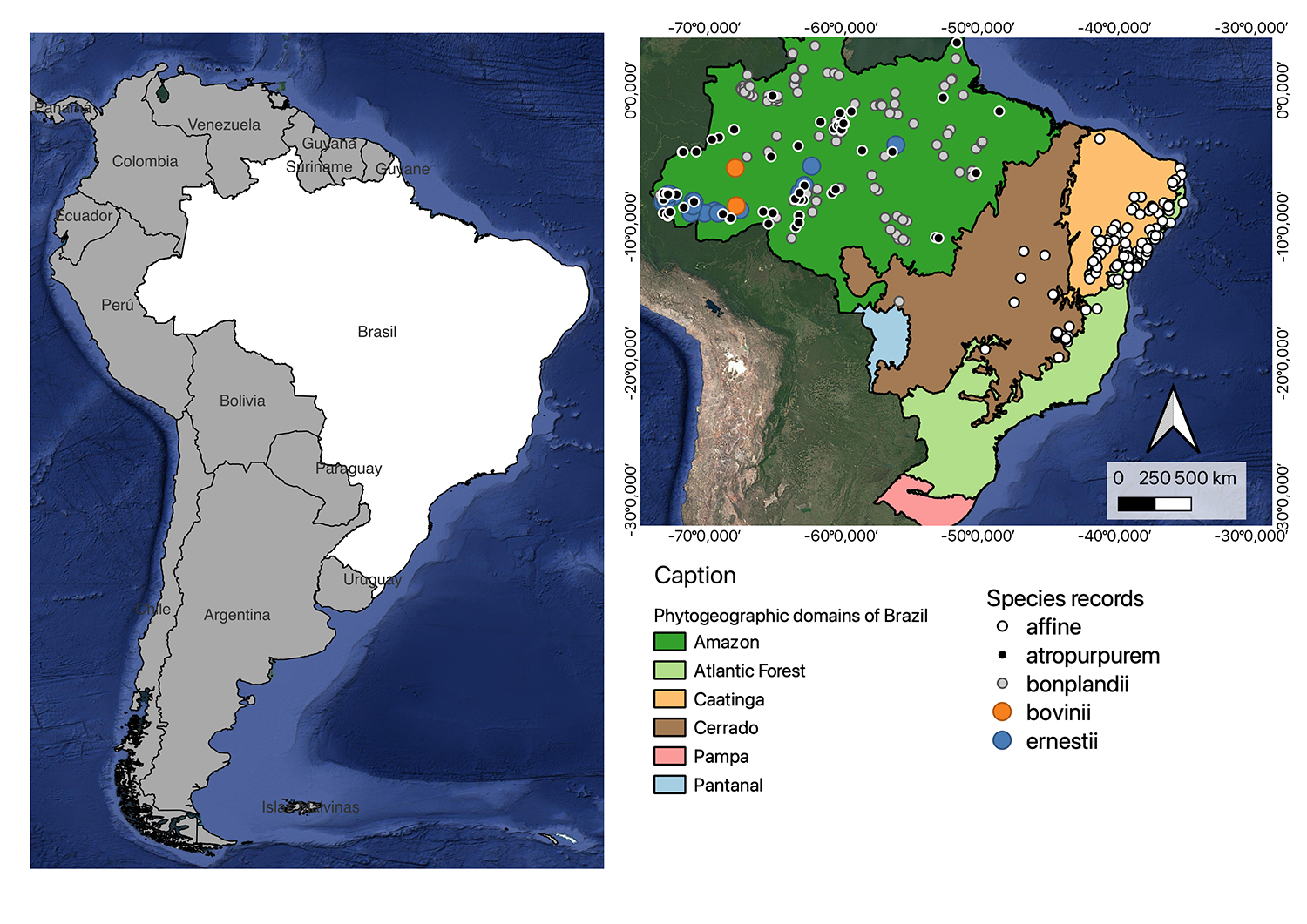
Geographic distribution of A. sect. Pachyneurium from Brazil. (A. affine, A. atropurpureum, A. bonplandii, A. bovinii and A. ernestii).
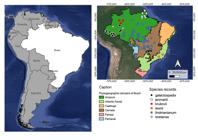
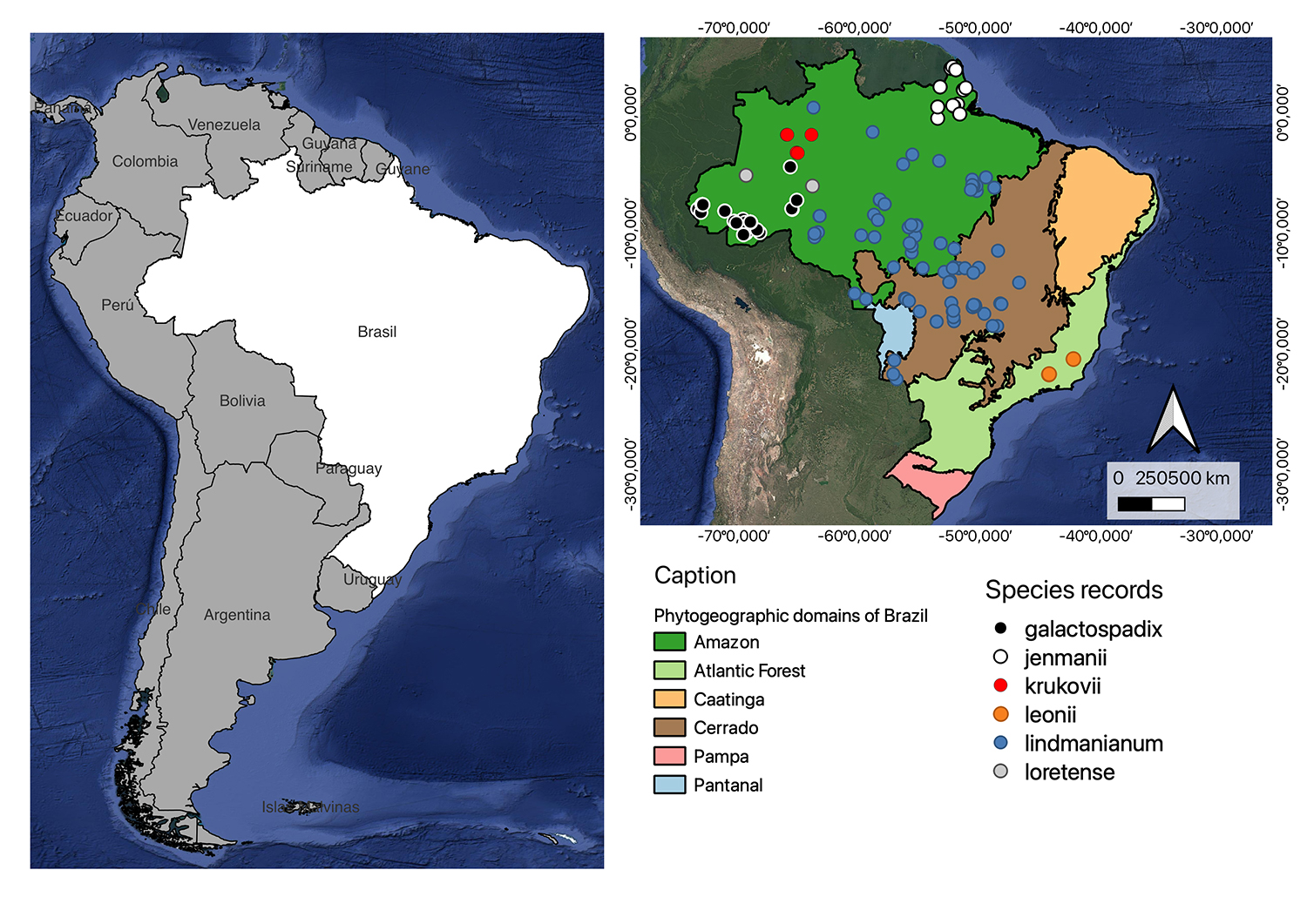
Geographic distribution of A. sect. Pachyneurium from Brazil. (A. galactospadix, A. jenmanii, A. krukovii, A. leonii, A. lindmanianum and A. loretense).
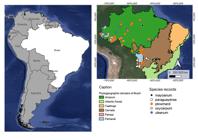
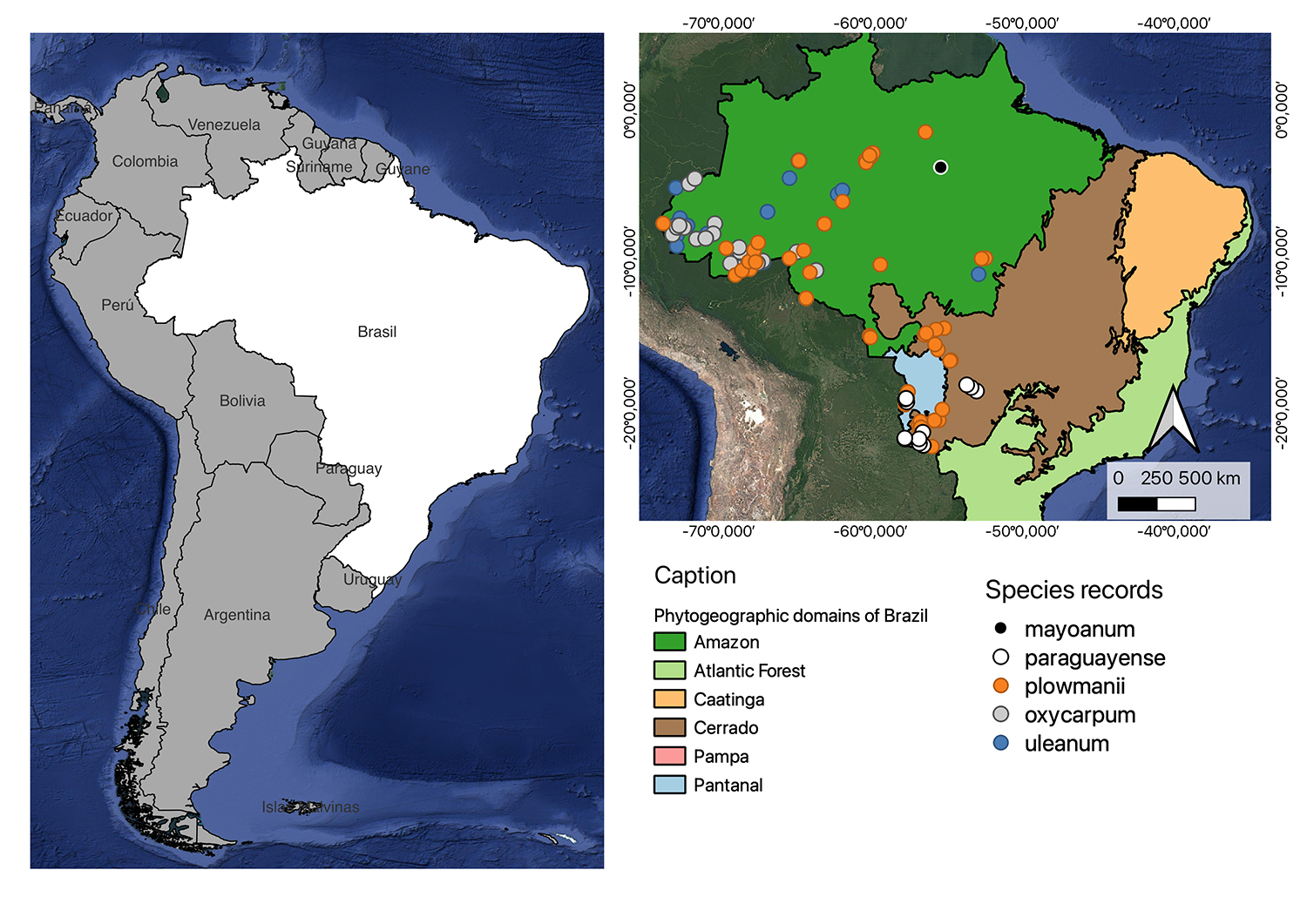
Geographic distribution of A. sect. Pachyneurium from Brazil (A. mayoanum, A. paraguayense, A. plowmanii, A. oxycarpum, A. uleanum).
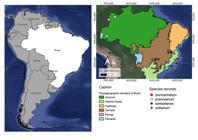
Geographic distribution of A. sect. Pachyneurium from Brazil. (A. pluricarinatum, A. pranceanum, A. santaritense, A. solitarium).
Habitat and life forms
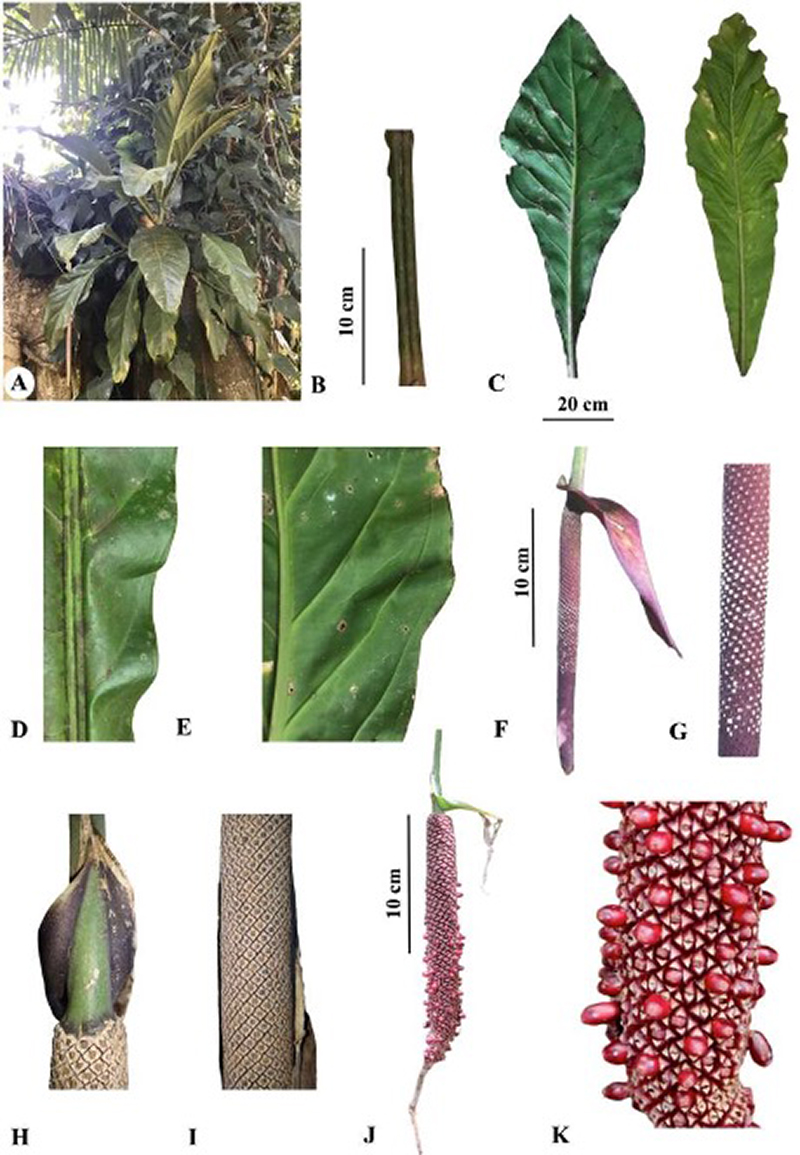
The types of life forms found in the species section Pachyneurium are epiphytic, terrestrial, or rupicolous. Most species are epiphytic, found mainly in the Amazon Domain, such as Anthurium atropurpureum R.E.Schult. & Maguire (Fig. 10A), A. bonplandii Bunting, A. ernestii Engl. (Fig. 13A) and A. mayoanum Camelo, Nadruz & Croat (Fig. 20A). The terrestrial ones are mainly found in the Atlantic Forest and Amazon Domain, and some species occur in white sandy soil, like A. atropurpureum (Fig. 10), A. bonplandii (Fig. 11), or dune vegetation, A. affine (Fig. 9), A. pluricarinatum Camelo, Nadruz, Temponi & Baumgratz (Fig. 24). The rupicolous can be found in the Amazon, Atlantic Forest, and Cerrado domains. Some species may have more than one type of habit, such as terrestrial and rupicolous, A. affine Schott; epiphytic and rupicolous, in A. leonii E.G.Gonç., A. paraguayense Engl. and A. santaritense Nadruz & Croat; and epiphytic, rupicolous, and terrestrial in A. solitarium Schott and A. plowmanii Croat.
They are most diverse in the Ombrophylous Dense Forest, Semideciduous Forest, and restingas. In addition, in the Acre and Minas Gerais states, we found four species. Some species of section Pachyneurium can grow relatively high in the canopy or near ground level, but others occur on rocks in areas where there is little aerial cover to provide an adequate supply of nutrients (Croat, 1988). This group is well adapted to environments with low precipitation and nutrient availability due to its growth form with short petiolate leaves and densely rooted stems (Croat, 1988). These vegetative structures, which concentrate fallen debris and falling water on the densely rooted stems, allow the plants to thrive from the captured rainwater and nutrients retained in fallen debris (Croat, 1988; Zona & Christenhusz, 2015).
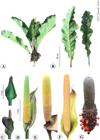
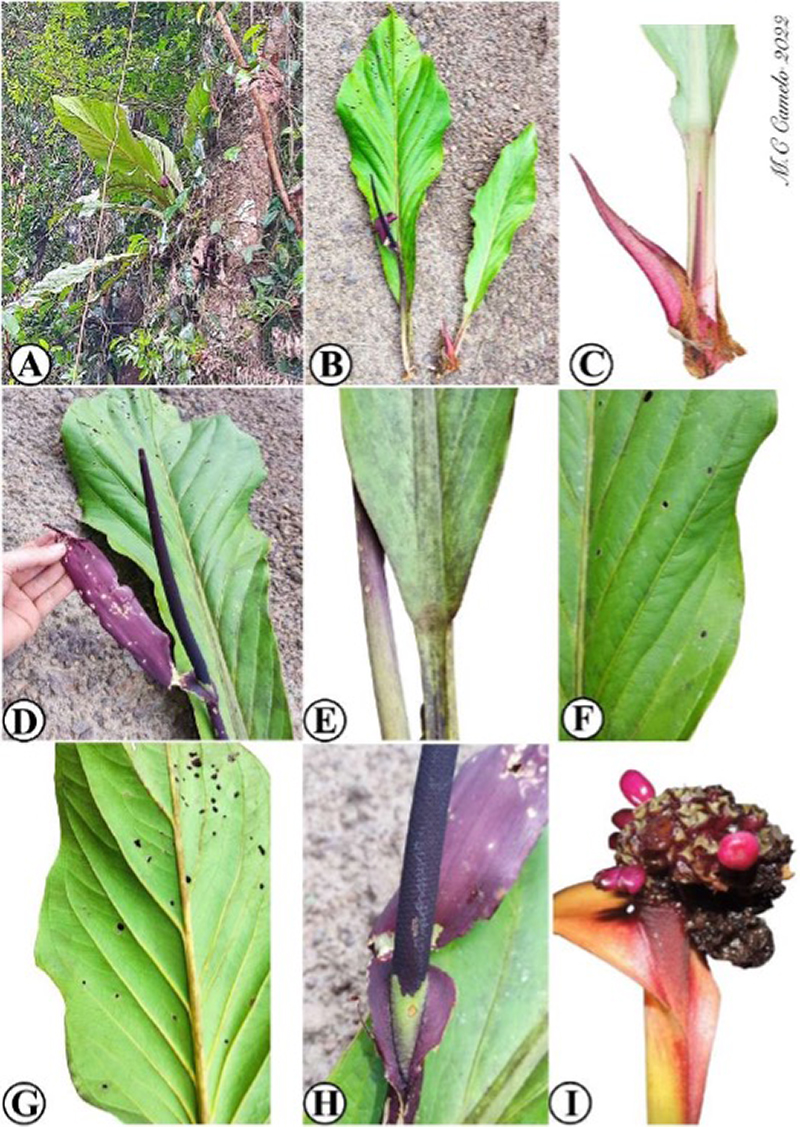
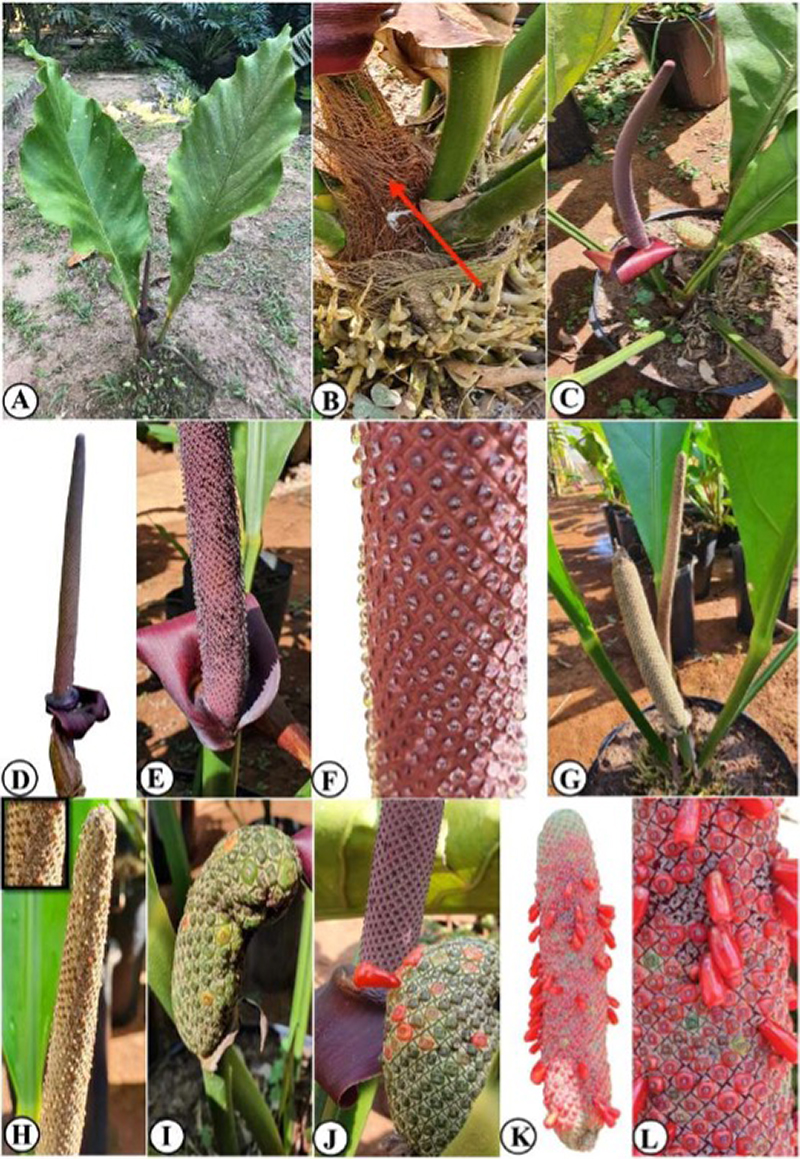
Anthurium affine Schott. A. Habit, emphasizing erect stem and inflorescence. B. Leaf blade with strongly wavy margins. C. Spathe entirely greenish to greenish with vinaceous streaks, ovate, erect to recurved. D. Greenish-yellowish spadix, cylindroid, with erect spathe in anthesis. E. Spadix yellowish, clavate in anthesis. F. Spadix yellowish to slightly golden, cylindroid post-anthesis. G. Erect infructescence, berries red at the base, purple to nigrescent at the apex, oblong to ellipsoid.
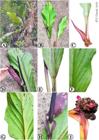
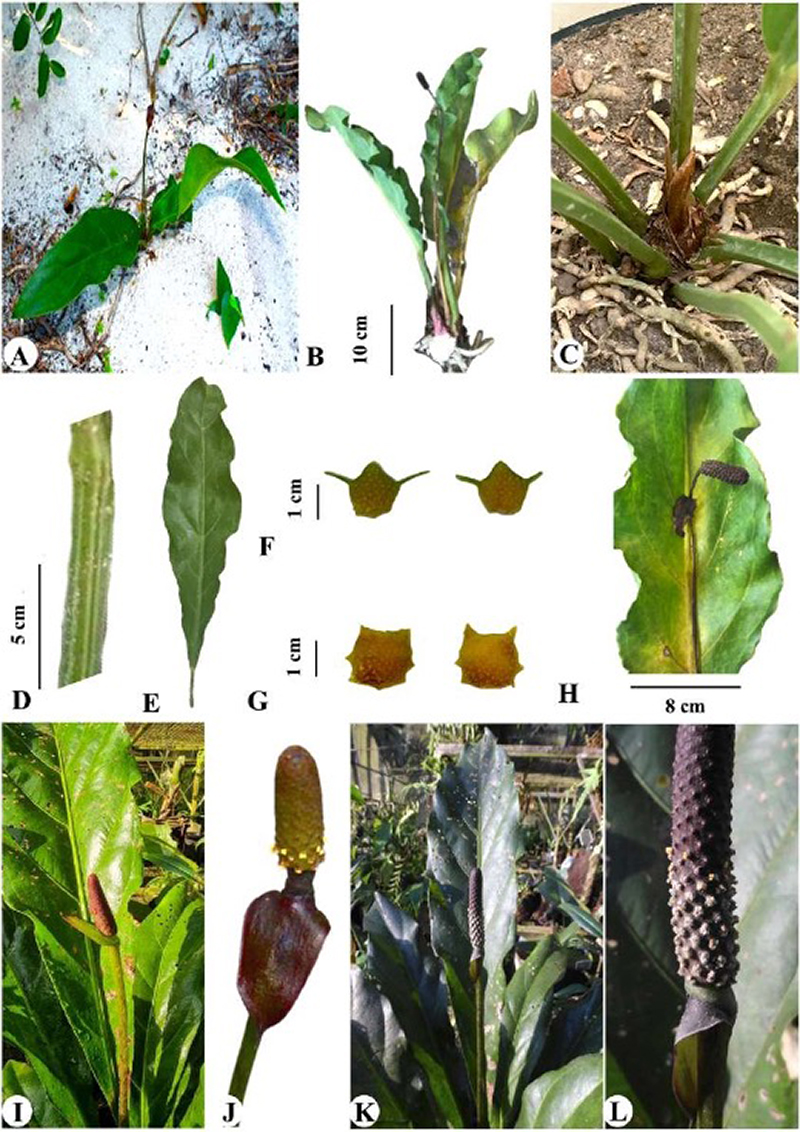
Anthurium atropurpureum R.E.Schult. & Maguire. A. Habit. B. Entire plant, erect stem, obovate leaf blade. C. Cataphyll lanceolate, erect, breaking into fibers at the base. D. Detail of the leaf blade, erect inflorescence and tapered purple spadix. E. Detail of the base of the leaf blade, sulcate petiole with sharp margins on the adaxial, cylindroid peduncle. F. Leaf blade with straight margins, midrib and primary lateral veins prominent on the adaxial surface. G. Midrib and primary lateral veins prominent on the abaxial surface. H. Detail of the greenish stipe. I. Erect infructescence, purple berries, obovoid.
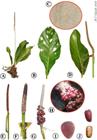
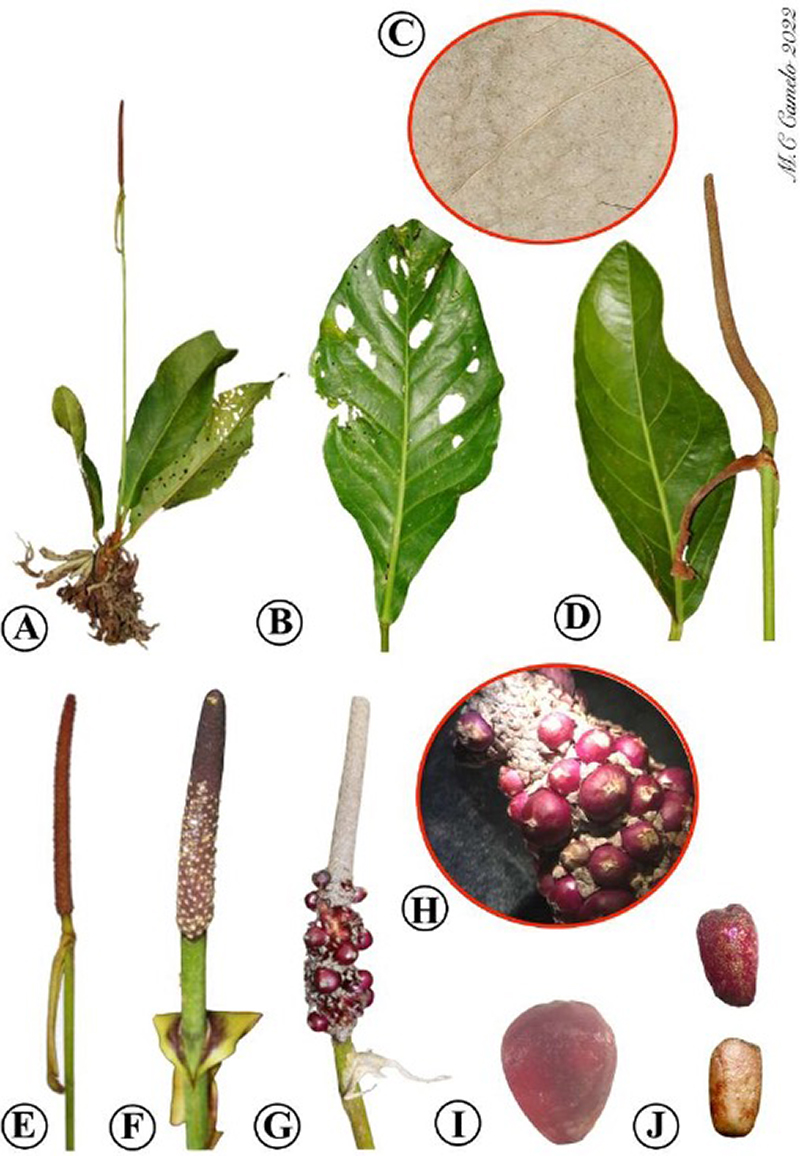
Anthurium bonplandii G.S.Bunting. A. Habit. B. Obovate leaf blade. C. Detail of punctate glands (brown dots) on the abaxial surface. D. Detail of midrib and primary lateral veins prominent, inflorescence erect. E. Peduncle green, spathe reflexed, greenish-yellowish, spadix tapered, reddish. F. Spadix in anthesis with yellowish pollen grains and detail of the stipe. G. Erect infructescence, marcescent spathe, purple berries. H. Detail of purple to dark red berries I. Obovoid berry, apex rounded. J. Detail of two seeds, one brownish-purple and the other brown, both with a rough forehead.
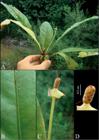
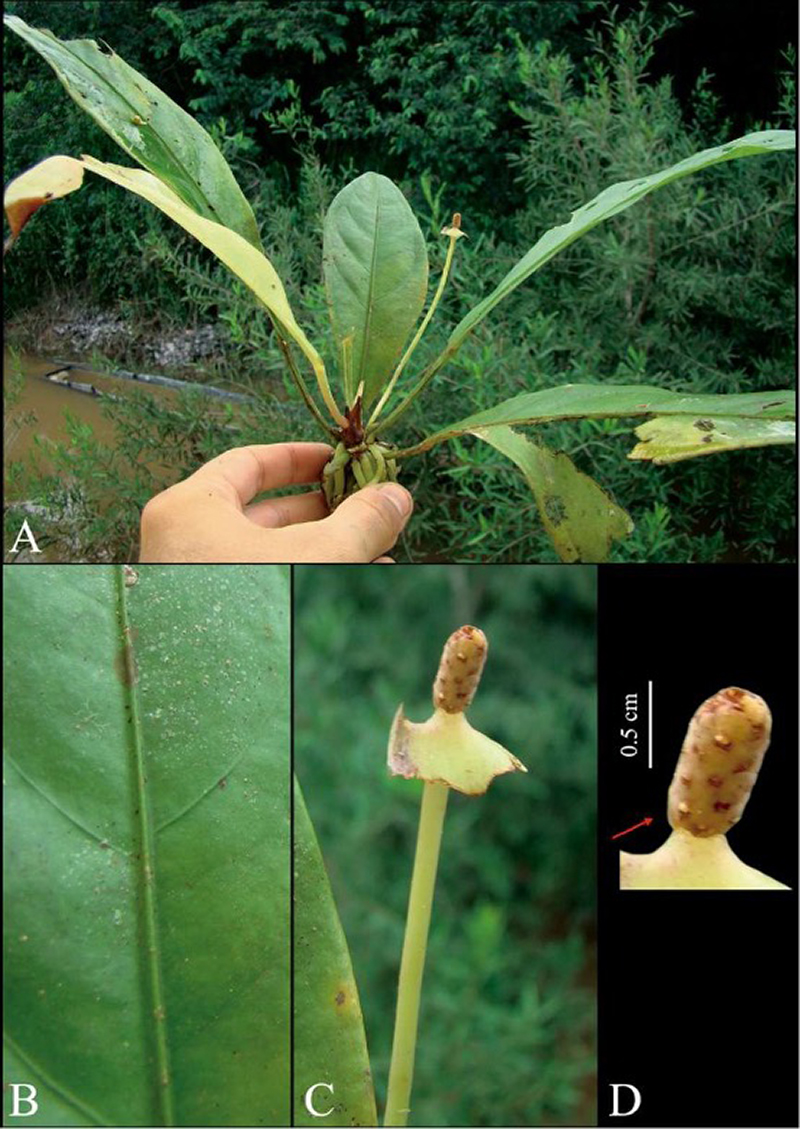
Anthurium bovinii Camelo & Nadruz. A. Entire plant, erect stem, cataphylls and lanceolate prophylls erect. B. Detail of the midrib and primary lateral veins prominent.C. Inflorescence erect, peduncle greenish, spathe yellowish-green, spadix cylindroid, orange-yellow. D. Detail of the flowers indicating (red arrow) the primary spiral with 4 flowers.
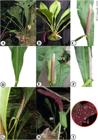
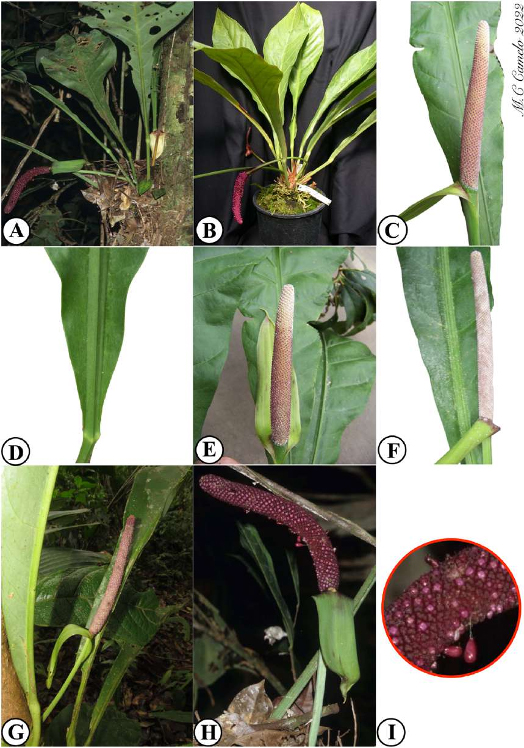
Anthurium ernestii Engl. A. Habit. B. Whole plant, erect stem. C. Leaf blade with strongly wavy margins, erect inflorescence. D. Detail of leaf blade base, prominent midrib, one rib in the middle. E. Inflorescence with erect spathe, green. F. Detail of inflorescence with whitish pollen grains. G. Inflorescence in post-anthesis with pink spadix. H. Infructescence with green spathe, persistent, reflexed, ovate with acuminate apex. I. Detail of the purple, obovoid berries. Photographs by Thomas Croat.
Inflorescences
The inflorescence is composed of the peduncle, spathe, stipe, and spadix (Fig. 1E; Fig. 3). The peduncle is usually green and cylindroid, occasionally keeled on one side of the peduncle and extending along most of its length, or rarely with several keels around the circumference of the peduncle. The peduncle is erect in most species, but several species have pendent peduncles. Peduncle length is highly variable within the section, even within the same species and at different stages of development. However, petiole/peduncle length ratios are often very taxonomically significant, at least at anthesis (Croat, 1991; Coelho et al., 2009). Most species have a peduncle longer than the petiole, and only in A. galactospadix Croat, A. plowmanii, and sometimes in A. ernestii, the peduncle is shorter than the petiole. The relative length of the spadix compared to the peduncle can also be taxonomically important, even making it possible to separate groups of species. Most species have a peduncle longer than the spadix, such as A. affine, A. leonii, A. lindmanianum Engl., A. paraguayense, A. santaritense, and A. solitarium. But some species have a peduncle shorter than the spadix, such as A. plowmanii and A. galactospadix.
Spathe
The spathe is typically oblong to elliptical, with an acuminate apex, normally thick and persistent, but occasionally marcescent where the spathe is thin and slowly withering, becoming deciduous (Fig. 3). Even in some species with typically thicker spathes, such as A. jenmanii Engl., they are marcescent soon after anthesis, turning yellow, and do not always persist on specimens. The spathes are generally longer than the spadix but may be shorter at anthesis, as in the case of A. galactospadix (Fig. 3).
Spadix
The spadix can be sessile or stipitate, but most species are sessile, and they are typically tapered (Fig. 3). The spadix size varies, and may be long, such as A. atropurpureum, A. bonplandii, A. lindmanianum, A. leonii, A. santaritense, and A. solitarium (Fig. 3E, (L) have tapered spadix; or short spadices in some species, such as A. affine, A. bovinii, A. galactospadix, have cylindroid or clavate spadix (Fig. 3A, B). The color of the spadix, although quite variable, is very useful for this section, but they usually are purple to brownish at anthesis, such as A. atropurpureum, A. solitarium, and A. plowmanii, or greenish purple tinged at anthesis, as in A. paraguayense. But there are some exceptions in color during anthesis; reddish in A. bonplandii, whitish in A. galactospadix, yellowish to yellowish green in A. affine, and some species, such as A. leonii and A. santaritense from the Atlantic Forest Domain, have lilac spadices.
Flowers
The flowers are arranged in spirals (with five or more flowers visible per spiral) (Fig. 3M). The number of flowers per spiral refers to the number of flowers visible from any angle (whether principal spiral or alternate spiral) (Fig. 3M). The number of flowers in Anthurium species can vary significantly and may hold taxonomic significance (Croat, 1991). For instance, certain species consistently have fewer than 10 flowers per spiral, e.g., A. atropurpureum, A. bonplandii, A. bovinii, A. ernestii, and A. uleanum, and other species typically have more than 10 flowers per spiral, e.g., A. galactospadix, A. plowmanii, and A. solitarium. Spadices at different stages of anthesis in situ or ex situ were observed (Fig. 4). It was possible to observe some species at pre-anthesis with nectar droplets, as in A. affine (Fig. 4A), A. lindmanianum (Fig. 4K), A. plowmanii (Fig. 4L), A. santaritense (Fig. 4D), and A. solitarium (Fig. 4F). The pollen grains can vary in color, but mostly they are yellowish and whitish or rarely orange (Fig. 4).
Infructescences, berries, and seeds
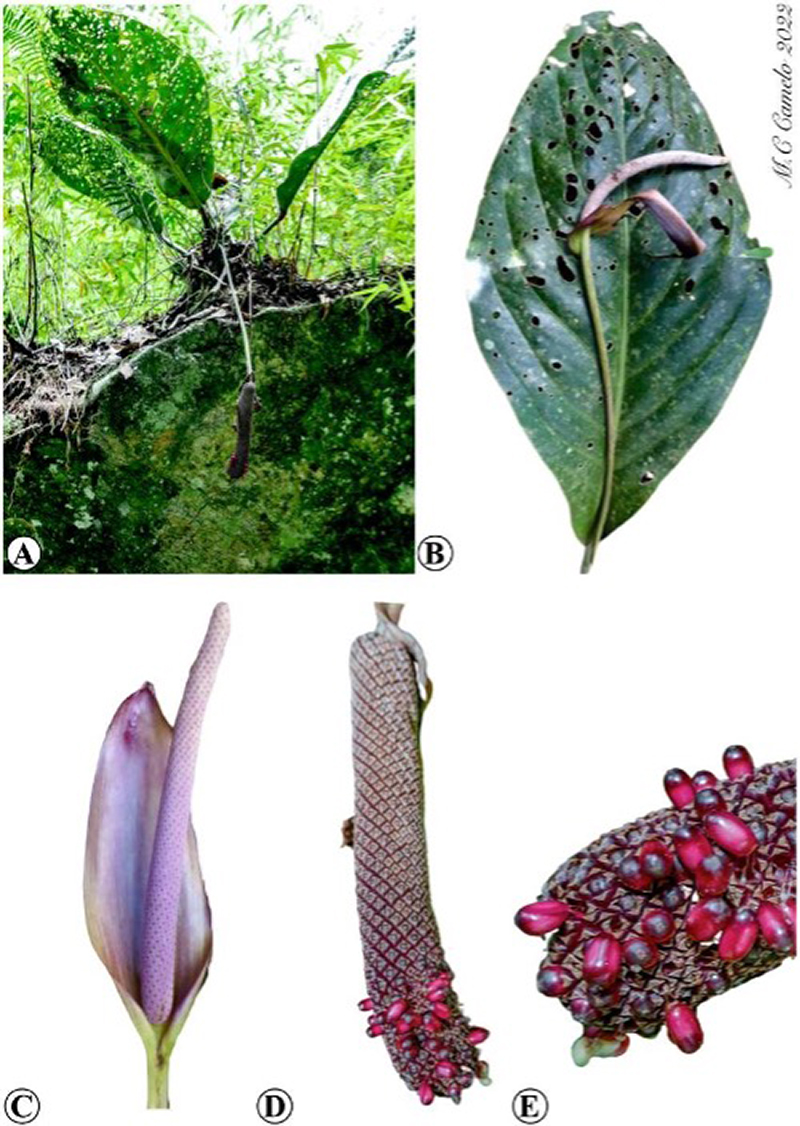
Infructescences, berries, and seeds of species in section Pachyneurium are distinguished by position, shape, size, color, and ornamentation. The infructescences can be erect or pendent, the spadix is generally cylindroid or tapered, the spathe is persistent or deciduous, entire or marcescent in post-anthesis. Berries are oblong, ellipsoid to obovoid, rarely globose, red, vinaceous, purple, rarely white or pink to violet, greenish or orange, with apex rounded or truncated. Two groups of species of Anthurium sect. Pachyneurium that differ in their berry color occur in different domains in Brazil. The species found in the Atlantic Forest Domain, e.g., A. affine, A. leonii, A. paraguayense, A. santaritense, and A. solitarium, have berries that are always reddish to vinaceous. Species found in the Amazon Domain, e.g., A. atropurpureum, A. bonplandii, A. ernestii, A. jenmani, and A. lindmanianum, the berries are often purple to violet, or white from the middle to the base (Camelo et al., 2023a). Seeds are oblong, ellipsoid to ovoid, their surfaces smooth or warty and yellowish, cream, cream with reddish or brownish streaks, or purple and surrounded by mucilage (Camelo et al., 2023a). Seeds are one per locule, 1-2 per berry, though one seed is typically aborted (Camelo et al., 2023a).
Geographic distribution and phytogeographical domains of Brazil
In Brazil, there are 20 species, and the highest species richness of section Pachyneureium is found in Acre, Amazonas, and Pará States in the Northern region, and Minas Gerais, Bahia, and Espírito Santo States in the Southeastern region. Most of the species of section Pachyneurium that occur in Brazil are also endemic, except for Anthurium ernestii, A. jenmani, A. paraguayense, and A. plowmanii, which also occur in northern South American countries (Croat, 1991). Moreover, the species studied here are also endemic to the Atlantic Forest Domain, except for three: Anthurium affine which also occurs in Caatinga and Cerrado Domains, A. paraguayense, which occurs in the transition of Atlantic Forest, Cerrado, and Pantanal Domains and A. plowmanii, which occurs in the Atlantic Forest, Cerrado, Pantanal, and Amazon Domains (Camelo et al., 2023b). The center of diversity is in the Amazon Domain (14 spp.) (Figs. 5-8), and the Atlantic Forest Domain holds the second-largest diversity with seven spp. In the Amazon Domain, species are mainly concentrated in the Western region. They occur in four types of vegetation formations: Ombrophylous Dense Forest, Terra Firme, Campina, and Campo Rupestre. The terrestrial species can be found in areas of sandy white soil and these include such species as A. atropurpureum and A. bonplandii. In flooded areas or rocky outcrops, we find A. lindmanianum. The recently described species, A. bovinii, occurs in Terra Firme Forest, and A. mayoanum occurs in Igapó Forest. In the Atlantic Forest Domain, these species can be identified by suites of distinctive morphological characteristics that include characters of the leaves, inflorescences, pollen grains, fruits, and seeds (Camelo et al., 2023a; 2023b).
Economic importance and uses
Anthurium, particularly the species of section Pachyneurium, has great economic importance, due to its ornamental potential and use as medicinal plants (Morais et al., 2017; Maitan & Jasmin, 2020; Nomura et al., 2012). Species of section Pachyneurium, i.e., Anthurium affine, A. bonplandii, A. plowmanii, and A. solitarium, with ornamental potential and for floriculture were verified by Morais et al. (2017) and Maitan & Jasmin (2020). Medicinal use in Anthurium is well-documented and Anthurium affine is known to be used and is popularly applied in the treatment of diabetes, mycoses, and cardiovascular diseases in humans (Nomura et al., 2012). In the treatment of skin diseases, such as psoriasis, it is used as a cream “milho-de-urubu”, which is the vernacular name of the species in portuguese (Nomura et al., 2012).
Taxonomic treatment
Key to the sections of Anthurium in Brazil
1. Leaves with punctate glands on both surfaces; spadix up to 1 cm long; berries whitish or pinkish to violet, 4-10 seeds per berry..........…... section Tetraspermium (Schott) Engl.
1’. Leaves without punctate glands adaxially, sometimes present abaxially; spadix >1 cm long; berries variously colored, but rarely whitish, pinkish to violet, 1-2 seeds per berry ................................................................................................................................. 2
2. Prefoliation involute; petiole usually < 20 cm long; leaves with eucamptodromous nervation; berries oblong-ellipsoid, obovoid, rarely globose ……....................................................................…. section Pachyneurium (Schott) Engl.
2’. Prefoliation supervolute; petiole usually > 20 cm long; leaves with brochidodromous nervation; berries globose to obovoid, rarely oblong- ellipsoid .................................... 3
3. Leaf blade 3-lobed or palmatifid to palmatisect ............................................................. .............................................................................. section Dactylophyllium (Schott) Engl.
3’. Leaf blade simple (entire), or sometimes lobed at the base but never 3-lobe........................................................................................................................... 4
4. Roots white, stem usually less than 1 cm long, rarely longer; cataphylls always intact; leaf blade linear to elliptical; spadix with up to 3 flowers visible per spiral ................................................................................. section Leptanthurium (Schott) Engl.
4’. Roots greenish, stem longer than 1 cm; cataphylls usually fibrous; leaf blade various; spadix with more than 3 flowers visible per spiral ........................... sect. Urospadix (Schott) Engl.
Anthurium section Pachyneurium Schott, Prodr. 466. 1860. Anthurium crenatum (L.) Kunth. Enum. Pl. 3: 75 (1841). Type: Virgin Islands. St. Thomas, Plumier t. 39 (Lectotype: designated by S. Mayo [1982: 705-710]: C. Plumier illustration published by J. Burman, Plant. Amer. Fasc. 1-10, t. 39, 1756).
Epiphytic, terrestrial, rupicolous to saxicolous herb. Stem erect to rarely pendent; cataphylls usually straight, lanceolate, rarely cucullate, decomposing and persisting in fibers. Leaves rosulate, non-circinate or circinate when young, erect to rarely deflected; petiole usually <20 cm long, smaller than leaf blade, rarely longer than blades, rigid to flexible, sheathed near base, subcircular, semicircular, semilunar, obtriangular to obtrapezoidal, rarely circular, with furrowed sulcate adaxially and sharp edges, sometimes 3-6-ribbed laterally, sometimes with midrib on adaxially in cross section, obtuse abaxially; geniculum conspicuous, rarely inconspicuous, present, smaller and slightly lighter than the petiole, rarely darker; leaf blade without punctate or with punctate glands abaxially, brown punctate when dry material, involute prefoliation, discolored to rarely discolored, greenish, green, yellowish green, olive-green to dark green, simple (entire), coriaceous, rarely chartaceous to membranaceous, oblong, obovate to elliptical, rarely linear, apex obtuse, acute, acuminate to apiculate, base acute, obtuse, attenuated, rarely cordate or with conspicuous posterior lobes, strongly undulate margins or straight; midrib green on both sides, prominent; primary lateral veins usually prominent on both surfaces, 7-14/side; collective vein absent or emerging only in the apical region of the leaf blade, or in the middle or close to the base or up to the middle region of the leaf blade. Inflorescence erect to pendent; peduncle usually cylindroid, short to elongated, longer or shorter than the spadix; spathe short to elongated, persistent, pendent to reflexed, sometimes recurved, rarely erect, rarely marcescent to deciduous, green, sometimes purple to reddish on the adaxially; spadix >1 cm long, tapered to cylindroid, rarely clavate, sessile to stipitate, green or purple to reddish, sometimes whitish. Flowers 3-28 per spiral; white, yellow or orange pollen. Infructescence pendent to erect; spathe persistent or deciduous, entire or marcescent; berries red, vinaceous, violet, purple, rarely green, orange, yellowish or white, concolorous or bicolored, oblong-ellipsoid, obovoid, rarely globose, rounded or truncated at the apex; Seeds cream, yellowish, brownish, sometimes purple, 1-2 per berry, obovoid, oblong-elliptical, smooth or verrucous, with mucilaginous appendage.
Field key of the species of Anthurium sect. Pachyneurium in Brazil.
1. Leaf blades with punctate glands abaxially…................................................................2
1'. Leaf blades without punctate glands abaxially…..........................................................4
2. Cataphylls cucullate; leaves with circinate margins during development; spadix 6-11 mm diam. .............................................................................................. A. loretense Croat
2’. Cataphylls lanceolate, never cucullate; leaves with non-circinate margins during development; spadix < 6 mm diam. .................................................................................. 3
3. Geniculum conspicuous; leaf blade <40 cm long, base attenuate to acute; inflorescence erect, spadix green, reddish to brown at anthesis ..................... A. bonplandii G.S. Bunting
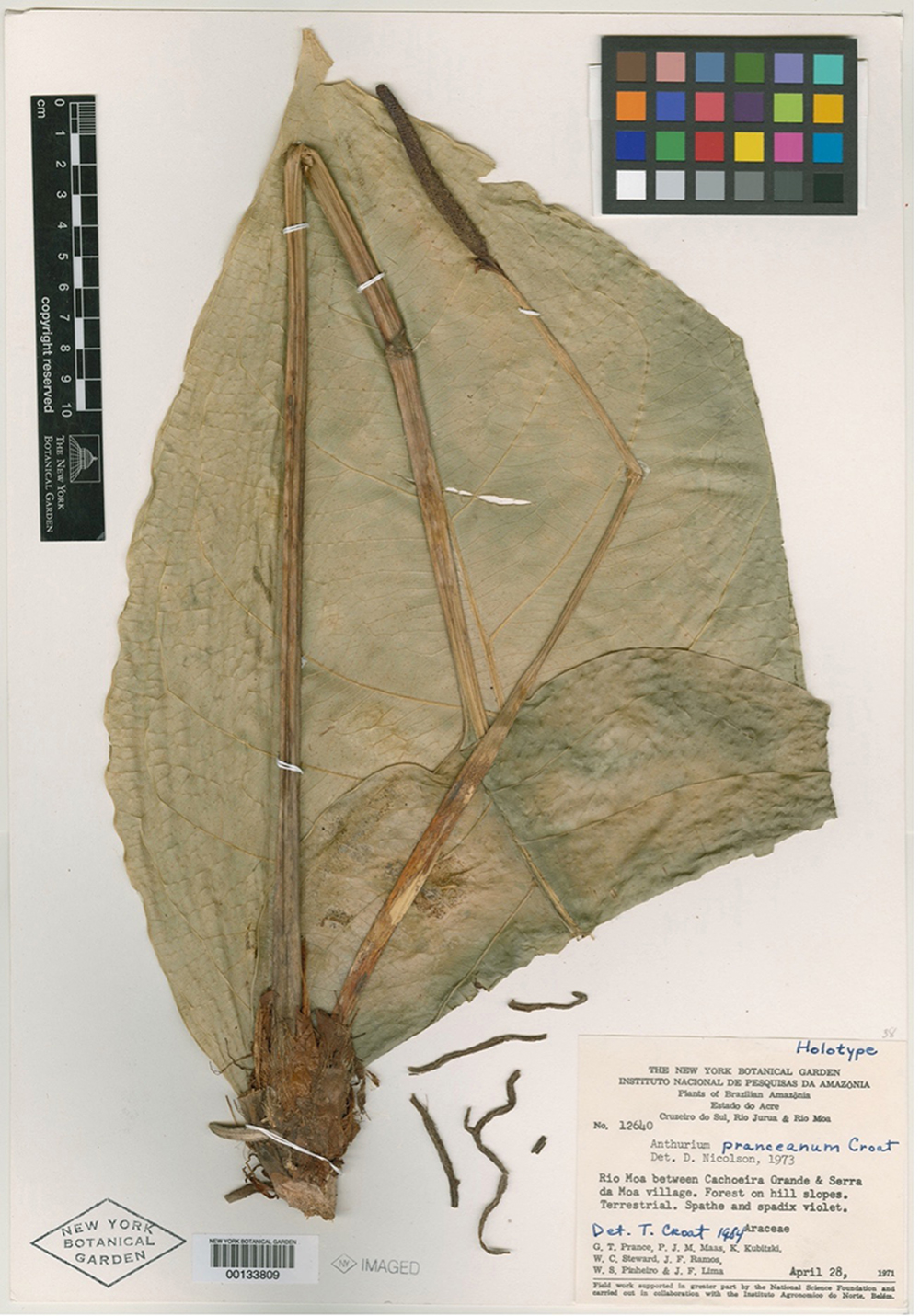
3'. Geniculum inconspicuous; leaf blade 40-70 cm long, base obtuse or rarely attenuated; inflorescence pendent, spadix violet at anthesis ................................ A. pranceanum Croat
4. Collective vein emerging near the base or up to the middle of the leaf blade ............. 5
4'. Collective vein absent or emerging only in the distal region of the leaf blade ........... 7
5. Spadix bluish, yellowish-greenish, greenish, sometimes cream at anthesis .......................................................................................................... A. oxycarpum Poepp.
5'. Spadix dark-purple at anthesis, sometimes brown ..................................................... 6
6. Geniculum located immediately at the base of the blade; leaf blade oblong to elliptical; spathe white, greenish to purple-tinged; stipe absent or < 1.5 cm long. ......................................................................... A. atropurpureum R.E.Schult. & Maguire
6'. Geniculum distant 4-11 cm from the blade base; leaf blade ovate-elliptic; spathe green to reddish; stipe 1.5-3.5 cm long ............................................................... A. krukovii Croat
7. Leaf blade margins straight ......................................................................................... 8
7’. Leaf blade with strongly undulate margins .............................................................. 14
8. Inflorescence pendent ................................................................................................. 9
8’. Inflorescence erect ................................................................................................... 11
9. Leaf blade narrowly lanceolate; spathe yellowish to greenish on both sides, striated margins present. .............................................................. A. santaritense Nadruz & Croat
9'. Leaf blade elliptic or obovate; spathe lilac adaxially, greenish, vinaceous abaxially or brownish on both sides; absent striated margins .......................................................... 10
10. Peduncle green, cylindric, never ribbed; pollen yellow; berries vinaceous at the base, purple at the apex; seeds cream-colored ........................................... A. leonii E.G.Gonç.
10'. Peduncle vinaceous to brownish, cylindric to 1-ribbed; pollen whitish; berries entirely vinaceous; seeds yellowish................................................................. A. solitarium Schott
11. Peduncle greenish-yellowish, <12 cm long; spadix yellowish-orange at anthesis, up to 9 mm long, cylindric, sessile .......................................... A. bovinii Camelo & Nadruz
11'. Peduncle green or sometimes tinged with purple, >20 cm long; spadix greenish, pinkish, reddish, purple, grayish or brownish at anthesis, 2.5-24.5 cm long., tapered, sessile to stipitate, when present 4-7 mm long ............................ A. lindmanianum Engl.
14. Peduncle shorter than the spadix .............................................................................. 15
14'. Peduncle longer than spadix .....................................................................................16
15. Spathe light to dark green; spadix whitish at anthesis, pollen white to creamy ....................................................................................................... A. galactospadix Croat
15'. Spathe violet to purple; spadix greenish, green tinged with violet, violet, purple to brownish at anthesis; pollen orange ................................................... A. plowmanii Croat
16. Spadix tapered .......................................................................................................... 17
16'. Spadix clavate, cylindroid to slightly tapered ........................................................... 19
17. Spadix coral at anthesis ................................... A. mayoanum Camelo, Croat & Nadruz
17'. Spadix greenish, purple to gray-brown at anthesis .................................................. 18
18. Spathe marcescent at anthesis; berries whitish to violet, tinged at the apex .................................................................................................................. A. jenmanii Engl
18'. Spathe persistent at anthesis; berries vinaceous to magenta ...... A.paraguayense Engl.
19. Spadix yellowish to yellowish-greenish at anthesis .............................. A. affine Schott
19'. Spadix whitish, pale-green, greenish, greenish-vinaceous, pinkish, reddish, magenta or purple at anthesis ........................................................................................................ 20
20. Spadix pinkish, magenta to vinaceous, sometimes greenish at anthesis ................................................................................................................. A. ernestii Engl.
20'. Spadix whitish, pale-green, greenish-vinaceous, reddish to purple at anthesis ........ 21
21. Spadix whitish, pale-green, reddish to purple, stipe <1 cm long; spathe greenish to olive, sometimes tinged to reddish at the margins ................................... A. uleanum Engl.
21'. Spadix greenish-vinaceous to purple at anthesis, stipe 2-4 cm long, spathe entirely vinaceous to nigrescent .......... A. pluricarinatum Camelo, Temponi, Nadruz & Baumgratz
Anthurium affine Schott, Oesterr. Bot. Wochenbl. 5: 82. 1855. Type: Locality not indicated. (Neotype: designated by M.C. Camelo [2021a: 178, p. 98] [icon] the original illustration H.W. Schott’s Icones Aroideae et Reliquiae No. 465!, deposited in the archives of the Museum of Natural History in Vienna (Nicolson, 1984; Schott, 1984). Figure 9.
Rupicolous or terrestrial herb. Stem erect, 1.5-4 cm diam.; cataphylls and prophylls brown, lanceolate, straight, acuminate to slightly rounded, apiculate at the apex, persistent and eventually breaking into fibers at the base. Leaves rosulate, not circinate when young, erect; petiole 3-28 cm long, green, sometimes pink at the base, obtrapezoidal, with adaxially canaliculate and sharp edges, abaxially 1-3-ribbed; geniculum conspicuous, at base of blade, not far apart, 1-2.5 cm long; leaf blade 32-104.5 × 9.7-32 cm, without punctate glands abaxially, discolored, pale green, olive to yellowish-green on both sides, coriaceous, simple (entire), elliptical to obovate, apex obtuse, acuminate the apiculate, acute base, obtuse to cordate, with strongly undulate margins; midrib green on both sides, flattened to 1-3-veins at base, obtuse on adaxial, acute on abaxial; primary lateral veins 7-14 on both surfaces, 40-60°, prominent adaxially, strongly prominent abaxially; collective vein absent or emerging only in the distal region of the leaf blade. Inflorescence erect; peduncle 10.6-88 cm long, green, green to purple at apex, cylindroid to several ribbed, longer than spadix; spathe 4-16 cm long, greenish, or with vinaceous striations, elliptical to ovate, apex acute to acuminate, entire, persistent, erect to pendent, sometimes recurved, forming an acute angle with the peduncle; spadix 4-19 cm long, olive-green at pre-anthesis, yellowish to yellowish-greenish at anthesis, brown at post-anthesis, cylindroid to clavate, sessile to stipitate, when present up to 5 mm in length. Flowers square, 1.6-2.2 mm in both directions, sides straight to sigmoid; 7-14 in the principal spiral; 4-10 in the alternate spiral; tepals slightly wrinkled, pale-dotted (when dry); lateral tepals 0.7-1 mm wide, outer margins 2-sided, inner margins convex to rounded; stamens emerging in regular sequence from the base, semi-erect in a tight cluster above pistil; anthers yellow, 0.5-0.7 × 0.7-0.8 mm; thecae somewhat divaricate; yellow pollen. Infructescence erect, smaller than peduncle, spathe persistent; berries 7-13 mm long, bicolored, red at the base, purple to fading at the apex, oblong-ellipsoid, rarely obovoid, apex rounded; seeds 5-8 mm long, 2 seeds per berry, yellowish, oblong.
Taxonomic remarks:Anthurium affine is characterized by leaf blades with strongly undulate margins, erect inflorescences, and a yellowish spadix that is greenish to yellowish at anthesis. It resembles Anthurium pluricarinatum, but differs mainly in having an obtrapezoidal up to ≤ 3-ribbed petiole (vs. >3-ribbed), greenish peduncle (vs. greenish and vinaceous), spathe greenish or with vinaceous striations (vs. entirely vinaceous to nigrescent), spadix 4-19 cm long (vs. 2.8-3 cm), yellowish green to yellowish at anthesis (vs. greenish -vinaceous to purple). (Camelo et al., 2023b).
Phenology:Anthurium affine has been collected with flowers from December to January and with fruits from May to August.
Distribution and habitat:Anthurium affine is endemic to Brazil, with a wide distribution, from the Northeast to the Central-West, where it is only found in the State of Mato Grosso. Anthurium affine occurs in Caatinga, Cerrado and Atlantic Forest Domain (Fig. 5) and a few records in Open Ombrophilous Forest, Restingas and Vegetation Refuges; it occurs in rupicolous and terrestrial habit.
Anthurium atropurpureum R.E.Schult. & Maguire, Bot. Mus. Leafl. 16(4): 60. 1953. Anthurium atropurpureum var. atropurpureum R.E. Schult., Bot. Mus. Leafl. 16(8): 180-181. 1951. Type: Colombia. Amazonas: Quebrada Água Preta, Black & Schultes 46 375 (GH00025733!).
Anthurium atropurpureum var. arenicolaCroat, Ann. Missouri Bot. Gard. 78(3): 604-606, f. 39-42, 45. 1991. Type: Ecuador. Napo: road between Lago Agrio and Rio San Miguel, 3 km N of Lago Agrio, 005’N, 76050’W, 450 m, Croat 50303 (Holotype: MO2828986!; Isotypes: AAU, B, BM, CAS, CM0293!, COL000006795!, G00098034!, GB0047050!, GH, IBE, INPA, K, part 1: K000434210, part 2: K000434211, part 3: K000434212, MO150527!, NY00133728!, QCA9438!, PMA54909!, RSA, SEL003391!, US 00170040!, W).
Anthurium atropurpureum var. thomasiiCroat, Ann. Missouri Bot. Gard. 78(3): 606. f. 352. 1991. Type: Bolivia. Santa Cruz: Prov. Velasco, Serrania de Huanchaca, Parque Nacional "Prof. Noel Kempif Mercado," 13°59'S 060°43'W, rocky hills E of airport, ca. 750 m, Thomas et al. 5696 (Holotype: MO3583031!; Isotypes: K000434120!, LPB, NY, USZ). Figure 10.
Terrestrial or rarely epiphytic herb. Stem erect, 1.5-2 cm diam.; cataphylls and prophylls brown, lanceolate, straight, slightly rounded at the apex, entire at the apex and breaking up into fibers towards the base. Leaves rosulate, not circinate when young, erect; petiole 4-25 cm long, green, semicircular, with flat to sulcate adaxially and blunt edges, obtuse abaxially; geniculum conspicuous, at base of blade, 0.5-1.5 cm long; leaf blade 11-75 × 5-14 cm, without glands abaxially, discolored, green on adaxially, lighter green on abaxially, chartaceous to slightly coriaceous, simple (entire), oblong to elliptical, apex acuminate, base acute attenuated, straight margins; midrib green on both faces, prominent, convexly to angular at base, becoming narrowly raised towards apex above, broadly acute at base below; primary lateral veins 5-11 on both surfaces, (30)50-60°, prominent on adaxially, strongly prominent on abaxial, collective vein emerging near base or to the median region of leaf blade, 5-10 mm away from margin. Inflorescence erect; peduncle 15-47.5 cm long, green, cylindroid, longer than spadix; spathe 2-15 cm long, white, greenish to purple tinged, elliptical, acute to slightly acute at apex, persistent at anthesis, reflexed, forming right angles to peduncle; spadix 2-14 cm long, dark purple, sometimes tapered, sessile to stipitate, when present 0.3-1.5 cm long. Flowers rhombic or 4-lobed, 1.6-2.2 mm in both directions, sides straight or smooth irregularly to sigmoid; 4-8(-10) per spiral; tepals matte, muricate, weakly to conspicuous and papillate, the papillae brown; lateral tepals 0.6-1.5 mm wide, inner margins straight to concave, outer margins straight to weakly quadrilateral; stamens emerging rapidly from 3 the base, trapped against the pistil; anthers yellow-green, 0.4-0.6 × 0.5-0.8 mm; 4 ellipsoid theca, slightly divaricate; pollen yellowish to orange, cream when dry. 5 Infructescence erect, smaller than the peduncle, marcescent spathe; berries 4-6 mm long, 6 concolorous, purple to dark red, ellipsoid to rarely globose; seeds 3-4 mm long, 1-2-per 7 berry, oblong-ellipsoid.
Taxonomic remarks: Anthurium atropurpureum is characterized by its elliptical leaf blades, straight margins, attenuated to acute base and erect inflorescence, spadix dark-purple and sometimes brown at anthesis and tapered. Anthurium atropurpureum is similar to A. bonplandii, but differs in the greenish leaf blade in dry material (vs. brownish) and without glands abaxially (vs. punctate glandular), and ellipsoidal to globose berries entirely purple to dark red (vs. berries bicolored and obovoid).
Phenology:Anthurium atropurpureum has been collected in flower from May to August and in fruit in November.
Distribution and habitat: Anthurium atropurpureum occurs in Colombia to Brazil and in Bolivia, at low elevations (100-160 m). In Brazil, it is restricted to the Northern region, distributed in the states of Acre, Amazonas, Pará, and Rondônia. Anthurium atropurpureum occurs in the Amazon Domain (Fig. 5), and it can occur in Terra Firme Forest, Ombrophilous Forest and Campina. Individuals of terrestrial habit can be found in sandy white soil.
Anthurium bonplandii G.S.Bunting, Acta Bot. Venez. 10: 267-268. 1975. Type: Venezuela. Amazonas, Dept. Atures, Rio Orinoco near Siquita, between Isla Castillito and San Fernando de Atabapo, 19 July 1969, 100-140 m alt., G.S. Bunting, L. Akkermans et J. van Rooden 3676 (Lectotype: designated by M.C. Camelo [2021a: 178, p. 100] K000434112!; Isolectotypes: K000434111!, NY00133732!, NY00133733!, NY00133734!, NY000133735!). Figure 11.
Anthurium bonplandii subsp. guayanum (Bunting) Croat, Ann. Missouri Bot. Gard. 78: (3). 614. f. 60-62. 1991. Anthurium guayanum Bunting, Acta Bot. Venez. 10: 268. 1975. Type: Venezuela. Bolivar: Chimantá Massif, lNW -part of Abacapa Tepui, 850-1,100 m, J.A. Steyermark 75100 (Holotype: VEN2005409!; Isotypes: F0044928F!, MO5447334!, NY).
Anthurium atropurpureum var. apertum R.E.Schultes, Bot. Mus. Leafl. Harvard Univ. 16: 180. 1951. Type: Colombia. Amazonas: Jerijerimo, Rio Apaporis, 4 May 1905, R. Schultes 12094 (Holotype: GH; isotype: COL000006794!).
Anthurium bonplandii subsp. cuatrecasii Croat, Aroideana 9(1-4): 11-14. 1986. Type: Venezuela. Amazonas: Dept. Atabapo, vic. Puerto Ayacucho, along rd. From Puerto Ayacucho to Sanariapo, T.B. Croat 55065 (Holotype: MO2934844!; Isotypes: NY00133736!, B, DUKE, GH, RSA, US, VEN).
Anthurium bonplandii Bunting subsp. rionegrense Bunting, Phytologia 64: 459. 1988.
Type: Venezuela. Amazonas: Dept. Rio Negro: San Carlos de Rio Negro, 125 m, 18 Apr. 1970, J.A. Steyermark & G.S. Bunting 102741 (Holotype: MO; isotype: VEN86800!).
Anthurium corocoroense Bunting, Phytologia 64: 462. 1988. Type: Venezuela. Amazonas: Dpt. Atures, Cerro Yutaje, northwest ridge, in montane woodland, 1,500 m, 1 Mar. 1953, B. Maguire & C. Maguire 35425 (Holotype: NY!; isotype, VEN! VEN93026).
Anthurium guaiquinimae Bunting, Phytologia 64: 462. 1988. Type: Venezuela. Bolivar: Dtto. Heres, summit of Cerro Guaiquinima, 1-2 km by river above Salto Szczerbani (Rio Caparo), 50º 44’04” N, 63º 041’08” W, 750 m, J.A. Steyermark et al. 113258 (Holotype: MO2581469!; Isotype: VEN118894!).
Epiphytic to terrestrial. Stem erect, 1-4 cm diam.; cataphylls and prophylls green, lanceolate, straight, entire to slightly decomposed at the apex and deciduous towards the base. Leaves rosulate, not circinate when young, erect; petiole 5-16.5 cm long, green semicircular, with adaxially flat to sulcate and blunt edges, abaxially obtuse to 4-sided; geniculum conspicuous, at base of blade, not far apart, 0.5-1.5 cm long; leaf blade 11.6-34.4 × 3.5-23 cm, punctate glands abaxially, brown punctate when dry material, discolored, lighter green on abaxially, coriaceous, simple (entire), elliptical, apex acute to acuminate, base acute to attenuated, straight margins; midrib green on both sides, prominent, obtuse; primary lateral veins 7-10(-15) on both surfaces, 45-70°, prominent on adaxially, strongly prominent on abaxial; collective vein absent or emerging from middle to apex of leaf, 3-15 mm from margin. Inflorescence erect; peduncle 28.5-66 cm
long, green, cylindroid to slightly flattened on one side, longer than spadix; spathe 2.5- 16 cm long, persistent at anthesis, reflexed, green with red streaks, linear to elliptical, forming an acute angle at junction with peduncle; spadix 2.5-23 cm long, < 6 cm diam., green, reddish to brown at anthesis, tapered, stipitate, when present 0.5-3.8 cm long. Flowers rhombic to lobed, 2.2-2.8 × 1.8-2.4 mm, sides sigmoid straight or somewhat irregular, 7 (8) principal spiral; 5-7 in alternate spiral; tepals pale-dotted, smooth to papillate; lateral tepals 1.2-1.8 mm wide, inner margins rounded, outer margins +- straight, 2 sides; yellowish white anthers, 0.6-0.8 × 0.7-1mm wide, sloping and obscuring the pistil; thecae oblong to somewhat triangular, slightly divaricate; yellow pollen. Infructescence erect, shorter than the peduncle, spathe marcescent to deciduous; berries 7-9 mm long, bicolored, purple to dark red at the apex, slightly whitish to purple at the base, obovoid, obtuse-truncate at the apex; seeds 0.2-0.4 cm diam., brownish, 1-2 per berry, oblong, wrinkled.
Taxonomic remarks:Anthurium bonplandii is characterized by presenting a brownish leaf blade in dry material, punctate glands abaxially, berries bicolored, obovoid, purple to dark red at the apex, slightly whitish to purple at the base. It is similar to A. atropurpureum, but that species differs mainly in the greenish leaf blade in dry material and berries entirely purple and ellipsoid to globose.
Phenology:Anthurium bonplandii has been collected with flowers from February to December and with fruits from February to June.
Distribution and habitat:Anthurium bonplandii is known from sea level to 1,400 m throughout much of the northern Amazon basin, ranging from southeastern Colombia to
southern Venezuela and Brazil. It occurs on sandstone rocks of the Guiana shield as well as on granite boulders or granitic outcrops and white sand deposited by eroded Guiana
sandstone on the lowland plateau of the Tertiary Amazon Lakebed (Croat, 1991).
In Brazil, it is distributed in the northern region, in Amazonas, Pará, Rondônia, and Roraima states. Anthurium bonplandii occurs in the Amazon Domain (Fig. 5) and can be found in multiple vegetation types, including Terra Firme Forest, Ombrophilous Forest and Campina, mainly on white sandy soil.
Anthurium boviniiCamelo & Nadruz, Syst. Bot. 47(3): 847. 2022. Type: Brazil. Amazonas: Boca do Acre, Rio Inauiní, Terra Firme, 8°27’45”S, 67°40’0.2”W, 6 Dec. 2009, M.G. Bovini, A. Quinet & L.E. Barros 2952 (Holotype: RB494157!). Figure 12.
Epiphytic herb. Stem erect, 2.5 cm long, cataphylls and prophylls brownish, lanceolate, straight, entire to slightly decomposed. Leaves rosulate, not circinate when young, erect; petiole 1.3-4.8 × 0.3 cm, greenish, semilunar, with adaxially flat and sharp edges abaxially obtuse; geniculum conspicuous, at base of blade, not far apart, 0.25-0.4 cm long; leaf blade 13-24.4 × 4-6.4 cm, without punctate glands abaxially, slightly discolored, greenish, chartaceous, simple (entire), elliptical to obovate, acute-acuminate at apex and acute at base, brownish in dry material, membranous, straight margins; midrib green on both sides, prominent, acute; primary lateral veins 5-6 on both surfaces, concolor with leaf blade, prominent on both sides; collective vein absent. Inflorescence erect; peduncle 11.4 cm long, greenish-yellowish, cylindroid, longer than spadix; spathe 0.8 cm wide, persistent at anthesis, erect, greenish-yellowish; spadix 0.85 cm long, yellowish-orange at anthesis, cylindroid, sessile. Flowers 3-4 visible per spiral. Infructescence erect, smaller than the peduncle, spathe deciduous, young fruits pinkish tending to purple; unseen berries; seeds unseen.
Taxonomic remarks: Anthurium bovinii is characterized by a stem 2.5 cm long, internodes up to 5 mm long, leaf blades less than 25 cm long, 5-6 primary lateral veins, spathe 8 mm long and greenish-yellowish, spadix 8 mm, yellow-orange at anthesis, and 3-4 flowers per spiral. It is similar to two other species, A. ernestii and A. uleanum, in the number of flowers < 10 per spiral. Anthurium ernestii differs by having a coriaceous leaf blade, attenuated to obtuse at the base, spadix pink to magenta, vinaceous or or sometimes greenish at anthesis, not curved, 5-8 flowers per spiral, from A. uleanum by the curved spadix whitish, pale-green, reddish to purple at anthesis, and 5-10 flowers per spiral (Camelo & Coelho, 2022).
Phenology: Anthurium bovinii has been collected with flowers in December, and with
fruits in June.
Distribution and habitat: Anthurium bovinii is endemic to Brazil and is known only in the Norther Region, in Amazonas state. Anthurium bovinii occurs in the Amazon Domain (Fig. 5) and can be found in Terra Firme Forest (Camelo & Coelho, 2022).
Anthurium ernestii Engl., Pflanzenr. (Engler) 4, Fam. 23b: 80. 1905. Anthurium ernestii Engl. var. ernestii Type: Peru. San Martin: Pongo de Cainarachi, Sep. 1902, Ule 6325 (Lectotype: by T.B. Croat [1991: 642, B!; MG006188!). Figure 13.
Anthurium ernestii var. oellgaardiiCroat, Ann. Missouri Bot. Gard. 78(3): 646. 1991. Type: Ecuador. Pastaza: between oil exploration camp Chichirota & Destacamento Cabo Pozo, 300 m, 2°25'S, 76°39'W, 20 Jul. 1980, Oellgaard et al. 34881 (Holotype: MO3039089!; Isotypes: AAU, QCA).
Epiphyte. Stem erect, 1-3 cm diam: cataphylls and prophylls brown, lanceolate, straight, entire and breaking into fibers at apex. Leaves rosulate, not circinate when young, erect; petiole 4-30 × 0.3-1.3 cm, green, obtriangular, with adaxially flat and sharp edges and with a 1 rib adaxially, abaxial veins obtuse, 1-5 ribbed; geniculum conspicuous, at base of blade, not far apart, 0.5-2.3 cm; leaf blade 40-60 × 7-20 cm, without glands abaxially, green, letter to slightly coriaceous, simple (entire), elliptical to oblong, apex acute to acuminate, base attenuated to obtuse, rarely rounded, with strongly undulate margins; midrib green on both sides, prominent, acute; primary lateral veins 6-15 on both surfaces, 30-70°, prominent on both faces; collective vein absent or emerging only in the apical region of the leaf blade, 5-13 mm away from the margin. Inflorescence erect; peduncle 3-25 cm long, green, cylindroid, longer than spadix; spathe 4-12 cm long, persistent at anthesis erect to reflexed, green to green tinged with red at base, elliptical, acuminate to acute at apex, forming obtuse angle at junction with peduncle; spadix 3-11 cm long, pinkish, magenta to vinaceous, sometimes greenish at anthesis, cylindroid to slightly tapered, not curved, sessile to rarely stipitate, when present 0.5-1 cm long. Flowers 4-lobed, 1-1.9 × 1.4-1.7 mm, sides sigmoid; 5-8 in the principal spiral; 7-11 in the alternate spiral; matte tepals, densely papillate; lateral tepals 0.4-1 mm, inner margins straight to convex, outer margins 2-3 sides; pistils raised, exposed portion rectangular to square, reddish violet, darker than tepals; anthers purplish or pink to pinkish-white, 0.2-0.7 × 0.4-0.6 mm, sloping and obscuring pistil; ellipsoid thecae, not divaricate; pale yellow to whitish pollen. Infructescence pendent, smaller than the peduncle, spathe persistent at anthesis. Berries 4-10 mm long, violet, obovoid, rounded at apex, seeds 2-4 mm long, 1-2 per berry, cream to brownish, obovoid.
Taxonomic remarks:Anthurium ernestii is characterized by a coriaceous leaf blade, attenuate to obtuse at the base, spadix not curved, pink to magenta, vinaceous or green at anthesis, and 5-8 flowers per spiral. It is similar to two other species, A. bovinii and A. uleanum in the number of flowers < 10 per spiral. Anthurium bovinii differs by having chartaceous leaf blade, acute at base, yellowish-orange spadix at anthesis, 3-4 flowers per spiral), from A. uleanum by the curved spadix, whitish, pale-green, reddish to purple at anthesis, and 5-10 flowers per spiral).
Phenology:Anthurium ernestii has been collected with flowers from August until November, and in fruit from January to March.
Distribution and habitat:Anthurium ernestii occurs in western Amazonia, from southern Colombia (Putumayo) to Peru (Amazonas, Loreto, San Martin, Huanuco, Pasco, and Bolivia (Madre de Dios). In Brazil, it is distributed in the Northern Region, in Acre and Amazonas states and as far east as the Rio Madeira basin, mostly below 500 m (rarely to 800 m). Anthurium ernestii occurs in the Amazon Domain in Ombrophilous Forest (Fig. 5).
Anthurium galactospadixCroat, Ann. Missouri Bot. Gard. 78(3): 654. f. 140, 143, 193, 343, 344. 1991. Type: Brazil. Acre: Rio Juruá, Cruzeiro do Sul, Prance et al. 2924 (Holotype: designated by T.B. Croat [1991: 654], INPA18451!; Isotypes: NY00133763!, US00170041!). Figure 14.
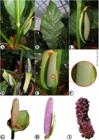
Anthurium galactospadix Croat. A. Stem erect, petiole carinate on the abaxial face. B. Leaf blade elliptical with strongly wavy margins, midrib and primary lateral veins prominent on the abaxial side. C. Inflorescence with short peduncle, spathe erect, green. D. Spadix whitish to greenish, spathe yellowish-green. E. Clavate spadix. F. Detail of flowers. G. Green, erect, ovate spathe with apex apiculate, whitish to cream spadix at anthesis with whitish pollen grains. H. Inflorescence in post-anthesis with a persistent spathe, spadix pinkish, clavate. I. Details from oblong to ellipsoid berries. Photos by Thomas Croat.
Epiphytic. Stem erect, 2-3 cm diam; cataphylls and prophylls brown, lanceolate, straight, persisting semi-intact as a reticulum of fibers, dividing at the apex. Leaves rosulate, not circinate when young, erect; petiole 11.5-29 × 0.5-1 cm green, obtriangular, with flat adaxially and sharp edges, obtuse abaxially; geniculum conspicuous, at base of blade, not spreading, 0.5-2 cm long; leaf blade 51-92 × 18-48 cm, without glands abaxially, discolored, green, coriaceous, simple (entire), elliptic, acute to acuminate apex, acute to obtuse base, with strongly undulate margins; midrib green in both faces, prominent, acute, 3-ribbed near the base; primary lateral veins 7-14 on both surfaces, 40-50º, prominent on both sides, rising straight or arched to the margin, acute on the adaxially; collective vein absent. Inflorescence erect; peduncle 6-11.3 cm long, green, cylindroid to clavate, smaller than the spadix; spathe 5.5-16.5 cm long, persistent at anthesis, erect to reflexed, dark green to green whitish, elliptic, flattened to navicular; spadix (4)5.4-18.2 cm long, whitish at anthesis, cream to green, cylindroid, sessile. Flowers square, 1.1-1.9 ×1.1-1.8 mm, sides mostly straight parallel to the spirals, irregularly sigmoidal perpendicular to the spirals; 13-25 in the principal spiral; 15-28 in the alternate spiral, tepals frosted, smooth or covered with a wax layer or papillate; lateral tepals 0.5-0.8 mm, the rounded inner margins, slightly upward against the pistil, the margins outer 2-sided; stamens emerging somewhat sporadically near the base, the lateral ones emerging at the apex before the first alternates appear, held erect by drying; anthers 0.4-0.6 × 0.4-0.5 mm wide; thecae oblong-ellipsoid, not divaricate; pollen whitish to cream. Infructescence erect, peduncle larger than the spadix; spathe persistent; berries pinkish, oblong; seeds 2 per berry, oblong to obovoid, 8 mm long.
Taxonomic remarks: Anthurium galactospadix is characterized by the peduncle being smaller than the spadix, the spadix whitish at anthesis, sessile, cylindroid to clavate, and the pollen grains whitish to cream. It resembles A. plowmanii in the proportion of the peduncle being smaller than the spadix, but differs from it in that it has a purple spadix, brownish at anthesis, sessile, tapered, and orange pollen.
Phenology:Anthurium galactospadix has been collected with flowers from October to December. Mature fruits have been observed in February (J.G. Graham & Schunke Vigo 1065 (F!).
Distribution and habitat:Anthurium galactospadix occurs in the western Amazon basin in extreme southeastern Colombia and east-central Loreto near the Brazilian border in Peru. In Brazil, it is distributed in the Northern region, in Acre and Amazonas states, at 300 m or less (Fig. 6). Anthurium galactospadix occurs in Ombrophilous Forest.
Anthurium jenmanii Engl., Pflanzenr. (Engler) 4, Fam. 23b: 72. 1905. Type: Guyana. Essequibo, Feb. 1889, Jenman 5760 (Lectotype: designated by T.B. Croat [1991: 662], K! 3 sheets, part 1: K000434162, part 2: K000434163, part 3: K000434164; isolectotypes, BRG!, NY!). Figure 15.
Anthurium englerianum Bunting, Acta Bot. Venez. 10: 270. 1975. Type: Venezuela. Monagas: between Guachardo & Cueva del Guacharo, 1 km above El Guacharo, 29 Nov. 1967, Bunting 2653 (Holotype: MY not found; Lectotype: designed by T.B. Croat [1991: 662], 4 sheets, part 1: NY00133760!, part 2: NY00133758!, part 3: NY00133759!, part 4: NY00133761!; isolectotypes, 4 sheets: part 1: K000434220!part2:K000434221!,part3:K000434222! Part 4: K000434223!)
Anthurium trinitatis Engl., Pflanzenr. (Engler) 4, Fam. 23b: 73. 1905. Type: Trinidad, 1877, Fendler 741 (Holotype: K000434027!; isotype, NY00133825!).
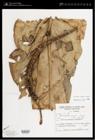
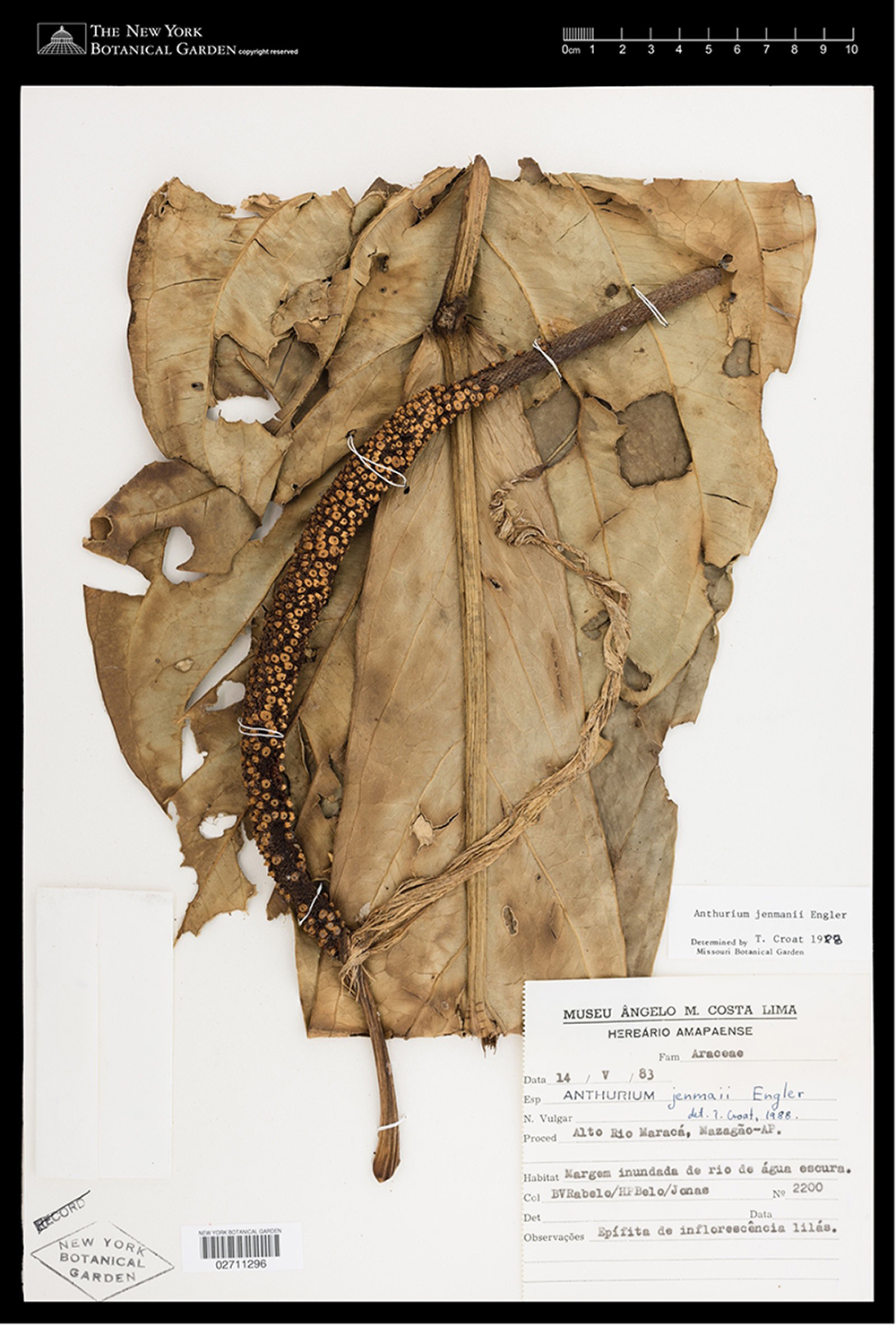
Epiphytic, terrestrial to rupicolous. Stem erect, 1.5-3 cm diam; cataphylls and prophylls brown, lanceolate, straight, entire at the apex and unraveling into fibers at the base of the stem. Leaves rosulate, not circinate when young, erect; petiole 7-20 × 0.6-1.5 cm, green, emicircular, flat to canaliculate adaxially, obtuse abaxially; geniculum conspicuous blade base, not spreading, 0.5-2.5 cm long; leaf blade 40-103 × 11-52 cm, without punctate glands abaxially, discolored, green, coriaceous, oblong to elliptic, acute apex, base slightly acute to obtuse, truncated to cordate at the base, with strongly undulate margins; midrib green, prominent, straight at the base, soon becoming abruptly acute above, becoming obtuse towards the apex below, prominent on the abaxial side, primary lateral veins 5-13 on both surfaces, 30-60º, sunken adaxially, prominent abaxially; absent collective vein or emerging only in the apical region of the leaf blade, 6-15 mm distant from margin. Inflorescence erect; peduncle 26-86 cm long, longer than spadix, green or sometimes purple, cylindroid; spathe 11-50 cm long, marcescent at anthesis, reflexed, light green tinged with purple, deciduous at post-anthesis, oblong to elliptic, sharp angle at junction with peduncle; spadix 10.4-47 cm long, dark brown to dark purple at anthesis, tapered, sessile. Flowers rhombic, 1.8-2.7 × 1.7-2.2 mm, sides straight to slightly sigmoid; 6-14 in the principal spiral; 6-10 in the alternate spiral; tepals frosted to semi bright, papillate; lateral tepals-1.2 mm long wide, slightly convex, the outer margins 2-sided; anthers yellow pale to orange, 0.4-0.5 × 0.5-0.7 mm; thecae ovoid, divaricate; pollen yellowish. Infructescence erect, smaller than the peduncle, spathe deciduous; berries 10 mm long, bicolored, violet at the base, whitish to violet tinged at the apex, obovoid; seeds 8 mm long, 2 per berry, brownish, oblong to obovoid.
Taxonomic remarks: Anthurium jenmanii is characterized by a leaf blade with primary lateral veins prominent adaxially, without punctate glands abaxially, spadix and spathe purple and usually marcescent on the anthesis, berries violet at base, whitish to tinged with violet at apex, obovoid. It resembles A. bonplandii, but that species usually has a leaf blade with dark punctate glands and purple to dark red at the apex, slightly whitish to purple at the base.
Phenology:Anthurium jenmanii has been collected with flowers and fruit throughout the year.
Distribution and habitat: Anthurium jenmanii occurs in Trinidad and Tobago, Venezuela (Sucre and Monagas; one collection from northeastern Bolivar) to Guyana, Surinam, French Guiana, and Brazil. In Brazil, it presents a distribution in the northern region, in Amapá, Amazonas, and Pará. Anthurium jenmanii occurs in the Amazon Domain Ombrophilous Forest (Fig. 6).
Anthurium krukoviiCroat, Ann. Missouri Bot. Gard. 78(3): 666. 1991. Type: Brazil. Amazonas: Maraã, Rio Japurá, Lago Maraã, Maraã, 10°51’S, 65°036’W, 4 Dec. 1982, Plowman et al. 12211 (Holotype: INPA125951!; isotype, MO3117449!). Figure 16.
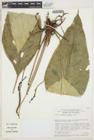
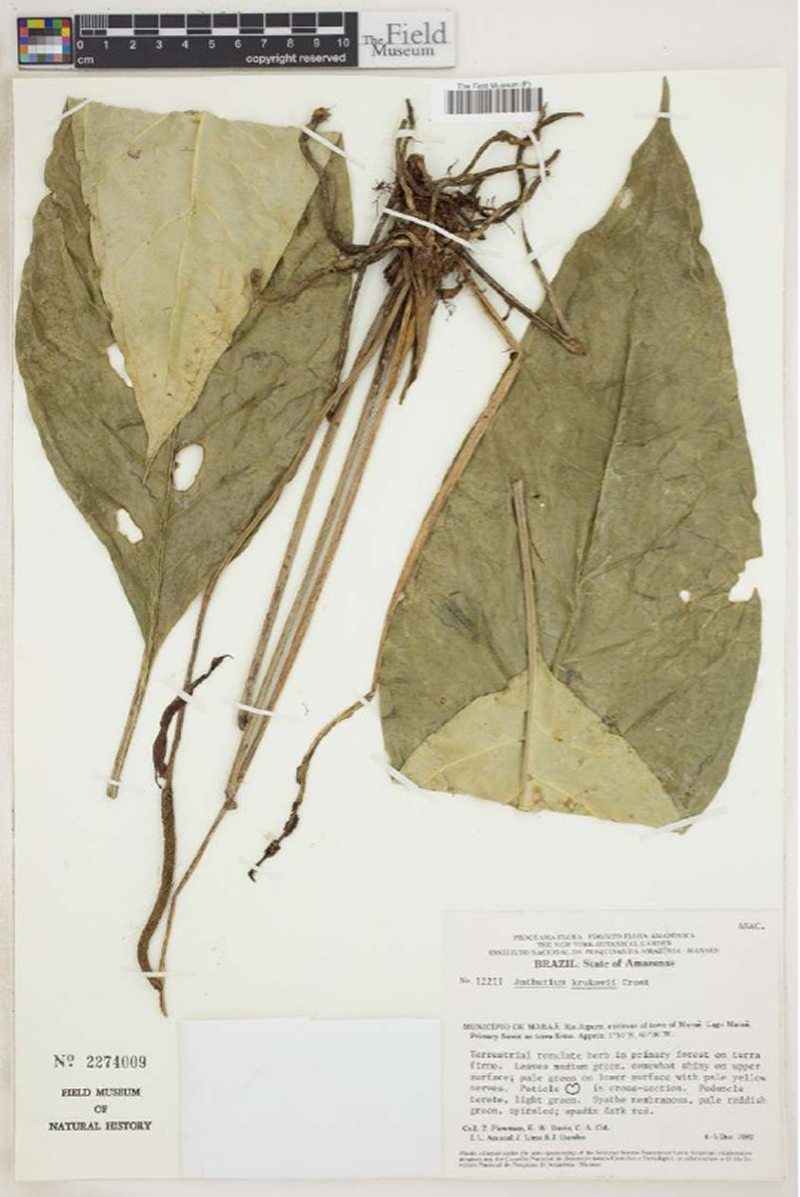
Terrestrial to epiphytic. Stem erect, 0.5-1 cm diam; cataphylls and prophylls lanceolate, straight, acute at the apex, persistent to eventually deciduous. Leaves rosulate, not circinate when young, erect, petiole 7-38 × 0.3-0.7 cm, green, subcircular, with adaxially canaliculate and obtuse margins, obtuse abaxially; geniculum appearing distant from the leaf blade, 4-11 cm long; leaf blade 26-40 × 8.5-18 cm, without glands abaxially, discolored, green, coriaceous, simple (entire), ovate-elliptic, apex long acuminate, base acute to obtuse, with strongly undulate margins; midrib green on both sides, prominent, slightly convex on the side adaxial, strongly acute on the adaxial; primary lateral veins 7-10 on both surfaces faces, 40-65º, flattened adaxially, prominent abaxially, acute; collective vein emerging near the base or to the midrib of the leaf blade, 5-15 mm away from the margin. Inflorescence erect; peduncle 20.5-57.5 cm long, green, cylindroid, larger than the spadix; spathe 8 cm long., persistent at anthesis, reflexed, green to reddish, coriaceous, oblong to elliptic, forming an acute angle at the junction with peduncle; spadix 12-15 cm long, dark brown to purple at anthesis, tapered to cylindroid, stipitate, when present, 1.5-3.5 cm long. Flowers ± square or rhombic when dry, 1.2-1.8 mm in both directions, sides straight to gently sigmoidal; lateral tepals 0.9-1.2 mm wide, the inner margins straight to broadly rounded, the outer margins 2-sided; anthers 0.2-0.3 × 0.4-0.5 mm, slanted on the pistil; thecae ovoid, slightly divaricate; pollen yellow to whitish. Infructescence erect, deciduous spathe; berries 3.5-3.7 mm long, concolorous, violet, globose to oblong-ovoid; seeds 2.5-2.8 mm long, 1-2 per berry, brown, oblong-ovoid, sometimes flattened on the sides.
Taxonomic remarks:Anthurium krukovii is characterized by an ovate to elliptic leaf blade, base rounded to abruptly attenuate and the geniculum 4-11 cm from the leaf blade, spadix 12-15 cm long, dark brown to purple at anthesis, and stipitate with the stipe 1.5-3.5 cm long. It resembles A. atropurpureum but differs from it in that it has more coriaceous and generally narrower leaf blades that are long attenuate (with more or less parallel margins) toward the base, and by having shorter petioles.
Phenology: Flowers from March to December and fruit in December.
Distribution and habitat: Anthurium krukovii is endemic to Brazil. It is known from a few collections made in the central, northern, and southwestern parts of Amazonas State, Brazil, below 150 m. Anthurium krukovii occurs in the Amazon Domain Ombrophilous Forest.
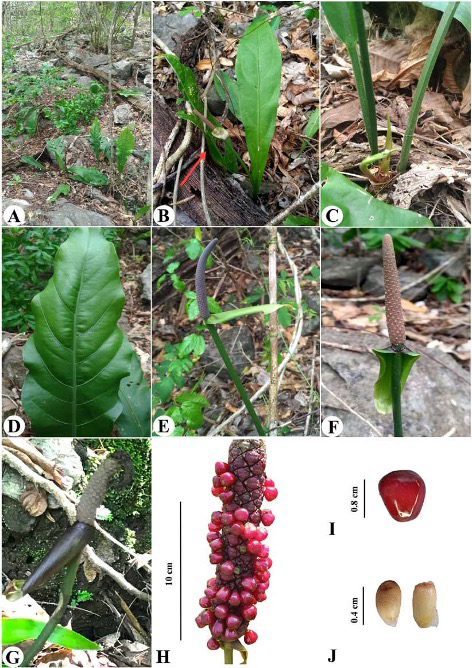
Anthurium leonii E.G.Gonçalves, Novon 15: 133. 2005. Type: Brazil. Minas Gerais, Alto Caparaó, Parque Nacional do Caparaó, 1300 m, 26 Oct. 1996, L.S. Leoni 3500 (Holotype: GFJP!; isotype, UB10451!). Figure 17.
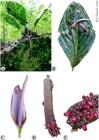
Anthurium leonii E.G.Gonç. A. Habit and inflorescence. B. Leaf blade with primary lateral veins and inflorescence with pendulous spadix. C. Spathe erect, spadix tapered, lilac. D. Infructescence pendulous with marcescent spathe. E. Detail of bicolor berries, vinaceous at base, purple at apex.
Terrestrial, rupicolous, rarely epiphytic. Stem erect, 0.4-0.7 cm diam; cataphylls and prophylls lanceolate, straight, entire to marcescent. Leaves rosulate, not circinate when young, erect; petiole 6-20 cm long, green, subcircular, with canaliculate adaxially and obtuse borders, obtuse abaxially; geniculum conspicuous, at base of blade, not distant, 1-1.2 cm long; leaf blade 46-79 × 21-40 cm, without punctate glands abaxially, discolored, green on the adaxially, lighter green abaxially, coriaceous, simple (entire), elliptic, apex obtuse to acuminate, base obtuse, truncate to cordate, straight margins; midrib green on both sides, prominent, obtuse; primary lateral veins 7-8 on both surfaces, 10º-30º; prominent on the axial side, strongly prominent abaxially; absent collective vein. Inflorescence pendent; peduncle 30-46 cm long, green, cylindroid, never ribbed, longer than the spadix; spathe 8-17 cm long, persistent at anthesis, erect, lilac adaxially, greenish abaxially, grooved margins absent, elliptic to ovate, apex acuminate, forming an acute angle at the junction with the peduncle; spadix 6.3-25 cm long, lilac at anthesis, tapered, sessile to stipitate, when present 4 mm long. Flowers rhombic, 1.4-2 cm; 9-13 flowers on the principal spiral; 7-10 on the alternate spiral; tepals matt, lateral tepals 0.6-1 mm, margins convex, 2-sided; pistil not emergent stigma ellipsoid; stamens obscuring pistil; filaments not exserted; anthers 0.4-0.5 × 0.3-0.8 mm, thecae ellipsoid to ovoid,0.4-0.5× 0.2-0.5 mm. pollen yellowish. Infructescence pendent, smaller than peduncle, spathe marcescent; berries 2-2.5 mm long., bicolored, vinaceous at base, purple at apex, oblong-ellipsoid; seeds 2-3 mm long, 1-2 per berry, cream colored, oblong to ellipsoid, smooth.
Taxonomic remarks: Anthurium leonii has an elliptic leaf blade, peduncle greenish, cylindroid, never ribbed, spathe lilac adaxially, greenish abaxially, the spadix lilac at anthesis, sessile or stipitate to 4 mm long, pollen yellowish, berries vinaceous at the base, purple at the apex, and cream-colored seeds. It is similar to A. solitarium, which has peduncle vinaceous to brown, cylindric to 1-keeled, vinaceous to brown spathe on both sides, vinaceous to brown spadix at anthesis, sessile, whitish pollen, entirely vinaceous berries and yellowish seeds.
Phenology: Flowers from January to October, and fruits from October to November.
Distribution and habitat:Anthurium leonii is endemic to Brazil and is distributed only in the southeastern region of Minas Gerais in the municipalities of Alto Caparaó, Parque Nacional do Caparaó (Camelo et al., 2020) and Lima Duarte, and Parque Estadual do Ibitipoca. Anthurium leonii occurs in the Atlantic Forest Domain, in Semideciduous Seasonal Forest and Vegetational Refuges (Fig. 6).
Anthurium lindmanianum Engl., Bot. Jahrb. Syst. 25: 367. 1898. Type: Brazil. Mato Grosso: Cupim próximo de Palmeiras, Lindman 2455 1/2 (Lectotype: designated by T.B. Croat [1991: 671], S!). Figure 18.
Anthurium douradense Rizzo, Rev. Goiana Med. 16: 31-33. 1970. Type: Brazil. Goiás: Serra Dourada, 1969, Rizzo 4532 (Holotype: UFG4470!; isotype, RB00535262!).

Anthurium lindmanianum Engl. A. Habit. B. Whole plant, stem decumbent, leaf blade obovate, straight margins. C. Inflorescence erect, peduncle greenish-vinaceous, spathe greenish with streaks, reflexed to revolute, spadix tapered, purple. D. Detail of stipitate spadix, green, green spathe with vinaceous striations. E. Spadix in post-anthesis, grayish, spathe marcescent. F. Infructescence with deciduous spathe, stipitate. G. Detail of bicolor berry, whitish from middle to base, purple at apex, obovoid. H. Detail of the purple seed, oblong.
Terrestrial to rupicolous, rarely epiphytic. Stem decumbent, 1-5 cm diam; cataphylls and prophylls green, lanceolate, straight, acute to acuminate at apex, persistent to entire, unraveling into thick fibers. Leaves rosulate, not circinate when young erect; petiole 4-9.5 cm long, green, subcircular, with flat to canaliculate adaxially, obtuse abaxially; geniculum conspicuous, at base of blade, not distant, 0.5-2 cm long; leaf blade 20-84 × 3-25 cm, without punctate glands abaxially, discolored, green, coriaceous, simple (entire), elliptic, apex acute, obtuse, acuminate, base cuneate to obtuse, rarely cordate, straight margins; midrib green lighter on both sides, prominent on both sides; primary lateral primary ribs 7-10 on both surfaces, 40-60º, prominent adaxially; collective vein absent or emerging only in the apical region of the leaf blade, 5-13 mm distant from the margin. Inflorescence erect; peduncle 39-74 cm long, green, cylindroid, larger than the spadix; spathe 4.5-5.5 cm long, persistent at anthesis, conspicuous to reflexed, white, greenish-yellow, elliptic, apex long-acuminate, forming an acute angle with the peduncle; spadix 3.9-24.5 cm long, greenish, grayish, pinkish, reddish, brown at anthesis, tapered, sessile or stipitate, when present 4-7 mm long. Flowers 4-lobed, 1.8-3 mm long; (2)4-9 flowers visible on the principal spiral, 4-10 on the alternate spiral; tepals matt, papillate; lateral tepals 0.9-2.2 cm long, inner margins straight to slightly rounded, outer margins 2-5 sides; pistil not emerging before anthesis, caviform; stigma linear, becoming circular, 0.2-0.3 mm long; anthers 0.4-0.6 mm long, 0.4-0.7 mm wide, drooping and obscuring the pistil; thecae ovoid-ellipsoid, not divaricate, pollen not seen. Infructescence erect, smaller than peduncle, spathe deciduous; berries 5-7 mm long, bicolored, white from middle to base, purple at apex, obovoid; seeds 5.5-6.8 mm long, 1-2 per berry, purple, apiculate on both sides, oblong, smooth.
Taxonomic remarks: Anthurium lindmanianum is characterized by a leaf blade elliptic without punctate glandular abaxially, elliptic or, rounded to acuminate at the apex, inflorescence with a long peduncle, 39-74 cm long, berries white from the middle to the base, purple at the apex. It is also distinguished by its stem decumbent on the soil surface and by its leaves being erect from the stem apex. It is similar to A. bonplandii but differs by having punctate glandular abaxially.
Phenology:Anthurium lindmanianum has been collected in flower from January to October, and in fruit from October to November.
Distribution and habitat: Anthurium lindmanianum is endemic to Brazil and is distributed in the northern and central-western region, in Rondônia, Pará, Goiás, and Mato Grosso states, at 90-1000 m. Anthurium lindmanianum occurs in the Amazon and Cerrado Domain in Campos Rupestres and Terra Firme Forest (Fig. 6).
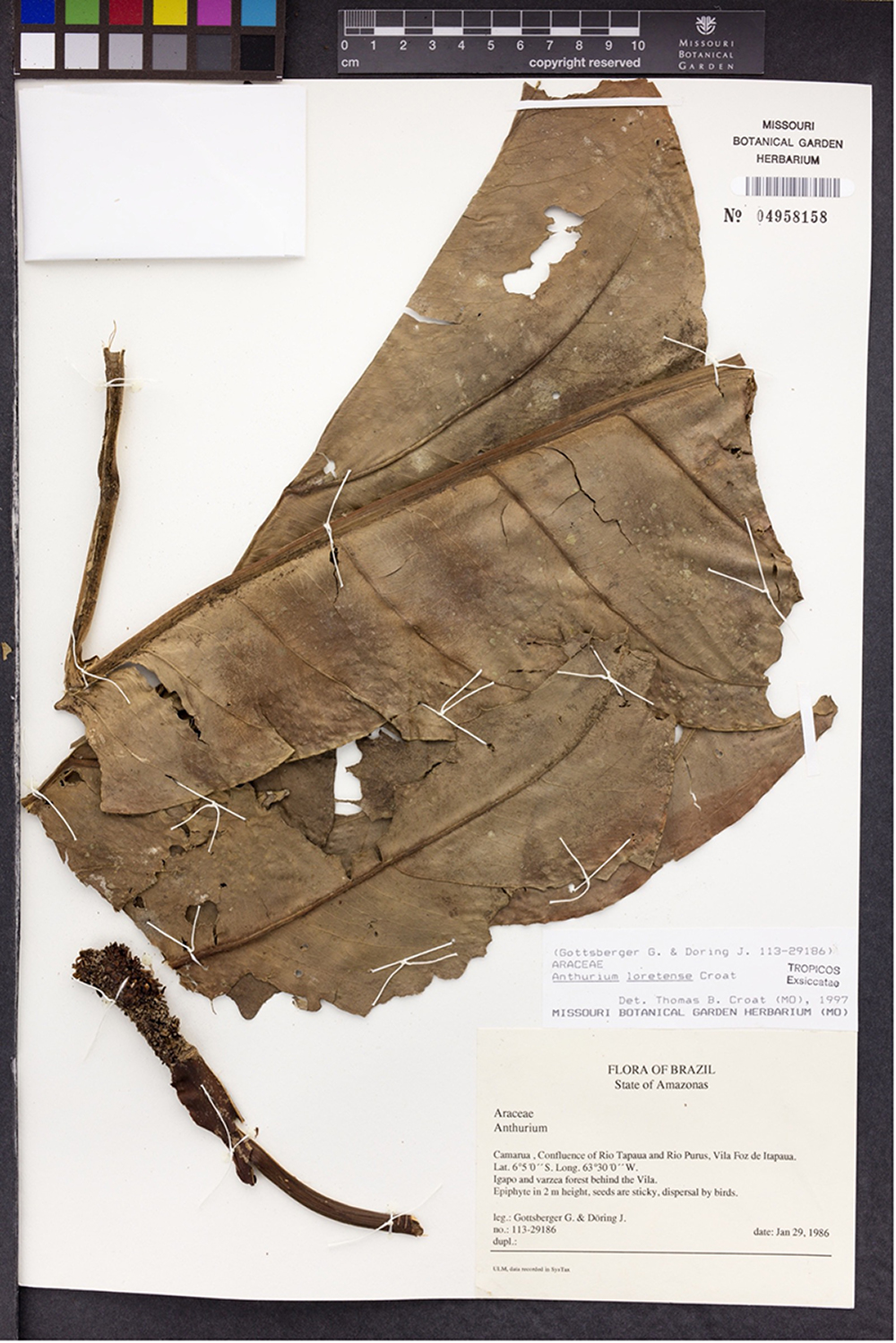
Anthurium loretense Croat, Novon 18: 144. 2008. Type: Peru. Loreto: Prov. Maynas, Dist. Iquitos, Rio Mo mon and Quebrada Momoncillo, 1 km do Rio Nanay, 200 m, 10 Nov. 1980, T.B. Croat 51226 (Holotype: MO101522067!; Isotypes: CM0299!, F0041633F!). Figure 19.

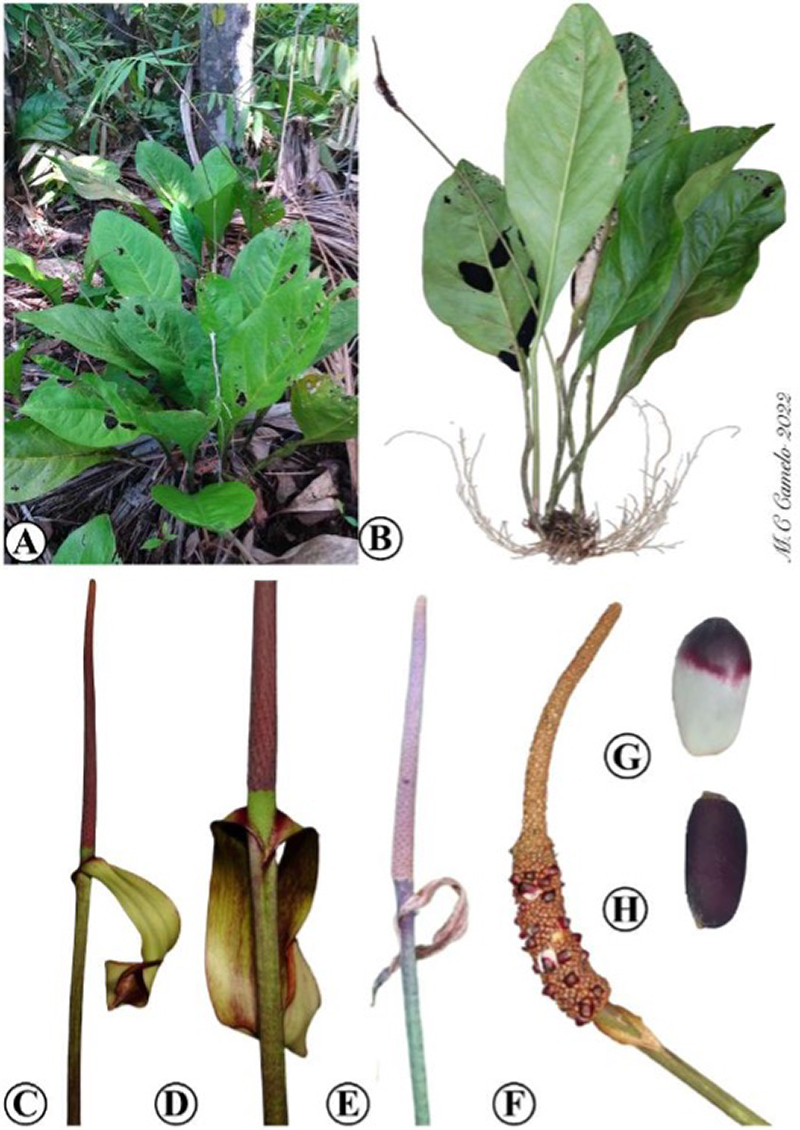
Epiphytic. Stem erect, 1.5-5 cm diam; cataphylls and prophylls green, cucullate, persistent at apex and unraveling into fibers at base. Leaves rosulate, with circinate margins when young, erect; petiole 2.5-13.5 × 0.6-2 cm, green, semi-circular, flattened to sulcate with a medial rib adaxially with acute edges, abaxially 3-8 costate; geniculum conspicuous, at base of blade, not distant, 0.7-3 cm long; leaf blade 56-120(168) × 14.2- 50 cm, punctate glands abaxially, brown punctate when dry material, discolored, green, coriaceous, simple (entire), oblong, elliptic to obovate, apex acute, obtuse to apiculate, base abruptly rounded, cordate, truncate, acute or attenuate, with strongly undulate margins; midrib light green abaxially, prominent on the both sides, flattened to acute at the base, becoming acute towards the apex; primary lateral veins 10-21 on both surfaces, 20-60º, prominent on the adaxially; collective vein absent or emerging only at the apical region of the leaf blade, 4-10 mm distant from the margin. Inflorescence pendent; peduncle 25-80 cm long, green to green tinged with brown, purple-violet, cylindroid, larger than the spadix; spathe 13-27 cm long, persistent at anthesis, erect, spreading to recurved, green slightly brownish green, elliptic, apex obtuse to long-acuminate; spadix 7.5-45 × 6-11 cm, brown, reddish to violet at anthesis, cylindroid, curved. Flowers square, rhombic to 4-lobed, 1.3-2.1 mm long, 7- 13 flowers visible on principal spiral, 5-9 flowers visible on alternate spiral; tepals matted, densely to minutely papillate; lateral tepals 0.6-1 mm, the inner margins straight to slightly convex, the inner margins straight to broadly convex, the outer margins 2-4 sided; pistils emergent, not elevated, purple to reddish; stigma linear, purplish violet, 0.3-0.7 mm long; stamens emerging in regular sequence from the base, the laterals preceding the alternates in ca. 18 spirals; anthers pink to purple-orange, 0.3-0.5 mm long, 0.2-0.7 mm wide, drooping and obscuring the pistil; thecae oblong-ellipsoid to obovoid, slightly or not divaricate; pollen yellow to white. Infructescence pendent, smaller than peduncle, spathe persistent; berries purple, oblong, mesocarp succulent; seeds 2 per berry, white.
Taxonomic remarks: Anthurium loretense is characterized by cucullate cataphyll and leaf blades with punctate glands abaxially, the spadix 6-11 cm in diameter and the peduncle 25-80 cm long. Anthurium loretense is similar to A. cataniapoense but differs by the cucullate cataphyll (vs. hook-shaped cataphyll), spadix 6-11 cm diam. (vs. 0.3-0.5 cm).
Phenology: Flowers from January to October, and fruits from October to November.
Distribution and habitat: Anthurium loretense occurs in Peru (Loreto, Pasco, San Martin, and Ucayali Departments below 350 m in tropical moist forests), in Ecuador (Napo and Morona-Santiago), from southernmost Colombia near Leticia, and from Brazil in southwestern Amazonas, where it is known only from the Jutaí River. Anthurium loretense occurs in the Amazon Domain in Ombrophilous Forest (Fig. 6).
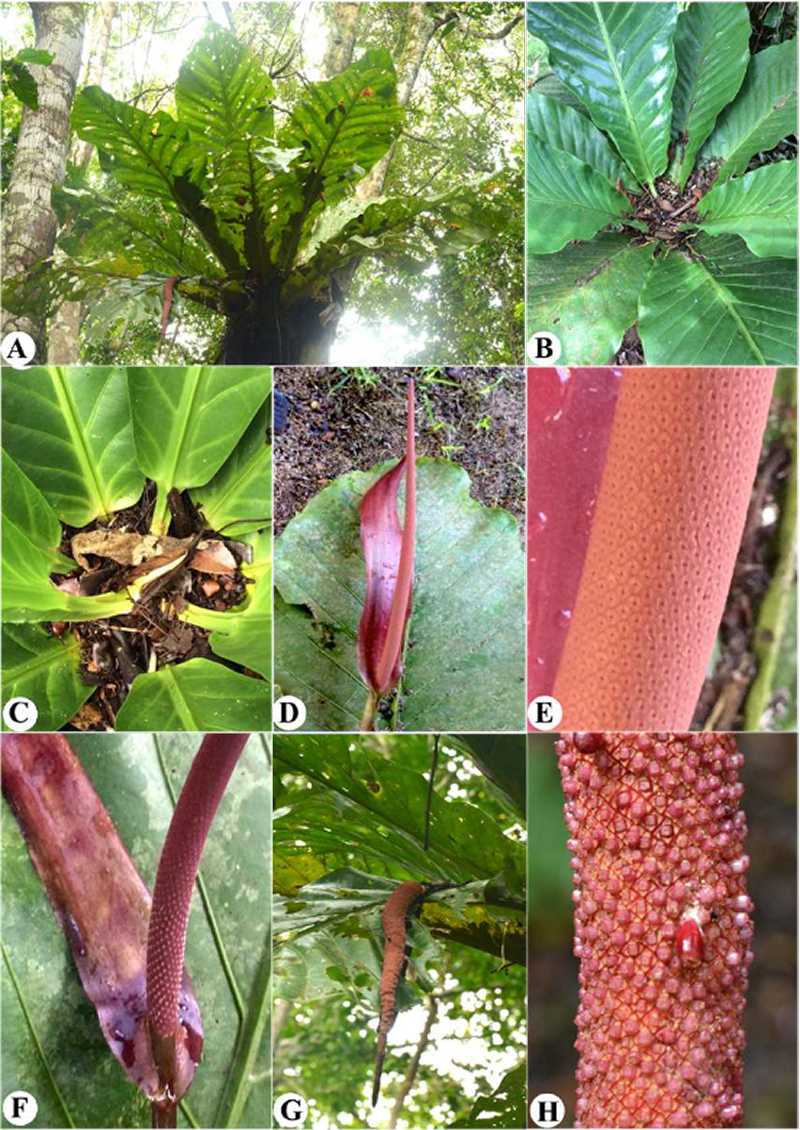
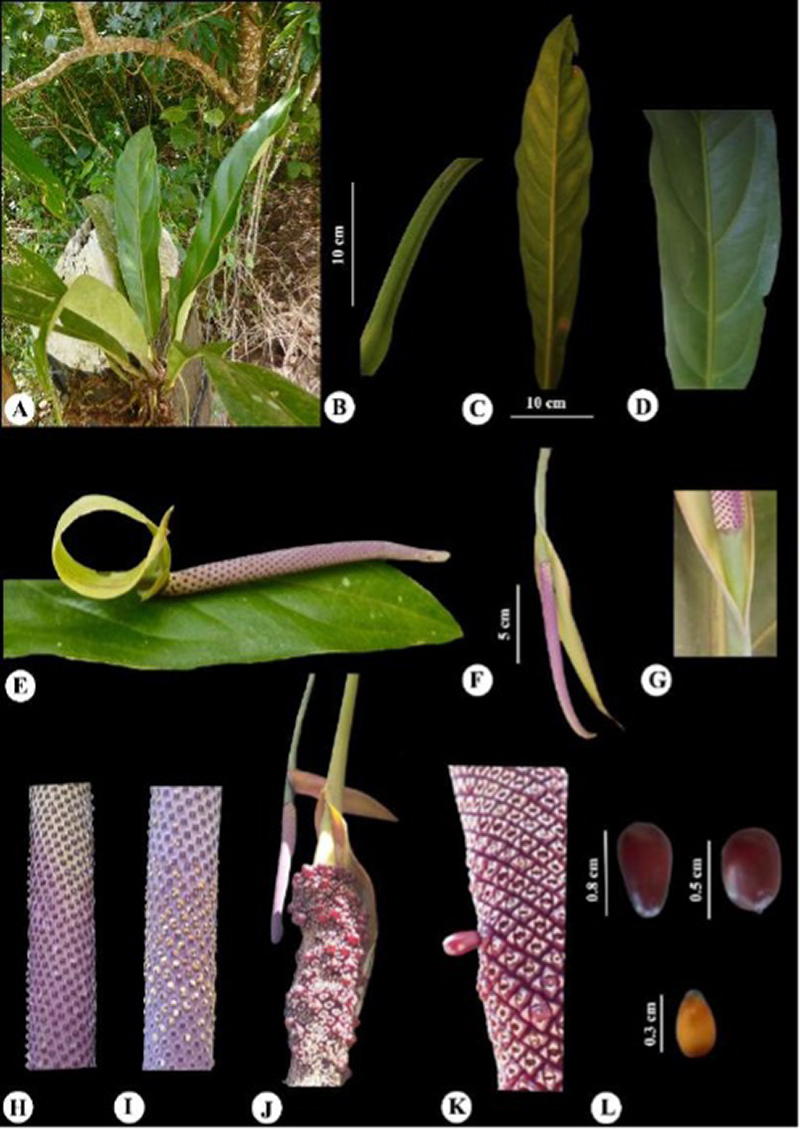
Anthurium mayoanumCamelo, Croat & Nadruz, Phytotaxa (523) 3: 230. 2021. Type. Brazil. Pará: Aveiros, Tapajós National Forest (FLONA), collected along the Rio Cupari just upstream of the community of São Francisco do Godinho, 3°47’18” S, 55°22’17” W, 17 m, 16 Jan. 2020, B.M. Torke et al. 2242 (Holotype: RB806923!, Isotypes: NY04205478!, HSTM16306!). Figure 20.
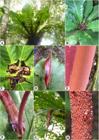
Anthurium mayoanum Camelo, Croat & Nadruz. A. Habit. B. Leaf blade with rosulate arrangement. C. Cataphylls and base of leaf blade truncated at the base. D. Spadix tapered, sessile, coral colored. E. Detail of coral-colored flowers. F. Spadix at anthesis. G. Pendent infructescence. H. Detail of the coral-colored infructescence, vinaceous berries. Photos by Edgar Lobato and Luiz Otávio Adão.
Epiphytic. Stem erect; cataphylls and prophylls brown, lanceolate, straight to slightly curved, usually deciduous. Leaves rosulate, petiole 6-10 cm, green, obtrapezoidal, with flat adaxially and median 1-rib, acute edges adaxially, abaxially 3-ribbed; geniculum conspicuous, at base of blade, not spaced apart, 1-1.5 cm; leaf blade (45)60-100 × (13)17-30 cm, without punctate glands abaxially, discolored, dark green adaxially, medium green abaxially, obovate, slightly oblong to elliptic, apex acute to acuminate, base truncate to cordate, coriaceous, entire, with strongly undulate margins; midrib green on both sides, prominent, acute adaxially, 3-ribbed abaxially, rounded towards the apex abaxially; primary lateral veins 10-18 on both surfaces, 45-90°, prominent; collective vein absent or emerging only on the apical region of the blade. Inflorescence pendent; peduncle 60-100 cm long, green tinged with purple, cylindroid, larger than the spadix; spathe 5-10 cm long, persistent at anthesis, pendent, greenish on the adaxially, entirely coral to slightly purple abaxially, elliptic, acuminate at the apex, forming an acute angle at the junction with the peduncle; spadix 7-9 cm long, coral at anthesis, tapered, sessile. Flowers 9-10 in the principal spiral, 9-10 in the alternate spiral; pollen cream to coral. Infructescence pendent to pendent, smaller than peduncle, spathe persistent; berries 8-10 mm long, concolorous, reddish to purple, oblong-ellipsoid, with tepal filaments; seeds 2 per berry, oblong, apex acute, cream-colored, 0.8-1 mm.
Taxonomic remarks:Anthurium mayoanum is characterized by leaf blades 60-100 cm long, oblong to elliptic, base truncate to cordate, strongly undulate margins, peduncle 60-100 cm long, spathe entirely coral to slightly purple tinged abaxially, elliptic, spadix coral at anthesis, tapered, sessile. It is similar to A. salvinii Hemsl., which does not occur in Brazil, but the two differ in their spadix color, bluish to lilac spadix in A. salvinii and coral spadix in A. mayoanum (Camelo et al., 2021b).
Phenology: Anthurium mayonum has been collected with flowers and fruits in January.
Distribution and habitat: Anthurium mayoanum is endemic to Brazil (Camelo et al., 2021b), with distribution only in the northern region, in Amazonas, near Rio Cupari. Anthurium mayoanum occurs in the Amazon Domain, in Igapó Forest vegetation type. (Fig. 7).
Anthurium oxycarpum Poepp., in Poeppig & Endl., Nov. Gen. Sp. 3: 83. 1845. Type: Peru. Loreto, Yurimaguas, 1831, Poeppig 2293 (Lectotype: designated by Croat [1991: 689], G00098032!; isolectotypes, MO390253!, MO101529498!). Figure 21.
Anthurium strictum N.E.Br. ex Engl., Monogr. Phan. 2: 638. 1879. Type: Brazil. Acre: Rio Branco, N. E. Brown s.n. (Holotype: K000434141!, isotype, F0BN012085!).
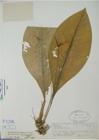
Epiphytic, terrestrial, sometimes saxicolous. Stem short, erect; internodes short; cataphylls and profiles lanceolate, straight, green, persistent and unraveling into fine linear fibers, prominent with 1 rib, apex acuminate and apiculate; leaves rosulate, not circinate when young, erect; petiole 5-15 × 4-9 cm, green, subcircular, canaliculate to rounded adaxially, rounded to flattened abaxially; geniculum conspicuous, at base of blade, not distant, 1-2.5 cm long; leaf blade 22-55 ×10-19 cm, without punctate glands abaxially, discolored, medium to dark green adaxially, moderately to conspicuously paler abaxially, coriaceous, simple (entire), elliptic to obovate, apex acute to acuminate, base acute to attenuate, straight margins; midrib green, prominent, obtuse to base, convexly raised to apex; primary lateral veins 10-25 on both surfaces; collective vein emerging close to base, inscribed on adaxially, acute abaxially, 5-11 mm distant from margin. Inflorescence erect; peduncle 18.5-54.7 cm long, green, cylindroid, larger than the spadix; spathe 4.5-12.5 cm long, green to dark green, sometimes tinged red or brown at the margins, lanceolate to elliptic, apex acuminate, entire, persistent, pendent to reflexed, acute angle with the peduncle; spadix 4-8.5 cm long; bluish, yellowish-greenish, greenish, sometimes cream, tapered, stipitate 1.7-2 cm long. Flowers square, 2.4-3.2 mm long, 4-7 flowers in the principal spiral; 9-11 flowers in the alternate spiral; tepals bluish-green, frosted, few droplets present at anthesis; lateral tepals 1.3-2 mm, the inner margins broadly convex, the outer margins 2-3 sided; pistils weakly emergent at anthesis, frosted, green, turning brown; stigma 0.6-0.7 mm long, oblong-ellipsoid, brush-like; stamens emerging in complete regular and ready sequence from the base, slightly inclined inward over the stigma; anthers 0.5-0.6 mm long, white, cream to orange; thecae divaricate; white pollen. Infructescence erect, with spadix smaller than the peduncle, spathe persistent, berries 7.3-12.3 mm long, bicolored, green at base, red to purple at apex, obovoid-oblong to ellipsoid-ovoid, apex long-acuminate to rounded towards apex, with radial crystals; pericarp transparent; mesocarp gelatinous with raphids; seeds 5.3- 5.5 mm long, 2 seeds per berry, yellowish, oblong-ovoid, flattened, with mucilage.
Taxonomic remarks: Anthurium oxycarpum is characterized by a leaf blade with straight margins, an erect inflorescence, spathe green to dark green, a stipitate spadix, stipe 1.7-2 cm long, the spadix bluish, yellowish - greenish, greenish, sometimes cream, and tapered at the apex. It is similar to A. krukovii, from which it differs in that the leaf blade is ovate-elliptic, apex acute to apiculate, coriaceous, spathe reddish-green, spadix reddish to brown, and the stipe 1.5-3.5 cm long.)
Phenology: Anthurium oxycarpum has been collected with flowers from April to November and fruit from January to June.
Distribution and habitat: Anthurium oxycarpum occurs in southeastern Colombia to Amazonian Ecuador, Peru, Bolivia, and in Brazil, is distributed only in the Northern region: Acre, Amazonas, and Rondônia, at 100-870 (-1300) m. Anthurium oxycarpum occurs in the Amazon Domain, in Ombrophilous and Terra Firme Forests (Fig. 7).
Anthurium paraguayense Engl., Bot. Jahrb. Syst. 25: 361. 1898. Anthurium paraguayense Engl. var. paraguayense. Type: Paraguay. Assunção, Colonia Elisa, Jul. 1893, Lindman A1823 (holotype B100242960!; isotype, S!). Figure 22.
Anthurium paraguayense var. coroicoanumCroat. Ann. Missouri Bot. Gard. 78(3): 698, f. 228, 229, 232. 1991. Type: Bolivia. La Paz: between Caranavi and Guanay, 28.1 km N of Caranavi, near bridge over Rio Coroico, 15°027'S, 67°050'W, 820 m, T.B. Croat 51704 (Holotype: MO2825694!; Isotypes: B10 0242959!, K000434259!, LPB0000146!).
Anthurium rodrigoi A. Hawkes, Phytologia 3: 27. 1948. Type: Argentina. Chaco: Tapenaga, Enrique Urien, Nov. 1940, Rodrigo 2690 (Holotype: NY00133814!).
Anthurium rusticum N. E. Br. ex Engl., Pflanzenr. (Engler.) 4, Fam. 23b: 82. 1905. Type: Bolivia. La Paz: Yungas, Coroico, Aug. 1894, Bang 2479 (Holotype: NY00133815!;isotypes:GH00028671!,K000434260!MICH1115580!, MO352120!,NY00133816!, US00087895!).
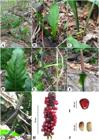
Anthurium paraguayense Engl. A. Habit B. Detail of the inflorescence smaller than half of the leaf blade. C. Cataphylls lanceolate, erect, petiole carinated. D. Leaf blade with strongly wavy margins, prominent midrib, acute, primary lateral veins prominent. E. Inflorescence in pre-anthesis, peduncle green, cylindroid, spathe green, patent, spadix lilac, tapered, curved. F. Brown spadix at anthesis, tapered, green spathe, reflexed. G. Spadix in post-anthesis brown, spathe dark green, reflexed. H. Infructescence erect, berries magenta. I. Detail of 1 berry, obovoid, shiny. J. Detail of two seeds, cream with vinaceous streaks.
Terrestrial to epiphytic. Stem 0.5-0.6 cm diam, erect; cataphylls and prophylls green, lanceolate, straight, acute to 1-ribbed at apex, persisting in a fibrous reticulum at base. Leaves rosulate, not circinate when young, deflexed; petiole 3-28 cm long, obtrapezoidal, grooved adaxially and 1 median rib with acute edges, abaxially 3-ribbed; geniculum conspicuous, at base of blade, 0.7-2.5 cm long; leaf blade 22-100 × 5-19.5 cm, without punctate glands abaxially, concolorous, dark green, coriaceous, oblong to obovate, long-acuminate apex, acute base, obtuse, rounded to truncate, with strongly undulate margins; midrib green on both faces, prominent, 1-median rib, acute, flattened towards apex adaxially, raised abaxially, becoming acute and then narrowly elevated towards apex above; primary lateral veins 4-10 on both faces, (25)30-70º, prominent on both faces, acute; collective vein absent or emerging only in apical region of blade, 5-9 mm from margin. Inflorescence erect to pendent, peduncle 14-65 cm long, dark green, cylindroid, larger than the spadix; spathe 6-17 cm long, persistent at anthesis, pendent to reflexed, dark green tinged with purple, elliptic to obovate, apex acute to acuminate, forming acute angle at the junction with peduncle; spadix 4-15 cm long, green tinged with purple or gray at anthesis, tapered, sessile. Flowers 4-sided to rhombic, 2.5-4 mm long; 5-8 flowers visible on the principal spiral, 7-10 on the alternate spiral; tepals matte, sometimes punctate and papillate; lateral tepals 0.9-1.5 mm, the inner margins convex to straight, outer margins 3-4 sided; pistils not emergent, greenish to tinged with purple; stigma ellipsoid, 0.2-0.5 mm long, stamens emerging in a regular sequence; filaments translucent, with raphids; anthers yellowish to reddish-purple, 0.5-0.7 mm, inclined above to obscuring the pistil; thecae oblong to oblong-ellipsoid. Infructescence pendent, smaller than peduncle, spathe persistent; berries 5-10 mm long, concolorous, vinaceous to magenta, obovoid, apex rounded; seeds 5-6.2 mm long, 2 per berry, cream colored with reddish or brown streaks, ovoid, flattened.
Taxonomic remarks:Anthurium paraguayense is characterized by an oblong to obovate leaf blade with strongly undulate margins, 1-3-keeled petiole abaxially and grooved with 1-rib adaxially, peduncle larger than the spadix, and vinaceous to magenta berries. It resembles A. plowmanii, which differs by the peduncle being shorter than the spadix and by the entirely red-orange berries.
Phenology:Anthurium paraguayense has been collected with flowers and fruits from June to December.
Distribution and habitat: Anthurium paraguayense occurs in Bolivia, Paraguay and Brazil. In Brazil, it is distributed only in the Central-western region, in Mato Grosso do Sul. Anthurium paraguayense occurs in the Atlantic Forest, Cerrado and Pantanal Domains and is only found in Deciduous Seasonal Forest (Fig. 7).
Anthurium plowmanii Croat, Candollea 42(2): 811-813. 1987. Type: Brazil. Amazonas: Manaus, Chácaras de Tarumã, 16 km de Manaus, 60 m, 2051'S, 59'50'W, 12 Jun. 1982, T.B. Croat & Nelson 53563 (Holotype: designated by T.B. Croat [1991: 702], INPA161527!; isotype, B!, G!, K! part 1: K001239600, part 2: K001239601, IBE!, MO3129392!, NY01073794!, RSA!, US!). Figure 23.
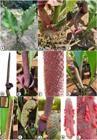
Anthurium plowmanii Croat. A. Habit. B. Cataphylls in thin, "hair-like" fibers (arrow). C. Petiole U-shaped, peduncle smaller than the petiole. D. Spadix larger than peduncle, tapered, purple. E. Spadix at pre-anthesis. F. Detail of the spadix with nectar droplets. G. Inflorescence at anthesis, brownish. H. Detail of the spadix at anthesis with orange pollen grains. I. Infructescence erect at post-anthesis. J. Post-anthesis inflorescence showing 1 berry. K. Infructescence with red berries. L. Detail of concolor, oblong, shiny berries.
Rupicolous, terrestrial to epiphytic. Stem erect, 0.2-0.6 cm diam; cataphylls and prophylls reddish-brown, lanceolate, straight, obtuse to acute at apex, persisting in a fibrous reticulum. Leaves rosulate, not circinate when young, erect; petiole 10-40 cm long, subcircular, with canaliculate adaxially and obtuse borders, obtuse abaxially to rarely 1-2 ribs abaxially; geniculum conspicuous, at base of blade, not distant, 0.5-2 cm long; leaf blade 34-125 × 20-55 cm, without glands abaxially, concolorous, dark green on both faces, coriaceous obovate, elliptic, apex acuminate to obtuse, base acute, attenuate, obtuse, with strongly undulate margins; midrib green on both faces, prominent, flattened to angular at base, becoming prominent to angular at apex on both faces, 2-3 ribs at base; primary lateral veins 7-15 on both surfaces, (30)45-65°, ascending directly to margin or slightly arched-ascending, prominent and convex raised on both faces; collective vein absent or emerging near apical region of blade, 4-6 mm from margin. Inflorescence erect to pendent; peduncle 6-32 cm long, green to lightly tinged with red, purple or brown, cylindroid to fluted, smaller than the spadix; spathe 5-26 cm long, persistent at anthesis, pendent, reflexed to recurved, violet to purple, apex acute to long-acuminate, forming an acute angle at the junction with the peduncle; spadix 8-46 cm long, greenish, brown, green tinged with violet, violet, purple at anthesis, tapered to cylindroid, sessile to stipitate, when present 0.5-2 cm long. Flowers square to rhombic, 1.5-2.5 mm, (8)10-16(18) flowers 6-10 visible on both spirals; tepals matted, densely papillate; lateral tepals 0.6-1.2 mm, the inner margins straight to convex, the outer margins 2-sided; pistil emergent, reddish to dark purple; stigma linear, 0.2-0.6 mm long; stamens emergent in a regular sequence to base; anthers orange, ca. 0.6-0.8 mm long; pollen orange. Infructescence erect, longer than peduncle, spathe deciduous; berries 8-13 mm long, concolorous, red-orange, obovoid, truncate at apex; seeds 8 mm long, 1-2 seeds per berry, cream, oblong.
Taxonomic remarks:Anthurium plowmanii has an erect inflorescence, the peduncle shorter than the spadix, the spadix violet to purple at anthesis and tapered distally, and the berries entirely red-orange. It resembles A. paraguayense, which differs in the peduncle longer than the spadix, the spadix greenish, purple or grayish at anthesis, and vinaceous to magenta berries.
Phenology: Anthurium plowmanii has been collected with flowers and fruits from March to October.
Distribution and habitat:Anthurium plowmanii occurs in Bolivia (La Paz, Pando, and Santa Cruz), Paraguay (Amambay), Peru (San Martin) at 50-900 m, and in Brazil it is distributed in the North Region and the Central-west (Acre, Amazonas, Mato Grosso, and Rondônia). Anthurium plowmanii occurs in the Amazon and Cerrado domains in Ombrophilous and Deciduous Seasonal Forests (Fig. 7).
Anthurium pluricarinatumCamelo, Temponi, Nadruz & Baumgratz. Phytotaxa 599 (2): 111. 2023. TYPE: Brazil. Rio Grande do Norte: Maxaranguape, subindo a duna ao lado da estrada principal, 5°26’5’’S, 35°17’52’’W, 20m, 20 Jul. 2019 (fl.), M.C. Camelo et al. 111 (Holotype: RB792031!; Isotype: UFRN!). Figure 24.
Terrestrial. Stem 1.5 cm diam, erect; cataphylls and profiles brown, lanceolate, straight, acuminate, persistent, and semi-integrated at apex, decomposed into fibers at stem base. Leaves rosulate, not circinate when young, erect; petiole 5.5-12 cm long, green, semilunar, with canaliculate adaxially and acute edges, abaxially multi-ribbed (3-6); geniculum conspicuous, at base of blade, not distant, 0.5-0.8 cm long; leaf blade 21.5-22.5 × 5.3-15 cm, without glands abaxially, discolored, green, coriaceous, simple, elliptic to obovate, apex acuminate to apiculate, base acute to obtuse, with strongly undulate margins; midrib prominent on both faces, greenish-yellow, 3-ribbed adaxially, acute angle at full length to obtuse at the apex, obtuse from the middle to the apex, 3-keeled to the base abaxially; primary lateral veins 5-7 on both faces, prominent; collective vein absent. Inflorescence erect; peduncle 21.5-26.5 cm long, greenish, several ribbed, larger than the spadix; spathe 2-2.5 cm long, persistent at anthesis, reflexed, entirely vinaceous to nigrescent, without streaks, ovate, apex acuminate, forming an acute angle at the junction with the peduncle; spadix 2.8-3 × 0.5 cm, greenish-vinaceous to purple at anthesis, cylindroid, stipitate; stipe 2-4 cm long. Flowers 7-10 in principal spiral; flowers 6-8 in alternate spiral; pollen yellowish. Infructescence erect; berries 5.5-6.1 x 3.6-4.1 mm, oblong, reddish; seeds 4.7-5.1 × 1.9-2.1 mm, 1-2 per berry, ellipsoid, flattened unilaterally, yellowish, wrinkled, with mucilage.
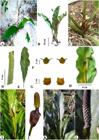
Anthurium pluricarinatum Camelo, Temponi, Nadruz & Baumgratz. A. Habit. B. Detail of the whole plant, erect stem. C. Leaf blade lanceolate, apex acuminate, persistent, cataphylls decomposed into fibers at base. D. Detail of petiole semilunar, sulcate adaxially with acute margins, abaxially surface 3-6-carinated. E. Detail of leaf blade. F. Cross-section of the petiole with several carinated on the adaxial side. G. Cross-section of midrib. H. Detail of leaf blade with strongly wavy margins and stipitate spadix. I. Erect inflorescence in pre-anthesis. J. Erect inflorescence, reflexed spathe, greenish-vinaceous spadix. K. Cylindroid spadix, purple at anthesis. L. Detail of purple spadix at anthesis with pollen grains.
Taxonomic remarks: Anthurium pluricarinatum can be recognized by the petioles that are 3-6-ribbed abaxially, vinaceous to nigrescent spathe, greenish-vinaceous peduncle, and a spadix 2.8-3 cm long that is greenish-vinaceous to purple (vs. A. affine, with a cylindroid up to < 3-ribbed petiole, greenish peduncle, spathe greenish or with vinaceous striations, spadix yellowish-green to yellowish at anthesis, and 4-19 cm long) (Camelo et al., 2023b).
Phenology:Anthurium pluricarinatum has been collected with flowers in June October and in fruit in May.
Distribution and habitat: Anthurium pluricarinatum is endemic to Brazil and is distributed only in the Northeastern region, Rio Grande do Norte and occurs in the Atlantic Forest and vegetation type of Restingas (Fig. 8).
Anthurium pranceanumCroat, Ann. Missouri Bot. Garden 78(3): 704, f. 241. 1991. Type: Brazil. Acre: Rio Moa, Cachoeira Grande e Serra de Moa, 28 Apr. 1971, G.T. Prance et al. 12640 (Holotype: designated by T.B. Croat [1991: 704], INPA30963!; Isotypes: NY133809!, U0000611!, US2705083!). Figure 25.
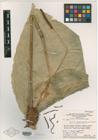
Terrestrial. Stem 1-1.5 cm long, erect; cataphylls and prophylls reddish-brown, lanceolate, straight, semi-intact. Leaves rosulate, not circinate when young, erect; petiole 35-65 × 4-8 cm, green, subcircular, grooved adaxially and obtuse margins, obtuse abaxially; geniculum inconspicuous, 1 cm long; leaf blade 40-70 × 15-26 cm, punctate glands abaxially, brown punctate when dry, concolorous, green to yellowish-green on both sides, coriaceous, simple (entire), ovate to elliptical, apex acuminate, base obtuse to attenuate, strongly undulate margins; prominent adaxially, acute abaxially; primary lateral veins 6-9 on both surfaces, prominent, arched to the margin; collective vein emerging near or above the leaf blade, 7-24 mm distant from the margin. Inflorescence pendent; peduncle 24-43 cm long, green, cylindroid, larger than the spadix; spathe 4 cm long, persistent at anthesis, violet, elliptic; spadix 3.7-7.7 cm long, < 6 cm diam., violet at anthesis, tapered, stipitate, 1.5-2.5 cm long; flowers rhombic, 2 mm on both sides, 2 mm in both sides, the sides straight to gently sigmoid; 4-6 flowers per spiral; tepals smooth when dry; lateral tepals 1 mm wide, the inner margins straight, the outer margins 2-sided; pollen not seen. Infructescence not seen; berries and seeds not seen.
Taxonomic remarks: Anthurium pranceanum can be recognized by the ovate to elliptic leaf blade, obtuse to rarely attenuate base, with punctate glands abaxially, inconspicuous geniculum, and violet spadix at anthesis. Anthurium pranceanum is similar to two other species, A. krukovii and A. bonplandii, but A. krukovii differs by the geniculum distant from the leaf blade 4-11 cm, without punctate glands abaxially, while A. bonplandii differs by its conspicuous geniculum, elliptic leaf blade, attenuate to acute base, and reddish spadix at anthesis.
Phenology:Anthurium pranceanum has been collected with flowers in April.
Distribution and habitat: Anthurium pranceanum is endemic to Brazil and is distributed only in the Northern region, in Rio Moa, Acre state. Anthurium pranceanum occurs in the Amazon Domain in Ombrophilous Forest (Fig. 8).
Anthurium santaritense Nadruz & Croat, Aroideana 28: 65. 2005. Type: Brazil. Minas Gerais: Faria Lemos, Fazenda Santa Rita, 600 m, 1 Feb. 2003, L. S. Leoni 5245 (Holotype: designated by Nadruz & Croat [2005: 28, p. 65], GFJP!; Isotypes: K!, MO1169782!, RB00535278!, US!). Figure 26.
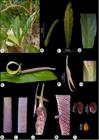
Anthurium santaritense Croat & Nadruz. A. Habit. B. Petiole subcircular, sulcate on adaxial face with obtuse margins on adaxial side, obtuse on abaxial side. C. Leaf blade lanceolate. D. Detail of prominent midrib and primary lateral veins on the adaxial side. E. Detail of inflorescence in pre-anthesis with revolute spathe. F. Pendulous inflorescence, reflexed sheath at anthesis. G. Stipitate spadix and spathe forming an acute angle at the junction with the peduncle. H. Pre-anthesis spadix with nectar droplets. I. Spadix at anthesis with yellowish pollen grains. J. Inflorescence and pendulous infructescence. K. Infructescence with a berry. L. Detail of concolorous berries and seeds. Photos F-L by Lucio Leoni.
Epiphytic. Stem 1.5 cm diam, erect; cataphylls and prophylls brown, lanceolate, straight, entire to decumbent. Leaves rosulate, not circinate when young, erect; petiole 2.4-13.1 cm long, greenish, subcircular, with canaliculate adaxially and obtuse margins, obtuse abaxially; geniculum conspicuous, at base of blade, not distant, 0.3-1 cm long; leaf blade 30.6-77.7 × 5.5-20 cm, without glands abaxially, discolored, greenish on both sides, slightly chartaceous, simple (entire), elliptic, acute to apiculate apex, acute base, straight margins; midrib green on both sides, lighter than the leaf blade, prominent, obtuse; primary lateral veins 4-6 on both surfaces, 10.5-30°, green, lighter than leaf blade, prominent on both sides; collective vein absent. Inflorescence pendent; peduncle 33-48 cm long, slightly greenish with vinaceous nuances, cylindroid, larger than the spadix; spathe 5.8-8.3 cm long; persistent, erect, yellowish to greenish on both sides, striated margins present, lilac at the apex, membranous, elliptic, ovate, apex acuminate, forming an acute angle with the peduncle; spadix 6-10 cm long, lilac at anthesis, tapered, always stipitate, 0.3-4 cm long in the principal spiral; flowers 6 in the alternate spiral; pollen yellowish, sigmoid clipped sides, yellowish brown drying, posterior tepals strongly convex ventrally and keeled dorsally, 1-1.5 mm; lateral tepals superficially convex ventrally and weakly keeled dorsally, 1.5 × 1.6 mm; stamens closely clustered around the stigma; filaments weakly obovate to oblong, flattened, often slightly broader toward the apex; anthers with widely divaricate, ovoid thecae, 2 × ca. 1 mm, gynoecium weakly obovate, truncate stigma, ovary 2-locular, 1 ovule per locule, subapical axillary placentation, 1.6-1.8 × 1-1.3 mm. Infructescence pendent, smaller than the peduncle, spathe persistent; berries 5 mm long, concolorous, dark reddish, oblong-ellipsoid; seeds ca. 3 mm long, yellowish to brown, ovoid.
Taxonomic remarks:Anthurium santaritense has an elliptic leaf blade, pendent inflorescence with spadix 6-10 cm long, lilac, stipitate, 0.3-4 cm long. It resembles A. solitarium in the pendent inflorescence and the coloration of the vinaceous to dark red berries, but A. solitarium is distinguished by the obovate leaf blade, the spadix 11-17 cm long, vinaceous to brown, and sessile.
Phenology:Anthurium santaritense has been collected with flowers from December to February and in fruit in January.
Distribution and habitat:Anthurium santaritense is endemic to Brazil, and is distributed only in the southeastern region, Espírito Santo, Minas Gerais and Rio de Janeiro. Anthurium santaritense occurs in the Atlantic Forest Domain in Semideciduous Forest, Ombrophilous Forest and Restingas (Fig. 8).
Anthurium solitariumSchott, Prodr. Syst. Aroid. 478. 1860. Type: Brazil, Rio de Janeiro, Santa Cruz (“Regii Praedii S. Crucis”), illustration of “Pothos solitaria” in J.M.C. Vellozo, Flora Fluminensis, t. 123 (1831 [“1827”]) (Lectotype: designated by M.C. Camelo [2021a: 178, p.102], original parchment illustration of Flora fluminensis t. 123 in the Manuscript Section, Biblioteca Nacional, Rio de Janeiro, indexed under digital object code mss1198658_127!) (Epitype: RB01111541!). Figure 27.
Pothos solitarius Vell., Fl.flum. text. p. 390, tab. 123 (“122”). 1881, as “solitaria”, nom. illeg., [Pothos solitarius (“solitaria”) Vell., Fl. flum. t. 123 (“122”). 1831 [“1827”], nom. non valid. publ.].
Anthurium glaziovii Hook. f., Bot. Mag. t. 6833. 1885. Type: Brazil. Rio de Janeiro, Glaziou 188 (Lectotype: designated by Camelo [2021: 102], 3 sheets, part 1 K000434142!, part 2 K000434143!, part 3 K000434144!).
Anthurium nobile Engl., Bot. Jahrb. Syst. 25: 366. 1898. Type: Brazil. Rio de Janeiro, 3 Nov. 1976, Glaziou 9039. (Holotype: B100242945!; isotype: P00748724!).
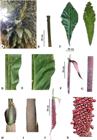
Anthurium solitarium Schott. A. Habit. B. Detail of petiole subcircular, slightly sulcate to canaliculate on adaxial face with obtuse margins on adaxial side, obtuse on abaxial face. C. Leaf blade obovate to elliptical. D. Midrib prominent on the adaxial side, leaf blade with straight margins. E. Detail of prominent midrib on adaxial side and eucamptodromous nervation. F. Pendulous inflorescence. G. Detail of the whitish pollen grains. H. Spathe with long stem forming an acute angle at the junction with the peduncle. I. Spadix in post-anthesis. J. Infructescence pendulous. K. Details of concolor berries.
Rupicolous, terrestrial or occasionally epiphytic. Stem 1.5-4 cm diam, erect; cataphylls and prophylls pink at base, greenish at apex when young, brownish when spent, lanceolate, straight, entire at apex, decayed to base of stem. Leaves rosulate, not circinate, when young, erect; petiole 6.8-33 cm long, green, subcircular, canaliculate adaxially and obtuse margins, obtuse abaxially; geniculum conspicuous, at base of blade, not distant, 0.8-1.2 cm long; leaf blade 30-65 × 14.5-23.8 cm, without glands abaxially, discolored, greenish adaxially, lighter green abaxially, coriaceous, simple (entire), obovate, apex acuminate, base acute to cuneate, straight margins, striations absent; midrib green on both sides, prominent, acute; primary lateral veins 6-15 on both surfaces, prominent on both sides, sometimes 3-keeled abaxially; collective vein absent. Inflorescence pendent; peduncle 22.4-102.9 cm long, vinaceous to brownish, cylindroid to 1-ribbed, larger than the spadix; spathe 6.3-25 cm long, persistent to marcescent, vinaceous to brownish on both sides, striated margins absent, lanceolate, apex acuminate, forming an acute angle with the peduncle; spadix 11.2-52 cm long, vinaceous to brownish at anthesis, sessile, tapered, curved. Flowers rhombic, 1.8-3.6 mm, 7-10 flowers on principal spiral, (6)10-12 on alternate spiral; tepals frosted; lateral tepals 1-1.6 mm wide, the inner margins broadly convex, the outer margins 2-sided; pistils not emergent; stigma linear becoming ellipsoid, 0.4-0.7 mm long; stamens emerging in regular sequence; the lateral ones preceding the alternate ones by 13-20 spirals, held at the edge of the tepals, inclined over and obscuring the pistil; filaments not exserted; anthers 0.4-0.5 × 0.8-0.9 mm wide; thecae ovoid, 0.3-0.4 mm wide, slightly divaricate; pollen whitish. Infructescence pendent, smaller than peduncle, spathe persistent; berries 5-6 mm long, concolorous, entirely vinaceous, oblong-ellipsoid; seeds 4-4.4 mm long, 1-2 per berry, yellowish, ellipsoid.
Taxonomic remarks: Anthurium solitarium has an obovate leaf blade, with straight margins, pendent inflorescence with spadix 11.2-52 cm long., vinaceous to brownish. It is similar to A. santaritense in its pendent inflorescence and coloration of the vinaceous to dark red berries, but A. santaritense is distinguished by the elliptic leaf blade, spadix 6-10 cm long, lilac, stipitate, 0.3-4 cm long.
Phenology: Anthurium solitarium has been collected with flowers and with fruits from January to November.
Distribution and habitat: Anthurium solitarium is endemic to Brazil and is distributed in the northeastern, southeastern and southern regions, in Bahia, Espírito Santo, Minas Gerais, Rio de Janeiro, São Paulo and Paraná states. Anthurium solitarium occurs in the Atlantic Forest in Semideciduous Forest, Ombrophilous Forest, and Restingas (Fig. 8).
Anthurium uleanum Engl.,Pflanzenr. (Engler) 4, Fam. 23b: 74. 1905. Anthurium uleanum var. uleanum. Type: Brazil. Amazonas: Rio Jurua Mirim, Aug. 1901, Ule 5731 (Holotype: B100242938!; Isotypes: K0004341371!, L0041859!, HBG514111!). Figure 28.
Anthurium uleanum var. nanayenseCroat. Ann. Missouri Bot. Gard. 78(3): 742, f. 318. 1991. Type: Peru. Loreto: Mishana, Rio Nanay, 120 m, 14 Jul. 1947, Solomon 3562 (Holotype: MO2627652!).
Anthurium tenuispadix Engl., Pflanzenr. (Engler) 4, Fam. 23b: 73. 1905. Type: Brazil. Amazonas: Rio Jurua Mirim ("Miry"), Jun. 1901, Ule 5597 (Holotype: B100242941!; Isotypes: F, G, MG).
Anthurium tessmannii K. Krause, Notizbl. Bot. Gart. Berlin-Dahlem 9:260. 1925. Type: Peru. Loreto: Prov. Requena, Cumaria, Rio Ucayali, 225 m, 20 Nov. 1923, Tessmann 3351 (Holotype: B100242940!).
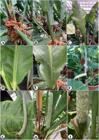
Anthurium uleanum Engl. A. Cataphylls and prophylls lanceolate, erect, and decomposed into fibers at the base. B. Stem erect, petiole flattened on adaxial, carinated on abaxial. C. Leaf blade elliptical, midrib and primary lateral veins prominent, with strongly wavy margins. D. Detail of midrib on adaxial side, 1-nerved median. E. Detail of midrib on abaxial side, 1-median vein acute. F. Inflorescence erect, peduncle greenish, spathe greenish to whitish, reflexed, spadix tapered. G. Spadix greenish to whitish, tapered, slightly curved, pollen grains whitish. H. Spadix greenish in post-anthesis, persistent spathe reflexed. I. Detail of long-decurrent spadix.
Epiphytic. Stem 2.5 cm diam; cataphylls and prophylls reddish brown, lanceolate, straight, persistent to eventually breaking into fibers, apex sometimes remains semi-intact. Leaves rosulate, not circinate when young, erect; geniculum conspicuous, at base of blade, not distant, 0.3-2 cm long; petiole (3)10-36 cm long, green, semicircular, with flat adaxially and acute edges, with median 1-rib, abaxially obtuse to 2-7 costate. Leaf blade 20-65 × (3-)5.5-24 cm, without glands abaxially, medium green, coriaceous, simple (entire), oblong, elliptic to obovate, apex acute to acuminate, attenuate to acute at base, rarely truncate to cordate, with strongly undulate margins; midrib green on both sides, prominent, acute on the adaxially, acute to obtuse or convex abaxially; primary lateral veins 5-11 on both surfaces, 30-85º, prominent; collective vein absent or emerging only in the distal region of the leaf blade, prominent adaxially, sunken abaxially, 4-8 mm distant from the margin. Inflorescence erect; peduncle 13-38 cm long, green, cylindroid, larger than the spadix; spathe 3.5-14 cm long, persistent at anthesis, conspicuous or reflexed, to recurved, rarely erect, green, olive-green, sometimes red tinged at the margins, elliptic, apex acute to acuminate, acute tapering at the junction with the peduncle; spadix (3)5-15 cm long, whitish, pale green, reddish to purple, cylindroid to slightly tapered, curved, stipitate, when present 0.3-0.7 cm long. Flowers rhombic to 4-lobed, margins obscure, 1.8-2.5 mm long, 1.7-2.5 mm wide, the sides straight to irregularly sigmoid; 6-10 flowers visible on principal spiral, 6-8 on alternate spiral; tepals frosted, slightly papillate, pale olive-green; lateral tepals (0.5) 2-2.2 mm wide, the inner margins broadly rounded to straight, the outer margins 2-3 sided; pistils slightly raised, not emergent, white to pale pinkish; stigma ellipsoid, 0.3 mm long; stamens emerging readily in a regular sequence from the base, held well above the tepals and retracting to the level of the tepals, the laterals preceding the alternates by ca. 4-5 spirals, the 3rd stamen preceding the 4th by ca. 2 spirals; anthers white to pink, 0.4 mm long, 0.4-0.5 mm wide, drooping and obscuring the pistil; thecae oblong, divaricate or not; pollen pale yellow, dry white. Infructescence pendent, smaller than peduncle, spathe persistent; berries 5 mm long, reddish to violet; seeds 2-2.5 mm long, 1-2 per berry.
Taxonomic remarks: Anthurium uleanum can be recognized by the petiole 10-36 cm long, peduncle 13-38 cm long, spadix 5-15 cm long, whitish, pale greenish-pale, reddish to purple at anthesis, cylindroid, curved, stipitate, when present 3-7 mm long. Anthurium uleanum can be confused with two species, A. bovinii and A. ernestii, by the number of flowers < 10 per spiral. Anthurium bovinii differs by having leaf blade chartaceous, acute at base, yellowish-orange spadix at anthesis, 3-4 flowers per spiral, and from A. ernestii by the spadix that is pink to magenta, vinaceous or greenish at anthesis and not curved).
Phenology: Anthurium uleanum has been collected with flowers from February to December.
Distribution and habitat: Anthurium uleanum occurs in Ecuador, southern Colombia (Meta, Amazonas, and Vaupes), Peru (Loreto, Huanuco, Amazonas, and Ucayali), and Brazil, where it is distributed in the Northern region (Acre and Amazonas). Anthurium uleanum occurs in the Amazon Domain in Terra Firme Forest, Várzea Forest and Ombrophilous Forest vegetation types (Fig. 7).
Excluded Species
Anthurium coriaceum G.S.Bunting was assigned to A. sect. Urospadix subsect. Obscureviridia based on morphological traits (e.g., chartaceous, concolor leaves with inconspicuous venation; Temponi 2006), later supported by molecular data (Carlsen & Croat 2013). Valadares et al. (2019) confirmed its exclusion from Pachyneurium.
Anthurium xanthopyloides G.S.Bunting, originally described in sect. Cardiolonchium (Barroso, 1970) was later attributed to Pachyneurium due to its involute vernation and prominent primary veins (Gonçalves & Salviani, 2001). However, Valadares et al. (2020) proposed its closer affinity to A. sagrilloanum G.S.Bunting (sect. Urospadix), citing synapomorphies such as funicular trichomes and brochidodromous venation. Consequently, both species are excluded from this revision of A. sect. Pachyneurium in Brazil.
Supplementary Material
The following online material is available for this article:
S1:
Acknowledgments
The authors are grateful to CAPES-JBRJ for the scholarship to the first author. We also thank the Conselho Nacional de Desenvolvimento Científico e Tecnológico - CNPq for the scholarship of productivity given to the second author (L.G.T.) with number 310302/2018-8 and the last author (J.F.A.B.) with number 304576/2018-2. We are indebted to the curators and technicians of herbaria ALCB, ASE, BHCB, GFJP, HFSL, HUENF, HUEFS, HURB, IAN, INPA, MG, MO, PEURN, R, RB, RON, UB, UNOP, UFMT, UFP, UFRN and UFRPE. To the RB, INPA and MO herbaria for consulting the largest number of specimens of Anthurium deposited for taxonomic analyses. We thank Dr. Mónica Carlsen for the partnership and her support during the exchange period in St. Louis, USA, for work at the MO Herbarium, the visit to the Missouri Botanical Garden’s living collection of Araceae, Climatron Greenhouse, and the University of St. Louis-Missouri. Thanks to Dr. Massimo Bovini for collecting the new species during the botanical expedition to Boca do Acre-AM, which allowed the description of the species A. bovinii Camelo & Nadruz; to Dr. Benjamin Torke and Edgar Lobato for collecting the new species during the botanical expedition to Flona do Tapajós, near the Cupari River, which allowed the description of the species A. mayoanum Camelo, Croat & Nadruz; to Karena Pimenta for making the botanical illustrations in the morphological part and to Isaque Mendes for making the geographic distribution maps.
References
- Barroso GM. 1970. Espécies novas de Anthurium Schott. Loefgrenia 46: 1-4.
- Beentje H. 2010. The Kew plant glossary: an illustrated dictionary of plant terms. Richmond, Kew Royal Botanic Gardens.
-
Boyce PC, Croat TB, Hay A. 2025. The Überlist of Araceae, Totals for Published and Estimated Number of Species in Aroid Genera. https://www.aroid.org/ueberlist. 9 Oct. 2025. http://dx.doi.org/10.13140/RG.2.2.24068.64646
» http://dx.doi.org/10.13140/RG.2.2.24068.64646 - Camelo MC, Coelho MAN, Leoni LS, Temponi LG. 2020. Araceae do Parque Nacional do Caparaó, MG-ES, Brazil. Rodriguésia 71: e01742018.
- Camelo MC, Temponi LG, Mayo SJ, Coelho MAN, Baumgratz JFA. 2021a. Typifications of some species names in Anthurium section Pachyneurium (Araceae). PhytoKeys 178: 95-109.
- Camelo MC, Croat TB, Coelho MAN, Aylward ST. 2021b. A new species of ‘Bird’s Nest’ Anthurium sect. Pachyneurium (Araceae) from Brazil. Phytotaxa 523: 229-238.
- Camelo MC, Coelho MAN. 2022. A New Species of Anthurium (Araceae) From the Amazon Domain. Systematic Botany 47: 846-852.
-
Camelo MC, Temponi LG, Coelho MAN, Baumgratz JFA. 2023a. Fruit morphology in Anthurium sect. Pachyneurium from Brazil (Araceae) and its taxonomic implications. Highlighted Student Research. Flora 309: 152406. doi: 10.1016/j.flora.2023.152406
» https://doi.org/10.1016/j.flora.2023.152406 - Camelo MC, Temponi LG, Coelho MAN, Baumgratz JFA. 2023b. Taxonomic updates in Anthurium sect. Pachyneurium (Araceae) from the Brazilian Atlantic Forest. Phytotaxa 599: 109-125.
- Camelo MC, Pappas GJ Jr, Carvalho Silva M, et al 2025. in prep. A target enrichment data to better resolution of phylogenetics analysis of Anthurium sect. Pachyneurium (Araceae).
- Carlsen MC, Croat TB.. 2013. A Molecular Phylogeny of the Species-Rich Neotropical Genus Anthurium (Araceae) Based on Combined Chloroplast and Nuclear DNA. Systematic Botany 38: 576-588.
- Carlsen MC, Croat TB. 2019. An analysis of the sectional classification of Anthurium (Araceae) comparing infrageneric groupings and their diagnostic morphology with a molecular phylogeny of the genus. Annals of the Missouri Botanical Garden 104: 69-82.
- Coelho MAN, Croat TB. 2005. A new species of Anthurium from Brazil. Aroideana 26: 65-68.
- Coelho MAN, Mayo SJ. 2007. Typifications of names of Brazilian taxa of Anthurium sect. Urospadix (Araceae). Taxon 56: 211-225.
-
Coelho MAN, Waechter JL, Mayo SJ. 2009. Revisão taxonômica das espécies de Anthurium (Araceae) seção Urospadix subseção Flavescentiviridia Rodriguésia 60: 799-864. https://doi.org/10.1590/2175-7860200960407
» https://doi.org/10.1590/2175-7860200960407 - Croat TB, Bunting GS. 1979. Standardization of Anthurium descriptions. Aroideana 2: 15-25.
- Croat TB, Sheffer RD. 1983. The sectional groupings of Anthurium (Araceae). Aroideana 6: 85−123.
- Croat TB. 1985. Collecting and preparing specimens of Araceae. Annals of the Missouri Botanical Garden 72: 252-258.
- Croat TB. 1991. A revision of Anthurium section Pachyneurium (Araceae). Annals of the Missouri Botanical Garden 76: 539-855.
- Croat TB, Carlsen MM. 2020. A New Section of Anthurium: Section Cordato-punctatum (Araceae), Restricted to Central America. Novon 28: 46-50.
- Ellis B, Daly DC, Hickey LJ et al 2009. Manual of Leaf Architecture. New York, The New York Botanical Garden, Cornell University.
- Engler HGA. 1905. Araceae-Pothoideae. In: Engler HGA. (eds.) Das Pflanzenreich, 23D. Berlin, Engelmann. vol. 4, p. 1-330.
- Fiaschi P, Pirani JR. 2009. Review of plant biogeographic studies in Brazil. Journal of Systematics and Evolution 47: 477-496.
-
Flora e Funga do Brasil. 2025. Jardim Botânico do Rio de Janeiro. http://floradobrasil.jbrj.gov.br/ 28 Jan 2025.
» http://floradobrasil.jbrj.gov.br/ - Gonçalves EG. 2005. A new Anthurium sect. Pachyneurium (Araceae) from Minas Gerais state, Brazil. Novon 15: 133-135.
- Gonçalves EG, Salviani ER. 2001. Anthurium xanthophylloides G. M. Barroso (Araceae) re-found in Espirito Santo state, Eastern Brazil. Aroideana 24: 13-17.
- Kunth CS 1841. Enumeratio Plantarum 3: 67-82.
-
Maitan MQ, Jasmim JM. 2020. Ornamental potential and commercial quality of Anthurium solitarium grown in bamboo compost. Revista Ceres 67: 191-198. https://doi.org/10.1590/0034-737X202067030004
» https://doi.org/10.1590/0034-737X202067030004 - Mayo SJ, Bogner J, Boyce P. 1997. The genera of Araceae. Belgium, Continental Printing.
- Morais EB, Castro A, Silva TF, Da Silva JP, Soares NS. 2017. Evaluation of potential use of native foliage. Ornamental Horticulture 23: 07-14.
- Nomura ES, Fuzitani EJ, Damatto Júnior ER. 2012. Cultivo do antúrio. Pesquisa e Tecnologia, São Paulo.
-
QGIS Development Team. 2025. QGIS Geographic Information System, version 3.28. Firenze. Open Source Geospatial Foundation Project. https://qgis.org/downloads/macos/qgis-macos-ltr.dmg Mar 2025.
» https://qgis.org/downloads/macos/qgis-macos-ltr.dmg - Schott HW. 1829. Für Liebhaber der Botanik. Vienna. Wiener Zeitschrift für Kunst, Litteratur, Theater und Mode.
-
Schott HW. 1860. Prodromus systematis Aroidearum. Vienna, Vindobonae. https://doi.org/10.5962/bhl.title.68
» https://doi.org/10.5962/bhl.title.68 - Stearn WT. 2004. Botanical Latin. Portland, Timber Press.
- Temponi LG. 2006. Sistemática de Anthurium sect. Urospadix (Araceae). Ph.D. Thesis, Universidade de São Paulo, Brazil.
- Temponi LG, Coelho MAN. 2011. Two new species of Anthurium sect. Urospadix (Araceae) from Brazil. Rodriguesia 62: 315-320.
-
Thiers B. 2020. [continuously updated] Index Herbariorum. global directory of public herbaria and associated staff. New York Botanical Garden's Virtual Herbarium. http://sweetgum.nybg.org/science/ih/ Mar 2024.
» http://sweetgum.nybg.org/science/ih/ - Valadares RT, Calazans LSB, Sakuragui CM. 2019. Nomenclatural Novelties in Anthurium sect. Urospadix subsect. Obscureviridia from the Brazilian Atlantic Forest. Novon 27: 17-21.
- Valadares RT, Sagrillo TF, Sakuragui CM. 2020. Anthurium sagrilloanum: A New Species of Anthurium (Araceae) from Southeastern Brazil. Novon 28: 60-63.
-
Zona S, Christenhusz MJM. 2015. Litter-trapping plants: filter-feeders of the plant kingdom. Botanical Journal of the Linnean Society 179: 554-586, https://doi.org/10.1111/boj.12346
» https://doi.org/10.1111/boj.12346
-
Data Availability
The datasets generated and/or analyzed during the current study are available in the herbaria cited in the materials and methods and in supplementary materials with M.C. Camelo collector and the databases can be accessed through the electronic addresses obtained from the website https://e3sys.com.br/inct-hvff/herbarios.
The datasets generated and/or analyzed during the current study are available in the herbaria cited in the materials and methods and in supplementary materials with M.C. Camelo collector and the databases can be accessed through the electronic addresses obtained from the website https://e3sys.com.br/inct-hvff/herbarios.