 Taxonomic revision of Phyllanthus sect. Gladiatus Orlandini, Cordeiro & V.C.Souza (Phyllanthaceae): A small group exclusive from the Atlantic Rain Forest areas, Brazil
Abstract
Phyllanthaceae, with a pantropical distribution, has recently undergone significant changes in the composition of its genera. Among these, Phyllanthus is notable for its vast number of species, currently the second-largest genus in the family, and its remarkable morphological diversity. Brazil is home to approximately 100 Phyllanthus species, some of which exhibit a distinctive morphological adaptation: phylloclades, found in multiple taxonomic sections. With the establishment of a new section exclusive to the Brazilian Atlantic Forest, this study provides a comprehensive contribution, including morphological descriptions of the section and its three constituent species, a key for species identification, detailed illustrations, field photographs, and distribution maps. Additionally, it offers taxonomic notes and evaluates the conservation status of the species using the updated IUCN criteria.
Keywords:
Brazilian Flora; Malpighiales; Phyllantheae; Taxonomy
Introduction
Phyllanthaceae Martinov has a predominantly pantropical distribution, with genera distributed in two subfamilies: Phyllanthoideae Kostel (ranging from tropical to temperate regions) and Antidesmatoideae Hurus. (ranging from tropical to subtropical regions), with most species distributed in Phyllanthoideae (Stevens, 2021, onwards).
For a long time, the largest genus in the family was Phyllanthus L., known for its herbaceous and medicinal species, reaching nearly 900 species officially recorded by Bouman et al. (2018). However, since the work of Kathriarachchi et al. (2006), it has been known that the genus is not monophyletic, especially due to the species of Breynia J.R.Forst. & G.Forst., Glochidion J.R.Forst. & G.Forst. and Synostemon F.Muell, which are nested in Phyllanthus (Bouman et al., 2022), a fact reinforced by subsequent phylogenetic studies (Bouman et al., 2021; Orlandini et al., 2023; Torres & Silva, 2025).
Considering the non-monophyly of the genus Phyllanthus in its traditional circumscription, Bouman et al. (2022) published a new version of the classification of the tribe Phyllantheae, in which the genus Glochidion would become the largest in the family, with 350 species, with Phyllanthus in second place, with 213 species.
Thus, Phyllanthus sensu stricto (or sensuBouman et al., 2022) became restricted to the American continent, except for cultivated or medicinal species, such as Phyllanthus niruri L. Of the species in the genus, 100 occur in Brazil, of which 71 are exclusive to the country (Orlandini et al., 2024), indicating that it is a possible center of diversity for the genus. Orlandini et al. (2023), in their phylogenetic study, demonstrated the existence of an endemic group in Brazil, composed of three species typical of Dense Ombrophilous Forest and with unique morphology among Brazilian species, described as Phyllanthus sect. Gladiatus Orlandini, Cordeiro & V.C.Souza. In this work we present its taxonomic revision with illustrations, field photographs, distribution maps, suggested conservation status according to the IUCN version 16 (2024), morphological descriptions, and taxonomic comments, as well as an identification key for the species of the section.
Materials and Methods
Literature Review
An analysis was conducted on all works related to phyllocladiferous species of Phyllanthus (Dingler, 1885; Santiago, 1988; Santiago et al., 2004; Santiago et al., 2006), as well as the main studies conducted by Webster (Webster, 1956a; b; c; 1957a; 1958a; b; 1959).
In recent years, the genus has been the subject of various phylogenetic studies (Kathriarachchi et al., 2005; 2006; Bouman et al., 2021; Orlandini et al., 2023; Torres & Silva, 2025). Therefore, this study involved an extensive bibliographic review to evaluate the entire group to support the decision to formalize a new taxonomic section (Orlandini et al., 2023).
Consultation of Herbaria and Morphological Analysis
For this study, we analyzed type collections as well as all specimens of the species that comprise this new section. This analysis included specimens from major Brazilian herbaria, encompassing the entire geographic distribution of the group. The analyses were conducted through in-person visits to most herbaria, as well as by accessing images available on the JSTOR Global Plants website (https://plants.jstor.org/). The consulted herbaria included ASE, BHCB, CEPEC, CSTR, ESA, HUEFS, HVASF, IPA, MBML, SP, SPF, UESC, and UNEB (acronyms as per Thiers, 2025, continually updated).
The descriptions were based on analyses of the studied specimens, as well as observations made of populations encountered during field trips. Measurements were taken for all analyzed specimens, highlighting both maximum and minimum values, along with any notable exceptions. The morphological terminology adhered to the standards set by Radford et al. (1974) and Font Quer (2000), in addition to specific terms used by Webster (1956a; b; c; d; 1957a; b) and Santiago et al. (2006). For the morphological analysis, all flowers examined were hydrated in a heated solution of water and glycerin.
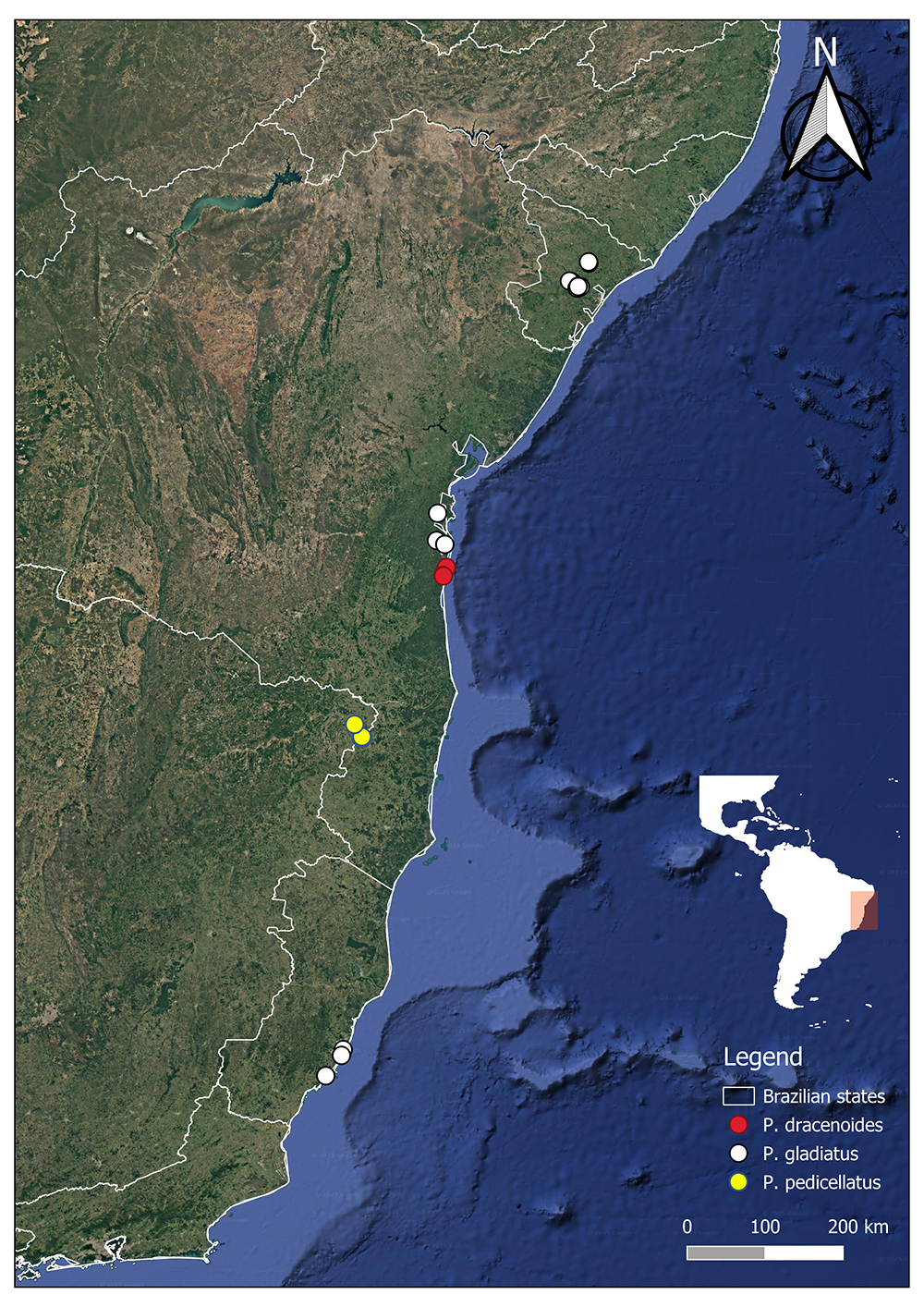
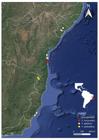
The geographic distribution of the species was recorded according to the World Geographical Scheme for Recording Plant Distribution - TDWG2 (Brummitt, 2001), following the model ‘Level 1. Level 2 (Level 4, in 5-letter abbreviation).’ Georeferencing was performed using geographic coordinates obtained from exsiccate labels and collections, with the coordinates presented in decimal form (conversion, when necessary, was done using splink.cria.org.br/conversor). When coordinates were absent, approximate values were obtained through geoLoc (SpeciesLink, 2025, avaiable at: https://splink.cria.org.br/geoloc), using data from IBGE and searches in the Global Gazetteer version 2.3 (available at https://www.fallingrain.com/world/). The maps were created using QGIS software version 2.18 (Quantum GIS Development Team, 2017), utilizing shapes and vectors from the Americas Base Map (Bletter et al., 2014) (Fig. 1).
To propose the conservation status of the species, the criteria established by the International Union for Conservation of Nature (IUCN, 2024) were followed, with the Extent of Occurrence and Area of Occupancy calculated using a 2 km width. The data were processed using the Geospatial Conservation Assessment Tool (GeoCAT) (Bachman et al., 2011).
Results and Discussion
Taxonomic treatment
Phyllanthus sect. Gladiatus Orlandini, Cordeiro & V.C.Souza
Type: Phyllanthus gladiatus Müll.Arg.
-Phyllanthus sect. Choretropsis Müll.Arg. (1863: 4, 52). Santiago et al., (2006: 138), pro parte, excluding the type. See diagnosis in Orlandini et al. (2023)
Subshrubs to dracaenoid trees, either monoecious or dioecious, reaching heights of 0.6-7 meters. Branching is monopodial and pinnatiform, restricted to the top of the main branch, which is cylindrical, woody, and has reddish wood resembling a stipe. Secondary branches are transformed into phylloclades, which are flattened, plagiotropic, and spirally arranged, restricted to the top of the stipe. Phylloclades are rigidly membranous or leathery, dark green, lanceolate to gladiate, with an acuminate to acute apex and an attenuated base, measuring 14-70 cm × 1-5 cm. They display prominent striations similar to leaf veins, with a central striation more prominent than the numerous lateral ones, which converge in pairs towards the nodes along the margins. The margin is slightly crenate to crenate, with 12-30 pairs of nodes per phylloclade and internodes 0.5-6 cm long. Cataphylls are scaly to membranous, triangular, 2-3 × 2-3 mm, with a dentate margin and are deciduous. Stipules are cordate with an acuminate apex and cordate base, measuring 0.5-1.2 × 0.4-1 mm, also with a dentate margin. Leaves are persistent or not in the adult phase, rigidly membranous, obovate, brochidodromous, 0.5-3 × 0.5-2.5 cm, glabrous, with an obtuse to emarginate apex, an attenuate base, entire margins, and a petiole 0.7-3 mm long. Staminate inflorescence occurs in cymules composed of 3-5 flowers, occasionally with only 1-2 flowers. Buds and flowers are subtended by bracts, which may be either congested or not, chartaceous, triangular, and glabrous, measuring 0.2-0.62 × 0.1-0.5 mm with an entire margin. Pistillate inflorescence is found in cymules composed of 1-2 flowers, though more commonly as solitary flowers. Buds and flowers are also subtended by bracts, which may be congested or not, vermiform or not, chartaceous, triangular, and glabrous, measuring 0.2-2 × 0.1-1 mm with an entire margin. Staminate flowers are trimerous, with six sepals that are fleshy or membranaceous in texture. Sepal colors range from pink, reddish, cream, greenish, to yellowish, and they are similar in appearance, arranged in either a single whorl or two whorls, with three larger and three smaller sepals. Sepals are concave, oblong to narrowly ovate, elliptical, or broadly ovate, measuring 1-2.5 × 0.5-2 mm, with a rounded or obtuse apex and a wavy to entire margin. The pedicel is 0.1-1.5 cm long. An extra staminal disc has oval, glandular, or cupuliform segments, which are partially united to the sepals or free-standing. Stamens are typically three, either free or, less commonly, monadelphous, with a staminal column measuring 1-2 mm in length. Anthers are 0.5-1 mm long, either united or not by the connective, with dehiscence that may be horizontal or vertical. Pistillate flowers are trimerous, with six sepals that are fleshy or membranous, colored pink, reddish, white, cream, greenish, or yellowish. Sepals similar to each other, arranged in a single whorl or in two whorls, with either three larger and three smaller sepals, concaves, oval to broadly oval or broadly obovate, invaginate or not, measuring 0.5-7 × 0.4-5 cm; Sepal apex are rounded, emarginate, acuminate, or obtuse, and may be inconspicuously apiculate, with margins entire, and the flowers are subsessile to pedicellate, with pedicels 0.1-2 cm long. Nectariferous disc entire, annular, and patelliform, thickened or not, with a slightly wavy to deeply wavy margin; Styles three, fused, reduced, or sessile, with stigmas that are either parallel to the ovary or prostrate; Stigmas may be bifid or falcate, with a lacerated surface or smooth, and corniculate at the apex or not; Ovary globose, slightly flattened, or dorsiventrally flattened, with six-sulcate mericarps. Capsule trigonal, slightly dorsiventrally flattened, with six deeply grooved mericarps measuring 0.3-1.5 × 0.4-1.5 cm, and is greenish or reddish, smooth, with sepals and stigmas persistent in the mature fruit; Seeds smooth or finely reticulate, trigonal, measuring 1-3 × 1-2 mm. Carpophore persistent, triangular, or three-winged.
Nomenclatural Comments
Phyllanthus sect. Gladiatus is a section formally established by Orlandini et al., (2023) that includes three phyllocladiferous species endemic to Brazil: P. dracaenoides Orlandini & Cordeiro, P. gladiatus Müll.Arg., and P. pedicellatus Orlandini, Cordeiro & V.C. Souza. For many years, taxonomic studies on this group (Santiago et al., 2006, 2008) focused solely on P. gladiatus, the only species known at the time, which was traditionally classified under P. sect. Choretropsis.
The three species occur in similar habitats-primarily tableland forests and other dense, ombrophilous forests with high humidity. This is in contrast to species in P. sect. Choretropsis, which are found in drier areas, such as those of the Espinhaço Range. Morphologically, species of P. sect. Gladiatus exhibit a growth habit that resembles certain species of the genus Dracaena (Asparagaceae). They feature a stipe-like main trunk (similar to the stems of palms) and rigidly membranous to leathery, gladiate to lanceolate phylloclades, with variations in length and width among the three species. The geographical distribution of P. sect. Gladiatus is illustrated in Figure 1.
Key to the species of Phyllanthus sect. Gladiatus
1. Pistillate flowers fleshy and subsessile, with erect and falcate stigmas….............................................................................................................P. dracaenoides
1.’ Pistillate flowers membranous, distinctly pedicellate, with reflexed and bifid stigmas........ 2
2. Pistillate flowers with pedicels 1.4-2 cm long, pink to reddish......................... P. pedicellatus
2’. Pistillate flowers with pedicels 0.4-1.2 cm long, white, cream, greenish, or yellowish....................................................................................................................P. gladiatus
1. Phyllanthus dracaenoides Orlandini & Cordeiro. Systematic Botany 46(4): 1011-1015. BRAZIL. Bahia: Itacaré, “Campo Cheiroso”, ca. 14 km North of Serra Grande, with entrance on the left of the Highway to Itacaré, 14°22’50" S, 39°2’22" W, 14 Jul 2020, fl., fr., L. Daneu 741 (Holotype: CEPEC156150!; Isotype: SP004457!) (Fig. 2).

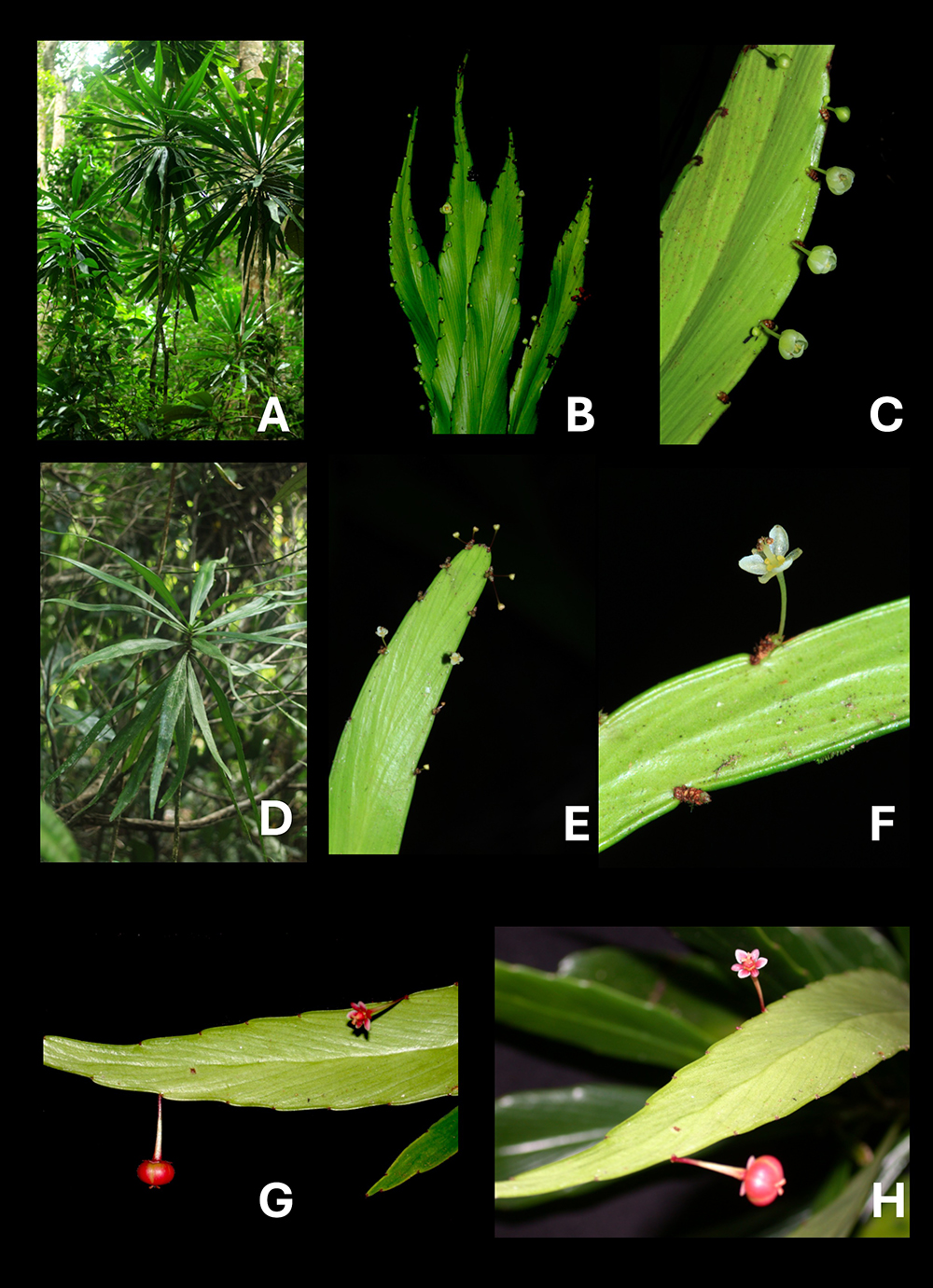
Plate of Phyllanthus sect. Gladiatus. A-C: Phyllanthus dracaenoides. A. Habit. B. Phylloclade displaying vermiform cincinni. C. Detail of phylloclade with male inflorescence. D-F: Phyllanthus gladiatus. D. Habit. E. Phylloclade displaying several flowers. F. Detail of phylloclade with male flower. G-H: Phyllanthus pedicellatus. G. Adaxial surface of phylloclade with male flower and fruit. H. Abaxial surface of phylloclade with male flower and fruit with persistent sepals. (A-E: Otávio Luis Marques da Silva; F-G: André Márcio Amorim).
Dracenoids shrubs to treelets, monoecious, 3-7 meters tall, with monopodial and pinnatiform branching restricted to the top of the main branch. The main branch is cylindrical, woody, with reddish wood, and secondary branches are transformed into phylloclades. Phylloclades are flattened, plagiotropic, spirally arranged, and positioned laterally to ascending, leathery, dark green, lanceolate to gladiate, with an acuminate to acute apex and an attenuated base, measuring 30-70 × 2-5 cm. Prominent striae, resembling leaf veins, are present, with a central vein more pronounced than the numerous lateral ones, which converge in pairs toward the nodes along the margins, with margins slightly crenate to crenate, with 20-30 pairs of nodes per phylloclade, and internodes are 1-4 cm long. Cataphylls, stipules, and leaves were not observed. Staminate inflorescence consists of cymules with isolated flowers. Buds and flowers are subtended by congested, vermiform bracts, which are chartaceous, triangular, glabrous, and measure 1-2 × 0.5-1 mm, with entire margins. Pistillate inflorescence in cymules with isolated flowers, with buds and flowers subtended by vermiform bracts, also chartaceous, triangular, glabrous, measuring 1-2 × 0.5-1 mm with entire margins. Staminate flower trimerous, 6 sepals, fleshy, cream to greenish, similar to each other, in two whorls, with 3 inner, concave ones and 3 outer, oblong ones, 1-2 × 1-2 mm, obtuse apex, entire margin, pedicel up to 1 mm long; extrastaminal disc with cupuliform segments, partially joined to the sepals; 3 stamens, monadelphous, with staminal column 2-3 mm long, anthers 1-2 mm long, joined by the connective, with vertical dehiscence. Pistillate flower trimerous, sepals 6, fleshy, cream to greenish, concave, similar to each other, in two whorls, with 3 inner ones, broadly oval and 3 outer ones, broadly obovate, dorsally invaginate, 4-7 × 3-5 mm, apex obtuse, inconspicuously apiculate, margin entire, subsessile, pedicel ca. 1 mm long; nectariferous disc annular, thickened, conspicuously wavy at the margin; styles 3, fused, stigmas parallel to the ovary, flattened and falcate; ovary globose, not flattened, mericarps not grooved. Capsule globose, not flattened, with ungrooved mericarps, 1-1.5 × 1-1.4 cm, smooth, with persistent sepals and stigmas in mature fruits. Seeds finely reticulate, trigonal, without punctuations, ca. 3 × 2 mm. Carpophore present, 3-winged.
Taxonomic comments
Phyllanthus dracaenoides specimens were historically identified as P. gladiatus, the only Phyllanthus species with phylloclades recognized for the Atlantic Forest. However, with field expeditions, it was possible to analyze the existing population in the “Campo cheiroso” region, in Bahia, and verify that they are two distinct species, although with a similar architecture, as is the case with P. pedicellatus.
Phyllanthus dracaenoides is the only species in the group that can reach up to 7 meters in height, an unusual pattern for the entire Phyllanthus genus. In addition, it has fleshy flowers, unlike P. gladiatus and P. pedicellatus, whose flowers are membranous and delicate. Another significant difference between these species is the morphology of the inflorescences and flowers. The flowers of P. gladiatus and P. pedicellatus are pedicellate, while in P. dracaenoides they are subsessile. Furthermore, the stigmas of P. dracaenoides are deeply falcate and parallel to the ovary, whereas P. gladiatus and P. pedicellatus have bifid and prostrate stigmas, corniculate at the apex in the last one. For illustrations, see Orlandini et al. (2021).
Etymology
Phyllanthus dracaenoides is named for its habit form, which is similar to that of several plants of the genus Dracaena (Asparagaceae).
Geographical distribution
Phyllanthus dracaenoides is a species exclusive to forests near the region known as “campo cheiroso” (a native field area in a tableland forest matrix), in Itacaré municipality, Bahia, an area located about 3 km from the coast, within a transitional vegetation between the tableland forest and the mussununga. The geographical distribution of P. dracaenoides is illustrated in Figure 1.
Phenology
Collected with flowers and fruits in March, June, July, and November.
Suggested conservation status
Phyllanthus dracaenoides is a species known only from the Campo Cheiroso region (Itacaré, Bahia), with a population of less than 30 individuals. It has an AOO of 8 km2 and is therefore a Critically Endangered (CR) species, meeting the geographic distribution criterion (B): CR B1ab(iii) + 2ab(iv). Additionally, it occurs in an area of high habitat decline, subject to fires in nearby areas and to coconut plantations and has a low number of known individuals (criterion D).
Material Examined
BRAZIL. Bahia. Itacaré: 25 Jun 1998, L.A. Mattos Silva et al. 3781 (CEPEC!, HUEFS!, UNEB, UESC); id., 14°22’50" S, 39°2’22" W, 29 Nov 2015, I. Cordeiro et al. 3557 (CEPEC!, SP!). Id., 4 Aug 2019, A. Campos-Rocha et al. 2678 (ESA). Id., 14°22’50" S, 39°2’22" W, 14 Jul 2020, L. Daneu 741 (CEPEC!, SP!). Id., 28 Mar 2019, P. Orlandini et al. 400 (ESA!). Id, 21 Mar 2022, A.M. Torres et al. 250 (BOTU!, ESA!). Id., 25 Jun 1998, Mattos-Silva, L.A. et al. 3781 (ALCB!).
2. Phyllanthus gladiatus Müll.Arg. Linnaea 32: 52. 1863.) BRAZIL. “In Brasilia”, s.d., Sellow 814 (Holotype: B - destroyed, Photo in F: F0BN005045). BRAZIL. Espírito Santo. Vila Velha, Weinberg s.n. (Neotype designated by Santiago et al. (2006): R 158894). (Figs. 2, 3).
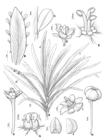
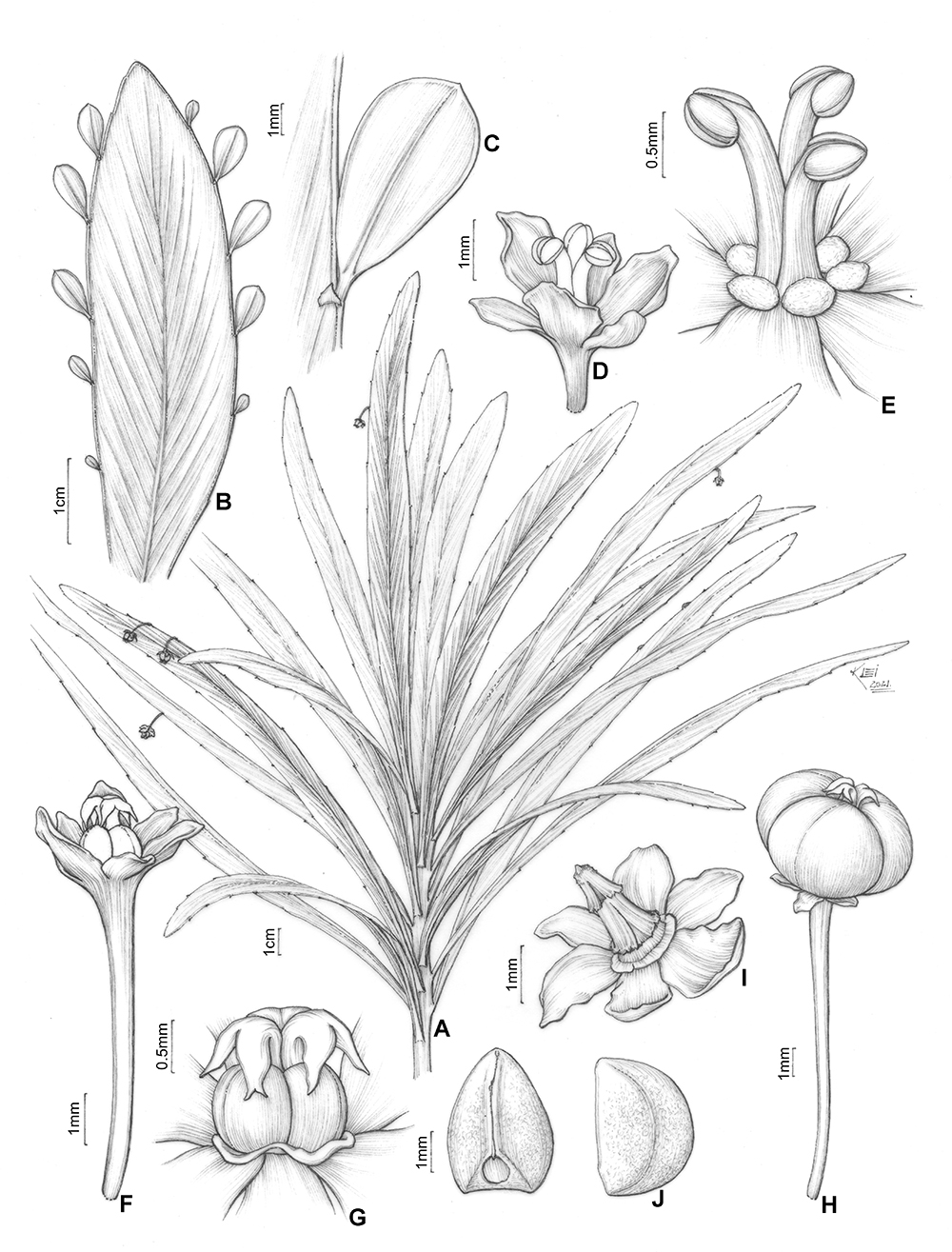
A-I: Phyllanthus gladiatus. A. Flowering branch. B. Phylloclade with persistent leaves. C. Detail of the leaf. D. Staminate flower. E. Free stamens, with anthers not joined by the connective and segments of the nectariferous disc. F. Pistillate flower. G. Nectariferous disc, ovary, styles and stigmas. H. Fruit. I. Carpophorous with persistent sepals. J. Seeds (ventral and lateral view). Illustration: Klei Sousa.
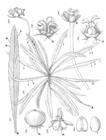
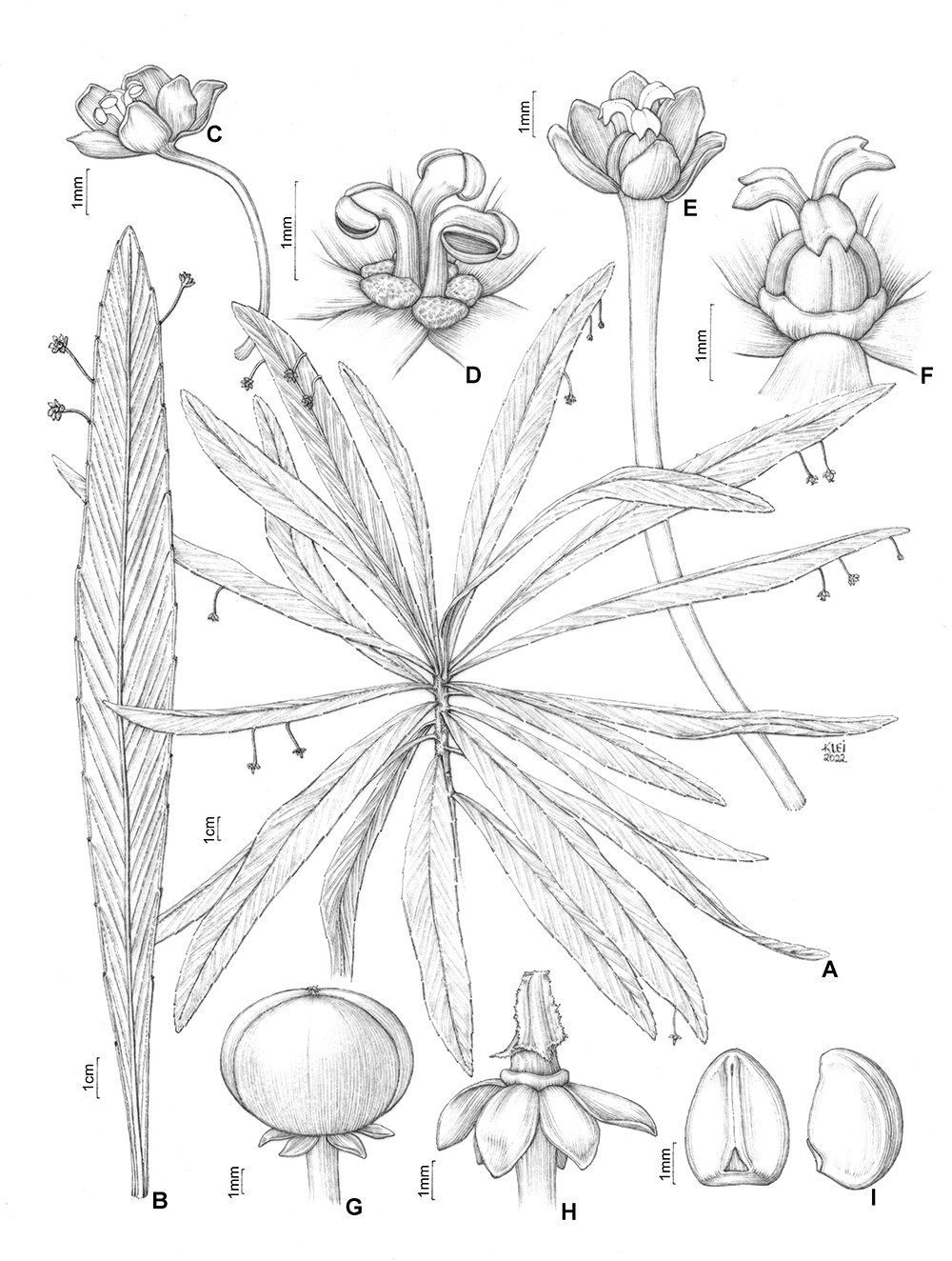
A-I: Phyllanthus pedicellatus. A. Habit. B. Phylloclade with pistillate flowers. C. Staminate flower. D. Details of free stamens and nectariferous disc. E. Pistillate flower. F. Details of Gynoecium. G. Fruit with persistent sepals. H. Carpophore. I. Seeds in ventral and lateral view. (Illustration by Klei Sousa).
Subshurbs to dracenoid shurbs, dioecious, 0.6-2.5 m tall, with monopodial and pinnatiform branching, restricted to the top of the main branch; main branch cylindrical, woody, reddish wood, secondary branches transformed into phylloclades. Phylloclades flattened, plagiotropic, spirally arranged, lateral to ascending, rigidly membranous, dark green, lanceolate to gladiate, apex acuminate to acute, base attenuated, 15-35 × 2-4 cm, with prominent striae, similar to leaf veins, the central one more prominent than the numerous lateral ones, which converge in pairs towards the nodes of the margins; margin slightly crenate to crenate, nodes 20-30 pairs per phylloclade, internodes 1-6 cm long. Cataphylls scaly to membranous, triangular, 2-3 × 2-3 mm, dentate margin, deciduous. Stipules cordate, apex acuminate, base cordate, 0.5-1.2 × 0.4-1 mm, dentate margin. Leaves persistent in adult phase, rigidly membranous, obovate, brochidodromous, 0.5−3 × 0.5−2.5 cm, glabrous, apex obtuse to emarginate, base attenuate, margin entire, petiole 0.7-3 mm long. Staminate inflorescence in cymules composed of 3-5 flowers, rarely 1-2 flowers; buds and flowers subtended by non-congested, chartaceous, triangular, glabrous bracts 0.2-0.62 × 0.1-0.5 mm, margin entire. Pistillate inflorescence in cymules composed of 1-2 flowers, but more often single flowers; buds and flowers subtended by non-congested, chartaceous, triangular, glabrous bracts 0.2-0.6 × 0.1-0.5 mm, margin entire. Staminate flower trimerous, sepals 6, membranous, white, cream, greenish to yellowish, 3 larger and 3 smaller, in two whorls, with 3 outermost, broadly oval and 3 innermost, narrowly oval to elliptic, 1-2.5 × 0.5-2 mm, apex obtuse, margin wavy to entire, pedicel 0.2-1 cm long; extra staminal disc with oval and glandular segments, partially united to the sepals; stamens 3, free, filaments 1-2 mm long, anthers 0.5-1 mm long, not united by the connective, with horizontal dehiscence. Pistillate flower trimerous, sepals 6, membranous, white, cream, greenish to yellowish, 3 larger and 3 smaller, in two whorls, with 3 innermost, oval, invaginated and concave and 3 outermost, elliptical and not invaginated, 0.5-1.5 × 0.4-1 cm, apex rounded to acuminate, entire margin, pedicel 0.4-1.2 cm long; nectariferous disc entire, annular and patelliform, wavy margin; styles 3, fused, reduced to sessile, stigmas prostrate, not parallel to the ovary, bifid, not flattened and with a lacerated surface; ovary globose, dorsiventrally flattened, mericarps 6-sulcate. Capsule trigonous, slightly flattened dorsiventrally, with 6 deeply grooved mericarps, 0.7-1.5 × 0.5-1.5 cm, greenish, smooth, with persistent sepals and stigmas in the mature fruit. Seeds smooth, trigone, without punctuations, 1-1.5 × 1-1.3 mm. Carpophore triangular at the apex and base (bi-triangular).
Taxonomic comments
Phyllanthus gladiatus is characterized by being a dioecious species, a fact observed in the populations present in Sergipe through field studies and also noted in the population studied by Santiago et al. (2006) in Espírito Santo. Female individuals are taller and have larger flowers than male individuals. Female inflorescences generally have only one flower, although up to two may occur in older individuals, while male inflorescences have about three flowers. Another distinctive characteristic is that pistillate flowers have three larger sepals and three significantly smaller sepals.
Several specimens of P. pedicellatus and P. dracaenoides were originally identified as P. gladiatus, indicating that species that exhibit a dracenoid morphological habit were identified as one. Considering that the flowers are fragile and generally fall off during the drying process, many of the advances were made from observations of populations in the field.
Since this species was the first with the dracenoid morphological pattern to be described (Müller, 1863), it was used to support the name of the new section of Phyllanthus proposed by Orlandini et al. (2023).
Etymology
Phyllanthus gladiatus has a specific epithet that refers to the sword-like shape of the phylloclades.
Geographic distribution
Phyllanthus gladiatus can be found in riparian and restinga forests, as well as in more open areas, on the banks of streams, in areas close to the coast of the states of Bahia, Espírito Santo, and Sergipe.
Originally, this species was known only for the states of Espírito Santo and Bahia (Santiago et al., 2006). However, several collections from Sergipe, especially from the Serra de Itabaiana National Park, were studied. This protected area has a relevant biological characteristic, being an ecotone of Dense Ombrophilous Forest of lowlands and Semi-Deciduous Sub-Montane Seasonal Forest, and also presenting restinga areas to the east and rocky fields in some areas (Dantas & Ribeiro, 2010). To obtain more information about the species, an expedition was conducted to the site, where the existence of some populations of P. gladiatus living in the most humid areas of the Ombrophilous Forest of Serra de Itabaiana was confirmed. The distribution of P. gladiatus is shown in Figure 1.
Phenology
Collected with flowers from February to July and from October to December. Collected with fruits in January and in April.
Suggested conservation status
This species is currently considered Vulnerable (VU) (CNCFlora, 2012); however, the analysis was based on occurrence points in Espírito Santo and Bahia, without including material from Sergipe. In addition, specimens from Minas Gerais, currently recognized as Phyllanthus pedicellatus, were included. Based on this data, we suggest a new conservation status for the species. Phyllanthus gladiatus occupies an EOO of 65,949,903 km2 (LC) and an AOO of 44,000 km2 (EN). However, it is important to note that all populations found are located in coastal areas of the Atlantic Forest, in Bahia, Espírito Santo, and Sergipe, subject to continuous declines and anthropogenic pressures. The species is therefore suggested to be classified as Endangered (EN) according to the geographic distribution criterion (B): EN B2ac(iv).
Material Examined
Brazil. Bahia. Camamu, 29 Apr 2007, A.M. Miranda et al. 5469 (HVASF, IPA). Nilo Peçanha, 24 Feb 1975, T.S. dos Santos 2915 (CEPEC!). Espírito Santo. Vila Velha, Apr 1983, B.M. Weinberg s.n. (R 142102!). Vila Velha, 1981, B.M. Weinberg s.n. (R 158894!). Vila Velha, 05 Jun 1981, B.M. Weinberg 468 (MBML!). Vila Velha, Apr 1980, B.M. Weinberg 134 (MBML!). Sergipe. Itabaiana, 04 Oct 1982. G. Viana 655 (ASE!). Id., 08 Nov 1982, E.M. Carneiro 192 (CSTR, ASE!). Id., 10°45’83" S, 37°20’81" W, 30 Jun 1985, G. Viana 1282 (ASE!). Id., 10°45’83" S, 37°20’81"W, 01 May 1991. M.L. Santos 96 (ASE!). Id., 10°45’83" S, 37°20’81" W,16 Mar 1983, E. Gomes 242 (ASE!, CEPEC!). Id., 10°44’49" S, 37°20’36" W, 29 Jun 2010, R. Simão-Bianchini et al. 1769 (ASE!). Id., 10°45’29" S, 37°18’54" W, 08 Feb 2010, L.A.S. Santos et al. 82 (ASE!). Id., 10°45’83" S, 37°20’81" W, 14 Dec 1985, G. Viana 1311 (ASE!). Id., 10°45’83" S, 37°20’81" W, 13 Mar 1984, G. Viana 892 (ASE!). Id., 10°44’43" S, 37°21’28" W, 23 Feb 2017, F.O. Silva & J.R. Fabricante 48 (ASE!). Id., 11 Jul 1962, Andrade-Lima 62-4097 (IPA). Areia Branca: complexo florístico da Serra de Itabaiana, 220m, 10°45’14" S, 37°20’35" W, 20 Apr 2008, B.S. Amorim et al., 306 (SP!). Brasil. “In Brasilia”, Sellow 814 (F!). Brasil, s.c. (G00316716!).
3. Phyllanthus pedicellatusOrlandini, Cordeiro & V.C.Souza. Phytotaxa 455 (2): 168. 2020. BRASIL. Minas Gerais: Santa Maria do Salto, Fazenda Duas Barras, sub-bosque da mata, próximo a curso d’água (com captação), 18 Mar 2017, fl., fr., A. Campos-Rocha & N. Oleas 1698 (Holotype: ESA156738!) (Isotype: SP!). (Figs. 2,4).
Dracenoid subshrubs, monoecious, 0.6-1 m tall, branching monopodial and pinnatiform, restricted to the top of the main branch; main branch cylindrical, woody, reddish wood, secondary branches transformed into phylloclades. Phylloclades flattened, plagiotropic, spirally arranged, lateral to ascending, leathery, dark green, lanceolate to gladiate, apex obtuse to acute, base cuneate to attenuate, 14-25 × 1-3 cm, with prominent striae, similar to leaf veins, the central one more prominent than the numerous lateral ones, which converge towards the nodes of the margins; margin slightly crenate to entire, nodes 12-15 pairs per phylloclades, internodes 0.5-5 cm long. Cataphylls scaly to membranous, triangular, 2-3 × 2-3 mm, margin dentate, deciduous. Stipules not seen. Leaves not seen. Staminate inflorescence in cymules composed of 1-2 flowers, often solitary flowers; buds and flowers subtended by non-congested, chartaceous, triangular, glabrous bracts of 0.2-0.62 × 0.1-0.5 mm, margin entire. Pistillate inflorescence in cymules composed of solitary flowers; buds and flowers subtended by non-congested, chartaceous, triangular, glabrous bracts of 0.2-0.6 × 0.1-0.5 mm, margin entire. Staminate flower trimerous, sepal 6, membranous, pink to reddish, striated or not, similar to each other, in two whorls, with 3 inner and 3 outer, oval, 1-2 × 1 mm, rounded apex, entire margin, pedicel 1-1.5 cm long; extra staminal disc with cupuliform segments, not joined to the sepals; stamens 3, free, filaments 1-2 mm long, anthers ca. 1 mm long, not joined by the connective, with horizontal dehiscence. Pistillate flower trimerous, 6 sepals, membranous, pinkish to reddish, striated or not, similar to each other, in two whorls, with 3 innermost, broadly oval and 3 outermost, oval, ca. 3 × 2 mm, obtuse apex, entire margin, pedicel 1.4-2 cm long; entire nectariferous disc, annular, slightly wavy margin; 3 styles, free, reduced to sessile, prostrate stigmas, bifid and corniculate at the apex; globose ovary, not flattened, mericarps grooved. Capsule trigone, slightly flattened dorsiventrally, with 6 deeply grooved mericarps, 0.3-0.7 × 0.4-0.8 cm, reddish, smooth, with sepals and stigmas persistent in the mature fruit. Seeds smooth, trigonal, without punctuations, 2-2.5 × 2 mm. Carpophore triangular at the apex and base (bi-triangular).
Taxonomic comments
Before the description of this species by Orlandini et al. (2020), the materials collected in Santa Maria do Salto were identified as P. gladiatus, the only Phyllanthus species with phylloclades previously known for forest areas (Santiago et al., 2006). However, analysis of the flowers, as well as observation of the population in the field, allowed us to verify that it is a distinct species of P. gladiatus. The main characteristics are the pinkish-reddish flowers, with long pistillate pedicels and 6 sepals of similar shape (versus cream to greenish flowers, pistillate flowers with short pedicels and 6 sepals, of which 3 are broadly oval and 3 are oblong in P. gladiatus).
Etymology
Phyllanthus pedicellatus presents this epithet as a reference to the long pedicels of the pistillate flowers.
Distribution
Phyllanthus pedicellatus is a species that occurs exclusively in areas referred to as Dense Montane Ombrophilous Forest in Santa Maria do Salto, near the border between the states of Minas Gerais and Bahia. The distribution of P. pedicellatus is shown in Figure 1.
Phenology
Collected with flowers from February to March and in August and November. Collected with fruits in March and August.
Suggested conservation status
Phyllanthus pedicellatus has an EOO of 1.055 km2 (CR) and an AOO of 12.000 km2 (EN). According to the parameters established by the IUCN (IUCN 2024), P. pedicellatus can be characterized as a Critically Endangered (CR) species, under criteria B1ab(iii)+B2ab(iii), given the low number of locations where it occurs (1), the decrease in the quality of the original habitat of this species (Atlantic Forest) and according to criterion D, due to the low number of individuals present in the only existing population in Santa Maria do Salto (MG). This was the same conservation status proposed by Orlandini et al. (2020).
Material Examined
Brazil. Minas Gerais. Santa Maria do Salto, 16°24'23" S 40°03'15" W, 8 Feb 2006, A.M. Amorim 5547 (CEPEC!, HUEFS, SPF!). Id., 16°24'40,7'' S 40°02'50,5'' W, 23 Aug 2003, J.A. Lombardi et al. 5443 (BHCB); id, 16°24’ S, 40°03’ W, 23 Apr 2006, J.A. Lombardi et al. 5996 (BHCB). id., 16°24'11' 'S 40°3'26' 'W, 23 Apr 2006, W.W. Thomas 14629 (CEPEC!, UESC); id., 850 m.a.s.l., 16°25'12'' S 40°4'00'' W 23 Mar 2010, L. Kollmann et al. 11872 (MBML!).
Acknowledgements
We would like to thank the Escola Superior de Agricultura “Luiz de Queiroz” (ESALQ) for the infrastructure provided for the morphological analyses (ESA Herbarium), and Klei Sousa for the line drawing of P. gladiatus and P. pedicellatus. We would also like to thank the anonymous reviewers for their contributions.
References
-
Bachman S, Moat J, Hill AW, Torre J, Scott B. 2011. Supporting Red List assessments with GeoCAT: Geospatial conservation assessment tool. Zookeys 150: 117-126. doi: 10.3897/zookeys.150.2109
» https://doi.org/10.3897/zookeys.150.2109 -
Bletter N, Janovec J, Brosi B, Daly DC. 2014. A digital base map for studying the Neotropical Flora. Taxon 53: 469-477. doi: 10.2307/4135624
» https://doi.org/10.2307/4135624 -
Bouman RW, Kessler PJA, Telford IRH, Bruhl JJ, van Welzen PC. 2018. Subgeneric delimitation of the plant genus Phyllanthus (Phyllanthaceae). Blumea 63: 167-198. doi: 10.3767/blumea.2018.63.02.14
» https://doi.org/10.3767/blumea.2018.63.02.14 -
Bouman RW, Kessler PJA, Telford IRH et al 2021. Molecular phylogenetics of Phyllanthus sensu lato (Phyllanthaceae): Towards coherent monophyletic taxa. Taxon 70: 72-98. doi: 10.1002/tax.12424
» https://doi.org/10.1002/tax.12424 -
Bouman RW, Kessler PJA, Telford IRH et al 2022. A revised phylogenetic classification of tribe Phyllantheae (Phyllanthaceae). Phytotaxa 540: 001-100. doi: 10.11646/phytotaxa.540.1.1
» https://doi.org/10.11646/phytotaxa.540.1.1 - Brummitt RK. 2001. World Geographical Scheme for Recording Plant Distribution. 2nd edn. Pittsburgh, International Working Group on Taxonomic Databases for Plant Sciences (TDWG).
-
CNCFlora. 2012. Phyllanthus gladiatus in Lista Vermelha da flora brasileira versão 2012.2 Centro Nacional de Conservação da Flora. http://cncflora.jbrj.gov.br/portal/pt-br/profile/Phyllanthus_gladiatus 06 Mar. 2025.
» http://cncflora.jbrj.gov.br/portal/pt-br/profile/Phyllanthus_gladiatus -
Dantas TVP, Ribeiro AS. 2010. Caracterização da vegetação do Parque Nacional da Serra de Itabaiana, Sergipe, Brasil. Biotemas 23: 9-18. doi: 10.5007/2175-7925.2010v23n4p9
» https://doi.org/10.5007/2175-7925.2010v23n4p9 - Dingler H. 1885. Die Flachsprosse der Phanerogamen. Vergleichende Morphologisch - Anatomische Studien. Erstes Heft: Phyllanthus sect. Xylophylla München, Ackermann.
-
Falling Rain Software. The Global Gazetter, version 2.3. https://www.fallingrain.com/world/ 06 Mar. 2025.
» https://www.fallingrain.com/world/ - Font Quer P. 2000. Diccionario de Botánica. Barcelona, Ediciones Península.
-
IUCN. 2024. Guidelines for Using the IUCN Red List Categories and Criteria. Version 16. prepared by the Standards and Petitions Subcommittee. http://cmsdocs.s3.amazonaws.com/RedListGuidelines.pdf 06 Mar. 2025.
» http://cmsdocs.s3.amazonaws.com/RedListGuidelines.pdf -
Kathriarachchi H, Hoffmann P, Samuel R, Wurdack KJ, Chase MW. 2005. Molecular phylogenetics of Phyllanthaceae inferred from five genes (plastid atpB, matK, 3’ndhF, rbcL and nuclear PHYC). Molecular Phylogenetics and Evolution 36: 112-134. doi: 10.1016/j.ympev.2004.12.002
» https://doi.org/10.1016/j.ympev.2004.12.002 -
Kathriarachchi H, Samuel R, Hoffman P et al 2006. Phylogenetics of tribe Phyllantheae (Phyllanthaceae; Euphorbiaceae sensu lato) based on nrITS and plastid matK DNA sequence data. American Journal of Botany 93: 637-655. doi: 10.3732/ajb.93.4.637
» https://doi.org/10.3732/ajb.93.4.637 - Müller Argoviensis J. 1863. Euphorbiaceae Vouläufige Mittheifungen aus dem für De Candolle’s Prodromus bestimanten Manuscript über dieses Familiae. Linnaea 32: 1-126.
-
Orlandini P, Cordeiro I, Campos-Rocha A, Souza VC. 2020. A new species of Phyllanthus L. (Phyllanthaceae) with phylloclades from Minas Gerais, Brazil. Phytotaxa 455: 167-172. doi: 10.11646/phytotaxa.455.2.8
» https://doi.org/10.11646/phytotaxa.455.2.8 -
Orlandini P, Cordeiro I, Mendes JCR, Campos-Rocha A, Souza VC. 2021. A new species of phyllocladiferous Phyllanthus (Phyllanthaceae) from the Atlantic Rain Forest. Systematic Botany 46: 1011-1015. doi: 10.1600/036364421X16370109698669
» https://doi.org/10.1600/036364421X16370109698669 -
Orlandini P, Silva OLM, Cordeiro I, Souza VC. 2023. Phylogenetics of Brazilian phyllocladiferous Phyllanthus (Phyllanthaceae): A new section exclusive from the Atlantic Rain Forest with morphological and molecular support. Plant Systematics and Evolution 309: 36. doi: 10.1007/s00606-023-01871-1
» https://doi.org/10.1007/s00606-023-01871-1 -
Orlandini P, Cordeiro I, Lombardi JA, Zavatin DA, Souza VC. 2024. A phyllocladiferous new species of Phyllanthus (Phyllanthaceae) from Minas Gerais, Brazil. Phytotaxa 661: 293-300. doi: 10.11646/phytotaxa.661.3.6
» https://doi.org/10.11646/phytotaxa.661.3.6 -
Quantum GIS Development Team. 2017. Quantum GIS Geographic Information System. Open Source Geospatial Foundation Project. https://www.qgis.org/en/site/ 05 Mar. 2025.
» https://www.qgis.org/en/site/ - Radford AE, Dickison WC, Massey JR, Bell CR. 1974. Vascular Plant Systematics. New York/Evanston/San Francisco/London, Harper and Row.
- Santiago LJM. 1988. Estudos preliminares da seção Choretropsis Muell.Arg., gênero Phyllanthus (Euphorbiaceae). Bradea 5: 44-49.
-
Santiago LJM, Louro RP, Emmerich M, Barth OM. 2004. Pollen morphology of Phyllanthus (Euphorbiaceae) section Choretropsis Botanical Journal of the Linnean Society 144: 243-350. doi: 10.1111/j.1095-8339.2003.00250.x
» https://doi.org/10.1111/j.1095-8339.2003.00250.x -
Santiago LJM, Louro RP, Emmerich M. 2006. Phyllanthus section Choretropsis (Euphorbiaceae) in Brazil. Botanical Journal of the Linnean Society 150: 131-164. doi: 10.1111/j.1095-8339.2006.00459.x
» https://doi.org/10.1111/j.1095-8339.2006.00459.x -
Santiago LJM, Louro RP, Emmerich M. 2008. Phylloclade anatomy in Phyllanthus sect. Choretropsis (Phyllanthaceae). Botanical Journal of the Linnean Society 157: 91-102. doi: 10.1111/j.1095-8339.2008.00780.x
» https://doi.org/10.1111/j.1095-8339.2008.00780.x -
SpeciesLink. 2025. SpeciesLink: dados e ferramentas - geoloc. https://splink.cria.org.br/geoloc 06 Mar. 2025.
» https://splink.cria.org.br/geoloc -
Stevens PF. 2021. Angiosperm Phylogeny Website. Version 14, July 2017 [and more or less continuously updated since]. http://www.mobot.org/MOBOT/research/APweb/ 09 Dec. 2024.
» http://www.mobot.org/MOBOT/research/APweb/ -
Thiers BM. 2025. Index Herbariorum: A global directory of public herbaria and associated staff. The New York Botanical Garden, New York. http://sweetgum.nybg.org/science/ih/ 06 Mar. 2025.
» http://sweetgum.nybg.org/science/ih/ -
Torres AM, Silva MJ. 2025. Molecular Phylogeny of Phyllanthus L. sect. Phyllanthus (Phyllantheae: Phyllanthaceae) reveals the need for a reclassification of Phyllanthus subg. Phyllanthus Botanical Journal of the Linnean Society 20: boaf037. doi: 10.1093/botlinnean/boaf037
» https://doi.org/10.1093/botlinnean/boaf037 -
Webster GL. 1956a. Studies on the Euphorbiaceae, Phyllanthoideae II. The American species of Phyllanthus described by Linnaeus. Journal of the Arnold Arboretum 37: 1-14. doi: 10.5962/p.185991
» https://doi.org/10.5962/p.185991 -
Webster GL. 1956b. A monographic study of the West Indian species of Phyllanthus Journal of the Arnold Arboretum 37: 91-122. doi: 10.5962/p.324651
» https://doi.org/10.5962/p.324651 -
Webster GL. 1956c. A monographic study of the West Indian species of Phyllanthus Journal of the Arnold Arboretum 37: 217-268. doi: 10.5962/bhl.part.25737
» https://doi.org/10.5962/bhl.part.25737 -
Webster GL. 1956d. A monographic study of the West Indian species of Phyllanthus Journal of the Arnold Arboretum 37: 340-359. doi: 10.5962/p.324654
» https://doi.org/10.5962/p.324654 - Webster GL. 1957a. A monographic study of the West Indian species of Phyllanthus: Subgenera Kirganelia, Cicca Journal of the Arnold Arboretum 38: 51-79.
-
Webster GL. 1957b. A monographic study of the West Indian species of Phyllanthus: Subgenus Phyllanthus Journal of the Arnold Arboretum 38: 170-198. doi: 10.5962/bhl.part.9102
» https://doi.org/10.5962/bhl.part.9102 -
Webster GL. 1958a. A monographic study of the West Indian species of Phyllanthus Journal of the Arnold Arboretum 39: 49-100. doi: 10.5962/bhl.part.19110
» https://doi.org/10.5962/bhl.part.19110 -
Webster GL. 1958b. A monographic study of the West Indian species of Phyllanthus Journal of the Arnold Arboretum 39: 111-212. doi: 10.5962/bhl.part.19111
» https://doi.org/10.5962/bhl.part.19111 -
Webster GL. 1959. The origin of the cultivated Xylophylla hybrid, Phyllanthus x elongatus Brittonia 11: 177-182. doi: 10.2307/2805138
» https://doi.org/10.2307/2805138
-
Data Availability
Not applicable.
-
Funding Information
The studies related to Phyllanthus and associated with the thesis of the first author were also funded by IDEAWild (grant number ORLABRAZ0121) and the Mohamed bin Zayed Species Conservation Fund (project number 210528056). This study was financed in part by the Coordenação de Aperfeiçoamento de Pessoal de Nível Superior-Brazil (CAPES), finance code 001, and by the Conselho Nacional de Desenvolvimento Científico e Tecnológico (CNPq), Process No.141939/2020-6. This work was supported by FAPESP Thematic Project No. 22/12597-0 - “Diversification and enhancement of the records of the São Paulo herbarium collections, with expansion of their virtual availability and spatial analyses, for advancing Neotropical biodiversity documentation”. IC thanks the Brazilian National Council for Scientific and Technological Development (CNPq) for the research productivity fellowship (Grant No. 314318/2023-2) and the Fundação de Amparo à Pesquisa do Estado de São Paulo (FAPESP) for support through the PROTAX-BIOTA Project (Grant No. 2021/08545-2).
Not applicable.