
 Microsatellite markers and transferability in Amburana cearensis (Allemão) A.C.Sm (Leguminosae), an endangered species of Seasonally Dry Tropical Forests
Abstract
Microsatellite markers (SSR) are still largely used to assess the reproductive system and genetic diversity in plant populations. Although the timber tree Amburana cearensis (Fabaceae) is endangered, according to the IUCN classification, there are no effective management and conservation plans being implemented for the species. It occurs exclusively in South America, predominantly in Seasonally Dry Tropical Forests, such as Caatinga and Chaco, but also in savanna areas of the Cerrado. The negative effect of large human populations on the biodiversity of these regions is likely to be more pronounced for endangered species such as A. cearensis. We developed SSR markers, tested their transferability to Amburana-related genera, and described the genetic diversity of A. cearensis in Brazilian dry forests. The number of alleles per locus ranged from two to 11. Eight loci showed significant deviation from HWE. The genetic differentiation was low to moderate (F ST = 0.0972, p < 0.001), suggesting some gene flow among populations. Two loci were widely transferable to related genera. The developed SSR markers can be useful to study the reproductive biology and genetic diversity, and may therefore support more effective conservation strategies for A. cearensis by the inclusion of genetic information.
Keywords:
biodiversity conservation; Caatinga; genetic diversity; polymorphism; Seasonally Dry Tropical Forests
Introduction
The species Amburana cearensis (Allemão) A.C.Sm. (Leguminosae; sensuLewis et al., 2005) is a timber tree that has a disjunct distribution, occurring exclusively in South America, predominantly in Seasonally Dry Tropical Forests (SDTF hereafter) of Brazil, Argentina, Bolivia, Paraguay, and Peru (Leite, 2005; Seleme et al., 2015). This species' diversification center is the northeast of Brazil (Leite, 2005), a region where the Caatinga dry forest is the most representative phytogeographic domain (Silva et al., 2017). This tree is largely explored for its attractive wood, which has a large range of uses, mainly for fine furniture; it has also various medicinal uses and is the source of essential oil for perfumes (e.g., Rizzini, 1978; Albuquerque et al., 2007; Bitu et al., 2015). In addition to the economic relevance, A. cearensis represents an important food resource and shelter for insects in SDTFs (e.g., Kiill & Lima, 2011; Barral et al., 2022). Indeed, several insect species were reported as floral visitors of A. cearensis in the Caatinga dry forest (e.g., Barral et al., 2022).
Currently, the species is endangered (Americas Regional Workshop, 1998; IUCN, 2019) mainly due to illegal and unsustainable wood extraction, so that practically all stands of large trees have been destroyed (IUCN, 2019). A specific and efficient conservation strategy for A. cearensis has not been developed yet, despite the urgent need for concrete measures to preserve the species. Aspects related to their life history, landscape dynamics, and genetic diversity should be jointly considered (e.g., Wilcock & Neiland, 2002; Young et al., 2002; Ramirez, 2006; González-Varo et al., 2009). Concerning the reproductive strategies, A. cearensis is mainly pollinated by moths and bees (Kiill & Lima, 2011; Barral et al., 2022), flowering is supra-annual, occurring every two years or at longer intervals (Machado et al., 1997), and it has anemochoric diaspores. Seeds have phanerocotylar germination (Cunha & Ferreira, 2003; Silva & Rodal, 2009; Guedes et al., 2010; Loureiro et al., 2013).
At the taxonomic level, Amburana erythrosperma E.P.Seleme, C.H.Stirt. & V.F.Mansano, which is endemic to southern Chapada Diamantina, Bahia, Brazil, has been described and suggested as the third species of the genus Amburana, together with A. acreana (Ducke) A.C.Sm., which is present in North and Southeast Brazil, and A. cearensis (Seleme et al., 2015). The most recent phylogenetic inference of the group indicates the African genera Cordyla Lour. and Mildbraediodendron Harms as the sister group of Amburana Schwacke & Taub., which together with the genera Myroxylon L.f., Myrocarpus Allem., Myrospermum Jacq., Dussia Krug & Urb. and Petaladenium Ducke, which occurr in Brazil, integrate the clade Amburaneae (Cardoso et al., 2015).
Molecular tools, such as microsatellite markers (SSR), are still largely used to access the reproductive system and genetic diversity in plant species (e.g., Guichoux et al., 2011; Soares et al., 2012; Otao et al., 2016; Spoladore et al., 2016; Hauser et al., 2021; Serrote et al., 2023). Microsatellites or Simple Sequence Repeats (SSRs) comprise tandem repeats of one to six nucleotides, which are widely spread in the genomes and are codominant (e.g., Tautz, 1989; Tóth et al., 2000; Zane et al., 2002; Agarwal et al., 2008). Because of their high polymorphism, neutrality, and abundance, SSRs have been used to evaluate kinship, reproductive system, incidence of genetic drift, inbreeding, and genetic structuring, to quantify effects of habitat fragmentation on the genetic diversity of populations, and thus guide more effective strategies for the conservation of plant and animal species (Collevatti et al., 1999; Heywood & Iriondo, 2003; Ganzhorn et al., 2015; Hauser et al., 2021). In synthesis, SSRs markers are still widely used for population genetics studies.
Despite their relevance and wide applicability, the use of SSR markers in plants occurring in the phytogeographical domains of A. cearensis is still relatively scarce. The use of SSR was reported for only nine plant species of the Cerrado, and three occurring in the Caatinga biomes (Serrote et al., 2023). These SSRs revealed, for example, that the leguminous trees Prosopis juliflora (Sw.) DC. and Prosopis pallida (Humb. & Bonpl. Ex Willd.) Kunth exhibited low levels of genetic diversity and inbreeding in the Caatinga (Freitas et al., 2019). Alternatively, certain species of Cactaceae, such as Pilosocereus gounellei (F.A.C.Weber ex K.Schum.) Byles & G.D.Rowley, exhibit a resilient genetic structure within the Caatinga biome. The application of SSR markers confirms that such genetic robustness supports large-scale reforestation and germplasm conservation, providing a scientific basis for utilizing seeds from wild populations without compromising their genetic identity (Monteiro et al., 2015). These contrasting findings highlight the importance of the use of SSRs for a better understanding of ecological and reproductive aspects of plants, which can be highly relevant for conservation genetics of threatened biomes (Serrote et al., 2023), such as Caatinga and Cerrado. In this context, the cross-amplification may represent an excellent cost-effective tool to rapidly disseminate the use of SSR markers across plant species. For leguminous species, high levels of cross-amplification have also been observed (e.g., Gonçalves et al., 2020; Oliveira et al., 2024). In order to describe the genetic diversity and the breeding system of A. cearensis, we developed and characterized 18 SSR markers. By testing the transferability of these SSRs, we predicted high levels of cross-amplification to 11 species related to A. cearensis. We also aimed to add genetic information to support more effective conservation and management plans for A. cearensis population occurring in Cerrado and Caatinga.
Materials and Methods
Plant material, sampling, and DNA extraction
The library of microsatellite (SSR) repeats was based on the DNA extracted from one individual of Amburana cearensis (Allemão) A.C.Sm. located in the municipality of Serra Talhada, Pernambuco, Brazil.
This individual is linked to a reference voucher specimen previously deposited in the Herbarium IPA (Dárdano de Andrade-Lima), under the accession number IPA 58196.
The characterization, based on amplification tests and polymorphism of the SSR markers, was performed with the DNA obtained from 30 individuals of A. cearensis, sampled in areas of natural occurrence of the species in the municipalities of Serra Talhada (Pernambuco, 10 individuals, PE population) (7°54'9.42"S, 38°18'5.94"W), Morro do Chapéu (Bahia, 10 individuals, BA population) (11°25'49"S, 41°22'40.32"W) and Buritizeiro (Minas Gerais, 10 individuals, MG population) (17°40'40.7"S, 45°02'9.4"W), Brazil (Fig. 1). The identification of these sampled individuals was validated by comparison with reference material voucher specimens previously deposited reference herbaria. Specifically, the vouchers IPA 58196, HUEFS 120750 and BHCB 184670 were used as reference material for the PE, BA and MG populations of A. cearensis, respectively. For both, library preparation and polymorphism tests, young leaves or cambium tissue of each A. cearensis sample were collected and dried in silica gel for posterior DNA extraction.
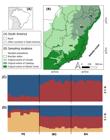
Distribution of the studied populations of Amburana cearensis. (A) Location of Brazil in South America. (B) Sampled populations. Genetic substruturing of Amburana cearensis (Leguminosae) populations in the Brazilian Cerrado and Caatinga domains. STRUCTURE plots for assumed population clusters, (C) K = 2 and (D) K = 3. Each bar represents a single individual and displays the proportion of the genotype assigned to a specific genetic cluster.
The transferability of the primers developed for A. cearensis was tested in the DNA of species phylogenetically related to the genus Amburana (see Cardoso et al., 2015; Choi et al., 2022; Carvalho et al., 2023). Specifically, dried leaves of Ateleia glazioveana Ball. (Swartzieae clade; voucher: IPA 14468), Alexa wachenheimii Benoist (Angylocalyceae clade; voucher: IPA 41964), Dipteryx lacunifera Ducke (Dipterygeae clade; voucher: IPA 84158), Dipteryx odorata (Aubl.) Forsyth f. (Dipterygeae clade; voucher: IPA 1977), Myrocarpus frondosus Allem. (Amburaneae clade; voucher: IPA 57613), Myroxylon peruiferum L.f. (Amburaneae clade; voucher: IPA 73359), Swartzia apetala Raddi (Swartzieae clade; voucher: IPA 67075), Swartzia cuspidata Spruce ex Benth. (Swartzieae clade; voucher: IPA 52618) and Swartzia simplex (Sw.) Spreng. (Swartzieae clade; voucher: IPA 54482) were obtained from exsiccates deposited in the Herbarium Dárdano de Andrade-Lima from the Instituto Agronômico de Pernambuco (IPA) located in Recife, Pernambuco, Brazil. Leaves of the tree species Myroxylon balsamum (L.) Harms (Amburaneae clade) and Trischidium molle (Benth.)H.E.Ireland (Swartzieae clade) were collected, respectively, in a natural area in the region of Campo dos Goytacazes, Rio de Janeiro (21°21'10.1"S, 41°14'57.1"W) and in the Catimbau National Park, Pernambuco (8°32'13.8"S, 37°18'35.0"W), Brazil, for transferability analysis. The specimen of T. molle was validated by comparison with the voucher UFP 43340, deposited in the Herbarium Geraldo Mariz - UFP.
The DNA of the A. cearensis individual used to construct the microsatellite library was extracted using the YGP100 Plant Genomic DNA Extraction Kit (Real Biotech Corporation). All remaining DNA samples were obtained by 2 % CTAB extraction following the protocol of Doyle & Doyle (1987) adapted by Ferreira & Grattapaglia (1995).
Library construction and development of SSR markers
The enriched genomic library was constructed according to the methodology proposed by Billotte et al. (1999). Genomic DNA was digested with the restriction enzyme AfaI (previously known as RsaI, Promega) and the fragments were ligated to the adaptors Rsa21 (5’-CTCTTGCTTACGCGTGGACTA-3’) and Rsa25 (5’- TAGTCCACGCGTAAGCAAGCAAGAGCACA-3’). Fragments of DNA containing microsatellites were selected by hybridization with (CT)8 and (GT)8 associated with the biotin protein [biotIIIII (CT)8 and biotIIIII (GT)8] with the Kit Streptavidin MagneSphere Paramagnetic Particles (Promega). The recovered fragments were amplified via PCR and cloned into vector pGEM-T (Promega). Plasmids were introduced into Escherichia coli XL1-Blue and 96 positive clones were grown overnight in selective medium with isopropyl β-d-1-thiogalactopyranoside (IPTG), β-galactosidase and ampicillin. The DNA of these clones was extracted by alkaline lysis, purified and sequenced using the primers T7 (5’-TAATACGACTCACTATAGGG-3’) and SP6 (5’GATTTAGGTGACACTATAG - 3’) with the Big Dye v.3.1 terminator kit (Applied Biosystems®) according to the manufacturer. Sequencing was performed on automatic DNA ABI PRISM 377 platform (Applied Biosystems®).
Sequences were aligned and edited using Geneious software platform. Microsatellite motif identification was performed using the automated tools within Gramene (Youens-Clark et al., 2011). In this process, motifs with long repeat units were prioritized (e.g., more than six units for dinucleotides) and included compound and imperfect patterns to maximize the potential for polymorphism. We designed primers for the identified loci using FastPCR v.3.6.97 (Institute of Biotechnology, University of Helsinki, Finland) and Primer3 v.0.4.0 (http://primer3.sourceforge.net/). The absence of dimers and hairpins was checked with NetPrimer (http://www.premierbiosoft.com/netprimer/). The robustness of the selected loci was ensured by selecting annealing temperature ranging from 46oC to 64oC. The desired product size range was 150bp to 300bp.
Amplification and genotyping
PCR was carried out in 10 μL volumes using an ABI3500 Genetic Analyzer thermocycler (Applied Biosystems). Each assay contained approximately 10 ng of genomic DNA, 2 mM of MgCl2, 0.25 mM of each dNTP, 1× Taq DNA polymerase buffer (10 mM TrisHCl, pH 8.3; 50 mM KCl, Invitrogen), 0.5 U ul-1 Taq DNA polymerase (Invitrogen), 0.5 mM of each primer and 1× TBT-PAR (150 mM Trehalose, 0.2 mg mL-1 Bovine Serum Albumin and 0.2 % polysorbate-20 in 8.5 mM Tris hydrochloride, pH 8.0). PCR conditions included an initial denaturation at 94 °C for 3 min, followed by 30 cycles of 30 s at 95°C, 30 s at the annealing temperature according to the analyzed SSR (see Table 1 for details about annealing temperatures), 45 s at 72°C, and a final extension at 72 °C for 10 min. The optimal annealing temperature for each locus was previously tested in a gradient system.
Description of the 18 SSR markers developed for Amburana cearensis (Leguminosae). T a: annealing temperature; Size (bp): Variation in allele size; A: number of alleles; A R: allelic richness rarefied to seven individuals; H o = observed heterozygosity; H E = expected heterozygosity; F IS = inbreeding coefficient and PIC = Polymorphic information content.
For genotyping, PCR products were analyzed on 6 % polyacrylamide gels in 1× TBE buffer and stained with silver nitrate 0.2 %, following Creste et al. (2001). Fragment sizes were estimated by comparison with the 10 bp DNA ladder (Invitrogen). For cross-amplifications, we used the same protocols described above. To avoid genotyping errors, all the samples were carefully checked for the presence of only one or two bands per locus in the polyacrylamide gel. Loci for which one clear band was observed around the expected size were considered transferable.
Data analysis
The presence of null alleles and occurrence of allele drop-out were analyzed using the Micro-Checker v.2.2 based on the “allelic signature” given by deficiencies or excesses of particular genotypes (Van Oosterhout et al., 2004). We tested for Hardy-Weinberg Equilibrium (HWE) for each locus and population using Genepop 4.1 (Raymond & Rousset, 1995). Linkage disequilibrium (LD) between all pairs of loci was tested using the FSTAT v. 2.9.3.2 (Goudet, 2001). Significance levels were determined through 10,000 permutations, considering a significance threshold of P < 0.001 after Bonferroni correction. Missing data were handled using the 'missingno' function in the R package poppr (Kamvar et al., 2014). Individuals and loci with more than 25 % missing genotypes were excluded from subsequent analyses to avoid biases in genetic diversity and structure estimates (e.g., Selkoe & Toonen, 2006). To evaluate whether the number of molecular markers was sufficient to achieve the high genotypic resolution, a genotype accumulation curve was generated using the 'genotype_curve' function in the R package poppr (Kamvar et al., 2014). This curve was produced by 1,000 random permutations of the loci set, recording the cumulative number of unique multilocus genotypes (MLG) at each step.
Allelic richness (A R ), mean number of alleles per locus (A), and observed and expected heterozygosity (H O and H E ) under HWE conditions were calculated for each locus and population using the FSTAT v.2.9.3.2 (Goudet, 2001). Polymorphic information content (PIC) was calculated using Cervus v.3.0.7 (Kalinowski et al., 2007). To evaluate population genetic structuring, we applied models for 1-10 clusters (i.e., Ks) with a burn-in of 100,000 and MCMC repetitions of 1,000,000 for 15 iterations per K in the software STRUCTURE 2.3.4 (Pritchard et al., 2000). For the admixture models, we assume correlation of allele frequencies among populations. The most likely number of clusters (K) was estimated by the likelihood curve implemented by the Evanno method (ΔK = m|L″(K)|/s[L(K)]; Evanno et al., 2005). The package pophelper (Francis, 2017), implemented in the RStudio (R Core Team, 2025) was used to estimate the number of clusters.
The eight most informative loci were selected for species genetic diversity analyses, following rigorous screening for linkage disequilibrium, missing data, PIC values, and genotype accumulation curve. Specifically, the loci selected for these analyses were: Amb_A11, Amb_C1, Amb_D8, Amb_F6/7, Amb_G3/4, Amb_B7, Amb_G2/3, and F8/9-3. The distribution of genetic variability among and within populations was analyzed with Wright's F statistics using FSTAT. In addition, a molecular variance analysis (AMOVA) was performed using the Arlequin v.3.0 software (Excoffier et al., 2005).
Results
We identified 19 distinct microsatellite sequences, including di-, tri- and hexanucleotides, among the 96 sequenced clones (Table 1). Of the 19 developed primer pairs, 18 loci amplified. No evidence for linkage disequilibrium was detected, indicating random association for any pair of loci. With an overall missing data rate of 1.73 %, the final dataset comprised all 30 sampled individuals of A. cearensis, genotyped across 18 loci. The genotyping accumulation curve had a greatly decreased variance and reached a plateau with eight loci (Fig. 2). A total of 90 alleles were detected, ranging from two to 11 and averaging five alleles per locus. All the amplified SSR loci were polymorphic for the sampled populations, indicating that they are useful for A. cearensis genetic diversity analysis. The H O per locus ranged from 0.133 (Amb_B7) to 1.000 (Amb_A11, D6, F8/9-1, H8/9-1), with an average of 0.761. The H E per locus ranged from 0.315 (Amb_F6/7) to 0.875 (Amb_F8/9-3), with an overall H E of 0.573. According to the Polymorphic Information Content (PIC), 12 markers were considered very informative (PIC > 0.5) and six were medium informative (0.25 < PIC ≤ 0.5).

Genotype accumulation curve for Amburana cearensis (Leguminosae). In total, 30 individuals from three populations were examined. The x-axis shows the number of loci sampled without replacement and the y-axis shows the number of unique multilocus genotypes observed in the dataset. A dotted line represents 100 % of the total observed multilocus genotypes.
Among the 18 developed markers, ten loci deviated from Hardy-Weinberg equilibrium by presenting an excess of heterozygotes, as indicated by the negative values of F is (p < 0.05; Table 1). Null alleles were identified for the locus Amb_B7 in the populations of Bahia and Minas Gerais, and for Amb_D5 in the population of Pernambuco. Regarding the transferability tests, eight SSR markers developed in this study amplified in one, two, or four species related to A. cearensis, except for the loci Amb_D5 and Amb_D8 that amplified in eight to 10 species (Table 2).
Transferability of SSR loci to 11 species phylogenetically related to Amburana cearensis (Leguminosae). Amplified loci are indicated by “+”. Loci that did not amplified are represented by “-”. %TL = percentage of transferable loci.
The three investigated populations showed moderate to high levels of gene diversity (H E ), ranging from 0.534 to 0.611 in the PE and BA populations, respectively (Fig. 3), and departure from HWE (p < 0.05), with negative values of F IS (Table 3). The Evanno method supported K = 2 (or two genetic clusters; Fig. 4). The STRUCTURE plots revealed low admixture in both K = 2 and K = 3 (Fig. 1C and 1D). The genetic differentiation based on pairwise F ST ranged from 0.071 (MG x BA populations) to 0.144 (BA x PE populations; Fig. 5). The structuring level across populations, estimated by AMOVA, was F ST = 0.0972 (p < 0.001).
Number of alleles and inbreeding coefficient of three Amburana cearensis (Leguminosae) populations in northeastern of Brazil. In total, 30 individuals (N = 10 per population) were sampled and the populations were compared based on: A = mean number of alleles per locus; F IS = Wright’s inbreeding coefficient.

Genetic diversity of three Amburana cearensis (Leguminosae) populations in dry forests in Brazil. Observed (H O ) and expected (H E ) heterozygosity levels across Minas Gerais (MG) in the Cerrado domain and Bahia (BA) and Pernambuco (PE) in the Caatinga dry forest.

Number of genetic clusters assigned to Amburana cearensis (Leguminosae) populations in the Brazilian Cerrado and Caatinga domains. ΔK = m|L″(K)|/s[L(K)] as defined in Evanno et al. (2005).

Genetic differentiation, based on pairwise Fst, and geographic distance (km) of three Amburana cearensis (Leguminosae) populations located, respectively, in Minas Gerais (MG), Cerrado domain, and Bahia (BA) and Pernambuco (PE), Caatinga dry forest.
Discussion
Approximately 95 % of the tested SSR markers developed for A. cearensis amplified successfully. They showed distinct polymorphic loci, with an average of five alleles per locus. These high levels of polymorphism reinforce the idea that the loci developed in our study will be useful for carrying out population genetic analyses involving the species in SDTFs throughout South America. Additionally, our results indicate that although A. cearensis is endangered (Americas Regional Workshop, 1998; IUCN, 2019), there is still high variability to maintain the genetic diversity of populations in the Caatinga dry forest, the largest SDTF in South America (Miles et al., 2006).
The presence of null alleles at locus Amb_B7 in the populations of Bahia and Minas Gerais, and at Amb_D5 in the population of Pernambuco, likely contributed to the departure from HWE (e.g., Stoeckel et al., 2006; Geng et al., 2016), observed in these cases. Although A. cearensis typically exhibits a biological trend toward heterozygote excess, according to our data, the occurrence of null alleles for these specific loci may possibly introduce a bias by inflating observed homozygosity. We emphasize that for these two loci, an increase in homozygotes appears to have counteracted the natural heterozygosity, leading to the recorded deviations from equilibrium. The transferability tests showed that eight markers amplified in species phylogenetically related to A. cearensis. According to Barbará et al. (2007), transferability between different species may be the result of broad adaptive radiation and low levels of divergence in DNA sequences among the species tested. For most species, transferability was effective for 11.1 % of loci, which may be supported by the phylogenetic relationship with A. cearensis. However, the 33.3 % transfer rate in Myroxylon balsamum supports the phylogeny of Cardoso et al. (2015), which places this species and A. cearensis in the Amburaneae clade. We emphasize that the SSR markers developed in this study may be applied to closely related species.
The detection of highly negative values of the inbreeding coefficient (F IS ) across several loci developed in this study suggests a widespread excess of heterozygotes. Since A. cearensis is a diploid species and genotyping errors were minimized, other underlying biological mechanisms, such as the mating system characterized by obligate outcrossing and potential self-incompatibility reproductive system, in association with genetic substructure, may jointly explain the negative F IS values. Indeed, the occurrence of distinct genetic pools among subpopulations may reduce the level of F IS , as previously observed on leguminous trees (e.g. Gonçalves et al., 2020). However, our STRUCTURE analysis revealed minimal evidence for strong genetic segregation within subpopulations. Alternatively, we propose that the negative F IS in certain loci of the studied A. cearensis may be better explained by non-neutral evolutionary processes, which actively maintain high allelic diversity (e.g., Chung et al., 2023). Additionally, the high genetic differentiation (F ST ) observed indicates restricted gene flow and limited connectivity among populations. This combination of negative F IS and high F ST may be likely associated with the negative consequences of habitat fragmentation and physical barriers, where small and isolated populations may retain high heterozygosity due to survival of diverse long-lived adults, despite limited contemporary gene flow (e.g., Weir & Cockerham, 1984; Rousset, 1997; Vranckx et al., 2012). We emphasize the importance of considering non-neutral evolutionary processes, reproductive biology, and geographical mechanisms to fully explain the genetic diversity of A. cearensis in the analyzed region of Brazil.
In synthesis, we conclude that the 18 SSR loci described for A. cearensis in this study will be useful for phylogeographic, macroecological, and reproductive analyses in the species. Furthermore, the transferability of some loci in relatively distant species suggests that they may also be useful for similar studies in closely related species, such as Amburana erythrosperma and A. acreana. Indeed, the development and transferability of molecular markers are particularly relevant in the context of South American biomes, especially in highly diverse countries like Brazil (Serrote et al., 2023). For the Caatinga dry forest, only two studies used SSR markers to assess genetic diversity in Prosopis pallida (Freitas et al., 2019) and Spondias tuberosa Arruda (Santos et al., 2021) populations. In this context, our study provides complementary genetic data that contributes to a broader understanding of the ecological processes influencing the distribution of A. cearensis. While acknowledging the limitations of the marker set, our results offer preliminary insights into the genetic structure of the species across dry forests. We also emphasize that the SSR markers with negative F IS should be interpreted cautiously when inferring neutral demographic parameters, because other causes not explored in this study could be involved. However, the remaining loci developed in this study may support the elaboration of more specific, effective, and urgent conservation strategies for A. cearensis in SDTFs, particularly in the Caatinga dry forest, which is endemic to Brazil.
Acknowledgments
We thank the Herbário IPA-Dárdano de Andrade-Lima of the Instituto Agronômico de Pernambuco (IPA, Brazil) for the donation of botanical material; to Paulo Aecyo Francisco da Silva, from the Universidade Federal de Pernambuco, and to Tatiane Pereira de Souza and Dr. Marcelo Trindade Nascimento, from the Universidade Estadual do Norte Fluminense, for the field support.
References
-
Agarwal M, Shrivastava N, Padh H. 2008. Advances in molecular marker techniques and their applications in plant sciences. Plant Cell Reports 27: 617-631. doi: 10.1007/s00299-008-0507-z.
» https://doi.org/10.1007/s00299-008-0507-z -
Americas Regional Workshop - (Conservation & Sustainable Management of Trees, Costa Rica, November 1996). 1998. Amburana cearensis, Umburana do cheiro. Available from: Available from: https:/doi.org/10.2305/IUCN.UK.1998.RLTS.T32291A9687595.en 08 Dec. 2018
» https:/doi.org/10.2305/IUCN.UK.1998.RLTS.T32291A9687595.en -
Albuquerque UP, Monteiro JM, Ramos MA, Amorim ELCA. 2007. Medicinal and magic plants from a public market in northeastern Brazil. Journal of Ethnopharmacology 110: 76-91. doi: 10.1016/j.jep.2006.09.010.
» https://doi.org/10.1016/j.jep.2006.09.010 -
Barbará T, Palma-Silva C, Paggi GM, Bered F, Fay MF, Lexer C. 2007. Cross-species transfer of nuclear microsatellite markers: Potential and limitations. Molecular Ecology 16: 3759-3767. doi: 10.1111/j.1365-294X.2007.03439.x.
» https://doi.org/10.1111/j.1365-294X.2007.03439.x -
Barral EC, Cruz-Neto O, Borges LA et al 2022. Scented at day and night: Diel variation in the floral scent chemistry of the threatened tree Amburana cearensis (Leguminosae) and effects of this variation on its pollinators. Flora 297: 152181. doi: 10.1016/j.flora.2022.152181.
» https://doi.org/10.1016/j.flora.2022.152181 - Billotte N, Lagoda P, Risterucci A, Baurens F. 1999. Microsatellite enriched libraries: Applied methodology for the development of SSR markers in tropical crops. Fruits 54: 277-288.
-
Bitu VCN, Matias EFF, Lima WP, Portelo AC, Coutinho HDM, Menezes IRA. 2015. Ethnopharmacological study of plants sold for therapeutic purposes in public Markets in Northeast Brazil. Journal Ethnopharmacology 172: 265-272. doi: 10.1016/j.jep.2015.06.022.
» https://doi.org/10.1016/j.jep.2015.06.022 -
Cardoso D, São-Mateus WMB, Cruz DT et al 2015. Filling in the gaps of the papilionoid legume phylogeny: The enigmatic Amazonian genus Petaladenium is a new branch of the early-diverging Amburaneae clade. Molecular Phylogenetics and Evolution 84: 112-124. doi: 10.1016/j.ympev.2014.12.015.
» https://doi.org/10.1016/j.ympev.2014.12.015 -
Carvalho CS, Lima HC, Lemes MR et al 2023. A dated phylogeny of the Neotropical Dipterygeae clade reveals 30 million years of winged papilionate floral conservatism in the otherwise florally labile early-branching papilionoid legumes. Botanical Journal of the Linnean Society 202: 449-475. doi: 10.1093/botlinnean/boad003.
» https://doi.org/10.1093/botlinnean/boad003 -
Choi IS, Cardoso D, Queiroz LP et al 2022. Highly resolved Papilionoid Legume phylogeny based on plastid phylogenomics. Frontiers in Plant Science 13: 823190. doi: 10.3389/fpls.2022.823190.
» https://doi.org/10.3389/fpls.2022.823190 -
Chung MY, Merilä J, Li J et al 2023. Neutral and adaptative diversity in plants: An overview. Frontiers in Ecology and Evolution 11: 1116814. doi: 10.3389/fevo.2023.1116814.
» https://doi.org/10.3389/fevo.2023.1116814 -
Collevatti RG, Brondani RV, Grattapaglia D. 1999. Development and characterization of microsatellite markers for genetic analysis of a Brazilian endangered tree species Caryocar brasiliense Heredity 83: 748-756. doi: 10.1046/j.1365-2540.1999.00638.x.
» https://doi.org/10.1046/j.1365-2540.1999.00638.x -
Creste S, Tulmann NA, Figueira A. 2001. Detection of simple sequence repeat polymorphisms in denaturing polyacrylamide sequencing gels by silver staining. Plant Molecular Biology Reporter 19: 299-306. doi: 10.1007/bf02772828.
» https://doi.org/10.1007/bf02772828 -
Cunha MCL, Ferreira RA. 2003. Aspectos morfológicos da semente e do desenvolvimento da planta jovem de Amburana cearensis (Arr. Cam.) A.C. Smith-Cumaru - Leguminosae Papilionoideae. Revista Brasileira de Sementes 25: 89-96. doi: 10.1590/S0101-31222003000400013.
» https://doi.org/10.1590/S0101-31222003000400013 - Doyle JJ, Doyle JL. 1987. Isolation of plant DNA from fresh tissue. Focus 12: 13-15.
-
Evanno G, Regnaut S, Goudet J. 2005. Detecting the number of clusters of individuals using the software STRUCTURE: A simulation study. Molecular Ecology 14: 2611-2620. doi: 10.1111/j.1365-294X.2005.02553.x.
» https://doi.org/10.1111/j.1365-294X.2005.02553.x -
Excoffier L, Laval G, Schneider S. 2005. Arlequin version 3.0: An integrated software package for population genetics data analysis. Evolutionary Bioinformatics Online 1: 47-50. doi: 10.1177/117693430500100003.
» https://doi.org/10.1177/117693430500100003 - Ferreira ME, Grattapaglia D. 1995. Introdução ao uso de marcadores moleculares em análise genética. Brasília, EMBRAPA/CENARGEN.
-
Francis RM. 2017. Pophelper: An R package and web app to analyse and visualize population structure. Molecular Ecology Resources 17: 27-32. doi: 10.1111/1755-0998.12509.
» https://doi.org/10.1111/1755-0998.12509 -
Freitas LS, Melo CAF, Gaiotto FA, Ronan X, Corrêa RX. 2019. SSR based genetic diversity analysis in diploid algaroba (Prosopis spp.) population. Journal of Agricultural Science 11: 179-190. doi: 10.5539/jas.v11n1p179.
» https://doi.org/10.5539/jas.v11n1p179 -
Ganzhorn SM, Perez-Sweeney B, Thomas WW, Gaiotto FA, Lewis JD. 2015. Effects of fragmentation on density and population genetics of a threatened tree species in a biodiversity hotspot. Endangered Species Research 26: 189-199. doi: 10.3354/esr00645.
» https://doi.org/10.3354/esr00645 -
Geng QF, Yang J, He J et al 2016. Microsatellite markers for the critically endangered elm species Ulmus gaussenii (Ulmaceae). Genes Genetic Systems 91: 11-14. doi: 10.1266/ggs.15-00053.
» https://doi.org/10.1266/ggs.15-00053 -
Gonçalves AR, Barateli LO, Souza UJB, Pereira MAS, Bertoni BW, Telles MPC. 2020. Development and characterization of microsatellite markers in Styphnodendron adstringens (Leguminosae). Plant Molecular Biology 26: 2095-2101. doi: 10.1007/s12298-020-00876-1.
» https://doi.org/10.1007/s12298-020-00876-1 -
González-Varo JP, Arroyo J, Aparicio A. 2009. Effects of fragmentation on pollinator assemblage, pollen limitation and seed production of Mediterranean myrtle (Myrtus communis). Biological Conservation 142: 1058-1065. doi: 10.1016/j.biocon.2009.01.017.
» https://doi.org/10.1016/j.biocon.2009.01.017 -
Goudet J. 2001. FSTAT, a program to estimate and test gene diversities and fixation indices, version 2.9.3.2. https://www.scienceopen.com/document?vid=79097bb4-ec3c-47c3-94a1-47085d721e6b 02 Nov. 2019
» https://www.scienceopen.com/document?vid=79097bb4-ec3c-47c3-94a1-47085d721e6b -
Guedes RS, Alves EU, Gonçalves EP, Viana JS, França PRC, Lima CR. 2010. Umedecimento do substrato e temperatura na germinação e vigor de sementes de Amburana cearensis (All.) A.C. Smith. Revista Brasileira de Sementes 32: 116-122. doi: 10.1590/S0101-31222010000300013.
» https://doi.org/10.1590/S0101-31222010000300013 -
Guichoux E, Lagache L, Wagner S et al 2011. Current trends in microsatellites genotying. Molecular Ecology Resources 11: 591-611. doi: 10.1111/j.1755-0998.2011.03014.x.
» https://doi.org/10.1111/j.1755-0998.2011.03014.x -
Hauser SS, Giridhar A, Leberg PL. 2021. Waste not, want not: Microsatellites remain an economical and informative technology for conservation genetics Ecology and Evolution 11: 15800-15814. doi: 10.1002/ece3.8250.
» https://doi.org/10.1002/ece3.8250 -
Heywood VH, Iriondo JM. 2003. Plant conservation: Old problems, new perspectives. Biological Conservation 113: 321-335. doi: 10.1016/S0006-3207(03)00121-6.
» https://doi.org/10.1016/S0006-3207(03)00121-6 -
IUCN - The Red List of Threatened Species version 2019-2. 2019. https://www.iucnredlist.org 02 Nov. 2019
» https://www.iucnredlist.org -
Kalinowski ST, Taper ML, Marshall TC. 2007. Revising how the computer program CERVUS accommodates genotyping error increases success in paternity assignment. Molecular Ecology 16: 1099-1106. doi: 10.1111/j.1365-294X.2007.03089.x.
» https://doi.org/10.1111/j.1365-294X.2007.03089.x -
Kamvar ZN, Tabima JF, Grünwald NJ. 2014. Poppr: An R package for genetic analysis of populations with mixed reproduction. PeerJ 2: e281. doi: 10.7717/peerj.281.
» https://doi.org/10.7717/peerj.281 - Kiill LHP, Lima PCF. 2011. Plano de manejo para espécies da Caatinga ameaçadas extinção na reserva legal do projeto salitre. Petrolina, Embrapa Semiárido.
-
Leite EJ. 2005. State-of-knowledge on Amburana cearensis (Fr.Allem.) A.C. Smith (Leguminosae: Papilionoideae) for genetic conservation in Brazil. Journal for Nature Conservation 13: 49-65. doi: 10.1016/j.jnc.2004.07.003.
» https://doi.org/10.1016/j.jnc.2004.07.003 - Lewis G, Schrire B, Mackinder B, Lock M. (eds.). 2005. Legumes of the world. Kew, Royal Botanic Gardens.
-
Loureiro MB, Teles CAS, Virgens IO, Araújo BRN, Fernandez LG, Castro RD. 2013. Aspectos morfoanatômicos e fisiológicos de sementes e plântulas de Amburana cearensis (FR. All.) A.C. Smith (Leguminosae - Papilionoideae). Revista Árvore 37: 679-689. doi: 10.1590/S0100-67622013000400011.
» https://doi.org/10.1590/S0100-67622013000400011 -
Machado IC, Barros LM, Sampaio EVSB. 1997. Phenology of Caatinga species at Serra Talhada - PE, Northeastern Brazil. Biotropica 29: 57-68. doi: 10.1111/j.1744-7429.1997.tb00006.x.
» https://doi.org/10.1111/j.1744-7429.1997.tb00006.x -
Miles L, Newton AC, DeFries RS et al 2006. A global overview of the conservation status of tropical dry forests. Journal of Biogeography 33: 491-505. doi: 10.1111/j.1365-2699.2005.01424.x.
» https://doi.org/10.1111/j.1365-2699.2005.01424.x -
Monteiro ER, Mangolin CA, Neves AF, Orasmo GR, Silva JGM, Machado MFPS. 2015. Genetic diversity and structure of populations in Pilosocereus gounellei (F.A.C.Weber ex K.Schum.) (Cactaceae) in the Caatinga biome as revealed by heterologous microsatellite primers. Biochemical Systematics and Ecology 58: 7-12. doi: 10.1016/j.bse.2014.10.006.
» https://doi.org/10.1016/j.bse.2014.10.006 -
Oliveira JC, Silva ALD, Silva LM et al 2024. Novel microsatellite markers derived from Arachis pintoi transcriptome sequencing for cross-species transferability and varietal identification. Plant Molecular Biology Reporter 42: 183-192. doi: 10.1007/s11105-023-01402-9.
» https://doi.org/10.1007/s11105-023-01402-9 -
Otao T, Kobayashi T, Uehara K. 2016. Development and characterization of 14 microsatellite markers for Indigofera pseudotinctoria (Fabaceae). Applications in Plant Science 4: 1500110. doi: 10.3732/apps.1500110.
» https://doi.org/10.3732/apps.1500110 -
Pritchard JK, Stephens M, Donnelly P. 2000. Inference of Population Structure Using Multilocus Genotype Data. Genetics 155: 945-959. doi: 10.1093/genetics/155.2.945.
» https://doi.org/10.1093/genetics/155.2.945 -
R Core Team 2025. 2025. R: A language and environment for statistical computing. R Foundation for Statistical Computing, Vienna, Austria. https://www.R-project.org/ 02 Nov. 2019
» https://www.R-project.org/ - Ramirez N. 2006. Reproductive biology and plant species selection for habitat restoration in the Venezuelan Gran Sabana Palteau. Interciencia 31: 330-337.
-
Raymond M, Rousset F. 1995. GENEPOP version 1.2: Population Genetics Software for Exact Tests and Ecumenicism. Journal of Heredity 86: 248-249. doi: 10.1093/oxfordjournals.jhered.a111573.
» https://doi.org/10.1093/oxfordjournals.jhered.a111573 - Rizzini CT. 1978. Árvores e madeiras úteis do Brasil. São Paulo, Editora Edgar Blücher LTDA.
-
Rousset F. 1997. Genetic differentiation and estimation of gene flow from F-statistics under isolation by distance. Genetics 145: 1219-1228. doi: 10.1093/genetics/145.4.1219.
» https://doi.org/10.1093/genetics/145.4.1219 -
Santos V, Santos CAF, Oliveira VR, Costa AES, Silva FFS. 2021. Diversity and genetic structure of Spondias tuberosa (Anacardiaceae) accessions based on microsatellite loci. Revista de Biología Tropical 69: 640-648. doi: 10.15517/rbt.v69i2.44194.
» https://doi.org/10.15517/rbt.v69i2.44194 -
Seleme EP, Lewis GP, Stirton CH, Sartori ALB, Mansano VF. 2015. A taxonomic review and a new species of the South American woody genus Amburana (Leguminosae, Papilionoideae). Phytotaxa 212: 249-263. doi: 10.11646/phytotaxa.212.4.1.
» https://doi.org/10.11646/phytotaxa.212.4.1 -
Selkoe KA, Toonen RJ. 2006. Microsatellites for ecologists: A practical guide to using and interpreting molecular markers. Ecology Letters 9: 615-629. doi: 10.1111/j.1461-0248.2006.00889.x.
» https://doi.org/10.1111/j.1461-0248.2006.00889.x -
Serrote CML, Reiniger LRS, Stefanel CM, Silva KB, Golle DP. 2023. Microsatellites are important for forest genetic resources conservation in Brazilian biomes. Acta Botanica Brasilica 37: e20220176. doi: 10.1590/1677-941X-ABB-2022-0176.
» https://doi.org/10.1590/1677-941X-ABB-2022-0176 - Silva JMC, Leal IR, Tabarelli M. 2017. Caatinga - The Largest Tropical Dry Forest Region in South America. Cham, Springer International Publishing AG.
-
Silva MCNA, Rodal MJN. 2009. Padrões das síndromes de dispersão de plantas em áreas com diferentes graus de pluviosidade, PE, Brasil. Acta Botanica Brasilica 23: 1040-1047. doi: 10.1590/S0102-33062009000400014.
» https://doi.org/10.1590/S0102-33062009000400014 -
Soares TN, Melo DB, Resende LV et al 2012. Development of microsatellite markers for the neotropical tree species Dipteryx alata (Fabaceae). American Journal of Botany 99: e72-e73. doi: 10.3732/ajb.1100377.
» https://doi.org/10.3732/ajb.1100377 -
Spoladore J, Mansano VF, Freitas LCD, Sebbenn AM, Lemes MR. 2016. DNA microsatellite markers for Swartzia glazioviana (Fabaceae), a threatened species from the Brazilian Atlantic forest. Applications in Plant Science 4: 1500081. doi: 10.3732/apps.1500081.
» https://doi.org/10.3732/apps.1500081 -
Stoeckel S, Grange J, Fernández-Manjarres JF, Bilger I, Frascaria-Lacoste N, Mariette S. 2006. Heterozygote excess in a self-incompatible and partially clonal forest tree species - Prunus avium L. Molecular Ecology 15: 2109-2118. doi: 10.1111/j.1365-294X.2006.02926.x.
» https://doi.org/10.1111/j.1365-294X.2006.02926.x -
Tautz D. 1989. Hypervariability of simple sequences as a general source for polymorphic DNA markers. Nucleic Acids Research 17: 6463-6471. doi: 10.1093/nar/17.16.6463.
» https://doi.org/10.1093/nar/17.16.6463 -
Tóth G, Gáspári Z, Jurka J. 2000. Microsatellites in different eukaryotic genomes: Survey and analysis. Genome Research 10: 967-981. doi: 10.1101/gr.10.7.967.
» https://doi.org/10.1101/gr.10.7.967 -
Van Oosterhout C, Hutchinson WF, Wills DPM, Shipley P. 2004. MICRO-CHECKER: Software for identifying and correcting genotyping errors in microsatellite data. Molecular Ecology Notes 4: 535-538. doi: 10.1111/j.1471-8286.2004.00684.x.
» https://doi.org/10.1111/j.1471-8286.2004.00684.x -
Vranckx G, Jacquemyn H, Muys B, Honnay O. 2012. Meta-analysis of susceptibility of woody plants to loss of genetic diversity through habitat fragmentation. Conservation Biology 26: 228-237. doi: 10.1111/j.1523-1739.2011.01778.x.
» https://doi.org/10.1111/j.1523-1739.2011.01778.x -
Weir BS, Cockerham CC. 1984. Estimating F-statistics for the analysis of population structure. Evolution 38: 1358-1370. doi: 10.1111/j.1558-5646.1984.tb05657.x.
» https://doi.org/10.1111/j.1558-5646.1984.tb05657.x -
Wilcock C, Neiland R. 2002. Pollination failure in plants: Why it happens and when it matters. Trends in Plant Science 7: 270-277. doi: 10.1016/S1360-1385(02)02258-6.
» https://doi.org/10.1016/S1360-1385(02)02258-6 -
Youens-Clark K, Buckler E, Casstevens T et al 2011. Gramene database in 2010: Updates and extensions. Nucleic Acids Research 39: D1085-D1094. doi: 10.1093/nar/gkq1148.
» https://doi.org/10.1093/nar/gkq1148 -
Young AG, Hill JH, Murray BG, Peakall R. 2002. Breeding system, genetic diversity and clonal structure in the sub-alpine forb Rutidosis leiolepis F. Muell. (Asteraceae). Biological Conservation 106: 71-78. doi: 10.1016/S0006-3207(01)00230-0.
» https://doi.org/10.1016/S0006-3207(01)00230-0 -
Zane L, Bargelloni L, Patarnello T. 2002. Strategies for microsatellite isolation: A review. Molecular Ecology 11: 1-16. doi: 10.1046/j.0962-1083.2001.01418.x.
» https://doi.org/10.1046/j.0962-1083.2001.01418.x
-
Data Availability
The datasets analyzed during the current study are available in the Replication data for: Microsatellite markers and transferability in Amburana cearensis (Allemão) A.C.Sm (Leguminosae), an endangered species of Seasonally Dry Tropical Forests repository, doi: 10.48331/SCIELODATA.87E8DC.
-
Funding Information
We thank the Fundação de Amparo à Ciência e Tecnologia do Estado de Pernambuco-FACEPE (Grants: BPG-0570-2.03/12 to ECB and AVL and BCT-0208-2.05/17 to OCN), Conselho Nacional de Desenvolvimento Científico e Tecnológico-CNPq (Grants: 481755/2013-6 and 309505/20186 to AVL), and Coordenação de Aperfeiçoamento de Pessoal de Nível Superior-CAPES (Grants: 001 to ECB, APH, AVL, and APQ-0789-2.05/16 to OCN) for the financial support.
The datasets analyzed during the current study are available in the Replication data for: Microsatellite markers and transferability in Amburana cearensis (Allemão) A.C.Sm (Leguminosae), an endangered species of Seasonally Dry Tropical Forests repository, doi: 10.48331/SCIELODATA.87E8DC.


