
 Evolutionary and biogeographic history of disjunct species of Polypodiaceae between tropical America and the Afrotropics
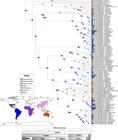
Across the tropical Atlantic, morphologically similar vascular plants suggest the action of vicariance and dispersal processes. Robbin C. Moran & Alan R. Smith’s research documented this pattern for ferns and lycophytes, particularly within Polypodiaceae. This study aims to determine the evolutionary history and biogeographical relationships of Polypodiaceae species between tropical America and Afrotropics. Using the floristic relationships proposed by Moran & Smith, a dated maximum-credibility topology was constructed with 113 species distributed in 24 genera. A presence-absence matrix was created for each species per bioregion, and biogeographical inferences were made using the BioGeoBEARS package in R. Six possible models were tested, and Stochastic Biogeographic Mapping (BSM) was used to estimate biogeographic events. Most proposed floristic relationships were corroborated by previous studies, except Microgramma lycopodioides (tropical America) and M. mauritiana (Afrotropics), explained by evolutionary convergence. Sympatric speciation and dispersal were the most frequent events, with Central and South America as the main source. Long-distance dispersal events, though less frequent, were crucial for the evolution and establishment of species on new continents, shaping current biogeographical patterns. These findings highlight the importance of understanding biogeographical processes in interpreting global plant diversity and distribution.
Keywords:
Convergence; Ferns; Long-Distance Dispersal; Speciation; Vicariance
 Thumbnail
