 Psoriasiform adult blaschkitis triggered by adalimumab: a rare paradoxical reaction
Dear Editor,
Blaschkitis is an acquired, self-limited inflammatory der-matosis that follows Blaschko’s lines, typically affecting adults and involving the trunk. Although its pathogene-sis remains unclear, it has been associated with biologic therapies. These paradoxical cutaneous reactions have been reported with Tumor Necrosis Factor Alpha (TNFa) inhibitors such as infliximab, etanercept, certolizumab and adalimumab.1,2
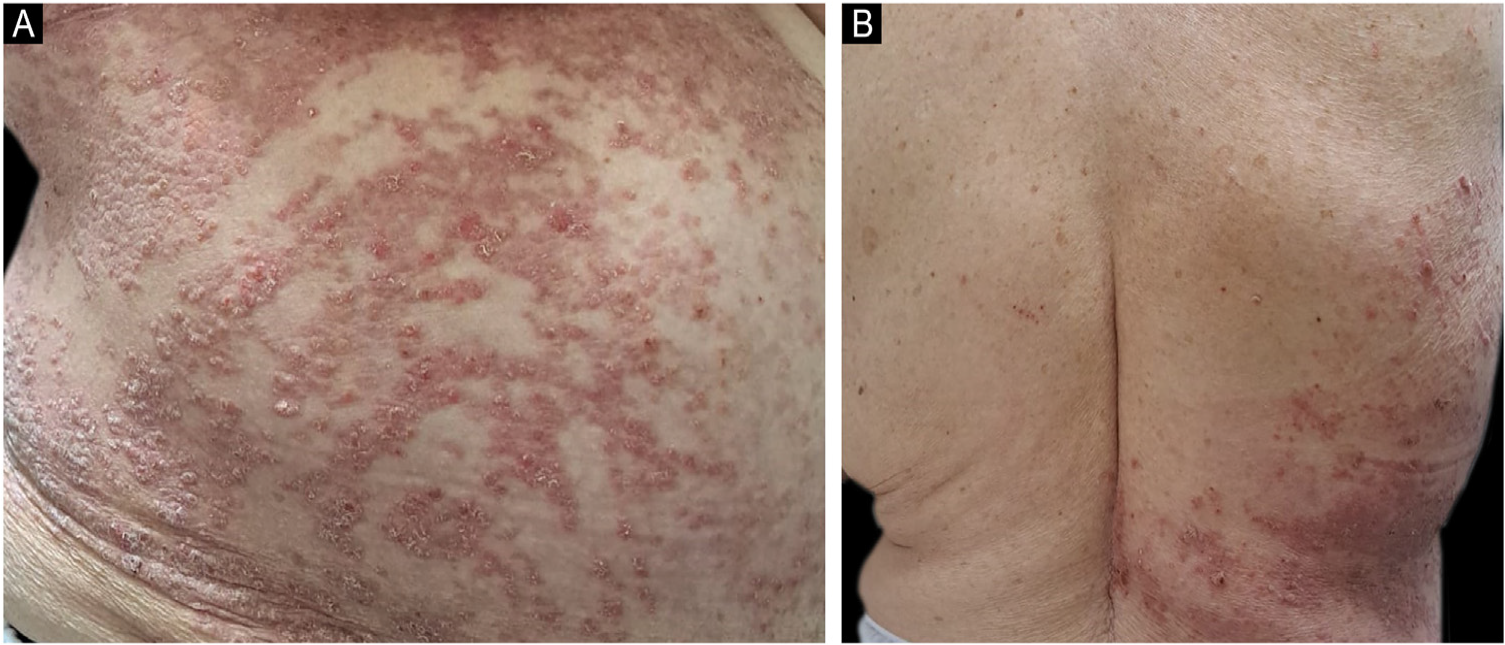
A 74-year-old woman with seronegative spondyloarthri-tis, on adalimumab for three months, developed a gradually progressive, pruritic, erythematous desquamative eruption following Blaschko’s lines on the right trunk (Fig. 1A), with sharp midline demarcation (Fig. 1B). It appeared three months after initiating adalimumab and resolved completely, and without sequelae, following drug discontinuation and substitution to secukinumab. No infectious or other pharmacologic triggers were identified.
Clinical features. (a) Psoriasiform eruption following Blashko’s lines on the trunk. (b) Midline demarcation on the back.
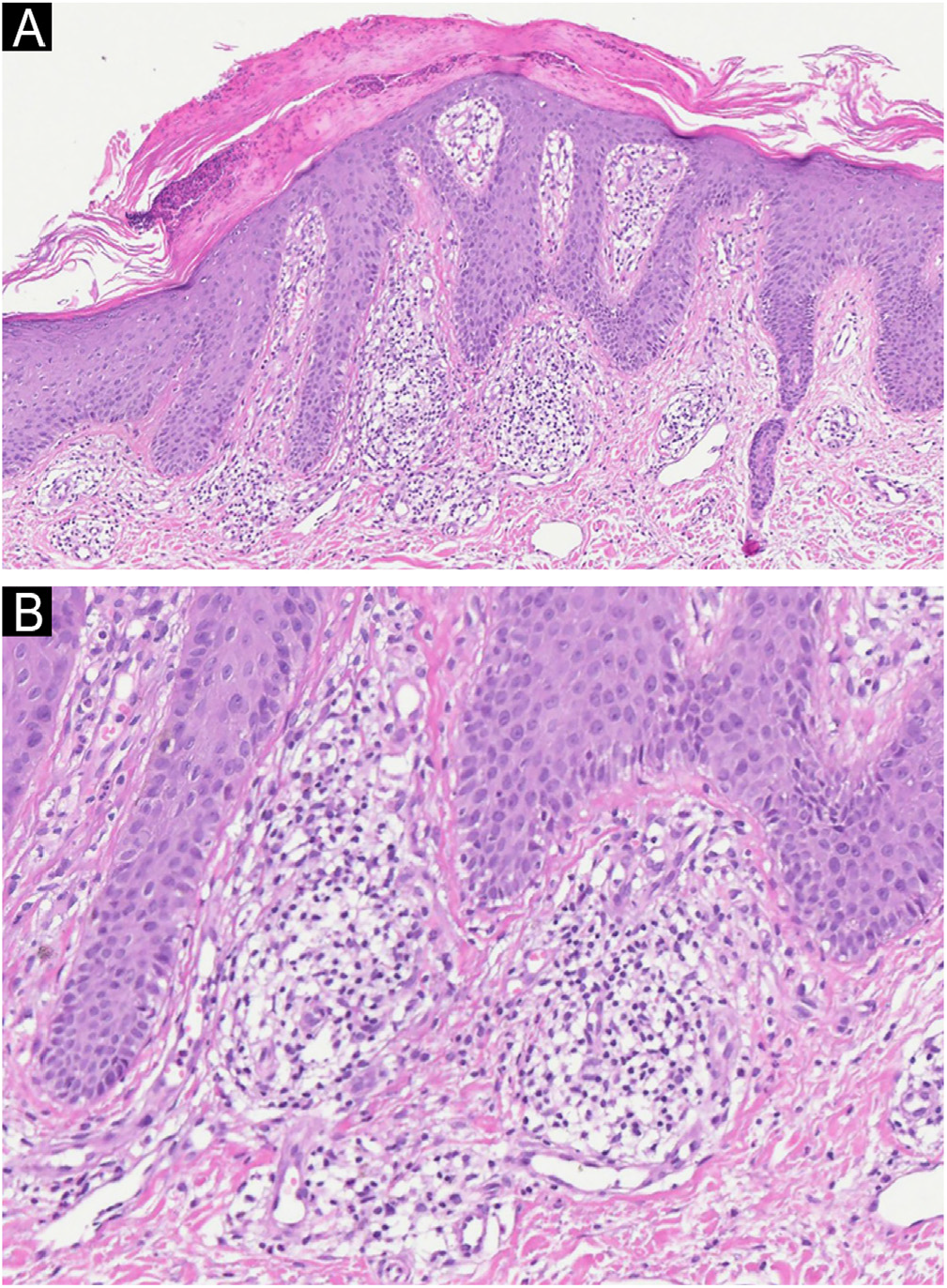
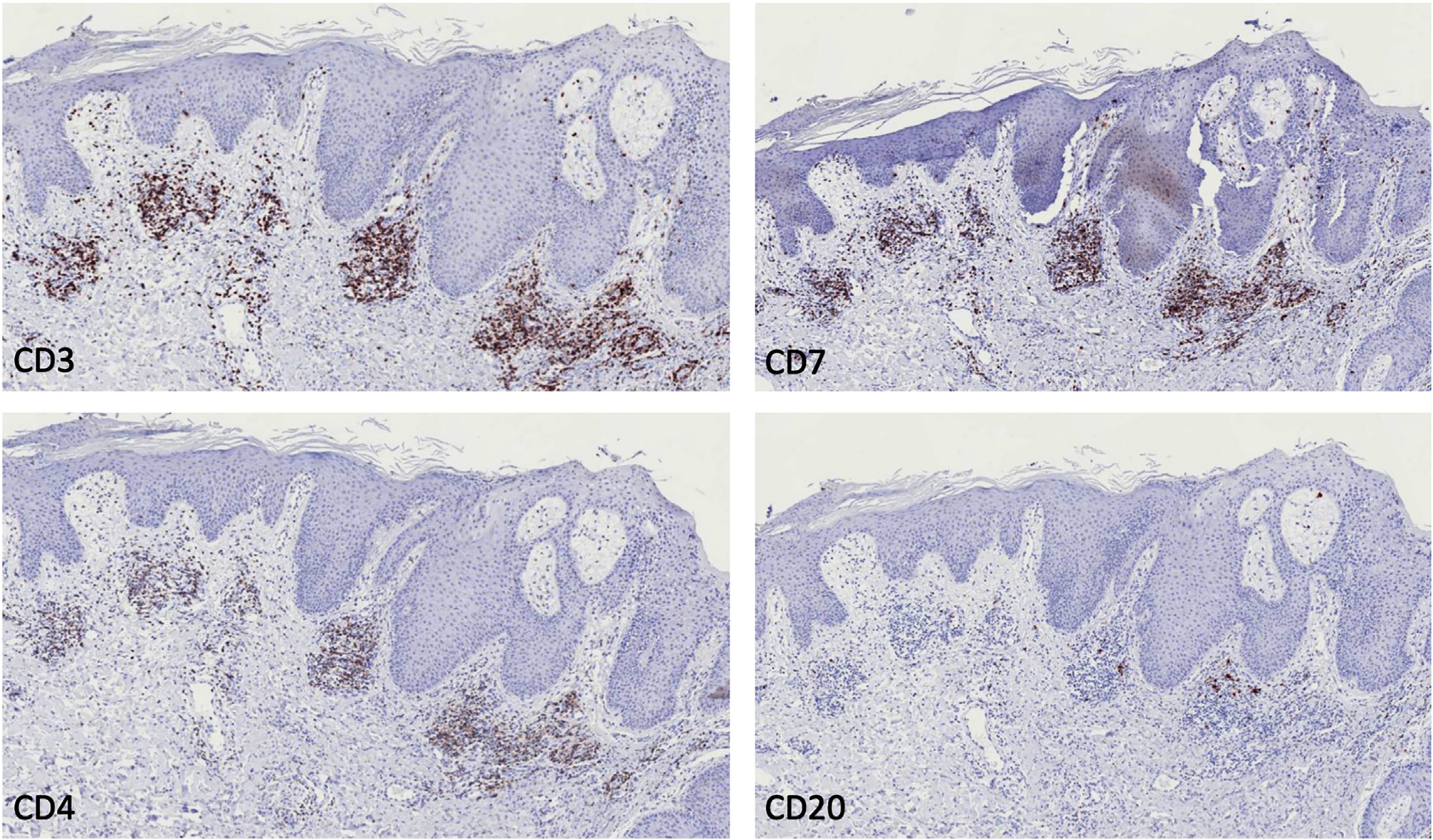
Histopathology revealed epidermis with psoriasiform hyperplasia with focal thinning of the suprapapillary epi-dermis, light spongiosis, and mild vacuolar alteration at the interface, as well as acanthosis and focal paraker-atosis. There were also aggregates of neutrophils within the stratum corneum. The dermis showed an inflamma-tory infiltrate composed of lymphocytes, histiocytes, and a few plasma cells around the superficial dermal vascu-lature, consistent with psoriasiform dermatitis (Fig. 2). Immunohistochemistry was positive in the superficial der-mal infiltrate for CD3, CD4 and CD7, whereas CD20 showed negativity (Fig. 3).
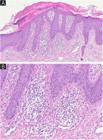
Light microscopy. (A) Psoriasiform hyperplasia with acanthosis and focal parakeratosis, with aggregates of neu-trophils within the stratum corneum (Hematoxylin & eosin, ×100). (B) Detail of the dermal infiltrate with lymphocytes and histiocytes (Hematoxylin & eosin, ×200).
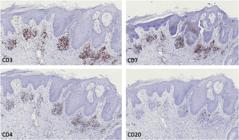
Immunohistochemistry. Positivity in the superficial dermal infiltrate for CD3, CD4 and CD7, and negative for CD20 (×100).
TNFa is a cytokine that plays a pivotal role in the inflammatory response. Its inhibitors have demonstrated significant efficacy in the management of inflammatory diseases such as rheumatoid arthritis, psoriasis, psoriatic arthritis, spondyloarthritis and inflammatory bowel disease. Paradoxically, however, these agents may induce or exacer-bate psoriasis.3 This phenomenon has been observed across multiple underlying diseases and does not appear to be disease-specific. Moreover, it has been associated with all agents within the anti-TNF class.
A retrospective cohort study compared the risk of psoriasis development among patients with Spondy-loarthritis treated with anti-TNF agents versus those receiving conventional therapy. The investigation uti-lized data from the Korea National Health Insurance Claims Database between January 2007 and December 2016. Psoriatic diseases were identified in 1.8% of patients fol-lowing initiation of anti-TNF therapy, whereas only 1.1% of patients treated with conventional therapies developed psoriasis.4
These findings are further supported by data from a recent meta-analysis.5 A statistically higher risk for psoriasis or psoriasiform lesions during anti-TNF therapy was observed in female patients, younger age, smokers, Crohn’s disease, and those who are using adalimumab or certolizumab.
When managing anti-TNF-induced psoriasis or psoriasi-form eruptions, clinicians must weigh whether to continue, discontinue, or switch anti-TNF therapy to another drug class. This decision should be individualized, taking into account factors such as the underlying disease, the ther-apeutic efficacy of the anti-TNF agent, the severity of the cutaneous eruption, and the feasibility of alternative treat-ment options.
According to the treatment algorithm proposed by Li and Perez-Chada,3 the severity of paradoxical psoriasis should first be classified as mild or moderate-to-severe.
For mild cases, if the underlying disease is well con-trolled, continuation of anti-TNF therapy is recommended, combined with conventional psoriasis treatments (e.g., topical corticosteroids, phototherapy, methotrexate). Fur-thermore, discontinuation of anti-TNF therapy may have detrimental effects on the control of the underlying inflam-matory disease.
When the underlying disease remains uncontrolled despite anti-TNF therapy, switching to another anti-TNF agent combined with conventional psoriasis management may be considered.
In patients presenting with moderate-to-severe eruptions and stable underlying disease, substitution of the anti-TNF agent with a drug from another therapeutic class, in combination or not with conventional psoriasis therapy, is recommended.
If anti-TNF therapy fails to control the underlying condi-tion and paradoxical psoriasis is moderate to severe, switching to an alternative biologic class, along with stan-dard psoriasis treatment, should be considered.
Additionally, similar cases of immunobiologicals-induced psoriasis have been described in patients receiving anti-PD-1 immunotherapy, very likely related to T-lymphocytic infiltration of the skin, as evidenced by our immunohisto-chemical findings, with positivity to CD3, CD4 and CD7, all T-cell markers.6
Some authors have used the denomination Blaschko-linear psoriasis to describe these cases,7 the term Blaschkolinear Acquired Inflammatory Skin Eruption (BLAISE) ha salso been used.8
The pathogenesis of these paradoxical lesions is not fully understood, very likely, uncontrolled IFN production is released after TNF inhibition, a process driven by the innate immune system, leading to keratinocyte inflamma-tion and proliferation,9 our immunohistochemical findings support this, since T-cells are predominant in the dermal infiltrate.
This case highlights psoriasiform blaschkitis as a rare paradoxical dermatologic reaction to TNF-α inhibitors. To date, only one case linked to adalimumab has been reported, making this the second in the literature. Recogniz-ing this self-limited condition,1 is essential for appropriate management and to avoid unnecessary discontinuation of effective biologic therapies.
Research data availability
Does not apply.
References
- 1 Monteagudo B, Cabanillas M, Suárez-Amor O, Ramírez-Santos A, Alvarez JC, de Las Heras C. Adult blaschkitis (lichen stria-tus) in a patient treated with adalimumab. Actas Dermosifiliogr. 2010;101:891-2.
- 2 Couderc M, Soubrier M. Blaschkitis under certolizumab for rheumatoid arthritis. Joint Bone Spine. 2014;81:372-3.
- 3 Li SJ, Perez-Chada LM, Merola JF. TNF inhibitor-induced psoriasis: proposed algorithm for treatment and management. J Psoriasis Psoriatic Arthritis. 2019;4:70-80.
- 4 Bae JM, Kwon HS, Kim GM, Park KS, Kim KJ. Paradoxical psoriasis following anti-TNF therapy in ankylosing spondyli-tis: A population-based cohort study. J Allergy Clin Immunol. 2018;142:1001-3.e2.
- 5 Xie W, Xiao S, Huang H, Zhang Z. Incidence of and risk factors for paradoxical psoriasis or psoriasiform lesions in inflammatory bowel disease patients receiving anti-tnf therapy: systematic review with meta-analysis. Front Immunol. 2022;13: 847160.
- 6 Wan Z, Huang J, Ou X, Lou S, Wan J, Shen Z. Psoriasis de novo or exacerbation by PD-1 checkpoint inhibitors. An Bras Dermatol. 2024;99:425-32.
- 7 Sfia M, Roth-Mall B, Tortel MC, Guillaume JC, Cribier B. Psoriasis blaschko-linéaire révélé par un traitement par infliximab (Remicade) [Blasch-kolinear psoriasis revealed by infliximab therapy]. Ann Dermatol Venereol. 2009;136: 898-903.
- 8 Darsha AK, Cohen PR. Blaschkolinear acquired inflammatory skin eruption (BLAISE): case report of a young man whose der-matosis had features of lichen striatus and blaschkitis. Cureus. 2020;12:e10785.
- 9 Sagonas I, Iliopoulos G, Baraliakos X, Daoussis D. Anti-TNF-α induced paradoxical psoriasis in patients with ankylos-ing spondylitis: a systematic review. Clin Exp Rheumatol. 2024;42:178-84.
Edited by
-
Editor
Sílvio Alencar Marques