 Prurigo nodularis: case series of 28 Brazilian patients treated with psychotropic medications
Dear Editor,
Prurigo nodularis (PN) is a chronic, intensely pruritic der-matosis of unknown cause. PN develops predominantly in adults,1 affecting men and women equally; in a US study, 53.1% were women, while 46.9% were men.2 The patho-physiology of PN remains unknown; mechanisms of neuronal sensitization and a cycle of itching and scratching contribute to the chronicity of the disease, with a clear influence of emotional factors.1
PN is defined as an intense, chronic pruritic condition with the presence of numerous localized or generalized papulo-nodular lesions. They are distributed symmetrically in areas of the skin accessible to scratching, being more common on the length of the limbs. A characteristic sign is the absence of lesions in areas inaccessible to scratch-ing, such as the upper back, demonstrating that lesions are self-inflicted. Nodules present with a rough, sometimes excoriated surface and are generally dark in color. Most PN patients report a combination of sensations ranging from heat and cold to stinging, burning, and tingling.3
PN can occur in healthy individuals or in conjunction with systemic diseases: kidney disease, hepatitis C, obstruc-tive pulmonary disease, congestive heart failure, and atopic diathesis (AD).4 It is also associated with advanced HIV infection and mental health disorders.2 Anxiety occurs in 37% of patients, followed by depression in 29%, and suici-dal ideation in 19%.5 It is believed that patients with PN have a threefold increased risk of depression compared to other inflammatory dermatoses. Furthermore, the severity of depression has been shown to have a direct impact on the intensity of pruritus, highlighting the importance of inter-vening in the mental state.6
Treatment of PN is challenging. Recommendations include topical corticosteroids, capsaicin, calcineurin inhibitors, phototherapy, and systemic gabapentinoids, ∝,-opioid receptor antagonists, antidepressants, immuno-suppressants, or biologics such as dupilumab.7 Our psycho-dermatosis group approaches the disease as being entirely secondary to scratching due to uncontrollable pruritus. We therefore present our findings on the treatment of PN with psychotropic medications that modify the sensation of pru-ritus.
Our objective is to describe the clinical characteristics and follow-up of 28 patients with PN seen at the Psychoder-matology Clinic of the Department of Dermatology, Hospital das Clínicas, University of São Paulo, Brazil. We also present our findings on the treatment of PN with psychotropic med-ications that modify the sensation of pruritus.
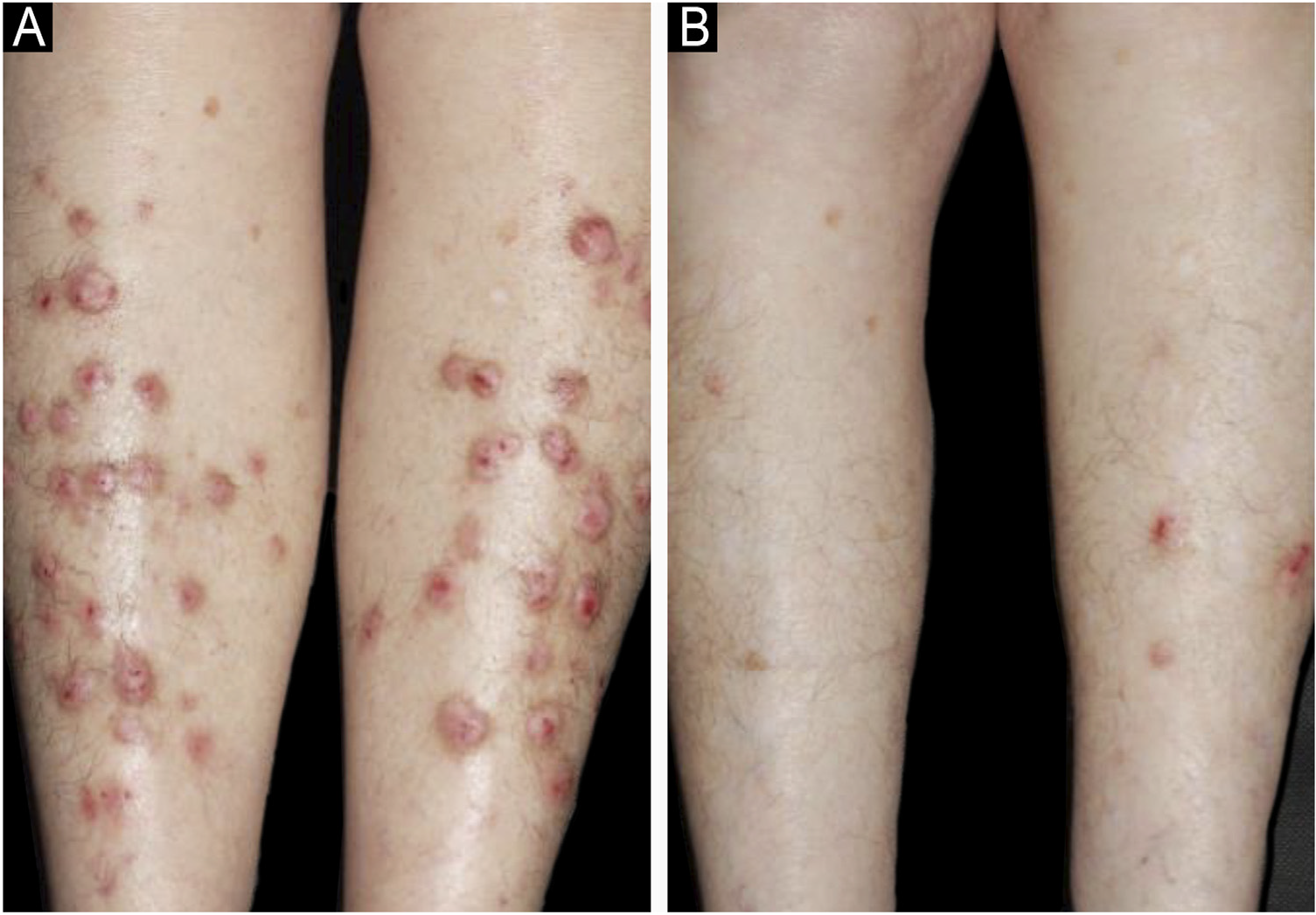
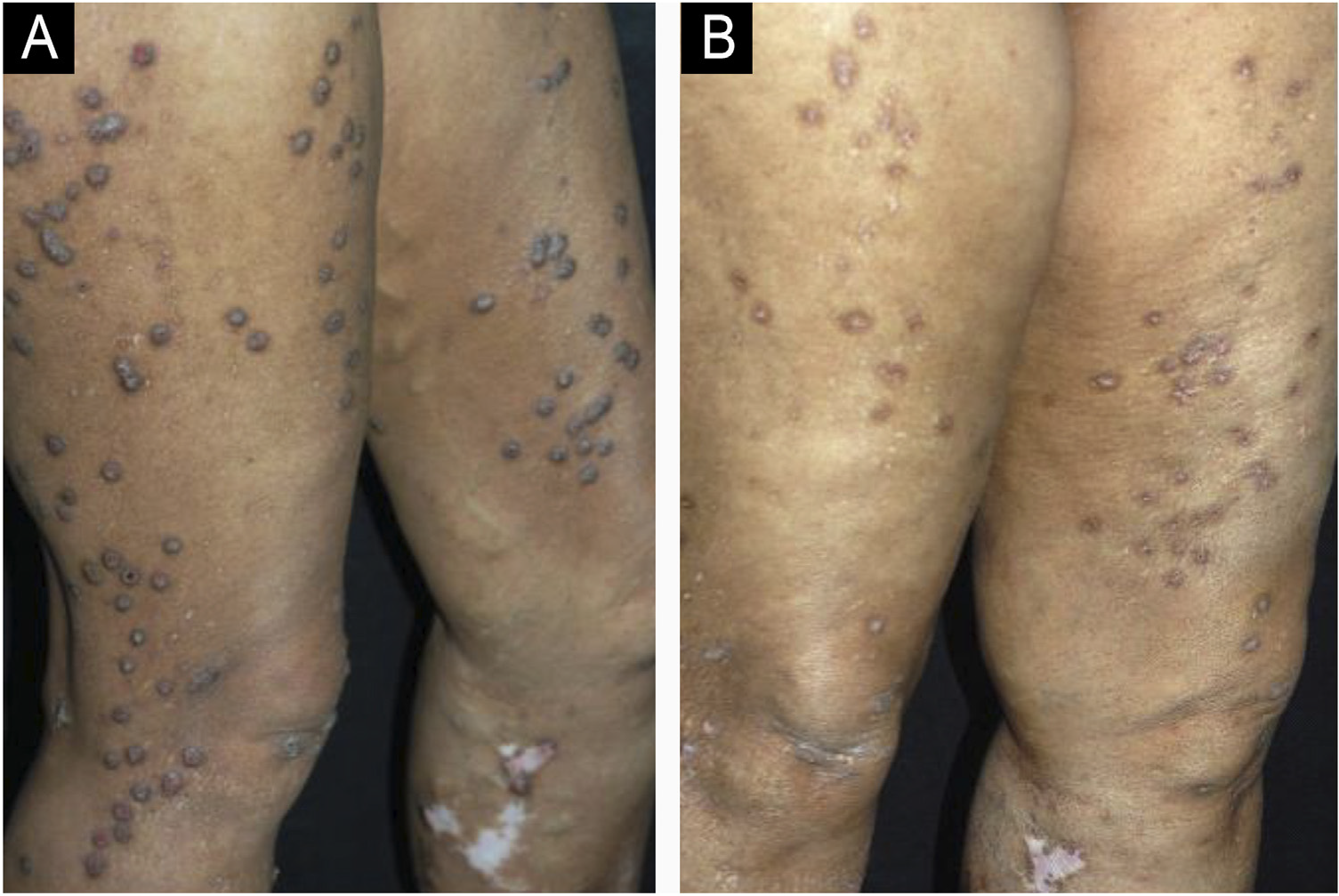
We conducted a retrospective case series study of patients with PN from 2012 to 2024. Patients were included if they met the current diagnostic criteria: presence of firm, nodular lesions; pruritus lasting at least 6-weeks; and history or signs, or both, of repeated scratching, pick-ing, or rubbing.8 Characteristics are depicted in Table 1. Our results showed a higher prevalence of women (21/28, 75%), with a mean age of 52.93 years (28-81 years). Most patients had disseminated lesions (Figs. 1 and 2). Skin lesions were distributed across areas accessible to hand scratch-ing: limbs, trunk, lower back, and face. The most frequent comorbidity was hypertension (n = 7), followed by diabetes mellitus type 2 (n = 4) and previously diagnosed depression (n = 2). Lichen simplex chronicus (LSC) was the most com-mon skin comorbidity (n = 6), followed by AD (n = 2). Skin biopsies were performed in 13 patients and revealed hyper-orthokeratosis, hypergranulosis, acanthosis, dermal fibrosis, and moderate lymphohistiocytic inflammatory infiltrate in all patients. Previous treatments, which mostly included oral antihistamines combined with topical corticosteroids and emollients, were completely ineffective. The treat-ments instituted by our group included doxepin (doses between 10-100 mg/day), amitriptyline (doses between 25-100 mg/day), fluoxetine and pregabalin. The follow-up period for these patients ranged from a single visit to 14 years (mean: 887 days). Four patients were lost to follow-up before any response could be assessed (4/28). Most patients who were followed up showed a satisfactory response, rang-ing from partial to complete. Only a small minority did not show a favorable outcome with doxepin.
(A) Case 20 - the lesions were limited to the legs in this patient. (B) Same patient after 6-months taking doxepin 35 mg/day.
(A) Case 2 - numerous PN lesions. (B) Same patient after 8-months taking amitriptyline 50 mg/day.
To our knowledge, this is the first retrospective study to evaluate clinical characteristics, long follow-up, and treat-ment outcomes of patients with PN in Brazil.
PN patients often present with significant psychological changes and substantially impaired quality of life. Topical treatments and antihistamines are completely ineffective for the treatment of PN, as these drugs are poor antipru-ritics and histamine is not implicated in the genesis of this condition.
Gabapentinoids, immunosuppressants (methotrexate, cyclosporine, azathioprine), antidepressants (mirtazap-ine, selective serotonin reuptake inhibitors), thalidomide, dupilumab, and other immunobiological medications are reported as being more effective. We believe that med-ications that reduce itching may be more effective than immunosuppressants, since lesions are secondary to scratch-ing, and not due to a primary inflammatory phenomenon.
Tricyclic antidepressants are effective antipruritic agents due to their action on the central nervous system, even if patients do not present with obvious depression on clinical examination. Even in the latter, we observe a clear influence of mental state on pruritus, and treatment with psychotrop-ics should be attempted. In our Psychodermatology Clinic, we have obtained excellent results with their use in var-ious pruritic conditions (neurotic excoriations, LSC, lichen amyloidosis). Doxepin is a tricyclic antidepressant not com-mercially available in our setting, being purchased through compounding pharmacies. It has strong antipruritic action, with an affinity for H1 receptors 56-times greater than that of hydroxyzine and 775-times greater than that of diphenhy-dramine. We begin with a dose of 10 mg/day (2.5-5 mg/day in the elderly), and we gradually increase every four weeks until the desired result is achieved. It is administered as a single nightly dose, and its main side effect is drowsi-ness, which can be controlled by adjusting the dose and timing of administration, so that sedation occurs in the early morning rather than during the day. Most of our cases were adequately controlled with doses less than 50 mg/day, with only a few requiring higher doses. Amitriptyline is a low-cost tricyclic antidepressant, a good alternative to doxepin, but the therapeutic range is more limited: it starts with 25 mg/day at night, and few patients tolerate doses higher than 75 mg/day due to the sedative effect.9 Peculiarities regarding its prescription in patients with comorbidities should be individualized on a case-by-case basis.
Serotonin reuptake inhibitors (fluoxetine, paroxetine) have less antipruritic effect than tricyclics, but can be tried in cases where there is intolerance to the latter.10 The mechanism of action of gabapentinoids is unclear; it is believed that they inhibit the α2δ subunit of voltage-gated calcium channels in the dorsal root ganglion and dorsal horn of the spinal cord, thus increasing the threshold for neu-ronal excitation by pruritic stimuli. The upper limit of the recommended dosage is 3,600 mg/day for gabapentin and 600 mg/day for pregabalin. The most common side effects are neurological symptoms such as drowsiness, dizziness, fatigue, and sedation.11 We only use these drugs in excep-tional cases.
Adjuvant therapy for PN includes intralesional corti-costeroid injection in resistant lesions. These should be injected at a high concentration (10 mg/mL of triamci-nolone hexacetonide), in a small volume, and within the nodules (and not underneath), thus causing their reduc-tion through atrophy, without compromising the surrounding skin.
Studies have shown increased expression of STAT6 in PN lesional skin, which is a marker for Th2 cells that release IL-4,10,13. These cytokines are the focus of dupilumab, which targets the IL-4 receptor, and nemolizumab, which targets the IL-31 receptor.12 Consistent with the central role of Th2 cytokines, blocking the IL-4/13 or IL-31 signaling pathways has demonstrated short and long-term efficacy in the treat-ment of PN.5
Limitations of our study included its retrospective design and results from a single academic center.
There are currently no therapeutic guidelines for the management of PN. As psychological factors definitively influence the course of PN (given the clear improvement in the condition with psychotropic drugs), we believe that, in the future, the association of psychotropics with modern interleukin inhibitors should be studied as a more com-prehensive therapy, especially in cases where there is no response to simpler treatments.
☆
Funding
Acknowledgements
The patients in this manuscript have given written informed consent to the publication of their case details.
Research data availability
The entire dataset supporting the results of this study was published in this article.
References
- 1 Pereira MP, Hoffmann V, Weisshaar E, Wallengren J, Halvorsen JA, Garcovich S, et al. Chronic nodular prurigo: clinical pro-file and burden. a european cross-sectional study. J Eur Acad Dermatol Venereol. 2020;34:2373-83.
- 2 Huang AH, Canner JK, Khanna R, Kang S, Kwatra SG. Real-world prevalence of Prurigo Nodularis and burden of associated dis-eases. J Invest Dermatol. 2020;140:480-3.
- 3 Pereira MP, Steinke S, Zeidler C, Forner C, Riepe C, Augustin M, et al. European academy of dermatology and venereology european prurigo project: expert consensus on the definition, classification and terminology of chronic prurigo. J Eur Acad Dermatol Venereol. 2018;32:1059-65.
- 4 Boozalis E, Tang O, Patel S, Semenov YR, Pereira MP, Stander S, et al. Ethnic differences and comorbidities of 909 prurigo nodularis patients. J Am Acad Dermatol. 2018;79:714-9.
- 5 Criado PR, Ianhez M, Criado RFJ, Nakano J, Lorenzini D, Miot HA. Prurigo: review of its pathogenesis, diagnosis, and treatment. An Bras Dermatol. 2024;99:706-20.
- 6 Müller S, Zeidler C, Ständer S. Chronic prurigo including Prurigo Nodularis: new insights and treatments. Am J Clin Dermatol. 2024;25:15-33.
- 7 Zeidler C, Pereira MP, Ständer S. Update zur Therapie der chro-nischen Prurigo [Update on the treatment of chronic prurigo]. Dermatologie (Heidelb). 2022;73:614-9. German.
- 8 Elmariah S, Kim B, Berger T, Chisolm S, Kwatra SG, Mollanazar N, et al. Practical approaches for diagnosis and management of Prurigo Nodularis: United States expert panel consensus. J Am Acad Dermatol. 2021;84:747-60.
- 9 Zalaudek I, Petrillo G, Baldassarre MA, De Luca T, Fran-cione S, Sgambato A, et al. Amitriptyline as therapeutic and not symptomatic approach in the treatment of Prurigo Nodularis. a pilot study. G Ital Dermatol Venereol. 2006;141: 433-7.
- 10 Brasileiro LE, Barreto DP, Nunes EA. Psychotropics in different causes of itch: systematic review with controlled studies. An Bras Dermatol. 2016;91:791-8.
- 11 Matsuda KM, Sharma D, Schonfeld AR, Kwatra SG. Gabapentin and pregabalin for the treatment of Chronic Pruritus. J Am Acad Dermatol. 2016;75:619-25.
- 12 Agrawal D, Sardana K, Mathachan SR, Bhardwaj M, Ahuja A, Jain S. A prospective study examining the effect of selected topical and systemic drugs on pruritus grading system score and stat 6 expression in patients of Prurigo Nodularis. Indian J Dermatol. 2021;66:638-44.