 Comparison between two types of diluents on the collection and preservation of lowland paca (Cuniculus paca) epididymal sperm
ABSTRACT
The aim of this study was to evaluate the efficiency of two diluents (coconut water powder and milk-based diluent) in preserving sperm of lowland paca. A total of seven animals were subjected to the method for recovering sperm directly from the tail of the epididymis by flotation. The samples obtained directly from the tail of the epididymis had an average volume of 1.5mL, an average concentration of 197.1±84.9 (106 sperm/ml). The average motility and vigor for the coconut water powder (ACP) diluent were 63.8% ± 34.2 and 4.2 ± 1.7 respectively. On the other hand, the samples diluted in milk-based diluent had an average motility of 29.8% ± 34.2 and an average vigor of 2.4 ± 1.9. The membrane integrity of the spermatozoa when diluted with ACP was preserved at 84% ± 0.07 and membrane viability maintained at 53.9% ± 3.78, while the milk-based diluent maintained 73% ± 0.21 of the sperm cells integrated and 39% ± 17.9 of viable membranes. The evaluations of the different diluents indicated that the ACP diluent provided better sperm viability compared to the commercial milk-based diluent. However, both compounds did not preserve the sperm samples for up to 24 hours.
Keywords:
wild animals; biotechnology; sperm refrigeration; epididymal sperm
RESUMO
O objetivo deste estudo foi avaliar a eficiência de dois diluentes comerciais (água de coco em pó e diluente à base de leite) na conservação de espermatozoides de pacas (Cuniculus paca). Ao todo, sete animais foram submetidos a método para recuperação espermática diretamente da cauda do epidídimo por flutuação. As amostras obtidas diretamente da cauda do epidídimo tiveram volume médio de 1,5mL, concentração média de 197,1±84,9 (106 espermatozoides/mL), sendo as médias da motilidade e vigor do diluente à base de água de coco em pó (ACP) 63,8±34,2% e 4,2±1,7, respectivamente. Por outro lado, as amostras diluídas utilizando o diluente à base de leite apresentaram motilidade média de 29,8±34,2% e vigor médio de 2,4±1,9. A integridade de membrana dos espermatozoides, quando diluídos com ACP, foi conservada em 84±0,07%, e a viabilidade de membrana foi mantida em 53,9±3,78%, enquanto o diluente à base de leite manteve 73±0,21% das células espermáticas íntegras e 39±17,9% de membranas viáveis. As avaliações dos diferentes diluidores indicaram que o diluente ACP proporcionou melhor viabilidade espermática em comparação com o diluente à base de leite, porém ambos os compostos não conservaram as amostras espermáticas até o tempo de 24 horas.
Palavras-chave:
animais silvestres; biotecnologia; refrigeração; espermatozoides epididimários
INTRODUCTION
Although the lowland paca is not an endangered species according to the International Union for Conservation of Nature (Emmons, 2016), the captive breeding of this animal can potentially reduce hunting and trafficking pressure since its meat is highly appreciated (Ribeiro et al., 2016). As a result, researchers have been trying to stablish tools and protocols to enhance reproductive efficiency of this species and other rodents (Castelo et al., 2015b; Ribeiro et al., 2017; Rodríguez et al., 2012). Preserving sperm for long periods can be an important tool in preserving the genetic variability of wild animals (Castelo et al., 2015a), however the effect of diluents on the preservation of viability of lowland paca semen during refrigeration is unknown. The purpose of cooling semen is to reduce the metabolism of sperm during its conservation, extending its lifespan so that it can be used in the future (England and Ponzio, 1996). For this procedure to be successful, several factors must be considered, such as the choice of diluents, the appropriate dilution rate, the cooling curve and maintaining a specific temperature during storage (Almeida and Santos, 2004). The main diluents used are Tris (tris-hydroxymethyl-aminomethane) and TES (N-tris-hydroxymethyl-2-aminomethane sulfonic acid) (Li et al., 2005). Alternative diluents have commonly been used, such as diluents based on powdered coconut water (Silva et al., 2011), egg yolk, milk and dairy products (Canisso et al., 2008; Oliveira et al., 2011).
Coconut water powder (ACP) is a natural, sterile and acidic diluent that has been used to dilute the semen of various species with satisfactory results, as well as having advantages such as easy preparation, low cost and biochemical characteristics similar to those of fresh coconut water (Barros and Toniolli, 2011).
Some commercial diluents like Botusemen Special® are based on milk lipoproteins and can stabilize protein elements in the sperm cell membrane (Oliveira et al., 2013). The main milk proteins are caseins (80% of all milk proteins), which bind strongly to calcium ions (Ca++), preventing the intracellular accumulation of toxic amounts of Ca++ which cause membrane damage (Hochachka, 1986). The integrity and functionality of the sperm membrane are crucial for assessing sperm viability and fertilization capacity (Snoeck et al., 2014). The aim of this study was therefore to evaluate two types of diluents on the efficiency during refrigeration at 5°C of lowland paca epididymal sperm.
ETHICAL ASPECTS
The research was submitted to the Ethics Committee on Animal Use of the Federal University of Acre, and approved under the number 14/2017.
MATERIALS AND METHODS
Seven pubertal male lowland paca were used for this experiment. The animals were kept at the Lowland Paca Breeding Center of the Wild Animal Breeding and Research Program - Caboclinho da Mata (IBAMA registration number 509309), located in Senador Guiomard/Acre (10°03'22.2''S, 67°36'03.1''W), where they were duly identified using a subcutaneous chip. All the seven males had proven reproductive efficiency through copulations prior to the start of the study. The animals underwent anthelmintic treatment, checked for physical health and were later isolated in 12 m² stalls. Their daily diet consisted of fruit, leaves, roots and grains, as well as mineral salt.
The animals were sacrificed and the testicles were immediately removed using scalpel and scissors (Fig. 1, A), placed in a cooler container with 0.9% saline solution preheated to 39°C, and kept at this temperature for transportation to the Wildlife Support Laboratory of the Federal University of Acre.
The epididymal sperm recovery technique used was flotation (Emerenciano et al., 2013). At the laboratory, the epididymis was dissected (Fig. 1, C and D) from the testicle and identified as to the type of diluent with which they would be washed. Two types of diluents were used: 2.88 g of ACP123® (ACP Biotecnologia, Fortaleza, Ceará; pH-8.2; 300 mOsm/kg H2O) diluted in 50 ml of distilled water; and milk-based Botusemen special® (pH-7.0; <1.61 mOsm/kg H2O; Botupharma, Botucatu, São Paulo), diluted according to the manufacturer orientations. Both solutions were previously warmed to room temperature. Procedures were carried out at the same time on both testicles with their respective diluents.
The head of the epididymis was removed to recover as much mature sperm as possible from the final portion of the body and tail of the epididymis, which were placed in a petri dish containing 1mL of the correspondent diluent. With the aid of scalpels and scissors, transverse cuts were made along the entire structure so that the sperm could migrate into the solution (Fig. 1, D). After resting for 5 minutes, 10 µl were removed from the solution using a micropipette and placed on a glass slide to assess the initial motility and vigor (strength of the sperm flagellum beating on a 0 to 5 scale) of the sample, using light microscopy at X100 and X400 magnification.
To obtain the concentration, 10µL of the solution were removed and fixed in 1mL of formaldehyde saline, and the counting was carried out using a Neubauer counting chamber and a light microscope. From the diluted samples obtained, 10µL were diluted in 50 µl of formalin saline in labeled 2mL microtubes. Microscope slides were assembled to identify the percentage of curled tail sperm from each individual before carrying out the hypoosmotic test.
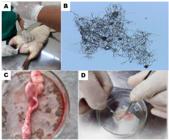
A) Handling and inguinal region sanitization of male lowland paca. B) Lowland paca spermatozoa agglutination. C) Lowland paca epididymis and testicle. D) Epididymal sperm recovery by the flotation technique.
After the initial evaluations, the epididymis was washed again with 1mL of diluent, resulting in a final volume of approximately 1.5mL. The final volume was placed in a 10mL plastic container (BotuIA®, Botucatu, São Paulo) labeled with the type of diluent and the date of the sample.
For cooling, they were placed in cooling boxes (Botuflex®, Botucatu, São Paulo) at a temperature of 5°C. After 24h, 50µL was taken from the cooled sample and placed in a water bath for 3 minutes. A volume of 10µL was used from each warmed sample for motility, vigor, hyposmotic response and membrane integrity evaluations. The ice packs used for cooling (BotuGelo®, Botucatu, São Paulo) were changed every 24 hours so that the temperature was maintained. These procedures were repeated until all samples showed motility <5% and vigor <1.
To carry out the Hyposmotic Test (HOS test) for membrane viability evaluation, 10µL were taken from each diluted sample, and re-diluted in 90µL of distilled water (0 mOsm/L) in labeled 2m microtubes, following the technique carried out by Castelo et al. (2015a) on agoutis. The samples were placed in a water bath at 39°C and evaluated for a total of 45 minutes. Every five minutes 10µL were removed from each sample and fixed in 50µL of formalin saline for subsequent counting of sperm tail alterations using a light microscope (X 400). This procedure was carried out to assess the time required for hypoosmotic tests on cooled semen of lowland paca. Melo and Henry (1999) describes the calculation for obtaining the result of the hypoosmotic test as: HO% = (% of changes in the tail region after the HOS test) - (% of changes in the tail region before the HOS test).
Using eosin and nigrosine staining, the aim was to assess the integrity of the sperm membrane. In this method, only spermatozoa with damaged cellular membranes will change their color (Łącka et al., 2016). Using a micropipette, 10µL of the epididymal wash was removed and added to a glass slide along with 10µL of a commercial mixture of eosin and nigrosine (Reprodux, Itapira, São Paulo). A simple smear was made, and the slides were left to dry for 10 minutes, after which 200 sperm cells were counted, and it was counted how many of them had been stained.
The means of the non-parametric variables were compared using the Wilcoxon-Mann-Whitney test, with a significance level of 5%.
RESULTS
The flotation technique was used to recover epididymal sperm from five pubertal adult lowland pacas. The technique delivered good results, with an average volume of 1.5mL and a concentration of 197.1±84.9 (106 sperm cells/ml). It was observed that lowland paca epididymal sperm can have progressive motility with excellent vigor, and even the formation of turbulence.
The comparison between motility, vigor, membrane integrity and hypoosmotic response after using the two different types of diluents used in lowland paca epididymal sperm can be seen in Table 1. Both ACP and milk-based diluent were not capable of maintain satisfactory motility and vigor parameters for more than 24 hours, so only one repetition of the motility, vigor, membrane integrity and osmotic response evaluations was carried out (Table 2).
DISCUSSION
This study is pioneer on the evaluation of lowland paca epididymal sperm, so the observations made here cannot be compared with studies using the same species. However, when compared with experiments using similar species of the Order Rodentia, it was observed that the average sperm concentration found is lower than that found by Castelo et al. (2023), that in sperm obtained by retrograde flushing of the epididymis tail of agouti (Dasyprocta aguti) found 822.5 ± 85.0 x10⁶ (sperm cells/ml). Also in agoutis, Ferraz et al. (2011) through recovery by retrograde flow reports that the average recovery was 748x106 (sperm cells/ml). Silva et al. (2014) performed flotation on Brazilian guinea pig (Cavia aperea) and found a sperm concentration of 207.3 ± 44.9x10⁶ (sperm cells /mL). The difference in concentration found between agoutis and lowland paca can be explained by the individual capacity of each species to produce sperm. According to Carretta Júnior (2012), the sperm reserve per gram of testicle in agoutis is 674 million, while in lowland pacas it is around 290 million sperm cells.
This study compared the efficiency of two types of diluents, the first based on coconut water (ACP) and a well-established milk-based commercial diluent for equine. The use of ACP in wild species has been reported with good success rates. Sousa et al. (2016) report its use in six-banded armadillo (Euphractus sexcinctus), Silva et al. (2011) and Castelo et al. (2015a) reported it in work with agouti epididymal sperm. The commercial milk-based diluent is widely used in equine reproduction. Castro et al. (2020) also mentions that this kind of diluent formula is superior to other commercial milk-based compositions in terms of preserving viable cooled semen for up to 48 hours. In terms of motility and vigor, the commercial milk-based diluent showed an average of 29.8±34.2% and 2.4±1.9 respectively. The ACP diluent, on the other hand, showed sperm values with motility of 63.8 ±34.2% and vigor of 4.2±1.7. There was a significant difference (p<0,05), according to the Mann-Witney test, between the motility and membrane viability of the two types of diluents. On the other hand, vigor and membrane integrity showed no significant difference (p>0,05).
The use of ACP was reported by Silva et al. (2011) as being one of the diluents of choice for preserving epididymal sperm in agouti, showing average motility and vigor of 91.5±5.0 and 4.7±0.2, respectively. Castelo et al. (2023), also working with agouti reported a decline from 96.2 ± 2.4 of motility and 5.0 ±0.0 of vigor for fresh epididymal collected sperm, to 24.8 ± 12.0% of motility and 2.5 of vigor for frozen and thawed sperm diluted with ACP and glycerol. This reduction is explained by cellular membrane damage caused by the adverse effects of low temperatures required for freezing (-196 °C; (Bucak et al., 2009) and the toxic effects of the cryoprotector (glycerol; Castelo et al. 2015a). The use of ACP as diluent for epididymal retrieved sperm is also reported in domestic species, such as in the study by Emerenciano et al. (2013) in cats, where the average motility was 44.7 ± 8.9% and vigor 3 ± 0.4 and. In dogs, Gomes et al. (2014) reported an average motility of 58.0 ± 10.95% and vigor 2.6 ± 0.41.
In the present study, lowland epididymal sperm diluted with ACP presented higher motility and membrane viability (HOS test) than sperm diluted with milk-based diluent (p<0,05). Studies with cat (Comercio et al., 2013) and human (Van den Saffele et al., 1992) spermatozoa have already found a positive correlation between the HOS test and sperm motility. On the other hand, Dantas et al. (2022) states that no such correlation was identified in epididymal sperm from agouti. The composition of coconut water is rich in nutrients that can potentially improve spermatozoa survival, like salts, proteins, carbohydrates, vitamins and neutral fats (Blume and Marques Júnior, 1997). The high concentrations of molecules like arginine, lysine, Na++, K+ and indole-3-acetic acid (IAA) are capable of enhance sperm motility and longevity of several species (Almeida and Soares, 2002; Toniolli et al., 1996). An intact cellular membrane allows proper transport of those molecules to the cytoplasm where they can be utilized for ATP generation, which leads to increased motility (Castelo et al., 2023). Besides, one can assume that the lowland paca sperm cells diluted with ACP would be more capable for fertilization, as the cellular membrane plays important roles on process like capacitation, acrosomal reaction and sperm biding to the egg surface (Jeyendran et al., 1984).
Milk-based diluents have already been used in sperm samples of rabbits by Andrade et al. (2008). The author observed an average motility and vigor of 65.9±5.31% and 2.72±0.45 respectively, and concluded that these are acceptable averages for reproduction protocols. Castro et al. (2020), evaluating the efficiency of skimmed milk in comparison with two commercial formulations (Botusemen® and Botusemen special®), observed that the commercial diluent Botusemen special® had a higher average success rate in preserving cooled equine semen for up to 48 hours. Also, the authors report an average of 67.6% motility in the samples studied. Castro et al. (2020) also describes that the average vigor in horses was 2.9, which is close to the average found in lowland pacas (2.4±1.9) in this study. Also assessing the viability of the samples diluted in milk-based diluent, the authors found an average membrane integrity of 70.1% and osmotic response of 46.1%, these results being close to those found in lowland pacas.
The two diluents (ACP and milk-based diluent) did not maintain satisfactory motility and vigor parameters for more than 24 hours. Other authors have described the drop in sperm viability when using the ACP diluent, such as Gomes et al. (2014), who evaluated cooled dog semen and observed that after 24 hours a motility of 58.0±10.95% and vigor 2.6±0.41 showed averages of 3±2.73% and 0.4±0.54, respectively. Mota Filho et al. (2014) also in a study with canine sperm diluted with ACP, concluded that after 12 hours of cooling at 4°C, the rates of motility and vigor begin to decline, becoming unviable after 18 hours of incubation.
Among the studies using milk-based diluents, Melo et al. (2014) observed that within 24 hours different types of milk-based diluents have similar efficiency, but after 24 hours the acceptable values for cooled equine semen begin to decline. According to Bispo et al. (2011), in a study with goats, milk-based diluents are one of the main diluents used in goat protocols, but their proven efficiency lasts from 12 to 24 hours. The use of these diluents in the cooling of lowland paca semen was pioneer, so comparison with other protocols is not yet possible. The procedure for assessing the best incubation time for the sperm viability test (HOS test) of lowland paca epididymal sperm showed that from 10 minutes onwards it was possible to observe the presence of a high percentage of isolated heads and from 15 minutes onwards there was agglutination of the sperm into lumps that made it difficult to count the tails (Fig. 1, B).
Therefore, for the evaluation of the results expressed in this study, the 5-minute incubation time of the samples in a water bath was considered. Even in cattle there is no completely defined time, where authors have been successful in various time ranges: 5 minutes (Correa et al., 1997), 30 minutes (Mocé and Graham, 2008) and 60 minutes (Vera-Munoz et al., 2009). Castelo et al. (2015a) evaluated sperm viability in agoutis and reported good results using 45 minutes. Cortés et al. (1993) state that the highest proportion of sperm reactions to the hyposmotic test occurs in the first 20 minutes.
In this study, sperm membrane integrity was assessed using eosin and nigrosine stain. This method is already well-established for this purpose in domestic species and has been used in wild rodents, as observed in Rodríguez et al. (2012) working with capybara (Hydrochoerus hydrochaeris) semen and Silva et al. (2014) in a study with Brazilian guinea pig (Cavia aperea) epididymal spermatozoa.
The average membrane integrity was 84±0.07% in the ACP diluted semen and 73±0.21% when using the commercial milk-based diluent. The results of the two diluents studied were higher than those found by Silva et al. (2014) in Brazilian guinea pig using the diluent TES, where they obtained an integrity of 52.7±7.3. Rosero Peñaherrera et al. (2018), evaluating different types of diluents in the processing of rabbit semen (Oryctolagus cuniculus), observed membrane integrity of 78% when using coconut water-based diluent, a result below that found in the samples with ACP in this study. However, the author mentions that 84% of the sperm had preserved integrity when using milk-based diluents, while in this study the milk-based diluent was successful at 73±0.21%. In the present study, samples preserved in ACP for 24 hours at 5 °C showed a 13% drop in membrane integrity, which was higher than that observed in samples diluted with milk-based diluent, which showed a 6% drop in sperm membrane integrity.
CONCLUSIONS
The epididymal samples diluted in ACP obtained better averages for sperm parameters, differing statistically in terms of motility and osmotic response at 5% probability, compared to milk-based diluents, but both diluents did not preserve the sperm samples with satisfactory parameters after 24 hours.
REFERENCES
- ALMEIDA, L.E.F.; SANTOS, M.R.C. Viability of extended canine semen cooled and storage in a transport container for overnight delivery. Rev. Bras. Cienc. Vet., v.11, p.116-118, 2004.
- ALMEIDA, R.; SOARES, A.E.E. Usage of green coconut water and different tissue culture media for in vitro honey bee semen storage (Apis mellifera; hymenoptera: apoidea). Interciencia, v.27, p.317-321, 2002.
- ANDRADE, A.F.C.; CARVALHO, C.E.C.; ANDREZA, Y.L. et al. Eficiência in vitro de três diluidores para sêmen de coelho. Braz. J. Vet. Res. Anim. Sci., v.45, Suppl, p.33-39, 2008.
- BARROS, T.B.; TONIOLLI, R. Potential use of coconut water in the semen technology. Rev. Bras. Reprod. Anim., v.35, p.400-407, 2011.
- BISPO, C.A.S.; PUGLIESI, G.; PALHÃO, M.P. et al. Características in vitro e fertilidade do sêmen caprino armazenado a 5°c por 24 horas utilizando duas concentrações de gema de ovo no diluente. Ciênc. Anim. Bras., v.12, n.4, 2011.
- BLUME, H.; MARQUES JÚNIOR, A.P.V. Avaliação da água de coco no cultivo e criopreservação de embriões murídeos. Rev. Bras. Reprod. Anim., v.18, p.97-104, 1997.
- BUCAK, M.N.; SARIÖZKAN, S.; TUNCER, P.B. et al. Effect of antioxidants on microscopic semen parameters, lipid peroxidation and antioxidant activities in Angora goat semen following cryopreservation. Small Ruminant Res., v.81, p.90-95, 2009.
- CANISSO, I.F.; Souza, F.A.; Silva, E.C. et al. INSEMINAÇÃO ARTIFICIAL EM EQUINOS: sêmen fresco, diluído, resfriado e transportado. Rev. Acad. Ciênc. Anim., v.6, n.3, p. 389, 2008.
- CARRETTA JÚNIOR, M. Estudo comparativo do processo espermatogênico e duração do ciclo do epitélio seminífero através da técnica de imunohistoquímica com Bromodeoxiuridina de três diferentes espécies de roedores da subordem Hystricomorfa: cutia (Dasyprocta leporina), paca (Cuniculus paca) e capivara (Hydrochoerus hydrochaeris). 2012. 146f. Tese (Doutorado em Medicnia Veterinária) - Universidade Federal de Viçosa, Viçosa, MG.
- CASTELO, T.S.; SILVA, A.M.S.; PEIXOTO, G.C.X. et al. Cryopreservation efficiency of red-rumped agouti (Dasyprocta leporina) sperm obtained from different origins through epididymal retrograde flushing or electroejaculation. Cryobiology, v.113, p.104787, 2023.
- CASTELO, T.S.; SILVAL, A.M.; BEZERRA, L.G.P. et al. Comparison among different cryoprotectants for cryopreservation of epididymal sperm from agouti (Dasyprocta leporina). Cryobiology, v.71, p.442-447, 2015a.
- CASTELO, T.S.; SOUZA, A.L.P.; LIMA, G.L. et al. Interactions among different devices and electrical stimulus on the electroejaculation of captive agoutis (Dasyprocta leporina). Reprod. Domest. Anim., v.50, p.492-496, 2015b.
- CASTRO, F.S.; PIMENTEL, A.M.; MATTOS, R.C. et al. Utilização de leite com diferentes concentrações de gordura como diluentes para sêmen equino refrigerado. Ciênc. Anim. Bras., v.21, p.e-44262, 2020.
- COMERCIO, E.A.; MONACHESI, N.E.; LOZA, M.E. et al. Hypo-osmotic test in cat spermatozoa. Andrologia, v.45, p.310-314, 2013.
- CORREA, J.R.; PACE, M.M.; ZAVOS, P.M. Relationships among frozen-thawed sperm characteristics assessed via the routine semen analysis, sperm functional tests and fertility of bulls in an artificial insemination program. Theriogenology, v.48, p.721-731, 1997.
- CORTÉS, S.; NUÑEZ, R. E VAZQUEZ, I. Capacidad de reaccion a endosmosis del espermatozoide de macho cabrio. In: INTERNATIONAL MEETING ON ANIMAL REPRODUCTION, 7., 1993, Murcia. Proceedings... Murcia, Portugal: [s.n.], 1993. p.225 (Resumo).
- DANTAS, M.R.T.; LUZ, D.N.N.; BEZERRA, L.G.P. et al. Evaluation of sperm membrane functionality during epididymal transit in red-rumped agouti (Dasyprocta leporina). Reprod. Domest. Anim., v.57, p.912-918, 2022.
- EMERENCIANO, K.D.M.; LIMA, G.L.; PEIXOTO, G.C.X. et al. Recuperação de espermatozóides epidimários de gatos domésticos (Felis catus) utilizando soluções à base de Tris ou água de coco em pó. Acta Vet. Bras., v.7, p.148-153, 2013.
- EMMONS, L. Cuniculus paca. The IUCN Red List of Threatened Species. e.T699A22197347, 2016.
- ENGLAND, G.C.W.; PONZIO, P. Comparison of the quality of frozen-thawed and cooled-rewarmed dog semen. Theriogenology, v.46, n.1, p.165-171, 1996.
- FERRAZ, M.S.; MENEZES, D.J.A.; PESSOA, G.T. et al. Collection and evaluation of epididymal sperm in captive agoutis (Dasyprocta aguti). Theriogenology, v.75, p.459-462, 2011.
- GOMES, E.T.; SANTOS, J.F.P.D.; SILVA, K.B.P.; FREITAS, P.C. Cooling of canine spermatozoa after recovery from epididymis using ACP-106c® added by or not egg yolk: preliminary results. Acta Vet. Bras., v.8, Suppl.2, p.144-145, 2014.
- HOCHACHKA, P.W. Defense strategies against hypoxia and hypothermia. Science, v.231, p.234-241, 1986.
- JEYENDRAN, R.S.; VAN DER VEN, H.H.; PEREZ-PELAEZ, M. et al. Development of an assay to assess the functional integrity of the human sperm membrane and its relationship to other semen characteristics. Reproduction, v.70, p.219-228, 1984.
- ŁĄCKA, K.; KONDRACKI, S.; IWANINA, M. WYSOKIŃSKA, A. et al. Assessment of stallion semen morphology using two different staining methods, microscopic techniques, and sample sizes. J. Vet. Res., v.60, p.99-104, 2016.
- LI, Y.H. et al. Effects of various extenders and permeating cryoprotectants on cryopreservation of cynomolgus monkey (Macaca fascicularis) spermatozoa. J. Androl. v. 26, n. 3, p. 387-395, 2005.
- MELO, C.C.S.; CAI, K.J.; KOVACS, A.; JI, W.Z. Renewal of tris extender with egg yolk or Aloe vera sp. on viability in cooled canine semen at 5°C-preliminary results. Acta Vet. Bras., v.8, Suppl.2, p.142-143, 2014.
- MELO, M.I.V.; HENRY, M. Teste hiposmótico na avaliaçäo do sêmen eqüino. Arq. Bras. Med. Vet. Zootec, v.51, p.71-78, 1999.
- MOCÉ, E.; GRAHAM, J.K. In vitro evaluation of sperm quality. Anim. Reprod. Sci., v.105, p.104-118, 2008.
- MOTA FILHO, A.C.; SILVA, H.V.R.; NUNES, T.G.P. et al. Cryopreservation of canine epididymal sperm using ACP-106c and TRIS. Cryobiology, v.69, p.17-21, 2014.
- OLIVEIRA, G.C.; OLIVEIRA, B.M.M.; CELEGHINI, E.C.C.; FERNANDES, C.B.; MATTOS, C.B. Criopreservação do sêmen equino: uma revisão. Rev. Bras. Reprod. Anim., v.37, p.23-28, 2013.
- OLIVEIRA, K.G.; MIRANDA, S.A.; LEÃO, D.L. et al. Semen coagulum liquefaction, sperm activation and cryopreservation of capuchin monkey (Cebus apella) semen in coconut water solution (CWS) and TES-TRIS. Anim. Reprod. Sci., v.123, p.75-80, 2011.
- RIBEIRO, V.M.F.; CARVALHO, Y.K.; PERUQUETTI, R.C.; MEDEIROS, L. Consumo e comercialização de carnes silvestres: potencial econômico para a Amazônia Ocidental. J. Amazon Health Sci., v.2, n.1, 2016.
- RIBEIRO, V.M.F.; DINIZ, S.R.; ALVES, F.V. et al. Synchronization of estrus in paca (Cuniculus paca L.): possible impacts on reproductive and productive parameters. Braz. J. Vet. Res. Anim. Sci., v.54, p.27-35, 2017.
- RODRÍGUEZ, J.; PEÑA, M.J.; GÓNGORA, A.O.; MURILLO, R.P. Obtención y evaluación del semen de capibara Hydrochoerus hydrochaeris. Rev. MVZ Córdoba, v.17, p.2991-2997, 2012.
- ROSERO PEÑAHERRERA, M.A.; NÚÑEZ-TORRES, O.P.; LOZADA-SALCEDO, E.E. Evaluación de tres diluyentes naturales para semen fresco de conejo en la inseminación artificial. J. Selva Andina Anim. Sci., v.5, p.23-32, 2018.
- SILVA, A.M.; BEZERRA, J.A.B.; CAMPOS, L.B.; SOUZA, P.C. omparison of different staining methods for the morphology evaluation of cavy (Galea spixii) epididymal sperm. Acta Vet. Bras., v.8, p.37-38, 2014.
- SILVA, M.A.; PEIXOOTO, G.C.X.; SANTOS, E.A.A. et al. Recovery and cryopreservation of epididymal sperm from agouti (Dasiprocta aguti) using powdered coconut water (ACP-109c) and Tris extenders. Theriogenology, v.76, p.1084-1089, 2011.
- SNOECK, P.P.N.; MELO, M.I.V.; ALVES, S.G.G. et al. Qual é o teste hiposmótico mais indicado para avaliar a integridade funcional de espermatozoides equino criopreservados? Braz. J. Vet. Med., v.36, p.355-361, 2014.
- SOUSA, P.C.; SANTOS, E.A.A.; SILVIA, A.M. et al. Identification of ultrastructural and functional damages in sperm from six-banded armadillos (Euphractus sexcinctus) due to cryopreservation. Pesqui. Vet. Bras., v.36, p.767-774, 2016.
- TONIOLLI, R.; BUSSIÈRE,J.; COUROT, M.; MAGISTRINI, M.; COMBARNOUS, Y. Effect of indole-3-acetic acid (plant auxin) on the preservation at 15 °C of boar semen for artificial insemination. Reprod. Nutr. Dev., v.36, p.503-511, 1996.
- VAN DEN SAFFELE, J.; VERMEULEN, L.; SCHOONJANS, F.; COMHAIRE, F.H. Evaluation of the hypo-osmotic swelling test in relation with advanced methods of semen analysis. Andrologia, v.24, p.213-217, 1992.
- VERA-MUNOZ, O.; AMIRAT-BRIAND, L.; DIAZ, T. et al. Effect of semen dilution to low-sperm number per dose on motility and functionality of cryopreserved bovine spermatozoa using low-density lipoproteins (LDL) extender: Comparison to Triladyl® and Bioxcell®. Theriogenology, v.71, p.895-900, 2009.
The research data are available upon request.