Mobility of trace elements in soil-water systems near a decommissioned uranium mine: influence of environmental factors
Abstract
Oligoelements are trace mineral substances that occur in minimal amounts in living organisms and can be either beneficial or toxic depending on their concentration and bioavailability. Understanding their mobility in soil and water systems is essential for assessing environmental and human health risks, particularly in areas affected by mining activities. This study evaluated the mobility of five trace elements-arsenic (As), selenium (Se), aluminum (Al), uranium (U), and molybdenum (Mo)-in soils near a decommissioned uranium mine in Salamanca, Spain. The soil was fractionated into three particle size classes and subjected to varying moisture levels (50%, 75%, 100%) and incubation times (one, seven, 30 days). Soil solutions were extracted by centrifugation at different speeds, simulating suction pressures associated with water availability in the soil. Concentrations in soil solutions ranged from As: 0.5-12.3 µg/L, U: 0.2-8.7 µg/L, Al: 0.8-15.4 µg/L, Mo: 0.3-6.2 µg/L, Se: 0.1-2.8 µg/L, depending on environmental conditions. Moisture increases from 50% to 100% raised As and U concentrations by up to 60%, while particle size shifts from coarse sand to silt/clay altered As levels by over 70%. Boxplot analysis revealed outliers for As, Al, U, and Mo, indicating strong sensitivity to soil texture and water availability. ANOVA confirmed particle size as the most influential factor (p < 0.05), followed by moisture and suction pressure, whereas incubation time showed no significant effect. These findings highlight rapid equilibrium and element-specific responses, with implications for groundwater contamination risk in post-mining landscape.
Keywords:
environmental contamination; soil mobility; trace elements; uranium mine; water resources
Resumo
Oligoelementos são substâncias minerais traço que ocorrem em quantidades mínimas em organismos vivos e podem ser benéficas ou tóxicas, dependendo de sua concentração e biodisponibilidade. Compreender sua mobilidade em sistemas de solo e água é essencial para avaliar os riscos ambientais e à saúde humana, particularmente em áreas afetadas por atividades de mineração. Este estudo avaliou a mobilidade de cinco oligoelementos - arsênio (As), selênio (Se), alumínio (Al), urânio (U) e molibdênio (Mo) - em solos próximos a uma mina de urânio desativada em Salamanca, Espanha. O solo foi fracionado em três classes de tamanho de partícula e submetido a diferentes níveis de umidade (50%, 75%, 100%) e tempos de incubação (um, sete, 30 dias). As soluções do solo foram extraídas por centrifugação em diferentes velocidades, simulando as pressões de sucção associadas à disponibilidade de água no solo. As concentrações nas soluções do solo variaram de As: 0,5-12,3 µg/L, U: 0,2-8,7 µg/L, Al: 0,8-15,4 µg/L, Mo: 0,3-6,2 µg/L, Se: 0,1-2,8 µg/L, dependendo das condições ambientais. O aumento da umidade de 50% para 100% elevou as concentrações de As e U em até 60%, enquanto a mudança no tamanho das partículas, de areia grossa para silte/argila, alterou os níveis de As em mais de 70%. A análise de boxplot revelou valores discrepantes para As, Al, U e Mo, indicando forte sensibilidade à textura do solo e à disponibilidade de água. A ANOVA confirmou o tamanho das partículas como o fator mais influente (p < 0,05), seguido pela umidade e pela pressão de sucção, enquanto o tempo de incubação não apresentou efeito significativo. Esses resultados destacam o rápido equilíbrio e as respostas específicas de cada elemento, com implicações para o risco de contaminação das águas subterrâneas em paisagens pós-mineração.
Palavras-chave:
contaminação ambiental; mina de urânio; mobilidade no solo; oligoelementos; recursos hídricos
1. INTRODUCTION
Trace elements, also known as oligoelements, are mineral substances that occur in minute concentrations in living organisms. Depending on their bioavailability and accumulation, these elements can exert either beneficial or toxic effects. While essential for physiological functions such as enzymatic activity and immune regulation, elements like mercury, nickel, cadmium, lead, aluminum, and arsenic are known to induce immunotoxicity through epigenetic mechanisms and have been associated with autoimmune diseases such as type 1 diabetes and multiple sclerosis (Cannas et al., 2020).
The World Health Organization (WHO) classifies trace elements into three categories based on their nutritional roles: (i) potentially toxic elements (e.g., Pb, Cd, Hg, As, Al); (ii) elements of probable physiological importance (e.g., Ni, B, V); and (iii) essential elements (e.g., Cu, Se, Mo) (U.S. Geological Survey, 2019). The environmental behavior of these elements is influenced by geochemical conditions, and their mobility in soil and water systems is a key factor in determining exposure risks to ecosystems and human populations.
Mining activities, particularly uranium extraction, significantly alter the geochemical landscape, increasing the release of metals, metalloids, and radionuclides into surrounding environments. These contaminants can leach into surface and groundwater systems, posing long-term risks to water quality and public health (Mehri, 2020; Antunes et al., 2024; Ibrayeva et al., 2025). Studies have shown that uranium and arsenic concentrations in water bodies near deactivated mines often exceed safe thresholds for human consumption and agricultural use, highlighting the need for continuous monitoring and risk assessment (Antunes et al., 2024; Ibrayeva et al., 2025).
In this context, understanding the mobility of trace elements in soil-water systems is essential for integrated water resource management, especially in post-mining landscapes. This study investigates the concentrations of five trace elements using data derived from controlled laboratory simulations. Soil samples collected near a deactivated uranium mine in Salamanca, Spain, were subjected to experimental conditions mimicking environmental variables such as rainfall volume (degree of saturation and contact time), soil particle size, and water suction pressure (analogous to plant root uptake).
Although studies have addressed contamination by trace elements in mining areas, little is known about how interactive environmental factors-such as soil texture, moisture, and suction pressure-simultaneously influence the mobility of these elements in soil-water systems. Most research focuses on isolated conditions or a single element, leaving a gap in the integrated understanding of these processes. This study helps fill that gap by systematically evaluating the combined influence of these factors on the mobility of arsenic (As), selenium (Se), aluminum (Al), uranium (U), and molybdenum (Mo) in soils from a decommissioned uranium mine, providing quantitative evidence relevant for environmental risk management and water quality protection.
A 3k factorial design was employed to evaluate the influence of these environmental factors on element mobility. Statistical analyses, including ANOVA and Scheffé tests, were conducted to identify significant relationships between experimental conditions and element concentrations. The selection of As, Se, Al, U, and Mo reflect their critical environmental relevance in uranium-mining soils. Arsenic and selenium are toxic metalloids that pose significant health risks when mobilized into water systems; uranium is both chemically toxic and radioactive, representing a legacy contaminant in mining landscapes; aluminum influences soil acidity and can impair plant growth; and molybdenum, while essential in trace amounts, becomes harmful at elevated concentrations.
According to the World Health Organization’s Guidelines for Drinking-water Quality (4th edition, WHO, 2022), the maximum permissible concentrations in water are approximately As (10 µg/L), Se (40 µg/L), Al (200 µg/L), U (30 µg/L), and Mo (70 µg/L). Brazilian regulations, such as CONAMA Resolution 357/2005, also establish strict limits for these elements in surface waters to protect human health and aquatic ecosystems. Beyond total concentrations, speciation strongly influences toxicity and mobility: arsenic occurs mainly as arsenite (As(III)) and arsenate (As(V)), with As(III) being more mobile and toxic; selenium appears as selenite and selenate, differing in solubility and bioavailability; uranium typically exists as U(VI) in oxidizing conditions, forming soluble complexes; while Al and Mo speciation governs adsorption and transport in soil-water systems. Understanding these dynamics is essential for accurate risk assessment and for designing effective remediation strategies in post-mining environments. The findings contribute to a better understanding of how soil-water interactions affect the transport of potentially hazardous elements, with implications for water quality monitoring and environmental remediation strategies in mining-impacted regions.
2. MATERIAL AND METHODS
2.1. Data description
Soil samples were collected from an uncultivated area near a decommissioned uranium mine in Salamanca, Spain, and fractionated into three particle-size classes: coarse sand (0.5-2 mm), fine sand (0.067-0.5 mm), and silt and clay (<0.067 mm). Each fraction was subjected to three moisture levels (50%, 75%, and 100%) and three incubation times (1, 7, and 30 days). Soil solutions were extracted by centrifugation at three speeds (2200, 5000, and 12,000 rpm), corresponding to suction pressures of approximately 36, 168, and 827 kPa, respectively, simulating water retention forces from gravitational to hygroscopic conditions (Lozano et al., 2020). For each treatment combination, three replicates were performed to ensure statistical robustness.
The soil samples were previously characterized for key physicochemical properties, including pH (ranging from 5.2 to 7.1), organic matter content (0.04-1.9%), cation exchange capacity (10.1-22 cmol/kg), and texture distribution (clay, silt, and sand percentages), as these factors strongly influence trace element mobility (see Table SM1 in Rodríguez et al., 2018; Lozano et al., 2020). Mineralogical composition was preserved across fractions to maintain consistency with the original soil matrix.
Element concentrations in the soil solutions were determined using Inductively Coupled Plasma Mass Spectrometry (ICP-MS) (Thermo Scientific iCAP Q), following acid digestion and filtration protocols. Calibration was performed with multi-element standards traceable to NIST, and detection limits were below 0.01 µg/L for all elements analyzed. Quality control included procedural blanks and duplicate analyses, with recovery rates between 95-105%.
This study is based on previous experimental data obtained by Rodríguez et al. (2018) regarding soil fractionation and centrifugation procedures, but introduces new statistical analyses and interpretation focused on the mobility of As, Se, Al, U, and Mo under varying environmental conditions. While the original dataset provided raw concentration values, the present work applies standardized statistical approaches (ANOVA, post hoc tests, and outlier analysis) to identify significant factor interactions and quantify variability.
All equipment used in the experimental procedures included an ultracentrifuge (Beckman-Coulter Avanti 25I) with fixed-angle rotor (JLA 16.250), orbital shaker for soil disaggregation (Heidolph Rotamax 120), and ICP-MS for elemental analysis. Soil solution extraction followed the centrifugation-based method validated for radionuclide and trace element studies (Medeiros et al., 2014; Lozano et al., 2020).
2.2. Statistical analysis
To assess the influence of environmental factors on the mobility of trace elements, a multi-step statistical analysis was conducted. Initially, boxplots were generated to visualize the distribution and dispersion of element concentrations, highlighting potential outliers and variability across treatments.
Subsequently, samples with concentrations above the third quartile were isolated to identify the experimental conditions associated with the highest levels of each element. These high-concentration subsets were analyzed in terms of relative frequency across the four experimental factors.
A one-way analysis of variance (ANOVA) was then applied to determine the statistical significance of each factor on element concentrations. Where significant differences were detected (p < 0.05), a Scheffé post hoc test was used to identify which levels within each factor contributed to the observed differences. This approach enabled the identification of key environmental drivers of trace element mobility, particularly those influencing the potential for groundwater contamination.
The integration of soil physicochemical properties, hydrodynamic behavior, and statistical modeling provides a robust framework for understanding the environmental fate of trace elements in mining-impacted soils. The methodology is particularly relevant for evaluating contaminant transport to water bodies and informing risk assessments in areas with legacy uranium mining activities.
3. RESULTS AND DISCUSSION
3.1. Element concentration distribution
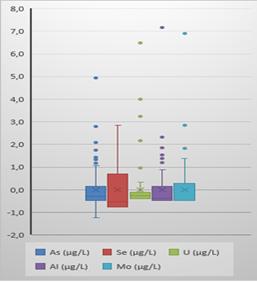
Figure 1 presents boxplots of the standardized concentrations of arsenic (As), selenium (Se), aluminum (Al), uranium (U), and molybdenum (Mo), calculated according to Equation 1:
Where:
StC: Standardized concentration
ObC: Obtained concentration
AvC: Average concentration
StDev: Sample standard deviation
Boxplots showing the distribution of concentrations of As, Se, Al, U, and Mo in soil solution (µg/L). The y-axis represents concentration in micrograms per liter (µg/L), while the x-axis lists the analyzed elements. Each box indicates the interquartile range (Q1-Q3), the horizontal line marks the median, and the “X” denotes the mean. Whiskers extend to 1.5 times the interquartile range, and points beyond these whiskers represent outliers. Arsenic exhibits the highest variability and number of outliers, reaching values close to 7 µg/L, whereas selenium shows a more uniform distribution with fewer extremes. These patterns highlight element-specific sensitivity to environmental conditions.
These standardized values allow for direct comparison of variability across elements with different concentration ranges. The boxplots reveal distinct patterns in the distribution of each element. Notably, As, Al, U, and Mo exhibit several outliers-data points that fall significantly outside the interquartile range-suggesting that certain experimental conditions may have strongly influenced their mobility. Arsenic, in particular, shows the highest number of outliers, indicating a greater sensitivity to the environmental factors tested.
Selenium, on the other hand, does not display outliers but shows a broader interquartile range, reflecting a more dispersed distribution of values. This may indicate a more uniform but variable behavior across the experimental conditions. The presence of outliers and the spread of values across the elements underscore the importance of the experimental design factors-such as particle size, moisture content, incubation time, and suction pressure-in modulating the release and mobility of trace elements in the soil solution. These findings are particularly relevant for understanding the potential for groundwater contamination in post-mining environments.
Figure 1 is a boxplot representation of the concentrations of five trace elements (As, Se, Al, U, and Mo) in soil solution. Each box shows the interquartile range (Q1-Q3), with the horizontal line indicating the median and the “X” marking the mean value. Whiskers extend to 1.5 times the interquartile range, and points beyond these whiskers represent outliers, highlighting experimental conditions that produced atypical concentrations. Arsenic (As) exhibits the greatest variability and the highest number of outliers, reaching values close to 7 µg/L, indicating strong sensitivity to environmental factors. Aluminum (Al) and molybdenum (Mo) also display several outliers, while uranium (U) shows lower dispersion, clustering near the median. Selenium (Se) presents a more uniform distribution with fewer extreme values. These patterns emphasize the heterogeneous behavior of trace elements and the influence of soil texture and moisture on their mobility.
3.2. Analysis of high-concentration samples
To better understand the experimental conditions associated with elevated trace element concentrations, a focused analysis was conducted on the subset of samples with values above the third quartile (Q3) for each element. This approach aimed to identify which combinations of environmental factors-particle size, moisture level, incubation time, and suction pressure-were most frequently associated with the highest concentrations observed in the dataset.
It is important to note that the number of samples above Q3 varied slightly among elements due to the presence of repeated concentration values. In the case of molybdenum, for instance, multiple observations shared the same concentration at the Q3 threshold, resulting in a larger subset of high-concentration samples compared to the other elements.
Table 1 summarizes the relative frequency of high-concentration samples across the different levels of each experimental factor. The analysis reveals that, for most elements, intermediate levels of particle size (fine sand) and incubation time (seven days) were most frequently associated with elevated concentrations. However, notable exceptions were observed:
-
Arsenic (As): High concentrations were predominantly associated with the finest particle size fraction (silt and clay) and the shortest incubation time (one day), suggesting rapid mobilization under these conditions.
-
Aluminum (Al): In contrast, elevated concentrations were more frequently observed at the highest levels of both particle size (coarse sand) and incubation time (30 days), indicating a slower release mechanism potentially influenced by prolonged water-soil interaction.
These findings highlight the complex and element-specific interactions between soil structure, hydrodynamic conditions, and trace element mobility. The use of relative frequencies allows for a standardized comparison across elements and reinforces the importance of considering multiple environmental variables when assessing contaminant behavior in soil-water systems.
Arsenic shows a distinct pattern compared to the other elements, with high concentrations predominantly associated with the lowest suction pressure (32-41 kPa). This suggests that arsenic is more readily mobilized in gravitational water fractions rather than in tightly bound water extracted under higher suction. Mechanistically, this behavior can be explained by its speciation and adsorption characteristics. Under the experimental conditions, arsenic likely occurs as arsenite (As(III)) and arsenate (As(V)), with As(III) being more mobile and less strongly adsorbed to mineral surfaces, especially under reducing microenvironments that may develop in saturated soils. In contrast, As(V) tends to form inner-sphere complexes with iron and aluminum oxides and clay minerals, reducing its mobility under oxidizing conditions. The predominance of fine particles (silt and clay) in high-concentration samples further supports this interpretation, as these surfaces provide abundant adsorption sites; however, when water is loosely held (low suction), desorption processes and competitive interactions with other anions (e.g., phosphate) can enhance arsenic release. This element-specific sensitivity underscores the importance of considering both soil physicochemical properties and arsenic speciation when assessing its environmental mobility.
Number of observations (in relative values) of samples above the third quartile for each factor.
3.3. Influence of moisture and suction pressure
For the factors moisture content and suction pressure, a predominance of high-concentration samples was observed at the highest levels of both variables. This trend aligns with the expectation that increased water availability enhances the solubilization of trace elements, and that higher suction pressures (simulated via centrifugation) are more effective at extracting water fractions tightly bound to soil particles-fractions that may contain higher concentrations of dissolved elements.
However, arsenic (As) once again deviated from this general pattern. The majority of high-concentration As samples were associated with the lowest suction pressure level, with minimal representation at the highest pressure. This suggests that arsenic may be more readily mobilized in loosely bound water fractions, potentially due to its affinity for finer particles or its speciation under lower energy extraction conditions.
3.4. Statistical significance of experimental factors
To quantitatively assess the influence of the experimental factors-particle size, moisture level, incubation time, and suction pressure-on the concentrations of the five trace elements, a one-way Analysis of Variance (ANOVA) was performed at a 5% significance level.
The results, summarized in Table 2, indicate the following:
-
Particle size significantly influenced the concentrations of As, U, and Al, highlighting the role of soil texture in element retention and release.
-
Moisture content had a significant effect on As and U, reinforcing the importance of water availability in mobilizing these elements.
-
Suction pressure was a significant factor only for As, suggesting a unique sensitivity of arsenic to the energy level of water extraction.
-
Incubation time, in contrast, did not show a statistically significant effect for any of the elements, indicating that equilibrium between soil and solution may have been reached rapidly, regardless of contact duration.
In all cases where p-values were below 0.05, the null hypothesis (i.e., no difference between group means) was rejected, confirming that the respective factor had a statistically significant impact on element concentration.
These findings underscore the complex interplay between soil physical properties and hydrodynamic conditions in controlling trace element mobility. They also highlight the need for element-specific considerations when assessing environmental risks related to soil-water interactions in contaminated or post-mining areas.
3.5. Post hoc analysis and interpretation of factor effects
The ANOVA results indicated that incubation time did not significantly influence the concentration of any of the five elements analyzed. This suggests that a contact period of just one day between soil and water was sufficient to reach equilibrium conditions, with no statistically significant differences observed between one, seven, and 30 days. This finding is particularly relevant for environmental modeling, as it implies that trace element mobilization may occur rapidly following rainfall events or irrigation.
To further explore the specific differences between factor levels, Scheffé post hoc tests were applied at a 5% significance level. The results revealed several key patterns.
Arsenic (As):
-
Suction pressure: Significant differences were observed between the low and high levels (p = 0.016), indicating that arsenic is more mobile under lower suction conditions, which correspond to more gravitationally available water.
-
Moisture content: A significant difference was also found between the low and high levels (p = 0.008), reinforcing the sensitivity of arsenic to water availability.
-
Particle size: The high particle size level (coarse sand) differed significantly from both the low (p = 0.004) and intermediate (p = 0.039) levels, suggesting that finer textures favor arsenic mobilization.
These findings are environmentally significant, as they suggest that arsenic may be more readily mobilized under conditions that simulate shallow infiltration or root-zone water uptake. The experimental design, which relates centrifugation speed to soil water potential, supports this interpretation by simulating the suction exerted by plant roots or capillary forces in the vadose zone.
Uranium (U):
-
Particle size: The intermediate level (fine sand) differed significantly from both the low (p = 0.013) and high (p = 0.012) levels, indicating a peak in uranium mobility at this texture.
-
Moisture content: Significant differences were observed between the high level and both the low (p = 0.014) and intermediate (p = 0.009) levels, suggesting that uranium becomes more mobile under saturated conditions.
Aluminum (Al):
-
Particle size: A significant difference was found between the low and intermediate levels (p = 0.040), indicating that aluminum mobility is also influenced by soil texture, though to a lesser extent than arsenic or uranium.
Overall, the particle size factor emerged as the most influential across the elements studied, followed by moisture content and suction pressure. Among the five elements, arsenic demonstrated the greatest sensitivity to environmental conditions, underscoring its potential risk for mobilization and transport in post-mining landscapes.
These results reinforce the importance of considering soil physical structure and hydrological conditions when assessing the environmental behavior of trace elements. The observed sensitivity of arsenic and uranium to moisture and texture, for instance, highlights the potential for rapid mobilization into the soil solution under specific rainfall or irrigation scenarios. This has direct implications for water quality in areas surrounding decommissioned or active mining sites. Moreover, the experimental design-based on controlled variation of suction pressure-offers a valuable analog for understanding how plant root uptake or capillary rise might influence contaminant transport in the vadose zone.
3.6. Comparative perspective: Spain and Brazil
Although this study was conducted using soils from a decommissioned uranium mine in Salamanca, Spain, its findings are highly relevant to Brazilian mining regions such as Caetité (Bahia), Poços de Caldas (Minas Gerais), and Santa Quitéria (Ceará), which share similar challenges regarding trace element mobilization (Montalván-Olivares et al., 2021). Research in Caetité has shown that uranium speciation and mobility are strongly influenced by sulfate complexation in treated ores, contrasting with carbonate complexation in untreated rocks, highlighting the role of chemical alterations during ore processing in controlling contaminant behavior (Scislewski, 2004). In Poços de Caldas, acid rock drainage has been identified as a major driver of trace element release, with low pH and high concentrations of Al and U in drainage waters, reinforcing the importance of pH and redox conditions in post-mining landscapes (Ferrari et al, 2015).
International studies corroborate these findings, emphasizing that soil pH, redox potential, and mineralogy are key factors governing trace element mobility. Lower pH enhances the solubility of cationic species such as U(VI), while higher pH favors the mobility of anionic species like molybdate and arsenate (Elbana, 2022). Speciation is critical: arsenic occurs mainly as arsenite (As(III)) under reducing conditions, which is more mobile and toxic, whereas arsenate (As(V)) dominates in oxidizing environments and tends to adsorb onto Fe/Al oxides and clay minerals. Similar mechanisms apply to selenium (selenite vs. selenate) and molybdenum, whose adsorption decreases sharply above pH 6-7, particularly in soils with low oxide content.
Brazilian soils often differ from Spanish soils in weathering degree and organic matter content, which can increase adsorption capacity and reduce mobility compared to temperate soils. However, studies in Brazilian uranium districts indicate that seasonal rainfall and high infiltration rates can promote rapid leaching of soluble species, especially in sandy or fractured substrates, paralleling the patterns observed in this study under high moisture conditions (Fitts, 2015).
By comparing these contexts, it becomes evident that while the experimental design in Spain provides controlled insights into factor interactions, Brazilian scenarios introduce additional complexity due to tropical soil characteristics and climatic variability. Therefore, site-specific studies integrating speciation analysis, soil physicochemical properties, and hydrological modeling are essential for accurate risk assessment and remediation planning in post-mining landscapes.
4. CONCLUSION
The experimental data enabled a comprehensive evaluation of how environmental factors-simulated through controlled laboratory conditions-affect the mobility of trace elements in soils surrounding a decommissioned uranium mine. Among these factors, rainfall volume, represented by soil moisture levels, proved to be a key driver in the mobilization of elements into the soil solution, potentially increasing their bioavailability to plants and their risk of leaching into water bodies.
The ANOVA analysis revealed that:
-
Particle size significantly influenced the concentrations of arsenic (As), uranium (U), and aluminum (Al);
-
Moisture content affected As and U;
-
Suction pressure had a significant effect only on As;
-
Incubation time showed no significant effect for any of the elements, suggesting that equilibrium between soil and water was reached within 24-h.
The presence of outliers in the dataset indicated that certain combinations of environmental conditions led to unusually high concentrations of specific elements. To explore this further, a targeted analysis was conducted on samples with concentrations above the third quartile. This approach allowed for the identification of the most influential factor levels-such as fine particle size, high moisture, and low suction pressure-associated with elevated trace element mobility.
By characterizing the distribution of high-concentration samples across the experimental conditions, the study contributes to a deeper understanding of the environmental behavior of potentially hazardous elements. The patterns identified help clarify how specific combinations of soil texture, moisture, and suction pressure influence the mobilization of trace elements into the soil solution. These findings are particularly relevant for risk assessment and water resource management in post-mining landscapes, where understanding the dynamics of contaminant release is essential for protecting ecosystems and human health.
These findings have practical implications for environmental management. Monitoring programs should focus on periods of high soil moisture and areas with fine-textured soils, as these conditions favor trace element mobilization. Sampling after intense rainfall events is recommended to capture peak concentrations. Remediation strategies may include stabilizing fine particles through vegetation cover or engineered barriers and applying amendments such as iron oxides to reduce arsenic mobility.
It is important to note that this study was based on controlled laboratory simulations, which may not fully reproduce field heterogeneity, seasonal variability, and biogeochemical interactions. Future research should incorporate in-situ monitoring under natural conditions, speciation analysis to confirm dominant chemical forms, and long-term modeling of contaminant transport. Comparative studies in tropical soils, such as those in Brazilian uranium districts, are essential to validate these findings and refine risk assessment and remediation strategies.
5. DATA AVAILABILITY STATEMENT
Data availability not informed.
6. ACKNOWLEDGEMENTS
The authors thank the Federal University of Salamanca (USAL), University of Extremadura (UEx), and the University of Minas Gerais (UFMG) for the logistical support, the Coordenação de Aperfeiçoamento de Pessoal de Nível Superior (CAPES), the Fundação de Amparo à Pesquisa do Estado de Minas Gerais (FAPEMIG), and the Conselho Nacional de Desenvolvimento Científico e Tecnológico (CNPq) for the financial support.
7. REFERENCES
-
ANTUNES, M.; ABDELKARIM, B.; VALENTE, T.; SANTOS, A. Post-mining water-sediment interaction on U-mine area - a contribution to water management. In: WEST VIRGINIA MINE DRAINAGE TASK FORCE SYMPOSIUM; INTERNATIONAL MINE WATER ASSOCIATION CONGRESS, 15., 21-26 April 2024, Morgantown. Proceedings[…] Morgantown: International Mine Water Association, 2024. Available: https://www.imwa.info/docs/imwa_2024/IMWA2024_Antunes_10.pdf
» https://www.imwa.info/docs/imwa_2024/IMWA2024_Antunes_10.pdf - CONAMA (Brasil). Resolução nº 357 de 17 de março de 2005. Dispõe sobre a classificação dos corpos de água e diretrizes ambientais para o seu enquadramento, bem como estabelece as condições e padrões de lançamento de efluentes, e dá outras providências. Diário Oficial [da] União: seção 1, Brasília, DF, n. 053, p. 58-63, 18 mar. 2005.
-
CANNAS, D.; LOI, E.; SERRA, M.; FIRINU, D.; VALERA, P.; ZAVATTARI, P. Relevance of essential trace elements in nutrition and drinking water for human health and autoimmune disease risk. Nutrients, v. 12, n. 7, p. 2074, 2020. https://doi;org/10.3390/nu12072074
» https://doi;org/10.3390/nu12072074 -
ELBANA, T. A. Mobility of Trace Elements in Agricultural Soils. In: NAEEM, M.; BREMONT, J. F. J.; ANSARI, A. A.; GILL, S. S. (eds.). Agrochemicals in Soil and Environment. Singapore: Springer, 2022. p. 253-275. https://doi.org/10.1007/978-981-16-9310-6_12
» https://doi.org/10.1007/978-981-16-9310-6_12 -
FERRARI, C. R.; AZEVEDO, H.; WISNIEWSKI, M. J. S.; RODGHER, S.; ROQUE, C. V.; NASCIMENTO, M. R. L. An overview of an acidic uranium mine pit lake (Caldas, Brazil): composition of the zooplankton community and limnochemical aspects. Mine Water and the Environment, v. 34, n. 3, p. 343-351, 2015. https://doi.org/10.1007/s10230-015-0333-9
» https://doi.org/10.1007/s10230-015-0333-9 - FITTS, C. R. Águas subterrâneas. Rio de Janeiro: Elsevier Brasil; 2015. 572p.
-
IBRAYEVA, D.; BAKHTIN, M.; AUMALIKOVA, M.; KASHKINBAYEV, Y.; KAZYMBET, P.; MASAHARU, H. et al Preliminary studies of the water contamination in settlements located near the uranium mining territory in Northern Kazakhstan. Environmental Science and Pollution Research, v. 32, p. 11242-11250, 2025. https://doi.org/10.1007/s11356-025-36398-0
» https://doi.org/10.1007/s11356-025-36398-0 -
LOZANO, J. C.; RODRÍGUEZ, P. B.; TOMÉ, F. V.; MALDONADO, R.; MEDEIROS, A. S.; PRIETO, C. A system for obtaining soil solution extracts and soil water retention curves using a bench centrifuge with fixed angle rotors. Geoderma, v. 361, p. 114063, 2020. https://doi.org/10.1016/j.geoderma.2019.114063
» https://doi.org/10.1016/j.geoderma.2019.114063 - MEDEIROS, A. S.; LOZANO, J. C.; PRIETO, C.; RODRÍGUEZ, P. B.; TOMÉ, F.V. An approach using centrifugation for the extraction of the soil solution and its usefulness in studies of radionuclide speciation in soils. In: ICRER 2014 - INTERNATIONAL CONFERENCE ON RADIOECOLOGY AND ENVIRONMENTAL RADIOACTIVITY, 13., 7-10 Sept. 2014, Barcelona. Proceedings[...] Barcelona: ICRER, 2014.
-
MEHRI, A. Trace elements in human nutrition (II)-an update. International journal of preventive medicine, v. 11, n. 1, p. 2, 2020. https://doi.org/10.4103/ijpvm.IJPVM_48_19
» https://doi.org/10.4103/ijpvm.IJPVM_48_19 -
MONTALVÁN-OLIVARES, D. M.; SANTANA, C. S.; VELASCO, F. G.; LUZARDO, F. H. M.; ANDRADE, S. F. R.; TICIANELLI, R. B. et al Multi-element contamination in soils from major mining areas in Northeastern Brazil. Environmental Geochemistry and Health, v. 43, n. 11, p. 4553-4576, 2021. https://doi.org/10.1007/s10653-021-00934-x
» https://doi.org/10.1007/s10653-021-00934-x -
RODRÍGUEZ, P. B.; LOZANO, J. C.; TOMÉ, F. V.; PRIETO, C.; MEDEIROS, A. S. Influence of soil conditions on the distribution coefficients of 226Ra in natural soils. Chemosphere, v. 205, p. 188-193, 2018. https://doi.org/10.1016/j.chemosphere.2018.04.093
» https://doi.org/10.1016/j.chemosphere.2018.04.093 - SCISLEWSKI, A. R. Estudo experimental da mobilidade do urânio por ação intempérica, distrito uranífero de Caetité, Lagoa Real, Bahia, Brasil. 2004. 100f. Dissertação (Curso de Pós-graduação em Geoquímica e Meio Ambiente) - Universidade Federal da Bahia, Salvador, 2004.
-
UNITED STATES GEOLOGICAL SURVEY. Metals and other trace elements, 2019. Available: Available: https://www.usgs.gov/mission-areas/water-resources/science/metals-and-other-trace-elements . Access in January 2022.
» https://www.usgs.gov/mission-areas/water-resources/science/metals-and-other-trace-elements -
WORLD HEALTH ORGANIZATION. Guidelines for drinking-water quality: fourth edition incorporating the first and second addenda. 2022. Available: Available: https://www.who.int/publications/i/item/9789240045064 . Access: Nov. 2025.
» https://www.who.int/publications/i/item/9789240045064
Edited by
-
Editor-in-Chief:
Editor-in-Chief: Nelson Wellausen Dias https://orcid.org/0000-0002-9507-9211