 Impact of Reiki on infertile women in Assisted Reproduction: a randomized clinical trial
Abstract
Objective to evaluate the effect of Reiki on levels of stress, anxiety, and pregnancy rate in infertile women during the Assisted Reproduction cycle.
Method a single-blind randomized controlled clinical trial. The sample (n=40) was divided into three groups: Reiki (n=14), Sham Reiki (n=13), and Control (n=13). Women diagnosed with infertility undergoing treatment at the infertility outpatient clinic of a public hospital. Anxiety and stress levels and pregnancy rates were the variables assessed. The psychometric scales of Fertility Problem Inventory and Hospital Anxiety and Depression Scale were used, as well as a questionnaire containing sociodemographic and clinical data, and knowledge about integrative practices and Reiki. Measures of central tendency and the calculation of relative frequencies of data were considered in the descriptive statistical analysis.
Results The pregnancy success rate was higher (42.9%) in the Reiki group compared to the others. Anxiety levels decreased in amplitude between T2 and T1 for the Reiki (p=0.02) and Sham Reiki (p=0.01) groups, as well as in median values across all three groups. Although there was no statistically significant difference for stress, there was a reduction in median values for most of the scale factors.
Conclusion The results demonstrated that both the Reiki group and the Placebo group showed a reduction in anxiety levels after the interventions, with median ranges of 3.5 and 3.0 points, respectively. Regarding stress scores, the interventions did not influence their levels. These findings suggest that the interventions applied were effective in reducing anxiety but had no impact on stress. These results reinforce the importance of integrative approaches to mental healthcare, especially in assisted reproduction treatment settings. Brazilian Registry of Clinical Trials: RBR-3q85m7g
Keywords
Stress; Anxiety; Infertile women; Assisted reproduction techniques; Reiki
Resumo
Objetivo Avaliar o efeito do Reiki sobre os níveis de estresse, ansiedade e taxa gestacional em mulheres inférteis durante o ciclo da Reprodução Assistida.
Métodos Ensaio clínico controlado, randomizado, simples cego. Amostra (n=40) em três grupos: Reiki (n=14), Placebo (n=13) e Controle (n=13). Mulheres com diagnóstico de infertilidade, em tratamento no ambulatório de infertilidade de um hospital público.
Variáveis avaliadas nível de ansiedade, estresse e taxa gestacional. Foram utilizadas as escalas psicométricas Inventário de Problemas de Fertilidade e Escala de Medida de Ansiedade e Depressão Hospitalar, e um questionário contendo dados sociodemográficos, clínicos, e conhecimento sobre práticas integrativas e Reiki. As medidas de tendência central e o cálculo das frequências relativas dos dados foram considerados na análise estatística descritiva.
Resultados A taxa de sucesso gestacional foi maior (42,9%) no grupo Reiki em relação aos demais. Os níveis de ansiedade reduziram na amplitude entre os tempos T2 e T1 para o grupo Reiki (p=0,02) e placebo (p=0,01), e nos valores das medianas nos três grupos. Embora não tenha havido diferença estatística significante para o estresse, houve redução dos valores das medianas para a maioria dos fatores da escala.
Conclusão Os resultados demonstraram que tanto o grupo Reiki quanto o grupo Placebo apresentaram redução nos níveis de ansiedade após as intervenções, com amplitudes entre as medianas de 3,5 e 3,0 pontos, respectivamente. Em relação aos escores de estresse, as intervenções não influenciaram em seus níveis. Esses achados sugerem que as intervenções aplicadas foram eficazes na redução da ansiedade, mas não tiveram impacto sobre o estresse. Houve impacto positivo na taxa gestacional do grupo que recebeu Reiki. Tais resultados reforçam a importância de abordagens integrativas no cuidado à saúde mental, especialmente em contextos de tratamento na reprodução assistida.
Descritores
Estresse; Ansiedade; Mulheres inférteis; Técnicas de reprodução assistida; Reiki
Resumen
Objetivo Evaluar el efecto del Reiki sobre los niveles de estrés y ansiedad y el índice de embarazo en mujeres infértiles durante el ciclo de reproducción asistida.
Métodos Ensayo clínico controlado, aleatorizado, simple ciego. Muestra (n = 40) en tres grupos: Reiki (n = 14), Placebo (n = 13) y Control (n = 13). Mujeres con diagnóstico de infertilidad, en tratamiento en la consulta de infertilidad de un hospital público.
Variables evaluadas nivel de ansiedad y estrés e índice de embarazo. Se utilizaron las escalas psicométricas Inventario de Problemas de Fertilidad y Escala de Medición de Ansiedad y Depresión Hospitalaria, y un cuestionario con datos sociodemográficos, clínicos y conocimientos sobre prácticas integrativas y Reiki. Las medidas de tendencia central y el cálculo de las frecuencias relativas de los datos se tuvieron en cuenta en el análisis estadístico descriptivo.
Resultados El índice de éxito gestacional fue mayor (42,9 %) en el grupo Reiki en comparación con los demás. Los niveles de ansiedad se redujeron en la amplitud entre los tiempos T2 y T1 para el grupo Reiki (p = 0,02) y Placebo (p = 0,01), y en los valores medianos de los tres grupos. Aunque no hubo diferencias estadísticamente significativas en cuanto al estrés, se observó una reducción de los valores medianos para la mayoría de los factores de la escala.
Conclusión Los resultados demostraron que tanto el grupo Reiki como el grupo Placebo presentaron una reducción en los niveles de ansiedad después de las intervenciones, con amplitudes entre las medianas de 3,5 y 3,0 puntos, respectivamente. En cuanto a los puntales de estrés, las intervenciones no influyeron en sus niveles. Estos hallazgos sugieren que las intervenciones aplicadas fueron eficaces para reducir la ansiedad, pero no tuvieron impacto sobre el estrés. Hubo un impacto positivo en el índice de embarazo del grupo que recibió Reiki. Estos resultados refuerzan la importancia de los enfoques integradores en la atención de la salud mental, especialmente en contextos de tratamiento de reproducción asistida. Registro Brasileiro de Ensaios Clínicos: RBR-3q85m7g
Descriptores
Estrés; Ansiedad; Mujeres infértiles; Técnicas de reproducción assistida; Reiki
Introduction
Infertility is defined as the inability to conceive children, characterized by the absence of pregnancy after one year of regular sexual intercourse without the use of contraception.(1) As a significant public health problem, it highlights the need for expanded and innovative care and planning for the infertile population, whether women, men, or couples.(2)
From a global perspective, the growing incidence of infertility is related to social and clinical determinants, lifestyle factors, anxiety, depression, and reproductive system diseases. The consequences of infertility in infertile women, men, or couples can directly impact emotional, mental, social and financial health, reinforce the negative stigma surrounding the problem, and generate multidimensional suffering for infertile individuals.(1,3)
Among the treatments offered in Brazil by the Unified Health System (SUS), according to the National Policy for Comprehensive Care in Assisted Human Reproduction, we highlight the Intracytoplasmic Sperm Injection (ICSI), adopted in this study.(2,4)
Studies indicate that infertility treatments can trigger negative repercussions for infertile women and/or couples. The most frequently reported are normally negative emotional aspects, such as depressed mood, anxiety, psychological and social stress, reduced well-being and quality of life, altered sperm viability, ovarian changes/disorders, and difficulties in the marital relationship. The higher the failure rates of assisted reproduction treatment, the greater the physical and emotional strain.(5-10)
Although pharmacological therapy is available for treating these symptoms, other options can add value and contribute to these cases, such as Integrative and Complementary Health Practices (ICPs). Their purpose is to care for the individual as a whole, integrating body, mind, and spirit. Studies indicate that women undergoing infertility treatment envision ICPs as a possibility of balancing the body and mind, hence, they can benefit positively during follow-up in the assisted reproduction journey.(11)
Reiki is a multidimensional energy replacement therapy with no religious affiliation, based on stimulating the natural mechanisms for maintaining and restoring a person’s overall health, aiming for balance and well-being.(12-14) Studies show that the therapy promotes better treatment-related clinical outcomes, has positive and lasting effects on controlling or reducing perceived anxiety and stress levels, controlling pain and chronic comorbidities, preventing side effects secondary to drug therapy, stabilizing vital signs, improving psycho-emotional aspects, and promoting a better quality of life.(15-32)
Considering the growing production of scientific studies on Reiki in the national and international context and the intention to contribute to the consolidation of scientific evidence and theories of care related to the therapy, this study aimed to evaluate the application of Reiki as a safe, efficient, and sustainable treatment option for infertile women undergoing assisted reproduction. The objective was to evaluate the effect of Reiki on levels of stress, anxiety, and pregnancy rates in infertile women during the cycle of assisted reproduction.
Methods
This is a single-blind randomized controlled clinical trial. The CONSORT guidelines were used to report the study, which was published in the Brazilian Registry of Clinical Trials (ReBEC) under number RBR-3q85m7g.(16)
The study took place at the Human Reproduction Center of the Hospital das Clínicas of the Faculdade de Medicina de Ribeirão Preto at the Universidade de São Paulo (CRH/HCFMRP-USP), city of Ribeirão Preto, state of São Paulo, Brazil.
Data collection began in August 2021 and ended in January 2023.
Women diagnosed with conjugal infertility and the indication for the fresh ICSI technique as treatment. This treatment begins with ovarian stimulation, followed by egg retrieval, and concludes with embryo transfer, when the in vitro fertilization (IVF) cycle is completed. Approximately seven days after embryo transfer, the mid-luteal phase occurs. After 15-20 days, pregnancy is diagnosed.
Infertile women aged between 18 and 42 years undergoing ICSI treatment were eligible. Women who withdrew from the study or whose treatment plan changed at any stage of IVF were discontinued.
Collection and management of study data were performed using the Research Electronic Data Capture (REDCap) tool, hosted at the Escola de Enfermagem de Ribeirão Preto at the Universidade de São Paulo (EERP-USP). REDCap is a secure, web-based software platform that supports and provides an intuitive interface for validated data capture, audits tracking, data manipulation and export procedures, automates export for continuous data downloads to common statistical packages, integrates data, and facilitates interoperability with external sources. The sociodemographic, clinical, and gynecological-obstetric variables, as well as knowledge about ICPs and Reiki of the eligible women who agreed to participate in the study were entered into REDCap. After completing the variables, the randomization groups to which each participant was allocated were generated. For randomization, 15 blocks of sizes 9, 12, 6, 12, 6, 9, 3, 6, 3, 12, 6, and 3 were generated in the R program, using the BLOCKRAND package. The participants were distributed into three groups: Reiki (G1), Sham Reiki (G2), and Control (G3). After randomization, the participants in groups G1 and G2 were blinded to their group assignment.
The sample size calculation was performed using the GPower software version 3.1.9.2, based on Cohen’s effect size estimate. An effect size of 0.7 (considered large) between groups, a power of 80%, and a significance level of 5% were assumed. A total of 102 participants were estimated, 34 women for each study group. However, 56 women were randomized and after loss to follow-up, 40 women comprised the final sample. This number was smaller than expected due to the pandemic situation at the time of data collection, as assisted reproduction treatments were interrupted because of social distancing measures and the risks to this population.
A data collection form was created with the variables recommended by the Ministry of Health and administered to the three groups only once at recruitment (T1).
Sociodemographic data (age, marital status, education, race/ethnicity, family income, occupation/profession, religion, religious/spiritual - R/S practices and frequency of R/S practices), clinical and gynecological/obstetric data (number of pregnancies and children, menarche, coitarche, frequency of sexual activity, miscarriage, sexually transmitted infections, comorbidities, medication use, body mass index, physical activity, daily meals, dietary quality, alcohol, tobacco, and other drug use, length of pregnancy attempts, previous treatment and treatment cycles), and knowledge of ICPs and Reiki (heard of PICS, benefited from PICS, heard of Reiki, benefited from Reiki).
The Hospital Anxiety and Depression Scale (HAD-A) was used to assess anxiety, considering the following scores for anxiety levels: 0 to 7 (unlikely); 8 to 11 mild and 12 to 21 moderate/severe. The Fertility Problems Inventory (FPI) was chosen to assess stress, encompassing four factors: F1 - Social concern, F2 – Rejection of a child free lifestyle, F3 - Marital/Sexual concerns, and F4 – Need for parenthood. Scores were interpreted as follows: below 25th percentile - low stress; between 25th and 50th - moderate stress; between 50th and 75th - moderately high stress; and between 75th and 100th - very high stress.(17, 18)
The scales were administered to the three groups at two time points: the first at the beginning of IVF (Time - T1); the second at the end of IVF (Time - T2), which corresponds to the mid-luteal phase. To assess the secondary outcome, the number of pregnant women was quantitatively recorded based on the HCG result within 15 to 20 days of completing IVF. Clinical pregnancy was confirmed by transvaginal pelvic ultrasound two to three weeks after the positive HCG result, revealing an embryo with a heartbeat.
The researcher invited women to participate in the study at the Human Reproduction Center reception area while they were waiting for their ultrasound or medical appointment. An informational pamphlet prepared by the researcher containing general information about Reiki and the study’s objectives was distributed. The study began on the day of the first appointment of the IVF cycle. Women who agreed to participate were directed to a private room for user embracement.
For Reiki group participants (G1): according to the Mikao Usui Reiki method, at least three sessions are necessary to elevate a person’s energy field and restore chakra health.(19) Three times were chosen for Reiki sessions: Session 1: during ovarian stimulation; Session 2: during embryo transfer; Session 3: during the mid-luteal phase.
Reiki applications were performed in a private room with a table available for the participant in an energetically prepared environment with soft music, using the Cho Ku Rei and Sei He Ki symbols mentally. The Reiki session was conducted individually and lasted approximately 15 minutes. Initially, five minutes of Reiki were applied to the heart chakra, followed by five minutes to the navel chakra, as these are related to the variables under investigation. Initially, an energy scan was performed to identify the energetic health of the chakras. If the procedure indicated an imbalance in another chakra, the final five minutes were directed to that point, with the goal of promoting greater energetic harmony.
The technique was administered by one of the researchers responsible for the study, who holds the highest degree of Master in the Mikao Usui Reiki method. She has 10 years of experience offering charitable Reiki to the Ribeirão Preto community, training new Reiki practitioners at a holistic center for integrative therapies, and contributing to university outreach projects at the HCFMRP-USP and the Escola de Enfermagem de Ribeirão Preto at the Universidade de São Paulo (EERP-USP).
For participants in the Sham Reiki group (G2): the applications were performed by the same researcher, using the same environmental conditions, chakras, and duration as those of the G1. As the therapist began the activity by extending her hands over the chakras without applying the Reiki technique, there was no transfer of Reiki energy to the participant.
For participants in the Control group (G3): there was no intervention. As a token of appreciation, a remote Reiki session was offered after the study ended. All participants accepted the Reiki session.
The IBM® SPSS® Statistics version 25 and R i386 v.3.4.0 was used in data processing. Measures of central tendency and the calculation of relative frequencies were considered in the descriptive statistical analysis. The McNemar’s test was used to compare the association between paired samples with and without intervention; Fisher’s exact test was used to test the association of variables in small groups and the effect of sample size; and the Wilcoxon test was used to compare independent and paired groups. A variance level of α = 5% with a 95% confidence interval was adopted in all analyses.
The study was approved by the Research Ethics Committee of the EERP-USP and the HCFMRP-USP 4.222.698 under Certificate of Presentation for Ethical Review (CAAE) number 34515120.2.0000.5393.
Results
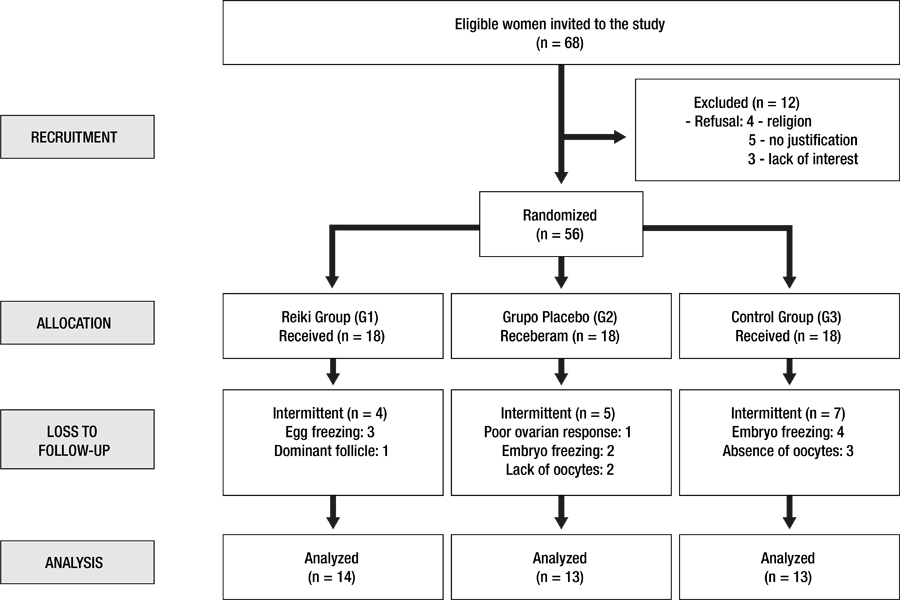
The flowchart (Figure 1) presents the inclusion, exclusion, and allocation process of study participants.

Flowchart of the design and allocation of participants according to CONSORT guidelines.(23)
Forty women aged 29 to 42 (mean = 35.5; SD = 3.7) years participated in the study. The sample showed homogeneity in the distribution of sociodemographic, clinical, and gynecological-obstetric variables, as well as Reiki knowledge. There were no statistically significant differences (Fisher’s exact test, p-value > 0.05) for any of the variables. The age of most participants (42.5%) was between 36 and 40 years; 95% were married or in a stable relationship; 65% had completed university; 70% identified themselves as White; 50% had an average family income of three to five times the minimum wage; and 82.5% were self-employed.
Regarding religious/spiritual aspects, 70% of participants identified themselves as Catholic, and 95% reported the practice of religious or spiritual activities, with 80% of them doing so an average of twice a week.
Regarding clinical and gynecological-obstetric variables, 85% of participants reached menarche between the ages of 9 and 14 years, and 65% reached coitarche between the ages of 16 and 20, 70% were nulliparous, 92.5% had no living children, and 90% had sex one to three times a week. Of the total, 17.5% had experienced a miscarriage, and no participant reported any previous sexually transmitted infections (STIs). Regarding previous comorbidities, 45% of participants reported at least one; endocrine system disorders are the most prevalent, accounting for 20% of cases. The majority, 72.5%, reported taking medications, usually vitamins and folic acid, as recommended by their physician; 47.5% practiced physical activity at least three times a week; and 42.5% were of healthy weight.
Regarding dietary intake, 72.5% of participants reported four or more meals a day; 60% considered their diet quality to be balanced; 57.5% reported low alcohol consumption (<1 dose a day); and none reported using tobacco or other drugs. Among the women, 52.5% reported trying to conceive for more than five years, and 62.5% had already undergone some type of assisted reproduction treatment, with 40% of these undergoing two to four treatment cycles.
Regarding the variables on ICPs and Reiki, 82.5% of participants had heard of the therapies, although 32.5% had not benefited from any integrative practices. When asked about their knowledge of Reiki therapy, although 85% had heard of it at some point in their lives, 77.5% had never received Reiki.
The nonparametric Wilcoxon test was performed to assess anxiety, considering the amplitude between T1 and T2 for the three study groups. The result in the Reiki group (G1) indicated a statistically significant difference, with p = 0.02. At T1, were obtained values of: minimum = 2.0, maximum = 15.0, median = 7.5, and mean = 7.7. At T2, we obtained values of: minimum = 0, maximum = 13.0, median = 4.0, and mean = 5.6. The amplitude between median values was of 3.5 points, which indicates a reduction in the anxiety level of participants in this group at the end of the Reiki intervention.
For the Sham Reiki group (G2), there was a statistically significant difference, with p = 0.01. At T1, were obtained values of: minimum = 2.0, maximum = 14.0, median = 7.0, and mean = 7.6. At T2, were obtained values of: minimum = 1.0, maximum = 9.0, median = 4.0 and mean = 4.4. The amplitude between the median values was of 3.0 points, also showing a reduction in anxiety levels after the sham Reiki intervention.
In the Control group (G3), there was no statistically significant difference, with p = 0.16. At T1, were obtained values of: minimum = 3.0, maximum = 16.0, median = 10.0, and mean = 9.7. At T2, were obtained values of: minimum = 4.0, maximum = 13.0, median = 9.0, and mean = 8.3. The amplitude between the medians was of 1.0 point, demonstrating a slight reduction in anxiety levels after the end of treatment.
For stress scores assessed using the nonparametric Kruskal-Wallis test, the results showed no statistically significant difference in the Reiki group (G1), with p = 0.42. At T1, were obtained values of: minimum = 3.1, maximum = 3.9, median = 3.4 and mean = 3.5, and at T2, values were: minimum = 3.2, maximum = 4.0, median = 3.5 and mean = 3.5. The amplitude between median values was insignificant for this group, that is, it was not possible to observe any variation in stress levels after the Reiki intervention.
In the Sham Reiki group (G2), there was no statistically significant difference, with p = 0.31. At T1, the values obtained were minimum = 3.1, maximum = 3.9, median = 3.5, and mean = 3.5. At T2, the values obtained were minimum = 3.1, maximum = 4.2, median = 3.5, and mean = 3.5. The amplitude between the medians did not change between time points, demonstrating no change in stress levels after the sham Reiki intervention.
In the Control group (G3), there was no statistically significant difference, with p = 0.89. At T1, the values obtained were minimum = 3.1, maximum = 3.9, median = 3.5, and mean = 3.5. At T2, the values obtained were minimum = 3.1, maximum = 4.2, median = 3.5, and mean = 3.5. The amplitude between the median values did not change between time points, demonstrating no change in stress levels after the end of treatment.
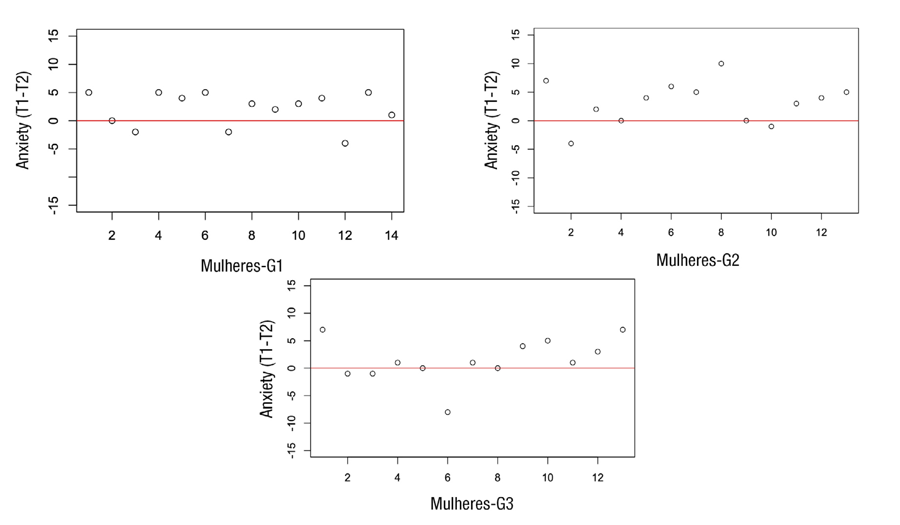
Figure 2 represents the scatterplot of the amplitude between time points T1 and T2 for the HAD-A scale scores. The median values for the Reiki (G1) and Sham Reiki (G2) groups were lower at the end of treatment, confirming the reduction in anxiety during the assisted reproduction cycle of participants undergoing the interventions. The red line corresponds to a value of 7 (cutoff point), classified according to the HAD-A scores as an unlikely level of anxiety. The spheres correspond to the participants. Negative values (-15 to -1) mean that the anxiety level increased for these women. Positive values (+1 to +15) indicate that the anxiety level decreased for these women after the intervention.

Scatterplot of the T1-T2 amplitude between the Hospital Anxiety and Depression Measure (HAD-A) scores in the Reiki (G1), Sham Reiki (G2), and Control (G3) groups.
Regarding the isolated statistical stress scores for factors F1 - Social concern, F2 - Rejection of a child free lifestyle, F3 - Marital/Sexual concerns, and F4 – Need for parenthood, the Wilcoxon test showed no statistically significant difference when comparing T1 and T2 for groups G1, G2, and G3, as shown in table 1.
Regarding the pregnancy rate of participants, 27 (67.5%) did not become pregnant and 13 (32.5%) became pregnant after completing the treatment. Of these, six (42.9%) participants in the Reiki group (G1, n=13) became pregnant, while eight (57.1%) did not. Five (38.5%) participants in the Sham Reiki group (G2) became pregnant and eight (61.5%) did not. In the Control group (G3), two women (15.4%) became pregnant and 11 (84.6%) did not. Although these findings do not present a statistically significant difference (p=0.33), quantitatively, those who received Reiki (n=6) became more pregnant in relation to the other groups studied.
Discussion
In the present study, participants who received Reiki (G1) showed reduced anxiety after the intervention (p=0.02). In the Control group (G3), there was no reduction in anxiety during the treatment period (p=0.16). This anxiety-related outcome in infertile women corroborates findings in other scientific studies.(30)
In the Sham Reiki group (G2), there was a reduction in anxiety after the intervention (p=0.01), which may be related to the embracement process and the positive mental attitude of participants, who trusted the intervention, given their lack of knowledge regarding their group allocation. They considered the intervention as a potential aid in controlling or reducing anxiety during infertility treatment.
Regarding stress, in this study there was no statistically significant difference in the overall FPI score in the Reiki (p=0.42), Sham Reiki (p=0.31), and Control (p=0.89) groups. However, in the Reiki (G1) and Sham Reiki (G2) groups, there was a quantitative reduction in median values for factors F1, associated with aspects of social relationships (p=0.16), and F3, associated with aspects of marital and sexual relationships (p=0.30). These FPI domains are identified in the literature as highly impacted by stress and anxiety in infertile women and those undergoing infertility treatment.
In the Sham Reiki group (G2), after the intervention, there was a statistically significant difference (p=0.04) and a quantitative reduction in median values for factor F1, associated with aspects of social relationships. However, for factors F3 (p=0.13), related to aspects of marital and sexual relationships, and F4 (p=0.08), related to the need for parenthood, although there was a reduction in median values, the difference was not statistically significant. This effect may be related to the participants’ positive and optimistic mental attitude toward the treatment and to receiving the intervention, regardless of whether it was Reiki or sham Reiki. In the Control group (G3), there was no statistically significant difference in factors F1 (p=0.73), F2 (p=0.68), and F3 (p=0.75). However, there was a quantitative reduction in median values for factors F1, F3, and F4.
This study observed the impact of the Reiki intervention on the different domains of the FPI scale in all three groups, demonstrating a reduction in central measurement values, thus confirming the stress reduction in the domains investigated. Although there was no statistically significant difference in most factors across the three study groups, these results indicate clinical relevance and the need to further investigate Reiki’s association with stress in infertile women. This is particularly true because the impact of stress on gestational outcomes in infertile women is not yet fully understood in the literature.
Reiki therapy increased the pregnancy rate among participants. The group that received the treatment had a higher number of women who became pregnant compared to the group that did not, suggesting that Reiki contributed to the success of the fertility treatment.
The association between female infertility, anxiety, and stress can trigger multidimensional distress, as well as depression and changes in biomarkers such as cortisol, especially associated with assisted reproduction treatments.(20)
Infertility treatments using assisted reproduction therapies require physical and emotional adaptation for infertile women and couples. The process can trigger psycho-emotional changes that lead to the emergence of anxiety, anguish and distress.(21)
Considering the negative effects of anxiety and stress on infertility treatment, since Reiki’s main objective is to provide greater energetic, physical, emotional, mental, and spiritual balance to the recipient, it favors the modulation of unfavorable responses from the autonomic centers of the central nervous system, facilitating the management of stressful and anxiety-producing stimuli, which can benefit women undergoing assisted reproduction treatments.(22)
The prevalence of anxiety in infertile women is higher in low- and middle-income countries (54.24%), such as Brazil. These data were confirmed by a systematic literature review with meta-analysis covering 132 articles and a collective sample of over 5,000 infertile women. Infertility-associated anxiety accounted for 36.17% of this sample, compared to the general public and healthy women. Despite its high prevalence, this symptom is neglected in most services that serve this population. This requires healthcare professionals and infertility care programs to take a broader look at women’s emotional needs and promote actions to control or reduce symptoms, benefiting overall health, as well as during infertility.(23)
When associating infertility with assisted reproduction treatments, such treatments increase women’s anxiety levels, especially when they are lengthy and pregnancy is not the treatment outcome. Beyond the physical dimension, this situation impacts all aspects of a woman’s life and deserves further investigation.(24)
Similarly, a meta-analysis evaluated the clinical outcome of pain, a prevalent condition in women with endometriosis and chronic pelvic pain undergoing infertility treatment. The application of Reiki resulted in a statistically significant reduction in pain (p<0.0001), confirming the therapy’s effectiveness for pain relief.(25)
In this sense, Reiki has been used as an important and efficient integrative therapeutic resource for reducing and controlling multidimensional imbalances, improving people’s quality of life through the management of pain, stress, anxiety, depression, chronic diseases, and overall mental health.(15, 25-29)
Results similar to the variables investigated in this study were found in a clinical trial with the aim to evaluate the impact of Reiki on pain, anxiety, surgical fear, and oxygen saturation levels in 93 pre- and postoperative participants randomized into Reiki, Sham Reiki, or Control (no intervention) groups. The study concluded that the Reiki group experienced a significant reduction in anxiety, fear and pain levels, as well as an increase in oxygen saturation. There was a statistically significant difference (p=0.000) between the groups in the pre- and post-test for anxiety.(11,15,28,29,31-33)
A randomized clinical trial described by Kurebayashi et al (2020) was conducted in an outpatient clinic of ICPs in São Paulo with 101 volunteers. In the Reiki group, there was a statistically significant reduction in stress levels, along with improvement in physical and mental quality of life, and in psycho-emotional aspects. Due to the positive and promising results, Reiki has been used in different populations in the public health context for stress research.(11, 15, 28, 29, 31-33)
Furthermore, the placebo effect is currently being discussed as scientific evidence. More and more studies are being published in which the placebo group presents positive results, and in the present study, even with a small sample, there was a reduction in anxiety in women. (p=0,01)
By overlooking the results of the placebo group, there is a risk of dismissing potential phenomena that deserve to be explored and understood by science and researchers so that clinical practice within healthcare can benefit from potentially promising and positive outcomes in care.
The results of this study are promising as they suggest an innovative approach, whether energetic or psychosocial, to treating infertility. Such interventions can improve quality of life and contribute to the necessary multidimensional adjustment that supports the exhaustive therapeutic journey faced by infertile women undergoing assisted reproduction. Energy therapies such as Reiki may be not only a viable strategy but also a safe and effective treatment option offered by professionals in infertility healthcare services.
Overall, the results are very satisfactory, and the benefits can be seen in a single therapy session. Reiki occupies a prominent place among the ICPs, as its effectiveness has prevailed in all care contexts, levels of criticality, and different complexities, contributing to better health treatment outcomes.
There are many challenges to the inclusion of professionals in this field, given its specificity and the ethical paradigms related to this care approach. The current paradigm refers to the expansion of policies and programs in this area to introduce integrative practices into conventional treatment, which is highly technical and uses hard technologies. Furthermore, in the scientific arena, research associating ICPs and infertility, especially in assisted reproduction, lacks interest from researchers and investment from funding agencies to strengthen the conditions for conducting studies in Brazil.
Studies associating ICPs and infertility are still scarce. Acupuncture is another example of ICPs used in the treatment of infertility, with an effect on pregnancy rates. It can be used alone or as an adjunctive treatment in infertile women. Traditional Chinese Medicine (TCM) techniques provide positive effects, acting directly on ovarian dysfunction and the endometrium, contributing to better embryo implantation during IVF. In addition to these benefits, they contribute to hormonal balance and the activation of endogenous analgesic release, inhibiting biological stress and increasing the chances of pregnancy in the treatment of infertility in assisted reproduction. (34)
This study, which combined a specific assisted reproduction treatment technique, ICSI, with an integrative energy practice, Reiki, investigating anxiety, stress, and pregnancy rates in infertile women, is the first of its kind in Brazil. The findings raise the prospects for care and the inclusion of ICPs, especially Reiki, in shared care planning between infertile women/couples and healthcare professionals in the infertility field.
Integrative and complementary practices present a new way of looking at care, bringing new efficacy parameters to health indicators, as well as new ways of producing health, whether by those who benefit from the practices or by practitioners who use them as therapeutic resources, fostering a reflection on the meaning of care production within our context. Advances in the use of Reiki in care are significant across different settings and complexities in care and achieve good clinical outcomes guiding person-centered care, as it encompasses the articulation of intersectoral, interdisciplinary, transdisciplinary, and interprofessional knowledge.
These results support the recommendation for incorporating Reiki performed by qualified professionals into clinical practice as a complementary strategy to the hegemonic care model. Within the context of ICPs, Reiki promotes more collaborative, educational, and emancipatory care. In the treatment of infertile women undergoing assisted reproduction, the technique demonstrated a significant reduction in anxiety and stress levels, in addition to being associated with higher pregnancy success rates, highlighting its clinical relevance in this context.
Some limitations were identified in this study, such as the sample size, due to the restrictions imposed by the pandemic at the time of data collection, and the change in the participants’ therapeutic itinerary, which prevented the inclusion predicted by the initially proposed sample size calculation.
Conclusion
The results demonstrated reductions in anxiety levels after the interventions in both the Reiki and Sham Reiki groups, with median amplitude of 3.5 and 3.0 points, respectively. The interventions did not affect the stress scores levels, suggesting that the interventions were effective in reducing anxiety but had no impact on stress. There was a positive impact on the pregnancy rate in the group that received Reiki. These findings reinforce the importance of integrative approaches to mental healthcare, especially in assisted reproduction treatment settings.
Acknowledgments
“This study was developed with support from the Brazilian Federal Agency for Support and Evaluation of Graduate Education - Brazil (CAPES) - Financing Code 001”.
References
- 1 Njagi P, Groot W, Arsenijevic J, Dyer S, Mburu G, Kiarie J. Financial costs of assisted reproductive technology for patients in low- and middle-income countries: a systematic review. Hum Reprod Open. 2023;2023(2):hoad007.
- 2 Brasil. Ministério da Saúde. Portaria nº 3.149, de 28 de dezembro de 2012. Ficam destinados recursos financeiros aos estabelecimentos de saúde que realizam procedimentos de atenção à Reprodução Humana Assistida, no âmbito do SUS, incluindo fertilização in vitro e/ou injeção intracitoplasmática de espermatozoides. Diário Oficial da União. 2012; v. 251, no 1, p. 232.
- 3 Emokpae MA, Brown SI. Effects of lifestyle factors on fertility: practical recommendations for modification. Reprod Fertil. 2021;2(1):R13-26.
-
4 Brasil. Ministério da Saúde. Portaria nº 426/GM, de 22 de março de 2005. Institui, no âmbito do SUS, a Política Nacional de Atenção Integral em Reprodução Humana Assistida e dá outras providências. Diário Oficial da União. 2005 [citado 2024 Maio 11] Mar 22; 56, n. 22. seção 1. Disponível em: https://bvsms.saude.gov.br/bvs/saudelegis/gm/2005/prt0426_22_03_2005.html#:~:text=Minist%C3%A9rio%20da%20Sa%C3%BAde%20Gabinete%20do%20Ministro%20PORTARIA%20N%C2%BA,DA%20SA%C3%9ADE%2C%20no%20uso%20de%20suas%20atribui%C3%A7%C3%B5es%2C%20e
» https://bvsms.saude.gov.br/bvs/saudelegis/gm/2005/prt0426_22_03_2005.html#:~:text=Minist%C3%A9rio%20da%20Sa%C3%BAde%20Gabinete%20do%20Ministro%20PORTARIA%20N%C2%BA,DA%20SA%C3%9ADE%2C%20no%20uso%20de%20suas%20atribui%C3%A7%C3%B5es%2C%20e - 5 Marciano RP, Amaral WN. Aspectos emocionais em reprodução humana assistida: uma revisão integrativa da literatura. Femina. 2021;49(6):379-84.
- 6 Babayev E, Duncan FE. Age-associated changes in cumulus cells and follicular fluid: the local oocyte microenvironment as a determinant of gamete quality. Biol Reprod. 2022;106(2):351-65.
- 7 Batista LA, Bretonesa WH, Almeida RJ. O impacto da infertilidade: narrativas de mulheres com sucessivas negativas pelo tratamento de reprodução assistida. Reprod Clim. 2016;31(3):121-7.
- 8 Anderheim L, Holter H, Bergh C, Möller A. Does psychological stress affect the outcome of in vitro fertilization? Hum Reprod. 2005;20(10):2969-75.
- 9 Lipp ME. Teoria de temas de vida do estresse recorrente e recorrente]. Bol Acad Paul Psicol. 2006;26(3):82-93.
- 10 Ferreira LA, Simões LR Junior, Gonçalves LC, Miyazaki MC, Pinto MJ. Estresse em casais inférteis. Reprod Climatério. 2014;29(3):88-92.
- 11 Sharifi F, Heydari A, Roudsari RL. Infertile women's healing experiences of using complementary and alternative medicine: A phenomenological inquiry. Eur J Integr Med. 2021;47:101369.
- 12 Magalhães J. O Grande livro do Reiki: manual prático e atualizado sobre a Arte da Cura, níveis 1, 2, 3. Lisboa: Editora Bambual; 2021. p. 416.
- 13 De'Carli J. Reiki Universal. São Paulo: Ed. Madras; 2006.
- 14 De'Carli J. Reiki - Amor, saúde e transformação. 9th ed. São Paulo: Editora Alfabeto; 2021.
- 15 Kurebayashi LF, Gnatta JR, Kuba G, Giaponesi AL, Souza TP, Turrini RN. Massagem e Reiki para redução de estresse e melhoria de qualidade de vida: ensaio clínico randomizado. Rev Esc Enferm USP. 2020;54:e03612.
- 16 Kahan BC, Hall SS, Beller EM, Birchenall M, Chan AW, Elbourne D, et al. Reporting of factorial randomized trials: extension of the CONSORT 2010 Statement. JAMA. 2023;330(21):2106-14.
- 17 Botega NJ, Bio MR, Zomignani MA, Garcia C Jr, Pereira WA. Transtornos do humor em enfermaria de clínica médica e validação de escala de medida (HAD) de ansiedade e depressão. Rev Saude Publica. 1995;29(5):355-63.
- 18 Ribeiro AC. Adaptation of the fertility problem inventory to infertile men and women [tese]. Faculdade de Filosofia, Ciências e Letras de Ribeirão Preto. Universidade de São Paulo, Ribeirão Preto (SP); 2007.
- 19 Usui M, Petter FA. The Original Reiki Handbook of Dr Mikao Usui. Lotus Press; 1999.
- 20 Rooney KL, Domar AD. The impact of stress on fertility treatment. Curr Opin Obstet Gynecol. 2016;28(3):198-201.
- 21 Boivin J. How does stress, depression and anxiety affect patients undergoing treatment? Curr Opin Obstet Gynecol. 2019;31(3):195-9.
- 22 Rohde CB, Mariani MM, Ghelman R. editores. Medicina integrativa na prática clínica. Santana de Parnaíba: Manole; 2021. p.667-72.
- 23 Kiani Z, Simbar M, Hajian S, Zayeri F, Shahidi M, Saei Ghare Naz M, et al. The prevalence of anxiety symptoms in infertile women: a systematic review and meta-analysis. Fertil Res Pract. 2020;6(1):7.
- 24 Gdanska P, Drozdowicz-Jastrzebska E, Grzechocinska B, Radziwon-Zaleska M, Wegrzyn P, Wielgos M. Anxiety and depression in women undergoing infertility treatment. Ginekol Pol. 2017;88(2):109-12.
- 25 Demir Dogan M. The effect of reiki on pain: A meta-analysis [Erratum in: Complement Ther Clin Pract. 2021;44:101423]. Complement Ther Clin Pract. 2018;31:384-7.
- 26 Bondi A, Morgan T, Fowler SB. Effects of Reiki on pain and anxiety in women hospitalized for obstetrical- and gynecological-related conditions J Holist Nurs. 2021;39(1):58-65. Erratum in: J Holist Nurs. 2022;40(3):NP1-NP5.
- 27 Koumparou M, Bakas P, Pantos K, Economou M, Chrousos G. Stress management and In Vitro Fertilization (IVF): A pilot randomized controlled trial. Psychiatriki. 2021;32(4):290-9.
- 28 Costeira CR. A influência da terapia de Reiki em indicadores de saúde. Rev Psicología. 2009;1(1):465-72.
- 29 Lopes-Júnior LC, Urbano IR, Schuab SI, Pessanha RM, Rosa GS, Lima RA. Effectiveness of complementary therapies for the management of symptom clusters in palliative care in pediatric oncology: a systematic review. Rev Esc Enferm USP. 2021;55:03709.
- 30 Gomes ET, Püschel VA. Effectiveness of Reiki therapy for preoperative anxiety in cardiac surgery: a randomized clinical trial. Acta Paul Enferm. 2024;37:eAPE00082.
- 31 Paraskevi L, Antigoni S, Kleanthi G. Stress and anxiety levels in couples who undergo fertility treatment: a review of systematic reviews. Mater Sociomed. 2021;33(1):60-4.
- 32 Bat N. The effects of reiki on heart rate, blood pressure, body temperature, and stress levels: A pilot randomized, double-blinded, and placebo-controlled study. Complement Ther Clin Pract. 2021;43:101328.
- 33 Salles LF, Vannucci L, Salles A, da Silva MJ. The effect of Reiki on blood hypertension. Acta Paul Enferm 2014;27(5):479-84.
- 34 Queiroz LS, Alves O F. [Acupuntura no tratamento da infertilidade]. Saúde Ciênc Ação. 2016;2(2):15-30.
-
Data availability:
The survey data are available in the article.
Edited by
-
Associate Editor:
Kelly Pereira Coca (https://orcid.org/0000-0002-3604-852X) Paulista School of Nursing, Federal University of São Paulo, São Paulo, SP, Brazil
The survey data are available in the article.