 Construction and validity of a simulated design to assist victims of stab wounds
Abstract
Objective To build and validate a simulated design for nursing care in the pre-hospital setting for victims of stab wounds.
Methods This is a methodological study developed in three stages: content survey from the literature; clinical simulation design elaboration; and simulation design validity by a committee of experts. Data were collected through a validity form that assessed clinical simulation regarding its objective, relevance, presentation and structure. To propose face and content validity, the Content Validity Index >80% agreement was adopted.
Results The design consisted of five stages, such as preparation, participation and debriefing, cognitive skills test, psychomotor and attitudinal skills checklist, and decision-making flowchart. The committee was composed of seven experts. Based on their responses, an agreement of >85% was obtained on all assessment items, considering “almost perfect agreement”. At the end, the total Content Validity Index was calculated, resulting in 99.3% agreement. The design and instruments were judged as valid, presenting relevance, clarity, coherence, scientifically correct information, and a logical sequence that allows the development of professional skills.
Conclusion The design was considered valid in its content because it achieved “almost perfect agreement”. Therefore, this construct is reliable for planning and executing clinical simulation of nursing care for a victim of stab wound in a pre-hospital situation.
Keywords
Simulation training; Wounds, stabs; Education nursing; Emergency medical services; External causes
Resumo
Objetivo Construir e validar um design simulado para atendimento de enfermagem no ambiente pré-hospitalar a vítimas de ferimento por arma branca.
Métodos Estudo metodológico desenvolvido em três etapas: levantamento de conteúdo a partir da literatura, elaboração do design da simulação clínica e validação do design da simulação por um comitê de experts. Os dados foram coletados por meio de um formulário de validação que avaliou a simulação clínica quanto ao objetivo, relevância, apresentação e estrutura. Para propor a validade de face e conteúdo foi adotado o índice de validade de conteúdo >80% de concordância.
Resultados O design foi composto por cinco etapas: preparação, participação e debriefing, teste de habilidades cognitivas, checklist de habilidades psicomotoras e atitudinais e fluxograma de tomada de decisões. O comitê foi composto por sete experts. Com base em suas respostas, foi obtido um resultado >85% de concordância em todos os itens de avaliação considerando uma “quase perfeita concordância”. No final, foi calculado o índice de validade de conteúdo total resultando em 99,3% de concordância. Foram julgados o design e os instrumentos como válidos, apresentando relevância, clareza, coerência, informações cientificamente corretas e uma sequência lógica que permite desenvolver competências profissionais.
Conclusão O design foi considerado valido em seu conteúdo por atingir uma “quase perfeita concordância”. Portanto, esse construto é confiável para planejar e executar a simulação clínica do atendimento de enfermagem a uma vítima de ferimento por arma branca em situação pré-hospitalar.
Descritores
Treinamento por simulação; Ferimentos perfurantes; Educação em enfermagem; Serviços médicos de emergência; Causas externas
Resumen
Objetivo Elaborar y validar un diseño simulado para la asistencia a víctimas de heridas por arma blanca por parte de enfermeros en ambiente prehospitalario.
Métodos Estudio metodológico realizado en tres etapas: recopilación de contenido a partir de la literatura, elaboración del diseño de la simulación clínica y validación del diseño de la simulación por un comité de especialistas. Los datos fueron recopilados mediante un formulario de validación que evaluó la simulación clínica con respecto al objetivo, la relevancia, la presentación y la estructura. Para proponer la validez aparente y contenido, se adoptó el índice de validez de contenido >80 % de concordancia.
Resultados El diseño estuvo compuesto por cinco etapas: preparación, participación y debriefing, prueba de habilidades cognitivas, checklist de habilidades psicomotoras y actitudinales y diagrama de flujo de toma de decisiones. El comité estuvo compuesto por siete especialistas. Con base en sus respuestas, se obtuvo un resultado de >85 % de concordancia en todos los ítems de evaluación, lo que se considera una “concordancia casi perfecta”. Al final se calculó el índice de validez de contenido total, que fue de 99,3 % de concordancia. El diseño y los instrumentos fueron considerados válidos y demostraron relevancia, claridad, coherencia, información científicamente correcta y una secuencia lógica que permite desarrollar competencias profesionales.
Conclusión El diseño fue considerado válido en su contenido por alcanzar una “concordancia casi perfecta”. Por lo tanto, este constructo es confiable para planificar y realizar la simulación clínica de la asistencia a víctimas de heridas por arma blanca por parte de enfermeros en situaciones prehospitalarias.
Descriptores
Entrenamiento por simulación; Heridas punzantes; Educación en enfermería; Servicios médicos de emergencia; Causas externas
Introduction
In the context of emergencies, trauma is considered a public health concern, due to its high morbidity and mortality and high costs in the health system, occupying fourth place in the ranking of hospitalizations in intensive care units in Brazil.(1)
Trauma is a mechanism that involves the exchange of energy from the environment to the body, resulting in injuries that can affect organs.(2)It presents, on a large scale, as precursors, social violence and traffic accidents, capable of causing traumatic injuries that are divided into two groups: blunt and penetrating.(3,4)
Stab wounds (SW) are one of the main examples of penetrating trauma, which can be caused by objects capable of piercing or cutting (points or blades). Such objects usually hit the trunk, upper limbs and head, compromising the integrity of organs. This leads to hemorrhage and shock, requiring immediate pre-hospital care (PHC) to reduce death rates.(1,5)
Nursing is inserted in this context of PHC, playing a fundamental and complex role. This scenario requires facing the unexpected, immediate conduct, knowledge and technical and specific skills to perform interventions and treat people in acute and threatening conditions.(6,7)
In this scenario, higher education institutions in nursing seek to improve teaching-learning processes to facilitate the acquisition and improvement of cognitive, psychomotor and affective skills. Their pedagogical strategies must support the quality of education by training qualified professionals to provide safe and quality care to trauma victims in PHC.(8)
Thus, clinical simulation strategies are incorporated into nursing education. They can be defined as strategies that replicate real situations in a safe and controlled environment, where professional skills are developed to enhance critical thinking and ensure the retention of specific skills.(9-11)
Clinical simulation is structured in three stages: preparation, participation and debriefing.(12) Preparation is divided into pre-simulation (preliminary preparation and skills training), pre-briefing (general presentation) and briefing (instruction to execute the scenario) phases.(13) Participation stage involves the execution of clinical scenario, and the debriefing stage involves analysis and discussion and/or reflection after simulation.(14-16)
To implement clinical simulation, the importance of developing and validating designs capable of guiding the development of this active strategy is highlighted, aiming to ensure its reliability, efficiency and applicability, thus supporting an effective teaching-learning process.(17)
However, despite its relevance, there is a lack of studies in literature on the development and validity of simulated designs on trauma in nursing and national and international scientific articles on the development and validity of clinical simulation designs on PHC for SW victims.(18)
A gap was observed in clinical simulation aimed at nursing in PHC for victims of SW. This reflects the importance of using educational strategies and offering meaningful learning so that students and professionals can develop the clinical skills desired in PHC.(7)
Given the importance of the topic for developing professional skills in nursing, and with a view to ensuring safe and quality care for victims of SW, this study aimed to build and validate a simulated design for nursing care in the pre-hospital setting for victims of SW.
Methods
This is a methodological study carried out at a university in Minas Gerais, Brazil, between March 2022 and February 2024. The design of a clinical simulation for nursing care for a trauma victim in PHC was constructed and validated. It is developed in three stages: content survey in the literature; simulation design elaboration; and clinical simulation design validity.
In the first stage, a literature review was carried out to support the design construction. We chose to follow “Healthcare Simulation Standards of Best PracticeTM”. These references guide and direct the implementation of clinical strategies, the current guidelines of Prehospital Trauma Life Support (PHTLS) and Mobile Emergency Care Service Basic and Advanced Life Support Protocol that support PHC.(5,12,19)
For validity, the study had a committee of experts. For their selection, the criteria for selecting experts for validity studies in nursing with two specific areas (clinical simulation and emergency care) were considered.(20)
Professionals whose profile was compatible with a score ≥5 points were selected: clinical experience ≥4 years in the specific area (mandatory) (4 points); experience ≥1 year in clinical teaching (1 point); participation ≥2 years in a research group (1 point); doctoral degree in nursing (2 points); master’s degree in nursing (1 point); nursing residency (1 point) in specific areas; and research experience with published articles (1 point).(20)
Experts with a degree in nursing, a score ≥5 and experience in teaching, training or experience in simulation and/or emergency care were included. Experts who submitted completed forms after the 30-day deadline were excluded.
Convenience sampling was used, and experts were selected based on the researchers’ resumes (Lattes Platform). In the search by subject, the keywords “simulation” and “urgency and emergency” were used in the databases of physicians and other researchers, without limiting nationality, using the filters “academic training” and/or “degree” and “professional activity”. Other fields were not delimited so as not to compromise the search.
To collect data from experts, a validity form in Google Forms was used. This process was conducted using questions that assessed three domains: objective; relevance; structure and presentation. In the validity form, the questions had alternatives governed by a Likert-type scale (5 points): (1) totally agree; (2) partially agree; (3) neither agree nor disagree; (4) partially disagree; and (5) totally disagree. After the questions in each assessed domain, the form had a free space for comments, suggestions, corrections or changes.(21)
Experts were contacted via email, including an invitation to participate in the study, a link to read and accept the Informed Consent Form, and access to the form; attached was clinical simulation design (Portable Document Format) for download and prior reading. Experts had 30 consecutive days from receipt to complete and return the forms with their considerations.
To propose content validity, a quantitative approach was used based on the Content Validity Index (CVI), adding the responses “1” and “2” of each item of the instrument and dividing the total by the number of responses.(22)To analyze and verify the agreement and validity between the aspects of simulation design and the instruments, a result of ≥80% agreement of CVI was recommended among the responses obtained in each item judged.(21)
Finally, the total CVI of clinical simulation design was calculated by adding each CVI value and dividing the result by the number of items in the instrument.(22) Classification was based on the result (in %): 0: no agreement; 0.1-20: poor agreement; 21-40: slight agreement; 41-60: acceptable or moderate agreement; 61-80: considerable agreement; 81-99: almost perfect agreement; and 100: perfect agreement.(21,22)
This study was approved by the Universidade Federal do Triângulo Mineiro Research Ethics Committee through the Plataforma Brasil (Opinion: 6.233.029/Certificate of Presentation for Ethical Consideration 69756023.2.0000.5154).
Results
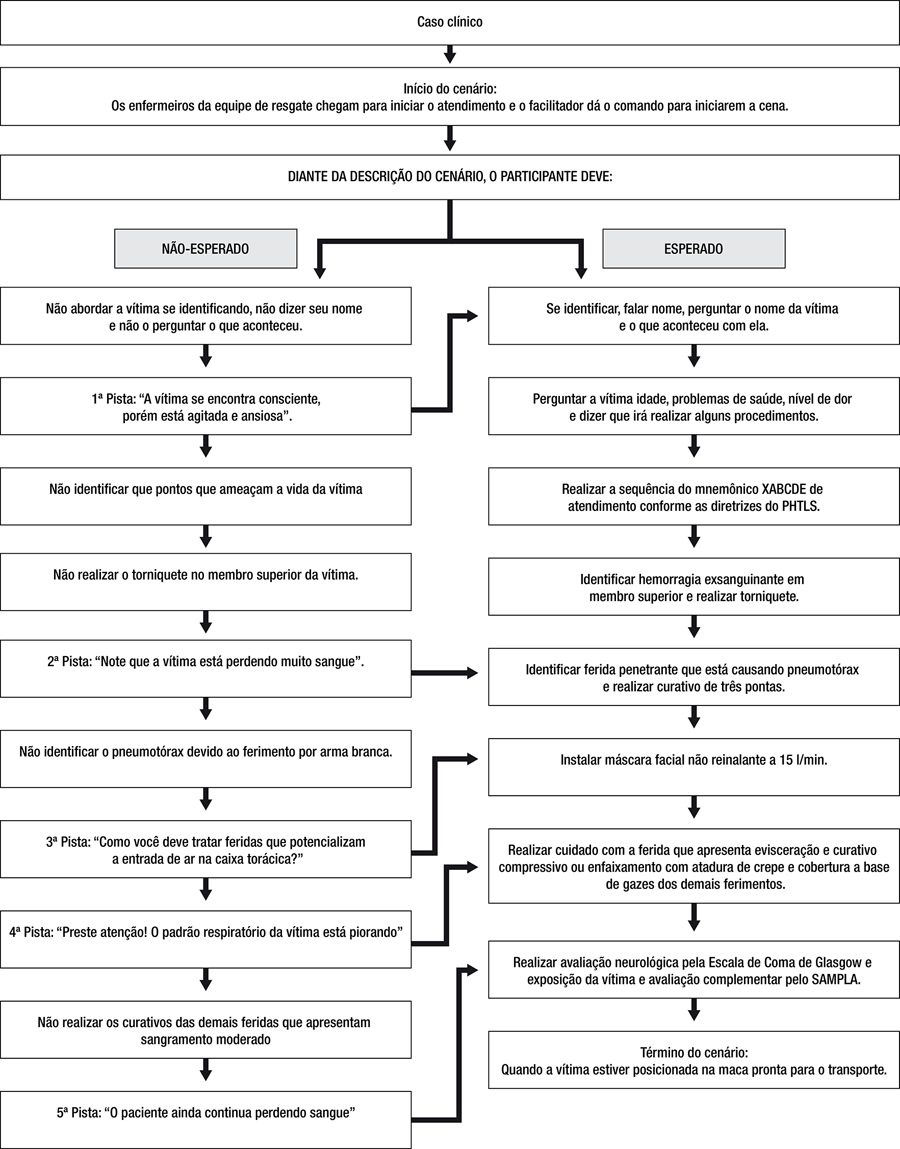
Clinical simulation design was constructed by describing the planning phase followed by the stages of preparation, participation, debriefing, a checklist of psychomotor and attitudinal skills, a decision-making flowchart and a cognitive skills test.
In the planning stage, design components were characterized to clarify the phase of their creation.(12) The preparation stage had three subdivisions: pre-simulation, pre-briefing and briefing.(13) Pre-simulation contains the theoretical framework for the preliminary study, with an explanation of aspects of simulation and its benefits to participants. Pre-briefing consisted of objectives, assessment mechanisms, details of the fictional contract and the functioning of simulation setting and materials. Briefing was structured with the clinical case and organization of the roles of participants involved.(13-15,23)
Participation is the stage corresponding to the execution of clinical scenario by participants, and facilitators are responsible for mediation and assessment mechanisms, consisting of items that detail the scenario with essential information for its execution.(12,24) A clinical case was constructed based on relevant information found in literature in order to develop clinical skills.(5)
The last stage (debriefing) consisted of method, technique, number of debriefers and estimated time. The G.A.S. debriefing technique was used, which is recommended in literature for enabling teaching and learning in emergency care.(25)
Clinical simulation design was submitted to 34 experts for a priori validity. Responses were obtained from seven experts who agreed to participate and completed the forms within the pre-established deadline. In the validity process, experts were characterized according to the criteria indicated by the framework, having obtained ten points (3; 42.9%), nine points (2; 28.5%) and six points (2; 28.5%).
Experts assessed the items in relation to objective, relevance, structure and presentation, assigning scores from 1 (strongly agree) to 5 (strongly disagree) and considering responses 1 or 2 to calculate the CVI. Table 1 presents the assessed items and experts’ responses used to validate the design.
As shown, the CVI of almost all items reached “perfect agreement” among experts. Only two items related to the objective and the cognitive skills test showed “almost perfect agreement” among experts. However, a margin was considered to propose content validity at a value ≥80% in CVI. Therefore, it was not necessary to use the Delphi technique with the committee of experts because the results obtained were satisfactory. Then, the total CVI of clinical simulation design (99%) was calculated, showing “almost perfect agreement” among experts. Even with almost perfect agreement on the total CVI, experts made some considerations regarding clinical simulation design components (Chart 1).
After experts’ assessment, a consensus meeting was held among the researchers and the considerations were discussed. Thus, it was observed that they were generally in line with evidence in literature, enhancing the design structure and giving greater emphasis to the clinical case that supports the participation stage. In turn, this should align with learning objectives, enabling the development of clinical skills. Thus, considerations were accepted to enhance simulation design, and the final version was validated (Appendix 1).
Discussion
The present study is relevant, attributing originality to teaching, research and nursing care, providing a reliable and content-valid design for clinical simulation aimed at nursing care in a pre-hospital setting for an adult victim of stab wounds.
This design was structured and designed to achieve the proposed objectives and obtain the expected results, including a systematic design to develop experiential and meaningful learning and to be successful in the validity process.(12)Thus, the validity process made it possible to demonstrate the reliability, clarity and logic in the arguments presented, making this teaching-learning strategy effective.(17)
Regarding the validity process, the CVI achieved “almost perfect agreement” on the design objective items. Based on the adopted framework, we can infer that the construct presents coherence, clarity, and coherence of objectives, providing logical reasoning based on scientific information, a logical sequence that allows establishing theoretical content with practice and the development of the skills necessary to care for a trauma victim in pre-hospital settings.(12,26)
It can be compared with a study that validated a clinical simulation scenario on postpartum hemorrhage management with CVI >95% in validating aspects related to the objective.(27)
In relation to item validity on relevance, structure and presentation, the design achieved “perfect agreement”, indicating that its clear and logical wording facilitates understanding, allowing the construction of reasoning towards the proposed objective. Evidence is shown so that participants can propose a diagnostic hypothesis with sufficient data to make a clinical judgment and provide care based on the decision-making flowchart. We emphasize that easy understanding of stages ensures better performance in the execution of clinical simulation.(12)
The total CVI of the design reached “almost perfect agreement”, demonstrating scientific relevance in the elaboration and assessment of the content, enhancing the objectives of this clinical simulation in the PHC for a victim of SW so that the proposed conducts are effective and efficient as a pedagogical strategy.(21,22)
This agrees with other national and international studies that validated simulation designs through CVI analysis by experts in various topics and contexts for teaching and learning in nursing, obtaining results with total CVI >80% in agreement.(26-29)
Regarding the experts’ considerations, the addition of penetrating injury to the abdominal region with the presence of evisceration was included due to its frequency and severity in SW victims, representing approximately 2/3 when added to thoracic injuries.(30,31)
After this inclusion, care related to nursing PHC in cases of evisceration was inserted into the decision-making flowchart and the checklist of procedural and attitudinal skills. According to literature, in cases of evisceration by SW in PHC, the exposed viscera should be covered with a compress (preferably sterile) moistened with saline solution (0.9%) to maintain viscera moisture and occlude the injury orifice until reaching the hospital.(5,19,32)
According to PHTLS guidelines, it is no longer recommended to plank SW victims with a stretcher and/or rigid board and fixation belts if there is no suspicion or evidence of spinal or cervical trauma.(5)
Concerning the triggers for recognizing clinical state and making decisions, speeches and symptoms presented by the simulated patient were modified, aiming to instigate the assessment process using clinical reasoning to carry out appropriate interventions given life-threatening conditions.(2,33)
In the considerations, the procedures of “direct compression and use of primary gauze-based coverage” were included to control small and medium hemorrhages because they are effective and low-cost, can be performed by nurses, and are also recommended in evidence.(5,19)
The mnemonic SAMPLA (S: signs and symptoms; A: allergies; M: medications; P: past or personal history; L: liquids and foods last ingested; A: trauma-related setting) was considered and included in the psychomotor and attitudinal skills checklist due to its consistent recommendation in obtaining relevant information for PHC and facilitating communication or exchange of information between pre-hospital and intra-hospital services.(5,34)
In the cognitive skills test, the main corrections were related to the wording of the questions. According to the recommendations for writing written tests for health sciences, it is not recommended to use the word “except” if most of the questions were expressed positively, because the inclusion of a negative item can be lost in the reading, making the question difficult and confusing the reader.(35)
This study contributed to research, assistance and teaching in nursing by presenting the validated design of a clinical simulation in the care of a victim of SW in PHC, listing the initial conducts based on the best evidence to be performed by nurses.
The limitations of this research are related to the low number of experts who agreed to participate in clinical simulation design validity (even though it was within what the literature recommends) as well as the lack of assessment and validity with the target audience.
Conclusion
The design of this clinical simulation was constructed in three stages: preparation, participation and debriefing. It was based on evidence from scientific literature according to Mobile Emergency Care Service Basic and Advanced Life Support Protocol national recommendations and PHTLS international guidelines on prehospital nursing care and conduct in the face of stab wounds. The study achieved a total CVI characterized as “almost perfect agreement” in the face and content validity considering the objectives, relevance, structure and presentation. The design of this clinical simulation can be used by professors, facilitators and researchers as a teaching-learning strategy to develop cognitive, psychomotor and attitudinal skills of students and professionals in the search for clinical competences related to nursing care for victims of stab wounds in prehospital care.
Acknowledgements
In gratitude to the Coordination for the Improvement of Higher Education Personnel – Brazil (In Portuguese, Coordenação de Aperfeiçoamento de Pessoal de Nível Superior - CAPES) for funding the master’s scholarship and supporting research – Financing Code 001.
Appendix 1
Appendix 2
Psychomotor and attitudinal skills checklist
Facilitator name: _______________________________________________________________.
Name of participants: ____________________________; _______________________________.
Appendix 3
Cognitive skills test on care for victims of trauma and stab wounds
( ) Pre-test ( ) Post-test
Name: _________________________________________________________________________.
Question 1 - This is a phase that assesses whether the scene is safe for the team and patients as well as carefully considering the exact nature of the situation and what happened. Select the alternative below that corresponds to what was described.
-
XABCDE assessment sequence.
-
Victim assessment.
-
Scene assessment.
-
Assessment of the safety of those involved.
-
Assessment of additional risks to victims.
Question 2 - The primary assessment of a trauma victim should be performed in a dynamic and integrated manner according to the initial care protocol for polytrauma victims, according to Prehospital Trauma Life Support (PHTLS). The first and final stage of trauma care protocol consists of:
-
Airway opening and neurological dysfunction assessment.
-
Exsanguinating hemorrhage control and neurological dysfunction assessment.
-
Airway opening and exposure of victims with environmental control.
-
Exsanguinating hemorrhage control and airway opening.
-
Exsanguinating hemorrhage control and exposure of victims with environmental control.
Question 3 - Injury resulting from the entry of air into the space between the visceral and parietal pleura caused by a penetrating and aspirating chest wound that culminates in lung collapse. Which of the following conditions is characterized by the one described above?
-
Closed hemothorax.
-
Open pneumothorax.
-
Pleural effusion.
-
Hypertensive chest.
-
Flail chest.
Question 4 - One of the main causes of death in trauma is exsanguinating hemorrhage, which is usually associated with limb amputation or rupture of large vessels. This requires effective and immediate intervention. In this case, choose the alternative below that should be used in the pre-hospital setting to control exsanguinating hemorrhage in the upper or lower limbs:
-
Local compression with compressive bandaging.
-
Direct pressure on injury size.
-
Vessel cauterization.
-
Tourniquet.
-
Tranexamic acid administration.
Question 5 - According to the PHTLS care protocol, the mnemonic XABCDE is a standard to guide care for a trauma victim. Select the alternative that best describes what is assessed in letter A:
-
Airway opening.
-
Cervical spine ventilation, oxygenation and stabilization.
-
Airway opening and cervical spine stabilization.
-
Ventilation and oxygenation.
-
Airway opening, ventilation and oxygenation.
Question 6 – In pre-hospital care, within the protocol for treating trauma victims, nurses must assess patients’ ventilation, breathing and oxygenation in an orderly and precise manner to identify possible signs of respiratory pattern deterioration. Which of the alternatives below is this conduct based on?
-
Count the heart rate and classify it as asystole, bradycardia, normosphygmia or tachycardia.
-
If chest trauma such as hemothorax or pleural effusion is detected, perform relief thoracentesis with Abocath 14 in the anterior axillary line in the 6th intercostal arch.
-
Assess the quality and quantity of breathing, signs of hypoxia, cyanosis and observe the presence of signs of respiratory effort.
-
Check whether patients are well oxygenated by measuring the capillary perfusion time.
-
If victims are conscious with preserved reflexes, but with difficulty breathing, insert an oropharyngeal cannula and supplemental oxygen device.
Question 7 – A rescue team is called to assist a victim of stab wounds at home, caused by domestic violence with attempted murder, and victims is in serious condition, according to information gathered. The team arrives at the scene and does not see the civil police team there, in this case they should:
-
Proceed with the assistance, given the serious condition of victims, and wait for the police to arrive at the scene.
-
Call and wait for the police to arrive at the scene and allow the rescue team to provide assistance, even knowing the possible seriousness of victims.
-
Call and wait for the police, and when they arrive, go together to the scene of the incident.
-
Proceed with the assistance independently if the police are on the way.
-
Proceed with the assistance and call the police, if necessary.
Question 8 – Select the correct alternative with the recommended conduct in cases of penetrating injuries, in which the object causing the injury remained inserted in victims, the pre-hospital care team must:
-
Keep the penetrating object in victims and immobilize victims to prevent further injuries during transportation.
-
Remove the penetrating object when it is identified and apply pressure to injury site with a sterile cotton swab.
-
Remove the object immediately and proceed with manual techniques to stop any bleeding.
-
Keep the penetrating object in victims and leave the wound exposed to assess blood loss.
-
Remove the penetrating object and suture to stop the bleeding.
Question 9 – Nurses need to know how to identify life-threatening injuries in order to prioritize care and expedite the care that will be provided. Regarding care for open pneumothorax, select the correct alternative.
-
Chest drainage is the first intervention performed by nurses in the care of open pneumothorax.
-
The three-point dressing on the chest injury is an intervention exclusively performed by a physician and only they can perform it since it is an invasive procedure.
-
Open pneumothorax causes decreasing respiratory discomfort and saturation rates always above 98% because it does not alter the ventilatory pattern.
-
The three-point dressing on the open chest injury is an emergency intervention indicated in primary care of polytrauma patients.
-
The use of a laryngeal mask is indicated in this case to optimize the respiratory pattern, regardless of patients’ clinical presentation.
Question 10 – Indicate the alternative procedures that are part of the pre-hospital care provided by the nursing team to a trauma victim who presents any type of hemorrhage;
-
Perform control by means of measures to stop/interrupt blood flow and preferably puncture two peripheral and large-caliber venous accesses.
-
In deep wounds, clean with an appropriate solution and suture the muscles and skin to stop bleeding.
-
Perform volume replacement through intravenous fluids without a medical prescription, given the hypotension due to blood loss.
-
Collect blood for blood typing.
-
Administer anti-hemorrhagic medications without medical support.

References
- 1 Dias MA, de Macedo FP, Coelho MA, di Tommaso GR, Rodriguez JE, Nascimento DV, et al. Ferimento em tórax com arma branca oculta na lesão: relato de caso. Rev Eletrôn Acervo Saúde. 2020;45(45):e3221.
- 2 Li S, Yuan S, Shi Y, Guo W, Yang C, Wang M, et al. Biomechanical characteristics of slashing attack on different body parts of a dummy using a kitchen knife. Int J Legal Med. 2023;137(1):259-66.
- 3 Lentsck MH, Sato AP, Mathias TA. Epidemiological overview - 18 years of ICU hospitalization due to trauma in Brazil. Rev Saude Publica. 2019;53:83.
- 4 Barros JP, Dapper AS. Viana KR, Mariot MD, Cicolella DA. Challenges of nursing assistance to individuals' victims of violence by firearms and white weapons. Rev Eletrôn Acervo Saúde. 2020;12(12):e5045.
- 5 National Association of Emergency Medical Technicians. Prehospital Trauma Life Support - PHTLS. Burlington: Jones & Bartlett Learning; 2023.
- 6 Andrade TF, Silva MM. Characteristics of nurses in pre-hospital care: conceptions about training and professional exercise. Enferm Foco. 2019;10(1):81-6.
- 7 Costa FN, Melo KA, Silva TC, Ribeiro JF, Andrade JMF. Challenges experienced by the pre-hospital care team. Rev Enferm Atual. 2021;94(34):e 021088.
- 8 Costa R, Lino MM, Souza AI, Lorenzini E, Fernandes GC, Brehmer LC, et al. Nursing teaching in COVID-19 times: how to reinvent it in this context? Texto Contexto Enferm. 2020;29:e20200202.
- 9 Ghezzi JF, Higa EF, Lemes MA, Marin MJ. Strategies of active learning methodologies in nursing education: an integrative literature review. Rev Bras Enferm. 2021;74(1):e20200130.
- 10 Santos LC, Conceição KO, Melo MS, Barreiro MS, Cartaxo Freitas CK, Verdes Rodrigues ID. Características e repercussões da simulação como estratégia para o ensino-aprendizagem em enfermagem: revisão integrativa. Arch. Health Sci. 2020;27(1):70-5.
- 11 Chabrera C, Dobrowolska B, Jackson C, Kane R, Kasimovskaya N, Kennedy S, et al. Simulation In Nursing Education Programs: findings from an international exploratory study. Clin Simul Nurs. 2021;59:23-31.
- 12 INACSL Standards Committee, Watts PI, McDermott DS, Alinier G, Charnetski M, Nawathe PA. Healthcare Simulation Standards of Best Practice TM Simulation Design. Clin Simul Nurs. 2023;58:14-21.
- 13 INACSL Standards Committee, McDermott DS, Ludlow J, Horsley E, Meakim, C. Healthcare Simulation Standards of Best Practice TM Prebriefing: Preparation and Briefing. Clin Simul Nurs. 2021; 58:9-13.
- 14 Tyerman J, Luctkar-Flude M, Graham L, Coffey S, Olsen-Lynch E. A systematic review of health care presimulation preparation and briefing effectiveness. Clin Simul Nurs. 2019;27:12-25.
- 15 Nascimento JS, Costa AB, Sangiovani JC, Silva TC, Regino DS, Dalri MC. Pre-simulation, pre-briefing or briefing in nursing simulation: what are the differences? Rev Eletr Enferm. 2020;22:60171.
- 16 INACSL Standards Committee, McMahon E, Jimenez FA, Lawrence K, Victor J. Healthcare Simulation Standards of Best Practice TM Evaluation of Learning and Performance. Clin Simul Nurs. 2021; 58:54-6.
- 17 Kaneko RM, Lopes MH. Realistic health care simulation scenario: what is relevant for its design? Rev Esc Enferm USP. 2019;53:e03453.
- 18 Amorim GC, Bernardinelli FC, Nascimento JD, Souza IF, Contim D, Chavaglia SR. Simulated scenarios in nursing: an integrative literature review. Rev Bras Enferm. 2022;76(1):e20220123.
-
19 Brasil. Ministério da Educação. Resolução n.º 3, de 7 de novembro de 2001. Institui Diretrizes Curriculares Nacionais do Curso de Graduação em Enfermagem. Brasília(DF): Ministério da Saúde; 2001 [citado 2024 Fev 07]. Disponível em: https://pesquisa.in.gov.br/imprensa/jsp/visualiza/index.jsp?data=09/11/2001&jornal=1&pagina=37&totalArquivos=160
» https://pesquisa.in.gov.br/imprensa/jsp/visualiza/index.jsp?data=09/11/2001&jornal=1&pagina=37&totalArquivos=160 - 20 Quatrini Carvalho Passos Guimarães HC, Pena SB, Lopes JL, Lopes CT, Bottura Leite de Barros AL. Experts for Validation Studies in Nursing: new proposal and selection criteria. Int J Nurs Knowl. 2016;27(3):130-5.
- 21 Polit DF, Beck CT. Fundamentals of Nursing Research: assessment of evidence for nursing practice. 9a ed. Porto Alegre: Artmed; 2019.
- 22 Souza AC, Alexandre NM, Guirardello EB. Psychometric properties in instruments evaluation of reliability and validity. Epidemiol Serv Saude. 2017;26(3):649-59.
- 23 Persico L, Belle A, DiGregorio H, Wilson-Keates B, Shelton C. Healthcare simulation standards of best practiceTM Facilitation. Clin Simul Nurs. 2021;58:22-6.
- 24 Nogueira LS, Domingues TA, Bergamasco EC. Construção do cenário simulado. In: Conselho Regional de Enfermagem de São Paulo, organizadores. Manual de simulação clínica para profissionais de enfermagem. São Paulo: Conselho Regional de Enfermagem; 2020. p. 47-63
- 25 Nascimento JD, Pires FC, Castro JP, Nascimento KG, Oliveira JL, Dalri MC. Instructor-led oral debriefing technique in clinical nursing simulation: integrative review. Rev Bras Enferm. 2021;74 Suppl 5:e20190750.
- 26 Bernardinelli FC, Amorim GC, Nascimento JS, Fonseca LM, Domingues TA, Condeles PC, et al. Desenvolvimento de um projeto de telesimulação para suporte básico de vida. Acta Paul Enferm. 2024;37:eAPE00021.
- 27 Andrade PON, Oliveira SC, Morais SCRV, Guedes TG, Melo GP, Linhares FMP. Validation of a clinical simulation setting in the management of postpartum hemorrhages. Rev Bras Enferm. 2019;72(3):624-31.
- 28 Ramos DF, Matos MP, Viduedo AF, Ribeiro LM, Leon CG, Schardosim JM. Consulta de enfermagem em planejamento reprodutivo: validação de cenário e checklist para o debriefing. Acta Paul Enferm. 2022;35:eAPE0296345.
- 29 Flewelling G, Augustine B, Groom JA, Edgren KE, Simmons VC. Design and Validation of a Simulation Scenario and Assessment Tool: a pilot projed. AANA J. 2023;91(1):46-54.
- 30 Ajayi B, Guthrie H, Trompeter A, Tennent D, Lui DF. The rising burden of penetrating knife injuries. Inj Prev. 2021;27(5):467-71.
- 31 Corbitt M, Schmidt E, Swift K, O'Neill J, Brunott N. Overview of stab injuries in Far North Queensland: A new insight into the demographics, injury patterns and management. Injury. 2023;54(5):1386-91.
- 32 Riesberg JC, Gurney JM, Morgan M, Northern DM, Onifer DJ, Gephart WJ, et al. The management of abdominal evisceration in tactical combat casualty care: guideline change. J Spec Oper Med. 2021;21(4):138-42.
- 33 Trisyani Y, Emaliyawati E, Prawesti A, Mirwanti R, Mediani HS. Emergency nurses' competency in the emergency department context: a qualitative study. Open Access Emerg Med. 2023;15(15):165-75.
- 34 Zhang Z, Brazil J, Ozkaynak M, Desanto K. Evaluative research of technologies for prehospital communication and coordination: a systematic review. J Med Syst. 2020;44(5):100.
- 35 NBME Item Writing Guide. Constructing written test questions for the health science. Philadelphia: NBME; 2022. 86 p.
Edited by
-
Associate Editor:
Juliana de Lima Lopes (https://orcid.org/0000-0001-6915-6781) Escola Paulista de Enfermagem, Universidade Federal de São Paulo, São Paulo, SP, Brasil

 Thumbnail