 Spirituality as a predictor of quality of life in older adults: an integrative review
Abstract
Objective To analyze the evidence that identifies spirituality as a predictor of quality of life in older adults.
Methods An integrative literature review was conducted from January 2021 to July 2025 in the following databases: Virtual Health Library (VHL), Elton B. Stephens Company (EBSCO), Scientific Electronic Library Online (SciELO), Scopus, and Web of Science (WoS). Following the PRISMA (Preferred Reporting Items for Systematic Reviews and Meta-Analyses) guidelines, 484 articles published in Portuguese, Spanish, or English were found. Twenty-one studies were selected because they addressed the following research question: How does spirituality predict an improvement in the quality of life of older adults?
Results Spirituality showed a positive and significant association with quality of life in various cultural and clinical contexts. Multiple mechanisms of influence were identified: sense of purpose, resilience, strengthening of social ties, promotion of healthy habits, and existential reinterpretation. In addition, spirituality was associated with less anxiety, depression, and dyspnea, greater positive affect, functionality, and social integration. Several instruments were used to assess spirituality and quality of life, reflecting its multidimensional approach.
Conclusion Spirituality positively predicts well-being in old age, improving mental, emotional, and social health. Its inclusion in gerontological interventions promotes resilient aging. However, cultural and methodological diversity limits the generalization of results, making it necessary to adapt strategies to the sociocultural context.
Keywords
Spirituality; Quality of life; Aged
Resumo
Objetivo Analisar as evidências que identificam a espiritualidade como fator preditor da qualidade de vida em idosos.
Métodos Foi realizada revisão integrativa da literatura no período de janeiro de 2021 a julho de 2025 nas seguintes bases de dados: Biblioteca Virtual em Saúde (BVS), Elton B. Stephens Company (EBSCO), Scientific Electronic Library Online (SciELO), Scopus e Web of Science (WoS). Seguindo as diretrizes PRISMA (Preferred Reporting Items for Systematic Reviews and Meta-Analyses), foram encontrados 484 artigos publicados em português, espanhol ou inglês. Vinte e um estudos foram selecionados por abordarem a seguinte questão de pesquisa: Como a espiritualidade prediz uma melhora na qualidade de vida de idosos?
Resultados A espiritualidade apresentou associação positiva e significativa com a qualidade de vida em diversos contextos culturais e clínicos. Múltiplos mecanismos de influência foram identificados: senso de propósito, resiliência, fortalecimento de laços sociais, promoção de hábitos saudáveis e reinterpretação existencial. Além disso, a espiritualidade foi associada a menos ansiedade, depressão e dispneia, maior afeto positivo, funcionalidade e integração social. Diversos instrumentos foram utilizados para avaliar a espiritualidade e a qualidade de vida, refletindo sua abordagem multidimensional.
Conclusão A espiritualidade prediz positivamente o bem-estar na terceira idade, melhorando a saúde mental, emocional e social. Sua inclusão em intervenções gerontológicas promove o envelhecimento resiliente. No entanto, a diversidade cultural e metodológica limita a generalização dos resultados, sendo necessário adaptar as estratégias ao contexto sociocultural.
Descritores
Espiritualidade; Qualidade de vida; Idosos
Resumen
Objetivo Analizar las evidencias que identifican la espiritualidad como factor predictor de la calidad de vida en personas mayores.
Métodos Se realizó una revisión integradora de la literatura entre enero de 2021 y julio de 2025 en las siguientes bases de datos: Biblioteca Virtual en Salud (BVS), Elton B. Stephens Company (EBSCO), Scientific Electronic Library Online (SciELO), Scopus y Web of Science (WoS). Siguiendo las directrices PRISMA (Preferred Reporting Items for Systematic Reviews and Meta-Analyses), se identificaron 484 artículos publicados en portugués, español o inglés. Se seleccionaron veintiún estudios por abordar la siguiente pregunta de investigación: ¿Cómo predice la espiritualidad una mejora en la calidad de vida de las personas mayores?
Resultados La espiritualidad presentó una asociación positiva y significativa con la calidad de vida en diversos contextos culturales y clínicos. Se identificaron múltiples mecanismos de influencia: sentido de propósito, resiliencia, fortalecimiento de los vínculos sociales, promoción de hábitos saludables y reinterpretación existencial. Además, la espiritualidad se asoció con menor ansiedad, depresión y disnea, así como con mayor afecto positivo, funcionalidad e integración social. Se utilizaron diversos instrumentos para evaluar la espiritualidad y la calidad de vida, lo que refleja su abordaje multidimensional.
Conclusión La espiritualidad predice positivamente el bienestar en la vejez, al mejorar la salud mental, emocional y social. Su inclusión en intervenciones gerontológicas favorece un envejecimiento resiliente. No obstante, la diversidad cultural y metodológica limita la generalización de los resultados, por lo que es necesario adaptar las estrategias al contexto sociocultural.
Descriptores
Espiritualidad; Calidad de vida; Personas mayores
Introduction
Population aging is a growing global phenomenon that poses significant challenges for health systems. The World Health Organization (WHO) estimates that by 2030, at least one in six people will be over 60 years old, projecting an increase in the older adult population from 1.4 billion in 2020 to 2.1 billion in 2050.(1) This demographic change highlights the need to adapt health systems to promote healthy and active aging through intersectoral policies that foster physical, psychological, social, and spiritual well-being.(2)
In the case of Chile, the demographic transition has been particularly rapid, placing it among the seven countries in Latin America and the Caribbean with the most advanced stages of population aging for the five-year period between 2030 and 2035.(3) Currently, people over 65 represent 14% of the national population.(4) Life expectancy in Chile has exceeded 80 years and is expected to continue to increase, posing significant challenges for the health system.(5) This requires the provision of comprehensive care that considers all dimensions of the well-being of older persons.(2)
Quality of life, understood as a person’s subjective perception of their position in life, considering their values, cultural context, and physical, psychological, social, and environmental factors, is a central concept in aging.(6) In older adults, it is especially associated with chronic diseases that may affect your independence and functionality.(7)
On the other hand, spirituality is an intrinsic dimension of human beings, which can be understood as the search for meaning, purpose, and transcendence in life, incorporating religious and non-religious experiences, and is relevant in studies on aging because it constitutes a psychosocial resource.(8,9) Currently, it is recognized as a universal aspect that promotes well-being and acts as a means to maintain inner peace.(10,11) Spiritual health can strengthen resilience in older adults, helping them to more effectively face the challenges of aging, such as chronic diseases, loss of functionality, reduced independence, isolation, and economic difficulties.(12)
In Chile, during the pandemic, religion played a crucial role in helping older adults cope with emotional challenges and socioeconomic vulnerability, contributing to improved mental and social health and, consequently, influencing their quality of life.(13) Similarly, recent studies demonstrate the association between spirituality and quality of life in people aged 60 to 80 years.(14)
Another study also reported a significant correlation between spirituality levels and perceived well-being.(15) In a context of rapid population aging and increased life expectancy in Chile, it is imperative to incorporate the spiritual dimension as an essential component in healthcare approaches, going beyond disease-centered interventions, since it is necessary to ensure a better quality of life in this age group.(2) The objective of this article was to analyze the best evidence identifying spirituality as a predictor of quality of life in older adults.
Methods
An integrative review was conducted in six stages: formulation of the research question; literature search; categorization of studies; critical evaluation of studies; interpretation of data; and presentation of the synthesis of knowledge.(16) Given that spirituality and its relationship with quality of life in older adults is a complex and multidimensional phenomenon, operationalized in various ways, a method that offers greater flexibility to integrate heterogeneous evidence is necessary.(16) The recommendations of the Preferred Reporting Items for Systematic Reviews and Meta-Analyses (PRISMA) were followed(17) to ensure transparency in the process of searching, selecting, and recording studies.
The research question was developed using the PICO strategy:(18) Population (P) refers to people over 60 years of age; Intervention (I) refers to the level of spirituality; Comparison (C) considers low levels or absence of spirituality; and Outcome (O) is perceived quality of life, which answers the following research question: How does spirituality predict better quality of life in older adults?
The literature search was conducted considering articles available from January 2021 to July 2025. The databases used were: Virtual Health Library (VHL), Elton B. Stephens Company (EBSCO), Scientific Electronic Library Online (SciELO), Scopus, and Web of Science (WoS). The Health Sciences Descriptors (DeCS) and Medical Subject Headings (MeSH) used were: “spirituality,” “quality of life,” “elderly,” and “cancer.” The Boolean operators “AND,” “OR,” and ‘NOT’ were applied to these terms, using the following search strategy: ((spirituality) AND (“quality of life”) AND (aged OR elderly OR “older people”)).
Subsequently, the methodology was adapted to each database. The inclusion criteria were: original articles using quantitative, qualitative, mixed, or multi-method approaches, published in English, Spanish, or Portuguese; including individuals over 60 years of age (either by minimum or average age); and available in full text and free of charge. The records were exported to Microsoft Excel® for organization and initial analysis, where the titles and abstracts were carefully read.
At this stage, duplicate studies, those that did not address the topic of interest, and those focused on cancer patients were excluded. This last exclusion was based on the fact that adults diagnosed with cancer have increased or intensified spiritual needs, along with a decrease in their perceived quality of life.(19) In addition, the spirituality of terminally ill cancer patients differs among older adults due to the progression and duration of their illnesses and the meaning they attribute to their remaining life span.(20)
The selected articles were read in full after this initial stage. Their data were collected using an instrument developed by the authors (Table 1). The procedures for selecting, evaluating, and characterizing the articles were performed in pairs by two researchers, and the conclusions (including statements and contradictions found) were interpreted in light of the available literature.
Results
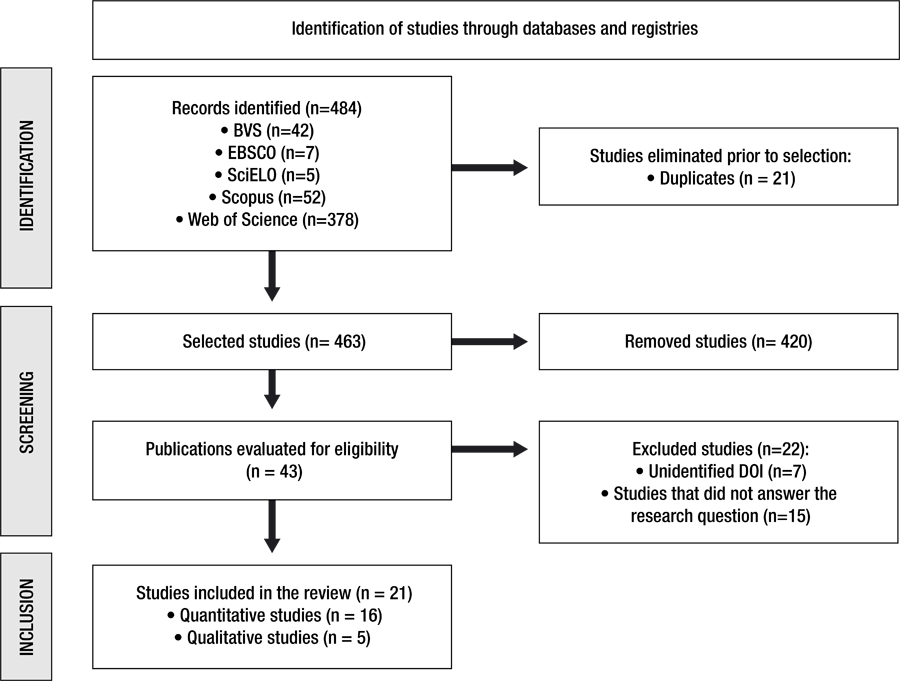
A total of 484 articles were found. After a detailed reading of the titles and abstracts, 43 articles were selected, which were read in full and submitted to the data collection instrument. After reading, 21 articles constituted the final sample of the study (Figure 1). Of the 21 articles analyzed, 14.3% were from Brazil(10,21,22) and Indonesia23; 9.5% were from India(26,27), Germany(28,29), and Malaysia(11,30) while 4.8% were from Australia,(31) Costa Rica(32) the Philippines,(33) Japan,(34) Iran,(35) Italy,(36) Nigeria,(37) Poland,(38) and the United States. (39)

Regarding the methodological approach, 76.2% (n=16) corresponded to studies with a quantitative design 10,21 and 23.8% (n=5) to qualitative studies. (11,25,26,31,37) Regarding the context of the participants, 71.4% of the studies (n=15) focused on older adult people living in the community, addressing spirituality as part of everyday well-being.11,23,25 In contrast, 28.6% (n=6) focused on hospitalized or institutionalized individuals, or those with chronic diseases such as COPD, heart failure, or myocardial infarction,(10,21,22,24,35,38) highlighting the relevance of spirituality in complex clinical contexts.
Regarding the temporal distribution of publications, there is a clear progressive increase in academic interest in this topic. In 2021, four studies were published;(21,28,31,32) in 2022, five studies;(10,29,30,33,36) in 2023, six studies;22,23,25 in 2024, five articles; (11,24,34,35,38) and in 2025, one article.(39)
Table 1 presents the selected studies and their main characteristics, including author(s), year, country of origin, objective, methodology, design, instruments used (measures of spirituality and/or quality of life), and main results.
Table 2 presents a summary of the instruments used to measure spirituality and quality of life.
Discussion
The evidence gathered suggests that spirituality acts as a positive and significant predictor of quality of life in older adults, both from quantitative and qualitative perspectives. This relationship manifests itself in a multidimensional way, including psychological, social, emotional, functional, and even cognitive aspects. Based on the studies reviewed, multiple mechanisms were identified through which spirituality influences the perception and reality of well-being in this age group.
One of the most documented mechanisms is spirituality’s ability to provide meaning and existential purpose, which directly contributes to emotional well-being.(10,11) Studies such as those by Reissmann et al.(28) and Yoshizawa et al.(34) show that feeling part of a larger or transcendent whole is associated with higher levels of positive affect and engagement with life. This existential dimension, expressed as “having a good spirit” in the Australian Aboriginal context,(31) acts as an emotional and cognitive anchor in the face of uncertainty, aging, and illness.
Similarly, spirituality acts as a positive coping resource in the face of adversity.
Okuno et al.(21) and Mendes et al.(10) highlight that spiritual experiences help to reinterpret suffering, fostering hope and reducing symptoms of anxiety and depression. However, it should be noted that not all spiritual strategies have positive effects: negative religious coping has been associated with increased dyspnea and emotional deterioration,(10) demonstrating that the type of spiritual connection can modulate mental health in different ways.
Spirituality also acts as a factor that promotes social interaction and a sense of community, which are essential elements for well-being in old age. For example, studies such as those by Alfaro and Espinoza(32) and Griffith et al.,(39) show that those who report an active spiritual life also have higher levels of life satisfaction and a lower risk of cognitive decline, aspects strongly related to social participation and positive affect.
In turn, spirituality strengthens intergenerational bonds and the social role of older adults as bearers of wisdom, as demonstrated by Smith et al.(31) in the Aboriginal context and by Jothikaran et al.(26) in India. This allows older adults to remain integrated into affective and cultural networks, preventing social isolation and strengthening their self-esteem.
In some cases, spirituality is also related to healthy habits and protective lifestyles, which directly influence indicators of physical health and functionality. Amir et al.(30) found that regular religious practices, such as prayer, fasting, and reading the Quran, were associated with less depression, greater functional independence, and better cognition. Meanwhile, Sturm et al.(29) showed that an intervention that included spiritual history and self-care promotion significantly improved the mental well-being of those who valued spirituality, revealing the importance of incorporating this dimension into the planning of care strategies.
These results suggest that spirituality can act as a catalyst for adherence to preventive or rehabilitative interventions, promoting self-management of health and greater intrinsic motivation to maintain well-being.
Finally, spirituality facilitates a positive reinterpretation of life. This occurs even in contexts of fragility, pain, or loss. This is evident in studies such as those by Okolie et al.,(37) Yahya et al.,(11) and Taufik et al.,(25)
in which older adults develop acceptance, gratitude, and inner peace through practices such as prayer or connection with the transcendent. This existential reinterpretation improves the perception of quality of life even in adverse contexts, such as institutionalization or rural poverty.
Regarding the instruments used, specific tools were identified to assess spirituality and quality of life. Among the questionnaires designed to assess spirituality, the studies employed a variety of instruments, reflecting both their conceptual complexity and their clinical and existential relevance. Of particular note is the FACIT-Sp,(42) which measures spiritual well-being through the domains of peace, meaning, and faith, allowing for an approach that goes beyond the purely religious. The Spiritual Well-Being Scale (SWBS) is also used, distinguishing between religious well-being (relationship with the divine) and existential well-being (meaning and purpose in life)(48). In culturally specific contexts, adapted instruments are used, such as the Spiritual Health Scale for Older Adults(41), which incorporates harmony with nature and self-transcendence, or Howden’s Spirituality Assessment Scale (SAS),(44) which focuses on dimensions relevant to health. Similarly, instruments such as the Spiritual Experience Scale (DSES),(47) allow for the capture of everyday spiritual experiences, not necessarily religious; while the Brief RCOPE-14,(40) assesses how people use spirituality as a coping strategy, differentiating between positive and negative styles. These tools, although different in approach, converge in highlighting the relevance of spirituality as a component of integrated well-being in old age.
On the other hand, among the instruments designed to measure quality of life are the Bowling Elderly Quality of Life Questionnaire (OPQLQ),(45) which addresses areas such as health, independence, and emotional well-being; Ryff’s Psychological Well-Being Scale (PWB) (1989),(46) which assesses factors such as self-acceptance and autonomy; the Satisfaction with Life Scale (SWLS), developed by Salamon and Conte (2003),(49) which measures aspects such as meaning in life and positive self-concept; the Satisfaction with Life Scale (SWLS) by Diener et al.,(50) which provides an overview of subjective well-being; and Lawton’s Philadelphia Geriatric Center Morality Scale,(43) which focuses on perceptions of aging and loneliness; and the Health Questionnaire (SF-36), which assesses health-related dimensions of quality of life.(52)
Also included is the WHOQOL-OLD Scale, proposed by the World Health Organization (WHO),(51)which assesses specific dimensions of aging, such as autonomy and social participation. Finally, the WHOQOL-BREF Scale, developed by the WHO, not only measures quality of life in areas such as physical health and social relationships, but also incorporates the dimension of spirituality, religion, and personal beliefs into its construct of psychological health.(6)
In summary, spirituality not only influences the subjective perception of well-being, but also brings benefits to objective variables such as mental health, social participation, cognitive function, and treatment adherence. It acts as an integrating force that connects the meaning of life, human relationships, and healthy behaviors, becoming an essential dimension for promoting dignified, resilient, and high-quality aging.
This integrative review has limitations related to the predominance of cross-sectional studies and small sample sizes, which limits the generalizability of the results. The cultural diversity observed highlights the need to adapt spiritual interventions to each context, especially in Latin America. In addition, the heterogeneity of the instruments used to measure spirituality and quality of life makes it difficult to compare studies.
Conclusion
It can be concluded that spirituality predicts a significant improvement in the quality of life of older adults through multiple mechanisms that integrate meaning of life, resilience, coping, social relationships, and emotional well-being. This relationship is documented through various measurement instruments for both spirituality and quality of life, demonstrating their close interdependence and their cross-cutting impact on older adults. The instruments reviewed confirm the multidimensionality of spirituality, encompassing religious, existential, and everyday dimensions, which allows us to estimate its influence on the well-being of older adults. At the same time, quality of life scales integrate physical, psychological, social, and environmental domains, promoting a holistic and contextualized assessment. However, there are still gaps, such as the lack of a consensus-based conceptual definition and appropriate and specific instruments to assess spirituality in this age group. Despite methodological heterogeneity, the evidence converges on similar results in relation to well-being and functionality. For nursing, the results highlight the importance of incorporating spirituality assessment as part of comprehensive care, through interventions that consider individuals’ spiritual perspectives and histories, emotional support, facilitation of meaningful practices, education for spiritual self-care, and support in coping processes. In the context of public policy, it is recommended that the spiritual dimension be included in the care provided to the population, especially in healthy aging programs, in the formation of interdisciplinary teams, and in the development of community support strategies for this population group. For this reason, incorporating the spiritual dimension into geriatric assessment and care emerges as a fundamental strategy for achieving quality care.
Acknowledgments
Espinoza-Padilla DJ was supported by the National Research and Development Agency (ANID) through the National Doctorate Scholarship (No. 21250916) and the Doctorate Program in Nursing Science and Scholarship from the Vice-Rectorate for Research at Andrés Bello University, Chile.
Miranda-Castillo C was supported by the National Research and Development Agency (ANID) through FONDECYT REGULAR (No. 1261408), the Millennium Science Initiative (No. ICS2019_024), and Centers of National Interest (No. CIN250054).
References
-
1 World Health Organization (WHO). Ageing and health. Geneva: WHO; 2024 [cited 2025 Mar 22]. Available from: https://www.who.int/es/news-room/fact-sheets/detail/ageing-and-health
» https://www.who.int/es/news-room/fact-sheets/detail/ageing-and-health -
2 Chile. Ministerio de Salud de Chile. Guía del Envejecimiento y Salud Mental en Personas Mayores. Chile; 2023 [citado 2025 Mar 22]. Disponível em: https://midap.org/wp-content/uploads/2023/08/2023-guia-envejecimiento-salud-mental-en-personas-mayores.pdf
» https://midap.org/wp-content/uploads/2023/08/2023-guia-envejecimiento-salud-mental-en-personas-mayores.pdf - 3 Huenchuan S. Envelhecimento, pessoas idosas e a Agenda 2030 para o Desenvolvimento Sustentável: uma perspectiva regional e de direitos humanos. Chile: Comissão Econômica para a América Latina e o Caribe (CEPAL).2019;19-48.
-
4 Chile. Instituto Nacional de Estadísticas (INE). Censo de 2024. 2024 [citado 2025 Jun25]. Disponível em: https://censo2024.ine.gob.cl/
» https://censo2024.ine.gob.cl/ -
5 Chile. Ministerio de Salud de Chile. Plano Nacional de Demência. Chile: 2017 [citado 2025 Jun 25]. Disponível em: https://www.coprad.cl/wp-content/uploads/2020/09/PLAN-DE-DEMENCIA_2017.pdf
» https://www.coprad.cl/wp-content/uploads/2020/09/PLAN-DE-DEMENCIA_2017.pdf - 6 The WHOQOL Group. Development of the World Health Organization WHOQOL-BREF quality of life assessment. Psychol Med. 1998;28(3):551-8.
- 7 Piña Morán M, Olivo Viana MG, Martínez Matamala C, Poblete Troncoso M, Guerra Guerrero V. [Ageing, quality of life and health: challenges for the social roles of older adults]. Rumbos TS. 2022;17:7-27. Spanish.
- 8 Gallardo-Peralta LP, Cuadra-Peralta A, Veloso-Besio C. Validation of a Brief Index of Religiosity and Spirituality in older adults. Rev Psicol. 2018;27:1.
- 9 Puchalski CM, Vitillo R, Hull SK, Reller N. Improving the spiritual dimension of whole person care: reaching national and international consensus. J Palliat Med. 2014;17(6):642-56.
- 10 Mendes NS, Malaguti C, Dos Anjos Sena L, Lucchetti G, de Jesus LA, Vitorino LM, et al. Spirituality and religiosity are associated with physical and psychological status in patients with chronic obstructive pulmonary disease. J Clin Nurs. 2022;31(5-6):669-78.
- 11 Yahya FB, Hassan HC, Panduragan SL, Mat S. Quality of life: the spirituality and spiritual wellbeing of elderlies in Malaysia. J Ilm Ilmu Terap Univ Jambi. 2024;8(2):773-83.
- 12 Bahrami L, Mohammadi-Shahboulaghi F, Rahgoy A, Biglarian A. Predicting Coping Strategies based on Spiritual Health and Resilience in the Elderly in Tehran. IJPN. 2021;9:56-65.
- 13 Fernández Lorca MB. Religiosity, physical and functional health in older people in Chile. Colomb Med (Cali). 2022;53(2):e2004846.
- 14 Ashar A. Quality of life among elderly individuals: Role of hardiness an spirituality. JNAO. 2024;15(1):160-9.
- 15 Nurfarhantya W, Situmorang NZ. The relationship between spirituality and quality of life among the elderly. Psisula: Prosiding Berkala Psicol. 2024;6;357-65.
- 16 Mendes KD, Silveira RC, Galvão CM. Integrative literature review: a research method to incorporate evidence in health care and nursing. Texto Contexto Enferm. 2008;17:758-64.
- 17 Page MJ, McKenzie JE, Bossuyt PM, Boutron I, Hoffmann TC, Mulrow CD, et al. The PRISMA 2020 statement: an updated guideline for reporting systematic reviews. Rev Esp Cardiol (Engl Ed). 2021;74(9):790-9.
- 18 Hosseini MS, Jahanshahlou F, Akbarzadeh MA, Zarei M, Vaez-Gharamaleki Y. Formulating research questions for evidence-based studies. J Med Surg Public Health. 2024;2:100046.
- 19 Esan DT, Bolarinwa FI, Oyama BO, Olabisi OI, Afolayan JA, Ramos CG, et al. Quality of life and spiritual needs of patients diagnosed with cancer in a tertiary hospital in southwestern Nigeria. Enferm Clin (Engl Ed). 2024;34(6):468-77.
- 20 Seneviwickrama M, Jayasinghe R, Kanmodi KK, Rogers SN, Keill S, Ratnapreya S, et al. Influence of religion and spirituality on head and neck cancer patients and their caregivers: a protocol for a scoping review. Syst Rev. 2025;14(1):27.
- 21 Okuno MFP, Costa KAL da, Barbosa DA, Belasco AGS. Religious/spiritual experiences, quality of life and satisfaction with life of hospitalized octogenarians. Rev Bras Enferm. 2021;75:e20201099.
- 22 von Flach M do RT, Ritt LEF, Santana Junior FG de, Correia M von F, Claro TC, Ladeia AM, et al. Spirituality, Functional Gain, and Quality of Life in Cardiovascular Rehabilitation. Arq Bras Cardiol. 2023;120:e20220452.
- 23 Yuniartika W, Kartinah K, Sudaryanto A. Social Interaction Using Spirituality Therapy to Improve the Quality of Life of the Elderly in the Community. Evid Based Care. 2023;13:65-74.
- 24 Salsabila NN, Ariani TA, Aini N, Marta OFD, Mashfufa EW. Prediction of quality of life among the elderly based on level of depression and spirituality. MEDISAINS. 2024;22(3):137.
- 25 Taufik T, Prihartanti N, Daliman D, Karyani U, Purwandari E. Be alone without being lonely: strategies to improve quality of life for an elderly living in nursing homes. Curr Psychol. 2024;43:6044-50.
- 26 Jaihind Jothikaran TA, Meershoek A, Ashok L, Krumeich A. Role of spiritual experiences in shaping the quality of intergenerational relationships - exploring views of older adults in South India. J Relig Spiritual Aging. 2023;0:1-18.
- 27 Debnath A, Basu Roy P, Mukhopadhyay D. Examining the influence of spiritual practices on quality of life among older urbanites in an Indian town. J Relig Spiritual Aging. 2023;35:139-48.
- 28 Reissmann M, Storms A, Woopen C. Individual values and spirituality and their meaning for affective well-being and engagement with life in very old age. Z Für Gerontol Geriatr. 2021;54:85-92.
- 29 Sturm N, Krisam J, Szecsenyi J, Bentner M, Frick E, Mächler R, et al. Spirituality, self-care, and social activity in the primary medical care of elderly patients-results of a cluster-randomized interventional trial (HoPES3). Dtsch Ärztebl Int. 2022; 119:124-31.
- 30 Amir SN, Juliana N, Azmani S, Abu IF, Talib AHQA, Abdullah F, et al. Impact of Religious Activities on Quality of Life and Cognitive Function Among Elderly. J Relig Health. 2022;61:1564-84.
- 31 Smith K, Gilchrist L, Taylor K, Clinch C, Logiudice D, Edgill P, et al. Good Spirit, Good Life: A Quality of Life Tool and Framework for Older Aboriginal Peoples. Meeks S, editor. The Gerontologist. 2021;61:e163-72.
- 32 Alfaro Vargas N, Espinoza Herrera R. [Older people in Costa Rica: an approach to perceptions about their quality of life]. Rev ABRA. 2021;41:99-124. Spanish.
- 33 Bangcola A, Pangandaman H. Exploring the connection between Spiritual Well-Being and Quality of Life among older adults in Marawi city. Malays J Nurs. 2022;13:12-8.
- 34 Yoshizawa T, Makram AM, Elsheikh R, Nakamura S, Makram EM, Kubota K, et al. Spirituality, Quality of Life, and Health: A Japanese Cross-Sectional Study. Eur J Investig Health Psychol Educ. 2024;14:767-81.
- 35 Marznaki ZH, Khalilizad M, Moradi A, Mamun MA. Impact of spirituality on elderly people's quality of life and life satisfaction after acute myocardial infarction: Iranian hospital-based study. BJPsych Open. 2024;10(1):e4.
- 36 Pascut S, Feruglio S, Crescentini C, Matiz A. Predictive Factors of Anxiety, Depression, and Health-Related Quality of Life in Community-Dwelling and Institutionalized Elderly during the COVID-19 Pandemic. Int J Environ Res Public Health. 2022;19:10913.
- 37 Okolie TJ, Ekoh PC, Onuh SC, Ugwu EO. Perspectives of Rural Older Women on the Determinants of Successful Ageing in Southeast Nigeria. J Cross-Cult Gerontol. 2023;38:173-89.
- 38 Radwanska E, Szwamel K, Lepsy E, Zurek A, Gurowiec PJ, Krok D, et al. Relationship between the level of spirituality and quality of life or psychological well-being in elderly patients hospitalised for heart failure. Med Stud. 2024;40:124-42.
- 39 Griffith EE, Robbins PA, Bentley-Edwards KL. Quality of life, religion/spirituality, and dementia risk among Black people in the US. Aging Ment Health. 2025;29:1072-80.
- 40 Pargament K, Feuille M, Burdzy D. The Brief RCOPE: Current Psychometric Status of a Short Measure of Religious Coping. Religions. 2011;2:51-76.
- 41 Takeda K, Futoyu Y, Kirino M, Kumo K, Kim JS, Nakajima K. Development of a spirituality rating scale related to health in the elderly: A study of the validity and reliability. J Jpn Health Sci. 2007;10:63-72.
- 42 Peterman AH, Fitchett G, Brady MJ, Hernandez L, Cella D. Measuring spiritual well-being in people with cancer: The functional assessment of chronic illness therapy-spiritual well-being scale (FACIT-Sp). Ann Behav Med. 2002;24:49-58.
- 43 Lawton MP. The Philadelphia Geriatric Center Morale Scale: A Revision1. J Gerontol [Internet]. 1975;30:85-9.
-
44 Howden J. Development and psychometric characteristics of the spirituality assessment scale [Internet]. Texas Woman's University; 1992 [citado 19 de julio de 2025]. Available from: http://hdl.handle.net/11274/187
» http://hdl.handle.net/11274/187 - 45 Bowling A. The Psychometric Properties of the Older People's Quality of Life Questionnaire, Compared with the CASP-19 and the WHOQOL-OLD. Curr Gerontol Geriatr Res. 2009;2009:298950.
- 46 Ryff CD. Happiness Is Everything, or Is It? Explorations on the Meaning of Psychological Well-Being. Journal of Personality and Social Psychology. 1989;57:1069-81.
- 47 Underwood LG. Ordinary Spiritual Experience: Qualitative Research, Interpretive Guidelines, and Population Distribution for the Daily Spiritual Experience Scale. Arch Psychol Relig. 2006;28:181-218.
- 48 Paloutzian RF, Ellison CW. Loneliness, spiritual well-being, and the quality of life. In L.A. Peplau & D. Perlman (Eds.), Loneliness: A sourcebook of current theory, research and therapy.1982; 224-237 p. New York: John Wiley & Sons.
- 49 Salamon MJ, Conte VA. Salamon-Conte Life Satisfaction in the Elderly Scale (LSES). 1984. Odessa, FL: Psychological Assessment Resources.
- 50 Diener E, Emmons RA, Larsen RJ, Griffin S. The Satisfaction With Life Scale. J Pers Assess. 1985;49:71-5.
- 51 Winkler I, Matschinger H, Angermeyer MC, WHOQOL-OLD Group. [The WHOQOL-OLD]. Psychother Psychosom Med Psychol. 2006;56:63-9.
- 52 Ware JE, Sherbourne CD. The MOS 36-item short-form health survey (SF-36). I. Conceptual framework and item selection. Med Care. 1992;30:473-83.
- 53 Lawton MP, Moss M, Hoffman C, Kleban MH, Ruckdeschel K, Winter L. Valuation of life: a concept and a scale. J Aging Health. 2001;13:3-31.
- 54 Lucchetti G, Granero Lucchetti AL, Peres MF, Leão FC, Moreira-Almeida A, Koenig HG. Validation of the Duke Religion Index: DUREL (Portuguese version). J Relig Health. 2012;51:579-86.
- 55 Ware J, Kosinski M, Keller SD. A 12-Item Short-Form Health Survey: construction of scales and preliminary tests of reliability and validity. Med Care. 1996;34:220-33.
-
56 National Institute on Aging (NIH). Health and Retirement Study (HRS) [Internet]. [citado 16 de febrero de 2026]. Available from: https://www.nia.nih.gov/research/resource/health-and-retirement-study-hrs
» https://www.nia.nih.gov/research/resource/health-and-retirement-study-hrs