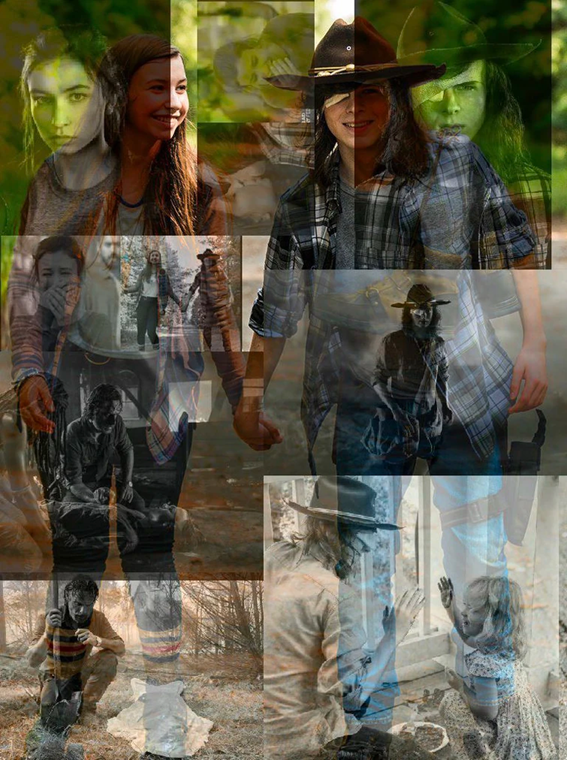
 Raising for the End of the World?
ABSTRACT
In this essay, I explore the forms of education, government, and socialization of children and teenagers in the post-apocalyptic TV show The Walking Dead. I use the concepts of complex narrative, necropolitics, and unconscious/desiring-production to answer the following question: how does our collective unconscious imagine the problem of government and socialization of children and teenagers for the end of the world? The inquiry points to a pedagogy of image centered on economic rationality, an identification between war and politics, in which the survival of communities depends on the physical elimination of others.
KEYWORDS:
Education; Apocalypse; Philosophy; Unconscious; Audiovisual
RESUMO
Neste ensaio, investigamos as formas de educação, governo e socialização de crianças e adolescentes na série pós-apocalíptica The Walking Dead. Utilizamos em nossa discussão os conceitos de narrativa complexa, necropolítica, e inconsciente/produção desejante para responder à seguinte questão: como nosso inconsciente coletivo imagina o problema do governo e socialização das crianças e adolescentes para o fim do mundo? A investigação aponta para uma pedagogia da imagem centrada em uma racionalidade econômica na qual a sobrevivência das comunidades depende da eliminação física dos outros.
PALAVRAS-CHAVE:
Educação; Apocalipse; Filosofia; Inconsciente; Audiovisual
RESUMEN
En este ensayo, investigamos las formas de educación, gobierno y socialización de niños y adolescentes en la serie post-apocalíptica The Walking Dead. Utilizamos en nuestra discusión los conceptos de narrativa compleja, necropolítica, e inconsciente/producción deseante para responder a la siguiente pregunta: ¿cómo imagina nuestro inconsciente colectivo el problema del gobierno y la socialización de los niños y adolescentes para el fin del mundo? La investigación apunta a una pedagogía de la imagen centrada en una racionalidad económica en la que la supervivencia de las comunidades depende de la eliminación física de los otros.
PALABRAS CLAVE:
Educación; Apocalipsis; Filosofía; Inconsciente; Audiovisual
I have put forward the notion of necropolitics, or necropower, to account for the various ways in which, in our contemporary world, weapons are deployed in the interest of maximally destroying persons and creating death--worlds, that is, new and unique forms of social existence in which vast populations are subjected to living conditions that confer upon them the status of the living dead. (Mbembe, 2019, p. 92)
[Alpha’s prayer]: We bathe in blood, we are free; we love no one, we are free; we fear nothing, we are free. This is the end of the world. Now is the end of the world, we are the end of the world. (The Walking Dead, 2010)
The sheriff approaches a gas station to find the accessways blocked by cars strewn haphazardly and traces of turmoil scattered all over the place. He approaches the gas pump only to find it empty. As he knelt beside a car, he hears footsteps and peers under it to find a little girl wearing white slippers. She picks up a teddy bear from the ground and moves away, not noticing his presence. Rick, the sheriff, calls out to her, declaring his occupation. When she turns back, we see her monstrous face. Her pale color and cadaveric aspect reveal to the policeman - and to us, the audience - her true nature: she is a zombie. He hesitates and moves back, then draws the gun and executes the tiny girl at point-blank range.2
The world is on the brink of the end; humanity is at risk of extinction. Hopes of salvation are, at best, scarce, if not impossible. Society is crumbling before the eyes of terrorized citizens. One by one, institutions fall apart, first the schools, hospitals, and administrative services, followed by the police, then the most vital public services such as energy and water. Finally, the American Army perishes before the unavoidable threat. The fall of the army paves the way for the ungovernable proliferation of numerous fragments of war machines (Deleuze; Guattari, 1987): families, communities, militias.
We return to the state of war described by Hobbes, although now man is no longer the only wolf to men. In addition to the raging hordes, the survivors must face the Other, the inhuman, the monstrous that threatens and surrounds helpless families hiding in basements, prisons, abandoned sewer stations, or any other underground and isolated haven. The end of the world is a return to the origins. First, from wolves to men, finally, from men to wolves over again. As a character said: “(...) some of the tribes around here, they thought that the first people were wolves transformed into men and now… well, you know, everything gets a return, right?” (The Walking Dead, 2010).3 Our days are numbered, our children are damned, and only a few of them will survive, if any.
Religions have always posed the problem of the end of time, but today, the climate crisis, the recent global pandemic, the shadow menace of structural economic breakdown, and the ever-present nuclear threats have inescapably posed the question: how do we educate our children and youth in the face of doomsday? How do we raise the new generation for this future that is taken from them?
Methodological notes
The Walking Dead (TWD) has been captivating audiences around the world for more than a decade. This essay will focus on the main series of the franchise, as the comic book, derived series, webisodes, novels, and games will not be discussed. The analysis covers all the 11 seasons, composed of 177 episodes, totaling almost 8000 minutes of audiovisual material.
The purpose of this article is to bring to light certain characteristics of our collective unconscious that guide the storyworld created in TWD, based on a cross-sectional analysis of the story time. We draw upon the concepts utilized by Mittel (2015) for the analysis of complex television narratives. According to the author's analysis, the 1990s saw the emergence of TV programs that challenged the episodic and simplistic canon of television, offering more sequential narratives, aesthetic experimentation, and a focus on elaborate screenwriting that goes beyond standard TV formulas.
In this exposition, I will first present an analysis of the pedagogical practices in different communities portrayed in the series and, subsequently, an overview of an extended version of Carl’s arc, including some sidelines of other children related to the main story. These two sections will guide our analysis through the intricacies of the pedagogy of the end times. In the final part, I will discuss the mechanisms of identification and subjectivation within the series, supported by contributions from viewers on Fandom.com.
In our modern capitalist society, desire is regulated and ruled through Oedipus triangularization (Deleuze; Guattari, 1983). In Foucauldian terms, Oedipus is the dispositif of the government of desire that acts through the family, psychoanalysis, psychiatry, the school, marketing, movies, TV series and the cultural industry in general. From early childhood, desire is shaped by a familiar universe that replicates the scheme of lack and castration. Desire, understood as lack, a desire for Objects, as the identification process ruled by castration, are products of capitalist society and its perverse machinery. The Oedipus complex is a desiring-production induced by parental and social stimuli; it establishes the boundaries, polarizations, and categories that regulate this production, inscribing it into a normalizing social order.
Mass culture produces, precisely, individuals: normalized individuals, articulated to one another according to hierarchical systems, systems of values, systems of submission (...) I would not even say that these systems of submission are 'interiorized' or 'internalized'-according to the expression that was very much in vogue at a certain time, and which implies an idea of subjectivity as something to be filled. On the contrary, what exists is simply a production of subjectivity. Not only a production of individuated subjectivity-the subjectivity of individuals-but a production of social subjectivity that can be found at all levels of production and consumption. And even more: a production of unconscious subjectivity. (Guattari, 2013a, p. 39, translated by the author)
It is no coincidence that in post-apocalyptic sci-fi movies and series, the heroes always fight for their families. End-of-the-world narratives tell us the story of the struggle of family values against their annihilation. According to this theory, the unconscious is a productive machine that registers itself in a diverse set of forms, such as delirium, movies, myths, or any kind of creative human expression. The unconscious is a collective, political, historical, and social milieu, where repressive societal forces attempt to codify and reterritorialize desire (social libido). This analysis aims to expose the boundaries of the Oedipal space outlined in a television version of the post-apocalyptic Myth:
Oedipus's misfortune is indeed that it no longer knows who begins where, nor who is who. And "being parent or child" is also accompanied by two other differentiations on the other sides of the triangle; "being man or woman," "being dead or alive." Oedipus must not know whether it is alive or dead, man or woman, any more than it knows whether it is parent or child. Commit incest and you'll be a zombie and a hermaphrodite. In this sense, indeed, the three major neuroses that are termed familial seem to correspond to Oedipal lapses in the differentiating function or in the disjunctive synthesis: the phobic person can no longer be sure whether he is parent or child; the obsessed person, whether he is dead or alive; the hysterical person, whether he is man or woman. (Deleuze; Guattari, 1983, p. 75)
But what exactly is the “unconscious” layer in a television narrative? The unconscious refers both to the mechanics of identification and to subjectivation that occur during the work’s narrative and story time (Mittel, 2015)-through which the audience performs affective labor that binds them to the characters-and to the presupposed element within the world of the narrative, the diegesis, which links the “real” world and the fictional world. It is a part of the discourse taken as natural and non-controversial, which, even in an absurd fictional situation, provides a certain rationality and predictability to the characters' actions and the world's coherence. It is through this coincidence between narrative expectations and real-world expectations (experienced in a given historical and social moment) that subjectivation and identification strategies can be extracted from the collective unconscious.
The new technologies of communication develop a collective imagination register of our culture (Kerckhove, 1997). If the unconscious is collective, productive, political, and socially invested, as Deleuze and Guattari (1983) suggest, then the industrial-capitalist production of cultural goods can be seen as a piece of the enormous machinery of desiring-production in which different forms of sociability and subjectivity are produced and reproduced. In this regard, the audiovisual zombie tropes are a product of the capitalist imaginary incorporated in our modern subjectivity as a true fundamental Myth of capitalism: “The only modern myth is the myth of zombies - mortified schizos, good for work, brought back to reason” (Deleuze; Guattari, 1983, p. 335).
From its colonial origins to its reappropriation by American cinema in the 1960s and 1970s, the zombie myth has always been imbued with a plastic and indeterminate political significance. In the cultural history of the genre, zombies have been associated with slavery, colonial resistance (McAlister, 2017; Larsen, 2017; Vint, 2017; Comentale, 2017; Stratton, 2017; Linnemann, Wall & Green, 2017), the communist threat to individuality (Dendle, 2001), American consumerism (Larsen, 2017; Lauro, 2017; Shaviro, 2017; Weinstock, 2017; McAlister, 2017), labor exploitation (Mcalister, 2017; Webb; Byrnard, 2017; Comaroff; Comaroff, 2017; Vint, 2017), the masses of immigrants in the USA and Europe (Comaroff; Comaroff, 2017; Stratton, 2017), and the fall of humanism (Vint, 2017; Botting, 2017; Lauro; Embry, 2017). Zombies are the quintessential modern myth because they are intrinsically ambiguous. One could say that they are a portmanteau image (Deleuze, 1990) or “an icon, a floating signifier, rather like the personal pronoun” (Lauro, 2017, p. xviii).
Therefore, monsters expose the risk of dehumanization to which we are routinely subjected (Silva, 2000; Cohen, 1996; Huyssen, 1986 ; Huet, 1993; Gil, 1994; Peixoto Junior, 2010). Zombies represent the threat of the loss of human identity, the loss of our inner essence (Sigurdson, 2017). Although the series does not use the term zombie, I argue that it belongs to the genre created by George Romero in Night of the Living Dead.
TWD offers an interesting perspective on the problem of education in the end of time. The series follows the Grimes family's odyssey in search of salvation and survival, as a deadly and incurable virus has caused the collapse of civilization and turned the dead into flesh-eating monsters. TWD articulates, through an audiovisual expression, diverse elements of our culture to reflect on current problems from the point of view of processes and dispositifs of subjectivation of neoliberal society. As Kirkman, creator of the original TWD and producer of the series, said: “Good zombie movies show us how messed up we are, they make us question our situation in society (...) and our society’s station in the world” (Kirkman, 2008 apud Canavan, 2017, p. 416).
The series presents some interesting answers to the pedagogical dilemmas imposed by the environmental, sanitary, economic, and military crises, based on the inherent rationality of utilitarian calculation of self-interested individuals. It reproduces the social values of national and family institutions in a borderline environment where the very logic of current societies is incessantly reenacted..
Analysis of pedagogical practices in TWD
The groups in The Walking Dead are defined by distinct organizational regimes, each shaping the way they reproduce their social order through education. Rick’s group functions as a tribal collective bound by fraternal sentiment. Initially characterized by a strict gendered division of labor, the group evolves toward an egalitarian survivalist model. Education here is communal and survival-oriented; mothers initially lead a “homeschooling” model-as seen with Rory and Carl in “Pretty Much Dead Already” (TWD, 2010)-before transitioning to early military training. The central tension in their pedagogy is the moral balance: cultivating the violence necessary for survival without destroying the empathy required for group cohesion.
In stark contrast, Woodbury operates as a militarized suburbia. While it mimics pre-apocalyptic normalcy, it is ruled by the Governor’s pathological fixations. No formal schools are shown; instead, the “educational” focus revolves around the leader’s secret obsession with his zombified daughter, whom he keeps locked in a hidden cell, occasionally releasing her to brush her hair and tend to her appearance. Within this context, the makeshift laboratory serves specifically to study the process of “zombification” with the hope of reversing it (TWD, 2010).4
Alexandria represents the early attempt to restore institutional education. As a gated community, it features makeshift schools in garages with morning and afternoon shifts (TWD, 2010).5 Here, we see the persistence of pre-apocalyptic adolescence: children read comics and play video games, though Carl’s hesitation to join them highlights his alienation from such normalcy. Alexandria also implements a vocational system to reproduce society, evidenced by Noah’s engineering lessons and Maggie’s political internship under Deanna Monroe, a former congresswoman. Even after the time jump in Season 9, this commitment remains, with Judith balancing sword training with formal schooling.
The Saviors introduce a disciplinary structure modeled after a factory or barracks. Governance is managed through a “point system” and “capillary control”, where Negan, the leader, treats people as exchangeable resources. There is no traditional education; instead, the “Savior way” is taught through the “pedagogy of the iron”-a system of public, graphic punishment designed to ensure absolute submission and discipline.
Conversely, The Kingdom functions as a benevolent fiefdom. Led by Ezekiel, who plays the role of a King to provide his people with a sense of security, the community offers a remarkably well-rounded curriculum. Residents participate in geography and choir classes held in public bandstands (TWD, 2010 ).6 The education of the youth, such as Henry, is diverse: he receives martial arts training from Morgan-which includes a pacifist, philosophical dimension-and later transitions into a technical apprenticeship at the plumbing station (TWD, 2010).7
Hilltop and The Whisperers provide the most extreme pedagogical opposites. Hilltop focuses almost exclusively on vocational training integrated with labor, such as agriculture and Enid’s medical training under the community doctor (TWD, 2010).8 Meanwhile, the Whisperers reject civilization entirely in favor of “natural selection”. Their education is one of total mimesis; members must learn the gait, voice, and mindset of the dead to “become them” (TWD, 2010).9 This brutal regime is captured in the chilling scene where Alpha allows a baby to be abandoned to walkers,10 claiming that if a mother cannot quiet her child, the dead will (TWD, 2010).11
Finally, The Commonwealth appears as a sophisticated, hierarchical State. It possesses a public education system and newspapers, but these are revealed to be tools for social stratification and the maintenance of an arbitrary power structure. While the community offers the highest level of social advancement, the series critiques it as a State-centric society.
Carl’s Arc: an end-of-the-world pedagogy
In the first season, Carl is approximately 10 years old. Initially, he is a quiet and shy boy who spends his days helping his mother and other women with chores and playing. Believing his father is dead, he clings strongly to Shane, who becomes a reference figure for him. When Rick reunites with the group, Carl witnesses the growing conflict between Lori, Rick, and Shane, though he remains unaware of the love triangle. In the episode “Tell It to the Frogs” (TWD, 2010), he and Sophia (also 10 years old) are seen screaming for their mothers when they witness a walker attacking a deer; when Lori appears, he hugs her, trembling with fear. He still finds comfort in childhood staples like board games and bedtime stories. Carl is still supervised closely and has no experience with weapons.
In “What Lies Ahead” (TWD, 2010), a walker herd descends upon the group's makeshift camp on the highway. While fleeing into the woods, Rick hides Sophia in a hollow log to protect her from two pursuing walkers, intending to draw them away and return for her. Sophia, who knows neither how to navigate the woods nor how to survive, ends up getting lost. Later in the episode, while Carl is gathering supplies with other group members, he is accidentally shot by a hunter. Carl is rushed to Hershel Greene’s farm, where the owner, a veterinarian, performs first aid and surgery to remove the bullet, without any anesthesia. Recovered, he receives a cowboy hat and a police badge, marking a transition for the character. One of the main features of end-times pedagogy appears here: trauma. Both children and educators are molded by fear, hatred, and loss.
In “Secrets” (TWD, 2010), Carl is seen helping the mothers tend to the chickens on the farm. Later, he asks his parents for a gun to protect himself, the camp, and to help in the search for Sophia. Rick agrees and, after helping convince a reluctant Lori, appoints Shane as Carl's instructor, conditioning his permission on the completion of training. However, in “Judge, Jury, Executioner” (TWD, 2010), Carl wanders into the woods with a gun stolen from Daryl’s motorcycle. He finds a zombie stuck in the mud by a creek and begins to taunt it. He aims the gun, but before he can fire, the zombie breaks free; Carl panics, falls, and loses the gun. After struggling with the undead, he manages to escape and runs back to the farm. Later, Dale is attacked and killed by the very walker Carl had provoked.
In the following episode, “Better Angels” (TWD, 2010), Carl tells Shane what happened, asking him to keep it a secret-which does not happen. Shortly thereafter, Rick engages in a father-son talk with Carl: “No more kid stuff”. He insists that his son carry a weapon to defend himself against monsters. This weapon functions as a multilayered Chekhov's Gun (Mittel, 2015, w/p), a signal that is revisited dramatically at various key moments in Carl's arc. Rick continues: “I wish that you had the childhood that I had, but that’s not gonna happen. People are gonna die, I’m gonna die, Mom... There’s no way you can be ready for (...) the best we can do now is avoid it as long as we can, keep one step ahead”.
By the end of the season, after Rick kills Shane, the gun Rick gave Carl saves Rick’s life, when Carl finds the reanimated body of Shane walking in the direction of his father and shoots it. Thus, Rick's investment in military education and firearms training becomes the deciding factor in the family's survival. The first zombie Carl killed was one of his role models, a man who taught him how to shoot and other basic survival skills. When the group discovers that Hershel (TWD, 2010)12 is keeping walkers in the barn (deceased family members and Sophia), Rick executes them. In a dialogue in the same episode, Carl approves of his father’s actions, stating he would have done the same; this shows the first traces of the character's desensitization.
In the third season, Carl emerges as a proficient marksman, assisting in missions and killing walkers with ease. In “Killer Within” (TWD, 2010), Carl protects his pregnant mother and Maggie during a walker breach in the prision, which they use as refuge. As Lori goes into labor, the three take shelter in a secure room. When the birth becomes complicated, Lori asks Maggie to perform a makeshift C-section with Carl’s hunting knife, realizing she must sacrifice herself so Judith can be born. Carl witnesses everything; his mother asks him to take care of his new sibling and asserts: “You’re gonna beat this world, I know you will.” The boy asks, “What am I gonna do?” to which his mother responds: “You’re gonna do what is right. (...) It’s so easy to do the wrong thing in this world. So if it feels wrong, don’t do it, all right? (...) Don’t let the world spoil you”.
Carl hands the knife to Maggie while holding his mother’s hand. During the surgery, Lori passes away. To prevent her from reanimating and killing his newborn sister, Carl must shoot his mother in the head. The camera captures Lori's face from above, alternating between Carl and Maggie’s reactions and graphic shots of the operation. The baby is born healthy. When Maggie says they must leave, Carl replies: “We can't just leave her here. She'll turn”. As Maggie reaches for her knife, Carl reacts: “No, she's my mom”, drawing his gun (another layer to the Chekhov’s gun mechanism) to ensure it himself. The scene is underscored by a dramatic piano and violin score suddenly interrupted by gunfire that occurs off-screen. While exiting the room, Carl emerges from the dark corridor, his face expressionless, walking past a beam of light as he exits the scene.
In the final battle of the season (TWD, 2010),13 a teenager from the Governor’s group flees the prison after the failed attack. Carl confronts him in the woods where he is hiding with Judith and Hershel; the boy appears to surrender, slowly lowering his weapon. However, Carl shoots and kills him in cold blood. Later, Carl justifies his actions: “He had just attacked us. (...) I couldn't take the chance. I didn't kill the walker that killed Dale”.
After the incident, Rick attempts to push Carl back toward childhood by encouraging him to play, read comics, and attend classes. He takes Carl’s gun away and focuses their efforts on farming. The problem of education at the end of the world poses itself bluntly: is it better to teach children to farm or to fight? As it turns out, this is a false dilemma: when a group of hostiles invades the prison, Rick has no choice but to arm his son so that he has a chance to defend himself. The problem resurfaces when Carl learns that Carol is secretly teaching the children self-defense; when he tells his father, Rick ultimately does not oppose Carol’s actions, instead returning Carl's gun. Rick realizes it is impossible to shield Carl from the world's violence. His plan to restore Carl’s innocence fails. Carol’s lessons prove critical when the barbarians attack the prison they use as a base: Lizzie and Mica, two little girls, show up unexpectedly to shoot and kill the stunned enemies. In “Internment” (TWD, 2010), Rick teaches his son to handle a rifle-a strategic skill that proves vital during the Governor's final attack.
In the following season, the group heads toward a new place to call home and finds Father Gabriel’s church. The priest has managed to survive in isolation, consuming food collected for donations to his parish before the outbreak. He is completely inexperienced in combat, and Carl begins helping him learn to survive (TWD, 2010).14 Initially, the priest resists, but by the sixth season, he eventually accepts the help (TWD, 2010).15 Carl becomes a mentor of sorts to the priest, teaching him how to shoot, handle a knife, kill walkers, and accept the new apocalyptic reality.
In a side story, Tyreese and Carol escape from the prison invasion with three children: Judith (a baby) and two sisters, Mica (10 years old) and Lizzie (12 years old). The sisters represent the two opposite ends of the moral and ethical spectrum within the context of the post-apocalyptic world. Mica is naive and gentle, while Lizzie is cold and cruel. Carol recognizes Mica's innocence and repeatedly warns her that she must learn how to kill enemies, how to survive and fight, and that she can no longer be docile or attached to moral rules. Lizzie, on the other hand, has difficulty killing zombies and even appears to treat them as if they were friends, although she is perfectly capable of killing humans. She also displays symptoms of a psychiatric disorder that is somehow positively reinforced by the environment. In a psychotic episode, Lizzie kills her sister, claiming that she is saving her. Carol then decides to kill Lizzie, as she can no longer function in society (TWD, 2010).16 The series exposes some of the risks of end-of-the-world education, which, as we shall see, produces the doomsday conditions of possibility.
When the group arrives in Alexandria, Carl meets a new group of friends his age, including Enid and Ron. Ron has no experience with walkers, having been protected in Alexandria since the start of the apocalypse. He seems like a normal child: he plays video games, goes to school, and listens to music. A rivalry forms between Carl and Ron due to a love triangle involving Enid. Tension escalates when Rick kills Ron’s father, who had murdered the husband of Deanna Monroe, the leader of Alexandria.
In the sixth season, the community faces a group called “The Wolves” who invade Alexandria. Carl saves Ron’s life, which only makes Ron more resentful. Rick begins dating Ron’s mother, Jessie, and subsequently teaches Ron how to handle a pistol, giving him a gun. The tension between the two boys increases until the episode “Start to Finish” (TWD, 2010), in which they fight while zombies breach Alexandria's walls. In the following episode, “No Way Out” (TWD, 2010), the walkers enter the house where the group is hiding. They decide to coat themselves in the viscera of the dead to walk through the herd undetected. Jessie and her children go with Rick and Carl. At one point, Sam, the youngest son, panics and is attacked; his mother, in shock, cannot stop crying and is also devoured. Sam had not become acclimatized to the dead; his sensibility had not been eroded by the horrors of the new world.
Amidst the chaos, Ron fires at Rick but hits Carl instead, just as Michonne stabs him from behind. The scene mirrors the death of Shane in a distorted way. While Ron was shielded from violence and learned to use a gun too late, Carl had undergone a complete “pedagogy of violence”, grappling with the moral dimension of his actions after killing his first victim.
The seventh season introduces the Saviors, who trap and surround Rick’s group. Their leader, Negan, kills Abraham and then Glenn with a baseball bat. Dissatisfied with Rick’s defiant reaction, he orders Rick to cut off Carl’s arm, threatening to kill everyone else if he refuses. Carl asks his father to just do it to avoid further suffering. As Rick raises his axe, Negan stops him, satisfied with his submission-a clear reference to the biblical episode of Abraham and his child. Negan takes control of Alexandria, demanding all the weapons and half of the supplies gathered by the group.
At the first opportunity, Carl hides in a truck traveling to collect supplies expropriated from Alexandria (TWD, 2010).17 When the truck arrives at the Saviors' headquarters, he takes a heavy rifle-the same type his father taught him to use-and hides behind a box, watching the base through a plastic curtain. He hears Negan’s voice off-screen. Carl eventually reveals himself, killing two henchmen before declaring: “I only want Negan. He killed my friends. Nobody else needs to die.” Negan emerges with a sardonic smile, saying “Damn, you’re adorable”. A dialogue follows using a shot/reverse-shot, over-the-shoulder setup. Negan admits, “Kid, I ain’t gonna lie, you scared the shit out of me.” After Carl shoots two more men, he is tackled and disarmed. Negan tells his soldier to back off and offers Carl a hand, saying, “That isn’t the way to treat our new guest. Come on kid, I’ll show you around”.
Negan takes Carl on a tour around the Saviors facility, and introduces Carl to this mode of governance and style of command. There is an evident pedagogical dimension. In a certain moment, Negan and Carl stand on a high platform while workers kneel below. Negan explains his “business model”: soldiers scavenge goods (mostly taken from other communities), which are then traded to workers for points. Discipline is enforced through ironclad rules and brutal punishments. Negan shows Carl the “ironing” of a man’s face for an affair with one of his “wives”. Negan begins a monologue:
Negan: “You know the deal. What's about to happen is gonna be hard to watch. I don't want to do it. I wish I could just ignore the rules and let it slide, but I can't. Why?”
Workers [in unison]: “The rules keep us alive”.
Negan: “That... is... right. We survive. We provide security to others. We bring civilization back to this world. We are the Saviors. But we can't do that without rules. Rules are what make it all work. I know it's not easy. But there's always work. There is always a cost. Here, if you try to skirt it, if you try to cut that corner... (chuckles) ...then it is the iron for you”.
Carl’s arc in Season 8 utilizes a more complex narrative structure (Mittel, 2015) with an awakened fever dream of “future visions” of a peaceful community, many analepses and prolepses. Carl and Rick encounter a stranger, Siddiq, and Carl offers him food, but Rick scares the stranger with a shot over the head. Later, Carl finds Siddiq in a forest and brings him to Alexandria. During a surprise attack by Negan, Carl offers himself as a sacrifice to buy time for the others to hide in the sewers. However, it is revealed later, in the ninth episode, that Carl was bitten by a walker while helping Siddiq earlier. Carl uses the same gun his father gave him as a child to take his own life. Before he dies, he passes his sheriff’s hat to his sister, Judith.
This completes the most enduring iteration of Chekhov’s Gun in the narrative. According to Mittel (2015), if a gun is hung over the mantle in the first act, it must be fired by the end. In TWD, the weapon Rick placed in his son’s hand is the same with which he finishes his journey as a man; the same one he uses to shoot Shane’s zombie, his dying mother and the first of his victims. Every key milestone of his life and every rite of passage he experienced was entangled with violence; his coming-of-age was inextricably linked to the gun he received from his father in childhood. Carl’s death represents a definitive turning point for Rick, who finally spares Negan in their final confrontation to honor his son’s final wish.
Between Seasons 9 and 11, Negan resides in Alexandria, eventually gaining his freedom and even saving the lives of Judith and Maggie’s son. Rick’s disappearance from the narrative serves as a diegetic necessity; he cannot continue leading the group while remaining entirely faithful to Carl's wish for peace. Solidarity, without the counterpoint of the struggle for survival, would lead the group to ruin. Thus, Rick’s only way to honor Carl’s legacy while ensuring the group’s survival is through his own sacrifice.
The economic dispositif of survival in The Walking Dead: pedagogical implications
TWD delves into the educational dilemmas and challenges of the characters in a very detailed and graphic way. What is at stake is the biological, cultural, and moral survival of the human species and civilization. The latent question posed by the series is as follows: how can we govern ourselves and others to ensure the survival of humanity? What is the optimal regime of power and subjectivation to resist the threat of extinction?
Herbert Spencer's famous motto, “survival of the fittest”, is repeated throughout the narrative by both villains and heroes to justify their behavior and decisions; fittingly, an installment of the video game franchise is titled “Survival of the Fittest”. As Dardot and Laval (2013) note, this concept has a distinct economic dimension: competition between individuals and private companies, free of State intervention, is believed to guarantee a balance and optimization of society and the economy. The natural laws of the market select the most efficient enterprises and reject the ineffective ones. This economic logic drives the narrative or diegetic causality-the way screenwriters link cause and effect within the story-and dictates the behavior of many characters. The different groups function as enterprises fighting for survival, scarce resources, and human labor. Henry Giroux points to the relationship between neoliberalism, zombie politics and the principle of social Darwinism: “Under this form of zombie politics (...), people become invested in their own survival, narrowly focused on their own interests, all the while confirming their regression into a Social Darwinism echoed daily on reality TV”. (Giroux, 2010, p. 66). The struggle for survival in the TWD universe is a limit-situation that reinforces the neoliberal economic logic of distribution and allocation of scarce resources to alternative goals (substitutable choices) in a competitive and State-free environment. As Foucault says:
Now, for the neo-liberals, economic analysis should not consist in the study of these mechanisms, but in the nature and consequences of what they call substitutable choices, that is to say, the study and analysis of the way in which scarce means are allocated to competing ends, that is to say, to alternative ends which cannot be superimposed on each other. (Foucault, 2008, p. 222)
In this context, education must be rationalized and managed according to neoliberal principles in order to make the most of children’s time, one of the scarcest resources. This is imperative for the survival of the individual and their group. Parents and educators must decide what is most fundamental to teach their children and ensure their survival. In an unruly competition, in a world where resources are continually decreasing, the winner appears to be the one who exhibits the lowest moral standards, the individual who fully embraces the rational calculation of survival at the cost of moral values (Comentale, 2017). Undoubtedly, such a prediction entails the risk of social disintegration.
In the fourth season, Rick and his group are fleeing a horde of walking dead. Aaron, a recruiter from a secure community called Alexandria, attempts to persuade them to join his people. He argues, “Like I said, security is obviously important. In fact, there's only one resource more critical to our community's survival, the people. Together we’re strong. You can make us even stronger” (TWD, 2010).18 Social cohesion also becomes a matter of survival, serving as one of the elements in a delicate balance that combines selfish rationality and a moral imperative, portrayed auspiciously in the episode of Mica and Lizzie. Ultimately, both elements aim for the same goal: survival. In the series, education operates under the same imperatives, striving to achieve a better balance between instrumental and moral reasoning, combining individual survivability with social cohesion.
The “education for the end times” depicted in the series mirrors other traits of neoliberal education: homeschooling, a focus on the family and the immediate community, a “minimum curriculum”, the development of practical life skills, vocational training, the reduction of non-productive aspects of education to the needs of minimal social cohesion. The curriculum of the end of the world is a strange reproduction of the neoliberal proposal for education in poor countries, a combination of economic and socioemotional skills (The World Bank, 2018, p. 4).
Education for the end of the world is an exercise of adaptation, which increases an individual’s chance to survive. As one of the good guys in the series says, like in any game:
(...) The key to survival is allowing oneself to be shaped by the assigned environment. In doing so, a broad range of capabilities are acquired, allowing one to flip the script and use said capabilities to shape said environment for maximum longevity. (TWD, 2010)19
Death economy and the zombie pedagogy
Necropolitics (Mbembe, 2019) recovers and transforms the sovereign right to kill, inserting this dispositif in the strategies of government, rationalizing these practices and submitting them to a mechanism of economic exploitation and a specific form of domination that blurs the lines between politics and war. It indefinitely extends the instruments of the State of exception, generalizing the right to violence and suppressing the rule of law. A colony is a place where “peace” is a matter of constant, capillary, and intense warfare interventions. Necropower is not an exclusive prerogative of the State but a prerogative of various colonizing entities; it impregnates every fiber of the social fabric. A key mechanism of this necropolitical State of exception is the production of imaginary enemies, the invention and maintenance of an Other that must be exterminated in order to defend society and civilization. Such division is always accompanied by a symbolic construction in which the Other is represented as absolute exteriority and a threat to the civilized world that must be stripped of all humanity, justifying all the terror of war without limits.
Just like necropolitics, the zombie genre has its roots in colonization (Canavan, 2017; McAlister, 2017; Webb; Byrnard, 2017; Comentale, 2017). End-of-the-world education has a necropolitical component, as observed in several scenes. In the ninth season (TWD, 2010),20 Judith (now nine years old) is kidnapped by an old friend of Michonne and taken to a camp where children are raised and trained for survival. These children form a violent gang that specializes in looting, stealing, and kidnapping other infants. Michonne’s old friend justifies her actions, saying “I told you, children are capable of anything. I taught them, helped them become what we are. Because they can't be soft. Not now. Not like I was” (TWD, 2010). To protect her daughter, Michonne slaughters all the boys and girls. In the end, she manages to retrieve her kid.
Before breaking into the prison where Rick and Hershel’s children are entrenched, Hershel asks the Governor (the villain of third and fourth seasons) how he could be willing to threaten someone else's daughters, himself being a father. The Governor replies, “Because they aren’t mine” (TWD, 2010 ).21 The survival of the families, the fighting for resources are a moral imperative that the audience can recognize and sympathize with, because this unconscious trait modulates both our desire and the unspoken rules of the diegetic world. In the same episode, a mother raises a moral objection to the attack, arguing that it would set a bad example for her daughter. The woman asks: “what she’s [her daughter] gonna be in this world?” He responds, “She’s gonna be alive” (TWD, 2010). In the end-of-the-world scenario, necropolitics is generalized and taught to children as an instrumental strategy for survival.
In that sense, the villain Negan is the herald of necropolitics. His actions and speeches are excellent examples that illustrate the pedagogical dimension of necropolitical government. Before the global cataclysm, Negan was a teacher, and, after, he continues educating young people and adults in his own way, teaching what is necessary for survival and instructs others on the most effective methods of ruling in the post-apocalyptic world. When Father Gabriel asks him if he has helped anyone in the past, Negan replies, “Kids, you don’t show them the way. Well, they turn out like garbage. Little assholes become great big ones. So you show them the way. Adults, they need it, too: the government, laws, religion, guilt” (TWD, 2010).22 Negan’s motto, “People are a resource”,23 has three complementary means: people are serviceable, they work and produce; they can be exchanged for services or submission if they were kidnapped or held hostage; they can be killed, tortured, marked with iron and fire, and mutilated to produce obedience, fear, and social control. According to Negan, torment serves as sacrifices that compel people to act in accordance with the true nature of the end of time. Fear makes people more productive and obedient; it reduces overall suffering. As he states, killing the right people at the right time can save lives by imposing a social order more suited to the reality of the time. Negan's necropolitics involves a calculation of pain and suffering that administers a precise dose to mitigate a greater one. In this sense, Negan is a perverse utilitarian philosopher. His mode of government fits perfectly the concept of necropolitics drawn by Mbembe:
(...) a key characteristic of which is to produce death on a large scale. This production is carried out on the basis of a purely instrumental calculation of life and of the political. We have, it is true, always lived in a world deeply marked by diverse forms of terror, that is to say, of squandering human life. (Mbembe, 2019, p. 34)
A neoliberal mindset in a world of dwindling resources leads inevitably to necropolitics, as both Negan and the Governor rightly perceive. The Governor says, “The scenery has changed, the landscape, but the way we think…” (TWD, 2010),24 while Negan claims:
One simple fact, one truth kept my people going: if you don’t protect what belongs to you, then sooner or later it belongs to someone else. That goes for your land, your wallet, your home, your country, everything. It is your job as a man to protect it. That’s the story of America, the story of the whole goddamn world. (TWD, 2010)25
He reveals the cornerstone of competition: propriety. Most of the series' conflicts unfold around the themes of family and property (resources). It becomes necessary to eliminate others to secure the resources and territories capable of providing for the community of families bound together by trauma and loss. While solidarity is necessary, it cannot be gratuitous or generalized, as demonstrated by Carl’s death.
Post-apocalyptic narratives often contain a hidden desire for a kind of twisted utopia: the end of the State, economic interventions, and the emergence of the true empire of individuality, families, and self-interested instrumental calculation. The theme of the last season is the fight of Carol and Daryl's community against the Commonwealth and the State form it represents. In the twentieth episode (TWD, 2010),26 one of the Commonwealth’s leaders, Hornsby, speaks to Carol about the consequences of the attack on his community. He says to her:
What comes after? (...) The unrest in the Commonwealth. Let’s say Pamela [the governor] doesn’t survive it. That’s going to open up a power vacuum, and when that happens, well, just look at history: the people who suffer the most in revolutions are the civilians (...) You and your people will hold 50,000 lives in your hands? (TWD, 2010)
Carol then says “until I find my people there is no ‘after’ (...) That’s not my problem.” She disregards even his plea for the lives of children. The lesson here is clear: the goal of a survival economy is not to ensure the survival of many, but to guarantee the survival of one’s own community. The lives of a dozen people in our community justify the risk of annihilation of the largest community found in all seasons, representing the future of humankind.
In this regard, we observe an ambiguous attitude toward the end of the world, a mixture of horror and fascination, abjection and attraction (Cohen, 1996). The end of the world is, in this sense, the limit that capitalism does not stop conjuring and pushing away again. In the zombie genre, the end of the world:
(...) work[s] around the classic end-time paradox that the world must be destroyed in order for it to be reborn, and time must end in order for there to be a future. The films all close with a gesture - but nothing like a full realisation - toward a new beginning. (McAlister, 2017, p. 75-6)
A necropedagogy of image
Until now, we have discussed the curricula of TWD, the pedagogical content of the mythologic narrative, but there is a didactic dimension, a pedagogy of image through which the series affects the audience. The recurrent death of characters, including those at the narrative core of TWD, often in a violent and unjustified way, disrupts the identification process between audience and characters. Viewers become emotionally attached to characters, only to witness them die over and over again. TWD’s dramatic structure contains a tragic pedagogical element that desensitizes the viewer through overwhelming interruptions in the identification process (Giroux, 2010). The hyperstimulation of sensitivity results in the stifling of the identification process, as the viewer becomes accustomed to death and surrounds himself or herself with it, preparing for the end times. This is essential for the survival economy depicted in the narrative. We must acclimate ourselves to death in order to respond to “reality”.
Mittel (2015) notes that within complex television narratives, storytelling often demands an active process of assimilation and comprehension from the audience. Narratives are not merely consumed or absorbed; they require memorization, intellection, imagination, and active perception. As Guattari (2013b) suggests, subjectivity and identity are productive, collective, and active processes in which many forces (extra- and intra-individual) converge; some are normative, while others are affirmative.
As Mittel (2015) posits regarding the consumption of complex television, it is common for viewers to engage in marathon-like binge-watching sessions, rewatching scenes and episodes while formulating interpretive hypotheses and theories.27 They even take to digital communities to debate casting decisions,28 scriptwriting,29 and the aesthetic choices made by the actors and production team.30 A vast digital group was formed around Fandom.com, hosting a dedicated wiki that archives character summaries, scene breakdowns, actor biographies, etc. This platform serves as a hub for blogs, polls, and extensive fan discussions.
There is also a profound process of identification and projection performed by the audience. The bond established with the characters is built through an affective exercise. Numerous posts dissect a character's evolution,31 offering alternative scenarios32 and emotional tributes.33 I argue that the most complex and intense dimension of this audience engagement in The Walking Dead is this “affective labor” of attraction and rejection, deeply shaped by the loss and trauma experienced by the protagonists. For instance, in a post dedicated to Carl's death, a user shared a sentimental photo montage focused on Enid (figure 1):
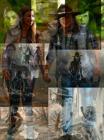
TheSOGGYwaffle, “I miss Carl so I made This for Him and Enid”. Collage of digital images. Digital. Fandom.com ( https://walkingdead.fandom.com/f/p/3343172654596352373)
The grief of the audience and the emotions of the characters begin to intertwine. Viewers project themselves into the characters' lives, experiencing a form of “diluted grief”. This loss generates sadness, desensitization, and anger-negative affects rooted in death and hate. End times education shapes subjectivity through real and symbolic violence and trauma, producing a negative and reactive form of Desire.
This mechanism operates between character and viewer, as the following example shows: upon learning of Carl’s death, Enid breaks down in a melodramatic scene (TWD, 2010).34 In the following episode (TWD, 2010),35 she and Michonne discuss his passing while standing guard at Hilltop. Enid reflects: “I killed Natania. She was out there trying to kill anyone she came across, and we came across her. So I killed her, and I'm alive, and Carl saved someone, and he's dead”. The detachment and desensitization felt by the character resonate deeply with the public. In a poll speculating on what Carl would have done had he survived, options range from the romantic to the comedic-such as “eating pudding” or “sneaking out of the house” (both inside jokes within the fandom). Suggestions alternate between romance and vengeance, as one fan argues: “He would either try to kill Negan obviously. But more snogging Enid” (Fandom, 2021).36 In another post, a fan summarizes the aforementioned process: “After Carl’s death, I didn’t even flinch when Rick disappeared” (Fandom, 2022).37
Most television programs revolve around conflicts that build audience expectations. When a protagonist is in danger, the audience-having performed the affective labor of identification and bonding-becomes anxious to learn their fate. In the traditional TV model, including much of what Mittel calls complex narrative, the audience inherently knows that the series cannot continue without certain characters, at least within the current season's arc. Consequently, the viewers' anxiety regarding their heroes' fates is mitigated; the audience knows the show must follow a certain formula.
Mittel (2015) posits that a hallmark of complex television is a shift from the mystery of what will happen to the pleasure of seeing how the narrative executes what it has already signaled-whether through ellipses or the audience’s prior knowledge of narrative mechanics and industry norms.
TWD evades this expectation of continuity. No one is safe; in practically every season, members of the central dramatic core are killed. Of the hundreds of characters who appear, only two from the original group survive through all the seasons (Daryl and Carol). The original Grimes family either dies or disappears. When a fan-favorite character enters a life-threatening situation, the audience cannot assume they will survive.
In this sense, the mechanism of identification/desensitization in TWD is more complex than in most other series, where knowledge of television norms interrupts the viewer's anguish. This mechanism allows the process of identification to reach a unique degree of commitment-one that is deeper and more realistic-that ironically can lead to desensitization.
Final remarks
For eleven years, Rick, Carl, and their companions fought hordes of zombies and other communities, engaging in massacres and dying in droves. However, as viewers, it’s impossible to remain unaffected by the tragic saga of the Grimes family. Rick sacrifices his values and humanity in order to save his family and fellow survivors, yet most of them still perish. The psychodramatic dynamic of the series generates a reactive image of Desire.
Education of the end-times erodes the conditions of possibility for any future, as the “capital persistently devours the very supports on which it relies” (Fraser, 2022, w/p). The competition between egoistic individuals, focused on the reproduction of their genes and communities in a world of increasingly scarce resources, contributes to the exhaustion of those resources and the subjugation of the “Other”. While the walkers initiated the apocalypse, it fell to the surviving communities to complete it-often by mobilizing the undead themselves as weapons of mass destruction.
The series unconsciously exposes how this form of “negative desire”-centered on consumption and the reproduction of the family and community-accelerates the collapse of the world rather than delaying it. Furthermore, the alternative of solidarity remains a diegetic impossibility, as every character who pursues that path ultimately perishes. The only viable choice is to enforce an end-times pedagogy: a necropedagogy. This desiring form, which traverses both the narrative diegesis and neoliberal economic discourse, promotes the reproduction of the very conditions that lead to the end of the world.
Negan’s discourse shows us the dark side of our collective unconscious, enunciating the truth that Rick and we, the audience, cannot accept: that in the end-times murder becomes a generalized strategy for population security and that, within economic logic, the misfortune of many justifies the fortune of a few, as anyone can attest in many regions of the world now where necropower manifests its logic. The rules of necropolitics-once localized in the colonies-become generalized in an apocalyptic world.
The pedagogy of the end-times comprises two complementary dimensions. On one hand, it describes how children are raised within their communities; this involves minimalist curricula centered on survival and combat skills alongside a limited set of cultural knowledge, such as language and basic artistic expression. There is also a moral pedagogy focused on guiding the choices and behavior of children, distinguishing between survival necessity, pragmatic morality, and “bare” human decency (even Negan adheres to certain principles, such as his refusal to kill the teenage Carl). Through a pedagogy of example, children learn from adults how to govern themselves and others to ensure survival. On the other hand, this pedagogy relates to the process of subjectivation and identification between the series and its audience. By breaking television conventions and subverting viewer expectations through the reiterated death of central characters, the narrative transforms the mechanism of identification, preparing the viewer for the urgency of the “end of time” while offering a set of materials to their subjectivity and identification process.
Both dimensions converge into a necropolitical pedagogy, which involves the universalization of the death drive and colonization techniques of governance. This apocalyptic approach to education is not merely a matter of science fiction; it is, in fact, an emerging reality expressed in transnational politics and the micropolitics of everyday life.
In the battle for survival between populations and nations, necropolitical governmental logic often takes the form of a fight for the survival of the fittest. Here lies the unfortunate irony: individual and sectarian survival strategies reproduce the subjective and objective conditions for an environmental, climatic, military, and sanitary cataclysms. On one hand, the use of resources becomes increasingly predatory and devastating; on the other, conflicts become almost inevitable as they are the product of the current political-subjective conditions.
References
- BOTTING, Fred. Zombie London: Unexceptionalities of the New World Order. In LAURO, Sarah J. Zombie Theory: A reader. Minneapolis: University of Minnesota Press, 2017. p. 277-293.
- CANAVAN, Gerry. “We are the Walking Dead”: Race, Time and Survival in Zombie Narrative. In LAURO, S. J. Zombie Theory: A reader. Minneapolis: University of Minnesota Press , 2017. p. 413-432.
- COHEN, Jeffrey. Monster theory; Reading Culture. Minneapolis: University of Minnesota Press, 1996.
- COMAROFF, Jean; COMAROFF, John. Alien-Nation: Zombie, immigrants and Millennial Capitalism. In LAURO, Sarah J. Zombie Theory: A reader. Minneapolis: University of Minnesota Press. 2017. p. 137-156.
- COMENTALE, Edward P. Zombie Race. In LAURO, Sarah J. Zombie Theory: A reader. Minneapolis: University of Minnesota Press, 2017. p. 189-211.
- DARDOT, Pierre; LAVAL, Christian. The new way of the world: on neoliberal society. London and New York: Verso, 2013.
- DELEUZE, Gilles. Logic of Sense. London: The Athlone Press. 1990.
- DELEUZE, Gilles; GUATTARI, Félix. Anti-Oedipus: Capitalism and schizophrenia. Minneapolis: University of Minnesota Press, 1983.
- DELEUZE, Gilles; GUATTARI, Félix. A Thousand Plateaus: Capitalism and schizophrenia. Minneapolis: University of Minnesota Press, 1987.
- DENDLE, Peter. The Zombie Movie Encyclopedia. North Carolina and London: McFarland & Company Inc and Publishers Jefferson, 2001.
-
FANDOM. The Walking Dead Wiki. A multi-platform for TWD Fans. 2026. Available at: https://walkingdead.fandom.com/wiki/The_Walking_Dead_Wiki Accessed at 12 de Janeiro de 2026.
» https://walkingdead.fandom.com/wiki/The_Walking_Dead_Wiki - FOUCAULT, Michel. The Birth of Biopolitics: Lectures at the Collège de France (1978-9). Houndmills: Palgrave MacMillan, 2008.
- FRASER, Nancy. Cannibal Capitalism. New York: Verso, 2022.
- GIL, José. Monstros. Lisboa: Quetzal Editores, 1994.
- GIROUX, Henry. Zombie politics and Culture in the age of casino capitalism. New York: Peter Lang Publishing, 2010.
- HUET, Marie-Hélène. Monstrous Imagination. London: Harvard University Press, 1993.
- GUATTARI, Félix. Cultura: um conceito reacionário? IN GUATTARI, Félix; ROLNICK, Sueli. Micropolítica: Cartografias do Desejo. Petrópolis: Vozes, 2013a. p. 15-24
- GUATTARI, Félix. Subjetividade e História. IN GUATTARI, Félix; ROLNICK, Sueli. Micropolítica: Cartografias do Desejo. Petrópolis: Vozes, 2013b. p. 25-126.
- HUYSSEN, Andreas. After the Great divide: Modernism, Mass Culture, Postmodernism. Bloomington and Indianapolis: Indiana University Press, 1986.
- KERCKHOVE, Derrick. The skin of culture. Investigating the new electronic reality. London: Kogan Page, 1997.
- LARSEN, Lars B. Zombies of Immaterial Labor: The Modern Monster and the Consumption of the Self. In LAURO, Sarah J. Zombie Theory: A reader. Minneapolis: University of Minnesota Press, 2017. p. 157-170.
- LAURO, Sarah J. Introduction: Wander and Wonder in Zombieland. In LAURO, Sarah J. Zombie Theory: A reader. Minneapolis: University of Minnesota Press, 2017. p. vii- xxiii.
- LAURO, Sarah J.; EMBRY, Karen. A Zombie Manifesto: The nonhuman Condition in the Era of Advanced Capitalism. In LAURO, Sarah J. Zombie Theory: A reader. Minneapolis: University of Minnesota Press , 2017. p. 395-412.
- LINNEMANN, Travis; WALL, Tyler; GREEN, Edward. The Walking Dead and Killing State: Zombification and the normalization of police violence. In LAURO, Sarah J. Zombie Theory: A reader. Minneapolis: University of Minnesota Press, 2017. p. 332- 351.
- MBEMBE, Achille. Necropolitics. Durham and London: Duke University Press, 2019.
- MCALISTER, Elizabeth. Slave, Cannibals, and Infected Hyper-Whites: The Race and Religion of Zombies. In LAURO, Sarah J. Zombie Theory: A reader. Minneapolis: University of Minnesota Press, 2017. p. 63-84.
- MITTEL, Jason. Complex TV: The poetics of Contemporary Television Storytelling. New York University Press, 2015.
- SHAVIRO, Steven. Contagious Allegories: George Romero. In LAURO, Sarah J. Zombie Theory: A reader. Minneapolis: University of Minnesota Press, 2017. p. 7-19.
- SIGURDSON, Ola. Slavoj Žižek, the death drive, and Zombies: A theological Account. In LAURO, Sarah J. Zombie Theory: A reader. Minneapolis: University of Minnesota Press, 2017. p. 85-101.
- SILVA, Tomaz Tadeu. Monstros, ciborgues e clones: os fantasmas da pedagogia Crítica. In SILVA, Tomaz Tadeu. A pedagogia dos monstros: os prazeres e os perigos da confusão de fronteiras. Belo Horizonte: Autêntica, 2000. p. 11-22.
- STRATTON, Jon. Trouble with Zombies: Mulsemänner, Bare life, and Displaced people. In Lauro, Sarah J. Zombie Theory: A reader. Minneapolis: University of Minnesota Press, 2017. p. 246-269.
- PEIXOTO Jr., Carlos Augusto. Sobre Corpos e Monstros: algumas reflexões contemporâneas a partir da filosofia da diferença. Psicologia em Estudo, Maringá, v. 15, n. 1, p. 179-187, jan./mar. 2010.
- VINT, Sherryl. Abject Posthumanism: Neoliberal, Biopolitics, and Zombies. In LAURO, Sarah J. Zombie Theory: A reader. Minneapolis: University of Minnesota Press, 2017. p.171-181.
-
THE WALKING DEAD (2010). Created by Frank Darabont. Produced by Frank Darabont, Robert Kirkman et al. New York: AMC. 2010. https://Netflix.com (Streaming)
» https://Netflix.com - THE WORLD Bank. Learning to realize education’s Promise. World Development Report. S/L. THE WORLD BANK Group, 2018.
- WEBB, Jen; BYRNAND, Samuel. Some Kind of Virus: The zombie body and as Trope. In LAURO, Sarah J. Zombie Theory: A reader. Minneapolis: University of Minnesota Press, 2017. p. 111-123.
- WEINSTOCK, Jeffrey. Zombie TV: Late-Night B MOvie Horror Fest. In LAURO, Sarah J. Zombie Theory: A reader. Minneapolis: University of Minnesota Press, 2017. p. 20-32.
1
2
3
4
5
6
7
8
9
10
11
12
13
14
15
16
17
18
19
20
21
22
23
24
25
26
27
28
29
30
31
32
33
34
35
36
37
Data Availability Statement:
The underlying content of the research text is contained within the manuscript.