 Efficiency of tropical maize genotypes in association with Azospirillum brasilense for grain yield
ABSTRACT.
The use of nitrogen fertilizers in maize crops must be reduced, and a potential alternative is the use of diazotrophic bacteria of the genus Azospirillum. This research aims to characterize the efficiency of the association with Azospirillum brasilense (Az) among maize genotypes on grain yield. Forty-eight experimental single-cross maize hybrids obtained from the cross in a partial diallel scheme between eight and six inbred lines were used. The maize hybrids were evaluated in seven environments, considering the grain yield (GY) without nitrogen (N) topdressing and without Az inoculation, GY with N topdressing and without Az inoculation, GY without N topdressing but with Az inoculation, and the efficiency to Az. The hybrids’ GY varied in the presence of Az, indicating a differential response to the bacteria and confirming that this association enables the selection of more efficient genotypes since some hybrids maintained similar yield levels when N topdressing was replaced by Az inoculation. Low or medium correlation estimates were obtained among the considered traits, indicating a low correspondence between yields under the different conditions and between yields and the efficiency of the association with Az, suggesting that indirect selection for these traits is not efficient. These results indicate that it is possible to select the most efficient maize genotypes.
Keywords:
Zea mays L.; diazotrophic bacteria; nitrogen; variability; selection; breeding.
Introduction
The increasing world population implies an increasing demand for food, requiring farmers to continually increase crop yield. One of the most fascinating challenges for agriculture in the coming years is sustainable food production to meet the growing population demand since available resources are limited. Maize crops (Zea mays L.) are of great economic and societal importance, as it is the third species in terms of planted area and the first in yield throughout the world and in Brazil (Companhia Nacional de Abastecimento [CONAB], 2024). High-yield maize crops have a high demand for nitrogen fertilizers, which are used on a large scale and normally supplied as chemical fertilizers (Ye et al., 2022). This practice increases production costs and can cause environmental problems (Liu et al., 2020; Martins et al., 2015; Sá et al., 2017). Alternatives for rationalizing and raising awareness of the use of nitrogen fertilizers in maize crops are a necessity, and among these, we highlight the use of microorganisms that are beneficial to plants, such as diazotrophic bacteria of the genus Azospirillum, which when associated with the roots of plants of the Poaceae family can promote plant growth and biological nitrogen fixation (Carvalho et al., 2023; Hungria, 2011). In maize, these bacteria increase yield and provide benefits (Araújo et al., 2023; Pereira et al., 2015).
Inoculating maize and other grass crops with Azospirillum spp. has increased yield (Buzinaro et al., 2018; Vidotti et al., 2019) and improved several genetic traits (Pereira et al., 2015; Silva et al., 2024). These bacteria produce growth hormones, such as auxins, gibberellins, and cytokinins (Hungria, 2011), and perform biological nitrogen fixation (Carvalho et al., 2023; Hungria, 2011; Szilagyi Zecchin et al., 2017), reducing the need for nitrogen fertilization in maize genotypes that are responsive to inoculation.
The literature suggests that successful inoculation is directly related to the specificity of the interaction between plant species or genotype and the bacterial species or strain (Buzinaro et al., 2018; Espindula & Passaglia, 2024; Hungria, 2011). Several studies have reported the differential response of maize genotypes to different bacterial strains, and in some cases, the association was so efficient that nitrogen fertilization was partially replaced by inoculation with Azospirillum spp. (Buzinaro et al., 2018; Carvalho et al., 2023; Hungria, 2011; Pereira et al., 2015). Thus, identifying and selecting maize genotypes that more efficiently associate with Azospirillum brasilense while also enhancing the response of maize plants (Espindula & Passaglia, 2024) should enable farmers to reduce nitrogen use in this crop.
Knowledge of the variability in the efficiency of the association between maize and Azospirillum brasilense should enable breeders to select and design specific breeding programs to develop maize genotypes with a more efficient association. The availability of such genotypes responsive to Azospirillum brasilense and their adoption by farmers will contribute to sustainable agriculture, significantly reducing environmental problems related to nitrogen and high production costs.
This work aims to verify the differences in the efficiency of the association with Azospirillum brasilense among tropical maize genotypes and the relationship with grain yield.
Material and methods
Genetic material
Forty-eight experimental single-cross maize hybrids were obtained by partial diallel crossing between eight and six inbred lines (S6) extracted from synthetics IG-3 and IG-4, respectively. Synthetics IG-3 and IG-4 were obtained from a reciprocal recurrent selection program applied to populations BR-105 and BR-106, which belong to distinct heterotic groups and are represented by A and B, respectively. Table 1 shows the genealogy of the hybrids obtained from the Maize Breeding Program of the Genetics Department at Luiz de Queiroz College of Agriculture/University of São Paulo, São Paulo State, Brazil (ESALQ/USP) that were used in the trials.
Experimental procedure
The 48 experimental and 1 commercial (DKB 390) single-cross hybrids were evaluated at different sowing times during two crop seasons at the Sertãozinho Experimental Station and the Genetics Department, both at the University of São Paulo, Luiz de Queiroz College of Agriculture in Piracicaba, São Paulo State, Brazil and the Teaching, Research and Extension Farm of the São Paulo University, School of Agricultural and Veterinarian Sciences in Jaboticabal, São Paulo State, Brazil. Each combination of crop season × site × sowing date was considered a distinct environment, totaling seven evaluation environments, as shown in Table 2.
Three experiments were installed at the same site for each environment: (i) without nitrogen topdressing and without Azospirillum brasilense inoculation; (ii) with nitrogen topdressing and without Azospirillum brasilense inoculation; and (iii) without nitrogen topdressing and with Azospirillum brasilense inoculation. In all trials, conventional soil preparation consisted and basal fertilization following the requirements and recommendations of each environment. In the nitrogen topdressing trial, urea was applied at a rate of 170 kg of N ha-1, when the plants were at the V3-V5 developmental stage. Qualyfix Gramíneas (mix of the Abv-5 and Abv-6 strains of Azospirillum brasilense) was applied to the soil at a rate of 600 mL ha−1 during the V3-V5 plant developmental stages. All other crop practices and treatments were similarly conducted across all three experiments, following the technical recommendations for each environment, with supplementary irrigation used only at the Genetics Department of the Experimental Station.
Each trial consisted of a 7×7 lattice design with two replications. Each plot consisted of a 4.0-m long row spaced out 0.80 m between rows and 0.20 m between plants, leaving 20 plants after thinning and representing a population of 62,500 plants ha−1. In the plots, the following traits were evaluated: grain weight, by threshing and weighing the grains of the harvested ears; plant stand, given as the number of plants in the plot at harvest; and grain moisture at harvest. For statistical analyses, the grain yield was obtained in each plot by correcting the grain weight to 13% moisture, and the average stand was determined by the covariance and conversion to t ha−1. After obtaining the grain yield for each plot in the trials, the following traits were considered: grain yield without topdressing nitrogen and without Azospirillum brasilense inoculation (-Az-N); grain yield with topdressing nitrogen and without Azospirillum brasilense inoculation (-Az+N); and grain yield without N topdressing and with Azospirillum brasilense inoculation (+Az-N); and the efficiency of the association with Azospirillum brasilense (EAz), which was determined using the following expression, adapted from Parentoni et al. (2011): EAz = [(+Az ( N)2]/[((Az ( N) x ((Az + N)].
Statistical analysis
All statistical analyses were performed using SAS software 8.2. The data were used to calculate the individual variance for each environment, following the lattice design and considering the hybrids as fixed effects. After the adjusted means were obtained in the individual analysis, joint variance analyses were performed, considering the hybrids as a fixed effect and the environments as a random effect. To perform joint variance analysis, the adjusted means of the commercial hybrid, used to complete the 7×7 lattice treatments, were not used. The mean effective error of the joint analysis was obtained by averaging the effective errors of the individual analyses for each trait since the joint analyses were performed with the adjusted means of the individual analyses.
To identify differences in trait means in the individual and joint variance analyses, the t-test was used to compare the following: +Az ( N= (Az ( N; +Az ( N= (Az + N; EAz = 0; and EAz = 1. Additionally, considering the means of EAz and +Az ( N, the methodology adapted from Fageria and Kluthcouski (1980) was used to classify the genotypes according to their Azospirillum brasilense response and efficiency.
Covariance analyses were performed between the analyzed traits and the genetic and phenotypic correlation coefficients between these traits using the adjusted means of individual analyses. The t-test was used to verify the significance of the correlation estimates, and the methodologies of Falconer and Mackay (1996) were used to estimate the standard errors of the phenotypic and genetic correlations.
Results and discussion
In the joint analysis of variance, the F test was significant for the following variation sources: environments, hybrids, and for the interaction of hybrids with environments for all traits considered ((Table 3). This indicates variability among the studied environments, with at least one of the hybrids differing from the others and the responses of the hybrids varying among the studied environments.
Based on the coefficient of variation of grain yield, the lowest value was recorded for -Az-N (11.76%), followed by +Az-N (13.56%), and the highest value was observed for -Az+N (16.69%). Beyond the variation in the mean effective errors, this difference may have occurred due to the different average yields obtained in the trials (7.45, 6.69, and 6.31 t ha−1) (Table 3). The obtained coefficients of variation were within the ideal values for experiments with maize, except for that obtained for the efficiency of Azospirillum brasilense (Fritsche Neto et al., 2012). The highest coefficient of variation (45.78%) determined for efficiency was likely determined due to the grouping of information from the other three traits, thus accumulating the errors from these individual traits, and the low mean (1.14) (Falconer & Mackay, 1996).
As the assessment environments were random, used to increase the precision of the trait estimates, and thus, not reproducible, the means obtained in the joint analysis are presented and discussed disregarding the specificities that may have occurred in each studied environment (Falconer & Mackay, 1996).
Although the general grain yield means were not significantly different, as indicated by the overlapping confidence intervals (Falconer & Mackay, 1996), we verified that yield was 6% higher after Azospirillum inoculation compared to the group without inoculation or topdressing and 11% lower compared to the group with nitrogen topdressing. The group with just topdressing was 18% higher than that without inoculation or topdressing (Table 3). These results reveal the beneficial effect of the microorganism on maize yield, as presented in the literature (Buzinaro et al., 2018; Hungria, 2011; Koltun et al., 2018; Oliveira et al., 2017; Revolti et al., 2018; Silva et al., 2024), suggesting that nitrogen fertilization can be partially replaced with inoculation. The varying efficiency range of the hybrids observed in association with Azospirillum suggests a differential response to the presence of the bacteria (Table 3), confirming that more efficient genotypes can be selected in this association (Buzinaro et al., 2018; Espindula & Passaglia, 2024; Hungria, 2011; Koltun et al., 2018; Pereira et al., 2015; Vidotti et al., 2019).
Degrees of freedom (DL), mean squares with respective significances, general mean with variation intervals (VI) and confidence intervals (CI), and coefficient of variation (CV%) of the joint variance analysis of the experimental maize hybrids for grain yields and efficiency to Azospirillum brasilense.
The averages obtained in the joint analyses confirmed that the hybrids differed in their responses to Azospirillum brasilense since the hybrids maintained similar yields when nitrogen topdressing was replaced by inoculation with the bacteria (Table 4). The obtained average yield enabled us to identify hybrids that presented significant differences between -Az-N and +Az-N and a higher average +Az-N according to the t-test as ideal. Alternatively, the comparison between +Az-N and -Az+N must not be significant, or when significant, the average +Az-N must be higher. This indicates that the hybrid response to inoculation with Azospirillum brasilense increased yield compared to the control and that this increase was maintained or increased when nitrogen topdressing was replaced with inoculation.
Approximately 19% of the evaluated hybrids responded positively to the bacteria (Hybrids 02, 04, 08, 13, 26, 30, 32, 34, and 48). Representing approximately 10% of the hybrids evaluated, hybrids 01, 06, 11, 12, and 36 are promising since their yield increased with inoculation, albeit lower than the yield observed with nitrogen topdressing. For the other studied hybrids, Azospirillum brasilense inoculation did not increase yield when comparing the trials without inoculation or nitrogen topdressing (Table 4). These results indicate that approximately 30% of the evaluated hybrids can be selected for use as efficient genotypes in association with the bacteria (Buzinaro et al., 2018; Pereira et al., 2015; Revolti et al., 2018; Takahashi et al., 2024; Vidotti et al., 2019).
For the efficiency of the association with Azospirillum brasilense (EAz), 13 of the 14 selected hybrids were characterized as efficient based on their yield, whereas only hybrid 06 was not discriminated by this trait (Table 4). This suggests that the adapted expression from Parentoni et al. (2011) has good accuracy for selecting efficient hybrids. Selection for efficiency added 17 hybrids to the 13 hybrids already selected for grain yield, totaling 30 efficient hybrids, representing 62.5% of the total. Therefore, different efficiencies were observed in the association of maize genotypes with Azospirillum brasilense, supporting the feasibility of selecting the most efficient genotypes for this association (Buzinaro et al., 2018; Espindula & Passaglia, 2024; Hungria, 2011; Koltun et al., 2018; Pereira et al., 2015; Revolti et al., 2018; Takahashi et al., 2024; Vidotti et al., 2019).
Although no hybrid presented efficiency greater than one based on the means of the joint analysis, this occurred considering the means of the environments individually (data not shown), indicating that the efficient association with the microorganism is shown in specific environments and affected by the environment. Several studies have shown that the response to Azospirillum brasilense is better under stress or environmental limitations, thus explaining, for example, the more developed root system observed in the plants inoculated with the bacteria (Araújo et al., 2023; Carvalho et al., 2023; Coelho et al., 2017; Guidinelle et al., 2024; Zeffa et al., 2018; Zhao et al., 2023).
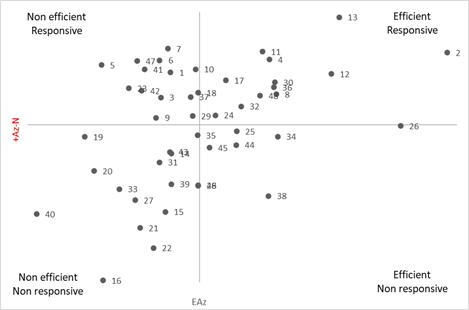
Based on the Fageria and Kluthcouski (1980) methodology, the set of hybrids evaluated was discriminated in all possible situations, with hybrids allocated in all four quadrants of the graph (Figure 1). Of the evaluated hybrids, 25% were classified as ideal and responsive to the bacteria since Azospirillum brasilense was effectively used. Therefore, these genotypes should be prioritized in breeding programs seeking to increase efficiency in association with this microorganism. Furthermore, 12.5% of the genotypes evaluated were efficient but non-responsive hybrids, whereas 29% were characterized as responsive but not efficient. Although not ideal, these hybrids can also be useful in breeding programs and contribute to obtaining genotypes that are efficient to Azospirillum brasilense. Of the hybrids, 33% were grouped in the quadrant containing non-efficient and non-responsive genotypes; these should be discarded from breeding programs in association with the bacteria, as they do not contribute to increasing efficiency.
This strategy, adapted from Fageria and Kluthcouski (1980), complements the information on genotypes that differ regarding efficiency and responsiveness to Azospirillum brasilense, suggesting the possibility of obtaining and selecting maize genotypes that are both efficient in this association and responsive to the bacteria (Buzinaro et al., 2018; Espindula & Passaglia, 2024; Takahashi et al., 2024; Vidotti et al., 2019). Additionally, most of the evaluated hybrids are of interest for breeding programs designed to develop genotypes that are efficient in association with the microorganism, as approximately 67% of these hybrids were characterized, at least, as efficient or responsive.

Classification of maize genotypes regarding efficiency and responsiveness to Azospirillum brasilense using the methodology adapted from Fageria and Kluthcouski (1980).
Except for the phenotypic and genetic correlations between -Az+N and the efficiency to Azospirillum brasilense and the genetic correlation between -Az-N and EAz, all other estimates were significant. The phenotypic correlation coefficients ranged from −0.36 (-Az-N and EAz) to 0.66 (+Az-N and -Az+N), while the genetic correlation coefficients varied from 0.52 (+Az-N and EAz) to 1.00 (-Az-N and -Az+N) (Table 5). Most of the values estimated for the significant phenotypic correlations were either low or medium, without biological significance, indicating little correspondence between the yields under the different conditions (nitrogen topdressing, inoculation with Azospirillum brasilense, and without topdressing or inoculation) or the yields with the efficiency of the association with the microorganism. The low correlation shows a lack of association between the traits considered, indicating that indirect selection is not efficient (Falconer & Mackay, 1996).
The low correspondence between the superior genotypes selected for the traits, especially when considering a higher selection intensity, confirmed the low efficiency of indirect selection (Table 6), and selection should be prioritized for each trait (yield with Azospirillum brasilense inoculation or the efficiency of the association with the bacteria itself) to maximize the yield gain in breeding programs. Although yield coincidences of up to 50% were found for a 20% selection intensity, a lower correspondence was observed when considering the coincidence of selection for yield with the efficiency of Azospirillum brasilense, thus suggesting that the selection of the most efficient genotypes directly on efficiency itself would lead to greater gains (Falconer & Mackay, 1996).
However, these research results and those available in the literature indicate a beneficial association between Azospirillum brasilense and maize, making it possible to reduce the reliance on nitrogen fertilization in maize crops while still maintaining acceptable yield levels (Buzinaro et al., 2018; Carvalho et al., 2023; Hungria, 2011; Koltun et al., 2018; Oliveira et al., 2017; Revolti et al., 2018; Silva et al., 2024).
More efficient genotypes should be selected from the initial phases of the breeding programs to increase the efficiency of maize genotypes inoculated with Azospirillum brasilense since it has been shown that this association varies and depends on the genotype. This initial selection discards less efficient genotypes and keeps only efficient genotypes in the breeding program. Several cycles of selection and recombination of efficient genotypes should enable the retention of populations with this trait, namely high efficiency when associated with the bacteria. Subsequently, efficient genotypes can be developed and made available to farmers, thus reducing nitrogen fertilization in maize crops, contributing to sustainable agriculture, and significantly reducing environmental problems and the costs related to nitrogen use.
Conclusion
The maize genotypes evaluated differ regarding grain yield and efficiency associated with the bacteria when using topdressing and Azospirillum brasilense inoculation. The efficiency of the association between maize and Azospirillum brasilense can be improved through selection, and designing breeding programs to develop genotypes that are efficient in this association could have benefits for maize crops and agriculture in general.
Data availability
The data used in the research can be requested by email from the corresponding author.
Acknowledgements
This research was supported by the National Council for Scientific and Technological Development (CNPq) and the Coordination for the Improvement of Higher Education Personnel (CAPES)
References
-
Araújo, V. L. V. P., Fracetto, G. G. M., Silva, A. M. M., Pereira, A. P. A., Freitas, C. C. G., Barros, F. M. R., Santana, M. C., Feiler, H. P., Matteoli, F. P., Fracetto, F. J. C. & Cardoso, E. J. B. N.. (2023). Potential of growth-promoting bacteria in maize (Zea mays L. ) varies according to soil moisture. Microbiological Research, 271, 1-11. https://doi.org/10.1016/j.micres.2023.127352
» https://doi.org/https://doi.org/10.1016/j.micres.2023.127352 -
Buzinaro, R., Oliveira, G. H. F., Amaral, C. B., Souza Júnior, C. L. & Moro, G. V.. (2018). Diallel mixed-model analyses to select superior maize parental lines for Azospirillum brasilense and nitrogen-use efficiency. Crop Breeding and Applied Biotechnology, 18(4), 382-389. http://dx.doi.org/10.1590/1984-70332018v18n4a57
» https://doi.org/http://dx.doi.org/10.1590/1984-70332018v18n4a57 -
Carvalho, A. D., Alves, G. C., Alves, B. J. R., Santos, L. A. & Reis, V. M.. (2023). Root development and nitrogen acquisition of maize inoculated with two species of diazotrophs. Bragantia, 82, 1-13. https://doi.org/10.1590/1678-4499.20230060
» https://doi.org/https://doi.org/10.1590/1678-4499.20230060 -
Coelho, A. E., Tochetto, C., Turek, T. L., Michelon, L. H. & Fioreze, S. L.. (2017). Inoculação de sementes com Azospirillum brasilense em plantas de milho submetidas à restrição hídrica. Scientia Agraria Paranaensis, 16(1), 186-192. http://dx.doi.org/10.18188/1983-1471/sap.v16n1p186-192
» https://doi.org/http://dx.doi.org/10.18188/1983-1471/sap.v16n1p186-192 -
Companhia Nacional de Abastecimento. (2024). Acompanhamento da Safra Brasileira Grãos. CONAB. https://www.conab.gov.br/info-agro/safras/graos/boletim-da-safra-de-graos
» https://www.conab.gov.br/info-agro/safras/graos/boletim-da-safra-de-graos -
Espindula, E. & Passaglia, L. M. P.. (2024). Maize - Azospirillum brasilense interaction: accessing maize’s miRNA expression under the effect of an inhibitor of indole‑3‑acetic acid production by the plant. Brazilian Journal of Microbiology, 55(1), 101-109. https://doi.org/10.1007/s42770-023-01236-3
» https://doi.org/https://doi.org/10.1007/s42770-023-01236-3 - Fageria, N. D. & Kluthcouski, J. (1980). Metodologia para avaliação de cultivares de arroz e feijão para condições adversas de solo. Embrapa.
- Falconer, D. S. & Mackay, T. F. C. (1996). Introduction to quantitative genetics (4th ed.). Longman.
-
Fritsche Neto, R., Vieira, R. A., Scapim, C. A., Miranda, G. V. & Rezende, L. M.. (2012). Updating the ranking of the coefficients of variation from maize experiments. Acta Scientiarum. Agronomy, 34(1), 389-395. https://doi.org/10.4025/actasciagron.v34i1.13115
» https://doi.org/https://doi.org/10.4025/actasciagron.v34i1.13115 -
Guidinelle, R. B., Burak, D. L., Rangel, O. J. P., Peçanha, A. L., Passos, R. R., Rocha, L. O., Olivares, F. L. & Mendonça, E. S.. (2024). Impact of historical soil management on the interaction of plant-growth-promoting bacteria with maize (Zea mays L.). Heliyon, 10(7), 1-15. https://doi.org/10.1016/j.heliyon.2024.e28754
» https://doi.org/https://doi.org/10.1016/j.heliyon.2024.e28754 - Hungria, M. (2011). Inoculação com Azospirillum brasilense: inovação em rendimento a baixo custo. Embrapa Soja.
-
Koltun, A., Cavalcante, A. P., Lopes, K. B. A., Krause, M. D., Marino, T. P., Oliveira, A. L. M. & Ferreira, J. M.. (2018). Performance of maize hybrids from a partial diallel in association with Azospirillum. African Journal of Agricultural Research, 13(25), 1297-1305. https://doi.org/10.5897/AJAR2018.13077
» https://doi.org/https://doi.org/10.5897/AJAR2018.13077 -
Liu, M., Zhang, W., Wang, X., Wang, F., Dong, W., Hu, C., Liu, B. & Sun, R.. (2020). Nitrogen leaching greatly impacts bacterial community and denitrifiers abundance in subsoil under long-term fertilization. Agriculture, Ecosystems & Environment, 294, 106885. https://doi.org/10.1016/j.agee.2020.106885
» https://doi.org/https://doi.org/10.1016/j.agee.2020.106885 -
Martins, M. R., Jantalia, C. P., Polidoro, J. C., Batista, J. N., Alves, B. J. R., Boddey, R. M. & Urquiaga, S.. (2015). Nitrous oxide and ammonia emissions from N fertilization of maize crop under no-till in a Cerrado soil. Soil and Tillage Research, 151, 75-81. https://doi.org/10.1016/j.still.2015.03.004
» https://doi.org/https://doi.org/10.1016/j.still.2015.03.004 -
Oliveira, A. L. M., Santos, O. J. A. P., Marcelino, P. R. F., Milani, K. M. L., Zuluaga, M. Y. A., Zucareli, C. & Gonçalves, L. S. A.. (2017). Maize inoculation with Azospirillum brasilense Ab-V5 cells enriched with exopolysaccharides and polyhydroxybutyrate results in high productivity under low N fertilizer input. Frontiers in Microbiology, 8, 1-18. https://doi.org/10.3389/fmicb.2017.01873
» https://doi.org/https://doi.org/10.3389/fmicb.2017.01873 - Parentoni, S. N., Mendes, F. F. & Guimarães, L. J. M. (2011). Melhoramento para eficiência no uso de fósforo. In R. Fritsche Neto & A. Borém (Eds.), Melhoramento de plantas para condições de estresses abióticos. (pp. 101-126). Editora UFV.
-
Pereira, L. M., Pereira, E. M., Revolti, L. T. M., Zingaretti, S. M. & Môro, G. V.. (2015). Seed quality, chlorophyll content index and leaf nitrogen levels in maize inoculated with Azospirillum brasilense. Revista Ciência Agronômica, 46(3), 630-637. http://doi.org/10.5935/1806-6690.20150047
» https://doi.org/http://doi.org/10.5935/1806-6690.20150047 -
Revolti, L. T. M., Caprio, C. H., Mingotte, F. L. C. & Môro, G. V.. (2018). Azospirillum spp. potential for maize growth and yield. African Journal of Biotechnology, 17(18), 574-585. https://doi.org/10.5897/AJB2017.16333
» https://doi.org/https://doi.org/10.5897/AJB2017.16333 -
Sá, J. C. M., Lal, R., Cerri, C. C., Lorenz, K., Hungria, M. & Carvalho, P. C. F.. (2017). Low-carbon agriculture in South America to mitigate global climate change and advance food security. Environment International, 98, 102-112. https://doi.org/10.1016/j.envint.2016.10.020
» https://doi.org/https://doi.org/10.1016/j.envint.2016.10.020 -
Silva, P. S. T., Garcia, N. S., Galindo, F. S., Arf, O., Nogueira, T. A. R., Jani, A. D. & Cassiolato, A. M. R.. (2024). Azospirillum brasilense inoculation in a Maize-Urochloa-Rice cropping system promotes soil chemical and biological changes and increases productivity. Crops, 4(2), 211-226. https://doi.org/10.3390/crops4020016
» https://doi.org/https://doi.org/10.3390/crops4020016 -
Szilagyi Zecchin, V. J., Marriel, I. E. & Silva, P. R. F.. (2017). Produtividade de milho inoculado com Azospirillum brasilense em diferentes doses de nitrogênio cultivado em campo no Brasil. Revista de Ciências Agrárias, 40(4), 795-798. http://doi.org/10.19084/RCA17142
» https://doi.org/http://doi.org/10.19084/RCA17142 -
Takahashi, W. Y., Galvão, C. W., Cassán, F. D., Urrea-Valencia, S., Stremel, A. C., Stets, M. I., Kremer, M. A. S., Jesus, E. C. & Etto, R. M.. (2024). Tracking maize colonization and growth promotion by Azospirillum reveals strain-specific behavior and the influence of inoculation method. Plant Physiology and Biochemistry, 215, 1-6. https://doi.org/10.1016/j.plaphy.2024.108979
» https://doi.org/https://doi.org/10.1016/j.plaphy.2024.108979 -
Vidotti, M. S., Matias, F. I., Alves, F. C., Pérez-Rodríguez, P., Beltran, G. A., Burgueño, J., Crossa, J. & Fritsche-Neto, R.. (2019). Maize responsiveness to Azospirillum brasilense: Insights into genetic control, heterosis and genomic prediction. PLoS ONE, 14(6), 1-22. https://doi.org/10.1371/journal.pone.0217571
» https://doi.org/https://doi.org/10.1371/journal.pone.0217571 -
Ye, J. Y., Tian, W. H. & Jin, C. W.. (2022). Nitrogen in plants: from nutrition to the modulation of abiotic stress adaptation. Stress Biology, 2(4), 1-14. https://doi.org/10.1007/s44154-021-00030-1
» https://doi.org/https://doi.org/10.1007/s44154-021-00030-1 -
Zeffa, D. M., Fantin, L. H., Santos, O. J. A. P., Oliveira, A. L. M., Canteri, M. G., Scapim, C. A. & Gonçalves, L. S. A.. (2018). The influence of topdressing nitrogen on Azospirillum spp. inoculation in maize crops through meta-analysis. Bragantia, 77(3), 493-500. http://doi.org/10.1590/1678-4499.2017273
» https://doi.org/http://doi.org/10.1590/1678-4499.2017273 -
Zhao, H., Sun, N., Huang, L., Qian, R., Lin, X., Sun, C. & Zhu, Y.. (2023). Azospirillum brasilense activates peroxidase-mediated cell wall modification to inhibit root cell elongation. iScience, 26(7), 1-19. https://doi.org/10.1016/j.isci.2023.107144
» https://doi.org/https://doi.org/10.1016/j.isci.2023.107144
Edited by
-
Associate Editor in charge:
Alessandro Lucca BracciniCarlos Alberto Scapim