 Environmental factors and their influence on the period and occurrence of vegetative and reproductive phenological events in Hymenaea martiana Hayne
ABSTRACT.
Phenological studies are fundamental for species management and conservation and support research into genetic improvement by providing insights into plant life cycles and their relationship with phenophases and environmental conditions. This study aimed to determine the environmental variables and their influence on the vegetative and reproductive phenological patterns of Hymenaea martiana Hayne. Field observations were carried out in five areas located in the municipality of Areia, Paraíba State, Brazil. Between May 2021 and April 2023, the phenological events of budding, senescence, flower bud, flowering, and fruiting were assessed every 30 days. Statistical analyses were circular to verify the occurrence of the phenophase periods, their concentration, seasonality, and duration, and Spearman correlations were used to test the relationships between meteorological variables during the period and the phenophases. The patterns of budding, senescence, flower bud, and flowering phenophases of H. martiana were seasonal, with an annual periodicity and a continuous fruiting pattern. The average dates of occurrence of the budding phenophase were August (area 2), October (areas 1, 4, and 5), and November (area 3). The average date for senescence was July (area 2) and August (areas 1 and 3-5). The average date for the flower bud phase was November (area 5) and December (areas 1-4). Flowering occurred in January (areas 3 and 4), March (area 2), and December (areas 1 and 5). Rainfall and temperature had a significant impact on the period and occurrence of vegetative and reproductive phenological events in H. martiana. Under highland marsh conditions, H. martiana fruit should be collected in October, November, and December.
Keywords:
circular statistics; environmental variables; phenology
Introduction
In recent years, plant resource management policies have changed significantly due to the social and environmental impacts of agricultural models focused on economic purposes (Afifah et al., 2022), resulting in biodiversity loss, soil and water contamination, deforestation, fires, rural exodus, and the disruption of productive arrangements (Costa et al., 2021). In addition, they jeopardize food security, intensify water scarcity, accelerate soil erosion, and increase greenhouse gas emissions, aggravating global warming (Gabardo et al., 2020). Deforestation and forest fragmentation reduce ecosystem services, threaten biodiversity, and impact genetic variability and gene flow (Shimamoto et al., 2018). The conversion of natural forests to agricultural crops and pastures and the burning of fossil fuels are the main drivers of climate change (Brancalion et al., 2016).
Due to anthropogenic activities, Hymenaea martiana Hayne has been included as low concern on the red conservation list of the IUCN (2024) and the National Center for the Conservation of Flora CNCFlora (2024). This species native to northeastern Brazil is secondary, heliophytic, and hygrophytic, grows in humid floodplains with clay soils, and can reach a height of 8-18 m. It produces a dense wood that is used in construction (Lorenzi, 2009; Silva et al., 2024). In traditional medicine, H. martiana is used to treat inflammation, infections, rheumatism, and anemia due to the presence of bioactive compounds with therapeutic potential (Borges et al., 2022; Menezes Filho et al., 2020; Oliveira et al., 2018; Silva & Lamarca, 2018; Tiago et al., 2019; 2020).
Phenological studies are essential for species management and conservation, providing an understanding of their life cycles and relationships with environmental conditions (Afifah et al., 2022). Despite the scientific and economic relevance of phenological research, there are few studies on the subject (Brito Neto et al., 2018; Morellato et al., 2016; Singh et al., 2017; Tres et al., 2020). Therefore, phenology is crucial for assessing the vegetative and reproductive events of H. martiana, and it is essential for determining the influence of climatic variables, such as temperature, humidity, and rainfall, on forest management and conservation (Afifah et al., 2022). This knowledge makes it possible to assess the impacts of environmental changes on species growth and plant community dynamics (Correa-Lima et al., 2019). It also aids in forest management, optimizing the production of wood and other resources without compromising sustainability and biodiversity (Souza et al., 2025). Thus, this study aimed to evaluate environmental variables and their influence on the vegetative and reproductive phenological patterns of H. martiana.
Material and methods
Characterization of the areas
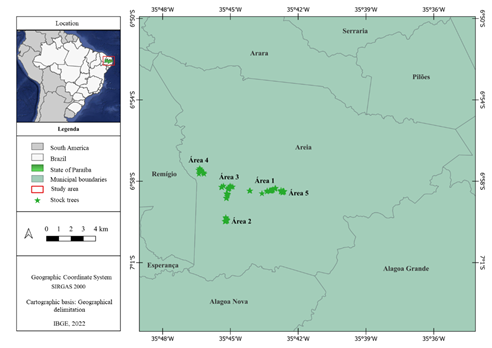
This study was conducted in five areas in the municipality of Areia, Paraíba State, Brazil (06°57'30" S, 35°45'33.8" W, altitude 560 m), located in the geo-environmental unit of the Borborema Plateau, situated in the Brejo paraibano micro-region, which is part of the Agreste paraibano meso-region (Nascimento et al., 2019) (Figure 1).

According to the Köppen-Geiger classification, the region’s climate is BSh (hot semi-arid) (Climatedata, 2023) with annual rainfall and average temperatures of 1,500 mm and 23°C, respectively, with a rainy season from January to September and a dry season from October to December (Alvares et al., 2013).
The municipality of Areia at an altitude of more than 600 m above sea level, and its topography is characterized by a rugged configuration, with a predominance of valleys, abrupt slopes, and steep hills (Santos et al., 2009). The relief of the region is classified as undulating (with slopes of 8-20%) to strongly undulating (with slopes of 20-45%), according to Embrapa (2013).
Area 1 is characterized by a group of highlands, among which there are flattened zones with vast erosive surfaces. The native vegetation in this study area is highly degraded, especially near urban areas, with few traces remaining of the original plant cover that once blanketed the municipality.
Area 2 is characterized by a strongly undulating relief and consists of a high-altitude Atlantic Forest reserve, which protects the catchment area of the Vaca Brava dam, Paraíba State, Brazil. The weathered areas have Argisol and Cambisol soils, with the beginnings of Latossols in higher regions and Fluvic Neosols near the water (Silva et al., 2005).
In area 3, an undulating relief predominates, with slopes accounting for 82% (Santos et al., 2009), featuring typical characteristics of the Brejos de Altitude of the Northeast, which are enclaves in the Atlantic Forest biome, located in regions with a higher altitude and humidity compared to the matrix of xerophilous vegetation, predominantly the Caatinga (Cavalcanti & Tabarelli, 2004). The distinctive humidity of this region is due to the orographic effect, contributing to increased rainfall and reduced temperatures (Tavares et al., 2000).
In area 4, the predominant activity is livestock grazing, followed by subsistence agriculture, which includes the cultivation of corn, bean, and cassava. The soils show evidence of physical degradation, indicating possible impacts from agricultural and livestock practices.
Area 5 is marked by intense anthropogenic occupation, resulting in significant forest degradation and reduced plant cover. Degradation has culminated in the formation of a fragmented landscape, composed of forest remnants surrounded by pastures, urban areas, agricultural zones, roads, and other land uses induced by humans.
Selection of H. martiana mother trees
Field observations were conducted by monitoring 21 H. martiana individuals in each of the five studied areas, totaling 105 randomly selected individuals (Gomes et al., 2008; Rocha et al., 2015). The specimens were spaced at least 8 m apart, marked with TNT tape, and identified with spray paint.
The selection of mother trees considered the following criteria: apparent absence of diseases, parasite infestations, and a fully visible crown. In addition, the mother plants were georeferenced using a Global Positioning System (GPS) to make it easier to locate them in the study areas.
Phenological characteristics of H. martiana
For 24 months, between May 2021 and April 2023, the phenological events of H. martiana were observed every 30 days for the vegetative and reproductive phases using binoculars (Sakura JF 10x-90x80 model).
During each visit, the following phenophases were assessed in H. martiana: budding - characterized by the emission of new leaves; floral bud - period between the appearance of floral structures until the moment before anthesis; flowering - period when the plant has flowers during anthesis; fruiting - recorded with the appearance of the fruit after flower, considered when fruit is green and ripe; senescence - characterized by leaf fall, determined on the basis of defoliated branches (Amorim et al., 2009).
Evaluation of phenological events in H. martiana
The semi-quantitative interval scale of five categories (0-4) proposed by Fournier (1974) was used to estimate the intensity of each phenophase in H. martiana: 0 represents the absence of the phenophase; 1 represents the presence of the phenophase with a magnitude between 1 and 25%; 2 represents the presence of the phenophase with a magnitude between 26 and 50%; 3 represents the presence of the phenophase with a magnitude between 51 and 75%; and 4 represents the presence of the phenophase with a magnitude between 76 and 100%.
The activity index is a quantitative method for recording the percentage of individuals in the population with the presence or absence of a given phenological event, without estimating intensity or volume (Morellato et al., 1990). When determining the synchronism between individuals in each phenophase, the occurrence of non-synchronized (< 20% of individuals in the phenophase), poorly synchronized (20-60% of individuals in the phenophase), and highly synchronized (> 60% of individuals in the phenophase) phenological events was considered (Bencke & Morellato, 2002).
Climate data for May 2021 to April 2023, including daily values for average temperature, rainfall, and relative humidity, were obtained from the National Meteorological Institute (INMET, 2023).
Statistical analysis
The climate data were analyzed using a descriptive relationship between the different phenophases observed and the daily rainfall, temperature, and relative humidity in the region. To verify the occurrence of the phenophase periods, their concentration, seasonality, and duration, circular statistical analyses were carried out using the statistical program R version 3.5.
The relationship between the meteorological variables of the period and the phenophases observed was tested using Spearman correlations (p), with data on the presence and absence of phenophases, using the JASP statistical package version 0.17.2.1. The correlation was positive when an increase in one variable was associated with an increase in the other variable or negative when an increase in one variable was associated with a decrease in the other variable. It was measured by values from -1 to 1, and the closer to the extremes, the greater the strength of the correlation, while values close to 0 indicated weaker or non-existent correlations (Damásio, 2021). The correlation was classified according to Cohen (1992) in which 0.10 ≤ r ≤ 0.29 indicated a weak correlation, 0.30 ≤ r ≤ 0.49 indicated a moderate correlation, and 0.50 ≤ r ≤ 1.00 indicated a strong correlation.
Results
Fournier index
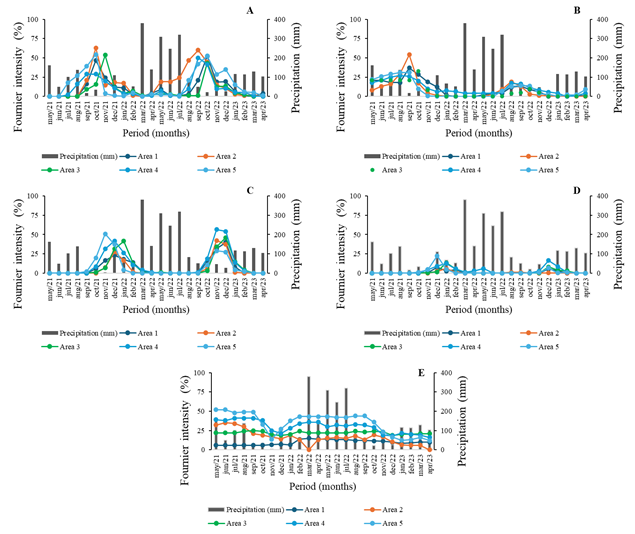
In areas 1, 2, and 3, the start of H. martiana leaf sprouting coincided with low rainfall (September 2021, 16.6 mm), with greater intensities during the dry season (October 2021 and November 2021 as well as September 2022 and October 2022). In area 4, the start of H. martiana leaf sprouting occurred in July 2021 (rainfall = 101.2 mm), with a peak (October 2021 and October 2022) when rainfall was 34 and 21.2 mm, respectively (Figure 2A).

Rainfall and Fournier intensity of five areas with H. martiana in the budding (A), senescence (B), flower bud (C), flowering (D), and fruiting (E) phenophase monitored from May 2021 to April 2023. Areia, Paraíba State, Brazil.
Hymenaea martiana leaf fall began in months with high rainfall (May 2021, 161.2 mm), with an increase in the intensity of this phenophase in the periods of low rainfall (September 2021, 16.6 mm in areas 1, 2, 4, and 5 and October 2021, 34 mm in area 3) (Figure 2B).
In the five areas evaluated, the intensity peaks of the flower bud phenophase occurred in the periods of November 2021 (area 5; rainfall = 4.2 mm), December 2021 (areas 1, 2, and 4; rainfall = 110.5 mm), January 2022 (area 3; rainfall = 67.6 mm), November 2022 (areas 2, 4, and 5; rainfall = 47.5 mm), and December 2022 (areas 1 and 3; rainfall = 26.6 mm) (Figure 2C).
The occurrence of flowering in the different areas with H. martiana followed the same pattern as the budding, senescence, and flower bud phenophases, with higher percentages of intensity in December 2021 (areas 1 and 5; rainfall = 110.5 mm), January 2022 (areas 2-4; rainfall = 67.6 mm), and December 2022 (areas 1 and 3-5; rainfall = 26.6 mm) (Figure 2D).
The intensity of fruiting was continuous and practically uniform, occurring during the dry and rainy periods, for the five areas with H. martiana (Figure 2E).
The intensity of individuals in bud followed the same behavior in the five areas, noting that there was little synchronicity in the appearance of leaves on the average date (20-60% of individuals in the phenophase) and that this phenological event was seasonal throughout the monitoring period. The average date of this phenophase occurred in October in areas 1, 4, and 5, September in area 2, and November in area 3 (Figure 3A), coinciding with periods of low rainfall.
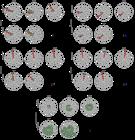
Circular distribution of Fournier intensity for the sprouting (A), senescence (B), flower bud (C), flowering (D), and fruiting (E) phenophase in different areas with H. martiana from May 2021 to April 2023. Areia, Paraíba State, Brazil. The arrow reflects the length of the r vector (0-1), and the direction of the arrow indicates the average date (average angle).
The highest leaf senescence intensity occurred throughout most of the months of observation, and in all areas of H. martiana, this phenophase began between the months of April and May 2021, with peaks between August and September (Figure 3B).
The emission of flower buds began in October in all H. martiana areas evaluated, but the individuals were not very synchronous, with the appearance of flower buds at a certain time of year and the average date being December in areas 1-4 and November in area 5 (Figure 3C).
The appearance of flowers during anthesis was non-seasonal (concentrated), occurring mainly in November and December 2021 and December 2022 to January 2023. A transition period occurred between the drought and precipitation peaks (4.2 and 110.5 mm; 26.6 and 116.4 mm), with similar behavior in all monitored populations (Figure 3D).
The fruiting of H. martiana was distributed continuously and uniformly during the months of evaluation, occurring during periods of drought and high rainfall (4.2-380.8 mm) in all areas evaluated (Figure 3E).
Activity index (percentage of individuals)
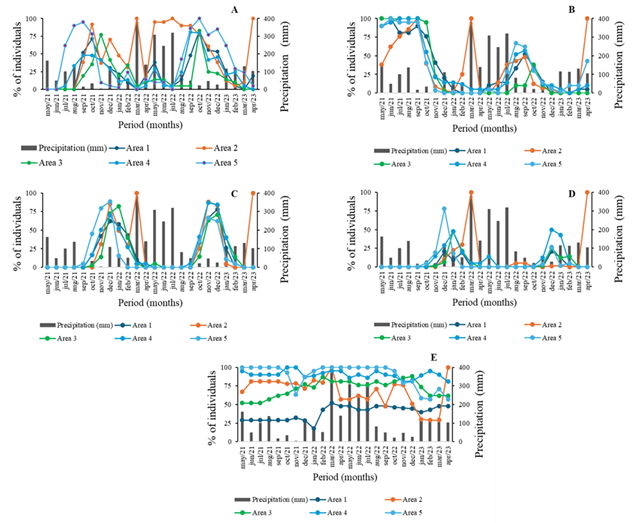
The greatest synchrony of H. martiana mother plants occurred in October 2021 (71.5%) and October 2022 (82.7%) in area 1 for the budding phenophase, coinciding with periods of low rainfall (34 and 21.2 mm). In area 2, greater synchrony was observed in October 2021 (77.3%), March 2022 (100%), July 2022 (100%), and April 2023 (100%), during periods of both low (34 mm) and high rainfall (380.8 mm). In area 3, there was high synchrony in November 2021 (70.5%) and October 2022 (83.6%). The emission of shoots in area 4 showed high synchrony in September (83%) and October 2022 (79.8%). In area 5, the greatest synchrony in the leaf sprouting phenophase occurred between September 2021 and October 2022 (Figure 4A).

Precipitation and percentage of individuals in five areas with H. martiana in the budding (A), senescence (B), flower bud (C), flowering (D), and fruiting (E) phenophase monitored from May 2021 to April 2023. Areia, Paraíba State, Brazil.
The senescence phase began in all areas evaluated in May 2021, when rainfall was 161.2 mm (Figure 4B). Between May and October 2021, more than 60% of individuals in area 1 showed high synchrony in the senescence phenophase. In area 2, synchrony was classified as non-synchronous and poorly synchronous in most months of 2022, ranging from 0.0 to 48%, with activity peaks in the dry (September 2021, 16.6 mm) and rainy periods (March 2022, 380.8 mm). In area 3, there was high synchrony between May and October 2021. In area 4, there was high synchrony in senescence between May and September 2021. In area 5, more than 60% of individuals showed high synchrony between May and September 2021 and in August 2022 (Figure 4B).
In the flower bud phenophase, high synchrony was observed in area 1 in December 2021 and in November and December 2022, with 62, 66.5, and 78% of the individuals, respectively. In area 2, high synchrony was recorded in December 2021 (72%), March (92%), November (74%), and December 2022 (70%), and April 2023 (100%). For area 3, there was high synchrony in December 2021 (69.8%) and in January, November, and December 2023. In area 4, there was high synchrony in December 2021 (67.5%), November (85%) and December 2022 (84.8%). In area 5, the flower buds showed high synchrony in November (81.6%) and December 2021 (89.7%) and November (69.5%) and December 2022 (65%) (Figure 4C).
For flowering, there was no or little synchrony (area 1). There was high synchrony in the occurrence of individuals in the flowering phase (area 2) only in March 2022 (100%) and April 2023 (100%). During the 24 months of monitoring, the flowering individuals in area 3 were classified as non-synchronous and poorly synchronous. In area 4, the monitored individuals showed no or little synchrony, but high synchrony was observed in December 2021 (area 5) (Figure 4D).
In area 1, no or little synchrony was found for fruiting, but in area 2, low synchrony (20-60% of individuals in the phenophase) and high synchrony (more than 60% of individuals in the phenophase) were observed. With regard to the presence or absence of individuals in area 3, there was high synchrony in fruiting in November and December 2021, January-December 2022, and January-April 2023. High synchrony was observed between individuals for fruiting during all the years of evaluation (area 4). High synchrony occurred in the majority of individuals during the 24 months of monitoring, with the exception of November 2022 (63%) and January (58%), February (57%), and April 2023 (57%), which were classified as low synchrony in area 5 (Figure 4E).
The sprouting phenophase occurred seasonally in areas 1, 3, and 4, with the average date being October in areas 1 and 4 and November in area 3. In areas 2 and 5, there were sprouts in all months evaluated, with the average date being August and October, respectively (Figure 5A). This vegetative event occurred during periods of high and low rainfall.
Leaf senescence of H. martiana followed the same behavior in areas 1 and 3-5, with seasonality of the phenophase for most individuals. In area 2, leaf fall occurred throughout the monitoring period (Figure 5B).
In December, the high synchrony of individuals was reduced in this phenophase. High synchrony was observed in individuals from area 2, whose average date was the same in all areas. The frequency of flower buds was more concentrated, with a higher frequency mainly in the transition from the months with the lowest rainfall (October and November) to those with the highest rainfall (December and January). In areas 1, 3 and 4, the average date was in December, while the average date in area 5 was in November, showing high synchrony between individuals (Figure 5C).
The flowering distribution of H. martiana in this study was seasonal in all areas, with asynchrony observed in areas 1 and 3 and an average date in December and January, respectively. Individuals from areas 2, 4, and 5 showed little synchrony in this phenophase, and the average date occurred in March in area 2, January in area 4, and December in area 5 (Figure 5D).
The presence of fruit on H. martiana trees was recorded during the monitoring period in all areas studied, with the average date occurring in April, August, December, June, and July in areas 1, 2, 3, 4, and 5, respectively (Figure 5E). High synchrony was also observed in most of the individuals in areas 3-5, and this phenological event was evenly distributed across the years (Figure 5E). Thus, the presence of this phenophase indicates that some H. martiana fruit remain on the trees after the natural dispersal period.
Spearman correlations (rs)
Between May 2021 and April 2023, correlations between climatic factors (temperature, relative humidity, and precipitation) and the vegetative and reproductive phenological events of Hymenaea martiana were assessed in the five study areas. Spearman analysis (Table 1) revealed a positive and significant correlation between temperature and floral bud formation and moderate associations between temperature and the budding and flowering phenophases. These results indicate that temperature plays a determining role in the growth and development of this species, as previously pointed out by Lima et al. (2020), suggesting that future increases in global temperatures may directly affect these phenological stages.

Circular distribution of the peak dates of the sprouting (A), senescence (B), flower bud (C), flowering (D), and fruiting (E) phenophase in different areas with H. martiana from May 2021 to April 2023. Areia, Paraíba State, Brazil. The arrow reflects the length of the r vector (0-1), and the direction of the arrow indicates the average date (average angle).
The relative humidity showed predominantly negative correlations with the budding, floral bud formation, and flowering phenophases, indicating that an increase in relative humidity may act as an inhibiting factor for these events in H. martiana (Table 1). Precipitation was also negatively correlated with most phenophases, except flowering, which showed a positive correlation with the onset of rain (Table 1). This pattern suggests that flowering may be induced by a sudden increase in water availability after a dry period, a phenomenon common in tropical tree species (Ivanov et al., 2022; Silva, 2018).
Synchronization between the onset of rain, flowering, and increased leaf senescence suggests an adaptive strategy in H. martiana that takes advantage of nutrients mobilized from senescent leaves for reproductive organ development (Araujo & Lobo, 2020; Felsemburgh et al., 2016). Furthermore, high temperatures may reduce the duration of the phenological cycle by increasing evapotranspiration (Medina López & Gil Rivero, 2017), whereas lower temperatures tend to prolong vegetative growth (Lima et al., 2020). Thus, understanding these relationships is essential for predicting the potential impacts of climate change on the reproductive and vegetative phenology of this species.
Discussion
The phenological behavior of plant species is influenced by climatic conditions, particularly rainfall intensity, which is a key factor in tropical seasonal ecosystems (Falla-Guzman et al., 2023; Haselhorst et al., 2017; Wu et al., 2021). Synchronizing flowering with the onset of the rainy season is a common reproductive strategy that optimizes pollination and reproductive success (Batalha & Mantovani, 2000; Silva & Lamarca, 2018). Precipitation variations are more closely linked to phenological patterns than temperature in tropical and semi-arid environments (Song et al., 2022).
Hymenaea martiana follows a reproductive strategy in which flowering and fruiting are synchronized with seasonal changes. Flower buds are produced during the transition from the rainy to the dry season, ensuring pollination before peak rainfall. Fruit ripens predominantly during the dry season, benefiting from the lower humidity, which facilitates seed dispersal and physiological maturity (Felsemburgh et al., 2016; Silva & Lamarca, 2018). Similar behavior has been observed in H. stigonocarpa in the Cerrado, where dry conditions enhance pericarp desiccation and seed dispersal (Silva, 2018).
The species is monoecious and exhibits self-incompatibility, meaning that pollinators are essential for genetic exchange and fruit formation (Moraes-Neto, 2023). Limited flower production encourages cross-pollination, as pollinators are compelled to visit multiple individuals (Figueiredo et al., 2024). Fruiting occurs all year, with peak ripeness coinciding with the end of the dry season, ensuring seed dispersal before humidity increases, facilitating germination (Silva, 2018).
Environmental conditions significantly affect phenology, with higher flower bud abortion rates observed during periods of heavy rainfall (May-August 2021; April-August 2022; January-April 2023). This pattern aligns with studies showing that climatic factors influence phenology across biomes and regions (Afifah et al., 2022; Gasper et al., 2021; Lage-Pinto et al., 2021). Asynchronous flower bud development ensures prolonged floral availability, reducing competition and ensuring pollination (Otárola et al., 2013).
In tropical forests, flowering typically occurs during the dry season, triggered by water stress and increased sunlight intensity, whereas peak flowering is influenced by rainfall and humidity (Lestari & Fiqa, 2020; Zhang et al., 2022). In Brazil’s Atlantic Forest, climate change has altered the species distribution and reproductive success, impacting ecological networks (Correa-Lima et al., 2019; Vasconcellos & Beltrão, 2018). The reproductive strategy of H. martiana benefits the species and its dispersers, as fruit availability provides critical resources for birds, bats, and primates during the dry season (Figueiredo et al., 2024; Moraes-Neto, 2023).
Fruiting in H. martiana is less seasonal than flowering, which is attributed to variations in fruit size and ripening duration (Staggemeier et al., 2015; 2017). This species employs a strategy in which fruit remains on trees for extended periods, ensuring availability for fauna during transitional seasons (Arruda et al., 2012). Plant reproductive events are tightly linked to climatic factors, influencing survival and reproductive success in seasonal environments (Costa et al., 2019; Stevenson et al., 2008). Flowering and fruiting occur earlier in subtropical regions than in tropical regions, highlighting the role of microclimate in shaping phenological patterns (Menegatti et al., 2019).
Conclusion
Rainfall and temperature have a significant impact on the period and occurrence of vegetative and reproductive phenological events in H. martiana individuals. The patterns of the budding, senescence, flower bud, and flowering phenophases of H. martiana were seasonal with annual periodicity and a continuous fruiting pattern. Hymenaea martiana fruit should be collected in October, November, and December.
Data availability
The data supporting the results of this study are available in the Google Drive repository, accessible at https://drive.google.com/drive/u/0/folders/1-e20dYbKCXQDJjzLSiV5Pj3i34Yvx2_O. The data were deposited in a way that ensures transparency and reproducibility of the research.
Acknowledgements
The authors thank the Postgraduate Program in Agronomy (CCA-UFPB) and the Coordination for the Improvement of Higher Education Personnel (CAPES) for granting the doctoral scholarship
References
-
Afifah, H., Sunarya, S., Dewi, S. P., Utoyo, L. & Sibarani, M. C.. (2022). Modeling the impact of climate change on general flowering in Bukit Barisan Selatan National Park, Sumatera. IOP Conference Series: Earth and Environmental Science, 950, 1-10. https://doi.org/10.1088/1755-1315/950/1/012001
» https://doi.org/https://doi.org/10.1088/1755-1315/950/1/012001 -
Alvares, C. A., Stape, J. L., Sentelhas, P. C., Moraes Gonçalves, J. L. & Sparovek, G.. (2013). Köppen’s climate classification map for Brazil. Meteorologische Zeitschrift, 22(6), 711-728. https://doi.org/10.1127/0941-2948/2013/0507
» https://doi.org/https://doi.org/10.1127/0941-2948/2013/0507 -
Amorim, I. L., Sampaio, E. V. S. B. & Araújo, E. L.. (2009). Fenologia de espécies lenhosas da Caatinga do Seridó, RN. Revista Árvore, 33(3), 491-499. https://doi.org/10.1590/s0100-67622009000300011
» https://doi.org/https://doi.org/10.1590/s0100-67622009000300011 -
Araujo, M. M. V. & Lobo, F. A.. (2020). Phenology of Copernicia alba in flooded and not flooded environments. Floresta e Ambiente, 27(1), 1-8. https://doi.org/10.1590/2179-8087.097917
» https://doi.org/https://doi.org/10.1590/2179-8087.097917 -
Arruda, R., Fadini, R. F., Carvalho, L. N., Del-Claro, K., Mourão, F. A., Jacobi, C. M., Teodoro, G. S., Berg, E., Caires, C. S. & Dettke, G. A.. (2012). Ecology of neotropical mistletoes: an important canopy-dwelling component of Brazilian ecosystems. Acta Botanica Brasilica, 26(2), 264-274. https://doi.org/10.1590/s0102-33062012000200003
» https://doi.org/https://doi.org/10.1590/s0102-33062012000200003 -
Batalha, M. A. & Mantovani, W.. (2000). Reproductive phenological patterns of cerrado plant species at the Pé-de-Gigante Reserve (Santa Rita do Passa Quatro, SP, Brazil): a comparison between the herbaceous and woody floras. Revista Brasileira de Biologia, 60(1), 129-145. https://doi.org/10.1590/S0034-71082000000100016
» https://doi.org/https://doi.org/10.1590/S0034-71082000000100016 -
Bencke, C. S. C. & Morellato, P. L. C.. (2002). Estudo comparativo da fenologia de nove espécies arbóreas em três tipos de floresta atlântica no sudeste do Brasil. Revista Brasileira de Botânica, 25(2), 237-248. https://doi.org/10.1590/s0100-84042002000200012
» https://doi.org/https://doi.org/10.1590/s0100-84042002000200012 -
Borges, A. V. C., Romão, B. & Zandonadi, R. P.. (2022). Jatobá (Hymenaea sp.) as a wheat substitute in plant-based cookies to improve its nutritional quality. Research, Society and Development, 11(17), 1-8. https://doi.org/10.33448/rsd-v11i17.39085
» https://doi.org/https://doi.org/10.33448/rsd-v11i17.39085 - Brancalion, P. H. S., Garcia, L. C., Loyola, R., Rodrigues, R. R., Pillar, V. D. & Lewinsohn, T. M.. (2016). A critical analysis of the native vegetation Protection Law of Brazil (2012): updates and ongoing initiatives. Brazilian Journal of Nature Conservation, 14(1), 1-15.
-
Brito Neto, R. L., Araújo, E. I. P., Maciel, C. M. S., Paula, A. & Tagliaferre, C.. (2018). Fenologia de Astronium graveolens Jacq. em floresta estacional decidual em Vitória da Conquista, Bahia. Ciência Florestal, 28(1), 641-650. https://doi.org/10.5902/1980509832057
» https://doi.org/https://doi.org/10.5902/1980509832057 - Cavalcanti, D. R. & Tabarelli, M. (2004). Distribuição das plantas amazônico-nordestinas no centro de endemismo Pernambuco: brejos de altitude vs. florestas de terras baixas. In K. C. Pôrto, J. J. P. Cabral & M. Tabarelli (Eds.), Brejos de altitude em Pernambuco e Paraíba: história natural, ecologia e conservação. (pp. 285-296). Ministério do Meio Ambiente.
-
Climatedata. (2023, 15 jun. 2023). Clima Areia (Brasil). https://pt.climate-data.org/america-do-sul/brasil/paraiba/areia-1044204/#climate-table
» https://pt.climate-data.org/america-do-sul/brasil/paraiba/areia-1044204/#climate-table - CNCFlora (2024). Hymenaea martiana in Lista Vermelha da flora brasileira versão 2012.2. Centro Nacional de Conservação da Flora.
-
Cohen, J.. (1992). A power primer. Psychological Bulletin, 112(1), 155-159. https://doi.org/10.1037/0033-2909.112.1.155
» https://doi.org/https://doi.org/10.1037/0033-2909.112.1.155 -
Correa-Lima, A. P. A., Varassin, I. G., Barve, N. & Zwiener, V. P.. (2019). Spatio-temporal effects of climate change on the geographical distribution and flowering phenology of hummingbird-pollinated plants. Annals of Botany, 124(3), 389-398. https://doi.org/10.1093/aob/mcz079
» https://doi.org/https://doi.org/10.1093/aob/mcz079 -
Costa, E., Lopes, K. G., Binotti, F. F. S., Binotti, E. D. C. & Dalastra, C.. (2019). Technologies for jatoba seedling formation. Floresta e Ambiente, 26(1), 1-8. https://doi.org/10.1590/2179-8087.008415
» https://doi.org/https://doi.org/10.1590/2179-8087.008415 -
Costa, T. M., Santos, M. G. M., Neves, S. P. S., Miranda, L. A. P. & Funch, L. S.. (2021). Phenological dynamics of Croton heliotropiifolius populations in a savanna/caatinga gradient, Chapada Diamantina, Brazil. Rodriguesia, 72, 1-17. https://doi.org/10.1590/2175-7860202172130
» https://doi.org/https://doi.org/10.1590/2175-7860202172130 -
Damásio, B. F. (2021). Entenda o que é correlação. Blog Psicometria Oline. https://psicometriaonline.com.br/o-que-e-correlacao/
» https://psicometriaonline.com.br/o-que-e-correlacao/ - Embrapa (2013). Sistema brasileiro de classificação de solos (3. ed.). Embrapa.
-
Falla-Guzman, C. K., Martínez-Atencia, J. C., Rodríguez-Vitola, J. L., Garrido-Pineda, J. F., Berrio-Guzmán, E. E. & Zulluaga-Peláez, J. J.. (2023). Estudio fenológico de Caesalpinia ebano (H. Karst) en el Valle medio del Sinú, Colombia. Revista Forestal Mesoamericana Kurú, 20(46), 44-50. https://doi.org/10.18845/rfmk.v20i46.6603
» https://doi.org/https://doi.org/10.18845/rfmk.v20i46.6603 -
Felsemburgh, C. A., Peleja, V. L. & Carmo, J. B.. (2016). Fenologia de Aniba parviflora (Meins.) Mez. em Uma Região do Estado do Pará, Brasil. Biota Amazônia, 6(3), 31-39. https://doi.org/10.18561/2179-5746/biotaamazonia.v6n3p31-39
» https://doi.org/https://doi.org/10.18561/2179-5746/biotaamazonia.v6n3p31-39 -
Figueiredo, D. P., Oliveira, T. & Meireles, L. D.. (2024). Recursos florais e frutíferos para a fauna de espécies arbóreas indicadas para arborização urbana de São Paulo: em busca de uma cidade biodiversa1. Hoehnea, 51, 1-18. https://doi.org/10.1590/2236-8906e482022
» https://doi.org/https://doi.org/10.1590/2236-8906e482022 - Fournier, L. A.. (1974). Un método cuantitativo para la medición de características fenológicas em árboles. Turrialba, 24(4), 422-423.
-
Gabardo, G., Sarzedas, C. G. & Silva, H. L. (2020). Queimadas na Amazônia Brasileira. In A educação ambiental em uma perspectiva interdisciplinar (pp. 332-343). https://doi.org/10.37885/200800872
» https://doi.org/https://doi.org/10.37885/200800872 -
Gasper, A. L., Grittz, G. S., Russi, C. H., Schwartz, C. E. & Rodrigues, A. V.. (2021). Expected impacts of climate change on tree ferns distribution and diversity patterns in subtropical Atlantic Forest. Perspectives in Ecology and Conservation, 19(3), 369-378. https://doi.org/10.1016/j.pecon.2021.03.007
» https://doi.org/https://doi.org/10.1016/j.pecon.2021.03.007 -
Gomes, R., Pinheiro, M. C. B. & Lima, H. A.. (2008). Fenologia reprodutiva de quatro espécies de Sapotaceae na restinga de Maricá, RJ. Revista Brasileira de Botânica, 31(4), 679-687. https://doi.org/10.1590/s0100-84042008000400013
» https://doi.org/https://doi.org/10.1590/s0100-84042008000400013 -
Haselhorst, D. S., Tcheng, D. K., Moreno, J. E. & Punyasena, S. W.. (2017). The effects of seasonal and long-term climatic variability on Neotropical flowering phenology: An ecoinformatic analysis of aerial pollen data. Ecological Informatics, 41, 54-63. https://doi.org/10.1016/J.ECOINF.2017.06.005
» https://doi.org/https://doi.org/10.1016/J.ECOINF.2017.06.005 -
INMET. (2023). Instituto Nacional de Meteorologia. http://www.inmet.gov.br/portal/
» http://www.inmet.gov.br/portal/ - IUCN (2024). Red List Categories and Criteria Version 3.1. (IUCN Species Survival Commission, 2024).
-
Ivanov, M. M. M., Oliveira, V. B., Sousa Leite, R., Vale, N. M. O., Karasinski, M. A. & Fernandes, G. S. T.. (2022). Seasonal dynamics of the phenology of native species from the seasonally dry tropical forest. Floresta e Ambiente, 29(4), 1-12. https://doi.org/10.1590/2179-8087-FLORAM-2021-0032
» https://doi.org/https://doi.org/10.1590/2179-8087-FLORAM-2021-0032 -
Lage-Pinto, F., Fernando, P. S., Carletto, A. F. M. & Bernini, E.. (2021). Reproductive phenology and influence of abiotic variables for two mangrove species in northeastern brazil. Rodriguesia, 72, 1-11. https://doi.org/10.1590/2175-7860202172065
» https://doi.org/https://doi.org/10.1590/2175-7860202172065 -
Lestari, D. A. & Fiqa, A. P.. (2020). Environmental factors influence on flowering and fruiting period of selected essential oil plants from annonaceae. Biodiversitas, 21(3), 910-921. https://doi.org/10.13057/biodiv/d210309
» https://doi.org/https://doi.org/10.13057/biodiv/d210309 -
Lima, P. R., Borsoi, A., Malavasi, U. C., Ecco, M. & Malavasi, M.. (2020). Morphological evaluation of Gallesia integrifolia seedlings under different water management systems. Floresta e Ambiente, 27(3), 1-8. https://doi.org/10.1590/2179-8087.021017
» https://doi.org/https://doi.org/10.1590/2179-8087.021017 - Lorenzi, H. (2009). Árvores brasileiras: manual de identificação e cultivo de plantas arbóreas nativas do Brasil (3. ed.). Instituto Plantarum.
-
Medina López, E. & Gil Rivero, A. E.. (2017). Phenology of Gossypium raimondii Ulbrich “native cotton” of green fiber. Scientia Agropecuaria, 8(3), 267-271. https://doi.org/10.17268/sci.agropecu.2017.03.09
» https://doi.org/https://doi.org/10.17268/sci.agropecu.2017.03.09 -
Menegatti, R. D., Mantovani, A. & Navroski, M.. (2019). Biometric and physiological quality of bracatinga seeds from different mother trees. Floresta e Ambiente, 26(1), 14-10. https://doi.org/10.1590/2179-8087.035916
» https://doi.org/https://doi.org/10.1590/2179-8087.035916 -
Menezes Filho, A. C. P., Oliveira Filho, J. G. & Castro, C. F. S.. (2020). Avaliações antioxidante e antifúngica dos óleos essenciais de Hymenaea stigonocarpa Mart. ex Hayne e Hymenaea courbaril L. Journal of Biotechnology and Biodiversity, 8(2), 104-114. https://doi.org/10.20873/jbb.uft.cemaf.v8n2.menezes
» https://doi.org/https://doi.org/10.20873/jbb.uft.cemaf.v8n2.menezes - Moraes-Neto, S. P. (2023). Considerações científicas de duas espécies de jatobá de ocorrência no bioma Cerrado. Empraba Cerrados.
- Morellato, L. P. C., Leitao Filho, H. F., Rodrigues, R. R. & Joly, C. A.. (1990). Estratégias fenológicas de espécies arbóreas em floresta de altitude na Serra do Japi, Jundiaí, São Paulo. Revista Brasileira de Biologia, 50(1), 149-162.
-
Morellato, L. P. C., Alberton, B., Alvarado, S. T., Borges, B., Buisson, E., Camargo, M. G. G., Cancian, L. F., Carstensen, D. W., Escobar, D. F. E., Leite, P. T. P., Mendoza, I., Rocha, N. M. W. B., Soares, N. C., Silva, T. S. F., Staggemeier, V. G., Streher, A. S., Vargas, B. C. & Peres, C. A.. (2016). Linking plant phenology to conservation biology. Biological Conservation, 195(1), 60-72. https://doi.org/10.1016/j.biocon.2015.12.033
» https://doi.org/https://doi.org/10.1016/j.biocon.2015.12.033 -
Nascimento, M. B., Bandeira, M. M. & Araújo, L. E.. (2019). Variabilidade climática da precipitação do município de Areia/Paraíba, Brasil. Gaia Scientia, 13(3), 24-37. https://doi.org/10.22478/ufpb.1981-1268.2019v13n3.41925
» https://doi.org/https://doi.org/10.22478/ufpb.1981-1268.2019v13n3.41925 -
Oliveira, F. S. G., Araújo, C. S., Rolim, L. A., Barbosa-Filho, J. M. & Almeida, J. R. G. S.. (2018). The Genus Hymenaea (Fabaceae): A chemical and pharmacological review. Studies in Natural Products Chemistry, 58, 339-388. https://doi.org/10.1016/B978-0-444-64056-7.00012-X
» https://doi.org/https://doi.org/10.1016/B978-0-444-64056-7.00012-X -
Otárola, M. F., Sazima, M. & Solferini, V. N.. (2013). Tree size and its relationship with flowering phenology and reproductive output in Wild Nutmeg trees. Ecology and Evolution, 3(10), 3536-3544. https://doi.org/10.1002/ece3.742
» https://doi.org/https://doi.org/10.1002/ece3.742 -
Rocha, T. G. F., Silva, R. A. R., Dantas, E. X. & Vieira, F. A.. (2015). Fenologia da Copernicia prunifera (Arecaceae) em uma área de caatinga do Rio Grande do Norte. Cerne, 21(4), 673-682. https://doi.org/10.1590/01047760201521041758
» https://doi.org/https://doi.org/10.1590/01047760201521041758 -
Santos, A. C., Salcedo, I. H. & Candeias, A. L. B.. (2009). Relação entre o relevo e as classes texturais do solo na Microbacia Hidrográfica de Vaca Brava, PB. Revista Brasileira de Cartografia, 54(1), 86-94. https://doi.org/10.14393/rbcv54n1-43941
» https://doi.org/https://doi.org/10.14393/rbcv54n1-43941 -
Shimamoto, C. Y., Padial, A. A., Rosa, C. M. & Marques, M. C. M.. (2018). Restoration of ecosystem services in tropical forests: A global meta-analysis. PLoS ONE, 13(12), 1-16. https://doi.org/10.1371/journal.pone.0208523
» https://doi.org/https://doi.org/10.1371/journal.pone.0208523 -
Silva, M. J., Alves, E. U., Silva, J. N., Silva, R. S., Bernardo, M. K. F., Rodrigues, C. M., Pádua, G. V. G., Silva, J. H. C. S., Silva, M. C. L., Souza, A. G. & Smiderle, O. J.. (2024). Biometric aspects of fruits and seeds and determination of the absorption curve of Hymenaea martiana Hayne seeds. Brazilian Journal of Biology, 84, 1-9. https://doi.org/10.1590/1519-6984.285632
» https://doi.org/https://doi.org/10.1590/1519-6984.285632 - Silva, M. R. & Lamarca, E. V.. (2018). Registros etnobotânicos e potenciais medicinais e econômicos do Jatobá (Hymenaea courbaril). Revista Ibirapuera, 15, 8-12.
-
Silva, P. O.. (2018). Fenologia reprodutiva de Hymenaea stigonocarpa Mart ex Hayne (Fabaceae) em cerrado sensu stricto. Acta Biológica Catarinense, 5(2), 89-97. https://doi.org/10.21726/abc.v5i2.304
» https://doi.org/https://doi.org/10.21726/abc.v5i2.304 -
Silva, M. C., Lima, E. R. V. & Queiroz, J. E. R.. (2005). A reserva ecológica estadual da Mata do Pau Ferro e sua importância como unidade de planejamento e gerenciamento dos recursos hídricos para o reservatório de Vaca Brava - Areia/PB. Caminhos de Geografia, 9(16), 83-92. https://doi.org/10.14393/RCG
» https://doi.org/https://doi.org/10.14393/RCG -
Singh, R. K., Svystun, T., AlDahmash, B., Jönsson, A. M. & Bhalerao, R. P.. (2017). Photoperiod- and temperature-mediated control of phenology in trees - a molecular perspective. New Phytologist, 213(2), 511-524. https://doi.org/10.1111/nph.14346
» https://doi.org/https://doi.org/10.1111/nph.14346 -
Song, G., Wu, S., Lee, C. K. F., Serbin, S. P., Wolfe, B. T., Ng, M. K., Ely, K. S., Bogonovich, M., Wang, J., Lin, Z., Saleska, S., Nelson, B. W., Rogers, A. & Wu, J.. (2022). Monitoring leaf phenology in moist tropical forests by applying a superpixel-based deep learning method to time-series images of tree canopies. ISPRS Journal of Photogrammetry and Remote Sensing, 183, 19-33. https://doi.org/10.1016/j.isprsjprs.2021.10.023
» https://doi.org/https://doi.org/10.1016/j.isprsjprs.2021.10.023 - Souza, M. M., Pereira, L. A. L. & Marenco, R. A.. (2025). Radial growth of seven multipurpose-use Amazonian tree species in response to intra-annual variations in rainfall, temperature and atmospheric dryness. Scientia Forestalis, 53, e4056.
-
Staggemeier, V. G., Diniz Filho, J. A. F., Zipparro, V. B., Gressler, E., Castro, E. R., Mazine, F., Costa, I. R., Lucas, E. & Morellato, L. P. C.. (2015). Clade-specific responses regulate phenological patterns in Neotropical Myrtaceae. Perspectives in Plant Ecology, Evolution and Systematics, 17(6), 476-490. https://doi.org/10.1016/j.ppees.2015.07.004
» https://doi.org/https://doi.org/10.1016/j.ppees.2015.07.004 -
Staggemeier, V. G., Cazetta, E. & Morellato, L. P. C.. (2017). Hyperdominance in fruit production in the Brazilian Atlantic rain forest: the functional role of plants in sustaining frugivores. Biotropica, 49(1), 71-82. https://doi.org/10.1111/btp.12358
» https://doi.org/https://doi.org/10.1111/btp.12358 -
Stevenson, P. R., Castellanos, M. C., Cortés, A. I. & Link, A.. (2008). Flowering patterns in a seasonal tropical lowland forest in Western Amazonia. Biotropica, 40(5), 559-567. https://doi.org/10.1111/j.1744-7429.2008.00417.x
» https://doi.org/https://doi.org/10.1111/j.1744-7429.2008.00417.x - Tavares, M. C. G., Rodal, M. J. N., Melo, A. L. & Lucena, M. F. A.. (2000). Fitossociologia do componente arbóreo de um trecho de floresta ombrófila montana do Parque Ecológico João Vasconcelos Sobrinho, Caruaru, Pernambuco. Naturalia, 25, 243-270.
-
Tiago, P. V., Rossi, A. A. B., Pedri, E. C. M., Fernandes, J. M., Tiago, A. V. & Lima, J. A.. (2019). Levantamento etnobotânico do jatobá (Hymenaea courbaril L., Fabaceae) no norte do estado de Mato Grosso, Brasil. Gaia Scientia, 13(1), 80-90. https://doi.org/10.22478/ufpb.1981-1268.2019v13n1.44089
» https://doi.org/https://doi.org/10.22478/ufpb.1981-1268.2019v13n1.44089 -
Tiago, P. V., Larocca, D., Carpejani, A. A., Tiago, A. V., Dardengo, J. F. E. & Rossi, A. A. B.. (2020). Caracterização morfoanatômica, fitoquímica e histoquímica de Hymenaea courbaril (Leguminosae), ocorrente na Amazônia Meridional. Rodriguesia, 71, 1-11. https://doi.org/10.1590/2175-7860202071063
» https://doi.org/https://doi.org/10.1590/2175-7860202071063 -
Tres, A., Tetto, A. F., Milani, J. E. F., Seger, C. D., Wendling, W. T., Pajewski, F. F. & Dickel, G.. (2020). Reproductive phenology of Euterpe edulis Mart. in two altitudinal classes in the Brazilian Atlantic forest. Revista Ibero-Americana de Ciências Ambientais, 11(2), 23-35. https://doi.org/10.6008/cbpc2179-6858.2020.002.0003
» https://doi.org/https://doi.org/10.6008/cbpc2179-6858.2020.002.0003 -
Vasconcellos, R. C. & Beltrão, N. E. S.. (2018). Avaliação de prestação de serviços ecossistêmicos em sistemas agroflorestais através de indicadores ambientais. Interações, 19(1), 209-220. https://doi.org/10.20435/inter.v19i1.1494
» https://doi.org/https://doi.org/10.20435/inter.v19i1.1494 -
Wu, W., Sun, Y., Xiao, K. & Xin, Q.. (2021). Development of a global annual land surface phenology dataset for 1982-2018 from the AVHRR data by implementing multiple phenology retrieving methods. International Journal of Applied Earth Observation and Geoinformation, 103, 1-25. https://doi.org/10.1016/J.JAG.2021.102487
» https://doi.org/https://doi.org/10.1016/J.JAG.2021.102487 -
Zhang, Y., Liu, Y., Sun, L., Baskin, C. C., Baskin, J. M., Cao, M. & Yang, J.. (2022). Seed dormancy in space and time: global distribution, paleoclimatic and present climatic drivers, and evolutionary adaptations. New Phytologist, 234(5), 1770-1781. https://doi.org/10.1111/nph.18099
» https://doi.org/https://doi.org/10.1111/nph.18099
Edited by
-
Associate Editor in charge:
Alessandro Lucca BracciniCarlos Alberto Scapim