
 TRAJECTORIES OF FEMALE STUDENTS IN COMPUTER SCIENCE: A QUANTITATIVE PERSPECTIVE
Abstract
A relatively recent subarea of knowledge, Computing quickly established itself as a male-dominated field, with one of the lowest female participation rates in the area of science, technology, engineering, and mathematics (STEM). This text is an excerpt from a master's dissertation focused on gender equity and parity in education and the workplace. Its objective was to examine the academic progress of female students in Computer Science, Computational Mathematics, and Computer Engineering programs at a federal higher education institution in Northeastern Brazil, based on quantitative data on admission, retention, dropout, and completion. Through a cohort study and quantitative analysis, it was possible to observe a reduction in the number of women in these programs, particularly in the first program, created in 1985. Despite this, the analysis shows that female students stand out for their academic success, completing proportionally more courses and, moreover, in less time than male students.
Keywords:
gender; higher education; computing.
Resumo
Uma sub-área de conhecimento recente, a Computação rapidamente se concretizou como um campo masculino, com uma das mais baixas participações de mulheres da área de ciência, tecnologia, engenharias e matemática (CTEM, em português). Este texto é um recorte de uma dissertação de mestrado, interessada na equidade e paridade de gênero na educação e no trabalho, que objetivou verificar o percurso acadêmico das alunas nos cursos de Ciência da Computação, Matemática Computacional e Engenharia da Computação de uma instituição federal de ensino superior do Nordeste brasileiro, a partir de dados quantitativos de ingresso, retenção, evasão e conclusão. Através de um estudo de coorte e análises quantitativas, foi possível constatar a redução da presença de mulheres nos cursos mencionados, com destaque para o primeiro, criado em 1985. Apesar disso, a análise evidencia que as alunas se destacam por seu sucesso acadêmico, ao concluírem proporcionalmente mais e, além disso, em menos tempo que os alunos.
Palavras-chave:
gênero; educação superior; computação.
Resumen
Computación es una subárea de conocimiento reciente, que se convirtió rápidamente en un campo masculino, con una de las tasas de participación de mujeres más bajas en el área de ciencia, tecnología, ingeniería y matemáticas (CTIM). Este texto es un extracto de una tesis de maestría, interesada en la equidad y paridad de género en la educación y el trabajo, que tuvo como objetivo verificar la trayectoria académica de alumnas de las carreras de Ciencias de la Computación, Matemática Computacional e Ingeniería en Computación de una institución federal de educación superior en el Nordeste brasileño, con base en datos cuantitativos de ingreso, retención, abandono y finalización. A través de un estudio de cohorte y análisis cuantitativos, se pudo constatar la reducción de la presencia de mujeres en los cursos antes mencionados, con énfasis en el primero, creado en 1985. Pese a ello, el análisis muestra que las estudiantes se destacan por su éxito académico: ellas completan el curso proporcionalmente más que los estudiantes y, además, en menos tiempo.
Palabras clave:
género; educación universitaria; informática.
1 INTRODUCTORY NOTES
This paper presents results from a master’s dissertation linked to broader research on gender in/exclusion funded by the MCTI/CNPQ/MEC/CAPES Public Call N. 22/2014 (Carvalho, 2014). The dissertation sought to analyze the trajectories and experiences of female students in Computer Science, Computational Mathematics, and Computer Engineering undergraduate programs, all in-person, at a northeastern Brazilian federal higher education institution (IFES, Brazilian acronym). This text highlights one of the dissertation’s specific objectives: to verify the academic path of female students based on enrollment and graduation data (Freitas, 2019)1.
The analyses are based on gender lenses, here understood as a primary identity marker and a system of power relations and representations of femininity and masculinity, thus establishing differences and inequalities. Through gender socialization, from family and through school, individuals identify as masculine or feminine and assume gendered identities, roles, positions, places, occupations/professions, thus reproducing the old sexual division of knowledge and labor (Carvalho, 2006; Hirata; Kergoat, 2007), since men continue to hold “the monopoly on the maintenance of technical objects and machines” (Bourdieu, 1999, p. 113).
Pierre Bourdieu’s concept of field (1989, 2004, 2011) is useful for understanding the organization of social spaces as social microcosms with their own logic and norms and relative autonomy, although subject to broader social laws. Gender relations at work are articulated with Bourdieu’s field theory (1989, 2004, 2011), understood as a space of tensions and struggles for recognition and positions, where individuals are hierarchically situated based on different types of capital, competing and cooperating for the continuation or modification of the field’s power structure. Consequently, a successful and united group needs the integration of individuals who share the same project or objective; with this, they establish the inclusion or exclusion of individuals, and what they can or cannot do. The scientific-academic project has historically been constituted by male individuals; therefore, the field is characterized as androcentric and patriarchal, especially in technology (Bourdieu, 1999).
Data from UNESCO’s (2018) report Cracking the code: girls’ and women’s education in science, technology, engineering and mathematics (STEM) indicate that, although women’s enrollment has increased worldwide in these first decades of the 21st century, including in natural sciences and statistics, with contextual variations by region and country, they represent only 28% in information and communication technologies (ICTs); therefore, this is one of the two most masculine fields, the other being engineering, manufacturing and construction. If 30% of the world’s female higher education student population choose STEM areas, their share in ICTs corresponds to 3%. According to PISA 2015 data, in 35 OECD countries, the career expectations of female students at age 15 are the lowest (2%) in ICTs compared to other areas (UNESCO, 2018).
This paper highlights the configuration of the computing field at a northeastern Brazilian IFES from 1985 to 2018. For this purpose, a cohort study and quantitative analyses are presented based on data on: enrollment, retention, dropout, and graduation, which enable focusing on the path of female students in Computer Science, Computational Mathematics, and Computer Engineering programs at the researched institution during the mentioned period, noting that the dissertation was defended in 2019.
1.1 Brief History of Low Female Presence in STEM
During the 17th and 18th centuries, the Scientific Revolution spurred the rise of modern institutions like universities and industries. However, these spaces were dominated by men under a strict patriarchal ideology; meanwhile, wives, mothers, and daughters were relegated to domestic roles "in the name of nature, love, and maternal duty", a dynamic that effectively barred them from science and the evolving workforce (Hirata & Kergoat, 2007, p. 597; Schiebinger, 2001). Consequently, throughout the history of science there has been an invisibilization of female contributions, even in the face of their occasional participation, thus legitimizing men as scientists - generally white, Western, heterosexual men from higher social strata (Bandeira, 2008; González García; Pérez Sedeño, 2002; Rago, 1998).
Although women finally entered universities in the early 19th century, their integration and advancement in the scientific world remained slow (Leta, 2003; Maffia, 2002). In Brazil, the first Medicine, Engineering, and Law programs excluded women, and only in 1881, through imperial decree, were they granted the right to enroll in higher education programs. The first woman to graduate in Medicine was Rita Lobato Velho Lopes in 1887, at the Federal University of Bahia (Romanelli, 1986). However, the exclusion of women from secondary school persisted, which made accessing higher education difficult.
It was at the beginning of the 20th century, according to Beltrão and Alves (2009), that enrollment rates of Brazilian women in secondary and higher education increased, though in much smaller numbers compared to men. Leta (2003) highlights that it was in the second half of the 20th century that changes effectively began, driven by the growing need for educated human resources, the women’s liberation movement, and the struggle for equal rights between men and women. The massive entry of women into higher education programs in Brazil occurred in the 1970s; however, their presence was concentrated in traditionally feminine programs related to care, such as Nursing, Social Work, Pedagogy, and some teaching degrees (Beltrão; Alves, 2009; Rosemberg, 2001).
Consequently, in the early 21st century women’s access to scientific fields and gender equity in sciences have not yet been achieved, and progress has been minimal, especially in the so-called “hard sciences”: Natural Sciences, Technology, Engineering, and Mathematics (STEM). According to data from the Institute for Statistics (UIS) of the United Nations Educational, Scientific and Cultural Organization (UNESCO), women accounted for only 30% of the world’s researchers in 2016 (UNESCO, 2019).
Thus, science has been constituted as a masculine field, excluding and/or denying knowledge produced by women (Silva, 2008). Even when they are included in the field, their efforts are not encouraged and their contributions are made invisible, so that the construction of science remains gendered (Carvalho; Sobreira, 2008; Lima, 2013). Their invisibility as research subjects and, even more, as science producers, has been an agenda of the feminist movement since the second wave (Lorber, 2010; Blay, 2006; Schiebinger, 2001; Rago, 1998).
Obstacles to the entry and permanence of girls and women in the STEM area still persist and are of two orders: internal, resulting from primary socialization that shapes girls for care and dedication to family, strengthened in secondary socialization in school from early childhood education on, directing them to traditionally feminine programs; and external, expressed by the androcentric culture of work, with more or less perceptible prejudice and discrimination (Carvalho, 2017). As pointed out in international literature and confirmed by Amorim (2017), in academia these external obstacles are characterized by a cold/hostile climate, lack of credibility in female intellectual capacities, and moral and/or sexual harassment.
Therefore, currently, the absence of formal barriers preventing women’s entry into sciences does not eliminate implicit barriers, generally imperceptible to women themselves, due to the naturalization of androcentric culture in science (González García; Pérez Sedeño, 2002). Bourdieu (1999) explains the small presence of women in hard sciences through self-exclusion and supposed “vocation,” which disguise explicit exclusion. Furthermore, of the few who enter masculine STEM careers, not all continue in the field, a phenomenon called leaky pipeline, that is, they tend to leave during or after training, which suggests a gender filter (Blickenstaff, 2005).
The rare female presence in STEM can be understood through horizontal and vertical segregation, explained by Kergoat (2009): respectively, the separation of women's work and men's work, and greater valorization of masculine work. Hence the tendency for women to occupy subordinate positions, in occupations with low pay and prestige, generally in the service sector. In professional and academic fields, they frequently have stagnant careers (Olinto, 2011) or face the "glass ceiling", that is, invisible obstacles to their progress to higher levels (Carvalho, 2017).
Indeed, the first records of female presence in scientific institutions are those of Marjory Stephenson and Kathleen Londsdale in 1945 at the English Royal Society; Yvonne Choquet-Bruhat in 1979 at the French Académie des Sciences (González García; Pérez Sedeño, 2002; Maffia, 2002); and, among us, Marta Vannucci in 1966, a biologist and oceanographer, at the Brazilian Academy of Sciences.
Cunha et al. (2014) observed that from 1901 to 2013, of the 540 scientists in Science (Physics, Chemistry, Medicine and Physiology) who received Nobel Prizes, only 3% (16) were women. From 2014 to 2024, of 87 laureates, 10.3% (9) were women: Donna Strickland in 2018 and Anne L'Huillier in 2023 in Physics; Frances Arnold in 2018, Emmanuelle Charpentier and Jennifer Doudna in 2020, and Carolyn R. Bertozzi in 2022 in Chemistry; May-Britt Moser in 2014, Tu Youyou in 2015, and Katalin Karikó in 2023 in Medicine or Physiology (The Nobel Prize, 2025). Therefore, in the entire history of the Nobel Prize until 2024, only five women have won the Nobel Prize in Physics (NOBEL, 2024), eight the Nobel Prize in Chemistry (NOBEL, 2024), and thirteen the Nobel Prize in Medicine and Physiology (NOBEL, 2024). In 2024, no woman was awarded the Nobel Prize in these areas.
In Computing, female exclusion is even more notable. The invisibility and rare recognition of women's scientific production can be observed among Turing Award laureates, a kind of "Nobel Prize for Computing." From 1966 to 2024, only three women (3.8%) obtained it among 79 scientists, all in this millennium: Frances Elizabeth Allen (2006), Barbara Liskov (2008), and Shafira Goldwasser (2012) (ACM, 2025).
Amaral et al. (2017) highlight various reasons for female scarcity in computing: practices based on a culture of gender differences, influencing identity construction; sex inequalities established since childhood in family and school, through toys and games determined/naturalized for girls and boys; the persistent association of men with computing in the social imaginary; women's responsibility for family, resulting in double work shifts and lack of encouragement for their involvement in scientific and computational activities.
Lima (2013) explains that the invisibilization of female contributions stems from computing history, as they have excelled in software creation, while men have concentrated on hardware development, the field's highlighted area. In the historical recovery of their contributions, those usually remembered are: the six women who were part of the team building the first computer, the so-called ENIAC girls; the programming pioneer Ada Lovelace, author of the first algorithm to be processed on a machine; and Grace Hopper, who developed the Common Business-Oriented Language (COBOL), still widely used today (Freitas, 2021).
According to Cabral and Bazzo (2005), one way to encourage more girls and women to enter STEM is through recognition and exposure of the trajectory of women scientists who contributed to science's development in the past. In turn, the entry of more girls and women in the area contributes to reducing prejudices and stereotypes that point to women as incapable of creating advanced science, serving as an example for others (Carvalho, 2014). By the same token, making women visible as knowledge producers can contribute to transforming androcentric curricula present in the area.
As Freitas (2019) underscores, encouraging more girls to enter STEM and especially Computing needs to begin in early childhood education and continue throughout basic education. However, Watanabe et al. (2015) point to the rarity of initiatives in both secondary and higher education, and emphasize the importance of curricular and pedagogical practices that contribute to female entry and permanence in the area, highlighting the need to go beyond the abstract level and create real and interdisciplinary challenges in curricular planning. From this perspective, gender mainstreaming in curriculum is "a multiple and powerful strategy" (Carvalho, 2018, p. 97) to respond to the 2030 Agenda and, specifically, to Sustainable Development (SDG) Goal 5, which emphasizes gender equality and empowerment of women and girls, mainstreamed across 12 SDGs (UN, 2022).
In 2015, UNESCO launched the SAGA project (STEM and Gender Advancement), which aims to provide governments and policymakers with various tools to contribute to reducing gender inequalities in the area, at all levels of education and research. UIS/UNESCO, through a partnership with SAGA, has developed new indicators to understand the process of including girls and women in STEM, based on: educational trajectories, social factors, family environment, and work environment (UNESCO, 2021). The aforementioned report "Cracking the code: girls' and women's education in science, technology, engineering and mathematics (STEM)" highlights elements that prevent or enable the presence (entry, permanence, and performance) of girls and women in the area, with suggestions for interventions that can be implemented at individual, family, school, and social levels (UNESCO, 2018).
For Computing specifically, Nunes et al. (2015) emphasize the development of projects and initiatives for female inclusion in all countries. In Brazil, one example is the Digital Girls Program of the Brazilian Computer Society (SBC), which has encouraged projects, mini-courses, workshops, and lectures, aiming to increase female presence in Computing programs, providing greater interaction among the rare women professors, students, and professionals.
2 THE TRAJECTORIES OF STUDENTS IN COMPUTER SCIENCE PROGRAMS
Computing is considered a recent science that served as support for other sciences and only later became a higher education program. The first program in Brazil emerged in 1968 at the State University of Campinas (UNICAMP), in the state of São Paulo, functioning as a specialization program in areas related to computing, such as Electrical Engineering and Mathematics (Daibert, 2016).
According to Daibert (2016), based on microdata from the 2013 Higher Education Census, active enrollments were then 52,578, with 12.53% women (6,593) and 87.46% men (45,985). In 2018, women represented 13.2% of the student body in Computer Science and Information and Communication Technology (ICT), according to data from the Map of Higher Education in Brazil (SEMESP, 2020), revealing stagnation. In 2022, enrollments in Computer Science and ICT grew 28.1%: 11.2% in on-campus programs and 45.1% in distance learning programs, but disaggregated data by sex are not available in the latest Map of Higher Education in Brazil (SEMESP, 2024, p. 15), except for the female participation rate in Computing Teacher Education undergraduate programs, which is 32.3% (p. 84).
According to data from the 2023 Higher Education Census, the latest available, the area of Information Systems has 19% female enrollments (Brazil, 2024). Regarding percentages of undergraduate graduates in Computer Science and ICT, based on the 2022 Higher Education Census, women represented 15.3% (Brazil, 2023); in the 2023 Higher Education Census, they comprised 17.5% of the field´s graduates (Brazil, 2024).
Research conducted by Carvalho (2006) at the Federal University of Paraíba, João Pessoa Campus, indicate that in 2000, the Computer Science program had 25.9% enrolled women; in 2005 there was a reduction to 7.9%. Freitas (2019) highlights that at the same university, in 2011, the percentage of women with active enrollments was 9.8%; in 2017 it was 9.6%, and 10.4% in 2018. This reduction is not an exception, being corroborated by various authors in other institutions (Amaral et al., 2017; Daibert, 2016; Maia, 2016; Lima, 2013).
To observe women's participation in Computer Science Programs at the Information Technology Center (CI) of Federal University of Paraíba, Freitas (2019) developed a study analyzing data on entry, retention, dropout, and completion, considering the founding year of each program until 2018: Computer Science, 1985; Computer Engineering, 2011; Computational Mathematics, 2012.
According to Freitas (2019), analyzing data from the institution's academic management system, in 2018, women at CI comprised 13.9% (109) of the student body, distributed among programs as follows: Computer Science, 10.4% (33); Computational Mathematics, 20.1% (30); and Computer Engineering, 14% (46). In 2022, they were 14.5% (126) of students with active enrollments, distributed among the three programs: Computer Science, 13.6% (55); Computational Mathematics, 16.4% (9); and Computer Engineering, 15.1% (62). In 2023, the scenario of female presence at CI remains at 14.6% (158), with the following distribution: Computer Science, 13.2% (71); Computational Mathematics, 8.3% (3); and Computer Engineering, 16.5% (84). A small growth in absolute numbers is observed over these recent years, except in the Computational Mathematics program.
3 COMPUTER SCIENCE
The Bachelor's degree program in Computer Science was established under the responsibility of the Department of Information Technology in March 1985, through CONSUNI/UFPB Resolution N. 61, and was officially recognized by Ordinance N. 569 of the Minister of Education and Culture on October 20, 1989. It is the oldest program in the CI (Information Technology Center), predating the center's creation. Throughout the years, its Program Pedagogical Project (PPC, Brazilian acronym) underwent curricular restructuring to change the graduation timeframe; since 2006, the duration is a minimum of 4 years (8 semesters) and a maximum of 6 years (12 semesters) (Freitas, 2019).
In 1995, the program had 25 annual admission slots, which remained an annual enrollment until 1998, switching to semester admissions the following year. By 2018, the program offered 90 admission slots, 45 per semester (Freitas, 2019), a number that remains the same today.
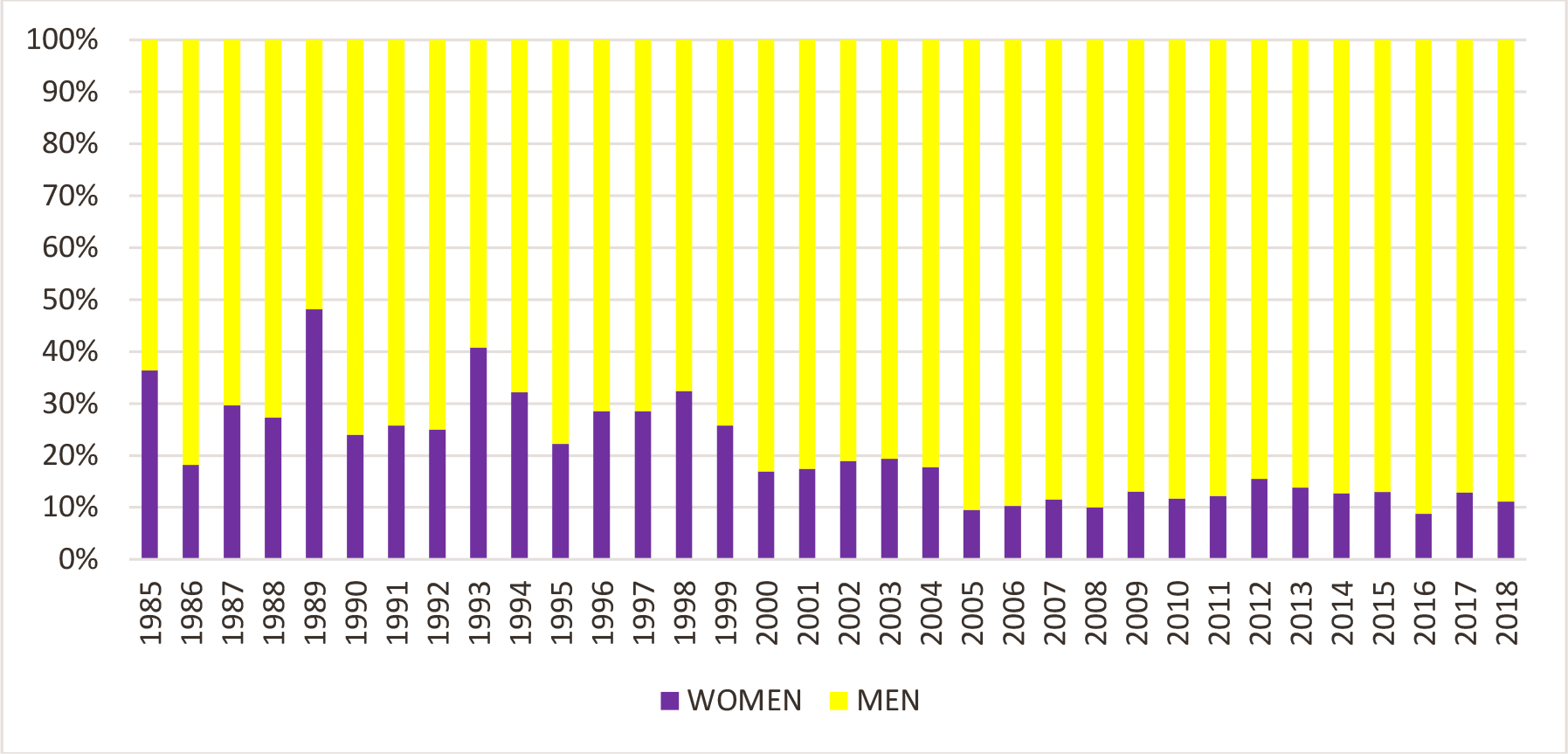
Throughout its more than 30 years of existence, the Computer Science program has seen a shifting scenery regarding female presence, as shown in Chart 1. The percentage of female enrollment decreased more significantly after the turn of the millennium, as in 1989 women made up 50% (13) of enrolment, whereas in 2005 that figure dropped to 3% (6).

The phenomenon of declining female enrollment in Computer Science programs in Brazil was observed by Lima (2014), who points to the year 2000 with 30% and the year 2010 with 20% of female students. Furthermore, other scholars have also observed this reduction in female presence and consequent male predominance in the field of Computing (Amaral et al., 2017; Monteiro et al., 2017; Santos, 2017; Maia, 2016; Moreira, Mattos; Reis, 2014; Sales et al., 2014; Lima, 2013; Monard; Fortes, 2013).
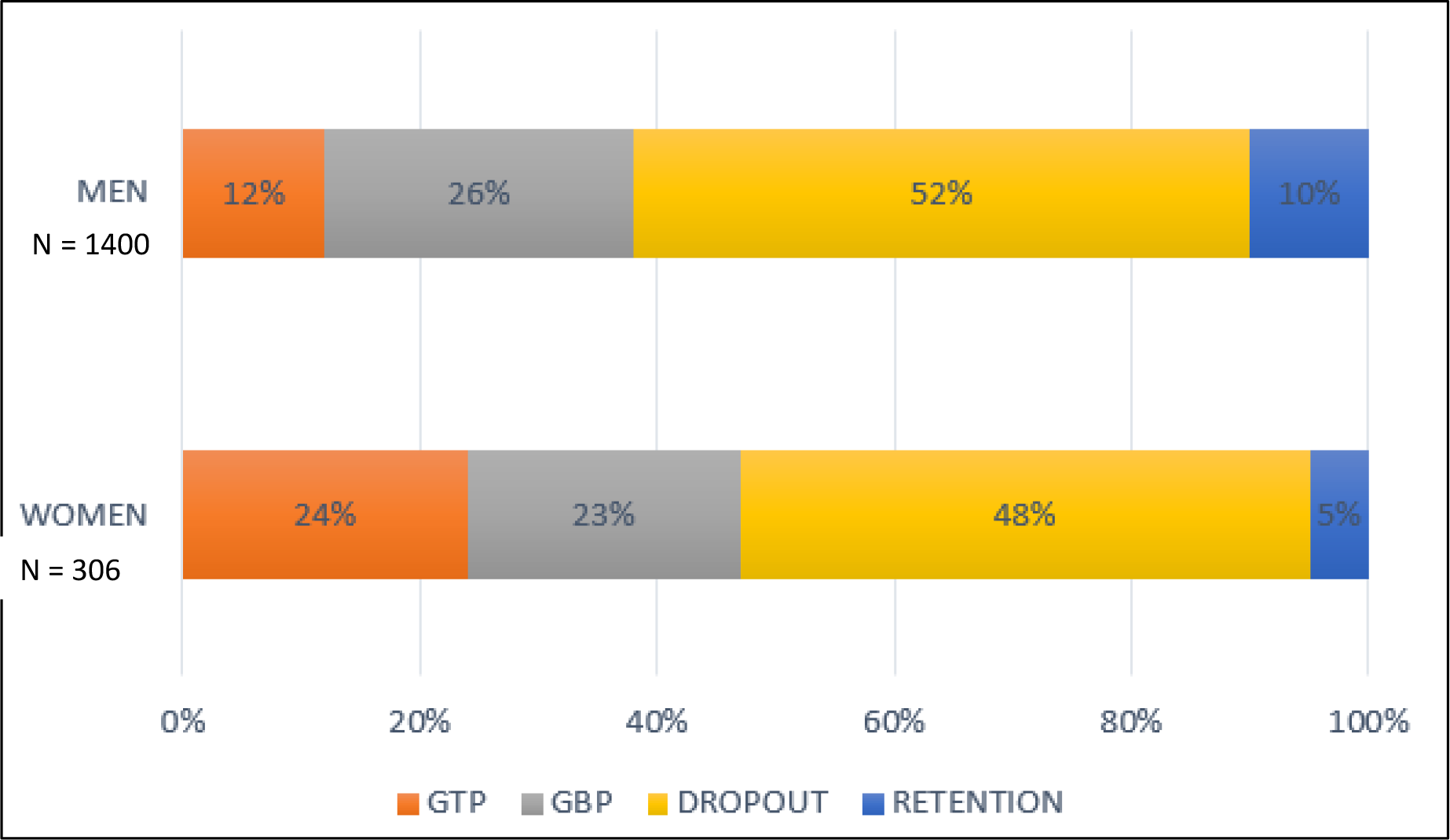
To observe the trajectory of female and male students in the Computer Science program at the CI of the studied institution, Chart 2 presents an overview, considering a time frame from 1985 to 2014, with information by sex about: admission; Completion in Expected Time (CTP), which refers to graduating before or within the time designated by the Program Pedagogical Project (PPC); Completion Outside the Deadline (CFP), after the determined time; dropout, considering withdrawals, transfers, cancellations, number of failures or exceeded time for completion; and retention, referring to students who remain active in the IFES system. Semester data are presented by year.
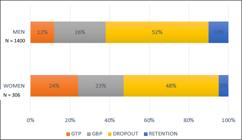
Thus, Chart 2 indicates that, from 1985 to 2014, 306 (18%) women and 1400 (82%) men enrolled in the Computer Science program. Regarding CTP, it is possible to observe that women proportionally completed more than men: they correspond to 24% while they are only 12% (half of the female percentage). In CFP, women are 23% and men 26%. When the two completion categories are added together (CTP + CFP), women present a percentage of 47% and men 38%, thus highlighting their success.
Regarding the dropout presented in Chart 2, the percentages are high for both women (48%) and men (52%), but even so, greater resilience is presumed for women. Finally, retention, which involves students who continue with active enrollment at the IFES, shows 5% for women and 10% for men. When considering the dropout and retention percentages in comparison to graduation rates, female students stand out for their success, even though they are a minority in both absolute and relative numbers.
Regarding the possibilities of success in relation to rates for men and women, Table 1 highlights the chances of each variable stratified by group, that is, the chances were calculated distinctly between groups. It is possible to note that the chance of dropout is always the highest in both groups. The chance of retention is more than double for men. In comparison, the chance of CTP is more than double for women, while the chances of CFP are similar, but higher for men.
The odds ratio (OR) was also verified between the female and male groups for the variables OTC (on-time completion), DC (delayed completion), Dropout, and Retention, with group A being the female group:
-
a) OR (OTC) = 2.34;
-
b) OR (DC) = 0.84;
-
c) OR (Dropout) = 0.84;
-
d) OR (Retention) = 0.49.
Of these values, it is interesting to note that in DC, Dropout, and Retention, the odds ratios were less than one, indicating that the chance of these events occurring is greater in the male group. In comparison, OTC is more common in the female group.
For a deeper analysis of the student trajectories of men and women in the Computer Science program, a cohort study was conducted. This is an observational, longitudinal, and analytical research study that provides follow-up of a particular group of people who share a common characteristic or experienced the same event, thus making it possible to analyze the outcome of this fact over a certain period of time (Gil, 2002). For this type of study, data analysis is especially quantitative (Gil, 2002).
Cohort studies occur through prospective means, produced in the present, in which the observation of the fact and time are determined by the object of study; and through retrospective means, based on historical facts, with their main source being records from the past to the present. In the development of the latter, it is essential to have access to all archives (Gil, 2002).
Table 2 therefore presents a retrospective cohort study, as it is based on historical data from 219 students, being 68 women and 151 men, who enrolled in CI/UFPB programs. The study considered six cohorts from the Computer Science program, the oldest one, whose selection was made due to the high incidence of women: the annual enrollments from 1989, 1993, 1998, and the semester enrollments from 2003 (1st semester), 2009 (1st semester), and 2012 (2nd semester). The four-year period of the program was considered, according to the PPC, plus two more years for those delayed.
Evolution of student trajectory indicators for different cohorts of the Computer Science program at CI
It is possible to observe in the cohorts presented in Table 2 that, even though the selected classes show a greater presence of women compared to other classes researched, female enrollment shows a reduction over the years in percentage terms, that is, in the 1989 class women represented 50% (13) and in the classes from subsequent years, respectively, 40.7% (11), 32.4% (12), 31.2% (10), 23.4% (11) and, finally, in 2012 they were 22% (11).
Also in Table 2, in the selected classes, women show no retention. Regarding completion, it is observed that the highest rates occur in the first classes: 1989 (69.2%), 1993 (81%), 1998 (50%), 2003 (20%), 2009 (27%) and 2012 (18%). Thus, as the program becomes more male-dominated, women tend not to persist and end up dropping out, as can be observed in the inverted graduation movement, where their dropout percentages are higher in the later classes: 1989 (30.8%), 1993 (9%), 1998 (50%), 2003 (80%), 2009 (73%) and 2012 (82%). Possible reasons can be considered from the perspectives of students in the programs, according to studies by Freitas (2019) and Amaral et al. (2017), which pointed to sexism, prejudice, and harassment.
The cohort study conducted in the Computer Science classes also resulted in Chart 3, which illustrates the balance of the total of the six classes selected in Table 2, highlighting the six years considered in each cohort and the categories: enrollment, retention, dropout, and graduation by sex.
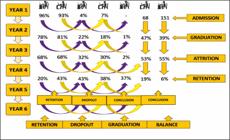
Chart 3 highlights that, in the six classes, women's enrollment corresponds to 31% (68) and men's to 69% (151). However, even though in absolute numbers they represent a smaller quantity, in percentage terms they graduate more often (47%) than men (39%) and have a lower drop-out rate (53%) compared to their male counterpart (55%). It is possible, therefore, to point to the success of female students in terms of program completion.
Nevertheless, the dropout category in Chart 3 still requires attention regarding the observed phenomenon, as both men and women drop out especially between the third and fourth year, which diverges from studies such as those by Hoed (2016) and Barroso and Falcão (2004), which point to dropout mainly between the first and second year of the program. In the case of the research by Klanovicz and Oliveira (2021), conducted in programs with male predominance, male and female students stay from two to fourteen semesters before dropping out of the program.
4 COMPUTER ENGENEERING
In May 2010, through Resolution N. 75 of CONSUNI/UFPB, the Computer Engineering program was created, having been recognized by the Ministry of Education (MEC) in 2014. From its creation in 2010 until 2016, the program had its PPC restructured twice to change the minimum total course load, to comply with Engineering guidelines, being established at 3,735 hours in the 2016 PCC, with a minimum completion period of 5 years (10 semesters) and a maximum of 7 and a half years (15 semesters) (Freitas, 2019).
According to Freitas (2019), since the first class began in 2011, the program has been offering 40 spots per semester, totaling 80 per year, an offering that remains to this day. In Table 3, it is possible to see the annual enrollment of men and women in the program, in addition to the categories of on-time completion and delayed completion (CTP and CFP), dropout and retention, considering the semester cohorts by year.
Table 3 illustrates, in a time frame from 2011 to 2018, the trajectories of incoming students by sex in the Computer Engineering program. The first part of the data, referring to the period from 2011 to 2015, the range corresponding to the subtotal, is necessary as it considers the expected time for program completion according to its PPC (5 years). Thus, in the period considered, the enrollment of 69 (14.2%) women and 416 (85.8%) men resulted in a completion rate of 9% (6) of women and 6% (25) of men, either on time or delayed.
Therefore, it can be observed that the scenario is similar to the Computer Science program, when considering that, proportionally, women have greater success compared to men. In the case of student retention in the program, there is similarity, being 30% (21) for women and 28% (115) for men. Even though the students who are retained finish the program, the success rate is less than half of those enrolled, since dropout rates are high, being 61% (42) for women and 66% (276) for men.
Regarding the range corresponding to the total in Table 3, little can be highlighted, since the program has an expected duration of five years, hence the possible changes are in dropout percentages that decrease and in retention percentages that increase, but without any perceptible transformation yet in the program's overall picture.
5 COMPUTATIONAL MATHEMATICS
The Bachelor's Degree Program in Computational Mathematics, one of the most recent among the three at CI, was created by Resolution N. 25/2011 of CONSUNI/UFPB, approved in June 2011. In the second semester of 2012, the inaugural class of the program took place, and in 2016.2 its first class graduated, composed of only 3 male students (Freitas, 2019).
Since its institution, the program has operated under the same PPC (Program Pedagogical Project) currently in effect, which establishes a minimum period of 4 years (8 semesters) and a maximum period of 6 years (12 semesters) for completion. Regarding enrollment offerings, from its creation until 2019 there were 80 spots divided by semester entry (Freitas, 2019). Currently, it is in the process of discontinuation, which may be related to graduation and dropout rates, observed in more detail below.
Table 4 highlights, in a timeframe from 2012 to 2018, the enrollment, dropout, retention, and graduation within the expected timeframe and beyond the deadline (CTP and CFP) of students by gender, combining the semester cohorts into a single year. It is organized highlighting the years 2012 to 2015 for an initial segment, considering program completion time stipulated in its PPC.
According to Table 4, in the period from 2012 to 2015, 53 (14.9%) women and 302 (85.1%) men enrolled, but only 5 (1.5%) men completed the program and no women. It is also worth noting that, among the 84 students enrolled in the first cohort of 2012, only 3, which corresponds to 4%, managed to graduate and the rest dropped out. Therefore, the dropout rates for women and men in the program exceed 90%, indicating its lack of success.
In total, between the years 2012 and 2018, dropout rates stand out with high percentages, both for women at 72% (71) and for men at 76% (390), leaving retention rates with low percentages, being 28% (28) for women and 23% (120) for men. However, if the persistence factor is considered, one can observe a probable future success of women in relation to men, if we analyze the sum of the completion rate with the retention rate of students in the period, in percentage terms, that is, 28% (28) for women compared to 24% (125) for men, although no women have graduated yet.
According to Hoed (2016) and Barroso and Falcão (2004), who also observed dropout in Computer Science programs, the explanatory factors are of a socioeconomic, vocational, and institutional nature. Although for Hoed (2016) these factors are broad and recurrent, they do not account for all explanations for dropout, and can be expanded to include family, personal, emotional, health-related factors, among others. Finally, Hoed (2016) points out that the dropout rate in Computer Science programs is higher for males at the University of Brasilia (UnB), a phenomenon also observed at the CI of researched institution.
6 FINAL THOUGHTS
This paper highlighted, from a quantitative perspective, the trajectory of female students in the three Computing Programs at a northeastern IFES and enabled analyzing, through student flow, a change in the Computing scenario, from 2000 onward, with the decline of the already reduced female presence, a phenomenon observed by Lima (2014) at a national level.
However, the analysis of student trajectories indicated that, even with their reduced presence, women show themselves to be more successful in proportional terms, since they have a higher graduation rate (except in the Computational Mathematics Program), less program retention, and lower drop out numbers compared to their male colleagues. It is worth noting that these results are similar for the Computer Science and Computer Engineering programs at the researched institution. Thus, women’s success stands out, despite the barriers they encounter in the STEM area and specifically in Computing, as the literature points out (Amorim, 2017; Amaral et al., 2017; Freitas, 2019).
As for the case of the Computational Mathematics program, since its creation no women have graduated. It so happens that the program presents high dropout rates for both women and men. However, it was possible to observe that, regarding the permanence factor, when considering retention and completion rates, even though until 2018 there were no female graduates, they would be more successful than men.
Female success in Computing programs was also observed by Amaral et al. (2017), who point out that despite this, there are signs of demotivation on their part to continue in the program, causing the leaky pipeline, which is dropout during and after graduation (Blickenstaff, 2005). Thus, the importance of qualitative research to analyze these students’ experiences is emphasized, as well as the need to understand the academic culture of the Computing field in which they are inserted, since this culture has produced and reproduces the lower female presence.
From this perspective, Bourdieu’s field theory (1989, 2004, 2011) contributes to analyzing gender relations that are established in Computing, a field governed by androcentrism, in which male predominance tends to feed such an exclusionary structure and culture for women.
For a faster transformation of this scenario, affirmative actions are required, as indicated by the study by Carvalho, Moreira and Silva (2018) on trends in women’s enrollment in STEM area programs, conducted at the same IFES. According to the referred study, without affirmative actions for women, a minority that has been declining, they will disappear from Computer Engineering programs by 2031, and from Computer Science programs by 2050, and will remain stagnant in the Computational Mathematics program.
Klanovicz and Oliveira (2021) highlight the need for gender debate in university spaces, and indicate educational actions that promote expansion, inclusion, and permanence for all. Emphasis is placed, above all, on urgent attention to inclusion and gender equity policies in Brazilian universities in response to the 2030 Agenda, especially SDG 5, toward the call for a 50-50 Planet.
ARTIFICIAL INTELLIGENCE (AI) USE STATEMENT
No Artificial Intelligence tools were used in the preparation of this manuscript.
DATA AVAILABILITY STATEMENT
The datasets generated and/or analyzed during the study are available at: https://docs.google.com/spreadsheets/d/1NfNoB28b61r8F7wFrm-GD0625Tbhcenx/edit?usp=sharing&ouid=103249570399700120838&rtpof=true&sd=true
References
-
ACM - Association for Computing Machinery. A. M. Turing Awar. Disponível em: https://amturing.acm.org/byyear.cfm Acesso em: 29 jun. 2025.
» https://amturing.acm.org/byyear.cfm - AMARAL, M. A. et al. Investigando questões de gênero em um curso da área de Computação. Revista Estudos Feministas, Florianópolis, v. 25, n. 2, p. 857-874, maio 2017.
-
AMORIM, V. G. Gênero e educação superior: perspectivas de alunas de física. 2017. Dissertação (Mestrado em Educação) - Universidade Federal da Paraíba, João Pessoa, 2017. Disponível em: https://repositorio.ufpb.br/jspui/handle/tede/9887 Acesso em: 10 jan. 2019.
» https://repositorio.ufpb.br/jspui/handle/tede/9887 -
BANDEIRA, L. A contribuição da crítica feminista à ciência. Revista Estudos Feministas, Florianópolis, v. 16, n. 1, p. 207-288, jan./abr. 2008. Disponível em: http://www.scielo.br/pdf/ref/v16n1/a20v16n1.pdf Acesso em: jan. 2019.
» http://www.scielo.br/pdf/ref/v16n1/a20v16n1.pdf -
BARROSO, M. F.; FALCÃO, E. B. M. Evasão universitária: O caso do instituto de física da UFRJ. In: ENCONTRO NACIONAL DE PESQUISA EM ENSINO DE FÍSICA, 9., 2004, Rio de Janeiro. Anais [...]. Rio de Janeiro: UFRJ, 2004. Disponível em: https://www.if.ufrj.br/~marta/artigosetal/2004-epef9-evasao.pdf Acesso em: 31 jan. 2019.
» https://www.if.ufrj.br/~marta/artigosetal/2004-epef9-evasao.pdf -
BELTRÃO, K. I.; ALVES, J. E. D. A reversão do hiato de gênero na educação brasileira no século XX. Cadernos de Pesquisa, São Paulo, v. 39, n. 136, 2009, p. 125-156. Disponível em: http://www.scielo.br/pdf/cp/v39n136/a0739136.pdf Acesso em: out. 2017.
» http://www.scielo.br/pdf/cp/v39n136/a0739136.pdf -
BLAY, E. A. Núcleos de estudos da Mulher x Academia. In: BRASIL (org). Presidência da República. Secretaria Especial de Políticas para as Mulheres (SPM). Pensando gênero e ciência. Encontro Nacional de Núcleos e Grupos De Pesquisas - 2005/2006 Brasília: Presidência da República, SPM, 2006. p. 63-71. Disponível em: https://www.gov.br/mdh/pt-br/navegue-por-temas/politicas-paramulheres/arquivo/sobre/publicacoes/publicacoes/2006/encontro-genero.pdf Acesso em: jan. 2019.
» https://www.gov.br/mdh/pt-br/navegue-por-temas/politicas-paramulheres/arquivo/sobre/publicacoes/publicacoes/2006/encontro-genero.pdf - BLICKENSTAFF, J. C. Women and science careers: leaky pipeline or gender filter? Gender and Education, London, v. 17, I. 4, p. 369-386, 2005.
- BOURDIEU, P. A dominação masculina: a condição feminina e a violência simbólica. Rio de Janeiro: Bertrand Brasil, 1999.
- BOURDIEU, P. O poder simbólico: memória e sociedade. Lisboa: Difusão Editorial, 1989.
- BOURDIEU, P. Razões práticas: sobre a teoria da ação. Campinas: Papirus, 2011.
- BOURDIEU, P. Os usos sociais da ciência: por uma sociologia clínica do campo científico. São Paulo: Editora UNESP, 2004.
- BRASIL. Instituto Brasileiro de Estudos e Pesquisas Educacional Anísio Teixeira (INEP). Censo da Educação Superior 2022: divulgação dos resultados. Brasília: INEP, 2023.
-
BRASIL. Instituto Nacional de Estudos e Pesquisas Educacionais Anísio Teixeira (INEP). Resumo técnico do Censo da Educação Superior 2023. Brasília, DF: Inep, 2024. Disponível em: https://download.inep.gov.br/educacao_superior/censo_superior/documentos/2023/resumo_tecnico_do_censo_da_educacao_superior_2023.pdf Acesso em: dez. 2024.
» https://download.inep.gov.br/educacao_superior/censo_superior/documentos/2023/resumo_tecnico_do_censo_da_educacao_superior_2023.pdf -
BRASIL. Instituto Nacional de Estudos e Pesquisas Educacionais Anísio Teixeira (INEP). Resumo técnico do Censo da Educação Superior 2022. Brasília, DF: Inep, 2024. Disponível em: https://download.inep.gov.br/publicacoes/institucionais/estatisticas_e_indicadores/resumo_tecnico_censo_educacao_superior_2022.pdf Acesso em: dez. 2024.
» https://download.inep.gov.br/publicacoes/institucionais/estatisticas_e_indicadores/resumo_tecnico_censo_educacao_superior_2022.pdf -
CABRAL, C. G.; BAZZO, W. A. As mulheres nas escolas de engenharia brasileiras: história, educação e futuro. Revista de Ensino de Engenharia, Brasília, v. 24, n. 1, p. 3-9, 2005. Disponível em: http://107.161.183.146/~abengeorg/revista/index.php/abenge/article/view/19/1 Acesso em: mar. 2018.
» http://107.161.183.146/~abengeorg/revista/index.php/abenge/article/view/19/1 -
CARVALHO, M. E. P. de. Gênero e carreiras universitárias: o que mudou? In: SEMINÁRIO INTERNACIONAL FAZENDO GÊNERO, 7., 2006, Florianópolis. Anais [...]. Florianópolis: UFSC, 2006. Disponível em: https://wwc2017.eventos.dype.com.br/fg7/artigos/M/Maria_Eulina_Pessoa_de_Carvalho_23.pdf Acesso em: jul. 2023.
» https://wwc2017.eventos.dype.com.br/fg7/artigos/M/Maria_Eulina_Pessoa_de_Carvalho_23.pdf - CARVALHO, M. E. P. de. Relações de gênero em cursos masculinos: engenharias mecânica e civil, física, matemática e ciência da computação. Projeto de pesquisa. Chamada MCTI/CNPQ/MEC/CAPES Nº 22/2014. João Pessoa/PB, 2014.
- CARVALHO, M. E. P. de. Relações de gênero em cursos masculinos: engenharias mecânica e civil, física, matemática e ciência da computação. Relatório Técnico. Projeto 471892/2014-9: Chamada MCTI/CNPQ/MEC/CAPES Nº 22/2014 Ciências Humanas e Sociais. João Pessoa: Universidade Federal da Paraíba, 2017.
- CARVALHO, M. E. P. de. Transversalizando gênero na educação básica e superior para reverter a baixa participação de mulheres em CTEM. In: RIBEIRO, P. R. C.; MAGALHÃES, J. C. (org.). Interlocuções sobre gêneros e sexualidades Rio Grande: Editora da FURG, 2018. p. 95-106.
- CARVALHO, M. E. P.; MOREIRA, J. A.; SILVA, R. M. da. Gênero e CTEM: aonde estamos no caminho da igualdade? In: ENCUENTRO CIENTÍFICO INTERNACIONAL E INTERMEDIO DEL COMITÉ DE LA FES DE SOCIOLOGÍA DEL GÉNERO, 2018, Valencia. Anais [...]. Valencia: Facultad de Ciencias Sociales de la Universitat de València, 2018.
-
CARVALHO, M. G.; SOBREIRA, J. L. Gênero nos cursos de engenharia de uma universidade tecnológica brasileira. ARBOR Ciencia, Pensamiento y Cultura, CLXXXIV, Madrid, p. 889-904, set./out., 2008. Disponível em: http://arbor.revistas.csic.es/index.php/arbor/article/viewFile/232/233 Acesso em: dez. 2017.
» http://arbor.revistas.csic.es/index.php/arbor/article/viewFile/232/233 -
CUNHA, M. B. et al As mulheres na ciência: o interesse das estudantes brasileiras pela carreira científica. Educ. quím., México, v. 25, n. 4, p. 407-417, 2014. Disponível em: http://www.scielo.org.mx/pdf/eq/v25n4/v25n4a2.pdf Acesso em: jul. 2018.
» http://www.scielo.org.mx/pdf/eq/v25n4/v25n4a2.pdf -
DAIBERT, M. S. Masculinização das carreiras de computação: uma análise quantitativa e comparativa do curso de computação da FAGOC com os cursos de computação de todo o ensino superior brasileiro. Revista Científica FAGOC - Multidisciplinar, v. 1, n. 1, ago. 2016. Disponível em: http://revista.fagoc.br/index.php/multidisciplinar/article/view/70 Acesso em: 10 jul. 2018.
» http://revista.fagoc.br/index.php/multidisciplinar/article/view/70 - FREITAS, M. J. T. Mulheres na computação: experiências, trajetórias e perspectivas de estudantes universitárias. 2019. Dissertação (Mestrado em Educação) - Universidade Federal da Paraíba, João Pessoa, 2019.
-
FREITAS, M. J. T. Ser mulher na computação: experiências de alunas em uma IFES nordestina. In: REUNIÃO NACIONAL DA ANPED, 40., 2021, Belém. Anais [...]. Belém: ANPED, 2021. Disponível em: https://anais.anped.org.br/sites/default/files/arquivos_17_26 Acesso em: maio 2022.
» https://anais.anped.org.br/sites/default/files/arquivos_17_26 - GIL, A. C. Como elaborar projetos de pesquisa São Paulo: Atlas, 2002.
-
GONZÁLEZ GARCÍA, M. I.; PÉREZ SEDEÑO, E. Ciencia, tecnologia y género. Revista Iberoamericana de Ciencia, Tecnologia, Sociedad y Innovación, n. 2, enero/abr. 2002. Disponível em: https://www.oei.es/historico/revistactsi/numero2/varios2.htm Acesso em: ago. 2018.
» https://www.oei.es/historico/revistactsi/numero2/varios2.htm -
HIRATA, H.; KERGOAT, D. Novas configurações da divisão sexual do trabalho. Cadernos de Pesquisa, São Paulo, v. 37, n. 132, p. 595-609, set./dez., 2007. Disponível em: http://www.scielo.br/pdf/cp/v37n132/a0537132.pdf Acesso em: jan. 2019.
» http://www.scielo.br/pdf/cp/v37n132/a0537132.pdf -
HOED, R. M. Análise da evasão em cursos superiores: o caso da evasão em cursos superiores da área de computação. 2016. Dissertação (Mestrado profissional em computação aplicada) - Universidade de Brasília, Brasília, 2016. Disponível em: http://repositorio.unb.br/bitstream/10482/22575/1/2016_RaphaelMagalh%C3%A3esHoed.pdf Acesso em: 31 jan. 2019.
» http://repositorio.unb.br/bitstream/10482/22575/1/2016_RaphaelMagalh%C3%A3esHoed.pdf - KERGOAT, D. Divisão sexual do trabalho e relações sociais de sexo. In: HIRATA, Helena et al Dicionário crítico do feminismo. São Paulo: Editora UNESP, 2009.
-
KLANOVICZ, L. R. F.; OLIVEIRA, V. A. M. de. Permanecer ou desistir? Mulheres na graduação em engenharia e tecnologias na UTFPR/Guarapuava, Brasil. Avaliação: Revista da Avaliação da Educação Superior, Campinas; Sorocaba, v. 26, n. 1, p. 137156, 2021. Disponível em: https://doi.org/10.1590/S1414-40772021000100008 Acesso em: 16 dez. 2021.
» https://doi.org/10.1590/S1414-40772021000100008 -
LETA, J. As mulheres na ciência brasileira: crescimento, contrastes e um perfil de sucesso. Estudos Avançados, São Paulo, v. 17, n. 49, 2003. Disponível em: http://www.scielo.br/pdf/ea/v17n49/18408.pdf Acesso em: 06 jul. 2016.
» http://www.scielo.br/pdf/ea/v17n49/18408.pdf -
LIMA, F. A. de. Mulheres na tecnociência: depoimentos e vivências de mulheres nos cursos de computação da Universidade Tecnológica Federal do Paraná. 2014. Dissertação (Mestrado em Tecnologia) - Universidade Tecnológica Federal do Paraná, Curitiba, 2014. Disponível em: http://repositorio.utfpr.edu.br/jspui/bitstream/1/1007/1/CT_PPGTE_M_LIMA%2C%20Fabiane%20Alves%20de_2014.pdf Acesso em: 10 jul. 2018.
» http://repositorio.utfpr.edu.br/jspui/bitstream/1/1007/1/CT_PPGTE_M_LIMA%2C%20Fabiane%20Alves%20de_2014.pdf -
LIMA, M. P. As mulheres na Ciência da Computação. Revista Estudos Feministas, Florianópolis, v. 21, n. 3, p. 793-816, set. 2013. Disponível em: https://periodicos.ufsc.br/index.php/ref/article/view/S0104-026X2013000300003 Acesso em: jul. 2017.
» https://periodicos.ufsc.br/index.php/ref/article/view/S0104-026X2013000300003 - LORBER, J. Gender inequality: feminist theories and politics. New York: Oxford University Press, 2010.
-
MAFFIA, D. Crítica feminista à ciência. In: COSTA, A. A. A.; SARDENBERG, C. M. B. (org.). Feminismo, ciência e tecnologia Salvador: REDOR/NEIM-FFCH/UFBA, 2002. p. 25-38. E-book Disponível em: http://www.neim.ufba.br/wp/wpcontent/uploads/2013/11/feminismocienciencia.pdf Acesso em: jan. 2019.
» http://www.neim.ufba.br/wp/wpcontent/uploads/2013/11/feminismocienciencia.pdf -
MAIA, M. M. Limites de gênero e presença feminina nos cursos superiores brasileiros do campo da computação. Cad. Pagu, Campinas, n. 46, p. 223-244, 2016. Disponível em: http://www.scielo.br/pdf/cpa/n46/1809-4449-cpa-46-0223.pdf Acesso em: 10 jul. 2018.
» http://www.scielo.br/pdf/cpa/n46/1809-4449-cpa-46-0223.pdf -
MONARD, M. C.; FORTES, R. P. M. Uma visão da participação feminina nos cursos de Ciência da Computação no Brasil. In: CONGRESO DE LA MUJER LATINOAMERICANA EN LA COMPUTACION, 5., 2013, Caracas. Anais [...]. Caracas: Universidade de São Paulo, 2013. Disponível em: http://sites.labic.icmc.usp.br/pub/mcmonard/MonardLAWCC2013.pdf.pdf Acesso em: 03 jan. 2019.
» http://sites.labic.icmc.usp.br/pub/mcmonard/MonardLAWCC2013.pdf.pdf -
MONTEIRO, R. S. et al Delineando o perfil feminino de discente do bacharelado em Ciência da Computação do IFCE campus Aracati. In: CONGRESSO DA SOCIEDADE BRASILEIRA DE COMPUTAÇÃO, 37., 2017, São Paulo. Anais [...]. São Paulo: Sociedade Brasileira de Computação, 2017. Disponível em: https://repositorio.usp.br/directbitstream/3515c725-35ae-4b0b-985c64aa7579ef4f/2855254.pdf Acesso em: 03 jan. 2019.
» https://repositorio.usp.br/directbitstream/3515c725-35ae-4b0b-985c64aa7579ef4f/2855254.pdf - MOREIRA, J. A.; MATTOS, G. de O.; REIS, L. S. Um panorama da presença feminina na Ciência da Computação. In: ENCONTRO NACIONAL DA REDE FEMINISTA NORTE E NORDESTE DE ESTUDOS E PESQUISAS SOBRE A MULHER E RELAÇÕES DE GÊNERO (REDOR), 18., 2014, Recife. Anais [...]. Recife: Universidade Federal Rural de Pernambuco, 2014.
-
NOBEL, Prize. Nobel Prizes & laureates 2025. Disponível em: https://www.nobelprize.org/prizes/ Acesso em: jun. 2025.
» https://www.nobelprize.org/prizes/ -
NUNES, M. N. et al Meninas++: uma iniciativa para fomentar a participação feminina na área de Computação. Tecnologias, Sociedade e Conhecimento, Campinas, v. 3, n. 1, p. 58-78, dez. 2015. Disponível em: http://www.nied.unicamp.br/ojs/ Acesso em: 10 jan. 2018.
» http://www.nied.unicamp.br/ojs/ -
OLINTO, G. A inclusão das mulheres nas carreiras de ciência e tecnologia no Brasil. Inclusão Social, Brasília, v. 5, n. 1, p. 68-77, jul./dez. 2011. Disponível em: http://repositorio.ibict.br/bitstream/123456789/427/1/GildaO.pdf Acesso em: jan. 2019.
» http://repositorio.ibict.br/bitstream/123456789/427/1/GildaO.pdf -
ONU. Sobre o nosso trabalho para alcançar os objetivos de desenvolvimento sustentável no Brasil. Brasília: ONU, 2022. Disponível em: https://brasil.un.org/ptbr/sdgs Acesso em: 10 jan. 2022.
» https://brasil.un.org/ptbr/sdgs -
RAGO, M. Epistemologia feminista, gênero e história. In: PEDRO, J. M.; GROSSI, M. (org.). Masculino, feminino, plural: gênero na interdisciplinaridade. Florianópolis: Editora Mulheres, 1998. p. 21-42. Disponível em: http://www.projcnpq.mpbnet.com.br/textos/epistemologia_feminista.pdf Acesso em: dez. 2011.
» http://www.projcnpq.mpbnet.com.br/textos/epistemologia_feminista.pdf -
ROMANELLI, O. O. História da educação do Brasil (1930/1973) Petrópolis: Vozes, 1986. Disponível em: https://www.academia.edu/10417718/Educacao_Otaiza_O_Romanelli_Livro_Historia_da_Educacao_no_Brasil Acesso em: jan. 2019.
» https://www.academia.edu/10417718/Educacao_Otaiza_O_Romanelli_Livro_Historia_da_Educacao_no_Brasil -
ROSEMBERG, F. Educação formal, mulher e gênero no Brasil contemporâneo. Revista Estudos Feministas, São Paulo, v. 9, n. 2, p. 515-540, jul./dez. 2001. Disponível em: http://www.scielo.br/pdf/ref/v9n2/8638.pdf Acesso em: jan. 2019.
» http://www.scielo.br/pdf/ref/v9n2/8638.pdf - SALES, A. et al Dificuldades para o ingresso e permanência na Ciência e Engenharia da Computação: um olhar feminino. In: ENCONTRO NACIONAL DA REDE FEMINISTA NORTE E NORDESTE DE ESTUDOS E PESQUISAS SOBRE A MULHER E RELAÇÕES DE GÊNERO, 18., 2014, Recife. Anais [...]. Recife: Universidade Federal Rural de Pernambuco, 2014.
-
SANTOS, W. O. Mulheres na computação: uma análise da participação feminina nos cursos de licenciatura em computação. In: CONGRESSO BRASILEIRO DE INFORMÁTICA NA EDUCAÇÃO (CBIE 2017), 6., 2017, Fortaleza. Anais [...]. Fortaleza: Sociedade Brasileira de Computação (SBC), 2017. Disponível em: http://www.brie.org/pub/index.php/wcbie/article/view/7467/5263 Acesso em: 10 jul. 2018.
» http://www.brie.org/pub/index.php/wcbie/article/view/7467/5263 - SCHIEBINGER, L. O feminismo mudou a ciência? Bauru: Edusc, 2001.
- SEMESP. Mapa do Ensino Superior no Brasil 2020 São Paulo: Instituto Semesp, 2020.
- SEMESP. Mapa do Ensino Superior no Brasil 2024 São Paulo: Instituto Semesp, 2024.
-
SILVA, E. R. da. A (in)visibilidade das mulheres no campo científico. Revista HISTEDBR, Campinas, n. 30, p. 133-148, jun. 2008. Disponível em: http://www.histedbr.fe.unicamp.br/revista/edicoes/30/art09_30.pdf Acesso em: dez. 2017.
» http://www.histedbr.fe.unicamp.br/revista/edicoes/30/art09_30.pdf -
UNESCO. Decifrar o código: educação de meninas e mulheres em ciências, tecnologia, engenharia e matemática (STEM). Brasília: UNESCO, 2018. Disponível em: http://unesdoc.unesco.org/images/0026/002646/264691por.pdf Acesso em: 10 ago. 2018.
» http://unesdoc.unesco.org/images/0026/002646/264691por.pdf -
UNESCO. STEM e Avanço de Gênero (SAGA) Brasília: UNESCO, 2021. Disponível em: https://en.unesco.org/saga Acesso em: 09 jan. 2022.
» https://en.unesco.org/saga -
UNESCO. Women in Science. Fact Sheet, Montreal, n. 55, Jun. 2019. Disponível em: https://unesdoc.unesco.org/ark:/48223/pf0000370742 Acesso em: 10 dez. 2020.
» https://unesdoc.unesco.org/ark:/48223/pf0000370742 -
WATANABE, F. Y. et al. Questão do gênero na engenharia e as iniciativas para a formação de mais engenheiras. Revista Eletrônica Engenharia Viva, Goiânia, v. 2, n. 1, p. 51-64, jan./jun 2015. Disponível em: https://www.revistas.ufg.br/ijaeedu/article/view/33458/24460 Acesso em: 05 maio 2018.
» https://www.revistas.ufg.br/ijaeedu/article/view/33458/24460
-
Editor de Seção:
André Pires | Editora de Layout: Silmara Pereira da Silva Martins
Edited by
-
Reviewed by:
Maria Eulina Pessoa de CarvalhoE-mail: mepcarv@gmail.com
-
Translated by:
Daniel Jalil de Carvalho DanaE-mail: djcdana@gmail.com

 Source:
  Source:
  Source: