
 GENDER INEQUALITY IN ENGINEERING: PROGRESS OR PERSISTENT STAGNATION OVER THE PAST DECADE?
Abstract
This article analyzes trends and changes in female representation in Engineering programs, as well as the social background of students in federal universities and institutes in Brazil, based on microdata from the Higher Education Census covering the last decade (2014-2023). Theoretically, it is grounded in studies on horizontal stratification in higher education and gender relations, within the field of Sociology of Education. Using descriptive statistics, the analysis of the results reflects the federal higher education trend of modest growth in student admissions and diversification of its social profile as a consequence of affirmative action policies. Regarding female representation, a gradual increase is observed. However, consistent with the reviewed literature, higher female presence is found in newer programs, many of which are linked to biological sciences, such as Biochemical, Food, and Environmental Engineering-fields already considered predominantly female.
Keywords:
higher education; engineering; gender relations.
Resumo
Este artigo objetiva analisar tendências e mudanças quanto à representação feminina nos cursos de Engenharia, bem como o perfil social das e dos estudantes das universidades e institutos federais do Brasil, a partir dos microdados do Censo da Educação Superior com o recorte para a última década (2014-2023). Teoricamente, o trabalho se fundamenta nos estudos sobre estratificação horizontal da educação superior e das relações sociais de gênero, no âmbito da Sociologia da Educação. Utilizando estatística descritiva, a análise dos resultados reflete a tendência do ensino superior federal de crescimento modesto de ingressantes e diversificação de seu perfil social como consequência de políticas afirmativas. Quanto à representação feminina, observa-se um gradual aumento. No entanto, confirmando a literatura revisada, a maior representação feminina está nas novas habilitações, muitas delas relacionadas às ciências biológicas, como Engenharia Bioquímica, Biotecnologia, de Alimentos e Ambiental, áreas já consideradas femininas.
Palavras-chave:
educação superior; engenharia; relações de gênero.
Resumen
Este artículo tiene como objetivo analizar las tendencias y cambios en la representación femenina en los cursos de Ingeniería, así como el perfil social de los y las estudiantes de las universidades e institutos federales de Brasil, a partir de los microdatos del Censo de Educación Superior en el recorte de la última década (20142023). Teóricamente, se basa en estudios sobre la estratificación horizontal de la educación superior y las relaciones sociales de género, en el ámbito de la Sociología de la Educación. Utilizando estadística descriptiva, el análisis de los resultados refleja la tendencia de la educación superior federal hacia un crecimiento modesto en el ingreso de estudiantes y la diversificación de su perfil social como consecuencia de las políticas de acción afirmativa. En cuanto a la representación femenina, se observa un aumento gradual. Sin embargo, en línea con la literatura revisada, la mayor presencia femenina se encuentra en nuevas titulaciones vinculadas a las ciencias biológicas, como Ingeniería Bioquímica, de Alimentos y Ambiental.
Palabras Clave:
educación superior; ingeniería; relaciones de género.
1 INTRODUCTION
Engineering education in Brazil dates back to the 19th century and has undergone significant transformation over the past nearly two centuries. While it was initially linked to the military and the construction of major infrastructure projects, such as railways, roads, and urban sanitation systems, today we speak of Engineering in the plural, reflecting the expansion of its scope and the branching out of Military and Civil Engineering into various specializations: Mining, Mechanical, Electrical/Electronic, Chemical, and Production Engineering, as well as more recent fields like Textile, Bioprocess, Materials, Acoustic, and Food Engineering, among others.
Despite this long process of transformation, Engineering in Brazil is still considered one of the imperial professions alongside Law and Medicine (Coelho, 1999; Vargas, 2010), i.e., professions that command high social prestige, offer the prospect of substantial financial returns, and are generally chosen by individuals from more privileged social strata. Alongside these characteristics that justify the term “imperial,” Engineering can also be viewed as a field where women’s participation remains exceptional (Francisco, 2021; Almeida, 2020; Mata, 2020; Carvalho, 2018; Nascimento, 2017; Flontino, 2016; Lombardi, 2005; Schwartzman, 2025).
In this sense, the objective of this article is to present, based on microdata from the Higher Education Census (CENSUP) of the National Institute of Educational Studies and Research Anísio Teixeira (INEP), the configuration of Engineering courses offered by federal universities and institutes, focusing on the last decade (2014-2023). Our goal is to analyze trends and changes in female representation in Engineering courses, as well as the social profile of students in this field.
By linking census data with discussions of equity, we seek to inform subsidies for public policies and institutional actions that promote the effective inclusion of women in Engineering, while broadening the debate on the democratization of access to technical-scientific higher education in Brazil.
To this end, this article is divided into two sections. In the first, more theoretical part, we will present a historical overview of Engineering in the Brazilian Higher Education context. Then, we will discuss the processes of schooling and socialization of women. In the second section, we will present the results regarding female representation in Engineering courses, in addition to data related to the student profile, comparing national data with those of two universities in Minas Gerais-the Federal University of Itajubá (UNIFEI) and the Federal University of Minas Gerais (UFMG)-taken here as a heuristic object of the study.
The analyses that underpin this article are part of an ongoing doctoral research project, carried out within the scope of the Postgraduate Program in Education, Knowledge, and Social Inclusion of the School of Education of the Federal University of Minas Gerais. The study objective is to understand, through an analysis of the types of relationship with knowledge (Charlot, 2000, 2013), the experiences and academic trajectories of women in Engineering courses offered by UFMG and UNIFEI4.
The relevance of this topic lies in the relative scarcity of gender-focused studies regarding women pursuing undergraduate degrees in Engineering. Our interest stemmed from a desire to understand the realities of young women who choose fields traditionally dominated by men and how this choice influences their persistence in university and their prospects for entering the labor market. Here, we consider gender as a cross-cutting category that permeates all these transitions, from the choice of degree program to workforce recruitment. Gender can be understood as everything socially determined in the relationships between men and women; it is, therefore, an asymmetrical relationship in which the feminine and the masculine exist in relation to one another (Duru-Bellat, 1994).
2 FROM FACTORIES TO CLASSROOMS: THE HISTORICAL CONSTRUCTION OF THE FIELD OF ENGINEERING IN BRAZIL AND ITS SOCIAL HIERARCHIES
Brazil’s first engineering school, dating back to 1811, was the Royal Military Academy, founded by the government of Dom João VI upon his arrival in Portuguese America following the Napoleonic invasions of Europe. The Navy Engineering School was founded in 1831, followed by the Polytechnic School of Engineering of Rio de Janeiro in 1874. It was at this latter school that a division between civil and military engineering first occurred. It was organized into six courses: a General course; one in Physical and Mathematical Sciences; one in Physical and Natural Sciences; Civil Engineering; Mining Engineering; and, finally, a course in Arts and Trades (Coelho, 1999).
Two years later, the School of Mines of Ouro Preto was founded, followed by the Polytechnic School of São Paulo in 1893 (Lins, 2018). In the early 20th century, other engineering schools were established, including those in Itajubá and Belo Horizonte, which would later become UNIFEI and UFMG. Throughout the 20th century and into the early 21st century, several other engineering schools were founded; by 2008, Brazil had approximately 450 engineering schools, the majority of which were private (Lins, 2018).
As background to the professionalization of Engineering, Lombardi (2005) describes the history of Engineering in Brazil, dividing it into different periods. The first period (1860-1930) is characterized by the emergence of schools and the first trained professionals in Brazil, who worked mainly in state agencies, given the predominance of an agro-export economy. The first engineers were, for the most part, sons of coffee farmers. The second period can be dated around 1930-1950, with the beginning of the import-substitution process, the rise of reinforced concrete, the construction of cities, and railway work. In 1933, the Engineering profession was regulated in Brazil with the creation of the Federal Council of Engineering and Agronomy (CONFEA) and its respective regional councils (CREA). Notably, the institutionalization of this body plays an important role in maintaining the prestige of the profession, engaging with bodies capable of authorizing the slot of positions in Engineering, maintaining, through the restriction of access, the rarity of the diploma, in addition to guaranteeing adequate remuneration conditions and regulating the functions of engineering professionals (Coelho, 1999).
The third period, dating from around 1950 to 1970, is characterized by rapid industrialization and an economic boom, an environment favorable to engineers’ work yet still not very open to female participation. This phase saw a rise in engineering enrollments, well-paid jobs, and engineers working in the burgeoning industrial sector and on major infrastructure projects. It is considered the golden age of the engineering profession in Brazil. Starting in the 1980s, a period of economic recession set in, marked by the state’s withdrawal from the economy and a decline in public-sector jobs and investment in large-scale projects; the resulting reduction in job opportunities and pay affected the engineering profession. The 1990s, in turn, were also marked by an expansion in engineering enrollments, particularly at private higher education institutions. This increase in available spots, combined with a challenging economic climate, contributed to a decline in job offers and remuneration, the erosion of stable employment conditions, and a perception that the engineering profession was losing prestige (Lombardi, 2005).
Regarding female representation, the first women graduated only in the 1920s. The presence of women increased gradually during the 1970s and became firmly established in the 1990s. In 2002, women accounted for 20% of engineering graduates, up from 16% in 1991 (Lombardi, 2005). Thus, there has been a slow, gradual increase in the number of women in engineering, largely driven by the diversification of specializations (Lombardi, 2005; Mata, 2020).
Despite increased women’s participation, their presence remains the exception rather than the rule. A gender-based division of labor still prevails within specializations: production and factory roles remain predominantly male, while relational activities, involving suppliers, colleagues, and clients, are more often associated with women. Leadership roles remain predominantly male; when women do reach senior management, they generally assume positions related to marketing, research, and product development (Lombardi, 2005). Even among female undergraduates in classic engineering fields, such as Electrical or Mechanical Engineering, the transition from university to the job market sees them tending to seek roles in areas like project management, climate change, and innovation, thereby distancing themselves from the environments traditionally viewed as male-dominated that are strongly associated with their original fields of study (Francisco, 2021).
Regarding the choice of the course, Lombardi (2005) notes that women who graduated in the 1970s acknowledge having enjoyed mathematics; for them, choosing a male-dominated field reflected a touch of “defiance,” a need to transgress norms and break away from the stereotypes imposed on women. In contrast, this need for transgression was less evident among students in the 1990s. An affinity for mathematics appears to be a shared reason among women for choosing their course, though this trend is less clearly defined among men. As Silva (2015, p. 97) observes, “An affinity for mathematics was a far more significant influencing factor for women than for men.”
Based on her research at Federal University of Bahia (UFBA), Nascimento (2017) argues that the underrepresentation of women in engineering programs stems from low demand for these courses among women; thus, the bottleneck occurs at the enrollment stage, suggesting that social processes shape career choices. According to the author, beyond the sexual division of labor, which socially shapes differing work expectations for men and women, educational settings are also marked by inequity, as women are encouraged more toward reading and language-based fields, while men are more strongly urged to pursue the challenges of mathematics and logical reasoning (Bourdieu, 2024; Nascimento, 2017).
Regarding persistence in undergraduate programs, Nascimento (2017) states that although men tend to outperform women on university entrance exams, these differences diminish over the course of the degree program in some fields of study. Lombardi (2005) recounts the experiences of female engineering students who became role models for their peers in dedication to their studies, even providing support for out-of-class study. Francisco (2021, p. 119) also demonstrates in her dissertation the burden women feel from the perception that they must study harder than their male counterparts:
Due to a perceived incongruity between mathematical skills, the technical competencies required by the program, and attributes associated with femininity, which reflect negative stereotypes regarding women’s scientific abilities, one participant noted that “at times and in certain situations, we feel compelled to prove our competence” (P31), a process requiring “double the effort” (P34). Another observed, “Because I am a woman, they expect me to be great, to perform excellently” (P9).
Regarding women’s pursuit of academic excellence, especially in a markedly male-dominated environment, Charlot (2009) reminds us that girls’ academic success stems from their stronger drive to master knowledge, as if they needed to compensate for a perceived deficit. Seemingly recognizing the social position their bodies occupy in environments that tend to legitimize male superiority (both intellectual and physical), girls develop a specific disposition, a form of compensatory overachievement, and a sense that intense effort is required to gain recognition of their worth. This may explain the strong performance of female students in engineering programs.
Despite this drive for excellence, women encounter a “glass ceiling”: the difficulty of ascending to leadership positions that remain predominantly held by men (Flontino, 2016; Lombardi, 2005). Notably, this situation extends to other professional fields; increased educational attainment among women does not directly translate into better job opportunities or income, even when they hold degrees-such as in engineering- that typically offer higher financial returns. In this field, studies show that women continue to face barriers in accessing high-power, high-prestige positions. Thus, the “glass ceiling” metaphor, referring to an invisible barrier to career advancement, applies (Lombardi, 2005; Flontino, 2016). However, the challenges women face are not limited to career advancement; as discussed throughout this work, these difficulties intersect at every stage of the process, from the initial choice of degree program and university experience to labor-market recruitment. Consequently, the term “crystal labyrinth” is also relevant, as the obstacles women encounter are diverse and stem specifically from being women. The labyrinth metaphor, according to Flontino (2016, p. 33, our translation), “refers to contests and ambushes along the path that can delay or even cause the person traversing it to give up, demonstrating through this comparison that the obstacles are numerous, situated along the career trajectory, and, above all, informal.”
In summary, while engineering originated as a military field, it has since branched out into various areas of practice, and it is precisely these new areas that have become more open to women’s participation. All indications suggest that the limited “choices” women make within engineering are influenced by societal conceptions of women’s roles, associated with caregiving, emotional relationships, and the domestic sphere, which steer them toward “softer” activities rather than “hard” engineering disciplines.
2.1 Social gender relations and engineering: historical and cultural challenges
Women’s limited access to education began to be overcome in the second half of the 20th century, a period marked by the narrowing of the educational gap between young men and women. Factors restricting girls’ access to formal education included the confinement of women to domestic life, an educational system geared toward conforming to traditional roles (such as mother and wife), and the lack of a labor market that actively recruited women; the absence of universal public education policies compounded these conditions. This landscape began to shift after World War II. Demographic changes underway at the time led to smaller families (declining birth rates), more diverse family structures, higher levels of schooling, and the subsequent entry of women into the workforce.
In Brazil, it was not until the 1990s that the issues of gender equity and formal education intersected within public policy, specifically through proposals to expand girls’ access to formal education (Rosemberg, 2001). Currently, numerous initiatives aim to encourage women’s participation in fields traditionally dominated by men5.
In higher education, women remained a minority until the first half of the 20th century. While women eventually gained access to higher education, this process was uneven and influenced by the prestige associated with specific careers; women were more heavily represented in fields linked to caregiving and to extensions of the domestic sphere. Women tend to pursue studies in less valued fields, earn less than men, and devote more time to unpaid domestic work (Almeida, 2020).
Historically, the sexual division of labor solidified the separation between the public (masculine) and private (feminine) spheres, a division that is not innate but socially constructed. Consequently, societies throughout history have assigned distinct tasks and social roles to men and women based on gender stereotypes. Thus, men tend to occupy public spaces (such as politics, science, technology, and engineering), which are associated with rationality, strength, and leadership. Women, conversely, tend to operate in the private sphere and in professions linked to caregiving, emotionality, delicacy, and subordination.
Given that engineering is historically linked to technology and innovation, the field tends to associate its public-and seemingly more rationalist-dimension with the masculine, thereby shaping it as a sphere strongly influenced by traditional gender hierarchies.
This association has created structural barriers for women, starting with educational exclusion, as previously mentioned. It is also worth recalling that, until the 20th century, many universities barred women from enrolling in engineering programs.
Cultural stereotypes also act as a barrier to women choosing engineering, as they are often deemed “less apt” for mathematics or physics and incapable of assuming technical leadership roles. Such stigmas, which remain pervasive in the 21st century, ultimately discourage women from entering the field.
The organizational culture of many companies is another recognized obstacle to women entering and remaining in engineering. This is because companies tend to adopt societal changes very slowly, often perpetuating masculinized dynamics, such as long working hours incompatible with domestic responsibilities, which largely fall to women.
All these aspects are closely linked to how individuals are socialized. From childhood, girls are often encouraged to play with objects associated with caregiving (dolls, household items), whereas boys are encouraged to engage in assembly, construction, and technology-related activities.
These social constructs contribute to a process that can be termed the “verticalization of inequality”: even when women enter engineering, many struggle to advance to leadership positions, encountering the so-called “glass ceiling,” thereby reproducing the public/private hierarchy.
Thus, studies that give voice to this gender dimension within the engineering profession reveal a facet of inequality that is not accidental but rather the result of a social structure that relegates women to subordinate, non-technical roles. In a study on horizontal stratification in Brazil, based on decennial census data spanning 1960 to 2010, Ribeiro and Schelegel (2015) noted that disparities by race/skin color, gender, and social origin are evident in higher education. Over these fifty years, university access has changed with an increase in the number of women and Black, Brown/Mixedrace, and Indigenous individuals. However, across specific university majors, this access has been unequal, with diversification more pronounced in fields less valued in the labor market. Since 1960, women’s participation among degree recipients has increased. According to Ribeiro and Schlegel (2015, p. 141, our translation), “In 1960, only 0.14% of women held a university degree, a figure that rose to 9.4% in the most recent Census [2010], compared to 7.2% among men.” Regarding educational attainment, according to the latest Census (IBGE, 2023), 20.7% of women aged 25 or older had completed higher education; among men, the rate was 15.8%.
While advances in women’s educational attainment are cause for celebration, women remain concentrated in Education, Languages, Arts, and Health. In contrast, men are concentrated in Engineering, Mathematics, Business, and Science, though a modest increase in female presence is also observed in these fields. According to CENSUP 2023 data comparing higher education enrollments by sex, 74.2% of enrollments in Education programs are held by women. In Engineering, this figure is 31.7%, while in Computing and Information Technologies, it drops to 18.7%6. Women remain underrepresented in Science, Technology, Engineering, and Mathematics (STEM) fields (Almeida, 2020).
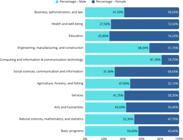
Studies on gendered socialization processes, particularly during the early years of life, have proven fundamental to understanding these trajectories. While sons are more encouraged to compete, assert themselves, and explore their environments in ways that develop spatial and analytical skills, daughters tend to be steered toward make-believe play, such as playing with dolls or playing house, that is closely linked to caring for and attending to others, serving as a form of preparation for adult life (Épiphane, 2012).
Are there innate aptitude differences between boys and girls that explain boys’ preference for mathematics? Could the spatial skills that boys strongly develop in early childhood explain this aptitude? Ultimately, sex-based differences do not imply greater or lesser competence in any given field of knowledge (Duru-Bellat, 1994). Career choices stem from long socialization processes through which social agents internalize societal expectations regarding the roles of men and women. According to Mosconi (1998), career choice is more closely tied to the construction of personal identity, selfesteem, and confidence than to preferences or aptitudes. It is also important to note that professional choices result from actors’ objective conditions, with gender among the variables shaping the choice of a profession (Flontino, 2016).
Regarding socialization within the school system, the hidden curriculum reveals nuances in how girls and boys are socialized: boys are generally encouraged to be more autonomous, receive more praise from teachers, and are more often challenged with cognitive tasks central to the learning process-effectively receiving more favorable treatment (Mosconi, 1998; Bourdieu, 2024). Girls, on the other hand, receive more praise for form, such as neatness and organization, than for cognitive performance. Girls are characterized as hardworking, whereas boys are seen as intelligent. These differing approaches influence how these students perceive themselves; it is common to find girls who feel less capable than their peers. These processes progressively shape self-confidence in both boys and girls, thereby strengthening (or undermining) their self-esteem.
Conversely, some studies challenge the notion of docility and submissiveness as inherent female traits, arguing instead that girls feel less compelled to pursue highpaying careers; they are ostensibly free from the heavy pressure weighing on young men, which drives them toward professional success defined by financial gain. If career choice is a vital necessity for young men, is it, for girls, an opportunity for personal fulfillment? According to Épiphane (2012, p. 576, our translation), “These female authors view the low representation of young women in mathematics and physics not so much as the result of self-exclusion, but rather as a positive stance on their part: they are more open-minded and face less pressure to achieve social success than boys.”
Other studies attribute girls’ avoidance of the exact sciences to a clear-eyed pragmatism, a keen sense of power dynamics, and a drive for self-preservation as they foresee career obstacles such as the “glass ceiling” and the “crystal labyrinth.” Among these researchers, Marie Duru-Bellat asserts that girls make sensible choices; their strategies are conscious and rational, grounded in an understanding of the situation’s underlying logic (Duru-Bellat, 1994; Épiphane, 2012).
3 ENGINEERING PROGRAMS AT UNIVERSITIES AND FEDERAL INSTITUTES (2014-2023)
In line with trends in Brazilian higher education, the 2000s saw an expansion of engineering programs, driven by the private sector. The programs that expanded the most were those with the highest labor market demand, such as Civil, Electrical, Production, and Mechanical Engineering. The expansion of these programs within private institutions reflects a search for secure investments, aimed at minimizing the risks associated with launching programs that attract little interest. In contrast, the public sector expanded to a lesser extent, maintaining a more balanced distribution across the various specializations (Rodrigues, 2023).
Analyzing the expansion of engineering programs in Brazil using CENSUP microdata for the 2011-2017 period, Rodrigues (2023) indicates that the five specializations with the highest number of graduates in 2011 were: Civil Engineering (16.8%), Production Engineering (18.6%), Electrical Engineering (13%), Mechanical Engineering (10.7%), and Environmental Engineering (7.8%). In 2017, the figures were: Civil Engineering (38.1%), Production Engineering (16.7%), Mechanical Engineering (11.5%), Electrical Engineering (9.3%), and Environmental Engineering (5.8%). For Rodrigues (2023, p. 16, our translation), these data reveal that “the dynamics of expansion were concentrated in a few engineering fields, mainly Civil, Production, Electrical, and Mechanical Engineering.” Regarding the public sector, expansion was more limited but more evenly distributed across institutions; in 2011, 41% of engineering graduates came from the public sector. By 2017, this figure had dropped to 18.3%, with the private sector accounting for 81.7% of engineering graduates. Regarding the concentration of graduates across specializations, Rodrigues uses the term isomorphism to describe the trend of private institutions increasingly concentrating their offerings in the most popular engineering fields.
Federal universities and institutes underwent significant expansion starting in 2007. Universities participated in the Federal Universities Expansion and Restructuring Program (REUNI), which aimed to expand access to these institutions and democratize them. Federal institutes, meanwhile, were established by Law No. 11.892 of December 29, 2008. This legislation created 38 Federal Institutes of Science, Education, and Technology and numerous campuses across various regions of the country, thereby expanding the reach and coverage of Brazil’s Federal Vocational Education Network. According to the 2023 Census, there are 41 Federal Higher Education Institutions (IFEs) and Federal Centers for Technological Education (CEFETs) in Brazil. Table 1 illustrates these higher education institutions:
4 PRESENTATION AND DISCUSSION OF RESULTS
In light of this study’s objective, we analyze CENSUP microdata for 2014 and 2023, the latter being the most recent data available at the time of writing. The data were organized in Excel and subsequently filtered to select only Engineering programs offered by federal universities and federal institutes of education, science, and technology, including CEFETs. The analysis used Descriptive statistics.
In 2014, there were 850 Engineering programs across federal universities and institutes. By 2023, this figure had risen by 36%, reaching 1,157 undergraduate programs. At UNIFEI and UFMG, the number of programs remained unchanged at 23 and 147, respectively. Among the ten most common Engineering programs at federal universities and institutes are Civil, Mechanical, Electrical, and Production Engineering, with results similar to those observed in private institutions, as discussed by Rodrigues (2023). The ten most common specializations among IFEs are detailed in Graphs 2 and 3:


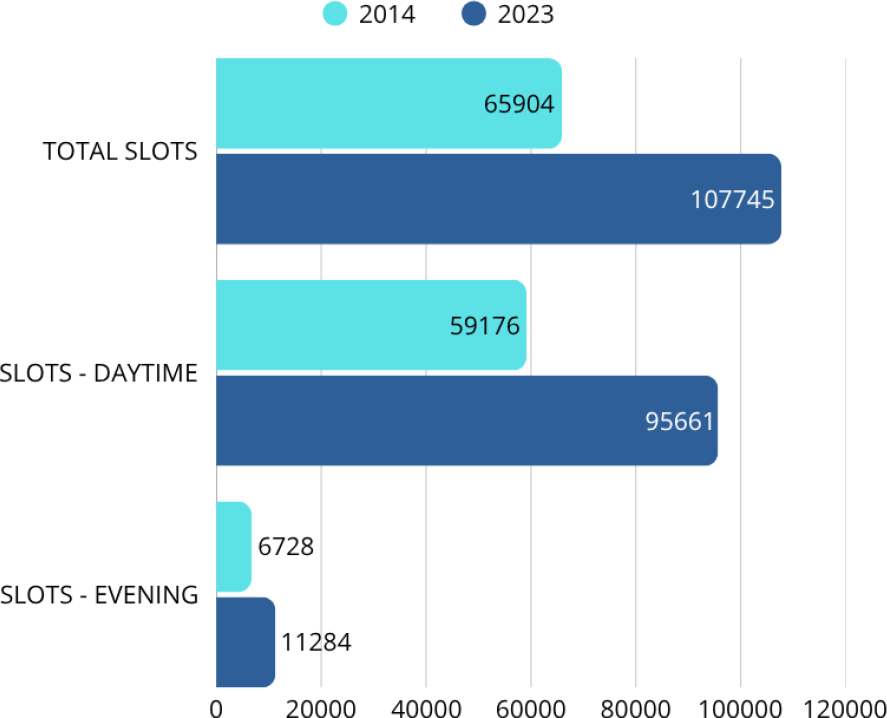
Regarding the number of slots, there were 65,904 in 2014, rising to 107,745 in 2023: a 63% difference. Most were available during the daytime (59,176), while 6,728 were available for the evening. By 2023, these figures had shifted to 95,661 for daytime and 11,284 for the evening. It is important to highlight that one of the objectives of the REUNI program was to expand course offerings and evening slots to make use of university infrastructure, while also enabling the enrollment of working students, a key aspect of democratizing access.
At UFMG, the total number of total slots jumped from 1,201 to 2,262; at UNIFEI, it decreased from 2,620 to 2,241, a 15% difference. Evening slots at UFMG rose from 197 to 301; UNIFEI does not offer evening slots.
Regarding the number of applicants, in 2014, there were 1,077,774 for the various Engineering programs. In 2023, this figure dropped to 319,475 applicants. In the “Applicants for new slots” category, the number fell from 1,059,078 (2014) to 294,802 (2023), meaning the national ratio of candidates per slot fell from 21.6 to 4.42. UFMG8 and UNIFEI also saw a reduction in the number of applicants.
These data reveal that a rise in available slots and engineering programs was not followed by an increase in the number of applicants. When comparing this to the number of new entrants, the rate of increase does not correspond to an increase in the number of available slots.
For comparison, using data covering all fields in the CENSUP dataset, there were 3,110,848 new entrants across all undergraduate programs in 2014. In 2023, this figure stood at 4,993,992. Focusing solely on public institutions, the number shifted from 547,510 in 2014 to 569,089 in 202310.
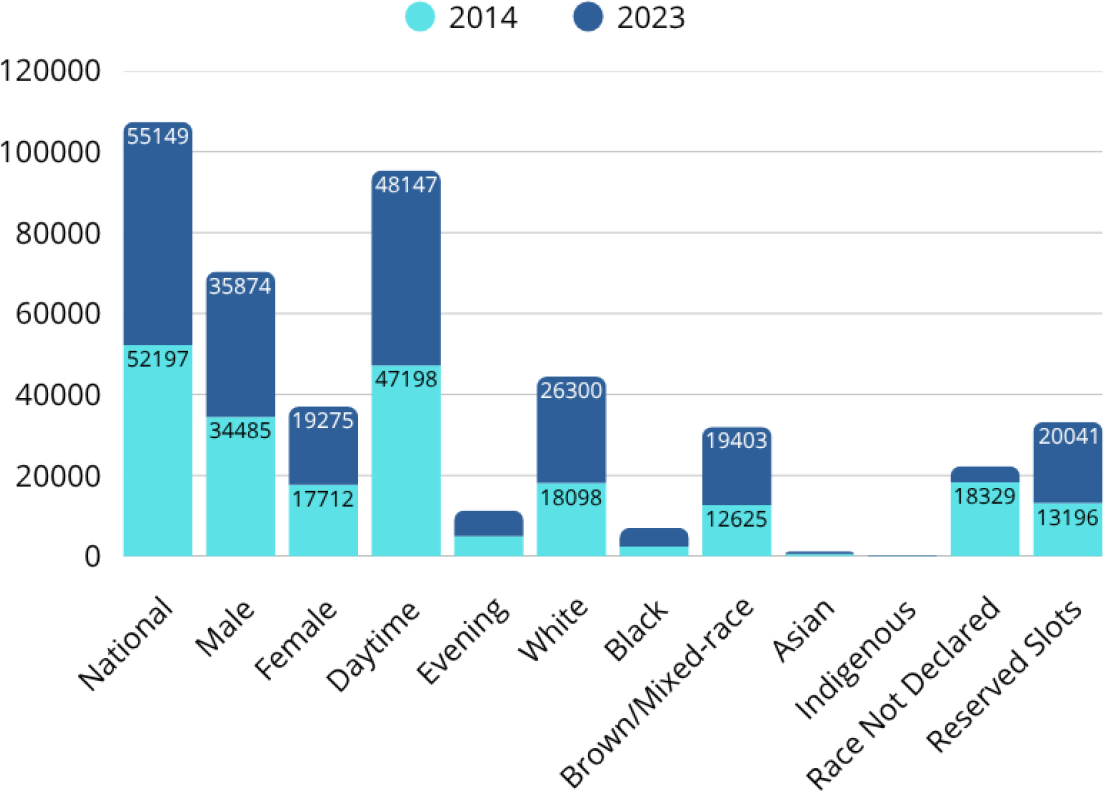
While the number of available slots increased by 63%, the number of new entrants fluctuated by about 6%. Students admitted through reserved-quota programs accounted for 25% of the total in 2014 and 36% in 2023. The percentage of Black and Brown new entrants rose from 28% to 43%, a result driven by the implementation of the quota policy, which requires all federal institutions to reserve 50% of their slots for students who completed their entire high school education in public schools, specifically prioritizing Black, Brown, quilombola, Indigenous, and disabled students8.
While the Quota Law also covers Indigenous students, their representation remains extremely low and has changed little, rising from 0.19% in 2014 to 0.35% in 2023. Across all undergraduate programs, CENSUP 2023 data reveal that 74.2% of the new slots offered by IFEs were filled. By way of example, the enrollment rate for Mechanical Engineering at public Higher Education Institutions (IESs) is 79.1%, compared to 96.6% for Medicine and 84.9% for Law.
Regarding female representation9, the figure rose from 33% to 34% over a decade. The program10 with the highest number of female new entrants was Biochemical Engineering (67.74%), while the most male-dominated program in 2014 was Acoustic Engineering (7.31% female). In 2023, the program with the highest female representation in the field was Biotechnology Engineering (70.83%), and the most male-dominated was Electronic Engineering (17.49% female).
Regarding data for UNIFEI and UFMG, UFMG saw a 17% increase in new entrants, and UNIFEI saw a 19% decrease. At UFMG, Black and Brown/Mixed-race students accounted for 35% of new entrants in 2014 and 41% in 2023; at UNIFEI, the figure shifted from 27% to 19%, a trend opposite to that observed at UFMG. Regarding reserved slots, UFMG saw the percentage of new entrants admitted through reserved quotas rise from 23% to 41% in 2023, while at UNIFEI, the figure went from 23% to 37%. Regarding female representation, the proportion at UFMG changed from 33% to 35%, and at UNIFEI, from 26% to 30%.
These data confirm the effectiveness of the Quota Law in significantly shifting the social profile of students at federal universities and institutes, making campuses more diverse and representative of a broader range of racial backgrounds. However, the decline in the number of new entrants raises a red flag. At UNIFEI, for instance, the number of new entrants, including Black and Brown/Mixed-race individuals, has dropped, even though the proportion of students admitted via the quota system rose from 23% to 37%. Could the political, economic, and institutional crisis Brazil has faced since 2016 help explain the difficulties the population faces in accessing higher education?11 What institutional factors account for the difference between UNIFEI and UFMG, given that the former specializes in Engineering?
UNIFEI does not offer evening classes; all its programs run on a full-time schedule, which may contribute to the observed data. Could this, combined with UFMG’s more robust student assistance policies and its academic prestige, hold the key to the explanation? It is also worth noting that UNIFEI only implemented the affirmative action policies mandated by the Quota Law starting in 2013, whereas UFMG had already been offering bonus points on entrance exam scores to public school students since 200915. Regarding female representation, both institutions show a slight increase in the number of women in Engineering programs.
As for enrollment indicators in Engineering programs nationwide, there has been a 23% increase in the number of students at federal universities and institutes- from 191,053 to 235,158. Through enrollment and graduation figures, we can better understand the Quota Law’s impact on student diversity in Engineering fields. Looking at enrollment figures broken down by various characteristics, we see an increase in the percentage of Black and Brown/Mixed-race students from 24% to 44%. Regarding students admitted through affirmative action policies, the figure rose from 15% to 37%. Graph 5 summarizes the national enrollment data:

Among enrolled students, female representation remained at 33% between 2014 and 2023. When analyzed by degree program, the engineering field with the highest female presence in 2014 was Food Engineering (71.76%), while in 2023, it was Biotechnology (70.37%). The programs with the highest male representation were Computer Engineering in 2014 (11.95% female) and Automotive Engineering in 2023 (10.48% female).
Regarding student demographics at UFMG and UNIFEI, the proportion of women rose from 29% to 33% and from 26% to 28%, respectively. As for Black and Brown/Mixed-race students, the figures increased from 33% to 40% at UFMG and from 18% to 29% at UNIFEI. Enrollments through affirmative action quotas at both institutions followed the national trend, improving the diversity of the student body’s social profile, rising from 8% to 38% at UNIFEI and from 22% to 44% at UFMG. It is worth noting that UFMG already had affirmative action policies in place before the enactment of the Quota Law. At UFMG, there were 5 Indigenous students in 2014 and 6 in 2023. At UNIFEI, there were two Indigenous students in engineering programs, according to the 2023 census.
Finally, it is worth highlighting a decrease in the number of enrolled students at UFMG, dropping from 6,120 in 2014 to 5,852 in 2023, whereas UNIFEI saw an increase from 4,501 to 5,512. It remains to be determined what proportion of this figure consists of students making normal progress versus those who have accumulated course failures, thereby delaying degree completion: a common situation in Engineering programs. Table 4 summarizes the enrollment data for both institutions:
Regarding national data on graduates, the following aspects are observed: a slight positive shift in the proportion of women, rising from 33% to 35%; a significant increase in Black and Brown/Mixed-race individuals, rising from 20% to 41%; and a rise in graduates admitted via quota systems, increasing from 6% to 34%. The number of Indigenous graduates was 39 in 2014 and 52 in 2023. It is worth highlighting the significant increase in the total number of graduates, which rose from 15,597 to 24,259. This growth contrasts with a reduction in the number of applicants in 2023 and a 6% variation in the number of new entrants. Regarding female representation by program, in 2014, Biochemical Engineering had the highest female representation (88.8%), while Railway and Subway Engineering, Nuclear Engineering, Information Engineering, and Automotive Engineering had no female representation12. In 2023, Food Engineering had the highest proportion of female students (67.82%), while Computer Engineering (National Curriculum Guideless Computing) had the lowest (13.53%).
The increase in graduates may reflect the success of enrolled students, who may be benefiting from expanded slots and the implementation of affirmative action policies. However, recent data indicate that Engineering programs face low competition for admission. It is also important to note that the number of graduates is significantly lower than the number of new entrants and currently enrolled students, indicating weaknesses in the academic trajectory. Graph 6 summarizes the data regarding Engineering graduates.


At UFMG and UNIFEI, data on graduates also align with the national trend, showing a significant presence of Black and Brown/Mixed-race individuals, as well as those admitted through affirmative action quotas. It is worth noting that at UNIFEI in 2023, 35% of all graduates were Black or Brown/Mixed-race, whereas in 2014, this figure was 9%. It should also be noted that there are no Indigenous graduates at either institution.
While Biochemical, Biomedical, Biosystems, Food, and Bioprocess Engineering programs continue to show significant female representation, the figures declined between 2014 and 2023, potentially indicating a trend of waning female interest in these specializations. In Biochemical and Biosystems Engineering, the percentage of female graduates dropped by nearly 35% compared with 2014. The programs with the highest female presence are the newer specializations (Bioprocess, Biochemical, Food, Environmental, and Sanitary Engineering), i.e., engineering fields linked to biology and environmental stewardship. Their work environments tend to be laboratory-based, in contrast to the settings of large-scale construction projects, which often involve adverse sanitary conditions and may require relocation.
At the same time, we are observing, albeit modestly, a greater presence of women in traditionally male-dominated fields: in 2023, the proportion of female graduates in Aeronautical Engineering rose from 9.09% to 20.68%. Similar trends are evident in Electronic Engineering (from 13.00% to 20.99%) and Transport Engineering (from 10% to 26.66%). The data suggest a slow, upward trend in female representation in more technology-focused fields.
5 FINAL CONSIDERATIONS - THE “SUBTLE IMPROVEMENT” IN FEMALE PARTICIPATION: PROGRESS OR ILLUSION?
Engineering programs at universities and federal institutes reflect the broader trend in Brazilian higher education: a modest increase in the number of incoming students and a diversification of their social profiles, driven by the effectiveness of affirmative action policies. Regarding female representation, a positive upward trend is evident, though it remains far from mirroring the national landscape or achieving the gender parity, or even reversal, seen in other fields. Key indicators from the last decade are summarized in Graph 8.

Female representation across degree programs showed little variation over a decade. Women are better represented in Environmental Engineering, Food Engineering, and other specializations at the intersection of biology and engineering. This affinity for biology seems to reflect a relationship with knowledge often found in women’s academic profiles: meticulous research, attention to detail, and a concern for life. Do these programs, which require less mathematical knowledge, favor women’s choices? Future analysis could determine whether a correlation exists between curricular structure and specialization choice.
It is important to note that, while there is greater representation of Black and Brown/Mixed-race individuals, this increase does not guarantee equity. University expansion, alongside affirmative action policies, has proven vital for democratizing access to and retention in higher education. However, economic cycles and political vulnerabilities, such as in Brazil, where many institutions have yet to consolidate policies to support student retention, create barriers to genuine democratization. The much-anticipated academic restructuring envisioned under the REUNI program also proved ineffective; in Engineering, for instance, evening programs, a locus for diversifying the student body to include working students, expanded less than daytime and full-time programs did.
The results show that, despite a modest increase in the number of female Engineering graduates, the change was minimal in traditional fields: female participation rose from 31.02% to 37.22% in Civil Engineering, from 15.38% to 19.77% in Electrical Engineering, and from 12.19% to 15.61% in Mechanical Engineering. Consequently, the field remains disproportionately male, particularly in its most traditional specializations. We can infer that the limitations on this progress stem from the improvement being insufficient, given the slow pace of change; growth over the decade was marginal, pointing to structural resistance. The concentration in “feminized” fields suggests that women tend to seek out engineering areas associated with care-oriented stereotypes, thereby reproducing the gendered division of labor.
Thus, we conclude that achieving gender equity remains a distant goal, owing to the persistence of a “vicious cycle.” Low female representation persists, reinforced by confirmation bias: male predominance is perceived as “natural,” which in turn justifies the absence of inclusion policies. We also note a lack of institutional incentives, as few universities offer mentorship programs for girls in STEM or include genderrelated topics in their curricula; i.e., there is little consideration of how to integrate these discussions into the courses and activities that make up a degree program. The underrepresentation of women in engineering is neither a historical accident nor a biological inevitability; rather, it is the result of social structures that continue to assign women to the domestic sphere and men to the realm of technical expertise.
-
4
As the study involved human subjects, it was submitted to and approved by the UFMG Ethics Committee as per Opinion No. 7,333,318.
-
5
Among these initiatives, we can highlight the Futuras Cientistas (Future Female Scientists) Program, linked to the Ministry of Science, Technology, and Innovation (MCTI), which aims to encourage female students to pursue careers in science, engineering, technology, and mathematics. The Asas para o Futuro (Wings for the Future) Program, also linked to the MCTI, aims to increase the participation of socially vulnerable women aged 15 to 29 in the technology, energy, infrastructure, logistics, transport, science, and innovation sectors. In March 2024, the MCTI, in partnership with the National Council for Scientific and Technological Development (CNPq), launched a call for proposals worth 100 million reais aimed at the inclusion of women in science, technology, and engineering.
-
6
Based on data from the National High School Exam (ENEM), Schwartzman (2025) shows that women achieve better results in languages, while men perform better in mathematics.
-
7
In the case of UFMG, eleven degree programs are offered by the School of Engineering in Belo Horizonte, and three in the city of Montes Claros. At UNIFEI, nine programs are offered at the campus in the city of Itabira, and the remainder in the city of Itajubá.
-
8
The first semester of 2014 marked UFMG’s debut in the Unified Selection System (SiSU) as an admission method for its undergraduate programs. That year, the average ratio of candidates to available slots across all programs was 52.65. Available at https://www.ufmg.br/sisu/wpcontent/uploads/2023/01/Inscricoes-vagas-1-2014.pdf. Accessed on: May 21, 2025.
-
9
This calculation was based on the total number of applicants for new slots relative to the total number of new slots offered.
-
10
Regarding undergraduate data across the entire higher education sector, according to INEP (2024b, p. 15): “Between 2013 and 2023, the number of new entrants declined (-24.6%) in in-person undergraduate programs, while increasing by 543.1% in distance learning programs.”
-
8
The Quota Policy was established by Law No. 12.711/2012, which reserves 50% of places at federal universities and institutes for students from public schools. Within this 50% allocation, the law also mandates reserved spots for Black, Brown, Indigenous, and quilombola individuals, as well as for lowincome individuals and people with disabilities.
-
9
CENSUP uses the “sex” variable divided into two categories: female and male.
-
10
Here, we consider the "Program Name" variable, based on an adaptation of the International Standard Classification of Education (ISCED/UNESCO), specifically the NO_CINE_ROTULO field in Portuguese, to identify the program names.
-
11
Since 2016, the number of participants in the National High School Exam (ENEM) has declined, dropping from 6,136,000 in 2016 to 2,740,000 in 2023 (Inep, 2024c). Key factors in the national landscape include the impeachment of President Dilma Rousseff in 2016 and the implementation of the Spending Cap in 2017, which, among other consequences, led to reduced public investment in federal universities and institutes. Finally, the 2020 COVID-19 pandemic was a major aggravating factor amid Brazil’s political and economic fragility.
-
15
In 2009, the UFMG University Council established the institution’s first affirmative action policy: a bonus of up to 10% on the entrance exam score for students who had attended public schools for their entire high school education and for at least the final four years of elementary/middle school. Additionally, candidates who self-identified as Black or Brown received an extra 5% bonus (UFMG University Council, Resolution No. 3/2008).
-
12
In these courses, the number of graduates was also low: Railway and Subway Engineering (2), Nuclear Engineering (8), Information Engineering (3), and Automotive Engineering (16).
-
13
Affirmative action policies were implemented at UNIFEI in 2013, following the enactment of the Quota Law. Consequently, in 2014, there were no graduating students who had benefited from this policy.
AI USAGE STATEMENT
The following Generative Artificial Intelligence tool was used to assist with text revision during the preparation of this article: ChatGPT.
DATA AVAILABILITY STATEMENT
The entire dataset supporting the results of this study was made available by INEP and can be accessed at https://www.gov.br/inep/pt-br/acesso-a-informacao/dadosabertos/microdados/censo-da-educacao-superior
References
-
ALMEIDA, Nuzyare Moura de. A sub-representação de mulheres no ingresso à educação superior brasileira em ciências, tecnologias, engenharias e matemática (CTEM) neste século 2020. Dissertação (Mestrado em Desenvolvimento e Cooperação Internacional) - Instituto Superior de Economia e Gestão, Universidade de Lisboa, Lisboa, 2020. Disponível em: https://repositorio.ulisboa.pt/entities/publication/ddee1bdf-f666-4377-87abd5411f16fe66
» https://repositorio.ulisboa.pt/entities/publication/ddee1bdf-f666-4377-87abd5411f16fe66 - BOURDIEU, Pierre. A dominação masculina: a condição feminina e a violência simbólica. Rio de Janeiro: Bertrand Brasil, 2024.
-
CARVALHO, Rayana Andrade de. Uma análise da permanência acadêmica em cursos de predomínio feminino e masculino da Universidade Federal da Paraíba 2018. Dissertação (Mestrado em Educação) - Universidade Federal da Paraíba, João Pessoa, 2018. Disponível em: https://repositorio.ufpb.br/jspui/handle/123456789/13096 Acesso em: 13 jun. 2026.
» https://repositorio.ufpb.br/jspui/handle/123456789/13096 - CHARLOT, Bernard. Da relação com o saber: elementos para uma teoria. Porto Alegre: Artmed, 2000.
- CHARLOT, Bernard. A relação com o saber e a discriminação de gênero na escola. In: MARREIRO, Adriana; MALLADA, Natalia. La universidad transformadora: elementos para una teoría sobre educación y género. Montevideo: CSIC - Universidad de la República, 2009. p. 119-128.
- CHARLOT, Bernard. Da relação com o saber às práticas educativas São Paulo: Cortez, 2013.
-
CARVALHO, Rayana Andrade de. Uma análise da permanência acadêmica em cursos de predomínio feminino e masculino da Universidade Federal da Paraíba. 2018. Dissertação (Mestrado em Educação) - Programa de Pós-Graduação em Educação, Universidade Federal da Paraíba, João Pessoa, 2018. Disponível em: https://repositorio.ufpb.br/jspui/handle/123456789/13096 Acesso em: 04 mar. de 2025.
» https://repositorio.ufpb.br/jspui/handle/123456789/13096 - COELHO, Edmundo Campos. As profissões imperiais: medicina, engenharia e advocacia no Rio de Janeiro (1822-1930). Rio de Janeiro: Record, 1999.
-
DURU-BELLAT, Marie. Filles et garçons: l’école, approches sociologiques et psychosociales. Revue Française de Pédagogie, Lyon, v. 109, p. 111-141, 1994. Disponível em: https://www.persee.fr/doc/rfp_0556-7807_1994_num_109_1_1250
» https://www.persee.fr/doc/rfp_0556-7807_1994_num_109_1_1250 - ÉPIPHANE, Dominique. Meninas (educação das). In: VAN ZANTEN, Agnès (coord.). Dicionário da educação Petrópolis: Vozes, 2012. p. 575-579.
- FLONTINO, Sandra Regina Dantas. Profissão para homem?: a escolha feminina por cursos de recrutamento majoritariamente masculino na UFMG. 2016. Dissertação (Mestrado em Educação) - Faculdade de Educação, Universidade Federal de Minas Gerais, Belo Horizonte, 2016.
-
FRANCISCO, Rayza Alexandra Aleixo. Elas nas engenharias: construção da carreira e identidade profissional de mulheres estudantes da UFSC. 2021. Dissertação (Mestrado em Psicologia) - Centro de Filosofia e Ciências Humanas, Universidade Federal de Santa Catarina, Florianópolis, 2021. Disponível em: https://repositorio.ufsc.br/handle/123456789/222089 Acesso em: 23 fev. 2026.
» https://repositorio.ufsc.br/handle/123456789/222089 -
INSTITUTO BRASILEIRO DE GEOGRAFIA E ESTATÍSTICA (IBGE). Censo 2022: proporção da população com nível superior completo aumenta de 6,8% em 2000 para 18,4% em 2022. Agência de notícias do IBGE, Rio de Janeiro, 2023. Disponível em: https://agenciadenoticias.ibge.gov.br/agencia-noticias/2012-agencia-denoticias/noticias/42742-censo-2022-proporcao-da-populacao-com-nivel-superiorcompleto-aumenta-de-6-8-em-2000-para-18-4-em-2022 Acesso em: 22 maio 2025.
» https://agenciadenoticias.ibge.gov.br/agencia-noticias/2012-agencia-denoticias/noticias/42742-censo-2022-proporcao-da-populacao-com-nivel-superiorcompleto-aumenta-de-6-8-em-2000-para-18-4-em-2022 -
INSTITUTO NACIONAL DE ESTUDOS E PESQUISAS EDUCACIONAIS ANÍSIO TEIXEIRA (Inep). Microdados do Censo da Educação Superior 2014 Brasília, DF: Inep, 2015. Disponível em: https://www.gov.br/inep/pt-br/acesso-a-informacao/dadosabertos/microdados/censo-da-educacao-superior Acesso em: 7 fev. 2025.
» https://www.gov.br/inep/pt-br/acesso-a-informacao/dadosabertos/microdados/censo-da-educacao-superior -
INSTITUTO NACIONAL DE ESTUDOS E PESQUISAS EDUCACIONAIS ANÍSIO TEIXEIRA (Inep). Resumo técnico: Censo da Educação Superior 2014. Brasília, DF: Inep, 2017. Disponível em: https://download.inep.gov.br/download/superior/censo/2014/resumo_tecnico_censo_educacao_superior_2014.pdf Acesso em: 7 fev. 2025.
» https://download.inep.gov.br/download/superior/censo/2014/resumo_tecnico_censo_educacao_superior_2014.pdf -
INSTITUTO NACIONAL DE ESTUDOS E PESQUISAS EDUCACIONAIS ANÍSIO TEIXEIRA (Inep). Microdados do Censo da Educação Superior 2023 Brasília, DF: Inep, 2024a. Disponível em: https://www.gov.br/inep/pt-br/acesso-a-informacao/dadosabertos/microdados/censo-da-educacao-superior Acesso em: 7 fev. 2025.
» https://www.gov.br/inep/pt-br/acesso-a-informacao/dadosabertos/microdados/censo-da-educacao-superior -
INSTITUTO NACIONAL DE ESTUDOS E PESQUISAS EDUCACIONAIS ANÍSIO TEIXEIRA (Inep). Censo da Educação Superior 2023: notas estatísticas. Brasília: Inep, 2024b. Disponível em: https://download.inep.gov.br/publicacoes/institucionais/estatisticas_e_indicadores/notas_estatisticas_censo_escolar_2023.pdf Acesso em: 7 fev. 2025.
» https://download.inep.gov.br/publicacoes/institucionais/estatisticas_e_indicadores/notas_estatisticas_censo_escolar_2023.pdf -
INSTITUTO NACIONAL DE ESTUDOS E PESQUISAS EDUCACIONAIS ANÍSIO TEIXEIRA (Inep). Censo da Educação Superior 2023: divulgação dos resultados. Brasília: Inep, 2024c. Disponível em: https://download.inep.gov.br/educacao_superior/censo_superior/documentos/2023/apresentacao_censo_da_educacao_superior_2023.pdf Acesso em: 10 fev. 2025.
» https://download.inep.gov.br/educacao_superior/censo_superior/documentos/2023/apresentacao_censo_da_educacao_superior_2023.pdf -
LINS, Leonardo Melo. A construção institucional da engenharia nacional: proteção, incentivos e escassez. 2018. Tese (Doutorado em Sociologia) - Faculdade de Filosofia, Letras e Ciências Humanas, Universidade de São Paulo, São Paulo, 2018. Disponível em: https://teses.usp.br/teses/disponiveis/8/8132/tde-18012019-124823/pt-br.html Acesso em: 23 fev. 2025.
» https://teses.usp.br/teses/disponiveis/8/8132/tde-18012019-124823/pt-br.html -
LOMBARDI, Maria Rosa. Perseverança e resistência: a Engenharia como profissão feminina. 2005. Tese (Doutorado em Educação) - Faculdade de Educação, Universidade Estadual de Campinas, Campinas, 2005. Disponível em: https://repositorio.unicamp.br/acervo/detalhe/333938
» https://repositorio.unicamp.br/acervo/detalhe/333938 -
MATA, Ana Flávia Martins da. Estado do conhecimento sobre a presença de mulheres nos cursos de Engenharia em artigos científicos (2008-2018) 2020. Dissertação (Mestrado em Educação) - Universidade Federal de Lavras, Lavras, 2020. Disponível em: https://educapes.capes.gov.br/handle/capes/1166488
» https://educapes.capes.gov.br/handle/capes/1166488 - MOSCONI, Nicole. Diferencia de sexos y relación con el saber Buenos Aires: Ediciones Novedades Educativas del Centro de Publicaciones Educativas y Material Didáctico, 1998.
-
NASCIMENTO, Jaqueline Dourado do. Mulheres nos cursos de Engenharia da UFBA: um estudo sobre o acesso e desempenho. 2017. Tese (Doutorado em Educação) - Faculdade de Educação, Universidade Federal da Bahia, Salvador, 2017. Disponível em: https://repositorio.ufba.br/handle/ri/24257
» https://repositorio.ufba.br/handle/ri/24257 - RIBEIRO, Carlos Antônio Costa; SCHLEGEL, Rogério. Estratificação horizontal da educação superior no Brasil (1960 a 2010). In: ARRETCHE, M. (org.). Trajetórias das desigualdades: como o Brasil mudou nos últimos cinquenta anos. São Paulo: Editora Unesp; CEM, 2015. p. 133-162.
-
RODRIGUES, Leonardo Augusto Lopes. A expansão desigual das Engenharias na educação superior brasileira (2011-2017). Avaliação: Revista da Avaliação da Educação Superior, Campinas; Sorocaba, v. 28, e023029, 2023. Disponível em: https://www.scielo.br/j/aval/a/JdT9R9kK6gB3Pj6gN5xv4sD/ Acesso em: 23 fev. 2025.
» https://www.scielo.br/j/aval/a/JdT9R9kK6gB3Pj6gN5xv4sD/ -
ROSEMBERG, Fúlvia. Educação formal, mulher e gênero no Brasil contemporâneo. Revista Estudos Feministas, Florianopólis, v. 9, n. 2, p. 515-540, 2001. Disponível em: https://www.scielo.br/j/ref/a/3N8v5K9t7R6Y7qXzjv9y4nH/ Acesso em: 23 fev. 2025.
» https://www.scielo.br/j/ref/a/3N8v5K9t7R6Y7qXzjv9y4nH/ -
SILVA, Monick Alexandre da. Análise dos fatores determinantes do gênero feminino nos cursos de Engenharia: uma perspectiva da UFRN e escolas. 2015. Dissertação (Mestrado em Engenharia de Produção) - Centro de Tecnologia, Universidade Federal do Rio Grande do Norte, Natal, 2015. Disponível em: https://repositorio.ufrn.br/items/0f31d608-b737-45c9-92f8-ceb9b9e52740
» https://repositorio.ufrn.br/items/0f31d608-b737-45c9-92f8-ceb9b9e52740 -
SCHWARTZMAN, Simon. Notas sobre a feminização do ensino superior brasileiro. Site Simon Schwartzman, 2025. Disponível em: https://www.schwartzman.org.br/sitesimon/nota-sobre-a-feminizacao-do-ensinosuperior-brasileiro/ Acesso em: 15 mar. 2025.
» https://www.schwartzman.org.br/sitesimon/nota-sobre-a-feminizacao-do-ensinosuperior-brasileiro/ -
VARGAS, Hustana Maria. Sem perder a majestade: “profissões imperiais” no Brasil. Estudos de Sociologia, Araraquara, v. 15, n. 28, p. 107-124, 2010. Disponível em: https://periodicos.fclar.unesp.br/estudos/article/view/2553/2173
» https://periodicos.fclar.unesp.br/estudos/article/view/2553/2173
-
Section Editor:
Rafael Ângelo Bunhi Pinto | Layout Editor: Silmara Pereira da Silva Martins

 Source:
  Source: Authors’ own elaboration.
 Source: Authors’ own elaboration.
 Source: Authors’ own elaboration.
 Source: Authors’ own elaboration.
 Source: Authors’ own elaboration.
 Source: Authors’ own elaboration.
 Source: Authors’ own elaboration.