 First Comparative Study of the Microbiota of Cheese and Associated Cheese Mites
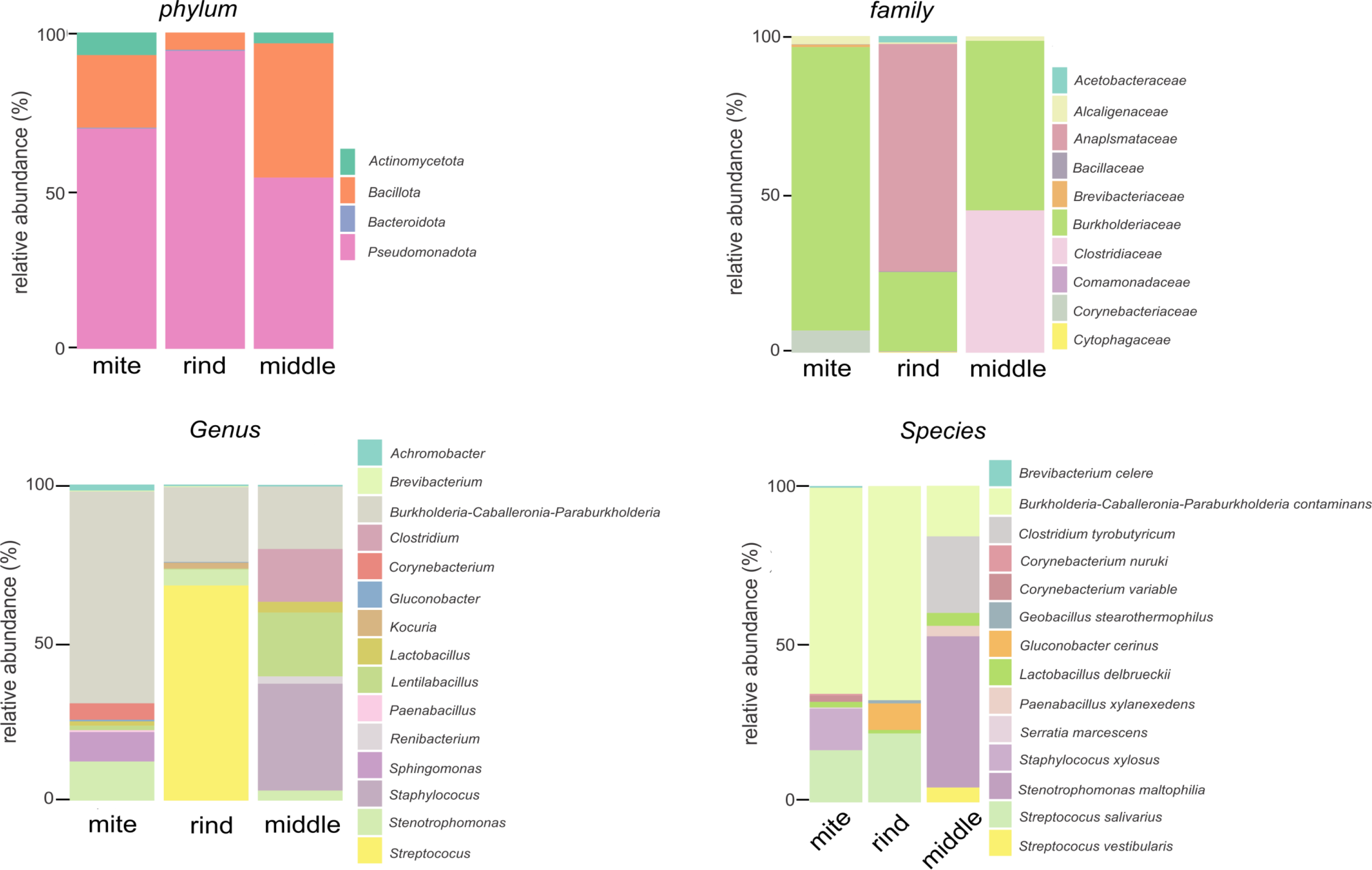
Mites are arachnids that can infest animals, plants, and stored foods, and in many cases act as vectors of diseases. These small acarids are naturally present in many sites, including cheese-ripening environments. When mycophagous, mites have fungi as their main food source and are therefore attracted to the fungi that develop on cheese surfaces during the ripening. Mites can impart a desirable sensory quality to cheeses, and although arthropod-associated microorganisms play a significant role in host fitness, protecting them from pathogens, little is known about the relationship between the microbiota of mites and cheese. Using metataxonomic analysis, this study aimed at ripening cheeses with autochthonous mites for six months to compare the microbiota of mites with the cheese (rind and core) microbiota. Although mites are seemingly carriers of food pathogens, the results obtained show that Burkholderia-Caballeronia-Paraburkholderia contaminans and Lactobacillus delbrueckii were the bacterial species shared among the intestinal samples of mites, the cheese rind, and the cheese inner. Streptococcus salivarius was the bacterial species shared among the intestinal samples of mites and cheese rind. No potential food pathogens were identified in the mite microbiota interacting with the cheese microbiota. This is the first report of a comparative metataxonomic study of the microbiota of mites and cheese. However, further exploratory analysis may contribute to the findings in demonstrating that mites have the potential to improve the sensory attributes of cheeses without harmful effects.
Keywords:
food safety; cheese ripening; Tyrophagus putrescentiae; metataxonomic analysis.
Burkholderia-Caballeronia-Paraburkholderia contaminant and Lactobacillus delbrueckii were the bacterial species shared among the intestinal samples of mites, the cheese rind, and the cheese inner.
Streptococcus salivarius was the bacterial species shared among the intestinal samples of mites and cheese rind.
Potential food pathogens were not identified in the mite microbiota interacting with cheese microbiota.
 Thumbnail
 Thumbnail