 Does Seed Coating Alter the Physiological Potential of Small-Seeded Native Species Used in Ecological Restoration?
Abstract
Seed coating technologies can enhance germination and seedling vigor, thereby improving the success of direct seeding in ecological restoration. These techniques involve applying protective and bioactive materials to the seed surface to improve performance under field conditions. This study aimed to evaluate the efficacy of different seed coating materials on germination and early seedling development of two native tree species, commonly used in ecological restoration: Guazuma ulmifolia Lam. and Mimosa bimucronata (DC.) Kuntze. Eight treatments were tested, comprising three coating techniques and an uncoated control. For pelleting, coating mass, agricultural limestone, potassium silicate, and gypsum were used. Film coating included drying powder with graphite and without finishing agent, and encapsulation involved sodium alginate and copper sulfate. The experiment followed a completely randomized design with ten replicates of 30 seeds, totaling 2,400 seeds per species. Pelleting and film coating did not significantly affect germination or early development, although responses varied depending on the species and materials used. In M. bimucronata, pelleting with limestone promoted the greatest root length. In G. ulmifolia, pelleting with gypsum delayed germination, while potassium silicate pellets yielded the most uniform germination speed. Encapsulation reduced germination percentages in both species. Overall, pelleting and film coating show potential as viable techniques for enhancing seed performance in ecological restoration efforts.
Keywords:
Germination; Direct seeding; Pelleting; Encapsulation; Seedlings; Seed Technology.
HIGHLIGHTS
• Pelleting and film coating do not impair germination of native tree species.
• Encapsulation with alginate and copper sulfate significantly reduces germination.
• Pelleting with agricultural limestone enhances root growth.
• Agricultural gypsum and potassium silicate promote more uniform germination speed.
INTRODUCTION
The global effort to restore degraded ecosystems has gained momentum in recent years, driven by urgent environmental and socio-economic concerns. In recognition of this need, the United Nations (UN) declared 2021-2030 the Decade on Ecosystem Restoration, prompting countries to adopt international commitments and implement large-scale ecological restoration initiatives [1-4]. Among the available techniques, direct seeding has emerged as a cost-effective and scalable method for restoring native vegetation [5-7]. However, it faces challenges such as low establishment and survival rates of species in the field [8], particularly for species with smaller seeds [9,10], which are more vulnerable to desiccation, limited seedling reserves, and often exhibit lower germination rates and require more precise sowing depth, making field sowing more technically demanding and management-intensive. Additional issues include low emergence [11], seed availability [12,13], and seed quality [14]. Recent research has identified seed wastage and poor early emergence as critical bottlenecks to the success of direct seeding [15], underscoring the need for strategies that improve seedling establishment and reduce seed loss in restoration contexts.
To overcome these challenges, seed enhancement technologies, such as coating, have been increasingly adopted to improve seed performance under field conditions [16-19]. Seed coating involves applying external materials to the seed surface [20], altering its physical properties to improve sowing efficiency by standardizing seed shape, mass, and size [20,21]. Common coating techniques include: (i) pelleting, which incorporates materials that increase seed size and roundness [16,22]; (ii) encapsulation, which uses hydrogels and cross-linking agents like aluminum chloride to form a gel capsule around the seed [23,24]; and (iii) film coating, which applies a thin layer of active ingredients such as agrochemicals or inert powders [17,20].
These techniques can facilitate mechanized sowing, improve seed handling, and synchronize germination and emergence [20]. Additionally, seed coating can improve soil-seed contact, regulate water uptake, and protect seeds from physical and environmental stressors, which are critical factors for enhancing seedling emergence in direct seeding systems, especially for small-seeded species [18]. The effectiveness of seed coating depends largely on the choice of coating materials, which can significantly influence seed vigor and germination performance [25]. Materials such as mineral powders, bio-stimulants, and pesticides have been explored for their potential to enhance seedling establishment [17,20,23]. However, further research is needed to assess the specific effects of these materials on native tree species commonly used in ecological restoration, in order to inform best practices and optimize treatment protocols.
In this study, we hypothesize that seed germination and vigor are key determinants of successful direct seeding [15,26], and that the efficiency of seed coating for forest species varies depending on the method and material used. Therefore, our objective is to evaluate the effectiveness of different seed coating materials on native tree species, guided by the following question: How can seed coating improve the germination and early development of native tree species used in direct seeding for ecological restoration?
MATERIAL AND METHODS
Criteria, species selection and quality tests
To assess the potential of direct seeding for ecological restoration, we considered two key factors that influence initial plant establishment: the selection of suitable species [15] and their seedling emergence capacity in field conditions [27]. Based on these principles, we used two species with smaller seeds (> 10,000 seeds per kilogram), identified as having low success in direct seeding [10,28]. The selection criteria included (a) species commonly used in direct seeding, (b) species with high laboratory germination rates, and (c) species with small seeds. Based on this, we selected the native forest tree species Guazuma ulmifolia Lam. and Mimosa bimucronata (DC.) Kuntze, native forest tree species.
Both species are pioneer trees recommended for ecological restoration [29], and exhibit germination rates above 50% under laboratory conditions once dormancy is overcome [30,31]. They are also used to restore degraded areas via direct seeding [10,15,32].The seed lots were assembled from nine mother trees of Guazuma ulmifolia Lam. and seven mother trees of Mimosa bimucronata (DC.) Kuntze, all located in the municipality of Promissão, São Paulo State, Brazil (21°21′12″S, 49°49′06″W), within areas of semi-deciduous seasonal forest remnants near the Tietê River reservoir. The seeds of both species were collected between September and October. The seeds were donated by AES Brasil, an energy company that maintains environmental restoration programs in the region, and were used exclusively for scientific research. As the material was obtained through institutional donation, individual herbarium vouchers of the mother trees are not available. The available information on geographic origin and habitat is provided here to ensure transparency and reproducibility regarding the biological source of the seeds. To assess physical quality, purity test, thousand-seed weight, and moisture content were conducted (Table 1) according to the Rules for Seed Analysis [33] and the International Seed Testing Association [34].
Analyses of the initial physical and physiological quality of Guazuma ulmifolia and Mimosa bimucronata seed lots. P%= purity percentage; TSW= Thousand-seed weight (grams); Ns= number of seeds/kg; Mc= Moisture content (%);
Coating process
Seed coating was tested using eight treatments with pelleting, encapsulation, and film coating methods (Table 2). A completely randomized experimental design was employed, with ten replicates per treatment. Each replicate used 30 coated seeds, totaling 300 seeds per treatment and 2,400 seeds per species throughout the experiment.
Dormancy and asepsis of the two species were addressed according to the Instructions for Forest Seed Analysis [35]. These procedures were followed for all treatments. To overcome dormancy in M. bimucronata, seeds were soaked in distilled water at 80°C. After removing the heat source, the seeds remained submerged for 24 hours. G. ulmifolia seeds were immersed in water at 90°C and left for one hour after removing the heat source. Seed asepsis involved soaking in a detergent solution (5 drops of detergent per 100 mL of water), followed by rinsing in running water, immersion in a sodium hypochlorite solution (5% solution of the commercial product, which contains 2.5% active ingredient) for 2 to 5 minutes, and three final rinses in water.
The coating materials were chosen based on their significant attributes for initial plant growth [36,37], as well as their market availability. These included agricultural limestone (CaO-42%; MgO-8%), which acts as a source of calcium and magnesium important for cell wall strength and enzyme activation; potassium silicate (K-10%; Si-25%), a product rich in soluble silicon and potassium, known to enhance plant productivity, improve resistance to biotic and abiotic stresses, and regulate water loss; agricultural gypsum (Ca-18%; S-15%), which provides calcium and sulfur essential for root development and nutrient uptake; and a commercial seed coating mass from Laborsan®. All materials were in powder form. In the pelleting method (T2, T3, T4, and T5), materials were added in a 3:1 ratio, with six grams of each powdered material (coating mass from Laborsan®, agricultural limestone, potassium silicate, and agricultural gypsum) for every two grams of G. ulmifolia seeds, and 7.7 grams of powdered materials for every 2.6 grams of M. bimucronata seeds.
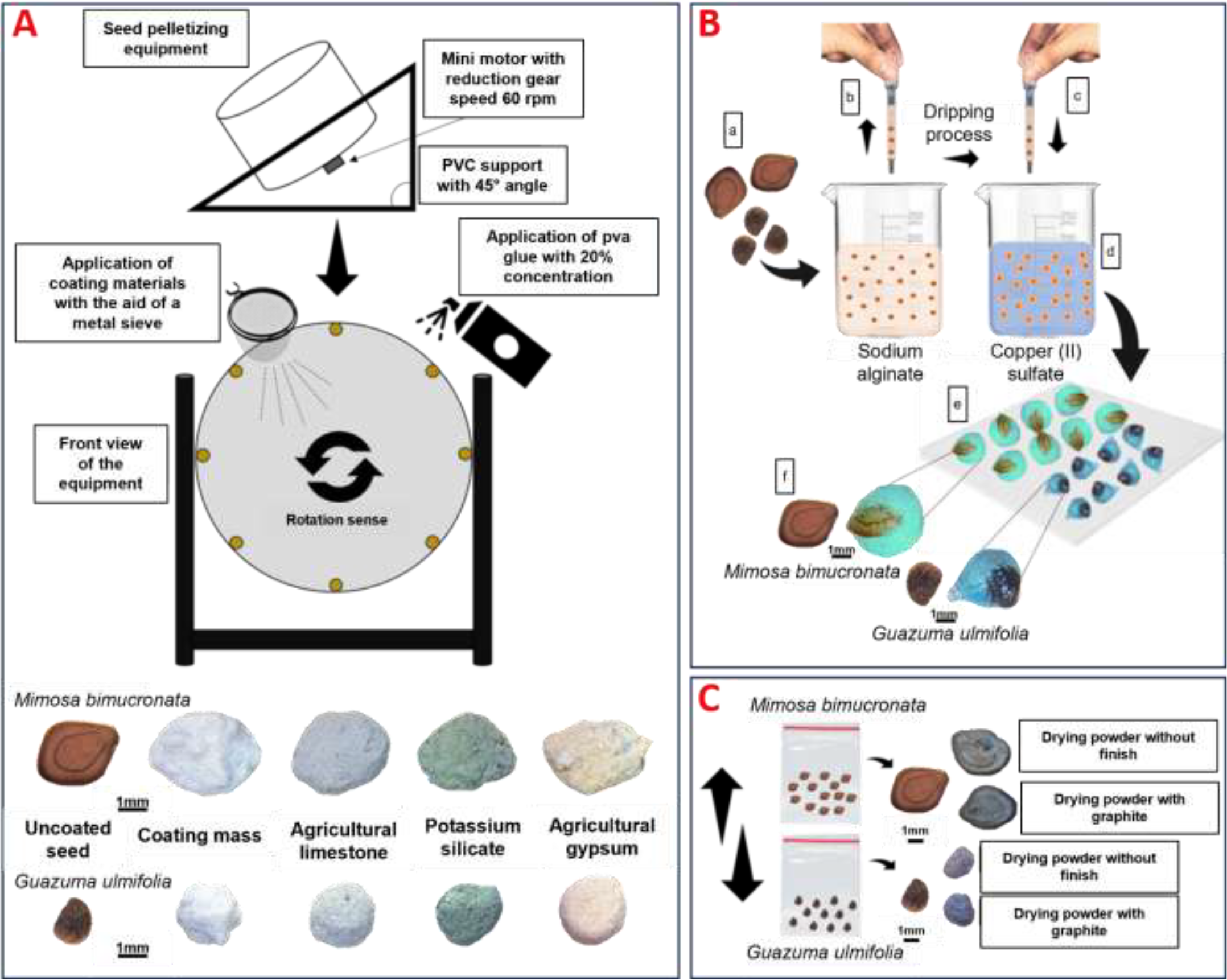
The pelleting process was carried out using a specialized apparatus comprising a rotating container measuring 15 x 20 cm, fitted with a mini-motor equipped with a reduction gearbox and speed control (Figure 1). This container was affixed to a polyvinyl chloride (PVC) pipe structure at a 45º angle. Varnished wooden flaps (0.5 cm x 15 cm) were affixed to the container to facilitate seed movement. Seeds were added to the container, maintaining a rotation speed of 60 rpm. Gradually, seeds were sprayed with an agglutinating material comprising white glue based on PVA (polyvinyl acetate) at a concentration of 20%.

Scheme A: Equipment for pelleting (above) and seeds of Mimosa bimucronata and Guazuma ulmifolia before and after pelleting. Scheme B: Encapsulation process: Mimosa bimucronata and Guazuma ulmifolia seeds (a) were submerged in a container filled with sodium alginate solution and extracted using a pipette (b). These seeds, now coated with alginate, were subsequently immersed in copper sulfate solution using the dripping method (c), resulting in the formation of alginate + copper sulfate capsules (d). After the capsules were formed, they were taken out of the container and laid on filter paper (e) to eliminate excess solution. A comparison between seeds with and without encapsulation (f). Scheme C: The post-drying agent application (film coating technique) for the two species tested. Arrows on the left indicate the agitation movement.
A plastic container with a nozzle opening of 0.5 mm was employed for spraying. The pelleting materials were divided into ten equal parts (six grams and 7.7 grams divided by 10) and added progressively using a sieve with a 1 mm opening. This division of materials allowed for improved aggregation of seed materials during the pelleting process. With each portion of pelleting material added to the seeds, adhesive totaling 3.2 ml was applied by the end of the process. Subsequently, pelleted seeds were dried for 24 hours at room temperature (25-26ºC) upon completion of the process.
To evaluate the effectiveness of encapsulation (T6), we prepared a sodium alginate solution (2% w/v) in distilled water (Figure 1), a commonly used material for seed coating [38]. Seeds were submerged in the alginate solution for one minute and subsequently extracted using a Pasteur pipette. Encapsulation was performed using the dripping method [39], in which the alginate-coated seeds were immersed in a copper (II) sulfate (CuSO₄) solution (1.5% w/v) for 60 minutes to promote ionic cross-linking and capsule formation.
The use of CuSO₄ as a cross-linking agent, instead of the conventional CaCl₂, was based on its dual functionality: copper ions (Cu2⁺) are capable of promoting alginate gelation through coordination with carboxyl groups, forming stable cross-linked structures comparable to those obtained with calcium ions (Ca2⁺), while also conferring antifungal and antimicrobial properties to the encapsulated seeds [40]. The selected concentration (1.5%) and exposure time (60 min) were determined from previous studies that optimized capsule integrity and polymer stability under similar conditions [41,42].
For the film coating process (T7 and T8), two drying powders were utilized, one without a finishing agent (T7) and the other containing graphite (T8) in its composition. These drying powders serve to dry the seeds and enhance their flowability, facilitating improved mechanized sowing. The application process entailed manual handling with the aid of a resealable plastic bag measuring 14x20 cm. Seeds were placed into the bag along with 0.2 grams of each material, and then thoroughly stirred until all the drying powder adhered to the seeds (see Figure 1, scheme 3).
Laboratory tests and data collection
The germination tests were conducted according to the Instructions for Forest Seed Analysis [35]. Seeds from control treatments (uncoated seeds - T1) and seeds subjected to coating treatments (T2, T3, T4, T5, T6, T7, T8) were placed in Petri dishes lined with two sheets of filter paper moistened with 2.5 times its mass in water. The plates were then placed in a BOD-type germination chamber with a constant temperature of 30°C and a 12-hour photoperiod. Moistening of the plates occurred twice a week, with 1 ml of distilled water being replaced each time.
The first count was conducted three days after installation and then repeated every three days until the end of the experiment (20 days). Seed germination was determined by the number of seeds emitting a radicle, in accordance with botanical criteria [43,44], which involved measuring radicle emission at 2mm. Twenty seedlings were sampled per treatment for measuring length of the shoot (Shoot), consisting of the epicotyl, hypocotyl, and cotyledons, as well as the length of the primary root (Root), in centimeters.
We calculated the germination percentage (%G) by the number of seeds that emit radicles to evaluate the relationship between coating techniques and seed quality. The germination speed index (GSI), a trait associated with seed vigor and field emergence [15], was used to evaluate the speed and uniformity of germination.
To compare the sensitivity of each species to the coating method, we calculated the ratio between the germination percentage of the coated seeds and the control (%Gtreat / %Gcontr), which we classified as follows: extremely sensitive (ES, < 0.25), sensitive (S, 0.26-0.50), low sensitivity (LS, 0.51-0.75), indifferent (I, 0.76-1.0), and potentiated (P > 1.0), according to Dutra and coauthors [24].
Data analysis
We tested data normality using the Shapiro-Wilk test and residual plots. Before applying the one-way ANOVA, the homogeneity of variances was verified using Levene’s test. The ANOVA was complemented by Tukey’s post-hoc test to detect differences between treatments at a 5% significance level. Exploratory data analysis was conducted, including box plots for the analysed parameters (%G, GSI, primary root length, and shoot). All analyses were performed using R software (version 4.3.3) [45].
RESULTS
Pelleting and film coating demonstrated comparable effects, with the magnitude of responses varying according to species, method, and coating material. For Guazuma ulmifolia, both pelleting and film coating had no detrimental impact on germination or initial seedling development, suggesting these methods are compatible with the physiological characteristics of the species (Table 3). The uncoated treatment (T1) exhibited the lowest variability in final germination percentage (%G) (Figure 2A), serving as a consistent baseline. Among treatments, only encapsulation (T6) significantly reduced germination (G = 18%), showing a strong statistical difference (F = 26.26; p =2 × 10-16) in the proportion of germinated seeds, along with an increase in seed mortality (F = 95.69; p = 2 × 10-16). Additionally, G. ulmifolia displayed extreme sensitivity (ES) to the encapsulation method, which negatively affected seedling development (Table 3).
Mean and standard deviation (±) of the percentage of germinated seeds (%G), germination speed index (GSI. Average primary root length (Root) and shoot length (Shoot) in centimeters. Degree of sensitivity (S) and its classification (Class.) S: Sensibility. Class: Classification. ES: extremely sensitive. S: sensitive. LS: low sensitive. I: indifferent. P: potentiated. Equal letters in the same column show no significant difference following Tukey's test (p < 0.05).

Boxplot of percentage germination (%G), germination speed index (GSI), Primary root length (Root) and shoot length (Shoot). A for Guazuma ulmifolia and B for Mimosa bimucronata. T1 - Control, uncoated; Pelleting with different materials (T2 - coating mass; T3 - agricultural limestone; T4 - potassium silicate; T5 - agricultural gypsum); Encapsulation (T6 - sodium alginate + copper sulfate II) and Film coating with two materials (T7 - drying powder without finishing agent and T8 - drying powder with graphite).
Although pelleting and film coating had no negative effects on germination, pelleting with potassium silicate (T4) resulted in the lowest variation in germination speed index (GSI) (Figure 2A), highlighting its potential to enhance uniformity. Pelleting with agricultural gypsum (T5) promoted a broader germination period, which can be advantageous for staggered seedling emergence. Encapsulation (T6) substantially reduced germination speed compared to all other treatments, being the only method that caused a significant delay (F = 22.7; p = 6.42 × 10⁻¹⁶) (Table 3).
Root and shoot lengths were not significantly affected (Root: F = 1.657; p = 0.137; Shoot: F = 1.385; p = 0.225), indicating that most coatings maintained normal seedling development (Table 3). Although encapsulated seeds (T6) did not produce normal seedlings and were excluded from this analysis, film coating treatments (T7 and T8) promoted more consistent root growth (Figure 2A). The shoot also showed reduced variability in T7 (film coating with drying powder without finishing agent), suggesting greater uniformity in seedling establishment (Figure 2A).
For Mimosa bimucronata, both pelleting and film coating maintained high germination percentages and germination speed (Table 3). Notably, agricultural gypsum (T5) and film coating with drying powder (T7) resulted in the most uniform germination responses (%G and GSI) (Figure 2B). Treatments such as coating mass (T2) and both film coatings (T7 and T8) enhanced germination performance, highlighting their potential applicability in seed enhancement (Table 3). In contrast, encapsulation with sodium alginate and copper sulfate (T6) significantly reduced germination (F = 7.18; p = 1.66× 10-06) and slowed germination speed (F = 17.74; p = 1.86 × 10⁻¹³). This treatment also decreased the number of hard seeds (F = 2.413; p = 0.0282) while causing the highest seed mortality (F = 294.8; p = 2 × 10-16) (Table 3). Nonetheless, M. bimucronata exhibited lower sensitivity to encapsulation than G. ulmifolia (Table 3), indicating some level of tolerance to this coating method.
Pelleting treatments significantly increased primary root length (F = 18.15; p = 2.57 × 10⁻¹⁵), with limestone (T3) yielding the most substantial effect-tripling root length relative to the control (Table 3). Despite this marked improvement, T3 showed higher variability in root growth (Figure 2B). Shoot length did not differ significantly among treatments (F = 1.434; p = 0.206); however, greater uniformity in shoot development was observed in the agricultural gypsum treatment (T5) (Figure 2B). As with G. ulmifolia, the encapsulation treatment (T6) did not result in viable seedlings and was excluded from this part of the analysis.
DISCUSSION
Pelleting increases seed mass and size while standardizing shape, thereby enhancing seed handling and sowing precision in restoration practices [17,20,46]. This technique also confers mechanical resistance to radicle and cotyledon protrusion [47]. Despite these structural modifications, our results indicate that pelleting did not impair the germination performance of either species evaluated. This finding aligns with previous studies showing that pelleting had no detrimental effect on Solanum sessiliflorum Dunal seeds [46] and 20 pelleted Myrtaceae species [46]. Furthermore, pelleting may confer additional advantages, such as protection against herbivory [49] and improved emergence rates [46], underscoring its potential value in direct seeding applications.
The pelleting material used (T2) consisted primarily of clay, a substance known for its excellent water retention and cation exchange capacities [50]. These properties likely contributed to mitigating any physical barrier effects, allowing normal germination. In addition, pelleting with agricultural limestone (T3) significantly increased root length in Mimosa bimucronata, a desirable outcome for seedling establishment. This benefit can be attributed to the presence of CaO and MgO in limestone, which are essential for structural integrity, enzymatic activation, and chlorophyll synthesis in plants [51]. Moreover, limestone has been shown to enhance root biomass [52] and promote the growth of native seedlings [53], reinforcing its potential value; however, any benefits in field conditions remain unverified and require direct field evaluation. Nonetheless, this treatment exhibited greater variability in root growth (Figure 2B), which may influence field performance under heterogeneous conditions.
For direct seeding, ideal treatments should promote rapid and uniform germination, increase seedling vigor, and offer protection against environmental stressors and pathogens [18]. In this regard, pelleting with potassium silicate (T4) yielded the most consistent germination speed index (GSI) in Guazuma ulmifolia, indicating stable and reliable germination, an important attribute for field establishment (Figure 2A). Potassium silicate offers multiple agronomic benefits, such as improved potassium availability, reduced salinity compared to potassium chloride, and enhanced tolerance to drought and diseases due to its silicon content [54-56]. While it did not significantly increase germination percentage or vigor in the species tested, its stabilizing effect on germination dynamics suggests potential relevance for restoration, although these effects must be validated under field conditions.
Agricultural gypsum (T5) did not negatively affect germination or seedling growth in either species. Gypsum provides essential nutrients such as calcium and sulfur in the form of CaSO₄, which play critical roles in enzymatic processes and structural development [49]. In G. ulmifolia, this treatment was observed to stagger germination over time under controlled conditions (Figure 2A). While this pattern may hypothetically reduce intra-specific competition or enhance establishment success, these potential benefits remain speculative and require field validation, particularly under variable environmental conditions. Early germination has been associated with reduced survival in the field [26], suggesting that distributing emergence over time could be advantageous; however, such extrapolations from controlled experiments should be interpreted with caution. Additionally, T5 reduced variability in germination parameters (%G and GSI) and improved total germination for M. bimucronata, indicating its potential suitability for direct seeding strategies in controlled conditions. Future studies should evaluate these effects under field conditions to confirm translational relevance.
In contrast, the encapsulation method produced the most unfavorable outcomes, significantly reducing both germination and seedling vigor in both species, with G. ulmifolia being particularly affected. Alginate-based encapsulation may impair water uptake due to the slow rehydration of sodium alginate, which depends on electrolyte presence and environmental conditions [57-58]. Similar issues have been reported in other native species, where encapsulation resulted in up to a 60% reduction in germination compared to uncoated seeds [24]. The inclusion of copper sulfate (CuSO₄) in the encapsulation matrix likely intensified these effects. Although Cu2⁺ contributes to antimicrobial protection and plays essential physiological roles [40,51,59,60], excessive availability of this ion can induce osmotic stress and ionic toxicity. High external concentrations of Cu2⁺ may reduce the water potential around the seed surface, delaying imbibition, while intracellular accumulation of copper can disrupt membrane integrity, generate reactive oxygen species, and inhibit key enzymes involved in germination [61,62]. These combined effects explain the pronounced decrease in germination and seed vigor observed in the CuSO₄ crosslinked treatments.
Given these findings, the use of Cu2⁺ as a cross-linking agent should be approached with caution in seed encapsulation protocols, particularly for sensitive native species. Alternative divalent cations, such as Ca2⁺, remain preferable for maintaining seed viability, while Cu2⁺ may be more suitable for applications emphasizing antimicrobial protection rather than germination enhancement. Drying powder-based film coatings (T7 and T8) are typically used in conjunction with bioactive compounds, such as protectants or growth regulators [17,63]. These materials facilitate rapid and uniform drying, reducing seed stickiness and improving flowability during sowing [23,64]. Although some studies suggest drying powders may reduce seed vigor in major crops [64,65], our findings show no adverse effects on either germination or seedling development in the native species tested. In fact, T7 promoted more uniform root growth and reduced variability in shoot development (Figure 2B), contributing to more predictable seedling performance under controlled conditions.
Among the treatments tested, pelleting with limestone (T3) consistently improved root development in M. bimucronata, which could theoretically benefit establishment, although such effects remain hypothetical and require field testing. Conversely, the film coating with drying powder (T7) promoted uniform seedling morphology, suggesting greater developmental stability. These complementary effects point to the potential of combining pelleting materials and coating strategies to maximize both performance and reliability in seed-based restoration.
Overall, most coating treatments tested did not negatively affect germination responses in either species. The exception was encapsulation, which proved unsuitable due to its detrimental effects on germination and seedling vigor. On the other hand, the beneficial impacts observed, such as increased root length (T3), reduced variation in germination and growth (T4, T5, T7), and enhanced emergence stability demonstrate the potential value of seed coating technologies, though their actual effectiveness in restoration settings requires field validation. While these treatments did not universally enhance germination rates, they contributed important functional traits (e.g., emergence uniformity, root development) that are critical for successful seedling establishment.
Although our findings provide important insights into the physiological responses of coated seeds under controlled conditions, the study did not include field trials, which limits extrapolation to restoration contexts. Environmental variability, seed soil interactions, and biotic pressures may alter treatment performance. Future research should therefore evaluate these seed coating materials under field conditions, quantifying emergence, early survival, and establishment to determine their practical relevance for large-scale ecological restoration.
CONCLUSION
Seed coating techniques, particularly pelleting and film coating, showed potential for modulating germination timing and improving certain aspects of seed performance. In Mimosa bimucronata, treatments involving potassium silicate, agricultural gypsum, and limestone, as well as film coating with drying powder, contributed to better seedling development and vigor. For Guazuma ulmifolia, however, the differences among treatments were less pronounced, and the control treatment often exhibited comparable or superior results. These findings suggest that the effectiveness of coating materials is species-dependent and may vary according to specific physiological responses. Therefore, while some materials present promising potential, especially for small-seeded species like M. bimucronata, their use in restoration programs should be carefully tailored to the target species and site conditions.
-
Funding:
The study was funded by the Conselho Nacional de Desenvolvimento Científico e Tecnológico (CNPq) and the Coordenação de Aperfeiçoamento de Pessoal de Nível Superior (CAPES - Financial Code 001).
-
Institutional Review Board Statement:
Not applicable
-
Informed Consent Statement:
Not applicable.
Acknowledgments:
The authors wish to thank the Seeds and Forest Seedlings Laboratory (LASEM-UFSCar) for supporting the development of this research and AES Brasil for kindly donating the seed lots used in the experiments, and the financial support, the Coordenação de Aperfeiçoamento de Pessoal de Nível Superior (CAPES) for the scholarship.
Use of Generative Artificial Intelligence
The authors declare that large language models and other generative artificial intelligence (AI) or AI-assisted technologies cannot be credited as authors and have not been listed as authors of this paper.
The authors declare that generative artificial intelligence (AI) or AI-assisted tools were used under full human supervision. The tool(s) and version(s) used, and their purpose, are described here: grammar correction, punctuation correction, and synonym suggestion. No confidential or sensitive data were uploaded to such tool(s), and all AI-assisted content was checked, corrected and approved by the authors, who take full responsibility for the integrity and originality of the manuscript.
Data Availability Statement:
Research data are available in the body of the manuscript.
REFERENCES
-
1 United Nations. Resolution adopted by the General Assembly [Internet]. United Nations Decade on Ecosystem Restoration (2021-2030). New York: United Nations; 2019.Available from: https://docs.un.org/en/a/res/73/284 Accessed on: 2024 June 02.
» https://docs.un.org/en/a/res/73/284 -
2 Gann GD, McDonald T, Walder B, Aronson J, Nelson CR, Jonson J, et al. International principles and standards for the practice of ecological restoration. Restor Ecol. 2019 Jan;27(S1):1-46. doi: 10.1111/rec.13035
» https://doi.org/10.1111/rec.13035 -
3 Calmon M. [Large-scale forest and landscape restoration: Brazil in global leadership]. Cienc Cult. 2021 Mar;73:44-8. doi: 10.21800/2317-66602021000100009
» https://doi.org/10.21800/2317-66602021000100009 -
4 Convention on Biological Diversity UN. First draft of the post-2020 global biodiversity framework [Internet]. Montreal: Convention on Biological Diversity; 2021. Available from: https://www.cbd.int/doc/c/abb5/591f/2e46096d3f0330b08ce87a45/wg2020-03-03-en.pdf Accessed on:2024 June 2.
» https://www.cbd.int/doc/c/abb5/591f/2e46096d3f0330b08ce87a45/wg2020-03-03-en.pdf -
5 Trentin BE, Estevan DA, Rossetto EFS, Gorenstein MR, Brizola GP, Bechara FC. [Forest restoration in the Atlantic Forest: passive restoration, nucleation and high-diversity planting]. Cienc Florest. 2018 Mar;28:160-74. doi: 10.5902/1980509831647
» https://doi.org/10.5902/1980509831647 -
6 Pedrini S, Dixon KW. International principles and standards for native seeds in ecological restoration. Restor Ecol. 2020 Feb;28(S1):S286-303. doi: 10.1111/rec.13155
» https://doi.org/10.1111/rec.13155 -
7 Raupp PP, Ferreira MC, Alves M, Campos-Filho EM, Sartorelli PAR, Consolaro HN, et al. Direct seeding reduces the costs of tree planting for forest and savanna restoration. Ecol Eng. 2020 Apr;148:105788. doi: 10.1016/j.ecoleng.2020.105788
» https://doi.org/10.1016/j.ecoleng.2020.105788 -
8 de Souza DC, Engel VL. Advances, challenges, and directions for ecological restoration by direct seeding of trees: lessons from Brazil. Biol Conserv. 2023 Aug;284:110172. doi: 10.1016/j.biocon.2023.110172
» https://doi.org/10.1016/j.biocon.2023.110172 -
9 Palma AC, Laurance SGW. A review of the use of direct seeding and seedling plantings in restoration: what do we know and where should we go? Appl Veg Sci. 2015 Jun;18:561-8. doi: 10.1111/avsc.12173
» https://doi.org/10.1111/avsc.12173 -
10 Ceccon E, González EJ, Martorell C. Is direct seeding a biologically viable strategy for restoring forest ecosystems? Evidences from a meta-analysis. Land Degrad Dev. 2016 Aug;27:511-20. doi: 10.1002/ldr.2421
» https://doi.org/10.1002/ldr.2421 -
11 de Souza DC, Engel VL. Direct seeding reduces costs, but it is not promising for restoring tropical seasonal forests. Ecol Eng. 2018 Jun;116:35-44. doi: 10.1016/j.ecoleng.2018.02.019
» https://doi.org/10.1016/j.ecoleng.2018.02.019 -
12 Urzedo DI, Fisher R, Piña-Rodrigues FCM, Freire JM, Junqueira RGP. How policies constrain native seed supply for restoration in Brazil. Restor Ecol. 2019 Feb;27:768-74. doi: 10.1111/rec.12936
» https://doi.org/10.1111/rec.12936 -
13 Urzedo D, Pina-Rodrigues F, Feltran-Barbieri R, Junqueira R, Fisher R. Seed networks for upscaling forest landscape restoration: is it possible to expand native plant sources in Brazil? Forests. 2020 Feb;11:259. doi: 10.3390/f11030259
» https://doi.org/10.3390/f11030259 -
14 Frischie S, Miller AL, Pedrini S, Kildisheva OA. Ensuring seed quality in ecological restoration: native seed cleaning and testing. Restor Ecol. 2020 Jun;28(S1):S239-48. doi: 10.1111/rec.13217
» https://doi.org/10.1111/rec.13217 -
15 Piotrowski I, Paladines HM, de Almeida LS, López AMT, Dutra FB, Francisco BS, et al. Seeds’ early traits as predictors of performance in direct seeding restoration. Forests. 2023 Mar;14:547. doi: 10.3390/f14030547
» https://doi.org/10.3390/f14030547 - 16 Halmer P. Seed technology and seed enhancement. XXVII International Horticultural Congress - IHC2006: International Symposium on Seed Enhancement and Seedling Production. 2006. p. 17-26.
-
17 Afzal I, Javed T, Amirkhani M, Taylor AG. Modern seed technology: seed coating delivery systems for enhancing seed and crop performance. Agriculture. 2020 Nov;10:526. doi: 10.3390/agriculture10110526
» https://doi.org/10.3390/agriculture10110526 -
18 Brown VS, Erickson TE, Merritt DJ, Madsen MD, Hobbs RJ, Ritchie AL. A global review of seed enhancement technology use to inform improved applications in restoration. Sci Total Environ 2021 Dec;798:149096. doi: 10.3390/agriculture10110526
» https://doi.org/10.3390/agriculture10110526 -
19 Zhang K, Khan Z, Yu Q, Qu Z, Liu J, Luo T, et al. Biochar coating is a sustainable and economical approach to promote seed coating technology, seed germination, plant performance, and soil health. Plants 2022 Oct;11:2864. doi: 10.3390/plants11212864
» https://doi.org/10.3390/plants11212864 -
20 Pedrini S, Balestrazzi A, Madsen MD, Bhalsing K, Hardegree SP, Dixon KW, et al. Seed enhancement: getting seeds restoration-ready. Restor Ecol 2020 Apr;28:S266-75. doi: 10.1111/rec.13184
» https://doi.org/10.1111/rec.13184 - 21 Kaufman G. Seed coating: a tool for stand establishment; a stimulus to seed quality. HortTechnology 1991 Dec;1:98-102.
-
22 Pedrini S, Merritt DJ, Stevens J, Dixon K. Seed coating: science or marketing spin? Trends Plant Sci 2017 Feb;22:106-16. doi: 10.1016/j.tplants.2016.11.002
» https://doi.org/10.1016/j.tplants.2016.11.002 -
23 Jarrar H, El-Keblawy A, Ghenai C, Abhilash PC, Bundela AK, Abideen Z, et al. Seed enhancement technologies for sustainable dryland restoration: Coating and scarification. Sci Total Environ 2023 Dec;904:166150. doi: 10.1016/j.scitotenv.2023.166150
» https://doi.org/10.1016/j.scitotenv.2023.166150 -
24 Dutra FB, Almeida LS, Pinto GC V, Furlaneto LF, Souza TKS, Viveiros E, et al. Pre-emergent indaziflam can enhance forest seed germination in direct seeding? Braz J Biol. 2023 Mar;83:e268716. doi: 10.1590/1519-6984.268716
» https://doi.org/10.1590/1519-6984.268716 - 25 Kangsopa J, Thawong N, Singsopa A, Rapeebunyanon D. Effect of seed pelleting with different binder types on the physical characteristics and seed quality of hybrid cucumber (Cucumis sativus L). Int J Agric Technol 2023;19:475-86. doi:
-
26 Laumann PD, Ferreira MC, da Silva DA, Vieira DLM. Germination traits explain the success of direct seeding restoration in the seasonal tropics of Brazil. For Ecol Manage 2023 Feb;529:120706. doi: 10.1016/j.foreco.2022.120706
» https://doi.org/10.1016/j.foreco.2022.120706 -
27 Araujo MER, Pérez DR. From seed germination to established seedlings: a comparative evaluation in five shrub species and implications for seed-based restoration in arid lands. Restor Ecol 2022 Dec;31:e13862. doi: 10.1111/rec.13862
» https://doi.org/10.1111/rec.13862 -
28 Grossnickle SC, Ivetić V. Direct seeding in reforestation-a field performance review. Reforesta 2017 Dec;4:94-142. doi: 10.21750/REFOR.4.07.46
» https://doi.org/10.21750/REFOR.4.07.46 - 29 Barbosa LM, Shirasuna RT, Lima FC, Ortiz PRT, Barbosa KC, Barbosa TC. [List of species recommended for ecological restoration in different regions of the State of São Paulo]. São Paulo: Instituto de Botânica; 2017.344 p.
- 30 Sales NLP, Cota CG, dos Reis Freitas FG, Moreira JL, de Carvalho LR, Moreira CDD, et al. [Germination, sanity and seed treatment of Guazuma ulmifolia Lam.] Cad. Ciênc. Agrár. 2018 Sep;10:46-52.
-
31 Santos JCC, Lima ANS, Silva DMR, Costa RN, Amorim DJ, Silva J V, et al. Multidimensional biometric analysis of pre-germination seed treatments and morphological characterization of Mimosa bimucronata (De Candolle) Otto Kuntze seedlings. Rev. Ciênc. Agrár. 2019 May;42:418-29. doi: 10.19084/rca.17169
» https://doi.org/10.19084/rca.17169 -
32 Balestrin D, de Souza J, Felitto da Costa G, Venâncio Martins S. Direct seeding for restoration in Tabuleiro forests: evaluation 16 years after implementation. Floresta 2023 Jan;53:19-27. doi: 10.5380/rf.v53i1.77713
» https://doi.org/10.5380/rf.v53i1.77713 -
33 Brazil. Rules for seed analysis. Brasília: Ministry of Agriculture, Livestock and Supply.; 2025. Available from: https://wikisda.agricultura.gov.br/ptbr/Laborat%C3%B3rios/Metodologia/Sementes/RAS_2025/Amostragem Accessed on: 2024 June 02.
» https://wikisda.agricultura.gov.br/ptbr/Laborat%C3%B3rios/Metodologia/Sementes/RAS_2025/Amostragem -
34 ISTA. International Rules for Seed Testing. Bassersdorf, Switzerland: The International Seed Testing Association.; 2025. Available from: https://www.seedtest.org/en/publications/international-rules-seed-testing.html Accessed on: 2024 June 02.
» https://www.seedtest.org/en/publications/international-rules-seed-testing.html - 35 Brazil. Instructions for analyzing seeds of forest species. vol. 5. 10th ed. Brasília: Ministry of Agriculture, Livestock and Supply.; 2013.
-
36 Zandoná RR, Beutler AN, Burg GM, Barreto CF, Schmidt MR. [Gypsum and limestone increase productivity and mitigate the effects of water deficit in corn and soybean]. Pesqui Agropecu Trop 2015 Jun;45:128-37. doi: 10.1590/1983-40632015v4530301
» https://doi.org/10.1590/1983-40632015v4530301 -
37 Ferreira JC, Mendes ERF, E Silva DG, De Sousa TS, Gonçalves FC de M, De Arruda FP. [Potassium silicate as nutrient source and resistance of maize (Zea mays L.) to fall armyworm, Spodoptera frugiperda.] Braz. J. Dev. 2022 Jun;8:42979-94. https://doi.org/10.34117/bjdv8n6-030
» https://doi.org/10.34117/bjdv8n6-030 -
38 Bashan Y, de-Bashan LE, Prabhu SR, Hernandez J-P. Advances in plant growth-promoting bacterial inoculant technology: formulations and practical perspectives (1998-2013). Plant Soil 2014 Nov;378:1-33. doi: 10.1007/s11104-013-1956-x
» https://doi.org/10.1007/s11104-013-1956-x -
39 Pereira JES, Guedes R da S, Costa FH da S, Schmitz GCB. Composition of the encapsulation matrix on the formation and conversion of synthetic seeds of long pepper. Hortic Bras 2008 Mar;26:93-6. doi: 10.1590/S0102-05362008000100018
» https://doi.org/10.1590/S0102-05362008000100018 - 40 Oziengbe EO, Osazee JO. Antifungal activity of copper sulphate against Colletotrichum gloeosporioides. Journal of Asian Scientific Research 2012 Dec;2:835-9
- 41 Labouriau LG. [Seed germination]. Washington (DC): General Secretariat of the Organization of American States; 1983. 174 p. (Biology Series. Monograph No. 24).
-
42 Castellani ED, Aguiar IB de, Paula RC de. Basis for standardization of the germination test in three Solanum L. species. Rev Bras Sementes. 2009 Sep;31:77-85. doi: 10.1590/S0101-31222009000200009
» https://doi.org/10.1590/S0101-31222009000200009 -
43 R Core Team. R: A language and environment for statistical computing [Internet]. Vienna, Austria: R Foundation for Statistical Computing; 2024. Available from: https://www.r-project.org/
» https://www.r-project.org/ -
44 Pedrini S, Webber Z, D’Agui H, Dixon K, Just M, Arya T, et al. Customise the seeds, not the seeder: Pelleting of small-seeded species for ecological restoration. Ecol Eng 2023 Nov;196:107105. doi: 10.1016/j.ecoleng.2023.107105
» https://doi.org/10.1016/j.ecoleng.2023.107105 -
45 Caldeira CM, de Carvalho MLM, Guimarães RM, Coelho SVB. Quality of tobacco seeds during the pelletizing process and storage. Cienc Rural. 2016 Feb;46:216. doi: 10.1590/0103-8478cr20141272
» https://doi.org/10.1590/0103-8478cr20141272 -
46 Sprey LM, Ferreira SA do N, Sprey MM. Physiological quality of pelleted Cubiu (Solanum sessiliflorum Dunal) seeds. Rev Bras Frutic 2019 Jan;41:e-075. doi: 10.1590/0100-29452019075
» https://doi.org/10.1590/0100-29452019075 -
47 Pearson DE, Valliant M, Carlson C, Thelen GC, Ortega YK, Orrock JL, et al. Spicing up restoration: can chili peppers improve restoration seeding by reducing seed predation? Restor Ecol 2019 Jul;27:254-60. doi: 10.1111/rec.12862
» https://doi.org/10.1111/rec.12862 - 48 Bocchese RA, de Oliveira AKM, Melotto AM, Fernandes V, Laura VA. [Effect of different soil types on Tabebuia heptaphylla seed germination in a screenhouse] CERNE 2008 Mar;14:62-7.
- 49 Prado RM.[Plant Nutrition]. São Paulo, Editora Unesp 2ed. 2020, 406 p.
-
50 Korzune M, Ávila FW, Botelho RV, Titski LHK, Petranski PH, de Matos KKBL, et al.[Growth and dry matter production of roots and shoots in Poncirus trifoliata (L.) Raf. seedlings under the effects of gypsum and lime application]. Res Soc Dev 2021 Apr;10:e44910510298-e44910510298. doi: 10.33448/rsd-v10i5.10298
» https://doi.org/10.33448/rsd-v10i5.10298 -
51 Vargas G de, Marques R. [Growth and Nutrition of Angico and Canafístula under Liming and Gypsum]. FLORAM 2017 May;24:e20160102. doi: 10.1590/2179-8087.010216
» https://doi.org/10.1590/2179-8087.010216 -
52 Yadav BK, Sidhu AS. Dynamics of potassium and their bioavailability for plant nutrition. Potassium solubilizing microorganisms for sustainable agriculture, Springer; 2016, p. 187-201. doi: 10.1007/978-81-322-2776-2_14
» https://doi.org/10.1007/978-81-322-2776-2_14 -
53 Zargar SM, Mahajan R, Bhat JA, Nazir M, Deshmukh R. Role of silicon in plant stress tolerance: opportunities to achieve a sustainable cropping system. 3 Biotech 2019 Feb;9:73. doi: 10.1007/s13205-019-1613-z
» https://doi.org/10.1007/s13205-019-1613-z -
54 Pinheiro PR, Nunes LR de L, Pinheiro CL, Abud HF, Torres SB, Dutra AS. [Potassium silicate as an inducer of abiotic stress resistance in grain sorghum seeds]. Rev Ciênc Agron. 2022 Aug;53:e20218136. doi: 10.5935/1806-6690.20220025
» https://doi.org/10.5935/1806-6690.20220025 -
55 da Silva JC, Neto AR, Severiano Eduardo DC, Silva FG, Dornelles DP. Sugarcane bud chip encapsulation for ex vitro synthetic seed formation. J. Agric. Sci. 2018 Mar;10:104-15. doi: 10.5539/jas.v10n4p104
» https://doi.org/10.5539/jas.v10n4p104 -
56 Dutra FB, de Almeida LS, Dona DBJ, Piotrowski I, da Silva JMS, Sabonaro DZ, et al. Assessing the performance of tropical forest seeds encapsulated with gels form Vitis vinifera and sodium alginate for direct seeding. J. Trop. For. Sci. 2023 Jan;35:37-50. doi: 10.26525/jtfs2023.35.1.37
» https://doi.org/10.26525/jtfs2023.35.1.37 -
57 Matsushita Y, Imai M, Tamura T, Fukushima K. Preparation and evaluation of a dispersant for gypsum paste from acid hydrolysis lignin. J Appl Polym Sci 2005 May;98:2508-13. doi: 10.1002/app.22119
» https://doi.org/10.1002/app.22119 -
58 Varympopi A, Dimopoulou A, Theologidis I, Karamanidou T, Kerou AK, Vlachou A, et al. Bactericides based on copper nanoparticles restrain growth of important plant pathogens. Pathogens 2020 Dec;9: 1024. doi: 10.3390/pathogens9121024
» https://doi.org/10.3390/pathogens9121024 -
59 Lopez-Lima D, Mtz-Enriquez AI, Carrión G, Basurto-Cereceda S, Pariona N. The bifunctional role of copper nanoparticles in tomato: Effective treatment for Fusarium wilt and plant growth promoter. Sci Hortic 2021 Feb;277:109810. doi: 10.1016/j.scienta.2020.109810
» https://doi.org/10.1016/j.scienta.2020.109810 -
60 Munzuroglu O, Geckil H. Effects of metals on seed germination, root elongation, and coleoptile and hypocotyl growth in Triticum aestivum and Cucumis sativus. Arch Environ Contam Toxicol 2002 Oct;43:203-13. doi: 10.1007/s00244-002-1116-4
» https://doi.org/10.1007/s00244-002-1116-4 -
61 Mahmood S, Hussain A, Saeed Z, Athar M. Germination and seedling growth of corn (Zea mays L.) under varying levels of copper and zinc. Int. J. Environ. Sci. Technol. 2005 Sep;2:269-74. doi: 10.1007/BF03325886
» https://doi.org/10.1007/BF03325886 -
62 Matera TC, Pereira LC, Braccini AL, Piana SC, Suzukawa AK, Ferri GC, et al. Physiological quality of soybean seeds treated with insecticides, fungicides, and fertilizers. Rev. sci. agrár. parana. 2018 Sep;17:236-43. doi: 10.1590/S0101-31222010000200016
» https://doi.org/10.1590/S0101-31222010000200016 -
63 Abati J, Brzezinski CR, Zucareli C, Costa DS, Henning AA, Henning FA. Physiological potential of soybean seeds treated in the industry with and without the application of dry powder. J. Seed Sci. 2018 Jun;40:179-84. doi: 10.1590/2317-1545v40n2190927
» https://doi.org/10.1590/2317-1545v40n2190927 -
64 Messias Rodrigues L, Alves Cantareli FK, de Carvalho LR. [Physiological quality of Carioca bean seeds treated with polymer and desiccant powder]. Rev. Agrotec. 2018 Sep;9(2). doi: 10.12971/2179-5959/agrotecnologia.v9n2p36-40
» https://doi.org/10.12971/2179-5959/agrotecnologia.v9n2p36-40
Edited by
-
Editor-in-Chief:
Bill Jorge Costa
-
Associate Editor:
Oriel Tiago Kölln