 Herbicidal Potential of Combined Essential Oil Nanoemulsions against Megathyrsus maximus (Jacq.) B.K. Simon & S.W.L. Jacobs and Lactuca sativa L.
Abstract
The development of sustainable alternatives to synthetic herbicides has become increasingly important due to environmental and health concerns. This study assessed the herbicidal activity of nanoemulsion (NE) mixtures, emphasizing the combination of distinct essential-oil nanoemulsions under constant surfactant load and multivariate statistical assessment of interaction effects. Nanoemulsions were prepared from seven commercial essential oils (EOs): Eucalyptus globulus, Melaleuca alternifolia, Mentha piperita, Cymbopogon winterianus, Cymbopogon flexuosus, Zingiber officinale, and Eucalyptus staigeriana. The experiments were conducted in two stages to assess effects on Megathyrsus maximus and Lactuca sativa. A structured experimental approach combining Plackett-Burman screening and full factorial optimization was employed to detect and quantify additive interaction effects under controlled formulation. The results for the first stage, all seven NEs were screened using a Plackett-Burman design at 0.03% (w/v), and four formulations were excluded based on lower phytotoxic performance. In the second stage, the three most active NEs were evaluated and optimized using a 33 full factorial design, individually and in combination at 0.02% and 0.04% with the statistical evaluation of the interaction effects. Germination percentage, germination speed index, shoot length, root length and dry mass were analyzed. The NEs of C. flexuosus, E. globulus, and E. staigeriana showed the most pronounced herbicidal effects. The C. flexuosus NE inhibited germination and early growth, but its combination with the other two oils produced stronger inhibition, suggesting an additive interaction, with combined formulations outperforming individual treatments under identical surfactant conditions. These findings indicate that combined NEs are a viable and environmentally sound option for pre-emergent weed control. This work contributes to the area of agricultural technologies, biotechnology and environment by developing and optimizing an essential-oil nanoemulsion-based preemergent bioherbicide as a sustainable alternative.
Keywords:
essential oils; nanoemulsion; weed control; Megathyrsus maximus; bioherbicides; factorial design.
HIGHLIGHTS
• Formulations of combined essential oil nanoemulsions exhibit significant herbicidal activity.
• In vitro assays confirm strong inhibitory effects on seed germination and seedling growth.
• A specific three-oil mixture demonstrated superior control of Megathyrsus maximus germination.
INTRODUCTION
Weeds are a major obstacle in agricultural systems, as they compete with crops for essential resources such as light, water, and nutrients, and frequently act as reservoirs for pests and pathogens. Merfield [1] defined a weed as “a plant, or a population of plants, at a specific time and place, causing significant damage, either immediately or in the long term, based on a holistic analysis of its positive and negative attributes.” Global annual losses linked to weed infestations are estimated at approximately USD 95 billion [2]. In many regions, particularly in developing countries, weed control strategies still rely heavily on synthetic herbicides [3].
One of the most invasive and economically important species is Megathyrsus maximus (guinea grass, family Poaceae). Native to Africa, this perennial grass is characterized by rapid growth, broad ecological tolerance, and strong colonization capacity. Although it serves as an important forage species, it frequently invades agricultural areas and ecological restoration sites and is considered one of the most troublesome weeds in sugarcane cultivation [4-6].
Brazil is among the world’s largest pesticide consumers, applying over 800,000 tons of active substances, both chemical and biochemical, in 2022 [7]. Glyphosate and its salts dominate the herbicide market, acting as nonselective, systemic agents that inhibit aromatic amino acid biosynthesis by blocking specific enzymatic pathways [8]. While its effectiveness is well established, extensive use raises concerns about environmental persistence, toxicological risks, and potential carcinogenicity. Some countries have restricted or banned glyphosate; in Brazil, however, it remains widely used and is officially classified as having a “low probability of causing acute harm” [9]. Experimental evidence also demonstrates phytotoxic and cytogenotoxic effects on nontarget plants, including Lactuca sativa [8]. The known sensitivity of L. sativa to various phytotoxins, including monoterpenes like citral and eucalyptol which are abundant in the EOs used in this study, reinforces its suitability as an indicator species for assessing the herbicidal potential of these natural compounds [3].
The widespread dependence on chemical herbicides, coupled with the emergence of resistant weed biotypes and the risk of soil, water, and air contamination, highlights the urgency of developing environmentally sound and effective control methods. Bioherbicides, derived from plants, microorganisms, or insects, represent a promising alternative, as they offer biodegradability, potential selectivity, and reduced ecological impact [10,11].
Essential oils (EOs), complex mixtures of volatile secondary metabolites such as monoterpenes, sesquiterpenes, and phenylpropanoids [12,13], are recognized for their ability to interfere with seed germination and seedling development [14-16]. These natural compounds have attracted increasing attention as potential substitutes for synthetic herbicides. However, their practical application is limited by low aqueous solubility, high volatility, and chemical instability. To overcome these limitations, nanoemulsions (NEs) have been proposed as suitable formulations. NEs are colloidal systems stabilized by emulsifiers, with droplet sizes typically between 20 and 200 nm [17]. Such systems improve solubility, stability, dispersion, surface wetting, and controlled release of active constituents, thereby enhancing biological performance while minimizing volatilization and degradation at the target site [18,19].
The combination of different essential oils can also be an effective strategy to achieve stronger biological effects. Although research in this area remains limited, available studies indicate that combinations may produce additive or synergistic interactions, enhancing phytotoxic, antibacterial, and antifungal activities [2022]. Most previous investigations have focused on mixtures of free essential oils, whereas considerably fewer studies have evaluated mixtures of pre-formulated nanoemulsions, in which physicochemical stability, droplet size distribution, and surfactant load may influence biological outcomes. Moreover, the statistical detection of interaction effects in structured nanoemulsion systems remains underexplored. This knowledge gap reinforces the need to investigate more effective and sustainable alternatives for weed management.
In this context, experimental design is a key methodological tool for evaluating bioherbicidal activity. Because biological systems involve multiple factors and interactions, traditional one-factor-at-a-time approaches are inefficient and often fail to detect synergistic or antagonistic effects. Designs such as Plackett - Burman and full factorial models allow for the simultaneous assessment of multiple variables while reducing the total number of experiments. This strategy increases statistical robustness, enhances reproducibility, and provides more reliable insights into the complex interactions among treatments. For these reasons, the use of structured experimental design is not only methodological but also strategic in studies with natural product formulations. When applied to nanoemulsion systems under constant surfactant load, such structured designs allow clearer attribution of biological effects to the active components rather than formulation artifacts. [23-25].
Therefore, the development of nanoemulsion-based bioherbicides fits within the scope of agricultural technologies, biotechnology and environment, aimed at sustainable weed management. The novelty of the present study lies not in the isolated evaluation of essential oils, but in the systematic screening and statistical optimization of combinations of distinct nanoemulsions under controlled formulation conditions. In this study, we propose and optimize nanoemulsion formulations as a pre-emergent bioherbicide targeting Megathyrsus maximus. The phytotoxic and herbicidal effects of NE formulations containing seven commercial EOs - Eucalyptus globulus Labill., Melaleuca alternifolia (Maiden & Betche) Cheel, Mentha piperita L., Cymbopogon winterianus Jowitt ex Bor, Cymbopogon flexuosus (Nees) W. Watson, Zingiber officinale Roscoe, and Eucalyptus staigeriana F. Muell. ex Bailey - were evaluated on L. sativa and M. maximus.
MATERIAL AND METHODS
Plant Material
Seeds of Megathyrsus maximus (guinea grass) were supplied by Sementes Plante Forte Ltda. (Auriflama, São Paulo, Brazil; Batch 05/2023; Harvest 2023; Exp. 10/2024). Seeds of Lactuca sativa ‘Mimosa’ were purchased from ISLA Sementes Ltda. (Porto Alegre, Brazil; Batch 156225-000S2; Exp. 08/2024). All seeds were stored in sealed containers under cool, dry conditions until use.
Essential Oils
Seven commercially sourced essential oils (EOs) were evaluated: Eucalyptus globulus, Melaleuca alternifolia, Mentha piperita, Cymbopogon winterianus, Cymbopogon flexuosus, Zingiber officinale, and Eucalyptus staigeriana. All EOs were obtained from Ferquima Indústria e Comércio Ltda. (Vargem Grande Paulista, São Paulo, Brazil) and stored in amber vials at 4 °C to minimize oxidation and volatilization.
The chemical characterization of the essential oils was performed using an Agilent Gas Chromatograph coupled to a Mass Spectrometer (7890 B) and a mass detector model 5977A MSD with an electron impact of 70 eV. An HP-5 column measuring 30 m x 250 µm x 0.25 µm was used for the separation process. The injector and the detector were set at 290°C and 310°C, respectively. The elution system operated with a heating ramp starting at 40°C with a heating rate of 5°C/min up to 280°C, followed by a rate of 15°C/min up to 310°C. For the characterization of the chemical compounds, an alkane standard from C10 to C40 was used to calculate the Kovats index (KI). The substances were identified by comparing the mass spectra from the NIST library with the retention indices and similarities of the mass spectra to data from the literature [26].
Nanoemulsion preparation and characterization
Nanoemulsions (NEs) were prepared as nanostructured colloidal systems (NCSs) via the low-energy phase inversion method, employing a Vortex mixer (Mod. VX-38) [17]. The oil phase (OP) consisted of each EO at a fixed concentration of 5% (w/w), while the emulsifier content ranged from 5% to 20% (w/w) relative to the OP. The aqueous phase (AQ) was added to complete the formulation to 100% (w/w). The general formula was:
where X = 20%, 15%, 10%, and 5%.
Emulsifiers were selected and combined based on their hydrophilic-lipophilic balance (HLB) values: polysorbate 20 (HLB 16.7), polysorbate 80 (HLB 15), sorbitan monooleate (HLB 4.3), and sorbitan trioleate (HLB 1.8). The target HLB (HLB_f) for binary mixtures was calculated as:
Where HLBa and HLBb are the HLB values of individual emulsifiers, and ma and mb are their respective masses.
Physical stability was assessed visually; and formulations exhibiting bluish opalescence (Tyndall effect) without phase separation or creaming were selected for further testing. Stable NEs were diluted to EO concentrations of 2.5%, 1.0%, and 0.5% (w/w, relative to formulation mass), and droplet size and polydispersity index (PDI) were determined by dynamic light scattering (DLS) using a Litesizer 500 (Anton Paar, Austria). Measurements were performed in disposable cuvettes at 25 °C, with the instrument’s refractive index and viscosity parameters set according to water at 25 °C. Each sample was analyzed in triplicate (n = 3), and results are presented as the z-average diameter (nm) and PDI. The stability of mixed NEs during Stage 1 and Stage 2 was monitored visually throughout the bioassay period to detect potential phase separation or coalescence. No macroscopic instability was observed under the experimental conditions.
Experimental design
Stage 1 - Screening of nanoemulsions (Plackett - Burman)
A Plackett - Burman (PB) design with 8 runs was used to screen the bioherbicidal potential of seven essential-oil nanoemulsions (factors: essential oils) at two levels (present/absent). For each run, the NEs indicated as “present” were combined to reach a fixed total EO concentration of 0.03% (w/v in the final Petri dish volume). When multiple NEs were present, their contributions were equally apportioned. A control emulsion (emulsifier system without EO) was added to ensure that the final surfactant concentration and total application volume (3 mL per Petri dish) were identical across all treatments and controls. (Table 1). [23,24]
Plackett - Burman design (Stage 1) for screening essential oil nanoemulsions (0.03%) against Lactuca sativa and Megathyrsus maximus.
All screening mixtures were prepared at a fixed total application volume per Petri dish (3 mL). The final total essential-oil concentration in the dish was kept constant at 0.03% (w/v); when a run contained more than one NE, the 0.03% was equally apportioned among the present NEs, and blank emulsion (surfactant without EO) was used to keep the surfactant content identical across treatments.
Stage 2 - Factorial Optimization
Based on Stage 1, three NEs showing the strongest phytotoxic responses were selected for further evaluation using a 3-factor, 3-level full factorial (33 = 27 treatments), with factor levels defined as EO concentration of 0.00%, 0.02%, and 0.04%, in the dish, for each NE. This structure enables estimation of main effects and twoand three-way interactions. The selected concentrations (0.02% and 0.04%) were chosen based on the effective range observed during screening and to enable evaluation of concentrationdependent responses within a low-dose interval relevant to pre-emergent laboratory assays.
Bioassays
Seeds were surface-sterilized with 2% sodium hypochlorite for 15 min, rinsed thoroughly with sterile distilled water, and placed in 7 cm Petri dishes lined with double-layer filter paper. For each replicate, 20 seeds were treated with 3 mL of either the NE formulation or emulsifier solution (negative control) at the same surfactant concentration. Plates were incubated in germination chambers (BOD) under species-specific conditions: L. sativa at 20 °C and M. maximus under alternating 35-15 °C, both with a 12 h photoperiod [27,28]. Germination (radicle ≥ 1 mm) was recorded daily for 7 days (L. sativa) or 28 days (M. maximus) [29].
The following parameters were measured:
-
• Germination percentage (%G) = (N/A) × 100, where N = germinated seeds and A = total seeds [30].
-
• Germination speed Index (GSI) = Σ (Gi / Ni), where Gi = seeds germinated at the i-th count; Ni = days elapsed since sowing [31].
-
• Shoot length (SL) and radicle length (RL) measured with a digital caliper (cm/seedling) [32].
-
• Dry mass (DM) of shoots and radicles, after drying at 60 °C for 72 h (mg/seedling) [33].
RESULTS
In the GC/MS analysis, the retention time of each peak was observed in the chromatograms, indicating the substances present in the essential oils and the relative area of each peak (Table S1). GC/MS analysis revealed distinct chemical profiles for the essential oils evaluated. Eucalyptus globulus was dominated by 1,8-cineole (RT 10.726 min; ~90.4%), with minor contributions of α-pinene and o-cymene. Melaleuca alternifolia showed terpinen-4-ol (RT 17.289 min; ~36.7%) as the major constituent, followed by o-cymene and α-terpineol. Mentha piperita was characterized by high levels of isomenthol (RT 17.198 min; ~42.1%) and menthone (RT 16.139 min; ~25.3%). Cymbopogon winterianus exhibited citronellal (RT 16.225 min; ~28.6%), geraniol (RT 20.774 min; ~18.3%), and citronellol (RT 19.521 min; ~14.5%) as major components. Cymbopogon flexuosus was rich in citral, represented by geranial (RT 21.592 min; ~38.3%) and neral (RT 20.150 min; ~30.8%). Zingiber officinale presented a sesquiterpene-rich profile, dominated by ar-curcumene (RT 30.284 min; ~59.6%) and α-zingiberene (RT 30.730 min; ~35.4%). Finally, Eucalyptus staigeriana showed geranial (RT 21.592 min; ~9.4%), neral (RT 20.150 min; ~6.8%), methyl geranate, and geranyl acetate as its main constituents.
The nanoemulsions selected as the most stable are summarized in Table 2 and Figure S1. For each essential oil, we report the concentration associated with the highest physical stability, the emulsifiers used, the mean droplet size (DLS; hydrodynamic diameter), and the polydispersity index (PDI)
The smallest droplets were observed for E. globulus and E. staigeriana (~27 - 28 nm) with polysorbate 20 + sorbitan trioleate, whereas C. flexuosus displayed the largest droplet size (~96 nm) with polysorbate 20. The lowest PDIs (≤0.10) were obtained for M. alternifolia and M. piperita (~64 nm), indicating narrower size distributions. All nanoemulsion systems exhibited PDI < 0.30, consistent with stable nanoemulsions suitable for subsequent bioassays.
Plackett - Burman screening ANOVA using pure error (df = 32; within-replicate variability used as the denominator of the F test) showed that the nanoemulsions significantly (p < 0.05) affected germination percentage (%G), shoot length (SL) and root length (RL) of Lactuca sativa (Table 3). The largest F-ratios were observed for C. winterianus (CW), C. flexuosus (CF) and E. staigeriana (ES), indicating that these factors accounted for the greatest share of response variation; the Pareto plots (Figure S2A - C) reproduce the same ranking.
Results of the analysis of variance for Experimental Design 1, according to the Plackett - Burman method, for the seven nanoemulsions tested at a concentration of 0.03% in Lactuca sativa.
In Megathyrsus maximus (Table 4), CF and ES produced the strongest effects on %G and RL and remained significant for SL, consistent with the corresponding Pareto plots (Figure S2 D - F). The estimated main-effect coefficients for CF and ES were negative, meaning that their presence reduced %G, SL and RL.
Results of the analysis of variance for Experimental Design 1, according to the Plackett - Burman method, for the seven nanoemulsions tested at a concentration of 0.03% in Megathyrsus maximus.
The Plackett - Burman screening at 0.03% (w/v) identified three influential nanoemulsions - EG (Eucalyptus globulus), CF (Cymbopogon flexuosus), and ES (Eucalyptus staigeriana). Accordingly, Experimental Design 2 was a full three-level factorial (33) used to resolve dose-response and mixtures. Each factor was tested at 0.00, 0.02, and 0.04% (w/v), yielding 27 runs with a fixed application volume and constant surfactant burden (blank emulsion when a factor = 0) (Table S2). The linear term (L) measures the average change in the endpoint as concentration increases across levels. The quadratic term (Q) captures curvature, i.e., whether the mid dose departs from the mean of the extremes. First-order interactions (EG×CF, EG×ES, CF×ES) quantify non-additivity between nanoemulsions. Endpoints were germination percentage (%G), shoot length (SL), and root length (RL). This structure separates main concentration effects from curvature and interaction effects (Figure S3).
ANOVA terms in Tables 5 - 6 are standard: df (degrees of freedom) represents the information supporting each effect (L+Q for a factor gives df = 2; a two-factor interaction has df = 4). SS (sum of squares) is th variation explained; MS (mean square) = SS/df. F compares the MS of an effect to the residual MS; larger F means a stronger effect relative to noise. The p-values is the probability of such an F if the true effect were zero (significant if p<0.05). Pure Error is replicate variability; Lack of Fit tests whether the model (L, Q, and first-order interactions) fits the data. In Lactuca sativa (Table 5), CF(L+Q) and ES(L+Q) dominate the variation in %G, with EG(L+Q) smaller; CF×ES and EG×ES are significant. Lack of fit is non-significant for %G (adequate) but significant for SL.
Analysis of variance results for the 33 factorial design evaluating the three nanoemulsions and their combinations tested at concentrations of 0.04% and 0.02% in Lactuca sativa.
In Megathyrsus maximus (Table 6), EG(L+Q), CF(L+Q), and ES(L+Q) are all highly significant for %G, and all first-order interactions are significant, evidencing mixture effects. Lack of fit is significant, implying additional structure beyond the quadratic form; inspection of the response-surface is therefore informative. Pareto C ranks CF(L) and ES(L) as dominant, with several interactions above the significance threshold. Model coefficients show negative main effects for CF and ES, meaning higher concentrations reduce %G (and, in L. sativa, SL). Biologically, these reductions indicate herbicidal activity within the range 0.00 - 0.04% (w/v), both individually and in combination. Quadratic terms confirm curvature, so 0.02% is not merely the average of 0 and 0.04%. Overall, the 33 design confirms CF and ES as principal inhibitors and quantifies their additive behavior with EG for optimization.
Analysis of variance results for Experimental Design 2, based on the full three-level (33) factorial, for the three nanoemulsions and their combinations tested at concentrations of 0.04% and 0.02% in Megathyrsus maximus.
In Lactuca sativa, linear (L) terms for CF (-28.7), ES (-17.1), and EG (-6.6) are negative and significant (p ≪ 0.05), showing that increasing concentration decreases %G; CF has the largest magnitude. The CF(L)×ES(L) interaction is positive (+11.75; p<0.001), indicating partial non-additivity/antagonism (the mixture reduces %G slightly less than the sum of individual linear effects). The intercept (38.7%) is the predicted germination at the center point (all at 0.02%). In Megathyrsus maximus, EG(L) (-7.67), CF(L) (10.0) and ES(L) (-7.0) are likewise negative and highly significant; CF(Q) (-2.06) evidences curvature, i.e., 0.02% is not the simple average of 0 and 0.04%. Several interactions are significant: CF(L)×ES(L) is positive (+7.25), again suggesting partial antagonism of their linear components, whereas some mixed terms with Q negative (e.g., EG(Q)×ES(L)) indicate nonlinearities that shift minima. Overall, the coefficients confirm CF and ES as the main drivers of inhibition in both species, with EG acting as a modulator and mixtures showing additive behavior.
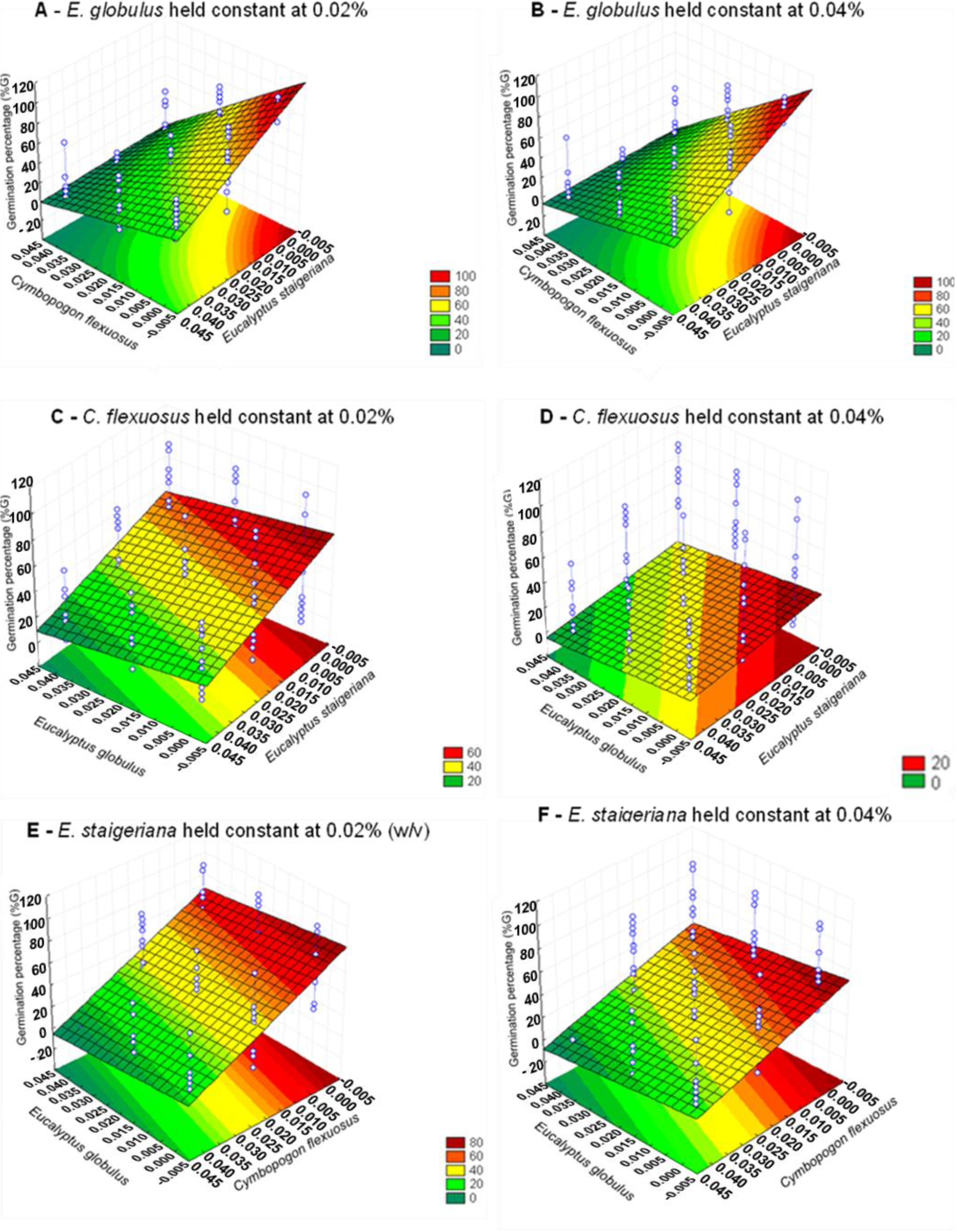
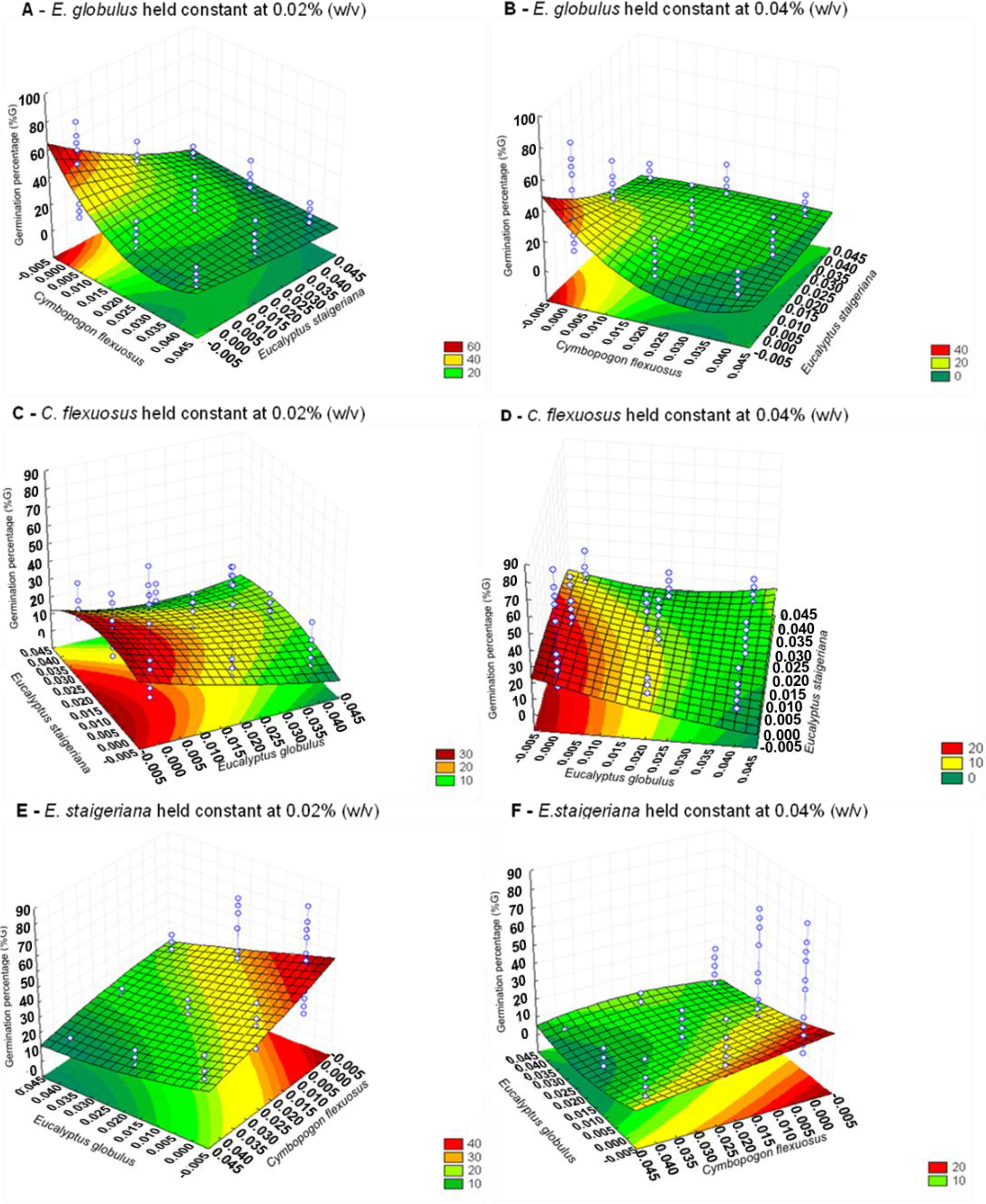
The response-surface plots (Figures 1 and 2) were generated from these models by fixing one factor at the center level (0.02%) and varying the other two within 0.00 - 0.04%. The mesh shows the model prediction, and blue dots are observations; the color scale encodes %G (green = lower). In L. sativa, the CF - ES, EG - ES, and EG - CF surfaces display downward slopes along CF and ES, consistent with the negative linear coefficients; a shallow valley at high CF+ES agrees with the positive interaction (mild antagonism). In M. maximus, %G decreases steeply with increasing CF and ES, curvature is more evident along CF (negative Q term), and saddle-like shapes appear where interactions dominate, producing low-%G regions near the upper boundary of CF and ES within the design space. The close alignment of points and mesh indicates good in-domain fit, although the significant lack-of-fit for M. maximus suggests additional structure beyond the quadratic model. Thus, the surfaces visualize findings and guide the identification of operational regions of minimal %G under constant surfactant load and application volume (Table S3)
Germination percentage (%G) of Lactuca sativa as a function of combinations of Eucalyptus globulus, Cymbopogon flexuosus, and Eucalyptus staigeriana under different conditions.
Germination percentage (%G) of Megathyrsus maximus as a function of combinations of Eucalyptus globulus, Cymbopogon flexuosus, and Eucalyptus staigeriana under different conditions.
DISCUSSION
The experimental design proved to be an effective tool for reducing experimental effort, as it provided robust data with a limited number of experiments. By combining Plackett - Burman screening and factorial optimization, it was possible to identify and rank the most promising nanoemulsions, whether used alone or in combination, for the development of a bioherbicide targeting Megathyrsus maximus as a potential option for replacing synthetic herbicides. Furthermore, the meticulous planning facilitated the establishment of a mathematical model that enabled the prediction of the germination percentage of M. maximus and L. sativa as a function of the concentrations of C. flexuosus, E. globulus, and E. staigeriana nanoemulsions used in the formulation of the three-NE combination.
Megathyrsus maximus (colonião-grass) is a significant weed species, and Lactuca sativa (lettuce) is an indicator plant that is frequently used in studies of this nature due to its sensitivity to phytotoxins in general [33]. The present study demonstrated the effectiveness of nanoemulsion combinations in inhibiting germination and initial growth of the two species tested. Among the nanoemulsions that were analyzed, the NE of Cymbopogon flexuosus caused greater inhibitions in the percentage of germination and initial growth. However, the combination of the NEs of E. globulus and E. staigeriana proved to be more effective, indicating statistically significant non-additive interaction effects within the tested concentration range, rather than direct evidence of classical biochemical synergy.
The factorial design comprising three factors at three levels confirmed that C. flexuosus was the most active individual NE. However, the combined formulation consistently outperformed the individual components, demonstrating interaction effects that deviated from strict additivity within the statistical model, although not necessarily fulfilling formal criteria for pharmacological or biochemical synergy. According to the mathematical model, the ideal condition is the combination of the three NEs at a concentration of 0.04%, which can predict complete inhibition of germination within the design space. Additionally, it was evident that the effect of each individual NE did not exceed the effect observed when they were combined.
A study that combined eight EOs in pairs and evaluated their influence on L. sativa seeds found that the interactions between the EO pairs were predominantly reported as additive or synergistic according to checkerboard-based frameworks, with only a few antagonistic interactions [20]. In a separate study, it was observed that a combination of Rosmarinus officinalis and Corymbia citriodora essential oils exhibited enhanced antifungal properties [22]. Enhanced antimicrobial effects were also reported with the combination of Drypetes gossweileri with four other essential oils against the bacteria Bacillus cereus, B. megaterium, B. subtilis, and Geobacillus stearothermophilus [21].
The interaction effects between essential oils can be characterized through in vitro experiments using the checkerboard assay. This assay is primarily used to evaluate interactions in antibacterial activity, but it can also be used with plant species [20,34]. A comprehensive understanding of these interactions is essential to elucidate the behavior of EOs in formulated combinations.
The biological activity of C. flexuosus EO has been the subject of extensive research, particularly with regard to its antimicrobial properties [35]. However, its potential as an herbicide has received comparatively less attention. The findings of this study underscore the considerable potential of its nanoemulsion, both as a standalone entity and in conjunction with other agents. The essential oil (EO) of Cymbopogon flexuosus are predominantly composed of citral and geraniol [35]. These monoterpenes have been shown to induce alterations in membrane composition and depolarization of microtubules, thereby affecting cell division [15]. While the C. flexuosus NE had the largest droplet size (96 nm), its pronounced bioactivity suggests that the chemical composition, particularly the high concentration of citral, may be the dominant factor driving its phytotoxicity, potentially overriding the influence of particle size in this context. In contrast, the smaller droplets of E. globulus and E. staigeriana (~27-28 nm) may facilitate faster penetration and action, contributing to their own efficacy and their role in the observed mixture effects. Additionally, geraniol has been reported to influence germination and root elongation [2], a property that may contribute, at least in part, to the observed outcomes.
The NE of Eucalyptus globulus produced considerable variation in the analyzed variables. Its EO has been the focus of numerous studies, and its biological activity is well-documented [36]. However, the development of formulations designed to increase its bioavailability remains in its early stages. The phytotoxic activity of E. globulus essential oil has been demonstrated in Lactuca sativa and in the weeds Avena fatua and Amaranthus hybridus, corroborating the results of the present study [37]. The essential oil (EO) of E. globulus is predominantly composed of 1,8-cineole, which is also referred to as eucalyptol. This monoterpene has been reported to induce a delay in the germination and growth of seedlings, as well as to inhibit cell proliferation, DNA synthesis, and cellular respiration in various plant species [37,15,2].
Eucalyptus staigeriana has been the subject of extensive research, as it is a commonly studied species in the evaluation of biological activities in various studies. However, the herbicidal and phytotoxic potential of E. staigeriana remains to be thoroughly explored, representing a significant gap in our understanding of its ecological impacts. The essential oil's primary components include citral, 1,8-cineole, and limonene [38]. In the present study, GC/MS analysis revealed a compositional profile dominated by citral-related compounds, with lower contributions of other monoterpenes, reflecting the known chemical plasticity of Eucalyptus essential oils. Citral-rich profiles have been associated with inhibition of seed germination and early seedling development, mainly through interference with auxin transport and disruption of meristematic organization, whereas eucalyptol has been linked to effects on mitochondrial respiration and cellular metabolism [14,15]. Therefore, despite quantitative differences in composition between the present GC-MS results and previous reports, the dominance of citral-related compounds in the analyzed oil provides a mechanistic basis compatible with the phytotoxic effects observed in this study.
The greater impact observed in combination treatments may be attributed to the combined concentrations of certain compounds, such as citral and eucalyptol. This hypothesis suggests that the combination treatments may exhibit a greater toxic effect, potentially resulting from the accumulation of these compounds.
The phytotoxic activity of the combinations observed in the present study is attributable to the chemical composition of the EOs in the nanoemulsions, as they are composed of terpenes with known phytotoxic activity that may be interacting statistically detectable non-additive effects. Importantly, the positive interaction terms observed in the factorial model should not be interpreted automatically as classical synergy, but rather as deviations from expected additive responses under the applied statistical framework. However, this interaction requires further investigation.
Furthermore, the employment of nanoemulsions proved instrumental in the suppression of germination, a consequence of their ability to enhance solubility and, most notably, stability. This ensures the effective delivery of the active components of essential oils the target site [18,19]. An important challenge encountered in the formulation of essential oil-based bioherbicide preparations pertains to the instability of these formulations and the volatilization of their components, a phenomenon with the potential to compromise their efficacy [39].
From a technological perspective, the present findings represent an early stage of product development, corresponding to a low technology readiness level. The demonstrated in vitro bioherbicidal activity provides proof of concept but does not constitute agronomic validation. Advancement toward a commercially relevant TRL will require soil-based and greenhouse studies, evaluation of selectivity toward crop species of economic relevance, assessment of potential effects on non-target organisms and soil microbiota, and investigation of formulation stability, scalability, and compatibility with existing weed management practices. In this context, the present study establishes a scientific foundation for future research aimed at translating nanoemulsionbased essential oil formulations into practical bioherbicidal applications.
CONCLUSION
The Plackett - Burman experimental design proved to be a useful tool for the initial screening and prioritization of nanoemulsions and their combinations, providing relevant results with reduced experimental effort. The comprehensive three-level factorial design proved to be effective in assessing the bioherbicidal effects of the combination of the three nanoemulsions initially selected and in elucidating their interactions, as well as the influence of concentration on the response variables. The mixture exhibited greater efficiency in inhibiting germination compared to individual nanoemulsions. The combination nanoemulsions of C. flexuosus, E. globulus, and E. staigeriana demonstrated consistent pre-emergent phytotoxic effects on M. maximus and L. sativa under controlled in vitro conditions, supporting its potential as a bioherbicidal formulation. While the C. flexuosus nanoemulsion has been demonstrated to be the most effective in terms of herbicidal activity, the present study indicates that the combination is more effective overall. However, further studies are needed to better understand the interactions among the combined nanoemulsions and their mechanisms of action. From a technological standpoint, the present findings represent an early-stage proof of concept. The bioherbicidal activity demonstrated here does not yet constitute agronomic validation, and advancement toward a commercially relevant technology readiness level will require additional soilbased and greenhouse studies, assessment of crop selectivity, evaluation of potential non-target and environmental effects, and investigation of formulation stability and scalability. Thus, this study provides a scientific foundation for future research aimed at translating essential oil-based nanoemulsions into practical and sustainable bioherbicidal applications.
Funding:
Acknowledgments:
The authors thank the CMVV - IFES - Campus Vila Velha
Use of Generative Artificial Intelligence
The authors declare that large language models and other generative artificial intelligence (AI) or AIassisted technologies cannot be credited as authors and have not been listed as authors of this paper.
The authors declare that no generative artificial intelligence (AI) or AI-assisted technologies were used to generate or modify the scientific content of this manuscript, including the conception of the study, data collection, data analysis, interpretation of results, or creation of original text, figures, tables or graphical abstracts, apart from routine tools for spelling, grammar checking and reference management that do not create original scholarly content.
Supplementary Material:
have datas supplementary - https://doi.org/10.6084/m9.figshare.32335719
Supplementary PDF
Data Availability Statement:
Research data are available as supplementary material. https://doi.org/10.6084/m9.figshare.32335719
REFERENCES
- 1 Merfield CN. Redefining weeds for the post-herbicide era. Weed Res. 2022;62(4):263-7.
-
2 Ninkuu V, Zhang L, Yan J, Fu Z, Yang T, Zeng H. Biochemistry of terpenes and recent advances in plant protection. Int J Mol Sci. 2021;22(11):5710. https://doi.org/10.3390/ijms22115710
» https://doi.org/10.3390/ijms22115710 -
3 Hasan M, Cheng Y, Kanwar MK, Chu XY, Ahammed GJ, Qi ZY. Physiological and biochemical responses of selected weed and crop species to the plant-based bioherbicide WeedLock. Sci Rep. 2022;12(1): 19602. https://doi.org/10.1038/s41598-022-24144-2
» https://doi.org/10.1038/s41598-022-24144-2 -
4 Bueno LG, Galvani DB, Diniz FM, Jank L, Bezerra JW, Jesus AA. [Characterization and selection of low-growing Megathyrsus maximus genotypes with potential use in the Brazilian semi-arid region]. Sobral (CE): Embrapa Caprinos e Ovinos; 2019.http://www.infoteca.cnptia.embrapa.br/infoteca/handle/doc/1117067
» http://www.infoteca.cnptia.embrapa.br/infoteca/handle/doc/1117067 -
5 Cruz JD, Martins CC, Silva PCC, Barros RT, Silva GZ. Provenance, viability and physical quality of Panicum maximus ‘Mombasa’ seeds. Rev Cienc Agron. 2022 Jul 6;53:e20207128. https://doi.org/10.5935/18066690.20220042
» https://doi.org/10.5935/18066690.20220042 -
6 Ghirardello GA, Araújo LD, Silva GS, Silva AF, Campos LH, Victoria Filho R. Efficacy of the herbicides indaziflam and clomazone on problematic weeds of family Poaceae to sugarcane crop. Biosci. J. 2022;38:1-9. https://doi.org/10.14393/BJ-v38n0a2022-56358
» https://doi.org/10.14393/BJ-v38n0a2022-56358 -
7 Instituto Brasileiro do Meio Ambiente e dos Recursos Naturais Renováveis (IBAMA). Relatórios de comercialização de agrotóxicos: boletim 2022 [Pesticide marketing reports: 2022 bulletin]. Brasilia; 2023. Available from: https://www.gov.br/ibama/pt-br/assuntos/quimicos-e-biologicos/agrotoxicos/relatorios-decomercializacao-de-agrotoxicos
» https://www.gov.br/ibama/pt-br/assuntos/quimicos-e-biologicos/agrotoxicos/relatorios-decomercializacao-de-agrotoxicos -
8 Vieira C, Marcon C, Droste A. Phytotoxic and cytogenotoxic assessment of glyphosate on Lactuca sativa L. Braz J Biol. 2024 Mar 11;84:e257039. https://doi.org/10.1590/1519-6984.257039
» https://doi.org/10.1590/1519-6984.257039 -
9 Agência Nacional de Vigilância Sanitária (ANVISA). Nota técnica nº 23/2018: glifosato [Technical note nº 23/2018: glyphosate]. Brasilia; 2019. Available from: https://www.gov.br/anvisa/ptbr/setorregulado/regularizacao/agrotoxicos/notas-tecnicas
» https://www.gov.br/anvisa/ptbr/setorregulado/regularizacao/agrotoxicos/notas-tecnicas -
10 Cai X, Gu MM. Bioherbicides in organic horticulture. Hortic. Mar 29;2(2):3. https://doi.org/10.3390/horticulturae2020003
» https://doi.org/10.3390/horticulturae2020003 -
11 Hasan M, Ahmad-Hamdani MS, Rosli AM, Hamdan H. Bioherbicides: an eco-friendly tool for sustainable weed management. Plants (Basel). 2021 Jun 15;10(6):1212. https://doi.org/10.3390/plants10061212
» https://doi.org/10.3390/plants10061212 -
12 Maes C, Meersmans J, Lins L, Bouquillon S, Fauconnier ML. Essential oil-based bioherbicides: human health risks analysis. Int J Mol Sci. 2021 Aug 30;22(17):9396. https://doi.org/10.3390/ijms22179396
» https://doi.org/10.3390/ijms22179396 - 13 Raveau R, Fontaine J, Sahraoui AL. Essential oils as potential alternative biocontrol products against plant pathogens and weeds: a review. Foods. 2020 Mar 21;9(3):365.
-
14 Martino L, Mancini E, Almeida LFR, De Feo V. The antigerminative activity of twenty-seven monoterpenes. Molecules. 2010;15(9):6630-7. https://doi.org/10.3390/foods9030365
» https://doi.org/10.3390/foods9030365 -
15 Werrie PY, Durenne B, Delaplace P, Fauconnier ML. Phytotoxicity of essential oils: opportunities and constraints for the development of biopesticides. Foods. 2020;9: 1291. https://doi.org/10.3390/foods9091291
» https://doi.org/10.3390/foods9091291 -
16 Rys M, Miastkowska M, Sikora E, Letocha A, Krajewska A, Synowiec A. Bio-herbicidal potential of nanoemulsions with peppermint oil on barnyard grass and maize. Molecules. 2022 May 28;27(11):3480. https://doi.org/10.3390/molecules27113480
» https://doi.org/10.3390/molecules27113480 -
17 Chamoun LB, Filho JR, Corte VB, Perin ITAL, Fernandes CP, Cruz RAS, et al. A nanoemulsion of Rosmarinus officinalis L. essential oil with allelopathic effect against Lactuca sativa L. seeds. Braz J Dev. 2021; Sep;7(9):86752-71. Doi: https://doi.org/10.34117/bjdv7n9-031
» https://doi.org/10.34117/bjdv7n9-031 -
18 Shang Y, Hasan MK, Ahammed GJ, Li M, Yin H, Zhou J. Applications of nanotechnology in plant growth and crop protection: a review. Molecules. 2019 Jul 13;24(14):2558. https://doi.org/10.3390/molecules24142558
» https://doi.org/10.3390/molecules24142558 -
19 Gumber K, Sidhu A. Trending nanoformulated pesticides: a review. Indian J Agric Sci. 2020 Mar 1;90(3):463-9. https://doi.org/10.56093/ijas.v90i3.101450
» https://doi.org/10.56093/ijas.v90i3.101450 -
20 Mirmostafaee S, Azizi M, Fujii Y. Study of allelopathic interaction of essential oils from medicinal and aromatic plants on seed germination and seedling growth of lettuce. Agronomy. 2020 Jan 23;10(2):163. https://doi.org/10.3390/agronomy10020163
» https://doi.org/10.3390/agronomy10020163 -
21 Voundi SO, Nyegue M, Lazar I, Raducanu D, Ndoye FF, Stamate M, et al. Effect of essential oils on germination and growth of some pathogenic and spoilage spore-forming bacteria. Foodborne Pathog Dis. 2015;12(6). https://doi.org/10.1089/fpd.2014.1
» https://doi.org/10.1089/fpd.2014.1 -
22 Baiotto CS, Baiotto LM, Beber SC, Kleibert KR, Fell AP, Babeski CM, et al. Antifungal effect of essential oils on control of phytopathogens in stored soybean seeds. Rev Bras Eng Agric Ambient. 2023 Jan 6;27(4):272-8. https://doi.org/10.1590/1807-1929/agriambi.v27n4p272-278
» https://doi.org/10.1590/1807-1929/agriambi.v27n4p272-278 -
23 Hanrahan G, Lu K. Application of factorial and response surface methodology in modern experimental design and optimization. Crit Rev Anal Chem. 2006 Dec 1;36(3-4):141-51. https://doi.org/10.1080/10408340600969478
» https://doi.org/10.1080/10408340600969478 -
24 Cunico MW, Cunico MM, Miguel OG, Zawadzki SF, Peralta-Zamora P, Volpato N. [Factorial design: a valuable statistical tool for defining experimental parameters used in scientific research.]. Vis Acad. 2008 Jan;9(1):23-32. Doi: https://doi.org/10.5380/acd.v9i1.14635
» https://doi.org/10.5380/acd.v9i1.14635 -
25 Spadi A, Angeloni G, Guerrini L, Corti F, Michelozzi M, Cencetti G, et al. Using a Plackett-Burman design to maximise yield of rosemary essential oil by distillation. Ind Crops Prod. 2021 Aug 1;166:113488. https://doi.org/10.1016/j.indcrop.2021.113488
» https://doi.org/10.1016/j.indcrop.2021.113488 - 26 Adams RP. Identification of essential oil components by gas chromatography/mass spectroscopy. 4th ed. Carol Stream (IL): Allured Publishing; 2007.
-
27 Ahmed HA, Yu-Xin T, Qi-Chang Y. Optimal control of environmental conditions affecting lettuce plant growth in a controlled environment with artificial lighting: a review. S Afr J Bot. 2020 May 1;130:75-89. https://doi.org/10.1016/j.sajb.2019.12.018
» https://doi.org/10.1016/j.sajb.2019.12.018 - 28 Brasil. Ministério da Agricultura, Pecuária e Abastecimento. Regras para análise de sementes [Rules for seed analysis]. Brasília: Secretaria de Defesa Agropecuária; 2009.
- 29 Bewley JD, Black M. Seeds: physiology of development and germination. New York: Plenum Press; 1994.
- 30 Krzyzanowski FC, Vieira RD, França Neto JB. [Seed vigor: concepts and tests]. Londrina: ABRATES; 1999.
-
31 Maguire JD. Speed of germination-aid in selection and evaluation for seedling emergence and vigor. Crop Sci. 1962;2(2):176-7. https://doi.org/10.2135/cropsci1962.0011183X000200020033x
» https://doi.org/10.2135/cropsci1962.0011183X000200020033x - 32 Nakagawa J. [Vigor tests based on seedling performance]. In: Krzyzanowski FC, Vieira RD, França Neto JB, editors. [Seed vigor: concepts and tests]. Londrina: ABRATES; 1999. p. 2.1-2.24.
-
33 Vieira CSS, Nicola PA, Bortoleti KCA. Determination of phytotoxicity and cytogenotoxicity due to exposure to particles originating from sugarcane burning using Lactuca sativa L. and Allium cepa L. J Toxicol Environ Health A. 2022 Jul 18;85(14):561-72. https://doi.org/10.1080/15287394.2022.2054483
» https://doi.org/10.1080/15287394.2022.2054483 -
34 Langeveld WT, Veldhuizen EJA, Burt SA. Synergy between essential oil components and antibiotics: a review. Crit Rev Microbiol. 2014 Feb 1;40(1):76-94. https://doi.org/10.3109/1040841X.2013.763219
» https://doi.org/10.3109/1040841X.2013.763219 -
35 Gündel SS, de Souza ME, Quatrin PM, Klein B, Wagner R, Gündel A, et al. Nanoemulsions containing Cymbopogon flexuosus essential oil: development, characterization, stability study and evaluation of antimicrobial and antibiofilm activities. Microb Pathog. 2018 May 1;118:268-76. https://doi.org/10.1016/j.micpath.2018.03.043
» https://doi.org/10.1016/j.micpath.2018.03.043 -
36 Čmiková N, Galovičová L, Schwarzová M, Vukic MD, Vukovic NL, Kowalczewski PŁ, et al. Chemical composition and biological activities of Eucalyptus globulus essential oil. Plants (Basel). 2023 Feb 28;12(5):1076. https://doi.org/10.3390/plants12051076
» https://doi.org/10.3390/plants12051076 -
37 Flores-Macías A, Reyes-Zárate GG, Cámara CAG, López-Ordaz R, Guillén JC, Ramos-López MA. Chemical composition and phytotoxic potential of Eucalyptus globulus essential oil against Lactuca sativa and two herbicide-resistant weeds Avena fatua and Amaranthus hybridus TIP Rev Esp Cienc Quim Biol. 2021;24:1-8. DOI:10.22201/fesz.23958723e.2021.303
» https://doi.org/10.22201/fesz.23958723e.2021.303 -
38 Pedrotti C, Marcon AR, Delamare APL, Echeverrigaray S, Ribeiro RTS, Schwambach J. Alternative control of grape rots by essential oils of two Eucalyptus species. J Sci Food Agric. 2019 Nov;99(14):6552-61. https://doi.org/10.1002/jsfa.9936
» https://doi.org/10.1002/jsfa.9936 -
39 Bordin ER, Frumi Camargo A, Stefanski FS, Scapini T, Bonatto C, Zanivan J, et al. Current production of bioherbicides: mechanisms of action and technical and scientific challenges to improve food and environmental security. Biocatal Biotransform. 2021 Sep 3;39(5):346-59. https://doi.org/10.1080/10242422.2020.1833864
» https://doi.org/10.1080/10242422.2020.1833864