 Machine Learning-Based Screening for HAM/TSP Risk: Exploring the Predictive Potential of ENTPD1 Polymorphisms and Clinical Symptoms
Abstract
HTLV is a neglected retrovirus affecting 5-10 million people worldwide, with Brazil having the highest number of cases. About 0.3-3.8% of people living with HTLV (PLwHTLV) develop HTLV-associated myelopathy/tropical spastic paraparesis (HAM/TSP), a neurological disorder mainly driven by an exacerbated host immune response. Currently, there are no validated biomarkers available to assess the risk of progression to HAM/TSP. Therefore, this study aimed to evaluate the performance of machine learning models (MLMs) in predicting disease progression among PLwHTLV based on clinical data and ENTPD1 gene polymorphisms, which may play a role in HAM/TSP pathogenesis. Variables with higher predictive impact included clinical features such as motor function, urinary impairment and limb dysfunction, while ENTPD1 variants (rs10748643 and rs11188513) showed minimal contribution. Among the evaluated models, Naive Bayes exhibited the best performance, achieving good sensitivity (Recall: 0.78) and class discrimination (ROC AUC: 0.85; G-Mean: 0.75). However, a low precision (0.45), led to a higher incidence of type I errors. Given that this study focuses on applying MLMs as a screening tool rather than a diagnostic one, this limitation has a minor impact on the intended purpose. Overall, our findings suggest low prognostic potential for rs10748643 and rs11188513 but support the applicability of MLMs based on clinical features to identify individuals at higher risk of disease progression. This strategy could enhance clinical monitoring, enable earlier interventions, and potentially delay neurological decline in PLwHTLV.
Keywords:
Human T-lymphotropic virus 1; Machine Learning; HTLV I Associated Myelopathy Tropical Spastic Paraparesis; Disease Progression.
HIGHLIGHTS
Machine learning models utilizing clinical data can effectively support risk screening for HAM/TSP.
ENTPD1 genotypes, which encode the CD39 protein, have low value as genetic biomarkers for predicting HAM/TSP progression in PLwHTLV.
Machine learning models can facilitate the prioritization of HTLV carriers, thereby aiding specialist follow-up and management of HAM/TSP.
INTRODUCTION
The Human T-lymphotropic virus type 1 (HTLV-1) is a retrovirus with significant global public health impact, affecting 5-10 million individuals worldwide, with a distribution based in endemic regions including the Caribbean, parts of Africa, Asia and South America [1,2]. HTLV transmission occurs by breastfeeding, sexual contact, blood transfusion and intravenous drug use [3,4]. Notably, Brazil hosts the highest absolute number of cases worldwide [5], with a seroprevalence ranging from 800,000 to 2.5 million individuals, with the highest prevalence observed in the northern and northeastern regions, reaching up to 1.48% in some areas [6,7]. However, the true burden of HTLV-1 infection in Brazil may be underestimated due to limited population-based screening and underdiagnosis.
The HTLV infection mainly targets CD4+ T lymphocytes (CD4+ T), the principal cellular target of its retrovirus, promoting immune, inflammatory and neurological dysfunctions [8]. Some clinical conditions are unique to People Living with HTLV (PLwHTLV) such as adult T-cell leukemia/lymphoma (ATL), a condition where HTLV promotes the oncogenesis of infected cells, with aggressive cases of ATL presenting a survival average time lower than one year [9]. Another characteristic condition is HTLV-1 associated myelopathy/tropical spastic paraparesis (HAM/TSP), a progressive neurological disease that impacts 0.3-3.8% of people living with this virus. HAM/TSP is clinically characterized by neurological dysfunctions such as spastic paraparesis and hyperreflexia, affecting not only the motor functions, but also urinary and sensory capacity too [10]. It is an insidious condition with a variable progression period that can cause wheelchair dependency, damaging independence and mental health, being PLwHTLV with HAM/TSP associated with intensification of anxiety and depression [11,12].
HAM/TSP pathogenesis is associated with injury to spinal cord, where the most acceptable theory in scientific literature points to a damage mediated by inflammatory cellular infiltration in the central nervous system (CNS), promoting a chronic inflammation process [10]. Pattern alterations in host's immune cells transmigration and changes in transcription factors of regulatory T cells (Tregs) are strongly associated with the development of HAM/TSP [13,14]. Therefore, the host immune response plays a central role in determining the clinical outcome of HTLV-1 infection, a process that is directly influenced by polymorphisms in immunomodulatory genes [15].
Among the immunoregulatory enzymes associated with HAM/TSP development, one of the most reported in the literature is CD39 (Cluster of Differentiation 39) [16,17]. This transmembrane glycoprotein is present on lymphoid lineage cells surface and is known as an immunological checkpoint due to its capacity to hydrolyze ATP (Adenosine Triphosphate), a pro-inflammatory mediator, into ADP (Adenosine Diphosphate) [18]. This enzyme plays a fundamental role in the purinergic pathway, corresponding to one of the mechanisms of Treg-mediated immunosuppression. Who enables the conversion of ATP into ADP, which is consecutively degraded by CD73 into AMP (Adenosine Monophosphate), an immunosuppressive molecule that stimulates anti-inflammatory activities [19]. Beyond the association between immune-mediated [20], inflammatory [21] and infectious diseases [19] with CD39 levels, PLwHTLV with HAM/TSP have been associated with the high expression levels of this ectoenzyme when compared to oligosymptomatic individuals with HTLV, indicating its possible use as a biomarker for PLwHTLV follow-up [16,17].
Not only have CD39 expression levels been associated with progression to HAM/TSP, but specific genotypes of ENTPD1, the gene which encodes the CD39 protein, have also demonstrated significant relevance. The heterozygous genotype AG/CT that is correlated with intermediate CD39 expression has been identified as a risk factor, reinforcing the potential utility of CD39 expression profiling and ENTPD1 genotyping for risk stratification and prognostic assessment in PLwHTLV [17]. The disability caused by HAM/TSP is substantial, especially due to spasticity in the lower limbs, with approximately 30% of affected individuals becoming bedridden within ten years of disease onset. To date there are no specific or effective treatments for HTLV-1 infection, with current management limited to palliative therapy, primarily based on corticosteroid administration aiming to delay clinical progression [22].
To analyze genetic data, tools from the data science field are widely applied in order to identify patterns and consequently expand knowledge about biological associations and mechanisms [23]. While data manipulation and classical statistical methods remain essential to comprehension of biological patterns, machine learning (ML) has recently emerged as a transformative tool to bioinformatics, improving the understanding of non-linear patterns in data and also building predictive models more robust through biological variables, such as single nucleotide polymorphisms (SNPs) [24].
Machine learning models (MLMs) can be conceptualized as computer systems capable of learning from experience, thereby improving their performance on a specific task over time [25]. They have been successfully applied across various medical domains, including disease prediction, diagnosis and prognosis, highlighting their potential to enhance healthcare outcomes [25,26]. Given the complex interplay between virological and host immunogenetic factors in the development of HAM/TSP, the use of ML to integrate clinical and genetic data represents a valuable tool for identifying PLwHTLV with profiles associated with disease progression. This enables the early identification of these patients and consecutively improving early intervention, resulting in a more effective symptom management while no definitive therapies are available.
Therefore, this study evaluates the performance of different supervised machine learning models in predicting HAM/TSP by integrating clinical signs and symptoms with ENTPD1 polymorphisms. The approach is hypothesized to enable the accurate identification of individuals at high risk of developing HAM/TSP, facilitating timely intervention and improved disease management. This research represents a novel application of ENTPD1 variants in the context of HTLV-1 infection and may contribute to the development of personalized medicine strategies for this neglected tropical disease.
MATERIAL AND METHODS
Study design and data grouping
This cross-sectional study integrated clinical data with genotypes of two loci of ENTPD1 gene from PLwHTLV patients followed up at palliative care sector of the Oswaldo Cruz University Hospital (HUOC-UPE). ENTPD1 variants were assessed by genotyping SNPs at rs10748643 and rs11188513, variants previously associated with altered expression levels and progression of inflammatory diseases or HIV clinical progression [27-28]. All the patients involved in this study were included upon confirmation of HTLV infection and the signing of an informed consent form (ICF), approved by CAAE 57785822.4.0000.5192.
The exclusion criteria were patients diagnosed with co-infections other than HTLV and HIV, under 18 years of age, with autoimmune diseases, neoplasms, history of stroke or motor dysfunctions not associated with HAM/TSP. The control group (without HTLV infection) was made up of 69 volunteers screened negative for HTLV-1/2, respecting the established exclusion criteria, from the Recife Naval Hospital and people from the Immunobiology and Pathology Laboratory (LIPa).
A total of 258 PLwHTLV underwent venipuncture for whole-blood collection into EDTA tubes, which were then aliquoted and preserved at -80°C. For the clinical characterization of PLwHTLV, information about the signs and symptoms of these individuals was extracted from their medical records. Genomic DNA was extracted using either the QIAamp DNA Mini Kit (Qiagen)® or the ReliaPrep Blood gDNA Miniprep System (Promega)®, following the manufacturers’ instructions. The samples were genotyped using TaqMan SNP Genotyping Assay System (Applied Biosystems, Foster City, CA, USA)®, and evaluated using QuantStudio™ 5 Real-Time PCR System®.
The outcome of interest was P-HAM/TSP status (N=59), defined as the combination of PLwHTLV classified as probable HAM/TSP and definite HAM/TSP. Conceptually, probable HAM/TSP was defined as a monosymptomatic clinical presentation (presence of spasticity, hyperreflexia or Babinski's sign) in people with HTLV antibodies and/or antigens identified in the serum or cerebrospinal fluid (CSF). While definitive HAM/TSP corresponds to presence of non-remitting progressive spastic paraparesis and the presence of HTLV antibodies and/or antigens in serum or CSF [29-30]. Participants not meeting these criteria were classified as oligosymptomatic/asymptomatic (at the plots referenced as Oligo/ASS).
Exploratory analyses, preprocessing, feature categorization, model training and evaluation were carried out through Python (V3.11.7), using libraries as pandas (V2.3.1), SciPy (V1.16.1), Matplotlib (V3.10.0), Sci-kit learn (V1.2.2), sci-kit optimize (0.10.1), imbalanced-learn (0.12.1) and SHAP (SHapley Additive exPlanations - V0.48.0). To ensure reproducibility and transparency, the code used in this analysis is available on GitHub.
Pre-processing
Variables were iteratively recategorized to maximize interpretability and information content, then encoded as binary, ordinal or multiclass features as appropriate. Continuous variables were normalized to the range 0-1 when required by the modeling workflow. Spearman’s rank correlation was used to assess associations between quantitative and ordinal variables due to non-normal data distributions.
Next, we evaluated the variables distribution and their relationships with the target outcome (P-HAM/TSP). Multicollinearity among candidate predictors was assessed using the Variance Inflation Factor (VIF). When multicollinearity was detected, variables were first recategorized when clinically justified, if multicollinearity persisted, the predictor was excluded to improve model performance and interpretability.
Application of ML and optimization of hyperparameters
During the exploratory analysis, imbalanced data were identified, a condition that can affect evaluation metrics such as accuracy [31]. To mitigate this bias several balancing techniques were assessed, after iterative evaluation, Random Under Sampling was selected and applied. This method is based on randomly reducing the number of observations in the majority class (oligosymptomatic/asymptomatic PLwHTLV), preventing model bias in favor of the majority class, improving model effectiveness and generalizability.
The data were applied to 10 different machine learning models, previously used to solve different biological problems [25,32] corresponding to: Logistic Regression (LR); K-Nearest Neighbors (KNN); Decision Tree (DT); Random Forest (RF); AdaBoost (AB); Gradient Boosting (GB); Naive Bayes (NB); Support Vector Machine (SVM); Linear Support Vector Machine (LSVM); Multilayer Perceptron (MLP).
To avoid information leakage and promote a more robust analysis of model performance, the dataset was split using a stratified hold-out split (70%/30%) based on the target outcome (P-HAM/TSP). The subset destined to train models (70%) was employed in hyperparameter search and learning curve generation. This optimization step was performed using Leave-One-Out Cross-Validation (LOOCV) exclusively on the training set, ensuring robust parameter selection. Conversely, final performance metrics and explainability analyses (SHAP) were computed on validation subset data (30%).
The optimization process was carried out by iteratively applying MLMs and evaluating their performance. If necessary, a new data categorization was proposed. This cycle was repeated until the best performance was achieved, guaranteeing the ideal combination of parameters and categorization before model's final evaluation.
Performance evaluation and explainability
Model performance was assessed using a comprehensive set of metrics, including geometric mean (G-mean), area under the receiver operating characteristic curve (ROC AUC), F1 Score, accuracy, precision and recall. Although Leave-One-Out cross-validation was employed for optimization during training phase, all performance metrics presented herein were calculated solely using the 30% independent validation set (unseen data) to guarantee an unbiased evaluation.
In addition to these metrics, learning curves were evaluated, corresponding to the learning process graphical representation carried out by model from the training group, simultaneously with the accuracy in the test group. These curves make it possible to identify potential problems such as overfitting and process stability, providing indications of the model's behavior during training and its capacity for generalization and prediction on unknown data [33]. In addition, we evaluated confusion matrices, used to analyze the performance of classification models, identifying true positives, true negatives, false positives and false negatives. This allows type I errors (false positives) and type II errors (false negatives) to be measured, providing a detailed analysis of the models' behavior [34].
To assess the variables predictive impact, SHAP was used, a robust and widely used tool for interpreting MLMs based on the theory of Shapley values. This approach enables the variables used by the algorithm to be consistently, reliably categorized and ranked, with a quantitative contribution assigned to each. [35].
RESULTS
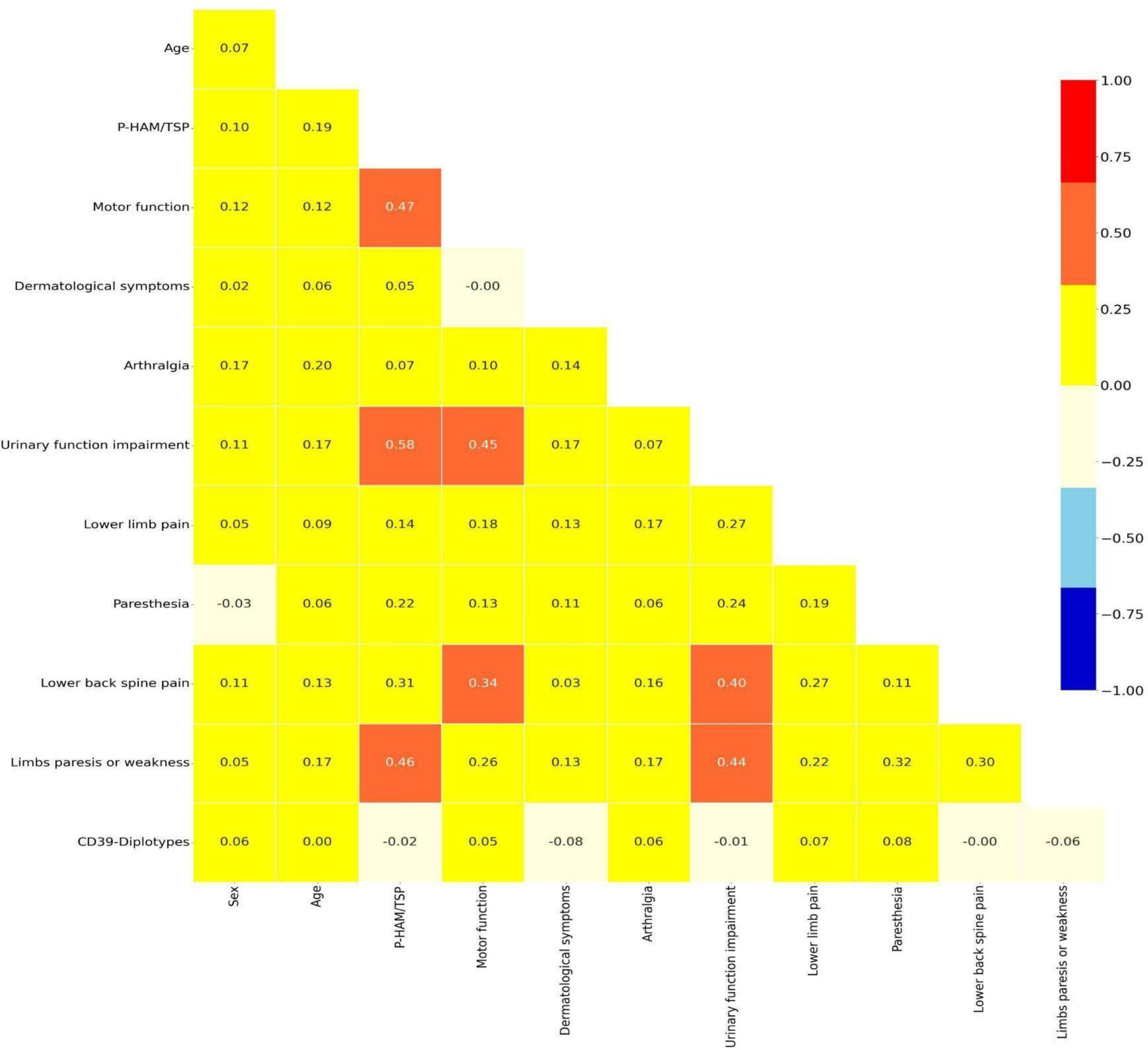
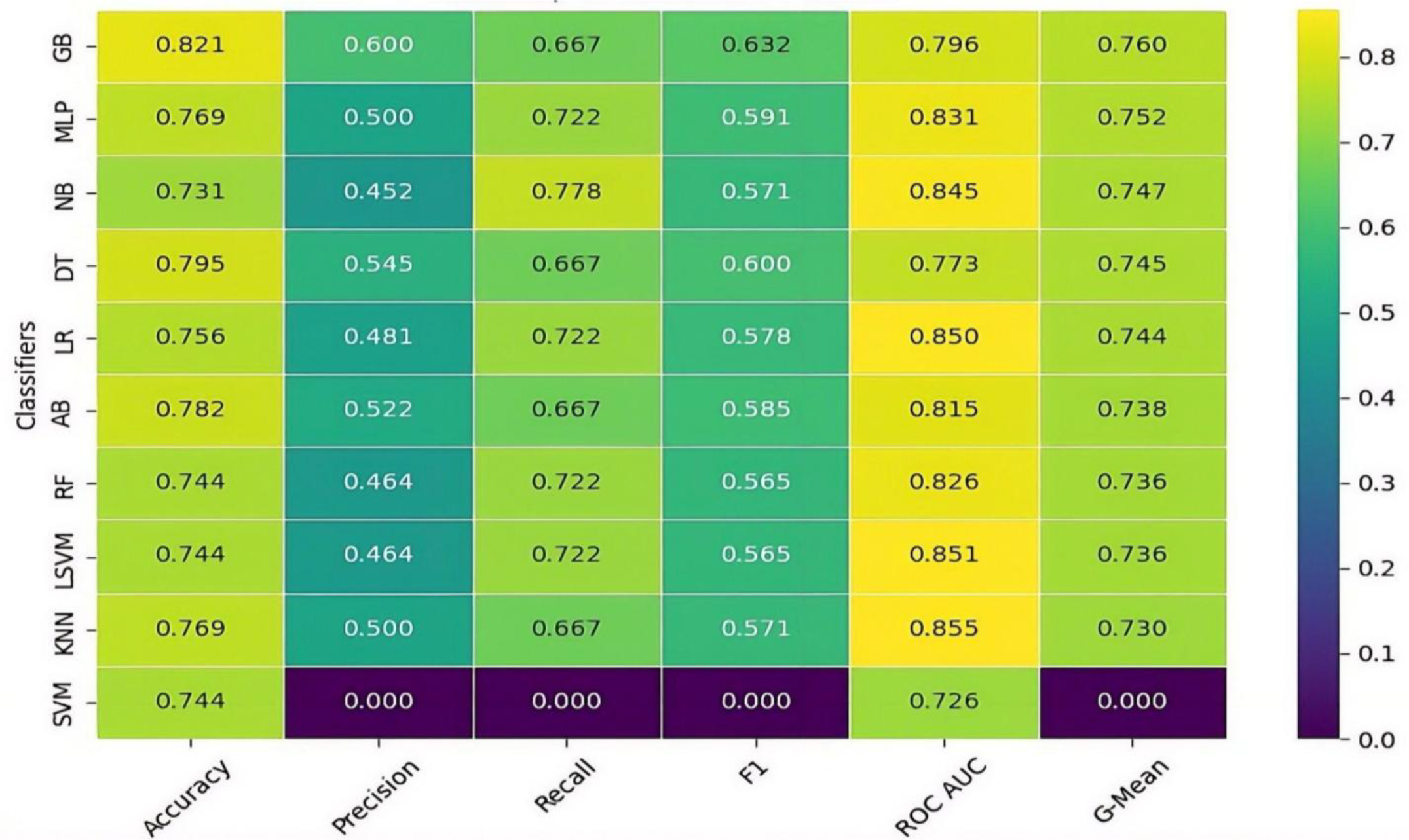
Initially, the correlation between independent variables and P-HAM/TSP was evaluated, resulting in an observation of weak to moderate linear correlation between clinical and genetic characteristics and the outcome of interest, P-HAM/TSP (Figure 1). The status of limb paresis or weakness (0.46), urinary function impairment (0.58), and motor function (0.47) had a moderate association with the outcome, which is expected since motor and urinary impairment are symptoms of HAM/TSP, consequently present in cases of P-HAM/TSP. When the data were applied to MLMs, a low to moderate predictive capacity was observed, with their performance evaluated mainly by G-Mean, Recall and ROC AUC values (Figure 2). It is important to mention that the three MLMs with the best performance according to G-Mean values (GB, MLP and NB) were selected and will hereafter be referred to as “Highlighted MLMs”. Given their interesting performance, we conducted a more in-depth evaluation of these models, examining their learning and predictive processes, as well as the variables used during classification.
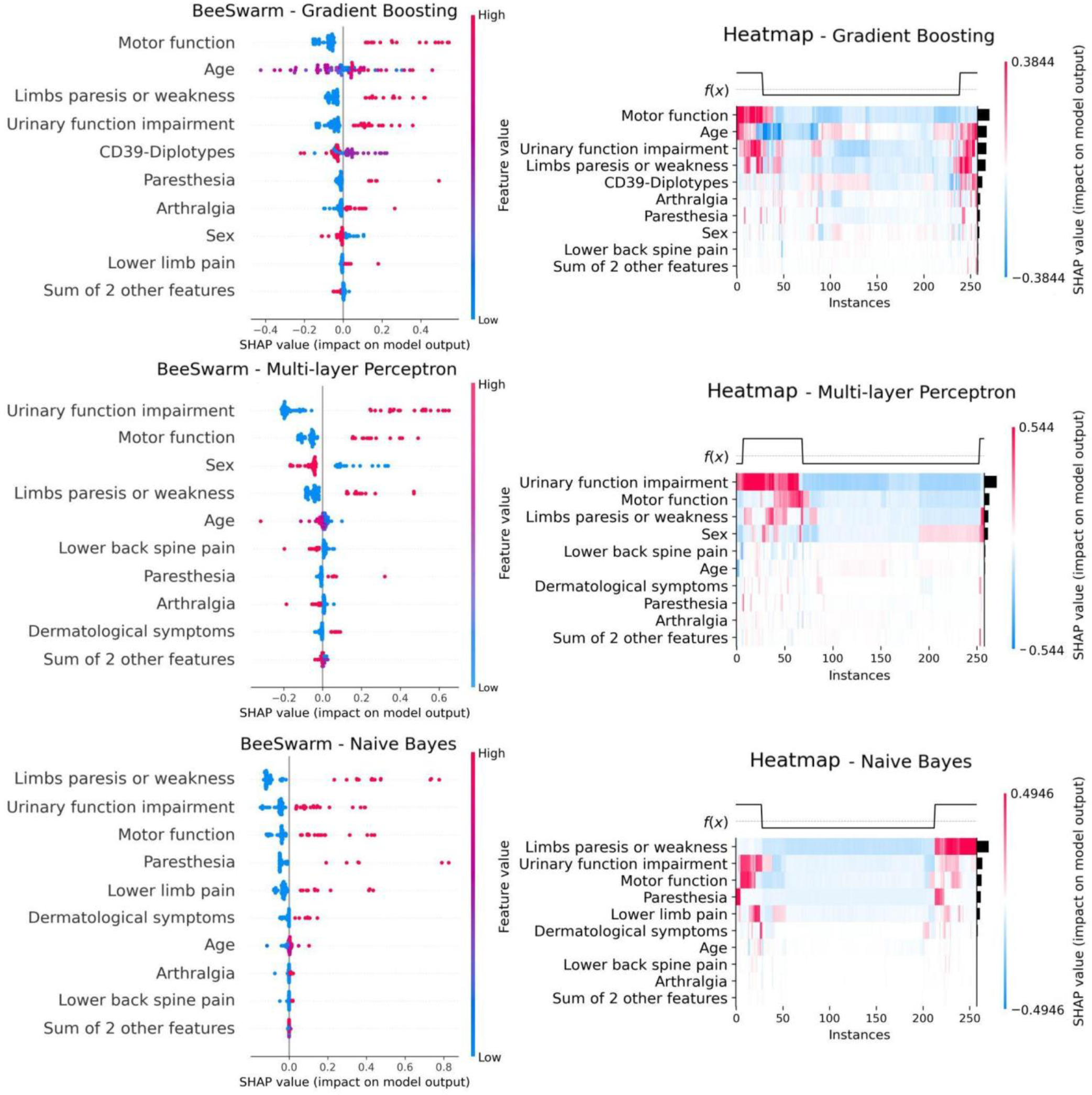
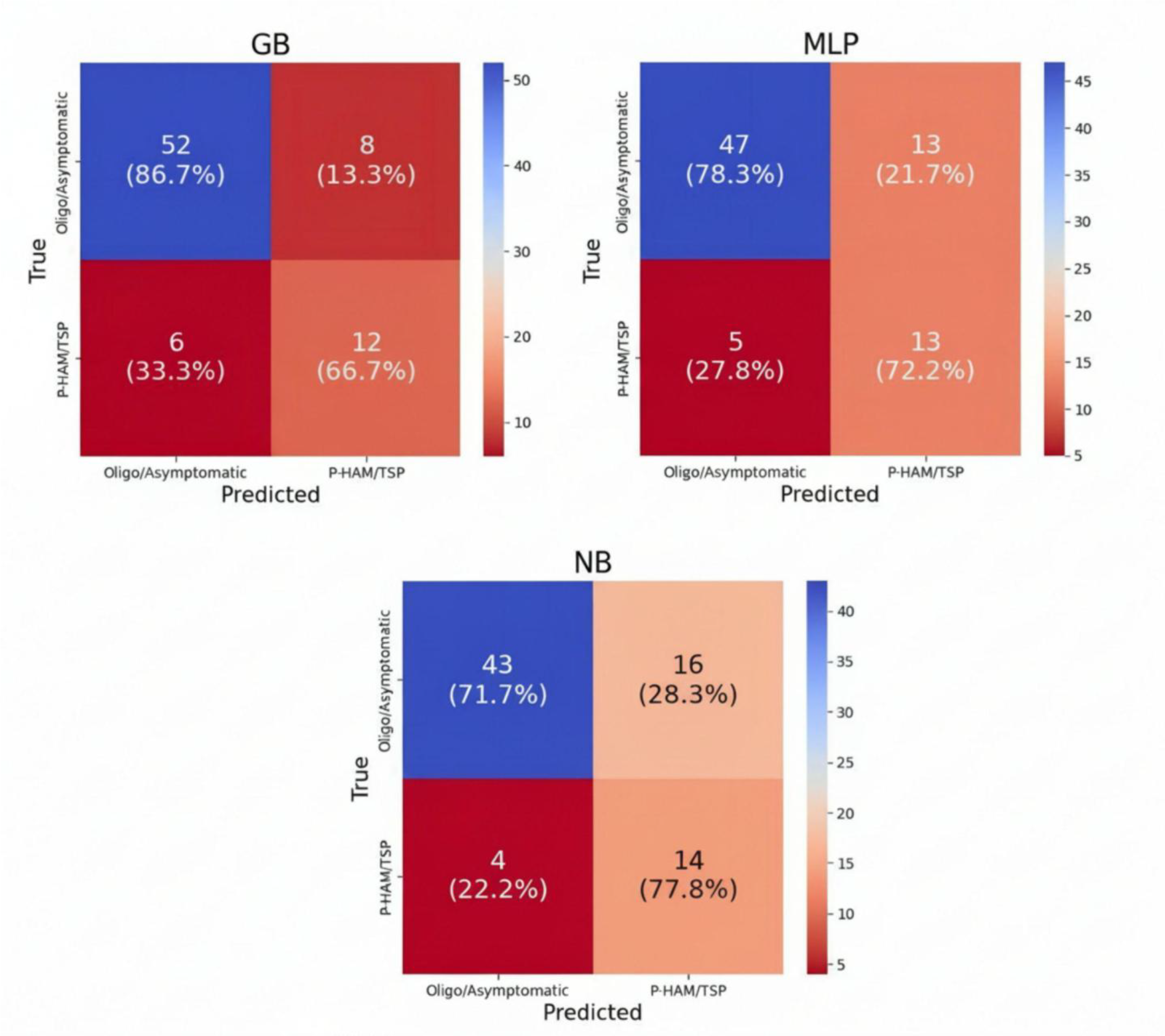
In terms of best-performing models, GB showed a lower sensitivity (Recall: 0.67) and class distinction capacity (ROC AUC: 0.80) when compared to the other two models, with the widest use of the dataset for classification (Figure 2 and Figure 3). The MLP model showed a slightly better sensitivity and distinction of classes (Recall: 0.72; ROC AUC 0.83), as illustrated by Figure 2, with a classification based almost entirely on urinary function impairment, motor function and limbs paresis or weakness, with a small impact of CD39-Diplotypes, not even among the 9 variables with the greatest predictive impact (Figure 3). Naive Bayes stands out in comparison with other two highlighted models, presenting the best equilibrium between class distinction (ROC AUC 0.85) and sensitivity (Recall: 0.78), with the prediction based on limbs paresis or weakness, urinary function impairment, motor function and paresthesia (Figure 2 and 3). It showed efficiency in distinguishing classes and recognizing the minority group (G-mean 0.75), presenting considerable accuracy (0.73), at the expense of very low precision (0.45), consequently with a low F1 score (0.57) (Figure 2).
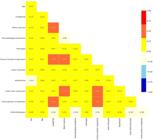
Heatmap representing the correlation coefficients among the clinical and laboratory variables of PLwVHTLV. Spearman's rank correlation measures the strength and direction of monotonic relationships between pairs of variables, where each cell displays the correlation coefficient (ρ) by color intensity indicating the magnitude and direction of the correlation (blue = negative, red = positive).
When evaluating the variables used during the classification process of PLwHTLV by the three highlighted MLMs, it is clear that motor function, age, urinary impairment and limb dysfunctions were the most impactful features from an overall perspective. The classification process was based mainly on clinical aspects, where CD39 diplotypes showed a low impact on the prediction in two of the three highlighted models, suggesting a poor capacity of genotypes at loci rs10748643 and rs11188513 as genetic biomarkers (Figure 3).
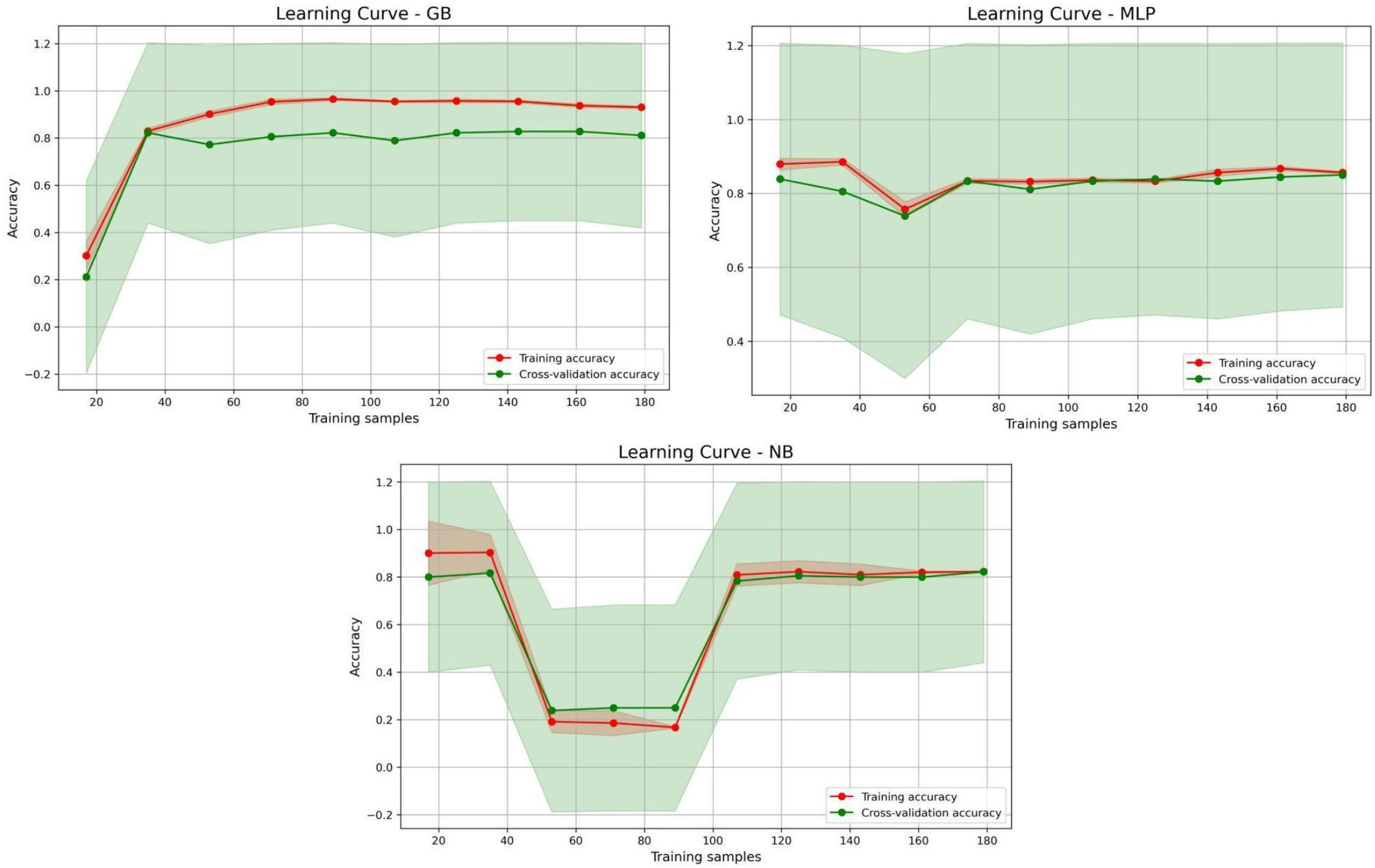
In terms of performance throughout the learning process assessment, all highlighted models were capable of generalization, with no signs of overfitting or underfitting (Figure 4). At the same time, evaluation using the confusion matrix indicated correct classification of up to 77.8% (NB) of PLwHTLV with P-HAM/TSP, and a variation of 71.7% (NB) to 86.7% (GB) in the identification of Oligo/asymptomatic individuals, as illustrated in Figure 5. The low precision observed in the models (Figure 2) was corroborated by considerable levels of false positives in the confusion matrices, indicating a high rate of Type I errors.
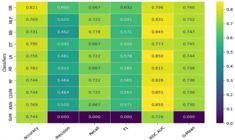
Heatmap displaying the performance metrics of MLMs evaluated. Including Accuracy, Precision, Recall, F1-score, ROC AUC, and G-Mean. Each cell represents the value of the corresponding metric for a specific model, with color intensity reflecting the performance (lighter cells indicating higher values). This visualization allows for an intuitive comparison of model performance across different evaluation criteria.
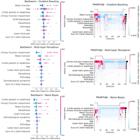
Global feature importance analysis using beeswarm-heatmap plots for the highlighted MLMs. The beeswarm plot shows the distribution of SHAP values for each feature across all samples, with each point representing a sample and its corresponding feature impact. Horizontal dispersion along the x-axis reflects both the magnitude and direction of the feature's contribution to the model output, where positive SHAP values are associated with the P-HAM/TSP outcome while negative values correspond to Oligo/ASS. The heatmap overlays the same SHAP values with a color scale representing the normalized input feature values. A black bar to the left of the heatmap indicates the relative contribution (mean SHAP) of each feature, while the top row labeled f(x) shows the final model output for each sample. In both plots, features are ranked along the y-axis from most to least important, and point colors represent the normalized value of the corresponding feature (blue = low, red = high).
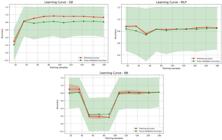
Learning curve of the highlighted MLMs trained to classify P-HAM/TSP among PLwHTLV population. The plot displays the model's performance in terms of training and validation scores as a function of the number of training samples. The training curve (red) indicates how well the model fits the training data, while the validation curve (green) reflects its generalization to unseen data. The shaded areas around the curves represents the variance, providing insights into the model's learning behavior and the sufficiency of the training data.
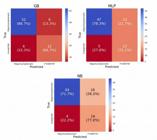
Confusion matrix of the highlighted MLMs designed to classify P-HAM/TSP among PLwHTLV. Each matrix illustrates the number of true positives, true negatives, false positives and false negatives produced by the models. Rows represent the actual class labels, while columns represent the predicted labels, with higher values in blue and lower in red. This visualization allows for a detailed assessment of classification errors, highlighting each model’s ability to correctly distinguish between individuals with and without P-HAM/TSP.
DISCUSSION
Among the evaluated MLMs, the highlighted models (GB, MLP and NB) consistently demonstrated a modest sensitivity (0.67-0.78), particularly in identifying individuals with P-HAM/TSP. These models presented a notable accuracy (0.73-0.82) with a low precision (0.45-0.6), resulting in an absolute correct classification rate of P-HAM/TSP between 66.7% and 77.8%, reinforcing their potential utility as screening tools for clinical follow-up of PLwHTLV.
In the evaluated context, the Gaussian Naive Bayes (NB) stood out, as indicated by its equilibrium between class distinction (G-mean and ROC-AUC) and its sensitivity to P-HAM/TSP identification (Recall), regarding its variables usage (Figures 3 and 5). A robust and simple probabilistic algorithm based on Bayes’ theorem, Naive Bayes has shown effective performance in small datasets with independent variables [38], similar to ours, which included 258 samples and presented a low to moderate linear class association (Figure 1). NB was previously used for a variety of applications, including the prediction of heart failure and for breast cancer stratification [36-37].
Furthermore, our results suggest that motor function, urinary impairment and limb dysfunctions were important factors for the classification process. These associations are in line with the literature, since it is widely known that urinary symptoms, as well as lower and upper limb dysfunction were more prevalent in PLwHTLV with HAM/TSP [38,39]. This highlights the possibility of constructing clinical risk scores incorporating these symptoms, which could enhance screening even in the absence of genotypic data. Moreover, a longer establishment of HAM/TSP is associated with a higher degree of motor dysfunction, a situation more probable in older individuals due to slowly progressive manner of HTLV infection, which remains latent for long periods until the clinical manifestation appears [39,40].
It is important to note that G-Mean and ROC AUC were chosen as metrics for the overall assessment of the predictive performance of the MLMs, since both are unaffected by class imbalance, an expected characteristic of our dataset since only 0.3-3.8% of PLwHTLV progress to HAM/TSP [10]. Moreover, as our intention is the evaluation of MLMs for screening PLwHTLV and not as a diagnostic tool, recall corresponds to another fundamental metric, since type II errors (false negatives) are more prejudicial to PLwHTLV follow-up in this context. Since untimely intervention of individuals with indications of progression to HAM/TSP results in missing a possible early intervention, which can delay the manifestation of symptoms, resulting in an irreversible clinical deterioration. Therefore, prioritizing recall as a metric aligns with a preventive approach to neurological decline. Future models could explore ensemble methods optimized specifically for high recall with acceptable specificity, thus balancing early detection with practical triage capacity.
As assessed by the beeswarm plot (Figure 3), only GB identified an impactful link between ENTPD1 genotypes and the phenotype, where diplotypes of ENTPD1 associated with intermediary levels of CD39, indicated in purple at the label “CD39-Diplotypes”, were linked with P-HAM/TSP (Figure 3). It is important to note that the associations assessed by SHAP represent the importance of the variables used for MLMs classification, and not a causal relationship between genotypes and its clinical manifestation. The associations identified by GB are in line with literature, since AG/CT genotypes, a cluster of SNPs at locus rs10748643 (AG) and rs11188513 (CT), were previously linked with HAM/TSP [17]. Genotypes associated with high and low expression levels of CD39 (illustrated in red and blue, respectively) were both linked with individuals with lower neurological impairment (Figure 3).
The primary neuropathological hallmark of HAM/TSP is chronic myelitis, suggested to result from bystander damage, mediated by inflammatory cytokines and cellular infiltration in the spinal cord [13]. This process is mainly attributed to HTLV-infected CD4+ T cells with a Th1 profile, associated with cytotoxic CD8+ T lymphocytes [42]. These lymphocytes not only initiate the inflammatory response but also sustain it through a positive feedback loop driven by CXCL10 secreted by astrocytes in response to IFN-γ and TNF-α, released by Th1-like CD4+ T cells, underscoring the central role of lymphocytes in both the development and persistence of HAM/TSP [13, 43].
In parallel, extracellular adenosine triphosphate (eATP) acts as a key mediator of chemotaxis and cytokine production during inflammation, its hydrolysis by CD39 into adenosine monophosphate (AMP), not only counterbalances immune activation but also serves as a marker of Th17-polarized CD4+ T cells and of CD8+ T cell exhaustion [18-19]. This pathway has been implicated in HIV pathogenesis, where CD39 functions as a modulator of acquired immunodeficiency syndrome (AIDS), with genetic associations identified for the rs11188513 variant, evaluated in the present study [27]. Based on these insights, we hypothesize that CD39 genotypes associated with clinical signs could be informative predictors to identify PLwHTLV progressing to HAM/TSP.
It was previously reported that PLwHTLV with HAM/TSP exhibit higher CD39 expression in CD4+ T cells compared to asymptomatic PLwHTLV, including inducer (CD39+CD252CD4+ T cells) and regulatory phenotypes (CD39+CD25+CD4+ T cells), accompanied by reduced production of IL-17 [16]. However, based on our findings, variants in the ENTPD1 gene, which encodes CD39, were not sufficiently informative to serve as reliable genetic biomarkers when applied to MLMs. This suggests that additional transcriptional components modulate the circulating levels of CD39, thereby limiting the predictive value of ENTPD1 SNPs for HAM/TSP progression. Underscoring the need for studies assessing CD39 expression in a cell-type-specific manner, including Tregs and T CD8+, which could refine its biological relevance and support its integration into machine learning pipelines to enhance prognostic capacity for PLwHTLV.
It's important to mention that SNPs rs11188513 and rs10748643 were initially included separately in the MLMs, but in order to optimize their predictive capacity, we identified that categorizing them by combining and organizing them into diplotypes associated with different levels of gene expression optimized the learning process by the models. This improved the predictive capacity, but still did not have a considerable impact on the classification of PLwHTLV, suggesting the low usefulness of these variants as prognostic biomarkers forPLwHTLV, at least within the current analysis framework.
It is worth mentioning that in this population the outcome assessed was P-HAM/TSP, defined by the presence of at least one of the symptoms associated with HAM/TSP, such as spasticity, hyperreflexia or neurogenic bladder [10, 30]. This outcome was defined due reduced number of individuals diagnosed with definitive myelopathy in the population of our study. This scenario is partly the result of high neurologists demand in Brazil, who are necessary to confirm the diagnosis of HAM/TSP and are not always available to assess all monitored PLwHTLV [44]. This limitation further emphasizes the value of screening tools, which could help prioritize neurological services referrals, potentially through health platforms. This reinforces the necessity to improve the follow-up of PLwHTLV, which can be achieved by the development of tools aimed to identify PLwHTLV with signs of progression to myelopathy, thereby prioritizing their access to specialized evaluation by neurologists and helping to mitigate the difficulty in accessing these professionals.
We propose the implementation of MLMs within this scope explored in our study as the first stage of a two-step screening process. In this framework, a positive result from the MLM should not be interpreted as a diagnosis of HAM/TSP, but rather as a 'high-risk alert' warranting priority clinical investigation. Individuals flagged by the model would be fast-tracked for a specialized neurological assessment, representing the second and confirmatory diagnostic step. Therefore, this approach effectively acts as a sensitive filter, optimizing scarce specialized resources allocation by ensuring that neurologists focus their attention on the subset of PLwHTLV with highest probability of disease progression.
As for the biomarker prospecting carried out in this study, the ENTPD1 SNPs had a limited predictive impact, suggesting the poor predictive capacity of these SNPs for monitoring PLwHTLV. It is important to highlight that for the clinical applicability of MLMs for the prognosis of this population, it is necessary to validate the MLMs performance in external cohorts, requiring evaluation of other biomarkers as well, such as proviral load, serum CD39 levels and expression levels, as well as cytokines associated with the pathogenesis of HAM/TSP. Future studies should consider using other methodological approaches, such as next-generation sequencing (NGS), a reality in the current search for biomarkers for neurodegenerative diseases [45, 46]. The combination of clinical, genetic and immunological data in an integrative model could significantly increase predictive power, offering a pathway toward precision medicine in HTLV-1 management.
CONCLUSION
This study suggests the potential utility of MLMs based on clinical profiles to identify PLwHTLV with signs of progression to HAM/TSP, particularly using the NB model (G-Mean: 0.75; ROC-AUC: 0.85; Recall: 0.78). By incorporating clinical aspects such as urinary impairment, motor function and limb dysfunction, this approach can improve the monitoring of PLwHTLV, allowing priority referral to the neurologists for individuals presenting indications of progression to HAM/TSP. This strategy could help optimize clinical resources and reduce diagnostic delays. Regarding the evaluated SNPs of ENTPD1, both loci showed low predictive impact for the MLMs model, although diplotypes associated with intermediate CD39 expression were linked to neurological impairment. This finding aligns with previous literature regarding genotypes associated with the HAM/TSP, but contrasts with reports associating expression levels of CD39 in Tregs with HAM/TSP. This highlights the importance of evaluating the use of CD39 as a biomarker integrated into MLMs in a cell-type-specific manner. Additionally, evaluating proviral load, serum CD39 levels and other immunomodulatory molecules involved in HAM/TSP pathogenesis as features in MLMs may be valuable, as it could enhance their performance. The incorporation of biomarkers and clinical data has the potential to transform this approach into a robust prognostic framework, paving the way for precision medicine in HTLV-1 management.
-
Funding:
We are very grateful to the staff of the palliative care sector of the HUOC-UPE and the Central Laboratory of Public Health of Pernambuco (LACEN-PE), without their service this study would not have been possible.This study was financed in part by the Coordenação de Aperfeiçoamento de Pessoal de Nível Superior - Brasil (CAPES) - Finance Code 001 and Grant 88887.900960/2023-00. It was also supported by the Research Program for the SUS (PPSUS) under Grant APQ-0763-4.01/22, a collaboration with the Ministry of Health (MS-Brazil), the Pernambuco State Health Department and the Pernambuco Science and Technology Foundation (FACEPE).
-
Institutional Review Board Statement: The study was conducted in accordance with the Declaration of Helsinki and approved by the Research Ethics Committee of the University Hospital Oswaldo Cruz, University of Pernambuco (HUOC-UPE) (protocol CAAE 57785822.4.0000.5192).
-
Informed Consent Statement: Informed consent was obtained from all subjects involved in the study.
-
Use of Generative Artificial Intelligence
The authors declare that large language models and other generative artificial intelligence (AI) or AI-assisted technologies cannot be credited as authors and have not been listed as authors of this paper.The authors declare that generative artificial intelligence (AI) or AI-assisted tools were used under full human supervision. The tool(s) and version(s) used, and their purpose, are described here: to assist with English language revision and editing. No confidential or sensitive data were uploaded to such tool(s), and all AI-assisted content was checked, corrected and approved by the authors, who take full responsibility for the integrity and originality of the manuscript.
Acknowledgments:
The authors would like to thank the University Hospital Oswaldo Cruz (HUOC-UPE) and the healthcare professionals working in the Palliative Care Unit for their support and collaboration, which made this study possible.
Data Available Statements:
Data are available in the GitHub repository: https://github.com/MatheusABomfim/ENTPD1_ML
REFERENCES
- 1 Gessain A, Cassar O. Epidemiological Aspects and World Distribution of HTLV-1 Infection. Front Microbiol. 2012;3:388.
- 2 Eusebio-Ponce E, Anguita E, Paulino-Ramirez R, Candel FJ. HTLV-1 infection: An emerging risk. Pathogenesis, epidemiology, diagnosis and associated diseases. Rev Espanola Quimioter Publicacion of Soc Espanola Quimioter. 2019;32(6):485-96.
- 3 Kalinichenko S, Komkov D, Mazurov D. HIV-1 and HTLV-1 Transmission Modes: Mechanisms and Importance for Virus Spread. Viruses. 2022;14(1):152.
- 4 Tagaya Y, Matsuoka M, Gallo R. 40 years of the human T-cell leukemia virus: past, present, and future. F1000Research. 2019;8:228.
-
5 Brazil. Ministério da Saúde. [In Brazil, it is estimated that between 800,000 and 2.5 million people live with the HTLV virus.] [Internet]. Brasília: Ministério da Saúde; 2023 [cited 2024 Apr 29]. Available from: https://www.gov.br/saude/pt-br/assuntos/noticias/2023/fevereiro/no-brasil-estima-se-que-entre-800-mil-e-2-5-milhoes-de-pessoas-vivam-com-o-virus-htlv
» https://www.gov.br/saude/pt-br/assuntos/noticias/2023/fevereiro/no-brasil-estima-se-que-entre-800-mil-e-2-5-milhoes-de-pessoas-vivam-com-o-virus-htlv -
6 Brasil. Ministério da Saúde. Secretaria de Vigilância em Saúde. [Prevalence of HTLV-1/2 infection in Brazil] [Internet]. Brasília: Ministério da Saúde; 2020 [cited 2024 Apr 29]. Available from: https://www.gov.br/aids/pt-br/central-de-conteudo/publicacoes/2022/boletim_epidemiologico-svs-48-htlv.pdf
» https://www.gov.br/aids/pt-br/central-de-conteudo/publicacoes/2022/boletim_epidemiologico-svs-48-htlv.pdf - 7 Nunes D, Boa-Sorte N, Grassi MFR, Taylor GP, Teixeira MG, Barreto ML, et al. HTLV-1 is predominantly sexually transmitted in Salvador, the city with the highest HTLV-1 prevalence in Brazil. PloS One. 2017;12(2):e0171303.
- 8 Schierhout G, McGregor S, Gessain A, Einsiedel L, Martinello M, Kaldor J. Association between HTLV-1 infection and adverse health outcomes: a systematic review and meta-analysis of epidemiological studies. Lancet Infect Dis. 2020;20(1):133-43.
- 9 Nakahata S, Enriquez-Vera D, Jahan MI, Sugata K, Satou Y. Understanding the Immunopathology of HTLV-1-Associated Adult T-Cell Leukemia/Lymphoma: A Comprehensive Review. Biomolecules. 2023;13(10):1543.
- 10 Yamauchi J, Araya N, Yagishita N, Sato T, Yamano Y. An update on human T-cell leukemia virus type I (HTLV-1)-associated myelopathy/tropical spastic paraparesis (HAM/TSP) focusing on clinical and laboratory biomarkers. Pharmacol Ther. 2021;218:107669.
- 11 Olindo S, Cabre P, Lézin A, Merle H, Saint-Vil M, Signate A, et al. Natural history of human T-lymphotropic virus 1-associated myelopathy: a 14-year follow-up study. Arch Neurol. 2006;63(11):1560-6.
- 12 Souza LS, Lins-Silva DH, Dorea-Bandeira I, Barouh JL, Tolentino A, Bandeira ID, et al. Prevalence and factors associated with depression and anxiety in people living with HTLV-1: A systematic review with meta-analysis and meta-regression. Gen Hosp Psychiatry. 2021;73:54-63.
- 13 Nakamura T. HAM/TSP Pathogenesis: The Transmigration Activity of HTLV-1-Infected T Cells into Tissues. Pathogens. 2023;12(3):492.
- 14 Ghezeldasht SA, Sadeghian H, Azarpazhooh MR, Shamsian SAA, Rafatpanah H, Mahmoodi M, et al. Evaluation of T Regulatory Lymphocytes Transcription Factors in HTLV-1-Associated Myelopathy/Tropical Spastic Paraparesis (HAM/TSP) Patients. Appl Biochem Biotechnol. 2017;182(4):1403-14.
- 15 Vallinoto ACR, Cayres-Vallinoto I, Freitas Queiroz MA, Ishak M de OG, Ishak R. Influence of Immunogenetic Biomarkers in the Clinical Outcome of HTLV-1 Infected Persons. Viruses. 2019;11(11):974.
- 16 Leal FE, Ndhlovu LC, Hasenkrug AM, Bruno FR, Carvalho KI, Wynn-Williams H, et al. Expansion in CD39+ CD4+ immunoregulatory t cells and rarity of Th17 cells in HTLV-1 infected patients is associated with neurological complications. PLoS Negl Trop Dis. 2013;7(2):e2028.
- 17 Teixera V. [Study of T cell subpopulations and CD39 expression in tropical spastic paraparesis/HTLV-1-associated myelopathy (HAM/TSP)] [doctoral thesis]. Recife: Universidade de Pernambuco; 2019.
- 18 Li C, Zhang L, Jin Q, Jiang H, Wu C. CD39 (ENTPD1) in tumors: a potential therapeutic target and prognostic biomarker. Biomark Med. 2023;17(12):563-76.
- 19 Elsaghir A, El-Sabaa EMW, Ahmed AK, Abdelwahab SF, Sayed IM, El-Mokhtar MA. The role of cluster of differentiation 39 (CD39) and purinergic signaling pathway in viral infections. Pathogens. 2023;12(2):279
- 20 Harshe RP, Xie A, Vuerich M, Frank LA, Gromova B, Zhang HH, et al. Endogenous antisense RNA curbs CD39 expression in Crohn's disease. Nat Commun. 2020;11:5894.
- 21 Ortiz MA, Diaz-Torné C, De Agustin JJ, Estrada P, Reina D, Hernandez MV, et al. Altered CD39 and CD73 Expression in Rheumatoid Arthritis: Implications for Disease Activity and Treatment Response. Biomolecules. 2023;14(1):1.
- 22 Araujo AQC, Wedemann D. HTLV-1 Associated Neurological Complex. What is Hidden below the Water? AIDS Rev. 2019;21(4):211-7.
- 23 Pittard WS, Villaveces CK, Li S. A Bioinformatics Primer to Data Science, with Examples for Metabolomics. Methods Mol Biol Clifton NJ. 2020;2104:245-63.
- 24 Lin J, Ngiam KY. How data science and AI-based technologies impact genomics. Singapore Med J. 2023;64(1):59-66.
- 25 Doupe P, Faghmous J, Basu S. Machine learning for health services researchers. Value Health. 2019;22(7):808-15.
- 26 Ho DSW, Schierding W, Wake M, Saffery R, O'Sullivan J. Machine learning SNP based prediction for precision medicine. Front Genet. 2019;10:267.
- 27 Nikolova M, Carriere M, Jenabian M-A, Limou S, Younas M, Kök A, et al. CD39/adenosine pathway is involved in AIDS progression. PLoS Pathog. 2011;7(7):e1002110.
- 28 Adhikary SR, Cuthbertson P, Turner RJ, Sluyter R, Watson D. A single-nucleotide polymorphism in the human ENTPD1 gene encoding CD39 is associated with worsened graft-versus-host disease in a humanized mouse model. Immunol Cell Biol. 2020;98(5):397-410.
- 29 De Castro-Costa CM, Araújo AQC, Barreto MM, Takayanagui OM, Sohler MP, da Silva ELM, et al. Proposal for diagnostic criteria of tropical spastic paraparesis/HTLV-I-associated myelopathy (TSP/HAM). AIDS Res Hum Retroviruses [Internet]. 2006;22(10):931-5.
- 30 Araujo A, Bangham CRM, Casseb J, Gotuzzo E, Jacobson S, Martin F, et al. Management of HAM/TSP: Systematic review and consensus-based recommendations 2019. Neurol Clin Pract [Internet]. 2021;11(1):49-56.
-
31 Azank F. Paradoxo da acurácia [Internet]. Medium; 2020 [cited 2025 Apr 20]. Available from: https://medium.com/turing-talks/paradoxo-da-acurácia-56baa75334f2
» https://medium.com/turing-talks/paradoxo-da-acurácia-56baa75334f2 - 32 An Q, Rahman S, Zhou J, Kang JJ. A Comprehensive Review on Machine Learning in Healthcare Industry: Classification, Restrictions, Opportunities and Challenges. Sensors. 2023;23(9):4178
-
33 DATACAMP. Tutorial on learning curves: what are learning curves? [Internet]. 2022 [cited 2025 Jan 10]. Available from: https://www.datacamp.com/tutorial/tutorial-learning-curve
» https://www.datacamp.com/tutorial/tutorial-learning-curve -
34 What is A Confusion Matrix in Machine Learning? The Model Evaluation Tool Explained | DataCamp [Internet]. [cited 2025 Jun 5]. Available from: https://www.datacamp.com/tutorial/what-is-a-confusion-matrix-in-machine-learning
» https://www.datacamp.com/tutorial/what-is-a-confusion-matrix-in-machine-learning - 35 Agarwal N, Das S. Interpretable Machine Learning Tools: A Survey. Em: 2020 IEEE Symposium Series on Computational Intelligence (SSCI). 2020; p. 1528-34.
- 36 Anand MV, KiranBala B, Srividhya SR, Kavitha, Younus M, Rahman MH. Gaussian Naïve Bayes algorithm: A reliable technique involved in the assortment of the segregation in cancer. Mob Inf Syst [Internet]. 2022;2022:1-7.
- 37 Ali L, Khan SU, Golilarz NA, Yakubu I, Qasim I, Noor A, et al. A feature-driven decision support system for heart failure prediction based on χ 2 statistical model and Gaussian Naive Bayes. Comput Math Methods Med [Internet]. 2019;2019:6314328.
- 38 Iijima N, Yamauchi J, Yagishita N, Araya N, Aratani S, Tanabe K, et al. Clinical course of neurogenic bladder dysfunction in human T-cell leukemia virus type-1-associated myelopathy/tropical spastic paraparesis: a nationwide registry study in Japan. Orphanet J Rare Dis. 2021;16(1):355.
- 39 Matsuzaki T, Nakagawa M, Nagai M, Usuku K, Higuchi I, Arimura K, et al. HTLV-I proviral load correlates with progression of motor disability in HAM/TSP: analysis of 239 HAM/TSP patients including 64 patients followed up for 10 years. J Neurovirol. 2001;7(3):228-34.
- 40 Rosadas C, Menezes MLB, Galvão-Castro B, Assone T, Miranda AE, Aragón MG, et al. Blocking HTLV-1/2 silent transmission in Brazil: Current public health policies and proposal for additional strategies. PLoS Negl Trop Dis. 2021;15(9):e0009717.
- 41 Kubota R, Kawanishi T, Matsubara H, Manns A, Jacobson S. Demonstration of human T lymphotropic virus type I (HTLV-I) tax-specific CD8+ lymphocytes directly in peripheral blood of HTLV-I-associated myelopathy/tropical spastic paraparesis patients by intracellular cytokine detection. J Immunol [Internet]. 1998;161(1):482-8.
- 42 Ando H, Sato T, Tomaru U, Yoshida M, Utsunomiya A, Yamauchi J, et al. Positive feedback loop via astrocytes causes chronic inflammation in virus-associated myelopathy. Brain [Internet]. 2013;136(Pt 9):2876-87.
- 43 Elsaghir A, El-Sabaa EMW, Ahmed AK, Abdelwahab SF, Sayed IM, El-Mokhtar MA. The role of cluster of differentiation 39 (CD39) and purinergic signaling pathway in viral infections. Pathogens [Internet]. 2023;12(2):279.
- 44 Santos-Lobato BL, Tomaselli PJ, Santos-Lobato EAV, Cassenote AJF, Cabeça HLS. There is no shortage, but inequality: demographic evolution of neurologists in Brazil (2010-2020). Arq Neuropsiquiatr. 2023;81:134-45.
- 45 Chang CH, Lin CH, Lane HY. Machine Learning and Novel Biomarkers for the Diagnosis of Alzheimer’s Disease. Int J Mol Sci. 2021;22(5):2761.
- 46 Yadav D, Patil-Takbhate B, Khandagale A, Bhawalkar J, Tripathy S, Khopkar-Kale P. Next-Generation sequencing transforming clinical practice and precision medicine. Clin Chim Acta. 2023;551:117568.
-
Editor-in-Chief:
Alexandre Rasi Aoki
-
Associate Editor:
Paulo Vitor Farago