 Determination of Changes in Insecticide Residues in Hot Water Treated Cold Stored Apple Using TQ LC-MS/MS
Abstract
The present study elucidates the effect of hot water treatment (HWT) on insecticide residue degradation in apple fruit while maintaining their optimum quality. Insecticide (chlorpyriphos, dimethoate, malathion and thiacloprid) residues were measured in apples by liquid chromatography coupled with tandem-mass spectrometry (TQ LC-MS/MS) after hot water treatment (48 °C, 50 °C, 52 °C and 54 °C each for 2, 3, 4 and 5 min) and during subsequent cold storage (2±1 °C at 90-95% RH) for 90 days. The method was validated for linearity, specificity, accuracy and precision using SANTE guidelines. Recovery of the insecticides was within the acceptable range (87.72 to 117.21%) with 4.00 to 8.52% relative standard deviation. Increasing HWT temperature and duration significantly reduced insecticide residues (ranging from 28% to 100%), with the lowest processing factors (PF values of 0.51 and 0.19 for 4 and 5 minutes) observed at 52 °C and 54 °C. The degradation of insecticides followed first-order kinetics, leading to complete dissipation of malathion and dimethoate during HWT, while chlorpyriphos and thiacloprid exhibited slower dissipation rates. In a nutshell HWT effectively reduced insecticide residues in apples while maintaining quality.
Keywords:
Hot water treatment; Apple; Residue; Dissipation; QuEChERS; TQ LC-MS/MS.
HIGHLIGHTS
Hot water treatment (HWT) impacts insecticide residues in stored apples.
Insecticide residues are extracted using modified QuEChERS and analyzed by TQ LC-MS/MS.
After HWT, t1/2 decreases due to rapid insecticide dissipation.
Complete dissipation of malathion and dimethoate during HWT.
HWT at 48°C for 5 min and 50°C for 2 min maintains best fruit quality.
INTRODUCTION
In India, apple production suffers from low yields and productivity compared to other countries, primarily due to emerging insect-pest infestations during the production period. Therefore, to protect this valuable crop from infestation, the application of plant protection chemicals is a mandatory requirement. Apples are highly nutritious and have anti-inflammatory properties. They contain a variety of vitamins (primarily B,C and K), minerals and fiber together with providing very strong antioxidant activity that inhibits cancer cell multiplication, decreases lipid oxidation and lowers cholesterol [1-2]. The average per capita consumption of apple fruits is approximately 13-15 kg per year due to high market availability and variation in taste [3]. However, apple growing is extensively linked with the use of chemical plant protection products against several insect-pest infestations such as San Jose scale, woolly apple aphid and Codling moth during the production period [4]. Therefore, the farmers seek to use an indiscriminate amount of insecticide to prevent the infestation of insects during the growing season. Insecticides are applied while blooming, during ripening or after harvesting. To minimize losses in apple orchards, approximately 20-30 pesticides are applied during the period of vegetative growth. In addition, insecticides may be applied during postharvest handling to control the infestation of the insect-pest under cold storage [5]. The persistence of these applied insecticides, whether in the short or long term, depends on their chemical composition. The physico-chemical nature of the insecticides decides their bioaccumulation in terms of insecticide residues in fruit. Certain insecticides are systemic and penetrate deep into layers of the fruit exocarp as compared to non-systemic insecticides, which makes them less susceptible against removal during postharvest processing. Meanwhile, non-systemic insecticides are easier to eliminate because they usually remain on the fruit surface [6]. Residues may be toxic to consumers, if insecticides are not applied in accordance with good agricultural practices (GAP) during fruit production. Owing to reports of several pesticide residues, our export consignments are being rejected [7]. Moreover, the toxic effects of insecticide residues also have been observed on environmental sustainability of the ecosystem. These residues can be reduced by postharvest interventions, such as modified atmosphere packaging, cold storage, ozone, UV-C as well as chemicals such as 1-methylcyclopropene, salicylic acid and methyl jasmonate [8]. Washing with tap water, alkali rinse with a surfactant, electrolyzed water and so on, are being used to reduce the pesticide residues in various fruit and vegetables to make them residue free [9]. In order to effectively and economically remove pesticide residues from fresh commodities, it is necessary to develop a technology that is both effective and affordable for marginal producers. Hence, among the alternative approaches, postharvest hot water treatment (HWT) is one of the feasible and practical solutions for the removal of insecticide residue from apple fruit. As a result of these hot water treatments, the beneficial effects include reduced chilling injury, delayed ripening and the killing of surface microflora and insects. The use of HWT also helps in the sanitization of fruit that has been affected by various insects because they lay eggs on the fruits. Hot water is the best medium to transfer heat because of better efficiency [10]. Furthermore, HWT promotes the self-defense mechanisms of fruits and reduces the pesticide residue by oxidizing them through volatilization, hydrolysis and breakdown of the chemical bond at elevated temperatures [11]. In 1922, Fawcett [12] was the first to report inhibition of pathogen growth as well as reduction of insect infestation in HWT citrus fruit. Later, Lalah and Wandiga [13] reported upto 69.75% reduction in malathion upon cooking of maize grains. Further, Alister [14] and Bian [15] demonstrated that heat treatment also affects the magnitude of residue dissipation apart from chemical nature of insecticides and matrix type. Several pesticides, viz; boscalid, mancozeb, iprodione and propamocarb were effectively reduced in spinach by blanching as asserted by Bonnechere [16]. Hence, this study was undertaken to investigate the effect of HWT on insecticide residue degradation in apples coupled with cold storage (2±1°C) without compromising on quality attributes. The insecticide residues were quantified using time and cost-effective modified QuEChERS (Quick, Easy, Cheap, Effective, Rugged and Safe) method [17] followed by analysis through TQ Liquid Chromatography-Mass Spectroscopy (LC-MS/MS).
MATERIALS AND METHODS
Chemicals and instrumentation
The formulation of four insecticides namely, chlorpyrifos (20 % EC, Lethal®, Insecticides Limited, India) dimethoate (30 % EC, Angar®, Anida International Pvt. Ltd.), malathion (50 % EC, Malhit®, Shri Ram Agro Chemical Limited, India) and thiacloprid (21.7% SC; Thiocel®, Excel Crop Care Limited, India) were purchased from the local market of Delhi, India. Acetonitrile (hyper grade for LCMS, Merck LiChrosolv, Germany), methanol (gradient grade for liquid chromatography, Merck LiChrosolv, Germany), anhydrous MgSO4 (GR grade, Merck, Germany) and NaCl (AR grade, Merck India) were used for insecticide extraction and chromatographic analysis. Agilent Technologies (California) provided the primary secondary amine (PSA) bulk sorbent for the dispersive solid phase extraction (dSPE) to remove sugars, fatty acids, organic acids, lipids and pigments from apple samples. Ultrapure water (resistivity of 18 MΩcm) was obtained from a Millipore-Q ultrapure water purification system (Milli-Q, Academic, Millipore, USA). Low volume homogenizer (Model Lab Gen 7, Cole Parmer, USA), vortex mixer (Model Sphinx, Tarson, India), high-speed centrifuge (R-8 C, Remi, India) and micro-centrifuge (Spinwin MC-00, Tarson, India) were utilized for sample preparation. For the precise weighing of insecticide samples and standards, a calibrated analytical balance (Sartorius, Göttingen, Germany) with a range of 0.001 to 100 g was used. Hamilton (Gastight® no. 1005, 5 mL capacity) syringe was used to filter the final extracted sample solution through a filter (Fluro FGLP 0.22 µ, 13 mm membrane) made by Millipore Pvt. Ltd, Bangalore, India. LC-MS/MS-8030 (Shimadzu, Japan) was used for chromatographic analysis of the above insecticides.
Preparation of analytical standards
Around 10 mg of certified reference standard (CRM) of each insecticide was mixed with acetonitrile and volume made up to 10 mL to obtain a stock solution of ~1000 µgmL-1 each. Accurate concentrations were determined using the following formula and further, it was enclosed with parafilm to protect it from light and stored at -20°C.
Using acetonitrile as a solvent, an intermediate standard mixture of the four insecticides were prepared at concentrations of 100, 10 and 1 µg mL-1 by serial dilution. All of the working solutions (0.001, 0.005, 0.01, 0.05, 0.1 and 0.5 µgmL-1) were prepared from 1 µgmL-1 standard in the similar way.
Preparation of mixed insecticides solution
To obtain uniform insecticide distribution on the samples, apple fruits were dipped for 15 min in a solution of mixed insecticides in a ratio of 2:5[fruit (kg): insecticide solution (L)] at respective doses recommended by the Directorate of Plant Protection, Quarantine & Storage under the Central Insecticide Board and Registration Committee, Government of India [18]. Insecticide fortified fruits were air dried at room temperature (27±1 °C) to ensure proper penetration into the fruit.
Procurement of fruit material
Organically grown ‘Royal Delicious’ fruits were harvested from an apple orchard located in Katrain, Himachal Pradesh (32.13° N latitude, 77.12° E longitude, 1472 m above mean sea level, India) where no insecticides were sprayed during the growing season. Sorted fruit was packed in cartons and transported within 24 h to the Division of Food Science and Postharvest Technology, ICAR-Indian Agricultural Research Institute, New Delhi where they were stored under cold storage (2±1 °C) at 90-95% RH till further study.
Hot water treatment and storage conditions
For the HWT, the Digital Thermostatic Water Bath (Autonix®, Sanco Co., Delhi) was used. The insecticides treated ‘Royal Delicious’ fruits were categorized into seventeen lots, with 5 kg fruits in each lot. Fruits of each lot were immersed in hot water fixed at four different temperatures (48 °C, 50 °C, 52 °C and 54 °C) for 2, 3, 4 and 5 min. (Supplementary material Figure S1). All seventeen lots were placed in cold store maintained at 2±1°C, 95% RH and stored for 3 months. The fruit from each lot were analyzed for insecticide residue and quality parameters at every 15th day interval. For comparison, insecticide fortified fruits that had not been given HWT were used as control.
Sample preparation and QuEChERS extraction
About 5 g homogenized sample was mixed with 5 mL of acetonitrile and 2 g of anhydrous magnesium sulphate and 0.75 g sodium chloride. The mixture was vortexed for 2 min and subsequently centrifuged at 5000 rpm for 10 min. For cleanup, 1 mL of the supernatant was mixed with 150 mg of anhydrous magnesium sulphate and 25 mg PSA and agitated vigorously followed by centrifugation at 5000 rpm for 5 min. The supernatant was passed into a glass vial through a syringe filter (0.22 μ) and used for TQ LC-MS/MS analysis of the insecticide residues.
Insecticide residue analysis
For quantification of targeted insecticides in the samples, Shimadzu LC-MS/MS-8030 (UPLC model-Nexera, LC-30AD Liquid Chromatography equipped with SIL- 30AC auto-injector Shimadzu Corporation, Kyoto, Japan) with Zorbax Eclipse Plus C-18 column, (3 mm i.d.10 cm length with 3.5 μm particle size) and Triple Quadrupole Mass Detector was used. The insecticide was ionized by electrospray ionization technique and trace level quantification was accomplished using unique multiple reaction monitoring (MRM) optimization for each insecticide. With regard to gradient programming at a flow rate of 0.2 mLmin-1 with a run time of 19 min, the mobile phase was a combination of A (80:20, 5 mM ammonium formate solution in water: methanol) and B (10:90, 5 mM ammonium formate solution in water: methanol). According to Khalil [19] ammonium formate in the mobile phase serves as an additive to enhance electrospray ionization. Initially, for 1 min, mobile phases A and B were used in proportions of 55% and 45%, respectively. Subsequently, mobile phase B was gradually elevated to 100% within 13 min and maintained for up to 16.5 min. It was once again changed to the original proportion of 55% A and 45% B after 17 min and maintained till 19 min. Sample volume of 1µL was injected in the column for analysis. The desolvation line and heat block temperatures were maintained at 300 °C and 120 °C, respectively. Nitrogen was utilized with flow rates of 15 Lmin1 as a drying gas and 3 Lmin-1 for the nebulizing gas, whereas ultrapure argon was used as the collision-induced dissociation gas.
Method validation
The method for estimation of four insecticides in apple fruit was validated with respect to the SANTE guidelines [20] for linearity, sensitivity, recovery and repeatability.
Linearity
Analytes were quantified in the samples on the basis of a 7-point linear calibration curve by plotting the area of different concentrations range from 0.001 to 2 µg L-1 against the respective calibration standard concentrations. The correlation coefficient and linear equations are depicted in Table 1.
LC-MS/MS conditions, parameters, regression equation and instrumental detection/quantification limits of the insecticide
Sensitivity
The limit of detection (LOD) of the insecticides was estimated by the signal-to-noise ratio (S/N ratio) ≥3:1 of the analyte in reference to the background noise. The limit of quantification (LOQ) of the insecticide was calculated by the S/N ratio ≥10:1. The LOD and LOQ of each insecticide acquired from the recovery through TQ LC-MS/MS of each sample is depicted in Table2.
Recovery and repeatability
The insecticide recovery experiment was carried out in three replicates by fortifying the organically grown apple matrix with a standard mixture of insecticide at the level of 0.01, 0.05, and 0.1 mgkg-1 concentrations. The recovery (%) of the four insecticides from the samples was determined against standards as per the following equation:
The repeatability of the method was determined in terms of replicated experiments which were determined at three fortification levels by calculating Relative Standard Deviation (% RSD) for each insecticide as follows:
where, % RSD ≤20 is considered as acceptable in terms of precision of the analytical method[21].
Insecticide residue dissipation percentage and processing factor
The influence of HWT on dissipation percentage of insecticide residue was determined as given below [15].
where, Icontrol depicts the quantity of insecticide residue (mgkg-1) in the fortified apple fruit without any treatment (i.e. untreated control, UC), Isample represents the quantity of residue (mgkg-1) in fortified apple samples treated with hot water for varied temperature and time intervals. The processing factor (PF) was calculated by the following formula:
Half-life of insecticide
The half-life (t1/2) of each insecticide was estimated from the degradation rate kinetics using a first-order kinetics model.
where, log (2) equals 0.301 and k is dissipation rate constant [22].
Statistical analysis
All the observations were carried out in triplicates (n=3) and the experiment was laid out in factorial Completely Randomized Design (CRD). PROC GLM of SAS software package version 9.4 (SAS Institute, Cary, North Carolina, USA) was used for statistical analysis. Tukey’s HSD was used to compare significant differences (P<0.05) among the treatments.
RESULTS AND DISCUSSION
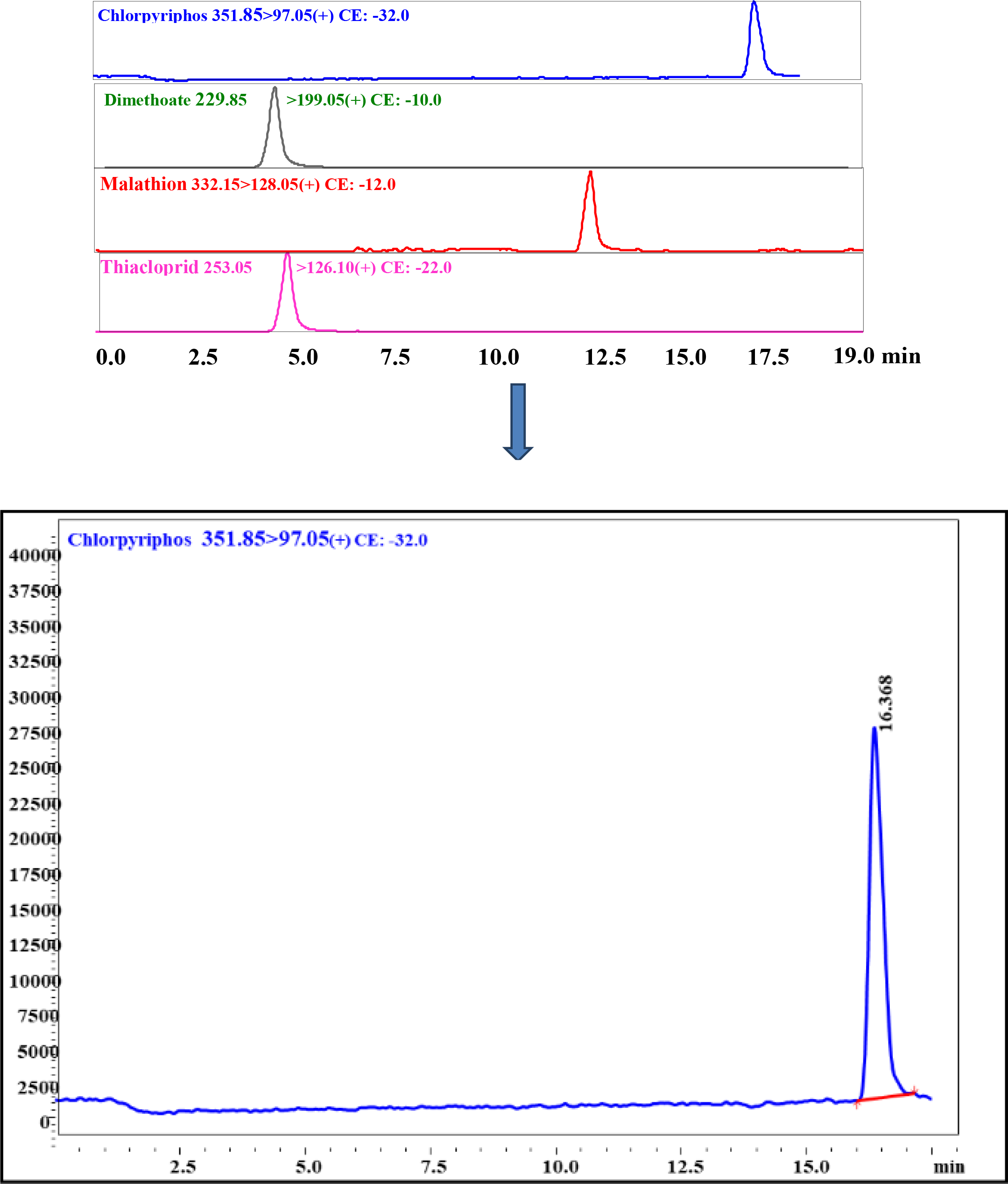
The apple matrix has combined interference due to the presence of sugars, fats, oils and pigments, which could significantly influence the extraction efficiency of the analytical methodologies for the insecticide residues. Therefore, optimizing the LC-MS/MS parameters is essential for achieving confidence in the identification and quantification of the different insecticide residues. Multiple reaction monitoring (MRM) optimizations have been conducted in the current study using electrospray ionization in both positive and negative modes to select the proper ionization mode and optimal production of ions for quantification and identification of each insecticide. The collision energy (CE), Q1 Pre-bias, Q3 Pre-bias, dwell time and pause time for each event were optimized based on the compound sensitivity. The separation of the insecticide through C-18 chromatographic column with their unique MRM transition was achieved during a 19 min run time, as shown in Figure 1.
Table 1 displays the ionization mode, retention time, molecular mass, qualifier and quantifier MRM transitions for each insecticide as well as the collision energy involved in the transition. A validation protocol was carried out for the optimization procedure in order to confirm the performance characteristics of the procedure. Validation of the method for estimation of the insecticide residue in apple matrices was done as per single laboratory validation approach. The performance of the method was evaluated through linearity, sensitivity, recovery and repeatability data as per the SANTE guidelines [20]. Under the optimized parameters, a mixture of four insecticides with trace level from 0.001 to 2 µgmL-1 was injected to achieve the calibration curve for each insecticide. Calibration curves obtained were linear in the concentration range of the insecticide tested with correlation coefficients ranging from 0.943 to 0.999. Table 1 depicts the regression equation and the correlation coefficient (r) value for each insecticide studied.
The specificity of insecticides for trace level identification and quantification in the ‘Royal Delicious’ matrix was acquired by optimizing quantifier (Q1) and qualifier (Q2) MRM transitions, which clearly extract the requisite insecticide in the presence of other insecticides and matrix interferences. Figure1shows a representation of the quantification of a single analyte without any background interference.
Table 2 shows the results of the recovery experiment fortified apple at 0.01, 0.05 and 0.1mg kg-1 levels. Except malathion all insecticides were recovered at 0.01, 0.05, and 0.1 mg kg-1 fortification levels, with recovery percentages ranging from 87.72 to 117.21%. Malathion could only be recovered at 0.05 and 0.1 mg kg-1 fortification levels by 110.81% and 97.56%, respectively (Table 2). %RSD was used to calculate the intra-laboratory repeatability of all insecticides in the apple matrices at three fortification levels. As illustrated in Table 2, % RSD values for all recovered insecticides at various fortification levels ranged from 4.00 to 8.52, which is well below the acceptable repeatability criteria of ≤ 20.
Recovery of the insecticides from the apple matrix at 0.01, 0.05 and 0.1 mg kg-1 levels of fortification
The limit of detection (LOD) as well as limit of quantification (LOQ) were determined using signal-to-noise (S/N) ratios of ≥3:1 and 10:1, respectively. Except for malathion, the LOD for all of the analyzed insecticides was 0.003 µg mL-1and the LOQ for the method was 0.01 µg mL-1 for malathion the LOD and LOQ were 0.015 and 0.05 µg mL-1, respectively (Table 2).The replicated recovery experiment at three spiking levels (0.01, 0.05, and 0.1 mgkg-1) resulted in the mean % recovery in the range of 87.72 to 117.21% with satisfactory repeatability of 4.00 to 8.52 %RSD that were within acceptable recovery (70 -120%) as well as intra-laboratory repeatability (%RSD ˂20) in accordance with the guidelines of European Commission, validation and quality control criteria for insecticide residue analysis [20].
Information cited by Asia and Pacific Plant Protection Commission concerning the insecticides used in this study, their physicochemical properties, commercial names, and active ingredient are listed in supplementary material Table S1 [23]. The physico-chemical properties reveal the differences in insecticides in term of sorption and their ability against removal efficiency from the food matrix during processing. Holden [24] reported that triazophos is a thermally stable organophosphorus pesticide that degrades by 72% in fruit and vegetables when cooked at 100 °C for 20 min. According to Zhao [25] insecticides with a relatively low octanol-water partition coefficient are removed more easily at elevated temperatures than those with a relatively high octanol-water partition coefficient (Kow). Similarly, ChemSafetyPro [26] also reflects that insecticide with high logKow value (i.e.˃4.5) have the potential to bio-accumulate in living organisms. Kow value is also indicative of the diffusion ability of the compound through the plant cuticle.
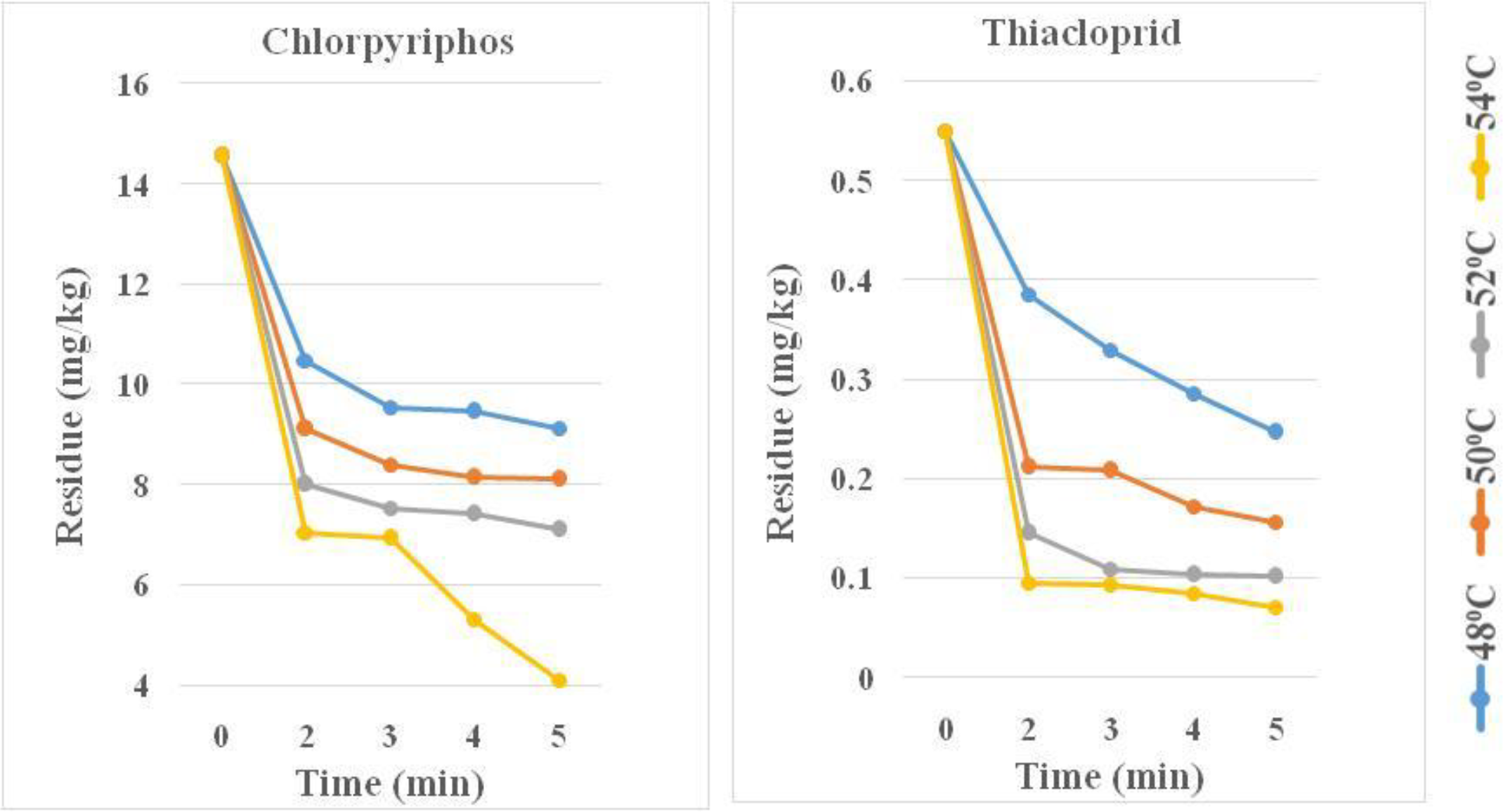
HWT is one of the safest postharvest treatment to extent storage life of fresh produce as it activates some indigenous phytoalexins that stimulate the self-defense mechanism [10]. Elevated temperatures during HWT trigger the volatilization and break down of chemical bonds of the insecticide leading to their degradation [28]. A study conducted by Severini [28] revealed that thermal processes in fruit and vegetables yield diverse distribution of insecticide residues which range from a complete elimination to a partial reduction of deposited chemicals. In our finding also, we observed that when insecticide fortified apple was treated by hot water at varied combinations of temperature (48 °C, 50 °C, 52 °C and 54 °C) and time (2, 3, 4 and 5 min), malathion and dimethoate were completely eliminated and chlorpyriphos and thiacloprid were partially reduced (Supplementary material Table S3). Chlorpyriphos residue of 14.54 mgkg-1 was quantified in fortified control samples not given any hot water treatment. But, when the fruits were treated with hot water at different temperatures for varied duration, chlorpyriphos residues in apple markedly declined. Degradation trend was elevated by increasing temperature from 48 to 54 °C in proportion to the time of exposure. Chlorpyriphos residues of 10.48 to 9.13 mgkg-1 were seen in 48 °C treatment (2 min to 5 min of exposure) while, least fraction of residues were seen at 52 °C/ 5 min (7.10 mgkg-1) and 54 °C/ 5 min (4.09 mgkg-1) (Figure 2, Supplementary material Table S3). Exposure to elevated temperature of 54 °C/ 5 min significantly increased PWL and resulted in bleaching of peel colour (Supplementary material Table S2). Hence, 48 °C/5 min and 50 °C/ 2 min were considered suitable treatments for degrading chlorpyriphos along with maintaining the fruit quality. By treating the samples in hot water, residues of thiacloprid quantified were 0.246 mgkg-1, 0.211 mgkg-1 at 48 °C/ 5 min and 50 °C/ 2 min, respectively, while it was 0.549 mgkg-1in untreated apple. The lowest residue of thiacloprid (0.071 mgkg-1) was seen at 54°C treatment for 5 min (Figure 2, Supplementary material Table S3). However, both dimethoate and malathion were the least persistent insecticides, which measured 0.05 mg kg-1 and 0.031 mg kg-1 before HWT at zero day. Residues were further reduced to 0.010 mg kg-1 and 0.02 mg kg-1, respectively in 90 day cold stored apples. It was observed that after the HWT at varied temperature and duration, both dimethoate and malathion completely degraded due to their thermo-lability or instability (Supplementary material Table S3). Holland and his co-workers [29] also reported 73% reduction of fenitrothion after boiling and blanching. Similarly, Alary [30] had reported complete degradation of captan in apples puree after sterilization at 125 °C for 20 min. Furthermore, hot water washing or blanching is much more efficient than cold washing in removing pesticide residues as asserted by Timme and Walz-Tylla [31]. A possible cause may be the hydrolysis of the insecticide in water at high temperatures, which leads to changes in its chemical structure during heating.
When the ‘Royal Delicious’ apple fruits were given hot water treatment for different time intervals (2, 3, 4 and 5 min) at different temperatures (48, 50, 52 and 54 °C), all the insecticides showed accelerated rate of dissipation. Just after HWT for 2, 3, 4 and 5 min at 48 °C, 27.90%, 34.46%, 35.01% and 37.21% dissipation of chlorpyriphos, respectively was noticed. Whereas, treatment at 48 °C/ 5 min and 50 °C/ 2 min followed by 90 days cold storage resulted in 98.34% and 98.91% dissipation of chlorpyriphos residues, respectively (Supplementary material Table S4). In a similar way, (81.71 % and 88.00%) dissipation of thiacloprid was observed after HWT at 48 °C/ 5 min and 50 °C/2 min, respectively in cold stored fruit (Supplementary material Table S5). A glance at Table S4 indicates that although temperature of hot water had a predominant effect on degradation of chlorpyriphos, but time of exposure was relatively less effective. On the other hand, the situation is reverse in case of thiacloprid where both temperature of hot water as well as time of exposure had significant effect on dissipation of thiacloprid (Table S5). Moreover, lesser dissipation of thiacloprid in comparison to chlorpyriphos under similar hot water treatment and time of exposure showed that chlorpyriphos is more heat labile than thiacloprid (Tables S4 and S5).These results got the support from the observation of Kang [32] who reported that dichlorvos was almost completely removed from spinach, even though chlorpyriphos and fenvalerate remained even after cooking for 2 min. It was possibly due to differences in water solubility and vapour pressure of the pesticides. Similarly, in 2001, Soliman [33] had reported that the degradation of hexachlorobenzene (HCB), lindane,1,1,1-trichloro-2,2 bis (p-chlorophenyl) ethane (p,p-DDT), dimethoate, pirimiphosmethyl and malathion in potato after peeling and blanching were to the extent of 28.3%, 22.9%, 26.0%, 47.3%, 46.3% and 45.9%, respectively. Interestingly, Radwan [34] noticed that blanching could remove almost all pesticides from peppers and eggplant fruits. The results of a study conducted by Chavarri [35] showed that blanching of tomatoes and asparagus reduced 50.0% and 83.4% chlorpyriphos residue, respectively. Dordevic and Durovic-Pejcev [36] opined that blanching of hot peppers decreased 100% dichlofluanid and folpet levels as a result of pesticide degradation by hydrolysis, volatilization and leaching. Byrne [37] investigated the behavior of chlorpyriphos after baking at 177 °C for 32 min on apples, cherries, peppers and winter squash and found that chlorpyriphos decreased by 39.1% in apples, 18.2% in peppers and 21.5% in winter squash, while increasing 15.9% in cherries.
Half-life of insecticide that is the time for it to degrade upto half of its original concentration can range from hours to years, depending on its persistence. The insecticide degradation rate resulting from hot water treatment followed first order kinetics and linear equations obtained were used to determine the half-life (t1/2) of each insecticide under different temperature-time regimes of HWT of the fortified apples (Table 3).
A comparative study on degradation behavior and persistence of four insecticides under investigation revealed that dimethoate and malathion completely dissipated immediately after HWT as compared to in untreated fruit indicating extreme effectiveness of HWT for removal of these two organophosphorus insecticides. Degradation of chlorpyriphos and thiacloprid increased with increasing hot water temperature and time. In comparison to the untreated sample, the result showed that 27.90% to 99.94% of the chlorpyriphos dissipated, as did 29.87% to 94.86% of the thiacloprid. Chlorpyriphos and thiacloprid showed a longer t1/2 of 19.05 days and 73.42 days in control apple samples, while t1/2 significantly reduced upon hot water treatment. Post HWT, the half-life drastically declined to 7.53, 5.96, 5.03 and 2.88 min for chlorpyriphos and 4.33, 2.86, 2.05 and 1.80 min for thiacloprid at treatment of 48, 50, 52 and 54°C, respectively. The result indicates that thiacloprid was less persistent as compared to chlorpyriphos under prolonged cold storage. Considering the overall quality of apple, following 90 days of cold storage and HWT at 48°C and 50°C, chlorpyriphos and thiacloprid t1/2 were 7.53, 5.96 and 4.33, 2.86 min, respectively (Table 3). Tomlin [38] observed significant reduction in chlorpyriphos, diazinon and fenitrothion during storage, while quinalphos remained persistent. He also observed that diazinon and quinalphos had the fastest hydrolysis rate in acidic media as compared to chlorpyriphos and fenitrothion. Fenoll [39] reported 5-9 times higher t1/2 in cold stored peppers than in other greenhouse samples. This is explained by the fact that the dark and cold environment likely results in enzymatic degradation, evaporation and photo-degradation. In our study also an incomparable reduction in half-life of the insecticides was observed where initial t1/2 of 19 and 73 days reduced to few min upon cold storage (Table 3). According to Zhao [25], chlorpyriphos dissipates from soybeans after 99 days under ambient conditions (25 °C). Alary [30] reported that tolylfluanid degradation might be induced by interactions with thiol compounds in the apple which resulted in thiacloprid degradation. Physico-chemical and structural variations contribute to the differences in half-life of the insecticides. Furthermore, presence of catalase enzyme has shown to degrade pesticide residues more efficiently, resulting in a reduction in the t1/2 of pesticides [40].
Processing factor can determine whether HWT may cause reduction or enrichment of insecticide residue in food matrix, Processing Factor (PFs) less than one was found for all processed samples (i.e., HWT at various temperatures for different durations and cold storage). For chlorpyriphos between at 48 °C/5 min and 50 °C/ 2 min, the PFs were 0.628 and 0.622, respectively. Meanwhile, at 48 °C/ 5 min and 50 °C/2 min, thiacloprid had PFs of 0.445 and 0.378, respectively. As shown in supplementary material Table S3 control sample of dimethoate or malathion had a PF of 1 initially and after cold storage for 90 days it reduced to 0.23 and 0.41, respectively (control fruits); however, upon heat treatment they got completely degraded because of their thermolabile nature. Our finding is supported by Boon [41] who observed that PFs for organophosphorus insecticide in various fruits and vegetables were 0.76, 0.44 and 0.74, respectively for washing, peeling and canning. In a similar study, Jankowska [42] tested 24 pesticides in varied fruits and vegetables for their stability towards various treatments in which, PFs ranged from 0.09-0.94 for washing, 0.13-0.32 for mechanical and 0.02-0.57 for thermal treatment. The reason for this variation might be the difference in physico-chemical properties of these insecticides. Furthermore, Ozbey [43] also reported that increased temperature accelerated the pesticide residue degradation.
CONCLUSION
Due to the high nutritional value, antioxidant level, flavonoids and flavour, apple fruit is very popular among the consumers. Indiscriminate use of pesticide on the fruit may pose a health risk for consumers. Consequently, this study aims to facilitate the optimum insecticide residue degradation in hot water treated apples. Maximum percentage dissipation of chlorpyriphos and thiacloprid residues was observed at 48 °C/ 5 min (37.21 to 98.34%, 55.19 to 81.71%, respectively). HWT significantly reduced the t1/2 of all insecticides. A calculation of processing factors (PFs) used to evaluate the efficiency of the correlation between HWT and physico-chemical properties of insecticides revealed values below one in all treated samples as compared to untreated fruit. The effectiveness of hot water treatment on the targeted insecticides can be summarized as dimethoate=malathion>thiacloprid>chlorpyriphos. Hot water treatment at 48°C/5 min or 50°C/2 min before cold storage were found to conserve the edible quality as well result in effective removal of almost total insecticide residues under investigation.
-
Funding:
This research received no external funding
Acknowledgement:
The authors are thankful to the ICAR-Indian Agricultural Research Institute, New Delhi for providing scholarship during the Ph.D programme of Dr. Ajit Kumar Singh for smooth conduct of the research work.
REFERENCES
-
1 Boyer J, Liu RH. Apple phytochemicals and their health benefits. Nutr. J. 2004May;3(1):1-15.https://doi.org/10.1186/1475-2891-3-5
» https://doi.org/10.1186/1475-2891-3-5 -
2 Barreira JC, Arraibi AA, Ferreira IC. Bioactive and functional compounds in apple pomace from juice and cider manufacturing: Potential use in dermal formulations. Trends Food Sci. Technol. 2019 Aug;90(1):76-87. https://doi.org/10.1016/j.tifs.2019.05.014
» https://doi.org/10.1016/j.tifs.2019.05.014 -
3 Eurostat. The Fruit and Vegetable Sector in the EU-A Statistical Overview,2019. Accessed on 02.10.2023.https://ec.europa.eu/eurostat/statisticsexplained/index.php?
» https://ec.europa.eu/eurostat/statisticsexplained/index.php -
4 Jones VP, Wiman NG. Longevity of the adult codling moth, Cydia pomonella, and the oblique banded leafroller, Choristoneura rosaceana, in Washington apple orchards. J. Insect Sci.2008 Feb;8(1):1-10. https://doi.org/10.1673/031.008.1401
» https://doi.org/10.1673/031.008.1401 - 5 Holb IJ. Fungal disease management in environmentally friendly apple production-A review. Climate change, intercropping, pest control and beneficial microorganisms, 2009 Jan;219-292. ISBN: 978-90-481-2715-3.
-
6 Farahy O, Laghfiri M, Bourioug M, Aleya L. Overview of pesticide use in Moroccan apple orchards and its effects on the environment. Curr. Opin.Environ. Sci. Health. 2021 Feb;19:100-223. https://doi.org/10.1016/j.coesh.2020.10.011
» https://doi.org/10.1016/j.coesh.2020.10.011 - 7 Naqash F, Wani, SA, Mir SA, Wani WM, Baba SH, Malik HA. Economics of pesticide use in the apple producing areas of Kashmir Valley.Int. J. Adv. Res. Innov. Ideas Educ.2019Jan;5(4):68-80.
-
8 Ikeaura H, Kobayashi F, Tamaki M. Removal of residual pesticide, fenitrothion, in vegetables by using ozone microbubbles generated by different methods. J. Food Eng. 2011 Apr;103(3):345-9. https://doi.org/10.1016/j.jfoodeng.2010.11.002
» https://doi.org/10.1016/j.jfoodeng.2010.11.002 -
9 Wei JCY, Tiemur A, Wang J, Wu B.Degradation of pesticide residues by gaseous chlorine dioxide on table grapes Postharvest Biol. Technol. 2018 Mar;137:142-148.https://doi.org/10.1016/j.postharvbio.2017.12.001
» https://doi.org/10.1016/j.postharvbio.2017.12.001 -
10 Reddy SVR, Sharma RR, Raghavendra HR, Prajapati U. Microbiological efficacy of decontamination methodologies for fresh produce. J. Plant Dis. Prot. 2020Nov;16323-355. https://doi.org/10.1016/B978-0-12-821843-3.00005-2
» https://doi.org/10.1016/B978-0-12-821843-3.00005-2 -
11 Heshmati A, Hamidi M, Nili-Ahmadabadi A. Effect of storage, washing, and cooking on the stability of five pesticides in edible fungi of Agaricus bisporus: A degradation kinetic study. Food Sci. Nutr.2019 Nov;7:3993-4000.https://doi.org/10.1002/fsn3.1261
» https://doi.org/10.1002/fsn3.1261 - 12 Fawcett HS. Packing house control of brown rot. Citograph.1922 Oct;7:232-4.
-
13 Lalah JO, Wandiga SO. The effect of boiling on the removal of persistent malathion residues from stored grains. J.Stored Prod.Res.2002 Dec;38(1):1-10.https://doi.org/10.1016/S0022-474X(00)00036-9
» https://doi.org/10.1016/S0022-474X(00)00036-9 -
14 Alister C, Araya M, Becerra K, Volosky C, Saavedra J, Kogan M. Industrial prune processing and its effect on pesticide residue concentrations. Food Chem. 2018 Dec;268:264-270. doi.org/10.1016/j.foodchem.2018.Dec:06.090.
» https://doi.org/doi.org/10.1016/j.foodchem.2018.Dec:06.090 -
15 Bian Y, Wang J, Liu F, Mao B, Huang H, Xu J. Residue behavior and removal of iprodione in garlic, green garlic, and garlic shoot. J. Sci. Food Agric.2020 May;100:4705-13.https://doi.org/10.1002/jsfa.10527
» https://doi.org/10.1002/jsfa.10527 -
16 Bonnechère A, Hanot V, Jolie R, Hendrickx M, Bragard C, Bedoret T, et al. Effect of household and industrial processing on levels of five pesticide residues and two degradation products in spinach. Food Control. 2012 May;25(1):397-406.doi.org/10.1016/j.foodcont.2011.11.010.
» https://doi.org/doi.org/10.1016/j.foodcont.2011.11.010 -
17 Lehotay SJ, Son KA, Kwon H, KoesUkWiwat U, Fu W, Mastovska K, Leepipatpiboon N. Comparison of QuEChERS sample preparation methods for the analysis of pesticide residues in fruits and vegetables. J.Chromatogr. 2010 April;1217(16):2548-60.https://doi.org/10.1016/j.chroma.2010.01.044
» https://doi.org/10.1016/j.chroma.2010.01.044 -
18 Central Insecticide Board and Registration Committee, Government of India (CIB&RC), 2022 Apr. https://ppqs.gov.in/divisions/central-insecticides-board-registration-committee
» https://ppqs.gov.in/divisions/central-insecticides-board-registration-committee - 19 Brittain HG, editor. Profiles of drug substances, excipients, and related methodology. Academic press. 2020 Mar;45:293.
- 20 Sante. European Commission (EC) director general for food and health safety. Guidance document on analytical quality control and validation procedures for pesticide residues analysis in food and feed. Document No: SANTE 12682/2020(2020).
-
21 Jankowska M, Kaczynski P, Hrynko I, Lozowicka B. Dissipation of six fungicides in greenhouse-grown tomatoes with processing and health risk. Environ. Sci. Pollut. Res. 2016 Mar;23(12):11885-900.https://doi.org/10.1007/s11356-016-6260-x
» https://doi.org/10.1007/s11356-016-6260-x -
22 Lozano A, Rajski Ł, Belmonte-Valles N, Uclés A, Uclés S, Mezcua M, Fernández-Alba ARA. Pesticide analysis in teas and chamomile by liquid chromatography and gas chromatography tandem mass spectrometry using a modified QuEChERS method: validation and pilot survey in real samples.J.Chromatogr.A.2012 Dec;1268:109-122. doi.org/10.1016/j.chroma.2012.10.013.
» https://doi.org/doi.org/10.1016/j.chroma.2012.10.013 -
23 APPPC. Asia and Plant Protection Commission Information on pesticides https://www.ippc.int › external-cooperation › apppc 2022 Accessed in May 2023.
» https://www.ippc.int - 24 Holden AJ, Chen L, Shaw IC. Thermal stability of organophosphorus pesticide triazophos and its relevance in the assessment of risk to the consumer of triazophos residues in food. J. Agric. Food Chem.2001 Dec; 49(1):103-6.
-
25 Zhao L, Ge J, Liu F, Jiang N. Effects of storage and processing on residue levels of in soybeans. Food Chem.2014May;150:182-6.https://doi.org/10.1016/j.foodchem.2013.10.124
» https://doi.org/10.1016/j.foodchem.2013.10.124 -
26 ChemSafetyPro. http://www.chemsafetypro.com/Topics/CRA/nOctanolWater_Partition_CoefficientKow-html (2019). Accessed on 02.10.2023.
» http://www.chemsafetypro.com/Topics/CRA/nOctanolWater_Partition_CoefficientKow-html -
27 Ticha J, Hajslova J, Jech M, Honzicek J, Lacina O, Kohoutkova J, Falta V. Changes of pesticide residues in apples during cold storage.Food Control.2008 March;19(3):247-56. https://doi.org/10.1016/j.foodcont.2008.03.011
» https://doi.org/10.1016/j.foodcont.2008.03.011 - 28 Severini C, Pilli TD, Petruccelli A, Baiano A, Scapicchio P. Effects of technological process on pesticide residues in canned tomatoes 2003 May:Ind. Aliment.30.
- 29 Holland PT, Hamilton D, Ohlin B, Skidmore W. Effects of storage and processing on pesticide residues in plant products. Pure Appl. Chem.1994; 66(2):335-56.
-
30 Alary J, Bescos D, Monge MC, Debrauwer L, Bories Gl. Laboratory simulation of captan residues degradation during apple processing. Food Chem. 1995 Jan;54(2):205-211.https://doi.org/10.1016/0308-8146(95)00033-F
» https://doi.org/10.1016/0308-8146(95)00033-F -
31 Timme G, Walz-Tylla B. Effects of food preparation and processing on pesticide residues in commodities of plant origin. Pesticide residues in food and drinking water: Expos. Health.2004 Oct;121-148. DOI:10.1002/0470091614.
» https://doi.org/10.1002/0470091614. - 32 Kang SM, Lee MG. Fate of some pesticides during brining and cooking of Chinese cabbage and spinach. Food Sci. Biotechnol.2005 Feb;14(1):77-81.
-
33 Soliman KM. Changes in concentration of pesticide residues in potatoes during washing and home preparation. Food Chem. Toxicol.2001 Aug;39(8):887-91.https://doi.org/10.1016/S0278-6915(00)00177-0
» https://doi.org/10.1016/S0278-6915(00)00177-0 -
34 Radwan MA. Residual behaviour of profenofos on some field-grown vegetables and its removal using various washing solutions and household processing. Food Chem. Toxicol.2005 April;43(4):553-7. https://doi.org/10.1016/j.fct.2004.12.009
» https://doi.org/10.1016/j.fct.2004.12.009 -
35 Chavarri, MJ. The decrease in pesticides in fruit and vegetables during commercial processing. Int. J. Food Sci. 2005Feb;40(2):205-211.https://doi.org/10.1111/j.1365-2621.2004.00932.x
» https://doi.org/10.1111/j.1365-2621.2004.00932.x -
36 Dordevic T, Durovic-Pejcev R. Food processing as a means for pesticide residue dissipation. Pesticidi. 2016 Nov;1(3):89-105. https://doi.org/10.2298/PIF1604089
» https://doi.org/10.2298/PIF1604089 -
37 Byrne SL, Pinkerton SL. The effect of cooking on chlorpyrifos and 3, 5, 6-trichloro-2-pyridinol levels in chlorpyrifos fortified produce for use in refining dietary exposure. J. Agric. Food Chem.2004 Nov;52(25):7567-73.https://doi.org/10.1021/jf049212w
» https://doi.org/10.1021/jf049212w - 38 Tomlin CDS. The pesticide manual 12th Edition. British Crop Protection Council. 2000; 49: 647-8.
-
39 Fenoll J. Dissipation rates of insecticides and fungicides in peppers grown in greenhouse and under cold storage conditions. Food Chem.2009 March;113(2):727-732.https://doi.org/10.1016/j.foodchem.2008.08.007
» https://doi.org/10.1016/j.foodchem.2008.08.007 -
40 Bian Y, Liu F, Chen F, Sun P. Storage stability of three organophosphorus pesticides on cucumber samples for analysis. Food Chem. 2018 Jan;250:230-5. https://doi.org/10.1016/j.foodchem.2018.01.008
» https://doi.org/10.1016/j.foodchem.2018.01.008 -
41 Boon PE, Vander VH, Van Raaij MTM, Klaveren JD. Cumulative risk assessment of the exposure to organophosphorus and carbamate insecticides in the Dutch diet. Food Chem. Toxicol. 2008 Sept;46(9):3090-8. https://doi.org/10.1016/j.fct.2008.06.083
» https://doi.org/10.1016/j.fct.2008.06.083 -
42 Jankowska ML, Kaczyński P. Comprehensive toxicological study over 160 processing factors of pesticides in selected fruit and vegetables after water, mechanical and thermal processing treatments and their application to human health risk assessment. Sci. Total Environ. 2019 Feb;652:1156-67: https://doi.org/10.1016/j.scitotenv.2018.10.324
» https://doi.org/10.1016/j.scitotenv.2018.10.324 - 43 Ozbey A, Karagoz Ş, Cingoz A. Effect of drying process on pesticide residues in grapes. GIDA/ J. Food.2017 May;42(2):204-09.
-
Editor-in-Chief:
Bill Jorge Costa
-
Associate Editor:
Aline Alberti