
 Enunciation on TikTok: Mechanisms of Acceleration in Content Creation
ABSTRACT
Based on an understanding of the algorithm as a set of strategic statements that regulate the functioning of social networks, this article analyzes the interactions that take place on TikTok in its short videos designed for the mobile format. Using the framework of French semiotics, especially tensional semiotics, we explore the diffusion of discourses within this platform and the incentives created for their production and circulation. In addition, we discuss the role of TikTok as a proto-enunciator and how this influences the content produced by users and encourages the construction of accelerated and tonic statements. We also explore the content acceleration strategies that users use to fulfill the expectations generated by the algorithm.
KEYWORDS:
Enunciation; TikTok; Algorithm; Semiotics; Digital Space
RESUMO
Partindo do entendimento do algoritmo enquanto um conjunto de enunciados estratégicos que regulam o funcionamento das redes sociais, este artigo analisa as interações ocorridas no TikTok em seus vídeos curtos pensados para o formato mobile. Por meio do arcabouço da semiótica francesa, sobretudo da semiótica tensiva, explora-se a difusão dos discursos dentro dessa plataforma e os incentivos criados para sua produção e circulação. Além disso, debatemos o papel do TikTok como um protoenunciador e como isso influencia nos conteúdos produzidos pelos usuários e incentiva a construção de enunciados acelerados e tônicos. Exploramos, ainda, as estratégias de aceleração de conteúdo de que os usuários lançam mão para cumprir as expectativas geradas pelo algoritmo.
PALAVRAS-CHAVE:
Enunciação; TikTok; Algoritmo; Semiótica; Espaço digital
Introduction
When Jean-Marie Floch (2023) described the famous semiotic typology of Paris metro users’ journeys in the 1980s, the significant activities that attracted the attention of the so-called “sleepwalkers” during the journey were reading, knitting and listening to music on walkmans. If the analysis were to be carried out in the 2020s, the most common action of this group would probably be lightly swiping their fingers on a smartphone to jump from one video to another on some social network, perhaps TikTok.
In this article, we consider both social media and social networks in the sense of social networking sites, as described by Boyd and Ellison (2007), i.e. systems that allow the construction of a persona through an online profile; interaction through comments; and the public exposure of actors. The authors highlight two elements that are addressed in this definition: appropriation, which refers to the use of the tools by the actors, and structure, which guarantees the connections between the publicly exposed actors. Thus, digital platforms, as spaces for online exchange, can be read as social networks based on their proposals for interaction between public profiles. This is the case with TikTok as well as Facebook, Instagram, X and others.
The popularization of mobile devices, the improvement of cell phone cameras, as well as the arrival of increasingly faster mobile internet connections - such as 4G and 5G - have not only included more users in these media, but have also brought an appreciation of a specific format that demands more data usage: video. In July 2021, Instagram’s own director, Adam Mosseri, went public with the news that the network would move away from photos and focus its efforts on videos.1 This was to get closer to its new competitor: TikTok.
In the wake of these changes, new audiovisual formats have emerged and the characteristics of these two platforms have come to guide user production and consumption. TikTok - which paved the way for Instagram’s Reels tool - began accepting only video content, vertically (the ideal format for mobile devices), and initially with a maximum duration of 60 seconds. At the end of 2020, the platform increased this time to up to 3 minutes and, at the beginning of 2022, up to 10 minutes. Posts can also receive captions and a cover. The user has a series of filters and editing tools that encourage filming and all editing to be done with the cell phone via the app itself. And it’s possible to add music and audio that is also chosen within the platform and can be shared from other videos.
In addition to the famous dance choreographies for which TikTok has become famous, these tools are used to produce different types of content, from humorous to political debate. What these pieces of content that go viral have in common is not their subject matter, but their engagement: their power to keep users interested and interacting with the texts presented, whether through likes, comments, shares or saves.
In order to motivate users to watch the videos till the end and interact with the content, the creators, i.e. the user-enunciators, use various strategies, creating new practices based on what they believe is privileged by the algorithm (Teixeira; Coutinho, 2025) - a system that hierarchizes content within the network based on a series of parameters and chooses what will or will not be shown to users. In the work mentioned above, we discussed the role of the algorithm as a strategic discourse produced by the social network and its role as a proto-enunciator that gives users a voice to formulate their own statements on the platform. This article develops the hypothesis that the mechanisms created by TikTok in its first enunciation encourage the creation of faster texts that engage users through intensity
1 Enunciative Dynamics in TikTok
In this study, we consider the algorithm as a strategy, a set of norms defined by the social network and, therefore, a discourse generated by an instance of enunciation, characterized by intentionality and by the interactions that it not only predicts, but also proposes and stimulates. The discursive action of algorithms disseminates values through the texts it favors and inaugurates a kind of enunciative ecosystem, in which the network presents itself as the primary enunciator that gives a voice to users who create content.
In this sense, the social network, in this case TikTok, functions as a proto-enunciator, as we proposed in previous work, in other words, an enunciator who delegates a voice to others and starts an enunciative chain, so that the enunciations derived from it concentrate their basic strategies.
Based on Fontanille’s (2019) conclusions on how material supports are used to configure practices of use, we understand that the discursive tangle produced on social networks is made up of a successive delegation of voices engendered by a first enunciator and strategist, the social network itself. “The term proto-enunciator will be thought of here in its etymological meaning of first enunciator. It designates the inaugural position of an enunciator 1, the one who opens up paths and, at the same time, delimits them” (Teixeira; Coutinho, 2025, p. 10).2 Thus, the secondary enunciators (users who own profiles on the networks) feel free to produce their discourses.
However, they can only do so within the parameters established by this proto-enunciator, who organizes the possibilities within the network by means of the algorithm. In this way, the interactivity that these platforms make possible - with a user who can, in theory, choose what they will consume and also create content for other users - constructs a simulacrum of neutrality in the digital space, where authorship would be directly the responsibility of the users, as well as the responsibility for the communications that are broadcast. Once the social network delegates the enunciation itself to users, it abstains from any consequences related to the published texts.
It is in this sense and in order to unveil this false neutrality that we propose an enunciative chain and not a delegation of voice from an enunciator to a narrator or even the possibility of the social network functioning only as the user-enunciator’s addressee. It is also the addressee, but it is more than that, because not only does it initiate the user’s enunciation, but it is also involved in the entire enunciative process.
This power of manipulation that the user can exercise ends up giving the impression that what we are observing depends exclusively on our intervention, without any prior editorializing on the part of the site’s editors. As if this data were truly raw and no interpretative activity on the part of the site’s programmers could matter (...) We act, but we do so following paths that have already been mapped out by someone else. Interactivity and manipulation are just possibilities that have been decided for us in advance. We are the subjects of manipulation, but ultimately, as users, we only actualize a potential predetermined by someone else, in a purely operational role: the subject then becomes the operator (Treleani, 2022, p. 7).3
Microsoft researcher and professor in the Department of Communication at Cornell University, Tarleton Gillespie describes algorithms as “encoded procedures for transforming input data into a desired output, based on specified calculations” (2014, p. 167),4 but questions their role as a central element of our information ecosystem.
In his article, he highlights six dimensions of publicly relevant algorithms that have political value:
1) inclusion patterns, which address the inclusion or exclusion of certain data and the preparation of the mass of data that will be processed by the algorithm;
2) anticipation cycles, which concern the algorithm’s attempt to predict users’ behavior based on their past interactions;
3) relevance assessment, which involves the criteria by which the algorithm determines what is relevant, appropriate and legitimate;
4) the promise of algorithmic objectivity, which deals with the aura of impartiality that the technical nature of the algorithm claims to uphold and which would legitimize its choices;
5) intertwining with practice, which highlights how users reconfigure their practices to suit the algorithms on which they depend; and
6) production of calculated audiences, a dimension that deals with how the algorithmic presentation of audiences to themselves shapes a notion of themselves. We could associate this last dimension with the creation of user bubbles, in which certain discourses reverberate in a uniform and amplified way, giving the feeling of exclusion - or non-existence - of opposing discourses.
We are led - by algorithms and our own preference for like-minded people - into “filter bubbles,” where we find only the news we expect to find and the political perspectives we already hold dear (Gillespie, 2014, p. 188).5
Thus, when we think about enunciation on social networks, it is impossible to ignore the role of the algorithm in the hierarchization of content, its presentation to users, the demands it sets for the users themselves who are content creators and the incentives for their creation, which end up shaping the data produced for that network. It is therefore a cycle in which the data entered into the platform is processed by the algorithm and this processing itself influences the creation of new data.
In this sense, the algorithm establishes the functioning of the network and dictates the courses of action of users in narratives to spread their values in the digital space, gain more followers, get interactions with their profiles and, finally, monetize their production to its maximum potential. Users then feel that it’s not enough just to be on the net, they have to create discourses that suit the demands of the algorithm so that they can be disseminated and actually reach other users online.
It’s also worth noting how the role of the algorithm has become even more prominent in the emerging practices within the system built by TikTok. It presents itself differently from other social networks such as Instagram and Twitter, for example. When they were first created, these networks proposed a consumption of content directed by the profiles the user chose to follow, weaving a “feed” of content only created by the profiles followed. TikTok’s default page is “For You,” the main version of the “news feed.” This page is presented to the user as an algorithmically-generated version customized just for them. In this logic, the user would not need to choose who to follow, since, having access to their preferences, the network itself would offer them new, up-to-date content within their interests at all times.
There is even the idea among regular users to “train the algorithm,” i.e. to use the network a lot and mark their preferences well, so that the algorithm is increasingly assertive. But even though the user has influence over the algorithm’s choices, there is also a dimension of passivity and lack of control over what will be viewed, since editing the feed is delegated to this “algorithm entity.”
In this way, looking at enunciation on a social network like TikTok considering only the dimensions of the user who creates content as the enunciator and the user of the network as the enunciatee does not take into account the complexity of this ecosystem and its discursive games. The range of possible users/enunciates is gigantic and the enunciator of each video not only has to construct their text with the aim of persuading and making the enunciatee-user agree with their values, but they also have to meet the demands of the algorithm, i.e. the social network’s strategy, so that this content reaches the desired users in the first place.
This is where the dimension of “intertwining with practice” (Gillespie, 2014)6 comes in. Based on Fontanille’s (2015) proposal, we understand that texts condense the supporting objects that host them, the practices that establish them and the cultural values and identities that subsume them. The enunciation on TikTok is therefore not dissociated from the practices established by the algorithms and the demands and intentions of the social networks themselves, within the contemporary capitalist context. But how is this kind of enunciative ecosystem structured?
2 The Platforms’ Narrative
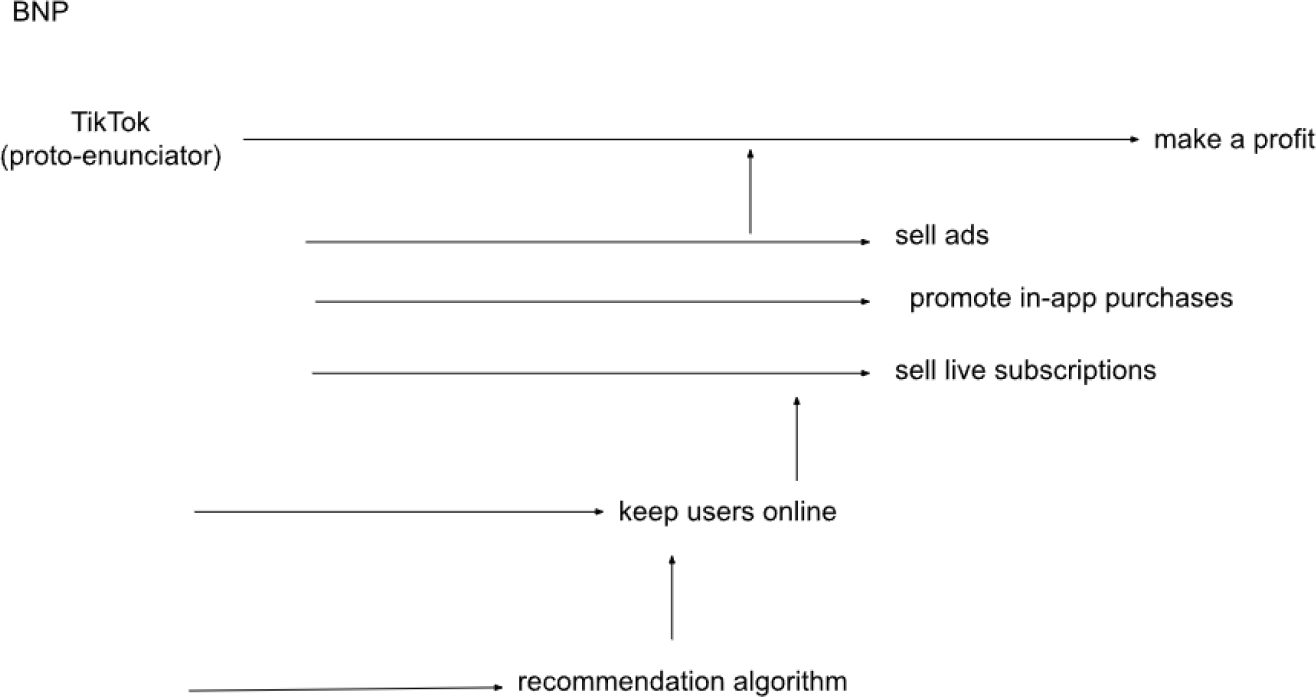
Where, in fact, is the role of the algorithm in this ecosystem? Taking Tiktok as a proto-enunciator, we can think about the narrative presupposed by this enunciation and thus trace a narrative program (Barros, 2002) of the proto-enunciator, which will guide the development of the other narrative programs. To organize our analysis, we’ll call this program BNP (base narrative program). Although it is a free platform for users, TikTok, as a company, has the ultimate goal of making a profit in its business model. This, therefore, will be the object-value of its base program, which directs the unfolding of all the use programs (narrative programs derived from the main program).
These secondary programs would thus be linked to outlining its business model, i.e. the way the network makes money, namely: 1) selling ads to companies; 2) producing and publicizing a purchase model within the app with its own currency; and 3) selling live subscriptions to creators, in which the platform keeps a percentage of the gross value , among others.7
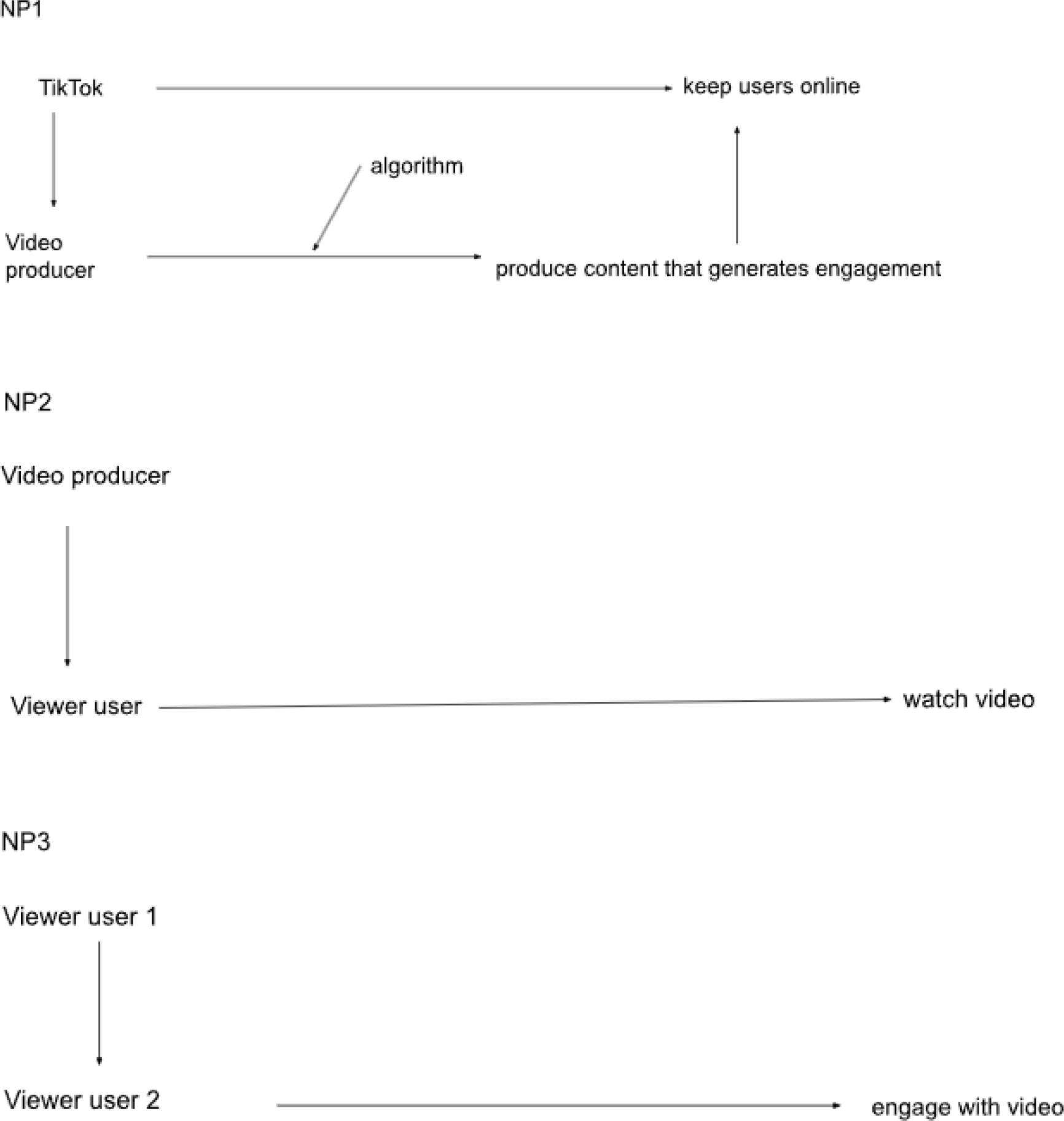
To work in conjunction with all these usage programs, TikTok needs to ensure that users spend many hours in the app and are engaged enough to interact with these three initial forms of financing. This gives rise to another use program, in another dimension, whose value-objective would be “keeping users inside the platform.” It is in this program that the role of the algorithm gains relevance. Before going on to talk about it, let’s take a look at a graphic representation of the BNP and its unfolding into programs of use.
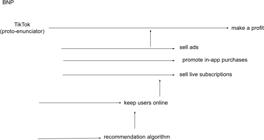
In the diagram, we see a succession of proto-enunciator programs, in which the creation and maintenance of the algorithm, as a dynamic discourse with rules for the operation of the network and recommendations for users, would be an adjuvant to the narrative in which the network seeks to keep users online for as long as possible, in other words, an agent that helps TikTok in this objective.
It is important to emphasize that here we are presenting the algorithm in an actantial adjuvant role, but it is not ontological, i.e. we are not taking it as a being independent of the proto-enunciator. The algorithm plays an adjuvant role in the social network’s manipulation of its users, since it presents itself as the discourse through which Tiktok imposes its principles and norms and is constructed using all the dimensions pointed out by Gillespie (2014).8
In this sense, through the algorithm, TikTok acts as a destinator for the narratives of content creators and consumers, manipulating them, in the case of users, to stay online and browse videos for longer; and, in the case of creators, to produce videos that are more attractive to users and that will generate more views and time online. The algorithm is thus a discourse in this global enunciation that will convey the values and beliefs of the social network, acting as an adjuvant to TikTok in its action as a destinator for its users.
This differentiation is very necessary because the algorithm is understood by many users less as a discourse or a strategy and more as a subject. Almost as if it were an entity with a will of its own. In the many videos of creators trying to teach other users how to “please” or “circumvent” the algorithm, it becomes the subject of actions within social networks. This confusion of roles is due to the fact that the network seems to delegate a lot of its workings to the algorithm and, by selling it as a mathematical scheme that can be “modified” by users, highlights an autonomous, almost neutral role devoid of intentions.
This confusion is very beneficial for the social network itself, which can exempt itself from its role as destinator-manipulator in the reading of users. Even though the algorithm does incorporate data imputed by users on the network and constantly adjusts its content hierarchization action to them, it is important to note that the algorithm is not an autonomous actor. It is a discourse programmed by the proto-enunciator and can only be modified within the limits imposed by the latter in his enunciation.
So, as much as the user-enunciators can contribute to the data that will be processed by the algorithm, they are not able to actually change its programming beyond what was delimited by the proto-enunciator’s first enunciation. Thus, the algorithm is not a secondary enunciator, but the strategy through which the social network structures its enunciative ecosystem.
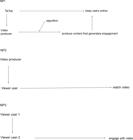
We could therefore think of a narrative program (NP1) in which S1 [TikTok] makes S2 [video producer user] enter into conjunction with a content know-how invested with values capable of producing engagement according to the belief system established in the algorithm. And a NP2 in which S1 [video producer user] makes S2 [network user, “spectator”] enter into conjunction with the video (watch). The sanction will take the form of actions such as liking, commenting and sharing. There is also a NP3, in which S1 [user of the network], by sharing or commenting or liking the video, makes S2 [another user] engage too, since users tend to pay more attention to videos that already have a lot of likes and comments. From there, there is a new unfolding of programs and subjects. Let’s see a representation of this reasoning below.
3 Tensive Space of the Network
This interlinking of programs means that values circulate uninterruptedly within the social network and increase in quantity. And what we call quantity here means an expansion in space and time, since it means that the video is shown for longer on more users’ screens around the world, for days, weeks or months.
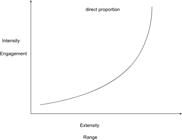
In this sense, the tensive approach helps us to understand how these relationships occur. Zilberberg (2011) describes a subject’s perception as a field of presence, i.e. a space governed by two quantities that appear as a function of each other: intensity (states of mind) and extensity (states of affairs). Intensity is the governing quantity and is represented graphically on a vertical axis, while extensity, the governed quantity, is represented by a horizontal axis.
Developing these concepts a little further, the tensive approach defines sub-dimensions for these quantities. Intensity is made up of tempo and tonicity, while extensity is made up of temporality and spatiality. These sub-dimensions of each dimension establish a conversational relationship with each other, i.e. they always go together: the greater the tempo, the greater the tonicity; the greater the temporality, the greater the spatiality.
Tempo refers to rhythm and speed (in relation to temporality, it can then be accelerated or decelerated); while tonicity relates to the strength of a value and operates in the pair [tonic x unstressed]. Extensity is considered the axis of demarcation. It will therefore delimit the expansion of values and their scope. We can think of the pair [concentrated x diffuse] to describe how it works.
Thus, spatio-temporal expansion in social networks is based on the perceptual key of extensity. And, in this case, it has a converse correlation with intensity, since the increase in extensity (expansion of these videos in time and space, i.e. their viewing by more users over a longer period of time) ends up producing more intense results (more interactions, followers, fame, money, etc.).
We can also think of the key to intensity in terms of the perception of the person watching the video. The more intense - in this sense, the faster from the point of view of tempo, and the more tonic from the point of view of tonicity - a piece of content is, the more it will gain the user’s attention and produce those results in viewing time and engagement.
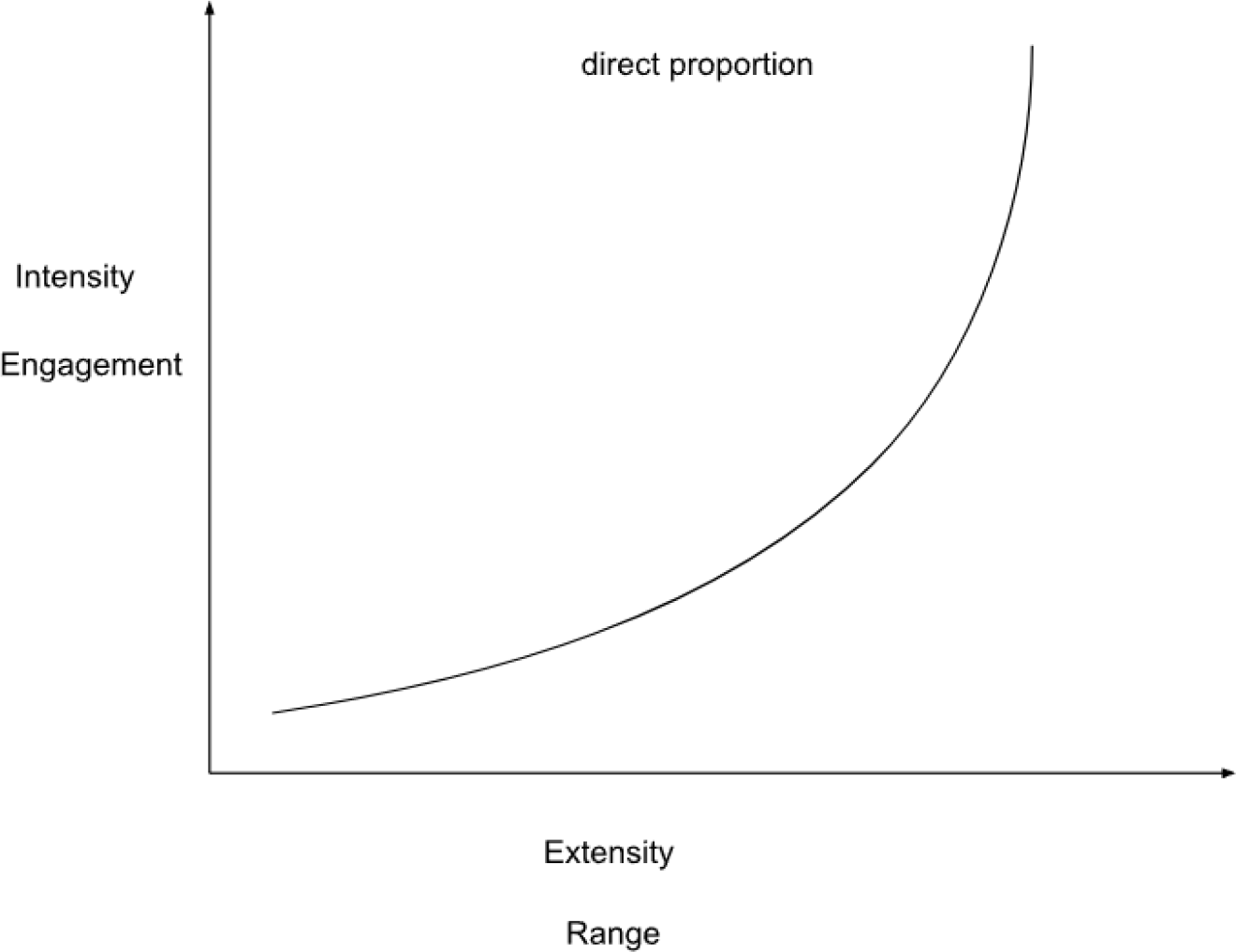
Unattractive and uninteresting content is quickly abandoned by the user, who moves on to the next video, looking for something that will excite them. We can thus see that the logic of TikTok, from this broader perspective, works on this conversational correlation between extensity and intensity in the tense space, i.e. the more extensity (reach), the more intensity (engagement), in a multiplier effect.
Zilberberg (2011, p. 92) explains this relationship and its opposite, the inverse correlation:
The debate designates, after all, a large-scale alternation: if conversational correlations endorse, guarantee semiotic infinitude, inverse correlations respect an - enigmatic - principle of constancy, alternately assigning to each magnitude no longer a multiplier function, as in the case of conversational correlations, but rather a divisor function, as if the inverse correlation were subject to a principle of constancy such that, if one of the magnitudes grows, the associated correlate necessarily decreases.9
We can represent this direct proportion within the space of social networks as follows:
In summary, in order to keep users online - so that they become consumers of TikTok ads or products and generate more revenue - the social network, through its algorithm, manipulates creators into following certain patterns, such as trying to keep the viewer until the end of the video, making them rewatch the video several times, directing them to derivative videos (answering questions in the comments, for example), etc.
Since this relationship takes place in a direct proportion, we see that in order to have a video go viral, i.e. expand in time and space on the social network, it is necessary to generate intensity - and taking its sub-dimensions, produce tonic and accelerated texts. Creators will therefore use manipulation strategies to keep users active and engaged. These strategies are the second point of analysis that interests us in this article.
4 Capturing Attention: Practices on Tiktok
Although it features live streaming, TikTok is based on edited videos designed to capture the user’s attention quickly and efficiently. In an almost infinite sea of videos, getting viewers to stop and watch content has become increasingly difficult. There is a competition for the user’s time on the platform. That’s why creators need to build curiosity or involvement within the first few seconds or they’ll be abandoned.
Unlike a medium such as cinema, where the viewer is already engaged in watching and the enunciator will have more of a challenge in conveying their values through the film-text, on social networks, the enunciator has a primary objective of not letting the enunciatee abandon the text, before actually moving on to persuasive strategies in order to convey their values.
The TikTok space thus demands intensity. In the direct proportion function already described, it is intensity that governs the function and will also increase extensity. In the field of sensitive relations with users, the same can be observed: a text built on the logic of intensity will provide greater user involvement and keep them in the video.
For this reason, the strategies used by the creators will favor toning and accelerating movements, in other words, more impactful constructions that require more presence from the subject in order to understand and process them. The more tonic and accelerated the videos, the more engagement they will provide. And so the greater the chances of viralization within the logic of the algorithm.
In order to create fast-paced content, the enunciator-content creator will be able to work within a concessive logic, that is, as opposed to the implicative logic (if...then), they will have to produce statements that break their users’ expectations (although...).
Zilberberg (2007) describes implication and concession as opposites. The former would be self-explanatory for the subject, since it merely reaffirms their expectations within a presented context. If we say, therefore, that “John pushed the ‘like button’ in the video because he had liked it,”10 there is no surprise in this and no need for further explanation. It is therefore an implicative, decelerated and unstressed statement. In the opposite case, if we say that “John pushed the ‘like button’ in the video, even though he had hated it,”11 we cause surprise and end up demanding further explanations about John’s attitude. This is a concessive utterance, which is therefore more accelerated and tense than the previous one. The creation of concessive utterances has a lot to do with breaking expectations, as described by Coutinho and Mancini (2019):
The creation of the concession would take place in three stages, establishing a relationship of dependence and an expectation (which may or may not be tense): 1) a question is raised, building the first element of the relationship of dependence. 2) to this question, the subject gives an answer that seems logical to him according to the contextual elements presented, his absorption of the values of the text and the socio-cultural values in which he fits (already foreseen in the inscribed enunciator profile), thus generating an expectation. 3) In the third stage, the text itself answers the question raised, confirming the answer predicted by the enunciatee in implicative relations and denying it in concessive relations.12
Thus, we see that the use of concessive logic is a very effective strategy for creating more intense statements. In the case of TikTok videos, in order to grab attention, it is also necessary to bring in the disruptive element right at the start of the video, so that the user is already committed to finishing watching it.
By observing videos that go viral on the platform, we’ve mapped out some acceleration strategies that work, above all, by creating expectations in the user and thus manage to produce more or less strong concessions. This possibility of a gradation within the concession, exploring the difference between expectations and developments, has already been opened up and described by Coutinho and Mancini (2020). Below, we have selected some strategies that benefit from sensitive engagement in the construction of short videos:
1) Generate suspense
Zilberberg (2011, p. 133) describes suspense as a manifestation that triggers duration, relating the dimension of intensity to that of temporality. Thus, “suspense is the extensive dilation of an intensive wait” (p. 136)13 and, by making the wait intense, it has the power to engage the audience for the entire length of a video. On a network like TikTok, suspense works better than surprise, since it manages to “hold” the user’s attention for longer.
In TikTok videos, suspense is created from a first concessive statement and the unfolding of a story that aims to explain or prove it. For example, a person who says “How I found out I have a twin brother who lives in Japan” or “I tried to make a homemade air conditioner. Come and see if it worked.”14 So the enunciator can already anticipate the end of the story or situation, but needs to watch the video to the end to understand how it happened and whether it really worked, i.e. whether the promise of the first statement comes true in something concessive.
2) Denying common sense or “popular wisdom”
Many videos begin with concessive statements that don’t necessarily create suspense, but demand an explanation, which also grabs the user’s attention for further development. This is the case with opening sentences that deny common sense or popular wisdom and aim to bring “a new truth” about something. For example, videos with promises written on the screen or in the caption such as: “Washing meat before cooking is bad for your health” or “Don’t bathe your newborn.”15
3) Offering a solution to a problem or a secret tip
Still exploring promises, many videos begin by generating the expectation of a disruptive new teaching, a secret tip that few people know, or by offering a simple solution to a problem that seems difficult to solve. For example: “I discovered that I spent 30 years folding my clothes the wrong way” or “Can’t grow on TikTok? I’ll show you how to gain 10,000 followers in a week.”16
4) Capturing an extraordinary moment
Some videos grab users’ attention with the promise of capturing an extraordinary moment, whether it’s the first contact between a puppy and a baby, strangers interacting in the street or the display of an unexpected talent. What these videos usually have in common, apart from the promise, is a certain notion of spontaneity. They won’t capture the user’s attention if they appear staged or fake. An example of this strategy would be the profile @edpeople, a Belgian boy who approaches ordinary people on the street in different cities around the world and asks them to teach him their “favorite dance move.” He then imitates the person’s steps and they dance together a typical dance from that country, creating an “extraordinary moment” of spontaneous interaction between two strangers.
Along these lines, there are also many profiles that invest in “opening the user’s eyes” to the extraordinary in the little things in life. For example, videos that intersperse images of traveling in landscapes around the world with inspiring music, and a text about enjoying youth or the preciousness of time. In this case, it’s an invitation to live the extraordinary.
In addition to strategies that generate anticipation in general and can therefore go viral among large audiences, the creators at TikTok also tend to invest in niches. The more niche videos generally address specifics of a subject that are of interest only to those who are already engaged with the topic.
However, they can follow similar lines to those described above, only further delimiting the audience within more specific knowledge. A profile specializing in watercolor painting, for example, can generate suspense (“I tried to paint a Monet painting in watercolor. Did it work?”), deny common sense (“You don’t need to put water in your watercolor. Come and see!”), offer a secret tip (“How I managed to earn 10 minimum wages selling my watercolors”17) and capture an extraordinary moment (with a fast-paced video of the watercolor painting process and inspiring music).
5 Passionate Engagement: Personalization
On the user’s side, entering a niche that interests them on TikTok can be very satisfying and even mean a match with something they’re looking for, whether it’s knowledge or entertainment. Thus, passionate engagement occurs through personalization, i.e. the more the video seems to be made for the user, the more they feel contemplated. In this sense, the reliance on intensification strategies in videos becomes less important than in content that aims to go viral to a wider audience.
Therefore, if the extensity decreases (targeting a smaller audience, generating fewer views), the intensity can also decrease. In this case, targeted audiences in a niche may be interested in a less concessive video on that topic, with more modest promises. Rather than saying that everything the user is doing is wrong and they need to learn a new way of doing it, the video promises only to go into more detail about a piece of information or give small tips on a technique, not revolutionizing, but merely deepening the user’s knowledge.
In this type of video, engagement is less about impact and more about the user’s passionate involvement with that specific topic. In this case, the creator can also gain more continuous engagement, since the user interested in the topic covered by the profile is more likely not only to interact with that content, but to visit the profile, like other videos and even follow the creator to see more similar content.
The personalization made possible by the mass of data shared by users makes it possible to reach this point. Once again, the role of the algorithm comes into play to prioritize content according to the preferences expressed, investing in similarities and repetition. The text of the feed is thus constructed in an individualized and interactive way throughout its course, with the constant action of the algorithm and the signals given by the user constantly updating what will be shown.
At the same time as the algorithm dictates the incentives for the construction of the videos, the enunciator feeds back into the algorithm with their likes and “dislikes,” through interactions with the app, the advancing of a video as a sign of negation and engagement in levels: from the video watched to the end or repeatedly, a like, a comment, a save or share to the movement of visiting the profile and following a new profile, which could be thought of as the maximum conjunction.
In this way, it can be seen that the algorithm works with users’ degrees of conjunction with the videos to draw up their profiles and continue providing content that will generate engagement and keep them within the app. Along these lines, there are two main strategies for keeping users online, which are carried out by content creators, but delimited by the social network through the operating rules established by the algorithm: intense content and personalized content (which can be less intense).
What we are calling intense content is that which aims to capture the attention of almost any online user - and therefore has a more diffuse enunciator - through acceleration and/or toning strategies. However, they don’t necessarily advance very far in terms of engagement on the social network, and may only achieve views of that video or likes.
Within this logic, what we think of as personalized content or niche content, although aimed at a less broad audience, can be more successful in pleasing the user and keeping them engaged within the platform, reaching higher degrees of conjunction with the content in the acts of saving, commenting, sharing or following the creator’s profile.
Conclusion
Based on the propositions presented, it is understood that it is necessary to analyze enunciative relationships within social networks not only to understand how these discursive spaces work, but also to highlight the roles at play in the dissemination of values in digital media.
Encouraging the production of accelerated and tonic discourses through social networks such as TikTok, Instagram, Facebook and X has far-reaching social consequences. This is both in terms of facilitating the dissemination of extremist and hate speech - which works with values of absolute (generally more tonic) as opposed to values of universe (more unstressed) (Zilberberg, 2011) - as well as a continuous change in the perception of rhythm of the subjects involved in these enunciations, which can reverberate beyond the digital space.
By proposing that on TikTok values are disseminated in the field of presence of the subjects through conversational relationships, as we have explained throughout the text, we understand that in order for content to go viral (i.e. a discourse that achieves high viewing metrics), it is necessary to increase extensity at the same time as investing in an increase in intensity.
And if the goal of going viral is almost unanimous among content creators (since it’s the metrics that turn into publicity, fame and money), this means that they will seek to comply with a global strategy based on the impact of their speeches, promoting an increase in tempo and tone. In a previous article, we proposed that the social network would function as a proto-enunciator since it inaugurates an enunciative chain, which will condense its strategies and replicate its incentives, working towards its global narrative and even establishing its own tone and rhythm, reproduced by secondary enunciations.
Understanding the social network as an actor interwoven throughout the enunciation created within the platforms, as a primary enunciator, we see that its intentionality in making tools available for users to use within the network structure and the parameters of the algorithm codes influences the entire textual production of the user-creators. The incentive established by the network as a protoenunciator, therefore, is to create concessive and tonic texts, in other words, texts that generate strong emotions and seek adherence to its values not through rational arguments and extensive explanations, but through passionate involvement.
This exacerbation of passion may even be a discursive key to understanding the spread of extreme discourses on the networks, which appeal much more to “states of mind” than to “states of affairs,” to quote a formulation by Zilberberg (2011). In these speeches aimed at a large audience - the viralized videos - there is no room for complexities, for quoting different points of view, for pondering or in-depth reflection. On the contrary, absolute affirmations, catchphrases and quick breaks with expectations without much explanation stand out.
This is a choice and a demand created by the social network. It establishes the behaviour of the algorithms and their intentions when organizing and distributing all the discourse circulating on the platforms. It sets the tone for this rhythmic and sensitive arrangement that is constructed in the digital space and that passionately manipulates the users-enunciators.
That’s why it’s important to take it in this role as the first enunciator, who establishes the rules of the game and manipulates the construction of all subsequent enunciations. We therefore emphasize that user-creators are not inherently free in their utterances in the digital space, as is constant in common sense discourses.
They are part of a kind of enunciative ecosystem that builds and feeds back into the dynamics of the social network. Still on the subject of rhythm, we can see that in order to keep users’ attention within the app, TikTok adjusts its algorithm to favor this tonic and impactful content in a network of values that feeds back into an enunciative cascade. The question that remains and opens the way for further discussion is how constant exposure to accelerated statements can reverberate in the perceptual field of subjects and what kind of consequences this can have in the long term and in practical life outside of digital spaces.
1
2
3
4
5
6
7
8
9
10
11
12
13
14
15
16
17
Reviews
Research Data and Other Materials Availability
The contents underlying the research text are included in the manuscript.
References
- BARROS, Diana Luz Pessoa. Teoria do discurso: fundamentos semióticos São Paulo: Humanitas; FFLCH/USP, 2002.
-
BOYD, Danah; ELLISON, Nicole. Social Network Sites: Definition, History, and Scholarship. Journal of Computer-Mediated Communication, Mediated Communication Indiana, v. 13, n.1, Oct. 2007. Disponível em: https://academic.oup.com/jcmc/article/13/1/210/4583062 Acesso em: 11 ago. 2025.
» https://academic.oup.com/jcmc/article/13/1/210/4583062 -
COUTINHO, Mariana.; MANCINI, Renata. Graus de concessão: as dinâmicas do inesperado. Estudos Semióticos, v. 16, n. 2, pp. 13-34, 2020. Disponível em: https://doi.org/10.11606/issn.1980-4016.esse.2020.172392 Acesso em: 11 ago. 2025.
» https://doi.org/10.11606/issn.1980-4016.esse.2020.172392 -
FLOCH, Jena-Marie. Você é agrimensor ou sonâmbulo? Elaboração de uma tipologia comportamental dos passageiros do metrô. Tradução: Ivã Carlos Lopes. Estudos Semióticos, v. 19, n. 2, pp. 1-25, 2023. Disponível em: https://revistas.usp.br/esse/article/view/214848/197293 Acesso em: 11 ago. 2025.
» https://revistas.usp.br/esse/article/view/214848/197293 - FONTANILLE, Jacques. Discursos, mídias, práticas e regimes de crença. Tradução: Mariana Coutinho. Revista do GEL, v. 16, n. 3, pp. 246-261, 2019.
- FONTANILLE, Jacques. Formes de vie Liège: Presses Universitaires de Liège, 2015.
-
GILLESPIE, Tarleton. A relevância dos algoritmos. Tradução: Amanda Jurno. Revista Parágrafo, v. 6, n. 1, pp. 95-121, jan./abr. 2018. Disponível em: https://revistaseletronicas.fiamfaam.br/index.php/recicofi/article/view/722/563 Acesso: 11 ago. 2025.
» https://revistaseletronicas.fiamfaam.br/index.php/recicofi/article/view/722/563 - GREIMAS, Algirdas Julius; COURTÉS, Joseph. Dicionário de semiótica 2. ed., 1ª reimpressão. São Paulo: Contexto, 2012.
-
TEIXEIRA, Lucia; COUTINHO, Mariana. Redes sociais, algoritmos e responsabilidade social: questões de enunciação na era digital. Entreletras, n. 15 (Especial), pp. 34-49, 2025. D.O.I. https://doi.org/10.70860/ufnt.entreletras.e19229 Acesso em: 11 ago. 2025.
» https://doi.org/10.70860/ufnt.entreletras.e19229 -
TRELEANI, Matteo. Dispositifs numériques: régimes d'interaction et de croyance. Actes sémiotiques, n. 17, 2014. Disponível em: https://www.unilim.fr/actes-semiotiques/5035 Acesso em: 11 ago. 2025.
» https://www.unilim.fr/actes-semiotiques/5035 - ZILBERBERG, Claude. Elementos de semiótica tensiva São Paulo: Ateliê Editorial, 2011.
-
ZILBERBERG, Claude. Louvando o acontecimento. Galáxia, São Paulo, n. 13, pp. 13-28, jun. 2007. Disponível em: https://revistas.pucsp.br/index.php/galaxia/article/view/1472/938 Acesso em: 11 ago. 2025.
» https://revistas.pucsp.br/index.php/galaxia/article/view/1472/938

 Source: Own elaboration.
 Source: Own elaboration.
 Source: Own elaboration.