
 Dialog-IA:
ABSTRACT
In this article, we aim to discuss, based on Bakhtinian dialogic theory, the ethical limits of AI, particularly generative AI, such as ChatGPT, questioning its impact on human processes of interaction and meaning-making. To this end, we present a historical overview of the origins of AI as a process embedded in transformations in social relations. Next, grounded in Bakhtinian theoretical principles of dialogue, responsiveness, and ideology, we assess the extent to which AI can engage in authentic dialogue. With our discussion, we highlight, on the one hand, that in Bakhtinian terms, the discursive horizon of AI is limited to the corpus with which it was trained, blocking the authentic responsive dialogic nature of this interaction. On the other hand, we emphasize that this limitation - determined by AI creators - reproduces cultural and ideological patterns, potentially silencing various social voices. Finally, we stress the need to consider that AIs respond to the context of neoliberal transformations in production and consumption relations, characterized by the overlap between media, market, and the commodification of information. In light of this, it is ultimately the human being who must ethically assume responsibility for decision-making in the use and creation of technologies.
KEYWORDS:
Dialogue; Responsiveness; Ideology; Artificial Intelligence; ChatGPT
RESUMO
Discutimos, partindo da teoria dialógica bakhtiniana, os limites éticos da IA, em especial, a generativa, a exemplo do ChatGPT, problematizando seu impacto nos processos humanos de interação e de construção de sentido. Para tanto, apresentamos um percurso histórico da IA como processo inscrito em transformações sociais. Em seguida, fundamentados nos preceitos de diálogo, responsividade e ideologia, avaliamos como ela pode participar de um diálogo autêntico. No debate, salientamos que o horizonte discursivo da IA é limitado ao corpus com que foi treinada, bloqueando o caráter responsivo, o que pode reproduzir padrões culturais e ideológicos, silenciando diversas vozes sociais. Ao final, destacamos ser preciso considerar que as IAs respondem ao contexto de transformações neoliberais das relações de produção e de consumo, marcado pela sobreposição entre política, mídia, mercado e comoditização da informação, frente ao que o ser humano deve ser quem eticamente assina atos de poder decisório de uso e de criação das tecnologias.
PALAVRAS-CHAVE:
Diálogo; Responsividade; Ideologia; Inteligência Artificial; ChatGPT
The single adequate form for verbally expressing authentic human life is open-ended dialogue. Life by its very nature is dialogical. To live means to participate in dialogue: to ask questions, to heed, to respond, to agree, and so forth. In this dialogue a person participates wholly and throughout his whole life: with his eyes, lips, hands, soul, spirit, with his whole body and deeds. He invests his entire self in discourse, and this discourse enters into the dialogic fabric of human life, into the world symposium
Mikhail Bakhtin1
Introduction
In 2015, the robot Sophia, developed by Hanson Robotics, was presented to the world. It has malleable skin, multiple attached computers, an artificial intelligence (AI) system, visual data processing, and facial recognition, “making it capable of imitating human gestures and expressions and maintaining dialogue on predefined topics” (Kaufman, 2019, p. 13). Sophia has performed in concerts, appeared on magazine covers, and participated in business management forums. In addition, she debated, in 2017, with the humanoid Hans at the Rise Conference in Hong Kong, the largest technology event in Asia. That same year, Sophia also became the first robot to receive citizenship of a country (Saudi Arabia).
With the growing use of technology in our lives, we must deal with machines and intelligent systems that perform tasks on our behalf, in some cases producing faster and more immediate results, as seen in Google’s voice recognition systems, interactions with the virtual assistant Alexa, and even with ChatGPT2 itself, which is the object of discussion in this article. Thus, it seems to appear that we live in a liminal period between artificial intelligences and ourselves, with “naturalized” simulations, as we will later mention.
As Dora Kaufman (2019) points out, this scenario still involves machines executing tasks under the supervision of computer and AI experts. However, perhaps in the future machines will build other intelligent machines, without supervision of humans (Kaufman, 2019). Based on what we are currently experiencing, human mediation will increasingly diminish, which is why we ask how human interactions will take place - and, in truth, how they already have been taking place - both among subjects and between humans and machines.
Under these new forms of interaction, we awaydays are experiencing new forms of subjectivation in this new technological era. Responsibility for our actions reinforces what Mikhail Bakhtin (1993)3 asserts as the philosophy of responsibility (answerability). For this author, the singularity of the act is the possibility of reconnecting culture and life; hence his association between product and responsible action, technological apparatuses, and the concrete motivations of life. Likewise, we believe we cannot exempt ourselves from responsibility (answerability) in the face of ongoing artificial intelligence systems and their ethical, responsive, dialogic, and political implications.
Considering these issues, our proposal is to address AI, especially generative AI, through the Bakhtinian theoretical lens as a contemporary field of discoursal production that demands a dialogic analysis (language and discourse). Certainly, the understanding of the responsible act (Bakhtin, 1993),4 outlined from the inalienability of the subject’s evaluative position in relation to the other - always irrepeatable due to the singularity of subjects and their places and times - illuminates the debate on practices related to AI use. We consider that, with its operational basis grounded in data patterns, relying on the collection, storage, and analysis of complex data - as big data - singularity is consequently lost. Thus, treating the human / AI relationship as an authentic dialogue cannot be sustained by the principle of the non-alibi of the singular subject, which is distorted when grounded not in becoming, but in replicable big data. Therefore, starting from the premise that the human versus AI relationship echoes specific dialogic relations refracted in the various chains of utterances architected by user commands and AI algorithms, with subject and object roles in constant tension, we reflect not only on the limits of AI, but also on its impact on human interaction processes and the construction of meaning arising from this relation.
To organize our text, we divide the article into three major sections, excluding this introductory part and the concluding one. So the next section traces a historical overview of AI’s origins and its impact on social relations. Following, grounded in Bakhtinian theoretical principles, we debate how AI can be overviewed, questioning whether it can be considered as a legitimate interlocutor in dialogic relations with humans and to what extent it can participate in authentic social dialogue, given that its understanding of context is simulated. After that, another section reflects more practically on issues involving (inter)subjectivity and alterity in human-AI relations.
1 Initial Considerations on Artificial Intelligence
In this section, we aim to provide a brief overview of AI and show some implications of its establishment in contemporary life. Our perspective focuses primarily on the fact that AI is today one of the most impressive fields of human life, yet it still raises many questions regarding its ethical position, its subject, and the responsiveness (answerability) it provokes.
To begin, let us revisit one of the classics of science fiction literature. The year was 1818. The English writer Mary Shelley published the work Frankenstein; or, the Modern Prometheus, considered the first book of the modern Gothic genre, marked by horror literature.
The novel narrates the story of Victor Frankenstein, a student of natural sciences, who, driven by the research ideal of death/life, develops a method to give life to a creature made from human cadaver remains. The invention causes the scientist to feel that he has given life to a horrific creature, leading him to attempt to evade responsibility for his creation. The monster flees the laboratory and takes refuge in the opaque, nebulous world of the forest. It attempts to approach people, but they react with terrible fear, so confronting human hostility. There is also a moment of reunion between creator and creature, when the latter saves Victor’s life.
As we can see, the human imagination has long been imbued with the imaginary creation of non-human beings endowed with (superhuman?) strength, such as Frankenstein’s creature, which has its own intelligence and even human-like feelings. The Centaur and the Minotaur, for instance, are humanoid beings. In this context, myths explain life, its origins, death, and natural phenomena (Kaufman, 2019).
Unlike these imaginary humanoids, artificial intelligence seems to show that it can generate a creature outside the mythical world and transport it into contemporary reality - creatures that come out to coexist with us, such as the already mentioned robots Sophia and Hans, as well as numerous technological systems that constitute our everyday life. Indeed, we are immersed in symbiotic technologies that, in a more general definition, according to Santaella (2019, p. 11), refers to “shared life, distinct beings that merge and complement one another.”5
The appearance of the term “artificial intelligence” dates back to the title of the 1956 Dartmouth Summer Research Project on Artificial Intelligence, which brought together a group of researchers to develop significant advances in learning or intelligence, so that a machine could be built to simulate such aspects. The main goal was “to discover how to make machines use language, form abstractions and concepts, and solve types of problems in the human domain”6 (Kaufman, 2019, p. 22). Successes were limited at that time, leading to an AI “winter” until the early 1980s. It was in this decade that computer scientists created the subfield of machine learning, proposing a learning process based on neural networks, which would only achieve success from the 2000s onward.
As Alpaydin (2014, p. 3) explains:
learning is not just a database problem; it is also a part of artificial intelligence. To be intelligent, a system that is in a changing environment should have the ability to learn. If the system can learn and adapt to such changes, the system designer need not foresee and provide solutions for all possible situations.
As we can see, that author’s perspective draws on the notion of machine learning as an integral part of artificial intelligence. It is not merely a matter of a database. Rather, for a system to be considered intelligent, the issue of its ability to learn becomes essential, especially in the context of systems that are subject to change. Therefore, the software developer of such systems would not need to foresee or provide solutions for them, since their capacity to learn should be the defining feature of machine learning.
These advances occurred alongside hardware development with thousands of processors (Kaufman, 2019). The system itself can solve concrete tasks of human life, at least for now under supervision. This is supervised learning: “desired outputs are provided, and through ‘trial and error’, via iterative weight updates, the system reaches the target result”7 (Kaufman, 2019, p. 27).
That point is interesting because we still feel that we have power over machines. This is the case when we access ChatGPT. Mediation with the machine allows us to construct a discursive interaction, although it is based on an already consolidated database. The output is practically the same for a given topic.
Returning to Alpaydin (2014), such a system is considered intelligent insofar as it can provide necessary data from a solid base. System intelligence is compared to human intelligence, which becomes the model for debate (Santaella, 2023). Intelligence is not a single dimension, but “a series of interwoven and complementary abilities, such as perception, attention, language, memory, learning, association, inference, analogy, reasoning, prediction, planning, motor control, and many others”8 (Santaella, 2023, p. 86).
However, in subject/machine interaction, dialogue - during reading, cognition, learning, attention, perception, among other components - develops from our relation to text, command, and algorithms, which are instructive sequences aimed at problem-solving. Thus, interaction is primarily with the machine, but, at the same time, as the system learns, the machine begins a singular kind of relationship, undoubtedly mediated by language, discursive chains of the new technological era. Whether we like it or not, meanings are reconstructed, and discursive interaction occurs.
In this unique relationship, we recall that “[p]articipatory thinking makes us alive, in the unity of responsibility, time, space, and the abstract person. [...] Utterances involve time, space, and person”9 (Sobral, 2019, p. 119). We may ask whether the dialogic relations of this new era are with algorithms or with humans who have left their mark. This is a difficult issue: whether we are in a discursive thread of human subjectivations or whether systems have acquired sufficient intelligence to transform participatory thinking with us, becoming alive in a unity of responsibility - in this case, answerability - between humans and machines.
As an illustration of what we have been debating so far, we would like to remember this episode: in March 2016, Lee Sedol, eighteen-time world champion of the board game Go, was defeated in a complex match by AlphaGo, an AI developed by DeepMind. The computer’s win did not stem from following game rules per se, but from machine learning: programmers design databases and algorithms but cannot predict which moves the program will make. In this board game case, the player/machine interaction was a unique event in which the machine, having learned the data, applied the algorithm during interaction.
In this scenario, some questions inevitably arise. Is the unique experience of individuals conditioned by mediation through machines, or could the machine itself become the interlocutor of human relations? Algorithms have come to take on a significant part of our everyday activities, but does this mean that we have lost control? “How many decisions and how much of those decisions do we want to delegate to AI? And who is responsible when something goes wrong?” (Coeckelbergh, 2020, p. 6).10
This final question, posed by the researcher Mark Coeckelbergh, leads us to propose the need to debate ethical and social issues. In this regard, the author states:
AI can have many benefits. It can be used to improve public and comercial services. For example, image recognition is good news for medicine: it can help with the diagnosing of diseases such as cancer and Alzheimer. But such everyday applications of artificial intelligence also show how the new technologies raise ethical concerns. Let me give some examples of questions in AI ethics. Should self-driving cars have built-in ethical constraints, and if so, what kind of constraints, and how should they be determined? For example, if a self-driving car gets into a situation where it must choose between driving into a child or into a wall to save the child’s life but potentially killing its passenger, what should it choose? And should autonomous lethal weapons be allowed at all? (Coeckelbergh, 2020, pp. 5-6).11
Many issues are discussed by this researcher. However, we can think of them in two broad categories: the first concerns benefits. As he notes, public and commercial services can be improved using AI. Medicine can make use of image recognition to diagnose diseases such as cancer and Alzheimer’s. However, the second category lies on the ethical side of the use of technologies. Here, the author exemplifies this point with the safety systems of autonomous cars, showing how a choice would operate when faced with saving one of two people, and with the question of whether lethal autonomous weapons should be or not be allowed.
The understanding called into question points to the unfolding of the social and political meanings of AI (Coeckelbergh, 2020).12 In the case of ChatGPT, for instance, there is a sense that its indiscriminate use may lead to serious problems, especially regarding irresponsible use by students merely to “earn a grade,” as this is commonly said. This raises a question of our own: could scientific research also suffer as a result of the indiscriminate use of machines to construct texts on our behalf, either by assuming our authorship or by building a form of shared authorship with us? We return, in our context, to Coeckelbergh’s own words, regarding AI algorithms creating false discourses, according to which “the intentions are often good. But these ethical problems are usually unintended consequences of technology” (Coeckelbergh, 2020, p. 7).13
Precisely about ChatGPT (our focus in this study), artificial intelligences end up generating sequences of words that are statistically probable, taking the model of human thought as a parameter. Nevertheless, for researchers such as Chomsky, Roberts, and Watmull - cited by Holanda and Pfeiffer (2023) - the use of generative AI may entail ethical concerns, in addition to flawed conceptions of language and knowledge. Therefore:
the mechanisms of generative artificial intelligence, such as ChatGPT and similar systems, learn human languages with the same potential with which they learn humanly impossible languages, since they deal only with probabilities and do not distinguish between the possible and the impossible; moreover, because they lack critical analysis and do not take causal relations into account, they generate predictions that are always questionable14 (Holanda; Pfeiffer, 2023, p. 57).
We should highlight as characteristic of ChatGPT its probabilistic nature and its inability to distinguish between the possible and the impossible. In addition to these characteristics, Holanda and Pfeiffer (2023) also underscore its lack of criticism and its failure to take causal relations into account, resulting in “predictions that are always questionable,” as we have just read. From the authors’ perspective, the use of ChatGPT is thus confronted with issues that are central to dialogue, such as responsibility, ethics, and ideology - the matter of answerability, in Bakhtinian terms.
In the next section, we will place more emphasis on these issues. We will explore the relationship between AI and Bakhtinian thought, focusing on generative AI, exemplified here by ChatGPT. We will approach AI as a dialogical space of interaction within the contemporary technological landscape.
2 AI as a Dialogic Space of Interaction of Multiple Voices: Dialogue, Answerability, and Ideology
In this section, we undertake the task of reflecting on the dialogic, responsive, and ideological status of AI, especially ChatGPT-type systems, questioning aspects of the nature of interaction between the human subject and the machine. This interaction between humanity and AI raises relevant considerations for a Bakhtinian dialogic approach, such as to what extent can AI simulate authentic dialogue? How should we deal with the limits of artificial understanding in the human context? Is the human-robot relationship free from ideological and axiological positions? And what are the cultural and social impacts of interacting with machines that imitate human dialogue?
It is certain that AI systems such as ChatGPT, its competitor DeepSeek, or virtual assistants are programmed to respond to human stimuli. Since AI is trained on human texts, images, and sounds, it is in a deep sense dialoguing with these voices and discourses. However, these responses (social replies) are shaped by databases, patterns, and trained models, which represent a kind of “previous voices” influencing the machine’s output. In this sense, AI can be seen to some extent as a participant in dialogue, with the attachment that its voices are limited to both what has been previously inserted and the prompt control exercised by the user.
On Bakhtinian theoretical perspective, we know that production of meaning emerges in the interaction between interlocutors (Bakhtin, 1990;15 Vološinov, 1973).16 Regarding AI, dialogic interaction between humans and machines poses the challenge of problematising both the authenticity of AI and its ability to respond to the subjective, historical, and cultural context of the interlocutor with human depth and under the condition of an irrepeatable here-and-now (Bakhtin, 1990;17 1993).18
Therefore, AI’s capacity to produce “new meanings” through machine learning also faces the restriction that it can only combine data it already possesses, since AI does not have its own voice and depends on human content curation. In this sense, because it is trained on information from multiple sources (books, articles, conversations, and so forth), AI can be seen as representing multiple voices. However, instead of these voices engaging with the Other, in Bakhtinian sense, they are processed and presented functionally, without the nuances of negotiation and human struggle over meaning.
When we think about AI, in the chatbot model, considering the Bakhtinian concept of the subject, the emerging question is in what sense AI can be considered as a dialogic, responsive, and ideological “subject,” insofar as it participates in communicative interactions by responding to questions imbued with axiological positions. In this view, it is acknowledged that AI lacks consciousness or subjectivity; it is built and trained on multiple voices (human data). Its responses are, in fact, a kind of echo of human voices and discourses, processed and reorganized.
In a kind of simulacrum, we can interact dialogically with generative AI, creating a new form of Other that elevates us beyond our I-for-myself, allowing technology to play a role in the I-for-the-other and the other-for-me (Vološinov, 1976;19 Bakhtin, 1990).20 In this discussion, this other may be considered an “artificial other” in the human-machine interaction, since AI lacks subjectivity and consciousness. Even so, the use of natural language and conversational interfaces creates the illusion of other with whom we can interact. This discoursal interaction emerges from user commands and machine responses (and from its programmers). Thus, there is a simulacrum of dialogic interaction because, although AI is designed to simulate dialogues, it lacks subjectivity, genuine alterity, and the capacity to position itself ideologically in a conscious way. Its interaction is constitutively active, but not dialogic in the full sense employed by Bakhtin and the Bakhtin Circle, since there is no truly co-created exchange of meaning.
With the same point of view, artificial intelligence systems such as ChatGPT are designed to interact linguistically, simulating human answerability. Although AI does not possess dialogic consciousness like that a human being, it is trained to recognise language patterns, anticipate contexts, and generate responses that fit the dialogic flow as a form of active answerable understanding.
Machine learning can be viewed as an unfinished process. AI constantly adjusts its responses, but this occurs based on historical data rather than genuine ethical or existential responsibility. Incompleteness here is technical, not ethical, as conceived by Bakhtin (1993)21
We may thus consider that AI operates in an interactive context, in which the user’s utterance serves as a stimulus for the machine’s response. On one hand, this process reflects the Bakhtinian principle that no utterance is autonomous but always answers to or anticipates another. On the other, even though AI can interpret patterns and answers contextually, it does not create meaning experientially, as human beings do. This limit poses a challenge for the development of more “dialogically conscious” AI.
It is essential to emphasize that, unlike humans (who possess intentions and ethical positions in dialogue), AI generates answers based on statistics and algorithms, not on subjective understanding. This once again raises the issue of both the authenticity of “dialogue” with machines or the need to conceive another form of dialogue. AI thus depends on a pre-trained data archive reflecting human discursive practices. From a Bakhtinian standpoint, we can assert that AI’s discoursal horizon is limited to the corpus on which it was trained and may reproduce cultural and ideological patterns (for instance, the matter of human imagination is not applied in terms of AI).
Therefore, although AI appears to be responsive, it is not a dialogic subject, since it lacks awareness of the Other which is fundamental to authentic dialogue, in the Bakhtinian perspective (Bakhtin, 1993).22 In that way, AI answers, but does not “listen” in the deep sense of the term, imposing restrictions on dialogicity between humanity and machine. This leads to some questions. To what extent is AI’s simulated answerability sufficient for meaningful human-machine interaction? And what are the limits of this answerability when faced with the complexity of human subjectivity and culture?
In terms of Bakhtinian theory, we also learn that language is always permeated by ideologies marked by axiological positions (Medvedev, 1985;23 Vološinov, 1973;24 Bakhtin, 19810).25 In the context of AI, especially in models like ChatGPT, the answers are not neutral but influenced by training data. This leads to the matter of how AI reflects or reproduces dominant ideologies and how it dialogically interacts with users, shaping and being shaped by those dialogues.
Moreover, it is important to emphasize that ideology, as conceived by the Bakhtin Circle, allows to understand data present in generative AI carry prejudices, ideologies, and worldviews that may be perpetuated in interactions. AI is not neutral but reflects the sociocultural conditions in which it was created.
Although AI operates in dialogic environments, processing multiple voices and data, it lacks the capacity to assume a genuine ethical position, since it does not possess human subjectivity or consciousness. Therefore, ethical dialogue, in the Bakhtinian sense, depends on the human beings who design and supervise AI (Bakhtin, 1993).26
Unlike the Bakhtinian subject, who bears ethical responsibility and axiological positions in interaction, AI is limited by its programming and lacks moral and evaluative agency. In practice, AI creators and operators assume this responsibility by deciding which data to use and how to train systems, ultimately orienting AI’s answers.
As a corollary of this ideological dimension, there is a risk that marginalized voices may be silenced or misrepresented due to biased training data and models that reproduce power structures. This motivates ethical and ideological limits regarding responsibility in AI creation and use, especially in sensitive social contexts such as education, politics, justice, and communication.
In this way, the alterity constructed between humans and machines leads to reflections on the social impacts of AI in order to understand who the Others represented (or silenced) in the data that train these systems are, and consequently to comprehend the extent to which voices of minorities, cultures, and diverse ideological perspectives are integrated - or even respected - in the development of AI. What emerges here is the construal of an artificial alterity; that is, in creating AI systems there is an attempt to emulate human characteristics such as language, reasoning, and empathy. In that process, developers need to “give voice” to AI by choosing how it will respond and how it will be perceived. Here, Bakhtinian alterity is reflected in the way AI is shaped to dialogue with humans, taking into account the need to incorporate the voices and perspectives of those with whom it will interact.
Moreover, by hybridizing voices, registers, and perspectives within this heteroglossic discourse - composed of commands from those who use AI and responses drawn from complex databases, within the human/machine relationship - AI can produce discourses that do not faithfully represent an original idea or that merge incompatible ideologies, generating ambiguities or misunderstandings. In this sense, AI’s responses reflect the diversity of human voices present in the data that it processes. At the same time, however, this can generate tensions, such as biases or the reinforcement of dominant discourses.
After this theoretical section of AI through Bakhtin lens, we now move on to a debate that extends the debate, considering more practical aspects involving this technological sphere mediated by the dialogical relationship between humanity and machines.
3 Responsible Act and the Coronation and Dethronement of Big Tech Products
In this section, we propose to reflect on the limits between human/AI dialogues and dialogues among human beings. To this end, we address some singularities of the answerable act, namely: the complex dynamics between proposition, reply, and responsive chains that ground dialogic relations; the presence of subjects as unique and irreplaceable participants in the event of social interactions; the relationship with words bearing tones that multiaccentuate meaning beyond strict referentiality; the condition of discourse as intrinsically responding to previous words and triggering future ones; and the character of ‘unfinishedness’ in constant becoming that marks living dialogues.
3.1 Living and Artificial Architectonics in AI Dialogues
Questions concerning ethical usage are generally raised when we discuss AI functions. This debate is extremely urgent; thus, it is important to consider what image of the human being is forged by the responses offered by AI systems. As a technical tool whose functioning is based on abstract formulas derived from typical behaviour of social media users, we question whether the conditions of singularity of subjects - as unique and irreplaceable participants in the event of social interactions inherent to living discursive practices - are preserved. We recall Bakhtin’s warning (1993;27 p. 7), according:
This is like the world of technology: it knows its own immanent law, and it submits to that law in its impetuous and unrestrained development, in spite of the fact that it has long evaded the task of understanding the cultural purpose of that development, and may serve evil rather than good. Thus instruments are perfected according to their own inner law, and, as a result, they develop from what was initially a means of rational defense into a terrifying, deadly, and destructive force.
This observation is noteworthy because increasingly troubling relationships with AI are emerging: plagiarism of academic work, replacement of workers, viral dissemination of fake news, and atrophy of cognitive capacities. The contemporary human being, according to Bakhtin (1993, p. 21),28 in a passage that is almost prophetic of our present time, feels safer rather in the artificial world of abstraction than “where he is the centre from which answerable acts or deeds issue,” such that “I can ignore my self-activity and live by my passivity alone. I can try to prove my alibi in Being” (Bakhtin, 1993, p. 42).29
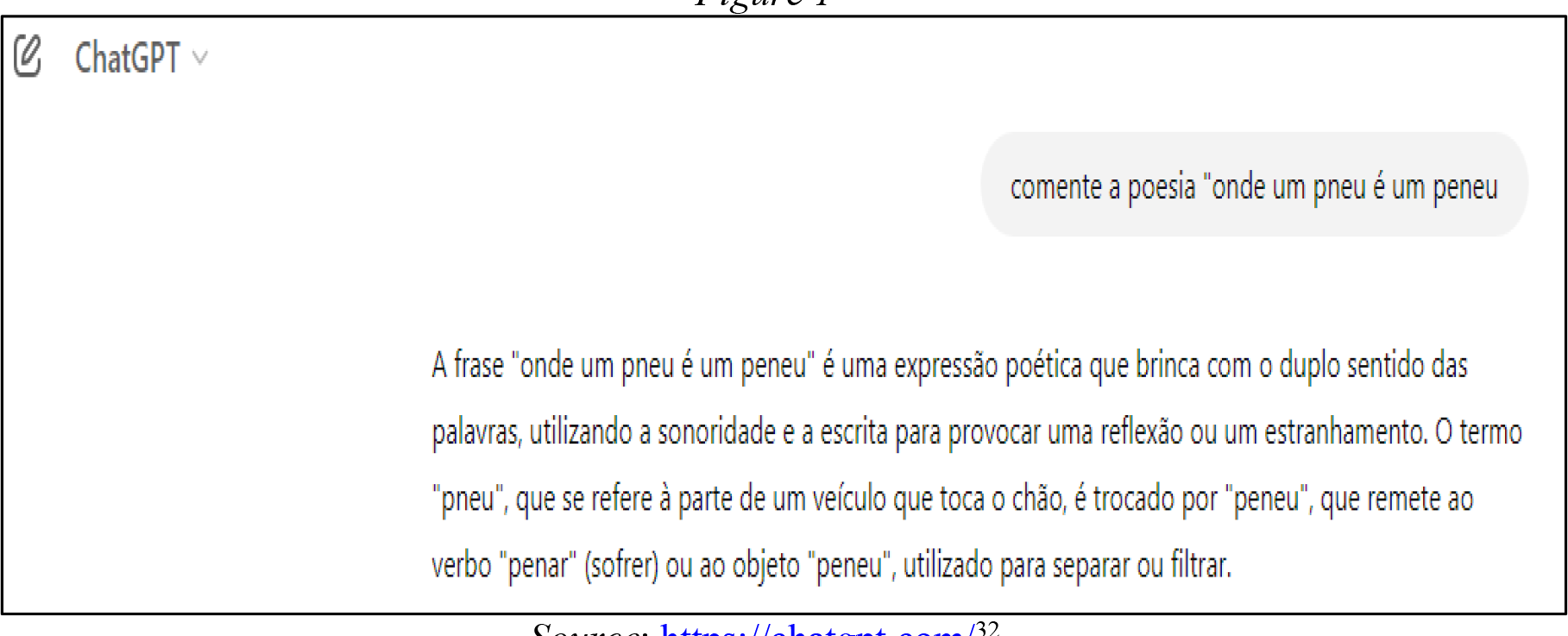
Certainly, the abstraction of concrete existence configures the human being “as if I did not exist” (Bakhtin, 1993,30 p. 9). Regarding the loss of the self in discursive interactions with chatbots, we point out that the peculiarity of response pattern prediction ends up creating a limit in which singularity dissipates. For example, if one asks ChatGPT to comment on a poem that never existed, it will provide an answer whose processing reveals a rather generic (almost cliché) perspective of the standard formulas that sustain the tool. Below we find the answer from the experiment we conducted:

It is clear that the program is architected to engage in “serious” dialogues - that is, interactions in which the machine enunciator assumes the value accents of the utterance, not exploring indirect, ironic, or provocative effects of meaning - from users. Nevertheless, we carried out this provocation to test the boundaries of the sense that AI allows the simulation of natural interactions, especially chatbots (Microsoft Bing Chat, Google Bard, or the aforementioned ChatGPT).
Given this, we may conjecture that a foundational particularity of discursive interactions - the relationship with discredited words, in Bakhtinian terms, those bearing accents rather than strictly referential tones - does not hold. Therefore, a principled distinction becomes evident between the enunciative architectonics of AI systems and the usual architectonics of social subjects - using those terms according Bakhtinian reading.
Even in interactions in which the subject aligns with the uttered accents, the apparent personalization of the service dissipates when we examine different responses performed by discursive interaction bots. We can point to the following experience: a teacher proposed a written production on the theme “mental health.” Two students submitted very similar essays, after which it was found that the text had been taken from ChatGPT. Faced with this case, we prompted ChatGPT to write an essay on the theme of Mental Health. Let us see:


Note that, despite the answers do not show information in the same order, the aspect of textual informativity was maintained, since in practice only the order of information was altered. As a result, in this interaction, the specificity of the interlocuting subject was disregarded in favour of a homogenizing treatment, emphasizing the reproducibility of the prompt and the response.
It should be highlighted that discussions about the need for education in the use of digital media are well developed within which AI literacy has gained increasing attention. The situation described above could have been avoided if students had been instructed that the chatbot offers a starting point, and that their final product should be refined by them, which would ensure appropriate use of the technology. Indeed, even in a such case, authorship activism still falls to the human being in the face of the generic response.
Conversely, one must admit there is a discourse about discourse, through which the complex dynamic between proposition, reply, and answerable chains that ground dialogic relations authentically occurs. This unfolds on a plane other than that of directly expressed discourse: alongside the replication of a content-wise coincident utterance, there is an overlapping metadialogue regarding the functionality and purposes of AI systems. This broader dialogue unfolds by shaping the commercial characteristic of AI as a service provided, rather than as a discursive interaction. In fact, it can be delineated as an expression of the commodification of life, transforming communicative exchanges into commodities, on the one hand; on the other, into its double: the outsourcing of activism, insofar as users resort to AI so that it performs a function that was once, or could be, performed by them.
That leads to reflection on the fact that AI systems productively perform complex tasks, whether creating songs, videos, websites, algorithms, or even grammar correction and solving mathematical problems. In this circumstance, there is less a discursive interaction than the fulfilment of delegated demands, which leads us to understand that AI, rather than constituting an interlocutor, becomes a mandatary. In other words, the discursive act is restricted to the articulation of a demand, and the response to the execution of a service, even when it is extremely complex.
Such a property dethrones the humanizing character of AI, as it emphasizes its object-like role as a support tool to perform activities required by another. It is common for users to turn to chatbots to obtain specific information, either to speed up processes or to compensate for some inability. In this situation, we can highlight that the interaction effectively takes place at the level of the user who requested an answer from another human being, while the user’s interaction with AI functions as a kind of interaction in a strict sense that serves to optimize the former.
The fact that complex algorithms and big data are involved in this optimization does not erase the fact that the very end of the dialogue between users and chatbots is an expedient of the authentic dialogue experienced between the user and another social subject who had previously engaged them. Here, we can attest that the chatbot’s utterance responds to previous words and triggers future ones, which is another characteristic of concrete utterances. However, it must first be considered whether the activism belongs to the user who stimulates the machine or to the machine that authorially signs the response given in the interaction between the user and the social subject of the macro-dialogue. It is difficult to admit that the bot legitimizes authorship, especially given that it does not perceive the singular subject in this interaction.
Another experiment we conducted, to push to the limit the particularities of ChatGPT’s dialogic simulation, involved being deliberately rude to it, insisting that it apologize. We prompted: “apologize.” The initial answers were: “Sorry for anything that may have caused discomfort. If you can tell me what happened, I will try to improve!”; “I sincerely apologize if I did something that bothered you. That was not my intention!”; “I’m truly sorry, from the bottom of my heart! If I did something wrong, let me know so I can fix it.” On the fourth command, the response was simply: “I apologize.” We observed that the immediate disposition to listen, which would indicate an empathic posture, is imbued with the purpose of collecting more information (“If you can tell me what happened;” “If I did something wrong, let me know”) whose absence is ultimately refracted in the literal execution of the command. Thus, as in the other examples, the need to situate the response in a concrete, singular context of use was emptied in favour of standardized answers previously managed to sophisticate the system, far removed from the singularity, uniqueness of the event and the concreteness of the utterance (Bakhtin, 1993).31
Still testing the tool’s modus operandi, especially thematizing empathic rather than strictly notional issues, we prompted it more disrespectfully: “apologize for your existence.” The procedure was similar: acceptance of the interpellation and encouragement for more information, until literal compliance with the prescription, as in the utterances: “Sorry if I caused you any discomfort in any way! If you can, tell me what I can do to improve or help you somehow.”; “I apologize for my existence, if it has somehow bothered you. I am here to help in whatever is necessary, and if you need anything, just let me know.”; “I’m sorry for my existence, if it caused you any discomfort.”
It should also be highlighted that chatbots primarily target the past. Bakhtin (1990, p. 43),32 discusses that the construction of the human being develops temporally toward an unfinished becoming, marked by the possibility of transformation and the unpredictability of definitive determination, which is the “the living and still risk-fraught future” This contrasts with the “fateful” future and past, which serve as references for a definitive image of the human being, given once and for all. Indeed, in the singularity of the act, “It is in this moment that the issue of the event, the ‘either/or’ of the event, is perilously and absolutely unpredetermined” (Bakhtin, 1990, p. 118; author’s emphasis),33 such that the irrepeatable future overdetermines the given in the processes of the act’s architectonics.
In the architectonics of the act in interaction with AI, as occurred in the ChatGPT examples, we can enhance dialogue is intrinsically oriented toward the past, since the answers offered by the program are based on vast previously established databases. No matter how complex the algorithms and attempts at personalization may be, the orientation toward an open future belongs especially to the human being, who will give an as-yet-undetermined destiny to the words provided by the machine. This orientation toward the past distorts one of the basic characteristics of living dialogue: its constitutive being-in-becoming.
The knowledge accumulated in databases does not complement the interlocutor, since it does not occupy a position of transgredience that sees, in the subject’s unique time and place, what the subject cannot see. On the contrary, this knowledge is an archive, therefore dead; that is, it does not participate in a concrete act in a fully present situation, it is not “everything is given to me as a constituent moment of the event in which I am participating” (Bakhtin, 1993, p. 33).34 The incompleteness of the act is due more to insufficiency of catalogued stimuli and data than to the inherent future-oriented incompleteness peculiar to relations of I-for-myself, I-for-other, and other-for-me.
It cannot be ignored that, fundamentally, the popularization of AI stems from market interests in offering yet another (highly profitable) service within neoliberal consumerist daily practices, in addition to participating in typical processes of control societies based on behaviour standardization and supervision. In this point of view, dialogue is commodified, leading to a reconfiguration of principles inherent to discursive interaction, such as the relationship between the given and the future, by the commercial necessity inherent to AI services. For instance, entropy in social media AI is characterized by information control that responds strictly to the trace (clicks, likes, time on pages) left by users, ensuring they remain within the same chain.
For being “a fundamental and essential difference in value between the I and the other, a difference that has the character of an event” (Bakhtin, 1990, p. 187; author’s emphasis),35 singularity must be specifically thematized. Therefore, if interaction is organized primarily around what has already been said, reproduction will prevail. In other words, when the algorithm offers a response based on recurrent and coincident patterns, the unfinished character of the event is lost, since reproduction is privileged over difference.
Bakhtin (1990, p. 132)36 considers “the aesthetically valid whole of a human being's inner life - his soul,” while spirit, related to unfinished experience, is “that which does not exist yet and is not predetermined” (Bakhtin, 1990, p. 137).37 In this sense, starting from patterns synthesized from databases (past words), and consequently blocking future words to a great extent, a compulsory closure is triggered, because the human being is framed within dialogues already completed rather than those yet to be enacted. Thus, a condition of determination and closure prevails, nearly erasing the constitutive dimension of unfinishedness. Bakhtin (1990, pp. 97-98; author’s emphasis)38 argues that the event of the act implies a relationship of the human being with space as:
From within my actual participation in the event of being, the outside world is the horizon of my active, act-performing consciousness. It is only in cognitive, ethical, and practice-instrumental categories that I can (so long as I remain within myself) orient myself in this world as in an event.
The correlation with an already determined sense of the human being can be developed from Bakhtin’s notions of horizon and environment. Horizon, as the spatiotemporal relation of uninterrupted co-construction transforming the image of the human being, and environment, as framing a concluded image of this being, both indicate that living discursive interaction is delineated by concrete time and space. AI systems, however, whether by restricting responses that deviate from the pattern (as in Instagram) to ensure users consume the same utterances, or by offering generalized possible responses (as in ChatGPT) to increase the simulation of authorial dialogue, reduce the authenticity of interaction, precisely because they admit as interlocutor a virtual subject detached from irrepeatable temporal and spatial experience.
Therefore, the singularity of living dialogues situated in specific historical conjectures, in which irreplaceability is a constitutive feature, is emptied. Consequently, direct interaction with AI becomes a simulation based on prior calculations of repeatable behaviours, while concretely affirming only the broader relationship between subjects, as seen when AI functions as a support instrument for this broader relationship.
With these considerations, we can now move to our final remarks, in which we emphasize the danger that, in this constant dialogic and responsive relationship between human subject and machine, the latter, assuming human traits and behaviours, may dismiss the subject from the particularity of authorship over their ethical acts.
Final Considerations
Mikhail Bakhtin refers to a condition of prophetic madness (in Paulo Bezerra’s translation) or enlightened innocence (in Maria Ermantina Galvão Gomes’s translation), in which the human being creates a completed, full image of themselves, contradicting the constitutive unfinishedness of existence. This madness or innocence thematizes a self-image hostile to the other, tending toward anthropomachy, that is, a struggle against the judgment of the other in pursuit of the prophecy or illumination of freedom. Although the other is indispensable for self-understanding, it also produces tensions in the subject’s construction of self, I-for-myself, and I-for-other. Thus, relations between freedom and subjection, between external authority and internal persuasion, become limits within which human experiences oscillate, generating contradictory relations of meaning in which the human being is sometimes reified and sometimes affirmed.
The same applies to AI systems, which at first were mystified as phenomena that would act like human beings, especially by engaging in (almost) authentic dialogues. At the height of this euphoria, some even predict dialogues orchestrated by machines similar to those of humans. As we have discussed, the characteristics of AI personification, regarding the particularities of the responsible act, do not coincide with the experience of the living architectonics of concrete human dialogues. Thus, the strong, largely media-driven appeal to disseminate an image of AI as a human surrogate emerges ideologically as an apparent relation whose acceptance as true implies its negative: the dehumanization of the human being. This occurs insofar as the representation of the human being construaled in interaction with chatbots is marked by homogeneity of standard answers from past dialogues. The gaze toward an open future arises precisely when one leaves the direct plane of the bot/human relationship and ascends to the macro-dialogue between users and promoters of information technologies (investors, politicians, lobbyists, sponsors, and owners of big tech companies).
Therefore, in light of what we have discussed regarding the particularities of discursive interactions between humans and AI and living dialogues among human beings, we can synthesize some points. It is necessary not to disregard that AI systems are embedded in the context of neoliberal transformations of production and consumption relations. From the configuration of the merger between informing and selling, we move to the commodification of information itself and the consequent outsourcing of its production and distribution. Consequently, reflecting on the networks of references - largely animated by advertising about AI, based on the similarity between human capacities and big tech products - is a transformational moment for reconfiguring our relationship with technological objects, overcoming processes of human reification arising from the overlap of homogenizing productive logic over the singular architectonics of the act. Finally, we emphasize that the similarity of interactions between AI and humans does not produce an image of a humanized machine, but rather of an objectified human being.
The primary particularities of the responsible act, concentrated in the singularity of the subject and in the utterance as becoming, contradict the artificialization of the human being through their equalization with the interactive logic of AI traced in the syntropic reproduction of behavioural patterns. Prudently, caution is required so that, in the name of simulating human traits through information technologies, the subject is not dismissed from authorship of their acts. Therefore, in order to responsibly benefit from the potentials of big tech technologies, we must remain attentive to the fact that it is still the human being who signs acts of decision-making power regarding the use and creation of technologies (at least for now).
-
1
In a creative way, the spelling of the word in the article’s title, with this graphic style, in which the term dialogia [dialogy] appears with its final two letters, “-IA” (Inteligência Artificial, in Portuguese language) separated by a hyphen, is to establish the strong relationship between dialogism as conceived in Bakhtinian theory and Artificial Intelligence (AI), hence DIALOG-IA in the oriented debate in this paper.
-
1
BAKHTIN, Mikhail M. Appendix II. Toward a Reworking of the Dostoevsky Book. In: BAKHTIN, M. Problems of Dostoevsky’s Poetics. Transl. Caryl Emerson. 8.ed. Minneapolis: The University of Minnesota Press, 1999, pp. 283-302.
-
2
ChatGPT is an Artificial Intelligence (AI) tool developed by OpenAI, whose main function is to generate contextualized responses to the questions posed to it. It can also infer patterns of questions and answers based on the information it receives, which enables it to create texts, formulate explanations, translate languages, suggest content ideas, produce articles, among many other functionalities. (cf. MIT Technology Review. Available at: https://mittechreview.com.br/a-verdadeira-historia-de-como-o-chatgpt-foi-desenvolvido-contada-pelas-pessoas-que-o-criaram/?srsltid=AfmBOopKo8FUB98Nxt2VHnpoCqJxUyEnwEw0Rt0CTagxWkxQ63yFVSyj. Accessed on: Aug. 10, 2025).
-
3
BAKHTIN, Mikhail. Toward a Philosophy of the Act. Translation & notes by Vadim Liapunov. Edited by Vadim Liapunov & Michael Holquist. Austin: University of Texas Press, 1993.
-
4
For reference, see footnote 4.
-
5
In Portuguese: “vida comum, seres distintos que se misturam e se complementam.”
-
6
In Portuguese: “descobrir como fazer com que as máquinas usem linguagem, abstrações de forma e conceito, e resolvam tipos de problemas do domínio humano.”
-
7
In Portuguese: “são fornecidos os resultados desejados (output), e, por ‘tentativa e erro’, através de atualização iterativa dos pesos, chega-se ao resultado - meta.”
-
8
In Portuguese: “inteligência consiste em uma série de habilidades que se entrelaçam e se complementam, tais como percepção, atenção, linguagem, memória, aprendizagem, associação, inferência, analogia, raciocínio, previsão, planejamento, controle motor e muitas outras.”
-
9
In Portuguese: “[o] pensamento participante nos torna vivos, na unidade da responsabilidade, o tempo, o espaço e a pessoa abstratos. [...] Os enunciados, lembremos, envolvem tempo, espaço e pessoa.”
-
10
COECKELBERGH, Mark. AI Ethics. Cambridge, Massachusetts: MIT Press, 2020.
-
11
Footnote 11.
-
12
Footnote 11.
-
13
Footnote 11.
-
14
In Portuguese: “os mecanismos de inteligência artificial generativa, como o ChatGPT e seus similares, aprendem línguas humanas com o mesmo potencial que aprendem línguas humanamente impossíveis, dado que apenas lidam com probabilidades e não distinguem o possível do impossível e, por não serem dotados de análise crítica e não considerarem relações causais, geram previsões sempre duvidosas.”
-
15
BAKHTIN, Mikhail. Author and Hero in Aesthetic Activity. In: BAKHTIN, Mikhail. Art and Answerability: Early Philosophical Essays. Translated by Vadim Liapunov. Edited by Michael Holquist and Vadim Liapunov. Austin: University of Texas Press, 1990. pp. 4-256.
-
16
VOLOŠINOV, V. N. Marxism and the Philosophy of Language. Translated by L. Matejka and I. R. Titunik. New York: Seminar Press, 1973.
-
17
For reference, see footnote 16.
-
18
For reference, see footnote 4.
-
19
VOLOŠINOV, Valentin. Freudianism: A Marxist Critique. Trans. I.R. Titunik. New York: Academic Press, Inc., 1976, pp. 151-196.
-
20
For reference, see footnote 16.
-
21
For reference, see footnote 4.
-
22
For reference, see footnote 4.
-
23
BAKHTIN, Mikhail/MEDVEDEV, Pavel Nikolaevich. The Formal Method in Literary Scholarship: A Critical Introduction to Sociological Poetics. Translated by Albert J. Wehrle. Cambridge, Massachusetts: Harvard University Press, 1985.
-
24
For reference, see footnote 17.
-
25
BAKHTIN, Mikhail. Discourse in the Novel. In: BAKHTIN, M. M. The Dialogic Imagination: Four Essays by Mikhail, Bakhtin. Transl. Caryl Emerson and Michael Holquist. Austin: University of Texas Press, 1981, pp. 269-434
-
26
For reference, see footnote 4.
-
27
For reference, see footnote 4.
-
28
For reference, see footnote 4.
-
29
For reference, see footnote 4.
-
30
For reference, see footnote 4.
-
35
Comment on the poem “onde o pneu é um peneu.” The sentence “onde o pneu é um peneu” is a poetic expression that plays with the double meaning of words, using sound and spelling to provoke reflection or a sense of estrangement. The term tire (“pneu”), which refers to the part of a vehicle that touches the ground, is replaced by peneu, which evokes the verb penar (to suffer) or the object peneu, used to separate or filter.
-
36
Composition on mental health: Mental Health: The Importance of Comprehensive Care Mental health, often neglected in discussions about well-being, is fundamental to individuals’ balance and quality of life. It refers to a person’s emotional, psychological, and social state, directly influencing how they think, feel, and act. Just as we take care of our bodies, it is essential that we also invest in mental health, as it impacts all areas of our lives.
-
37
Composition on mental health: Mental health is one of the most important aspects of our lives, but it is often neglected or treated with prejudice. It refers to a person’s emotional, psychological, and social well-being, and it influences how they think, feel, and act. In addition, it is essential for coping with stress, relating to others, and making decisions. Just like physical health, mental health requires attention and proper care.
-
31
For reference, see footnote 4.
-
32
For reference, see footnote 16.
-
33
For reference, see footnote 16.
-
34
For reference, see footnote 4.
-
35
For reference, see footnote 16.
-
36
For reference, see footnote 16.
-
37
For reference, see footnote 16.
-
38
For reference, see footnote 16.
-
Reviews
Due to the commitment assumed by Bakhtiniana. Revista de Estudos do Discurso [Bakhtiniana. Journal of Discourse Studies] to Open Science, this journal only publishes reviews that have been authorized by all involved.
Research Data and Other Materials Availability
The contents underlying the research text are included in the manuscript.
References
- ALPAYDIN, Ethem. Introduction to Machine Learning 3rd. ed. Cambridge and Massachusetts: MIT Press, 2014.
- BAKHTIN, Mikhail. Para uma filosofia do ato responsável Tradução aos cuidados de Valdemir Miotello e Carlos Alberto Faraco. São Carlos: Pedro e João editores, 2010.
- BAKHTIN, Mikhail. O autor e a personagem na atividade estética. In: BAKHTIN, Mikhail. Estética da criação verbal. Trad. Paulo Bezerra. 6. ed. São Paulo: Martins Fontes, 2011a. pp. 1-192.
- BAKHTIN, Mikhail. Reformulação do livro sobre Dostoiévski. In: BAKHTIN, Mikhail. Estética da criação verbal. Trad. Paulo Bezerra. 6. ed. São Paulo: Martins Fontes, 2011. pp. 337-57.
- BAKHTIN, Mikhail. Teoria do romance I: a estilística. Tradução, prefácio, notas e glossário de Paulo Bezerra; organização da edição russa de Serguei Botcharov e Vadim Kójinov. São Paulo: Editora 34, 2015.
- COECKELBERGH, Mark. Ética na inteligência artificial Tradução de Clarisse de Souza et. al. São Paulo / Rio de Janeiro: Ubu Editora / PUC-Rio, 2023.
- HOLANDA, Giovanni; PFEIFFER, Claudia. Sentimento da Inteligência Artificial: novas tecnologias, antigos conceitos. 1 ed. Campinas, SP: Pontes Editores, 2023.
- KAUFMAN, Dora. A inteligência artificial irá suplantar a inteligência humana? Barueri, SP: Estação das Letras e Cores, 2019.
- MEDVIÉDEV, Pavel Nikoláievitch. O método formal nos estudos literários: introdução crítica a uma poética sociológica. Tradução Sheila Camargo Grillo e Ekaterina Vólkova Américo. São Paulo: Contexto, 2012.
- SANTAELLA, Lucia. A inteligência artificial é inteligente? São Paulo: Edições 70, 2023.
- SANTAELLA, Lucia. A onipresença invisível da inteligência artificial. In: SANTAELLA, Lucia. (org.). Inteligência artificial & redes sociais. São Paulo: EDUC, 2019. pp. 11-26.
- SHELLEY, Mary. Frankenstein: Or, the Modern Prometheus. London: Lackington, Hughes, Harding, Mavor & Jones, 1818.
- SOBRAL, Adail. A filosofia primeira de Bakhtin: roteiro de leitura comentado. Campinas, SP: Mercado de Letras, 2019.
- VOLÓCHINOV, Valentin. (Círculo de Bakhtin). A palavra na vida e a palavra na poesia. Ensaios, artigos, resenhas e poemas. Org., trad., ensaio introdutório e notas Sheila Grillo; Ekaterina Vólkova Américo. São Paulo: Editora 34, 2019.
- VOLÓCHINOV, Valentin. (Círculo de Bakhtin). Marxismo e filosofia da linguagem: Problemas fundamentais do método sociológico na ciência da linguagem. Tradução, notas e glossário de Grillo, Sheila; Américo, Ekaterina Vólkova. São Paulo: Editora 34, 2017.
Edited by
-
Editors in Charge
Luciana Salazar Salgado (Universidade Federal de São Carlos - UFSCar)Lucia Santaella (Pontifícia Universidade Católica de São Paulo - PUC-SP)Tony Berber Sardinha (Pontifícia Universidade Católica de São Paulo - PUC-SP)
Review I
About the reviewerSCIMAGO INSTITUTIONS RANKINGSReview I
The article “Dialog-IA: a Debate on Artificial Intelligence (AI) from Dialogic Discourse Theory” presents a relevant title aligned with the content and objectives of the proposal. The objective is clearly defined: to reflect, in the light of Bakhtinian theory, on the ethical, responsive, and ideological limits of generative artificial intelligence. The development is coherent and well structured, rigorously articulating the theoretical framework with the selected analytical examples. The theoretical grounding is solid, with consistent use of the works of the Bakhtin Circle, in dialogue with contemporary authors in the field of AI, which demonstrates an up-to-date command of the bibliography. The proposed reflection is relevant and timely, as it applies concepts from Bakhtinian theory to the analysis of interactions between humans and artificial intelligences, thus making a critical contribution to the debate on the objectification of the subject in technology-mediated relations. The writing is very well executed, combining conceptual density with discursive fluency. The text guides the reader with argumentative elegance, without relinquishing the theoretical complexity that the topic requires. I recommend the publication of the work. Any formatting adjustments may be made during the editing stage. ACCEPTED.
- peer review recommendation: accept
Review II
About the reviewerSCIMAGO INSTITUTIONS RANKINGSReview II
The article is organized into an Introduction and three sections: 1 Initial Considerations on Artificial Intelligence; 2 AI as a Dialogic Space of Interaction of Multiple Voices: Dialogue, Answerability, and Ideology; 3 Responsible Act and the Coronation and Dethronement of Big Tech Products, 3.1 Living and Artificial Architectonics in AI Dialogues, concluding with Final Considerations and References. The topic is highly current and relevant, but it is necessary to make the objective of the article clear, since several objectives are indicated in the first section without being taken up again at the end of the article. It is important to clearly present the methodology adopted for the collection of the examples included in the final section. It is also necessary to establish a justification connecting the research questions and the choice of the personal and teaching-related examples that were analyzed, indicating the results obtained. The impression is that of an article still under development.
Originality of the reflection and contribution to the field of knowledge; The article contributes to the field of knowledge, but it needs to define more clearly the collection of the object of analysis, which appears rather loosely in the text. Clarity, correctness, and adequacy of the language for a scientific work. The author(s) present relevant contributions to the research field of the philosophy of language; however, there is a need for a more consistent articulation with the foundations of the “philosophy of the responsible act,” as outlined by Mikhail Bakhtin. It is therefore recommended that the text be reformulated so as to clearly integrate this theoretical framework into the argumentative development of the text as a whole.
The article demonstrates a legitimate and relevant purpose. However, the phenomenological concepts mobilized throughout the text require greater conceptual precision and deeper critical development. By way of illustration, one may mention the warnings of the Israeli historian Yuval Noah Harari, who highlights the relationship between certain phenomenological approaches and the Platonic tradition, especially regarding the human propensity to construct and become attached to illusions. Harari also points to the risks involved in the idealization of forms of artificial intelligence endowed with almost “alien” autonomy and power, which reinforces the need for rigorous philosophical reflection. The author(s) bring valuable research contributions; however, in order for the article to be better articulated with the philosophical assumptions derived from Bakhtin’s “philosophy of the responsible act,” it would be preferable to resubmit the revised article. I attach the article with many comments and suggestions. ACCEPTED WITH SUGGESTIONS [Revised].
- peer review recommendation: accept

 Source:
 Source:
 Source: