
 Bariatric surgery and female sexuality: is there an improvement in sexual function after weight loss?
ABSTRACT
Introduction: Severe obesity is most effectively treated with bariatric surgery. The resulting weight loss is expected to improve obesity-related conditions, including sexual dysfunction.
Objective: To evaluate the sexual function of morbidly obese women undergoing bariatric surgery using a questionnaire validated at three time points: preoperatively, six months and twelve months later.
Method: A quantitative, descriptive and analytical cross-sectional, quasi-experimental study was carried out with a convenience sample of women over 18 years of age, with class III obesity, submitted to Roux-en-Y gastric bypass. The questionnaire adopted was the Female Sexual Function Index (FSFI), which evaluates six domains: desire, arousal, lubrication, orgasm, satisfaction and pain. Scores above 26.55 translate satisfactory sexual function and lower scores define sexual dysfunction.
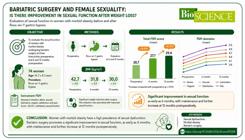
Results: A total of 74 women were evaluated from 36.2 ± 8.3 years, BMI before surgery was 42.7 ± 4.0, after six months 31.8 ± 3.5 and after 12 months 30.0 ± 3.6. The mean total FSFI score obtained in the preoperative period was 20.7. After six months, 27.7 (p < 0.01), and after 12 months, 29.4 (increase of 42.0% compared to the preoperative period). Both in terms of the total score and the isolated domains of the FSFI, an association was observed between improved sexual function and reduced BMI.
Conclusion: There was a significant improvement in sexual function as early as six months after surgery, as well as in the other domains alone.
KEYWORDS:
Sexual dysfunction; Morbid obesity; Bariatric surgery
RESUMO
Introdução: A obesidade severa é mais eficazmente tratada com a cirurgia bariátrica. Espera-se que a perda de peso resultante melhore as condições relacionadas à obesidade, incluindo disfunção sexual.
Objetivo: Avaliar a função sexual de mulheres com obesidade mórbida submetidas a cirurgia bariátrica através de um questionário validado em três momentos: pré-operatório, seis e doze meses após.
Método: Estudo quantitativo, descritivo e analítico, do tipo corte transversal, quasi-experimental, realizado com amostra de conveniência composta por mulheres com idade maior que 18 anos, com obesidade grau III, submetidas ao by-pass gástrico em Y de Roux. O questionário adotado foi o Índice de Função Sexual Feminino (FSFI), o qual avalia seis domínios: desejo, excitação, lubrificação, orgasmo, satisfação e dor. Escores acima de 26,55 traduzem função sexual satisfatória e inferiores definem disfunção sexual.
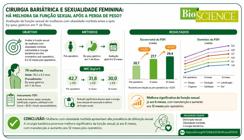
Resultados: Foram 74 mulheres avaliadas de 36,2 ± 8,3 anos, IMC antes da operação de 42,7 ± 4,0, após seis meses de 31,8 ± 3,5 e após 12 meses 30,0 ± 3,6. A média do escore total do FSFI obtida no pré-operatório foi de 20,7. Após seis meses de 27,7 (p < 0,01), e após 12 meses, 29,4 (aumento de 42,0% em comparação ao pré-operatório. Tanto no que refere ao escore total como aos domínios isolados do FSFI, observou-se associação entre a melhora da função sexual e a redução do IMC.
Conclusão: Houve melhora significativa na função sexual logo aos seis meses da operação, assim como dos outros domínios isoladamente.
PALAVRAS-CAHVE:
Disfunção sexual; Obesidade mórbida; Cirurgia bariátrica
INTRODUCTION
Over the past few years, there has been a growing interest in the quality of life of individuals due to their relationship with health and chronic diseases. Studies in large number have investigated the relationship between quality of life and specific health conditions, including obesity.
At the other end of the malnutrition scale, obesity is a blatant public health problem, growing but still neglected and has reached epidemic proportions globally, with at least 2.8 million people dying each year as a result of the consequences. Previously associated with high-income countries, obesity is now also present in low- and middle-income countries. The prevalence of obesity has grown significantly in recent decades, becoming a serious public health problem, affecting, indistinctly, any age group, ethnicity and sex.
For a long time in human history, weight gain, as well as fat accumulation, was seen as signs of health and prosperity. Today, however, obesity is considered a chronic disease and with a high risk for numerous of other chronic diseases, including diabetes, cardiovascular diseases and cancer. Overweight and obesity are also associated with psychological disorders, including depression, eating, distorted body image, and low self-esteem. The prevalence of anxiety and depression is three to four times higher among obese individuals. In addition, obese individuals are also stigmatized and suffer social discrimination.1
Obesity is also associated with specific sexual problems, including lack of desire, poor performance, low fertility, reduced frequency, and even resistance to sexual encounters, negatively affecting sex life.2 The high rates of comorbidities associated with morbid obesity are part of the multifactorial mechanism underlying sexual dysfunction. Most female candidates for bariatric surgery have this dysfunction, and obese women face greater difficulties in this area when compared to men.
Quality of life is considered a multidimensional construction that includes several aspects. When discussed in relation to obesity, health and weight are the most used dimensions. Particularly relevant to people with morbid obesity and those who undergo bariatric surgery are body image and sexual functioning.3
The operation is considered an important therapeutic measure for weight reduction in case of documented failure of clinical treatment in patients with a degree of severe obesity and/or associated with serious diseases.3,4 Among the techniques used for this procedure, Roux-en-Y gastric bypass is performed with low mortality rates and demonstrates high efficiency, especially if the impact on weight loss and control of comorbidities is taken into account.5 This procedure aims to reduce weight and promote weight loss through the restriction of food intake or malabsorption, or by combining these.4
By reducing weight, individuals report improvements in their psychosocial state6, raising their self-esteem and greater interaction in society, as well as improved sexual function. After bariatric surgery, individuals report statistically and clinically significant benefits in health- and weight-related quality of life. Many of these improvements are reported during the period of rapid weight reduction and before patients achieve their maximum weight loss.7
Analyzing the female sexual function (SP) of morbidly obese patients is important because it is little studied and little reported in the literature, especially in Brazil. It is also important to evaluate the role of bariatric surgery in the impact of weight loss on the sexual function of these women in our country.8
The objective of this study was to evaluate the sexual function of morbidly obese women undergoing bariatric surgery through a questionnaire validated at three moments: preoperatively, six and 12 months after Roux-en-Y gastric bypass.
METHOD
This study was approved by the Research Ethics Committee of the Universidade Estadual de Feira de Santana, in Feira de Santana, BA, Brazil, under opinion number 1.033.680/2015 and CAAE number 39234214.1.0000.0053. All patients were only admitted to the study after signing the Informed Consent Form (ICF).
This is a quantitative, descriptive and analytical cross-sectional, quasi-experimental cohort study, carried out with a convenience sample composed of women with grade III obesity, with the application of the Female Sexual Function Index (FSFI).
Women over 18 years of age who underwent Roux-en-Y gastric bypass by the Obesity Surgery Service of Feira de Santana, BA, at the São Matheus and Unimed hospitals, and who agreed to answer the proposed questionnaires, after signing the Informed Consent Form (ICF) were selected. They answered a validated sexual dysfunction (SP) analysis questionnaire for their gender, the Female Sexual Function Index (FSFI).9 The FSFI assesses female sexual function through 19 questions graded from 0 to 5, covering six domains: desire (questions 1 to 2), arousal (questions 3 to 6), lubrication (questions 7 to 10), orgasm (questions 11 to 13), satisfaction (14 to 16) and pain (questions 17 to 19). In all, the points obtained can reach a maximum of 95, and the values of each domain are submitted to different weights to obtain a final score. Scores above 26.55 translate satisfactory sexual function and scores below this value, sexual dysfunction.10
By means of such tools, we proceed to an analysis in three stages. In the first moment, referring to the preoperative phase, the patients under the outpatient regime answered two questionnaires - the FSFI and another structured one containing the preoperative clinical data - self-administered in a reserved room, only numbered and, later, inserted in a collection box. These same questionnaires were reapplied six months after surgery, which constituted the second moment of the analysis. Finally, the same questionnaires were applied 12 months postoperatively.
The inclusion criteria were being a woman, having an indication for bariatric surgery; having attended pre-surgical and post-surgical follow-up appointments; agree to participate in the research and have signed the ICF.
The exclusion criteria were refusal to participate in the research, submission to previous or ongoing pelvic surgery and/or radiotherapy; history of neurological diseases; sexual inactivity in the last six months; inadequate filling (blank or left any items unanswered); or non-adherence to follow-up for at least six months postoperatively.
Statistical analysis
The data were processed electronically using the statistical program Social Package for the Social Sciences - SPSS for Windows, version 22.0.
RESULTS
A total of 74 women were evaluated, aged 36.2 ± 8.3 years, BMI before surgery 42.7 ± 4.0, after six months 31.8 ± 3.5 and after 12 months 30.0 ± 3.6, showing a change in the classification of these patients with obesity from grade III to grade I. Most individuals (68.5%) were married or in a stable union. Regarding religion, 41 were Catholic (55.4%). The ethnic profile comprised 32 browns (43.2%), 17 blacks (23.0%) and 25 whites (33.8%). Regarding education, most of them had completed higher education, equivalent to 33.8%, followed by 32.4% with complete secondary education (Table 1).
Sociodemographic and clinical characteristics of the 74 women who underwent bariatric surgery.
The mean total FSFI score obtained in the preoperative period was 20.7, reflecting the picture of sexual dysfunction. Six months after the operation, the score increased to 27.7, i.e., an increase of 33.8% compared to the preoperative period, which already represents an improvement in sexual function (p < 0.01). After 12 months, the FSFI corresponded to 29.4, which is equivalent to 42.0% more than the preoperative period. Both in terms of the total score and the isolated domains of the FSFI, an association was observed between improved sexual function and reduced BMI.
All domains after six and 12 months of surgery when compared to the preoperative period were statistically significant, i.e., p < 0.05. When analyzing each one individually, the desire domain obtained the greatest variation in the two postoperative moments compared to the preoperative period, corresponding to an improvement of 44.9% after six months and 55.1% after 12. Arousal has second best value, with an improvement of 40.6% and 53.1% in the two moments studied (Table 2 and Figure 1).

When asked about their perception of their SP at the times studied, the majority (n = 19) in the preoperative period, corresponding to 26% of the sample, evaluated it as very dissatisfied. Another 19% (n = 14) were reasonably dissatisfied; 16% (n = 12) were indifferent; 28% (n = 21) reasonably satisfied; and 11% (n = 8) reported being very satisfied (Figure 2).
After six and 12 months of bariatric surgery, there was a decrease in the number of women who considered themselves very dissatisfied, 10% (n = 7) and 5% (n = 4) respectively. There was also a reduction for the item reasonably dissatisfied, corresponding to 7% (n = 5) at both times. For those who reported indifference in their SP, after six months there was a reduction to 9% (n = 7), while the value increased to 19% (n = 14) at 12 months of the study. The values were more expressive in terms of improvement in sexual function: 39% (n = 29) reported being reasonably satisfied at six months, while 31% (n = 23) 12 months after bariatric surgery. For those who self-rated themselves as very satisfied, they corresponded to 35% (n = 26) at six months and 38% (n = 28) at 12 months (Figures 3 and 4).
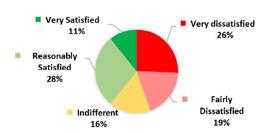
Self-assessment of their sexual function in the preoperative period of the 74 women studied


DISCUSSION
This study demonstrates that morbidly obese women have a high prevalence of sexual dysfunction, and there is a significant improvement in it after bariatric surgery. The data show that the effect after 12 months is even greater than after six.
Currently, studies on the relationship between body weight and sexual functioning are minimal.11 Although there are few analyses investigating the association between female sexual functioning and obesity, the present study shows that bariatric surgery has a great impact on the improvement of sexual function in women with morbid obesity, which coincides with other studies carried out.4,6,12 These patients experience significant improvement in weight loss with improvement in various physical aspects, diseases, well-being, and quality of life.4
Kim et al.13 conducted an eight-week study of 46 overweight or obese women who received weight-reduction medication (sibutramine) along with behavioral therapy and used the FSFI for sexual function analysis. Weight reduction was significantly associated with improved sexual functioning, specifically in arousal and orgasm scores (p < 0.05). This study corroborates the idea that weight reduction positively affects sexual function.
Kolotkin et al.14 conducted a cross-sectional study with 1,158 participants with obesity prior to weight loss treatment, in order to examine the association between sexual quality of life and obesity. The results revealed a statistically significant negative correlation between the quality of sexual life. This study also demonstrates sexual dysfunction in the preoperative sample.
In the study by Sarwer et al.3 in a prospective cohort of 106 women evaluated through the FSFI in the preoperative period and two years after the operation, showed an increase from 20.3 to 24.8 in the mean total FSFI score, as well as improvement in all domains. Two domains, orgasm and pain, did not reach statistical significance. In this study, women also reported improvement in these domains. Although there was a small difference in the mean age in the aforementioned study - 40.5 years - compared to this study, which consisted of younger people aged 36.2 years, the differences in the results of the domains should reflect the particularities of each sample analyzed.
Goitein et al.15 that evaluated 34 women, comparing FSFI scores before and six months after the operation, also did not achieve statistical relevance in all domains. Improvements of 25% in the mean total score (p = 0.006), 17% in the desire domain (p = 0.18), 29% in arousal (p = 0.025), 24% in orgasm (p = 0.046), 35% in satisfaction (p = 0.001), 23% in lubrication (p = 0.011) and 34% in pain (p = 0.027) were evaluated. In contrast, this study found statistical significance in all domains. This disparity may be associated with the fact that the aforementioned study had a significantly smaller sample, as well as possibly due to cultural differences, given that the study comprises individuals from Israel, whose cultural environment, historically, is marked by less sexual freedom.
Bond et al.16 evaluated 54 women at two time points: pre- and six months after gastric bypass in Roux-en-Y by videolaparoscopy. The mean age was 43.3 years and the method of analysis of sexual function was the FSFI. When analyzed at the moment before the operation, 63% had sexual dysfunction. Afterwards, 68% showed improvement in sexual function, and only one worsened. Thus, it is considered that there is a significant improvement in the period of six months after the procedure, which coincides with the values found in this study. There was improvement in all domains, but only desire and lubrication reached statistical significance, showing that the improvement in sexual function seems to be independent of the surgical technique.16
In a publication by Efthymiou et al.17 sexual function and BMI evolution were analyzed in 80 patients - 50 women and 30 men. The analysis in question was performed in four times after the operation: T1, referring to the preoperative period; T2, one month later; T3, six months later; and T4, one year later. For women, the FSFI questionnaire was applied, whose domains showed statistically significant improvement between T1 and T4. In this period, the mean scores showed an improvement of: 45% in the desire domain, 43% in arousal, 34% in lubrication, 39% in orgasm, 34% in satisfaction, 33% in pain and 28% in total satisfaction. This study demonstrates equivalent results showing that the desire domain has greater improvement compared to the others, followed by the arousal domain.
The FSFI is the most accepted instrument in the diagnosis of female sexual dysfunctions in research. However, this questionnaire aims only at the sexual context, allowing the grading of sexual dysfunctions and, also, comparing the results before and after clinical and/or surgical therapeutic interventions. However, they do not identify the factors that may interfere negatively or positively with the score.
There is strong evidence of a link between body weight and mental disorders, among a number of factors that influence the relationship between common mental disorders and obesity, such as depression and anxiety.14 These should be studied, analyzing the degree of satisfaction of these women with this aspect of their life, in addition to their long-term sexual function. Clarifying these pathways is necessary to inform treatment guidelines for clinical practice in overweight or obese individuals suffering from mental health problems and/or impaired sexual functioning.
It is also important to make a more accurate assessment of the impact of comorbidities and changes in the improvement of sexual function. It is known that vascular disorders also interfere with sexual performance, and laboratory analyses and their pathophysiological associations can add even more to the understanding of the causes of sexual dysfunction.
The results of this research could have important implications for public health policy and practice and put sexual function higher on the agenda to help reduce obesity. It is important to emphasize that this is a theme that is still little portrayed in Brazilian literature, especially regarding the female sex.
The relationship between sexual functioning and obesity is highly complex, and although there is strong evidence to support the association between these two variables, studies looking at the impact of obesity on sexual functioning to illustrate the complex interaction between these two variables, is much needed
CONCLUSION
This study demonstrates a high prevalence of sexual dysfunction in women with morbid obesity in the preoperative period, and a significant improvement in sexual function at six and 12 months after bariatric surgery, as well as improvement in all domains alone. Sexual function still shows better results at 12 months. Further studies are needed to better assess the relationship of physical, clinical, and psychological components to female sexual function.
References
-
1 Office of the Surgeon General (US); Office of Disease Prevention and Health Promotion (US); Centers for Disease Control and Prevention (US); National Institutes of Health (US). The Surgeon General's Call To Action To Prevent and Decrease Overweight and Obesity. Rockville (MD): Office of the Surgeon General (US); 2001. Disponível em: https://www.ncbi.nlm.nih.gov/books/NBK44206/
» https://www.ncbi.nlm.nih.gov/books/NBK44206 -
2 Mancini MC. Cirurgia bariátrica - Uma atualização para o endocrinologista. Arq Bras Endocrinol Metab. 2014;58(9):875-88. https://doi.org/10.1590/0004-2730000003413
» https://doi.org/10.1590/0004-2730000003413 -
3 Sarwer DB, Steffen KJ. Quality of Life, Body Image and Sexual Functioning in Bariatric Surgery Patients. Eur Eat Disord Rev. 2015;23(6):504-8. https://doi.org/10.1002/erv.2412
» https://doi.org/10.1002/erv.2412 -
4 Colquitt JL, Pickett K, Loveman E, Frampton GK. Surgery for weight loss in adults. Cochrane Database Syst Rev. 2014;2014(8):CD003641. https://doi.org/10.1002/14651858.cd003641.pub4
» https://doi.org/10.1002/14651858.cd003641.pub4 -
5 da Silva CF, Cohen L, Sarmento LA, Rosa FMM, Rosado EL, Carneiro JRI, et al. Effects of long-term roux-en-y gastric bypass on body weight and clinical metabolic comorbidities in bariatric surgery service of a university hospital. arq. bras. cir. Dig. 2016;29(Supl.1):20-3. https://doi.org/10.1590/0102-6720201600S10006
» https://doi.org/10.1590/0102-6720201600S10006 -
6 Andersen JR, Aasprang A, Karlsen TI, Natvig GK, Våge V, Kolotkin RL. Health-related quality of life after bariatric surgery: a systematic review of prospective long-term studies. Surg Obes Relat Dis. 2015;11(2):466-73. https://doi.org/10.1016/j.soard.2014.10.027
» https://doi.org/10.1016/j.soard.2014.10.027 -
7 Sarwer DB, Crerand CE. Body image and cosmetic medical treatments. Body Image. 2004;1(1):99-111. https://doi.org/10.1016/s1740-1445(03)00003-2
» https://doi.org/10.1016/s1740-1445(03)00003-2 -
8 Esposito K, Giugliano D. Obesity, the metabolic syndrome, and sexual dysfunction. Int J Impot Res. 2005;17(5):391-8. https://doi.org/10.1038/sj.ijir.3901333
» https://doi.org/10.1038/sj.ijir.3901333 -
9 Rosen R, Brown C, Heiman J, Leiblum S, Meston C, Shabsigh R, et al. The Female Sexual Function Index (FSFI): a multidimensional self-report instrument for the assessment of female sexual function. J Sex Marital Ther. 2000;26(2):191-208. https://doi.org/10.1080/009262300278597
» https://doi.org/10.1080/009262300278597 -
10 Wiegel M, Meston C, Rosen R. The female sexual function index (FSFI): cross-validation and development of clinical cutoff scores. J Sex Marital Ther. 2005;31(1):1-20. https://doi.org/10.1080/00926230590475206
» https://doi.org/10.1080/00926230590475206 -
11 Larsen SH, Wagner G, Heitmann BL. Sexual function and obesity. Int J Obes (Lond). 2007;31(8):1189-98. https://doi.org/10.1038/sj.ijo.0803604
» https://doi.org/10.1038/sj.ijo.0803604 -
12 Esfahani SB, Pal S. Obesity, mental health, and sexual dysfunction: A critical review. Health Psychol Open. 2018;5(2):2055102918786867. https://doi.org/10.1177/2055102918786867
» https://doi.org/10.1177/2055102918786867 -
13 Kim KK, Kang HC, Kim SS, Youn BB. Influence of weight reduction by sibutramine on female sexual function. Int J Obes (Lond). 2006;30(5):758-63. https://doi.org/10.1038/sj.ijo.0803198
» https://doi.org/10.1038/sj.ijo.0803198 -
14 Kolotkin RL, Binks M, Crosby RD, Østbye T, Gress RE, Adams TD. Obesity and sexual quality of life. Obesity (Silver Spring). 2006;14(3):472-9. https://doi.org/10.1038/oby.2006.62
» https://doi.org/10.1038/oby.2006.62 - 15 Goitein D, Zendel A, Segev L, Feigin A, Zippel D. Bariatric Surgery Improves Sexual Function in Obese Patients. Isr Med Assoc J. 2015;17(10):616-9.
-
16 Bond DS, Wing RR, Vithiananthan S, Sax HC, Roye GD, Ryder BA, et al. Significant resolution of female sexual dysfunction after bariatric surgery. Surg Obes Relat Dis. 2011;7(1):1-7. https://doi.org/10.1016/j.soard.2010.05.015
» https://doi.org/10.1016/j.soard.2010.05.015 -
17 Efthymiou V, Hyphantis T, Karaivazoglou K, Gourzis P, Alexandrides TK, Kalfarentzos F, et al. The effect of bariatric surgery on patient HRQOL and sexual health during a 1-year postoperative period. Obes Surg. 2015;25(2):310-8. https://doi.org/10.1007/s11695-014-1384-x
» https://doi.org/10.1007/s11695-014-1384-x
-
Central Message
Obesity is associated with specific sexual problems, including lack of desire, poor performance, low fertility, reduction in frequency, and even resistance to sexual encounters, negatively affecting sex life. The high rates of comorbidities associated with morbid obesity are part of the multifactorial mechanism underlying sexual dysfunction. Most candidates for bariatric surgery have this dysfunction, and obese women face greater difficulties in this area when compared to men.
-
Perspective
To evaluate the sexual function of morbidly obese women undergoing bariatric surgery at three time points: preoperatively, six and 12 months postoperatively after Roux-en-Y gastric bypass.
-
How to cite this article
Leite Filho H, de Oliveira DV, Palermo M, Ribeiro RJS, Piatanesi P, Nassif PAN. Cirurgia bariátrica e sexualidade feminina: há melhora da função sexual após a perda de peso? BioSCIENCE. 2026;84:e00004. https://doi.org/10.55684/2026.84.en.e00004
-
Funding:
None
-
Data availability:
Data are available from the corresponding author upon reasonable request.
Edited by
-
Associate Editor:
Thomas Linder https://orcid.org/0000-0001-5187-3010
Data are available from the corresponding author upon reasonable request.


