 Mortality due to meningococcal infection in Brazil: a temporospatial analysis
ABSTRACT
Introduction: Meningococcal infection characterizes infection by Neisseriaseria meningitidis, Gram-negative bacteria, normally present as commensals in the normal nasopharyngeal microbiota, but potentially pathogenic. The combination of factors such as the specific characteristics and virulence of the strain involved with the host predisposition can culminate in the disease.
Objective: To analyze the spatial and epidemiological profile of mortality from meningococcal infection in municipalities in Brazil, from 2001 to 2021.
Method: Epidemiological study focusing on the spatial analysis of mortality between 2001 and 2021. Data from the Mortality Information System (SIM), made available by DATASUS, and population data from the Brazilian Institute of Geography and Statistics (IBGE) were used to calculate crude and standardized mortality rates. The temporal analysis was performed using Joinpoint, while the spatial analysis was performed using GeoDa.
Results: There were 9,815 deaths from meningococcal infection in Brazil. The analysis identified clusters of high rates in the Northeast and Southeast regions. The municipalities with the highest rates were Sampaio, TO (4.77/100 thousand inhabitants), Serra da Raiz, PB (4.33/100 thousand) and Sambaíba, MA (4.25/100 thousand).
Conclusion: The study identified municipalities and clusters with high rates and the need for targeted strategies for disease prevention and control.
KEYWORDS:
Spatio-temporal analysis; Meningococcal infections; Epidemiological monitoring

RESUMO
Introdução: Infecção meningocócica caracteriza a infecção por Neisseriaseria meningitidis, bactérias Gram-negativas, normalmente presentes como comensais na microbiota nasofaríngea normal, porém potencialmente patógenas. A combinação de fatores como as características e virulência específicas da cepa envolvida com a predisposição do hospedeiro podem culminar na doença.
Objetivo: Analisar o perfil espacial e epidemiológico da mortalidade por infecção meningocócica nos municípios do Brasil, no período de 2001 a 2021.
Método: Estudo epidemiológico com enfoque na análise espacial da mortalidade entre 2001 e 2021. Foram utilizados dados do Sistema de Informação sobre Mortalidade (SIM), disponibilizados pelo DATASUS, e dados populacionais do Instituto Brasileiro de Geografia e Estatística (IBGE) para o cálculo das taxas brutas e padronizadas de mortalidade. A análise temporal foi realizada utilizando Joinpoint, enquanto as espaciais pelo GeoDa.
Resultados: Registraram-se 9.815 óbitos por infecção meningocócica no Brasil. A análise identificou aglomerados de altas taxas nas regiões Nordeste e Sudeste. Os municípios com maiores taxas foram Sampaio, TO (4,77/100 mil habitantes), Serra da Raiz, PB (4,33/100 mil) e Sambaíba, MA (4,25/100 mil).
Conclusão: O estudo identificou municípios e aglomerados com elevadas taxas e necessidade de estratégias direcionadas de prevenção e controle da doença.
PALAVRAS-CHAVE:
Análise espaço-temporal; Infecções meningocócicas; Monitoramento epidemiológico

INTRODUCTION
Meningococcal infection (ICD A39) characterizes infection with Neisseriaseria meningitidis, Gram-negative bacteria, normally present as commensals in the normal nasopharyngeal microbiota, but potentially pathogenic. The combination of factors such as the specific characteristics and virulence of the strain involved with the host predisposition can culminate in the disease. Among the invasive conditions, meningitis and sepsis predominate, which, together, represent 90% of the cases; however, infections also present elsewhere.1.2
Symptoms include fever, headache, and stiff neck. In the case of meningococcemia, the disease commonly presents as an acute condition, with possible multiple organ failure, shock, and disseminated intravascular coagulation. If it is a syndromic condition, chronic meningococcemia, the symptoms are milder and recurrent, affecting mainly the skin and joints.3.4
The overall endemic incidence is 0.5 to 5/100,000, with an increase in the number of cases in winter and spring in temperate climates, a region that comprises 26 countries and is known as the meningitis belt. Vaccination has visible effects on the incidence of meningococcal infections, being the main means of preventing their occurrence.5
As it is an infection caused by meningococci (Gram-negative diplococci), the diagnosis has different possible steps and conducts. A relevant detail in the diagnostic approach is that, due to the invasive and severe nature of the disease, antibiotic treatment associated with tests for proper diagnosis should often be taken. Among the possible conducts to be taken to make the diagnosis are blood cultures; however, they are only truly positive in half of patients affected with meningococcal infection; thus, it is necessary to cerebrospinal fluid analysis. Its analysis is valuable and often essential in the search for the pathogen that causes the infection; Gram staining is well observed in about 90% of samples and culture has a sensitivity of approximately 90%. Currently, techniques using polymerase chain reaction are under development, and some are already in use, to improve the processes of the analysis of the liquor and optimize the diagnostic process. Another tool that can be used in the diagnostic process is the performance of computed tomography of the brain to evaluate evidence of intracranial mass effect.3
The objective of this study was to analyze the spatial and epidemiological profile of mortality from meningococcal infection in municipalities in Brazil, from 2001 to 2021.
METHOD
This is an epidemiological study of secondary data analysis in health with a focus on temporospatial analysis. Data on cases of death due to meningococcal infection and streptococcal septicemia were obtained from the Mortality Information System (SIM) of the Department of Informatics of the Unified Health System (DATASUS) of the Ministry of Health (MS), via Tabnet, through the place of death and place of occurrence. The population data used as the denominator for the purpose of calculating mortality rates came from DATASUS.
For the analysis of the mortality trend due to meningococcal infection and streptococcal septicemia in Brazil, the period from 2001 to 2021 was selected, in order to better understand the outcome in this historical series. For the study population, individuals were selected according to data available from the Department of Informatics of the Unified Health System (DATASUS) for adults who were registered with deaths from meningococcal infection and streptococcal septicemia. The following variables were considered for the analysis: sex, age group, color/race, marital status, education, deaths by residence, year of death, place of death, and place of occurrence.
For the underlying cause of these deaths, ICD A39 (meningococcal infection) and A40 (streptococcal septicemia) of the International Classification of Diseases (ICD-10) were adopted. Information on the epidemiological profile and frequency of deaths from meningococcal infection and streptococcal septicemia were compiled using the Microsoft Excel for Microsoft 365 MSO software. Thus, the nominal variables were analyzed by means of the absolute frequency and percentage of occurrence in the study population. Annual mortality was calculated using the total number of deaths in the state as the numerator and the population of the state in that year as the denominator, taking 100 thousand inhabitants as a reference for this coefficient. While the mortality of each municipality was calculated based on standardization by the indirect method, using the average number of cases in the period, divided by the average population between 2001 and 2021, multiplied by 100 thousand inhabitants.
Statistical analysis
Initially, the temporal trend of mortality due to meningococcal infection and streptococcal septicemia was analyzed (Figure 1). Thus, the annual percent change (APC) of the studied trend was evaluated, with a 95% confidence interval (95%CI) and statistical significance p < 0.05. The temporal pattern analysis was performed using the Joinpoint Regression Program 5.0.2 2023 software. Next, the spatial distribution of mortality from meningococcal infection and streptococcal septicemia in Brazil was studied. Initially (Figure 1) the mean mortality from meningococcal infection and streptococcal septicemia in the Brazilian municipalities were studied. As there is a probability of identifying a heterogeneous pattern between municipalities, the municipal values were smoothed by the local empirical Bayesian method. This method weights the value of the municipal tax in relation to the municipalities that border it by means of a spatial proximity matrix. The spatial analyses were carried out in the GeoDa 1.22.0.4 2023 program, as well as the creation of the thematic maps. To identify spatial clusters, the Global and Local Moran’s Index was used, which measures the correlation between first-order neighbors and was used to test the hypothesis of spatial dependence. The method identifies spatial autocorrelation and can vary between -1 and +1, in which values close to zero indicate the absence of spatial dependence, considering p < 0.05 to be significant. If the hypothesis of dependence is accepted, the Local Index of Spatial Association (LISA) is used to observe the presence of spatial aggregates, given p < 0.05. The results of the analyses described above were demonstrated by Moran Map and LISA Map (Figure 4). The Moran Map graphically demonstrates the degree of similarity between neighbors, being represented by four quadrants: 1) high-high (upper right quadrant) corresponds to municipalities that have high mortality rates and are close to municipalities that also have high mortality rates; 2) low-low (lower left quadrant): corresponds to municipalities with low mortality and are close to municipalities that also have low rates; 3) high-low (lower right quadrant): corresponds to municipalities that have high rates and are close to municipalities that have low mortality rates; 4) low-high (upper left quadrant): corresponds to municipalities that have low rates and are close to municipalities with high rates.
The data used to compose the research were available on the internet free of charge for consultation. Thus, there is no possibility of causing physical or moral damage from the perspective of the individual and the collectivity. Therefore, the present study did not need to be approved by the Ethics Committee.
RESULTS
After analyzing the profile of Brazilian victims of meningococcal infection and streptococcal septicemia, a significant prevalence was identified among individuals aged 1-4 years, totaling 19.22% of the cases. However, it is notable that the incidence of this fatal event is practically comparable in similar age groups, with 13.12% of deaths occurring among children under one year of age. In addition, there was a marked predominance of males, representing 53.49% of the cases. At the same time, most of the victims belonged to the white ethnicity (47.60%), followed by 37.06% among browns, and had 15.67% of singles.
Regarding educational level, it was observed that most deaths occurred among individuals without complete schooling, comprising 20.10% of the cases, followed by 12.45% among those aged one to three years. It is crucial to highlight that most cases of mortality due to meningococcal infection and streptococcal septicemia occurred in the hospital environment, representing 90.14% of the total, followed by the home environment, with 4.20%.
From 2001 to 2021, 9815 deaths from meningococcal infection and streptococcal septicemia were recorded in Brazil. The average mortality in this period was 0.24/100 thousand inhabitants, with the lowest mortality recorded in 2021 (0.07/100 thousand inhabitants) and the highest in 2001 (0.39/100 thousand inhabitants). The analysis of the temporal pattern of mortality in the study period showed a significant mean decrease of 6.32% per year in the mortality rate per 100 thousand inhabitants (p < 0.05, Figure 1). Pearson’s correlation coefficient was -0.8871 with p < 0.05, indicating that there is a significant and inversely proportional linear correlation, over the years, there was a significant reduction in the mortality rate.
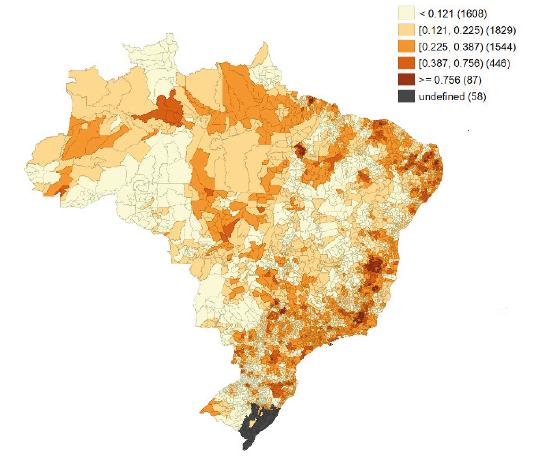
Through spatial analysis, Figure 2 shows the spatial dispersion of mortality due to meningococcal infection and streptococcal septicemia in Brazil, with a focus of incidence in the Southeast and Northeast regions, but with the incidence dispersed throughout the country. Sampaio, TO (4.77/100 thousand inhabitants), Serra da Raiz, PB (4.33/100 thousand inhabitants), Sambaíba, MA (4.25/100 thousand inhabitants), Ouroeste, SP (3.80/100 thousand inhabitants) and Arapei, SP (3.73/100 thousand inhabitants) were the five municipalities that had the highest mortality rate from meningococcal infection and streptococcal septicemia between 2001-2021.
With the smoothing of the crude rates by the local empirical Bayesian method (Figure 3), it is possible to observe a more apparent spatial pattern, with aggregation of municipalities with higher mortality rates in the Southeast and Northeast regions. Spatial autocorrelation was identified by the Global Moran Index (I = 0.660; p = 0.01), demonstrating evidence of positive autocorrelation.


Mortality rate smoothed by the local empirical Bayesian method due to meningococcal infection in Brazil, between 2001-2021
The application of the Local Moran’s Index made it possible to identify spatial clusters of both high and low equal values (Figure 4). The high-high pattern was identified mainly in the Northeast and Southeast regions, which indicates similarity between the municipalities in these regions for high mortality values due to the pathology analyzed.

While the low-low pattern was identified mainly in the Midwest, South, Northeast and North regions, which indicates similarity between the municipalities in these regions for low mortality values from the analyzed disease.
DISCUSSION
Mortality due to meningococcal infection requires careful analysis, given that it is an important cause of infant death. After analyzing the epidemiological data, it is possible to perceive frequency in early childhood, that is, in children up to four years old (32.34%), agreeing with the article by Barroso et al.6 that most cases of mortality from meningococcal infection occur in early childhood. It shows that about 2.45 cases of lethality per 100,000 individuals are children under one year of age, but the average incidence would be 0.24 per 100,000 individuals. Reiterating that the main cause of cases is due to facilitated transmission in children’s environments such as daycare centers and schools and the immaturity of the immune system, increasing susceptibility to meningococcal infection.6-8
The demographic characteristics of mortality due to meningococcal infection point to a predominance of risk and mortality factors in males (53.49%), especially in those of white ethnicity (47.60%) and with no complete year of schooling (20.10%). Manfred S Green et al.9, in their article on the difference between the sexes in the incidence of meningococcal infection, says that there are actually more young men but says that in older people, the majority are women. This higher incidence in men is explained by the authors by genetics and hormonal differences in young men.9 The association between low level of education and increased infection highlights how education can function as an important social determinant of health, and that, usually when its rates are low, they are situations in which there are greater social problems and decreased quality of life, which reflect on health-related issues.
In the analysis of spatial data, the Southeast and Northeast regions show higher mortality from meningococcal infection than the others, 4,017 and 1,440 deaths, respectively.6-8 The Northeast region has higher mortality rates due to meningococcal infection, which can be associated with the fact that the region has social ills, even with good development observed in recent years. Such ills can be intensified by the characteristic of accentuated rurality observed in the region, which hinders access to health services that are more concentrated in urban centers, causing less adequate investigation of cases, with consequent worsening of the conditions, in addition to deficient adherence to vaccination. In the Southeast region, the concentration of people, especially in closed places such as subways, buses, and air-conditioned environments, and added to disorderly urbanization - marked by the existence of favelas and peripheries with limited access to adequate housing conditions (Brasil, 2016) - contributes to the dissemination of etiological agents, especially those of bacterial origin, which have high lethality, with variation in their indexes.4
When analyzing the data from the temporal aspect it can be seen that the highest incidence of meningococcal infection was in 2001 with about 0.39/100,000 individuals compared to the lowest incidence which was in 2021 with 0.07/100,000 individuals. According to DATASUS, from 2001 onwards the number of cases was progressively decreasing, that is, from the beginning of the 90s to 2001 it was considerably high and from that point on, it began to decrease, making the year 2001 the year with the highest incidence in the period analyzed in this article.
Limitations
The secondary data used in this study are a limiting factor, which can generate biases, such as underreporting, lack of information and inconsistencies in filling in the causes of death. Associated with this, there is a limitation in the analysis of information on population estimates through the indirect method, as the last census dates from 2010. The results found for the general population may not be repeated at the individual level due to the effects of data aggregation, a characteristic of ecological fallacy. It is noteworthy that the mortality analysis was based only on the underlying cause of death and not on multiple causes. Thus, there may be an underestimation of deaths from meningococcal infection.
CONCLUSION
The temporospatial analysis allowed the identification of the municipalities of the different states with high mortality from meningococcal infection, in addition to the differences between the mortality rates between states in Brazil. Thus, the need for strategies that act according to the reality and particularities of these places is exposed. This research serves as a scientific subsidy for the organization and planning of actions aimed at improving health care in the most vulnerable places, especially in Primary Health Care (PHC), since it is the level with the greatest and most direct contact with the population and the most efficient with regard to educational and preventive actions that They aim to ensure access and care for the population served, and, consequently, promote health and prevent conditions that culminate in aggravation of meningococcal infection.
References
-
1 MacNeil JR, Blain AE, Wang X, Cohn AC. Current Epidemiology and Trends in Meningococcal Disease-United States, 1996-2015. Clin Infect Dis. 2018;66(8):1276-81. https://doi.org/10.1093/cid/cix993
» https://doi.org/10.1093/cid/cix993 -
2 Willerton L, Lucidarme J, Walker A, Lekshmi A, Clark SA, Walsh L, et al. Antibiotic resistance among invasive Neisseria meningitidis isolates in England, Wales and Northern Ireland (2010/11 to 2018/19). PLoS One. 2021;16(11):e0260677. https://doi.org/10.1371/journal.pone.0260677
» https://doi.org/10.1371/journal.pone.0260677 - 3 Campsall PA, Laupland KB, Niven DJ. Severe meningococcal infection: a review of epidemiology, diagnosis, and management. Crit Care Clin. 2013;29(3):393-409.
-
4 do Espirito-Santos RR, de Almeida NRC, Campos RALS, Parente F de S, Andrade MCS, Pinheiro ACS de O, et al. Infecção meningocócica em crianças no Brasil: análise do período 2013 a 2017. Brazilian Journal of Health Review. 2021;4(3):9570-8. http://doi.org/10.34119/bjhrv3n4-193
» http://doi.org/10.34119/bjhrv3n4-193 -
5 Berry I, Rubis AB, Howie RL, Sharma S, Marasini D, Marjuki H, et al. Selection of Antibiotics as Prophylaxis for Close Contacts of Patients with Meningococcal Disease in Areas with Ciprofloxacin Resistance - United States, 2024. MMWR Morb Mortal Wkly Rep. 2024;73(5):99-103. https://doi.org/10.15585/mmwr.mm7305a2
» https://doi.org/10.15585/mmwr.mm7305a2 -
6 Barroso DE, de Carvalho DM, Nogueira SA, Solari CA. Doença meningocócica: epidemiologia e controle dos casos secundários. Rev Saude Publica. 1998;32(1):89-97. https://doi.org/10.1590/S0034-89101998000100014
» https://doi.org/10.1590/S0034-89101998000100014 -
7 Rausch-Phung EA, Hall WA, Ashong D. Meningococcal Disease (Neisseria meningitidis Infection) StatPearls.; 2026. Available from: https://www.ncbi.nlm.nih.gov/books/NBK549849/
» https://www.ncbi.nlm.nih.gov/books/NBK549849 -
8 Silva LRD, Arruda LES, Barreto IJB, Aragão JVR, Silva MLFID, Lira G, et al. Geography and public health: analysis of the epidemiological dynamics of meningitis in Brazil, between 2010 and 2019. Rev Bras Epidemiol. 2024;27:e240031. https://doi.org/10.1590/1980-549720240031
» https://doi.org/10.1590/1980-549720240031 -
9 Green MS, Schwartz N, Peer V. A meta-analytic evaluation of sex differences in meningococcal disease incidence rates in 10 countries. Epidemiol Infect. 2020;148:e246. https://doi.org/10.1017/s0950268820002356
» https://doi.org/10.1017/s0950268820002356
-
How to cite this article
Ribas HS, de Souza FR, de Oliveira TC, Dias LM, Ortiz YS, Prezoto LS, Queiroz IB, Salmória GS, Youssef KM. Mortalidade por infecção meningocócica no Brasil: uma análise têmporo-espacial. BioSCIENCE. 2026;84:e00018. https://doi.org/10.55684/2026.84.pt.e00018
-
Central Message
Meningococcal infection (Neisseriaseria meningitidis), Gram-negative bacteria, which are normally present as commensals in the normal nasopharyngeal microbiota, can potentially mutate into pathogens. The combination of factors such as the specific characteristics and virulence of the strain involved with the host predisposition can culminate in the disease. Thus, it is pertinent to analyze the spatial and epidemiological profile of mortality from meningococcal infection in Brazilian municipalities.
-
Perspective
The temporospatial analysis allows the identification of municipalities in the different states with high mortality from meningococcal infection, in addition to presenting differences between mortality rates. In this way, it supports the need for strategies that act according to the reality and particularities of the affected places. Thus, this research serves as a scientific subsidy for the organization and planning of actions aimed at improving health care in the most vulnerable places, especially in Primary Health Care
-
Funding:
None
-
Data availability:
Data are available from the corresponding author upon reasonable request.
Edited by
-
Associate Editor:
Carina Rossoni https://orcid.org/0000-0002-6494-4639
Data are available from the corresponding author upon reasonable request.