 Crude biosurfactant production and heterologous expression of rhamnolipid biosynthesis genes of Pseudomonas aeruginosa UA isolated from oil contaminated soil
Abstract
Biosurfactants, particularly rhamnolipids produced by Pseudomonas aeruginosa, have been increasingly used in industries because of their multifunctional properties, including emulsification, foaming, and antimicrobial activities. Despite its excellent characteristics, the use of these rhamnolipids is still limited due to the pathogenicity of P. aeruginosa. This study investigates the potential production of biosurfactant by P. aeruginosa strain UA isolated from oil-contaminated soil in Indonesia while exploring the heterologous expression of rhamnolipid biosynthesis genes in Escherichia coli BL21(DE3) to overcome safety concerns. Crude biosurfactant production was confirmed through microplate, oil spreading, and drop collapse assays, with significant surface tension reduction and emulsification activity observed. Glycerol as a carbon source enhanced biosurfactant production, yielding emulsification activity comparable to the synthetic surfactant Tween-80. The much safer microbial host E. coli BL21(DE3) has successfully cloned and expressed the rhamnolipid biosynthesis genes (rhlA, rhlB, and rhlC). The results presented in this study confirm the biosurfactant production with recombinant system from P. aeruginosa strain UA. The limitations of industrial applications and future directions were also discussed for optimization and scalability.
Keywords:
biosurfactants; Pseudomonas aeruginosa; rhamnolipids; emulsifiers; biological production
Resumo
Os biossurfactantes, particularmente os ramnolipídeos produzidos por Pseudomonas aeruginosa, têm sido cada vez mais utilizados nas indústrias devido às suas propriedades multifuncionais, incluindo emulsificação, formação de espuma e atividades antimicrobianas. Apesar de suas excelentes características, o uso desses ramnolipídeos ainda é limitado por causa da patogenicidade de P. aeruginosa. Este estudo investiga a produção potencial de biossurfactante pela cepa UA de P. aeruginosa isolada de solo contaminado com óleo na Indonésia, ao mesmo tempo que explora a expressão heteróloga de genes de biossíntese de ramnolipídeos em Escherichia coli BL21 (DE3) para superar preocupações de segurança. A produção de biossurfactante bruto foi confirmada através de ensaios de microplacas, espalhamento de óleo e colapso de gotas, observando-se significativa redução da tensão superficial e atividade de emulsificação. O glicerol como fonte de carbono melhorou a produção de biossurfactante, produzindo atividade emulsificante comparável à do surfactante sintético Tween-80. O hospedeiro microbiano muito mais seguro, E. coli BL21 (DE3), clonou e expressou com sucesso os genes da biossíntese de ramnolipídeos (rhlA, rhlB e rhlC). Os resultados apresentados neste estudo confirmam a produção de biossurfactante com sistema recombinante a partir da cepa UA de P. aeruginosa. As limitações das aplicações industriais e direções futuras também foram discutidas para otimização e escalabilidade.
Palavras-chave:
biossurfactantes; Pseudomonas aeruginosa; ramnolipídeos; emulsificantes; produção biológica
1. Introduction
Biosurfactants’ ability to lower the surface and interfacial tension between polar and non-polar compounds (Baccile et al., 2023) make them a valuable material for various industries, such as oil recovery, bioremediation, cosmetics, food, and pharmaceuticals (Banat and Thavasi, 2019; Pandey et al., 2022). In industries such as bioremediation and food processing, biosurfactants have been used to create stable emulsions for effective pollutant degradation and product formulation (Liu et al., 2018). Due to their lower toxicity, higher biodegradability, and exceptional stability across a wide range of pH and salinity conditions, they are more environmentally friendly than synthetic surfactants (Hrůzová et al., 2020). They are also more attractive for industries that aim to decrease environmental impacts because they can be produced from renewable resources, contributing to global sustainable goals (Jimoh and Lin, 2019).
Rhamnolipids are a type of biosurfactant mainly produced by Pseudomonas aeruginosa and are known for their multifunctionality and high industrial potential with their surface tension reduction and emulsification activities. Their dual use as surfactants and antimicrobials makes them preferable to be applied in oil recovery processes to cosmetics and pharmaceutical formulations (Thakur et al., 2021). Even though the demand for mono-rhamnolipids and di-rhamnolipids is high (Sood et al., 2020), the virulence of P. aeruginosa introduces a problem in their production. The direct application of rhamnolipids in sensitive sectors such as food, pharmaceuticals, and cosmetics is restricted due to the safety and health issues presented by P. aeruginosa as a human pathogen (Soberón‐Chávez et al., 2021).
In recent years, a much safer and more effective rhamnolipid production by using genetic engineering has been studied by using alternative hosts to clone and express biosynthetic genes, i.e., rhlA (3-3-hydroxydecanoyloxy decanoate synthase), rhlB (rhamnosyltransferase-1), and rhlC. Much safer microbial hosts or Generally Recognized as Safe (GRAS), such as Escherichia coli BL21(DE3), Pseudomonas putida, and Saccharomyces cerevisiae (Bahia et al., 2018; Suhandono et al., 2021) have been shown to address safety issues and allow for production optimization and industrial processes scale-up.
The rich ecosystem of Indonesia offers a large and mostly unexplored resource for novel biosurfactant-producing microbes. The unique microbial species found in this country can produce biosurfactants (Arifiyanto et al., 2020; Nafidiastri et al., 2021; Astuti et al., 2023; Fatimah et al., 2024), such as P. aeruginosa strain UA isolated from petroleum-contaminated soil in the port area of Tanjung Perak, Surabaya (unpublished data). This study aims to investigate Pseudomonas aeruginosa UA strain as a potential source of biosurfactants by producing crude biosurfactants and analyzing its surface tension reduction and emulsification activities. Furthermore, this study also opts to construct a rhamnolipid-producing recombinant bacterial strain by cloning and expressing rhlA, rhlB, and rhlC genes from P. aeruginosa strain UA in E. coli gene BL21 (DE3). Successful results from this approach can help to overcome the safety limitations of using P. aeruginosa for rhamnolipid production
2. Materials and Methods
2.1. Production of crude biosurfactant
A single colony of P. aeruginosa strain UA and the reference strain P. aeruginosa ATCC 27853 (Kezrane et al., 2020) were inoculated into Luria Bertani (LB) Broth and placed in a shaker incubator overnight (150 rpm, 24 hours, 37°C). Subsequently, 500 µL of it was transferred to 25 mL of fresh LB broth and incubated with continuous shaking (150 rpm, 48 hours, 30°C). Next, the culture was centrifuged (4000 rpm, 15 minutes) to obtain a cell-free supernatant containing crude biosurfactant.
2.2. Screening of crude biosurfactant activity
The biosurfactant activity of the crude extracts produced by P. aeruginosa strain UA and ATCC 27853 was evaluated using microplate, oil spreading, and drop collapse assays, each performed in triplicate. The positive and negative controls were Tween-80 and distilled water subsequently.
The microplate assay used 100 µL of cell-free supernatant and added to a 96-well microplate. Observations were made over grid paper with a concave meniscus indicating a positive result of surfactant activity, while a flat surface indicated a negative result (Saruni et al., 2019).
The oil spreading assay was started by placing 20 mL of distilled water in a Petri dish and adding 5 µL of oil onto the water surface using a pipette. Subsequently, 10 µL of cell-free supernatant was added to the center of the oil layer. Clear zone formation indicated biosurfactant presence through oil displacement activity (Sambanthamoorthy et al., 2014), and a caliper was used to measure its diameter.
The drop collapse assay was done according to Burch et al., (2010). Two µL of kerosene were added to a 96-well microplate and left at room temperature for 2 hours to ensure even coating. Then, 5 µL of cell-free supernatant was placed into the center of each well. A positive result was indicated by the collapse of the supernatant into the oil layer, accompanied by a reduction in contact angle, whereas a negative result was indicated by the droplet remaining intact on the oil surface (Nayarisseri et al., 2018).
2.3. Surface tension reduction and emulsification activity
Surface tension measurements were triplicated using the du Nouy ring method, with prior calibration using LB broth. A reduction in surface tension of the supernatant compared to LB broth indicated the presence of biosurfactants in the cell-free supernatant.
Emulsification activity was assessed by mixing 500 µL of cell-free supernatant with 500 µL of kerosene in a test tube, followed by high-speed mixing with vortex for 2 minutes. The mixture was left for 24 hours to settle. Then, the emulsification index was calculated as the percent height (cm) of the emulsion layer to mixture’s total height (cm) (Goswami and Deka, 2019).
2.4. Rhamnolipid production and activity with varied carbon sources
A single colony of P. aeruginosa strain UA was cultured in LB broth and placed in a shaker incubator (150 rpm, 24 hours, 37°C). Subsequently, 500 µL of culture was transferred to 25 mL of Synthetic Mineral Water (SMW) media (Ni’matuzahroh et al., 2020) supplemented with either 2% (v/v) glucose or 2% (v/v) glycerol as carbon sources and 0.5% (w/v) yeast extract as a nitrogen source. The culture was incubated (150 rpm, 48 hours, 30°C) and then centrifuged (4000 rpm, 15 minutes) to obtain cell-free supernatant containing crude biosurfactant. Surface tension reduction was then evaluated using the du Nouy ring method calibrated with SMW media. Emulsification activity was tested against kerosene.
2.5. Cloning and recombinant expression of rhamnolipid biosynthesis genes
For cloning the rhamnolipid biosynthesis genes, genomic DNA extracted from P. aeruginosa strain UA was subjected to PCR using forward and reverse primers (Table 1) designed for cloning into the pLATE11 vector using the aLICator LIC Cloning and Expression Kit 1 (Thermo Fisher Scientific, USA).
The amplified PCR products were cloned into the pLATE11 vector according to the instructions from the manufacturer, resulting in the constructs pLATE11-rhlA, pLATE11-rhlB, and pLATE11-rhlC. Then, competent E. coli BL21 (DE3) cells were subjected to transformation with each recombinant plasmid using the heat shock method. Colony PCR was used to validate successful transformation, and selected colonies were used to express the recombinant rhlA, rhlB, and rhlC proteins.
A single colony of the recombinant E. coli BL21 (DE3) strain was cultured in LB broth and placed in a shaker incubator (150 rpm, 24 hours, 37°C). Then, 200 µL of the pre-culture was moved into 10 mL of fresh LB broth and placed in a shaker incubator (37°C) until the OD600 reached 0.6. Then, 0.5 mM isopropyl β-D-1-thiogalactopyranoside (IPTG) was added to induce the recombinant protein expression, followed by incubation (200 rpm, 4 hours, 37°C). Next, 1 mL of induced culture was centrifuged (16,000 × g, 1 minute, 4°C). The obtained pellet was resuspended in 10 mM Tris-EDTA (TE) buffer (pH 7.6) and lysed by sonication. The sodium dodecyl sulfate polyacrylamide gel electrophoresis (SDS-PAGE) was used to confirm the expression of recombinant protein.
3. Results
The cell-free supernatant obtained from P. aeruginosa strain UA culture demonstrated positive results for biosurfactant production in the microplate, oil spreading, and drop collapse assay (Table 2). In contrast, the reference strain P. aeruginosa ATCC 27853, a known biosurfactant producer (Amraini et al., 2022; Souza Araújo et al., 2024), showed positivity only in the microplate assay (Table 2).
Biosurfactant screening results using cell-free supernatant from P. aeruginosa strain UA and ATCC 27853.
The microplate assay detects surfactants by observing optical distortions in aqueous solutions. Since the well is hydrophobic, pure water will form a flat surface, whereas surfactants wet the well edges and cause a concave surface resembling a diverging lens (Balakrishnan et al., 2022). In this study, a concave meniscus was observed in the cell-free supernatant of P. aeruginosa strain UA and ATCC 27853, indicating surfactant production. The drop collapse assay evaluates surfactant activity by assessing the destabilization of liquid droplets on a solid surface coated by oil. In the absence of surfactants, polar water molecules repel the surface, maintaining the cohesion of droplets. However, when droplets contain surfactants, interfacial tension can be reduced, and it will spread or collapse. In the oil spreading assay, crude oil was layered on the surface of distilled water in a Petri dish to form a thin oil film. The cell-free supernatant was then placed in the middle of the layer. When biosurfactants are present, a clearing zone around the oil-filled tube is formed, with the size of the clearing area directly proportional to the surfactant's activity (Nayarisseri et al., 2018). Based on the results of the drop collapse and oil spreading assays, only the cell-free supernatant of P. aeruginosa strain UA demonstrated the production of biosurfactants exhibiting surface-active properties.
The cell-free supernatant from P. aeruginosa strain UA demonstrated significantly greater surface tension reduction activity than P. aeruginosa ATCC 27853 (Table 3). A reduction in surface tension of more than 10 mN/m by the cell-free supernatant indicates the potential of the microorganism to produce biosurfactants (Walter et al., 2010). These findings are consistent with the drop collapse and oil spreading assays, in which P. aeruginosa strain UA produced biosurfactants with surface-active properties. Meanwhile, both strains exhibited emulsification activities that were not significantly different, with P. aeruginosa strain UA showing slightly higher activity (Table 3). Previous studies (El-Housseiny et al., 2020; Zhao et al., 2021a) have reported that cell-free supernatants from P. aeruginosa containing rhamnolipids can reduce surface tension and exhibit emulsification activity.
Results of the surface tension reduction and emulsification activity of cell-free supernatant from P. aeruginosa Strain UA and ATCC 27853.
The cell-free supernatants obtained from cultures grown with glucose and glycerol as carbon sources showed comparable surface tension reduction activities (Table 4). However, these values remained lower than those of the positive control (Tween-80). Interestingly, the cell-free supernatant from cultures using glycerol as a carbon source exhibited emulsification activity comparable to that of Tween-80 (Table 4). In contrast, the cell-free supernatant from glucose-based cultures showed relatively lower emulsification activity. As previously reported in other studies (Varjani and Upasani, 2016; Ehinmitola et al., 2018), the type of carbon source can influence the biosurfactants characteristics produced by P. aeruginosa.
Results of the surface tension reduction and emulsification activity of cell-free supernatant from P. aeruginosa strain UA grown with glucose and glycerol as carbon sources
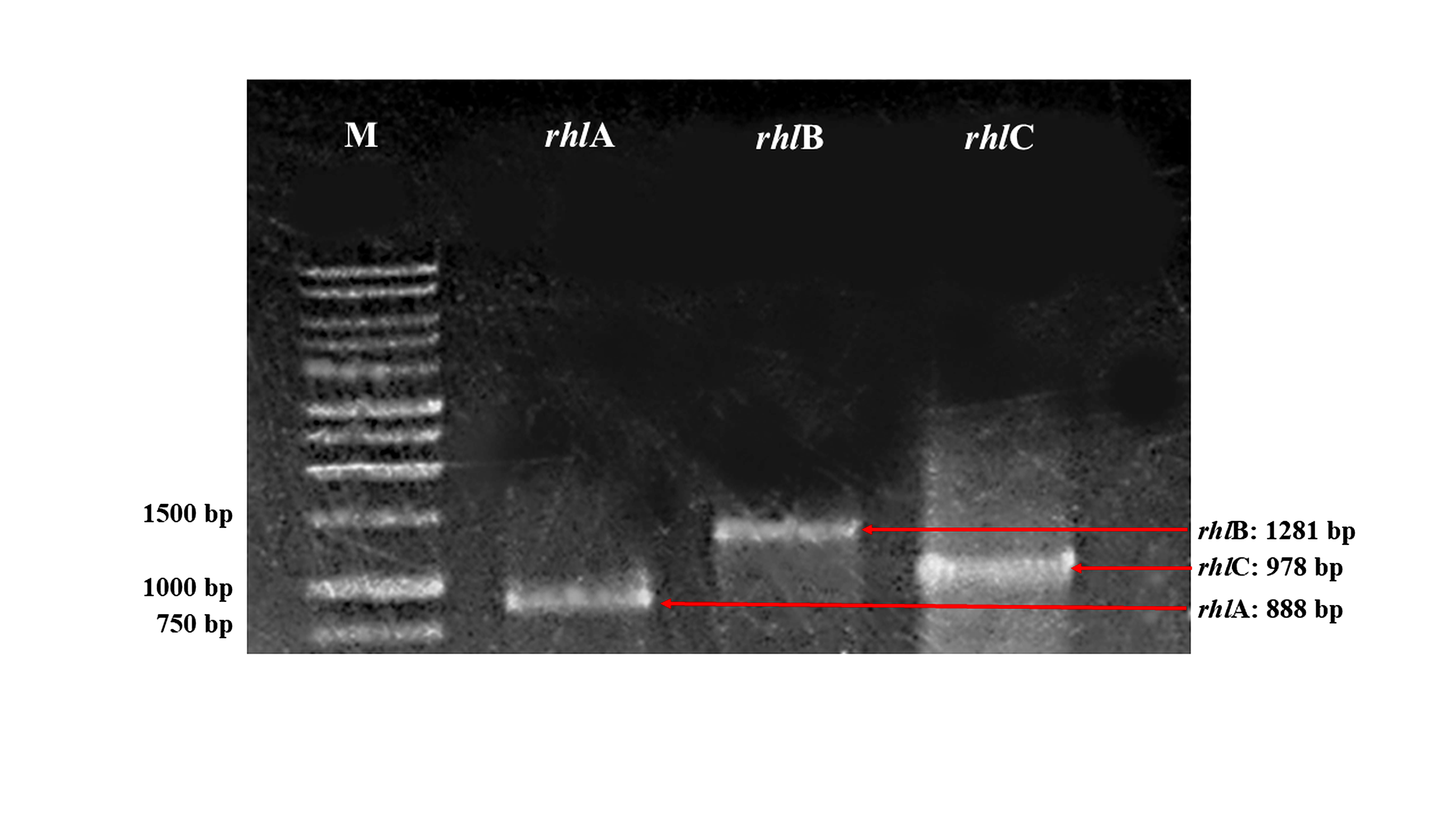
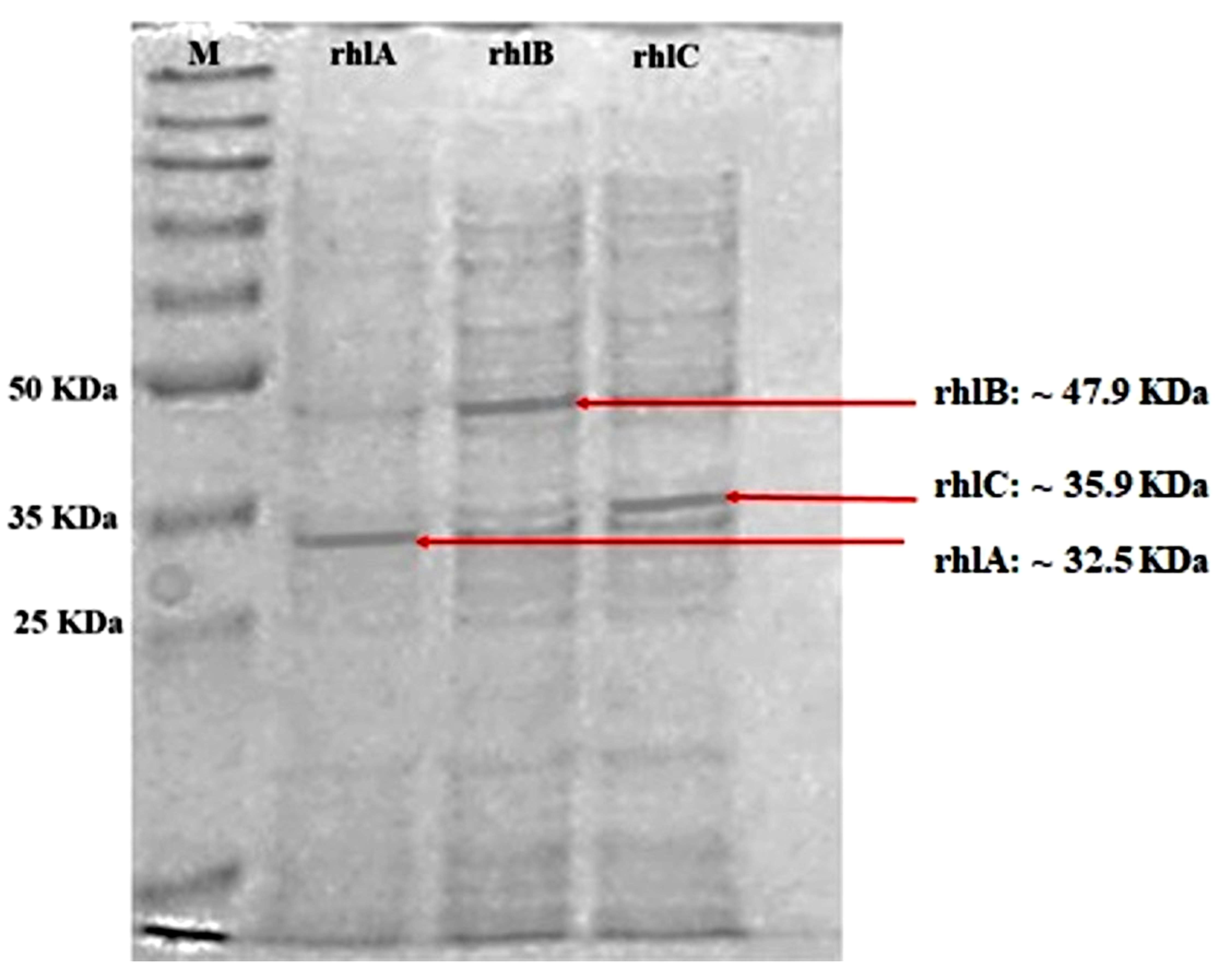
As an initial step in developing recombinant rhamnolipid-producing E. coli strains, the genes involved in rhamnolipid biosynthesis were cloned (Figure 1) and inserted into the pLATE11 vector. These genes were then transformed into E. coli BL21(DE3), and SDS-PAGE was used to confirm the gene expression (Figure 2), which revealed distinct protein bands corresponding to the expected molecular weights: approximately 32.5 kDa for RhlA, 35.9 kDa for RhlC, and 47.9 kDa for RhlB, as reported previously (Kiss et al., 2017; Rahim et al., 2001). These findings provide clear evidence of successful amplification, cloning, and translation of the rhlA, rhlB, and rhlC genes in a recombinant system.
Amplification results of rhlA, rhlB, and rhlC genes visualized in 1% agarose gel; M = BenchTop 1kb DNA Ladder (Promega).
The recombinant rhlA, rhlB, and rhlC expression in E. coli BL21 (DE3) analyzed with SDS-PAGE; M = Broad Range Protein Molecular Weight Markers (Promega).
5. Discussion
Glycolipid biosurfactant rhamnolipids are increasingly popular due to their multifunctional properties, including emulsification, foaming, and antimicrobial activities, which make them suitable for industrial applications such as petroleum, food, pharmaceuticals, and cosmetics (Thakur et al., 2021; Guzmán et al., 2024). Rhamnolipids are mainly produced by P. aeruginosa, and their production is affected by the microbial strain, carbon source, and environmental conditions. Strains isolated from hydrocarbon-contaminated environments, such as oil-polluted soils, are often efficient biosurfactant producers due to their adaptation to metabolize hydrophobic substrates (Varjani and Upasani, 2017). For instance, P. aeruginosa strains isolated from oil-contaminated sites in Nigeria and the Persian Gulf have demonstrated high rhamnolipid production capabilities (Onwosi and Odibo, 2012; Hassanshahian, 2014). Similarly, as a major oil-producing country, Indonesia has numerous oil-polluted areas harboring diverse microbial communities with biosurfactant-producing potential (Kurniati et al., 2019; Elvina et al., 2021; Sari et al., 2022).
Pseudomonas aeruginosa strain UA from an oil-polluted site used in this study exhibited biosurfactant production, as shown by positive results in three assays. The biosurfactant functionality indicated by significant surface tension reduction and kerosene emulsification activities from the strain tested was also observed. The capability of crude biosurfactants from P. aeruginosa to lower the surface tension and stabilize emulsions was also reported by previous studies (Meliani and Bensoltane, 2014; Ikhwani et al., 2017). In the present study, the cell-free supernatant of strain UA reduced the surface tension to 12.29 mN/m, a value comparable to that achieved by P. aeruginosa strain SG isolated from an oil field in China (Zhao et al., 2015).
The composition and yield of biosurfactants are significantly impacted by the type of carbon sources available, such as glucose and glycerol. The cell-free supernatant with only surface tension-lowering activity was observed in biosurfactant with glucose as the carbon source. Meanwhile, surface tension reduction and emulsification activity were observed in biosurfactants with glycerol. Indeed, glycerol provided precursors for rhamnose and lipid moieties, which promotes rhamnolipid production in Pseudomonas species (Henkel et al., 2012). A study (Zhao et al., 2021b) reported a threefold reduction in surface tension and a fivefold increase in oil-spreading diameter on P. aeruginosa grown in a medium with glycerol compared to the same bacteria grown in glucose.
The emulsification activity of the cell-free supernatant from P. aeruginosa grown in a glycerol-based medium was found to be comparable to that of the synthetic surfactant Tween-80. Additionally, it exhibited superior emulsification efficiency compared to three P. aeruginosa strains isolated from oil-contaminated soils in India (Yagoo and Vilvest, 2023). These findings highlight the significance of selecting an appropriate carbon source, such as glycerol, to enhance biosurfactant functionality. Glycerol, a low-cost and renewable byproduct of biodiesel production, not only improves biosurfactant yield and activity but also contributes to waste valorization and cost reduction, making it an attractive substrate for large-scale biosurfactant production.
Moreover, the enhanced emulsifying properties observed in glycerol-derived biosurfactants demonstrate their broad applicability across multiple industries. In environmental remediation, for instance, biosurfactants facilitate the emulsification and solubilization of hydrophobic pollutants such as crude oil, thereby accelerating microbial degradation processes (Karlapudi et al., 2018). In the food industry, they serve as natural emulsifiers that improve the texture, stability, and shelf life of various emulsified products, including sauces, dressings, and dairy-based formulations (Roy et al., 2024). In pharmaceutical applications, biosurfactants aid in developing stable emulsions for drug delivery systems, enhancing the solubility and bioavailability of poorly water-soluble drugs (Bjerk et al., 2021; Rehman et al., 2024). Furthermore, in enhanced oil recovery (EOR), their ability to lower interfacial tension is exploited to mobilize residual oil in reservoirs, thereby improving extraction efficiency (Chafale and Kapley, 2022; Shaikhah et al., 2024).
To expand the application of rhamnolipids, recombinant production in Generally Recognized as Safe (GRAS) microorganisms is essential. Among the available GRAS hosts, E. coli BL21(DE3) is frequently used in recombinant chemical production and presents a promising alternative to P. aeruginosa for rhamnolipid biosynthesis. E. coli BL21(DE3) offers several advantages, including rapid growth, the ability to utilize a wide range of carbon sources, and extensive availability of genetic engineering tool. Recombinant production of rhamnolipids in E. coli BL21(DE3) has been successfully achieved using the rhlA, rhlB, and rhlC genes derived from P. aeruginosa strain PAO1, resulting in yields of up to 1.25 g/L (Suhandono et al., 2021). This yield is significantly higher than that obtained using E. coli DH5α, which produced less than 0.02 g/L (Wittgens and Rosenau, 2020). Despite these advances, the production levels in E. coli remain lower than those achieved in non-GRAS hosts such as Pseudomonas putida, which can yield up to 19.77 g/L. However, P. putida is not considered a GRAS organism due to its potential pathogenicity in immunocompromised individuals (Kampers et al., 2019). Meanwhile, efforts to produce rhamnolipids using eukaryotic systems such as Saccharomyces cerevisiae have demonstrated feasibility, but current yields remain very low and insufficient for industrial applications (Bahia et al., 2018).
In this study, the three biosynthetic genes, rhlA, rhlB, and rhlC, were successfully cloned from P. aeruginosa strain UA. An expression vector was constructed and transformed into E. coli BL21(DE3), and the genes were successfully expressed. Amino acids sequence analysis of rhlA and rhlB protein revealed 100% identity with those of P. aeruginosa ATCC 27853 commonly used for recombinant rhamnolipid production. Interestingly, five amino acid mutations were identified in Rhamnosyltransferase 2 encoded by rhlC from strain UA compared to P. aeruginosa ATCC 27853: H61Y, A78T, V84L, R111C, and T140A. These substitutions may explain the observed differences in the biosurfactant activity between strain UA and ATCC 27853, likely due to altered di-rhamnolipid synthesis, which is specifically catalyzed by Rhamnosyltransferase 2 (Rahim et al., 2001). Unfortunately, there are no structural studies or crystal structures available for Rhamnosyltransferase 2, and thus the impact of these mutations on enzyme activity remains unknown.
This study represents the first report on the production of crude biosurfactants and cloning of rhamnolipid biosynthesis genes from P. aeruginosa strain UA isolated from Indonesian oil-polluted soil. However, several limitations must be addressed in future research. First, the production, purification, quantification, and optimization of rhamnolipid yield and purity from strain UA must be conducted. Second, functional validation using biosurfactant assays is required to confirm the activity of recombinant proteins expressed in E. coli. For large-scale production, further optimization of the recombinant strain and evaluation of scalability and economic feasibility are essential. Future work should also explore genetic and metabolic engineering strategies to enhance rhamnolipid synthesis, such as introducing genes for precursor biosynthesis or fine-tuning culture conditions to improve productivity and efficiency.
Acknowledgements
This work was supported by Universitas Airlangga through Penelitian Unggulan Fakultas 2021 [2718/UN3.1.8/PT/2021].
Data Availability Statement
The entire data set that supports the results of this study was published in the article itself.
References
-
AMRAINI, S.Z., MURIA, S.R., BAHRUDDIN, B., IRDONI, H.S., ARTHA, U.D. and SUSANTO, R., 2022. Biosurfactant production from Pseudomonas aeruginosa ATCC27853 with carbon source from crude palm oil for oil recovery. Indonesian Journal of Chemical Research, vol. 10, no. 1, pp. 47-52. http://doi.org/10.30598/ijcr.2022.10-sai
» http://doi.org/10.30598/ijcr.2022.10-sai -
ARIFIYANTO, A., SURTININGSIH, T., NI’MATUZAHROH., FATIMAH., AGUSTINA, D. and ALAMI, N.H., 2020. Antimicrobial activity of biosurfactants produced by actinomycetes isolated from rhizosphere of Sidoarjo mud region. Biocatalysis and Agricultural Biotechnology, vol. 24, pp. 101513. http://doi.org/10.1016/j.bcab.2020.101513
» http://doi.org/10.1016/j.bcab.2020.101513 -
ASTUTI, D.I., RAHMATUNISA, N., KAMARISIMA, NUGROHO, G.G.S., SUHARDI, V.S.H., and TAUFIK, I., 2023. Enhancement of biosurfactant production by bacteria isolated from crude oil through adaptation laboratory evolution. Geomicrobiology Journal, vol. 40, no. 2, pp. 123-130. http://doi.org/10.1080/01490451.2022.2128112
» http://doi.org/10.1080/01490451.2022.2128112 -
BACCILE, N., POIRIER, A., LE GRIEL, P., PERNOT, P., PALA, M., ROELANTS, S., SOETAERT, W. and STEVENS, C.V., 2023. Aqueous self-assembly of a wide range of sophorolipid and glucolipid microbial bioamphiphiles (biosurfactants): considerations on the structure-properties relationship. Colloids and Surfaces. A, Physicochemical and Engineering Aspects, vol. 679, pp. 132518. http://doi.org/10.1016/j.colsurfa.2023.132518
» http://doi.org/10.1016/j.colsurfa.2023.132518 -
BAHIA, F.M., DE ALMEIDA, G.C., DE ANDRADE, L.P., CAMPOS, C.G., QUEIROZ, L.R., DA SILVA, R.L.V., ABDELNUR, P.V., CORRÊA, J.R., BETTIGA, M. and PARACHIN, N.S., 2018. Rhamnolipids production from sucrose by engineered Saccharomyces cerevisiae. Scientific Reports, vol. 8, no. 1, pp. 2905. http://doi.org/10.1038/s41598-018-21230-2 PMid:29440668.
» http://doi.org/10.1038/s41598-018-21230-2 -
BALAKRISHNAN, S., ARUNAGIRINATHAN, N., RAMESHKUMAR, M.R., INDU, P., VIJAYKANTH, N., ALMAARY, K.S., ALMUTAIRI, S.M. and CHEN, T.W., 2022. Molecular characterization of biosurfactant producing marine bacterium isolated from hydrocarbon-contaminated soil using 16S rRNA gene sequencing. Journal of King Saud University. Science, vol. 34, no. 3, pp. 101871. http://doi.org/10.1016/j.jksus.2022.101871
» http://doi.org/10.1016/j.jksus.2022.101871 -
BANAT, I.M. and THAVASI, R., eds, 2019. Microbial biosurfactants and their environmental and industrial applications Florida: CRC Press Boca Raton, Florida. http://doi.org/10.1201/b21950
» http://doi.org/10.1201/b21950 -
BJERK, T.R., SEVERINO, P., JAIN, S., MARQUES, C., SILVA, A.M., PASHIROVA, T. and SOUTO, E.B., 2021. Biosurfactants: properties and applications in drug delivery, biotechnology and ecotoxicology. Bioengineering (Basel, Switzerland), vol. 8, no. 8, pp. 115. http://doi.org/10.3390/bioengineering8080115 PMid:34436118.
» http://doi.org/10.3390/bioengineering8080115 -
BURCH, A.Y., SHIMADA, B.K., BROWNE, P.J. and LINDOW, S.E., 2010. Novel high-throughput detection method to assess bacterial surfactant production. Applied and Environmental Microbiology, vol. 76, no. 16, pp. 5363-5372. http://doi.org/10.1128/AEM.00592-10 PMid:20562275.
» http://doi.org/10.1128/AEM.00592-10 -
CHAFALE, A. and KAPLEY, A., 2022. Biosurfactants as microbial bioactive compounds in microbial enhanced oil recovery. Journal of Biotechnology, vol. 352, pp. 1-15. http://doi.org/10.1016/j.jbiotec.2022.05.003 PMid:35569576.
» http://doi.org/10.1016/j.jbiotec.2022.05.003 -
EHINMITOLA, E.O., ARANSIOLA, E.F. and ADEAGBO, O.P., 2018. Comparative study of various carbon sources on rhamnolipid production. South African Journal of Chemical Engineering, vol. 26, pp. 42-48. http://doi.org/10.1016/j.sajce.2018.09.001
» http://doi.org/10.1016/j.sajce.2018.09.001 -
EL-HOUSSEINY, G.S., ABOSHANAB, K.M., ABOULWAFA, M.M. and HASSOUNA, N.A., 2020. Structural and Physicochemical Characterization of Rhamnolipids produced by Pseudomonas aeruginosa P6. AMB Express, vol. 10, no. 1, pp. 201. http://doi.org/10.1186/s13568-020-01141-0 PMid:33146788.
» http://doi.org/10.1186/s13568-020-01141-0 -
ELVINA, S.M., MAFTUCH, and PRIHANTO, A.A., 2021. Identification and characterization of biosurfactant producing bacteria isolated from diesel-contaminated seawater. Russian Journal of Agricultural and Socio-Economic Sciences, vol. 118, no. 10, pp. 290-297. https://www.doi.org/10.18551/rjoas.2021-10.33.
» https://doi.org/https://www.doi.org/10.18551/rjoas.2021-10.33 -
FATIMAH, RAHAYUNINGTYAS, N.D., NASTITI, A., ALAWIYAH, D.D., RAMADHAN, R., GERALDI, A., and JUNAIRIAH, 2024. Antibacterial and biosurfactant activity of endophytic bacteria isolated from mangrove plant in Lamongan, Indonesia. Biodiversitas Journal of Biological Diversity, vol. 25, no. 7, pp. 3035-3042. https://www.doi.org/10.13057/biodiv/d250725.
» https://doi.org/https://www.doi.org/10.13057/biodiv/d250725 -
GOSWAMI, M. and DEKA, S., 2019. Biosurfactant production by a rhizosphere bacteria Bacillus altitudinis MS16 and its promising emulsification and antifungal activity. Colloids and Surfaces. B, Biointerfaces, vol. 178, pp. 285-296. http://doi.org/10.1016/j.colsurfb.2019.03.003 PMid:30878803.
» http://doi.org/10.1016/j.colsurfb.2019.03.003 -
GUZMÁN, E., ORTEGA, F. and RUBIO, R.G., 2024. Exploring the world of rhamnolipids: A critical review of their production, interfacial properties, and potential application. Current Opinion in Colloid & Interface Science, vol. 69, pp. 101780. http://doi.org/10.1016/j.cocis.2023.101780
» http://doi.org/10.1016/j.cocis.2023.101780 -
HASSANSHAHIAN, M., 2014. Isolation and characterization of biosurfactant producing bacteria from Persian Gulf (Bushehr provenance). Marine Pollution Bulletin, vol. 86, no. 1-2, pp. 361-366. http://doi.org/10.1016/j.marpolbul.2014.06.043 PMid:25037876.
» http://doi.org/10.1016/j.marpolbul.2014.06.043 -
HENKEL, M., MÜLLER, M.M., KÜGLER, J.H., LOVAGLIO, R.B., CONTIERO, J., SYLDATK, C. and HAUSMANN, R., 2012. Rhamnolipids as biosurfactants from renewable resources: concepts for next-generation rhamnolipid production. Process Biochemistry (Barking, London, England), vol. 47, no. 8, pp. 1207-1219. http://doi.org/10.1016/j.procbio.2012.04.018
» http://doi.org/10.1016/j.procbio.2012.04.018 -
HRŮZOVÁ, K., PATEL, A., MASÁK, J., MAŤÁTKOVÁ, O., ROVA, U., CHRISTAKOPOULOS, P. and MATSAKAS, L., 2020. A novel approach for the production of green biosurfactant from Pseudomonas aeruginosa using renewable forest biomass. The Science of the Total Environment, vol. 711, pp. 135099. http://doi.org/10.1016/j.scitotenv.2019.135099 PMid:32000342.
» http://doi.org/10.1016/j.scitotenv.2019.135099 -
IKHWANI, A.Z.N., NURLAILA, H.S., FERDINAND, F.D.K., FACHRIA, R., HASAN, A.E.Z., YANI, M., SETYAWATI, I., and SURYANI, 2017. Preliminary study: optimization of pH and salinity for biosurfactant production from Pseudomonas aeruginosa in diesel fuel and crude oil medium. IOP Conference Series: Earth and Environmental Science, vol. 58, pp. 012056. http://doi.org/10.1088/1755-1315/58/1/012056
» http://doi.org/10.1088/1755-1315/58/1/012056 -
JIMOH, A.A. and LIN, J., 2019. Biosurfactant: A new frontier for greener technology and environmental sustainability. Ecotoxicology and Environmental Safety, vol. 184, pp. 109607. http://doi.org/10.1016/j.ecoenv.2019.109607 PMid:31505408.
» http://doi.org/10.1016/j.ecoenv.2019.109607 -
KAMPERS, L.F.C., VOLKERS, R.J.M. and MARTINS DOS SANTOS, V.A.P., 2019. Pseudomonas putida KT2440 is HV1 certified, not GRAS. Microbial Biotechnology, vol. 12, no. 5, pp. 845-848. http://doi.org/10.1111/1751-7915.13443 PMid:31199068.
» http://doi.org/10.1111/1751-7915.13443 -
KARLAPUDI, A.P., VENKATESWARULU, T.C., TAMMINEEDI, J., KANUMURI, L., RAVURU, B.K., RAMU DIRISALA, V. and KODALI, V.P., 2018. Role of biosurfactants in bioremediation of oil pollution-a review. Petroleum, vol. 4, no. 3, pp. 241-249. http://doi.org/10.1016/j.petlm.2018.03.007
» http://doi.org/10.1016/j.petlm.2018.03.007 -
KEZRANE, I., HAROUNA, B.M., HAMADACHE, M., BENKORTBI, O. and AMRANE, A., 2020. Use of hydrocarbons sludge as a substrate for the production of biosurfactants by Pseudomonas aeruginosa ATCC 27853. Environmental Monitoring and Assessment, vol. 192, no. 5, pp. 287. http://doi.org/10.1007/s10661-020-08269-3 PMid:32296943.
» http://doi.org/10.1007/s10661-020-08269-3 -
KISS, K., NG, W.T. and LI, Q., 2017. Production of rhamnolipids-producing enzymes of Pseudomonas in E. coli and structural characterization. Frontiers of Chemical Science and Engineering, vol. 11, no. 1, pp. 133-138. http://doi.org/10.1007/s11705-017-1637-z
» http://doi.org/10.1007/s11705-017-1637-z -
KURNIATI, T.H., RAHAYU, S., SUKMAWATI, D. and MAHARANI, W., 2019. Screening of biosurfactant producing bacteria from hydrocarbon contaminated soil. Journal of Physics: Conference Series, vol. 1402, no. 5, pp. 055026. http://doi.org/10.1088/1742-6596/1402/5/055026
» http://doi.org/10.1088/1742-6596/1402/5/055026 -
LIU, G., ZHONG, H., YANG, X., LIU, Y., SHAO, B. and LIU, Z., 2018. Advances in applications of rhamnolipids biosurfactant in environmental remediation: a review. Biotechnology and Bioengineering, vol. 115, no. 4, pp. 796-814. http://doi.org/10.1002/bit.26517 PMid:29240227.
» http://doi.org/10.1002/bit.26517 -
MELIANI, A. and BENSOLTANE, A., 2014. The ability of some Pseudomonas strains to produce biosurfactants. Poultry Fisheries & Wildlife Science, vol. 2, no. 1, pp. 112. http://doi.org/10.4172/2375-446X.1000112
» http://doi.org/10.4172/2375-446X.1000112 -
NAFIDIASTRI, F.A., SUSETYO, R.D., NURHARIYATI, T., SUPRIYANTO, A., GERALDI, A., NI’MATUZAHROH, N.M., FATIMAH, F. and SALAMUN, S., 2021. Biosurfactant activity of indigenous Bacillus sp. ES4. 3 isolated from endemic breeding sites of dengue hemorrhagic fever vector in Surabaya, East Java, Indonesia: biosurfactant activity Bacillus sp. ES4. 3 Indonesia. Biodiversitas (Surakarta), vol. 22, no. 12, pp. 5375-5381. http://doi.org/10.13057/biodiv/d221219
» http://doi.org/10.13057/biodiv/d221219 -
NAYARISSERI, A., SINGH, P. and SINGH, S.K., 2018. Screening, isolation and characterization of biosurfactant producing Bacillus subtilis strain ANSKLAB03. Bioinformation, vol. 14, no. 6, pp. 304-314. http://doi.org/10.6026/97320630014304 PMid:30237676.
» http://doi.org/10.6026/97320630014304 -
NI’MATUZAHROH., SARI, S.K., TRIKURNIADEWI, N., IBRAHIM, S.N.M.M., KHIFTIYAH, A.M., ABIDIN, A.Z., NURHARIYATI, T. and FATIMAH., 2020. Bioconversion of agricultural waste hydrolysate from lignocellulolytic mold into biosurfactant by Achromobacter sp. BP(1)5. Biocatalysis and Agricultural Biotechnology, vol. 24, pp. 101534. http://doi.org/10.1016/j.bcab.2020.101534
» http://doi.org/10.1016/j.bcab.2020.101534 -
ONWOSI, C.O. and ODIBO, F.J.C., 2012. Effects of carbon and nitrogen sources on rhamnolipid biosurfactant production by Pseudomonas nitroreducens isolated from soil. World Journal of Microbiology & Biotechnology, vol. 28, no. 3, pp. 937-942. http://doi.org/10.1007/s11274-011-0891-3 PMid:22805814.
» http://doi.org/10.1007/s11274-011-0891-3 -
PANDEY, R., KRISHNAMURTHY, B., SINGH, P.H. and BATISH, D.R., 2022. Evaluation of a glycolipopepetide biosurfactant from Aeromonas hydrophila RP1 for bioremediation and enhanced oil recovery. Journal of Cleaner Production, vol. 345, pp. 131098. http://doi.org/10.1016/j.jclepro.2022.131098
» http://doi.org/10.1016/j.jclepro.2022.131098 -
RAHIM, R., OCHSNER, U.A., OLVERA, C., GRANINGER, M., MESSNER, P., LAM, J.S. and SOBERÓN-CHÁVEZ, G., 2001. Cloning and functional characterization of the Pseudomonas aeruginosa rhlC gene that encodes rhamnosyltransferase 2, an enzyme responsible for di-rhamnolipid biosynthesis. Molecular Microbiology, vol. 40, no. 3, pp. 708-718. http://doi.org/10.1046/j.1365-2958.2001.02420.x PMid:11359576.
» http://doi.org/10.1046/j.1365-2958.2001.02420.x -
REHMAN, R., JAMAL, A., ALI, I., QUDDUS, M. and UR REHMAN, A., 2024. Role of biosurfactants in improving target efficiency of drugs and designing novel drug delivery systems. In: R. ASLAM, J. ASLAM and C.M. HUSSAIN, eds. Industrial applications of biosurfactants and microorganisms green technology avenues from lab to commercialization. Cambridge: Academic Press, chap. 10, pp. 217-247. http://doi.org/10.1016/B978-0-443-13288-9.00010-3
» http://doi.org/10.1016/B978-0-443-13288-9.00010-3 -
ROY, A., KHAN, M.R. and MUKHERJEE, A.K., 2024. Recent advances in the application of microbial biosurfactants in food industries: opportunities and challenges. Food Control, vol. 163, pp. 110465. http://doi.org/10.1016/j.foodcont.2024.110465
» http://doi.org/10.1016/j.foodcont.2024.110465 -
SAMBANTHAMOORTHY, K., FENG, X., PATEL, R., PATEL, S. and PARANAVITANA, C., 2014. Antimicrobial and antibiofilm potential of biosurfactants isolated from lactobacilli against multi-drug-resistant pathogens. BMC Microbiology, vol. 14, no. 1, pp. 197. http://doi.org/10.1186/1471-2180-14-197 PMid:25124936.
» http://doi.org/10.1186/1471-2180-14-197 -
SARI, S.K., NURHARIYATI, T., TRIKURNIADEWI, N., KHIFTIYAH, A.M., ABIDIN, A.Z. and INDRIYASARI, K.N., 2022. Comparison of nutrient-rich and limited media in the production of biosurfactant by Achromobacter xylosoxidans BP (1) 5. Malaysian Journal of Microbiology, vol. 18, no. 2. http://doi.org/10.21161/mjm.211272
» http://doi.org/10.21161/mjm.211272 -
SARUNI, N.H., RAZAK, S.A., HABIB, S., AHMAD, S.A., ALIAS, S.A., JOHARI, W.L.W., SMYKLA, J. and YASID, N.A., 2019. Comparative screening methods for the detection of biosurfactant-producing capability of Antarctic hydrocarbon-degrading Pseudomonas sp. Journal of Environmental Microbiology and Toxicology, vol. 7, no. 1, pp. 44-47. http://doi.org/10.54987/jemat.v7i1.471
» http://doi.org/10.54987/jemat.v7i1.471 -
SHAIKHAH, D., LOISE, V., ANGELICO, R., PORTO, M., CALANDRA, P., ABE, A.A., TESTA, F., BARTUCCA, C., ROSSI, C.O. and CAPUTO, P., 2024. New Trends in Biosurfactants: From Renewable Origin to Green Enhanced Oil Recovery Applications. Molecules (Basel, Switzerland), vol. 29, no. 2, pp. 301. http://doi.org/10.3390/molecules29020301 PMid:38257213.
» http://doi.org/10.3390/molecules29020301 -
SOBERÓN‐CHÁVEZ, G., GONZÁLEZ‐VALDEZ, A., SOTO‐ACEVES, M.P. and COCOTL‐YAÑEZ, M., 2021. Rhamnolipids produced by Pseudomonas: from molecular genetics to the market. Microbial Biotechnology, vol. 14, no. 1, pp. 136-146. http://doi.org/10.1111/1751-7915.13700 PMid:33151628.
» http://doi.org/10.1111/1751-7915.13700 -
SOOD, U., SINGH, D.N., HIRA, P., LEE, J.-K., KALIA, V.C., LAL, R. and SHAKARAD, M., 2020. Rapid and solitary production of mono-rhamnolipid biosurfactant and biofilm inhibiting pyocyanin by a taxonomic outlier Pseudomonas aeruginosa strain CR1. Journal of Biotechnology, vol. 307, pp. 98-106. http://doi.org/10.1016/j.jbiotec.2019.11.004 PMid:31705932.
» http://doi.org/10.1016/j.jbiotec.2019.11.004 -
SOUZA ARAÚJO, L., SANTANA, L.A.R., OTENIO, M.H., NASCIMENTO, C.W., CERQUEIRA, A.F.L.W. and RODARTE, M.P., 2024. Biosurfactant production by Pseudomonas: a systematic review. Applied Biochemistry and Biotechnology, vol. 196, no. 12, pp. 9049-9063. http://doi.org/10.1007/s12010-024-05036-9 PMid:39088028.
» http://doi.org/10.1007/s12010-024-05036-9 -
SUHANDONO, S., KUSUMA, S.H. and MEITHA, K., 2021. Characterization and Production of Rhamnolipid Biosurfactant in Recombinant Escherichia coli Using Autoinduction Medium and Palm Oil Mill Effluent. Brazilian Archives of Biology and Technology, vol. 64, pp. e21200301. http://doi.org/10.1590/1678-4324-2021200301
» http://doi.org/10.1590/1678-4324-2021200301 -
THAKUR, P., SAINI, N.K., THAKUR, V.K., GUPTA, V.K., SAINI, R.V. and SAINI, A.K., 2021. Rhamnolipid the Glycolipid Biosurfactant: emerging trends and promising strategies in the field of biotechnology and biomedicine. Microbial Cell Factories, vol. 20, no. 1, pp. 1. http://doi.org/10.1186/s12934-020-01497-9 PMid:33397389.
» http://doi.org/10.1186/s12934-020-01497-9 -
VARJANI, S.J. and UPASANI, V.N., 2016. Carbon spectrum utilization by an indigenous strain of Pseudomonas aeruginosa NCIM 5514: Production, characterization and surface active properties of biosurfactant. Bioresource Technology, vol. 221, pp. 510-516. http://doi.org/10.1016/j.biortech.2016.09.080 PMid:27677153.
» http://doi.org/10.1016/j.biortech.2016.09.080 -
VARJANI, S.J. and UPASANI, V.N., 2017. A new look on factors affecting microbial degradation of petroleum hydrocarbon pollutants. International Biodeterioration & Biodegradation, vol. 120, pp. 71-83. http://doi.org/10.1016/j.ibiod.2017.02.006
» http://doi.org/10.1016/j.ibiod.2017.02.006 -
WALTER, V., SYLDATK, C. and HAUSMANN, R., 2010. Screening concepts for the isolation of biosurfactant producing microorganisms BT - Biosurfactants. In: R. SEN, ed. New York: Springer, pp. 1-13. http://doi.org/10.1007/978-1-4419-5979-9_1
» http://doi.org/10.1007/978-1-4419-5979-9_1 -
WITTGENS, A. and ROSENAU, F., 2020. Heterologous rhamnolipid biosynthesis: advantages, challenges, and the opportunity to produce tailor-made rhamnolipids. Frontiers in Bioengineering and Biotechnology, vol. 8, pp. 594010. http://doi.org/10.3389/fbioe.2020.594010 PMid:33195161.
» http://doi.org/10.3389/fbioe.2020.594010 -
YAGOO, A. and VILVEST, J., 2023. Extraction of biosurfactant from Pseudomonas aeruginosa inhabiting oil-spilled soils. Future Journal of Pharmaceutical Sciences, vol. 9, no. 1, pp. 58. http://doi.org/10.1186/s43094-023-00511-2
» http://doi.org/10.1186/s43094-023-00511-2 -
ZHAO, F., WANG, Q., ZHANG, Y. and LEI, L., 2021a. Anaerobic biosynthesis of rhamnolipids by Pseudomonas aeruginosa: performance, mechanism and its application potential for enhanced oil recovery. Microbial Cell Factories, vol. 20, no. 1, pp. 103. http://doi.org/10.1186/s12934-021-01593-4 PMid:34016105.
» http://doi.org/10.1186/s12934-021-01593-4 -
ZHAO, F., YUAN, M., LEI, L., LI, C. and XU, X., 2021b. Enhanced production of mono-rhamnolipid in Pseudomonas aeruginosa and application potential in agriculture and petroleum industry. Bioresource Technology, vol. 323, pp. 124605. http://doi.org/10.1016/j.biortech.2020.124605 PMid:33388600.
» http://doi.org/10.1016/j.biortech.2020.124605 -
ZHAO, F., ZHANG, J., SHI, R., HAN, S., MA, F. and ZHANG, Y., 2015. Production of biosurfactant by a Pseudomonas aeruginosa isolate and its applicability to in situ microbial enhanced oil recovery under anoxic conditions. RSC Advances, vol. 5, no. 45, pp. 36044-36050. http://doi.org/10.1039/C5RA03559G
» http://doi.org/10.1039/C5RA03559G
Edited by
-
Editor:
Ana Paula Peron