 Reproductive performance of Nile tilapia (Oreochromis niloticus) in successive spawnings in biofloc technology (BFT)
Abstract
The objective of this study was to evaluate the reproductive performance of Nile tilapia (Oreochromis niloticus) in successive spawnings maintained in biofloc technology (BFT). A total of 30 broodstock (females: 29.1±67.39 g and 25.9±1.84 cm; males: 31.4±62.47 g and 27.4±1.93 cm) were distributed into five experimental units, each with a volume of 1 m3, containing six broodstock at a sex ratio of 2:1 (4 females:2 males). The experimental period was five weeks. Water quality were monitored and kept for the species in BFT, with an average temperature of 28.59 ± 0.22 ºC, settleable solids below 50 mL/L, and alkalinity above 100 mg/L. Among the 11 females (55.0%) that spawned for the first time, seven (63.6%) spawned again, with intervals ranging from 14 to 27 days between spawnings. No changes were observed in the reproductive variables, except for a reduction in the minor egg diameter in the second spawning. These results indicate that rearing Nile tilapia females in BFT promotes successive spawnings within a short period, suggesting it is a viable and efficient alternative to the traditional breeding system using hapas installed in earthen ponds.
Keywords:
aquaculture; aquaculture sustainability; female reproductive characteristics; fish reproduction; reproductive quality
Resumo
Objetivou-se avaliar o desempenho reprodutivo de tilápia-do-Nilo (Oreochromis niloticus) em desovas sucessivas em tecnologia de bioflocos (BFT). O total de 30 reprodutores (fêmeas: 29,1 ± 67,39 g e 25,9 ± 1,84 cm; machos: 31,4 ± 62,47 g e 27,4 ± 1,93 cm) foram distribuídos em cinco unidades experimentais, cada uma com volume de 1 m3, contendo seis reprodutores em proporção sexual de 2:1 (4 fêmeas:2 machos). O período experimental teve duração de cinco semanas. Durante o período experimental, as condições de qualidade de água foram monitoradas e mantidas dentro dos parâmetros adequados para a espécie em BFT, com temperatura média de 28,59 ± 0,22 ºC, concentração de sólidos sedimentáveis inferior a 50 mL/L e alcalinidade superior a 100 mg/L. Do total de 11 fêmeas (55,0%) que apresentaram uma primeira desova, sete (63,6%) desovaram novamente, com variação de 14 a 27 dias entre as desovas. Não houveram alterações nas variáveis reprodutivas, exceto pela redução no diâmetro menor dos ovos na segunda desova. Os resultados obtidos indicam que o cultivo de fêmeas de tilápia-do-Nilo em BFT favorece a ocorrência de desovas sucessivas em um curto intervalo de tempo, indicando ser uma alternativa viável e eficiente ao sistema tradicional de reprodução em hapas instalados em viveiros escavados.
Palavras-chave:
aquicultura; sustentabilidade da aquicultura; características reprodutivas femininas; reprodução de peixes; qualidade reprodutiva
1. Introduction
In 2022, Nile tilapia ranked as the third most farmed fish species worldwide, behind only grass carp and silver carp (FAO, 2024). In Brazil, by 2024, it had become the most extensively cultivated species, reaching 662.2 thousand tons, which represented 68.36% of national production and a growth of 14.36% compared to the previous year (PeixeBr, 2024). This continuous growth in Nile tilapia production underscores the need to proportionally expand the supply of high-quality fingerlings, particularly through the adoption of more efficient and sustainable production systems.
Among the challenges of intensive aquaculture, the need to reduce water consumption and minimize effluent discharge stands out, since traditional systems require daily water exchanges of approximately 10% of the total tank volume. In this context, biofloc technology (BFT) emerges as a sustainable alternative, as it eliminates the need for daily water renewal, requiring only water replacement due to evaporation (Avnimelech, 2009). Additionally, it promotes the balance of the carbon-to-nitrogen (C/N) ratio, fostering the growth of heterotrophic and chemoautotrophic bacteria, which aid in the conversion of nitrogen compounds into microbial biomass (bioflocs) and improve water quality (Avnimelech, 2007; Crab et al., 2012; Emerenciano et al., 2017).
The culture system directly impacts the reproductive performance of Nile tilapia, influencing larval quality and juvenile production (Ekasari et al., 2015). Environmental factors (Yoshida et al., 2015) and nutrient availability affect female reproductive performance and offspring viability (Ekasari et al., 2015). In BFT, bioflocs can enhance the reproductive performance of female Nile tilapia, as the nutrients provided by bioflocs are readily available for consumption and serve as sources of lipids involved in the synthesis of reproductive hormones (Becerril-Cortés et al., 2017). Furthermore, BFT may contribute to intensifying broodstock exploitation through successive spawning management, an approach that remains underexplored. Therefore, this study aimed to evaluate whether the reproductive performance of female Nile tilapia reared in BFT is affected under successive spawning management.
2. Material and Methods
2.1. Study site and fish
The study was conducted between late summer (March) and early autumn (April) in Brazil, at the Experimental Fish Farming Station of the Federal University of Mato Grosso do Sul, located in Campo Grande, Mato Grosso do Sul, Brazil. A total of 30 Nile tilapia broodstock (20 females and 10 males) were used. These fish were reared in a biofloc system (BFT) from the larval stage for 180 days until reaching sexual maturity, when they were allocated to the experimental units. The experiment was approved by the Ethics Committee on Animal Use (protocol no. 1,213/2022).
2.2. Experimental design
The reproductive performance of Nile tilapia under successive spawning management using biofloc technology (BFT) was evaluated over a five-week period, with assessments conducted twice a week to check for the presence of eggs in the females' oral cavity. The experiment was carried out in five homogeneous experimental units, each containing six broodstock (four females and two males), maintaining a sex ratio of 2:1 (female:male), as described by Silva et al. (2020). At the beginning of the experiment, females were individually tagged with microchips to allow the identification of spawning females (those incubating eggs in their mouths) and to determine the number of spawnings per female throughout the experimental period.
For the formation of the BFT experimental units, liquid molasses was used as a carbon source. During the initial biofloc formation phase, a carbon-to-nitrogen (C:N) ratio of 20:1 was adopted. After system stabilization, this ratio was adjusted to 6:1, following the methodology proposed by Ebeling et al. (2006). The concentration of settleable solids (SS) was maintained around 20 mL/L, as recommended for Nile tilapia culture (Emerenciano et al., 2017). When necessary, the system underwent clarification (Ray et al., 2010) and alkalinity adjustments (Ebeling et al., 2006) to maintain water quality within optimal parameters.
2.3. Reproductive characteristics
Females were inspected twice a week over a five-week period for the presence of eggs in the oral cavity (Almeida et al., 2013; Valentin et al., 2015; Silva et al., 2020). Eggs were carefully removed with the aid of a wash bottle and transferred to plastic containers, following the methodology described by Yoshida et al. (2015). The microchip number of each spawning female was recorded, and the total egg volume (mL) per spawning event was measured.
To evaluate the productive and reproductive performance of females, the following variables were measured: initial and final body weight (g), standard length (cm), total length (cm), Fulton’s condition factor [100 × (weight/length3)], spawning rate [(number of spawned females/total number of females) × 100, %], egg volume (mL), number of eggs per milliliter (eggs/mL), absolute fecundity (total number of eggs per female, calculated as [total number of eggs per milliliter × number of eggs per milliliter]), relative fecundity (absolute fecundity/average females weight, in g), production index [((egg volume, in mL)/(female weight, in g)) × 100, %] and hatching rate [((number of hatched larvae)/(total number of eggs)) × 100, %]. In addition, the largest (μm) and smallest egg diameters (μm) were measured from samples of 10 units for female (Silva et al., 2020).
Number of eggs per milliliter (eggs/mL) was determined by counting the number of eggs in 1 mL subsamples, with two replicates per spawning. Absolute and relative fecundity were then calculated based on this density. For the hatching rate assessment, all collected eggs were transferred to 2-L cylindrical-conical incubators equipped with continuous aeration and water flow (7 L/s). The number of hatched larvae was counted upon completion of hatching. The average water temperature and pH in the incubation system were 27.2±0.85 ºC and 7.57±0.34, respectively.
2.4. Feeding and water quality
Broodstock were fed twice daily (morning and afternoon) with extruded pellets (8 mm) containing the following composition: dry matter 94.84%, ash 11.84%, crude protein 33.71%, and ether extract 3.36%. The feeding rate was set at 3% of total biomass.
Water quality parameters were monitored daily, including temperature (ºC), dissolved oxygen (mg/L; Hanna HI98198 optical meter), pH (Hanna HI98128 meter), and salinity (g/L; Hanna HI98319 meter). Mean values during the experimental period were as follows: temperature 28.5 ± 0.20 ºC, pH 6.89 ± 0.04, dissolved oxygen 7.72 ± 0.36 mg/L, and salinity 1.60 ± 0.24 g/L.
Alkalinity (mg CaCO3/L; via titration), total ammonia nitrogen (TAN, mg/L), nitrite (NO2−, mg/L), and nitrate (NO3−, mg/L) were measured weekly using commercial colorimetric kits. The average values recorded were: 116.00 ± 4.16 mg CaCO3/L for alkalinity, 0.03 ± 0.02 mg/L for TAN, 0.12 ± 0.02 mg/L for nitrite, and 80.00 ± 0.0 mg/L for nitrate. Settleable solids concentration was measured twice a week using 1-L Imhoff cones after 30 minutes of sedimentation, remaining stable at 19.00±0.67 mL/L. All water quality parameters were maintained within the optimal ranges for Nile tilapia culture in BFT, as recommended by Emerenciano et al. (2017).
2.5. Statistical analysis
All dependent variables were tested for normality using the Shapiro-Wilk test. When the assumption of normality was met, data were analyzed using Student’s t-test for paired samples. For variables that did not meet normality assumptions, the Wilcoxon signed-rank test was applied. Statistical analyses were performed following the procedures outlined by Zar. (2010) using the Statistical Analysis System. A significance level of 0.05 was adopted for all tests.
3. Results
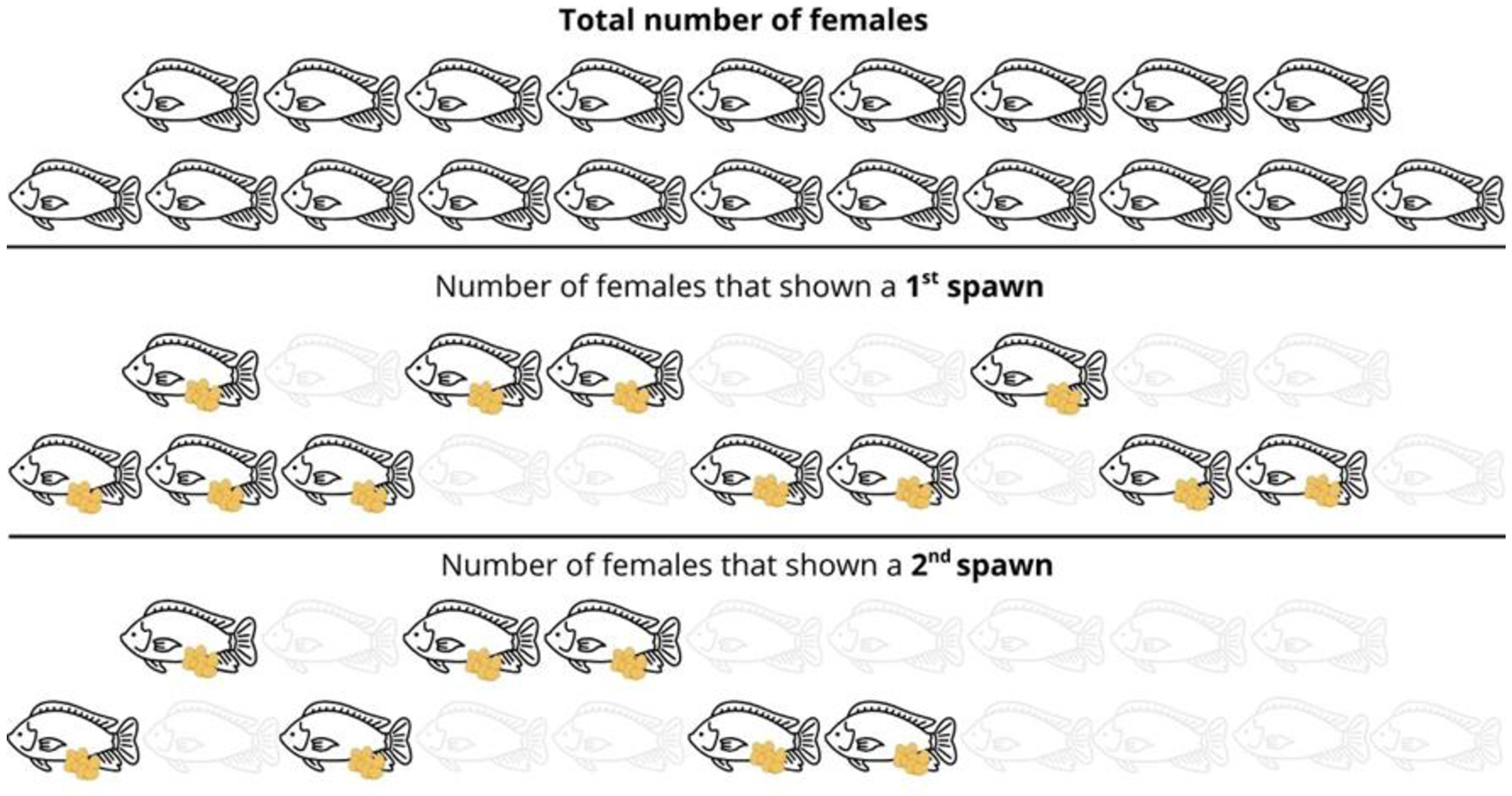
The spawning rate of Nile tilapia females kept in biofloc technology (BFT) was 55.0% (11 out of 20 females) for the first spawning. Among these, 63.6% (7 out of 11) spawned a second time during the five-week experimental period. This demonstrates that maintaining Nile tilapia females in BFT for five weeks allowed more than half of the females to reproduce (Figure 1).
Spawning performance of Nile tilapia (Oreochromis niloticus) females maintained in biofloc technology (BFT) over a five-week period.
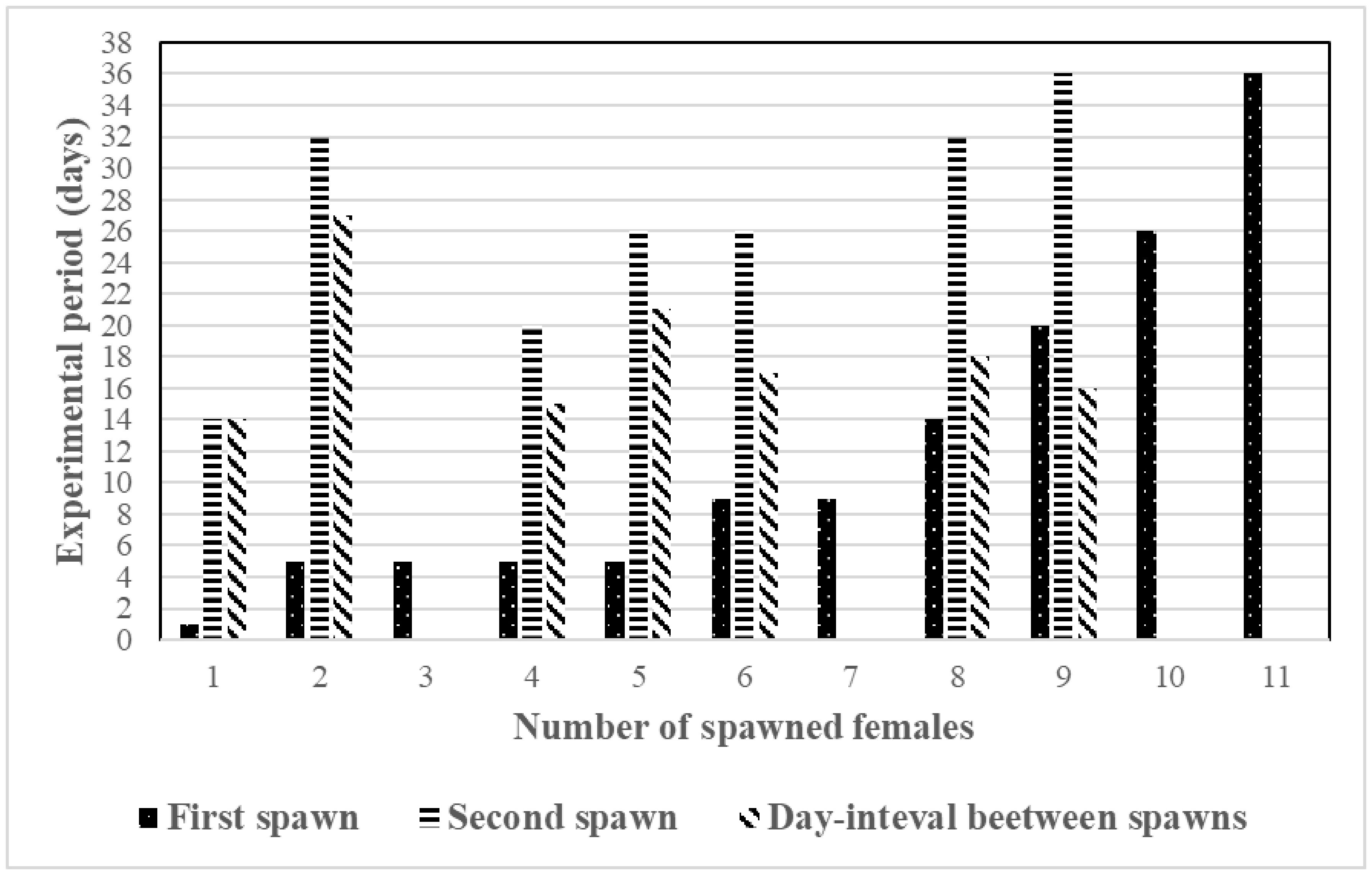
The females exhibited variability in the number of days until the first spawning from the start of the experiment, as well as in the interval between the first and second spawning (Figure 2). Of the 11 females that spawned initially, five spawned within the first five days, one spawned on day 9, three on days 20 and 26, and two after day 30. Regarding the second spawning, observed in seven females, the interval ranged from 14 to 36 days after the first spawning. However, the interval between successive spawnings was less variable, with most females spawning between 14 and 21 days after the first event (Figure 2).
Reproductive pattern of Nile tilapia (Oreochromis niloticus) females maintained in biofloc technology (BFT), showing the intervals from the start of the experiment to the first spawning and between the first and second spawnings.
Regarding the reproductive and productive variables, there were no statistically significant differences (P>0.05) between the first and second spawnings for final body weight, standard length, total length, Fulton’s condition factor, spawning rate, egg volume, number of eggs per milliliter, absolute fecundity, relative fecundity, production index, hatching rate, and largest egg diameter. However, the smallest egg diameter was significantly lower (P<0.05) in the second spawning (1.55±0.12 μm) compared to the first spawning (1.79±0.07 μm) (Table 1).
Medias for productive and reproductive parameters of Nile tilapia (Oreochromis niloticus) females maintained in biofloc technology (BFT) during the first and second spawnings.
4. Discussion
The results of this study indicate that biofloc technology (BFT) is effective in the reproduction of Nile tilapia. Research on aquatic organisms in BFT highlights the efficiency of this production system, particularly regarding water quality (Xu et al., 2016; Oliveira et al., 2022), probiotic effects and potential immune benefits (Monroy-Dosta et al., 2013), improvements in zootechnical performance (Brol et al., 2017), and, notably, reproductive performance in other species (Emerenciano et al., 2014; Spica et al., 2025). However, although some studies have addressed Nile tilapia reproduction in BFT (Alvarenga et al., 2017; Sallam et al., 2025), information on the reproductive aspects of females —particularly regarding successive spawnings— remains scarce. In the present work, most females spawned successfully in the BFT system, and the majority (63.6%) performed successive spawnings during the evaluated period, indicating that this technology did not compromise reproductive performance. These results demonstrate the effectiveness of BFT in promoting successive reproduction of Nile tilapia.
The spawning rate is a key indicator of reproductive efficiency, as it reflects the number of oocytes released by each female during the reproductive period. It is directly related to the potential for producing viable offspring, impacting both the sustainability of natural populations and the productivity of aquaculture systems. In the present study, th e spawning rate observed in BFT was similar to that reported by Alvarenga et al. (2017), who recorded a 62.5% rate in BFT, higher than that observed in systems with partial water exchange. This indicates that successive spawning management in this system did not compromise female reproductive performance. These results demonstrate the efficiency of BFT in enhancing the utilization of female Nile tilapia spawners through successive spawning, and suggest that BFT can yield reproductive performance equal to or better than traditional systems, making it a viable alternative for Nile tilapia reproduction.
Higher spawning rates have been reported by Almeida et al. (2013) using a traditional breeding system (hapas installed in earthen ponds), with 100% spawning over 12 weeks (GIFT variety) and rates ranging from 76.1% to 92.0% (Supreme, Premium Aquabel, and Chitralada varieties) over seven weeks. The lower spawning rate in the present study may be attributed to the shorter evaluation period (five weeks compared to 12 weeks) and to the age and/or body weight of the females used, as the fish were still in the early stages of sexual maturity. This can negatively influence the frequency and regularity of spawning, particularly in genetically improved strains, which tend to reach reproductive maturity later (Yoshida et al., 2015).
The interval between the first and second spawnings ranged from 14 to 27 days, which is consistent with environmental and genetic factors such as temperature, nutrition, body condition, and genetic lineage that influence the reproductive cycle (El-Sayed, 2020). Almeida et al. (2013) reported spawning intervals between 14 and 28 days, similar to those found in the present study. Additionally, the reproductive condition of the females prior to the experiment may have influenced their capacity for successive spawnings in BFT. It is important to note that this study was conducted entirely within a BFT system, which remains underutilized in commercial tilapia reproduction and research.
The lower hatching rate observed in the second spawning may be related to the short interval between reproductive events, which could limit the time required for the complete recovery of maternal reserves allocated to vitellogenesis and embryonic development, even with the additional nutritional input provided by bioflocs (Emerenciano et al., 2017; London and Volkoff, 2019). Nevertheless, despite the reduction observed in hatching rate, the results for the characteristics total egg volume, number of eggs, and absolute fecundity during the second spawning indicates that females that spawned again exhibited good physiological condition and greater oocyte recruitment, resulting in a higher individual reproductive contribution (El-Sayed, 2020). Therefore, even with short reproductive intervals, the BFT system proved capable of sustaining the continuity of females reproductive performance.
The variability in the number of days until the first spawning and the intervals between spawnings may be related to the time elapsed since each female’s previous spawning before the experiment. Although reproductive induction protocols are not commonly used in Nile tilapia, they could be applied in future research to synchronize female reproductive cycles and minimize variability caused by prior spawning history, as recommended by Fernandes et al. (2013). In this context, Alvarenga et al. (2017) applied a hormonal induction protocol using human chorionic gonadotropin (HCG) to synchronize Nile tilapia spawning, given the species’ asynchronous gonadal development.
In the present study, the absolute fecundity was lower than that reported by Sallam et al. (2025), who observed fecundity ranging from 1,330 to 1,900 eggs per female in BFT with varying salinity levels. Ekasari et al. (2013) also reported higher fecundity, ranging from 828 to 1,243 eggs per female in BFT. This discrepancy may be explained by differences in female body weight (855g in Ekasari et al. (2013) and 182g in Sallam et al. (2025), and 291 ± 67.40g and 297 ± 69.69g in the first and second spawnings, respectively, in the present study). Other factors such as environmental conditions, stocking density, and sex ratio could also contribute to the observed differences. Nevertheless, the absolute fecundity values obtained in this study (322 in the first spawning and 492 in the second) are within the expected range for the species under controlled conditions.
Dilmi et al. (2024) evaluated the reproductive performance of Nile tilapia in BFT after two months and reported higher egg volume (7.95 mm3) and relative fecundity (2.63) than those observed in the present study (egg volume: 4.56 mm3 in the first spawning and 5.96 mm3 in the second; relative fecundity: 1.18 in the first spawning and 1.68 in the second). These differences may be associated with the length of exposure to bioflocs, suggesting that longer experimental periods may improve reproductive performance in BFT.
Egg diameter is an important indicator of reproductive quality, as the nutritional status of broodstock directly affects egg quality, embryonic development, and larval growth (London and Volkoff, 2019). Dilmi et al. (2024) reported an average maximum egg diameter of 2.53±0.24 mm in BFT, while Silva et al. (2020) recorded diameters ranging from 2.4 to 2.8 mm in Nile tilapia females from different genetic lines housed in hapas in earthen ponds. The egg diameters recorded in the present study are similar to those previously reported, supporting the suitability of BFT for producing high-quality eggs.
The reduction in minimum egg diameter observed in the second spawning may be related to the depletion of maternal nutritional reserves. Despite the additional nutrient supply provided by bioflocs, it may not have been sufficient to fully restore reserves before the next spawning, possibly due to the relatively short interval between spawnings. BFT can serve as an additional source of nutrients (Stringhetta et al., 2024; Emerenciano et al., 2017), potentially supporting sexual maturation and spawning rates, and positively impacting reproductive development. However, this study did not include comparisons with other production systems, making it impossible to directly attribute the observed reproductive performance to the nutritional contribution of bioflocs. Nonetheless, other studies in different production phases have reported such benefits in BFT, both in qualitative terms (e.g., replacing fishmeal with brewer’s yeast; Nhi et al., 2018) and quantitative terms (e.g., a 50% reduction in feeding rates; García-Ríos et al., 2019).
Bioflocs generated in BFT can serve as a continuously available natural food source rich in nutrients that support fish reproduction. Furthermore, there is a well-established positive relationship between diets with higher protein content and increased protein concentrations in Nile tilapia eggs (El-Sayed and Kawanna, 2008). Thus, BFT appears to be a promising system for Nile tilapia reproduction, particularly considering its contribution to nutritional balance and water quality stability, as demonstrated by the water parameters maintained over five weeks without water exchange. Future studies comparing BFT with other systems, as well as analyses of gene expression related to reproduction, could further confirm the suitability of BFT for Nile tilapia breeding.
5. Conclusion
Nile tilapia exhibited a high spawning rate and satisfactory reproductive performance in biofloc technology (BFT) over a five-week period, indicating that this system supports reproductive success of females in successive spawnings.
Acknowledgments
This study was financed in part by Coordenação de Aperfeiçoamento de Pessoal de Nível Superior - Brasil (CAPES) - Finance Code 001; and Fundação de Apoio ao Desenvolvimento do Ensino, Ciência e Tecnologia do Estado de Mato Grosso do Sul – FUNDECT (TO 280/2022). Thanks, are extended to Conselho Nacional de Desenvolvimento Científico e Tecnológico (CNPq) for the fellowship grants awarded (150256/2023-0; 312671/2021–0; and 312072/2021-0); and to the Univesidade Federal de Mato Grosso do Sul (UFMS).
Data Availability Statement
All datasets supporting the findings of this study are included in the article itself.
References
-
ALMEIDA, D.B., COSTA, M.A.P., BASSINI, L.N., CALABUIG, C.I.P., MOREIRA, C.G.A., RODRIGUES, M.D.N., PÉREZ, H.J., TAVARES, R.A., VARELA JUNIOR, A.S. and MOREIRA, H.L.M., 2013. Reproductive performance in female strains of Nile tilapia, Oreochromis niloticus. Aquaculture International, vol. 21, no. 6, pp. 1291-1300. https://doi.org/10.1007/s10499-013-9630-0
» https://doi.org/10.1007/s10499-013-9630-0 -
ALVARENGA, É.R., SALES, S.C.M., BRITO, T.S., SANTOS, C.R., CORRÊA, R.D.S., ALVES, G.F.O., MANDUCA, L.G. and TURRA, E.M., 2017. Effects of biofloc technology on reproduction and ovarian recrudescence in Nile tilapia. Aquaculture Research, vol. 48, no. 12, pp. 5965-5972. https://doi.org/10.1111/are.13420
» https://doi.org/10.1111/are.13420 -
AVNIMELECH, Y., 2007. Feeding with microbial flocs by tilapia in minimal discharge bio flocs technology ponds. Aquaculture, vol. 264, no. 1-4, pp. 140-147. https://doi.org/10.1016/j.aquaculture.2006.11.025
» https://doi.org/10.1016/j.aquaculture.2006.11.025 - AVNIMELECH, Y., 2009. Biofloc technology: a practical guide book 3rd ed. Baton Rouge: The World Aquaculture Society. 278 p.
- BECERRIL-CORTÉS, D., MONROY-DOSTA, M.C., COELHO-EMERENCIANO, M.G., CASTRO-MEJÍA, G., CIENFUEGOS-MARTÍNEZ, K. and LARA-ANDRADE, R., 2017. Nutritional importance for aquaculture and ecological function of microorganisms that make up biofloc: a review. International Journal of Aquatic Science, vol. 8, no. 2, pp. 69-77.
- BROL, J., PINHO, S.M., SGNAULIN, T., PEREIRA, K.R., THOMAS, M.C., MELLO, G.L., MIRANDA‑BAEZA, A. and EMERENCIANO, M.G., 2017. Tecnologia de bioflocos (BFT) no desempenho zootécnico de tilápias: efeito da linhagem e densidades de estocagem. Archivos de Zootecnia, vol. 66, no. 254, pp. 229-235.
-
CRAB, R., DEFOIRDT, T., BOSSIER, P. and VERSTRAETE, W., 2012. Biofloc technology in aquaculture: beneficial effects and future challenges. Aquaculture, vol. 356, pp. 351-356. https://doi.org/10.1016/j.aquaculture.2012.04.046
» https://doi.org/10.1016/j.aquaculture.2012.04.046 -
DILMI, A., MOGAF, H., LOURGUIOUI, H. and REFES, W., 2024. Biofloc technology application in Nile tilapia (Oreochromis niloticus, L.) hatcheries: effect on the reproductive performance, offspring quality, growth performance, and physiological parameters of fry. Journal of Applied Aquaculture, vol. 36, no. 2, pp. 478-497. https://doi.org/10.1080/10454438.2023.2276408
» https://doi.org/10.1080/10454438.2023.2276408 -
EBELING, J.M., TIMMONS, M.B. and BISOGNI, J.J., 2006. Engineering analysis of the stoichiometry of photoautotrophic, autotrophic, and heterotrophic removal of ammonia-nitrogen in aquaculture systems. Aquaculture, vol. 257, no. 1-4, pp. 346-358. https://doi.org/10.1016/j.aquaculture.2006.03.019
» https://doi.org/10.1016/j.aquaculture.2006.03.019 -
EKASARI, J., PUTRI, D.U., SARI, N.P., SURAWIDJAJA, E.H., ZAIRIN JUNIOR, M. and BOSSIER, P., 2013. Biofloc-based reproductive performance of Nile tilapia Oreochromis niloticus L. broodstock. Aquaculture Research, vol. 46, no. 2, pp. 509-512. https://doi.org/10.1111/are.12185
» https://doi.org/10.1111/are.12185 -
EKASARI, J., RIVANDI, D.R., FIRDAUSI, A.P., SURAWIDJAJA, E.H., ZAIRIN JUNIOR, M., BOSSIER, P. and DE SCHRYVER, P., 2015. Biofloc technology positively affects larval performance of Nile tilapia (Oreochromis niloticus). Aquaculture, vol. 448, pp. 117-123. https://doi.org/10.1016/j.aquaculture.2015.02.019
» https://doi.org/10.1016/j.aquaculture.2015.02.019 -
EL-SAYED, A.F.M. and KAWANNA, M.A., 2008. Effect of dietary protein and energy levels on the reproductive performance of Nile tilapia (Oreochromis niloticus). Aquaculture, vol. 274, pp. 288-300. https://doi.org/10.1016/j.aquaculture.2008.04.030
» https://doi.org/10.1016/j.aquaculture.2008.04.030 - EL-SAYED, A.F.M., 2020. Tilapia culture 2nd ed. London: Academic Press.
-
EMERENCIANO, M.G., CUZON, G., ARÉVALO, M. and GAXIOLA, G., 2014. Biofloc technology in intensive broodstock farming of the pink shrimp Farfantepenaeus duorarum: spawning performance, biochemical composition and fatty acid profile of eggs. Aquaculture Research, vol. 45, no. 10, pp. 1713-1726. https://doi.org/10.1111/are.12117
» https://doi.org/10.1111/are.12117 -
EMERENCIANO, M.G., MARTÍNEZ‑CÓRDOVA, L.R., MARTÍNEZ‑PORCHAS, M. and MIRANDA‑BAEZA, A., 2017. Biofloc technology (BFT): a tool for water quality management in aquaculture. In: H. TUTU, ed. Water quality London: InTech, pp. 91-109. https://doi.org/10.5772/66416
» https://doi.org/10.5772/66416 -
FERNANDES, A.F.A., ALVARENGA, É.R., OLIVEIRA, D.A.A., ALEIXO, C.G., PRADO, S.A., LUZ, R.K., SARMENTO, N.L.A.F., TEIXEIRA, E.A., LUZ, M.R. and TURRA, E.M., 2013. Production of oocytes of Nile tilapia (Oreochromis niloticus) for in vitro fertilization via hormonal treatments. Reproduction in Domestic Animals = Zuchthygiene, vol. 48, no. 6, pp. 1049-1055. https://doi.org/10.1111/rda.12212 PMid:23834584.
» https://doi.org/10.1111/rda.12212 - FOOD AND AGRICULTURE ORGANIZATION – FAO, 2024. World Fisheries and Aquaculture Rome: FAO.
-
GARCÍA-RÍOS, L., MIRANDA-BAEZA, A., COELHO-EMERENCIANO, M.G., HUERTA-RÁBAGO, J.A. and OSUNA-AMARILLAS, P., 2019. Biofloc technology (BFT) applied to tilapia fingerlings production using different carbon sources: emphasis on commercial applications. Aquaculture, vol. 502, pp. 26-31. https://doi.org/10.1016/j.aquaculture.2018.11.057
» https://doi.org/10.1016/j.aquaculture.2018.11.057 -
LONDON, S. and VOLKOFF, H., 2019. Cloning and effects of fasting on the brain expression levels of appetite-regulators and reproductive hormones in glass catfish (Kryptopterus vitreolus). Comparative Biochemistry and Physiology. Part A, Molecular & Integrative Physiology, vol. 228, pp. 94-102. https://doi.org/10.1016/j.cbpa.2018.11.009 PMid:30453036.
» https://doi.org/10.1016/j.cbpa.2018.11.009 -
MONROY-DOSTA, M.C., DE LARA-ANDRADE, R., CASTRO-MEJÍA, J., CASTRO-MEJÍA, G. and COELHO-EMERENCIANO, M.C., 2013. Composición y abundancia de comunidades microbianas asociadas al biofloc en un cultivo de tilapia. Revista de Biología Marina y Oceanografía, vol. 48, no. 3, pp. 511-520. https://doi.org/10.4067/S0718-19572013000300009
» https://doi.org/10.4067/S0718-19572013000300009 -
NHI, N.H.Y., DA, C.T., LUNDH, T., LAN, T.T. and KIESSLING, A., 2018. Comparative evaluation of brewer’s yeast as a replacement for fishmeal in diets for tilapia (Oreochromis niloticus), reared in clear water or biofloc environments. Aquaculture, vol. 495, pp. 654-660. https://doi.org/10.1016/j.aquaculture.2018.06.035
» https://doi.org/10.1016/j.aquaculture.2018.06.035 -
OLIVEIRA, C.R.R., OLIVEIRA, V.Q., PIMENTEL, O.A.L.F., SANTOS, E.P., OLIVEIRA FILHO, P.R.C., GÁLVEZ, A.O. and BRITO, L.O., 2022. Growth performance and proximate composition of Penaeus vannamei reared in low-salinity water with different ionic compositions in a synbiotic system. Aquaculture International, vol. 30, no. 6, pp. 3123-3141. https://doi.org/10.1007/s10499-022-00952-1
» https://doi.org/10.1007/s10499-022-00952-1 - PEIXEBR, 2024. Anuário 2024 da Associação Brasileira da Piscicultura São Paulo: Peixe BR.
-
RAY, A.J., LEWIS, B.L., BROWDY, C.L. and LEFFLER, J.W., 2010. Suspended solids removal to improve shrimp (Litopenaeus vannamei) production and an evaluation of a plant-based feed in minimal-exchange, super-intensive culture systems. Aquaculture, vol. 299, no. 1-4, pp. 89-98. https://doi.org/10.1016/j.aquaculture.2009.11.021
» https://doi.org/10.1016/j.aquaculture.2009.11.021 -
SALLAM, G.R., EL BASUINI, M.F., FAHMY, A.F., AL‑ABSAWEY, M.A., HABIB, Y.J., MUSTAFA, R.A., FAYED, W.M., EL‑SAYED, A.F.M. and SHEHATA, A.I., 2025. Salinity-dependent effects of integrated biofloc technology on reproductive performance, biological responses, and offspring quality in red tilapia aquaculture. Aquaculture International, vol. 33, no. 2, pp. 135-175. https://doi.org/10.1007/s10499-024-01804-w
» https://doi.org/10.1007/s10499-024-01804-w -
SILVA, A.C.F., CORRÊA FILHO, R.A.C., VENTURA, A.S., NUNES, A.L., LAICE, L.M., RIBEIRO, R.P., OLIVEIRA, C.A.L., ALMEIDA, L.C., BARBOSA, P.T.L. and POVH, J.A., 2020. Reproductive traits in different Nile tilapia genetic groups. Arquivo Brasileiro de Medicina Veterinária e Zootecnia, vol. 72, pp. 1797-1804. https://doi.org/10.1590/1678-4162-11764
» https://doi.org/10.1590/1678-4162-11764 -
SPICA, L.N., CORRÊA FILHO, R.A.C., EMERENCIANO, M.G., SILVA, D.H.S., BRASILEIRO, L.O., SOUSA, R.M., STRINGHETTA, G.R., GOMES, J.B.S., COSTA, A.A., ROQUE, L.S., PEDROSA, S.F. and POVH, J.A., 2025. Successive seminal collections from Piaractus mesopotamicus in biofloc technology during the reproductive period. Animal Reproduction Science, vol. 276, pp. 107821. https://doi.org/10.1016/j.anireprosci.2025.107821 PMid:40121814.
» https://doi.org/10.1016/j.anireprosci.2025.107821 -
STRINGHETTA, G.R., POVH, J.A., TEIXEIRA, S.A., BRASILEIRO, L.O., SPICA, L.N., SOUSA, R.M., SOARES, E.S.M., EMERENCIANO, M.G.C. and CORRÊA-FILHO, R.A.C., 2024. Growth and survival of Betta splendens fed microbial aggregates from ex-situ biofloc technology (BFT). Brazilian Journal of Biology = Revista Brasileira de Biologia, vol. 84, pp. e278851. https://doi.org/10.1590/1519-6984.278851 PMid:38865566.
» https://doi.org/10.1590/1519-6984.278851 -
VALENTIN, F.N., NASCIMENTO, N.F., SILVA, R.C., TSUJI, E.A., PAES, M.C.F., KOBERSTEIN, T.C.R.D. and NAKAGHI, L.S.O., 2015. Maternal age influences on reproductive rates in Nile tilapia (Oreochromis niloticus). Revista Brasileira de Zootecnia, vol. 44, no. 4, pp. 161-163. https://doi.org/10.1590/S1806-92902015000400005
» https://doi.org/10.1590/S1806-92902015000400005 -
XU, W.J., MORRIS, T.C. and SAMOCHA, T.M., 2016. Effects of C/N ratio on biofloc development, water quality, and performance of Litopenaeus vannamei juveniles in a biofloc-based, high-density, zero-exchange, outdoor tank system. Aquaculture, vol. 453, pp. 169-175. https://doi.org/10.1016/j.aquaculture.2015.11.021
» https://doi.org/10.1016/j.aquaculture.2015.11.021 -
YOSHIDA, G.M., OLIVEIRA, C.A.L., KUNITA, N.M., RIZZATO, G.S. and RIBEIRO, R.P., 2015. Reproduction performance of female Nile tilapia under different environments and age classes. Acta Scientiarum. Animal Sciences, vol. 37, no. 3, pp. 221-226. https://doi.org/10.4025/actascianimsci.v37i3.25907
» https://doi.org/10.4025/actascianimsci.v37i3.25907
Edited by
-
Editor: Takako Matsumura Tundisi