 Purple-skinned sweet potato as a substrate to produce hydrolytic enzymes by Pleurotus eryngii DPUA 1816
Abstract
Fungi, particularly the edible mushrooms, are recognized as efficient producers of hydrolytic enzymes playing an essential role in various industrial processes, including food, beverage, leather, textile, and pharmaceutical industries. Despite its promising biotechnological potential, the enzymatic capacity of Pleurotus eryngii remains largely unexplored. Thus, this study investigated the production of hydrolytic enzymes by P. eryngii DPUA 1816 using purple-skinned sweet potato as a substrate under submerged fermentation. The fungus was grown in different culture media containing purple-skinned sweet potato under constant stirring at 150 rpm at 25 °C for 15 days. The enzymatic activities in the fermented broths were determined using specific substrates: p-nitrophenyl palmitate (lipases), starch 1% (amylases), carboxymethylcellulose 1% (cellulases), xylan 1% (xylanases), polygalacturonic acid 1% (pectinases) and azocasein 1% (proteases). The results showed the presence of hydrolytic enzymes, with highest proteolytic activity (60.84 U mL−1), followed by pectinolytic activity (8.78 U mL−1). Moderate activities were obtained for amylases, cellulases and lipases, with maximum means of 0.94 U mL−1, 0.86 U mL−1 and 1.38 U mL−1, respectively, and lower activity for xylanolytic enzymes (0.03 U mL−1). The findings suggest that cultivation of P. eryngii on purple-skinned sweet potato represents a promising and sustainable strategy to produce hydrolytic enzymes with potential biotechnological applications.
Keywords:
edible mushroom; Ipomoea batatas; hydrolases; submerged fermentation
Resumo
Os fungos, especialmente os cogumelos comestíveis, são reconhecidos como produtores eficientes de enzimas hidrolíticas, desempenhando um papel essencial em diversos processos industriais, incluindo as indústrias de alimentos e bebidas, couro, têxtil e farmacêutica. Apesar de seu promissor potencial biotecnológico, a capacidade enzimática de Pleurotus eryngii permanece amplamente inexplorada. Assim, este estudo investigou a produção de enzimas hidrolíticas por P. eryngii DPUA 1816 utilizando batata-doce de casca roxa como substrato em fermentação submersa. O fungo foi cultivado em diferentes meios de cultura contendo batata-doce de casca roxa, sob agitação constante de 150 rpm, a 25 °C, durante 15 dias. As atividades enzimáticas nos caldos fermentados foram determinadas utilizando substratos específicos: p-nitrofenil palmitato (lipases), amido a 1% (amilases), carboximetilcelulose a 1% (celulases), xilano a 1% (xilanases), ácido poligalacturônico a 1% (pectinases) e azocaseína a 1% (proteases). Os resultados demonstraram a produção de enzimas hidrolíticas, com maior atividade proteolítica (60,84 U mL−1), seguida pela atividade pectinolítica (8,78 U mL−1). Atividades moderadas foram obtidas para amilases, celulases e lipases, com médias máximas de 0,94 U mL−1, 0,86 U mL−1 e 1,38 U mL−1, respectivamente, enquanto a atividade das xilanases foi menor (0,03 U mL−1). Os achados sugerem que o cultivo de P. eryngii em batata-doce de casca roxa representa uma estratégia promissora e sustentável para a produção de enzimas hidrolíticas com potencial aplicação biotecnológica.
Palavras-chave:
cogumelos comestíveis; Ipomoea batatas; hidrolases; fermentação submersa
1. Introduction
Hydrolases represent one of the most important groups of enzymes in the global industrial enzyme market. These enzymes catalyze the hydrolysis of complex polymers into smaller molecules or monomers and include proteases, amylases, cellulases, pectinases, xylanases, and lipases, which are widely applied in diverse industrial processes (Farhan et al., 2025; Singh and Panesar, 2023).
Proteases are widely used in stain removal, leather processing and food industry (Naveed et al., 2021), while lipases are used in the production of biodiesel and biosurfactants (Chandra et al., 2020). Amylases have applications, notably in the pulp and paper industry (Ali et al., 2025), while xylanases are important for processes like pulp bleaching, as well as the pharmaceutical, textile and bio-refinery industries (Phuyal et al., 2023). Cellulases are employed in the extraction of flavoring materials, in the production of juices and wines, alongside applications in fiber processing, discoloration and modification and bioethanol production (Ejaz et al., 2021). Pectinases are essential for the maceration, liquefaction, clarification and filtration of beverages (Souza and Kawaguti, 2021).
These enzymes can be produced by a wide variety of biological sources, including plants, animals, and microorganisms, as well as through recombinant biotechnological processes (Razzaq et al., 2019). Among microorganisms, fungi are particularly notable due to their high capacity for extracellular enzyme production. Edible mushrooms, which belong predominantly to the macrofungi, represent a valuable resource for industrial enzyme production (Barua et al., 2024; Barbosa et al., 2025; Pimenta et al., 2025). Their industrial relevance is attributed to several advantages, such as low production costs and low production costs, ease of cultivation under submerged fermentation, and efficient recovery of extracellular enzymes. Moreover, enzyme production under controlled fermentation conditions is independent of seasonal and geographical constraints. (Liu and Kokare, 2017; Barua et al., 2024).
The genus Pleurotus is among the most extensively studied edible mushrooms due to its remarkable capacity to produce extracellular hydrolytic enzymes. Nevertheless, the enzymatic potential of P. eryngii remains underexplored. Since enzyme production is strongly influenced by substrate composition, the use of abundant plant-based agricultural substrates represents a sustainable and cost-effective strategy (Melanouri et al., 2022). Among these substrates, purple-skinned sweet potato (Ipomoea batatas) is particularly attractive because of its high carbohydrate content, structural polysaccharides, natural availability, and agricultural productivity. In the Amazon region, this crop reaches average yields of approximately 25 t ha−1 during a 150-day cultivation cycle and can be grown throughout the year (EMBRAPA, 2021).
Although various agricultural substrates and agro-industrial by-products have been investigated for hydrolytic enzyme production, information regarding the use of purple-skinned sweet potato for cultivating P. eryngii remains scarce. Owing to its high starch content, structural polysaccharides, natural availability, and bioactive composition, this substrate may simultaneously serve as a nutrient source and a natural inducer of enzyme production, supporting the simultaneous production of multiple hydrolytic enzymes in a single fermentation process (Bodjrenou et al., 2023; Ali et al., 2025).
Therefore, this study evaluated the potential of Pleurotus eryngii DPUA 1816 to simultaneously produce multiple hydrolytic enzymes by submerged fermentation using a previously unexplored natural substrate, purple-skinned sweet potato.
2. Materials and Methods
2.1. Submerged fermentation of Pleurotus eryngii DPUA 1816
Pleurotus eryngii DPUA 1816 was obtained from the DPUA Culture Collection at Universidade Federal do Amazonas. Mycelial fragments were inoculated in potato dextrose agar (PDA) supplemented with 0.5% yeast extract (YE) and incubated in the dark at 25 °C for 10 days. Different concentrations of glucose and yeast extract were evaluated to investigate the influence of carbon and nitrogen supplementation on hydrolytic enzyme production. Three 10-mm-diameter mycelial discs were transferred to Erlenmeyer flasks containing 100 mL of culture medium (Table 1), adjusted to pH 6.0 and prepared from an infusion of 200 g L−1 of freshly cut purple-skinned sweet potato (Ipomoea batatas), supplemented with glucose and yeast extract. The cultures were incubated in an orbital shaker (150 rpm) for 15 days at 25 °C. Fermented broths were recovered by vacuum filtration and stored at 4 °C until enzymatic analyses.
Composition of the culture media used for submerged cultivation of Pleurotus eryngii for 15 days at 25 °C and 150 rpm.
A second submerged fermentation was carried out over 18 days using the culture medium selected from treatment E4 (Table 1). The incubation conditions were identical to those described for the initial cultivation. For the time-course analysis, three independent Erlenmeyer flasks were randomly selected every two days for sampling throughout the cultivation period. Fermented broth samples were recovered and stored using the same procedure described for the initial experiment.
2.2. Lipolytic activity
Lipolytic activity was determined according to the method of Winkler and Stuckmann (1979). The reaction mixture consisted of 900 μL of substrate solution containing p-nitrophenyl palmitate and 100 μL of enzyme extract. The substrate solution was prepared by dissolving 30 mg of p-nitrophenyl palmitate in 10 mL of isopropanol and emulsifying it with 0.5 g of gum arabic and 2 g of Triton X-100 in 0.05 M Tris-HCl buffer (pH 8.0) at a 1:9 ratio. The reaction mixture was incubated at 37 °C for 15 min, and absorbance was measured at 410 nm. One unit of lipase activity was defined as the amount of enzyme required to release 1 μmol of p-nitrophenol per minute.
2.3. Amylolytic activity
Amylolytic activity was determined by mixing 50 μL of enzyme extract with 50 μL of 1% starch solution prepared in 1 M sodium acetate buffer (pH 6.0). The reaction mixture was incubated at 50 °C for 30 min and stopped by adding 100 μL of DNS reagent (3,5-dinitrosalicylic acid). The mixture was then heated at 100 °C for 5 min, diluted with 800 μL of distilled water, and the absorbance was measured at 540 nm using a glucose standard curve. One unit of amylase activity was defined as the amount of enzyme required to release 1 μmol of reducing sugars per minute (Miller, 1959).
2.4. Cellulolytic activity
Cellulolytic activity was determined by mixing 50 μL of enzyme extract with 50 μL of a 1% carboxymethylcellulose (CMC) solution prepared in 50 mM acetate-phosphate buffer (pH 5.5). The reaction mixture was incubated at 50 °C for 30 min and stopped by adding 100 μL of DNS reagent. The mixture was then heated at 100 °C for 5 min, diluted with 800 μL of distilled water, and absorbance was measured at 540 nm using a glucose standard curve (Miller, 1959). One unit of cellulase activity was defined as the amount of enzyme required to release 1 μmol of reducing sugars per minute.
2.5. Proteolytic activity
Proteolytic activity was determined according to Leighton et al. (1973). The reaction mixture consisted of 150 μL of enzyme extract and 250 μL of 1% azocasein solution prepared in 0.2 M Tris-HCl buffer (pH 7.2). The mixture was incubated at 25 °C in the dark for 60 min. The reaction was stopped by adding 1.2 mL of 10% (w/v) trichloroacetic acid, followed by centrifugation at 10,000 rpm for 10 min. An 800-μL aliquot of the supernatant was mixed with 1.4 mL of 1 M sodium hydroxide, and absorbance was measured at 440 nm. One unit of protease activity was defined as the amount of enzyme producing an increase of 0.01 absorbance units after 1 h.
2.6. Xylanolytic activity
Xylanolytic activity was measured by incubating 50 μL of enzyme extract with 75 μL of 1% xylan prepared in 50 mM sodium acetate buffer (pH 6.5) at 50 °C for 10 min. The reaction was stopped by adding 125 μL of DNS reagent, followed by heating at 100 °C for 5 min. After dilution with 1.0 mL of distilled water, absorbance was measured at 540 nm. Reducing sugars were quantified using a xylose standard curve according to Miller (1959). One unit of xylanase activity was defined as the amount of enzyme required to release 1 μmol of xylose per minute per mL.
2.7. Evaluation of pectinolytic activity
Pectinolytic activity was measured by mixing 125 μL of the substrate (1% polygalacturonic acid prepared in 0.052 M sodium acetate buffer pH 4.4) with 125 μL of the enzyme extract. The reaction was incubated for 40 minutes at 37 °C, followed by the addition of 250 μL of DNS reagent. The reaction mixture was heated at 100 °C for 15 min, diluted with 500 μL of distilled water, and absorbance was measured at 540 nm using a standard curve prepared with polygalacturonic acid (1 g L−1). One unit of pectinase activity was determined as the amount of polygalacturonic acid released per milliliter per minute (μmol mL−1 min−1).
2.8. Statistical analysis
All experiments were performed in triplicate. The enzymatic activity data were subjected to one-way analysis of variance (one-way ANOVA). Differences among means were evaluated using Tukey's multiple comparison test at a significance level of p < 0.05. All statistical analyses were performed using Minitab® 17 software.
3. Results and Discussion
Figure 1 shows the production of hydrolytic enzymes by P. eryngii DPUA 1816 cultivated in different culture media containing purple-skinned sweet potato. Lipolytic activity was detected in all culture media tested (Figure 1A). Medium E1 yielded the highest activity (1.38 U mL−1), followed by E2 (0.97 U mL−1) and E3 (0.96 U mL−1). However, no statistically significant difference was observed between E2 and E3.

Lipolytic (A), proteolytic (B), polygalacturonase (C), amylolytic (D), and endoglucanase (E) activities of P. eryngii cultivated in different culture media for 15 days at 25 °C and 150 rpm. Means followed by the same letter do not differ significantly according to Tukey's test (p < 0.05).
Although direct comparisons should be interpreted with caution because of methodological differences, the lipolytic activities obtained in this study were comparable to or higher than those reported for Pleurotus spp. For example, Almeida (2016) reported a lipolytic activity of 0.0011 U mL−1 for P. ostreatus, whereas Zorn et al. (2003) reported 0.312 U mL−1 for P. sapidus. Although a different methodology was used by Zorn et al. (2003), the higher activity observed in the present study supports the potential of P. eryngii DPUA 1816 cultivated on purple-skinned sweet potato for lipase production.
In addition, lipolytic activity was consistently higher in culture media supplemented with yeast extract (YE) (E1–E4) than in media lacking this nitrogen source. This difference may be attributed to the rich nutritional composition of YE, which provides nitrogen-containing compounds, vitamins, and growth factors that promote fungal metabolism and extracellular enzyme biosynthesis. In contrast, media without YE contained only glucose and purple-skinned sweet potato, suggesting that their more limited nutrient composition may have reduced lipase production. These findings indicate that the nutritional composition of the culture medium plays an important role in regulating lipase production by P. eryngii.
Proteolytic activity was also detected in media lacking yeast extract (E0, E7, and E8), suggesting that purple-skinned sweet potato itself supplied nutrients capable of sustaining fungal metabolism. In addition to its high carbohydrate content, this substrate contains proteins, amino acids, minerals, and other bioactive compounds that may partially satisfy the nutritional requirements of P. eryngii. Therefore, the absence of yeast extract does not represent a complete nutritional limitation, which may explain the considerable proteolytic activity observed under these conditions. Furthermore, moderate nutrient limitation may stimulate the secretion of extracellular hydrolytic enzymes as an adaptive strategy for nutrient acquisition, thereby explaining the maintenance of protease production even in the absence of yeast extract (Sinsabaugh, 1994; Baldrian, 2008).
In addition to its nutritional contribution, purple-skinned sweet potato represents a complex plant-derived substrate rich in starch and structural polysaccharides, containing starch, pectin, cellulose, hemicellulose, soluble sugars, and minor amounts of proteins and phenolic compounds (Alam, 2021). This heterogeneous composition likely provided multiple natural signals and substrates capable of promoting the simultaneous production of different hydrolytic enzymes (Liguori et al., 2015; Melanouri et al., 2022; Østby et al., 2020; Baig, 2020). Unlike defined synthetic media, the substrate offers diverse carbon sources that can sustain fungal metabolism and enzyme production according to the physiological requirements of the fungus. Such metabolic versatility has been reported as one of the main adaptive characteristics of Pleurotus species growing on plant-derived substrates (Mata et al., 2016; Zhang et al., 2020; Melanouri et al., 2022).
A similar pattern was observed for proteolytic activity across all culture media tested (Figure 1B). The highest proteolytic activity was recorded in medium E1 (57.11 U mL−1), followed by media E2 (51.56 U mL−1) and E4 (49.56 U mL−1), which did not differ significantly from each other. The proteolytic activities obtained in this study were comparable to or higher than those reported in previous studies. Machado et al. (2017) cultivated P. ostreatoroseus on tropical tubers and reported comparable proteolytic activities in Dioscorea trifida (51.04 U mL−1) and Manihot esculenta (31.26 U mL−1), whereas cultivation on Dioscorea alata resulted in a substantially higher activity (142 U mL−1). Furthermore, the maximum proteolytic activity obtained in the present study (57.11 U mL−1) exceeded the 50.03 U mL−1 reported for Tricholoma saponaceum PKSR8 (Khaund and Joshi, 2014).
The slight reduction in proteolytic activity observed under the highest glucose concentration (40 g L−1; E4) compared with E1 may be associated with carbon catabolite repression (CCR), a regulatory mechanism commonly observed in filamentous fungi. Under conditions of excess readily metabolizable carbon, fungal cells preferentially utilize glucose as an energy source, potentially reducing the expression of genes involved in the production of extracellular hydrolytic enzymes, including proteases. Consequently, the physiological demand for degrading complex protein substrates decreases, leading to lower extracellular protease production. Nevertheless, the proteolytic activity detected in E4 remained considerable, suggesting that the nutritional complexity of purple-skinned sweet potato may have partially mitigated this regulatory effect (Ruijter and Visser, 1997; Liu and Kokare, 2017; Alfaro et al., 2020; Assis et al., 2021; Noël et al., 2021).
These findings suggest that hydrolytic enzyme production by P. eryngii depends on a balanced nutritional environment, in which moderate availability of carbon and nitrogen sources supports fungal growth and enzyme secretion, whereas excessive glucose concentrations may induce carbon catabolite repression, while limited availability of specific nutrients may activate adaptive mechanisms that promote extracellular enzyme production (Mata et al., 2016; Melanouri et al., 2022).
Pectinolytic activity (Figure 1C) was detected in five culture media formulations used for the cultivation of P. eryngii DPUA 1816. The highest activity was observed in medium E0 (8.78 U mL−1), followed by E4 (2.76 U mL−1) and E8 (2.60 U mL−1). The absence of significant differences between E4 and E8 may be related to their identical carbon source composition (40 g L−1 glucose and 200 g L−1 purple-skinned sweet potato). The high pectinolytic activity observed in E0, together with enzyme production in five different media, suggests the potential of purple-skinned sweet potato as a suitable substrate for pectinase production by P. eryngii. The maximum pectinolytic activity obtained in the present study (8.78 U mL−1) was comparable to the 9.40 U mL−1 reported for P. pulmonarius cultivated in orange juice (Inácio et al., 2015) and exceeded the activities reported for P. ostreatus cultivated on tomato pomace (2.18 U mL−1), Pleurotus sp. cultivated on sisal residues (3.31 U mL−1), and P. pulmonarius cultivated on a glucose-based synthetic medium (0.70 U mL−1) (Freixo et al., 2008; Raymond et al., 2015; Díaz-Godinez et al., 2016).
Figures 11E present the amylolytic and cellulolytic activities produced by P. eryngii DPUA 1816, with the highest activities observed in media E2 (0.76 U mL−1) and E5 (0.71 U mL−1), respectively. It is worth noting that both enzymatic activities were detectable in all different culture media formulations tested. The amylolytic activity was expected due to the presence of glucose and the starchy nature of the sweet potato residue (potato broth) in the culture media, acting as effective carbon sources and inducers. However, cellulolytic activity yielded better overall results, a trend that was maintained in both the initial screening and the second time-course experiment using medium E4 (Figures 22E).

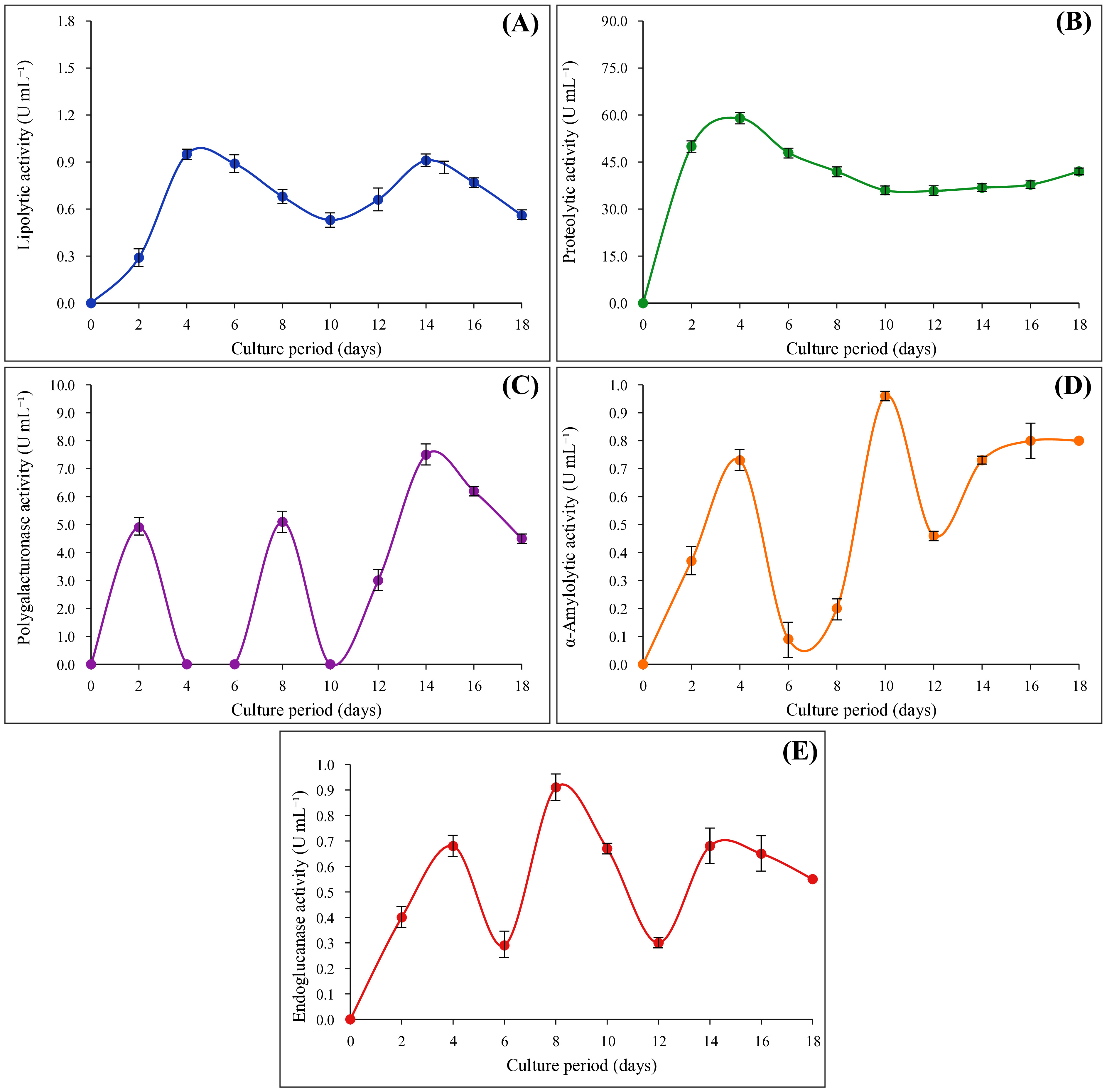
Lipolytic (A), proteolytic (B), polygalacturonase (C), amylolytic (D), and endoglucanase (E) activities of P. eryngii cultivated in the E4 culture medium over an 18-day cultivation period at 25 °C and 150 rpm. Means followed by the same letter do not differ significantly according to Tukey's test (p < 0.05).
Although direct comparisons should be interpreted with caution because of differences in fungal species, cultivation conditions, substrates, and assay methodologies, the cellulolytic and amylolytic activities obtained in the present study were lower than those reported in some previous studies. For example, a cellulolytic activity of 3.19 U mL−1 was reported for P. ostreatus after 9 days of cultivation (Liguori et al., 2015). Similarly, amylolytic activities ranging from 1.10 to 3.10 U mL−1 were reported for the edible mushroom Neurospora intermedia (Shahryari et al., 2019). Higher amylolytic (40.29 U mL−1) and cellulolytic (20.26 U mL−1) activities were reported for Inocybe sp. PKSR10 by Khaund and Joshi (2014). These differences are likely associated with variations in fungal species, substrates, cultivation conditions, and enzymatic assay protocols.
The moderate amylase production observed in this study may be explained by carbon catabolite repression. During submerged cultivation, the starch present in purple-skinned sweet potato likely promoted amylase production, while its hydrolysis gradually released glucose into the culture medium. As glucose accumulated, it may have repressed further amylase synthesis through carbon catabolite repression, reducing enzyme production despite the continued availability of starch (Fernandes et al., 2007).
Figure 2 shows the time-course production of hydrolytic enzymes by P. eryngii over 18 days in medium E4. The highest lipolytic activity (0.97 U mL−1) was recorded on the fourth day of cultivation (Figure 2A), followed by a second peak of similar magnitude on the 14th day. This biphasic profile suggests temporal regulation of lipase production during distinct stages of fungal growth. A similar trend was observed for proteolytic activity (Figure 2B), with the maximum activity (60.84 U mL−1) also occurring on the 4th day. Following this initial peak, proteolytic activity declined but remained relatively stable until the 18th day.
Our finding of maximum production early in the cultivation phase is supported by Bano et al. (2016), who observed optimal protease production for P. eryngii at 4 days (0.546 U mL−1), using glucose, and peptone. Similarly, Benmrad et al. (2019) reported optimal activity for P. sajor-caju CTM10057 after just 3 days (10,500 U mL−1), highlighting that optimal yields often occur rapidly in submerged fungal cultures.
Time-course analysis of pectinolytic activity showed that the highest activity (6.84 U mL−1) occurred on the 14th day of cultivation. Although the activity measured on the 16th day (6.28 U mL−1) did not differ significantly from that observed on the 14th day, the highest activity recorded during the 18-day cultivation period occurred on the 14th day (Figure 2C). Interestingly, the activity profile exhibited a pattern similar to that observed for the other hydrolytic enzymes, characterized by pronounced peaks in enzyme production followed by substantial declines, occasionally reaching undetectable levels. Moreover, peaks of pectinolytic activity appeared to recur at approximately 6-day intervals, suggesting temporal regulation of pectinase production.
The maximum amylolytic activity (0.94 U mL−1) was observed on the 10th day of cultivation (Figures 22E). The cellulolytic profile showed a similar trend, with its peak (0.86 U mL−1) occurring slightly earlier, on the 8th day. Although amylolytic and cellulolytic activities were successfully detected in P. eryngii DPUA 1816 cultivated on purple-skinned sweet potato, the values obtained were lower than those reported in some previous studies. For instance, Daba et al. (2011) achieved higher cellulolytic activity (3.13 U mL−1 and 4.0 U mL−1) after 6 and 8 days, respectively, when cultivating P. ostreatus NRRL-0366.
Conversely, the cellulolytic activity obtained in the present study (0.86 U mL−1 on the eighth day of cultivation) was higher than that reported for several Pleurotus species cultivated in defined media. Goyal and Soni (2011) evaluated cellulolytic activity in three Pleurotus species cultivated in Czapek–Dox medium and reported lower activities after 12 days: 0.42 U mL−1 for P. ostreatus, 0.48 U mL−1 for P. florida, and 0.45 U mL−1 for P. sajor-caju. Even when the medium was supplemented with carboxymethyl cellulose (CMC, 1%) and malt extract (ME), the reported cellulolytic activities remained relatively low. For example, P. florida showed maximum activities of 0.46 U mL−1 with 0.5% ME after 12 days, 0.34 U mL−1 with 1.0% ME after 5 and 7 days, and 0.38 U mL−1 with 0.1% ME after 15 days.
This observation is further supported by the findings of Asgher, Khan and Bilal (2016), who reported peak cellulolytic activity for P. eryngii WC888 cultivated on other agro-industrial residues. Specifically, they reported cellulolytic activities of only 0.20 U mL−1 after 6 days using banana stem residue and 0.13 U mL−1 after 4 days using corn straw residue. These comparisons support the potential of purple-skinned sweet potato as an effective and low-cost substrate for cellulase production by P. eryngii DPUA 1816, yielding cellulolytic activities comparable to or higher than those obtained using defined media and conventional inducing substrates.
In contrast to the other enzymes investigated, P. eryngii DPUA 1816 produced only low levels of xylanase in the culture media. This low activity is consistent with the findings of Álvarez-Cervantes et al. (2016), who reported similarly low xylanase activity (0.18 U mL−1) for P. ostreatus cultivated in a defined medium containing only glucose (10 g L−1) and yeast extract (5 g L−1). These results suggest that the available glucose in the culture medium may have promoted carbon catabolite repression, as xylanase production is typically inducible. This hypothesis is supported by Altaf et al. (2016), who reported high xylanolytic activity (0.46–0.92 U mL−1 after 4–8 days) for P. eryngii cultivated in the presence of xylose, a well-established inducer of xylanase production. Thus, the high content of readily metabolizable sugars in the purple-skinned sweet potato-based medium may have limited xylanase induction, resulting in reduced enzyme production.
The temporal production curves for most enzymes in medium E4, with the notable exception of proteases and xylanases, displayed characteristic peaks of high activity followed by rapid declines. This kinetic behavior is commonly attributed to several factors in submerged cultivation, including product inhibition, enzyme instability or denaturation, and the inhibitory action of secondary metabolites released during fungal growth (Lakshmi et al., 2014; Cui et al., 2015; Bonomini et al., 2017). Furthermore, the observation of multiple activity peaks may suggest the differential production of isozymes within the same enzyme class (Bano et al., 2018). The ability of P. eryngii to produce a diverse range of hydrolytic enzymes on purple-skinned sweet potato likely reflects its metabolic adaptability to utilize the complex polysaccharides and other nutrients present in this substrate (Mata et al., 2016).
The literature demonstrates considerable variability in enzymatic profiles among Pleurotus species. Studies on P. djamor var. roseus (Hernandez-Nava et al., 2016) and P. tuber-regium (Jonathan and Adeoyo, 2011) reported low xylanolytic, cellulolytic and pectinolytic activities (<0.15 U mL−1), even when standard inducers such as carboxymethyl cellulose (CMC) and maltose were used (<0.64 U mL−1). Similarly, Bonomini et al. (2017) reported moderate amylolytic (0.35 and 0.45 U mL−1) and pectinolytic (0.29 U mL−1) activities in P. sajor-caju CCB019 and P. djamor UNIVILLE01, while no detectable cellulolytic, proteolytic or lipolytic activities were observed. In contrast, P. eryngii DPUA 1816 exhibited activity for all of these enzymes, demonstrating a broader hydrolytic profile under the cultivation conditions employed in the present study.
Although some enzymatic activities were lower than those reported in the literature, these results were obtained using a simple culture medium without the addition of conventional enzyme-inducing substrates. Under the cultivation conditions employed, the synthetic carbon source (glucose) and the purple-skinned sweet potato were the only potential inducers of enzyme production.
Overall, the findings demonstrate that purple-skinned sweet potato represents more than a simple carbon source. Its complex nutritional composition supported the simultaneous production of several hydrolytic enzymes by Pleurotus eryngii, highlighting its potential as an inexpensive and renewable substrate for enzyme production. This strategy may contribute to reducing production costs while adding value to agricultural resources, thereby supporting a more sustainable enzyme production system.
4. Conclusion
This study demonstrated that purple-skinned sweet potato is a promising alternative natural substrate for hydrolytic enzyme production by P. eryngii DPUA 1816 under submerged fermentation. The cultivation system supported the production of a broad hydrolytic enzyme profile, including proteases, pectinases, lipases, amylases and cellulases, without the need for specific synthetic inducers. These findings highlight the potential of this underutilized agricultural resource as a sustainable substrate for fungal enzyme production. Further studies on enzyme characterization and process optimization may contribute to the development of future biotechnological applications.
Acknowledgements
The authors thank the Universidade do Estado do Amazonas and the Grupo de Pesquisa de Química Aplicada à Tecnologia for providing the facilities necessary to conduct this research, and the Fundação de Amparo à Pesquisa do Estado do Amazonas (FAPEAM) for its financial support.
Data Availability Statement
The data set analyzed or produced in this study can be requested from the corresponding author.
References
-
ALAM, M.K., 2021. A comprehensive review of sweet potato (Ipomoea batatas [L.] Lam): revisiting the associated health benefits. Trends in Food Science & Technology, vol. 115, pp. 512-529. https://doi.org/10.1016/j.tifs.2021.07.001
» https://doi.org/10.1016/j.tifs.2021.07.001 -
ALFARO, M., MAJCHERCZYK, A., KÜES, U., RAMÍREZ, L. and PISABARRO, A.G., 2020. Glucose counteracts wood-dependent induction of lignocellulolytic enzyme secretion in monokaryon and dikaryon submerged cultures of the white-rot basidiomycete Pleurotus ostreatus. Scientific Reports, vol. 10, no. 1, pp. 12421. https://doi.org/10.1038/s41598-020-68969-1 PMid:32709970.
» https://doi.org/10.1038/s41598-020-68969-1 -
ALI, Z., ABDULLAH, M., YASIN, M.T., AMANAT, K., SULTAN, M., RAHIM, A. and SARWAR, F., 2025. Recent trends in production and potential applications of microbial amylases: a comprehensive review. Protein Expression and Purification, vol. 227, pp. 106640. https://doi.org/10.1016/j.pep.2024.106640 PMid:39645158.
» https://doi.org/10.1016/j.pep.2024.106640 - ALMEIDA, M.N.R., 2016. Produção enzimática de biodiesel a partir de resíduos agro-industriais usando a lipase imobilizada de origem microbiana. Lisboa: Instituto Superior de Engenharia de Lisboa. Master’s thesis in Chemical and Biological Engineering.
-
ALTAF, S.A., SUGHRA, M.G., NASREEN, T.K., UMAR, D.M. and SHER, M.M., 2016. Characterization of crude xylanase produced by edible mushroom Pleurotus eryngii. Journal of Bioprocessing & Biotechniques, vol. 6, no. 2, pp. 268. https://doi.org/10.4172/2155-9821.1000268
» https://doi.org/10.4172/2155-9821.1000268 -
ÁLVAREZ-CERVANTES, J., SÁNCHEZ, C., DÍAZ, R. and DÍAZ-GODÍNEZ, G., 2016. Characterization of production of laccases, cellulases and xylanases of Pleurotus ostreatus grown on solid-state fermentation using an inert support. Revista Mexicana de Ingeniería Química, vol. 15, no. 2, pp. 323-331. https://doi.org/10.24275/rmiq/Bio998
» https://doi.org/10.24275/rmiq/Bio998 - ASGHER, M., KHAN, S.W. and BILAL, M., 2016. Optimization of lignocellulolytic enzyme production by Pleurotus eryngii WC 888 utilizing agro-industrial residues and bio-ethanol production. Romanian Biotechnological Letters, vol. 21, no. 1, pp. 11133-11143.
-
ASSIS, L.J., SILVA, L.P., BAYRAM, Ö., DOWLING, P., KNIEMEYER, O., KRÜGER, T., BRAKHAGE, A.A., CHEN, Y., DONG, L., TAN, K., WONG, K.H., RIES, L.N.A. and GOLDMAN, G.H., 2021. Carbon catabolite repression in filamentous fungi is regulated by phosphorylation of the transcription factor CreA. mBio, vol. 12, no. 1, e03146-20. https://doi.org/10.1128/mBio.03146-20 PMid:33402538.
» https://doi.org/10.1128/mBio.03146-20 -
BAIG, K.S., 2020. Interaction of enzymes with lignocellulosic materials: causes, mechanism and influencing factors. Bioresources and Bioprocessing, vol. 7, no. 1, pp. 21. https://doi.org/10.1186/s40643-020-00310-0
» https://doi.org/10.1186/s40643-020-00310-0 - BALDRIAN, P., 2008. Enzymes of saprotrophic basidiomycetes. In: L. BODDY, J. FRANKLAND and P. VANWEST, eds. Ecology of saprotrophic basidiomycetes. New York: Academic Press, pp. 19-41.
- BANO, S., DAHOT, M.U. and NAQVI, S.H.A., 2016. Optimization of culture conditions for the production of protease by Pleurotus eryngii. Pakistan Journal of Biotechnology, vol. 13, no. 3, pp. 193-198.
- BANO, S., DAHOT, M.U., NAQVI, S.H.A. and QURESHI, A.S., 2018. Characterization of crude protease produced by Pleurotus eryngii ATCC 90888. University of Sindh Journal of Animal Sciences, vol. 2, no. 4, pp. 3-11.
-
BARBOSA, E.E.P., PIMENTA, L., ARAÚJO, K.S., BRITO, A.K.P., BATISTA, S.C.P., MARTIM, S.R., GOMES, W.R. and TEIXEIRA, M.F.S., 2025. Production and partial characterization of a new fibrinolytic protease from salmon oyster mushroom from Amazonia. Brazilian Journal of Biology = Revista Brasileira de Biologia, vol. 85, e289933. https://doi.org/10.1590/1519-6984.289933 PMid:40608634.
» https://doi.org/10.1590/1519-6984.289933 -
BARUA, R.C., CONIGLIO, R.O., MOLINA, M.A., DÍAZ, G.V. and FONSECA, M.I., 2024. Fungi as biotechnological allies: exploring contributions of edible and medicinal mushrooms. Journal of Food Science, vol. 89, no. 11, pp. 6888-6915. https://doi.org/10.1111/1750-3841.17390 PMid:39349976.
» https://doi.org/10.1111/1750-3841.17390 -
BENMRAD, M.O., MECHRI, S., JAOUADI, N.Z., BEN ELHOUL, M., REKIK, H., SAYADI, S., BEJAR, S., KECHAOU, N. and JAOUADI, B., 2019. Purification and biochemical characterization of a novel thermostable protease from the oyster mushroom Pleurotus sajor-caju strain CTM10057 with industrial interest. BMC Biotechnology, vol. 19, no. 1, pp. 43. https://doi.org/10.1186/s12896-019-0536-4 PMid:31262286.
» https://doi.org/10.1186/s12896-019-0536-4 -
BODJRENOU, D.M., LI, X., LU, X., LEI, S., ZHENG, B. and ZENG, H., 2023. Resistant starch from sweet potatoes: recent advancements and applications in the food sector. International Journal of Biological Macromolecules, vol. 225, pp. 13-26. https://doi.org/10.1016/j.ijbiomac.2022.12.002 PMid:36481330.
» https://doi.org/10.1016/j.ijbiomac.2022.12.002 - BONOMINI, F.M., WISBECK, E. and GERN, R.M.M., 2017. Produção de enzimas por Pleurotus sajor-caju e Pleurotus djamor Periódico Científico do Núcleo de Biociências, vol. 7, no. 14, pp. 109-126.
-
CHANDRA, P., ENESPA., SINGH, R. and ARORA, P.K., 2020. Microbial lipases and their industrial applications: a comprehensive review. Microbial Cell Factories, vol. 19, no. 1, pp. 169. https://doi.org/10.1186/s12934-020-01428-8 PMid:32847584.
» https://doi.org/10.1186/s12934-020-01428-8 -
CUI, H., WANG, L. and YU, Y., 2015. Production and characterization of alkaline protease from a high-yielding moderately halophilic marine bacteria strain SD11. Journal of Chemistry, vol. 2015, pp. 798304. https://doi.org/10.1155/2015/798304
» https://doi.org/10.1155/2015/798304 -
DABA, A.S., YOUSSEF, G.A., KABEIL, S.S. and HAFEZ, E.E., 2011. Production of recombinant cellulase enzyme from Pleurotus ostreatus (Jacq.) P. Kumm. (type NRRL-0366). African Journal of Microbiological Research, vol. 5, no. 10, pp. 1197-1202. https://doi.org/10.5897/AJMR11.014
» https://doi.org/10.5897/AJMR11.014 -
DÍAZ-GODÍNEZ, G., TÉLLEZ-TÉLLEZ, M., RODRÍGUEZ, A., OBREGÓN-BARBOSA, V., ACOSTA-URDAPILLETA, M.L. and VILLEGAS, E., 2016. Enzymatic, antioxidant, antimicrobial, and insecticidal activities of Pleurotus pulmonarius and Pycnoporus cinnabarinus grown separately in an airlift reactor. BioResources, vol. 11, no. 2, pp. 4186-4200. https://doi.org/10.15376/biores.11.2.4186-4200
» https://doi.org/10.15376/biores.11.2.4186-4200 -
EJAZ, U., SOHAIL, M. and GHANEMI, A., 2021. Cellulases: from bioactivity to a variety of industrial applications. Biomimetics, vol. 6, no. 3, pp. 44. https://doi.org/10.3390/biomimetics6030044 PMid:34287227.
» https://doi.org/10.3390/biomimetics6030044 -
EMPRESA BRASILEIRA DE PESQUISA AGROPECUÁRIA – EMBRAPA, 2021 [viewed 16 April 2026]. Sistema de produção de batata-doce [online]. Brasília: Embrapa Hortaliças. Sistema de Produção, no. 9. Available from: https://www.embrapa.br/documents/1355126/8971369/Sistema+de+Produ%C3%A7%C3%A3o+de+Batata-Doce.pdf
» https://www.embrapa.br/documents/1355126/8971369/Sistema+de+Produ%C3%A7%C3%A3o+de+Batata-Doce.pdf -
FARHAN, M., HASANI, I.W., KHAFAGA, D.S.R., RAGAB, W.M., AHMED KAZI, R.N., AATIF, M., MUTEEB, G. and FAHIM, Y.A., 2025. Enzymes as catalysts in industrial biocatalysis: advances in engineering, applications, and sustainable integration. Catalysts, vol. 15, no. 9, pp. 891. https://doi.org/10.3390/catal15090891
» https://doi.org/10.3390/catal15090891 -
FERNANDES, L.P., ULHOA, C.J., ASQUIERI, E.R. and MONTEIRO, V.N., 2007. Produção de amilases pelo fungo Macrophomina phaseolina. Revista Eletrônica de Farmácia, vol. 4, no. 1, pp. 43-51. https://doi.org/10.5216/ref.v4i1.2120
» https://doi.org/10.5216/ref.v4i1.2120 -
FREIXO, M.R., KARMALI, A. and ARTEIRO, J.M., 2008. Production and chromatographic behaviour of polygalacturonase from Pleurotus ostreatus on immobilized metal chelates. Process Biochemistry, vol. 43, no. 5, pp. 531-539. https://doi.org/10.1016/j.procbio.2008.01.010
» https://doi.org/10.1016/j.procbio.2008.01.010 -
GOYAL, M. and SONI, G., 2011. Production and characterization of cellulolytic enzymes by Pleurotus florida. African Journal of Microbiological Research, vol. 5, no. 10, pp. 1131-1136. https://doi.org/10.5897/AJMR10.192
» https://doi.org/10.5897/AJMR10.192 -
HERNÁNDEZ-NAVA, R.M., JAIME, S., MENDOZA, G., DÍAZ-GODÍNEZ, G., ACOSTA-URDAPILLETA, M.D.L. and TÉLLEZ-TÉLLEZ, M., 2016 [viewed 16 April 2026]. Activity of hydrolases and laccases of Pleurotus djamor var. roseus grown in submerged fermentation [online]. Available from: https://www.cabidigitallibrary.org/doi/pdf/10.5555/20173097389
» https://www.cabidigitallibrary.org/doi/pdf/10.5555/20173097389 -
INÁCIO, F.D., FERREIRA, R.O., ARAUJO, C.A.V., PERALTA, R.M. and SOUZA, C.G.M., 2015. Production of enzymes and biotransformation of orange waste by oyster mushroom, Pleurotus pulmonarius (Fr.) Quél. Advances in Microbiology, vol. 5, no. 1, pp. 1-8. https://doi.org/10.4236/aim.2015.51001
» https://doi.org/10.4236/aim.2015.51001 -
JONATHAN, S.G. and ADEOYO, O.R., 2011. Evaluation of ten wild Nigerian mushrooms for amylase and cellulase activities. Mycobiology, vol. 39, no. 2, pp. 103-108. https://doi.org/10.4489/MYCO.2011.39.2.103 PMid:22783085.
» https://doi.org/10.4489/MYCO.2011.39.2.103 -
KHAUND, P. and JOSHI, S.R., 2014. Enzymatic profiling of wild edible mushrooms consumed by the ethnic tribes of India. Journal of the Korean Society for Applied Biological Chemistry, vol. 57, no. 2, pp. 263-271. https://doi.org/10.1007/s13765-013-4225-z
» https://doi.org/10.1007/s13765-013-4225-z -
LAKSHMI, B.K.M., RATNA SRI, P.V., AMBIKA DEVI, K. and HEMALATHA, K.P.J., 2014. Screening, optimization of production and partial characterization of alkaline protease from haloalkaliphilic Bacillus sp. International Journal of Research in Engineering and Technology, vol. 3, no. 2, pp. 435-445. https://doi.org/10.15623/ijret.2014.0302077
» https://doi.org/10.15623/ijret.2014.0302077 -
LEIGHTON, T.J., DOR, R.H., WARREN, R.A.J. and KELLN, R.A., 1973. The relationship of serine protease activity to RNA polymerase modification and sporulation in Bacillus subtilis. Journal of Molecular Biology, vol. 76, no. 1, pp. 103-122. https://doi.org/10.1016/0022-2836(73)90083-1 PMid:4198065.
» https://doi.org/10.1016/0022-2836(73)90083-1 -
LIGUORI, R., IONATA, E., MARCOLONGO, L., VANDENBERGHE, L.P.S., LA CARA, F. and FARACO, V., 2015. Optimization of Arundo donax saccharification by (hemi)cellulolytic enzymes from Pleurotus ostreatus. BioMed Research International, vol. 2015, pp. 951871. https://doi.org/10.1155/2015/951871 PMid:26634214.
» https://doi.org/10.1155/2015/951871 -
LIU, X. and KOKARE, C., 2017. Microbial enzymes of use in industry. In: G. BRAHMACHARI, ed. Biotechnology of microbial enzymes: production, biocatalysis and industrial applications London: Academic Press, pp. 267-298. https://doi.org/10.1016/B978-0-12-803725-6.00011-X
» https://doi.org/10.1016/B978-0-12-803725-6.00011-X -
MACHADO, A.R.G., MARTIM, S.R., ALECRIM, M.M. and TEIXEIRA, M.F.S., 2017. Production and characterization of proteases from edible mushrooms cultivated on amazonic tubers. African Journal of Biotechnology, vol. 16, no. 46, pp. 2160-2166. https://doi.org/10.5897/AJB2017.16154
» https://doi.org/10.5897/AJB2017.16154 -
MATA, G., SALMONES, D. and PÉREZ-MERLO, R., 2016. Hydrolytic enzyme activities in shiitake mushroom (Lentinula edodes) strains cultivated on coffee pulp. Revista Argentina de Microbiología, vol. 48, no. 3, pp. 191-195. https://doi.org/10.1016/j.ram.2016.05.008 PMid:27614795.
» https://doi.org/10.1016/j.ram.2016.05.008 -
MELANOURI, E.M., DEDOUSI, M. and DIAMANTOPOULOU, P., 2022. Cultivating Pleurotus ostreatus and Pleurotus eryngii mushroom strains on agro-industrial residues in solid-state fermentation. Part I: screening for growth, endoglucanase, laccase and biomass production in the colonization phase. Carbon Resources Conversion, vol. 5, no. 1, pp. 61-70. https://doi.org/10.1016/j.crcon.2021.12.004
» https://doi.org/10.1016/j.crcon.2021.12.004 -
MILLER, G.L., 1959. Use of dinitrosalicylic acid reagent for determination of reducing sugar. Analytical Chemistry, vol. 31, no. 3, pp. 426-428. https://doi.org/10.1021/ac60147a030
» https://doi.org/10.1021/ac60147a030 -
NAVEED, M., NADEEM, F., MEHMOOD, T., BILAL, M., ANWAR, Z. and AMJAD, F., 2021. Protease: a versatile and ecofriendly biocatalyst with multi-industrial applications: an updated review. Catalysis Letters, vol. 151, no. 2, pp. 307-323. https://doi.org/10.1007/s10562-020-03316-7
» https://doi.org/10.1007/s10562-020-03316-7 -
NOËL, D., NGUYEN, D.V. and SORMANI, R., 2021. How to rot: a role for TOR. Interplay between carbon catabolite repression and TOR signaling pathway. Advances in Botanical Research, vol. 99, pp. 151-173. https://doi.org/10.1016/bs.abr.2021.05.002
» https://doi.org/10.1016/bs.abr.2021.05.002 -
ØSTBY, H., HANSEN, L.D., HORN, S.J., EIJSINK, V.G.H. and VÁRNAI, A., 2020. Enzymatic processing of lignocellulosic biomass: principles, recent advances and perspectives. Journal of Industrial Microbiology & Biotechnology, vol. 47, no. 9–10, pp. 623-657. https://doi.org/10.1007/s10295-020-02301-8 PMid:32840713.
» https://doi.org/10.1007/s10295-020-02301-8 -
PHUYAL, M., BUDHATHOKI, U., BISTA, D., SHAKYA, S., SHRESTHA, R. and SHRESTHA, A.K., 2023. Xylanase-producing microbes and their real-world application. International Journal of Chemical Engineering, vol. 2023, pp. 3593035. https://doi.org/10.1155/2023/3593035
» https://doi.org/10.1155/2023/3593035 -
PIMENTA, L., BARBOSA, E.E.P., ARAÚJO, K.S., BRITO, A.K.P., BATISTA, S.C.P., MARTIM, S.R., ROCHA, W. and TEIXEIRA, M.F.S., 2025. Bioconversion of Amazonian vegetables by Pleurotus albidus: production of fibrinolytic enzyme. Brazilian Journal of Biology = Revista Brasileira de Biologia, vol. 85, e290015. https://doi.org/10.1590/1519-6984.290015 PMid:40465973.
» https://doi.org/10.1590/1519-6984.290015 -
RAYMOND, P., MSHANDETE, A.M. and KIVAISI, A.K., 2015. Enzyme profiles of Pleurotus HK-37 during mycelia vegetative growth and fruiting on solid sisal waste fractions supplemented with cow manure. Advances in Biochemistry, vol. 3, no. 5, pp. 57-65. https://doi.org/10.11648/j.ab.20150305.12
» https://doi.org/10.11648/j.ab.20150305.12 -
RAZZAQ, A., SHAMSI, S., ALI, A., ALI, Q., SAJJAD, M., MALIK, A. and ASHRAF, M., 2019. Microbial proteases applications. Frontiers in Bioengineering and Biotechnology, vol. 7, pp. 110. https://doi.org/10.3389/fbioe.2019.00110 PMid:31263696.
» https://doi.org/10.3389/fbioe.2019.00110 -
RUIJTER, G.J.G. and VISSER, J., 1997. Carbon repression in aspergilli. FEMS Microbiology Letters, vol. 151, no. 2, pp. 103-114. https://doi.org/10.1111/j.1574-6968.1997.tb12557.x PMid:9228741.
» https://doi.org/10.1111/j.1574-6968.1997.tb12557.x -
SHAHRYARI, Z., FAZAELIPOOR, M.H., GHASEMI, Y., LENNARTSSON, P.R. and TAHERZADEH, M.J., 2019. Amylase and xylanase from edible fungus Neurospora intermedia: production and characterization. Molecules (Basel, Switzerland), vol. 24, no. 4, pp. 721. https://doi.org/10.3390/molecules24040721 PMid:30781572.
» https://doi.org/10.3390/molecules24040721 -
SINGH, J. and PANESAR, P.S., 2023. Industrial enzymes: basic information, assay, and applications. In: A.K. BHATT, R.K. BHATIA and T.C. BHALLA, eds. Basic biotechniques for bioprocess and bioentrepreneurship London: Academic Press, pp. 295-309. https://doi.org/10.1016/B978-0-12-816109-8.00020-9
» https://doi.org/10.1016/B978-0-12-816109-8.00020-9 -
SINSABAUGH, R.S., 1994. Enzymic analysis of microbial pattern and process. Biology and Fertility of Soils, vol. 17, no. 1, pp. 69-74. https://doi.org/10.1007/BF00418675
» https://doi.org/10.1007/BF00418675 -
SOUZA, T.S.P. and KAWAGUTI, H.Y., 2021. Cellulases, hemicellulases, and pectinases: applications in the food and beverage industry. Food and Bioprocess Technology, vol. 14, no. 8, pp. 1446-1477. https://doi.org/10.1007/s11947-021-02678-z
» https://doi.org/10.1007/s11947-021-02678-z -
WINKLER, U.K. and STUCKMANN, M., 1979. Glycogen, hyaluronate, and some other polysaccharides greatly enhance the formation of exolipase by Serratia marcescens. Journal of Bacteriology, vol. 138, no. 3, pp. 663-670. https://doi.org/10.1128/jb.138.3.663-670.1979 PMid:222724.
» https://doi.org/10.1128/jb.138.3.663-670.1979 -
ZHANG, T., LIU, H., LV, B. and LI, C., 2020. Regulating strategies for producing carbohydrate active enzymes by filamentous fungal cell factories. Frontiers in Bioengineering and Biotechnology, vol. 8, pp. 691. https://doi.org/10.3389/fbioe.2020.00691 PMid:32733865.
» https://doi.org/10.3389/fbioe.2020.00691 -
ZORN, H., BREITHAUPT, D.E., TAKENBERG, M., SCHWACK, W. and BERGER, R.G., 2003. Enzymatic hydrolysis of carotenoid esters of marigold flowers (Tagetes erecta L.) and red paprika (Capsicum annuum L.) by commercial lipases and Pleurotus sapidus extracellular lipase. Enzyme and Microbial Technology, vol. 32, no. 5, pp. 623-628. https://doi.org/10.1016/S0141-0229(03)00020-6
» https://doi.org/10.1016/S0141-0229(03)00020-6
*
e-mail: cleudiane.andrade@gmail.comEditor: