 The effect of water scarcity on Iran’s food security
Abstract
Water scarcity is one of the most urgent food security issues facing countries of arid and semiarid climate like Iran. This study examines the impact of water scarcity on food security in an era of climate change. Using the Iranian Statistics Center (ISC) data on food production, climate change variables, energy consumption, population growth and water use coupled with a simultaneous equations (3SLS) modelling approach, the impacts of water scarcity, are analyzed. The results show that water scarcity in Iran is a regional issue, mainly in eastern and central areas. This is reflected in the limited and uneven distribution of water resources, decline of surface water resources, depletion of groundwater resources, degradation of water quality and increasing water demand. Climate change has further aggravated water scarcity in several river basins in central Iran, resulting in the food security shortage due to fall in food production. The need for more research on improving water-limited crop production is highlighted, and emphasis is placed on interdisciplinary approaches to gain the insight needed to achieve new breakthroughs that would help in tackling this complex problem.
Keywords:
water scarcity; food security; food production; climate change
Resumo
A escassez de água é uma das questões de segurança alimentar mais urgentes que os países de clima árido e semiárido enfrentam, como o Irã. Este estudo examina o impacto da escassez de água na segurança alimentar em um cenário de mudanças climáticas. Utilizando dados do Centro de Estatísticas Iraniano (ISC) sobre produção de alimentos, variáveis de mudanças climáticas, consumo de energia, crescimento populacional e uso de água, combinados com uma abordagem de modelagem de equações simultâneas (3SLS), são analisados os impactos da escassez de água. Os resultados mostram que a escassez de água no Irã é um problema regional, principalmente nas zonas oriental e central. Isto reflete-se na distribuição limitada e desigual dos recursos hídricos, no declínio dos recursos hídricos superficiais, no esgotamento dos recursos hídricos subterrâneos, na degradação da qualidade da água e no aumento da demanda por água. As mudanças climáticas agravaram ainda mais a escassez de água em várias bacias hidrográficas no centro do Irã, resultando na escassez de segurança alimentar devido à queda na produção de alimentos. É a necessidade de mais pesquisas sobre a melhoria da produção agrícola com limitação de água é destacada, e a ênfase é colocada em abordagens interdisciplinares para obter o conhecimento necessário para alcançar novas descobertas que ajudem a enfrentar esse problema complexo.
Palavras-chave:
escassez de água; segurança alimentar; produção de alimentos; mudanças climáticas
1. Introduction
Unconstrained water use has grown at global level, to the point where reliable water services can no longer be delivered in many regions. Demographic pressures, the rate of economic development, urbanization and pollution are all putting unprecedented pressure on a renewable but finite resource, particularly in semi-arid and arid regions.
Of all economic sectors, agriculture is the sector where water scarcity has the greatest relevance. Currently, agriculture accounts for 70 percent of global freshwater withdrawals, and more than 90 percent of its consumptive use. Under the joint pressure of population growth and changes in dietary habits, food consumption is increasing in most regions of the world. It is expected that by 2050 an additional billion tons of cereals and 200 million tons of meat will need to be produced annually to satisfy growing food demand (FAO, 2020).
Limited water resources are therefore the greatest challenge to food security, and water scarcity has undoubtedly become a global problem, with serious implications for global food security and ecosystem health. According to Dawson's calculations, climate change will put 1.7 billion people at risk of food shortages worldwide by 2050 (Liu et al., 2020). Therefore food security policymakers should not ignore the growing lack of water because it is a key factor in agricultural production, and water scarcity can reduce production and negatively impact on food security.
It can be concluded that water is critical for agriculture and the future food security of the world (Hanjra and Qureshi, 2010), and this has led the United Nations to conclude that water scarcity will be the most important constraint to increasing food production in the coming decades (Watkins, 2006).
Water scarcity in Iran is a complex social-ecological challenge (Ashraf, 2019), and various factors contribute to it differently, including agriculture, urbanization, climate change, population growth, land-use change, and an ineffective water management system (Madani, 2014). According to the Falkenmark water stress index, i.e., annual water availability per person, the water conditions in an area can be categorized as: no stress (>1700 m3 per capita), stress (1000-1700 m3 per capita), scarcity (500-1000 m3 per capita), and absolute scarcity (<500 m3 per capita) (Brown and Matlock, 2011). Therefore, Iran is suffering from water stress as per capita renewable water of 1560 cubic meters (Moazzezi et al., 2021).
The water stress index in some regions of the country is significantly lower than the annual average of the country, and this is due to the prevalence of arid and semi-arid climate in Iran, characterized with low rainfall and high evaporation (Mehri, 2020). Moreover, the water stress index has been projected to experience a downward trend (Bagherzadeh, 2021; Moridi, 2017). Dwindling surface water and runoffs that have been due to low precipitation and high evaporation rates (Zarghami et al., 2011), have increased pressure on other water resources in the country, e.g. groundwater, making Iran groundwater depletion status as alarming (Barati et al., 2019). Iran is the second largest groundwater miner, and 56% of this water are consumed in agricultural sector to maintain food production and trade (Al-Yasin, 2017), which has consequently caused severe land subsidence in major plains (Dehghani et al., 2013). Agricultural sector consumes the largest share of freshwater withdrawals in the country (92%) (Barati et al., 2019; Esfandiari, et al., 2016) and has been one of the major causes of land-use change since the last 30 years (Moridi, 2017). Agricultural demand land use change has increased greenhouse gas emission, and this has caused significant changes in climatic parameters and hazards such as droughts, floods, storms (Ajjur and Al-Ghamdi, 2022; Barati et al., 2019), air humidity, temperature, precipitation, and solar radiation. These changes have exacerbated climate change which, in turn, have reduced crop production (Norouzi and Kalantari, 2020), influenced precipitation distribution (Moradi et al., 2021), increased irrigation water requirements (Beiragi et al., 2012), reduced groundwater quality (Zarghami et al., 2011), and caused extreme weather events in Iran (Al-Yasin, 2017).
Population growth is another key player in this complicated water crisis. Iran population has sharply increased in the latest decades (from 35 million people in 1979 to 86 million people in 2020), and this has increased water and food demand in various sectors (Madani, 2014), e.g. agricultural sector. Irrigated and rainfed agriculture production have expanded by 137% and 59%, respectively in recent decades to feed the higher population.
Considering the complex relationships that exist among various factors that cause water scarcity in Iran, as elaborated in previous paragraph, water scarcity impact on food security, needs to be analyzed in a holistic way. This would be the first step for an appropriate decision-making. This study aims to develop model to analyze water scarcity and the effectiveness on food security in Iran.
Most of studies have analyzed water scarcity and stress at local scales; such as at river basins (Cansino-Loeza et al., 2022), at lakes (Shabanzadeh-Khoshroudi and Hosseini, 2021) and at province levels (Savari and Ghanian, 2019; Campi et al., 2021), however, there is no adequate quantitative knowledge on the present status of water scarcity and its effects on food security in Iran in a national scale (Sakhi et al., 2021). Therefore, this study will seek to fill this knowledge gap by examining the two-sided effects of food security and water crisis. The study aims to examine the effects of water scarcity on food security in Iran by addressing three key aspects. First, it investigates the impact of water scarcity on food security indicator to assess its overall consequences. Second, it explores the influence of climate change on food security by analyzing its direct and indirect effects. Finally, it examines how agricultural production fluctuations contribute to food security challenges, providing a comprehensive understanding of the interconnections between these factors. Through this approach, the study seeks to bridge the existing knowledge gap and offer insights of more effective policy decisions.
In this perspective, our work is organized as follow. In the next section, a review of literature is proposed. Section 3 describes data and the methodology we adopted. Results are then discussed in section 4 and section 5 concludes.
2. Literature Review
As Moazzezi et al. (2021) shows in his study, climate change and water scarcity in Iran can lead to decrease food security through reducing food production and increasing the price of food. According to the results of this study, even with optimistic climate changes scenario, consumer welfare and, consequently, food security will decrease.
Fattahi Ardakani et al. (2022) investigated the effect of climate change and food price index on the food security of urban households in Iran. Results showed that in the short and long term, the food price index and climate change had a negative significant effect on food security of urban households.
Moradi et al. (2021) investigated the effect of agricultural water consumption management on the food security of farmers’ households in the family exploitation system in Kermanshah, Iran. The results of the path analysis showed that the management of agricultural water consumption directly and indirectly affected farmers’ food security through improving product quality, production diversity, changing the cultivation pattern, increasing the consumption of agricultural products, increasing crop production and increasing income.
Ghalehsard et al. (2019) investigated the effects of climate change on Iran’s food security. The results of this research indicated a sharp decrease in farmers’ income and surplus of economic welfare, as well as an increase in the price of products under the four assumptions. Reducing the effects of climate change can be done by changing the cultivation pattern, using new methods of irrigation and desertification.
Hao et al. (2022) investigated the integrated analytical framework of water-energy-food security for sustainable development in five Central Asian countries. In their opinion, a thorough understanding of water, energy and food security (WEF) and the factors affecting them is essential to manage sustainable development in any region. The results showed that Kazakhstan has achieved the highest level of WEF security, followed by Kyrgyzstan, Turkmenistan and Uzbekistan. Tajikistan showed the lowest level of security from 2000 to 2014. Approaches to improve the country’s WEF security based on their research are as follows: Kazakhstan should prioritize the allocation and supply of food, Kyrgyzstan and Tajikistan should increase energy and food production, and also increase the level of water and food supply and consumption efficiency, Turkmenistan should increase the available water resources and food production and improve the supply level and efficiency of water and energy use, and Uzbekistan should increase both the amount of water and energy available and also increase the management performance for food security.
Haji et al. (2022) investigated a computational modeling approach based on the energy-water-food nexus node to support decision making for sustainable food security. Risk identification and analysis concluded that climate and groundwater factors are critical to dairy farms and, if exceeded, are likely to affect dairy cow health and milk production. On the other hand, the factors of underground water and soil have the greatest effect on fodder fields. A new energy, water, and food linkage node is then introduced at an optimal location that operates at minimal cost, including groundwater pumping, desalination, and transportation costs, while greatly reducing the risk of existing energy, water, and food nodes. .
Mohammad Omar et al. (2021) investigated the effects of climate change on water quantity, water salinity, food security and social economy in Egypt. According to them, climate change may have a direct effect on water quantity in Egypt and lead to indirect effects on the intrusion of Mediterranean salt water into groundwater, which makes agriculture vulnerable. The results showed that future climate change will directly affect the entire crop level. Crop areas for 13 types of crops, self-sufficiency of wheat, rice, grain and corn stocks and the social and economic indicators of the adaptation measures of the proposed cultivation pattern are focused on stabilizing rice cultivation areas and orchards and providing half of the population with lentils, corn, onions, vegetables, milk and meat. Adaptation measures can improve food security without worsening socioeconomic status. However, water availability has far more important effects on food security and socioeconomics than cropping pattern adaptation measures. Based on this, the country should rationalize the efficiency of water consumption and increase water supply.
Alvi et al. (2021) presented an integrated assessment model for food security under climate change for South Asia. The results show that climate change causes a decrease in food production, an increase in food prices, a decrease in food consumption, and thus on welfare. Trade and financial policy responses to combat the food security problem are examined. It has been found that these two policies fail to compensate for climate change in all selected South Asian countries.
While these studies provide valuable insights into specific aspects of food security, they remain limited in scope. Many focus on either urban or rural households without integrating a national perspective. Additionally, most studies analyze either climate change or water scarcity in isolation, overlooking their combined impact. Haji et al. (2022) introduced a computational approach for decision-making in sustainable food security, and Omar et al. (2021) examined the effects of climate change on Egypt water and food systems, providing comparative insights but not addressing Iran case comprehensively. Furthermore, Rezaei et al. (2012) assessed the economic consequences of food security under climate change in South Asia, yet their findings cannot be directly applied to Iran unique socio-economic and environmental conditions.
Given these limitations, this study seeks to bridge the knowledge gap by providing a comprehensive analysis of water scarcity and food security at a national scale in Iran. Unlike previous studies, it employs a simultaneous equation model to capture the interdependent effects of climate change, water scarcity, and agricultural production on food security indicators, offering a more holistic perspective for policymakers.
3. Material and Methods
This study examines the relation between water scarcity and food security amidst climate change for Iran from 1981 to 2022. From the empirical investigation, using simultaneous equation model (3SLS) for the robustness checks, considering the probable indigeneity issue in the model.
Study variables include: Food security index, water crisis, climate change, agricultural production, food price index, migration, population growth, temperature, rainfall, environmental incidents, capital, labor and energy consumption.
Research model inspired by Amolegbe et al. (2021) (considering the variables of food security, food prices), Alvi et al. (2021) (considering the variables of food security, climate change and agricultural production), Rasul (2021) (considering variables of climate change, food security, Covid-19), Kookana et al. (2020) (considering the variables of migration, food security and water crisis), Zarei (2020) (considering the variables of climate change, food security, water crisis and population growth), Liu et al. (2020) (considering variables of climate change, population growth, migration, water crisis and agricultural production), Veettil and Mishra (2018) (considering variables of climate change, water crisis, agricultural production and population growth), Amorim et al. (2018) (considering the variables of migration, food security, climate change and water crisis) and Rezaei et al. (2012) (considering the variables of food security and material price index food) is in the form of the following Equation 1.
where AHFSI is Food Security Index, WS is Water Crisis, CC Climate Change, AP Agricultural Production, FPI Food Price Index, Mi Migration, PG Population Growth, Covid19 is COVID-19 Outbreak, Tem is Temperature, Ra is Rainfall, EA is Extreme Environmental Incidents, K Capital, L is labor, E is energy consumption, and ε is model error. In this study, the logarithmic form of the variables has been used. In this study, the data from the time period of 1981-2020 and using the econometric model of simultaneous equations, the 3SLS method has been used.
AHFSI is Total Household Food Security Index: FAO has developed this index based on age work in 1976 as the following Equation 2:
where, H and PU are the percentage and number of people who received less than the energy standard (the energy standard is considered 2300 calories) and PT is the total number of the studied population. G is the intensity of food poverty, cs is the standard energy, CAU is the average energy intake less than the standard, IP is the Gini coefficient of energy distribution among the poor, which is due to the unavailability of the energy intake figures of individual poor households, the Gini coefficient of the distribution of household expenses has been used. CV is the coefficient of variation of energy supply over time, S is the standard deviation of energy supply over time, and X is the average of energy supply over time. The fluctuation range of this index is from 0 to 100 (Gol Karami and Kaviani rad., 2017).
WS is water crisis: based on the Falcon Mark index, which defined the water crisis based on the per capita amount of renewable water resources in the country, and introduced the per capita water amount of 1700 m2 per year as an indicator of scarcity (Veettil and Mishra, 2018). 1700 m2 of water per capita per year is introduced as a stress index and 1000 m2 of water per capita per year is introduced as a scarcity index. Based on this, countries that have annual renewable water resources of more than 1700 m2 per capita do not have the problem of water crisis. Countries with per capita renewable water resources between 1000 and 1700 m2 are water stressed and countries with per capita renewable water resources less than 1000 m2 per year are countries with water shortage. It should be mentioned that less than 500 m2 of water per capita per year puts a lot of pressure on that country. Although the per capita renewable water resources in the world are 6079 m2, but due to the disproportionate distribution of these resources, the Middle East is in a critical situation with 1559 m2 per capita. But other areas have a better situation. Iran is also on the verge of entering water stress conditions with 1718 m2 of renewable water resources per capita in 2011 (Mohammadjani and Yazdanian, 2013). Also, the volume of renewable water (RW) has been calculated according to the following Equation 3 (Raja et al., 2019):
where R and I are respectively the runoff and volume of infiltrated water due to precipitation, Ri and Ro are the incoming and outgoing runoff respectively, Gi and Go are the incoming and outgoing underground flows respectively.
CC is climate changes: Barat climate coefficient is used to calculate climate changes. In this method, Barat climatic coefficient, which is dependent on rainfall, surface runoff and annual rainfall, has been calculated using the following Equation 4:
where I is Barat climatic coefficient, P average annual precipitation in millimeters, N number of rainy days per year, E annual evaporation in millimeters, C coefficient of surface runoff (where R runoff in millimeters ).
Standard deviation, variance, skewness and kurtosis coefficients are the indices used in the study for this purpose. Before estimating the model, it is necessary to test the significance of all the variables used in the research model. Because the indeterminacy of the variables causes false regression. In this study, the augmented Dickey-Fuller (ADF) and Phillips-Perron (PP) tests were used to check the significance of the variables. In most economic time series variables, there is a tendency to move in the same direction, and this is due to the existence of a common trend that is observed in most of them. In general, economic variables whose statistical properties (such as mean and variance) are a function of time are called non-stationary variables. One way to avoid false regression is to differentiate and use the difference of variables in the model. But such a model does not provide any information about the long-term relationship of the variables. Under such conditions, it is possible to resort to co-accumulation methods and estimate the desired model far from being false based on the level of variables. According to the results of the unit root test that there are some variables with the degree of accumulation one and two, in order to avoid false regression estimation, the cointegration test should be performed to check the existence of long-term relationship between the variables. Therefore, the Johansen-Juselius cointegration test was used to analyze the convergence between model variables. The reason for using this method compared to other cointegration methods is that this method considers more than one cointegration vector between model variables and if this method is used, the estimators will have asymptotic efficiency. Trace and Maximum Eigenvalue statistical quantities have been used to determine the number of co-integration vectors. The null hypothesis in both tests means the absence of co-integration.
The simultaneity test of the system of simultaneous equations has been performed using the Hausman test for the functions in the system. After confirming the existence of simultaneity between the equations in the model, the variance-covariance matrix test of the residual sentences was performed.
4. Results
The descriptive indicators of the study are listed in Table 1. Food security is not realized only with sufficient supply of food at the community level, but also requires optimal distribution, appropriate access and the economic ability of households to provide minimum food products. Economic disturbances such as unemployment and reduced purchasing power fuel the imbalance in access to food between groups and social classes, therefore factors such as the efficiency of agricultural production support policies, food distribution and supply system, consumption and nutrition patterns, basic goods subsidy system, employment status, income distribution, foreign trade policy and nutritional culture affect it.
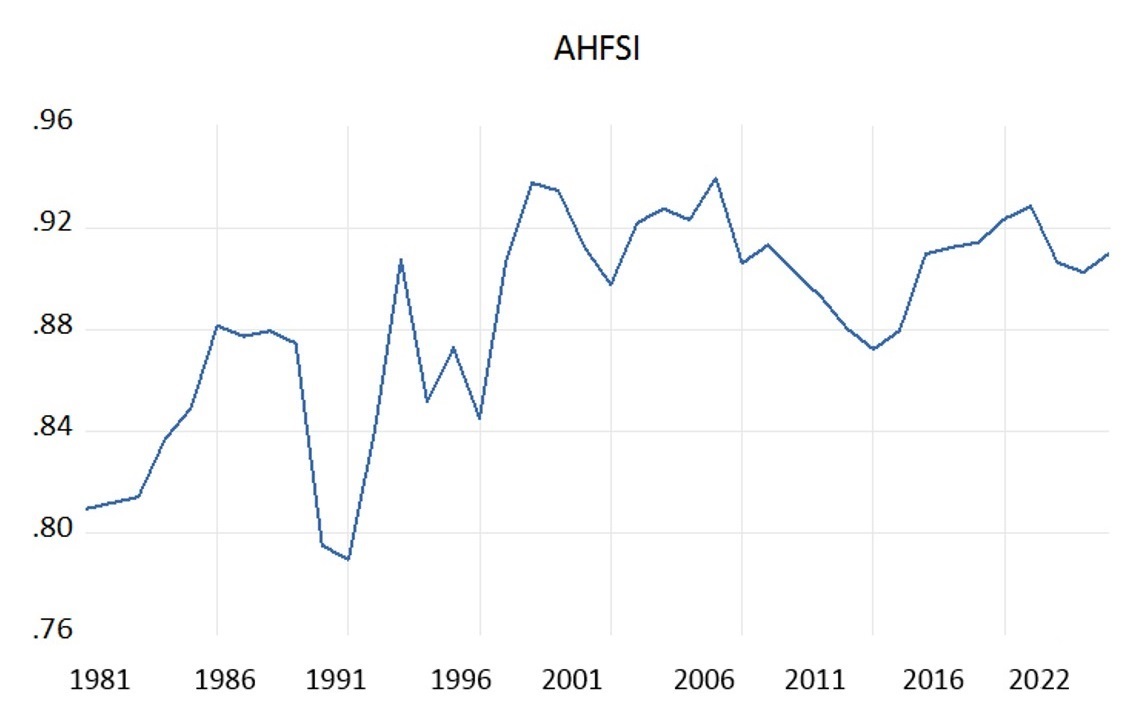
Figure 1 shows the trend of changes in the food security index during 1981-2022 for Iran. According to the graph, the general trend of the food security index during this time is upward, although in some years (1989-1991 and 2009-2011) it has decreased due to the occurrence of some economic and non-economic shocks.
4.1. Water scarcity (WS)
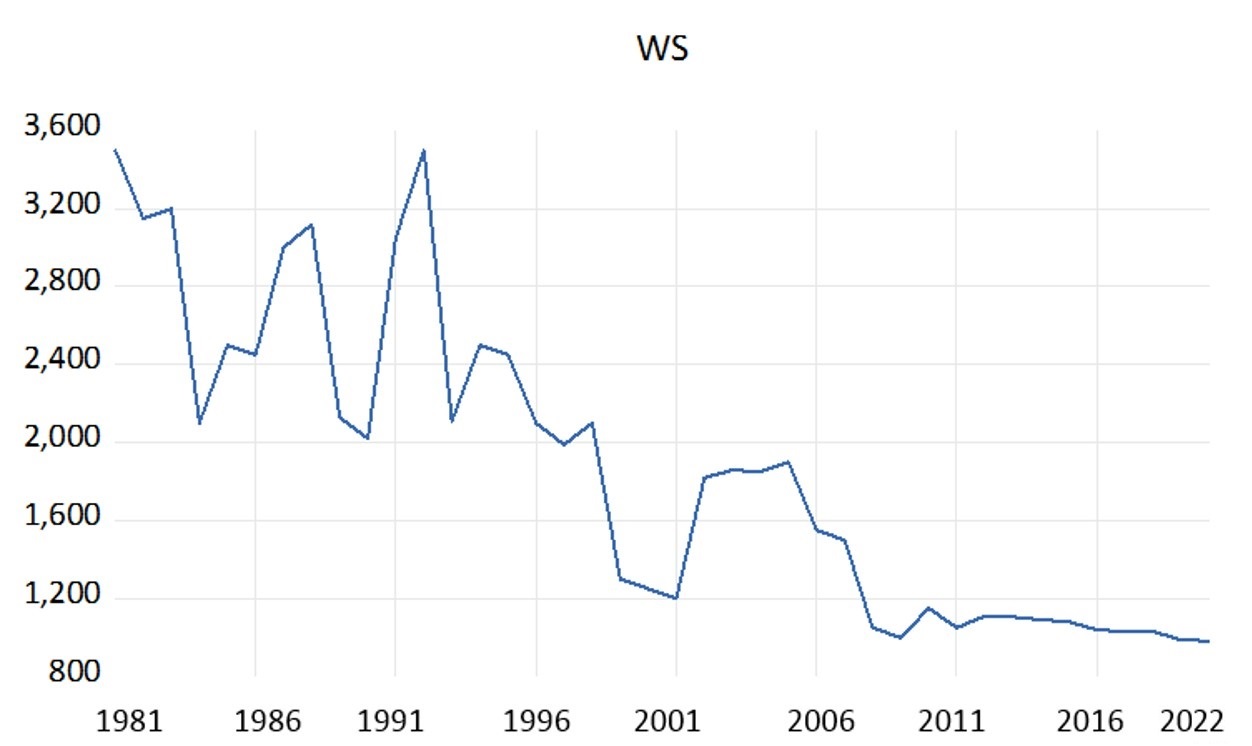
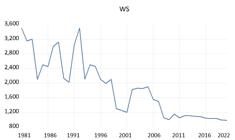
Renewable water per capita is an indicator to reveal the water scarcity situation in any country. Unfortunately, the occurrence of drought on the one hand and the indiscriminate extraction of surface and underground water resources in recent years, on the other hand, has caused Iran to face a water shortage crisis. Figure 2 shows the trend of changes in renewable water per capita during 1981-2020 for Iran. According to the chart and based on the Falcon Mark index, during 1981-1998, 2002-2005, the amount of renewable water per capita was higher than 1700 m2 and there was no tension during these years. In 1999-2001 and 2006-2018, the amount of renewable water per capita was between 1700-1000 m2 and there was tension during these years. During 2019 and 2020, the amount of renewable water per capita was less than 1000 m2 and there was a shortage during these years.
4.2. Climate change (CC)
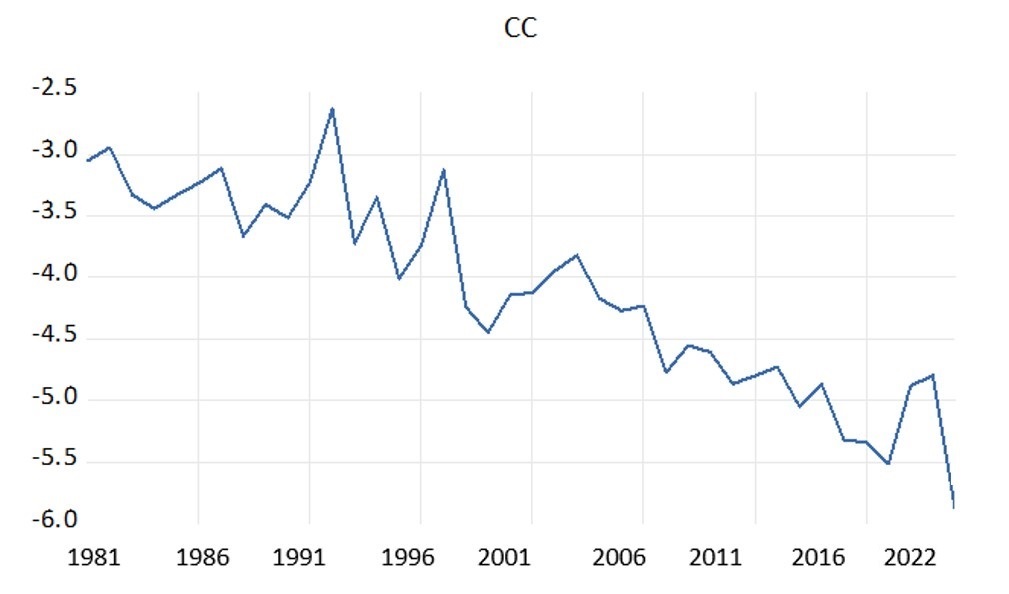
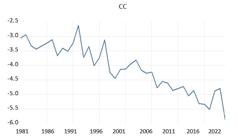
Barat index is used in this study. According to this index, the climate with a coefficient smaller than -20 is arid, between -20 and 0 is semi-arid climate, between 0 and 7 is semi-humid climate and above 7 is humid forest climate. Figure 3 shows the trend of climate changes during 1981-2020 for Iran. According to the distribution of rainfall, during 1981-2020, it is between 0 and -20, which indicates that Iran is considered to be a semi-arid climate during this period.
4.3. Unit root test
Based on the results of Table 2, based on the augmented Dickey Fuller test, the variables of food security index, population growth, water scarcity, temperature, rainfall, environmental incidents and energy consumption in the agricultural sector are at a stationary level and their degree of integration is zero. Variables of climate changes, agricultural production, food price index, labor force in the agricultural sector and capital in the agricultural sector are not at the stationary level and have been stationary with one time differentiation and their degree of integration is one. Also, the variable of migration is not at the stationary level, and they are stationary by differentiating twice, and their degree of integration is two.
According to the Phillips-Perron test, variables like climate changes, migration, population growth, temperature, rainfall, environmental incidents and energy consumption in the agricultural sector are at the stationary level and their degree of integration is 0. Variables of food security index, water scarcity, agricultural production, food price index, labor force in the agricultural sector and capital in the agricultural sector are not at the stationary level and they have been stationary by one time differentiation and their degree of integration is one.
4.4. Co-integration test
Regarding to the results of Table 3, based on both the trace test statistics and the maximum eigenvalue, the null hypothesis of all three models; food security index, water scarcity and agricultural production was rejected at the level of 95%. Therefore, cointegration has been confirmed in these models. Therefore, there is no danger of fake regressions threatening the research.
4.5. Simultaneity test of the simultaneous equation system
In Table 4, the residual sentences variable represents the residual sentences of the food security index equation. According to the significant level of this variable, it is clear that the residual sentences of the food security index have an effect on the water crisis and are related to it. Therefore, the simultaneity between the equations of food security index and water scarcity is confirmed.
In Table 5, the residual sentences variable represents the residual sentences of the food security index equation. According to the significant level of this variable, it is clear that the residual sentences of the food security index have an effect on agricultural production and are related to it. Therefore, the simultaneity between the equations of food security index and agricultural production is confirmed.
In Table 6, the residual sentences variable represents the residual sentences of the agricultural production equation. According to the significant level of this variable, it is clear that the sentences of agricultural production waste have an effect on the water crisis and are related to it. Therefore, the simultaneity between the equations of agricultural production and water scarcity is confirmed.
According to the results of Hausman simultaneity test, the equations in the model of this study should be estimated simultaneously. Two methods can be used to estimate the model, which are: two-stage least squares (2SLS) and three-stage least squares (3SLS).
4.6. Diagonality test results
The results of the diagonality test show that a system method or a single equation method should be used to estimate the model. To perform this test, the members outside the main diameter were raised to the power of 2, added together and multiplied by the number of observations, and the result was compared with the critical value of the chi-square table, and the obtained number (5.216) was greater than the critical value of the chi-square table. The results of Table 7 show that there is a correlation between the disturbance sentences in the structural equations. Therefore, the results related to the estimation of the model from the system method are better than the single-equation method, and the 3SLS method should be used.
4.7. Model estimation based on 3SLS method
Table 8 shows the estimation results of the food security index model using the 3SLS method. The variables of water scarcity, climate change, food price index and population growth have a negative significant effect on the food security index. The estimated coefficient for the variables of water scarcity, climate change, food price index, and population growth is equal to -0.134, -0.408, -0.044 and -0.012, respectively, which is significant at the 90% level. This means that with the occurrence of water scarcity, climate change, food price increase by 1% and population increase by 1% in the country, food security will decrease by 0.134, 0.408, 0.044 and 0.12% respectively. Also, the agricultural production variable has a positive significant effect on the food security index. The estimated coefficient is equal to 0.158, which is significant at the 90% level. This means that by increasing the level of agricultural production by 1%, food security increases by 0.158%.
The results showed that this migration variable has no significant effect on the food security index. The estimated coefficient is equal to 0.0086, which is not significant.
Table 9 shows the estimation results of the water crisis model using the 3SLS method. In this study, the Falcon Mark index, which defined the water crisis based on the per capita amount of renewable water resources in the country, and introduced the per capita amount of 1700 m2 of water per year as an indicator of scarcity, was used. The variable of climate change, COVID-19 outbreak, temperature and population growth has a positive significant effect on the water crisis index. The estimated coefficient for the variables of climate change, COVID-19 outbreak and population growth is equal to 0.275, 0.0064, 0.194 and 0.361, respectively, which is significant at 95% level. This means that with the occurrence of climate changes, COVID-19 outbreak, increase in temperature and population growth in Iran, the water crisis will increase by 0.275, 0.0064, 0.194 and 0.361%, respectively. In other words, with the occurrence of any of the mentioned environmental factors, the per capita amount of renewable water resources in Iran will decrease, which indicates the aggravation of the water crisis. Earth warming, temperature increase and rainfall decrease are among the dangerous climate changes that have affected human life and natural creatures. The effect of climate change in recent decades is more than visible in Iran with its arid and semi-arid climate. Climate changes have caused water scarcity with two effects: decrease in rainfall and increase in temperature and evaporation level.
The rainfall variable has a negative significant effect on the water scarcity index. The estimated coefficient is equal to -0.070, which is significant at the 99% level. This means that by increasing the amount of rainfall in Iran by 1%, the water crisis will decrease by 0.070%. Also, the variable of environmental incidents does not have a significant effect on the water scarcity. The estimated coefficient is equal to -0.072, which is not significant.
Table 10 shows the estimation results of agricultural production model by 3SLS method. The variables of the agricultural sector capital, agricultural sector labor force, energy consumption of the agricultural sector and food price index have a positive significant effect on agricultural production. The estimated coefficient for agricultural sector capital, labor force of the agricultural sector, energy consumption of the agricultural sector and food price index are respectively equal to 0.396, 2.601, 0.184 and 0.333, which are significant at the level of 59%. This means that with the increase of the agricultural sector capital, agricultural sector labor force, energy consumption of the agricultural sector and food price index by 1%, agricultural production increases by 0.396, 2.601, 0.184 and 0.333%, respectively.
The results showed that the variables of climate change and COVID-19 outbreak have no significant effect on agricultural production. The estimated coefficients for the variables of climate change and COVID-19 outbreak are respectively -0.022 and -0.042, which are not significant. Also, the results showed that the variable of water scarcity has a negative significant effect on agricultural production. The estimated coefficient is equal to -0.404, which is significant at the 95% level. This means that with the occurrence of water scarcity in Iran, the level of agricultural production will decrease by 0.404%.
5. Discussion
Results of this study showed that the occurrence of water scarcity decreases the food security index. One of the important pillars of producing agricultural products and strengthening food security is the timely supply of required inputs and their optimal use. Global and domestic experiences show that increasing productivity is one of the most feasible, fastest and most economical solutions that are welcomed by stakeholders and can boost production, generate income, and reduce repair costs of water sources, repair and restore the damage done as soon as possible. If the world does not improve its agricultural productivity, reduce water use and reuse wastewater, water scarcity will be a permanent stress in the future. The competition for the use of water in different sectors, environment and food production is increasing as a threat not only in Iran, but all over the world. In order to evaluate the extent of strengthening Iran’s food security, it is necessary to diagnose the state of Iran’s water resources and describe the challenges of the water sector and provide a reliable picture of the amount of renewable water that can be allocated to the agricultural sector in a sustainable model. Iran is currently facing deep and widespread challenges, including the reduction of the underground water level, land subsidence, drying up of lakes and wetlands, and the emergence of water disputes. The most effective factors in this situation can be seen in population increase and inappropriate water distribution, inappropriate water governance, low water productivity in all sectors of consumption and climate change and extreme events.
Results showed that climate change reduces the food security index. Climate change is an important and growing threat to water resources and food security. First, climate change leads to increased evaporation and transpiration. Second, climate change will increase temperatures. However, higher temperatures promote faster crop growth and therefore shorter crop life, and together with higher atmospheric CO2, may favor the growth and survival of many crop pests and diseases. These factors in most cases lead to a decrease in efficiency. Third, climate change also increases the likelihood of agricultural drought, which in turn increases crop water stress. This phenomenon requires more water to produce grains. In summary, climate change increases inefficient water evaporation and reduces cereal production, which poses a serious threat to the region’s water resources and food security.
The results of this study showed that the increase in agricultural production increased the food security index. Food security is the foundation of the economic, social, cultural and political security of Iran and is considered one of the pillars of good and fair governance, so that from the perspective of fundamental values, it is considered as one of the most important rights of the individual and the society. From this point of view, the rights of future generations are considered through the protection of basic production resources and sustainable exploitation of these resources. It should be noted that throughout history, the rise and fall of many civilizations and their dominance has relied on providing food. Even today, food has the same political and security function in a new format, and the new global order and sovereignty take advantage of the role of food as an important actor in the global area. Food security is achieved when all people always have physical and economic access to sufficient, healthy, nutritious and halal food and this food provides the needs of a person for a healthy and active life. The main pillars of food security include an interconnected chain of “food supply”, “access to food”, “food health and consumption” and “sustainability”. Food availability is affected by three factors: production, trade, and storage. Domestic production of agricultural products is one of the key components of food security, which is the result of components such as the basic resources of water and soil production, investment in the agricultural sector, effective support for production, skilled human capital, quantity and quality of production inputs, knowledge system, technology and information, production and processing management system of agricultural products and a systemic approach to the value chain. Since agriculture in the current context of the world, in addition to the important task of providing food security, is also responsible for the protection of natural and basic resources, the only way to respond to the food needs of the country’s population is “to make agriculture knowledge-based” and the use of huge capacities of science and technology at the national and global levels. In the approach of knowledge-based agriculture, in addition to the correct use of agricultural capacities, the important issue of sustainable protection and exploitation of natural and basic resources and ensuring the health of production is a priority.
The results of this study showed that climate change increases the water crisis. In the discussion of Iran’s water scarcity, the lowering of the underground water level, land subsidence, the decline in the quality of water resources, the inappropriate allocation of water and as a result of the reduction of environmental benefits and the dryness of wetlands, desertification, soil erosion, sandstorms and fine dust, and the occurrence of conflicts, and social and water conflicts are the conditions that Iran is facing in the water, agriculture and environment sectors.
The results of this study showed that COVID-19 outbreak increases the water crisis. COVID-19 outbreak has posed a major threat to human security and well-being, even as climate change continues to affect Iran. COVID-19 outbreak has also taught us that food, agriculture, environment and climate are intertwined and must be used in an integrated and balanced manner. This study contributes to a better understanding of the nexus of the global crisis of climate change, COVID-19 and food security, and highlights the need for integrated action to address the interconnected challenges. The unprecedented challenge caused by the COVID-19 outbreak requires very urgent and decisive measures to ensure food and nutrition security and save people’s lives and livelihoods. In designing policies and strategies, it is important to integrate long-term sustainability into short-term policy decisions. COVID-19 outbreak provides an opportunity to take a broader look at how economic, social, and environmental sustainability is factored into policy choices to build more resilient food systems and sustainable societies. However, this requires strategic thinking and systematic evaluation of policy options and strategies for long-term investment to ensure that short-term actions lead to long-term benefits. Some short-term support can be related to the long-term sustainability of the food system with appropriate conditions that improve social and environmental conditions for human health, such as replacing diesel pump irrigation with solar pump irrigation, chemical fertilizers to organic fertilizers, which can reduce the COVID-19 outbreak and support climate mitigation. This interrelationship between climate change and COVID-19 calls for an integrated approach to dealing with food security in the context of the pandemic and climate change. Unless food, public health and climate change are brought together, the challenges of food security, public health and climate mitigation cannot be effectively and sustainably addressed. In light of the above interconnections, it is clear that food security, public health and climate change must be addressed in integrated ways to harness synergies and minimize trade-offs between food production and climate adaptation and mitigation. Regional and global cooperation is also essential to address the ripple effects of Covid-19 and climate change. Asian countries should act collectively to solve the disruption of the agricultural supply chain. They should create favorable conditions to make the agricultural sector more attractive, especially for the young workforce, while implementing other reforms such as rapid investment in technology and logistics. Above all, innovative strategies and approaches are needed to deal with the COVID-19 and the climate crisis. Some of the short-term measures to address the challenges of COVID-19 can be linked to economic growth by investing in natural capital to improve long-term productivity and resilience in the region. No matter what challenges need to be addressed in the short term, government policies and actions must consider the need for sustainability in the long term. Therefore, policy choices must focus both on meeting immediate food and health needs and on ensuring long-term resilience and sustainability in agriculture, while taking into account the impact of climate change.
The results also showed that water scarcity causes a decrease in agricultural production. There is a consensus among agricultural economists that food production is at high risk due to climate change in large areas of the world. Asian countries are the most vulnerable to such climate changes. The agricultural sector is the main source of employment in these countries, as more than 40% of the population is directly or indirectly dependent on agriculture. Apart from that, this sector has so far been successful in providing consumers with food items at low prices. While current climate change is steadily increasing, which is damaging crops, population and incomes are increasing in Asia. Experts and policy makers are increasingly concerned about food access for a growing population in the coming years. In this era of globalization and competition, there is an urgent need for macro and micro economic policy measures to ensure the sustainability of food supply by making the economy more competitive. A decrease in grain production due to climate change in the middle of this century will lead to an increase in grain prices, a decrease in income and, as a result, a loss of welfare. Furthermore, such a reduction in local food consumption could be disastrous for a region that already faces a significant share of undernourished populations. Due to the interdisciplinary nature of water and the variability of the effective parameters in its amount, solving the challenges related to the water crisis is complex and it is not possible to predict how long it will take to achieve the desired situation. What is clear is that Iran’s water capacity has decreased and this decrease continues, there is no balance between demand and supply, and aquifers are under serious threat. Therefore, it is necessary to consider a set of solutions on a macro and national, regional and local scale in the short-term, medium-term and long-term time frames. In order to solve the existing challenges, national determination and will, coordination between organizations, and the use of appropriate tools and equipment are needed.
6. Conclusion
This research aimed to investigate the impact of water scarcity on food security in Iran. In this study, 3 equations of food security, water scarcity and agricultural production are used as simultaneous equations. The results of this study showed that in the equation of food security, water scarcity, climate change, level of agricultural production, price of agricultural products and population growth have an effect on food security. In the water crisis equation, the results showed that climate change, COVID-19 outbreak, temperature, rainfall and population growth have an effect on the water scarcity. Also, in the equation of agricultural production, the results showed that labor force, capital, energy consumption, price index and water scarcity have an effect on agricultural production. The importance and status of food security requires that studies related to Iran’s food security be compiled in accordance with the fundamental values, a holistic and knowledge-based approach. Since environmental conditions play a key role in providing food security, it is not logical to model other countries without considering the country’s differences and environmental characteristics. Based on this and using the attitude of “thinking globally and acting regionally” in Iran’s food security studies, while taking advantage of global experiences and the existing body of knowledge, special attention should be paid to “native knowledge and localization”. Therefore, studies related to Iran’s food security with the above approach and especially in the tense conditions of recent decades that a clear example of which is COVID-19 outbreak, the water scarcity, global warming and climate change, and political conflicts between countries, are essential and inevitable. In this regard, it is important to rely on domestic capabilities and pay special attention to the conditions of Iran’s natural environment and the cultural, social and economic sphere. Results of this study are in line with the studies such as Rasul (2021), Alvi et al. (2021), van Bodegom and Koopmanschap (2020), Barbier (2020), Liu et al. (2020), Bao and Fang (2012) and Miralles-Wilhelm (2016). Therefore, the following suggestions were presented:
6.1. Recommendations
-
According to the results of this study regarding the effect of water scarcity on the food security index, it is recommended to pay attention to water as a trans-sectoral factor with economic, social, environmental and political dimensions. Also, it is recommended to support the import of agricultural products with high virtual water consumption, support the production and export of agricultural products based on the relative advantage of virtual water consumption, and pay attention to virtual water in regional and international understanding and interactions to strengthen food security and help Iran’s water resources (supporting extraterritorial cultivation);
-
According to the findings of this research on the effect of climate change on the food security index, it is recommended that considering the negative trend of the annual rainfall, the policy makers of the agricultural sector should find technical solutions in the field of injecting technology into rainfed farming and also producing quality seeds in their work agenda to increase the capacity of rainfed farms;
-
According to the results on the effect of agricultural production on the food security index, it is suggested that the government implement appropriate policies to improve the country’s food security, such as the appropriate distribution of income in urban and rural areas, at the same time as implementing the policy of increasing population growth. The import of agricultural products should be calculated and adopted to regulate the market of basic products and control the price at the right time;
-
According to the results on the effect of climate change on the water scarcity, it is suggested that the government, in cooperation with the private sector, after the feasibility of building dams and all types of dams, build dams in different regions of Iran that have high rainfall in different seasons;
-
According to the results on the impact of the COVID-19 outbreak on the water crisis, it is suggested to manage water consumption in different sectors, especially the domestic sector, which had the highest consumption during COVID-19 outbreak, by providing alternative ways to cleaning, including the use of disinfectants;
-
According to the results on the effect of water crisis on agricultural production, it is suggested to identify the stakeholders and actors of water in the catchment basins and their participation in decision-making and management of water resources. It is also suggested to support the production of agricultural products in different areas based on the advantage in water efficiency and to limit the cultivation of crops in areas that do not have the minimum expected productivity with the existing technologies (correction of the crop pattern).
References
-
AJJUR, S.B. and AL-GHAMDI, S.G., 2022. Towards sustainable energy, water and food security in Qatar under climate change and anthropogenic stresses. Energy Reports, vol. 8, pp. 514-518. http://doi.org/10.1016/j.egyr.2022.02.099
» http://doi.org/10.1016/j.egyr.2022.02.099 -
ALVI, S., ROSON, R., SARTORI, M. and JAMIL, F., 2021. An integrated assessment model for food security under climate change for South Asia. Heliyon, vol. 7, no. 4, e06707. http://doi.org/10.1016/j.heliyon.2021.e06707 PMid:33898829.
» http://doi.org/10.1016/j.heliyon.2021.e06707 -
AL-YASIN, A., 2017 [viewed 16 August 2023]. Paradox of food security and water resources [online]. Tehran: Tehran Chamber of Commerce, Industries, Mines and Agriculture. Available from: http://tccim.ir/story/?nid=49378
» http://tccim.ir/story/?nid=49378 -
AMOLEGBE, K.B., UPTON, J., BAGEANT, E. and BLOM, S., 2021. Food price volatility and household food security: evidence from Nigeria. Food Policy, vol. 102, pp. 102061. http://doi.org/10.1016/j.foodpol.2021.102061
» http://doi.org/10.1016/j.foodpol.2021.102061 -
AMORIM, W.S., VALDUGA, I.B., RIBEIRO, J.M.P., WILLIAMSON, V.G., KRAUSER, G.E., MAGTOTO, M.K. and GUERRA, J.B.S.O.A., 2018. The nexus between water, energy, and food in the context of the global risks: an analysis of the interactions between food, water, and energy security. Environmental Impact Assessment Review, vol. 72, pp. 1-11. http://doi.org/10.1016/j.eiar.2018.05.002
» http://doi.org/10.1016/j.eiar.2018.05.002 - ARDAKANI, F., ALIREZA, F.S., BOSTAN, Y. and REZVANI, M., 2022. Assessing the effect of climate change and food price index on food security of urban households in Iran. Journal of Agricultural Economics and Development, vol. 36, no. 3, pp. 249-263.
-
ASHRAF, M.A., 2019. The mediating role of work atmosphere in the relationship between supervisor cooperation, career growth and job satisfaction. Journal of Workplace Learning, vol. 31, no. 2, pp. 78-94. http://doi.org/10.1108/JWL-12-2017-0113
» http://doi.org/10.1108/JWL-12-2017-0113 - BAGHERZADEH, A., 2021. Evaluation of the relationship between food security index and economic variables and population in Iran. In: National Conference on Agriculture and Food Security, 16 August 2021, Tehran, Iran. Tehran: Islamic Azad University.
-
BAO, C. and FANG, C.-L., 2012. Water resources flows related to urbanization in China: challenges and perspectives for water management and urban development. Water Resources Management, vol. 26, no. 2, pp. 531-552. http://doi.org/10.1007/s11269-011-9930-y
» http://doi.org/10.1007/s11269-011-9930-y -
BARATI, A.A., AZADI, H. and SCHEFFRAN, J., 2019. A system dynamics model of smart groundwater governance. Agricultural Water Management, vol. 221, pp. 502-518. http://doi.org/10.1016/j.agwat.2019.03.047
» http://doi.org/10.1016/j.agwat.2019.03.047 -
BARBIER, E.B., 2020. Greening the post-pandemic recovery in the G20. Environmental and Resource Economics, vol. 76, no. 4, pp. 685-703. http://doi.org/10.1007/s10640-020-00437-w PMid:32836827.
» http://doi.org/10.1007/s10640-020-00437-w - BEIRAGI, M.A., SAR, B.A.S., GEIVE, H.S., ALHOSSINI, M.N., RAHMANI, A. and GHARIBDOOSTI, A.B., 2012. Application of the multivariate analysis method for some traits in maize. African Journal of Agricultural Research, vol. 7, no. 10, pp. 1524-153.
- BROWN, A. and MATLOCK, M., 2011. A review of water scarcity indices and methodologies Tempe: The Sustain Consortium, White Paper #106.
-
CAMPI, M., DUEÑAS, M. and FAGIOLO, G., 2021. Specialization in food production affects global food security and food systems sustainability. World Development, vol. 141, pp. 105411. http://doi.org/10.1016/j.worlddev.2021.105411
» http://doi.org/10.1016/j.worlddev.2021.105411 -
CANSINO-LOEZA, B., MUNGUÍA-LÓPEZ, A.C. and PONCE-ORTEGA, J.M., 2022. A water-energy-food security nexus framework based on optimal resource allocation. Environmental Science & Policy, vol. 133, pp. 1-16. http://doi.org/10.1016/j.envsci.2022.03.006
» http://doi.org/10.1016/j.envsci.2022.03.006 -
DEHGHANI, M., ZOEJ, M.J.V., HOOPER, A., HANSSEN, R.F., ENTEZAM, I. and SAATCHI, S., 2013. Hybrid conventional and Persistent Scatterer SAR interferometry for land subsidence monitoring in the Tehran Basin, Iran. ISPRS Journal of Photogrammetry and Remote Sensing, vol. 79, pp. 157-170. http://doi.org/10.1016/j.isprsjprs.2013.02.012
» http://doi.org/10.1016/j.isprsjprs.2013.02.012 - ESFANDIARI, S., BOSHRABADI, H.M. and SEPAHVAND, E., 2016. Investigating the impact of agricultural mechanization on the food security of rural households in Iran. Journal of Economic Research and Agricultural Development of Iran, vol. 47, no. 2, pp. 609-618.
-
FOOD AND AGRICULTURE ORGANIZATION OF THE UNITED NATIONS – FAO, 2020 [viewed 16 August 2023]. The state of food and agriculture [online]. Rome: FAO. Available from: http://www.fao.org/state-of-food-agriculture/en
» http://www.fao.org/state-of-food-agriculture/en - GHALEHSARD, K., SARA, J.S., AKBARI, A. and SHAHRAKI, A.S., 2019. Investigating the effects of climate change on food security of Iran. Journal of Natural Environmental Hazards, vol. 8, no. 22, pp. 19-40.
- GOL KARAMI, A. and KAVIANI RAD, M., 2017. The effect of water resource limitation on hydrolytic stresses (case example: the central watershed of Iran with emphasis on the Zayandeh Rood watershed). Environmental Geography and Planning, vol. 28, no. 65, pp. 113-134.
-
HAJI, M., GOVINDAN, R. and AL-ANSARI, T., 2022. A computational modelling approach based on the ‘Energy - Water - Food nexus node’ to support decision-making for sustainable and resilient food security. Computers & Chemical Engineering, vol. 163, pp. 107846. http://doi.org/10.1016/j.compchemeng.2022.107846
» http://doi.org/10.1016/j.compchemeng.2022.107846 -
HANJRA, M.A. and QURESHI, M., 2010. Global water crisis and future food security in an era of climate change. Food Policy, vol. 35, no. 5, pp. 365-377. http://doi.org/10.1016/j.foodpol.2010.05.006
» http://doi.org/10.1016/j.foodpol.2010.05.006 -
HAO, L., WANG, P., YU, J. and RUAN, H., 2022. An integrative analytical framework of water-energy-food security for sustainable development at the country scale: a case study of five Central Asian countries. Journal of Hydrology, vol. 607, pp. 127530. http://doi.org/10.1016/j.jhydrol.2022.127530
» http://doi.org/10.1016/j.jhydrol.2022.127530 -
KOOKANA, R.S., DRECHSEL, P., JAMWAL, P. and VANDERZALM, J., 2020. Urbanisation and emerging economies: issues and potential solutions for water and food security. The Science of the Total Environment, vol. 732, pp. 139057. http://doi.org/10.1016/j.scitotenv.2020.139057 PMid:32438167.
» http://doi.org/10.1016/j.scitotenv.2020.139057 -
LIU, X., SHI, L., ENGEL, B.A., SUN, S., ZHAO, X., WU, P. and WANG, Y., 2020. New challenges of food security in Northwest China: water footprint and virtual water perspective. Journal of Cleaner Production, vol. 245, pp. 118939. http://doi.org/10.1016/j.jclepro.2019.118939
» http://doi.org/10.1016/j.jclepro.2019.118939 -
MADANI, K., 2014. Water management in Iran: what is causing the looming crisis? Journal of Environmental Studies and Sciences, vol. 4, no. 4, pp. 315-328. http://doi.org/10.1007/s13412-014-0182-z
» http://doi.org/10.1007/s13412-014-0182-z -
MEHRI, A., 2020. Trace Elements in Human Nutrition (II): an Update. International Journal of Preventive Medicine, vol. 11, no. 1, pp. 2. http://doi.org/10.4103/ijpvm.IJPVM_48_19 PMid:32042399.
» http://doi.org/10.4103/ijpvm.IJPVM_48_19 -
MIRALLES-WILHELM, F., 2016. Development and application of integrative modeling tools in support of food-energy-water nexus planning: a research agenda. Journal of Environmental Studies and Sciences, vol. 6, no. 1, pp. 3-10. http://doi.org/10.1007/s13412-016-0361-1
» http://doi.org/10.1007/s13412-016-0361-1 - MOAZZEZI, F., MOSAVI, S.H., YAVARI, G. and BAGHERI, M., 2021. Assessing the impact of climate change on food security and economic welfare: case study Hamedan-Bahar plain. Agricultural Economics and Development, vol. 29, no. 2, pp. 249-292.
- MOHAMMADJANI, A. and YAZDANIAN, N., 2013. Analysis of the water crisis situation in Iran and its management requirements. Trend Quarterly, vol. 65, pp. 117-144.
- MORADI, M., FAMI, H.S. and ASADI, A., 2021. The effect of agricultural water consumption management on the food security of farmers’ households in the family exploitation system: the case study of Kermanshah. Agricultural Education and Promotion Research, vol. 12, no. 4, pp. 51-64.
-
MORIDI, A., 2017. State of water resources in Iran. International Journal of Hydrology, vol. 1, no. 4, pp. 111-114. http://doi.org/10.15406/ijh.2017.01.00021
» http://doi.org/10.15406/ijh.2017.01.00021 -
NOROUZI, N. and KALANTARI, G., 2020. The food-water-energy nexus governance model: a case study for Iran. Water-Energy Nexus, vol. 3, pp. 72-80. http://doi.org/10.1016/j.wen.2020.05.005
» http://doi.org/10.1016/j.wen.2020.05.005 -
OMAR, M.E.D.M., MOUSSA, A.M.A. and HINKELMANN, R., 2021. Impacts of climate change on water quantity, water salinity, food security, and socioeconomy in Egypt. Water Science and Engineering, vol. 14, no. 1, pp. 17-27. http://doi.org/10.1016/j.wse.2020.08.001
» http://doi.org/10.1016/j.wse.2020.08.001 - RAJA, O., PARSINEJAD, M., SOHRABI, T. and AALI, K., 2019. Investigating the status of water resources in Marvdasht-Kharameh area using stability analysis indicators. Iran Water and Soil Research, vol. 50, no. 4, pp. 897-909.
-
RASUL, G., 2021. Twin challenges of COVID-19 pandemic and climate change for agriculture and food security in South Asia. Environmental Challenges, vol. 2, pp. 100027. http://doi.org/10.1016/j.envc.2021.100027
» http://doi.org/10.1016/j.envc.2021.100027 - REZAEI, M., MOHAMMADI, H. and KARAMI, A., 2012. Investigating factors affecting the exploitation of water resources and its sustainability in different geographical conditions in Fars province. Environmental Journal, vol. 38, no. 64, pp. 67-78.
- SAKHI, F., HOSSEINI, S. and ARDAKANI, A.F., 2021. Investigation and analysis of the effects of international trade on food security: a case study of a selection of countries with middle to high income. Agricultural Economics and Development, vol. 29, pp. 155-176.
- SAVARI, M. and GHANIAN, M., 2019. Analysis of challenges and strategies to improve food security in rural households in Iran with hierarchical analysis. Village and Development, vol. 22, no. 3, pp. 95-124.
- SHABANZADEH-KHOSHROUDI, M. and HOSSEINI, S., 2021. Investigating factors affecting household food security in Tehran province. Agricultural Economics and Development, vol. 29, no. 3, pp. 209-237.
- VAN BODEGOM, A. and KOOPMANSCHAP, E., 2020. The COVID-19 pandemic and climate change adaptation Wageningen: Wageningen Centre for Development Innovation, pp. 1-24.
-
VEETTIL, A.V. and MISHRA, A.K., 2018. Potential influence of climate and anthropogenic variables on water security using blue and green water scarcity, Falkenmark index, and freshwater provision indicator. Journal of Environmental Management, vol. 228, pp. 346-362. http://doi.org/10.1016/j.jenvman.2018.09.012 PMid:30241040.
» http://doi.org/10.1016/j.jenvman.2018.09.012 - WATKINS, K., 2006. Human development report 2006: beyond scarcity: power, poverty and the global water crisis. New York: UNDP.
-
ZAREI, M., 2020. The water-energy-food nexus: a holistic approach for resource security in Iran, Iraq, and Turkey. Water-Energy Nexus, vol. 3, pp. 81-94. http://doi.org/10.1016/j.wen.2020.05.004
» http://doi.org/10.1016/j.wen.2020.05.004 -
ZARGHAMI, M., ABDI, A., BABAEIAN, I., HASSANZADEH, Y. and KANANI, R., 2011. Impacts of climate change on runoffs in East Azerbaijan, Iran. Global and Planetary Change, vol. 78, no. 3-4, pp. 137-146. http://doi.org/10.1016/j.gloplacha.2011.06.003
» http://doi.org/10.1016/j.gloplacha.2011.06.003