 Extraction efficiency of Graptophyllum pictum: influence of methods and durations on bioactive compound recovery and antioxidant capacity
Abstract
Graptophyllum pictum, commonly known as daun wungu, is a medicinal plant rich in bioactive compounds with antioxidant properties. This study evaluated the effects of three extraction methods—continuous shaking extraction (CSE), microwave-assisted extraction (MAE), and ultrasonic-assisted extraction (UAE)—along with three different extraction durations for each method, on total phenolic content (TPC), total flavonoid content (TFC), and antioxidant capacity. TPC and TFC were quantified using spectrophotometric assays, while antioxidant activity was assessed through DPPH, ABTS, FRAP, and CUPRAC methods. Results revealed that MAE at a duration of three minutes achieved the highest TPC (3.202 ± 0.128 mg GAE/g DW) and TFC (3.604 ± 0.085 mg QE/g DW), accompanied by the most potent antioxidant activities across all assays. In contrast, CSE and UAE demonstrated moderate efficiency, with longer extraction times generally enhancing yield but reducing consistency. A strong positive correlation was found between TPC, TFC, and antioxidant activities, highlighting the contribution of phenolics and flavonoids to antioxidant performance. These results highlight MAE's potential as the most efficient extraction method forG. pictum, supporting its potential application in nutraceutical and pharmaceutical development.
Keywords:
phenolic content; flavonoid content; antioxidant capacity; extraction methods; Graptophyllum pictum
Resumo
Graptophyllum pictum, comumente conhecida comodaun wungu, é uma planta medicinal rica em compostos bioativos com propriedades antioxidantes notáveis. Este estudo avaliou os efeitos de três métodos de extração – extração por agitação contínua (EAC), extração assistida por micro-ondas (EAM) e extração assistida por ultrassons (EAU) –, juntamente com três durações de extração para cada método, sobre o teor de fenólicos totais (TFT), teor de flavonoides totais (TFTI) e capacidade antioxidante. Os teores compostos fenólicos e flavonoides foram quantificados por ensaios espectrofotométricos, enquanto as atividades antioxidantes foram avaliadas pelos métodos DPPH, ABTS, FRAP e CUPRAC. Os resultados revelaram que a EAM com duração de três minutos alcançou o maior TFT (3,202 ± 0,128 mg GAE/g DW) e TFC (3,604 ± 0,085 mg QE/g DW), juntamente com as atividades antioxidantes mais potentes em todos os ensaios. Em contraste, a EAC e a EAU demonstraram eficiência moderada, com tempos de extração mais longos aumentando os rendimentos, mas diminuindo a consistência. Uma forte correlação positiva foi observada entre o TFT, o TFTI e as atividades antioxidantes, destacando a contribuição dos fenólicos e flavonoides para o desempenho antioxidante. Esses resultados apoiam a aplicação de condições otimizadas de EAM para a recuperação eficiente de compostos bioativos deG. pictumno desenvolvimento de produtos nutracêuticos e farmacêuticos.
Palavras-chave:
teor fenólico; teor de flavonoides; capacidade antioxidante; métodos de extração; Graptophyllum pictum
1. Introduction
The detrimental impact of free radicals on human health has been extensively documented, elucidating their role in initiating chain reactions that damage cellular components, including membranes, enzymes, and DNA, while impairing vital biological processes such as energy production and cell division (Silva et al., 2017). Free radicals originate from endogenous sources, such as mitochondrial oxidative reactions and inflammatory processes, as well as exogenous sources, including UV radiation, pollution, and certain drugs (Phaniendra et al., 2015). The human body possesses endogenous antioxidants such as enzymes to mitigate these effects; however, they are often insufficient to counteract oxidative stress. Consequently, supplementation with exogenous antioxidants from dietary sources has gained prominence as a strategy to combat oxidative damage (Tungmunnithum et al., 2018). Among these, plant-derived secondary metabolites, particularly phenolics and flavonoids, have garnered significant interest due to their robust antioxidant properties (Makkiyah et al., 2021). These compounds are abundant in numerous plants and are used in traditional medicine. Graptophyllum pictum, a shrub from the Acanthaceae family commonly known in Indonesia as "daun wungu," has been recognized for its therapeutic potential, including its antioxidant activity (Jiangseubchatveera et al., 2017). Despite its widespread traditional use and preliminary phytochemical investigations revealing the presence of bioactive compounds, the optimization of the extraction process to maximize these beneficial properties remains underexplored.
A central issue in the application of plant-based antioxidants is the efficient extraction of bioactive compounds, such as phenolics and flavonoids. The selection of extraction methodology and parameters significantly influence the yield and quality of these compounds (Osorio-Tobón, 2020). Conventional extraction methods, including maceration and Soxhlet extraction, have been extensively utilized, but are limited by inefficiency, time consumption, and environmental concerns related to solvent usage (Upadhya et al., 2015). Emerging techniques, including Microwave-Assisted Extraction (MAE) and Ultrasonic-Assisted Extraction (UAE), offer promising alternatives because of their capacity to enhance extraction efficiency while reducing the energy and solvent requirements (Bratinčević et al., 2023). MAE utilizes microwave energy to heat the solvent and plant matrix, resulting in cell wall rupture and improved solvent penetration, whereas UAE uses ultrasonic waves to facilitate compound release through cavitation effects (Ridlo et al., 2020). However, the efficacy of these methods can vary depending on the duration of exposure and plant material characteristics, necessitating further investigation to establish the optimal extraction conditions. G. pictum, with its established secondary metabolite profile, represents an excellent candidate for exploring these advanced extraction techniques.
Numerous studies have investigated the extraction of bioactive compounds using innovative methods. In particular, microwave-assisted extraction (MAE) has demonstrated superior efficacy in extracting phenolics and flavonoids from diverse plant materials, such as Achyranthes aspera and Crithmum maritimum, compared to conventional methods (Zhang et al., 2018; Bratinčević et al., 2023). This enhanced efficiency can be attributed to the rapid and uniform heating provided by the microwave energy, which facilitates the disruption of plant cell walls and enhances compound diffusion into the solvent (Osorio-Tobón, 2020). Similarly, ultrasound-assisted extraction (UAE) has been reported to improve antioxidant extraction from Rhodomyrtus tomentosa (Ridlo et al., 2020). However, prolonged durations of ultrasonic treatment can occasionally result in reduced yields owing to diffusion limitations and the potential degradation of sensitive compounds (Elshreef et al., 2021). Despite these advancements, limited research has been conducted on G. pictum, particularly regarding the optimization of extraction methods to maximize its phenolic and flavonoid contents.
While there is a growing body of literature on advanced extraction techniques, gaps remain in the understanding of their specific application to G. pictum. Previous studies have confirmed the presence of antioxidants in plants (Makkiyah et al., 2021), but data on the influence of different extraction methods and durations on total phenolic content (TPC), total flavonoid content (TFC), and antioxidant capacity are sparse. Additionally, comprehensive comparisons between traditional and advanced extraction techniques in this context are lacking. This gap in the literature hinders the development of effective and scalable methods to utilize G. pictum as a source of natural antioxidants. A systematic investigation of the effects of extraction parameters on the plant’s bioactive compounds and antioxidant activity is essential to address these gaps and harness its full potential.
This study aimed to evaluate and compare the effects of different extraction methods, including continuous shaking extraction (CSE), microwave-assisted extraction (MAE), and ultrasonic-assisted extraction (UAE), and durations on the TPC, TFC, and antioxidant capacity of G. pictum methanol extracts. By identifying the optimal extraction conditions, this study seeks to contribute to the scientific understanding of the application of advanced extraction techniques to medicinal plants. The novelty of this study lies in its focus on G. pictum, a plant with substantial medicinal potential, yet underexplored in terms of its antioxidant properties and extraction optimization. The scope of this research extends to provide data that could inform the development of industrial-scale processes for antioxidant production from G. pictum, with implications for pharmaceuticals and nutraceuticals. Ultimately, this study strives to bridge the knowledge gap in the field and lay the groundwork for future studies on bioactive compounds in plants and their therapeutic applications.
2. Materials and Methods
2.1. Materials
This study utilized dried G. pictum leaves as the primary material, obtained from the Tropical Biopharmaca Research Center at IPB University in Bogor, Indonesia (geographic coordinates: 6°33'16.1"S, 106°43'56.6"E). The plant material underwent air-drying at 45°C for 48 hours, followed by pulverization into a fine powder using an 80-mesh sieve. Analytical-grade chemicals, including methanol, Folin–Ciocalteu phenol reagent, gallic acid, quercetin, sodium carbonate, aluminum chloride, DPPH, ABTS, FeCl3, HCl, TPTZ, and Trolox, were procured from Merck-Millipore (Darmstadt, Germany) and Sigma-Aldrich (St. Louis, MO, USA). To ensure experimental precision, all reagents utilized were of analytical grade.
2.2. Sample preparation
Prior to extraction, the G. pictum leaves were pulverized, weighed, and stored in sealed containers to prevent moisture absorption. Each extraction technique utilized specific quantities of the plant material, adhering to distinct protocols. The extraction process employed three different methodologies: continuous shaking extraction (CSE), microwave-assisted extraction (MAE), and ultrasonic-assisted extraction (UAE). Each of these methods was conducted for three predetermined time intervals.
2.3 Extraction methods
2.3.1. Continuous shaking extraction (CSE)
CSE process was conducted utilizing a water bath shaker maintained at 25°C with a constant agitation rate of 110 rpm. A mixture comprising 5 g of the pulverized sample and 100 mL of methanol was prepared in a beaker. The extraction was performed for durations of 30, 180, and 360 minutes. Following the extraction, the mixture was filtered using Whatman filter paper No. 1. The resultant filtrates were collected, adjusted to a final volume of 100 mL, and stored at 4°C for subsequent analysis. This extraction technique was selected based on its demonstrated efficacy in extracting phenolic compounds through mechanical agitation (Nurcholis et al., 2022).
2.3.2. Microwave-assisted extraction (MAE)
A Sharp R-21D0(S)-IN microwave oven, operating at 135 W, was employed for MAE. The procedure entailed combining 1 gram of G. pictum powder with 20 mL of methanol in an Erlenmeyer flask. This mixture was subjected to microwave radiation for periods of 1, 2, or 3 minutes, with intermittent cooling intervals to prevent thermal degradation. Subsequent to the extraction, the resultant solution was filtered and adjusted to a volume of 20 mL prior to storage at 4°C. This extraction methodology was selected for its potential to enhance extraction efficiency by facilitating cell wall disruption through dielectric heating (Bratinčević et al., 2023).
2.3.3. Ultrasonic-assisted extraction (UAE)
UAE process was conducted in a sonicator bath at ambient temperature. A mixture comprising 1 g of plant powder and 20 mL of methanol was prepared in an Erlenmeyer flask, sealed, and wrapped with aluminum foil. The solution underwent sonication for durations of 20, 40, or 60 minutes. Subsequently, the extracts were subjected to centrifugation at 10,000 × g for 15 minutes at 4°C. The resultant supernatant was collected and adjusted to a final volume of 20 mL. UAE was selected due to its capacity to enhance solvent penetration through acoustic cavitation, resulting in efficient extraction of compounds (Osorio-Tobón, 2020).
2.4. Quantification of bioactive compounds
2.4.1. Total phenolic content (TPC) determination
Total phenolic content (TPC) was determined utilizing the Folin–Ciocalteu assay, as described by Nurcholis et al. (2022). Twenty microliters of methanol extract were combined with 120 µL of 10% Folin–Ciocalteu reagent in a microplate. Following a 5-minute reaction period in a dark environment, 80 µL of 10% sodium carbonate solution was added. The mixture was subsequently incubated for 2 hours at room temperature, and the absorbance was measured at 750 nm using a nano-spectrophotometer (SPECTROstarNano BMG LABTECH). The results were expressed as milligrams of gallic acid equivalents (mg GAE/g dry weight).
2.4.2. Total flavonoid content (TFC) determination
The aluminum chloride colorimetric method was employed to quantify TFC, as described by Nurcholis et al. (2022). The procedure involved combining 25 µL of extract with 120 µL of distilled water, 10 µL of 10% aluminum chloride, 10 µL of glacial acetic acid, and 50 µL of methanol. The resulting mixture was subsequently incubated at room temperature for 30 minutes, after which the absorbance was measured at 409 nm. A quercetin standard curve was utilized to calculate TFC, with results expressed as milligrams of quercetin equivalents per gram of dry weight (mg QE/g dry weight).
2.5. Antioxidant activity assays
2.5.1. DPPH radical scavenging assay
The DPPH free radical scavenging assay was conducted according to the method described by Gulcin and Alwasel (2023). In this procedure, 100 µL of the sample extract was combined with an equal volume of 125 µM DPPH solution in a test tube. The mixture was subsequently incubated for 30 minutes at 37°C, after which its absorbance was measured at 515 nm using a nano-spectrophotometer. The extract's capacity to scavenge free radicals was indicated by a decrease in absorbance, and the results were reported as micromoles of Trolox equivalents per gram of dry weight (µmol TE/g DW).
2.5.2. ABTS radical cation decolorization assay
The ABTS radical scavenging activity was evaluated utilizing the protocol delineated by Rubio et al. (2016). The methodology entailed combining 20 µL of the extract with 180 µL of ABTS reagent. Subsequently, the mixture was incubated for 6 minutes at a temperature of 30°C, after which the absorbance was measured at 734 nm. The antioxidant capacity was quantified and expressed as µmol TE/g DW.
2.5.3. Ferric reducing antioxidant power (FRAP) assay
The FRAP assay was conducted according to the protocol delineated by Atere et al. (2018). The methodology entailed combining 300 µL of FRAP reagent with 10 µL of the extract, followed by vortexing and incubation at 37°C for 5 minutes. Subsequently, the absorbance was measured at 593 nm. The antioxidant capacity was determined utilizing a Trolox standard curve as a reference.
2.5.4. Cupric ion reducing antioxidant capacity (CUPRAC) assay
The CUPRAC assay was conducted in accordance with the protocol described by Tomaz et al. (2019). A microplate was utilized to combine 50 µL of the extracted sample with equivalent volumes of 0.01 M CuCl2, ammonium acetate buffer (pH 7), and 0.0075 M neocuproine. Following vortexing, the mixture was incubated for 30 minutes in the absence of light. Subsequently, the absorbance was measured at 450 nm. Results were expressed as µmol TE/g DW.
2.6. Statistical analysis
The experimental results were presented as means ± standard deviations, derived from triplicate measurements. Statistical analysis was conducted using one-way analysis of variance (ANOVA), followed by Duncan's multiple range test, to determine significant differences among the means at a 95% confidence level. To evaluate the correlations between total phenolic content (TPC), total flavonoid content (TFC), and antioxidant activities, Pearson's correlation analysis was performed using GraphPad Prism 9. This software was also employed for the generation of all figures in the study.
3. Results
This investigation examined the influence of diverse extraction methodologies and temporal parameters on the total phenolic content (TPC), total flavonoid content (TFC), and antioxidant properties of G. pictum methanol extracts. The study utilized three extraction techniques: continuous shaking extraction (CSE), microwave-assisted extraction (MAE), and ultrasonic-assisted extraction (UAE). The results are presented in a systematic manner, delineating the quantitative analysis of TPC, TFC, and antioxidant activities as determined by DPPH, ABTS, FRAP, and CUPRAC assays.
3.1. Effect of extraction methods and durations on total phenolic content (TPC)
As demonstrated in Table 1, both the extraction methodology and duration exhibited significant effects on the total phenolic content (TPC) of G. pictum methanol extracts. Microwave-assisted extraction (MAE) conducted for three minutes yielded the highest TPC, attaining 3.202 ± 0.128 mg of gallic acid equivalent (GAE) per gram of dry weight (DW). In contrast, continuous shaking extraction (CSE) performed for 30 minutes resulted in the lowest TPC, measuring 1.423 ± 0.083 mg GAE/g DW. Prolonged extraction periods in CSE and ultrasound-assisted extraction (UAE) led to gradual increases in TPC, with MAE demonstrating a more substantial enhancement. The UAE method exhibited minimal variation in TPC across different extraction durations, suggesting that extended exposure did not significantly improve the recovery of phenolic compounds.
Total phenolic and flavonoid contents (TPC and TFC) of G. pictum methanol extracts obtained through various extraction methods and durations.
3.2. Effect of extraction methods and durations on total flavonoid content (TFC)
The trends observed in TFC were consistent with those of TPC, with MAE demonstrating the highest extraction efficiency. The maximum TFC, quantified at 3.604 ± 0.085 mg quercetin equivalent (QE) per gram of dry weight, was attained after three minutes of MAE. Conversely, CSE produced the lowest TFC of 2.565 ± 0.101 mg QE/g DW after 30 minutes of extraction. UAE exhibited intermediate TFC values, with the highest flavonoid concentration (3.038 ± 0.090 mg QE/g DW) achieved after the longest extraction period of 60 minutes.
3.3. Antioxidant activity of methanol extracts
The antioxidant potential of the extracts was evaluated using four distinct methods: DPPH, ABTS, FRAP, and CUPRAC. The results, presented in Table 2, demonstrate significant variations in antioxidant activities based on the extraction technique and duration.
MAE at three minutes yielded the most efficacious DPPH radical scavenging effect, measuring 2.30 ± 0.00 µmol TE/g DW. Analogous outcomes were observed in the ABTS assay, with MAE extracts exhibiting the greatest antioxidant capacity (8.35 ± 0.17 µmol TE/g DW). Regarding reducing power assessments, MAE extracts at three minutes also produced the highest FRAP value (15.35 ± 0.77 µmol TE/g DW) and the most substantial CUPRAC reducing ability (28.88 ± 0.39 µmol TE/g DW).
The analysis of antioxidant capacities showed that MAE was consistently superior across all evaluated parameters. The results affirm that MAE at three minutes is the most effective extraction method, achieving the highest phenolic and flavonoid content alongside superior antioxidant capacity.
4. Discussion
This investigation demonstrated that the extraction techniques and time periods significantly influence the concentration of bioactive compounds and antioxidant properties in G. pictum methanol extracts. Microwave-assisted extraction (MAE) consistently yielded the highest levels of total phenolic content (TPC), total flavonoid content (TFC), and antioxidant activity across all tests, surpassing other methods. The efficacy of MAE can be attributed to its rapid and uniform heating process, which effectively disrupts cell walls and facilitates solvent penetration. In contrast, continuous shaking extraction (CSE) and ultrasonic-assisted extraction (UAE) produced lower yields, with improvements only observed after extended extraction periods.
The Total Phenolic Content (TPC) analysis revealed that Microwave-Assisted Extraction (MAE) yielded the highest concentration of 3.202 ± 0.128 mg GAE/g DW within three minutes, significantly exceeding Conventional Solvent Extraction (CSE) and Ultrasound-Assisted Extraction (UAE). CSE produced the lowest TPC value of 1.423 ± 0.083 mg GAE/g DW after 30 minutes. The substantial increase in TPC with prolonged extraction times in CSE and MAE indicates a time-dependent dissolution of phenolic compounds, attributed to enhanced solvent-sample interaction. This observation aligns with previous studies suggesting that extended extraction periods improve phenolic recovery until equilibrium is achieved (Upadhya et al., 2015). Conversely, UAE demonstrated only marginal increases in TPC with prolonged extraction, reaching a maximum of 2.331 ± 0.053 mg GAE/g DW after 60 minutes. This limited improvement may be attributed to the degradation of phenolic compounds due to extended ultrasonic exposure, as noted by Osorio-Tobón (2020). These findings corroborate the superiority of MAE for phenolic extraction, owing to its combined thermal and non-thermal effects, thus supporting the initial research hypothesis.
A comparable pattern was observed for TFC, with MAE yielding 3.604 ± 0.085 mg QE/g DW in three minutes, which was significantly higher than the maximum TFC obtained through CSE (2.782 ± 0.033 mg QE/g DW) or UAE (3.038 ± 0.090 mg QE/g DW). The superior TFC extraction efficiency of MAE can be attributed to its dielectric heating mechanism, which enhances solvent penetration into plant tissues, disrupting cellular structures and facilitating flavonoid release (Ridlo et al., 2020). In contrast, CSE demonstrated limited effectiveness due to its reliance on passive diffusion, necessitating extended periods for modest TFC yields. UAE achieved moderate TFC levels; however, its efficacy reached a plateau after 60 minutes. This plateau may be attributed to decreased cavitation efficiency resulting from particle agglomeration and restricted solvent access (Elshreef et al., 2021). These observations support the hypothesis that MAE outperforms other methods due to its unique heating process, which enhances both extraction efficiency and compound retention.
Four distinct methods were employed to evaluate the antioxidant potential of G. pictum extracts: DPPH, ABTS, FRAP, and CUPRAC. Microwave-assisted extraction (MAE) for three minutes consistently yielded the highest antioxidant activity across all assays. The maximum DPPH scavenging activity observed was 2.30 µmol TE/g DW, indicating the extract's substantial capacity to donate hydrogen atoms (Gulcin and Alwasel, 2023). The ABTS assay further corroborated these findings, demonstrating a maximum antioxidant capacity of 8.35 µmol TE/g DW for MAE extracts, thus confirming its robust radical-scavenging properties. The efficacy of MAE was also evident in the reducing power assays, with FRAP and CUPRAC values reaching 15.35 µmol TE/g DW and 28.88 µmol TE/g DW, respectively. These results are consistent with studies suggesting that phenolic compounds are potent electron donors, enhancing their redox-based antioxidant capabilities (Tomaz et al., 2019).
The antioxidant activities of CSE and UAE extracts were observed to be lower, with modest enhancements noted as extraction times increased. A significant increase in antioxidant activity was observed in CSE at 360 minutes, presumably resulting from extended phenolic diffusion despite its relatively inefficient extraction process. UAE extracts produced varied outcomes; maximum antioxidant values were recorded after 60 minutes using ABTS and CUPRAC assays, while DPPH and FRAP assays demonstrated diminished efficacy. This variability may be attributed to phenolic degradation caused by prolonged ultrasonic exposure, as reported in previous research by Osorio-Tobón (2020). These findings underscore the critical role of extraction technique and duration in determining antioxidant yield.
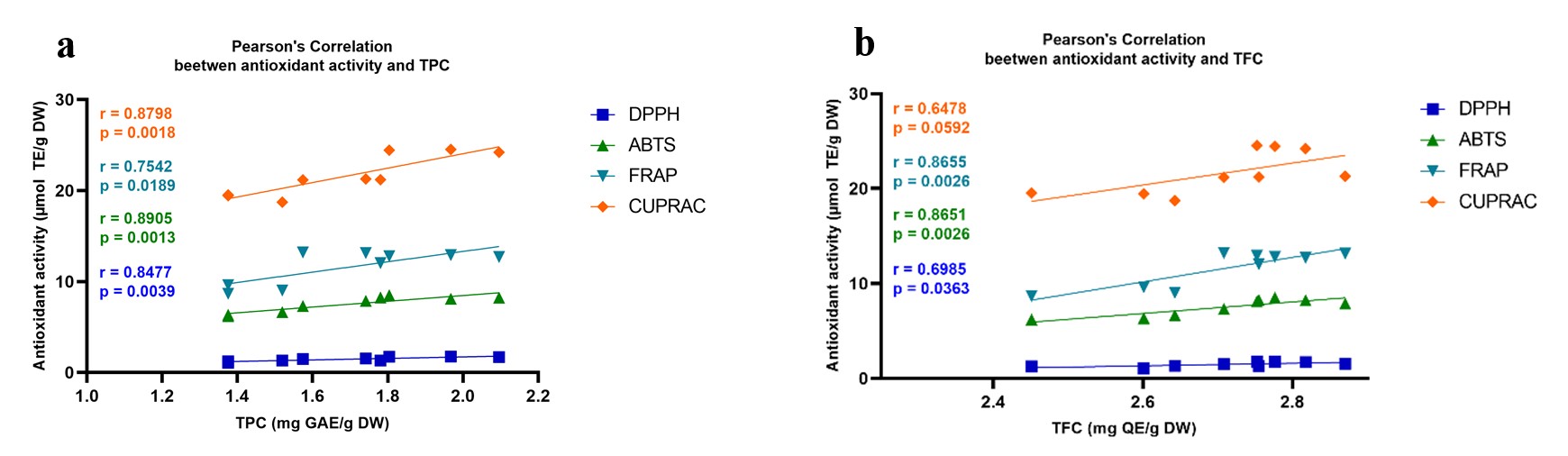
Pearson’s correlation analysis was conducted across all extraction methods to examine the relationship between TPC, TFC, and antioxidant capacity. In the CSE method (Figure 1), TPCs were strongly and significantly correlated with antioxidant capacities measured by DPPH (R = 0.8477), ABTS (R = 0.8905), FRAP (R = 0.7542), and CUPRAC (R = 0.8798). TFCs also showed positive correlations, especially with FRAP (R = 0.8655) and ABTS (R = 0.8651).
Correlation analysis employing Pearson's method to examine the relationship between antioxidant capacities and (a) the content of total phenolics (TPC) and (b) total flavonoids (TFC) in methanol extracts obtained through continues shaking extraction (CSE) from G. pictum. The antioxidant capacities were evaluated using four distinct assays: DPPH, ABTS, FRAP, and CUPRAC.
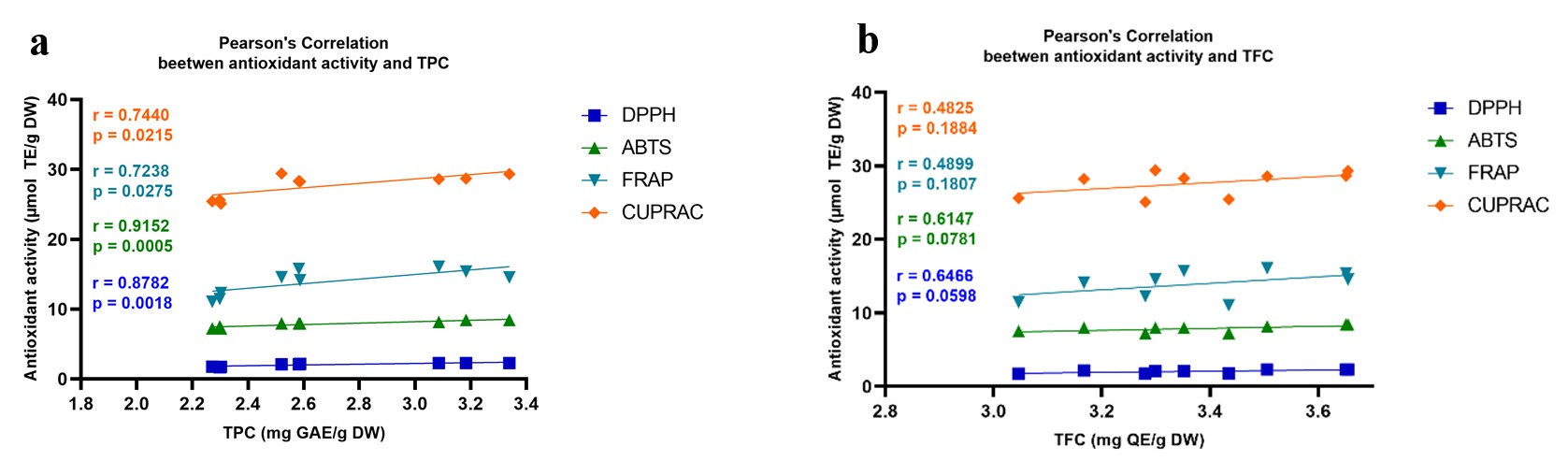
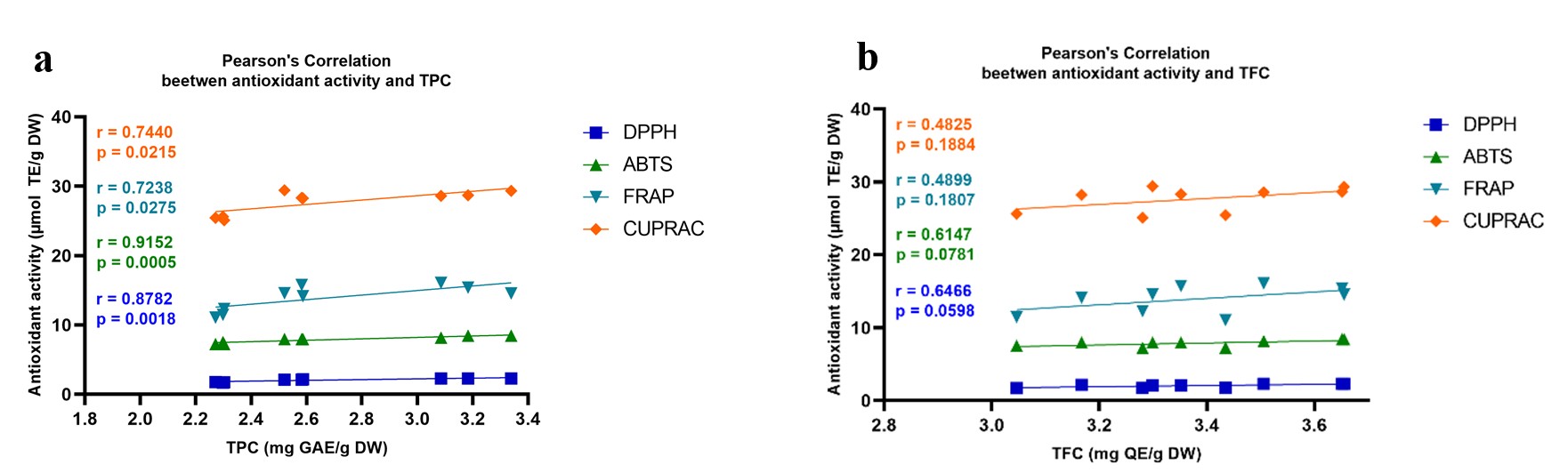
In the MAE method, TPCs displayed strong positive correlations with all assays: DPPH (R = 0.8782), ABTS (R = 0.9152), FRAP (R = 0.7238), and CUPRAC (R = 0.7440) (Figure 2), confirming the strong role of phenolics. However, TFCs from MAE extracts did not correlate significantly with any antioxidant assay, which may be due to thermal degradation during microwave treatment (Elshreef et al., 2021; Makkiyah et al., 2021).
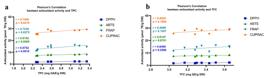
Correlation analysis employing Pearson's method to examine the relationship between antioxidant capacities and (a) the content of total phenolics (TPC) and (b) total flavonoids (TFC) in methanol extracts obtained through microwave-assisted extraction (MAE) from G. pictum. The antioxidant capacities were evaluated using four distinct assays: DPPH, ABTS, FRAP, and CUPRAC.
In the UAE method, TPCs correlated positively with ABTS (R = 0.8473) and CUPRAC (R = 0.9090), but negatively with FRAP (R = –0.9034) and insignificantly with DPPH. TFCs showed positive correlations with ABTS (R = 0.8068), CUPRAC (R = 0.8510), and DPPH (R = 0.7367), but again, negative with FRAP (R = –0.7095) (Figure 3). This trend reflects the instability of some antioxidant compounds under prolonged sonication (Elshreef et al., 2021).
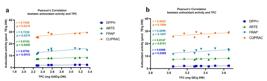
Correlation analysis employing Pearson's method to examine the relationship between antioxidant capacities and (a) the content of total phenolics (TPC) and (b) total flavonoids (TFC) in methanol extracts obtained through ultrasound-assisted extraction (UAE) from G. pictum. The antioxidant capacities were evaluated using four distinct assays: DPPH, ABTS, FRAP, and CUPRAC.
5. Conclusion
This study successfully evaluated the effects of different extraction methods (CSE, MAE, and UAE) and durations on the total phenolic and flavonoid contents (TPC and TFC) and antioxidant capacities ofGraptophyllum pictummethanol extracts. Among them, microwave-assisted extraction (MAE) for three minutes yielded the highest TPC, TFC, and antioxidant activity. The strong correlation between TPC and antioxidant capacity across all assays confirms the central role of phenolic compounds in determining antioxidant performance. These findings highlight MAE as an optimal, efficient method for recovering bioactive compounds fromG. pictumand support its potential application in the development of standardized nutraceutical and pharmaceutical products.
Data Availability Statement
The entire data set that supports the results of this study was published in the article itself.
References
-
ATERE, T.G., AKINLOYE, O.A., UGBAJA, R.N., OJO, D.A. and DEALTRY, G., 2018. In vitro antioxidant capacity and free radical scavenging evaluation of standardized extract of Costus afer leaf. Food Science and Human Wellness, vol. 7, no. 4, pp. 266-272. http://doi.org/10.1016/j.fshw.2018.09.004
» http://doi.org/10.1016/j.fshw.2018.09.004 -
BRATINČEVIĆ, M.V., KOVAČIĆ, R., POPOVIĆ, M., RADMAN, S. and MEKINIĆ, I.G., 2023. Comparison of conventional and green extraction techniques for the isolation of phenolic antioxidants from sea fennel. Processes, vol. 11, no. 7, pp. 2172. http://doi.org/10.3390/pr11072172
» http://doi.org/10.3390/pr11072172 -
ELSHREEF, H.S., MIRGHANI, M.E.S., SULAIMAN, S. and JAMI, M.S., 2021. A review of the effect of UAE optimization parameters on antioxidant activity. IOP Conference Series: Earth and Environmental Science, vol. 765, no. 1, pp. 012109. http://doi.org/10.1088/1755-1315/765/1/012109
» http://doi.org/10.1088/1755-1315/765/1/012109 -
GULCIN, İ. and ALWASEL, S.H., 2023. DPPH radical scavenging assay. Processes, vol. 11, no. 8, pp. 2248. http://doi.org/10.3390/pr11082248
» http://doi.org/10.3390/pr11082248 - JIANGSEUBCHATVEERA, N., LIAWRUANGRATH, S., TEERAWUTGULRAG, A., SANTIARWORN, D., PYNE, S.G. and LIAWRUANGRATH, B., 2017. Phytochemical screening, phenolic and flavonoid contents, antioxidant and cytotoxic activities of Graptophyllum pictum (L.) Griff. Warasan Khana Witthayasat Maha Witthayalai Chiang Mai, vol. 44, no. 1, pp. 193-202.
-
MAKKIYAH, F., RAHMI, E.P., REVINA, R., SUSANTININGSIH, T. and SETYANINGSIH, Y., 2021. Graptophyllum pictum (L.) Griff. (Syn: Justicia picta Linn.) and its effectiveness: a well-known Indonesian plant. Pharmacognosy Journal, vol. 13, no. 3, pp. 835-838. http://doi.org/10.5530/pj.2021.13.106
» http://doi.org/10.5530/pj.2021.13.106 -
NURCHOLIS, W., ALFADZRIN, R., IZZATI, N., ARIANTI, R., VINNAI, B.Á., SABRI, F., KRISTÓF, E. and ARTIKA, I.M., 2022. Effects of methods and durations of extraction on total flavonoid and phenolic contents and antioxidant activity of Java cardamom (Amomum compactum Soland Ex Maton) fruit. Plants, vol. 11, no. 17, pp. 2221. http://doi.org/10.3390/plants11172221 PMid:36079603.
» http://doi.org/10.3390/plants11172221 -
OSORIO-TOBÓN, J.F., 2020. Recent advances and comparisons of conventional and alternative extraction techniques of phenolic compounds. Journal of Food Science and Technology, vol. 57, no. 12, pp. 4299-4315. http://doi.org/10.1007/s13197-020-04433-2 PMid:33087945.
» http://doi.org/10.1007/s13197-020-04433-2 -
PHANIENDRA, A., JESTADI, D.B. and PERIYASAMY, L., 2015. Free radicals: properties, sources, targets, and their implication in various diseases. Indian Journal of Clinical Biochemistry, vol. 30, no. 1, pp. 11-26. http://doi.org/10.1007/s12291-014-0446-0 PMid:25646037.
» http://doi.org/10.1007/s12291-014-0446-0 -
RIDLO, M., KUMALANINGSIH, S. and PRANOWO, D., 2020. Process of microwave-assisted extraction (MAE) for Rhodomyrtus tomentosa fruit and its bioactive compounds. IOP Conference Series. Earth and Environmental Science, vol. 475, no. 1, pp. 012038. http://doi.org/10.1088/1755-1315/475/1/012038
» http://doi.org/10.1088/1755-1315/475/1/012038 -
RUBIO, C.P., TVARIJONAVICIUTE, A., MARTINEZ-SUBIELA, S., HERNÁNDEZ-RUIZ, J. and CERÓN, J.J., 2016. Validation of an automated assay for the measurement of cupric reducing antioxidant capacity in serum of dogs. BMC Veterinary Research, vol. 12, no. 1, pp. 137. http://doi.org/10.1186/s12917-016-0760-2 PMid:27370026.
» http://doi.org/10.1186/s12917-016-0760-2 -
SILVA, S.A.M., MICHNIAK-KOHN, B. and LEONARDI, G.R., 2017. An overview about oxidation in clinical practice of skin aging. Anais Brasileiros de Dermatologia, vol. 92, no. 3, pp. 367-374. http://doi.org/10.1590/abd1806-4841.20175481 PMid:29186250.
» http://doi.org/10.1590/abd1806-4841.20175481 -
TOMAZ, I., HUZANIĆ, N., PREINER, D., STUPIĆ, D., ANDABAKA, Ž., MALETIĆ, E., KONTIĆ, J.K. and AŠPERGER, D., 2019. Extraction methods of polyphenols from grapes: extractions of grape polyphenols. In: R.R. WATSON, ed. Polyphenols in plants 2nd ed. Cambridge: Academic Press, pp. 151-167. http://doi.org/10.1016/B978-0-12-813768-0.00010-4
» http://doi.org/10.1016/B978-0-12-813768-0.00010-4 -
TUNGMUNNITHUM, D., THONGBOONYOU, A., PHOLBOON, A. and YANGSABAI, A., 2018. Flavonoids and other phenolic compounds from medicinal plants for pharmaceutical and medical aspects: an overview. Medicines (Basel, Switzerland), vol. 5, no. 3, pp. 93. http://doi.org/10.3390/medicines5030093 PMid:30149600.
» http://doi.org/10.3390/medicines5030093 -
UPADHYA, V., PAI, S.R. and HEGDE, H.V., 2015. Effect of method and time of extraction on total phenolic content in comparison with antioxidant activities in different parts of Achyranthes aspera. Journal of King Saud University - Science, vol. 27, no. 3, pp. 204-208. http://doi.org/10.1016/j.jksus.2015.04.004
» http://doi.org/10.1016/j.jksus.2015.04.004 -
ZHANG, Q.-W., LIN, L.-G. and YE, W.-C., 2018. Techniques for extraction and isolation of natural products: a comprehensive review. Chinese Medicine, vol. 13, pp. 20. http://doi.org/10.1186/s13020-018-0177-x PMid:29692864.
» http://doi.org/10.1186/s13020-018-0177-x
Edited by
-
Editor:
Takako Matsumurua Tundisi