 Hydrogel technology increases resilience of Inga edulis seedlings under drought conditions
Abstract
Technologies that can mitigate the stressful effect of water deficit and assist in seedling recovery are necessary. This study aimed to evaluate the effect of hydrogel doses on mitigating water deficit stress and the recovery of Inga edulis Mart. seedlings in the post-stress period. The seedlings were grown under the following water management regimes: control - daily irrigation; water restriction (WR) - seedling irrigation suppression + 50 mL of Hydrogel (H); WR + 100 mL of H, and WR + 150 mL of H. The seedlings were evaluated in two periods: P0 - when the photosynthetic rate (A) of the seedlings of at least one of the treatments subjected to irrigation suppression with or without hydrogel reached values close to zero; REC (recovery) - after P0 in the seedlings of each treatment, irrigation was resumed until the seedlings previously subjected to WR of each treatment reached values of A ≥ 50% to that of the control seedlings. Adding 100 mL of hydrogel delayed the stressful effect of water deficit on the photosynthetic rate. Furthermore, it assisted in a more rapid post-stress recovery while keeping the Rubisco carboxylation efficiency high upon recovery.
Keywords:
mitigation; phenotypic plasticity; physiological adjustment; polymer; proline; water-retaining
Resumo
Tecnologias que possam contribuir na mitigação do efeito estressante do déficit hídrico e auxiliar na recuperação de mudas são necessárias. Objetivou-se nessa pesquisa avaliar o efeito de doses de hidrogel na mitigação do estresse por déficit hídrico e na recuperação de mudas de Inga edulis Mart. no pós-estresse. As mudas foram cultivadas sob os seguintes manejos hídricos: controle -irrigação realizada diariamente; restrição hídrica (RH) - suspensão da irrigação das mudas + 50 mL de Hidrogel (H); RH + 100 mL de H e RH + 150 mL de H. As mudas foram avaliadas em dois períodos: F0 – quando a taxa fotossintética (A) das mudas, de pelo menos um dos tratamentos, submetidos à suspensão da irrigação alcançou valores próximos a zero; REC (recuperação) – após a F0 nas mudas de cada tratamento, realizou-se a retomada da irrigação até que as mudas previamente submetidas a RH de cada tratamento atingissem valores de A ≥ 50% ao das mudas controle. A adição de 100 mL de hidrogel retardou o efeito estressante do déficit hídrico sobre A e auxiliou na recuperação de maneira mais rápida no pós-estresse, mantendo elevada a eficiência de carboxilação da Rubisco na recuperação.
Palavras-chave:
mitigação; plasticidade fenotípica; ajuste fisiológico; polímero; prolina; retenção de água
1. Introduction
Inga edulis Mart. (Fabaceae) is a Brazilian native fruiting pioneer species with wide occurrence. It occurs in several phytogeographic domains in Brazil, including Amazon, Caatinga, Cerrado, and Atlantic Forest (Guimarães Sobrinho et al., 2020). It comprises phytophysiognomies of anthropic areas, riparian or gallery forests, floodplain forests, seasonal semideciduous forests, ombrophilous/pluvial forests, and Restinga (Garcia and Fernandes, 2015). The seedlings can be inserted in agroforestry systems and the recovery of degraded areas because they show rapid growth (Pireda et al., 2018; Delatorre et al., 2020).
Considering that the species is generally found in humid areas and the worsening of global climate change, low soil water availability is/or may become a limiting factor for its growth. Furthermore, for several species, photosynthetic metabolism activities change when under water deficit conditions. Thus, the increment of photoassimilates and biomass production decreases (Beltramin et al., 2020; Braga et al., 2021; Santos et al., 2021).
In order to minimize the possible damage to the photosynthetic apparatus, it is essential to establish cultivation technologies that can contribute to mitigating the stressful effect of water deficit and assist in seedling recovery in the post-stress period. The hydrogel, a water-retaining polymer with polyacrylamide in its constitution, contributes to water retention capacity and water storage in the soil and near the roots (Tatagiba et al., 2019; Beltramin et al., 2020; Felippe et al., 2021). Thus, it reduces seedling losses and the success of reforestation practices. Responses in fruit and native species and the optimal hydrogel dose remain scarcely studied. Considering the fact that I. edulis is a species sensitive to water deficit (Alvarado-Sanabria, 2023; Faustino and Marciano, 2021) and that there is no work associated with hydrogel makes further studies necessary.
We hypothesized that even though water restriction damages the photosynthetic apparatus and growth of I. edulis seedlings, adding hydrogel to the pit mitigates the stressful effect. Thus, this study aimed to evaluate the effect of hydrogel doses on mitigating water deficit stress and the recovery of I. edulis seedlings in the post-stress period.
2. Materials and Methods
The experiment was carried out at the Faculty of Agricultural Sciences (22º 11' 43.7” S and 54º 56' 08.5” W, 452 m) of the Universidade Federal da Grande Dourados (UFGD), in Dourados - MS, Brazil. The seedlings were kept in a 30% shaded nursery with additional top and side protection with plastic sheeting to prevent rainfall.
The seedlings were grown under the following water management regimes: 1) control = daily irrigation maintaining 70% of WRC (water retention capacity) according to Souza et al. (2000); 2) WR + 50 mL of Hydrogel (H); 3) WR + 100 mL of H and 4) WR + 150 mL of H. The experimental design was entirely randomized, with four replications. Each experimental unit comprised one pot with two seedlings each.
The hydrogel used was the Nutrigel SOLCROP® water-retaining polymer, presenting the following specifications according to the manufacturer: 6,000% WRC, 270% cation exchange capacity (mmol dm3), maximum moisture of 1.5%, and raw material comprising MgCO3, CaCO3, and polymers. The product was prepared in 4 g L-1 of water and left to stand for 20 min until it showed a gel-like appearance. Then, the seedlings grown with hydrogel were removed from the pots, and the amount of H corresponding to each treatment was added into the pit near the root, characterizing the second transplanting of these seedlings.
The seedlings were evaluated in two periods: (i) P0 - the photosynthetic rate was monitored, considering favorable climatic conditions, until the moment in which the seedlings of each irrigation suppression treatment showed values close to zero. (ii) REC (recovery) - after P0 in the seedlings of each treatment, irrigation was resumed, maintaining 70% of the WRC, until the seedlings previously submitted to the WR of each treatment reached values of A ≥ 50% to that of the control seedlings, which occurred on different days. The non-destructive and destructive characteristics evaluated were:
Gas exchange: Using a portable photosynthesis meter LCIPro- SD ADC Bio Scientific Ltd, we evaluated photosynthetic rate (A - µmol CO2 m-2 s-1), transpiration (E - mmol H2O m-2 s-1), and intercellular CO2 concentration (Ci - mmol CO2 m-2 s-1). Furthermore, we calculated the carboxylation efficiencies of Rubisco (A/Ci - μmol m-2 s-1/mmol m-2 s-1) and water use (WUE: A/E - μmol m-2 s-1/ mmol m-2 s -1). Monitoring of A was performed on days with favorable weather conditions. That is, average photosynthetic photon flux density (PPFD) of 950 μmol m-2 s-1, no constant winds, and no cloudiness during the evaluations. Evaluations of gas exchange, chlorophyll a fluorescence and chlorophyll index were performed on fully expanded leaves, located in the middle third of the plants.
Chlorophyll a fluorescence: Using a portable fluorometer model OS-30p (Opti-Sciences Chlorophyll Fluorometer, Hudson, USA), the potential quantum efficiency of photosystem II (Fv/Fm) was evaluated and from initial fluorescence measurements (F0) and maximum fluorescence (Fm), the effective efficiency of absorbed energy conversion (Fv/F0) and the basal quantum output of non-photochemical processes (F0/Fm) were calculated. For this, the leaves were subjected to a period of 30 minutes of adaptation to the dark with the aid of adapter clips.
Chlorophyll index and initial growth: Using a portable chlorophyll meter - SPAD (Soil Plant Analyzer Development - Konica Minolta SPAD 502), the chlorophyll index was
evaluated between 8 and 10 am, on the same leaves used to assess gas exchange. The leaf area (LA) was measured using a Li 3100 - Area Meter, and the results were expressed in cm2. Root length (RL) was obtained with a ruler graded in cm. In order to obtain the total dry mass, we put the material in Kraft paper bags and placed them in an oven with forced air circulation at 60 ± 5 ºC for 72 hours.
Proline: The extraction of proline in roots was performed in sulfosalicylic acid according to Colton-Gagnon et al. (2014) and quantification was performed using spectrophotometer at 520 nm according to the methodology of Bates et al. (1973).
The data taken in each evaluation period were analyzed separately. The data were subjected to analysis of variance (ANOVA), and when significant according to the F-test (P ≤ 0.05), the means were compared using Tukey's test for water management regimes (P ≤ 0.05) using SISVAR software.
3. Results
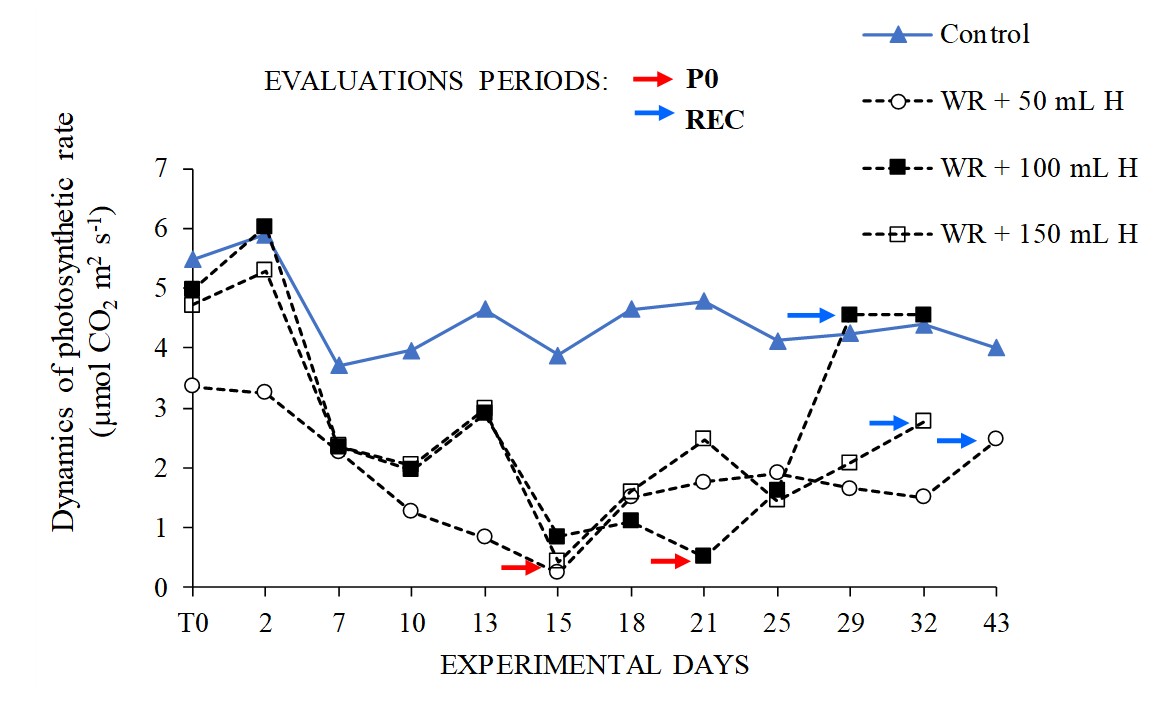
Inga edulis seedlings showed sensitivity to water deficit, and the first to reach P0 were those grown under WR with 50 and 150 mL of H, which occurred on the 15th day after irrigation suppression. They showed values of 0.30 and 0.39 μmol CO2 m-2 s-1, respectively. Seedlings under WR with 100 mL of H reached P0 at 21 days. At REC, seedlings in WR with 100 mL of H took 8 days after resuming irrigation to increase A values, while those grown with 150 and 50 mL of H took 14 and 17 days, respectively (Figure 1).
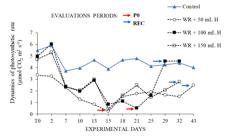
Dynamics of photosynthetic rate in Inga edulis Mart. seedlings cultivated under different water management (control = irrigated, and suppression of irrigation (WR) with 50, 100 and 150 mL of Hydrogel - H) in two evaluation periods (P0 = photosynthesis close to zero; REC = recovery).
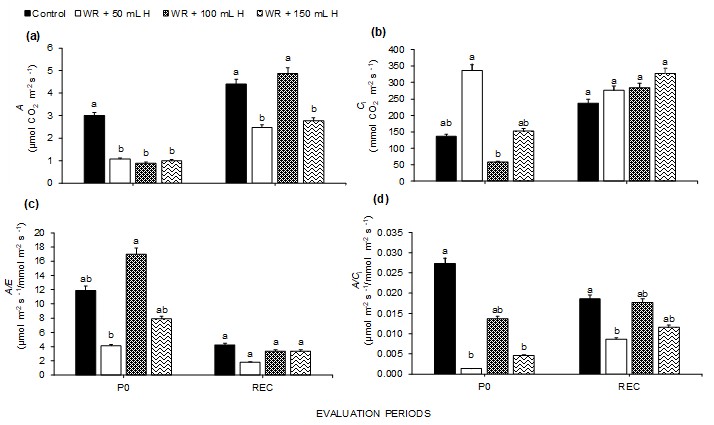
We observed lower A values in seedlings subjected to WR associated with 50 and 150 mL of H, while those grown with 100 mL did not differ from control seedlings (Figure 2a). At REC, the seedlings previously grown under WR with 100 mL of H showed higher A (6.03 μmol CO2 m-2 s-1), differing from those with 50 mL of H (3.28 μmol CO2 m-2 s-1).
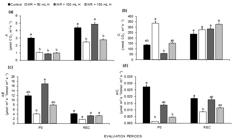
Photosynthetic rate - A (a), intercellular CO2 concentration - Ci (b), water use efficiency – WUE (A/E) (c) and intrinsic carboxylation efficiency of Rubisco - A/Ci (d) in Inga edulis Mart. seedlings cultivated under different water management (control = irrigated, and suppression of irrigation (WR) with 50, 100 and 150 mL of Hydrogel - H) in two evaluation periods (P0 = photosynthesis close to zero; REC = recovery). Equal letters do not differ statistically in each evaluation period (Tukey, p > 0.05).
We found a higher intercellular CO2 concentration (Ci) value (337 mmol CO2 m-2 s-1) in the seedlings under WR with 50 mL of H at P0 (Figure 2b), which promoted lower efficiency A/Ci (0.014 μmol m-2 s-1/mmol m-2 s -1) in this same condition. Moreover, there was a greater accumulation of CO2 in the tissues in this same period (Figure 2d).
On the other hand, the seedlings subjected to WR with 100 mL of H (58.00 mmol CO2 m-2 s-1) showed the lowest Ci value, which consequently reflected on the A/Ci at P0, making these seedlings show values close to that of the control seedlings. At REC, the highest A/Ci values (0.0430 and 0.0203 μmol m-2 s-1/mmol m-2 s-1) occurred in the control seedlings and under WR with 100 mL of H, respectively (Figure 2d). Meanwhile, the Ci normalized in all water management regimes in this same evaluation period.
At P0, the seedlings subjected to WR with 100 mL of H showed the highest water use efficiency (WUE) values (14.57 μmol m-2 s-1/mmol m-2 s-1), followed by the control. Seedlings under WR with 50 mL of H showed the lowest WUE values at P0 (2.8 μmol m-2 s-1/mmol m-2 s-1). There were no differences between the water management regimes at REC (Figure 2c).
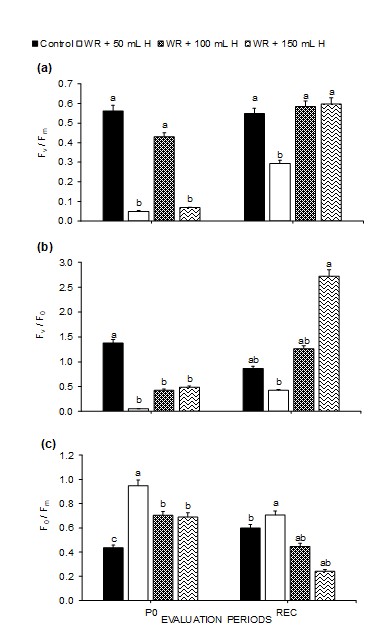
Regarding Fv/Fm at P0, the seedlings under WR with 50 and 150 mL of H showed lower values (0.050 and 0.069), respectively, while seedlings in the other water management regimes did not differ. However, the seedlings previously under WR with 150 mL of H at REC showed the highest Fv/Fm values (0,598). Conversely, the seedlings under WR with 50 mL of H (0.29) showed the lowest value. Seedlings previously in WR with 100 mL of H showed values similar to the control (Figure 3a).
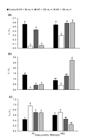
Potential photochemical quantum efficiency of photosystem II - Fv/Fm (a), absorbed energy conversion efficiency - Fv/F0 (b) and - maximum basal yield of non-photochemical processes F0/Fm (c) in Inga edulis Mart. seedlings cultivated under different water management (control = irrigated, and suppression of irrigation (WR) with 50, 100 and 150 mL of Hydrogel - H) in two evaluation periods (P0 = photosynthesis close to zero; REC = recovery). Lowercase letters compare water regimes and H use in each evaluation period (Tukey, p < 0.05).
In the Fv/F0, seedlings subjected to WR with 50 mL of H showed the lowest values at P0 (0.05), differing from the other water management regimes. At REC, the WR seedlings with 150 mL of H showed the highest observed value (3.05). The seedlings subjected to WR + 50 mL of H showed the lowest Fv/F0 value (Figure 3b).
Inga edulis seedlings subjected to WR with 50 mL of H showed the highest F0/Fm value (0.94) at P0 and REC. In contrast, the control seedlings showed the lowest values for this characteristic at P0. At REC, the WR seedlings with 150 mL of H (0.24) showed the lowest values (Figure 3c).
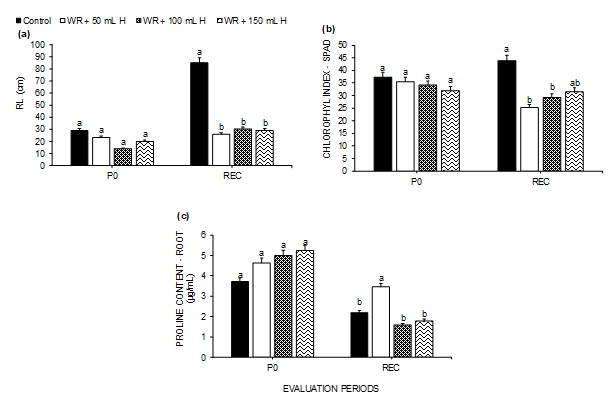
For RL at P0, there was no difference between the H doses (Figure 4a). At REC, the control showed the highest RL value. Regarding the chlorophyll index, at P0, there was no difference between the water management regimes. However, at REC, the highest values occurred in the control seedlings, which did not differ from those subjected to WR with 100 mL de hydrogel (Figure 4b).
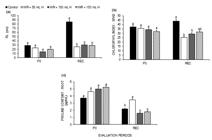
Root length - RL (a), chlorophyll index - SPAD (b) and proline content (c) in Inga edulis Mart. seedlings cultivated under different water management (control = irrigated, and suppression of irrigation (WR) with 50, 100 and 150 mL of Hydrogel - H) in two evaluation periods (P0 = photosynthesis close to zero; REC = recovery). Lowercase letters compare water regimes and H use in each evaluation period (Tukey, p < 0.05).
The leaf area of I. edulis seedlings was not influenced by water management. Proline in P0 showed no difference between water managements, while in REC it remained higher in seedlings previously under RH associated with 50 mL H in REC (Figure 4c). Seedling total dry mass did not vary according to water management regimes during the evaluation periods, showing an overall average of 2.170 g per plant.
4. Discussion
We emphasize that the 100 mL dose of hydrogel delayed the effect of water deficit stress compared to the other water management regimes. In addition, P0 was only reached 21 days after irrigation was stopped and this dose helped in the rapid recovery in the post-stress period, which occurred 8 days after irrigation was resumed, reinforcing our hypothesis.
The seedlings subjected to WR with 100 mL of H showed the highest values of A compared to the other seedlings under stress. They even outperformed the control plants in the REC, demonstrating that this dose of H was sufficient when placed in the pit, absorbing the water and making it available during the deficit. Thus, it meets the needs of these seedlings for a longer period, which promotes a faster recovery after resuming irrigation compared to other doses.
The hydrogel is a polymer formed by an endophilic group that can absorb 150 to 400 times its weight in water. It can alleviate deficit symptoms when placed in the hole, as it is close to the root, improving the water status, turgidity and leaf metabolism of the plant (Santos et al., 2021). This polymer acts as a soil conditioner, improving aeration and drainage by reducing water and nutrient loss through leaching. Furthermore, the addition of the polymer increases the water potential in the substrate, leading to a more efficient translocation of water through the xylem vessels to the leaves (Azevedo et al., 2002; Teixeira et al., 2019).
Likewise, the hydrogel contributed to mitigate the stressful effect of water deficit in seedlings of Schinus terebinthifolia Raddi (Beltramin et al., 2020) and Campomanesia xanthocarpa O. Berg. (Santos et al., 2021), which maintenance of growth and photosynthetic activity.
We emphasize that in general, especially at P0, the seedlings in WR associated with 50 and 150 mL of H showed lower A values compared to the other water management regimes, suggesting that it was an insufficient and excessive H dose for this species. Even though plant responses to hydrogel vary depending on the species, in Cedrela odorata L. seedlings subjected to water deficit, 50 mL of H per pit contributed little to maintaining photosynthetic metabolism (Silva et al., 2021). Regard to A/Ci, similarly, I. edulis, S. terebinthifolia seedlings also showed higher A/Ci and A values when subjected to water restriction with the addition of 100 mL of H into the pot (Beltramin et al., 2020).
Thus, 50 mL was insufficient to maintain the A/Ci, but in contrast, I. edulis seedlings subjected to WR with 100 mL of H showed a similar performance to normally-irrigated seedlings. Even though the Rubisco activity responds to various environmental factors, this lower efficiency may refer to damage to the thylakoid membranes of the chloroplasts in these seedlings' cells (Beltramin et al., 2020).
One of the first responses of plants under conditions of water deficit is to avoid water loss through transpiration (Felippe et al., 2021) while decreasing the CO2 influx to the substomatal cavity, but response often reduces the CO2 in the chloroplasts available to the active carboxylation site of the Rubisco enzyme (Bertolli et al., 2015). On the other hand, these stomatal regulation mechanisms favor the maintenance of WUE, suggesting a physiological adjustment strategy to the water deficit, as observed in our study in the treatment of I. edulis with 100 mL of H.
Demonstrating that this dose contributed to soil moisture and plant water statuses even under adverse conditions. According to Felippe et al. (2021), hydrogel provided increased soil water content, delaying the effects of water stress symptoms in Eucalyptus urograndis seedlings. We emphasize that the maintenance of WUE with 100 mL of H during P0 reflected in better functioning of the photosynthetic apparatus, since although the seedlings previously under WR with 50 and 150 mL of H presented statistically similar values to the control, these were not able to to efficiently increase the values of A.
The reduction and increased of Fv/F0 and F0/Fm, respectively, under WR with 50 mL of H pointing out that the photosystem II reaction centers were compromised. When the photochemical apparatus does not properly operate, the regenerative capacity of the CO2 ribulose bisphosphate fixing enzyme decreases, given that ATP and NADPH synthesis may be compromised (Bertolli et al., 2015). Besides not helping to alleviate the symptoms of water deficit, we verified that 50 mL of hydrogel into the pit of I. edulis seedlings affected the seedlings' development, damaging their photosynthetic apparatus and reducing the production of photo-assimilates.
Seedlings with lower Fv/Fm values indicate possible damage to the thylakoid membranes leading to low levels of electron transfer considered as a heat dissipation strategy for morphological adjustment (Toro-Tobón et al., 2022). With low Fv/Fm values, the seedlings have difficulty fixing CO2 in the leaf tissue, which is an excellent indicator of stress in the seedlings. When the plant has compromised electron flow, the photochemical activity of the leaves also becomes limited. (Freire et al., 2022; Veloso et al., 2023).
By maintaining a higher humidity in the substrate (here at a dose of 100 mL), hydrogel helped reduce the damage to the reaction centers even under low water availability, especially at REC. When absorbing the water and slowly making it available to the plants, deficit symptoms can be mitigated by maintaining cell membrane integrity, reducing reactive oxygen species production (Navroski et al., 2016; Santos et al., 2021), and having a beneficial effect on photoassimilates production.
H was incorporated close to the roots and kept the area humid, influencing the maintenance of the water potential of the seedlings, without increasing root length, since for RL at P0 there was no difference between treatments.
Although the effect of the deficit was not pronounced on the chlorophyll index at P0, this condition reflected negatively on the REC, since the previously stressed seedlings had lower values than the control ones. Normally, under conditions of water deficit, degradation of chlorophyll occurs due to the formation of reactive oxygen species (ROS), damaging the membranes of thylakoids and chloroplasts, resulting in the degradation of photosynthetic pigments (Foresti et al., 2022; Santos et al., 2022).
The increase in proline occurs due to the adjustment mechanism of tolerance to moderate water stress, that is, the accumulation of proline in plant tissues acts as an osmoprotector in the stabilization of subcellular structures and as an antioxidant (Queiroz et al., 2017; Hussain et al., 2022), and its reduction in recovery indicates potential metabolism normalization, except in seedlings grown with 50 mL of hydrogel, suggesting that these seedlings would not recover post-stress.
The fact that the seedlings did not present alterations in terms of leaf area and total dry mass an be explained by the time of exposure to the stress condition, which may have been insufficient to promote accentuated changes in growth, a response proven by the production of biomass. This result suggests I. edulis has the potential for adaptation by phenotypic plasticity to water restriction in the period evaluated here. Whereas Inga edulis is a pioneer plant tolerant to short periods of drought (Possette and Rodrigues, 2010).
However, how growth responses vary by species. For example, regarding LA for seedlings of S. terenbinthifolia (Beltramin et al., 2020) and Callophyllum brasiliense Cambess. (Reis et al., 2020) submitted to water deficit showed lower values for this characteristic, as a mechanism for reducing water loss through transpiration and maintaining plant tissue turgor.
Considering that I. edulis occurs in several phytogeographic regions and phytophysiognomies (Garcia and Fernandes, 2015), we suggest that this species is generalist to several edaphoclimatic conditions and presents a high level of environmental resilience. Further studies aimed at a longer period to evaluate growth characteristics could determine, with greater certainty, the ideal hydrogel dose for seedling cultivation.
Even though Inga edulis is a species resilient to adverse conditions, adding 100 mL of H into the pot increased the Rubisco carboxylation. Furthermore, it reduced the damage to the photosystem II reaction centers, delaying water deficit stress effects and assisting in photosynthesis recovery more rapidly during the post-stress period.
Acknowledgements
The authors thank CAPES and CNPq, for granting the scholarships, and the FUNDECT, for financial support.
Data Availability Statement
The entire data set that supports the results of this study was published in the article itself.
References
-
ALVARADO-SANABRIA, O.H., 2023. Effect of water déficit on water status and growth of five tropical species used in urban forestry. Revista Facultad Nacional de Agronomía, vol. 76, no. 1, pp. 10125-10134. http://doi.org/10.15446/rfnam.v76n1.101470
» http://doi.org/10.15446/rfnam.v76n1.101470 - AZEVEDO, T.L.F., BERTONHA, A. and GONÇALVES, A.C.A., 2002. Uso de hidrogel na agricultura. Revista Ciências Agro-ambientais, vol. 1, no. 1, pp. 23-31.
-
BATES, L.S., WALDREN, R.P. and TEARE, I.D., 1973. Rapid determination of free proline for water-stress studies. Plant and Soil, vol. 39, no. 1, pp. 205-207. http://doi.org/10.1007/BF00018060
» http://doi.org/10.1007/BF00018060 -
BELTRAMIN, F.A., SILVA, W.C., SANTOS, C.C., SCALON, S.P.Q. and VIEIRA, M.C., 2020. Water-retaining polymer mitigates the water deficit in Schinus terebinthifolia: photosynthetic metabolism and initial growth. Engenharia Agrícola, vol. 40, no. 6, pp. 684-691. http://doi.org/10.1590/1809-4430-eng.agric.v40n6p684-691/2020
» http://doi.org/10.1590/1809-4430-eng.agric.v40n6p684-691/2020 -
BERTOLLI, S.C., SOUZA, J. and SOUZA, G.M., 2015. Caracterização fotossintética da espécie isohídrica pata-de-elefante em condições de deficiência hídrica. Revista Caatinga, vol. 28, no. 3, pp. 196-205. http://doi.org/10.1590/1983-21252015v28n322rc
» http://doi.org/10.1590/1983-21252015v28n322rc -
BRAGA, F.M., FERREIRA, E.A., CABRAL, C.M., FREITAS, I.C., MACIEL, J.C., FREITAS, M.S.S., ASPIAZU, I., SANTOS, J.B., FERNANDES, L.A., FRAZÃO, L.A. and SAMPAIO, R.A., 2021. Revisão: crescimento de plantas C3 e C4 em respostas a diferentes concentrações de CO2 Research, Society and Development, vol. 10, no. 7, e33810716701. http://doi.org/10.33448/rsd-v10i7.16701
» http://doi.org/10.33448/rsd-v10i7.16701 -
COLTON-GAGNON, K., ALI-BENALI, M.A., MAYER, B.F., DIONNE, R., BERTRAND, A., DO CARMO, S. and CHARRON, J.B., 2014. Comparative analysis of the cold acclimation and freezing tolerance capacities of seven diploid Brachypodium distachyon accessions. Annals of Botany, vol. 113, no. 4, pp. 681-693. http://doi.org/10.1093/aob/mct283 PMid:24323247.
» http://doi.org/10.1093/aob/mct283 -
DELATORRE, F.M., CUPERTINO, G.F.M., SANTOS JÚNIOR, A.J., DA SILVA, A.M., DIAS JÚNIOR, A.F. and DE CARVALHO, A.M., 2020. Behavior of Ingá wood (Inga edulis Mart) against machining tests. Research, Society and Development, vol. 9, no. 8, pp. 1-17. http://doi.org/10.33448/rsd-v9i8.5119
» http://doi.org/10.33448/rsd-v9i8.5119 -
FAUSTINO, L.F. and MARCIANO, C.R., 2021. Intervalo hídrico ótimo e valores críticos de densidade como indicadores de recuperação de um solo sob Sistema florestais e pasto. Ciência Florestal, vol. 31, no. 2, pp. 658-682. http://doi.org/10.5902/1980509833474
» http://doi.org/10.5902/1980509833474 -
FELIPPE, D., NAVROSKI, M.C., SAMPIETRO, J.A., MOTA, C.S., PEREIRA, M.O., ALBUQUERQUE, J.A., ANDRADE, R.S. and MORAES, C., 2021. Hydrogel and irrigation frequencies in survival, growth and gas exchanges in Eucalyptus urograndis. Ciência Florestal, vol. 31, no. 4, pp. 1569-1590. http://doi.org/10.5902/1980509836889
» http://doi.org/10.5902/1980509836889 -
FORESTI, A.C., REIS, L.C., SCALON, S.P.Q., DRESCH, D.M., SANTOS, C.C. and JESUS, M.V., 2022. Salicylic acid mitigating damage to the photosynthetic apparatus and quality of Eugenia myrcianthes seedlings under water deficit. Rodriguésia, vol. 73, e00872021. http://doi.org/10.1590/2175-7860202273052
» http://doi.org/10.1590/2175-7860202273052 -
FREIRE, F.C.J., SILVA-PINHEIRO, J., SANTOS, J.S., SILVA, A.G.L., CAMARGOS, L.S., ENDRES, L. and JUSTINO, G.C., 2022. Proline and antioxidante enzymes protect Tabebuia aurea (Bignoniaceae) from transitory water deficiency. Rodriguésia, vol. 73, e02062020. http://doi.org/10.1590/2175-7860202273031
» http://doi.org/10.1590/2175-7860202273031 - GARCIA, F.C.P. and FERNANDES, J.M., 2015. Inga In: JARDIM BOTÂNICO DO RIO DE JANEIRO, ed. Lista de espécies da Flora do Brasil. Rio de Janeiro: JBRJ.
-
GUIMARÃES SOBRINHO, A.C., ROGEZ, H.L.G., NASCIMENTO, V.H.A., TEIXEIRA, B.J., DIAS, A.L.S. and SOUZA, J.N.S., 2020. Determination of bioactive compounds and scavenging capacity of free radicals in Byrsonima crassifolia and Inga edulis leaf extracts. Brazilian Journal of Development, vol. 6, no. 6, pp. 34954-34969. http://doi.org/10.34117/bjdv6n6-147
» http://doi.org/10.34117/bjdv6n6-147 -
HUSSAIN, N., YASMEEN, A. and YOUSAF, M.M., 2022. Antioxidant status and their enhancements strategies for water stress tolerance in chickpea. Brazilian Journal of Biology = Revista Brasileira de Biologia, vol. 82, e237809. http://doi.org/10.1590/1519-6984.237809 PMid:33978079.
» http://doi.org/10.1590/1519-6984.237809 -
NAVROSKI, M.C., ARAUJO, M.M., CUNHA, F.S., BERGHETTI, A.L.P. and PEREIRA, M.O., 2016. Redução da adubação e melhoria das características do substrato com o uso do hidrogel na produção de mudas de Eucalyptus dunni Maiden. Ciência Florestal, vol. 26, no. 4, pp. 1155-1165. http://doi.org/10.5902/1980509825106
» http://doi.org/10.5902/1980509825106 -
PIREDA, S., MIGUEL, E.C., XAVIER, V. and CUNHA, M., 2018. Morpho-anatomical and ultra-structural analysis of extrafloral nectaries in Inga edulis (Vell.) Mart. (Leguminosae). Nordic Journal of Botany, vol. 36, no. 7, pp. 1-11. http://doi.org/10.1111/njb.01665
» http://doi.org/10.1111/njb.01665 -
POSSETTE, R.F.S. and RODRIGUES, W.A., 2010. O gênero Inga Mill. (Leguminosae – Mimosoideae) no estado do Paraná, Brasil. Acta Botanica Brasílica, vol. 24, no. 2, pp. 354-368. http://doi.org/10.1590/S0102-33062010000200006
» http://doi.org/10.1590/S0102-33062010000200006 -
QUEIROZ, T.B., ROCHA, S.M.G., FONSECA, F.S.A., ALVARENGA, I.C.A. and MARTINS, E.R., 2017. Efeitos do déficit hídrico no cultivo de mudas de eucalipto. Irriga, vol. 22, no. 4, pp. 659-674. http://doi.org/10.15809/irriga.2017v22n4p659-674
» http://doi.org/10.15809/irriga.2017v22n4p659-674 -
REIS, L.C., SCALON, S.P.Q., DRESCH, D.M., FORESTI, A.C., SANTOS, C.C. and PEREIRA, Z.V., 2020. Chlorophyll-a fluorescence as an indicator of water stress in Callophyllum brasiliense. Notulae Botanicae Horti Agrobotanici Cluj-Napoca, vol. 48, pp. 210-220. http://doi.org/10.15835/nbha48111757
» http://doi.org/10.15835/nbha48111757 -
SANTOS, C.C., SILVERIO, J.M., SCALON, S.P.Q. and VIEIRA, M.C., 2021. Hydrogel and water regimes in the chlorophyll-a fluorescence and growth of Campomanesia xanthocarpa seedlings. Engenharia Agrícola, vol. 41, no. 3, pp. 330-337. http://doi.org/10.1590/1809-4430-eng.agric.v41n3p330-337/2021
» http://doi.org/10.1590/1809-4430-eng.agric.v41n3p330-337/2021 -
SANTOS, C.C., LIMA, N.M., SARACHO, L.C.S., SCALON, S.P.Q. and VIEIRA, M.C., 2022. Salicylic acid alleviates the water stress on photochemical apparatus and quality of Schinus terebinthifolia seedlings. Revista Brasileira de Engenharia Agrícola e Ambiental, vol. 26, no. 10, pp. 747-752. http://doi.org/10.1590/1807-1929/agriambi.v26n10p747-752
» http://doi.org/10.1590/1807-1929/agriambi.v26n10p747-752 -
SILVA, M.S., SCALON, S.P.Q., SILVERIO, J.M., SANTOS, J.K.V., SANTOS, C.C. and DRESCH, D.M., 2021. Do hydro-retainer polymers attenuate damage from water fluctuations in leaf metabolism and the quality of Cedrela odorata seedlings? International Journal of Agriculture and Biology, vol. 26, no. 2, pp. 209-216. http://doi.org/10.17957/IJAB/15.1826
» http://doi.org/10.17957/IJAB/15.1826 -
SOUZA, C.C., OLIVEIRA, F.A., SILVA, I.F. and AMORIM NETO, M.S., 2000. Avaliação de métodos de determinação de água disponível e manejo da irrigação em terra roxa sob cultivo de algodoeiro herbáceo. Revista Brasileira de Engenharia Agrícola e Ambiental, vol. 4, no. 3, pp. 338-342. http://doi.org/10.1590/S1415-43662000000300006
» http://doi.org/10.1590/S1415-43662000000300006 -
TATAGIBA, S.D., SILVA, A.G., PENCHEL FILHO, R.M., REIS, E.F. and RAMOS, K.A., 2019. Disponibilidade hídrica e doses de polímero hidrorretentor na produção de mudas clonais de eucalipto. Engenharia na Agricultura, vol. 27, no. 4, pp. 359-369. http://doi.org/10.13083/reveng.v27i4.938
» http://doi.org/10.13083/reveng.v27i4.938 -
TEIXEIRA, C.E.S., TORRES, A.Q.A., NIERI, E.M., MELO, L.A., SANTOS, L.V. and BOTELHO, A.S., 2019. Polímero hidrorretentor e fertilização mineral na implantação de híbrido de Eucalyptus urophylla x Eucalyptus grandis. Ciência Florestal, vol. 29, no. 3, pp. 1060-1071. http://doi.org/10.5902/1980509834950
» http://doi.org/10.5902/1980509834950 -
TORO-TOBÓN, G., ÁLVAREZ-FLÓREZ, F., MARIÑO-BLANCO, H.D. and MELGAREJO, L.M., 2022. Foliar funtional traits of resource Island-Forming nurse tree species from a semi-arid ecosystem of La Guarija, Colombia. Plants, vol. 11, no. 13, pp. 1723. http://doi.org/10.3390/plants11131723 PMid:35807675.
» http://doi.org/10.3390/plants11131723 -
VELOSO, L.L.S.A., AZEVEDO, C.A.V., NOBRE, R.G., LIMA, G.S., CAPITULINO, J.D. and SILVA, F.A., 2023. H2O2 alleviates salt stress effects on photochemical efficiency and photosynthetic pigments of cotton genotypes. Revista Brasileira de Engenharia Agrícola e Ambiental, vol. 27, no. 1, pp. 34-41. http://doi.org/10.1590/1807-1929/agriambi.v27n1p34-41
» http://doi.org/10.1590/1807-1929/agriambi.v27n1p34-41
Edited by
-
Editor:
Takako Matsumura Tundisi