 Diagnosis and risk factors associated with Schistosoma mansoni infection in a population of an endemic area of Northeastern Brazil
Abstract
Brazil is one of the countries for which the World Health Organization (WHO) has set the goal of eliminating schistosomiasis as a public health problem by 2030. However, the current scenario shows that 19 out of the 26 Brazilian states are still affected by the disease. This study aimed to assess the positivity rate, parasite load, and risk factors associated with Schistosoma mansoni infection in the population, as well as to identify potential risk areas for parasite transmission in a municipality in Northeastern Brazil. A cross-sectional study was conducted between January and October 2023 in the municipality of Feira Grande, Alagoas. To determine S. mansoni positivity and parasite burden, the Kato-Katz coproparasitological method was used, with four slides analyzed per participant, in addition to a questionnaire to identify risk factors. Intermediate host snails were also collected and examined for trematode infection. Spatial analysis was used to identify risk areas, and both univariate and multivariate logistic regression were applied to evaluate the association between infection and risk factors. The overall positivity rate was 5.5% (n=20), with 90% (n=18) of infected individuals presenting with low parasite loads. In the univariate analysis, predictors of S. mansoni infection included age between 25 and 64 years, marital status (married or widowed), occupation as a farmer, and the use of water sources such as dams, ponds, reservoirs, wells, or cisterns. After adjustment for confounding factors, only occupation as a farmer remained significantly associated with an increased risk of infection. Of the 22 water collections identified, 12 were classified as breeding sites, and one was considered a transmission focus based on the detection of an infected Biomphalaria glabrata specimen. Four risk areas were identified, two of which were breeding sites for Biomphalaria straminea, and one for B. glabrata. Despite the low positivity rate, all conditions necessary for maintaining the parasite’s life cycle were present, associated with both population behavior and the existence of breeding and transmission foci. Our findings indicate that understanding the specific characteristics of endemic areas is crucial for developing locally adapted prevention and control strategies.
Keywords:
schistosomiasis; positivity; risk factors; epidemiology; public health
Resumo
O Brasil é um dos países que a Organização Mundial da Saúde (OMS) estabeleceu como meta eliminar a esquistossomose como problema de saúde pública até 2030. No entanto, o cenário atual revela que 19 dos 26 estados brasileiros ainda são afetados pela doença. Este estudo teve como objetivo avaliar a taxa de positividade, a carga parasitária e os fatores de risco associados à infecção por Schistosoma mansoni na população, bem como identificar as potenciais áreas de risco de transmissão do parasito em um município do Nordeste do Brasil. Foi realizado um estudo transversal entre janeiro e outubro de 2023, no municipio de Feira Grande, Alagoas. Para determinar a positividade e a carga parasitária de infecções por S. mansoni, foi realizado o método coproparasitológico Kato-Katz, com a leitura de quatro lâminas por participante, além da aplicação de um questionário para identificar os fatores de risco. Também foram coletados hospedeiros intermediários e examinados quanto à sua infecção por trematódeos. A análise espacial foi usada para identificar áreas de risco, e a regressão logística univariada e multivariada avaliou a associação entre infecção e fatores de risco. A taxa geral de positividade foi de 5,5% (n=20), com 90% (n=18) dos indivíduos apresentando baixa carga parasitária. Na análise univariada, os preditores de infecção por S. mansoni foram idade entre 25 a 64 anos, estado civil (casado ou viúvo), ocupação como agricultor e uso de fontes de água como represas, lagoas, reservatórios, poços ou cisternas. Após o ajuste para fatores de confusão, apenas a ocupação como agricultor permaneceu associada a um maior risco de infecção. Das 22 coleções hídricas identificadas, 12 foram classificadas como locais de reprodução, e uma foi considerada como foco de transmissão com base na detecção de um espécime infectado de Biomphalaria glabrata. Foram identificadas quatro áreas de risco, duas das quais eram criadouros de Biomphalaria straminea, e uma era criadouro de B. glabrata. Apesar da baixa taxa de positividade, foram identificadas todas as condições necessárias para a manutenção do ciclo do parasito, associadas tanto ao comportamento populacional quanto à presença de criadouros e focos de transmissão. Nossos achados indicam que entender as características específicas das áreas endêmicas é crucial para o desenvolvimento de estratégias de prevenção e controle adaptadas a cada local.
Palavras-chave:
esquistossomose; positividade; fatores de risco; epidemiologia; saúde pública
1. Introduction
Schistosomiasis is an acute and chronic neglected tropical disease caused by digenetic trematodes of the genus Schistosoma (Weiland, 1858), affecting at least 240 million people worldwide. Among the six Schistosoma species known to cause human schistosomiasis, only Schistosoma mansoni (Sambon, 1907) is found in Brazil. The occurrence of new cases depends on a complex life cycle involving humans as definitive hosts and freshwater snails of the species Biomphalaria glabrata (Say, 1818), Biomphalaria straminea (Orbigny, 1835), and Biomphalaria tenagophila (Dunker, 1848) as intermediate hosts (WHO, 2022a; Brasil, 2014)
Brazil is one of the 78 endemic countries where the World Health Organization (WHO) includes schistosomiasis in the new neglected tropical disease roadmap for elimination by 2030 (WHO, 2022b). However, the current scenario in this vast country reveals that 19 of its 26 states are affected by the disease, particularly Pernambuco, Alagoas, and Sergipe, located in the Northeastern region (Silva et al., 2019; Katz, 2018; Brasil. 2014). Despite this, there has been a substantial reduction in positivity rates in Brazil over recent decades. Among schoolchildren, the rate decreased from 10.0% in 1950 to 1.79% in 2015 (Katz 2018). This decline has also been reflected in community and individual parasite burdens, mainly due to the relatively regular treatment of populations in endemic areas (Hoefle-Bénard and Salloch, 2024).
The persistence and spread of Schistosoma mansoni are influenced by multiple factors, including social and economic vulnerability, cultural practices, lack of effective management policies, and, the ecological and biological characteristics of the intermediate host (Tibiriçá et al., 2011; Gazzinelli et al., 2012). Consequently, prevention and control strategies aimed at eliminating schistosomiasis as a public health problem by 2030, as recommended by the WHO, need to be designed and implemented locally. For this, it is essential to understand the parasite dynamics, considering all aspects of transmission.
Thus, this study aimed to assess the positivity rate, parasite burden, risk factors associated with S. mansoni infection and potential transmission hotspots of the parasite a municipality located in Northeastern Brazil.
2. Material and Methods
2.1. Ethical considerations
Ethical approval was granted by the Research Ethics Committee of the Federal University of Pernambuco under protocol no. 5.896.340 (CAAE: 57431022.2.0000.5208). Authorization was also granted by the Municipal Health Department, which committed to providing free treatment to all individuals who tested positive. Prior to the commencement of the study, all participants were informed about its objectives, and informed consent was obtained: adults (≥18 years) signed the Free and Informed Consent Form, while for minors (<18 years), consent was obtained from their legal guardians and assent was provided by the minors themselves through the Free and Informed Assent Form.
2.2. Study area
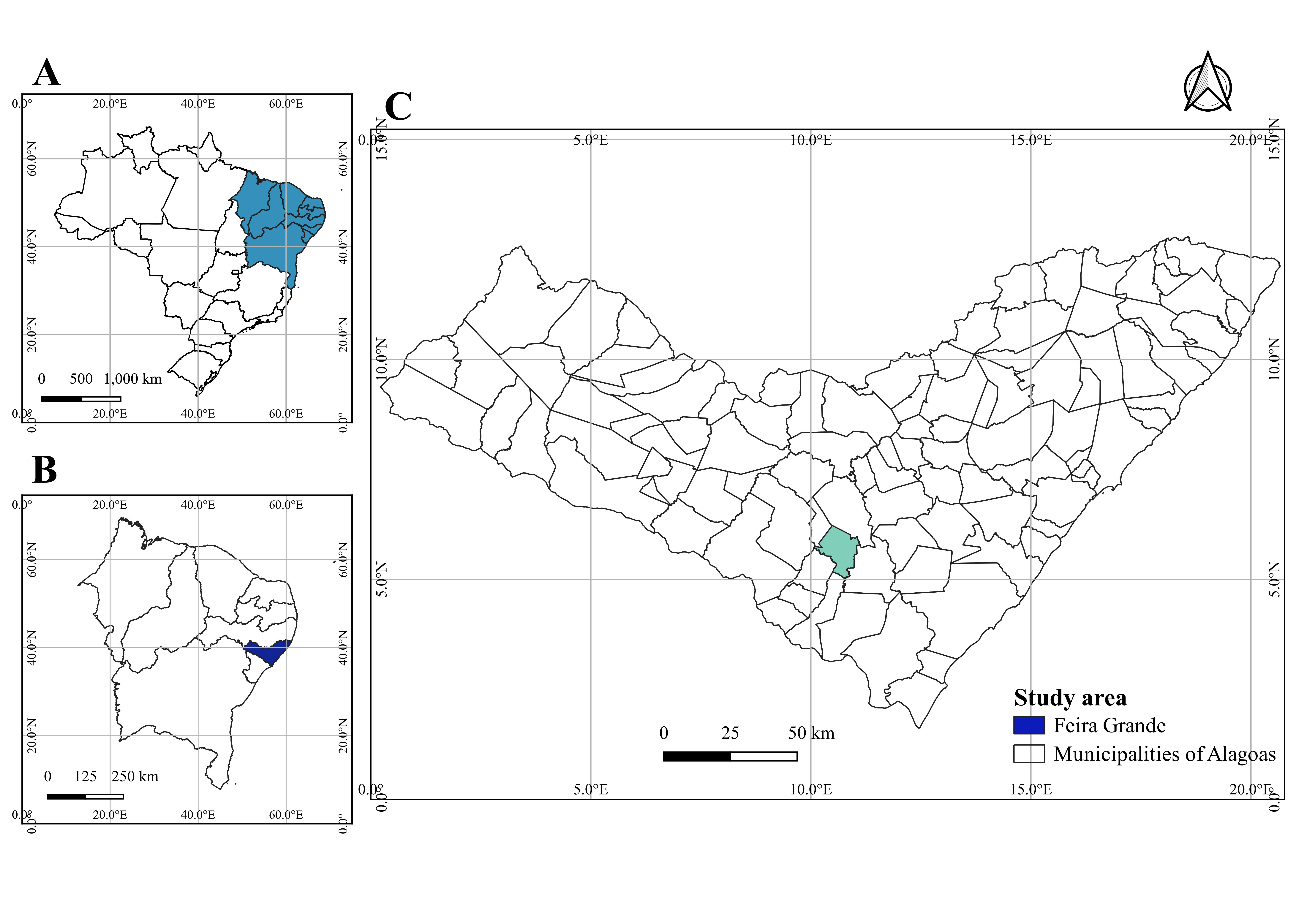
This study was conducted in the municipality of Feira Grande, located in the state of Alagoas, Northeastern Brazil (Figure 1). Feira Grande is part of the Agreste region of the state and, according to the 2022 Brazilian census, has a population of 22,712 inhabitants, distributed over a territorial area of 175,906 km2, with a density of 129.11 inhabitants/km2. It has a Human Development Index of 0.533; in 2010, only 7.8% of households had access to adequate sanitation (Alagoas, 2017; IBGE, 2024).
Location of the municipality of Feira Grande in the state of Alagoas, Brazil. Legend: (A) Brazil, with emphasis on the Northeastern region; (B) Northeastern region, with emphasis on the state of Alagoas; (C) State of Alagoas, with emphasis on the municipality of Feira Grande.
2.3. Study design and population
An analytical, population-based cross-sectional study was conducted in the municipality of Feira Grande from January to October 2023 to investigate positivity, parasite load, risk factors associated with S. mansoni infection, intermediate host species of S. mansoni, and trematode infection in these snails. The study population consisted of individuals over 5 years old residing in one of the four areas of the municipality selected for the study, as recommended by the Schistosomiasis Control Program (SCP) technicians.
2.4. Sample calculation and sampling
The sample size was calculated using Epi Info™ version 7.2.5.0 based on the following parameters: acceptable error of 3%, 95% confidence level, an estimated population of 22,192 in 2021, and an expected prevalence of 7.4%, the average between the years 2010 and 2021. The required sample size was estimated at 289 individuals, but considering potential losses, an additional 10% was added.
The sample was equally divided among the four areas indicated by the SCP technicians, and households were randomly selected. Family approaches were conducted with the assistance of health professionals, and all individuals over 5 years of age were invited to participate in the study.
2.5. Collection and parasitological analysis
Each participant received a pre-labeled collector with an identification code for stool sample collection. The next day, the samples were collected by researchers and transported to the Human Parasitology and Malacology Laboratory (Lapahum) at the State University of Alagoas (UNEAL), where it was processed using the Kato-Katz method. This technique is the gold standard, as established by the WHO for population-based surveys, for identifying human infection by S. mansoni and allows for the quantitative estimation of eggs per gram of feces, determining the parasite infection intensity (Katz et al., 1972; WHO, 2002). To increase the sensitivity of the method, four slides were prepared from each fecal sample, following the approach proposed by Santos et al. (2021), and were analyzed by an experienced analyst in this type of examination.
2.6. Risk factors associated with S. mansoni infection
All study participants were invited to complete a semi-structured investigative questionnaire adapted from Santos et al. (2020a). The questionnaire collected information on three main categories: (1) sociodemographic characteristics; (2) household and peri-household infrastructure factors associated with S. mansoni transmission; and (3) occupational and recreational activities associated with S. mansoni transmission.
2.7. Snail collection and trematode larvae positivity
Throughout 2023, each water source in the study area was visited twice – once during the dry season and once during the rainy season – for the collection of S. mansoni intermediate host snails. The criteria for selecting water sources were health professionals’ recommendations, population usage, and road access.
Water bodies were classified by type, according to the guidelines of the Brazilian Ministry of Health (Brasil, 2008), and then subclassified as breeding sites (when live or dead snails were found in the water) or transmission hotspots (when collected snails were observed to release cercariae under artificial photostimulation).
Snails were collected during 20 minutes of sampling effort (Olivier and Schneiderman, 1956) using a malacological shell, metal tweezers, and a labeled universal collector containing cotton moistened with water from the collection site. Subsequently, the specimens were transported to the Lapahum of UNEAL, and 5% of the specimens were subjected to morphological identification of the reproductive and excretory apparatus, following procedures described by Paraense and Deslandes (1955). For animals from water collections with only shells or those that did not survive until morphological identification of the reproductive apparatus, identification was performed based on shell morphology (Brasil, 2008).
To stimulate and verify the release of trematode larvae, all specimens were exposed to an artificial light source for approximately 3 hours at a temperature of about 30 °C (Jannotti-Passos et al., 2008; Kuntz, 1947). This procedure was repeated once a week for four weeks, and during the final exposure to light, snails were crushed between glass plates to confirm the result. Trematode larvae were visualized under a stereomicroscope and morphologically identified using the identification keys by Pinto and Melo (2014).
2.8. Spatial distribution and analysis
All water sources were georeferenced to construct distribution maps using the Global Positioning System with a Garmin eTrex® 20 device (Garmin, 2024). Furthermore, for areas with transmission hotspots, the residences of study participants were also georeferenced to analyze areas at greatest risk for S. mansoni transmission using the Kernel intensity estimator based on the geolocation of positive individuals. Risk levels were classified as follows: 0.0 (very low), 0.0 to 0.5 (low), 0.5 to 1.0 (moderate), 1.0 to 1.5 (high), and 1.5 to 2.0 (very high). Data stratification parameters were based on quartic data and a bandwidth set with a radius of 500 m. Maps were constructed using QGis software version 3.34.2.
2.9. Data analysis
Data were entered into Microsoft Excel version 2019, then transferred and analyzed using the Statistical Package for the Social Sciences (SPSS) version 23. S. mansoni positivity rate was calculated using the following Formula 1:
The intensity of infection was determined as the mean number of schistosome eggs excreted in feces (expressed as eggs per gram - EPG), categorized as light (≤99 EPG), moderate (100 to 399 EPG), and heavy infection (≥400 EPG) (WHO, 2002).
Descriptive analyses were performed to summarize the frequency and proportions of independent variables. The association of the positivity rate with demographic factors, household infrastructure, and work and leisure activities was tested using Chi-Square or Fisher’s Exact tests. The association between the dependent variable (infection) and independent variables was tested using univariate and multivariate logistic regression models. Risk factors with a p-value < 0.25 in the univariate analysis were selected for inclusion in the multivariate logistic regression model to obtain the adjusted odds ratio (AOR). Results are presented with 95% confidence intervals (CI) and significance level p < 0.05.
3. Results
3.1. Sociodemographic characteristics of study participants
This study included 364 participants residing in four localities within the municipality of Feira Grande, Alagoas. As shown in Table 1, there was a similar frequency between men (51.1%) and women (48.9%). Most participants were in the age groups of 5-24 years (32.7%) and 25-44 years (33.2%). Furthermore, most participants were married (53.8%), had completed elementary education (79.9%), were natives of the city (87.9%), had an income equal to or below the minimum wage (87.9%), and self-identified as farmers (69.5%).
3.2. Positivity and infection intensity among study participants
We identified an overall positivity of 5.5% (n=20) for schistosomiasis mansoni. The highest positivity was observed in male individuals (7.0%), aged 45 to 64 years (8.8%), widowed participants (16.7%), without formal education (6.9%), who were not natives of the city (6.3%), with an income equal to or below the minimum wage (5.8%), and farmers (3.6%) (Table 1). Of those who tested positive, 90% (n=18) had a low parasite load (≤99 EPG), while only one patient had a high parasite load (>400 EPG).
3.3. Factors associated with S. mansoni infection
In the univariate logistic regression analysis, statistically significant predictors of S. mansoni infection (p<0.05) included age groups of 25 to 64 years, married and widowed marital status, farmers, and those who fetch water from dams, lakes, ponds, wells, or cisterns (Tables 2, 3, and 4). After adjusting for confounding factors, only the occupation of farming (AOR: 9.63; 95% CI: 1.24 to 74.67) was associated with a higher likelihood of parasite infection (Table 2).
Household and peri-household infrastructure factors associated with S. mansoni infection among study participants.
Labor and leisure activity factors associated with S. mansoni infection among study participants.
3.4. Positivity for trematode larvae in Biomphalaria spp. snails collected
According to established criteria, 22 water bodies were identified within the study area, of which 12 were classified as breeding sites for the intermediate host snails of S. mansoni. During the dry season, 157 snails were collected from six water bodies, while 150 snails were collected from 11 sites during the rainy season. Only one of these water bodies was identified as a transmission focus for S. mansoni from a B. glabrata specimen. However, in other water bodies, Magnacauda-type larvae were found parasitizing B. glabrata and B. straminea and Echinostoma-type larvae parasitizing B. straminea (Table 5).
Positivity for trematode larvae in intermediate host snails of S. mansoni by collection site in the municipality of Feira Grande, Alagoas.
3.4. Spatial distribution of the risk of S. mansoni infection
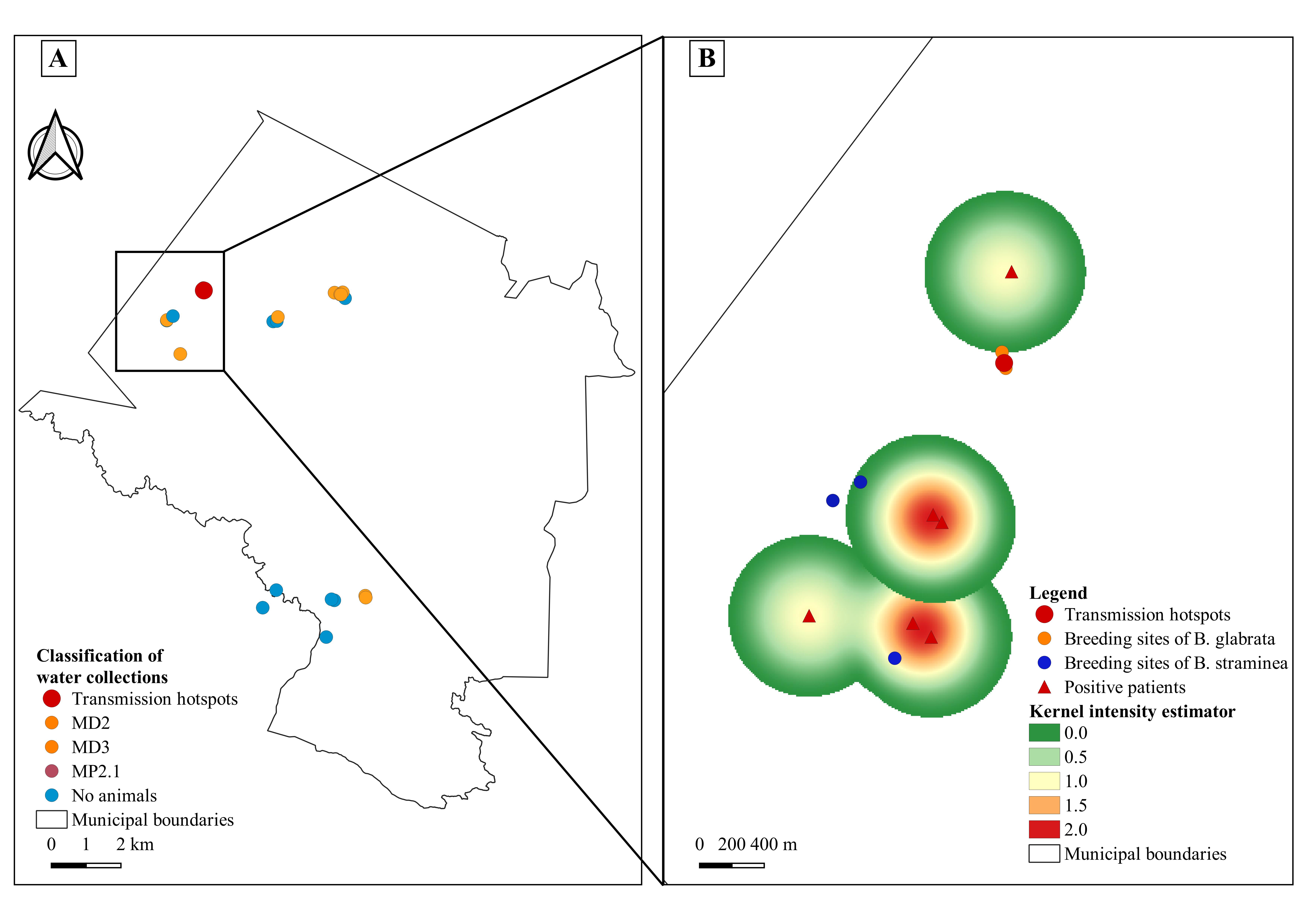
The distribution of positive cases and risk analysis using Kernel density estimation in the locality where the single transmission focus of S. mansoni was found are illustrated in Figure 2. Four risk areas were identified, two of which contained B. straminea breeding sites, while a B. glabrata breeding site was located in another risk area.
Spatial distribution of study water bodies (A) and spatial distribution and risk analysis using Kernel density estimation of positive patients living near the transmission focus (B).
4. Discussion
This study is among the few conducted in Brazil to comprehensively assess S. mansoni positivity, infection intensity, associated risk factors, identification of trematode larvae in intermediate hosts, and spatial risk distribution in a low-endemicity area. These areas and the low parasite load in the population represent an advance in the control of schistosomiasis but simultaneously pose a new challenge for eliminating the disease in focal areas, as each locality has specific factors that influence the maintenance of the parasite cycle (WHO, 2022b).
A descriptive study conducted between 2010 and 2014 reported a higher positivity rate in the municipality of Feira Grande than that found in this study for all the years analyzed, especially in 2010, when the rate was 15.8% (Rocha et al., 2016). However, the low parasite load (≤99 EPG) was an indicator that remained constant over the years, as demonstrated between 2010 and 2016, during which 78.2% of the studied population showed a low parasite load (Araújo et al., 2020). These findings indicate that the epidemiological situation of schistosomiasis mansoni in the studied area has undergone some changes over the past 13 years in terms of positivity rates, similar to what occurred in Alagoas and Brazil, indicating possible advances in government control programs (Alencar et al., 2024).
To meet the Sustainable Development Goals, the WHO set a target of eliminating schistosomiasis as a public health problem in 78 countries by 2030. This goal is defined as achieving a prevalence of high-intensity infections of less than 1% (WHO, 2022c). In line with this, as seen in this study, the latest national survey in Brazil showed that low parasite loads are already a reality in several municipalities (Katz, 2018). However, the results of this survey are controversial since it is well documented that, although the Kato-Katz technique is still considered the gold standard by the WHO, analyzing only two slides is insufficient to estimate positivity, especially in low-endemicity areas (Magalhães et al., 2020; Vaillant et al., 2024). Therefore, we used four slides to improve the method’s performance and obtain better results for the municipality of Feira Grande.
The high positivity observed among males aged 45 to 64, without formal education, and income below the minimum wage may be related to labor activities that involve frequent contact with parasite transmission foci, such as farming. This occupation also showed higher positivity rates and is typically practiced by individuals with these socioeconomic characteristics (Ayabina et al., 2021; Calasans et al., 2018). Additionally, in our study area, the main economic activity is agriculture, focusing on planting sweet potatoes, cassava, and tobacco (Alagoas, 2023), which requires contact with water bodies for irrigation, thus facilitating S. mansoni infections.
Being born outside Feira Grande was another factor associated with higher schistosomiasis mansoni positivity and may have contributed to the spread and establishment of the endemic disease. Indeed, migration processes deserve attention for the propagation of diseases, especially regarding endemic schistosomiasis mansoni areas, such as those found in the Northeastern, particularly in the states of Alagoas, Pernambuco, and Sergipe (Santos, et al., 2020b; Katz, 2018; Jesus et al., 2022).
In the univariate analysis, the 25-44 age group, married and widowed individuals, farmers, and those fetching water from natural sources were significantly associated with S. mansoni infections. Moreover, the multivariate analysis showed that only the farming occupation had a significant association. In general, the likely source of infection for the study participants can be attributed to low socioeconomic status, as previously mentioned, and the poor sanitary conditions in Feira Grande. Although not significantly associated with infection, the findings showed that positivity was higher in individuals with the following conditions: using well or cistern water to supply their homes, open sewer, habit of burning, burying, or throwing garbage in vacant lots, and living on unpaved streets.
In Brazil, transmission of S. mansoni is maintained by B. glabrata snails, which are highly susceptible and widely geographically distributed (Souza et al., 1995; Brasil. 2008). In addition to finding a transmission focus with B. glabrata, nine of the 12 collection points were classified as breeding sites for this species, thereby indicating that the study area is conducive to the maintenance of schistosomiasis mansoni cases, with B. glabrata acting as the primary intermediate host. Were also found three other breeding sites with B. straminea, two of which were located in areas of risk for S. mansoni transmission, suggesting that B. straminea may also play a role in transmission under favorable conditions. A previous investigation, conducted by our research group in a neighboring municipality, also identified habitats for these species of Biomphalaria spp. Although no transmission foci were detected, several positive individuals were diagnosed, as in this study, reinforcing the maintenance of the parasite cycle by these snail species in the region (Santos et al., 2020a).
Seasonality also strongly influences S. mansoni transmission, as during the rainy season, snails disperse, and new breeding sites emerge, while in the summer, conditions are favorable for new infections in both snails and humans due to the high temperatures (Souza et al., 2008; David et al., 2018; Marques et al., 2025). Thus, were recorded the highest number of breeding sites during the rainy season, while in the dry season, we found a transmission focus. Although only one snail shed cercariae, the detection of positive cases in the human population confirms that the parasite cycle is actively occurring in the area. Furthermore, the negative results for most of snails does not mean that there are no other transmission foci, as studies are conducted on a sample of snails from each water body, and the light exposure and crushing methods are less sensitive compared to molecular approaches (Kamel et al., 2021; Leite et al., 2016).
In addition to S. mansoni, the collected snails tested positive for other trematodes of the Echinostome and Magnacauda groups, both from the family Echinostomatidae. Echinostome cercariae utilize a variety of vertebrates as definitive hosts and can encyst in snails, fish, and amphibians after emerging (Pinto and Melo, 2014). Some species are human parasites endemic to Asia and can cause severe gastrointestinal disorders (Toledo et al., 2022). In the Magnacauda group, cercariae develop in planorbids and, when they emerge, are ingested by fish, encysting in the oral cavity, and when birds eat the fish, the worms develop into their adult stage (Pinto et al., 2013).
Understanding the geographical distribution of breeding sites and, especially, transmission foci is essential for establishing control strategies. Despite the WHO’s recommendation for chemical control (King and Bertsch, 2015), the toxicity of this method for the local ecosystem and its inability to eliminate all snails from a water body must be considered. Additionally, in Brazil, there are restrictions on its use (Coelho and Caldeira, 2016). Therefore, the alternatives recommended by the Brazilian Ministry of Health and FioSchisto experts include coating or channeling watercourses, periodically cleaning and removing aquatic vegetation from the edges, filling or draining water-accumulation areas, and building bridges. These measures are intended to minimize environmental impacts while effectively reducing snail populations (Menezes et al., 2023; Brasil, 2008).
The Kernel map showed hotspots with different risk levels around study participants who tested positive for S. mansoni, aiming to estimate transmission areas and the possible expansion of the parasite to new environments. The overlap of risk levels with B. straminea and B. glabrata breeding sites reflects an important transmission scenario and deserves special attention from epidemiological surveillance. Furthermore, the transmission focus identified in this study was very close to the risk area, highlighting the need for vigilance regarding new infections. Other studies have demonstrated that this spatial analysis is a valuable tool for identifying priority areas (Gomes et al., 2016).
Our study has some limitations. First, the risk factor data were collected using a questionnaire that included questions subject to recall bias. Second, although we used gold-standard methods for detecting S. mansoni in humans and intermediate hosts, these techniques have low performance in low-endemicity areas (Siqueira et al., 2015; Enk et al., 2008). However, four Kato-Katz slides were used per individual to increase the sensitivity of the method for diagnosing the population, and the combination of parasitological, malacological, and geospatial tools used in this study allows for the identification and characterization of S. mansoni infection risks in endemic areas.
5. Conclusion
The positivity for schistosomiasis mansoni classified the municipality of Feira Grande as a low-endemicity area. However, were identified all the necessary conditions for the maintenance of the parasite cycle associated with the population’s behavior, as well as the presence of breeding sites for the intermediate host and transmission foci. The results indicate that understanding the specific characteristics of endemic areas is crucial for developing and implementing individualized prevention and control strategies for each location.
Acknowledgements
We are very grateful to the study participants and also to the team at the Feira Grande Health Department.
Data Availability Statement
The entire data set that supports the results of this study was published in the article itself.
References
- ALAGOAS. Secretaria de Saúde do Estado de Alagoas – SESAU, 2017. Saúde Alagoas: análise de situação de saúde 2017 Maceió: SESAU, 184 p.
- ALAGOAS. Superintendência de Informações e Cenários – SINC, 2023. Perfil municipal: Feira Grande. Maceió: Estado de Alagoas, vol. 5, no. 5, 233 p.
-
ALENCAR, V.J.B., LIMA, P.D., MACHADO, J.P.V., LIMA, M.W.S., GOMES, S.C., PAZ, W.S., RAMOS, R.E.S., BEZERRA, L.P. and SANTOS, I.G.A., 2024. Temporal trends and spatial and spatiotemporal distribution of Schistosomiasis mansoni in northeast Brazil between 2005 and 2016. Transactions of the Royal Society of Tropical Medicine and Hygiene, vol. 118, no. 6, pp. 359-366. http://doi.org/10.1093/trstmh/trad099 PMid:38243827.
» http://doi.org/10.1093/trstmh/trad099 - ARAÚJO, M.P., SANTOS, C.M.A., GOMES, D.S., CIRILO, T.M., BEZERRA, L.P., LIMA, P.D., MACHADO, J.P.V., RAMOS, R.E.S., GOMES, S.C., ALENCAR, V.J.B., SILVA, G.I.L., DAMASCENO, I.A., SILVA, L.O., PAZ, W.S. and SANTOS, I.G.A., 2020. Epidemiologia da esquistossomose em uma área de baixa prevalência de Alagoas entre 2010 e 2016. Pubvet, vol. 14, no. 3, pp. 1-6. .
-
AYABINA, D.V., CLARK, J., BAYLEY, H., LAMBERTON, P.H.L., TOOR, J. and HOLLINGSWORTH, T.D., 2021. Gender-related differences in prevalence, intensity and associated risk factors of Schistosoma infections in Africa: a systematic review and meta-analysis. PLoS Neglected Tropical Diseases, vol. 15, no. 11, e0009083. http://doi.org/10.1371/journal.pntd.0009083 PMid:34788280.
» http://doi.org/10.1371/journal.pntd.0009083 - BRASIL. Ministério da Saúde. Secretaria de Vigilância em Saúde. Departamento de Vigilância Epidemiológica, 2008. Vigilância e controle de moluscos de importância epidemiológica: diretrizes técnicas. 2. ed. Brasilia: Ministério da Saúde, 178 p.
- BRASIL. Ministério da Saúde. Secretaria de Vigilância em Saúde, 2014. Vigilância da esquistossomose mansoni: diretrizes técnicas. 4. ed. Brasília: Ministério da Saúde, 146 p.
-
CALASANS, T.A.S., SOUZA, G.T.R., MELO, C.M., MADI, R.R. and JERALDO, V.L.S., 2018. Socioenvironmental factors associated with Schistosoma mansoni infection and intermediate hosts in an urban area of northeastern Brazil. PLoS One, vol. 13, no. 5, e0195519. http://doi.org/10.1371/journal.pone.0195519 PMid:29718924.
» http://doi.org/10.1371/journal.pone.0195519 -
COELHO, P.M.Z. and CALDEIRA, R.L., 2016. Critical analysis of molluscicide application in Schistosomiasis control programs in Brazil. Infectious Diseases of Poverty, vol. 5, no. 1, pp. 57. http://doi.org/10.1186/s40249-016-0153-6 PMid:27374126.
» http://doi.org/10.1186/s40249-016-0153-6 -
DAVID, N.F., CANTANHEDE, S.P.D., MONROE, N.B., PEREIRA, L.P.L.A., SILVA-SOUZA, N., ABREU-SILVA, A.L., OLIVEIRA, V.M. and TCHAICKA, L., 2018. Spatial distribution and seasonality of Biomphalaria spp. in São Luís (Maranhão, Brazil). Parasitology Research, vol. 117, no. 5, pp. 1495-1502. http://doi.org/10.1007/s00436-018-5810-1 PMid:29551000.
» http://doi.org/10.1007/s00436-018-5810-1 -
ENK, M.J., LIMA, A.C.L., DRUMMOND, S.C., SCHALL, V.T. and COELHO, P.M.Z., 2008. The effect of the number of stool samples on the observed prevalence and the infection intensity with Schistosoma mansoni among a population in an area of low transmission. Acta Tropica, vol. 108, no. 2-3, pp. 222-228. http://doi.org/10.1016/j.actatropica.2008.09.016 PMid:18973744.
» http://doi.org/10.1016/j.actatropica.2008.09.016 -
GARMIN, 2024 [viewed 5 December 2024]. eTrex® 20x [online]. Available from: https://www.garmin.com/pt-BR/p/518046
» https://www.garmin.com/pt-BR/p/518046 -
GAZZINELLI, A., CORREA-OLIVEIRA, R., YANG, G.-J., BOATIN, B.A. and KLOOS, H., 2012. A research agenda for helminth diseases of humans: social ecology, environmental determinants, and health systems. PLoS Neglected Tropical Diseases, vol. 6, no. 4, e1603. http://doi.org/10.1371/journal.pntd.0001603 PMid:22545168.
» http://doi.org/10.1371/journal.pntd.0001603 -
GOMES, E.C.S., MESQUITA, M.C.S., REHN, V.N.C., NASCIMENTO, W.R.C., LOYO, R. and BARBOSA, C.S., 2016. Transmissão urbana da esquistossomose: novo cenário epidemiológico na Zona da Mata de Pernambuco. Revista Brasileira de Epidemiologia, vol. 19, no. 4, pp. 822-834. http://doi.org/10.1590/1980-5497201600040012 PMid:28146171.
» http://doi.org/10.1590/1980-5497201600040012 -
HOEFLE-BÉNARD, J. and SALLOCH, S., 2024. Mass drug administration for neglected tropical disease control and elimination: a systematic review of ethical reasons. BMJ Global Health, vol. 9, no. 3, e013439. http://doi.org/10.1136/bmjgh-2023-013439 PMid:38485140.
» http://doi.org/10.1136/bmjgh-2023-013439 -
INSTITUTO BRASILEIRO DE GEOGRAFIA E ESTATÍSTICA – IBGE, 2024 [viewed 5 December 2024]. Feira Grande: panorama [online]. Available from: https://cidades.ibge.gov.br/brasil/al/feira-grande/panorama
» https://cidades.ibge.gov.br/brasil/al/feira-grande/panorama - JANNOTTI-PASSOS, L.K., CALDEIRA, R.L. and CARVALHO, O.S., 2008. Técnicas utilizadas no estudo dos moluscos do gênero Biomphalaria e na manutenção do ciclo de Schistosoma mansoni In: O.S. CARVALHO, P.M.Z. COELHO and H.L. LENZI, eds. Schistosoma mansoni e esquistossomose: uma visão multidisciplinar Rio de Janeiro: Editora FIOCRUZ, pp. 529-546.
-
JESUS, D.M.S., SOUZA, M.R., SANTOS, A.D., BEZERRA-SANTOS, M. and ARAÚJO, K.C.G.M., 2022. Evaluation of the schistosomiasis control program (PCE) in an endemic area, northeastern Brazil: a population-based and 10-year time series study. Revista de Patologia Tropical, vol. 51, no. 4, pp. 264-274. http://doi.org/10.5216/rpt.v51i4.74846
» http://doi.org/10.5216/rpt.v51i4.74846 -
KAMEL, B., LAIDEMITT, M.R., LU, L., BABBITT, C., WEINBAUM, O.L., MKOJI, G.M. and LOKER, E.S., 2021. Detecting and identifying Schistosoma infections in snails and aquatic habitats: a systematic review. PLoS Neglected Tropical Diseases, vol. 15, no. 3, e0009175. http://doi.org/10.1371/journal.pntd.0009175 PMid:33760814.
» http://doi.org/10.1371/journal.pntd.0009175 - KATZ, N., CHAVES, A. and PELLEGRINO, J., 1972. A simple device for quantitative stool thick-smear technique in Schistosomiasis mansoni Revista do Instituto de Medicina Tropical de São Paulo, vol. 14, no. 6, pp. 397-400. PMid:4675644.
- KATZ, N., 2018. Inquérito nacional de prevalência da esquistossomose mansoni e geo-helmintoses 1. ed. Belo Horizonte: CPqRR, 76 p.
-
KING, C.H. and BERTSCH, D., 2015. Historical perspective: snail control to prevent schistosomiasis. PLoS Neglected Tropical Diseases, vol. 9, no. 4, e0003657. http://doi.org/10.1371/journal.pntd.0003657 PMid:25905621.
» http://doi.org/10.1371/journal.pntd.0003657 -
KUNTZ, R.E., 1947. Effect of light and temperature on emergence of Schistosoma mansoni cercariae. Transactions of the American Microscopical Society, vol. 66, no. 1, pp. 37-49. http://doi.org/10.2307/3223320 PMid:20242301.
» http://doi.org/10.2307/3223320 -
LEITE, M.G.P., PIMENTA, E.C., FUJACO, M.A.G. and ESKINAZI-SANT’ANNA, E.M., 2016. Irrigation canals in Melo creek basin (Rio Espera and Capela Nova municipalities, Minas Gerais, Brazil): habitats to Biomphalaria (Gastropoda: Planorbidae) and potential spread of schistosomiasis. Brazilian Journal of Biology = Revista Brasileira de Biologia, vol. 76, no. 3, pp. 638-644. http://doi.org/10.1590/1519-6984.22714 PMid:27097093.
» http://doi.org/10.1590/1519-6984.22714 -
MAGALHÃES, F.C., RESENDE, S.D., SENRA, C., GRAEFF-TEIXEIRA, C., ENK, M.J., COELHO, P.M.Z., OLIVEIRA, E., NEGRÃO-CORRÊA, D.A., GEIGER, S.M. and CARNEIRO, M., 2020. Accuracy of real-time polymerase chain reaction to detect Schistosoma mansoni: infected individuals from an endemic area with low parasite loads. Parasitology, vol. 147, no. 10, pp. 1140-1148. http://doi.org/10.1017/S003118202000089X PMid:32484122.
» http://doi.org/10.1017/S003118202000089X -
MARQUES, A.M., COSTA, B.N., BRITO, K.L.R., CANTANHEDE, A.S., SOUSA, E.P., VELOSO, B.L., BRAGA, N.B.C., CANTANHEDE, S.P.D., TCHAICKA, L. and REBÊLO, J.M.M., 2025. Limnic gastropods and trematodes of public health concern in Barreirinhas, Maranhão State, Brazil. Brazilian Journal of Biology = Revista Brasileira de Biologia, vol. 84, e286766. http://doi.org/10.1590/1519-6984.286766 PMid:40105523.
» http://doi.org/10.1590/1519-6984.286766 -
MENEZES, C.A., MONTRESOR, L.C., JANGOLA, S.T.G., MATTOS, A.C., DOMINGUES, A.L.C., MALDONADO JÚNIOR, A., SILVA, C.C.M., BARBOSA, C.S., MENDONÇA, C.L.F., MASSARA, C.L., FONSECA, C.T., OLIVEIRA, E.J., GOMES, E.C.S., SILVA, E.F., BEZERRA, F.S.M., SILVA-JR, F.P., SIQUEIRA, I.C., SILVA, J.R.M., HELLER, L., FARIAS, L.P., HOLSBACH BECK, L.C.N., SANTOS, M.C., LIMA, M.G., MOURÃO, M.M., ENK, M.J., FERNANDEZ, M.A., KATZ, N., CARVALHO, O.S., PARREIRAS, P.M., NEVES, R.H., GAVA, S.G., OLIVEIRA, S.A., THIENGO, S.C., FAVRE, T.C., GRAEFF-TEIXEIRA, C., PIERI, O.S., CALDEIRA, R.L., SILVA-PEREIRA, R.A., ROCHA, R.S. and OLIVEIRA, R.R., 2023. FioSchisto’s expert perspective on implementing WHO guidelines for schistosomiasis control and transmission elimination in Brazil. Frontiers in Immunology, vol. 14, pp. 1268998. http://doi.org/10.3389/fimmu.2023.1268998 PMid:38143743.
» http://doi.org/10.3389/fimmu.2023.1268998 -
OLIVIER, L. and SCHNEIDERMAN, M., 1956. A method for estimating the density of aquatic snail populations. Experimental Parasitology, vol. 5, no. 2, pp. 109-117. http://doi.org/10.1016/0014-4894(56)90008-X PMid:13317935.
» http://doi.org/10.1016/0014-4894(56)90008-X -
PARAENSE, W.L. and DESLANDES, N., 1955 [viewed 5 December 2024]. Observation on the morfology of Australorbis glabratus Memórias do Instituto Oswaldo Cruz [online], vol. 53, no. 1, pp. 88-112. Available from: https://memorias.ioc.fiocruz.br/article/8994/observation-on-the-morphology-of-australorbis-glabratus
» https://memorias.ioc.fiocruz.br/article/8994/observation-on-the-morphology-of-australorbis-glabratus - PINTO, H.A. and MELO, A.L., 2014. Larvas de trematódeos em moluscos do Brasil: panorama e perspectivas após um século de estudos. Revista de Patologia Tropical, vol. 42, no. 4, pp. 369-386. .
-
PINTO, H.A., MAHECHA, G.A.B. and MELO, A.L., 2013. Petasiger Dietz, 1909 (Trematoda: Echinostomatidae) in birds and mollusks from Brazil. Revista Brasileira de Parasitologia Veterinária, vol. 22, no. 3, pp. 427-432. http://doi.org/10.1590/S1984-29612013000300019 PMid:24142178.
» http://doi.org/10.1590/S1984-29612013000300019 - ROCHA, T.J.M., SANTOS, M.C.S., LIMA, M.V.M., CALHEIROS, C.M.L. and WANDERLEY, F.S., 2016. Aspectos epidemiológicos e distribuição dos casos de infecção pelo Schistosoma mansoni em municípios do Estado de Alagoas, Brasil. Revista Pan-Amazonica de Saude, vol. 7, no. 2, pp. 27-32. .
-
SANTOS, I.G.A., BEZERRA, L.P., CIRILO, T.M., SILVA, L.O., MACHADO, J.P.V., LIMA, P.D., BISPO, M.R.S., GOMES, S.C., SILVA, G.I.L., ALENCAR, V.J.B., DAMASCENO, I.A., CARVALHO, M.M.V., GOMES, D.S., RAMOS, R.E.S., SANTOS JÚNIOR, E.G., ALVES, L.C. and BRAYNER, F.A., 2020a. New epidemiological profile of schistosomiasis from an area of low prevalence in Brazil. Revista da Sociedade Brasileira de Medicina Tropical, vol. 53, e20200335. http://doi.org/10.1590/0037-8682-0335-2020 PMid:33111913.
» http://doi.org/10.1590/0037-8682-0335-2020 -
SANTOS, I.G.A., RAMOS, R.E.S., GOMES, D.S., BEZERRA, L.P., SILVA, L.O., CIRILO, T.M., ALVES, L.C. and BRAYNER, F.A., 2020b. Analysis and spatial distribution of schistosomiasis mansoni in a historically endemic area of northeastern Brazil. Tropical Medicine & International Health, vol. 25, no. 9, pp. 1085-1092. http://doi.org/10.1111/tmi.13458 PMid:32633066.
» http://doi.org/10.1111/tmi.13458 -
SANTOS, I.G.A., BEZERRA, L.P., CIRILO, T.M., SILVA, L.O., MACHADO, J.P.V., LIMA, P.D., SOUZA, M.R.B., GOMES, S.C., SILVA, G.I.L., DAMASCENO, I.A., ALENCAR, V.J.B., CARVALHO, M.M.V., RAMOS, R.E.S., GOMES, D.S., PAZ, W.S., SANTOS JÚNIOR, E.G., ALVES, L.C. and BRAYNER, F.A., 2021. Aspectos relacionados com a positividade para a esquistossomose: estudo transversal em área de baixa prevalência em Alagoas, 2020. Epidemiologia e Serviços de Saúde: Revista do Sistema Único de Saúde do Brasil, vol. 30, no. 2, e2020520. http://doi.org/10.1590/s1679-49742021000200005 PMid:34076228.
» http://doi.org/10.1590/s1679-49742021000200005 -
SILVA, L.F., NUNES, B.E.B.R., LEAL, T.C., PAIVA, J.P.S., LEMOS, A.M.S., ARAÚJO, L.M.M., ARAÚJO, M.D.P., MACHADO, M.F., FRAGA, C.A.C. and SOUZA, C.D.F., 2019. Schistosomiasis mansoni in the northeast region of Brazil: temporal modeling of positivity, hospitalization,and mortality rates. Revista da Sociedade Brasileira de Medicina Tropical, vol. 52, e20180458. http://doi.org/10.1590/0037-8682-0458-2018 PMid:30994811.
» http://doi.org/10.1590/0037-8682-0458-2018 -
SIQUEIRA, L.M.V., GOMES, L.I., OLIVEIRA, E., OLIVEIRA, E.R., OLIVEIRA, Á.A., ENK, M.J., CARNEIRO, N.F., RABELLO, A. and COELHO, P.M.Z., 2015. Evaluation of parasitological and molecular techniques for the diagnosis and assessment of cure of schistosomiasis mansoni in a low transmission area. Memórias do Instituto Oswaldo Cruz, vol. 110, no. 2, pp. 209-214. http://doi.org/10.1590/0074-02760140375 PMid:25946244.
» http://doi.org/10.1590/0074-02760140375 -
SOUZA, C.P., JANNOTTI-PASSOS, L.K. and FREITAS, J.R., 1995. Degree of host-parasite compatibility between Schistosoma mansoni and their intermediate molluscan hosts in Brazil. Memorias do Instituto Oswaldo Cruz, vol. 90, no. 1, pp. 5-10. http://doi.org/10.1590/S0074-02761995000100003 PMid:8524084.
» http://doi.org/10.1590/S0074-02761995000100003 -
SOUZA, M.A.A., BARBOSA, V.S., WANDERLEI, T.N.G. and BARBOSA, C.S., 2008. Criadouros de Biomphalaria, temporários e permanentes, em Jaboatão dos Guararapes, PE. Revista da Sociedade Brasileira de Medicina Tropical, vol. 41, no. 3, pp. 252-256. http://doi.org/10.1590/S0037-86822008000300006 PMid:18719804.
» http://doi.org/10.1590/S0037-86822008000300006 - TIBIRIÇÁ, S.H.C., GUIMARÃES, F.B. and TEIXEIRA, M.T.B., 2011. Schistosoma mansoni in the context of the Brazilian health policy. Ciência & Saúde Coletiva, vol. 16, suppl. 1, pp. 1375-1381. PMid:21503488.
-
TOLEDO, R., ÁLVAREZ-IZQUIERDO, M., ESTEBAN, J.G. and MUÑOZ-ANTOLI, C., 2022. Neglected food-borne trematodiases: echinostomiasis and gastrodiscoidiasis. Parasitology, vol. 149, no. 10, pp. 1319-1326. http://doi.org/10.1017/S0031182022000385 PMid:35343418.
» http://doi.org/10.1017/S0031182022000385 -
VAILLANT, M.T., PHILIPPY, F., NEVEN, A., BARRÉ, J., BULAEV, D., OLLIARO, P.L., UTZINGER, J., KEISER, J. and GARBA, A.T., 2024. Diagnostic tests for human Schistosoma mansoni and Schistosoma haematobium infection: a systematic review and meta-analysis. The Lancet Microbe, vol. 5, no. 4, pp. e366-e378. http://doi.org/10.1016/S2666-5247(23)00377-4 PMid:38467130.
» http://doi.org/10.1016/S2666-5247(23)00377-4 - WORLD HEALTH ORGANIZATION – WHO, 2002. Prevention and control of schistosomiasis and soil-transmitted helminthiasis: report of a WHO expert committee 1st ed. Geneva: WHO, 57 p.
-
WORLD HEALTH ORGANIZATION – WHO, 2022a [viewed 10 May 2022]. Schistosomiasis [online]. Geneva: WHO. Available from: https://www.who.int/news-room/fact-sheets/detail/schistosomiasis
» https://www.who.int/news-room/fact-sheets/detail/schistosomiasis - WORLD HEALTH ORGANIZATION – WHO, 2022b. WHO guideline on control and elimination of human schistosomiasis 1st ed. Geneva: WHO, 144 p.
- WORLD HEALTH ORGANIZATION – WHO, 2022c. Ending the neglect to attain the Sustainable Development Goals: a rationale for continued investment in tackling neglected tropical diseases 2021-2030 1st ed. Geneva: WHO, 50 p.
Edited by
-
Editor:
Marcelo A.M. Esquisatto