 Gas exchange and bioactivity in yellow passion fruit seedlings cv. Rubi do Cerrado under organic substrates and water levels
Abstract
Fertilization and water supply are indispensable factors in the initial growth of passion fruit and, consequently, in its production in the field. The aim of this study was to evaluate the influence of organic substrates and water levels on gas exchange and bioactive compounds in passion fruit seedlings (cv. BRS Rubi do Cerrado). The treatments consisted of a 5 × 2 factorial arrangement, comprising five organic substrates: S1= 100% soil, S2= 75% soil and 25% cattle manure, S3= 75% soil and 25% goat manure, S4= 75% soil and 25% worm humus, S5= 75% soil and 25% organic compost and two water levels: L1 50% and L2 100% of water available in the substrate, with six replicates. Gas exchange was analyzed: stomatal conductance - gs, transpiration - E, CO2 assimilation rate - A and internal CO2 concentration - Ci. From the data obtained, the instantaneous water use efficiency - EiUA and the instantaneous carboxylation efficiency - EiCi were estimated, as well as the bioactive compounds: total carotenoids, chlorophyll a and b, phenolic compounds and proline. When the seedlings were irrigated with 100% available water, they showed higher stomatal conductance, transpiration, CO2 assimilation rate and internal CO2 concentration, resulting in greater carboxylation. Seedlings grown in substrates containing cattle manure and worm humus showed better responses to water deficit. There was an influence of the different substrates and water levels on the gas exchange and bioactive compounds of passion fruit seedlings cv. Rubi do Cerrado.
Keywords:
seedling physiology; organic sources of fertilizer; secondary metabolites; water deficit
Resumo
A adubação e o suprimento hídrico são fatores indispensáveis no crescimento inicial do maracujazeiro e, consequentemente, na sua produção no campo. O objetivo deste trabalho foi avaliar a influência de substratos orgânicos e níveis de água nas trocas gasosas e compostos bioativos em mudas de maracujazeiro (cv. BRS Rubi do Cerrado). Os tratamentos foram constituídos de um arranjo fatorial 5 × 2, compreendendo cinco substratos orgânicos: S1= 100% solo, S2= 75% solo e 25% esterco bovino, S3= 75% solo e 25% esterco caprino, S4= 75% solo e 25% húmus de minhoca, S5= 75% solo e 25% composto orgânico e dois níveis de água: L1 50% e L2 100% da água disponível no substrato, com seis repetições. Para as trocas gasosas analisaram-se: condutância estomática - gs, transpiração - E, taxa de assimilação de CO2 - A e concentração interna de CO2 - Ci. A partir dos dados obtidos, foram estimadas a eficiência instantânea do uso da água - EiUA e a eficiência instantânea de carboxilação - EiCi, bem como os compostos bioativos: carotenoides totais, clorofila a e b, compostos fenólicos e prolina. Quando as mudas foram irrigadas com 100% de água disponível, elas apresentaram maior condutância estomática, transpiração, taxa de assimilação de CO2 e concentração interna de CO2, resultando em maior carboxilação. Mudas cultivadas em substratos contendo esterco bovino e húmus de minhoca apresentaram melhores respostas ao déficit hídrico. Houve influência dos diferentes substratos e níveis de água nas trocas gasosas e compostos bioativos de mudas de maracujá cv. Rubi do Cerrado.
Palavras-chave:
fisiologia de mudas; fontes orgânicas de fertilizantes; metabólitos secundários; déficit hídrico
1. Introduction
Among the fruit trees of economic importance in Brazil, the passion fruit tree stands out for its estimated production of 697.859 tons and harvested area of 45.602 hectares (IBGE, 2022). Originally from tropical America, the crop belongs to the genus Passiflora, made up of more than 500 species, of which more than 150 are endemic to Brazil (He et al., 2024), and of these species, the yellow passion fruit represents 95% of commercial orchards, and is also the most widely cultivated in the world. New passion fruit cultivars have been developed, such as the BRS Rubi do Cerrado passion fruit hybrid, which was obtained based on population breeding, through crosses using commercial and wild accessions (EMBRAPA, 2014).
Despite the use of organic substrates as an input in the production of seedlings, there is still not enough scientific information on the ideal types of substrates, suitable sources and the most appropriate level and/or levels for the production of seedlings for the Rubi do Cerrado cultivar, under conditions in the high sertao of Paraiba. Similarly, factors such as water deficit can compromise the physiological processes and productivity of passion fruit, as a lack of water in the soil can restrict the stomatal opening of the leaves with severe damage to the photosynthetic system, especially in regions where the crop's water consumption is affected by water deficit (Mulovhedzi et al., 2020).
The ideal supply of water and nutrients is essential for the agronomic quality of passion fruit seedlings, especially in the initial formation phase (Barros et al., 2021). However, studies on production management are still incipient, with a focus on alternative technologies that make it possible to minimize input and labour costs in the production of fruit seedlings, especially for passion fruit cv. Rubi do Cerrado in the highlands of Paraiba. It is known that in addition to being a conductor of all the necessary nutrients, water also promotes growth and development, and with a lack of water there is unsatisfactory crop development (Santos and Peres, 2021). In this sense, water deficit is an important restriction and, as such, understanding the tolerance mechanisms for the development of tolerant crops is crucial.
The unlimited use of water has grown worldwide, to the point where it is no longer possible to provide reliable water services in many regions. Population pressures, the pace of economic development, urbanization and pollution are putting unprecedented pressure on a renewable but finite resource, especially in semi-arid and arid regions (Nikpey et al., 2025). Water scarcity is therefore one of the most pressing food security issues facing arid and semi-arid countries.
Hinojosa et al. (2018) explain that plants, in general, develop different mechanisms in order to avoid water loss, such as: reduction in leaf area, alteration in the root/shoot ratio which are related to ontogenetic processes that can contribute to the plant escaping or avoiding the stress that is being imposed; physiological strategies, such as the production of bioactive substances, stabilization of turgidity, control of stomatal closure and osmotic adjustment which are related to drought tolerance mechanisms and molecular strategies and the activation of proteins that act protectively to stress. However, the literature is still scarce on the effect of bioactive compounds that can influence the adaptation of passion fruit cv. Rubi do Cerrado to water deficit when subjected to organic sources of substrates.
Considering the above, it can be seen that the production of seedlings is the main stage for the successful development and productivity of passion fruit, and is totally related to the final performance of the plants in the field, pointing to the importance of producing quality seedlings through proper management, which meets the nutritional and water requirements, while being accessible to the producer (Siqueira et al., 2020). The aim of this study was to evaluate the influence of organic substrates and water levels on gas exchange and bioactive compounds in seedlings of passion fruit cv. BRS Rubi do Cerrado.
2. Materials and Methods
2.1. Experimental design
A completely randomized experimental design was adopted in a 5 × 2 factorial scheme, corresponding to five (5) organic substrates: S1 = 100% soil (v/v), S2 = 75% soil and 25% cattle manure (v/v), S3 = 75% soil and 25% goat manure (v/v), S4 = 75% soil and 25% worm humus (v/v), S5 = 75% soil and 25% organic compost (v/v) and two (2) water levels: L1 = 50% water available in the substrate (ADS) and L2 = 100% water available in the substrate (ADS), with six repetitions, totaling 60 experimental units.
2.2. Conducting the experiment
The seeds of the passion fruit cv. BRS Rubi do Cerrado were purchased from AGROCINCO©. Germination took place in 128-cell trays and 28 days after sowing the seeds were transplanted into polyethylene bags with a capacity of 2 liters.
The organic materials bovine manure and earthworm humus were sourced from the UEPB Campus in Catolé do Rocha. The goat manure was purchased from a rural producer in the city of Sousa and the organic compost was obtained from the composting process at the Agro-Environmental Technology Laboratory at UFCG, Campina Grande campus.
The substrates were prepared using NEOSSOLO FLÚVICO Eutrófico classified according to the criteria of the Brazilian Soil Classification System - SiBCS (EMBRAPA, 2018).
Irrigation was carried out daily and the volumes of water were determined according to the plants' water needs, via drainage lysimetry, according to the methodology adapted from Ramos et al. (2021), as shown in Equation 1:
where: VI: volume of water to be applied in the next irrigation event, mL; Va: volume of water to be applied in the previous event, mL; Vd: volume of water drained in the previous irrigation event, mL.
Based on the calculated value, the water table corresponding to 50% of the available water in the soil (ADS) was determined.
2.3. Gas exchange in leaves of passion fruit cv. Rubi do Cerrado
Using a plant gas exchange determiner, containing an infrared gas analyzer - IRGA (Infra Red Gas Analyser, model LCpro - SD, from ADC Bioscientific, UK), the following were measured at 45 DAT: stomatal conductance - gs (mol H2O m-2 s-1), transpiration - E (mmol H2O m-2 s-1), CO2 assimilation rate - A (μmol CO2 m-2 s-1) and internal CO2 concentration - Ci (μmol CO2 m-2 s-1). Based on the data obtained, the instantaneous efficiency of water use - EiUA (A/E) [(μmol CO2 m-2 s-1) (mmol H2O m-2 s-1)-1] and the instantaneous efficiency of carboxylation - EiCi (A/Ci) [(µmol CO2 m-2 s-1) (µmol CO2 m-2 s-1)-1] were estimated.
2.4. Bioactive compounds in passion fruit leaves cv. Rubi do Cerrado
Total carotenoid, chlorophyll a and chlorophyll b contents: Passion fruit leaf samples were collected by extracting leaf disks with an area of 1.54 cm2 from the third fully expanded leaf from the apical bud. They were then taken to the laboratory for analysis of photosynthetic pigments, according to Arnon's (1949) methodology. In a substance made up of 7 ml of acetone diluted to 70% and with the aid of a spectrophotometer, readings were taken of the levels of photosynthetic pigments chlorophyll a and b and carotenoids at the respective absorbance wavelengths of 470, 647 and 663 n.
Total phenolic compounds: Determined by the FolinCiocalteu method, as described by Cao et al. (2020), using gallic acid as a standard and read in a spectrophotometer at 765 nm. The results were expressed in gallic acid equivalents (mg EAG/100g).
Proline was determined using the method of Troll and Lindsley (1955) modified by Rena and Masciotti (1976), which uses the reaction of the amino acid with acidic ninhydrin solution and photometric determination at 515 nm. The amount of proline was calculated in micromoles of proline per gram of leaf dry matter.
2.5. Statistical analysis
Statistical methodology plays a critical role in the design of scientific studies, analysis of The data was subjected to the Shapiro-Wilk distribution normality test at the 0.05 probability level and then submitted to analysis of variance using the F test at the 0.05 and 0.01 probability levels, with the means being compared using the Tukey test, using the SISVAR statistical software version 5.6 from Ferreira (2019).
3. Results
When evaluating the plants' stomatal conductance, transpiration, internal CO2 concentration and instantaneous carboxylation efficiency, it was observed that there was a significant effect by the F test (ρ < 0.01) for the factors studied alone. There was a significant interaction for the CO2 assimilation rate and instantaneous water use efficiency (Table 1).
Summary of the analysis of variance for stomatal conductance (gs), transpiration (E), CO2 assimilation rate (A), internal CO2 concentration (Ci), instantaneous carboxylation efficiency (EiCi) and instantaneous water use efficiency (EiUA) in passion fruit seedlings cv. Rubi do Cerrado as a function of organic substrates and water levels at 45 days after transplanting.
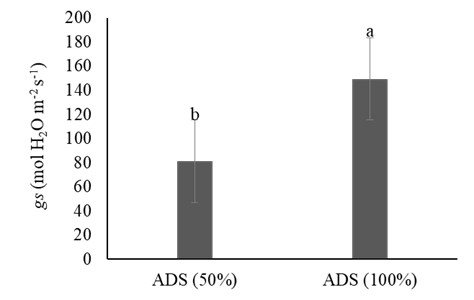
Figure 1 shows that plants irrigated with 50% (ADS) had a lower average (81.30 mol m2 s-1) than those irrigated with 100% of the water available in the substrate (149.37 mol m2s-1).
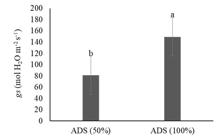
Stomatal conductance (gs) of passion fruit seedlings cv. Rubi do Cerrado as a function of organic substrates and water levels at 45 days after transplanting. Average followed by the same lowercase letter do not differ at 5% probability by the F test.
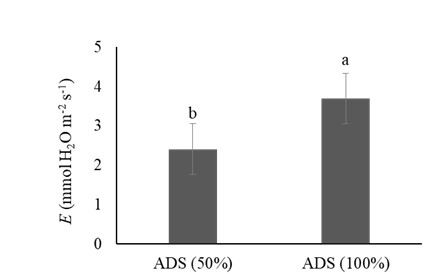
As was observed for stomatal conductance, the transpiration of passion fruit seedlings cv. Rubi do Cerrado was significant between the water levels applied, since transpiration is proportional to stomatal conductance and/or vice versa (Figure 2). Thus, transpiration behaved similarly to stomatal conductance.
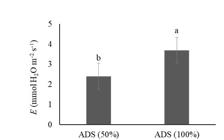
Transpiration (E) of passion fruit seedlings cv. Rubi do Cerrado as a function of organic substrates and water levels at 45 days after transplanting. Average followed by the same lowercase letter do not differ at 5% probability by the F test.
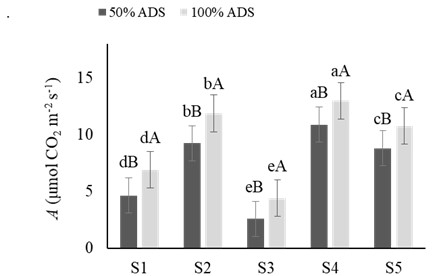
For the CO2 assimilation rate, Figure 3 shows that L1 affected CO2 assimilation, in which the seedlings irrigated with 50% of the water available in the soil with the application of goat manure had a low rate (2.57 μmol m¬2s¬1). In turn, the production of seedlings of the Rubi do Cerrado cv. with the application of 100% of the water table and the use of S4 resulted in a higher CO2 assimilation rate (12.98 μmol m¬2s¬1), differing from the other treatments.
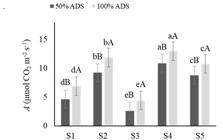
CO2 assimilation rate (A) in passion fruit seedlings cv. Rubi do Cerrado as a function of organic substrates and water levels at 45 days after transplanting. Averages followed by the same capital letter (water levels) do not differ from each other at 5% probability by the F-test, lower case (organic substrates) do not differ from each other at 5% probability by the Tukey test.
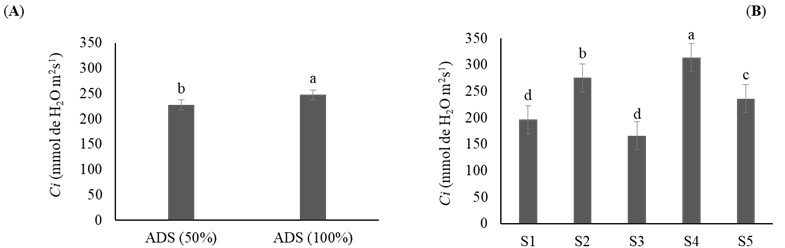
As for the internal CO2 concentration (Figure 4), there was a significant difference between the substrates, with S4 standing out, because when comparing it with the other substrates, it can be seen that the seedlings had a higher internal CO2 concentration (313.92 μmol mol-1), differing from the others. On the other hand, the seedlings produced in S1 (196.42 μmol mol-1) and S3 (165.92 μmol mol-1) had lower internal CO2 concentrations and no significant difference could be observed between them.
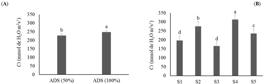
Internal C02 concentration (Ci) in yellow passion fruit seedlings cv. Rubi do Cerrado at 45 days after transplanting as a function of water levels (A) and organic substrates (B). Averages followed by the same lowercase letter, using the F test for water levels and the Tukey test for organic substrates, do not differ from each other at 5% probability.
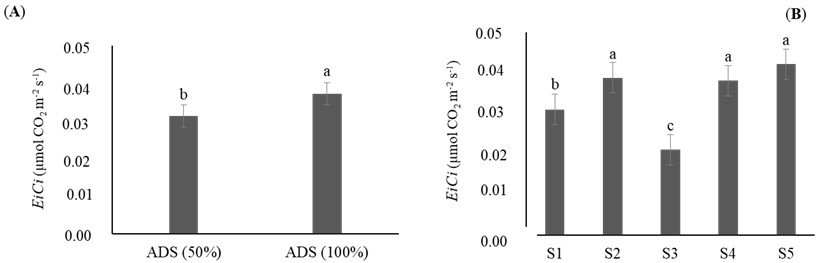
Figure 5 shows that the carboxylation efficiency of passion fruit seedlings cv. Rubi do Cerrado was affected by the factors analyzed in isolation. It can be seen that the highest carboxylation efficiency was found in the seedlings grown with S2, S4 and S5 at water level L2, and no difference was observed between them.
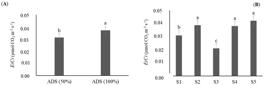
Instantaneous carboxylation efficiency (EiCi) in yellow passion fruit seedlings cv. Rubi do Cerrado at 45 days after transplanting as a function of water levels (A) and organic substrates (B). Averages followed by the same lowercase letter, by the F test for water levels and by the Tukey test for organic substrates, do not differ from each other at 5% probability.
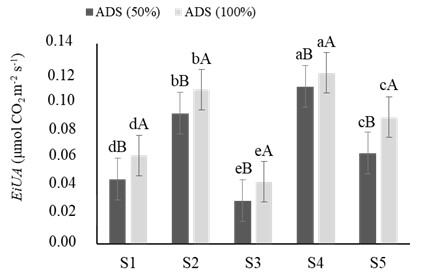
Figure 6 shows that passion fruit seedlings grown in substrates containing 75% soil and 25% humus (0.12 μmol m-2 s-1), followed by those grown in 75% soil and 25% cattle manure (0.11 μmol m-2 s-1) showed greater instantaneous water use efficiency than the others.
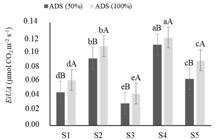
Instantaneous efficiency of water use (EiUA) in passion fruit seedlings cv. Rubi do Cerrado as a function of organic substrates and water levels at 45 days after transplanting. Averages followed by the same capital letter (water levels) do not differ from each other at 5% probability using the F-test, lower case (organic substrates) do not differ from each other at 5% probability using the Tukey test.
When comparing the water use efficiency of the seedlings grown in L2 using the S4 substrate with the other treatments, there was a 50% increase compared to those grown using S1, an 8.33% increase compared to those grown using S2, a 33.33% increase in water use efficiency compared to the plants grown using S3 and a 25% increase in water use efficiency compared to S5 Padilla et al. (2024) observed in pepper seedlings that under water stress, water use efficiency and relative leaf water content were higher, in line with the closure of the main stomata and water retention in the leaves.
Given the need to understand the contribution of primary and secondary metabolites to water stress tolerance in passion fruit cv. Rubi do Cerrado, bioactive compounds were analyzed. Table 2 shows a significant effect of the interaction between the factors (Sub × Slats) for chlorophyll b, phenolic compounds and proline. On the other hand, there was an isolated effect for chlorophyll a and carotenoids.
Summary of the analysis of variance for the bioactive compounds chlorophyll a, chlorophyll b, Carotenoids (Car), Phenolic Compounds (PC) and Proline in passion fruit seedlings cv. Rubi do Cerrado as a function of organic substrates and water levels at 45 days after transplanting.
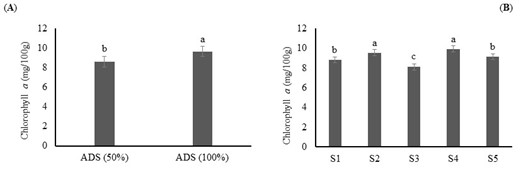
Figure 7 shows that the highest chlorophyll average was obtained in the seedlings grown with substrate S2 (9.55 mg/100g) and S4 at 100% (9.93 mg/100g), both of which did not differ from each other.
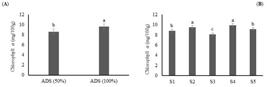
Chlorophyll a content in leaves of yellow passion fruit seedlings cv. Rubi from Cerrado at 45 days after transplanting as a function of water levels (A) and organic substrates (B). Averages followed by the same lowercase letter in the F test for water levels and in the Tukey test for organic substrates, do not differ at 5% probability.
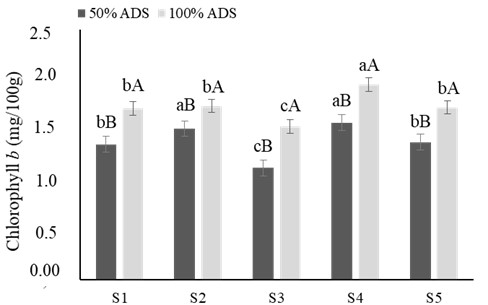
As far as chlorophyll b is concerned, the seedlings produced with S4, under 100% water, had the highest averages (1.95 mg/100g). The opposite occurred with the seedlings in which only 50% of the water was applied, where it can be seen that the S3 substrates and the control S1 resulted in seedlings with the lowest averages for chlorophyll b, 1.12 and 1.36 mg/100g, respectively (Figure 8).
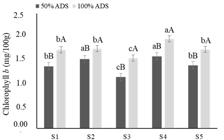
Chlorophyll b in leaves of passion fruit seedlings cv. Rubi do Cerrado as a function of organic substrates and water levels at 45 days after transplanting. Averages followed by the same uppercase letter (irrigation rates) do not differ from each other at 5% probability by the F test, lower case (organic substrates) do not differ from each other at 5% probability by the Tukey test.
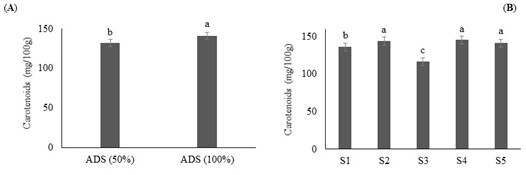
Carotenoids have the potential to detoxify plants from the effects of reactive oxygen species. The lowest averages were found for substrates S3 and S1, with 116.54 and 136.05 mg/100g, respectively (Figure 9). The production of carotenoids in passion fruit plants may be related to the plant's physiological defense process against photooxidation to prevent a reduction in photosynthetic efficiency. It can be seen that, after 45 days, the content of carotenoids in Rubi do Cerrado passion fruit seedlings was reduced as a result of the water deficit. Taken together, these results indicate that these organic substrates can mitigate the effect of drought, allowing a higher rate of carotenoid production in BRS Rubi do Cerrado passion fruit seedlings.
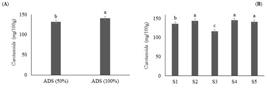
Carotenoids in leaves of yellow passion fruit seedlings cv. Rubi at 45 days after transplanting from the Cerrado as a function of water levels (A) and organic substrates (B). Averages followed by the same lowercase letter, by the F test for water levels and by the Tukey test for organic substrates, do not differ at 5% probability.
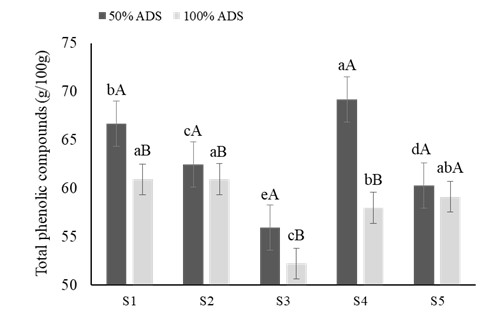
Secondary metabolites, such as phenolic compounds, are promoted during abiotic stress to help plants adapt to stress conditions, probably due to their antioxidant properties derived from hydroxyl groups (Gundaraniya et al., 2020). To this end, when phenolic compounds were assessed, it was found that the association of the 100% blade with the use of substrate S4 promoted the highest content of this metabolite (69.20 g/100g), differing from the others, as shown in Figure 10.
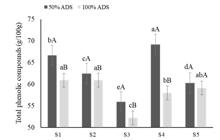
Total phenolic compounds present in passion fruit seedlings cv. Rubi do Cerrado as a function of organic substrates and water levels at 45 days after transplanting. Averages followed by the same uppercase letter (water levels) do not differ from each other at 5% probability by the F test, lower case (organic substrates) do not differ from each other at 5% probability by the Tukey test.
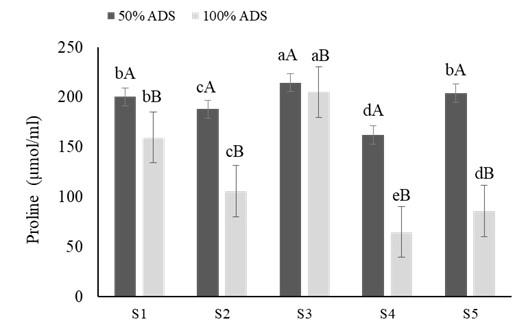
When plants are affected by stress, their metabolism can switch between primary and secondary metabolism to deal with unfavorable conditions (Jia et al., 2020). As with the primary metabolite proline, there was a significant effect of the Sub ⨯ Slats interaction for this metabolite in passion fruit seedlings cv. Rubi do Cerrado (Figure 11). When the seedlings were grown under L1 (214.62 µmol/ml) and L2 (205.18 µmol/ml) in S3, the highest proline averages were obtained, but there was no difference between them.
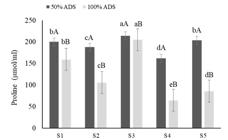
Proline in passion fruit seedlings cv. Rubi do Cerrado as a function of organic substrates and water levels at 45 days after transplanting. Averages followed by the same uppercase letter (water levels) do not differ from each other at 5% probability by the F test, lower case (organic substrates) do not differ from each other at 5% probability by the Tukey test.
In general, the seedlings irrigated with 50% of their requirements had the highest averages, with the exception of substrates S2 and S1, in which the averages were lower for L1. Therefore, the higher levels of proline may indicate that the plants are responding to the stress in an adaptive way and the reason why S2 and S1 had lower proline averages at the 50% level may be related to the nutritional composition of these substrates or even their water retention capacity, which may have influenced the absorption of nutrients or the response to stress, since the plant subjected to water stress starts to accumulate proline more quickly in the leaf.
4. Discussion
In general, plants under water deficit have lower gs because they have less water available for metabolism and this causes them to close their stomata. Thus, the high stomatal conductance may indicate that the stomata were open in the seedlings irrigated with 100%ADS, facilitating the entry of CO2 for photosynthesis and the exit of water vapor. Taiz et al. (2017) explain that high temperature can affect stomatal conductance, since at higher temperatures there is usually a higher transpiration rate and therefore higher stomatal conductance.
According to Arif et al. (2020) and Figueiredo et al. (2020), reduced stomatal conductance is a protective mechanism to prevent water loss through transpiration, but it also restricts the plant's ability to absorb water. According to Souza et al. (2018) plants, in response to extreme environmental conditions, develop many adaptive systems, including cellular, physiological and metabolic processes that function as the main defense mechanisms against water stress, thus ensuring their acclimatization and survival.
Santos et al. (2019) observed that the greatest gas exchange in seedlings of ora-pro-nóbis (Pereskia aculeata) was produced in the substrate with added organic matter, probably due to the increase in essential nutrients in the chemical composition of the chicken litter. Souto et al. (2024) observed that the leaf transpiration of sour passion fruit cv. BRS GA1 irrigated with 70% of ETc showed an average value of 4.21 mmol H2O m-2s-1, which was higher than the value observed for the L1 (2.41 mmol H2O m-2s-1) and L2 (3.69 mmol H2O m-2s-1) leaves.
Zörb et al. (2019) report that reductions in stomatal conductance limit the entry of CO2 into leaf cells, potentially increasing susceptibility to photochemical damage due to limited CO2 availability and excessive energy input into photosystem II. In addition, Uchoa et al. (2018) explain that inadequate water supply to yellow passion fruit is one of the most limiting factors for production and, in general, according to Cavalcante et al. (2021), plants under conditions of water deficit reduce their physiological processes, limiting carbon assimilation, resulting in reduced yields. Therefore, organic substrates play a crucial role in the production of passion fruit seedlings, helping to mitigate the effects of lack of water, since they help retain water, improving the structure of the soil/substrate, increasing its porosity, consequently improving aeration and facilitating water infiltration.
Guedes et al. (2023) found that the application of liquid fertilizers affected the rate of CO2 assimilation. The authors observed that the application of Codasal™ and the Codasal™ + Aminoagro Raiz™ mixture resulted in an increase in the CO2 assimilation rate in yellow passion fruit seedlings.
The internal concentration of CO2 in the leaves can influence the opening of the stomata. Thus, lower CO2 concentrations tend to promote the opening of stomata. Cabrera et al. (2021) explain that the increase in internal CO2 concentration is linked to stomatal conductance, as plants can capture more atmospheric CO2. For Leal et al. (2021), an increase in stomatal conductance is associated with a greater influx of CO2 into the leaf mesophyll, increased transpiration and, consequently, an increase in net photosynthesis. Thus, with less water available, the plant may have a lower rate of photosynthesis and a higher concentration of CO2 inside the leaves. Thus, the stomata may open wider to allow more CO2 to enter, compensating for the reduced photosynthesis, leading to higher stomatal conductance (Taiz et al., 2017).
Iñiguez et al. (2019) describe that, with increased transpiration and stomatal conductance, there is a greater influx of CO2, resulting in greater carboxylation. Figueiredo et al. (2020) found an increase in water use efficiency in yellow passion fruit seedlings up to an EC of 2.2 dS m-1, suggesting that the species, due to its tolerance to salinity, can maintain carbon assimilation up to a certain level of stress. In certain cases, when the plant is subjected to water deficiency, it develops morphological adaptations, reducing, for example, leaf area and water loss through evapotranspiration, providing greater efficiency in the use of water by the plant (Ramezanifar et al., 2022). This statement demonstrates the importance of using substrates from organic sources in the production of passion fruit cv. Rubi do Cerrado seedlings in conditions in the high sertão of Paraiba, as they can store a significant amount of water, which is essential during periods of water deficit.
The need for more research into improving agricultural production with water limitation is highlighted, and emphasis is placed on interdisciplinary approaches to obtain the knowledge needed to reach new breakthroughs that help tackle this complex problem. The efficient use of fertilizers in fruit production, aimed at increasing the absorption of nutrients by plants, can improve fruit productivity without harming the environment (Nascimento et al., 2025). This search becomes more challenging in the family farming production system, which mainly uses cattle manure as its main source due to its better response compared to other organic materials with higher nutrient content.
Lima et al. (2020) in a study evaluating the effects of irrigation with saline water and potassium doses on the formation of passion fruit seedlings cv. BRS Rubi do Cerrado found that the interaction between the factors only had a significant effect on the chlorophyll a content of the passion fruit plants at 40 days after sowing. Souza (2022) observed that plants subjected to an ECa of 3.5 dS m¬1 reduced their chlorophyll a content by 40.41% (6,264 mg g¬1) compared to those irrigated with water of a lower saline level (0.3 dS m¬1). The reduction may be due to slow synthesis or rapid degradation, indicating that there was a photoprotection mechanism by reducing the absorbance of light, thus reducing chlorophyll levels.
Water deficit (50% of the water requirement) can stimulate plants to optimize nutrient absorption and increase chlorophyll production as an adaptive response. Therefore, the application of L1 (50%ADS) was expected to affect the plants' chlorophyll, since chlorophyll is usually damaged during drought and the photosynthetic apparatus needs to resynthesize the pigment to avoid an irreversible decline in photosynthetic capacity (Padilla et al., 2024).
According to Wang et al. (2019), chlorophyll a absorbs light mainly in the blue and red regions of the spectrum and reflects green light, giving plants their characteristic green color, while chlorophyll b complements chlorophyll a, absorbing light at wavelengths that chlorophyll a does not absorb as efficiently, such as in the orange region. Plant metabolism is affected by water deficit and organic substrates, and both primary and secondary metabolism are disrupted, along with metabolic networks, which reprogram themselves to counteract the damaging effects of water stress, as explained by You et al. (2019).
Pinheiro et al. (2021), evaluating the photosynthetic pigments of the yellow passion fruit under irrigation strategies with saline water and potassium fertilization, found that irrigation with high salinity water in the vegetative/flowering phases resulted in lower levels of chlorophyll a and carotenoids. Souza (2022) observed that plants subjected to an electrical conductivity level of 2.8 dS m1 obtained the maximum estimated value for carotenoids of 4.017 mg g1 and the lowest content of 2.682 mg g1 was found in plants irrigated with the lowest saline water level (0.3 dS m1). Studying 'BRS GA1' sour passion fruit in the seedling stage, Lima et al. (2020) observed that an increase in water salinity from 0.3 to 3.5 dS m-1 increased the synthesis of carotenoids, highlighting this as a protective mechanism against oxidative reactions.
Worm humus is rich in nutrients and organic matter, which can promote the synthesis of phenolic compounds, which are important for plant defense and can act as antioxidants. However, the reduction in water supplied to the Rubi do Cerrado seedlings led to a reduction in phenolic compounds, especially when using S3 (52.22 g/100g). Plants use a series of enzymatic antioxidants and non-enzymatic antioxidants (carotenoids and phenolic compounds) to prevent oxidative damage and maintain concentrations of reactive oxygen species in a functional range.
According to Tabssum et al. (2019), increasing the concentration of proline induces the activity of enzymes involved in the plant's defense system against oxidative stress triggered by the accumulation of reactive oxygen species (ROS), improving physiological processes. For their part, Khalid et al. (2022) explain that proline is an amino acid that acts as an osmoprotectant and in hormonal signaling, involved in the plant's physiological behavior, capable of maintaining cell turgidity under stressful conditions, increasing CO2 assimilation capacity and, consequently, photosynthesis.
5. Conclusions
When subjected to irrigation with 100% ADS, the seedlings presented higher: stomatal conductance, transpiration, CO2 assimilation rate and internal CO2 concentration. Therefore, with the increase in transpiration and stomatal conductance, there was a greater entry of CO2, resulting in greater carboxylation. The higher proline levels may indicate that the plants are responding to stress in an adaptive manner and the reason why S2 and S1 presented lower proline averages in the 50% layer may be related to the nutritional composition of these substrates or even their capacity water retention.
Acknowledgements
This work was supported by the Paraiba State Research Support Foundation – FAPESQ.
-
Data Availability Statement
The research data analyzed in this study are not publicly available by any means.
References
-
ARIF, Y., SINGH, P., SIDDIQUI, H., BAJGUZ, A. and HAYAT, S., 2020. Salinity induced physiological and biochemical changes in plants: an omic approach towards salt stress tolerance. Plant Physiology and Biochemistry, vol. 156, pp. 64-77. http://doi.org/10.1016/j.plaphy.2020.08.042 PMid:32906023.
» http://doi.org/10.1016/j.plaphy.2020.08.042 -
ARNON, D.I., 1949. Copper enzymes in isolated chloroplasts: polyphenoloxidase in Beta vulgaris. Plant Physiology, vol. 24, no. 1, pp. 1-15. http://doi.org/10.1104/pp.24.1.1 PMid:16654194.
» http://doi.org/10.1104/pp.24.1.1 -
BARROS, P.H.S., PEREIRA, T.L.S., LIMA, R.K.A., MATOS, S.S., LIMA, C.J.G. and SILVA JÚNIOR, G.B., 2021. Produção de mudas de maracujazeiro sob lâminas e frequência de aplicação de solução nutritiva. Acta Tecnológica, vol. 16, no. 1, pp. 135-146. http://doi.org/10.35818/acta.v16i1.1040
» http://doi.org/10.35818/acta.v16i1.1040 -
CABRERA, J.C.B., HIRL, R.T., SCHÄUFELE, R., MACDONALD, A. and SCHNYDER, H., 2021. Stomatal conductance limited the CO2 response of grassland in the last century. BMC Biology, vol. 19, no. 1, pp. 50. http://doi.org/10.1186/s12915-021-00988-4
» http://doi.org/10.1186/s12915-021-00988-4 - CAO, W., ZHANG, J.J., LIU, C.Y., BAI, W.S. and CHENG, N., 2020. A modified Folin-Ciocalteu method for the microdetermination of total phenolic content in honey. International Food Research Journal, vol. 27, no. 3, pp. 576-584.
-
CAVALCANTE, E.S., LACERDA, C.F., COSTA, R.N.T., GHEYI, H.R., PINHO, L.L., BEZERRA, F.M.S., OLIVEIRA, A.C. and CANJÁ, J.F., 2021. Supplemental irrigation using brackish water on maize in tropical semi-arid regions of Brazil: yield and economic analysis. Scientia Agrícola, vol. 78, suppl. 1, e20200151. http://doi.org/10.1590/1678-992x-2020-0151
» http://doi.org/10.1590/1678-992x-2020-0151 - EMPRESA BRASILEIRA DE PESQUISA AGROPECUÁRIA – EMBRAPA, 2014. BRS Rubi do Cerrado: hibrido de maracujazeiro-azedo de frutos avermelhados e amarelos para indústria e mesa. 2. ed. Brasília: Embrapa Cerrado, 2 p.
- EMPRESA BRASILEIRA DE PESQUISA AGROPECUÁRIA – EMBRAPA, 2018. Sistema brasileiro de classificação de solos. 5. ed. rev. e ampl. Brasília: Embrapa, 356 p.
-
FERREIRA, D.F., 2019. Sisvar: a computer analysis system to fixed effects split plot type designs. Revista Brasileira de Biometria, vol. 37, no. 4, pp. 529-535. http://doi.org/10.28951/rbb.v37i4.450
» http://doi.org/10.28951/rbb.v37i4.450 -
FIGUEIREDO, F.R.A., NÓBREGA, J.S., DE FÁTIMA, R.T., FERREIRA, J.T.A., PEREIRA, M.B., LOPES, M.F.Q., PEREIRA, W.E. and ALBUQUERQUE, M.B., 2020. Morphophysiology of yellow passion fruit seedlings under application of nitrogen and potassium and irrigation with high salinity water. Semina: Ciências Agrárias, vol. 41, pp. 1897-1908. http://doi.org/10.5433/1679-0359.2020v41n5supl1p1897
» http://doi.org/10.5433/1679-0359.2020v41n5supl1p1897 -
GUEDES, L.R., CAVALCANTE, L.F., SOUTO, A.G.L., CARVALHO, L.H.M., CAVALCANTE, I.H.L., DINIZ NETO, M.A., LIMA, G.S., MELO, T.S. and HENRIQUE, J.C.G.S., 2023. Liquid fertilizers on photochemical efficiency and gas exchange in yellow passion fruit under saline stress. Revista Brasileira de Engenharia Agrícola e Ambiental, vol. 27, no. 11, pp. 839-847. http://doi.org/10.1590/1807-1929/agriambi.v27n11p839-847
» http://doi.org/10.1590/1807-1929/agriambi.v27n11p839-847 -
GUNDARANIYA, S.A., AMBALAM, P.S. and TOMAR, R.S., 2020. Metabolomic profiling of drought-tolerant and susceptible peanut (Arachis hypogaea L.) genotypes in response to drought stress. ACS Omega, vol. 5, no. 48, pp. 31209-31219. http://doi.org/10.1021/acsomega.0c04601 PMid:33324830.
» http://doi.org/10.1021/acsomega.0c04601 -
HE, J., YANG, S., GOKSEN, G., CONG, X., KHAN, M.R. and ZHANG, W., 2024. Functionalized pectin/alginate food packaging films based on metal-phenol networks. Food Bioscience, vol. 58, pp. 103635. http://doi.org/10.1016/j.fbio.2024.103635
» http://doi.org/10.1016/j.fbio.2024.103635 -
HINOJOSA, L., GONZÁLEZ, J.A., BARRIOS-MASIAS, F.H., FUENTES, F. and MURPHY, K.M., 2018. Quinoa abiotic stress responses: a review. Plants, vol. 7, no. 4, pp. 106. http://doi.org/10.3390/plants7040106 PMid:30501077.
» http://doi.org/10.3390/plants7040106 -
IÑIGUEZ, C., GALMÉS, J. and GORDILLO, F.J.L., 2019. Rubisco carboxylation kinetics and inorganic carbon utilization in polar versus coldtemperate seaweeds. Journal of Experimental Botany, vol. 70, no. 4, pp. 1283-1297. http://doi.org/10.1093/jxb/ery443 PMid:30576461.
» http://doi.org/10.1093/jxb/ery443 -
INSTITUTO BRASILEIRO DE GEOGRAFIA E ESTATÍSTICA – IBGE, 2022 [viewed 22 November 2023]. Produção brasileira de maracujá em 2022 [online]. Available from: https://www.ibge.gov.br/explica/producao-agropecuaria/maracuja/br
» https://www.ibge.gov.br/explica/producao-agropecuaria/maracuja/br -
JIA, H., WANG, L., LI, J., SUN, P., LU, M. and HU, J., 2020. Comparative metabolomics analysis reveals different metabolic responses to drought in tolerant and susceptible poplar species. Physiologia Plantarum, vol. 168, no. 3, pp. 531-546. http://doi.org/10.1111/ppl.13036
» http://doi.org/10.1111/ppl.13036 -
KHALID, M., REHMAN, H.M., AHMED, S., NAWAZ, S., SALEEM, F., AHMAD, S., UZAIR, M., RANA, I.A., ATIF, R.M., ZAMAN, Q.U. and LAM, H.M., 2022. Using exogenous melatonin, glutathione, proline, and glycine betaine treatments to combat abiotic stresses in crops. International Journal of Molecular Sciences, vol. 23, no. 21, pp. 12913. http://doi.org/10.3390/ijms232112913
» http://doi.org/10.3390/ijms232112913 -
LEAL, Y.H., DIAS, T.J., SOUZA, A.G., BEZERRA, A.C., RODRIGUES, L.S., ALBUQUERQUE, M.B., LEAL, M.P.S., SILVA, A.J. and LUCENA, M.F.R., 2021. Gas exchanges and chlorophyll content in green pepper plants under bio-fertilization and times of application. Bioscience Journal, vol. 37, e37051. http://doi.org/10.14393/BJ-v37n0a2021-53661
» http://doi.org/10.14393/BJ-v37n0a2021-53661 -
LIMA, G.S., SOUZA, W.B.B., SOARES, L.A.A., PINHEIRO, F.W.A., GHEYI, H.R. and OLIVEIRA, V.K.N., 2020. Dano celular e pigmentos fotossintéticos do maracujazeiro-azedo em função da natureza catiônica da água. Irriga, vol. 25, no. 4, pp. 663-669. http://doi.org/10.15809/irriga.2020v25n4p663-669
» http://doi.org/10.15809/irriga.2020v25n4p663-669 -
MULOVHEDZI, N.E., ARAYA, N.A., MENGISTU, M.G., FESSEHAZION, M.K., POOY, C.P., ARAYA, H.T. and LAAN, M.V., 2020. Estimating evapotranspiration and determining crop coefficients of irrigated sweet potato (Ipomoea batatas) grown in a semi-arid climate. Agricultural Water Management, vol. 233, pp. 106099. http://doi.org/10.1016/j.agwat.2020.106099
» http://doi.org/10.1016/j.agwat.2020.106099 -
NASCIMENTO, L.S., SILVA, F.D.B., NOGUEIRA, R.S., CIA, S.N., SOUSA, H.M.A., SOUSA, G.G., SOUSA, H.C., MORAES, J.G.L., RIBEIRO, J.F., GOES, G.F., LOPES, D.J.G. and CABRAL, M.J., 2025. Organic fertilization strategies and use of Trichoderma in the agronomic performance of green maize. Brazilian Journal of Biology = Revista Brasileira de Biologia, vol. 85, e287513. http://doi.org/10.1590/1519-6984.287513 PMid:39968996.
» http://doi.org/10.1590/1519-6984.287513 -
NIKPEY, S., RAHIMIBADR, B., NOZARI, N. and REZAEI, S., 2025. The effect of water scarcity on Iran’s food security. Brazilian Journal of Biology = Revista Brasileira de Biologia, vol. 85, e291705. http://doi.org/10.1590/1519-6984.291705 PMid:40396824.
» http://doi.org/10.1590/1519-6984.291705 - PADILLA, Y.G., MIRAS-MORENO, B., GISBERT-MULLOR, R., LUCINI, L., LÓPEZ-GALARZA, S. and CALATAYUD, A., 2024. Leaves and roots metabolomic signatures underlying rootstock-mediated water stress tolerance in grafted pepper plants. Plant Stress, vol. 13, pp. 100542. http://doi.org/10.1016/j.stress.2024.100542.
- PINHEIRO, F.W.A., LIMA, G.S., GHEYI, H.R., SOARES, L.A.A., SOUSA, P.F.N. and SOUZA, W.B.B., 2021. Pigmentos fotossintéticos do maracujazeiro-azedo sob estratégias de irrigação com águas salinas e adubação potássica. In: Inovagri International Meeting & XXX CONIRD, 2021, Fortaleza, CE. Fortaleza: Inovagri, 2021. pp. 1-8.
-
RAMEZANIFAR, H., YAZDANPANAH, N., YAZD, H.G.H., TAVOUSI, M. and MAHMOODABADI, M., 2022. Spinach growth regulation due to interactive salinity, water, and nitrogen stresses. Journal of Plant Growth Regulation, vol. 41, no. 4, pp. 1654-1671. http://doi.org/10.1007/s00344-021-10407-1
» http://doi.org/10.1007/s00344-021-10407-1 -
RAMOS, J.G., LIMA, G.S., LIMA, V.L.A., PAIVA, F.J.S., NUNES, K.G., PEREIRA, M.O., FERNANDES, P.D. and SABOYA, L.M.F., 2021. Foliar application of H2O2 as salt stress attenuator in ‘BRS Rubi do Cerrado’ sour passion fruit. Semina: Ciências Agrárias, vol. 42, no. 4, pp. 2253-2270. http://doi.org/10.5433/1679-0359.2021v42n4p2253
» http://doi.org/10.5433/1679-0359.2021v42n4p2253 - RENA, A.B. and MASCIOTTI, G.Z., 1976. The effect of dehydration on nitrogen metabolism and growth of 4 bean cultivars (Phaseolus vulgaris L.). Revista Ceres, vol. 23, no. 128, pp. 288-301.
-
SANTOS, C.C., GOELZER, A., SILVERIO, J.M., SCALON, S.P.Q., ZARATE, N.A.H. and VIEIRA, M.C., 2019. Capa idade vegetativa e trocas gasosas em mudas de Pereskia aculeata Plum em diferentes substratos. Scientia Plena, vol. 15, no. 11, pp. 1-9. http://doi.org/10.14808/sci.plena.2019.110201
» http://doi.org/10.14808/sci.plena.2019.110201 - SANTOS, M.A.S.S. and PERES, W.L.R., 2021. Estresse hídrico na cultura do maracujá. Scientia Generalis, vol. 2, suppl. 1, pp. 93-93.
-
SIQUEIRA, R.H.S., CHAGAS, E.A., MARTINS, S.A., OLIVEIRA, A.H.C. and SILVA, E.S., 2020 [viewed 22 November 2023]. Seleção de substratos para a produção de mudas de maracujazeiro-amarelo em Roraima. Revista de Ciências Agrárias [online], vol. 63, pp. 1-9. Available from: http://www.alice.cnptia.embrapa.br/alice/handle/doc/1138581
» http://www.alice.cnptia.embrapa.br/alice/handle/doc/1138581 -
SOUTO, A.G.L., MELO, E.N., CAVALCANTE, L.F., NASCIMENTO, A.P.P., CAVALCANTE, I.H.L., LIMA, G.S., BATISTA, R.O., GHEYI, H.R., FÁTIMA, R.T., MESQUITA, E.F., SOUZA, G.L.F., SILVA, G.R., SILVA, D.V., MESQUITA, F.O. and OLIVEIRA, P.V.C., 2024. Water-retaining polymer and planting pit size on chlorophyll index, gas exchange and yield of sour passion fruit with deficit irrigation. Plants, vol. 13, no. 2, pp. 235. http://doi.org/10.3390/plants13020235 PMid:38256788.
» http://doi.org/10.3390/plants13020235 -
SOUZA, P.U., LIMA, L.K.S., SOARES, T.L., JESUS, O.N., COELHO FILHO, M.A. and GIRARDI, E.A., 2018. Biometric, physiological and anatomical responses of Passiflora spp. to controlled water deficit. Scientia Horticulturae, vol. 229, pp. 77-90. http://doi.org/10.1016/j.scienta.2017.10.019
» http://doi.org/10.1016/j.scienta.2017.10.019 - SOUZA, W.B.B., 2022. Aspectos fisiológicos do maracujazeiroazedo irrigado com águas salinas e adubação potássica Pombal: Universidade Federal de Campina Grande, 42 p. Trabalho de Conclusão de Curso (Graduação em Agronomia).
-
TABSSUM, F., ZAMAN, Q.U., CHEN, Y., RIAZ, U., ASHRAF, W., ASLAM, A., EHSAN, N., NAWAZ, R., AZIZ, H. and SHAH, S.U.S., 2019. Exogenous application of proline improved salt tolerance in rice through modulation of antioxidant activities. Pakistan Journal of Agricultural Research, vol. 32, no. 1, pp. 140-151. http://doi.org/10.17582/journal.pjar/2019/32.1.140.151
» http://doi.org/10.17582/journal.pjar/2019/32.1.140.151 - TAIZ, L., ZEIGER, E., MØLLER, I.M. and MURPHY, A. Fisiologia e desenvolvimento vegetal. 6. ed. Porto Alegre: Artmed, 2017. 858 p.
-
TROLL, W. and LINDSLEY, J., 1955. The photometric methods to determination of proline. The Journal of Biological Chemistry, vol. 215, no. 2, pp. 655-660. http://doi.org/10.1016/S0021-9258(18)65988-5 PMid:13242563.
» http://doi.org/10.1016/S0021-9258(18)65988-5 -
UCHÔA, T.L., ARAÚJO NETO, S.E., SELHORST, P.O., RODRIGUES, M.J.S. and GALVÃO, R.O., 2018. Yellow Passion fruit performance in organic crop under mulch. Revista Brasileira de Fruticultura, vol. 40, no. 2, e-212. http://doi.org/10.1590/0100-29452018212
» http://doi.org/10.1590/0100-29452018212 -
WANG, E., BRAUN, M.S. and WINK, M., 2019. Chlorophyll and chlorophyll derivatives interferewith multi-drug resistant cancer cells and bacteria. Molecules, vol. 24, no. 16, pp. 2968. http://doi.org/10.3390/molecules24162968
» http://doi.org/10.3390/molecules24162968 -
YOU, J., ZHANG, Y., LIU, A., LI, D., WANG, X., DOSSA, K., ZHOU, R., YU, J., ZHANG, Y., WANG, L. and ZHANG, X., 2019. Transcriptomic and metabolomic profiling of drought-tolerant and susceptible sesame genotypes in response to drought stress. BMC Plant Biology, vol. 19, no. 1, pp. 267. http://doi.org/10.1186/s12870-019-1880-1 PMid:31221078.
» http://doi.org/10.1186/s12870-019-1880-1 -
ZÖRB, C., GEILFUS, C.M. and DIETZ, K.J., 2019. Salinity and crop yield. Plant Biology, vol. 21, no. S1, pp. 31-38. http://doi.org/10.1111/plb.12884 PMid:30059606.
» http://doi.org/10.1111/plb.12884
Edited by
-
Editor:
Takako Matsumura Tundisi
The research data analyzed in this study are not publicly available by any means.