 Antibacterial potential of Citrus sinensis essential oil against foodborne pathogens: a systematic review
Abstract
Bacteria are single-celled, prokaryotic organisms that can be present in contaminated food, causing various waterborne and foodborne diseases (WBD), which generate high morbidity rates and, in more severe cases, mortality in various regions of the world. The growing increase in bacterial resistance to antimicrobials used in the food industry and public health represents a serious health challenge, making the search for new microbial control strategies urgent. In this context, natural products, such as essential oils, have gained prominence for their bioactive compounds with significant antimicrobial potential, such as the terpenes found in Citrus sinensis (sweet orange) essential oil, which have been shown to be effective against various pathogenic bacteria involved in WFDIs. The objective of the study was to conduct a systematic review to evaluate the therapeutic potential of Citrus sinensis essential oil against foodborne pathogenic bacteria. The search covered documents in Portuguese and English published between 2019 and 2024. Data were collected through CAPES electronic journal platforms, using the Embase, PubMed, and Web of Science databases. The studies were organized and managed with the help of Mendeley software. Initially, 1,562 articles were found. After applying exclusion criteria and refining the search, 12 studies were selected for this review. It was observed that Citrus sinensis essential oil, both alone and in combination with other compounds, demonstrated significant antibacterial activity against gram-positive and gram-negative strains. Citrus sinensis essential oil appears to be a promising alternative in combating pathogenic bacteria, although further studies are needed to elucidate its mechanism of action and broaden its spectrum of application.
Keywords:
waterborne and foodborne diseases; microbiology; natural product
Resumo
Bactérias são organismos unicelulares e procariontes que podem estar presentes em alimentos contaminados, sendo responsáveis por diversas doenças transmitidas por água e alimentos (DTHA), as quais geram elevadas taxas de morbidade e, em casos mais graves, mortalidade em várias regiões do mundo. O crescente aumento da resistência bacteriana aos antimicrobianos utilizados na indústria alimentícia e na saúde pública representa um sério desafio sanitário, tornando urgente a busca por novas estratégias de controle microbiano. Nesse contexto, os produtos naturais, como os óleos essenciais, têm ganhado destaque por apresentarem compostos bioativos com significativo potencial antimicrobiano, como os terpenos encontrados no óleo essencial de Citrus sinensis (laranja doce), que demonstram eficácia contra diversas bactérias patogênicas envolvidas em DTHA. O estudo teve como objetivo realizar uma revisão sistemática para avaliar o potencial terapêutico do óleo essencial de Citrus sinensis contra bactérias patogênicas de origem alimentar. A pesquisa abrangeu documentos em português e inglês publicados entre 2019 e 2024. Os dados foram coletados por meio das plataformas de periódicos eletrônicos da CAPES, utilizando as bases de dados Embase, PubMed e Web of Science. A organização e o gerenciamento dos estudos foram feitos com o auxílio do software Mendeley. Inicialmente, foram encontrados 1.562 artigos. Após os critérios de exclusão e refinamento da busca, 12 estudos foram selecionados para compor esta revisão. Observou-se que o óleo essencial de Citrus sinensis, tanto isoladamente quanto em combinação com outros compostos, demonstrou atividade antibacteriana significativa contra cepas gram-positivas e gram-negativas. O óleo essencial de Citrus sinensis apresenta-se como uma alternativa promissora no combate às bactérias patogênicas, embora sejam necessários mais estudos para elucidar seu mecanismo de ação e ampliar seu espectro de aplicação.
Palavras-chave:
doenças hídricas e alimentares; microbiologia; produto natural
1. Introduction
Bacterial resistance to antimicrobials is one of the biggest health problems of the 21st century. It occurs when bacteria change and manage to live with the effects of antibacterials that previously killed them. This problem is made worse by the excessive and incorrect use of antibacterial agents in human and animal medicine, as well as their use on farms. The excessive and inappropriate use of these antimicrobials helps to create resistant strains, making bacterial infections more difficult to treat and increasing deaths linked to these diseases. The World Health Organization (WHO) warns that if no action is taken to control this situation, the world could enter an era without antibiotics, where common infections and minor injuries could once again become deadly (Loureiro et al., 2016; OMS, 2020).
Waterborne and Foodborne Diseases (WBFDs) are causing increasing concern for global public health due to the high presence of pathogenic bacteria in the food we consume daily. These bacteria include Salmonella, Escherichia coli, Listeria monocytogenes, and others that cause various infections ranging from simple gastroenteritis to serious conditions such as sepsis. The transmission of these pathogens is largely due to inadequate storage practices, unsanitary processes, and poor understanding of food hygiene (Al-mamun et al., 2018; Ju et al., 2019; Lai et al., 2022).
Recent studies not only provide evidence of the high presence of bacteria in foods from various sources, but also explain the trend toward resistance to antibacterial agents, whose effects make treatment prescription quite complicated, significantly impairing existing available treatments (Hussaini et al., 2024). It is an emerging public health challenge that significantly interferes with the protection of housing standards, requires surveillance measures, research, public education, and appropriate public policies, and places additional pressure on health systems to control the spread of resistant bacteria (Huang et al., 2022).
Thus, essential oils have emerged as a promising option in combating bacterial resistance. Among these, sweet orange essential oil (Citrus sinensis) stands out. This oil is extracted from orange peel and is widely used for its antibacterial, antifungal, and antioxidant properties (Reis et al., 2020; Avola et al., 2020; Fagodia et al., 2017). Studies show that sweet orange essential oil has bioactive compounds, such as limonene, myrcene, and linalool, which work well against various types of pathogenic bacteria. It can be used on the skin or in hygiene and cleaning products, helping to reduce bacterial load and complementing conventional treatments (Hamdan et al., 2024).
These considerations highlight the immediate need to innovate strategies regarding bacterial resistance. The use of essential oils, such as Citrus sinensis, may be a promising complementary alternative, especially against pathogens resistant to multiple antibacterials. Therefore, this study aims to conduct a systematic review to evaluate the therapeutic potential of C. sinensis essential oil against pathogenic and foodborne bacteria.
2. Materials and Methods
The systematic review is based on synthesizing scientific knowledge in a specific area, encompassing part of the literature in an unbiased manner, aiming to aggregate, synthesize, and interpret studies on a given subject, preserving the integrity of the information sources in order to theoretically ground the theme (Valeriano et al., 2017).
2.1. Formulation of the question
The characterization of the question was based on the PICO strategy, which stands for P = Population (Meat-derived bacteria), I = Intervention (Effect of Citrus sinensis), C = Comparison (bacteria treated with antibacterials), and O = Outcomes/results (Antibacterial activity). Does Citrus sinensis oil have antibacterial activity against pathogenic and foodborne bacteria?
2.2. Protocol and data collection
The review was conducted in accordance with the PRISMA-P (Preferred Reporting Items for Systematic Reviews and Meta-Analyses Protocols) recommendations (Moher et al., 2015). The research was conducted between November and December 2024 and focused on documents written in English and Portuguese published between 2019 and 2024. The data were collected from the literature available in CAPES electronic journals, using three databases: Embase, Pubmed, and Web of Science, through the following combinations of descriptors and Boolean operators: “antibacterial activity” AND “Citrus sinensis oil” and “antibacterial activity” AND “pathogenic bacteria.” The organization of the studies and their management until the end of the writing process was carried out with the aid of Mendeley software.
2.3. Inclusion and exclusion criteria
The following inclusion criteria were adopted: original articles that were consistent with the study theme involving antibacterial activity and sweet orange essential oil (Citrus sinensis) and written in English or Portuguese. Review articles, monographs, dissertations, theses, duplicate articles, and those that did not constitute the study theme were excluded.
2.4. Risk of bias
The quality of the methods used and the analysis of the risk of bias in the study were performed in accordance with the PRISMA-P recommendations (Moher et al., 2015). The evaluation prioritized clear description of information. The review was conducted independently by two reviewers, and in cases of disagreement, a third reviewer was involved to avoid any potential bias or conflict of interest by masking the names of authors and journals.
2.5. Data extraction
The information extracted from the articles included: author(s), year, objective, and main results obtained.
3. Results
After initial screening of 1,562 studies identified in the databases, 371 were excluded due to duplication and 423 because they were reviews, monographs, dissertations, or theses. A total of 768 articles remained for title and abstract reading, of which 735 were excluded because they did not meet the inclusion criteria. Thus, 33 articles were selected for full reading, of which 21 were excluded because they did not perform experiments with bacterial strains. In the end, 12 studies were included in this review de according to Figure 1.
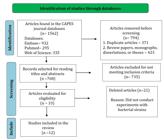
Flowchart of the process of identification, screening, eligibility, and inclusion of studies in the systematic review. The diagram illustrates the stages of the systematic review, from the identification of records in the databases, removal of duplicates, screening of titles and abstracts, analysis of full texts, to the final inclusion of studies that met the eligibility criteria.
All studies analyzed the antibacterial activity of Citrus sinensis essential oil, which demonstrated significant action against several bacteria, especially Staphylococcus aureus, Escherichia coli, Listeria monocytogenes, Bacillus cereus, and Pseudomonas aeruginosa. The inhibition zones ranged from 8 to 26 mm, with generally low minimum inhibitory concentrations, indicating high efficacy. In some cases, the activity was enhanced when the oil was combined with other compounds, such as nanoparticles, or incorporated into biodegradable matrices, broadening its spectrum of action against sensitive and multidrug-resistant strains.
The main results of the selected studies, as well as the characterization of the author, year, and objective, are described and summarized in Table 1.
Characterization of the author, year, objective, and main results included in the research data analysis.
4. Discussion
Antimicrobial resistance is one of the most complex and worrying challenges facing public health today (Robino et al., 2013). This systematic review sought to explore, based on scientific evidence, the therapeutic potential of Citrus sinensis essential oil, popularly known as sweet orange oil, in combating pathogenic bacteria commonly associated with food contamination. The data collection and careful analysis of the 12 selected studies allowed us to identify not only the promising antibacterial activity of this phytocompound, but also the various forms of application, spectra of action, and combinations that can enhance its effectiveness.
Most of the studies included showed that C. sinensis essential oil has significant action against a wide range of bacteria, both Gram-positive and Gram-negative, with emphasis on Staphylococcus aureus, Escherichia coli, Listeria monocytogenes, Bacillus cereus, and Pseudomonas aeruginosa. These microorganisms, as widely documented, are often associated with foodborne diseases, which reinforces the relevance of this research for public health.
These findings corroborate existing literature on the antimicrobial effects of essential oils, especially C. sinensis, whose main bioactive compound, limonene, acts directly on the bacterial cell membrane, causing lysis and inhibiting microbial growth. In addition, other components, such as myrcene, linalool, and α-terpineol, may act synergistically, strengthening the oil's action, as evidenced in several studies included in this review (Azghar et al., 2023; Hamdan et al., 2024; Anwar et al., 2023).
An important observation from the studies analyzed is that the efficacy of C. sinensis can be amplified when combined with innovative technologies, such as metallic nanoparticles or incorporation into biodegradable matrices (Meroni et al., 2024; Liu et al., 2024). These combinations not only increase the spectrum of action against multidrug-resistant strains, but also open up new application possibilities, such as in antimicrobial packaging for food or personal hygiene products, such as natural hand sanitizers (Mohammed et al., 2024).
In total, 9 of the 12 studies analyzed reported the efficacy of C. sinensis essential oil against Staphylococcus aureus (7 studies), Escherichia coli (6 studies), and Listeria monocytogenes (5 studies). In particular, the study by Meroni et al. (2024) combining C. sinensis essential oil with silver nanoparticles demonstrated a significant increase in antibacterial activity, achieving bacterial elimination of around 90%, which highlights the potential of combining natural therapies with nanotechnology.
On the other hand, some studies have reported only moderate antibacterial activity when the oil was used alone (Evangelho et al., 2019; Sado et al., 2022), suggesting that efficacy may vary depending on the bacterial strain, the chemical composition of the oil (influenced by seasonal, geographical, and methodological factors), and the extraction method used. This variability reinforces the importance of standardizing methodologies and focusing efforts on identifying synergistic combinations that enhance the clinical efficacy of the oil.
Regarding the percentage of efficacy in the studies, approximately 75% (9 of the 12 studies) reported a robust antibacterial effect against the main pathogenic strains, with some reaching inhibition zones of up to 26 mm. The remaining 25% of the studies showed moderate intensity activities, which is still significant, but not as high as the results of the others.
It is important to note that antibacterial activity varied depending on the bacterial strain and experimental conditions, such as the method of essential oil extraction, the concentration applied, and the type of technology used (such as nanoparticles). Overall, studies indicate that combining C. sinensis with other substances, such as silver nanoparticles, may be an effective strategy for increasing the oil's antibacterial spectrum of action.
In addition to their antibacterial effect, essential oils have also been shown to have antioxidant and antifungal properties, which increases their appeal as a multifunctional alternative in medical, food, and cosmetic applications (Bahramikia et al., 2024; Lin et al., 2021). The multifactorial approach of the studies suggests that C. sinensis may be an adjuvant tool not only to combat infections, but also to preserve the integrity and safety of food products and promote more sustainable and natural alternatives to the indiscriminate use of antibacterials.
Bacterial resistance, mainly related to foodborne pathogens, has become a growing challenge in public health, especially in waterborne and foodborne diseases (WBFD). These diseases, often caused by bacteria, are transmitted mainly through contaminated food or water, directly reflecting the importance of hygiene and storage practices (Batista et al., 2022). Antibacterial resistance in these pathogens, as noted in the review, poses a significant threat, as it renders conventional treatments ineffective, prolonging the duration of diseases and increasing mortality rates.
However, as described in the review, essential oils, such as Citrus sinensis oil, emerge as promising alternatives for controlling these infections. The use of essential oils, especially sweet orange oil, has been shown to be effective against various pathogenic bacteria, both sensitive and multidrug-resistant, with positive results in studies evaluating the oil's action against E. coli, S. aureus, and Listeria monocytogenes. Sweet orange essential oil, when applied in topical treatments or incorporated into hygiene and cleaning products, can reduce bacterial load and complement conventional treatment, especially in situations where antimicrobials are not effective.
5. Conclusion
This systematic review showed that Citrus sinensis essential oil has significant therapeutic potential in combating pathogenic bacteria that contaminate food, especially in a context of growing bacterial resistance to conventional antimicrobials. The studies analyzed demonstrated that this oil, rich in bioactive compounds such as limonene, linalool, and myrcene, has significant antibacterial activity against a wide variety of Gram-positive and Gram-negative bacteria. These results reinforce the importance of natural alternatives in microbial control, with emphasis on the direct action of C. sinensis in inhibiting the growth of pathogenic microorganisms. Thus, sweet orange essential oil presents itself as a promising tool in strengthening food biosecurity strategies and combating bacterial resistance, provided that more in-depth in vivo studies are conducted, in addition to the necessary standardization of extraction methods, dosages, and formulations to ensure its safe and effective application.
Data Availability Statement
All the data supporting the results of this study were published in the article itself.
References
-
AL-MAMUN, M., CHOWDHURY, T., BISWAS, B. and ABSAR, N., 2018. Food poisoning and intoxication: a global leading concern for human health. In: A.M. GRUMEZESCU and A.M. HOLBAN, eds. Food safety and preservation Cambridge, MA: Academic Press, pp. 307-352. http://doi.org/10.1016/B978-0-12-814956-0.00011-1
» http://doi.org/10.1016/B978-0-12-814956-0.00011-1 -
AL-MIJALLI, S.H., JEDDI, M., EL HACHLAFI, N., ABDALLAH, E.M., ASSAGGAF, H., QASEM, A., RAJAB, B.S., LEE, L.-H., BOUYAHYA, A., GOH, K.W., MING, L.C. and MRABTI, H.N., 2023. Combination of sweet orange, lentisk and lemon eucalyptus essential oils: optimization of a new complete antimicrobial formulation using a mixture design methodology. Heliyon, vol. 9, no. 9, pp. e19814. http://doi.org/10.1016/j.heliyon.2023.e19814 PMid:37809691.
» http://doi.org/10.1016/j.heliyon.2023.e19814 -
ANWAR, T., QURESHI, H., FATIMA, A., SATTAR, K., ALBASHER, G., KAMAL, A., AYAZ, A. and ZAMAN, W., 2023. Citrus sinensis peel oil extraction and evaluation as an antibacterial and antifungal agent. Microorganisms, vol. 11, no. 7, pp. 1662. http://doi.org/10.3390/microorganisms11071662 PMid:37512835.
» http://doi.org/10.3390/microorganisms11071662 -
AVOLA, R., GRANATA, G., GERACI, C., NAPOLI, E., GRAZIANO, A.C.E. and CARDILE, V., 2020. Oregano (Origanum vulgare L.) essential oil provides anti-inflammatory activity and facilitates wound healing in a human keratinocytes cell model. Food and Chemical Toxicology, vol. 144, pp. 111586. http://doi.org/10.1016/j.fct.2020.111586 PMid:32679285.
» http://doi.org/10.1016/j.fct.2020.111586 -
AZGHAR, A., DALLI, M., AZIZI, S., BENAISSA, E.M., BEN LAHLOU, Y., ELOUENNASS, M. and MALEB, A., 2023. Chemical composition and antibacterial activity of citrus peels essential oils against multidrug-resistant bacteria: a comparative study. Journal of Herbal Medicine, vol. 42, pp. 100799. http://doi.org/10.1016/j.hermed.2023.100799
» http://doi.org/10.1016/j.hermed.2023.100799 -
BAHRAMIKIA, S., HABIBI, S. and SHIRZADI, N., 2024. Antioxidant, anti-inflammatory and antibacterial activities of methanol extract and essential oil of two varieties of Citrus sinensis L. in Iran. Natural Product Research, vol. 39, no. 24, pp. 6989-6993. http://doi.org/10.1080/14786419.2024.2400232 PMid:39234994.
» http://doi.org/10.1080/14786419.2024.2400232 -
BATISTA, J.D.S., SOARES, L.S., OLIVEIRA, L.L.F., BALDONI, N.R. and CHEQUER, F.M.D., 2022. Intoxicações por alimentos e bebidas e ocorrência das doenças de transmissão hídrica e alimentar no Brasil. Saúde e Pesquisa, vol. 15, no. 4, pp. 1-21. http://doi.org/10.17765/2176-9206.2022v15n4.e11170
» http://doi.org/10.17765/2176-9206.2022v15n4.e11170 -
EVANGELHO, J.A., DANNENBERG, G.S., BIDUSKI, B., EL HALAL, S.L.M., KRINGEL, D.H., GULARTE, M.A., FIORENTINI, A.M. and ZAVAREZE, E.R., 2019. Antibacterial activity, optical, mechanical, and barrier properties of corn starch films containing orange essential oil. Carbohydrate Polymers, vol. 222, pp. 114981. http://doi.org/10.1016/j.carbpol.2019.114981 PMid:31320073.
» http://doi.org/10.1016/j.carbpol.2019.114981 -
FAGODIA, S.K., SINGH, H.P., BATISH, D.R. and KOHLI, R.K., 2017. Phytotoxicity and cytotoxicity of Citrus aurantiifolia essential oil and its major constituents: limonene and citral. Industrial Crops and Products, vol. 108, pp. 708-715. http://doi.org/10.1016/j.indcrop.2017.07.005
» http://doi.org/10.1016/j.indcrop.2017.07.005 -
HAMDAN, M., JARADAT, N., AL‑MAHARIK, N., ISMAIL, S. and QADI, M., 2024. Chemical composition, cytotoxic effects and antimicrobial activity of combined essential oils from Citrus meyeri, Citrus paradise, and Citrus sinensis leaves. Industrial Crops and Products, vol. 210, pp. 118096. http://doi.org/10.1016/j.indcrop.2024.118096
» http://doi.org/10.1016/j.indcrop.2024.118096 -
HUANG, L.J., CHEN, S.J., HU, Y.W., LIU, C.Y., WU, P.F., SUN, S.M., LEE, S.Y., CHEN, Y.Y., LEE, C.Y., CHAN, Y.J., CHOU, Y.C. and WANG, F.D., 2022. The impact of antimicrobial stewardship program designed to shorten antibiotics use on the incidence of resistant bacterial infections and mortality. Scientific Reports, vol. 12, no. 1, pp. 913. http://doi.org/10.1038/s41598-022-04819-6 PMid:35042878.
» http://doi.org/10.1038/s41598-022-04819-6 -
HUSSAINI, I.M., SULAIMAN, A.N., ABUBAKAR, S.C., ABDULAZEEZ, T.M., ABDULLAHI, M.M., SULAIMAN, M.A., MADIKA, A., BISHIR, M. and MUHAMMAD, A., 2024. Unveiling the arsenal against antibiotic resistance: antibacterial peptides as broad-spectrum weapons targeting multidrug-resistant bacteria. Microbe, vol. 5, pp. 100169. http://doi.org/10.1016/j.microb.2024.100169
» http://doi.org/10.1016/j.microb.2024.100169 -
JU, J., XIE, Y., GUO, Y., CHENG, Y., QIAN, H. and YAO, W., 2019. O efeito inibitório dos óleos essenciais vegetais sobre bactérias patogênicas transmitidas por alimentos. Revisões Críticas em Ciência e Nutrição de Alimentos, vol. 59, no. 20, pp. 3281-3292. http://doi.org/10.1080/10408398.2018.1488159 PMid:29902072.
» http://doi.org/10.1080/10408398.2018.1488159 -
LAI, H., TANG, Y., WANG, Z., REN, F., KONG, L., JIAO, X. and HUANG, J., 2022. Handling practice as a critical point influencing the transmission route of campylobacter throughout a commercial restaurant kitchen in China. Food Control, vol. 139, pp. 109056. http://doi.org/10.1016/j.foodcont.2022.109056
» http://doi.org/10.1016/j.foodcont.2022.109056 -
LIN, X., CAO, S., SUN, J., LU, D., ZHONG, B. and CHUN, J., 2021. The chemical compositions, and antibacterial and antioxidant activities of four types of citrus essential oils. Molecules (Basel, Switzerland), vol. 26, no. 11, pp. 3412. http://doi.org/10.3390/molecules26113412 PMid:34199966.
» http://doi.org/10.3390/molecules26113412 -
LIU, M., HE, C., CHEN, W., LI, Y., YANG, N., CHEN, X., XUE, J., WANG, X., LU, A., XU, Z., ZHANG, X., SUN, L. and LIU, H., 2024. Carboxymethyl chitosan/peach gum polysaccharide packaging film incorporating Citrus sinensis essential oil effectively enhances the quality preservation of strawberries. Food Packaging and Shelf Life, vol. 46, pp. 101409. http://doi.org/10.1016/j.fpsl.2024.101409
» http://doi.org/10.1016/j.fpsl.2024.101409 -
LOUREIRO, R.J., ROQUE, F., RODRIGUES, A.T., HERDEIRO, M.T. and RAMALHEIRA, E., 2016. O uso de antibióticos e as resistências bacterianas: breves notas sobre a sua evolução. Revista Portuguesa de Saude Publica, vol. 34, no. 1, pp. 77-84. http://doi.org/10.1016/j.rpsp.2015.11.003
» http://doi.org/10.1016/j.rpsp.2015.11.003 -
MERONI, G., LATERZA, G., TSIKOPOULOS, A., TSIKOPOULOS, K., VITALINI, S., SCAGLIA, B., IRITI, M., BONIZZI, L., MARTINO, P.A. and SOGGIU, A., 2024. Antibacterial potential of essential oils and silver nanoparticles against multidrug-resistant Staphylococcus pseudintermedius isolates. Pathogens (Basel, Switzerland), vol. 13, no. 2, pp. 156. http://doi.org/10.3390/pathogens13020156 PMid:38392894.
» http://doi.org/10.3390/pathogens13020156 -
MOHAMMED, I.O., ALRASHEID, A.A. and HUSSEIN AYOUB, S.M., 2024. GC-MS analysis and study of the antimicrobial activity of Citrus paradisi, Citrus aurantifolia, and Citrus sinensis peel essential oils as hand sanitizer. International Journal of Microbiology, vol. 2024, no. 1, pp. 4957712. http://doi.org/10.1155/2024/4957712 PMid:38204865.
» http://doi.org/10.1155/2024/4957712 -
MOHER, D., SHAMSEER, L., CLARKE, M., GHERSI, D., LIBERATI, A., PETTICREW, M., SHEKELLE, P. and STEWART, L.A., and the PRISMA-P Group, 2015. Preferred reporting items for systematic review and meta-analysis protocols (PRISMA-P) 2015 statement. Systematic Reviews, vol. 4, no. 1, pp. 1. http://doi.org/10.1186/2046-4053-4-1 PMid:25554246.
» http://doi.org/10.1186/2046-4053-4-1 -
ORGANIZAÇÃO MUNDIAL DA SAÚDE – OMS, 2020 [viewed 31 December 2024]. Resistência antimicrobiana [online]. Available from: https://www.who.int/es/news-room/fact-sheets/detail/antibiotic-resistance
» https://www.who.int/es/news-room/fact-sheets/detail/antibiotic-resistance -
OSANLOO, M., GHAZNAVI, G. and ABDOLLAHI, A., 2020. Surveying the chemical composition and antibacterial activity of essential oils from selected medicinal plants against human pathogens. Iranian Journal of Microbiology, vol. 12, no. 6, pp. 577-583. http://doi.org/10.18502/ijm.v12i6.5032 PMid:33613912.
» http://doi.org/10.18502/ijm.v12i6.5032 -
REIS, J.B., FIGUEIREDO, L.A., CASTORANI, G.M. and VEIGA, S.M.O.M., 2020. Avaliação da atividade antimicrobiana dos óleos essenciais contra patógenos alimentares. Brazilian Journal of Health Review, vol. 3, no. 1, pp. 342-363. http://doi.org/10.34119/bjhrv3n1-025
» http://doi.org/10.34119/bjhrv3n1-025 -
ROBINO, L., CORDEIRO, N., GARCÍA-FULGUEIRAS, V., BADO, I., ALGORTA, G. and VIGNOLI, R., 2013. Fallo terapéutico por resistencia antibacteriana intra-tratamiento, a propósito de dos casos clínicos. Revista Chilena de Infectologia, vol. 30, no. 3, pp. 326-328. http://doi.org/10.4067/S0716-10182013000300010 PMid:23877783.
» http://doi.org/10.4067/S0716-10182013000300010 -
SADO, M., YUSUF, Z., DESTA, M. and IDRIS, M., 2022. Physicochemical properties, antioxidant and antimicrobial activities of sweet orange (Citrus sinensis L. OSBECK) fruit peel and pulp oil extracts. The Open Biotechnology Journal, vol. 16, no. 1, pp. e187407072206160. http://doi.org/10.2174/18740707-v16-e2206160
» http://doi.org/10.2174/18740707-v16-e2206160 -
VALERIANO, A.C.F.R., SILVA JÚNIOR, E.X., BEDOR, C.N.G. and COSTA, M.M., 2017. O uso da fitoterapia na medicina por usuários do SUS: uma revisão sistemática. Id on Line Revista Multidisciplinar e de Psicologia, vol. 10, no. 33, pp. 219-236. http://doi.org/10.14295/idonline.v10i33.631
» http://doi.org/10.14295/idonline.v10i33.631
Edited by
-
Editor:
Takako Matsumura Tundisi