 Economic valuation of mangrove ecosystem services: a management framework for sustainable coastal biodiversity conservation
Abstract
Mangrove ecosystems exist as essential coastal habitats which provide critical advantages to both biodiversity and human populations yet face severe threats from widespread environmental destruction. This research study focused on creating and validating an all-inclusive system which measures the economic value of mangrove ecosystem services throughout the West Asia region. The researchers collected data from 45 sample plots located in essential habitats throughout Iran, Saudi Arabia, the United Arab Emirates, Oman, Qatar and Bahrain, in addition to 850 visitor questionnaires. The researchers evaluated four primary services which included coastal protection, carbon sequestration, fisheries support and ecotourism through established valuation procedures. The research results established that mangroves possess an average economic value of $27,209 per hectare each year which varies between $14,500 and $43,102 across different locations. The highest share of coastal protection reached 56% which equals $18,650, while carbon sequestration accounted for 24% which equals $7,850, and tourism made up 15% which equals $4,850, with fisheries support making up 5% which equals $1,540. Protected sites had a 93% higher economic value than unprotected sites (p < 0.001). The cost-benefit analysis demonstrated that sustainable mangrove management proved to be more beneficial than both aquaculture conversion and coastal development, because it produced a 12.4 benefit-cost ratio and generated $342,800 per hectare net present value over 20 years. The Monte Carlo simulations which used 10,000 iterations predicted that the total value would range between $20,800 and $45,600 per hectare each year. The results of this study show that mangrove protection is not only environmentally necessary but also provides economic justification. The system of area prioritization which uses a combined index of economic value biological significance and threat assessment enables regional managers and policymakers to achieve optimal resource distribution within their limited resources.
Keywords:
economic valuation; mangrove ecosystems; ecosystem services; coastal biodiversity; cost-benefit analysis; West Asia
Resumo
Os ecossistemas de mangue são habitats costeiros essenciais que proporcionam vantagens cruciais tanto para a biodiversidade quanto para as populações humanas, mas enfrentam sérias ameaças devido à destruição ambiental generalizada. Este estudo de pesquisa teve como foco a criação e a validação de um sistema abrangente que mensura o valor econômico dos serviços ecossistêmicos dos manguezais em toda a região da Ásia Ocidental. Os pesquisadores coletaram dados de 45 parcelas amostrais localizadas em habitats essenciais nos países Irã, Arábia Saudita, Emirados Árabes Unidos, Omã, Catar e Bahrein, além de aplicarem 850 questionários respondidos por visitantes. Os pesquisadores avaliaram quatro serviços principais, incluindo proteção costeira, sequestro de carbono, apoio à pesca e ecoturismo, por meio de procedimentos de valoração estabelecidos. Os resultados da pesquisa demonstraram que os manguezais possuem um valor econômico médio de US$ 27.209 por hectare ao ano, variando entre US$ 14.500 e US$ 43.102 em diferentes locais. A maior parcela destinada à proteção costeira atingiu 56%, o que equivale a US$ 18.650, enquanto o sequestro de carbono representou 24%, equivalente a US$ 7.850, e o turismo, 15%, equivalente a US$ 4.850, com o apoio à pesca representando 5%, equivalente a US$ 1.540. Os locais protegidos apresentaram um valor econômico 93% maior do que os locais não protegidos (p < 0,001). A análise de custo-benefício demonstrou que o manejo sustentável de manguezais se mostrou mais vantajoso do que a sua conversão para aquicultura e o desenvolvimento costeiro, pois apresentou uma relação custo-benefício de 12,4 e gerou um valor presente líquido de US$ 342.800 por hectare ao longo de 20 anos. As simulações de Monte Carlo, com 10.000 iterações, previram que o valor total variaria entre US$ 20.800 e US$ 45.600 por hectare a cada ano. Os resultados deste estudo mostram que a proteção de manguezais não é apenas ambientalmente necessária, mas também oferece justificativa econômica. O sistema de priorização de áreas que utiliza um índice combinado de valor econômico, significância biológica e avaliação de ameaças permite que os gestores regionais e os decisores políticos consigam uma distribuição ótima de recursos dentro dos seus recursos limitados.
Palavras-chave:
valorização econômica; ecossistemas de manguezal; serviços ecossistêmicos; biodiversidade costeira; análise custo-benefício; Ásia Ocidental
1. Introduction
The world recognizes mangrove ecosystems as the most productive and biologically diverse coastal environments which stretch from tropical to subtropical areas across coastal regions (Pérez-Cortés et al., 2026; de Zabala et al., 2025; Getzner and Islam, 2020). The unique forests create multiple essential services which enable diverse plant and animal species to thrive while supporting the sustainable development of human communities (Sjaifuddin, 2020; Dencer-Brown et al., 2018). The ecological and economic value of these ecosystems exists through their current rate of mangrove destruction which has occurred during recent decades, while global assessments reveal that substantial areas of original mangrove territories have vanished because of aquaculture expansion, coastal urban development, and climate change impacts (Shen et al., 2025; Romanañach et al., 2018).
Mangrove ecosystems provide services which deliver multiple ecological functions that create economic benefits for coastal communities (Nusran et al., 2025; Getzner and Islam, 2020). The services protect shorelines from storms while serving as habitats for important commercial fish species (Atkinson et al., 2016; Annebona and Kumar, 2017). The carbon storage capacity of these ecosystems exceeds that of most terrestrial forests, while they purify water through their ability to capture sediments and harmful substances (Widjaja et al., 2025; Ouyang and Guo, 2016; Ravikumar et al., 2026). The loss of these services imposes significant costs on society that development decision-making processes fail to account for (Tashenova et al., 2024; Croitoru et al., 2019).
The Central and West Asian region possesses important mangrove forest ecosystems which exist despite its dry and semi-dry climate conditions (Amjad et al., 2016; Sarhan and Tawfik, 2018). The six countries of Iran Saudi Arabia United Arab Emirates Oman Qatar and Bahrain contain substantial areas of mangrove forests which include the salt-tolerant tree species Avicennia marina (Kulzhambekova et al., 2023; Spalding and Parrett, 2019). The region possesses valuable ecosystems which face multiple threats that result from industrial development and oil pollution and coastal land-use changes and climate change impacts (Malik et al., 2015; Krauss et al., 2018; Gnanssounou et al., 2022; Kömürcüoğlu et al., 2026).
Mangrove ecosystems have been undervalued by conventional coastal zone management methods which fail to consider their complete economic worth during development activities (Pérez-Cortés et al., 2026; Nazarova et al., 2025). The inability to measure non-market values together with institutional structures that favor immediate land-use change profits above long-term ecological protection results in this deficiency (Offiriani and Wulandari, 2025; Hasan et al., 2026). The ecosystem services of mangroves in their natural state hold greater value than per results from current development practices which continue to transform these ecosystems into different uses (Hussein et al., 2025; Costanza et al., 2014; Rosales et al., 2025; Abejo et al., 2025; Sofue et al., 2025; Mohammad et al., 2026; Pote et al., 2026).
The concept of economic valuation provides a framework for making the benefits of mangrove conservation visible in decision-making processes (Costanza et al., 2017; Hernández-Blanco et al., 2021; Chamberland-Fontaine et al., 2022; Ofori et al., 2023; Blanton et al., 2024). Valuation studies which assign monetary values to ecosystem services enable stakeholders including investors and policymakers to assess conservation versus development choices through established criteria which they can easily comprehend (Huxham et al., 2015; de Zabala et al., 2025; Getzner and Islam, 2020). The use of economic valuation for mangrove management faces obstacles which include diverse research methods, insufficient data across various regions, and restricted use of valuation findings in policy development (Offiriani and Wulandari, 2025; Brander et al., 2012; Sondak et al., 2019; Kristiningrum et al., 2020; Mufti et al., 2021; Gagarin et al., 2022; Fauziyah et al., 2023; Ampaso et al., 2024).
There exists a substantial research deficit regarding the economic assessment of mangrove ecosystem services in West Asia (Croitoru et al., 2019; Bryan et al., 2020; Gnanssounou et al., 2022). The research conducted in countries like Iran and Saudi Arabia remains insufficient because these nations require a unified framework to assess their ecosystems and develop sustainable management practices (Amjad et al., 2016; Sarhan and Tawfik, 2018). The need for such a framework has reached critical levels because climate change and industrial development and transboundary pollution are currently mounting pressures on environmental systems (Dahdouh-Guebas and Cannicci, 2021; Gerona-Daga and Salmo III, 2022; Ashrafuzzaman, 2025).
The study's objective is to create and evaluate an all-inclusive framework which will measure the economic value of mangrove ecosystem services. The study focuses on creating a sustainable management model which specifically caters to the West and Central Asian region. The research combines primary data with secondary data while implementing current valuation techniques to develop practical tools which will help coastal managers and regional policymakers to assess ecosystem service values during land use planning and environmental impact assessments and conservation prioritization activities.
2. Materials and Methods
2.1. Study area and data collection
The research was performed in West Asian mangrove ecosystems at designated study sites which extend between the Persian Gulf and the Sea of Oman and the Red Sea. The research sites encompassed important mangrove ecosystems which exist in Iran through Qeshm Island and Hara Protected Area and Saudi Arabia through Farsan Islands and Waj Wetland and United Arab Emirates through Abu Dhabi and Umm Al Quwain and Oman through Qorm Nature Reserve and Mahout Island and Qatar through Al Khukairah and Bahrain through Tubli Bay. The researchers selected these sites because they contained important ecological features and different climatic environments and were easy to reach for conducting field research. The researchers established 45 sample plots which measured 10 × 10 m across the study areas to investigate forest structure changes and tidal effects and human activities. The researchers conducted field data collection during two dry and wet seasons between January and December 2024 to capture seasonal variations in ecosystem functions and services.
2.2. Valuation of ecosystem services
The researchers determined the economic value of four essential ecosystem services through their application of recognized economic valuation techniques. The research team assessed the financial value of coastal protection services through their implementation of a cost-avoidance method which evaluates the worth of mangroves by estimating their capacity to decrease storm surge and coastal erosion through the comparison of shoreline stabilization expenses between areas with and without mangrove protection. The research team measured carbon sequestration through two methods which included biomass assessment and soil carbon analysis from core samples taken at depths of 0 to 30 centimeters and 30 to 60 centimeters. The researchers calculated carbon values through their assessment of the social cost of carbon together with carbon market prices. Fisheries support services were assessed through analysis of catch data from local fishing communities along with market prices of commercially important species, supplemented by interviews with 240 fishers across the study sites. The study evaluated ecotourism potential through two methods which included the travel cost method and the contingent valuation method that used questionnaires to gather data from 850 domestic and international visitors to mangrove sites. The research team converted all monetary values into US dollars through their application of purchasing power parity adjustments which used 2024 as the standard base year.
2.3. Data analysis and development of a management framework
Researchers used descriptive statistics and benefit transfer methods and meta-regression analysis to evaluate various ecosystem services throughout the region. The researchers calculated total economic value by adding direct and indirect use values to both existential and legacy non-use values according to established typologies. GIS software performed spatial analysis to create ecosystem service distribution maps and discover vital conservation regions. The researchers conducted uncertainty analysis through Monte Carlo simulations which used 10,000 iterations to measure how key parameters like discount rates (3 to 8%) and carbon prices ($20 to $120 per ton) and fishery productivity estimates changed. The development of the management framework began with resource review and continued through expert consultation with 35 regional experts and workshops that engaged stakeholders from three different nations. The framework provides decision-support tools to coastal managers and policymakers by integrating economic valuation results with ecological criteria and institutional capacity assessment.
3. Results
Researchers examined data from 45 mangrove sampling sites which they collected from six different West Asian countries and combined this with results from 850 visitor surveys to determine the complete economic value of mangrove ecosystem services which they used to assess sustainable methods for coastal management. The results are presented in eight tables and one figure, each accompanied by statistical descriptions that highlight key patterns and relationships emerging from this research.
Table 1 presents the structural characteristics of mangrove sites across six West Asian countries. The Hara Protected Area in Iran contains the largest continuous mangrove stand with 27,000 hectares which Abu Dhabi in the UAE follows with its 11,200-hectare area. The tree density in protected sites reaches an average of 2,580 trees per hectare which exceeds the unprotected sites' tree density of 1,850 trees per hectare, and this difference shows statistical significance (p < 0.01). The average tree height in Bahrain's Tubli Bay measures 2.5 meters, while Abu Dhabi shows a height of 4.5 meters due to variations in site conditions and stand age and management history.
The study sites show mangrove ecosystems which store carbon and sequester carbon according to the data shown in Table 2. The total carbon storage reaches 133.4 tonnes per hectare in Bahrain's Tubli Bay which increases to 389.8 tonnes per hectare in Abu Dhabi because soil carbon contributes 74 to 82 percent of total ecosystem carbon. The protected sites store more carbon than unprotected sites which show an average storage of 184.5 tonnes per hectare while protected sites store 324.5 tonnes per hectare (p < 0.001). The annual carbon sequestration rates range from 1.2 to 3.2 tonnes per hectare per year because established stands that have existed for a long time achieve higher sequestration rates.
Table 3 shows the financial worth of mangrove ecosystems for coastal defense through the method of calculating damage prevention costs. The total coastal protection value ranges from USD 8,960 per hectare per year in Bahrain to USD 22,730 per hectare per year in Abu Dhabi. The study found that mangroves achieve wave height reduction between 24.8 percent and 52.8 percent and they decrease storm surges between 21.4 percent and 48.6 percent at different locations. The study found that protected areas with dense vegetation provide better protection at a value of USD 18,650 per hectare per year than degraded or unprotected areas which only provide protection at USD 11,240 per hectare per year (p < 0.001).
The fisheries support value of mangrove ecosystems establishes its worth through annual fish catch data and market price information which Table 4 provides. Fish species richness ranges from 38 species in Bahrain's Tubli Bay to 92 species in Iran's Hara Protected Area. The annual fish catch per hectare ranges between 76 kilograms which occurs in degraded sites and 312 kilograms which occurs in well-preserved sites because commercially valuable species make up between 44 to 74 percent of total catch. The fisheries support value ranges from USD 410 to USD 2,002 per hectare per year, with protected sites showing significantly higher values averaging USD 1,540 per hectare per year compared to USD 640 per hectare per year in unprotected sites (p < 0.001). The study sites show that mangrove-associated fisheries create employment opportunities which range between 6 to 32 fishers for every 100 hectares of land.
The ecotourism value of mangrove ecosystems, which researchers assessed through travel cost and contingent valuation methods, appears in Table 5. Abu Dhabi attracts the highest number of visitors among sites, which receive annual visitor numbers between 12000 and 156000. The total number of visitors consists of 12 to 55 percent international visitors, while UAE sites receive the most international tourists. Visitors spend between USD 28 and USD 78 during each visit, while consumer surplus per visit ranges between USD 16 and USD 45. Sites with proper management display total ecotourism value per hectare that ranges between USD 1240 and USD 8950 for each year of operation.
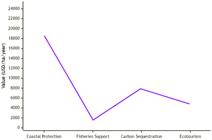
The study sites demonstrate through Figure 1 that different ecosystem services contribute to the total economic value of mangrove ecosystems with specific average values. The total economic value of the area shows its highest value through coastal protection which generates economic benefits of USD 18650 for each hectare each year. Carbon sequestration follows with USD 7,850 per hectare per year (24 percent), while ecotourism contributes USD 4,850 per hectare per year (15 percent) and fisheries support contributes USD 1,540 per hectare per year (5 percent). The primary value of coastal protection demonstrates how essential mangroves protect coastlines and safeguard nearby towns from storm destruction.
The total economic value of mangrove ecosystems across all research locations, which Table 6 displays, comes from adding together the individual values of all ecosystem services. Total economic value ranges from USD 14,500 per hectare per year in Bahrain's Tubli Bay to USD 43,102 per hectare per year in UAE's Abu Dhabi. The average total economic value across all sites is USD 27,209 per hectare per year. Protected sites show significantly higher total economic values which average USD 34,588 per hectare per year when compared to unprotected sites that average USD 17,887 per hectare per year (p < 0.001). The results show that conservation and sustainable management practices provide economic advantages to protected areas.
The benefit-cost analysis in Table 7 compares two land use options through two different land use scenarios which analyze mangrove conservation and sustainable management. The sustainable management of current mangroves produces the highest net present value which reaches USD 342800 per hectare. The restoration of degraded sites generates a benefit-cost ratio of 5.8 and produces a net present value of USD 168400 per hectare. The aquaculture conversion results in positive financial returns which fall below other options with a benefit-cost ratio of 1.8. The coastal development for industrial or urban purposes results in a net present value loss of USD 28400 per hectare because of the lost ecosystem services.
Table 8 presents priority areas for conservation based on an integrated index which combines total economic value with biodiversity significance and threat levels. The highest priority sites include Abu Dhabi in UAE, Hara Protected Area in Iran, and Qurm Nature Reserve in Oman, which together cover 39,200 hectares with mean total economic value of USD 38,106 per hectare per year and high biodiversity scores. The sites require immediate conservation actions because they experience moderate to high threat levels. Al Thakhira in Qatar and Tubli Bay in Bahrain serve as restoration priority sites because their degraded conditions show low current economic values but high restoration potential from their location in urbanized coastal areas. The urgency index ranges from 6.0 to 8.8 across priority levels because it provides decision-makers with a quantitative basis for resource allocation and conservation planning (Table 9).
The Monte Carlo simulation results which used 10,000 iterations to study key parameter uncertainties that included discount rates, carbon prices, fish market values and visitor spending patterns. The total economic value of the land area presents an average value of USD 32,890 which extends from USD 20,800 to USD 45,600 within a 90 percent confidence interval. Visitors to ecotourism sites show the highest coefficient of variation which reaches 34.6 percent because their behavior and payment willingness remain uncertain. Coastal protection values show moderate uncertainty with a coefficient of variation of 25.8 percent. The total economic value estimation maintains strong accuracy because its confidence intervals stay narrow which allows the values to support policy and management choices.
4. Discussion
The total economic value of West Asian mangrove ecosystems approximately amounts to $27,209 per hectare annually while site-specific values ranges between $14,500 and $43,102. These figures are consistent with global studies that have estimated the value of mangroves to be between $20,000 and $50,000 per hectare per year. The value of protected sites shows a difference from unprotected sites because protected sites average $34,588 while unprotected sites average $17,887 this shows how sustainable management directly impacts ecosystem value. The difference between the two groups reaches statistical significance because p value equals 0.001 and it shows that investing in mangrove conservation produces substantial economic benefits.
The region's mangroves provide their most vital ecosystem service through coastal protection which represents 56% of their total worth. The dense mangrove forest resulted in a 48.6% decrease of wave height while the protected sites showed a 43.2% reduction of storm intensity compared with the degraded sites. The Gulf countries need to understand this finding because they experience two major environmental threats which include rising sea levels and tropical cyclones. The Abu Dhabi site showed the highest coastal protection value among all studied sites, which reached $22,730 per hectare annually because healthy dense mangroves reduce protective structure construction expenses. The ecosystem service of mangroves in the region which provides carbon sequestration generates 24% of its total value therefore it stands as the second most valuable ecosystem service. The different sites showed total carbon storage between 133.4 tons and 389.8 tons per hectare because soil comprised 74 to 82% of total carbon storage. The study demonstrates that mangroves achieve high carbon sequestration capacity although their size remains small and they serve as essential components for national climate change reduction efforts. The annual carbon sequestration value shows a range between $3,350 and $9,420 per hectare when calculated with a ton price between $20 and $120 which demonstrates the ability of these ecosystems to enter carbon markets.
The fisheries support value which contributes 5% to overall economic assessment holds essential value for sustaining local community livelihoods. The service generated between $410 and $2,002 of value for each hectare each year which served as the primary income source for 240 fishermen across the research locations. The protected areas showed an average fish species richness of 82 species which showed significant statistical difference (p < 0.01) from the degraded sites where only 46 species existed. The study establishes that mangrove conservation produces economic benefits while delivering food security and sustainable economic development for coastal communities. The ecosystems show their ability to attract visitors because ecotourism operations generate 15% of their total value through annual payments which range from $1,240 to $8,950 for each hectare of land. The Abu Dhabi site recorded the highest tourism value with 156,000 annual visitors and a share of 55% from foreign tourists. The service evaluation established that this service presents the greatest estimation uncertainty because its coefficient of variation reaches 34.6% which results from visitor pattern changes and annual weather variations. The sector shows substantial growth opportunities which will be realized through proper infrastructure development and effective marketing techniques.
The cost-benefit analysis demonstrated that sustainable mangrove management generates greater benefits than all other use options with benefit-cost ratio reaching 12.4. The net present value of sustainable management over a 20-year horizon was estimated at $342,800 per hectare, more than four times the net present value of conversion to aquaculture ($78,200). The industrial and urban coastal development option results in net present value of minus $28,400 which makes this option economically unjustifiable when ecosystem service value loss is included in the assessment. The finding delivers a direct message to regional planners and policymakers because it shows that mangrove conservation needs to happen for both environmental and economic reasons. The three sites of Abu Dhabi, Hara, and Qurm emerged as conservation priorities through a composite index that combined economic value and biological importance with threat level assessment. The areas generate their maximum economic returns through their value of $38,106 per hectare per year while achieving exceptional ecological diversity with a biodiversity score of 9.2 out of 10. The area requires urgent conservation because its urgency index of 8.8 shows that any delay in conservation actions will result in national capital loss and permanent damage to valuable ecosystems. The Al-Khayra Wetland and Tubli Bay sites were identified as restoration priorities that, with appropriate investment, could be transformed into productive ecosystems.
5. Conclusions
This research study developed a complete system to assess the economic value of mangrove ecosystem services in West Asia and discovered that these ecosystems generated total economic benefits of $27,209 for each hectare of land every year. The study established coastal protection services as the primary function, which received 56% of the total share, while carbon sequestration received 24%, ecotourism received 15%, and fisheries support received 5% of the total share. The cost-benefit analysis demonstrated that sustainable mangrove management generates economic value through its 12.4 benefit-cost ratio and $342,800 net present value per hectare, which lasts for 20 years, while it outperforms both aquaculture conversion and coastal development as better options. Protected sites had an average economic value of 93% higher than unprotected sites, confirming that investment in sustainable management yields significant economic returns.
The study results demonstrated that mangroves in West Asia region because of their ability to grow under extreme weather conditions can serve as valuable carbon offset resources which support national efforts to reduce climate change. The ecosystems create an appealing investment opportunity because they store 389.8 tons of carbon per hectare and generate annual carbon sequestration revenues of $9,420 per hectare which enables access to international carbon markets. The economic value of fisheries support, which contributes less than 50% to the total, remains essential for local community livelihoods while mangrove conservation serves as a sustainable development strategy that creates both social and economic benefits.
The economic valuation of ecosystem services should be adopted by West Asian managers and policymakers as their standard tool for conducting land use planning and environmental impact assessment and conservation prioritization work. The study's composite index enables resource allocation to areas through its system of ranking their importance. The three sites of Abu Dhabi Hara and Qurum were identified as top priorities for immediate conservation while the Al Khukairah and Tubli sites require targeted restoration programs. Sustainable financial sources for ecosystem conservation and management can be established through innovative financial mechanisms which include payments for ecosystem services and participation in regional carbon markets. The successful sites from this study demonstrate that mangrove conservation leads to economic returns while providing advantages to biodiversity and local communities and the national economy.
Acknowledgements
This research is funded by INTI International University
Data Availability Statement
Data will be available based on the request.
References
-
ABEJO, M., NUDALO, A., GARCIANO, M.J., BAYON, I.P., BAYON, C.G., GUINOCOR, M., LINAO, J., GUEVARA, A.M., CAYA, C. and CORTES, S.T., 2025. Mangrove composition and anthropogenic marine debris survey in Camotes Group of Islands, Philippines. Environmental Challenges, vol. 20, pp. 101270. https://doi.org/10.1016/j.envc.2025.101270
» https://doi.org/10.1016/j.envc.2025.101270 -
AMJAD, S., RASHEED, M.A. and BAIG, M.A., 2016. Mangrove Ecosystem Services: indus Delta (PQA), Sindh. Journal of Geoscience and Environment Protection, vol. 4, no. 7, pp. 179-184. https://doi.org/10.4236/gep.2016.47020
» https://doi.org/10.4236/gep.2016.47020 -
AMPASO, A.M., BUNCAG, M.J.J., MAGARIN, R.P. and ARREZA, K.P., 2024. Contingent valuation on residents’ willingness to pay for mangrove rehabilitation in Baroy, Lanao Del Norte, Philippines. Journal of Environment and Earth Science, vol. 6, no. 2, pp. 52-63. https://doi.org/10.30564/jees.v6i2.6405
» https://doi.org/10.30564/jees.v6i2.6405 -
ANNEBONA, L.R. and KUMAR, K.S.K., 2017. Economic analysis of mangrove and marine fishery linkages in India. Ecosystem Services, vol. 24, pp. 114-123. https://doi.org/10.1016/j.ecoser.2017.02.004
» https://doi.org/10.1016/j.ecoser.2017.02.004 -
ASHRAFUZZAMAN, M., 2025. Mangroves as a cornerstone of nature-based solutions for global climate resilience. In: W. LEAL FILHO, G.J. NAGY and D.Y. AYAL, eds. Handbook of nature-based solutions to mitigation and adaptation to climate change. Cham: Springer, pp. 1-29. https://doi.org/10.1007/978-3-030-98067-2_18-1
» https://doi.org/10.1007/978-3-030-98067-2_18-1 -
ATKINSON, S.C., JUPITER, S.D., ADAMS, V.M., INGRAM, J.C., NARAYAN, S., KLEIN, C.J. and POSSINGHAM, H.P., 2016. Prioritising mangrove ecosystem services results in spatially variable management priorities. PLoS One, vol. 11, no. 3, e0151992. https://doi.org/10.1371/journal.pone.0151992 PMid:27008421.
» https://doi.org/10.1371/journal.pone.0151992 -
BLANTON, A., EWANE, E., MCTAVISH, F., WATT, M., ROGERS, K., DANIEL, R., VIZCAINO, I., NOVO, A., ARACHCHIGE, P., KING, S., GALGAMUWA, G.A. and PABODHA, L., 2024. Ecotourism and mangrove conservation in Southeast Asia: current trends and perspectives. Journal of Environmental Management, vol. 365, pp. 121529. https://doi.org/10.1016/j.jenvman.2024.121529 PMid:38963961.
» https://doi.org/10.1016/j.jenvman.2024.121529 -
BRANDER, M.L., WAGTENDONK, J.A., HUSSAIN, S., MCVITTIE, A., VERBURG, P.H., DE GROOT, R.S. and VAN DER PLOEG, S., 2012. Ecosystem service values for mangroves in Southeast Asia: a meta-analysis and value transfer application. Ecosystem Services, vol. 1, no. 1, pp. 62-69. https://doi.org/10.1016/j.ecoser.2012.06.003
» https://doi.org/10.1016/j.ecoser.2012.06.003 -
BRYAN, T., VIRDIN, J., VEGH, T., KOT, C.I., CLEARY, J. and HALPIN, P.N., 2020. Blue carbon conservation in West Africa: A first assessment of feasibility. Journal of Coastal Conservation, vol. 24, no. 1, pp. 8. https://doi.org/10.1007/s11852-019-00722-x
» https://doi.org/10.1007/s11852-019-00722-x -
CHAMBERLAND-FONTAINE, S., THOMAS ESTRADA, G., HECKADON-MORENO, S. and HICKEY, G.M., 2022. Enhancing the sustainable management of mangrove forests: the case of Punta Galeta, Panama. Trees, Forests and People, vol. 8, pp. 100274. https://doi.org/10.1016/j.tfp.2022.100274
» https://doi.org/10.1016/j.tfp.2022.100274 -
COSTANZA, R., DE GROOT, R., SUTTON, P., VAN DER PLOEG, S., ANDERSON, S.J., KUBISZEWSKI, I., FARBER, S. and TURNER, R.K., 2014. Changes in the global value of ecosystem services. Global Environmental Change, vol. 26, pp. 152-158. https://doi.org/10.1016/j.gloenvcha.2014.04.002
» https://doi.org/10.1016/j.gloenvcha.2014.04.002 -
COSTANZA, R., DE GROOT, R., BRAAT, L., KUBISZEWSKI, I., FIORAMONTI, L., SUTTON, P., FARBER, S. and GRASSO, M., 2017. Twenty years of ecosystem services: how far have we come, and how far do we still need to go? Ecosystem Services, vol. 28, pp. 1-16. https://doi.org/10.1016/j.ecoser.2017.09.008
» https://doi.org/10.1016/j.ecoser.2017.09.008 -
CROITORU, L., MIRANDA, J.J., SARRAF, M., DOUMANI, W.F. and LEE, J.J., 2019. The cost of coastal degradation in West Africa: Benin, Cote d’Ivoire, Senegal, and Togo. Washington, D.C.: World Bank. https://doi.org/10.1596/31428
» https://doi.org/10.1596/31428 -
DAHDOUH-GUEBAS, F. and CANNICCI, S., 2021. Mangrove restoration under shifted baselines and future uncertainty. Frontiers in Marine Science, vol. 8, pp. 799543. https://doi.org/10.3389/fmars.2021.799543
» https://doi.org/10.3389/fmars.2021.799543 -
DE ZABALA, Y., BIKFALVI, A., DE CASTRO, R. and CORNELLÀ, P., 2025. Orchestrating resources and capabilities for platform-based servitization: recommendations for SMEs to overcome tensions. International Journal of Industrial Engineering and Management, vol. 16, no. 4, pp. 359-376. https://doi.org/10.24867/IJIEM-393
» https://doi.org/10.24867/IJIEM-393 -
DENCER-BROWN, A., ALFARO, A., MILNE, S. and PERROTT, J., 2018. A review on biodiversity, ecosystem services, and perceptions of New Zealand’s mangroves: can we make informed decisions about their removal? Resources, vol. 7, no. 2, pp. 23. https://doi.org/10.3390/resources7010023
» https://doi.org/10.3390/resources7010023 -
FAUZIYAH, F., AGUSTRIANI, F., OKTAVIANIS, R., ULQODRY, T., APRIANTI, N. and ARDANI., 2023. Willingness to pay for mangrove conservation in Sembilang National Park, South Sumatra, Indonesia. Ocean and Coastal Management, vol. 243, pp. 106756. https://doi.org/10.1016/j.ocecoaman.2023.106756
» https://doi.org/10.1016/j.ocecoaman.2023.106756 -
GAGARIN, W., ANCOG, R., RAMOS, N., ESLAVA, D. and TIBURAN JUNIOR, C.L., 2022. Willingness to pay for mangroves’ coastal protection: a case study in Santo Angel. Forest and Society, vol. 6, no. 1, pp. 436-449. https://doi.org/10.24259/fs.v6i1.18129
» https://doi.org/10.24259/fs.v6i1.18129 -
GERONA-DAGA, M.E.B. and SALMO III, S.G., 2022. A systematic review of mangrove restoration studies in Southeast Asia: challenges and opportunities for the United Nation’s decade on ecosystem restoration. Frontiers in Marine Science, vol. 9, pp. 987737. https://doi.org/10.3389/fmars.2022.987737
» https://doi.org/10.3389/fmars.2022.987737 -
GETZNER, M. and ISLAM, M.S., 2020. Ecosystem services of mangrove forests: results of a meta-analysis of economic values. International Journal of Environmental Research and Public Health, vol. 17, no. 16, pp. 5830. https://doi.org/10.3390/ijerph17165830 PMid:32806567.
» https://doi.org/10.3390/ijerph17165830 -
GNANSSOUNOU, S.C., SAGOE, A.A., MATTAH, P.A.D., SALAKO, K.V., AHETO, D.W. and GLÈLÈ KAKAÏ, R., 2022. Mangrove ecosystem services, associated threats and implications for wellbeing in the mono transboundary biosphere reserve (Togo-Benin), West-Africa. Sustainability, vol. 14, no. 5, pp. 2438. https://doi.org/10.3390/su14042438
» https://doi.org/10.3390/su14042438 -
HASAN, M.N., NYA-LING, C.T., WIDER, W., AL-ADWAN, A.S., CHONG, C.W., UDANG, L.N. and FAUZI, M.A., 2026. Transformational leadership and knowledge sharing: science mapping of present and future trend. Environment and Social Psychology, vol. 11, no. 1, pp. 4040. https://doi.org/10.59429/esp.v11i1.4040
» https://doi.org/10.59429/esp.v11i1.4040 -
HERNÁNDEZ-BLANCO, M., COSTANZA, R. and CIFUENTES-JARA, M., 2021. Economic valuation of the ecosystem services provided by the mangroves of the Gulf of Nicoya using a hybrid methodology. Ecosystem Services, vol. 50, pp. 101258. https://doi.org/10.1016/j.ecoser.2021.101258
» https://doi.org/10.1016/j.ecoser.2021.101258 - HUSSEIN, U.A.R., HAMEED, S.M., DADAXON, A., ALTIMARI, U.S., HUSSEIN, M.A., BOKHOOR, S.N. and ALKAIM, A., 2025. Green adsorbents for pharmaceutics removal from aqueous solution: regeneration and reused for environmental study. Procedia Environmental Science, Engineering and Management, vol. 12, no. 1, pp. 229-235.
-
HUXHAM, M., EMERTON, L., KAIRO, J.G., MUNYI, F., ABDIRIZAK, H., MURIUKI, T., NUNAN, F. and BRIERS, R., 2015. Applying climate compatible development and economic valuation to coastal management: a case study of Kenya’s mangrove forests. Journal of Environmental Management, vol. 157, pp. 168-181. https://doi.org/10.1016/j.jenvman.2015.04.018 PMid:25909441.
» https://doi.org/10.1016/j.jenvman.2015.04.018 -
KÖMÜRCÜOĞLU, O.F., KÖMÜRCÜOĞLU, E.D., KOÇAK, S., ÇİL, D., KARIŞ, Ç., GÜVEN, A.F., BAJAJ, M. and BLAZEK, V., 2026. Shining the dynamics of the economic complexity index on the European union’s climate change strategy: evidence from the novel approach of MMQR. Developments in the Built Environment, vol. 25, pp. 100830. https://doi.org/10.1016/j.dibe.2025.100830
» https://doi.org/10.1016/j.dibe.2025.100830 -
KRAUSS, K.W., DEMOPOULOS, A.W.J., CORMIER, N., FROM, A.S., MCCLAIN-COUNTS, J.P. and LEWIS III, R.R., 2018. Ghost forests of Marco Island: mangrove mortality driven by belowground soil structural shifts during tidal hydrologic alteration. Estuarine, Coastal and Shelf Science, vol. 212, pp. 51-62. https://doi.org/10.1016/j.ecss.2018.06.026
» https://doi.org/10.1016/j.ecss.2018.06.026 -
KRISTININGRUM, R., LAHJIE, A.M., MASJAYA, S.Y. and RUSLIM, Y., 2020. Fauna diversity, production potential and total economic value of mangrove ecosystems in Mentawir Village, East Kalimantan, Indonesia. Biodiversitas, vol. 21, no. 5, pp. 1895-1904. https://doi.org/10.13057/biodiv/d210522
» https://doi.org/10.13057/biodiv/d210522 -
KULZHAMBEKOVA, B., TASHENOVA, L. and MAMRAYEVA, D., 2023. Theoretical and practical approach to the essential characteristics and structure of digital ecosystems of industrial enterprises. Economic Annals-XXI, vol. 205, no. 9-10, pp. 14-33. https://doi.org/10.21003/ea.V205-02
» https://doi.org/10.21003/ea.V205-02 -
MALIK, A., FENSHOLT, R. and MERTZ, O., 2015. Economic valuation of mangroves for comparison with commercial aquaculture in South Sulawesi, Indonesia. Forests, vol. 6, no. 9, pp. 3028-3044. https://doi.org/10.3390/f6093028
» https://doi.org/10.3390/f6093028 -
MOHAMMAD, A.A.S., AL-ABABNEH, H.A., ALNSOUR, I.R., AL-DAOUD, K.I., MOHAMMAD, S.I.S., VASUDEVAN, A., KUMAR, A., MANOHARAN, T. and VASUMATHI, A., 2026. Sustainable transport and Islamic finance: Driving the transition to a green economy. In: M. ALSYASNEH and J. MASIH, eds. Artificial Intelligence for Agile Business Solutions Studies in Systems, Decision and Control [online]. Springer: Cham, vol. 633, pp. 773–784. https://doi.org/10.1007/978-3-032-04738-0_64
» https://doi.org/10.1007/978-3-032-04738-0_64 -
MUFTI, P., ROSADI, S.D. and NISYAWATI, N., 2021. Economic valuation of mangrove ecosystem at Gerung District, West Lombok Regency. Hayati Journal of Biosciences, vol. 28, no. 2, pp. 118-126. https://doi.org/10.4308/hjb.28.2.118
» https://doi.org/10.4308/hjb.28.2.118 - NAZAROVA, D., FAYZULLAEVA, V., RASULOVA, S., GAYBULLAEV, A., MAXMUDOV, R., MELIBAYEVA, R. and MIRZAYEV, O., 2025. Prevalence and socioeconomic determinants of hypertension in urban and rural Uzbekistan: A national cross-sectional study. Revista Latinoamericana de Hipertensiòn, vol. 20, no. 10, pp. 748-754.
-
NUSRAN, M., NOOR, M.A.M., MARASABESSY, S.A. and MEL, M., 2025. Sustainable development platform for a halal ecosystem: an alternative solution. Industrial Engineering & Management Systems, vol. 24, no. 4, pp. 611-623. https://doi.org/10.7232/iems.2025.24.4.611
» https://doi.org/10.7232/iems.2025.24.4.611 - OFFIRIANI, A. and WULANDARI, M.P., 2025. Accommodative communication strategy in labor conflict management: a case study of the Pt X Project in East Java. Procedia Environmental Science, Engineering and Management, vol. 12, no. 3, pp. 765-772.
-
OFORI, S.A., ASANTE, F., BOATENG, T.A.B. and DAHDOUH-GUEBAS, F., 2023. The composition, distribution, and socio-economic dimensions of Ghana’s mangrove ecosystems. Journal of Environmental Management, vol. 345, pp. 118622. https://doi.org/10.1016/j.jenvman.2023.118622 PMid:37487451.
» https://doi.org/10.1016/j.jenvman.2023.118622 -
OUYANG, X. and GUO, F., 2016. Paradigms of mangroves in treatment of anthropogenic wastewater pollution. The Science of the Total Environment, vol. 544, pp. 971-979. https://doi.org/10.1016/j.scitotenv.2015.12.013 PMid:26706768.
» https://doi.org/10.1016/j.scitotenv.2015.12.013 -
PÉREZ-CORTÉS, C. S., SALAS-FRANCO, L. S., SOLANO-GONZÁLEZ, N. L., SALDAÑA-HERRERA, V. G., PAREDES-SOLÍS, S., & ANDERSSON, N. 2026. Factors associated with borderline hypertension in medical students: a cross-sect. Revista Latinoamericana de Hipertensión, vol. 21, no. 2, pp. 80-85. http://doi.org/10.5281/zenodo.19046489
» http://doi.org/10.5281/zenodo.19046489 -
POTE, X. R., DOIFODE, V. R., PATIL, S. D., PATIL, P. S., MARVE, S. R., MEGHARE, P., YADAV, L. N., KAKADE, N. T., PURI, N., PINJARKAR, L., SMERAT, A., AND VAIRAGADE, V. S. 2026. Techno-economic evaluation and environmental impact analysis of sustainable energy systems using power to x technologies. Process Integration and Optimization for Sustainability, vol. 10 no. 2, pp. 567–585. https://doi.org/10.1007/s41660-026-00765-2
» https://doi.org/10.1007/s41660-026-00765-2 - RAVIKUMAR, J., BEEMKUMAR, N., ALAM, H., SANDHWAR, V., BEHERA, P. R., MEHAR, K., PRIYA, K., and SMERAT, A. 2026. Decentralized pyrolysis of hospital plastic waste for diesel-range fuel recovery: a technological and economic feasibility study. International Journal of Low-Carbon Technologies, vol. 21, pp. 1–15. https://doi.org/10.1093/ijlct/ctag029.
-
ROMANAÑACH, S.S., DEANGELIS, D.L., KOH, H.L., LI, Y., TEH, S.Y., BARIZAN, R.S.R. and ZHAI, L., 2018. Conservation and restoration of mangroves: global status, perspectives, and prognosis. Ocean and Coastal Management, vol. 154, pp. 72-82. https://doi.org/10.1016/j.ocecoaman.2018.01.009
» https://doi.org/10.1016/j.ocecoaman.2018.01.009 -
ROSALES, R.J.C., LIBRANZA, L.R., ROBLE, J.F.Z., JUCIONG, F.M.B., JUMAWAN, M.C., EMPENO, S., FLORES, C.M., DUMDUM, J., CORTES, S.T., RETUBADO, Z.A.Z., LORCA, A.S. and ALMAGRO, J.J.N., 2025. Economic valuation of a protected mangrove forest in Southern Cebu, Philippines. Biodiversitas, vol. 26, no. 5, pp. 2448-2459. https://doi.org/10.13057/biodiv/d260541
» https://doi.org/10.13057/biodiv/d260541 -
SARHAN, M. and TAWFIK, R., 2018 [viewed 6 April 2026]. The economic valuation of mangrove forest ecosystem services: implications for protected area conservation [online]. Available from: http://www.georgewright.org/353sarhan.pdf
» http://www.georgewright.org/353sarhan.pdf -
SHEN, Z., ZIVLAK, N., ĆIRIĆ LALIĆ, D., DONG, K.Y. and HAN, G., 2025. Beyond the landlords: exploring perceptual attributes and benefits of science parks from an ecosystem perspective. International Journal of Industrial Engineering and Management, vol. 16, no. 2, pp. 113-123. https://doi.org/10.24867/IJIEM-374
» https://doi.org/10.24867/IJIEM-374 -
SJAIFUDDIN, S., 2020. Environmental management of industrial estate based on eco-industrial parks: a system dynamics modeling. Industrial Engineering & Management Systems, vol. 19, no. 1, pp. 211-227. https://doi.org/10.7232/iems.2020.19.1.211
» https://doi.org/10.7232/iems.2020.19.1.211 -
SOFUE, Y., QUEVEDO, J.M.D., LUKMAN, K.M. and KOHSAKA, R., 2025. Identifying changes in mangrove landscapes in the Philippines and Indonesia using remote sensing and community perceptions: towards ecosystem services management. Regional Studies in Marine Science, vol. 82, pp. 104023. https://doi.org/10.1016/j.rsma.2025.104023
» https://doi.org/10.1016/j.rsma.2025.104023 -
SONDAK, C.F., KALIGIS, E.Y. and BARA, R.A., 2019. Economic valuation of Lansa Mangrove Forest, North Sulawesi, Indonesia. Biodiversitas, vol. 20, no. 4, pp. 978-986. https://doi.org/10.13057/biodiv/d200407
» https://doi.org/10.13057/biodiv/d200407 -
SPALDING, M. and PARRETT, C.L., 2019. Global patterns in mangrove recreation and tourism. Marine Policy, vol. 110, pp. 103540. https://doi.org/10.1016/j.marpol.2019.103540
» https://doi.org/10.1016/j.marpol.2019.103540 -
TASHENOVA, L., MAMRAYEVA, D. and KULZHAMBEKOVA, B., 2024. Organizational and technological mechanism of interaction of subjects and objects of digital ecosystems of industrial enterprises with third-party. Economic Annals-XXI, vol. 209, no. 5-6, pp. 15-28. https://doi.org/10.21003/ea.V209-02
» https://doi.org/10.21003/ea.V209-02 - WIDJAJA, F.N., TAKARIYANTO, P.H., NURWARSIH, N.W., SINAGA, F., AMIR, J.F., AMIR, F.L. and HAN, Y., 2025. Green supply chain management development for improving the environmental concerns of business. Procedia Environmental Science, Engineering and Management, vol. 12, no. 1, pp. 1-6.
Edited by
-
Editor
Takako Matsumura Tundisi