 Inhibition of acetylcholinesterase and histopathological changes in Aedes aegypti and Aedes albopictus larvae exposed to ethanolic extract of Acmella oleracea (L.) R.K. Jansen (Asteraceae)
Abstract
Important arboviruses for public health such as Dengue, Zika, and Chikungunya are transmitted by mosquito vectors, primarily Aedes aegypti and Aedes albopictus. The control of populations of these mosquitoes can be carried out by mechanical, chemical, and biological control. In view of the environmental impacts caused by synthetic chemical insecticides, the search for botanical larvicides with larvicidal potential has intensified. The objective of this work is to investigate the occurrence of acetylcholinesterase inhibition and histopathological alterations in Aedes aegypti and Aedes albopictus submitted to treatment with the ethanolic extract of the leaves of Acmella oleracea as possible mechanisms of larvicidal action. Larvae of Aedes aegypti and Aedes albopictus were exposed to treatment with the ethanolic extract of Acmella oleracea for an exposure period of 24 hours. After this time, larval mortality was recorded, and the larvae were separated in order to investigate the mechanisms of action. The ethanolic extract of Acmella oleracea had an LC50 of 29.15 µg.mL−1 and 16.00 µg.mL−1 against Aedes aegypti and Aedes albopictus, respectively. Significant reductions in acetylcholinesterase activity were observed in larvae treated with the ethanolic extract of Acmella oleracea, as well as histopathological changes in the midgut of treated larvae, including loss of integrity of the intestinal epithelium, vacuolation of the cell cytoplasm, and disruption of the peritrophic matrix. These results suggest that that the mechanism of action of the ethanolic extract of Acmella oleracea against Aedes larvae includes the potential to inhibit acetylcholinesterase and cause histopathological alterations in the midgut.
Keywords:
larvicidal action; culicidae; Jambu; natural products
Resumo
Arbovírus importantes para a saúde pública, como dengue, zika e chikungunya, são transmitidos por mosquitos vetores, como Aedes aegypti e Aedes albopictus. O controle das populações desses mosquitos pode ser realizado por meio de controle mecânico, químico e biológico. Diante dos impactos ambientais causados por inseticidas químicos sintéticos, a busca por larvicidas botânicos com potencial larvicida tem se intensificado. O objetivo deste trabalho é investigar a ocorrência de inibição da acetilcolinesterase e alterações histopatológicas em Aedes aegypti e Aedes albopictus submetidos ao tratamento com o extrato etanólico das folhas de Acmella oleracea como possíveis mecanismos de ação larvicida. Larvas de Aedes aegypti e Aedes albopictus foram submetidas ao tratamento com o extrato etanólico de Acmella oleracea por um período de exposição de 24 horas. Após esse tempo, a mortalidade larval foi registrada e as larvas foram separadas para investigar os mecanismos de ação. O extrato etanólico de Acmella oleracea apresentou CL50 de 29,15 µg.mL−1 e 16,00 µg.mL−1 contra Aedes aegypti e Aedes albopictus, respectivamente. Foram observadas reduções significativas na atividade da acetilcolinesterase em larvas tratadas com o extrato etanólico de Acmella oleracea, bem como alterações histopatológicas no intestino médio das larvas tratadas, incluindo perda da integridade do epitélio intestinal, vacuolização do citoplasma celular e desorganização da matriz peritrófica. Os resultados deste trabalho sugerem que o mecanismo de ação do extrato etanólico de Acmella oleracea contra as larvas de Aedes inclui o potencial para inibir a acetilcolinesterase e causar alterações histopatológicas no intestino médio.
Palavras-chave:
ação larvicida; culicidae; Jambu; produtos naturais
1. Introduction
The urbanization process has contributed to the expansion of insects in large urban centers, reflecting the cosmopolitan behavior of most of the Arthropoda phylum. Among them, mosquitoes stand out, as their hematophagous behavior enables them to act as vectors for viruses that cause diseases in humans, such as arboviruses—diseases caused by viruses that require sucking arthropods to complete their cycle (arboviruses) (Gould et al., 2017; Gubler, 2002; Taipe-Lagos and Natal, 2003).
The most circulating arboviruses in Brazil are those that cause Dengue, Chikungunya, and Zika, which share their primary vector, the Aedes aegypti mosquito, and secondarily, the species Aedes albopictus (Rodrigues et al., 2021). Due to the lack of vaccines and adequate treatments for these diseases, measures to control their vectors are necessary to minimize their impact on public health, with synthetic chemical insecticides being opportunely used (Karunaratne et al., 2013). However, some mosquitoes develop resistance to conventional insecticides; moreover, there is the issue of environmental impact caused by these products, which highlights the need for alternatives, such as plant-derived products (Sant'Anna, 2009; Vasantha-Srinivasan et al., 2017).
The use of natural products of plant origin in mosquito larval control stands out as a promising strategy, as it eliminates mosquitoes during the larval stage, preventing them from continuing their life cycle to the pupal and adult stages, when females exhibit hematophagous behavior (Simas et al., 2004; Zara et al., 2016). In this perspective, the Asteraceae family has demonstrated significant larvicidal activity, with emphasis on the species Acanthospermum hispidum DC., Acmella oleracea (L.) R. K. Jansen, Artemisia annua L., Solidago canadensis L., and Spilanthes mauritiana DC., as reported by Rodrigues et al. (2020).
Acmella oleracea (L.) R. K. Jansen (syn. Spilanthes acmella L.) is popularly known in Brazil as "jambu." Belonging to the Asteraceae family, it is an herbaceous plant with creeping and branched stems (Ranjan et al., 2022). In the cuisine of Pará, Brazil, the leaves and stems of this plant are widely used in various regional dishes (Balieiro et al., 2020; Araújo et al., 2018; Spinozzi et al., 2021). Among the compounds present in A. oleracea, phenolic acids, glycosylated flavonoids, alkamides, and fatty acids stand out (Nascimento et al., 2020). Studies have investigated the biological activities of these compounds, including antioxidant, anesthetic, and anti-inflammatory potential (Abeysiri et al., 2013). Spilanthol is a bioactive compound commonly found as a major constituent in A. oleracea extracts, with a wide range of biological and pharmacological activities, including analgesic, neuroprotective, antioxidant, antimutagenic, anticancer, anti-inflammatory, antimicrobial, larvicidal, and insecticidal effects (Barbosa et al., 2016).
The objective of this study is to investigate the occurrence of acetylcholinesterase inhibition and histopathological alterations in Ae. aegypti and Ae. albopictus submitted to treatment with the ethanolic extract of A. oleracea leaves (EEAO) as possible mechanisms of larvicidal action.
2. Materials and Methods
2.1. Obtaining Plant Material and the EEAO
The leaves and roots of Acmella oleracea were purchased at Feira da Oito de Maio, Icoaraci, Belém, Pará, Brazil. The taxonomic identification was performed by the Botany-Herbarium Laboratory of Embrapa Amazônia Oriental and registered under NID No. 34/2022. After complete drying of the plant samples, the aerial parts were separated from the roots for grinding. The 30 g obtained from the dried and crushed aerial parts were subjected to maceration in 120 mL of 99% ethyl alcohol for a period of seven days. This process was repeated three times, resulting in approximately 21 days of maceration. After the established period, the ethanol solution was filtered and concentrated in a water bath at a temperature of 50 ºC, resulting in 0.9 g of ethanolic extract.
2.2. Phytochemical test
The phytochemical test performed is a qualitative analysis aimed at detecting the presence or absence of compounds such as phenols, anthocyanins, anthocyanidins, flavones, flavonoids, terpenes, free steroids, saponins, alkaloids, among others, using colorimetric methods, as described by Matos (1997). To carry out the analysis, 50 mg of extract was diluted in 15 mL of 70% ethyl alcohol.
The presence of flavonoids is indicated by a color change to blue or red in an alcoholic solution of FeCl3. For hydrolysable tannins, a blue precipitate should form, and a green precipitate for condensed tannins. To identify anthocyanins and anthocyanidins, the color of the solution should change to red in acidic medium, and lilac or purple blue in basic medium; for flavones, flavonols, and xanthones, the color change should result in yellow in basic medium.
Additionally, chalcones and aurones are evidenced by a red color in basic medium and purple red in basic medium; for flavononols, the color changes to red-orange in basic medium; for xanthones, the color ranges from pink to red in acidic medium, checked with Mg tapes. The presence of free steroids is indicated by a blue color followed by green, and for triterpenoids, a brown color in a medium containing chloroform, acetic anhydride, and concentrated sulfuric acid. The presence of saponins is tested with distilled water and agitation of the solution, evidenced by the formation of persistent foam, while the presence of alkaloids is identified by the formation of precipitates in the presence of Dragendorff and Mayer reagents in an acidic medium.
2.3. Characterization of compounds by HPLC
HPLC analysis of EEAO phenolic compounds was performed using a Shimadzu Prominence (SIL-20A) autosampler (Shimadzu, Kyoto, Japan), equipped with Shimadzu LC-20AD reciprocating pumps connected to a DGU 20A5 degasser with an integrating CBM 20A, SPD-M20A diode array detector, and LC Solution1.22 SP1 software. Chromatographic analyses were performed on a Shim-pack reversed-phase column (CLC) ODS GOLD (4.6x250 mm, 5 µm). Mobile phases C and D were acetonitrile and Milli-Q water acidified to pH 2.8 with phosphoric acid, respectively. The solvent gradient was used as follows: 0-15 min, isocratic elution with C:D (20:80 v/v); 17 – 25 min, linear variation up to C:D (40:60 v/v); 25 –40 min, isocratic elution with C:D (20:80 v/v). The flow rate was 1.0 mL.min-1, with an injection volume of 20 µL and a wavelength of 350 nm. The standard reference stock solution was prepared in methanol HPLC in a concentration range of 0.001 – 0.5 mg.mL-1 for gallic acid and 0.00032 – 1.0 mg.mL-1 for quercetin. The chromatography peak was confirmed by comparing its retention time with that of the chromatography standard reference and by DAD spectra (200 to 400 nm). The calibration curve for gallic acid was: y = 3.10-8x - 0.0061 (r = 0.9997), and for quercetin: 2.10-8x - 0.00002 (r = 0.999). Samples were analyzed in triplicate, and mean peak areas were measured.
2.4. Mosquito collection and maintenance
Mosquito larvae of the species Ae. aegypti and Ae. albopictus in the third instar were provided by the Ceará Vector Center for the larvicidal assay with Acmella oleracea extract. Larvae were obtained from successive colonies of specimens and kept under controlled conditions of temperature (25 ± 2 ºC), relative humidity (80 ± 10%), and light and dark photoperiod (12:12) in plastic containers.
2.5. Larvicidal assay
Larvicidal tests were conducted at concentrations of 5, 10, 20, 30, 40, 50, and 100 µg.mL-1 of the ethanolic extract of Acmella oleracea L.R.K. Jansen. All assays were performed in triplicate (WHO, 2005). The ethanolic extract was diluted in a solution of dimethyl sulfoxide (DMSO) (5%) and distilled water (95%), and the negative control was made with DMSO and water. Twenty larvae of each species were subjected to the tests, with mortality being verified after 24 hours of exposure. Larvae of Ae. aegypti exposed to concentrations of 100 and 50 µg.mL-1 and of Ae. albopictus exposed to 50 and 40 µg.mL-1 were subjected to histopathological analysis.
2.6. Histopathological analysis
After treatment with EEAO, some larvae were separated for the evaluation of histological alterations according to the method described by Prophet et al. (1992). Larvae were kept in Bouin fixative for further processing. The larvae were removed from the fixative and kept in 70% alcohol for about 24 hours. After 30 minutes, they were placed on slides and stained with hematoxylin and eosin.
2.7. Inhibition of Acetylcholinesterase
Larvae treated with EEAO were subjected to the acetylcholinesterase enzyme (AChE) inhibition test. For this, 96-well plates were used, and the BioTek ELISA reader was based on the method described by Ellman et al. (1961) and Rodrigues et al. (2021). Sample and positive control dilutions were based on a 20 mg.mL-1 control solution to prepare other concentrations of 200, 100, 50, 25, 12.5, 6.25, 3.12, 1.56, and 0.78 µg. The parameters that refer to the natural color of the extracts were removed from the analysis. The percentage of AChE inhibition was calculated by comparing the reaction rate of the samples (substrate hydrolysis) against the total enzyme activity (100%).
2.8. Statistical analysis
Lethal concentration values for 50% of the larvae (LC50) and 90% (LC90) were obtained from probit analysis using SPSS statistical software. Analysis of variance (ANOVA) was used to investigate significant differences in enzymatic activity parameters between treated and untreated mosquito larvae after EEAO application (p < 0.05). The normality criterion was applied to the variables, and the Tukey test was used to identify where the differences occurred among the studied groups.
3. Results
3.1. Chemical characterization of EEAO
From the phytochemical analysis performed on the ethanol extract, the presence of free alkaloids, catechins, coumarins, steroids, simple phenols, flavones, flavonols, flavanones, flavanols, and xanthones was qualitatively verified, while the other constituents listed in Table 1 were absent.
The characterization of the compounds presents in the ethanolic extract of A. oleracea by high-performance liquid chromatography identified quercetin and gallic acid as constituents (Table 2), suggesting that the plant's activities may likely be associated primarily with these compounds.
Characterization of phenolic compounds in the Acmella oleracea leaf extract by high performance liquid chromatography (HPLC).
3.2. Larvicidal effect of EEAO Against Aedes aegypti and Aedes albopictus
The ethanolic extract of Acmella oleracea presented an LC90 of 50.41 µg.mL-1 and an LC50 of 29.15 µg.mL-1 against Aedes aegypti larvae, while in Ae. albopictus larvae it presented an LC90 of 39.59 µg.mL-1 and an LC50 of 16.00 µg.mL-1 (Table 3). These results indicate greater lethality of this product for larvae of the species Ae. albopictus and, consequently, greater resistance of Ae. aegypti to the EEAO.
Lethal concentrations of EEAO against third and fourth-instar larvae of Ae. aegypti and Ae. albopictus.
3.3. Histological damage to the midgut
The larvae of Aedes treated with EEAO exhibited several histopathological changes due to exposure to the product. The main changes included the disruption or disappearance of the peritrophic matrix, total or partial disintegration of the epithelium, with cells invading the intestinal lumen, and vacuolization of the cytoplasm.
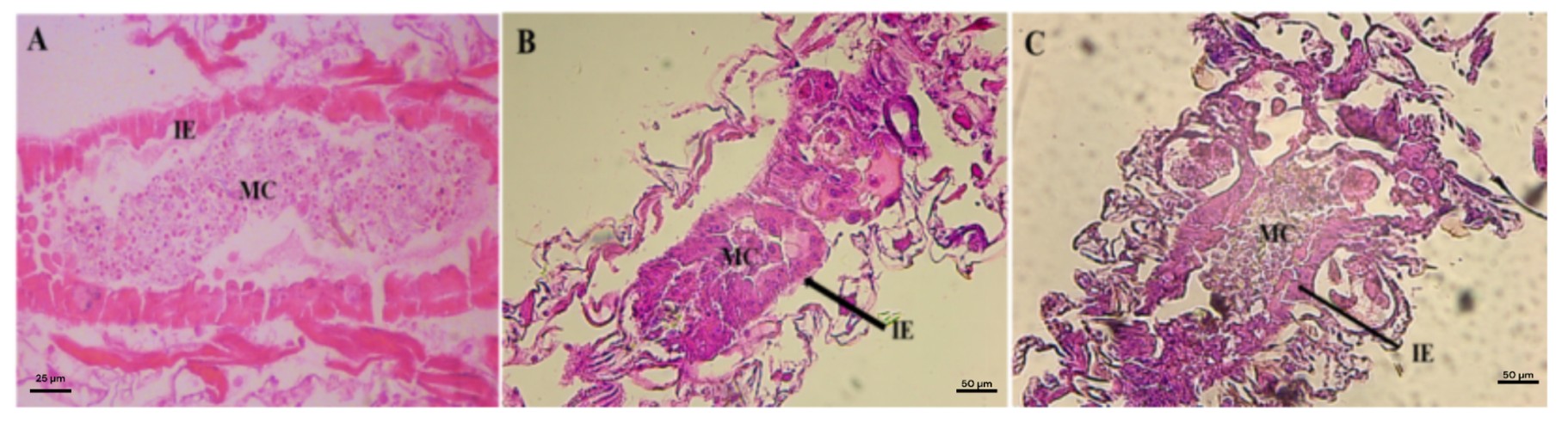
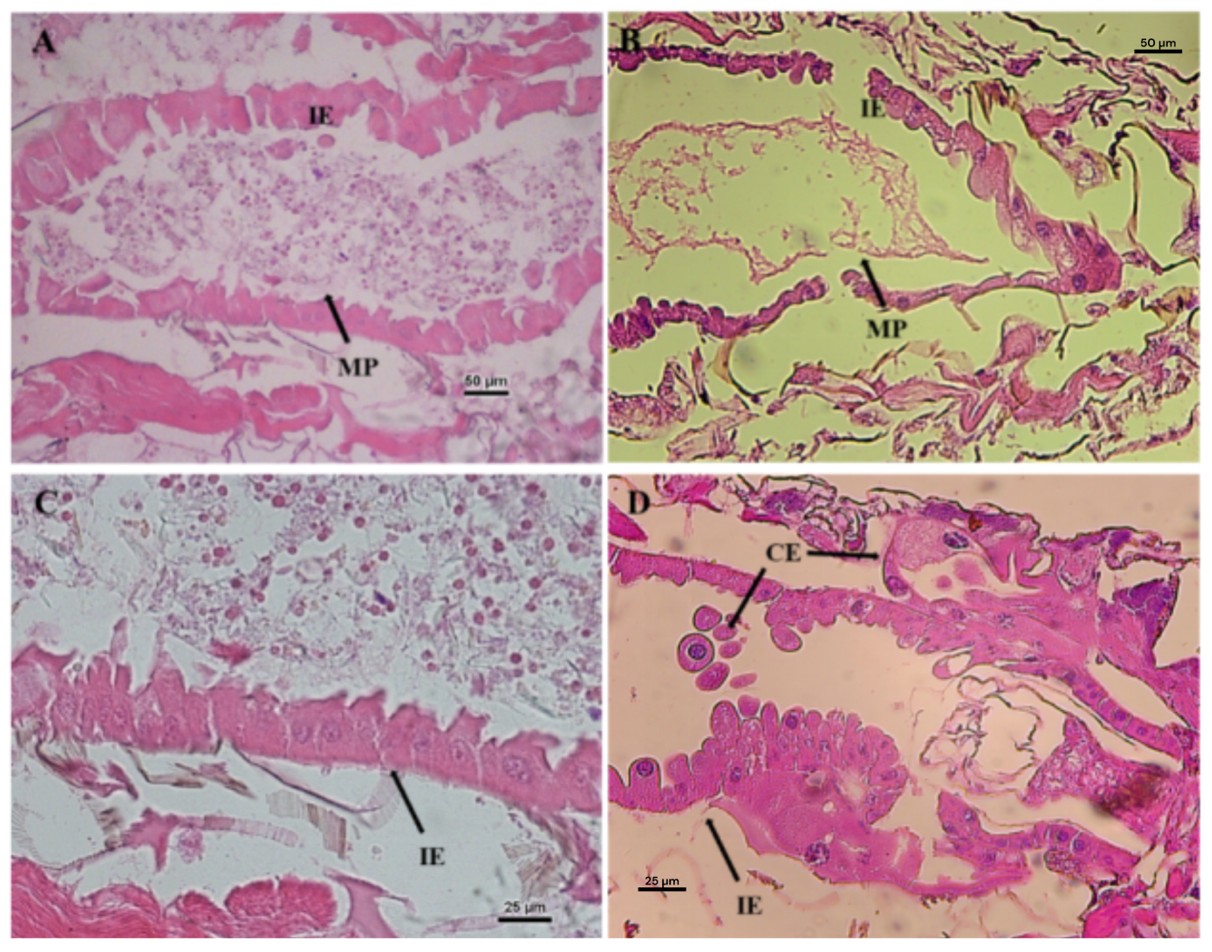
The control groups of Ae. aegypti (Figure 1A) and Ae. albopictus (Figures 2A and 2C) displayed a well-defined epithelium with uniform cells and a well-defined peritrophic matrix in relation to the ectoperitrophic space and the epithelium region. This was also observable in the control larvae of these species.
Photomicrograph of the midgut of third-instar larvae of Aedes aegypti, treated and not treated with ethanolic extract of Acmella oleracea. Control (A), treated with 50 μg.mL-1 (B) and treated with 100 μg.mL-1 (C). MC - midgut content; IE – midgut epithelium. Scale bars: (A) - 25 μm; (B, C) - 50 μm.
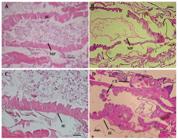
Histological section of the midgut of third-instar larvae of Aedes albopictus, treated and not treated with ethanolic extract of Acmella oleracea. Control (A), treated with 40 μg.mL-1 (B), control (C) and treated with 50 μg.mL-1 (D). IE – midgut epithelium; CE - epithelial cells; MP - peritrophic membrane. Scale bars: (A, B) - 50 μm; (C, D) - 25 μm.
The Ae. aegypti larvae treated with 50 µg.mL-1 of EEAO (Figure 1B) showed disruption of the intestinal epithelium and peritrophic membrane, causing the cells of the intestinal lining tissue to mix with the intestinal contents. Additionally, enlarged nuclei of epithelial cells that entered the lumen and disruption of some of these cells due to vacuolization of the cytoplasm were noted. The group treated with 100 µg.mL-1 (Figure 1C) exhibited disintegration of the intestinal epithelium, with loss of cell shape. The delimitation between the intestinal contents contained in the peritrophic matrix and the epithelium began to be lost due to the loss of integrity of this membrane.
The Ae. albopictus larvae exposed to 40 µg.mL-1 of EEAO (Figure 2B) showed alterations in cell morphology, including cytoplasm vacuolization. The tissue exhibited rupture in certain regions, and some cells lost their integrity. Larvae exposed to 50 µg.mL-1 (Figure 2D) presented nuclei in distinct positions, with some epithelial cells entering the intestinal contents region or being displaced to the external region of the tissue. There was also a loss or increase in nucleus size in some cells, while others showed more elongation. Furthermore, the delimitation of the peritrophic matrix was barely noticeable.
3.4. Effect of Acmella oleracea ethanol extract on acetylcholinesterase activity in Larvae of Ae. aegypti and Ae. albopictus
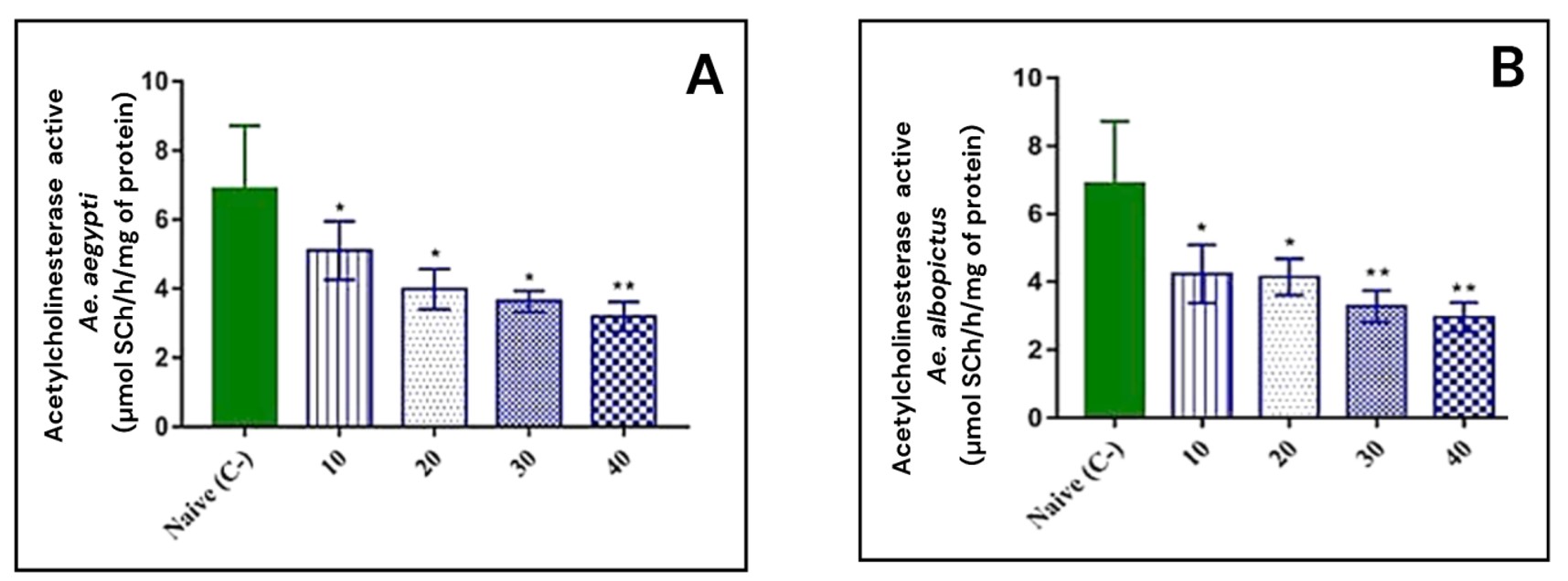
The anti-acetylcholinesterase activity test revealed that the ethanolic extract of Acmella oleracea caused the inhibition of acetylcholinesterase (AChE) enzymes in both Ae. aegypti and Ae. albopictus larvae, indicating that one possible mechanism of action of the natural product on larvae is the inhibition of enzymatic activity. The results shown in Figure 3 also indicate that an increase in the concentration of the extract directly interferes with enzyme activity, causing a reduction in its activity.
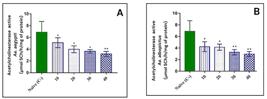
Inhibition of acetylcholinesterase in third-instar larvae of Aedes aegypti (A) and Aedes albopictus (B), treated and not treated with the ethanolic extract of Acmella oleracea. Untreated larvae (C-), treated with 10, 20, 30, and 40 μg.mL-1. Different symbols (*, **) in the bar denote a significant difference (p < 0.05).
The Ae. aegypti larvae treated with concentrations of 10, 20, and 30 µg.mL-1 of EEAO did not show significant differences in enzyme inhibition in AChE, while the concentration of 40 µg.mL-1 of the extract showed significant differences compared to the other concentrations, exhibiting a higher inhibition potential (Figure 3A).
Regarding Ae. albopictus larvae, significant differences were observed between the control and EEAO-treated groups concerning AChE inhibition. The concentrations of 10 and 20 µg.mL-1 of EEAO did not show statistical differences in AChE inhibition, but significant differences were observed when compared to the concentrations of 30 and 40 µg.mL-1, which were statistically similar (Figure 3B).
4. Discussion
The results of the phytochemical analysis of the ethanolic extract of Acmella oleracea indicated the presence of various bioactive compounds, including alkaloids, catechins, coumarins, steroids, simple phenols, flavones, flavonols, flavanones, flavanols, and xanthones. Among these, spilanthol ((2E,6Z,8E)-N-isobutyl-2,6,8-decatrienamide), identified as the predominant polar compound in the leaves of A. oleracea by Araújo et al. (2018), is an alkaloid with significant larvicidal activity, as demonstrated in tests against immature stages of Culex quinquefasciatus (Spinozzi et al., 2021). Other studies have also highlighted the larvicidal and adulticidal effects of alkaloids, such as sarniensine, isolated from Nerine sarniensis, against Aedes aegypti (Masi et al., 2017).
In this study, the ethanolic extract of A. oleracea exhibited an LC50 of 29.15 µg.mL-1 and 16 µg.mL-1 after 24 hours of exposure against Ae. aegypti and Aedes albopictus, respectively. These findings are consistent with those reported by Araújo et al. (2018), who observed an LC50 of 11.41 µg.mL-1 and 32.40 µg.mL-1 against Ae. aegypti and Culex quinquefasciatus, respectively, using a hydroethanolic extract of A. oleracea. However, these results differ from those obtained using the hexane fraction of ethanol extracts from jambu, which had an LC50 of 145.6 µg.mL-1 (Simas et al., 2013).
A technology using crude leaf extracts of A. oleracea solubilized in fibroin solution was evaluated by Araújo et al. (2020) against Ae. aegypti larvae, with the hexane extract showing an LC50 of 2.23 µg·mL−1, representing the best performance when compared to the hydroethanolic (LC50 of 28.42 µg·mL−1) and methanolic extracts (LC50 of 39.67 µg·mL−1).
Another study evaluated the larvicidal potential of the fatty acid fraction enriched with N-alkylamides from A. oleracea against Ae. albopictus larvae, which showed an LC50 of 10.8 µg·mL−1, a value very close to that observed for spilanthol (8.16 µg·mL−1), its major component (Ferrati et al., 2024).
Other plants in the Asteraceae family have also demonstrated significant larvicidal activity. For example, the hexane extract of Parthenium hysterophorus trunk had an LC50 of 379.76 µg.mL-1 against Ae. aegypti (Kumar et al., 2012). Similarly, the methanolic extract of Eclipta alba leaves exhibited an LC50 of 127.64 µg.mL-1 against third-instar Ae. aegypti larvae (Govindarajan and Karuppannan, 2011).
The data from this study indicate that Ae. albopictus larvae are significantly more susceptible to larvicidal treatment with A. oleracea compared to Ae. aegypti, with a substantially lower LC50. This increased susceptibility was also observed in the larvicidal activity of the ethanol extract and rolliniastatin 1 isolated from Annona mucosa seeds (Rodrigues et al., 2021). In studies examining the larvicidal efficacy of Trichoderma longibrachiatum and Trichoderma viride extracts, lower LC50 values were reported for Ae. albopictus compared to Ae. aegypti, with the LC50 of T. viride extract being 81.46 g.L-1 and 87.75 g.L-1 at 24 hours, 70.66 g.L-1 and 77.93 g.L-1 at 48 hours for Ae. albopictus and Ae. aegypti, respectively, and the LC50 for T. longibrachiatum being 103.35 g.L-1 and 108.79 g.L-1 at 24 hours and 93.05 g.L-1 and 102.1 g.L-1 at 48 hours for Ae. albopictus and Ae. aegypti respectively (Perera et al., 2023).
Significant histopathological alterations were observed in the midgut of third-instar larvae of Ae. aegypti and Ae. albopictus, suggesting a possible mechanism of action of the ethanolic extract of A. oleracea. Similar findings have been reported in other studies, where vacuolization of the cytoplasm of intestinal epithelium cells was observed in Aedes larvae treated with Annona coriacea extract (Costa et al., 2012) and with the ethanolic extract of Sapindus saponaria Lin (Barreto et al., 2006). Cabral (2015) also noted the folding of the peritrophic matrix and shrinkage in Aedes larvae treated with Swinglea glutinosa extract. Comparable histopathological changes, such as cell hypertrophy and detachment from the basal membrane of the epithelium, have been described in Ae. aegypti larvae treated with products isolated from Magonia pubescens like catechin tannin (Valotto et al., 2010) and tannic acid in Ae. albopictus larvae (Rey et al., 1999)
The inhibition of enzyme activity has been recognized as a crucial mechanism of action for lethality against invertebrate organisms, particularly in insects where such inhibition affects the nervous system, leading to paralysis and death (Ryan and Byrne., 1988). This suggests that one of the mechanisms of action of plant-based larvicides may involve enzyme inhibition. Literature reports indicate that secondary metabolites such as terpenes, phenolic compounds, and alkaloids, which are present in the extract of A. oleracea, are responsible for the inhibition of AChE enzyme activity (Rattan, 2010). This is consistent with findings from Silva (2009), who reported intense AChE inhibitory activity in the Amaryllidaceae family, attributable to the presence of various alkaloids. Similarly, the anti-acetylcholinesterase activity of A. oleracea extract may be associated with the presence of these alkaloids, as supported by studies on Annona classifora by Hidalgo (2017).
5. Conclusion
The ethanolic extract of the aerial parts of Acmella oleracea (EEAO) exhibited high lethality in the larvae of Aedes aegypti and Aedes albopictus, with Ae. albopictus larvae being more susceptible to the product. The EEAO caused significant histopathological alterations in both species, including loss of integrity of the intestinal epithelium, vacuolization of the cytoplasm, cellular disruption, disruption of the peritrophic matrix, and loss of definition of spaces and intestinal constituents. These changes are likely associated with the mechanism of action of the product.
Additionally, the ethanolic extract of A. oleracea induced a dose-dependent inhibition of acetylcholinesterase (AChE) enzyme activity in both Ae. aegypti and Ae. albopictus larvae, suggesting that biochemical changes in the larvae may contribute to its larvicidal effects. Based on these results, the application of A. oleracea ethanolic extract is proposed as a sustainable and environmentally safe alternative for controlling Aedes populations.
Acknowledgements
We would like to thank the Laboratory of Chromatographic and Spectroscopic Analysis (LACES) at the Universidade Estadual do Ceará for their contribution to the analyses in this study.
Data Availability Statement
The datasets generated and/or analyzed during the current study are available from the corresponding author on reasonable request.
References
-
ABEYSIRI, G.R.P.I., DHARMADASA, R.M., ABEYSINGHE, D.C. and SAMARASINGHE, K., 2013. Screening of phytochemical, physico-chemical and bioactivity of different parts of Acmella oleraceae Murr. (Asteraceae), a natural remedy for toothache. Industrial Crops and Products, vol. 50, pp. 852-856. http://doi.org/10.1016/j.indcrop.2013.08.043
» http://doi.org/10.1016/j.indcrop.2013.08.043 -
ARAÚJO, I.F., ARAÚJO, P.H.F., FERREIRA, R.M.A., SENA, I.D.S., LIMA, A.L., CARVALHO, J.C.T., FERREIRA, I.M. and SOUTO, R.N.P., 2018. Larvicidal effect of hydroethanolic extract from the leaves of Acmella oleracea L. R. K. Jansen in Aedes aegypti and Culex quinquefasciatus. South African Journal of Botany, vol. 117, pp. 134-140. http://doi.org/10.1016/j.sajb.2018.05.008
» http://doi.org/10.1016/j.sajb.2018.05.008 -
ARAÚJO, I.F., LOUREIRO, H.A., MARINHO, V.H.S., NEVES, F.B., SARQUIS, R.S.F., FAUSTINO, S.M.M., YOSHIOKA, S.A., FERREIRA, R.M.A., SOUTO, R.N.P. and FERREIRA, I.M., 2020. Larvicidal activity of the methanolic, hydroethanolic and hexanic extracts from Acmella oleracea, solubilized with silk fibroin, against Aedes aegypti. Biocatalysis and Agricultural Biotechnology, vol. 24, pp. 101550. http://doi.org/10.1016/j.bcab.2020.101550
» http://doi.org/10.1016/j.bcab.2020.101550 -
BALIEIRO, O.C., DA SILVA PINHEIRO, M.S., SILVA, S.Y.S., OLIVEIRA, M.N., SILVA, S.C., GOMES, A.A. and PINTO, L., 2020. Analytical and preparative chromatographic approaches for extraction of spilanthol from Acmella oleracea flowers. Microchemical Journal, vol. 157, pp. 105035. http://doi.org/10.1016/j.microc.2020.105035
» http://doi.org/10.1016/j.microc.2020.105035 -
BARBOSA, A.F., CARVALHO, M.G., SMITH, R.E. and SABAA-SRUR, A.U.O., 2016. Spilanthol: occurrence, extraction, chemistry and biological activities. Revista Brasileira de Farmacognosia, vol. 26, no. 1, pp. 128-133. http://doi.org/10.1016/j.bjp.2015.07.024
» http://doi.org/10.1016/j.bjp.2015.07.024 -
BARRETO, C.F., CARVASIN, G.M., SILVA, H.H.G.D. and SILVA, I.G., 2006. Estudo das alterações morfo-histológicas em larvas de Aedes aegypti (Diptera, Culicidae) submetidas ao extrato bruto etanólico de Sapindus saponaria Lin (Sapindaceae). Revista de Patologia Tropical, vol. 35, no. 1, pp. 37-58. http://doi.org/10.5216/rpt.v35i1.1891
» http://doi.org/10.5216/rpt.v35i1.1891 - CABRAL, S.S., 2015. Atividade larvicida do extrato bruto de Swinglea glutinosa evidenciada pelas alterações morfohistológicas em larvas de Aedes aegypti (Diptera, Culicidae) Goiânia: Universidade Federal de Goiás, 42 p. Dissertação de Mestrado em Biologia da Relação Parasito-Hospedeiro.
-
COSTA, M., PINHEIRO, D., SERRÃO, J. and PEREIRA, M., 2012. Morphological changes in the midgut of Aedes aegypti L. (diptera: Culicidae) larvae following exposure to an Annona coriacea (magnoliales: Annonaceae) extract. Neotropical Entomology, vol. 41, no. 4, pp. 311-314. http://doi.org/10.1007/s13744-012-0050-z PMid:23950067.
» http://doi.org/10.1007/s13744-012-0050-z -
ELLMAN, G.L., COURTNEY, K.D., ANDRES JUNIOR, V. and FEATHERSTONE, R.M., 1961. A new and rapid colorimetric determination of acetylcholinesterase activity. Biochemical Pharmacology, vol. 7, no. 2, pp. 88-95. http://doi.org/10.1016/0006-2952(61)90145-9 PMid:13726518.
» http://doi.org/10.1016/0006-2952(61)90145-9 -
FERRATI, M., SPINOZZI, E., BALDASSARRI, C., ROSSI, P., FAVIA, G., FIORINI, D., DE ZORDI, N., DRENAGGI, E., DE FAZI, L., BENELLI, G., ZEPPA, L., AGUZZI, C., MAGGI, F. and PETRELLI, R., 2024. Green purification of Acmella oleracea extract by wiped-film short path molecular distillation enhances insecticidal activity against mosquito larvae. Industrial Crops and Products, vol. 218, pp. 118818. http://doi.org/10.1016/j.indcrop.2024.118818
» http://doi.org/10.1016/j.indcrop.2024.118818 -
GOULD, E., PETTERSSON, J., HIGGS, S., CHARREL, R. and LAMBALLERIE, X., 2017. Emerging arboviruses: why today? One Health, vol. 4, pp. 1-13. http://doi.org/10.1016/j.onehlt.2017.06.001 PMid:28785601.
» http://doi.org/10.1016/j.onehlt.2017.06.001 -
GOVINDARAJAN, M. and KARUPPANNAN, P., 2011. Mosquito larvicidal and ovicidal properties of Eclipta alba (L.) hassk (asteraceae) against chikungunya vector, Aedes aegypti (Linn.) (diptera: culicidae). Asian Pacific Journal of Tropical Medicine, vol. 4, no. 1, pp. 24-28. http://doi.org/10.1016/S1995-7645(11)60026-6 PMid:21771410.
» http://doi.org/10.1016/S1995-7645(11)60026-6 -
GUBLER, D.J., 2002. The global emergence/resurgence of arboviral diseases as public health problems. Archives of Medical Research, vol. 33, no. 4, pp. 330-342. http://doi.org/10.1016/S0188-4409(02)00378-8
» http://doi.org/10.1016/S0188-4409(02)00378-8 - HIDALGO, E.M.P., 2017. Atividades biológicas dos alcaloides de Annona crassiflora Mart São Paulo: USP, 111 p. Dissertação de Mestrado em Botânica.
-
KARUNARATNE, S.H.P.P., WEERARATNE, T.C., PERERA, M.D.B. and SURENDRAN, S.N., 2013. Insecticide resistance and, efficacy of space spraying and larviciding in the control of dengue vectors Aedes aegypti and Aedes albopictus in Sri Lanka. Pesticide Biochemistry and Physiology, vol. 107, no. 1, pp. 98-105. http://doi.org/10.1016/j.pestbp.2013.05.011 PMid:25149242.
» http://doi.org/10.1016/j.pestbp.2013.05.011 -
KUMAR, S., NAIR, G., SINGH, A.P., BATRA, S., WAHAB, N. and WARIKOO, R., 2012. Evaluation of the larvicidal efficiency of stem, roots and leaves of the weed, Parthenium hysterophorus (family: Asteraceae) against Aedes aegypti L. Asian Pacific Journal of Tropical Disease, vol. 2, no. 5, pp. 395-400. http://doi.org/10.1016/S2222-1808(12)60086-3
» http://doi.org/10.1016/S2222-1808(12)60086-3 -
MASI, M., WESTHUYZEN, A.E., TABANCA, N., EVIDENTE, M., CIMMINO, A., GREEN, I.R., BERNIER, U.R., BECNEL, J.J., BLOOMQUIST, J.R., OTTERLO, W.A.L. and EVIDENTE, A., 2017. Sarniensine, a mesembrine-type alkaloid isolated from Nerine sarniensis, an indigenous south african amaryllidaceae, with larvicidal and adulticidal activities against Aedes aegypti. Fitoterapia, vol. 116, pp. 34-38. http://doi.org/10.1016/j.fitote.2016.11.007 PMid:27864138.
» http://doi.org/10.1016/j.fitote.2016.11.007 - MATOS, F.J.A., 1997. Introdução à ritoquímica experimental 2. ed. Fortaleza: UFC, 141 p.
-
NASCIMENTO, L.E.S., ARRIOLA, N.D.A., SILVA, L.A.L., FAQUETI, L.G., SANDJO, L.P., ARAÚJO, C.E.S., BIAVATTI, M.W., BARCELOS-OLIVEIRA, J.L. and AMBONI, R.D.M.C., 2020. Phytochemical profile of different anatomical parts of jambu (Acmella oleracea (L.) R.K. Jansen): a comparison between hydroponic and conventional cultivation using PCA and cluster analysis. Food Chemistry, vol. 332, pp. 127393. http://doi.org/10.1016/j.foodchem.2020.127393 PMid:32603921.
» http://doi.org/10.1016/j.foodchem.2020.127393 -
PERERA, D.S., THARAKA, W.G.H., AMARASINGHE, D. and WICKRAMARACHCHI, S.R., 2023. Extracellular extracts of antagonistic fungi, Trichoderma longibrachiatum and Trichoderma viride, as larvicides against dengue vectors, Aedes aegypti and Aedes albopictus. Acta Tropica, vol. 238, pp. 106747. http://doi.org/10.1016/j.actatropica.2022.106747 PMid:36368414.
» http://doi.org/10.1016/j.actatropica.2022.106747 - PROPHET, E.B., MILLS, B., ARRINGTON, J.B. and SOBIN, L.H., 1992. Laboratory methods in histotechnology Washington: Amer Registry of Pathology, 279 p.
-
RANJAN, R.K., TANEJA, I., TANEJA, V. and KANNAN, G., 2022. Ethnopharmacological aspects of Acmella oleracea-a comprehensive review. Journal of Ethnopharmacology, vol. 299, pp. 115754. http://doi.org/10.1016/j.jep.2022.115754
» http://doi.org/10.1016/j.jep.2022.115754 -
RATTAN, R.S., 2010. Mechanism of action of insecticidal secondary metabolites of plant origin. Crop Protection (Guildford, Surrey), vol. 29, no. 9, pp. 913-920. http://doi.org/10.1016/j.cropro.2010.05.008
» http://doi.org/10.1016/j.cropro.2010.05.008 -
REY, D., PAUTOU, M.-P. and MEYRAN, J.-C., 1999. Histopathological effects of tannic acid on the midgut epithelium of some aquatic diptera larvae. Journal of Invertebrate Pathology, vol. 73, no. 2, pp. 173-181. http://doi.org/10.1006/jipa.1998.4810 PMid:10066397.
» http://doi.org/10.1006/jipa.1998.4810 -
RODRIGUES, A.M., MARTINS, V.E.P. and MORAIS, S.M., 2020. Larvicidal efficacy of plant 12 extracts and isolated compounds from Annonaceae and Piperaceae against Aedes aegypti and Aedes albopictus. Asian Pacific Journal of Tropical Medicine, vol. 13, no. 9, pp. 384-396. http://doi.org/10.4103/1995-7645.290583
» http://doi.org/10.4103/1995-7645.290583 -
RODRIGUES, A.M., SILVA, A.A., FREITAS, J.C.C., MARTINS, V.E.P., FERREIRA, M.A.P., FERREIRA, A.C.S., CABE¸CA, C.L.S., RODRIGUES, A.L.M., ALVES, D.R. and MORAIS, S.M., 2021. Larvicidal activity of Annona mucosa Jacq. extract and main constituents rolliniastatin 1 and rollinicin against Aedes aegypti and Aedes albopictus. Industrial Crops and Products, vol. 169, pp. 113678. http://doi.org/10.1016/j.indcrop.2021.113678
» http://doi.org/10.1016/j.indcrop.2021.113678 -
RYAN, M. and BYRNE, O., 1988. Plant-insect coevolution and inhibition of acetylcholinesterase. Journal of Chemical Ecology, vol. 14, no. 10, pp. 1965-1975. http://doi.org/10.1007/BF01013489 PMid:24277106.
» http://doi.org/10.1007/BF01013489 - SANT’ANNA, F.B., 2009. Main mechanisms of insecticide resistance on insects. Pubvet, vol. 3, no. 2.
- SILVA, M.S.S., 2009. Alcaloides de plantas da família Amaryllidaceae: isolamento caracterização e testes de inibição de acetilcolinesterase Campinas: UNICAMP, 234 p. Tese de Doutorado em Química.
-
SIMAS, N.K., DELLAMORA, E.D.C.L., SCHRIPSEMA, J., LAGE, C.L.S., FILHO, A.M.D.O., WESSJOHANN, L., PORZEL, A. and KUSTER, R.M., 2013. Acetylenic 2-phenylethylamides and new isobutylamides from Acmella oleracea (L.) R. K. Jansen, a TAIPE-LAGOS, C.B. and NATAL, D., 2003. Abundância de culicídeos em área metropolitana preservada e suas implicações epidemiológicas. Revista de Saude Publica, vol. 37, no. 3, pp. 275-279. http://doi.org/10.1590/S0034-89102003000300002
» http://doi.org/10.1590/S0034-89102003000300002 -
SIMAS, N.K., LIMA, E.D.C., CONCEIÇÃO, S.D.R., KUSTER, R.M., DE OLIVEIRA FILHO, A.M. and LAGE, C.L.S., 2004. Produtos naturais para o controle da transmissão da dengue - Atividade larvicida de Myroxylon balsamum (óleo vermelho) e de terpenoides e fenilpropanoides. Quimica Nova, vol. 27, no. 1, pp. 46-49. http://doi.org/10.1590/S0100-40422004000100009
» http://doi.org/10.1590/S0100-40422004000100009 -
SPINOZZI, E., PAVELA, R., BONACUCINA, G., PERINELLI, D.R., CESPI, M., PETRELLI, R., CAPPELLACCI, L., FIORINI, D., SCORTICHINI, S., GARZOLI, S., ANGELONI, C., FRESCHI, M., HRELIA, S., QUASSINTI, L., BRAMUCCI, M., LUPIDI, G., SUT, S., DALL’ACQUA, S., BENELLI, G., CANALE, A., DRENAGGI, E. and MAGGI, F., 2021. Spilanthol-rich essential oil obtained by microwave-assisted extraction from Acmella oleracea (L.) R.K. Jansen and its nanoemulsion: Insecticidal, cytotoxic and anti-inflammatory activities. Industrial Crops and Products, vol. 172, pp. 114027. http://doi.org/10.1016/j.indcrop.2021.114027
» http://doi.org/10.1016/j.indcrop.2021.114027 -
TAIPE-LAGOS, C.B. and NATAL, D., 2003. Abundância de culicídeos em área metropolitana preservada e suas implicações epidemiológicas. Revista de Saúde Pública, vol. 37, no. 3, pp. 275-279. https://doi.org/10.1590/S0034-89102003000300002
» https://doi.org/10.1590/S0034-89102003000300002 - VALOTTO, C.F.B., CAVASIN, G., SILVA, H.H.G., GERIS, R. and SILVA, I.G., 2010. Changes in morphohistologic larvae of Aedes aegypti (Linnaeus, 1762) (Diptera, Culicidae) caused by tannins catechin isolated from the plant Magonia pubescens (Sapindaceae). Revista de Patologia Tropical, vol. 39, no. 4, pp. 309-321.
-
VASANTHA-SRINIVASAN, P., SENTHIL-NATHAN, S., PONSANKAR, A., THANIGAIVEL, A., EDWIN, E.S., SELIN-RANI, S., CHELLAPPANDIAN, M., PRADEEPA, V., LIJA-ESCALINE, J., KALAIVANI, K., HUNTER, W.B., DURAIPANDIYAN, V. and AL-DHABI, N.A., 2017. Comparative analysis of mosquito (Diptera: Culicidae: Aedes aegypti Liston) responses to the insecticide Temephos and plant derived essential oil derived from Piper betle L. Ecotoxicology and Environmental Safety, vol. 139, pp. 439-446. http://doi.org/10.1016/j.ecoenv.2017.01.026 PMid:28213320.
» http://doi.org/10.1016/j.ecoenv.2017.01.026 -
WORLD HEALTH ORGANIZATION - WHO, 2005 [viewed 4 September 2024]. Guidelines for laboratory and field testing of mosquito larvicides [online]. Geneva: WHO. Available from: https://iris.who.int/handle/10665/69101
» https://iris.who.int/handle/10665/69101 -
ZARA, A.L.D.S.A., SANTOS, S.M.D., FERNANDES-OLIVEIRA, E.S., CARVALHO, R.G. and COELHO, G.E., 2016. Estratégias de controle do Aedes aegypti: uma revisão. Epidemiologia e Serviços de Saúde : Revista do Sistema Unico de Saúde do Brasil, vol. 25, no. 2, pp. 391-404. http://doi.org/10.5123/S1679-49742016000200017 PMid:27869956.
» http://doi.org/10.5123/S1679-49742016000200017
Edited by
-
Editor:
Takako Matsumura Tundisi