 Research trends and gaps in ant-mediated seed dispersal: a review with emphasis on Brazilian biomes
Abstract
This scientometric review analyzes global research patterns on seed dispersal by ants (myrmecochory) from 2009 to 2019, with particular emphasis on geographic and methodological biases across Brazilian biomes. Our analysis reveals not only pronounced disparities in research distribution, with studies heavily concentrated in Atlantic Forest and Cerrado ecosystems, while Amazonia, Pantanal, and Pampa remain critically understudied, but also fundamental methodological limitations that constrain our understanding of the ecological role of myrmecochory. More importantly, we provide the first comprehensive biome-level comparison of research effort and methodological approaches, identifying critical gaps in distinguishing seed dispersal from predation events and assessing post-dispersal seed viability. Rather than merely documenting these imbalances, we offer a strategic framework for prioritizing research in underrepresented biomes and implementing standardized methodologies. Our findings have direct implications for conservation planning and restoration ecology, particularly in threatened tropical ecosystems where ant-mediated dispersal could significantly enhance recovery programs. Addressing these geographic and methodological biases is therefore essential for advancing myrmecochory research and improving its applied relevance.
Keywords:
ant-plant interaction; myrmecochory; research biases; ecological restoration; conservation planning; scientometric review
Resumo
Esta revisão cienciométrica analisa a pesquisa global sobre dispersão de sementes por formigas (mirmecocoria) de 2009 a 2019, com ênfase particular nos padrões geográficos e abordagens metodológicas nos biomas brasileiros. Nossa análise revela disparidades pronunciadas na distribuição da pesquisa, com estudos fortemente concentrados nos ecossistemas da Mata Atlântica e do Cerrado, enquanto a Amazônia, o Pantanal e o Pampa permanecem criticamente pouco estudados. Mais importante ainda, identificamos limitações metodológicas fundamentais que limitam nossa compreensão do papel ecológico da mirmecocoria, particularmente a falha em distinguir entre eventos de dispersão de sementes e predação, e a avaliação insuficiente da viabilidade de sementes pós-dispersão. Além de meramente mapear lacunas de conhecimento, nosso estudo fornece uma estrutura estratégica para priorizar a pesquisa em biomas sub-representados e implementar metodologias padronizadas. Essas percepções são particularmente importantes para orientar os esforços de restauração em ecossistemas tropicais ameaçados, onde a dispersão mediada por formigas pode aprimorar significativamente programas de recuperação. Abordar esses vieses geográficos e metodológicos é, portanto, essencial para o avanço dos estudos sobre mirmecocoria e para fortalecer sua relevância aplicada.
Palavras-chave:
interação formiga-planta; mirmecocoria; vieses de pesquisa; restauração ecológica; planejamento de conservação; revisão cienciométrica
1. Introduction
In an ecosystem, many interactions occur simultaneously between animals and plants, which can be positive or negative (Del-Claro and Torezan-Silingardi, 2021; Pereira et al., 2021; Couto et al., 2022; Alencar et al., 2023). Among these interactions, seed dispersal stands out as a fundamental process for the maintenance of ecosystem functioning (Corlett, 2021). Seed dispersal enables the movement of plant genes across space and, in some cases, through time, influencing reproduction, population genetic structure, and several other components of plant ecology (Lengyel et al., 2009). This mechanism benefits both the mother plant and the propagule by reducing intraspecific competition and mitigating density- and distance-dependent effects from pathogens and herbivores. It also contributes to floristic heterogeneity and supports the maintenance of forest areas (Lengyel et al., 2009; Corlett, 2021).
The structural traits, chemical composition, and nutritional properties of seeds and/or fruits influence how they are dispersed, forming what are classically known as dispersal syndromes, as defined by van der Pijl (1982). Among these syndromes, six major categories are recognized: autochory, zoochory, anemochory, anthropochory, hydrochory, and barochory (Oliveira et al., 2022; Torres et al., 2022). Zoochory, the dispersal of seeds by animals, is particularly prominent and is considered the dominant dispersal strategy in several pristine ecosystems (Jordano, 2000). In South American forests, zoochory is estimated to represent about 70-90% of Angiosperm seed dispersal (Almeida-Neto et al., 2008; Oliveira et al., 2022). Zoochoric fruits typically exhibit traits that facilitate animal-mediated dispersal, such as fleshy pulp, elaiosome-bearing seeds, mucilage production, or structures that enable adhesion (Almeida-Neto et al., 2008; Hernández-Brito et al., 2021; Oliveira et al., 2022). Within zoochory, there are subdivisions based on the taxonomic group of the dispersal agent, including saurochory (reptiles), mastozoochory (mammals), ornithochory (birds), ichthyochory (fish), and myrmecochory (ants) (Almeida-Neto et al., 2008; Silveira and Weiss, 2014; Gomes et al., 2021; Leal et al., 2011).
Myrmecochory is a relatively common type of seed dispersal, occurring in several regions and ecosystems worldwide and present in more than 11,000 species of angiosperms (approximately 4.5%) (Lengyel et al., 2009). This interaction is primarily mediated by the presence of a lipid-rich elaiosome attached to the seed coat (Beattie, 1985), although factors such as seed size, odor, and chemical cues may also influence ant-seed interactions. Elaiosomes are highly attractive to ants due to their protein and carbohydrate content (van der Pijl, 1982), functioning both as a food reward and a structure that facilitates seed transport. In primary dispersal, ants actively collect seeds bearing elaiosomes and transport them to their nests to consume this nutritive structure. Secondary dispersal occurs when ants relocate seeds previously dispersed by other vectors or attempt to predate upon seeds lacking elaiosomes. After handling, ants typically consume the elaiosome and may discard the intact seed in nutrient-rich nest chambers or midden piles (Beattie, 1985), potentially enhancing germination, protecting against predators, and placing seeds in favorable microsites (Dáttilo et al., 2009; Rapalino and Haydar, 2017). However, ants may also act as seed predators, and dispersal effectiveness may be reduced when seeds are deposited in unsuitable locations (Oliveira et al., 2023).
Despite its ecological relevance, the occurrence and importance of myrmecochory studies are not equally distributed among world ecosystems. In addition, many studies do not verify whether ants truly disperse seeds, whether seeds remain viable after handling, or whether deposition sites are ecologically advantageous. Therefore, mapping where, when, and how myrmecochory has been studied becomes essential, particularly in biodiverse regions. Although myrmecochory has been studied globally, the distribution of research effort across Brazilian biomes remains poorly understood. Here, we aim to detect current and geographical trends and gaps in myrmecochory research. We examined how published studies are distributed spatially (a) and temporally (b). In addition, we assessed which type of myrmecochory is most studied (c), whether there is empirical evidence of dispersal (d), whether native seeds were used (e), whether ants disperse viable seeds (f), and how far seeds are transported (g). These results provide a foundation for future studies to address knowledge gaps and inform strategies for vegetation recovery. Although this is a global scientometric review, our discussion places particular emphasis on Brazilian biomes in order to identify national research gaps and provide applied recommendations for conservation and restoration.
2. Material and Methods
2.1. Literature survey
We carried out a literature search in the Scopus (2025) database during 2020, because this database provides broad, multilingual journal coverage, advanced filtering by fields (title/abstract/keywords) and consistent indexing that supports reproducible searches. The search used the following terms in English, Portuguese, and Spanish: “myrmecochory”, “seed AND dispersal AND ants”, and their translated equivalents. The search was conducted in the fields “title”, “abstract”, and “keywords”. We restricted the survey to peer-reviewed articles published between 2009 and 2019, a decade-long interval commonly used in scientometric analyses to identify recent trends. This timeframe captures methodological developments in myrmecochory research, such as the use of artificial seeds and evaluations of secondary dispersal, while minimizing dilution by older studies based on less comparable approaches. Additionally, the period precedes the most severe constraints on Brazilian science funding, offering a relatively stable context for interpreting research productivity. We therefore consider this interval appropriate for identifying current geographic and methodological gaps in myrmecochory research. Although the survey encompasses global studies, the Discussion places particular emphasis on Brazilian biomes to highlight region-specific research gaps and applied implications.
2.2. Information compilation
All retrieved papers were screened for thematic relevance and redundancy. We included only empirical studies directly investigating seed dispersal by ants. Review articles, meta-analyses, data papers, scientometric articles, and studies that did not fit the topic were excluded. Non-peer-reviewed materials such as books, book chapters, conference abstracts, technical reports, and graduate dissertations were also excluded. Duplicate records were removed when the same data set appeared in more than one publication. Screening was performed by the first author, with support from the senior author. To ensure consistency in the screening process, a second coauthor independently validated a subset of the selected records, and any discrepancies were resolved through discussion. For transparency, we report a concise summary of the screening flow: 295 records were retrieved from Scopus, 144 were excluded based on the criteria above, and 151 studies met the inclusion criteria and were analyzed.
From each eligible study, we compiled 11 data metrics: (1) year of publication; (2) geographical coordinates; (3) phytophysiognomy or biome of the study area; (4) country; (5) type of dispersal investigated (primary or secondary); (6) type of seed used (native, exotic, or artificial); (7) distance of seed removal or dispersal; (8) focal event (removal, dispersal, or predation); (9) whether the event was verified; (10) whether a germination test was conducted; and (11) how the germination test, when present, was performed.
When coordinates were provided, we assigned the study to a biome using official Brazilian biome limits (IBGE, 2025). When coordinates were absent, biome classification was inferred from the vegetation descriptions reported in the original article. Although biome or phytophysiognomy was one of the recorded metrics, this information was consistently available only for studies conducted in Brazil. Most international articles lacked sufficient detail to allow reliable biome assignment, and attempting to force a global classification would likely generate artifactual patterns. For this reason, biome-level analyses were restricted to Brazilian studies, where vegetation descriptions are more standardized and where evaluating the spatial distribution of research effort is particularly relevant given the country’s large area and high representation in our data set. Descriptive analyses based on simple frequencies were conducted, and results were visualized in R (R Core Team, 2023) using the ggplot2 package (Wickham, 2016).
3. Results
A total of 295 peer-reviewed articles were initially retrieved, of which 151 met the inclusion criteria. The 144 excluded studies were primarily review articles or papers not focused directly on seed dispersal by ants.
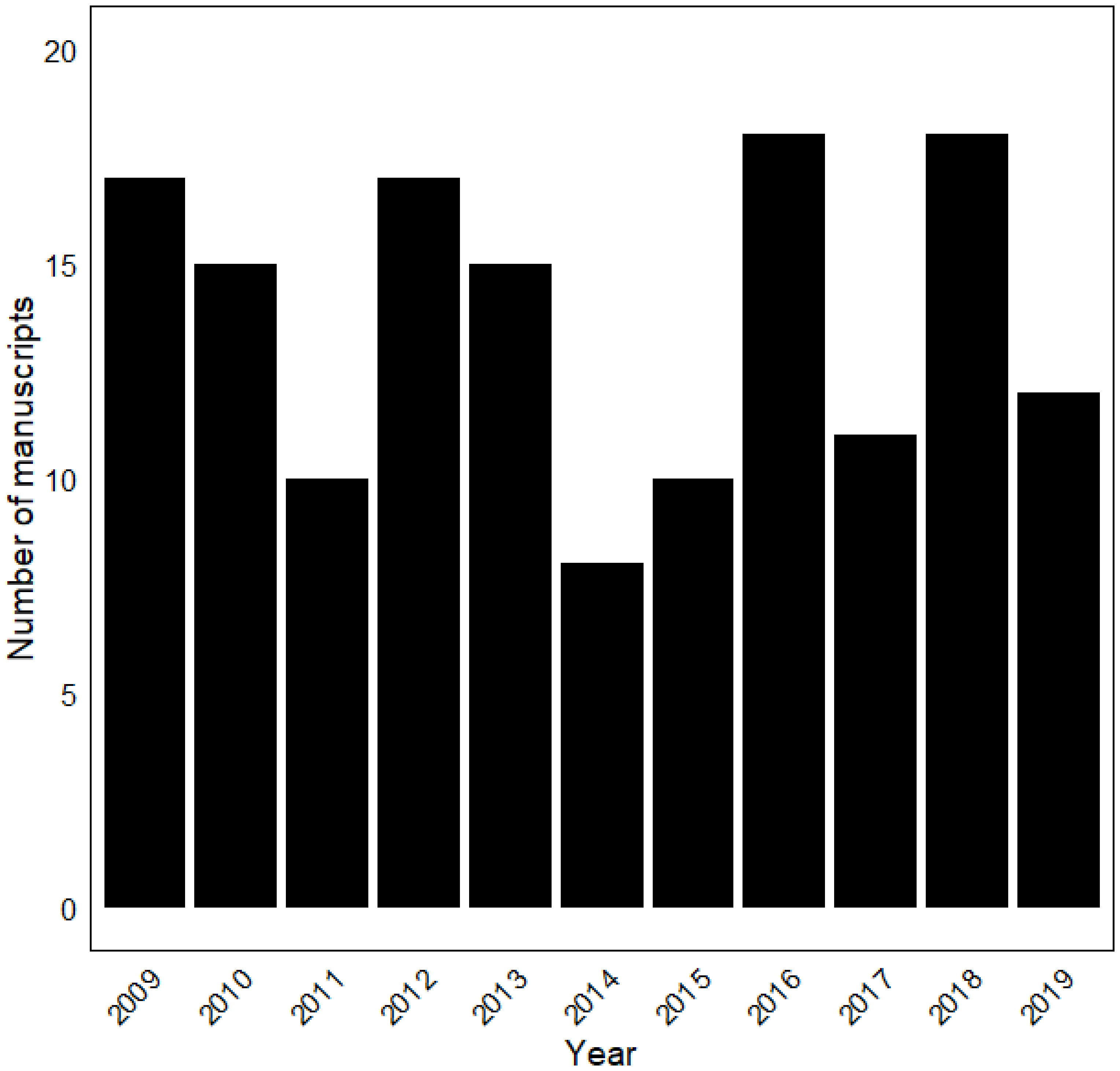
We observed a temporal oscillation in the annual number of publications on myrmecochory, with no clear trend across the 11-year period. The highest number of publications occurred in 2018 (18 articles), whereas 2014 had the lowest output (8 articles) (Figure 1). On average, 15.1 articles were published per year during the study period.
Annual number of peer-reviewed articles on myrmecochory retrieved from the Scopus database.
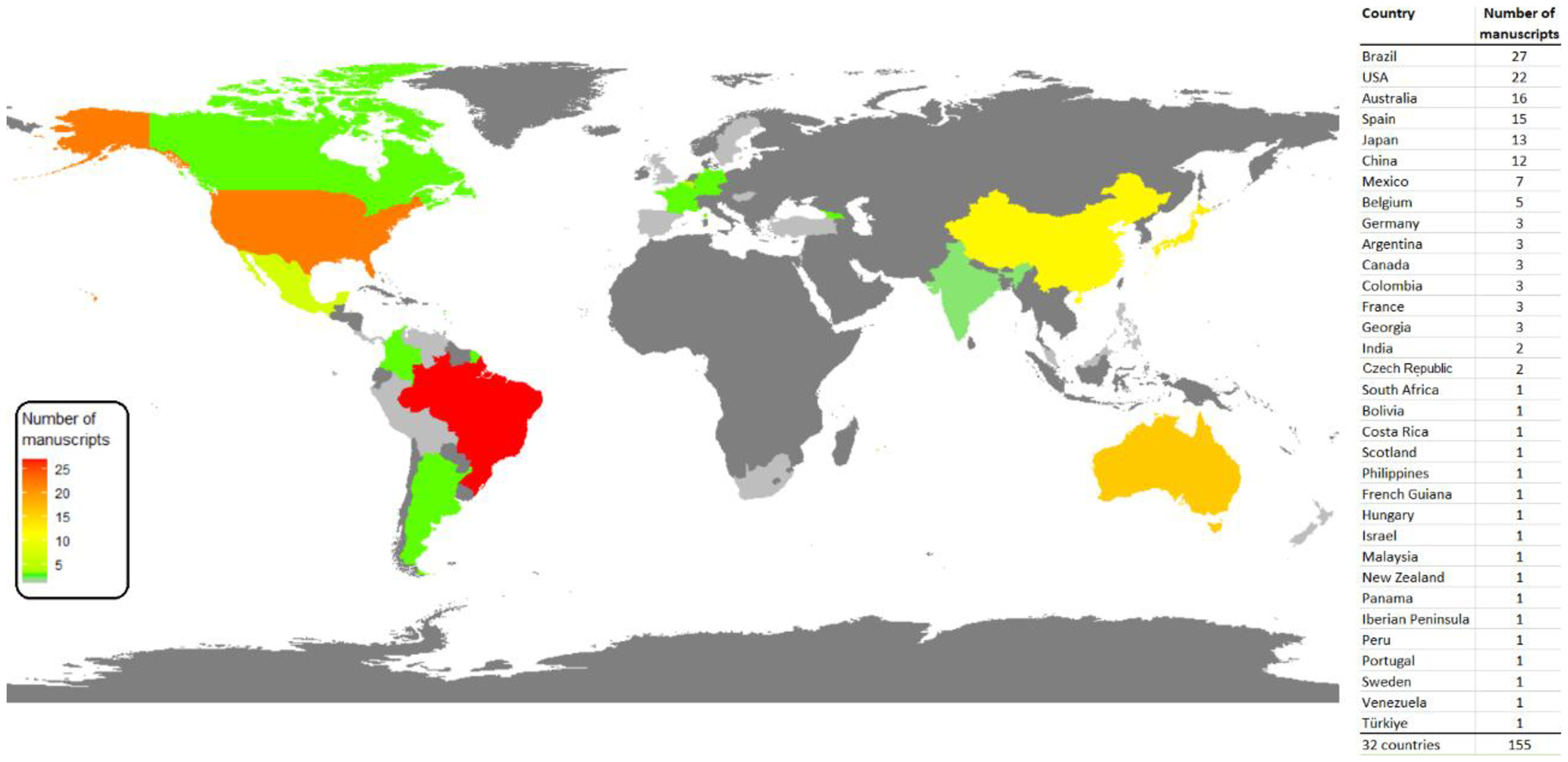
Brazil was the country with the highest number of publications (27 articles; 17.9% of all studies), followed by the United States (22; 14.6%), Australia (16; 10.6%), Spain (15; 9.9%), Japan (13; 8.6%), and China (12; 7.9%) (Figure 2). Seventeen countries (11.3%) had only one published study on this topic between 2009 and 2019.
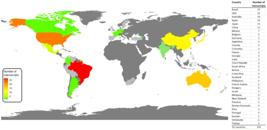
Number of peer-reviewed articles on myrmecochory published per country between 2009 and 2019. Dark gray areas indicate countries with no studies indexed in Scopus; warmer colors represent higher publication numbers.
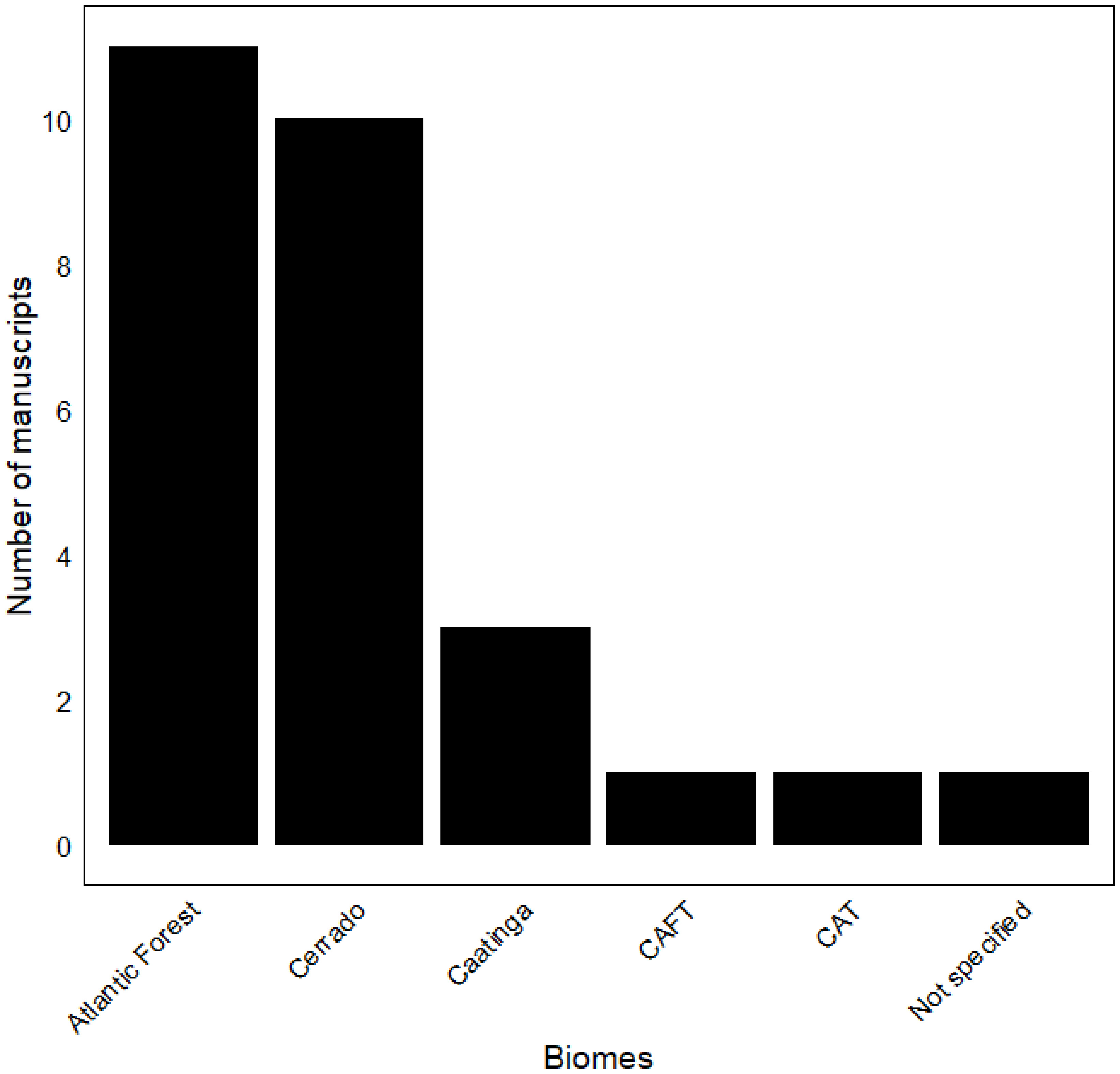
In Brazil, studies were unevenly distributed among biomes. The Atlantic Forest had the highest number of publications (11 studies), followed by the Cerrado (10). However, additional records occurred outside these two dominant biomes, including three studies in the Caatinga, one study in the Cerrado-Atlantic Forest transition (CAFT), one study in the Cerrado-Amazon transition (CAT), and one study that could not be assigned to a specific biome due to insufficient geographic information (“Not specified”). No studies were recorded for the Amazon, Pantanal, or Pampa biomes sensu stricto, despite the presence of records in their ecotonal zones (Figure 3).
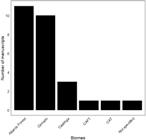
Number of peer-reviewed articles on myrmecochory conducted in different Brazilian biomes. CAFT = Cerrado-Atlantic Forest transition; CAT = Cerrado-Amazon transition.
To contextualize this geographic bias, we compared the number of studies per biome with their total area and cumulative deforestation between 2009 and 2019 (MapBiomas, 2025 – Table 1). This comparison revealed that research effort is not aligned with environmental vulnerability: although the Caatinga does contain studies (n = 3), research effort in this biome remains very low relative to its extent and deforestation levels. Research gaps are particularly concerning in the Amazon, Pantanal, and Pampa, which had no studies, and in the Cerrado, which was only modestly represented (10 studies). These biomes also experienced the highest proportional deforestation during the study period (Pampa 13.9%, Caatinga 7.0%, Cerrado 6.0%). This overlap reveals an acute mismatch between ecological threat and research effort, indicating that the ecosystems under the greatest anthropogenic pressure are precisely those for which empirical data on ant-mediated seed dispersal are most lacking. Overall, these results indicate that myrmecochory research in Brazil remains geographically concentrated and does not track the environmental urgency of the biomes most impacted by land-cover change.
Area of Brazilian biomes, accumulated deforestation (2009-2019), and number of myrmecochory studies identified in this review. Deforestation values were converted from hectares to km2 based on the data set provided (MapBiomas, 2025).
Worldwide, primary dispersal was the focus of 117 studies (77.5%), whereas 30 studies (19.9%) investigated secondary dispersal. Four studies (2.6%) addressed both processes. Only 27 studies (17.9%) explicitly verified whether seeds were dispersed or predated by ants. Most studies used native seeds (137; 90.7%), followed by exotic seeds (13; 8.6%), while only three studies (2.0%) used artificial seeds.
Seed viability was rarely evaluated: 126 studies (83.4%) did not perform germination tests on seeds removed by ants. Only 25 studies (16.6%) included germination assessments, and even fewer described the specific procedures adopted. Seed removal distance was reported in 48 studies (31.8%), which quantified how far ants transported seeds from the point of origin.
4. Discussion
Despite expectations that scientific output on myrmecochory would increase over the years, especially with advances in methodology and the use of artificial seeds (Henao-Gallego et al., 2012; Bieber et al., 2014), our results indicate a relatively stable number of publications in the last decade. This pattern contrasts with the general growth of Brazilian scientific production over recent decades (Barreto, 2006; Zorzetto et al., 2006; Leta et al., 2013), including the consolidation of research groups dedicated to ant biology and ecology (Brandão, 2020). Although Brazil has significantly advanced the knowledge of ant diversity (Andrade-Silva et al., 2022; Feitosa et al., 2022; Melo et al., 2021; Schmidt et al., 2022; Silva et al., 2022; Queiroz et al., 2023; Vicente et al., 2023; Lopes et al., 2021) and ant-plant interactions (Baccaro et al., 2015; Barbosa et al., 2015; Prado et al., 2016, 2022; Vicente and Izzo, 2017; Sozanski et al., 2020; Alencar et al., 2022), myrmecochory remains comparatively underrepresented. This demonstrates that the scientific community has not yet integrated ant-mediated seed dispersal as a mainstream research theme, despite its ecological and applied relevance. More recent contributions (e.g., Anjos et al., 2020; Alcolea et al., 2022) reinforce the importance of myrmecochory for ecosystem resilience and restoration, highlighting the need to expand research efforts in this field.
Although Brazil contributed the largest absolute number of myrmecochory studies in our sample, this scientific production is concentrated in only two biomes, which prevents a biome-level understanding of ant-seed interactions across the country. Given Brazil’s continental scale and its wide range of environmental conditions, interactions between ants and seeds are likely to vary substantially among biomes. The absence of studies in vast regions such as the Amazon, Pantanal, and Pampa therefore represents not only a numerical gap but also a loss of ecological resolution. Although our results show the presence of studies in Caatinga (3 studies) and in ecotonal regions (CAFT and CAT), these records remain sparse and do not compensate for the lack of studies within the Amazon, Pantanal, and Pampa biomes sensu stricto. In this sense, Brazil’s numerical leadership does not translate into comprehensive coverage, and expanding research to underrepresented biomes is essential for capturing the full functional variability of myrmecochory.
Brazil, the United States, Japan, and Australia led in the number of myrmecochory studies. Although these countries are megadiverse, biodiversity alone does not explain the research effort. For instance, the USA invests a larger proportion of its Gross Domestic Product in research (2.7%) compared to Brazil (1.3%), and Brazilian science has experienced recurrent funding cuts and political instability (Caires, 2019; Escobar, 2019; Jordão, 2019). These constraints often limit research to more accessible areas, contributing to geographic gaps, especially in biomes facing climate and land-use pressures (Carvalho et al., 2023). Acknowledging these structural limitations is essential, as they influence not only scientific output but also the representativeness of ecological studies. Future syntheses should incorporate analyses of how financial and infrastructural disparities shape research agendas, particularly in regions of the Global South.
Within Brazil, the mismatch between biodiversity and research effort is evident in the uneven distribution of studies across biomes. Most investigations occurred in the Atlantic Forest and the Cerrado that is global biodiversity hotspots undergoing rapid environmental change (Françoso et al., 2015; Lima et al., 2017; Gonella et al., 2021; Francisco et al., 2023). These biomes receive more scientific attention due to their conservation urgency and the concentration of research institutions. The focus on seed dispersal processes in these regions (Arruda et al., 2018; Fraga et al., 2019; Klink et al., 2020; Marques and Grelle, 2021) reflects their sensitivity to fragmentation (Rocha-Santos et al., 2020). The presence of studies in the Caatinga and in transition zones (CAFT and CAT) suggests emerging, although still limited, research efforts outside the two major biomes. Although justified, this concentration reinforces a geographic bias that limits national-scale conservation planning. Understudied biomes such as the Amazon, Pantanal, and Pampa still present substantial knowledge gaps, despite increasing anthropogenic pressures. Addressing these gaps is essential for designing restoration strategies that consider ant-mediated seed dispersal as a potential tool.
The Amazon, despite its extraordinary biodiversity (Vicente et al., 2020; Alencar et al., 2023), remains scarcely represented in myrmecochory studies. Only one study in our data set was conducted in the Amazon-Cerrado transition (Paolucci et al., 2016). More recent work has shown that land-use change, such as pasture conversion, reduces both the diversity of seed-dispersing ants and the quality of dispersal services (Fontenele and Schmidt, 2021). This is concerning given the intensification of forest degradation and the weakening of environmental protections (Carvalho et al., 2019; Ribeiro et al., 2022). Similarly, no studies were recorded for the Pantanal or Pampa biomes, both experiencing increasing environmental pressures (Albuquerque et al., 2017; Marengo et al., 2021; Ziliotto et al., 2023). These omissions overlook the potential of ants to contribute to forest regeneration (Gallegos et al., 2014; Bianchi et al., 2017; Cristo et al., 2019). Recent evaluations of Amazonian research gaps (Carvalho et al., 2023) reinforce that these ecosystems require urgent scientific attention.
Our analysis also highlights methodological limitations that hinder a complete understanding of myrmecochory's ecological role. A recurring issue is the lack of clarity about whether seeds removed by ants were consumed or dispersed, an essential distinction for evaluating dispersal effectiveness (Rodgerson, 1998; Suárez-Esteban et al., 2018). Although most studies used native seeds, few assessed seed viability after removal (17%) or quantified dispersal distance (32%), both critical for determining whether ant-mediated dispersal enhances plant fitness (Christianini et al., 2007; Slusarenko et al., 2012). Ants typically disperse seeds over short distances, but they may compensate for this by acting in contexts where vertebrates are absent or functionally reduced (Christianini and Oliveira, 2013; Anjos et al., 2020; Alcolea et al., 2022). Thus, the absence of viability and distance assessments limits the applicability of results to restoration planning. To reconcile these points, we now explicitly clarify that myrmecochory has strong ecological and theoretical potential to contribute to restoration, but its practical implementation is currently constrained by these methodological gaps, which must be resolved through standardized protocols and empirical tests that quantify seed fate, viability, and establishment.
Recent developments in restoration ecology emphasize the need for precision forest restoration, which argues that restoration success depends on verifying the fate, viability, and effective establishment of each seed rather than relying solely on broad-scale interventions. This perspective (Castro et al., 2021) directly aligns with the methodological gaps revealed by our review, particularly the limited verification of dispersal vs. predation, the rarity of post-removal viability tests, and the inconsistent measurement of removal distances. Integrating these principles into studies of ant-mediated seed dispersal would enable the development of standardized protocols capable of determining whether myrmecochory can reliably contribute to restoration outcomes.
Artificial seeds and elaiosomes remain underutilized in myrmecochory research, despite their potential to provide controlled experimental conditions that help evaluate ant behavior and ecological filters (Raimundo et al., 2004; Luna and Dáttilo, 2018; Luna et al., 2021). Wider adoption of these approaches would allow comparative analyses across regions and offer insights into how environmental variation shapes seed removal.
Globally, most studies focused on primary dispersal, while secondary dispersal remains poorly investigated. Diplochory (sequential dispersal by two vectors) is common in tropical ecosystems (Vander Wall and Longland, 2004; Leal et al., 2015; Zhu et al., 2018) and likely depends on local biodiversity and faunal integrity. For example, the overhunting of frugivores in the Amazon disrupts vertebrate-mediated dispersal (Peres and Palacios, 2007), which may affect subsequent ant-mediated secondary dispersal. Integrating diplochory into restoration ecology is particularly relevant, as degraded areas often lose large vertebrates first, making ants potential “last-resort” dispersers. Recognizing this applied dimension increases the conservation value of myrmecochory research.
Recent advances in ecological big data and citizen science offer promising opportunities to reduce geographic and taxonomic gaps in myrmecochory research. Large, curated biodiversity repositories such as speciesLink and the Brazilian Biodiversity Information System (SiBBr), together with structured ecological data sets (Iamara-Nogueira et al., 2022; Silva et al., 2022; Boscolo et al., 2023; Lacerda, 2025), demonstrate how standardized and open-access databases can expand spatial coverage and enable integrative analyses across ecosystems. A parallel expansion of citizen-science initiatives in Brazil, including major platforms such as WikiAves and iNaturalist, has proven effective for filling distributional gaps; for example, citizen-generated records substantially increased the known area of occupancy and ecological representation of Amazona vinacea (Bovo et al., 2024). These developments echo broader arguments in ecology that big data and participatory monitoring enhance inference, especially in poorly sampled systems (Kremen et al., 2011; Dickinson et al., 2012; Hampton et al., 2013). Together, these initiatives outline a clear path forward: integrating curated biodiversity databases, national repositories and validated citizen-science observations can accelerate the discovery of ant-seed interactions in undersampled biomes, support macroecological assessments and guide restoration planning in regions where traditional field sampling remains logistically challenging.
Standardization is essential to enable comparisons across regions and biomes. Without consistent methodologies, it is difficult to integrate findings into conservation strategies or identify global patterns. Future research agendas should prioritize the development of standardized protocols. Addressing the geographic and methodological gaps revealed by our review is not only a scientific goal but a conservation necessity. These findings have direct implications for conservation planning and ecological restoration, particularly in threatened tropical ecosystems where ant-mediated seed dispersal may play a crucial role. Confronting these biases should be treated as both a scientific and conservation priority in the face of accelerating environmental change.
5. Conclusions
This review highlights the main advances and persistent gaps in myrmecochory research, particularly the uneven geographic distribution of studies both globally and within Brazil. Although Brazil published the highest number of publications in our data set, research remains concentrated in a few well studied biomes, leaving large regions with little to no empirical information.
We also identified key methodological shortcomings that constrain broader inferences about the ecological role of ant-mediated seed dispersal. These include the limited verification of whether seeds are truly dispersed or predated, the low frequency of seed viability assessments, and the underuse of standardized experimental tools such as artificial seeds and elaiosomes. Establishing consistent and comparable protocols across regions and biomes is essential for integrating results into conservation planning and for building a more comprehensive understanding of global myrmecochory patterns.
Bridging these geographic and methodological gaps is fundamental for advancing both basic and applied aspects of ant-mediated seed dispersal. Incorporating myrmecochory into restoration programs (particularly in ecologically significant and understudied biomes such as the Amazon, Pantanal, and Pampa) represents both a scientific opportunity and a conservation priority. Given the accelerating pace of environmental change and habitat fragmentation across Brazilian ecosystems, recognizing and leveraging the role of ants in seed dispersal is an urgent step toward more effective restoration and conservation strategies.
Acknowledgments
We thank Livia Pires do Prado, Liliane Stedile de Matos, and Thiago Junqueira Izzo for reviewing and providing valuable feedback on earlier versions of the manuscript, as well as the five referees whose comments greatly improved this updated version. We also thank Gustavo Rocha Costa for his support with data compilation, Thiago Ferreira for producing the heat map, and Ivone Silva for allowing us to use the laboratory during the study. WSB acknowledges support from the National Council for Scientific and Technological Development (CNPq) through a scientific initiation scholarship and a Desenvolvimento Tecnológico e Industrial (DTI) fellowship (Grant No. 350388/2024-5). REV thanks the Fundação de Amparo à Pesquisa do Estado de Mato Grosso (FAPEMAT; DCR 003/2016), CNPq (PDJ 150826/2024-9) for postdoctoral research fellowships and the Programa de Pós-graduação em Zoologia, Universidade Federal do Amazonas (POSGRAD/FAPEAM and PROAP/ CAPES).
Data Availability Statement
The data set analyzed or produced in this study can be requested from the corresponding author.
References
-
ALBUQUERQUE, E.Z., DIEHL, E. and SILVA, R.R., 2017. Structure of ground‐dwelling ant communities in burned and unburned areas in Brazilian subtropical grasslands. Entomological Science, vol. 20, no. 1, pp. 427-436. https://doi.org/10.1111/ens.12270
» https://doi.org/10.1111/ens.12270 -
ALCOLEA, M., DURIGAN, G. and CHRISTIANINI, A.V., 2022. Prescribed fire enhances seed removal by ants in a Neotropical savanna. Biotropica, vol. 54, no. 1, pp. 125-134. https://doi.org/10.1111/btp.13036
» https://doi.org/10.1111/btp.13036 -
ALENCAR, C.L., VICENTE, R.E., PIRES, J.C., FONSECA, E.O. and SOBCZAK, J.F., 2022. What’s in your head, zombie? Camponotus renggeri ants parasitized by the entomopathogenic fungus Ophiocordyceps camponoti-renggeri in a relic of Atlantic Forest in Caatinga Biome, Brazil. Biodiversidade Brasileira, vol. 12, no. 4. https://doi.org/10.37002/biobrasil.v12i4.2081
» https://doi.org/10.37002/biobrasil.v12i4.2081 -
ALENCAR, C.L.S., NOGUEIRA, A., VICENTE, R.E. and COUTINHO, Í.A.C., 2023. Plant species with larger extrafloral nectaries produce better quality nectar when needed and interact with the best ant partners. Journal of Experimental Botany, vol. 74, no. 15, pp. 4613-4627. https://doi.org/10.1093/jxb/erad160 PMid:37115640.
» https://doi.org/10.1093/jxb/erad160 -
ALMEIDA-NETO, M., CAMPASSI, F., GALETTI, M., JORDANO, P. and OLIVEIRA-FILHO, A., 2008. Vertebrate dispersal syndromes along the Atlantic Forest: broad-scale patterns and macroecological correlates. Global Ecology and Biogeography, vol. 17, no. 4, pp. 503-513. https://doi.org/10.1111/j.1466-8238.2008.00386.x
» https://doi.org/10.1111/j.1466-8238.2008.00386.x -
ANDRADE-SILVA, J., BACCARO, F.B., PRADO, L.P., GUÉNARD, B., WARREN, D.L., KASS, J.M., ECONOMO, E.P. and SILVA, R.R., 2022. A large-scale assessment of ant diversity across the Brazilian Amazon Basin: integrating geographic, ecological and morphological drivers of sampling bias. Ecography, vol. 2022, no. 9, e06295. https://doi.org/10.1111/ecog.06295
» https://doi.org/10.1111/ecog.06295 -
ANJOS, D.V., LEAL, L.C., JORDANO, P. and DEL-CLARO, K., 2020. Ants as diaspore removers of non-myrmecochorous plants: a meta-analysis. Oikos, vol. 129, no. 6, pp. 775-786. https://doi.org/10.1111/oik.06940
» https://doi.org/10.1111/oik.06940 -
ARRUDA, F.V., SOUSA, D.G., TERESA, F.B., PRADO, V.H.M., CUNHA, H.F. and IZZO, T.J., 2018. Trends and gaps of the scientific literature about the effects of fire on Brazilian Cerrado. Biota Neotropica, vol. 18, no. 1, e20170426. https://doi.org/10.1590/1676-0611-bn-2017-0426
» https://doi.org/10.1590/1676-0611-bn-2017-0426 - BACCARO, F.B., FEITOSA, R.M., FERNANDEZ, F., FERNANDES, I.O., IZZO, T.J., SOUZA, J.D. and SOLAR, R., 2015. Guia para os gêneros de formigas do Brasil. Manaus: Editora INPA.
-
BARBOSA, B.C., FAGUNDES, R., SILVA, L.F., TOFOLI, J.F.V., SANTOS, A.M., IMAI, B.Y.P., GOMES, G.G., HERMIDORFF, M.M. and RIBEIRO, S.P., 2015. Evidences that human disturbance simplify the ant fauna associated to Stachytarpheta glabra Cham. (Verbenaceae) compromising the benefits of ant-plant mutualism. Brazilian Journal of Biology = Revista Brasileira de Biologia, vol. 75, no. 1, pp. 58-68. https://doi.org/10.1590/1519-6984.07213 PMid:25945621.
» https://doi.org/10.1590/1519-6984.07213 -
BARRETO, M.L., 2006. Growth and trends in scientific production in epidemiology in Brazil. Revista de Saúde Pública, vol. 40, no. spe, pp. 79-85. https://doi.org/10.1590/S0034-89102006000400012 PMid:16924307.
» https://doi.org/10.1590/S0034-89102006000400012 -
BEATTIE, A.J., 1985. The evolutionary ecology of ant-plant mutualisms. Cambridge: Cambridge University Press. https://doi.org/10.1017/CBO9780511721878
» https://doi.org/10.1017/CBO9780511721878 -
BIANCHI, M.O.D., SCORIZA, R.N., RESENDE, A.S.D., CAMPELLO, E.F.C., CORREIA, M.E.F. and SILVA, E.M.R.D., 2017. Macrofauna edáfica como indicadora em revegetação com leguminosas arbóreas. Floresta e Ambiente, vol. 24, pp. e00085714. https://doi.org/10.1590/2179-8087.085714
» https://doi.org/10.1590/2179-8087.085714 -
BIEBER, A.G.D., SILVA, P.S., SENDOYA, S.F. and OLIVEIRA, P.S., 2014. Assessing the impact of deforestation of the Atlantic Rainforest on ant-fruit interactions: a field experiment using synthetic fruits. PLoS One, vol. 9, no. 2, e90369. https://doi.org/10.1371/journal.pone.0090369 PMid:24587341.
» https://doi.org/10.1371/journal.pone.0090369 -
BOSCOLO, D., NOBREGA RODRIGUES, B., FERREIRA, P.A., LOPES, L.E., TONETTI, V.R., REIS DOS SANTOS, I.C., HIRUMA-LIMA, J.A., NERY, L., BAPTISTA DE LIMA, K., PEROZI, J., FREITAS, A.V.L., VIANA, B.F., ANTUNES-CARVALHO, C., AMORIM, D.S., FREITAS DE OLIVEIRA, F., GROPPO, M., ABSY, M.L., ALMEIDA-SCABBIA, R.J., ALVES-ARAÚJO, A., AMORIM, F.W., ANTIQUEIRA, P.A.P., ANTONINI, Y., AOKI, C., SANTOS ARAGÃO, D., BALBINO, T.C.T., SILVA FERREIRA BANDEIRA, M., BARBOSA, B.C., VASCONCELLOS BARBOSA, M.R., BARONIO, G.J., BARROS, L.O., BEAL-NEVES, M., BERTOLLO, V.M., MELO BEZERRA, A.D., BUZATTO, C.R., CARNEIRO, L.T., CARON, E., CARPIM, C.S., CARVALHO, E.S., CARVALHO, T.L., CARVALHO-LEITE, L.J., CASCAES, M.F., CASTRO, F.S., CAVALLERI, A., CAZETTA, E., CEREZINI, M.T., COELHO, L.F.M., COLARES, R., CORDEIRO, G.D., CORDEIRO, J., SILVA CORRÊA, A.M., DA COSTA, F.V., COVRE, C., CRUZ, R.D.M., CRUZ-NETO, O., CORREIA-DA-ROCHA-FILHO, L., DELABIE, J.H.C., DA COSTA DÓREA, M., DO-NASCIMENTO, V.T., ALVES DOS-SANTOS, J.M., DUARTE, M., DUARTE, M.C., DUARTE, O.M.P., DUTILH, J.H.A., EMERICK, B.P., FABIANO, G.D.S., FARACHE, F.H.A., FARIA, A.P.G., FERNANDES, G.W., MARIA ABREU FERREIRA, P., FERREIRA-CALIMAN, M.J., FERREIRA, L.M.N., FILGUEIRA DE SÁ, T.F., FRANCESCHINELLI, E.V., FRANCO-ASSIS, G.A., FREGOLENTE FARACCO MAZZIERO, F., FREITAS, B.M., FREITAS, J., GALASTRI, N.A., GALETTO, L., GARCIA, C.T., AMELA GARCÍA, M.T., GARCIA, N.L., GARÓFALO, C.A., GÉLVEZ-ZÚÑIGA, I., GOLDAS, C.D.S., GUERRA, T.J., GUERRA, T.M., HARTER-MARQUES, B., HIPÓLITO, J., KAMKE, R., KLEIN, R.P., KOCH, E.B.A., LANDGREF-FILHO, P., LAROCA, S., LEANDRO, C.M., LIMA, R., LIMA, T.R.A., LIMA-VERDE, L.W., LÍRIO, E.J., LOPES, A.V., LUIZI-PONZO, A.P., MACHADO, I.C.S., MACHADO, T., MAGALHÃES, F.S., MAHLMANN, T., MARIANO, C.D.S.F., MARQUES, T.E.D., MARTELLO, F., MARTINS, C.F., MARTINS, M.N., MARTINS, R., MASCARENHAS, A.L.S., ASSIS MENDES, G., MENDONÇA, M.S., MENINI NETO, L., MILWARD-DE-AZEVEDO, M.A., MIRANDA, A.O., MONTOYA-PFEIFFER, P.M., MORAES, A.M., MORAES, B.B., MOREIRA, E.F., MORINI, M.S., MOURE-OLIVEIRA, D., NADAI, L.F., NAGATANI, V.H., NERVO, M.H., DE SIQUEIRA NEVES, F., DE NOVAIS, J.S., ARAÚJO-OLIVEIRA, ES., OLIVEIRA, J.H.F., PACHECO-FILHO, A.J.S., PALMIERI, L., PAREJA, M., PASSARELLA, M.A., PASSOS, N.D.M., PAULINO-NETO, H.F., LUNA PEIXOTO, A., PEREIRA, L.C., PEREIRA, R.A.S., PEREIRA-SILVA, B., PINCHEIRA-ULBRICH, J., PINHEIRO, M., PIRATELLI, A.J., PODGAISKI, L.R., POLIZELLO, D.S., PRADO, L.P.D., PREZOTO, F., QUADROS, F.R., QUEIROZ, E.P., GLEBYA MACIEL QUIRINO, Z., RABELLO, A.M., RABESCHINI, G.B.P., RAMALHO, M.M.M., RAMOS, F.N., RATTIS, L., REZENDE, L.H.G., RIBEIRO, C., ROBE, L.J., ROCHA, E.M.S.R., RODRIGUES, R.R., ROMERO, G.Q., ROQUE, N., SABINO, W.O., SANO, P.T., REIS, P.D.S.S., SANTOS, F.S., ALVES SANTOS, I., SANTOS, F.A.R., SILVA DOS SANTOS, I., SARTORELLO, R., SCHMITZ, H.J., SIGRIST, M.R., SILVA JUNIOR, J.C., SILVA, A.C.G.E., SILVA, C.V.C., ALVES VIEIRA SILVA, B.S., SILVA, B.L.F., SILVA, C.I., SILVA, F.O., SILVA, J.L.S.E., SILVA, N.S., SILVA, O.G.M., SILVA NETO, C.M.E., SILVA NETO, E.R., SILVEIRA, D., SILVEIRA, M.S., SINGER, R.B., SOARES, L.A.S.S., LOCATELLI DE SOUZA, E.M., SOUZA, J.M.T., STEINER, J., TEIXEIRA-GAMARRA, M.C., TRENTIN, B.A., VARASSIN, I.G., VILA-VERDE, G., YOSHIKAWA, V.N., ZANIN, E.M., GALETTI, M. and RIBEIRO, M.C., 2023. Atlantic flower-invertebrate interactions: a data set of occurrence and frequency of floral visits. Ecology, vol. 104, no. 3, e3900. https://doi.org/10.1002/ecy.3900 PMid:36315032.
» https://doi.org/10.1002/ecy.3900 -
BOVO, A., SOMENZARI, M., ALEXANDRINO, E.R., PRESTES, N.P., MARTINEZ, J. and BARROS, K.M.P.M., 2024. Ciência cidadã aplicada à conservação de uma espécie ameaçada: o caso do papagaio-de-peito-roxo. Biodiversidade Brasileira, vol. 14, no. 3, pp. 7-18. https://doi.org/10.37002/biodiversidadebrasileira.v14i3.2421
» https://doi.org/10.37002/biodiversidadebrasileira.v14i3.2421 -
BRANDÃO, C.R., 2020 [viewed 27 August 2025]. A Mirmecologia no século XXI no Brasil. Boletim do Museu Paraense Emílio Goeldi. Ciências Naturais [online], vol. 15, no. 1, pp. 15-16. Available from: https://boletimcn.museu-goeldi.br/bcnaturais/article/view/314
» https://boletimcn.museu-goeldi.br/bcnaturais/article/view/314 -
CAIRES, L., 2019 [viewed 27 August 2025]. Nos países desenvolvidos, o dinheiro que financia a ciência na universidade é público. Jornal da USP [online]. Available from: https://jornal.usp.br/ciencias/nos-paises-desenvolvidos-o-dinheiro-que-financia-a-ciencia-e-publico/
» https://jornal.usp.br/ciencias/nos-paises-desenvolvidos-o-dinheiro-que-financia-a-ciencia-e-publico/ -
CARVALHO, R.L., RESENDE, A.F., BARLOW, J., FRANÇA, F.M., MOURA, M.R., MACIEL, R., ALVES-MARTINS, F., SHUTT, J., NUNES, C.A., ELIAS, F., SILVEIRA, J.M., STEGMANN, L., BACCARO, F.B., JUEN, L., SCHIETTI, J., ARAGÃO, L., BERENGUER, E., CASTELLO, L., COSTA, F.R.C., GUEDES, M.L., LEAL, C.G., LEES, A.C., ISAAC, V., NASCIMENTO, R.O., PHILLIPS, O.L., SCHMIDT, F.A., TER STEEGE, H., VAZ-DE-MELLO, F., VENTICINQUE, E.M., VIEIRA, I.C.G., ZUANON, J., FERREIRA, J., CARVALHO, R.L., RESENDE, A.F., BARLOW, J., FRANÇA, F., MOURA, M.R., MACIEL, R., ALVES-MARTINS, F., SHUTT, J., NUNES, C.A., ELIAS, F., SILVEIRA, J.M., STEGMANN, L., BACCARO, F.B., JUEN, L., SCHIETTI, J., ARAGÃO, L., BERENGUER, E., CASTELLO, L., COSTA, F.R.C., GUEDES, M.L., LEAL, C.G., LEES, A.C., ISAAC, V., NASCIMENTO, R.O., PHILLIPS, O.L., SCHMIDT, F.A., TER STEEGE, H., VAZ-DE-MELLO, F., VENTICINQUE, E.M., VIEIRA, I.C.G., ZUANON, J., FERREIRA, J., GEBER FILHO, A.N.S., RUSCHEL, A., CALOR, A.R., DE LIMA ALVES, A., MUELBERT, A.E., QUARESMA, A., VICENTINI, A., PIEDADE, A.R., OLIVEIRA, A.A., ALEIXO, A., CASADEI-FERREIRA, A., GONTIJO, A., HERCOS, A., ANDRIOLO, A., LOPES, A., PONTES-LOPES, A., SANTOS, A.P.M., OLIVEIRA, A.B.S., MORTATI, A.F., SALCEDO, A.K.M., ALBERNAZ, A.L., FARES, A.L., ANDRADE, A.L., OLIVEIRA PES, A.M., FARIA, A.P.J., BATISTA, A.P.B., PUKER, A., BUENO, A.S., JUNQUEIRA, A.B., HOLANDA DE ANDRADE, A.L.R., GHIDINI, A.R., GALUCH, A.V., MENEZES, A.S.O., MANZATTO, A.G., CORREA, A.S.A.S., QUEIROZ, A.C.M., ZANZINI, A.C.S., OLIVO NETO, A.M., MELO, A.W.F., GUIMARAES, A.F., CASTRO, A.B., BORGES, A., FERREIRA, A.B., MARIMON, B.S., MARIMON-JUNIOR, B.H., FLORES, B.M., DE RESENDE, B.O., ALBUQUERQUE, B.W., VILLA, B., DAVIS, B., NELSON, B., WILLIAMSON, B., MELO, B.S.B., CINTRA, B.B.L., SANTOS, B.B., PRUDENTE, B.S., LUIZE, B.G., GODOY, B.S., RUTT, C.L., DUARTE RITTER, C., SILVA, C.V.J., RIBAS, C.R., PERES, C.A., AZEVÊDO, C.A.S., FREITAS, C., CORDEIRO, C.L., BROCARDO, C.R., CASTILHO, C., LEVIS, C., DORIA, C.R.C., ARANTES, C.C., SANTOS, C.A., JAKOVAC, C.C., SILVA, C.A., BENETTI, C.J., LASMAR, C., MARSH, C.J., ANDRETTI, C.B., OLIVEIRA, C.P., CORNELIUS, C., ALVES DA ROSA, C., BAIDER, C., GUALBERTO, C.G., DEUS, C.P., MONTEIRO JUNIOR, C.S., SANTOS NETO, C.R., LOBATO, C.M.C., SANTOS, C.R.M., PENAGOS, C.C.M., COSTA, D.S., VIEIRA, D.L.M., AGUIAR, D.P.P., VERAS, D.S., PAULETTO, D., BRAGA, D.L., STORCK-TONON, D., ALMEIDA, D.F., DOUGLAS, D., AMARAL, D.D., GRIS, D., LUTHER, D., EDWARDS, D.P., GUIMARÃES, D.P., SANTOS, D.C., CAMPANA, D.R.S., NOGUEIRA, D.S., SILVA, D.R., DUTRA, D.B.S., ROSA, D.C.P., SILVA, D.A.S., PEDROZA, D., ANJOS, D.V., MELO LIMA, D.V., SILVÉRIO, D.V., RODRIGUES, D.J., BASTOS, D., DALY, D., BARBOSA, E.M., ARENAS, E.R.C., OLIVEIRA, E.A., SANTOS, E.A., SANTANA, E.C.C., GUILHERME, E., VIDAL, E., CAMPOS-FILHO, E.M., VAN DEN BERG, E., MORATO, E.F., SILVA, E.R., MARQUES, E.E., PRINGLE, E.G., NICHOLS, E., ANDRESEN, E., FARIAS, E.S., SIQUEIRA, E.L.S., ALBUQUERQUE, E.Z., GÖRGENS, E.B., CUNHA, E.J.R., HOUSEHOLDER, E., NOVO, E.M.M.L., OLIVEIRA, F.F., ROQUE, F.O., COLETTI, F., REIS, F., MOREIRA, F.F.F., TODESCHINI, F., CARVALHO, F.A., COELHO DE SOUZA, F., SILVA, F.A.B., CARVALHO, F.G., CABECEIRA, F.G., D’HORTA, F.M., MENDONÇA, F.P., FLORÊNCIO, F.P., CARVALHO, F.R., ARRUDA, F.V., NONATO, F.A.S., SANTANA, F.D., DURGANTE, F., SOUZA, F.K.S., OBERMULLER, F.A., CASTRO, F.S., WITTMANN, F., SALES, F.M.S., NETO, F.V., SALLES, F.F., BORBA, G.C., DAMASCO, G., BARROS, G.G., BREJÃO, G.L., JARDIM, G.A., PRANCE, G.T., LIMA, G.R., DESIDÉRIO, G.R., MELO, G.C., CARMO, G.H.P., CABRAL, G.S., ROUSSEAU, G.X., SILVA, G.C., SCHWARTZ, G., GRIFFITHS, H., QUEIROZ, H.L., ESPÍRITO-SANTO, H.M.V., CABETTE, H.S.R., NASCIMENTO, H.E.M., VASCONCELOS, H.L., MEDEIROS, H., AGUIAR, H.J.A.C., LEÃO, H., WILKER, I., GONÇALVES, I.C., SOUSA GORAYEB, I., MIRANDA, I.P.A., BROWN, I.F., SANTOS, I.C.S., FERNANDES, I.O., FERNANDES, I., DELABIE, J.H.C., ABREU, J.C., GAMA NETO, J.L., COSTA, J.B.P., NORONHA, J.C., DE BRITO, J.G., WOLFE, J., SANTOS, J.C., FERREIRA-FERREIRA, J., E GOMES, J.O., LASKY, J.R., DE FARIA FALCÃO, J.C., COSTA, J.G., CRAVO, J.S., GUERRERO, J.E.B., MUÑOZ GUTIÉRREZ, J.A., CARREIRAS, J., LANNA, J., SILVA BRITO, J., SCHÖNGART, J., MENDES AGUIAR, J.J., LIMA, J., BARROSO, J.G., NORIEGA, J.A., PEREIRA, J.L.S., NESSIMIAN, J.L., SOUZA, J.L.P., DE TOLEDO, J.J., MAGALHÃES, J.L.L., CAMARGO, J.L., OLIVEIRA JUNIOR, J.M.B., RIBEIRO, J.M.F., SILVA, J.O.A., SILVA GUIMARÃES, J.R., HAWES, J.E., ANDRADE-SILVA, J., REVILLA, J.D.C., SILVA, J.S., SILVA MENGER, J., RECHETELO, J., STROPP, J., BARBOSA, J.F., DO VALE, J.D., LOUZADA, J., CERQUEIRA SILVA, J.C., SILVA, K.D., MELGAÇO, K., CARVALHO, K.S., YAMAMOTO, K.C., MENDES, K.R., VULINEC, K., MAIA, L.F., CAVALHEIRO, L., VEDOVATO, L.B., DEMARCHI, L.O., GIACOMIN, L., DUMAS, L.L., MARACAHIPES, L., BRASIL, L.S., FERREIRA, L.V., CALVÃO, L.B., MARACAHIPES-SANTOS, L., REIS, L.P., SILVA, L.F., DE OLIVEIRA MELO, L., CARVALHO, L.C.S., CASATTI, L., AMADO, L.L., MATOS, L.S., VIEIRA, L., PRADO, L.P., ALENCAR, L., FONTENELE, L., MAZZEI, L., NAVARRO PAOLUCCI, L., ZANZINI, L.P., CARVALHO, L.N., CREMA, L.C., BRULINGER, L.F.B., MONTAG, L.F.A., NAKA, L.N., AZARA, L., SILVEIRA, L.F., NUNES, L.G.O., ROSALINO, L.M.C., MESTRE, L.A.M., BONATES, L.C.M., COELHO, L.S., BORGES, L.H.M., LOURENÇO, L.S., FREITAS, M.A.B., BRITO, M.T.S., POMBO, M.M., DA ROCHA, M., CARDOSO, M.R., GUEDES, M.C., RASEIRA, M.B., MEDEIROS, M.B., CARIM, M.J.V., SIMON, M.F., PANSONATO, M.P., DOS ANJOS, M.R., NASCIMENTO, M.T., SOUZA, M.R., MONTEIRO, M.G.T., SILVA, M.J., UEHARA-PRADO, M., OLIVEIRA, M.A., CALLISTO, M., VITAL, M.J.S., O SANTOS, M.P.D., SILVEIRA, M., OLIVEIRA, M.V.N.D., PÉREZ-MAYORGA, M.A., CARNIELLO, M.A., LOPES, M.A., SILVEIRA, M.A.P.A., ESPOSITO, M.C., MALDANER, M.E., PASSOS, M.I.S., ANACLÉTO, M.J.P., COSTA, M.K.S., MARTINS, M.P., PIEDADE, M.T.F., IRUME, M.V., COSTA, M.M.S., MAXIMIANO, M.F.A., FREITAS, M.G., COCHRANE, M.A., GASTAUER, M., ALMEIDA, M.R.N., SOUZA, M.F., CATARINO, M., COSTA BATISTA, M., MASSAM, M.R., MARTINS, M.F.O., HOLMGREN, M., ALMEIDA, M., DIAS, M.S., ESPÍRITO SANTO, N.B., BENONE, N.L., IVANAUSKAS, N.M., MEDEIROS, N., TARGHETTA, N., FÉLIX, N.S., FERREIRA JUNIOR, N., HAMADA, N., CAMPOS, N., GIEHL, N.F.S., METCALF, O.C., SILVA, O.G.M., CERQUEIRA, P.V., MOSER, P., MIRANDA, P.N., PERUQUETTI, P.S.F., ALVERGA, P.P.P., PRIST, P., SOUTO, P., BRANDO, P., POMPEU, P.S., BARNI, P.E., GRAÇA, P.M.A., MORANDI, P.S., CRUZ, P.V., SILVA, P.G., BISPO, P.C., CAMARGO, P.B., SARMENTO, P.S.M., SOUZA, P., ANDRADE, R.B., BRAGA, R.B., BOLDRINI, R., BASTOS, R.C., ASSIS, R.L., SALOMÃO, R.P., LEITÃO, R.P., MENDES JUNIOR, R.N.G., CARPANEDO, R.S., MELINSKI, R.D., LIGEIRO, R., E PÉREZ, R.E.P., BARBOSA, R.I., CAJAIBA, R.L., SILVANO, R.A.M., SALOMÃO, R.P., HILÁRIO, R.R., MARTINS, R.T., PERDIZ, R.O., VICENTE, R.E., SILVA, R.J., KOROIVA, R., SOLAR, R., SILVA, R.C., S DE LIMA, R.B., SILVA, R.S.A., MARIANO, R., RIBEIRO, R.A.B., FADINI, R.F., OLIVEIRA, R.L.C., FEITOSA, R.M., MATAVELLI, R., MORMUL, R.P., SILVA, R.R., ZANETTI, R., BARTHEM, R., ALMEIDA, R.P.S., RIBEIRO, S.C., R COSTA NETO, S.V., NIENOW, S., OLIVEIRA, S.A.V., BORGES, S.H., MILHEIRAS, S., RIBEIRO, S.P., COUCEIRO, S.R.M., SOUSA, S.A., RODRIGUES, S.B., DUTRA, S.L., MAHOOD, S., VIEIRA, S.A., ARROLHO, S., SILVA, S.S., TRIANA, S.P., LAURANCE, S., KUNZ, S.H., ALVARADO, S.T., RODRIGUES, T.H.A., SANTOS, T.F., MACHADO, T.L.S., FELDPAUSCH, T.R., SOUSA, T., MICHELAN, T.S., EMILIO, T., BRITO, T.F., ANDRÉ, T., BARBOSA, T.A.P., MIGUEL, T.B., IZZO, T.J., LARANJEIRAS, T.O., MENDES, T.P., SILVA, T.S.F., KROLOW, T.K., BEGOT, T.O., BAKER, T.R., DOMINGUES, T.F., GIARRIZZO, T., BENTOS, T.V., HAUGAASEN, T., PEIXOTO, U., POZZOBOM, U.M., KORASAKI, V., RIBEIRO, V.S., SCUDELLER, V.V., OLIVEIRA, V.H.F., LANDEIRO, V.L., SANTOS FERREIRA, V.R., SILVA, V.N.G., GOMES, V.H.F., OLIVEIRA, V.C., FIRMINO, V., SANTIAGO, W.T.V., BEIROZ, W., ALMEIDA, W.R., OLIVEIRA, W.L., SILVA, W.C., CASTRO, W., DÁTTILO, W., CRUZ, W.J.A., SILVA, W.F.M., MAGNUSSON, W.E., LAURANCE, W., MILLIKEN, W., PAULA, W.S., MALHI, Y., SHIMABUKURO, Y.E., LIMA, Y.G., SHIMANO, Y. and FEITOSA, Y., 2023. Pervasive gaps in Amazonian ecological research. Current Biology : CB, vol. 33, no. 16, pp. 3495-3504.e4. https://doi.org/10.1016/j.cub.2023.06.077 PMid:37473761.
» https://doi.org/10.1016/j.cub.2023.06.077 -
CARVALHO, W.D., MUSTIN, K., HILÁRIO, R.R., VASCONCELOS, I.M., EILERS, V. and FEARNSIDE, P.M., 2019. Deforestation control in the Brazilian Amazon: a conservation struggle being lost as agreements and regulations are subverted and bypassed. Perspectives in Ecology and Conservation, vol. 17, no. 3, pp. 122-130. https://doi.org/10.1016/j.pecon.2019.06.002
» https://doi.org/10.1016/j.pecon.2019.06.002 -
CASTRO, J., MORALES-RUEDA, F., NAVARRO, F.B., LÖF, M., VACCHIANO, G. and ALCARAZ-SEGURA, D., 2021. Precision restoration: a necessary approach to foster forest recovery in the 21st century. Restoration Ecology, vol. 29, no. 7, e13421. https://doi.org/10.1111/rec.13421
» https://doi.org/10.1111/rec.13421 -
CHRISTIANINI, A.V., MAYHÉ-NUNES, A.J. and OLIVEIRA, P.S., 2007. The role of ants in the removal of non-myrmecochorous diaspores and seed germination in a neotropical savanna. Journal of Tropical Ecology, vol. 23, no. 3, pp. 343-351. https://doi.org/10.1017/S0266467407004087
» https://doi.org/10.1017/S0266467407004087 -
CHRISTIANINI, A.V. and OLIVEIRA, P.S., 2013. Edge effects decrease ant-derived benefits to seedlings in a neotropical savanna. Arthropod-Plant Interactions, vol. 7, no. 2, pp. 191-199. https://doi.org/10.1007/s11829-012-9229-9
» https://doi.org/10.1007/s11829-012-9229-9 -
CORLETT, R.T., 2021. Frugivory and seed dispersal. In: K. DEL-CLARO and H.M. TOREZAN-SILINGARDI, eds. Plant-animal interactions. Cham: Springer. https://doi.org/10.1007/978-3-030-66877-8_7
» https://doi.org/10.1007/978-3-030-66877-8_7 -
COUTO, D.R., FRANCISCO, T.M. and NASCIMENTO, M.T., 2022. Commensalistic epiphyte-phorophyte networks in woody vegetation of tropical inselbergs: patterns of organization and structure. Austral Ecology, vol. 47, no. 5, pp. 911-927. https://doi.org/10.1111/aec.13173
» https://doi.org/10.1111/aec.13173 -
CRISTO, S.C.D., VITORINO, M.D., ARENHARDT, T.C.P., KLUNK, G.A., ADENESKY FILHO, E. and CARVALHO, A.G.D., 2019. Leaf-litter entomofauna as a parameter to evaluate areas under ecological restoration. Floresta e Ambiente, vol. 26, e20170295. https://doi.org/10.1590/2179-8087.029517
» https://doi.org/10.1590/2179-8087.029517 -
DÁTTILO, W., MARQUES, E.C.C., FALCÃO, J.C.F. and MOREIRA, D.D.O., 2009. Interações mutualísticas entre formigas e plantas. EntomoBrasilis, vol. 2, no. 2, pp. 32-36. https://doi.org/10.12741/ebrasilis.v2i2.44
» https://doi.org/10.12741/ebrasilis.v2i2.44 -
DEL-CLARO, K. and TOREZAN-SILINGARDI, H.M., 2021. Plant-animal interactions Cham: Springer. https://doi.org/10.1007/978-3-030-66877-8
» https://doi.org/10.1007/978-3-030-66877-8 -
DICKINSON, J.L., SHIRK, J., BONTER, D., BONNEY, R., CRAIN, R.L., MARTIN, J., PHILLIPS, T. and PURCELL, K., 2012. The current state of citizen science as a tool for ecological research and public engagement. Frontiers in Ecology and the Environment, vol. 10, no. 6, pp. 291-297. https://doi.org/10.1890/110236
» https://doi.org/10.1890/110236 -
ESCOBAR, H., 2019. Brazilian scientists lament ‘freeze’ on research budget. Science, vol. 364, no. 6436, pp. 111. https://doi.org/10.1126/science.364.6436.111 PMid:30975866.
» https://doi.org/10.1126/science.364.6436.111 -
FEITOSA, R.M., CAMACHO, G.P., SILVA, T.S., ULYSSÉA, M.A., LADINO, N., OLIVEIRA, A.M., ALBUQUERQUE, E.Z., SCHMIDT, F.A., RIBAS, C.R., NOGUEIRA, A., BACCARO, F.B., QUEIROZ, A.C.M., DÁTTILO, W., SILVA, R.R., SANTOS, J.C., RABELLO, A.M., MORINI, M.S.D.C., QUINET, Y.P., DEL-CLARO, K., HARADA, A.Y., CARVALHO, K.S., GUERRA SOBRINHO, T., MORAES, A.B., VARGAS, A.B., TOREZAN-SILINGARDI, H.M., SOUZA, J.L.P., MARQUES, T., IZZO, T., LANGE, D., SANTOS, I.A., NAHAS, L., PAOLUCCI, L., SOARES, S.A., COSTA-MILANEZ, C.B., DIEHL-FLEIG, E., CAMPOS, R.B.F., SOLAR, R., FRIZZO, T. and DAROCHA, W., 2022. Ants of Brazil: an overview based on 50 years of diversity studies. Systematics and Biodiversity, vol. 20, no. 1, pp. 1-27. https://doi.org/10.1080/14772000.2022.2089268
» https://doi.org/10.1080/14772000.2022.2089268 -
FONTENELE, L.K. and SCHMIDT, F.A., 2021. Forest-pasture shifting alters the assemblages of seed-removing ants in southwestern Brazilian Amazon. Journal of Insect Conservation, vol. 25, no. 2, pp. 213-220. https://doi.org/10.1007/s10841-021-00295-x
» https://doi.org/10.1007/s10841-021-00295-x - FRAGA, C.N., FORMIGONI, M.H. and CHAVES, F.G., 2019. Fauna e flora ameaçadas de extinção no estado do Espírito Santo. Santa Teresa: Instituto Nacional da Mata Atlântica, 432 p.
-
FRANCISCO, T.M., COUTO, D.R., MOREIRA, M.M., FONTANA, A.P. and DE FRAGA, C.N., 2023. Inselbergs from Brazilian Atlantic Forest: high biodiversity refuges of vascular epiphytes from Espírito Santo. Biodiversity and Conservation, vol. 32, no. 7, pp. 2561-2584. https://doi.org/10.1007/s10531-023-02618-7
» https://doi.org/10.1007/s10531-023-02618-7 -
FRANÇOSO, R.D., BRANDÃO, R., NOGUEIRA, C.C., SALMONA, Y.B., MACHADO, R.B. and COLLI, G.R., 2015. Habitat loss and the effectiveness of protected areas in the Cerrado Biodiversity Hotspot. Natureza & Conservação, vol. 13, no. 1, pp. 201-215. https://doi.org/10.1016/j.ncon.2015.04.001
» https://doi.org/10.1016/j.ncon.2015.04.001 -
GALLEGOS, S.C., HENSEN, I. and SCHLEUNING, M., 2014. Secondary dispersal by ants promotes forest regeneration after deforestation. Journal of Ecology, vol. 102, no. 3, pp. 659-666. https://doi.org/10.1111/1365-2745.12226
» https://doi.org/10.1111/1365-2745.12226 -
GOMES, V.G.N., KOROIVA, R., CASSIMIRO, C.A.L. and BATISTA, F.R.D.C., 2021. Endangered globose cactus Melocactus lanssensianus P.J. Braun depends on lizards for effective seed dispersal in the Brazilian Caatinga. Plant Ecology, vol. 222, no. 12, pp. 1375-1387. https://doi.org/10.1007/s11258-021-01185-7
» https://doi.org/10.1007/s11258-021-01185-7 -
GONELLA, P., SINISCALCHI, C.M. and LOEUILLE, B., 2021. Where Linnaeus meets Wallace: new botanical discoveries highlight the biological shortfalls in the easternmost “campos rupestres” of Minas Gerais, Brazil. Capitulum: The International Compositae Alliance Newsletter, vol. 1, no. 1, pp. 48-53. https://doi.org/10.53875/capitulum.01.1.05
» https://doi.org/10.53875/capitulum.01.1.05 -
HAMPTON, S.E., STRASSER, C.A., TEWKSBURY, J.J., GRAM, W.K., BUDDEN, A.E., BATCHELLER, A.L., DUKE, C.S. and PORTER, J.H., 2013. Big data and the future of ecology. Frontiers in Ecology and the Environment, vol. 11, no. 3, pp. 156-162. https://doi.org/10.1890/120103
» https://doi.org/10.1890/120103 -
HENAO-GALLEGO, N., ESCOBAR-RAMÍREZ, S., CALLE, Z., MONTOYA-LERMA, J. and ARMBRECHT, I., 2012. An artificial aril designed to induce seed hauling by ants for ecological rehabilitation purposes. Restoration Ecology, vol. 20, no. 5, pp. 555-560. https://doi.org/10.1111/j.1526-100X.2011.00852.x
» https://doi.org/10.1111/j.1526-100X.2011.00852.x -
HERNÁNDEZ-BRITO, D., ROMERO-VIDAL, P., HIRALDO, F., BLANCO, G., DÍAZ-LUQUE, J.A., BARBOSA, J.M., SYMES, C.T., WHITE, T.H., PACÍFICO, E.C., SEBASTIÁN-GONZÁLEZ, E., CARRETE, M. and TELLA, J.L., 2021. Epizoochory in parrots as an overlooked yet widespread plant–animal mutualism. Plants, vol. 10, no. 4, pp. 760. https://doi.org/10.3390/plants10040760 PMid:33924535.
» https://doi.org/10.3390/plants10040760 -
IAMARA-NOGUEIRA, J., TARGHETTA, N., ALLAIN, G., GAMBARINI, A., PINTO, A.R., RUI, A.M., ARAÚJO, A.C., LOPES, A., PEREIRA-SILVA, B., DE CAMARGO, B.B., MACHADO, C.G., MISSAGIA, C., SCULTORI, C., BOSCOLO, D., FISCHER, E., ARAÚJO-OLIVEIRA, E.S., GAVA, H., PAULINO-NETO, H.F., MACHADO, I.C., VARASSIN, I.G., SAZIMA, I., VIZENTIN-BUGONI, J., SILVA, J.L.S., DE OLIVEIRA FERREIRA, J., NARITA, J., SANTOS, J.S., AGOSTINI, K., FREITAS, L., LOPES, L.E., CARVALHO-LEITE, L.J., TABARELLI, M., ROCCA, M.A., MALANOTTE, M.L., ALVES, M.A.S., CANELA, M.B.F., DARRIGO, M.R., MOREIRA, M.M., WOLOWSKI, M., SAZIMA, M., GALETTI, M., RIBEIRO, M.C., GROPPO, M., KAEHLER, M., BATISTA, M.D.A., NETO, O.C., FERREIRA, P.A., BERGAMO, P.J., MARUYAMA, P.K., BUENO, R.O., LEAL, R.L.B., FARIA, R.R., BAZARIAN, S., MALUCELLI, T. and BUZATO, S., 2022. Atlantic pollination: a data set of flowers and interaction with nectar-feeding vertebrates from the Atlantic Forest. Ecology, vol. 103, no. 2, e03595. https://doi.org/10.1002/ecy.3595 PMid:34807455.
» https://doi.org/10.1002/ecy.3595 -
INSTITUTO BRASILEIRO DE GEOGRAFIA E ESTATÍSTICA – IBGE, 2025 [viewed 28 November 2025]. Biomas [online]. Available from: https://www.ibge.gov.br/geociencias/cartas-e-mapas/informacoes-ambientais/15842-biomas.html
» https://www.ibge.gov.br/geociencias/cartas-e-mapas/informacoes-ambientais/15842-biomas.html -
JORDANO, P., 2000. Fruits and frugivory. In: M. FENNER, ed. Seeds: the ecology of regeneration in plant communities. 2nd ed. Wallingford: CABI Publishing, pp. 125-166. https://doi.org/10.1079/9780851994321.0125
» https://doi.org/10.1079/9780851994321.0125 -
JORDÃO, E.M.A., 2019. PhDs in Brazil are perishing even when they publish. Nature Human Behaviour, vol. 3, no. 10, pp. 1015. https://doi.org/10.1038/s41562-019-0723-2 PMid:31602031.
» https://doi.org/10.1038/s41562-019-0723-2 -
KLINK, C.A., SATO, M.N., CORDEIRO, G.G. and RAMOS, M.I.M., 2020. The role of vegetation on the dynamics of water and fire in the Cerrado ecosystems: implications for management and conservation. Plants, vol. 9, no. 12, pp. 1803. https://doi.org/10.3390/plants9121803 PMid:33353242.
» https://doi.org/10.3390/plants9121803 -
KREMEN, C., ULLMAN, K.S. and THORP, R.W., 2011. Evaluating the quality of citizen-scientist data on pollinator communities. Conservation Biology : The Journal of the Society for Conservation Biology, vol. 25, no. 3, pp. 607-617. https://doi.org/10.1111/j.1523-1739.2011.01657.x PMid:21507061.
» https://doi.org/10.1111/j.1523-1739.2011.01657.x -
LACERDA, G.M.C., 2025. VERTENOS: a primeira base de dados de vertebrados do Nordeste brasileiro. Biodiversidade Brasileira, vol. 15, no. 4. https://doi.org/10.37002/biodiversidadebrasileira.v15i4.2817
» https://doi.org/10.37002/biodiversidadebrasileira.v15i4.2817 -
LEAL, I.R., LEAL, L.C. and ANDERSEN, A.N., 2015. The benefits of myrmecochory: a matter of stature. Biotropica, vol. 47, no. 3, pp. 281-285. https://doi.org/10.1111/btp.12213
» https://doi.org/10.1111/btp.12213 - LEAL, I.R., WIRTH, R., TABARELLI, M. and DELLA LUCIA, T.M.C., 2011. Dispersão de sementes por formigas-cortadeiras. In: T.M.C. DELLA LUCIA, ed. Formigas-cortadeiras: da biologia ao controle. Viçosa: Editora UFV, pp. 236-248.
-
LENGYEL, S., GOVE, A.D., LATIMER, A.M., MAJER, J.D. and DUNN, R.R., 2009. Ants sow the seeds of global diversification in flowering plants. PLoS One, vol. 4, no. 5, e5480. https://doi.org/10.1371/journal.pone.0005480 PMid:19436714.
» https://doi.org/10.1371/journal.pone.0005480 -
LETA, J., THIJS, B. and GLÄNZEL, W., 2013. Um estudo de nível macro da ciência no Brasil: sete anos depois. Encontros Bibli: Revista Eletrônica de Biblioteconomia e Ciência da Informação, vol. 18, no. 36, pp. 51-66. https://doi.org/10.5007/1518-2924.2013v18n36p51
» https://doi.org/10.5007/1518-2924.2013v18n36p51 -
LIMA, D.A., MÜLLER, C., COSTA, A.C., BATISTA, P.F., DALVI, V.C. and DOMINGOS, M., 2017. Morphoanatomical and physiological changes in Bauhinia variegata L. as indicators of herbicide diuron action. Ecotoxicology and Environmental Safety, vol. 141, pp. 242-250. https://doi.org/10.1016/j.ecoenv.2017.03.038 PMid:28359990.
» https://doi.org/10.1016/j.ecoenv.2017.03.038 -
LOPES, F.J.A., VICENTE, R.E. and GARLET, J., 2021. Contribution to knowledge of Amazonian myrmecofauna: new records for the state of Mato Grosso, Brazil. Brazilian Journal of Biology = Revista Brasileira de Biologia, vol. 84, e249802. https://doi.org/10.1590/1519-6984.249802 PMid:34705948.
» https://doi.org/10.1590/1519-6984.249802 -
LUNA, P. and DÁTTILO, W., 2018. A new protocol using artificial seeds to evaluate dietary preferences of harvester ants in semi-arid environments. Sociobiology, vol. 65, no. 2, pp. 149-154. https://doi.org/10.13102/sociobiology.v65i2.1783
» https://doi.org/10.13102/sociobiology.v65i2.1783 -
LUNA, P., GARCÍA-CHÁVEZ, J.H., IZZO, T., SOSA, V.J., DEL-CLARO, K. and DÁTTILO, W., 2021. Neutral and niche-based factors simultaneously drive seed and invertebrate removal by red harvester ants. Ecological Entomology, vol. 46, no. 4, pp. 816-826. https://doi.org/10.1111/een.13018
» https://doi.org/10.1111/een.13018 -
MAPBIOMAS, 2025 [viewed 28 November 2025]. MapBiomas collection 10, deforestation by biome and state, dataset [online]. Available from: https://data.mapbiomas.org/
» https://data.mapbiomas.org/ -
MARENGO, J.A., CUNHA, A.P., CUARTAS, L.A., DEUSDARÁ LEAL, K.R., BROEDEL, E., SELUCHI, M.E., MICHELIN, C.M., DE PRAGA BAIÃO, C.F., CHUCHÓN ANGULO, E., ALMEIDA, E.K., KAZMIERCZAK, M.L., MATEUS, N.P.A., SILVA, R.C. and BENDER, F., 2021. Extreme drought in the Brazilian Pantanal in 2019-2020: characterization, causes, and impacts. Frontiers in Water, vol. 3, pp. 639204. https://doi.org/10.3389/frwa.2021.639204
» https://doi.org/10.3389/frwa.2021.639204 -
MARQUES, M.C. and GRELLE, C.E., 2021. The Atlantic Forest: history, biodiversity, threats and opportunities of the mega-diverse forest Cham: Springer. https://doi.org/10.1007/978-3-030-55322-7
» https://doi.org/10.1007/978-3-030-55322-7 -
MELO, T.S., KOCH, E.B.A., ANDRADE, A.R.S., TRAVASSOS, M.L.O., PERES, M.C.L. and DELABIE, J.H.C., 2021. Ants (Hymenoptera: Formicidae) in different green areas in the metropolitan region of Salvador, Bahia state, Brazil. Brazilian Journal of Biology = Revista Brasileira de Biologia, vol. 82, e236269. https://doi.org/10.1590/1519-6984.236269 PMid:33825757.
» https://doi.org/10.1590/1519-6984.236269 -
OLIVEIRA, P.D., BENEVIDES, C.R., GRECO, A.V., LEÃO, L.C.S., RODARTE, A.T.D.A. and LIMA, H.A.D., 2022. Fruiting phenology and dispersal syndromes in a sandy coastal plain in southeastern Brazil. Rodriguésia, vol. 73, e02012019. https://doi.org/10.1590/2175-7860202273047
» https://doi.org/10.1590/2175-7860202273047 -
OLIVEIRA, F.M., KNOECHELMANN, C.M., WIRTH, R., TABARELLI, M. and LEAL, I.R., 2023. Leaf-cutting ant nests support less dense and impoverished seed assemblages in a human-modified Caatinga dry forest. Biotropica, vol. 55, no. 2, pp. 444-453. https://doi.org/10.1111/btp.13198
» https://doi.org/10.1111/btp.13198 -
PAOLUCCI, L.N., MAIA, M.L., SOLAR, R.R., CAMPOS, R.I., SCHOEREDER, J.H. and ANDERSEN, A.N., 2016. Fire in the Amazon: impact of experimental fuel addition on responses of ants and their interactions with myrmecochorous seeds. Oecologia, vol. 182, no. 2, pp. 335-346. https://doi.org/10.1007/s00442-016-3638-x PMid:27206792.
» https://doi.org/10.1007/s00442-016-3638-x -
PEREIRA, A.A., SILVA, I.V. and VICENTE, R.E., 2021. Interaction between epiphytic chemical allelopathy and ant-pruning determining the composition of Amazonian ant-garden epiphytes. Arthropod-Plant Interactions, vol. 15, no. 3, pp. 399-407. https://doi.org/10.1007/s11829-021-09825-5
» https://doi.org/10.1007/s11829-021-09825-5 -
PERES, C.A. and PALACIOS, E., 2007. Basin-wide effects of game harvest on vertebrate population densities in Amazonian forests: implications for animal-mediated seed dispersal. Biotropica, vol. 39, no. 3, pp. 304-315. https://doi.org/10.1111/j.1744-7429.2007.00272.x
» https://doi.org/10.1111/j.1744-7429.2007.00272.x -
PRADO, L.P., SILVA, R.R., BRANDÃO, C.R.F., MORINI, M.S.C. and ADAMS, R.M.M., 2022. A natural history account of Megalomyrmex ayri Brandão, 1990 (Hymenoptera: Formicidae: Myrmicinae). Insectes Sociaux, vol. 69, no. 1, pp. 123-130. https://doi.org/10.1007/s00040-021-00840-6
» https://doi.org/10.1007/s00040-021-00840-6 -
PRADO, L.P., VICENTE, R.E., SILVA, T.S. and SOUZA, J.L.P., 2016. Strumigenys fairchildi Brown, 1961 (Formicidae, Myrmicinae): first record of this rarely collected ant from Brazil. Check List, vol. 12, no. 4, pp. 1922. https://doi.org/10.15560/12.4.1922
» https://doi.org/10.15560/12.4.1922 -
QUEIROZ, A.C., MARQUES, T.G., RIBAS, C.R., CORNELISSEN, T.G., NOGUEIRA, A., SCHMIDT, F.A., FEITOSA, R.M., GUERRA SOBRINHO, T., QUINET, Y., BACCARO, F.B., ULYSSÉA, M.A., VARGAS, A.B., MORINI, M.S.C., SOUZA, J.L.P., PAOLUCCI, L.N., DÁTTILO, W., DEL-CLARO, K., LANGE, D., SANTOS, J.C., SILVA, R.R., CAMPOS, R.B.F., ALBUQUERQUE, E.Z., IZZO, T., RABELLO, A.M., SOLAR, R.R.C., SOARES, S.A., CARVALHO, K.S., MORAES, A.B., TOREZAN-SILINGARDI, H.M., NAHAS, L., SANTOS, I.A., COSTA-MILANEZ, C.B., ESTEVES, F., FRIZZO, T., HARADA, A.Y., DAROCHA, W. and DIEHL-FLEIG, E., 2023. Ant diversity decreases during the dry season: a meta-analysis of the effects of seasonality on ant richness and abundance. Biotropica, vol. 55, no. 1, pp. 29-39. https://doi.org/10.1111/btp.13158
» https://doi.org/10.1111/btp.13158 - R CORE TEAM, 2023. R: a language and environment for statistical computing Vienna: R Foundation for Statistical Computing.
- RAIMUNDO, R.L.G., GUIMARAES, P.R., ALMEIDA-NETO, M. and PIZO, M.A., 2004. The influence of fruit morphology and habitat structure on ant-seed interactions: a study with artificial fruits. Sociobiology, vol. 44, no. 2, pp. 261-270.
-
RAPALINO, B.P.G. and HAYDAR, Y.D.C.D., 2017. Contribution of Pheidole fallax and Ectatomma ruidum (Hymenoptera: Formicidae) to the dispersion and germination of seeds in rehabilitated areas of the Cerrejón coal mine, Colombia. Revista de Biología Tropical, vol. 65, no. 2, pp. 575-587. https://doi.org/10.15517/rbt.v65i2.24639
» https://doi.org/10.15517/rbt.v65i2.24639 -
RIBEIRO, R.S., VICENTE, R.E., ARROLHO, S. and FEARNSIDE, P.M., 2022. Amazon deforestation restrictions likely to be circumvented. Die Erde, vol. 153, no. 3, pp. 216-217. https://doi.org/10.12854/erde-2022-621
» https://doi.org/10.12854/erde-2022-621 -
ROCHA-SANTOS, L., MAYFIELD, M.M., LOPES, A.V., PESSOA, M.S., TALORA, D.C., FARIA, D. and CAZETTA, E., 2020. The loss of functional diversity: A detrimental influence of landscape-scale deforestation on tree reproductive traits. Journal of Ecology, vol. 108, no. 1, pp. 212-223. https://doi.org/10.1111/1365-2745.13232
» https://doi.org/10.1111/1365-2745.13232 -
RODGERSON, L., 1998. Mechanical defense in seeds adapted for ant dispersal. Ecology, vol. 79, no. 5, pp. 1669-1677. https://doi.org/10.1890/0012-9658(1998)079[1669:MDISAF]2.0.CO;2
» https://doi.org/10.1890/0012-9658(1998)079[1669:MDISAF]2.0.CO;2 -
SCHMIDT, F.A., RIBAS, C.R., FEITOSA, R.M., BACCARO, F.B., QUEIROZ, A.C.M., GUERRA SOBRINHO, T., QUINET, Y., CARVALHO, K.S., IZZO, T., CASTRO MORINI, M.S., NOGUEIRA, A., TOREZAN-SILINGARDI, H.M., SOUZA, J.L.P., ULYSSÉA, M.A., VARGAS, A.B., DÁTTILO, W., DEL-CLARO, K., MARQUES, T., MORAES, A.B., PAOLUCCI, L., RABELLO, A.M., SANTOS, J.C., SOLAR, R., ALBUQUERQUE, E.Z., ESTEVES, F., CAMPOS, R.B.F., LANGE, D., NAHAS, L., SANTOS, I.A., SILVA, R.R., SOARES, S.A., CAMACHO, G.P., COSTA-MILANEZ, C.B., DAROCHA, W., DIEHL-FLEIG, E., FRIZZO, T., HARADA, A.Y. and MARTELLO, F., 2022. Ant diversity studies in Brazil: an overview of the myrmecological research in a megadiverse country. Insectes Sociaux, vol. 69, no. 1, pp. 105-121. https://doi.org/10.1007/s00040-022-00848-6
» https://doi.org/10.1007/s00040-022-00848-6 -
SCOPUS [online], 2025 [viewed 28 November 2025]. Available from: www.scopus.com
» www.scopus.com -
SILVA, R.R., MARTELLO, F., FEITOSA, R.M., SILVA, O.G.M., DO PRADO, L.P., BRANDÃO, C.R.F., ALBUQUERQUE, E.Z., MORINI, M.S.C., DELABIE, J.H.C., SANTOS MONTEIRO, E.C., EMANUEL OLIVEIRA ALVES, A., WILD, A.L., CHRISTIANINI, A.V., ARNHOLD, A., CASADEI FERREIRA, A., OLIVEIRA, A.M., SANTOS, A.D., GALBÁN, A., OLIVEIRA, A.A., SUBTIL, A.G.M., DIAS, A.M., DE CARVALHO CAMPOS, A.E., WALDSCHIMIDT, A.M., FREITAS, A.V.L., AVALOS, A.N., MEYER, A.L.S., SÁNCHEZ-RESTREPO, A.F., SUAREZ, A.V., SOUZA, A.S., QUEIROZ, A.C.M., MAYHÉ-NUNES, A.J., CRUZ REIS, A., LOPES, B.C., GUÉNARD, B., TRAD, B.M., CAITANO, B., YAGOUND, B., PEREIRA-SILVA, B., FISHER, B.L., TAVARES, B.L.P., MORAES, B.B., FILGUEIRAS, B.K.C., GUARDA, C., RIBAS, C.R., CERETO, C.E., ESBÉRARD, C.E.L., SCHAEFER, C.E.G.R., PARIS, C.I., BUENO, C., LASMAR, C.J., DA COSTA-MILANEZ, C.B., LUTINSKI, C.J., ORTIZ-SEPULVEDA, C.M., WAZEMA, C.T., MARIANO, C.S.F., BARRERA, C.A., KLUNK, C.L., SANTANA, D.O., LARREA, D., ROTHER, D.C., SOUZA-CAMPANA, D.R., KAYANO, D.Y., ALVES, D.L., ASSIS, D.S., ANJOS, D., FRANÇA, E.C.B., SANTOS, E.F., SILVA, E.A., SANTOS, É.V., KOCH, E.B., SIQUEIRA, E.L.S., ALMEIDA, É.A., ARAUJO, E.S., VILLARREAL, E., BECKER, E., DE OLIVEIRA CANEDO-JÚNIOR, E., SANTOS-NETO, E.A., ECONOMO, E.P., ARAÚJO-OLIVEIRA, É.S., CUEZZO, F., MAGALHÃES, F.S., NEVES, F.M., ROSUMEK, F.B., DORNELES, F.E., NOLL, F.B., ARRUDA, F.V., ESTEVES, F.A., RAMOS, F.N., GARCIA, F.R.M., DE CASTRO, F.S., SERNA, F., MARCINEIRO, F.R., NEVES, F.S., DO NASCIMENTO, G.B., DE FIGUEIREDO JACINTHO, G., CAMACHO, G.P., RIBEIRO, G.T., LOURENÇO, G.M., SOARES, G.R., CASTILHO, G.A., ALVES, G.P., ZURITA, G.A., MACHADO SANTOS, G.H., ONODY, H.C., OLIVEIRA, H.S., VASCONCELOS, H.L., PAULINO-NETO, H.F., BRANT, H., RISMO COELHO, I., DE MELO TELES E GOMES, I.J., LEAL, I.R., SANTOS, I.A., SANTOS, I.C.S., FERNANDES, I.O., NASCIMENTO, I.C., QUEIROZ, J.M., LATTKE, J.E., MAJER, J., SCHOEREDER, J.H., DANTAS, J.O., ANDRADE-SILVA, J., DÍAZ GUASTAVINO, J.M., SILVEIRA DOS SANTOS, J., FILLOY, J., CHAUL, J.C.M., LUTINSKI, J.A., CARVALHO, K.S., RAMOS, K.S., SAMPAIO, K.L.S., RIBEIRO, L.A.M., SOUSA-SOUTO, L., PAOLUCCI, L.N., ELIZALDE, L., PODGAISKI, L.R., CHIFFLET, L., CARVALHO-LEITE, L.J., CALCATERRA, L.A., MACEDO-REIS, L.E., MAGNAGO, L.F.S., MADUREIRA, M.S., SILVA, M.M., PIE, M.R., UEHARA-PRADO, M., PIZO, M.A., PESQUERO, M.A., CARNEIRO, M.A.F., BUSATO, M.A., DE ALMEIDA, M.F.B., BELLOCQ, M.I., TIBCHERANI, M., CASIMIRO, M.S., RONQUE, M.U.V., DA COSTA, M.M.S., ANGOTTI, M.A., DE OLIVEIRA, M.V., LEPONCE, M., IMATA, M.M.G., DE OLIVEIRA MARTINS, M.F., ANTUNES ULYSSÉA, M., DO ESPIRITO SANTO, N.B., LADINO LÓPEZ, N.M., BALBINO, N.S., SILVA, N.S., SAFAR, N.V.H., DE ANDRADE, P.L., CAMARGO, P.H.S.A., OLIVEIRA, P.S., DODONOV, P., LUNA, P., WARD, P.S., HANISCH, P.E., SILVA, P.S., DIVIESO, R., CARVALHO, R.L., CAMPOS, R.B.F., ANTONIAZZI, R., VICENTE, R.E., GIOVENARDI, R., CAMPOS, R.I., SOLAR, R.R.C., FUJIHARA, R.T., DE JESUS SANTOS, R., FAGUNDES, R., GUERRERO, R.J., PROBST, R.S., DE JESUS, R.S., SILVESTRE, R., LÓPEZ-MUÑOZ, R.A., FERREIRA-CHÂLINE, R.S., ALMEIDA, R.P.S., DE MELLO PINTO, S., SANTOANDRÉ, S., ALTHOFF, S.L., RIBEIRO, S.P., JORY, T., FERNANDES, T.T., OLIVEIRA ANDRADE, T., PEREIRA, T.P.L., GONÇALVES-SOUZA, T., SILVA, T.S.R., SILVA, V.N.G., LOPEZ, V.M., TONETTI, V.R., NACAGAVA, V.A.F., OLIVEIRA, V.M., DÁTTILO, W., DAROCHA, W., FRANCO, W., DRÖSE, W., ANTONIALLI, W. and RIBEIRO, M.C., 2022. ATLANTIC ANTS: a data set of ants in Atlantic Forests of South America. Ecology, vol. 103, no. 2, e03580. https://doi.org/10.1002/ecy.3580 PMid:34727372.
» https://doi.org/10.1002/ecy.3580 -
SILVEIRA, R.M.L. and WEISS, B., 2014. Evidence for herbaceous seed dispersal by small-bodied fishes in a Pantanal seasonal wetland. Brazilian Journal of Biology = Revista Brasileira de Biologia, vol. 74, no. 3, pp. 588-596. https://doi.org/10.1590/bjb.2014.0089 PMid:25296207.
» https://doi.org/10.1590/bjb.2014.0089 -
SLUSARENKO, A.J., FRASER, R.S. and VAN LOON, L.C., eds., 2012. Mechanisms of resistance to plant diseases Dordrecht: Springer. https://doi.org/10.1007/978-94-011-3937-3
» https://doi.org/10.1007/978-94-011-3937-3 -
SOZANSKI, K., PRADO, L.P., MULARO, A.J., SADOWSKI, V.A., JONES, T.H. and ADAMS, R.M., 2020. Venom function of a new species of Megalomyrmex Forel, 1885 (Hymenoptera: formicidae). Toxins, vol. 12, no. 11, pp. 679. https://doi.org/10.3390/toxins12110679 PMid:33137918.
» https://doi.org/10.3390/toxins12110679 -
SUÁREZ-ESTEBAN, A., DELIBES, M. and FEDRIANI, J.M., 2018. Dangerous life at the edge: implications of seed predation for roadside revegetation. Applied Vegetation Science, vol. 21, no. 1, pp. 55-63. https://doi.org/10.1111/avsc.12349
» https://doi.org/10.1111/avsc.12349 -
TORRES, I., PARRA, A. and MORENO, J.M., 2022. Effects of spatial distance and woody plant cover on beta diversity point to dispersal limitation as a driver of community assembly during postfire succession in a Mediterranean shrubland. Ecology and Evolution, vol. 12, no. 7, e9130. https://doi.org/10.1002/ece3.9130 PMid:35898419.
» https://doi.org/10.1002/ece3.9130 -
VAN DER PIJL, L., 1982. Principles of dispersal in higher plants. 3rd ed. Berlin: Springer-Verlag. https://doi.org/10.1007/978-3-642-87925-8
» https://doi.org/10.1007/978-3-642-87925-8 -
VANDER WALL, S.B. and LONGLAND, W.S., 2004. Diplochory: are two seed dispersers better than one? Trends in Ecology & Evolution, vol. 19, no. 3, pp. 155-161. https://doi.org/10.1016/j.tree.2003.12.004 PMid:16701247.
» https://doi.org/10.1016/j.tree.2003.12.004 -
VICENTE, R.E. and IZZO, T.J., 2017. Defining habitat use by the parabiotic ants Camponotus femoratus (Fabricius, 1804) and Crematogaster levior Longino, 2003. Sociobiology, vol. 64, no. 4, pp. 373-380. https://doi.org/10.13102/sociobiology.v64i4.1228
» https://doi.org/10.13102/sociobiology.v64i4.1228 -
VICENTE, R.E., SILVA, I.V. and IZZO, T.J., 2020. Jardins de formigas: qual o estado do conhecimento sobre essas interações mutualísticas entre formigas e plantas? Boletim do Museu Paraense Emílio Goeldi. Ciências Naturais, vol. 15, no. 1, pp. 55-63. https://doi.org/10.46357/bcnaturais.v15i1.236
» https://doi.org/10.46357/bcnaturais.v15i1.236 -
VICENTE, R.E., SOUZA, J.L.P. and PRADO, L.P., 2023. The Capixaba ant species inventory is far from complete: a local scale assessment of the ants (Formicidae) reveals the importance of diversity studies and entomological collections. Sociobiology, vol. 70, no. 2, e9601. https://doi.org/10.13102/sociobiology.v70i2.9601
» https://doi.org/10.13102/sociobiology.v70i2.9601 - WICKHAM, H., 2016. ggplot2: elegant graphics for data analysis. 2nd ed. Cham: Springer-Verlag.
-
ZHU, Y., WANG, D., ZHANG, L. and LIU, M., 2018. Differential importance of consecutive dispersal phases in two ant-dispersed Corydalis species (Papaveraceae). Nordic Journal of Botany, vol. 36, no. 1-2, pp. njb-01644. https://doi.org/10.1111/njb.01644
» https://doi.org/10.1111/njb.01644 -
ZILIOTTO, M., KULMANN-LEAL, B., ROITMAN, A., BOGO CHIES, J.A. and ELLWANGER, J.H., 2023. Pesticide pollution in the Brazilian Pampa: detrimental impacts on ecosystems and human health in a neglected biome. Pollutants, vol. 3, no. 2, pp. 280-292. https://doi.org/10.3390/pollutants3020020
» https://doi.org/10.3390/pollutants3020020 -
ZORZETTO, R., RAZZOUK, D., DUBUGRAS, M.T.B., GEROLIN, J., SCHOR, N., GUIMARÃES, J.A. and MARI, J.J., 2006. The scientific production in health and biological sciences of the top 20 Brazilian universities. Brazilian Journal of Medical and Biological Research = Revista Brasileira de Pesquisas Médicas e Biológicas, vol. 39, no. 12, pp. 1513-1520. https://doi.org/10.1590/S0100-879X2006001200001 PMid:17160259.
» https://doi.org/10.1590/S0100-879X2006001200001
Edited by
-
Editor:
Takako Matsumura Tundisi