 Characterization of the insect assemblage associated with two weed species in a rice-growing area
Abstract
Rice is essential to global food security, and its crops are challenged by the presence of Aeschynomene Fabaceae (jointvetch), whose control by herbicides generates environmental, health and resistance risks. Thus, this study aims to characterizing the assemblage of phytophagous insects associated with A. denticulata and A. indica during two rice harvests, and cooperates in identifying possible biocontrol agents and understanding the role these plants play as alternative hosts of insects that have agricultural pest status. A total of 300 plants were inspected where phytophagous entomofauna was collected. Faunal analysis was performed, including its abundance, constancy, dominance, frequency, richness, diversity, equitability, rarefaction and principal component analysis (PCA). Acanthoscelides atrocephalus, Morphospecie 6, Ceresa sp., Morphospecie 2 and Euschistus heros were predominant when collecting the two plants. For the first time, 15 species of insects associated with A. denticulata and 16 with A. indica were recorded. Among the insects found, species such as A. atrocephalus present in the seeds and Tyloderma sp. (observed in the roots) showed potential for future research in Integrated Weed Management as bioagents. The observed association between jointvetch and economic interest insects, such as E. heros, suggests that these weeds may favor the maintenance of these populations in the rice-growing area. These results contribute to the development of sustainable strategies in weed management for rice cultivation, and expand knowledge about ecological interactions of these species.
Keywords:
biological control; insect-plant interaction; weeds
Resumo
O arroz, fundamental à segurança alimentar global, enfrenta desafios causados por Aeschynomene Fabaceae (angiquinho), cujo controle por herbicidas gera riscos ambientais, à saúde e resistência. Assim, este estudo objetivou caracterizar a assembleia de insetos fitófagos associados a A. denticulata e A. indica durante duas safras de arroz, e colaborou na identificação de potenciais bioagentes de controle e a compreender o papel dessas plantas como hospedeiras alternativas de insetos com status de pragas agrícolas. Foi inspecionado um total de 300 plantas, nas quais coletou-se a entomofauna fitófaga presente. Realizou-se análise faunística incluindo os índices de abundância, constância, dominância, frequência, riqueza, diversidade, equitabilidade, rarefação e análise de componentes principais (PCA). As espécies Acanthoscelides atrocephalus, Morphospecie 6, Ceresa sp., Morphospecie 2 e Euschistus heros foram predominantes nas coletas das duas plantas. Registrou-se pela primeira vez, 15 espécies de insetos associadas a A. denticulata e 16 a A. indica. Dentre os insetos encontrados, espécies como A. atrocephalus presente nas sementes e Tyloderma sp., observados nas raízes, demonstraram potencial para futuras pesquisas em Manejo Integrado de Plantas Daninhas como bioagentes. E a associação observada entre o angiquinho e insetos de interesse econômico como E. heros, sugere que essas plantas daninhas podem favorecer a manutenção dessas populações na área orizícola. Esses resultados contribuem para o desenvolvimento de estratégias sustentáveis no manejo de plantas daninhas no cultivo do arroz e ampliam o conhecimento sobre as interações ecológicas dessas espécies.
Palavras-chave:
controle biológico; interação inseto-planta; plantas daninhas
1. Introduction
Irrigated rice, Oryza sativa L. (Poaceae), plays a key role in both human nutrition and global food security. In Brazil, this culture is greatly prominent, especially in the state of Rio Grande do Sul, due to availability of adequate areas, usage of modern technologies, and efficient management (Moura and Landau, 2020). Despite technological advances that increase productivity, weeds are still an obstacle, competing with rice for resources and reducing crop yields (Silva et al., 2022).
In flooded areas of irrigated rice cultivation, species of Fabaceae, such as Aeschynomene denticulata Rudd and A. indica L., which have adapted to humid environments, colonize and quickly become common in crops, in southern part of Brazil (Martins et al., 2021). Such species, in addition to impairing rice development, hinder management, reduce harvest quality, and can cause more than 50% losses, when lacking adequate control (Agostinetto et al., 2004). Herbicide control is the most used method for weed management, but its continuous use favors resistance, thus requiring more sustainable strategies (Correia and Streck, 2023).
In this context, biological control stands out as a promising alternative for Integrated Weed Management (IWM). The use of phytophagous insects as bioagents has been studied, since it has advantages such as selectivity, lower environmental impact and long-term control (Souza et al., 2019). For effectiveness, it is necessary to know the insect species naturally associated with weeds (Menezes and Soares, 2016). Also, such plants can act as alternative hosts, ecologically influencing the agro-ecosystem — since insects can act as pests or biological control agents. Understanding these kinds of interactions is essential to assess possible control and to prevent ecological risks, such as transference to cash crops or effects on non-target organisms (Herrick and Kok, 2011). Thus, detailed faunal studies, considering species richness, abundance and function, are indispensable to plan and apply biological control safely in different agroecosystems (Lovatto et al., 2012).
In such context, this study aims to characterizing the assemblage of phytophagous insects associated with A. denticulata and A. indica during 2022/2023 and 2023/2024 rice harvests, in order to indicate species that can potentially become biological weed control agents, as well as their economic barrier with insect species in pest status that use them as alternative hosts in irrigated rice areas.
2. Materials and Methods
2.1. Collection and identification of phytophagous insects
The study was conducted in a 20 x 40 m area of spontaneous growth of A. denticulata and A. indica, located at the Herbology Center/cap/UFPel, Capão do Leão, RS (lat: -31.8066940, lon: -52.4824340). The area, previously used for irrigated rice, was prepared with narrow leaf herbicide (187.5 Clinger/125 Veget) to reduce competition, without application of insecticides or herbicides for broad leaves. The collection of phytophagous insects occurred every fifteen days, from February to April 2023 and 2024, thus covering two harvests (2022/2023 and 2023/2024).
Fifteen plants of each species were collected by date, with a total of 150 samples per plant. Plants were first bagged to capture the insects, uprooted and transported to the Insect Ecology Laboratory (LABEI/UFPel) for scanning analysis. Collected insects were preserved in 70% alcohol, then identified with a dichotomous key, and counted (Fujihara et al., 2016; Rafael et al., 2024). Additional methods included observing the emergence grain-feeding insects in air-conditioned chambers (24°C ± 2°C, 70% ± 10% RH, 12h photoperiod) from fruit separation and periodic observation of emergencies for two months, as well as the inspection of stems and roots for drills, with transplantation of larvae found to new plants in a greenhouse.
2.2. Faunal analysis and ecological indices
A faunal analysis of the phytophagous insects collected in, A. denticulata and A. indica was performed. The Abundance (A) (Garcia and Corseuil 1998), Constancy (C) (Silveira-Neto et al., 1976), Dominance (D) (Silva, 1993) and Frequency (F) (Thomazini and Thomazini, 2002) indices were applied, according to Silveira-Neto et al. (1976), using Anafau® software. The species that reached maximum category in all indexes analyzed were considered dominant.
Similarity between plants was assessed by the similarity quotient (SQ) (Silveira-Neto et al., 1995). The Shannon-Wiener diversity index (H') and the Pielou equitability index (J') were also calculated, considering species richness and distribution (Magurran, 1988).
Species richness of the entomofauna found in each assemblage was compared, through rarefaction analyses based on occurrence number (Gotelli and Colwell, 2001). To evaluate the relationship between recorded richness and each sampling event (according to the weed species), Principal Component Analysis (PCA) was used. Data on abundance were previously transformed into Log(x+1) to avoid the effect of very abundant species (outliers). For this analysis, PAST statistical software version 4.17 (Hammer et al., 2001) was used.
3. Results
For the first time, 15 species of insects associated with A. denticulata, and 16 to A. indica, were registered (Table 1).
Phytophagous insects, collected in Aeschynomene denticualata and Aeschynomene indica during 2022/2023 and 2023/2024 harvests of rice cultivation, in experimental areas of the Herbology Center Capão do Leão/RS.
Based on the data obtained, the entomofauna associated with the plants showed a similarity of 45.2%, considering both harvests. When analyzed separately by plant, similarity between annual crops was of 47.6% for A. denticulata, and 66.7% for A. indica.
3.1. Insect composition and richness in A. denticulata and A. indica
Low diversity of phytophagous insects was observed in both weed species. Hemiptera and Coleoptera were the most abundant in both collection periods. The A. denticulata plant recorded 702 individuals of Hemiptera (mainly aphids and bedbugs), and 687 in Coleoptera. In A. indica, Coleoptera was most abundant, with 272 individuals, followed by Hemiptera with 170 individuals, due to the significant amount of beetles collected in seeds and roots.
However, A. indica presented greater Richness (S=16), proven by Margalef's Richness (3.15). In comparison, A. denticulata showed greater diversity of species recorded (Table 2).
Richness and diversity indices of phytophagous insects assemblage in the 2022/2023 and 2023/2024 harvests, in rice cultivation of experimental areas of the Herbology Center, Capão do Leão/RS.
The equitability of Pielou (J’) demonstrated that phytophagous insects in A. denticulata showed greater uniformity in distribution of individuals between species (J’=0.91), thus indicating a more balanced community. In A. indica, equitability was lower (J’=0.80), suggesting the effect of predominant species and lower uniformity, despite the greater richness observed.
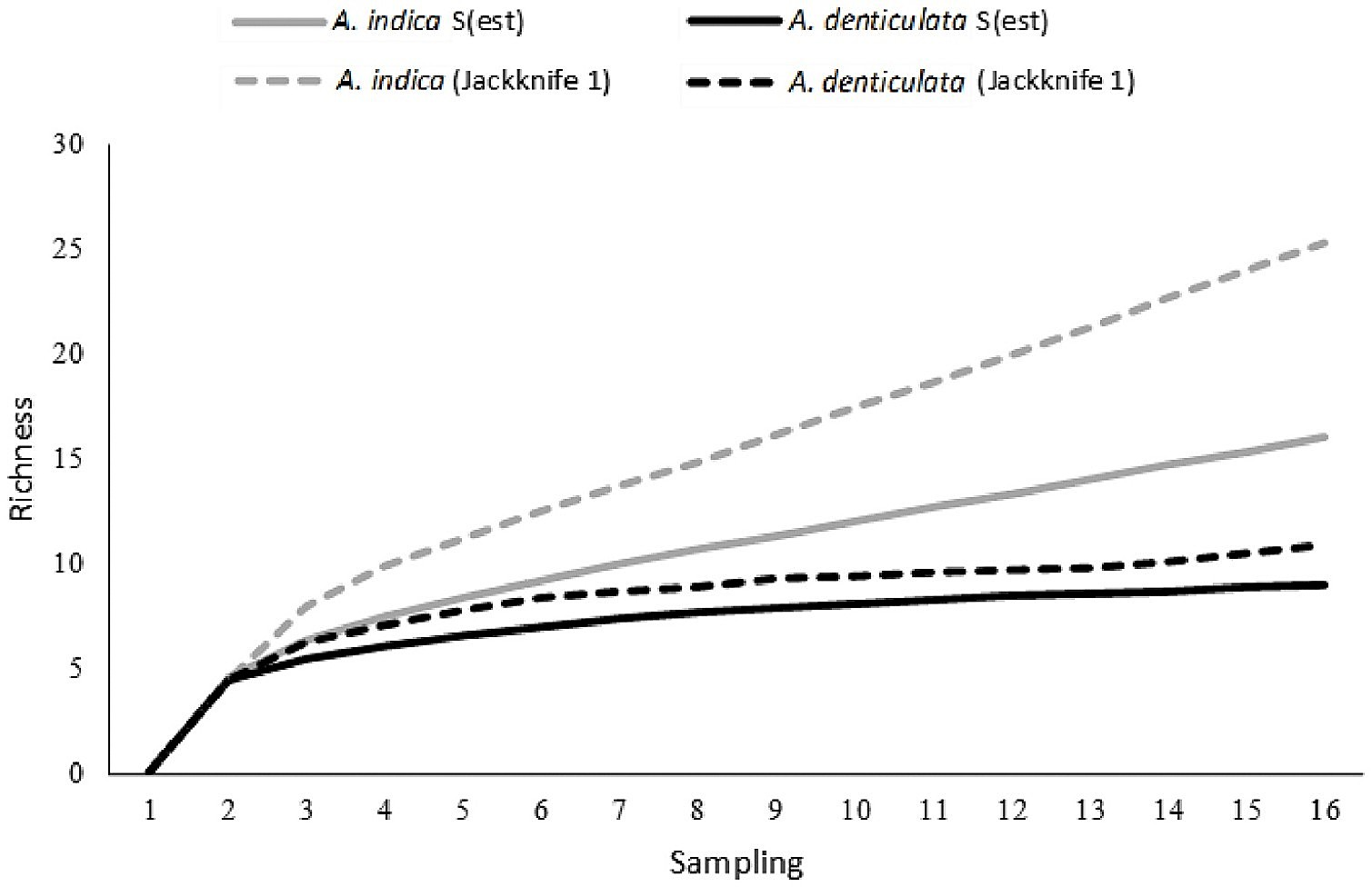
The results of species accumulation obtained through rarefaction curves (Figure 1), based on observed species richness, allowed the comparison of richness between the two jointvetch species under standardized sampling effort. From the perspective of estimated richness, using the first-order Jackknife estimator, A indica showed a higher number of species compared to A. denticulata. As the rarefaction curves did not reach an asymptote, the results suggest that additional species may still be associated with both jointvetch species.
Rarefaction curve of two species of jointvetch, Aeschynomene denticulata and Aeschynomene indica, in rice cultivation, in experimental areas, Capão do Leão, RS, Brazil. Estimated number of species A. denticulata S(est): Continuous black line; A. indica S(est): Continuous grey line); First order Jackknife richness estimator A. denticulata (Jackknife 1): Dashed black line; A. indica: Dashed grey line).
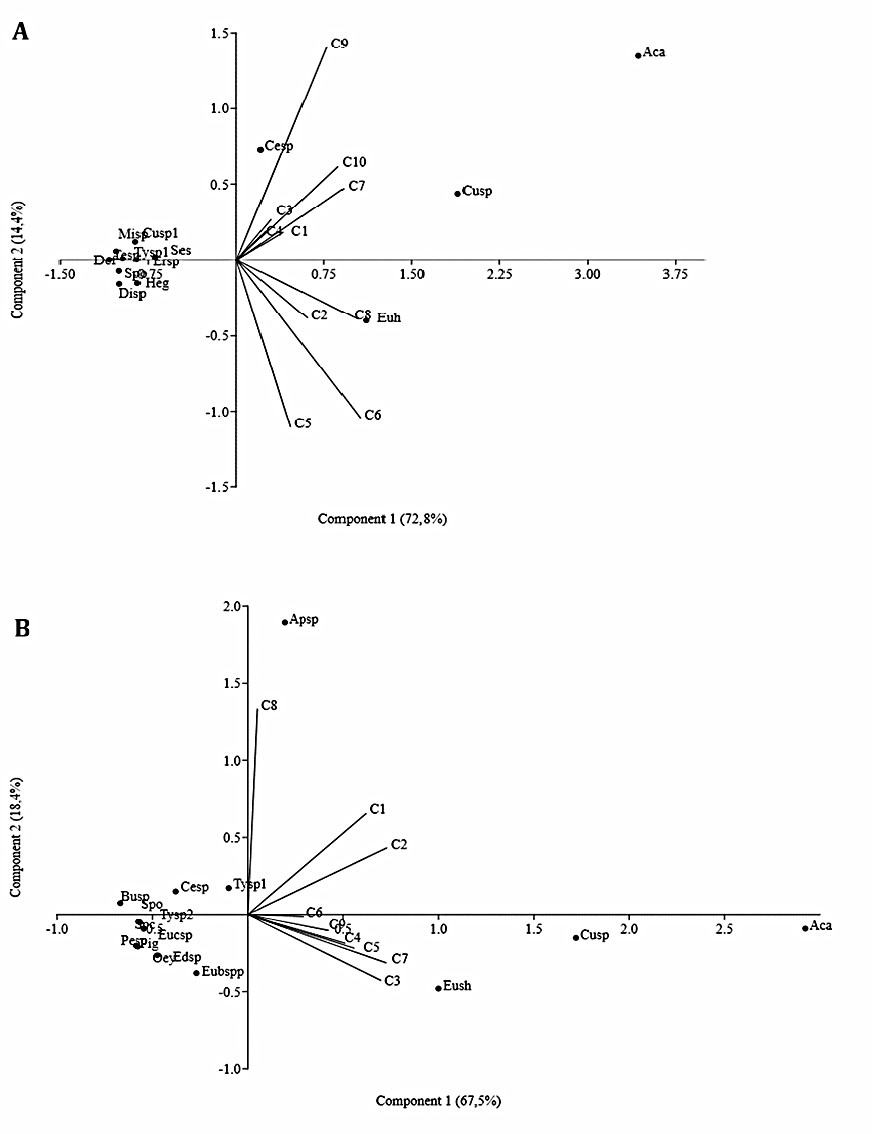
Principal Component Analysis (PCA) in areas with A. denticulata (Figure 2A) and A. indica (Figure 2B) reveals that the structure of the phytophagous insect community is dominated by a common primary gradient (PC1), which is strongly determined by high occurrence of A. atrocephalus (Aca) and Morphospecie 2* (Cusp), suggesting that their abundance is the most important factor in differentiating sampling contexts, regardless of Aeschynomene. However, plants exert a distinct selective effect on secondary variation (PC2): in A. denticulata, PC2 is driven by the spittlebug Ceresa sp. (Cesp), whereas in A. indica, PC2 is determined by aphids (Morphospecie 6), indicating that each host plant favors a different pattern of co-occurrence for the most abundant species.
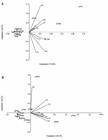
A. Principal component analysis of phytophagous insect species recorded in A. denticulata; B. in A. indica. Aca = A. atrocephalus; Apsp = Morphospecie 6; Busp = Morphospecie 1; Cesp = Ceresa sp.; Cusp = Morphospecie 2*; Cusp1 = Curculionidae sp.1; Def = D. flexuosa; Disp = Diceraeus sp.; Ersp = Morphospecie 8; Edsp = Edessa sp.; Eubspp = Eubulus sp.; Eucsp = Morphospecie 4; Euh = E. heros; Heg = H. gelotopoeon; Misp = Morphospecie 5; Oey = O. yspsilongriseus; Pesp = Morphospecie 7; Pig = Piezodorus guildinii; Spc = S. cosmioides; Spo = S. ornithogalli; Ses = S. sueroides; Spo = S. ornithogalli; Tesp = Tettigoniidae sp.; Tysp1 = Tyloderma sp.1; Tysp2 = Tyloderma sp.2.
It is also remarkable in the group of species with low projection (left side of the graphs); by presenting ecological characteristics similar to each other, they are distinguished from the dominant species. This group composition differs between the two plants (Figure 2A and B). The occurrence of unique species in each scenario reinforces the conclusion that the two Aeschynomene species act as distinct environmental filters, thus shaping the phytophagous community for both dominant species that define PC2, and those of lower occurrence.
3.2. Faunal analysis
Insects belonging to four Orders were found: Coleoptera, Hemiptera, Lepidoptera, and Orthoptera (Table 3).
Faunistic analysis of phytophagous insects collected in Aeschynomene denticulata and A. indica during the 2022/2023 and 2023/2024 harvests for rice cultivation, in experimental areas of the Herbology Center, Capão do Leão/RS.
It was possible to observe that Acanthoscelides atrocephalus (Chrysomelidae), Morphospecie 6* (Aphididae), Ceresa sp. (Membracidae), Morphospecie 2* (Curculionidae) and Euschistus heros (Pentatomidae) were predominant in A. denticulate collections, reaching maximum category in all indexes analyzed (very abundant, constant, dominant and very frequent). For A. indica, in addition to these species, Tyloderma sp.1 was also predominant.
Adults of A. atrocephalus (Coleoptera: Chrysomelidae) and larvae of an unidentified rhizophagous curculionid were predominant in both plant species. On the other hand, adults of Eubulus sp. were collected only in roots of A. indica, being common, constant, non-dominant and frequent. Also in the roots, two species of Tyloderma were observed: Tyloderma sp. 1 was observed in the two species of Aeschynomene, and manifested as very abundant, constant, non-dominant and very frequent in A. denticulata; in A. indica, it differed only in the dominance index. Tyloderma sp. 2 was observed in A. indica only in the first collection period, as common, constant, non-dominant and frequent. Approximately 90% of the bore specimens collected from the roots were in larval phase, thus preventing precise species identification.
Pentatomidae presented the highest richness, with six species collected. Euschistus heros was collected in both several nymphal instars and adulthood, and was classified as predominant in both weeds. Ceresa sp. (Membracidae) has been set as predominant in both A. denticulata and A. indica.
Five species of caterpillars (Lepidoptera) were recorded, with emphasis on S. ornithogalli, which was the only one detected in both weeds. All caterpillar species belong to the families Noctuidae (H. gelotopoeon, S. ornithogalli and S. cosmioides) and Erebidae (S. sueroides and Morphospecie 8) were common, constant and non-dominant, differing only in abundance and frequency.
3.3. Importance of phytophagous entomofauna in A. denticulata and A. indica
Among the phytophagous insects collected, Acanthoscelides atrocephalus and Euschistus heros were predominant. A. atrocephalus emerged directly from seeds of A. denticulata and A. indica, visibly damaging the inside. This occurrence reinforces it as a potential biological control agent, since its feeding can make seed germination unfeasible. Another case of potential agent of biological control is indicated by the presence of borer larvae of genera Tyloderma and Eubulus, which were found in the roots of both weed species, with greater diversity in A. indica. Root damage (galleries) caused by these larvae compromises plant development.
Euschistus heros is considered as a pest of soybeans, corn and rice. Nymphs and adults occurred in both weeds. The use of A. denticulata and A. indicates as alternative hosts reinforces the importance of managing these species, since they can act as reservoirs for insects with pest status.
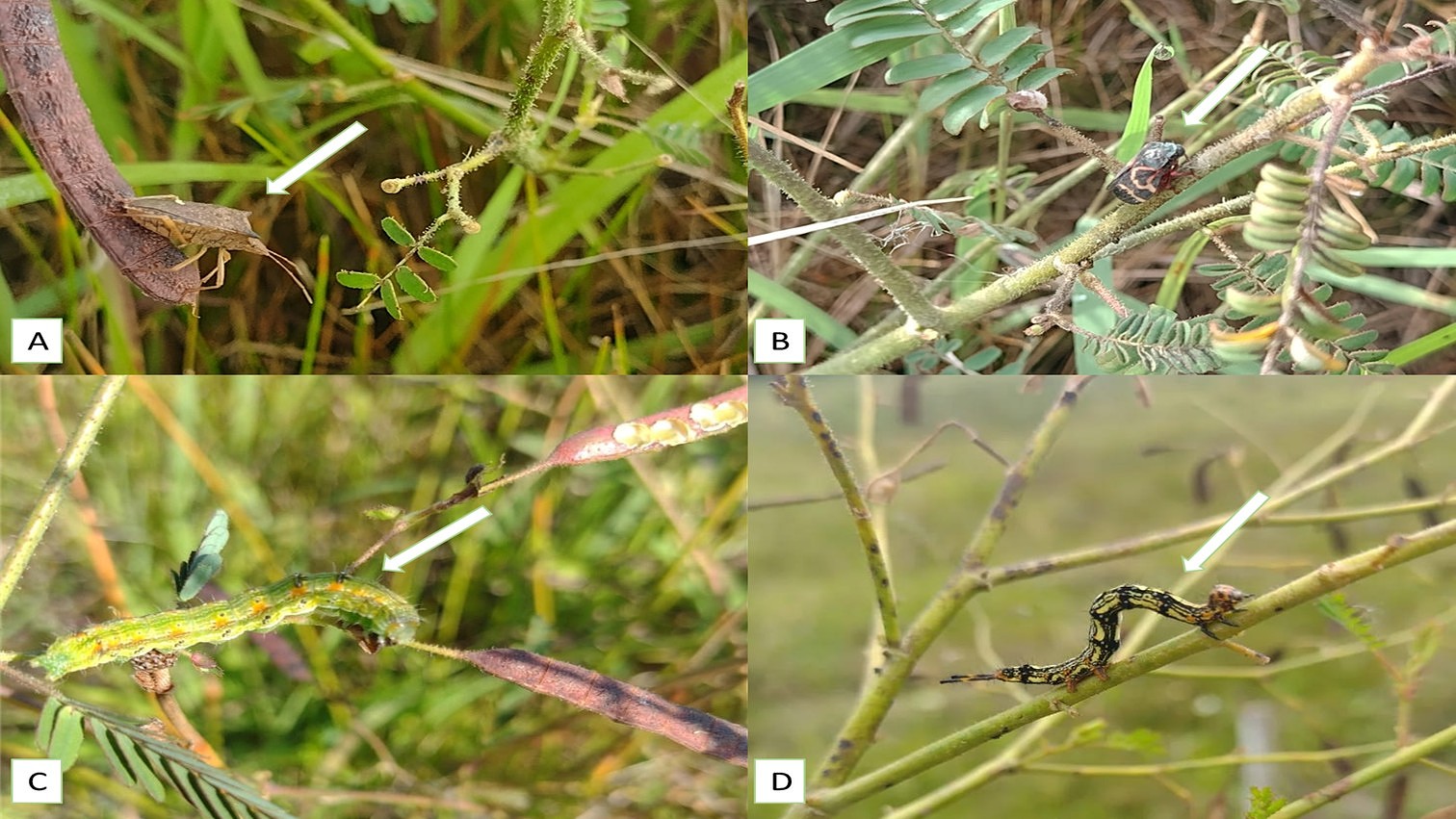
Finally, other associations of insects that have pest status in crops of economic importance were observed (Figure 3). A. denticulata was registered as an alternative host for Morphospecie 6 (Aphididae), D. flexuosa (Cercopidae), H. gelotopoeon and S. ornithogalli (Noctuidae). A. indica, on the other hand, was associated to Morphospecie 6 (Aphididae), O. ypsilongriseus and P. guildinii (Pentatomidae), S. cosmioides and S. ornithogalli (Noctuidae). These species are known for their economic importance, which reinforces the role of weeds in population dynamics of agricultural insects.
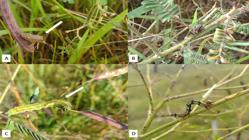
Field records. a. Euschistus heros (Hemiptera: Pentatomidae); b. Deois flexuosa (Hemiptera: Cercopidae); c. Helicoverpa gelotopoeon (Lepidoptera: Noctuidae); d. Selenisa sueroides (Lepidoptera: Erebidae, Erebinae). Source: Greco, M.G.C.E.
4. Discussion
The first records of phytophagous insects associated with Aeschynomene denticulata and A. indica highlight the relevance of these weed species as components of local trophic networks, providing insights into ecological interactions and their potential implications for biological control and sustainable weed management (Vargas and Mundaca, 2014).
Several authors have recorded insects associated with Aeschynomene species, such as Euschistus heros in A. rudis in Rio Grande do Sul (Link, 1979), Selenisa sueroides in A. americana in Florida (Bushwein et al., 1989) and Aphis craccivora in India (Singh et al., 2016). In different regions of Africa and Asia, Bruchidae associated with fruits of several species of the genus Aeschynomene have been recorded; Acanthoscelides modestus, for instance, has been associated with A. ciliata Vogel, A. rudis Benth., A. scabra G. Don, and A. sensitiva Sw (Romero and Johnson, 2002; Delobel and Le Rü, 2008). More recently, A. atrocephalus has been associated with A. denticulata and A. indica (Greco et al., 2025), thus reinforcing the potential of bruchids as biological control agents, given their seed-feeding habit, host specificity, and capacity to reduce seed viability (Greco et al., 2025).
The insect assemblages observed on weeds in the present study emphasize the relevance of faunal surveys for understanding patterns of insect diversity and their implications for agricultural systems (Diagne et al., 2021; Ahmed et al., 2022; Winston et al., 2024). In particular, the presence of phytophagous insects associated with A. denticulata and A. indica that, according to previous studies, may present potential for their biological control (Paterson et al., 2021; Canavan et al., 2021; Day and Callander, 2024).
At the same time, the association of insects with alternative hosts such as A. denticulata and A. indica is especially relevant from an integrated pest management perspective, as these plants can act as refuge and food resources during off-season periods, favoring insect survival and persistence, as reported in the literature (Eliyatiningsih et al., 2020; Kumar et al., 2021; Lagôa et al., 2021; Pal et al., 2023). In this sense, recognizing these ecological relationships supports a better understanding of population dynamics, contributing to the definition of preventive control strategies and to the reduction of insecticide dependence, in line with more sustainable management approaches (Eliyatiningsih et al., 2020; Kumar et al., 2021; Lagôa et al., 2021).
Records in this study show the association of insects of economic importance with weeds, such as E. heros, an insect that causes significant productivity losses in both soybeans and rice (Oliveira et al., 2016); S. cosmioides, which causes losses in soybeans, cotton and corn (Santos et al., 2010; Silva et al., 2011) and O. ypsilongriseus, rice pest (Cherry et al., 1998). Species with lower agricultural impact were also observed, such as Morphospecie 1 (Buprestidae), Ceresa sp. (Membracidae) and Eubulus sp. (Curculionidae), but their presence is important for monitoring biodiversity and prevention of new pests (Capinera, 2005). This information favors practices such as biological control and agricultural landscape management, thus reducing the impacts of pests on productivity and the economy (Eliyatiningsih et al., 2020; Kumar et al., 2021). For example, insects that consume seeds and roots, such as Curculionidae beetles, act as a natural controlling factor of weeds, by destroying seeds before germination or attacking the root system (Herrick and Kok, 2011). This process helps restore ecosystems and reduces the use of herbicides (Cullen et al., 2023), promoting more balanced and sustainable agricultural systems (Oliveira et al., 2021).
Furthermore, faunal analyses are essential to characterize a region's biodiversity, and are widely used as indicators of ecosystem health (Yasinzai et al., 2019). Differences in abundance among insects collected during the collection period, may be related to temperature and humidity, which directly influence organism behavior and distribution, and thus interfere with population dynamics (Coelho et al., 2021). Rice fields, which constitute the sampling environment of the present survey, are temporary humid agroecosystems that support a high diversity of arthropods and tend to harbor greater biodiversity than other cropping systems (Acosta et al., 2017). A study on organic rice fields showed that the most numerous phytophagous families were Pentatomidae, Chrysomelidae and Curculionidae (Acosta et al., 2017), thus reinforcing the relevance of both the area studied and the interaction between irrigated rice and weeds. Understanding these communities is vital for ecosystem conservation and management (Duffus et al., 2023; Köthe et al., 2023).
The fact that weeds as A. denticulata and A. indica host phytophagous pest insects associated or not with irrigated rice indicates that they can maintain populations of these insects and their natural enemies beyond the growing seasons, contributing to the conservative management in the agrosystem (Cortez-Madrigal and Gutiérrez-Cárdenas 2023). Finally, faunal studies of phytophagous insects in weeds are essential for new management strategies. Research with other weed species has been carried out with hairy fleabane in soybeans, such as in the state of Goiás, Brazil, that confirms its potential as an alternative host and indicates possible biological control agents, corroborating this present study (Dalazen et al., 2017).
5. Conclusions
In this study, individuals of A. atrocephalus, Morphospecie 6 (Aphididae), Ceresa sp. (Membracidae), Morphospecie 2 (Curculionidae) and Euschistus heros (Pentatomidae) were predominant in collections that took place in both plants. In addition to these species, Tyloderma sp.1 was also predominant on A. indica.
Species A. indica and A. denticulata are also recorded as alternative hosts for species of agricultural importance such as E. heros, emphasizing the importance of controlling these weed species in agricultural fields. In addition, A. atrocephalus, larvae of Curculionidae (Morphospecie 2 and Tyloderma sp.) are the main insects for potentially becoming biological control agents, due to the damage they cause to seeds and roots of Aeschynomene.
Finally, 15 species of insects associated with A. denticulata and 16 with A. indica were recorded for the first time. These results contribute to the development of sustainable strategies in weed management regarding irrigated rice cultivation, and expand knowledge about ecological interactions of A. denticulata and A. indica with the recorded entomofauna.
Acknowledgements
The National Council for Scientific and Technological Development—Brazil (CNPq) for the productivity scholarships (311390/2021-8) for F.R.M.G and D.A. And Coordination for the Improvement of Higher Education Personnel—Brazil (CAPES)-Code 001 for granting doctoral scholarships for M.G.C.E.G and L.M.A. We thank Dr. Luiz Alexandre Campos for his collaboration in identifying the Hemiptera specimens. And we thank Daniel Soares Duarte and Lúcia Maciel for the English translation.
Data Availability Statement
All the data supporting the results of this study were published in the article itself.
References
-
ACOSTA, L.G., JAHNKE, S.M., REDAELLI, L.R. and PIRES, P.R.S., 2017. Insect diversity in organic rice fields under two management systems of levees vegetation. Brazilian Journal of Biology, vol. 77, no. 4, pp. 731-744. https://doi.org/10.1590/1519-6984.19615 PMid:28355392.
» https://doi.org/10.1590/1519-6984.19615 -
AGOSTINETTO, D., FLECK, N.G., RIZZARDI, M.A., BIANCHI, M.A. and SILVA, F.P.R., 2004. Comparação de modelos matemáticos na estimativa das perdas de produtividade de grãos em arroz irrigado. Pesquisa Agropecuária Brasileira, vol. 39, no. 9, pp. 863-870. https://doi.org/10.1590/S0100-204X2004000900003
» https://doi.org/10.1590/S0100-204X2004000900003 -
AHMED, D.A., HUDGINS, E.J., CUTHBERT, R.N., KOURANTIDOU, M., DIAGNE, C., HAUBROCK, P.J., LEUNG, B., LIU, C.L., LEROY, B., PETROVSKII, S., BEIDAS, A. and COURCHAMP, F., 2022. Managing biological invasions: the cost of inaction. Biological Invasions, vol. 24, no. 7, pp. 1927-1946. https://doi.org/10.1007/s10530-022-02755-0
» https://doi.org/10.1007/s10530-022-02755-0 -
BUSHWEIN, J.R., MATTHEWS, C.H. and CHILDERS, C.C., 1989. Selenisa sueroides (Lepidoptera: Noctuidae): A pest of subcanopy irrigatrion systems in citrus in southwest Florida. The Florida Entomologist, vol. 72, no. 3, pp. 511-518. https://doi.org/10.2307/3495191
» https://doi.org/10.2307/3495191 -
CANAVAN, K., PATERSON, I.D., IVEY, P., SUTTON, G.F. and HILL, M.P., 2021. Prioritisation of targets for weed biological control III: a tool to identify the next targets for biological control in South Africa and set priorities for resource allocation. Biocontrol Science and Technology, vol. 31, no. 6, pp. 584-601. https://doi.org/10.1080/09583157.2021.1918638
» https://doi.org/10.1080/09583157.2021.1918638 -
CAPINERA, J.L., 2005 [viewed 12 October 2025]. Relationships between insect pests and weeds: an evolutionary perspective. Weed Science [online], vol. 53, no. 6, pp. 892-901. Available from: https://www.cambridge.org/core/journals/weed-science/article/relationships-between-insect-pests-and-weeds-an-evolutionary-perspective/2E97A812FA72909ECE900FBB195A86F7
» https://www.cambridge.org/core/journals/weed-science/article/relationships-between-insect-pests-and-weeds-an-evolutionary-perspective/2E97A812FA72909ECE900FBB195A86F7 -
CHERRY, R., JONES, D. and DEREN, C., 1998. Establishment of a new stink bug pest, Oebalus ypsilongriseus (Hemiptera: Pentatomidae) in Florida rice. The Florida Entomologist, vol. 81, no. 4, pp. 550-552. https://doi.org/10.2307/3496089
» https://doi.org/10.2307/3496089 -
COELHO, M.S., RODRIGUES, V.S., BARBOZA, J.B., XAVIER, L.M.S., ARAÚJO, J.R.E.S., CARTAXO, P.H.A., SILVA, J.H.B., BULHÕES, L.E.L. and SANTOS, J.P.O., 2021. Ecologia, monitoramento populacional e análise faunística de insetos: uma revisão. Scientific Electronic Archives, vol. 14, no. 9. https://doi.org/10.36560/14920211365
» https://doi.org/10.36560/14920211365 -
CORREIA, N.B. and STRECK, H.J., 2023 [viewed 20 October 2025]. Resistência de plantas daninhas a herbicidas: manejo e situação atual. In: L.L. COSTA and E.F. LEÃO-ARAÚJO. Tecnologia de aplicação de caldas fitossanitárias [online]. 2. ed. Morrinhos: Instituto Federal Goiano., vol. 6, pp. 63-80. Available from: http://www.alice.cnptia.embrapa.br/alice/handle/doc/1162178
» http://www.alice.cnptia.embrapa.br/alice/handle/doc/1162178 -
CORTEZ-MADRIGAL, H. and GUTIÉRREZ-CÁRDENAS, O.G., 2023. Enhancing biological control: conservation of alternative hosts of natural enemies. Egyptian Journal of Biological Pest Control, vol. 33, no. 25, pp. 25. https://doi.org/10.1186/s41938-023-00675-2
» https://doi.org/10.1186/s41938-023-00675-2 -
CULLEN, J.M., PALMER, W.A. and SHEPPARD, A.W., 2023. Biological control of weeds in Australia: the last 120 years. Austral Entomology, vol. 62, no. 2, pp. 133-148. https://doi.org/10.1111/aen.12638
» https://doi.org/10.1111/aen.12638 -
DALAZEN, G., BIGOLIN, M., VALMORBIDA, I., STACKE, R.F. and CAGLIARI, D., 2017. Faunistic analysis of pest insects and their natural enemies associated with hairy fleabane in soybean crop. Pesquisa Agropecuária Tropical, vol. 47, no. 3, pp. 336-344. https://doi.org/10.1590/1983-40632016v4747348
» https://doi.org/10.1590/1983-40632016v4747348 -
DAY, M.D. and CALLANDER, J.T., 2024. The benefits and potential of Preemptive weed biological control: three case studies in Queensland, Australia. Biological Control, vol. 198, pp. 105635. https://doi.org/10.1016/j.biocontrol.2024.105635
» https://doi.org/10.1016/j.biocontrol.2024.105635 - DELOBEL, A. and LE RÜ, B.P., 2008. Les Bruchidius consumidores de sementes Esquinomeno; definição de grupo de espécies Bruchidius kiliwaensis (Decelle) (Coleoptera, Bruchidae). Boletim da Sociedade Entomológica da França, vol. 113, no. 1, pp. 5-14.
-
DIAGNE, C., LEROY, B., VAISSIÈRE, A.C., GOZLAN, R.E., ROIZ, D., JARIĆ, I., SALLES, J.M., BRADSHAW, C.J.A. and COURCHAMP, F., 2021. High and rising economic costs of biological invasions worldwide. Nature, vol. 592, no. 7855, pp. 571-576. https://doi.org/10.1038/s41586-021-03405-6 PMid:33790468.
» https://doi.org/10.1038/s41586-021-03405-6 -
DUFFUS, N.E., ECHEVERRI, A., DEMPEWOLF, L., NORIEGA, J.A., FURUMO, P.R. and MORIMOTO, J., 2023. The present and future of insect biodiversity conservation in the neotropics: policy gaps and recommendations. Neotropical Entomology, vol. 52, no. 3, pp. 407-421. https://doi.org/10.1007/s13744-023-01031-7 PMid:36918492.
» https://doi.org/10.1007/s13744-023-01031-7 -
ELIYATININGSIH, ERDIANSYAH, I. and PUTRI, S.U., 2020. The implementation of integrated pest management technology in chili farming in East Java, Indonesia. IOP Conference Series: Earth and Environmental Science, vol. 411, no. 1, pp. 012018. https://doi.org/10.1088/1755-1315/411/1/012018
» https://doi.org/10.1088/1755-1315/411/1/012018 - FUJIHARA, R.T., FORTI, L.C., ALMEIDA, M.D. and BALDIN, E.L.L., 2016. Insetos de importância econômica: guia ilustrado para identificação de famílias Botucatu: FEPAF, pp. 391.
-
GARCIA, F.R.M. and CORSEUIL, E., 1998. Análise faunística de moscas-das-frutas (Diptera, Tephritidae) em pomares de pessegueiro em Porto Alegre, Rio Grande do Sul. Revista Brasileira de Zoologia, vol. 15, no. 4, pp. 1111-1117. https://doi.org/10.1590/S0101-81751998000400028
» https://doi.org/10.1590/S0101-81751998000400028 -
GOTELLI, N.J. and COLWELL, R.K., 2001. Quantifying biodiversity: procedures and pitfalls in the measurement and comparison of species richness. Ecology Letters, vol. 4, no. 4, pp. 379-391. https://doi.org/10.1046/j.1461-0248.2001.00230.x
» https://doi.org/10.1046/j.1461-0248.2001.00230.x -
GRECO, M.G.C.E., CORREIA, E.S., MORSE, G., CARON, E., AGOSTINETTO, D. and GARCIA, F.R.M., 2025. Acanthoscelides atrocephalus (Pic, 1938) and its potential for biological control of two weed species. Agronomy (Basel), vol. 15, no. 2, pp. 315. https://doi.org/10.3390/agronomy15020315
» https://doi.org/10.3390/agronomy15020315 - HAMMER, Ø., HARPER, D.A.T. and RYAN, P. D., 2001. PAST: Paleontological Statistics software package for education and data analysis. Palaeontologia Electronica, vol. 4, no. 1, pp. 1-9.
-
HERRICK, N.J. and KOK, L.T., 2011. Classical biological control of weeds with Curculionidae. CABI Reviews, vol. 2010, no. 14, pp. 1-22. https://doi.org/10.1079/PAVSNNR20105028
» https://doi.org/10.1079/PAVSNNR20105028 -
KÖTHE, S., SCHNEIDER, F.D., BAKANOV, N., BRÜHL, C.A., EICHLER, L., FICKEL, T., GEMEINHOLZER, B., HÖRREN, T., LUX, A., MEINEL, G., SCHÄFFLER, L., SCHERBER, C., SORG, M., SWENSON, S.J., TERLAU, W., TURCK, A., ZIZKA, V.M.A., LEHMANN, G.U.C. and MÜHLETHALER, R., 2023. Improving insect conservation management through insect monitoring and stakeholder involvement. Biodiversity and Conservation, vol. 32, no. 2, pp. 691-713. https://doi.org/10.1007/s10531-022-02519-1
» https://doi.org/10.1007/s10531-022-02519-1 -
KUMAR, S., BHOWMICK, M.K. and RAY, P., 2021. Weeds as alternate and alternative hosts of crop pests. Indian Journal of Weed Science, vol. 53, no. 1, pp. 14-24. https://doi.org/10.5958/0974-8164.2021.00002.2
» https://doi.org/10.5958/0974-8164.2021.00002.2 -
LAGÔA, A.C.G., MOLINA, A.A., JÚNIOR, A.F.O., LEITE, C.E.O.S., OLIVEIRA, M., REHMER, C., CHEMNITZ, C., WANNEMACHER, D., AMARAL, D.S.S.L., NAVA, D.E., NETO, E.M.C., LEMOS, F., FERNANDES, G.B., DIEZ-RODRIGUEZ, G.I., SCHÜHLI, G.S., RÜTZLER, H., WERNING, H., VIANA, J.H., SIMONI, J., WENZ, K., AGOSTINI, K., MELGAREJO, L., VENZON, M., REZENDE, M.Q., MONTENEGRO, M., FRIZZAS, M.R., WOLOWSKI, M., SANTOS, M., BATISTA, M.C., SCHIMPF, M., TOGNI, P.H.B., CAMARGO, R.C.R., BENDER, S. and DEBONI, T.C., 2021 [viewed 8 July 2025]. Atlas dos insetos: fatos e dados sobre as espécies mais numerosas da Terra [online]. Fundação Heinrich Böll, pp. 1-60. Available from: https://br.boell.org/sites/default/files/2022-02/Atlas%20dos%20Insetos%20completa%20final.pdf
» https://br.boell.org/sites/default/files/2022-02/Atlas%20dos%20Insetos%20completa%20final.pdf - LINK, D., 1979. Percevejos do gênero Euschistus sobre soja no Rio Grande do Sul (Hemiptera: pentatomidae). Revista do Centro de Ciências Rurais, vol. 9, no. 4, pp. 361-364.
- LOVATTO, P.B., SCHIEDECK, G. and GARCIA, F.R.M., 2012. A interação co-evolutiva entre insetos e plantas como estratégia ao manejo agroecológico em agroecossistemas sustentáveis. Interciencia, vol. 37, no. 9, pp. 657-663.
- MAGURRAN, A.E., 1988. Ecological diversity and its measurement New Jersey: Princeton University Press, pp. 179.
-
MARTINS, M.B., AGOSTINETTO, D., FOGLIATTO, S., VIDOTTO, R. and ANDRÉS, A., 2021. Aeschynomene spp. identification and weed management in rice fields in southern Brazil. Agronomy (Basel), vol. 11, no. 3, pp. 453. https://doi.org/10.3390/agronomy11030453
» https://doi.org/10.3390/agronomy11030453 -
MENEZES, C.W.G. and SOARES, M.A., 2016. Impacts of weed control and herbicide application on natural enemies. Revista Brasileira de Herbicidas, vol. 15, no. 1, pp. 2-13. https://doi.org/10.7824/rbh.v1i1.407
» https://doi.org/10.7824/rbh.v1i1.407 - MOURA, L. and LANDAU, E.C., 2020. Evolução da produção de arroz (Oryza spp., Poaceae). In: E.C. LANDAU, G.A. SILVA, L. MOURA, A. HIRSCH and D.P. GUIMARÃES, orgs. Dinâmica da produção agropecuária e da paisagem natural no Brasil nas últimas décadas: produtos de origem vegetal Brasília: Embrapa, vol. 2, cap. 13, pp. 379‑405.
- OLIVEIRA, J., MARIANO, P., PEREIRA, C., THEODORO, C. and TOMQUELSKI, G., 2016. Eficiência de inseticidas no controle do percevejo-marrom, Euschistus heros, em soja. Resumos Expandidos., vol. 1, no. 2, pp. 80.
-
OLIVEIRA, J.E., PEDROSA, J.L.F., DE OLIVEIRA, F.L., DALVI, L.P., MENDES, T.P. and RANGEL, G.B.R., 2021. Insetos como reguladores biológicos de plantas daninhas: uma breve revisão. In: F.S. MACHADO and A.S. MOURA, orgs. Avanços no conhecimento científico na área de ecologia Ponta Grossa-PR: Atena, pp. 27-38. https://doi.org/10.22533/at.ed.6242115093
» https://doi.org/10.22533/at.ed.6242115093 - PAL, R.K., KUMAR, M., SINGH, R., SRIVASTAVA, A. and BISEN, K., 2023. Weeds as reservoirs of crop pathogens and pests: implications for integrated management. International Journal of Food and Nutritional Sciences, vol. 12, no. 4, pp. 1151-1160.
-
PATERSON, I.D., HILL, M.P., CANAVAN, K. and DOWNEY, P.O., 2021. Prioritisation of targets for weed biological control II: a tool to identify the next targets for biological control in South Africa and set priorities for resource allocation. Biocontrol Science and Technology, vol. 31, no. 6, pp. 566-583. https://doi.org/10.1080/09583157.2021.1918637
» https://doi.org/10.1080/09583157.2021.1918637 - RAFAEL, J.A., DE MELO, G.A.R., DE CARVALHO, C.J.B., CASARI, S.A. and CONSTANTINO, R., 2024. Insetos do Brasil: diversidade e taxonomia Manaus: Editora INPA, pp. 880.
-
ROMERO, J. and JOHNSON, C.D., 2002. Five new species of Meibomeus Bridwell from the New World with new host records for them and six named species (Coleoptera: bruchidae). Coleopterists Bulletin, vol. 55, no. 2, pp. 182-202. https://doi.org/10.1649/0010-065X(2002)056[0182:FNSOMB]2.0.CO;2
» https://doi.org/10.1649/0010-065X(2002)056[0182:FNSOMB]2.0.CO;2 -
SANTOS, K.B., MENEGUIM, A.M. and SANTOS, W.J., 2010. Characterization of the damage caused by Spodoptera eridania (Cramer) and Spodoptera cosmioides (Walker) (Lepidoptera: Noctuidae) to cotton plant structures. Neotropical Entomology, vol. 39, no. 4, pp. 626-631. https://doi.org/10.1590/S1519-566X2010000400025 PMid:20878002.
» https://doi.org/10.1590/S1519-566X2010000400025 -
SILVA, A.L., STRECK, N.A., ZANON, A.J., RIBAS, G.G., FRUET, B.L. and ULGUIM, A.R., 2022. Surveys of weed management on flooded rice yields in southern Brazil. Weed Science, vol. 70, no. 2, pp. 249-258. https://doi.org/10.1017/wsc.2021.77
» https://doi.org/10.1017/wsc.2021.77 -
SILVA, D.M., ZIMMERMANN, A.O. and BUENO, A.F., 2011 [viewed 14 September 2025]. Aspectos biológicos de Spodoptera cosmioides Walk. (Lepidoptera: Noctuidae) em diferentes plantas hospedeiras. In: Anais da Jornada Acadêmica, 2011, Londrina. Londrina: Embrapa Soja, pp. 43. Available from: https://www.embrapa.br/documents/1355202/1529289/Jornada_Acad%C3%AAmica_2011.pdf#page=43
» https://www.embrapa.br/documents/1355202/1529289/Jornada_Acad%C3%AAmica_2011.pdf#page=43 - SILVA, N.M., 1993. Levantamento e análise faunística de moscas-das-frutas (Diptera: Tephritidae) em quatro locais do Estado do Amazonas São Paulo: Universidade de São Paulo. Tese de Doutorado em Entomologia, 152 p.
-
SILVEIRA-NETO, S., MONTEIRO, R.C., ZUCCHI, R.A. and DE MORAES, R.C.B., 1995. Uso da análise faunística de insetos na avaliação do impacto ambiental. Scientia Agrícola, vol. 52, no. 1, pp. 9-15. https://doi.org/10.1590/S0103-90161995000100003
» https://doi.org/10.1590/S0103-90161995000100003 - SILVEIRA-NETO, S., NAKANO, O., BARBIN, D.D. and VILLA NOVA, N.A., 1976. Manual de ecologia dos insetos Piracicaba: Ed. Agronômica Ceres, pp. 419.
- SINGH, R., SINGH, G., SINGH, K. and SHARMA, A., 2016. Biodiversity of Aphids (Insecta: Homoptera: Aphididae) infesting legumes (Angiospermae: Fabales: Fabaceae) in India. Jornal Internacional de Estudos de Pesquisa em Zoologia, vol. 2, no. 1, pp. 30-44.
- SOUZA, B., VAZQUEZ, L.L. and MARUCCI, R.C., 2019. Natural enemies of insect pests in neotropical agroecosystems. Biological control and functional biodiversity. Cham: Springer, vol. 1, pp. 546.
-
THOMAZINI, M.J. and THOMAZINI, A.P.B.W., 2002. Bee diversity (Hymenoptera: Apoidea) in Piper hispidinervum inflorescences. Neotropical Entomology, vol. 31, pp. 27-34. https://doi.org/10.1590/S1519-566X2002000100004
» https://doi.org/10.1590/S1519-566X2002000100004 -
VARGAS, H.A. and MUNDACA, E.A., 2014. First record of an exotic host plant for the oligophagous moth Macaria mirthae (Geometridae) in the coastal valleys of the northern Chilean Atacama Desert. Journal of the Lepidopterists Society, vol. 68, no. 4, pp. 292-295. https://doi.org/10.18473/lepi.v68i4.a11
» https://doi.org/10.18473/lepi.v68i4.a11 -
WINSTON, R.L., SCHWARZLÄNDER, M., HINZ, H.L., RUSHTON, J. and PRATT, P.D., 2024. Prioritizing weeds for biological control development in the western USA: results from the adaptation of the biological control target selection system. Biological Control, vol. 198, pp. 105634. https://doi.org/10.1016/j.biocontrol.2024.105634
» https://doi.org/10.1016/j.biocontrol.2024.105634 - YASINZAI, M.I., SHAMSULLAH, S., AKHTAR, B., ESSOTE, S.A. and UR, A., 2019. Faunistic study of lady Bird beetle on the basis of external morphology of urban and rural areas of district Pishin, Baluchistan. University of Sindh Journal of Animal Sciences, vol. 3, no 1, pp. 01-08.
Edited by
-
Editor:
Takako Matsumura Tundisi