 ProTaper Ultimate vs WaveOne Gold: instrumentation time, fractures and canal morphology in curved molars
Abstract
Aim This study aimed to compare total working time, active instrumentation time, instrument fracture, and preservation of canal morphology in curved mesiobuccal canals of mandibular molars prepared with ProTaper Ultimate (PTU) or WaveOne Gold (WOG).
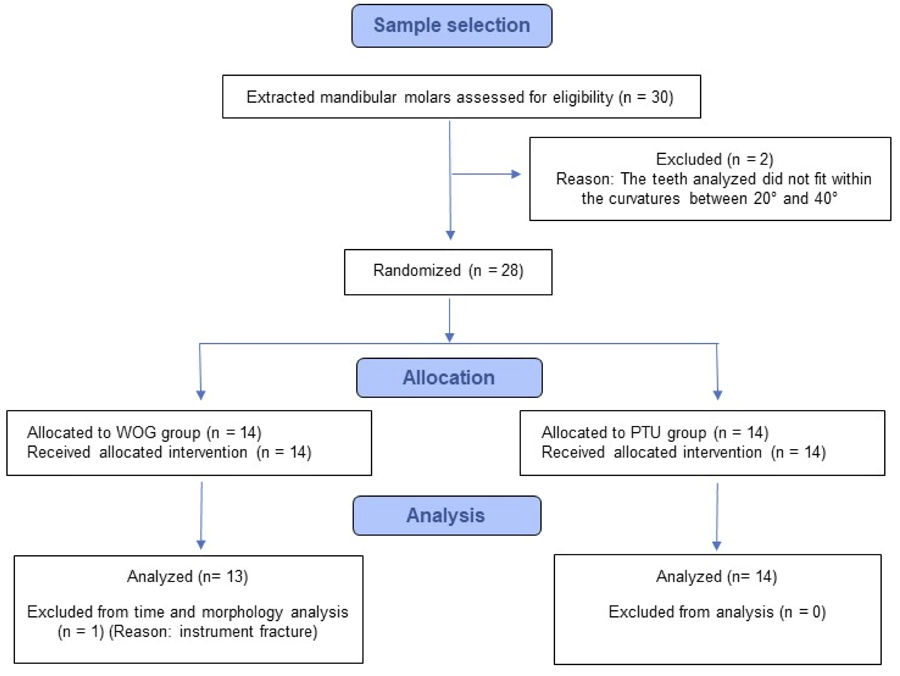
Methods Twenty-eight extracted human mandibular molars were randomly assigned to the PTU or WOG groups (n = 14). The canals were prepared by a single calibrated undergraduate operator using an X-Smart Plus motor and the manufacturers’ protocols, with 2.5% NaOCl irrigation. Two independent observers timed total working time (including instrument changes and irrigation) and active instrumentation time using digital stopwatches. In each group, a single instrument kit was reused across all specimens; if an instrument fractured, the corresponding specimen was excluded from the analysis. Pre- and postoperative cone-beam computed tomography enabled qualitative assessment of canal morphology, considering apical transportation, ledges, and canal axis deviation. Shapiro–Wilk, Mann–Whitney test, and Student’s t-test were performed.
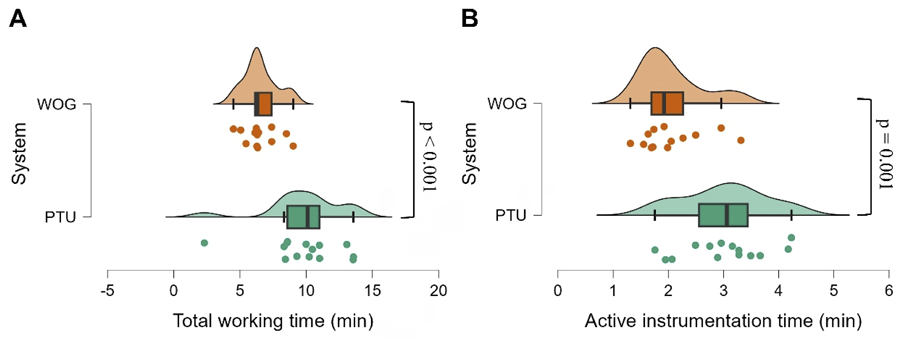
Results The WOG group exhibited shorter total working time than PTU (median = 6.310 min; 95% CI: 5.775–7.311 vs median = 10.115 min; 95% CI: 8.241–11.535; p < 0.001), as well as shorter active instrumentation time (2.05 ± 0.576 min vs 3.01 ± 0.765 min; p = 0.001). One fracture occurred in the WOG group (Small 20/.07), and none in PTU. No specimens showed clinically relevant postoperative apical transportation, ledges, or canal deviation; both systems preserved canal morphology, and WOG was more time-efficient despite an isolated instrument fracture.
Conclusion Overall performance was considered safe, and the clinical choice should balance reduced working time against instrument durability.
Keywords
Endodontics; Root canal therapy; Dental instruments
 Thumbnail
 Thumbnail